M’Cheyne Bible Reading Plan, February 15

Today’s readings are from Genesis 47, Luke 1:1-38, Job 13 and 1 Corinthians 1.

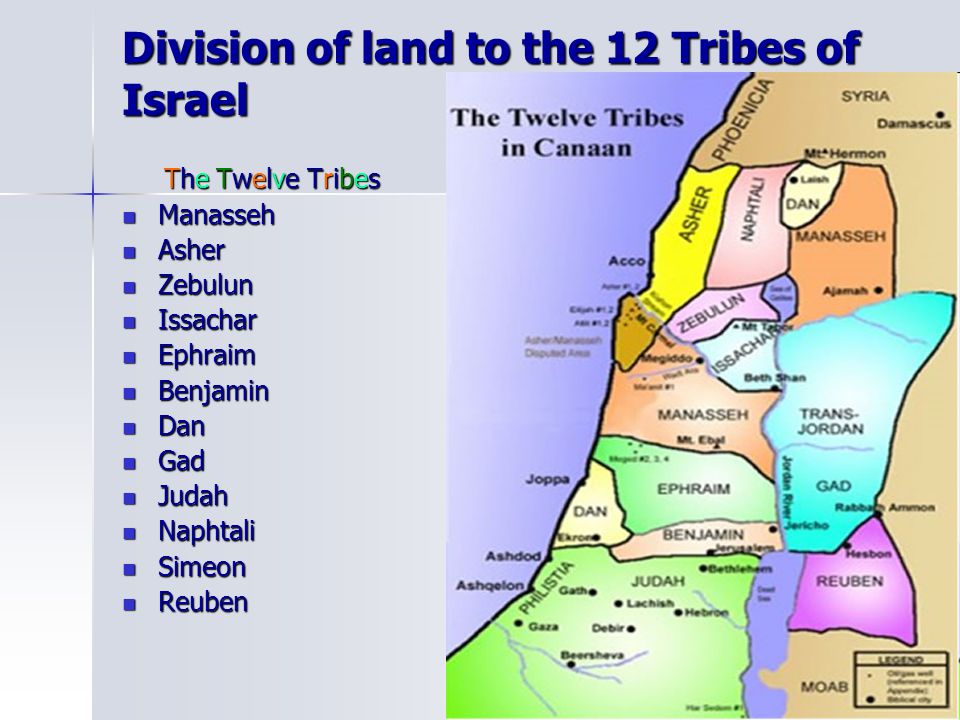
Genesis 47 starts with Pharoah assigning Joseph’s family the land of Goshen to raise their flocks, then asking his brothers to look after his livestock (vv. 1-6).  Then Jacob is presented to Pharoah and since Jacob was so old, he blessed Pharoah (vv. 7-10).  Joseph settled his family in Goshen, near Ramesses and made sure they had food (vv. 11-12).

Related image

Joseph buys all the money, land, and people under Pharaoh in exchange for food.  He makes them slaves of Pharaoh!  Yet the people of Egypt regard Joseph not as a tyrant, but as a savior.   He made a plan whereby they could still farm the land and live on it, but contribute 20% to Pharoah.

Meanwhile…

27 Thus Israel settled in the land of Egypt, in the land of Goshen. And they gained possessions in it, and were fruitful and multiplied greatly.

Jacob, before he died, asked to be buried “with my fathers” in Canaan (vv. 29-30), to which Joseph agreed (vv. 30b-31).  Jacob knew this was not the land God had promised to him and he wanted to participate in the promises made to him and his family.  Joseph’s bones would also be buried there (50:

Luke 1:1-38.  Luke is my favorite gospel, but I won’t just regurgitate my sermons here.  Luke wrote both this gospel and Acts.  Luke is written to Theophilus (“God lover”), a Gentile.

Luke wanted to give a third account with an emphasis on comprehensiveness and order. Therefore, Luke is the most comprehensive gospel. He documents the story of Jesus all the way from the annunciation of John the Baptist to Jesus’ ascension.

  • Luke is the most universal gospel. In Luke, Gentiles are often put in a favorable light.
  • Luke’s gospel is the one most interested in the roles of womenchildren, and social outcasts.
  • The gospel of Luke is the one most interested in prayer. He has seven different references to Jesus praying that are found in this gospel alone.
  • Luke’s gospel is the one with the most emphasis on the Holy Spirit and on joy.
  • Luke’s gospel is the one with the most emphasis on preaching the good news (the gospel). This term is used ten times in this Gospel (and only once in any other Gospel) as well as fifteen additional times in Acts.

–David Guzik

Verses 5-24 recount the foretelling of John the Baptist’s birth.

Only priests from a particular lineage could serve in the temple. Over the years the number of priests multiplied (there were said to be as many as 20,000 priests in the time of Jesus), so they used the lot to determine which priests would serve when. The lot to serve might fall to a priest only once in his life. To a godly man like Zacharias, this was probably the biggest event of his life, a tremendous privilege, a-once-in-a-lifetime opportunity.

–David Guzik

Zechariah and Elizabeth were old and had been unable to have children.  An angel told him “your prayer has been heard. Your wife Elizabeth will bear you a son, and you are to give him the name John” (1:13).  He was told that John would have a special mission in life, being a forerunner for “the Lord” (1:17).

Expressing unbelief, Zechariah was struck mute, which made people believe he had seen a vision.

24 After these days his wife Elizabeth conceived, and for five months she kept herself hidden, saying, 25 “Thus the Lord has done for me in the days when he looked on me, to take away my reproach among people.”

Luke 1:26-36 is the angelic announcement of the birth of Jesus to Mary.  He was born of a virgin (v. 27), the Son of the Most High who would sit on David’s throne (v. 32), in other words, Israel’s Messiah!

Mary says two things in this interchange with the angel:

34 And Mary said to the angel, “How will this be, since I am a virgin?”

and

38 “Behold, I am the servant of the Lord; let it be to me according to your word.”


Job 13 is another round from Job to his friends.  In vv. 1-12 he says that they didn’t know everything and they were worthless physicians who should not presume to speak for God.  The weakness of their wisdom is expressed in v. 12

12 Your maxims are proverbs of ashes; your defenses are defenses of clay.

Their counsel has no substance or use.

In vv. 13-19 Job expressed his confidence in God, but also in his own integrity before God.  He expresses these two (seemingly contradictory) thoughts in v. 15…

15 Though he slay me, I will hope in him; yet I will argue my ways to his face.

That first part is a great expression of trust; the second is an expression of desperation.  Slaying times are like the sifting times of Luke 22:31-32.  He continues that thought of arguing his case to God in v. 18…

18 Behold, I have prepared my case; I know that I shall be in the right.

Job appeals to God to let him know if his sin is really the cause of his troubles (13:20-28).  Apparently he had no inclination from God yet, that he was guilty of sin.

Of all the churches Paul dealt with, the Corinthians seemed to have the most problems.  They had factions favoring different “preachers,” unchecked immorality in the church, disunity over “gray area” issues, mockery of the Lord’s Supper in the way they treated one another, superiority through spiritual gifts, and denial of the resurrection.

Even so, he says of them…

2 To the church of God that is in Corinth, to those sanctified in Christ Jesus, called to be saints together with all those who in every place call upon the name of our Lord Jesus Christ, both their Lord and ours

Although not acting saintly, they are nevertheless “saints” because they have called on the name of Jesus.

Later, he shows the security of their salvation by saying by saying about Jesus, then about God…

8 who will sustain you to the end, guiltless in the day of our Lord Jesus Christ. 9 God is faithful, by whom you were called into the fellowship of his Son, Jesus Christ our Lord.

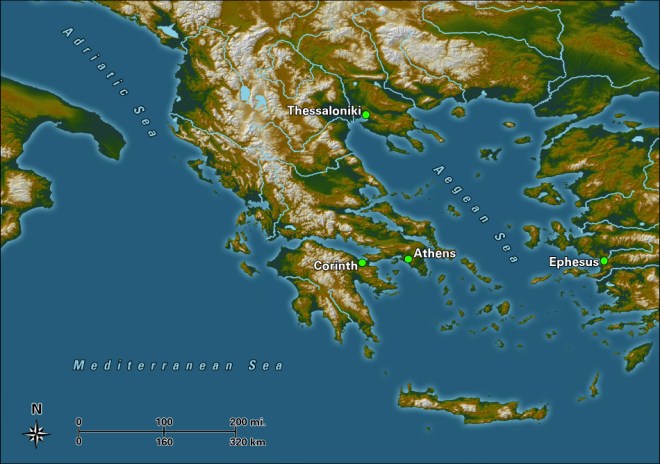
Corinth map, Bible Odyssey


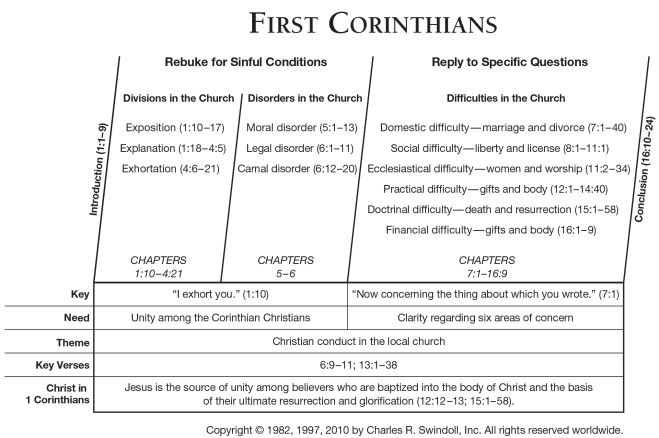
1st Corinthians, Swindoll

Though they were quarreling (v. 11), advocating different favorite preachers, Paul tells them that Christ is not divided (v. 13) and that no one was baptized by any name other than that of Jesus (vv. 13-16).

Paul then talks about the gospel he preached, primarily “Christ crucified” (2:2).  H. B. Charles had a great message on this passage at the Together for the Gospel conference in 2018.  He asked the question: How does the message of the cross distinguish the church from the world?”  His answer was…

  1. The message of the cross determines our eternal destiny (1:18)
  2. The message of the cross declares true wisdom (1:19-21)
  3. The message of the cross defines Christian ministry (1:22-25)

A couple of quotes

“The Spirit of God uses the Word of God to make the children of God look like the Son of God” (H. B. Charles)

“Human wisdom cannot be conquered without unwavering confidence in the truthfulness and sufficiency of God’s Word.” (H. B. Charles)

“The foolishness of preaching is not the preaching of foolishness.” (A. T. Robertson)

M’Cheyne Bible Reading Plan, February 14

Today’s readings are from Genesis 46, Mark 16, Job 12 and Romans 16.

In Genesis 46 Jacob prepares to take his family to Egypt.  God re-affirms His covenant with Jacob in v. 3…

3 Then he said, “I am God, the God of your father. Do not be afraid to go down to Egypt, for there I will make you into a great nation. 4 I myself will go down with you to Egypt, and I will also bring you up again, and Joseph’s hand shall close your eyes.”

When you are worried about the future and what it holds, just remember the promises of God.

So Jacob left Beersheba for Egypt, taking everything and everyone with him.  Judah led the way to Goshen (v. 28) and Jacob and Joseph had a tearful reunion (vv. 29-30).

Shepherds have always gotten a bad rap (vv. 33-34).

Mark 16…He lives!  Vv. 1-8 recounts Jesus’ resurrection, the only one who rose from the dead never to die again, the One with the power of indestructible life.

Many early versions of Mark do not have vv. 9-20. See Daniel Wallace’s video if your interested in an explanation of why these verses are noted as not in the oldest manuscripts.

Whether original or not, we need to take the gospel to the nations.

Take with you the joy of Easter to the home, and make that home bright with more unselfish love, more hearty service; take it into your work, and do all in the name of the Lord Jesus; take it to your heart, and let that heart rise anew on Easter wings to a higher, a gladder, a fuller life; take it to the dear grave-side and say there the two words “Jesus lives!” and find in them the secret of calm expectation, the hope of eternal reunion.

–John Ellerton

Job 12 is Job’s answer to Zophar (and the others).  He is very sarcastic (vv. 1-3).  Can’t you just see the dripping sarcasm in v. 2?

“No doubt you are the people, and wisdom will die with you.”

Then he complains that they misunderstand him (vv. 4-6).  He then explains his own understanding of who God is and how powerful He is (vv. 7-25).

As much as Job thinks that God has mistreated him, he continues to see God as intimately involved (vv. 9-10).

Romans 16 starts with a long list of names.  As a leader Paul noticed people’s involvement and showed his appreciation.

The first responsibility of a leader is to define reality.  The last is to say thank you.  In between, the leader is a servant. -Max DePree (Leadership Jazz)

Paul then shares some final instructions with the Romans.  The focus is upon dissension within the church, a common problem.  Much of the time, dissenters are serving “their own appetites,” their own preferences (v. 18).

Verse 19 calls us to be experts is good and not even novices in evil.

Verse 20 picks up on the proto-evangelium in Genesis 3:16 and says…

20 The God of peace will soon crush Satan under your feet.

One day our Prince will come and defeat our great enemy once and for all!

Quotes to Ponder

In Dostoevsky’s The Brothers Karamazov, Ivan poses the question: “Imagine that you are creating a fabric of human destiny with the object of making men happy in the end, giving them peace and rest at last, but that it was essential and inevitable to torture to death only one tiny creature—that baby beating its breast with its fist, for instance—and to found that edifice on its unavenged tears, would you consent to be the architect on those conditions?” And softly, his brother Alyosha answers: No.

Today’s Democratic Party says: Yes.

The main trouble in this whole matter of spiritual depression in a sense is this, that we allow our self to talk to us instead of talking to our self.  Am I just trying to be deliberately paradoxical?  Far from it.  This is the very essence of wisdom in this matter.  Have you realized that most of your unhappiness in life is due to the fact that you are listening to yourself instead of talking to yourself?  Take those thoughts that come to you the moment you wake up in the morning.  You have not originated them, but they start talking to you, they bring back the problem of yesterday, etc.  Somebody is talking.  Who is talking to you?  Your self is talking to you.  Now this man’s treatment [in Psalm 42] was this; instead of allowing this self to talk to him, he starts talking to himself, ‘Why art thou cast down, O my soul?’ he asks.  His soul had been repressing him, crushing him.  So he stands up and says: ‘Self, listen for a moment, I will speak to you’.  Do you know what I mean?  If you do not, you have but little experience.

The main art in the matter of spiritual living is to know how to handle yourself.  You have to take yourself in hand, you have to address yourself, preach to yourself, question yourself.  You must say to your soul: ‘Why art thou cast down’–what business have you to be disquieted?  You must turn on yourself, upbraid yourself, condemn yourself, exhort yourself, and say to yourself: ‘Hope thou in God’–instead of muttering in this depressed, unhappy way.  And then you must go on to remind yourself of God, Who God is, and what God is and what God has done, and what God has pledged Himself to do.  Then having done that, end on this great note: defy yourself, and defy other people, and defy the devil and the whole world, and say with this man: ‘I shall yet praise Him for the help of His countenance, who is also the health of my countenance and my God’.

D. Martyn Lloyd-Jones, Spiritual Depression: Its Causes and Cures, pp. 20-21; emphasis added.

Aspire, for Rising Leaders (2.17.19)

These are notes and resources that I have used to train up young men for leadership at Grace Bible Church.  Feel free to use my materials.  Most of the other materials are available on the internet.  Read to your heart’s delight.  To listen to the audios, copy the http through mp3 into your internet browser.  Let me know if something does not work.

My Notes for this week (week 8)…

Session 8.1__Self-Control

Session 8.2__Pneumatology

Session 8.3__Love Dare, Memory Verse

Session 8.4__Motivation

Follow-Up Materials

Self-Control

6 Areas of Life Where Successful Leaders Practice Self-Discipine, Rick Warren

The Eternal Importance of Exercising Self-Control, Kristen Wetherell

THE MOST COMMON TRAIT IN GREAT MEN, David Murray

The Secret to Self-Discipline, Jon Bloom

Leadership Takes Self-Control. Here’s What We Know about It, Kai Chi Yam, Huiwen Lian, D. Lance Ferris, Douglas Brown

Relearning the Discipline of Self-Control in a Society of Instant Gratification (3 parts), Ace Davis

Self-Control, the Leaders Make-or-Break Virtue, Drew Dyck

THE SECRET TO SELF-CONTROL, David Murray, quoting James Clear

Pneumatology

Dispensationalists and Spirit Baptism (TMSJ), Larry PettegrewPneumatology__

The Holy Spirit, Greg Herrick

Spirit in Christianity, part 1—Early Church to Reformation, Ben Frostad

Spirit in Christianity, part 2—The Reformation to the Present, Ben Frostad

The Deity of The Holy Spirit, Daniel Henderson

The Doctrine of the Holy Spirit, John Frame

Spiritual Gifts Test

Love Dare

Love Fights Fair

The Love Dare, Day 13__Love Fights Fair

Love Takes Delight

Drink water from your own cistern, running water from your own well.  Should your springs overflow in the streets, your streams of water in the public squares?  Let them be yours alone, never to be shared with strangers.  May your fountain be blessed, and may you rejoice in the wife of your youth.  A loving doe, a graceful deer – may her breasts satisfy you always, may you ever be captivated by her love.  (Prov. 5:15-19)

Teaching My Daughter How to Handle Mean Girls, Susan Merrill

Motivation

8 Things the Smartest Leaders Do to Motivate Their Employees, Marcel Schwantes

Empowerment Checklist, Jim Cathcart

Igniter Phrases and Killer PhrasesMotivating Your Team (show notes),

Craig Groeschel

The Myth of Motivation, The John Maxwell Company


M’Cheyne Bible Reading Plan, February 13

Today’s readings are from Genesis 45, Mark 15, Job 11 and Romans 15.

In Genesis 45 Joseph finally reveals himself to his brothers.  At first the brothers were dismayed, probably from shock.  Joseph saw God’s purpose in all his trials.

7 And God sent me before you to preserve for you a remnant on earth, and to keep alive for you many survivors.

He will expand on this in 50:20.

All Joseph’s sorrows were for a purpose.  God used them to preserve his family and provide the conditions for it to become a nation.  Joseph was a victim of men, but God turned it around for His glory.   And remember, if this family does not go into Egypt, then they assimilate among the pagan tribes of the Promised Land and cease to become a distinctive people.  God had to put them in a place where they could grow in numbers, yet stay a distinctive nation.

–David Guzik

Joseph then gave instructions to bring the whole family to Egypt (vv. 16-27).  They would be given “the best of the land of Egypt” by Pharoah (v. 18), the land of Goshen.

Image result for land of goshen

Image result for land of goshen

Typical scene in the Land of Goshen, Ferrell Jenkins

Mark 15 starts with Jesus’ trial before Pilate, the Roman governor (vv. 1-15), then his mocking by the soldiers (vv. 16-20).

Why did the Jewish leaders take Jesus to Pilate at all?  First, they did not have the legal right to execute their own criminals because Rome revoked that right in A.D. 7.  At the time, the Jews regarded this loss as a national disaster because to them it was the final proof that they no longer had the basic right of self-government-–to punish their own criminals–-and it demonstrated that they were totally under the boot of Rome.  There were times when the Jews disregarded this prohibition of the Romans and executed those they considered criminals, such as at the stoning of Stephen (Acts 7:57-60).  Why didn’t they take things into their own hands regarding Jesus?  Because they knew multitudes had a favorable opinion of Jesus and if Pilate executed Him, they could distance themselves from the political fallout.

–David Guzik

Vv. 21-41 record the crucifixion and vv. 42-47 Jesus’ burial.

Job 11 is Zophar’s first speech, wherein he criticizes Job (vv. 1-6) for his complaining, that he actually deserves worse than he had received (really Zophar, how would you like to be in Job’s place?).  God can see his wickedness (vv. 7-12), therefore repent (vv. 13-19).  ( wonder how much of our counseling is like Zophar’s speech.

Romans 15:1-7 continues the discussion of disagreement among those with different perspective on “gray area” issues (issues where there is no clear biblical prohibition or command).

Paul then speaks of his mission towards the Gentiles (vv. 8-13) and his reason for writing them (vv. 14-21), including his desire to plant churches where others have not gone and preach the gospel among those who have not heard.

20 and thus I make it my ambition to preach the gospel, not where Christ has already been named, lest I build on someone else’s foundation, 21 but as it is written, “Those who have never been told of him will see, and those who have never heard will understand.”

His desire was to make it to Rome (vv. 22-32).  He was on his way currently to Jerusalem (vv. 26, 31), but asks for prayers that he would be “rescued from the unbelievers in Judea” (v. 31) so that he could come see them.


M’Cheyne Bible Reading Plan, February 12

Today’s readings are from Genesis 44, Mark 14, Job 10 and Romans 14.

Genesis 44 unfolds Joseph’s plan to reveal himself to his brothers.  It begins with his silver cup being placed in Benjamin’s sack, to trump up charges against him (44:1-17).  This section shows the change in the brothers’ hearts.  Before, they were willing to sell Joseph despite his cries.  Now they are willing to stand with Benjamin and become slaves or possibly die.

Judah pleads for Benjamin’s release in vv. 18-34, giving one of the most moving speeches in the Bible.  He was willing to be a substitute, laying down his life for his brother, just as One of his descendants would lay down His life for the whole world.  This, of course, moved the heart of Joseph, which was already disposed towards Benjamin without a word.

But this was the way to move towards complete reconciliation.  The brothers saw and admitted their sin against Joseph, so not only forgive them but be reconciled.

Mark 14 joins John 12 in revealing the anointing of Jesus (for burial) by Mary (vv. 1-9).

In the ancient Middle East, the majesty of a king was expressed not only by what he wore—his jewelry and robes—but by his royal “aroma.”  Even after a king was first anointed, he would perfume his robes with precious oils for special occasions.  Listen to a line from King David’s wedding song:

You love righteousness and hated wickedness;
therefore God, your God,
has set you above your companions

by anointing you with the oil of joy.
All your robes are fragrant with myrrh and aloes and cassia.
(Psalm 45:7-8)

Ann Spangler and Lois Tverberg, Sitting at the Feet of Rabbi Jesus (p. 17)

Then Judas, possibly motivated by the “waste” of money on Jesus, agrees to betray Jesus (vv. 10-26).  He attends the Passover with the other disciples, but is subtly pointed out by Jesus and leaves.  On the way to the garden, Jesus predicts Peter’s denial (vv. 27-31), then prays (vv. 32-41).  Jesus is betrayed by Judas and arrested (vv. 43-50).

Job 10 is Job’s “If I could just get an audience with God” speech.  He says he would first ask God “Why are you doing this to me?” (vv. 1-7), then ask God “Why are you afflicting me, since you created me?” (vv. 8-12), then just a plaintive “Why God?” (vv. 13-17) and ends by asking God just to leave him alone (vv. 18-22).  Jesus stands before the council (vv. 53-65) and Peter denies him, as Jesus had predicted (vv. 66-72).

Romans 14-15 talk about how to handle disagreements over “gray issues,” issues of conscience.

Philip Yancey once said…

“Christians get very angry toward other Christians who sin differently than they do.”

There is an excellent article by Andy Naselli and J. D. Crowley at 9 Marks on this issue at https://www.9marks.org/article/romans-14/.  I would encourage you to go there and read that article.  It is an edited excerpt from their book Conscience.

Those principles are…

  1.  Welcome those who disagree with you.  Don’t shun them.  Sit down with them and talk it out.
  2. Those who have freedom of conscience must not look down on those who don’t (“stick in the mud,” “ultra-conservative”, etc.) (vv. 3-4)
  3. Those whose conscience restricts them must not be judgmental toward those who have freedom (“liberals,” “worldly”) (vv. 3-4)
  4. Each believer must be fully convinced of their position in their own conscience (v. 5)
  5. Assume that others are partaking or refraining for the glory of God (vv. 6-9)
  6. Do not judge each other in these matters because we will all someday stand before the judgment seat of God (vv. 10-12).
  7. Your freedom to eat meat is correct, but don’t let your freedom destroy the faith of a weak brother or sister (vv. 13-15).
  8. Disagreements about eating and drinking are not important in the kingdom of God; building each other up in righteousness, peace, and joy is the important thing (vv. 16–21).
  9. If you have freedom, don’t flaunt it; if you are strict, don’t expect others to be strict like you (v. 22a)
  10. A person who lives according to their conscience is blessed (vv. 22b-23)
  11. We must follow the example of Christ, who put others first (15:1-6)
  12. We bring glory to God when we welcome one another as Christ has welcomed us (15:7


M’Cheyne Bible Reading Plan, February 11

Today’s readings are from Genesis 43, Mark 13, Job 9 and Romans 13.

Genesis 43

The famine being severe, Jacob’s family needed to return to Egypt for food.  However, Jacob did not want to loose Benjamin like he had lost Joseph.  Judah promised to be surety for Benjamin.  Jacob relented, sending a gift to (Joseph) and double the money, to pay for the last supply of food as well as this one.

David Guzik indicates that the 10 pieces of money (silver) returned to them, plus the 10 pieces of money (silver) that they were bringing this time, amounted to 20 pieces of silver, exactly what they had sold Joseph for (Gen. 37:28).

Jacob didn’t pray about it, but at least blessed Judah and his brothers…

14 May God Almighty grant you mercy before the man, and may he send back your other brother and Benjamin. And as for me, if I am bereaved of my children, I am bereaved.”

When they arrived, Joseph prepared a meal for them.  The brothers were already afraid (v. 18) about the money that had been left in their sacks (as if they had stolen it).  The servant pronounces another blessing…

23 He replied, “Peace to you, do not be afraid.  Your God and the God of your father has put treasure in your sacks for you.  I received your money.”  Then he brought Simeon out to them.

What strange things are happening!  After asking about the welfare of his father and seeing his brother Benjamin, Joseph had to rush out…

30 Then Joseph hurried out, for his compassion grew warm for his brother, and he sought a place to weep.  And he entered his chamber and wept there.

The table arrangement, from oldest to youngest, amazed them (v. 33).  Statistically, the odds of placing 11 brothers in their precise order of birth would be something like 1 in 40 million.

Benjamin’s portions were five times the amount of the others, which could have led to jealousy (as Jacob’s favoritism of Joseph led to jealousy), but instead they “drank and were merry with him” (v. 34).

David Guzik explained why Joseph and his brothers ate separately–because the Egyptians were highly racist, believing they were descendants of the gods.  This was the sovereign purpose of God in the famine–to bring the family of Jacob to Egypt, where they would be separated from the Egyptians, rather than in Canaan, where they were being assimilated into the Canaanite culture (and religion).

Mark 13 is Mark’s Olivet Discourse.  See January 24 for Matthew 24.

In Job 9 Job responds to Bildad’s accusations.  As an all-powerful God, Job cannot make a defense against Him, even if he is right.

14 How then can I answer him, choosing my words with him?  15 Though I am in the right, I cannot answer him; I must appeal for mercy to my accuser.

20 Though I am in the right, my own mouth would condemn me; though I am blameless, he would prove me perverse.  21 I am blameless; I regard not myself; I loathe my life.

In other words, I cannot defend myself, even though I have done nothing.  It is hopeless.

Job 9:20 says that if a man justifies himself, his own mouth will condemn him. Romans 8:33-34 tells us that if God justifies a man, then none can condemn him.

Is Job saying that God is unjust in His dealings with man?  Remember that Job did not know all that had gone on “behind the scenes” in Job 1-2.

24 The earth is given into the hand of the wicked; he covers the faces of its judges– if it is not he, who then is it?

“Job saw God’s power as if it were amoral, a sovereign freedom, an uncontrollable power that works mysteriously to do whatever he wills so that no one can stop him and ask, ‘What are you doing?'” (Smick)

Not only did God seem to be against him, but his friends as well.

28 I still dread all my sufferings, for I know you will not hold me innocent.

Romans 13 begins with our obligation towards government (vv. 1-7).  Since governments have authority from God, we are bound to obey them — unless, of course, they order us to do something in contradiction to God’s law. Then, we are commanded to obey God before man (as in Acts 4:19).

Rom13 coin

7 Give to everyone what you owe them: If you owe taxes, pay taxes; if revenue, then revenue; if respect, then respect; if honor, then honor.

See Mark 12:13-17 yesterday.

Vv. 8-10 tell us about our real debt–the debt to love one another.  I’ve been reading Alan Jacob’s book How to Think and he mentions how vitriolic statements can be on twitter and other social media, because we do not see others as neighbors, just people.

Romans 13 ends with these verses

11 Besides this you know the time, that the hour has come for you to wake from sleep.  For salvation is nearer to us now than when we first believed. 12 The night is far gone; the day is at hand. So then let us cast off the works of darkness and put on the armor of light. 13 Let us walk properly as in the daytime, not in orgies and drunkenness, not in sexual immorality and sensuality, not in quarreling and jealousy. 14 But put on the Lord Jesus Christ, and make no provision for the flesh, to gratify its desires.

The first two verses tell us the urgency and verses 13-14 deliver the ultimatum–behave properly by putting on the Lord Jesus Christ and making NO provision for the flesh.

In the summer of 386, a young man wept in the backyard of a friend.  He knew that his life of sin and rebellion against God was killing him, leaving him empty; but he just couldn’t find the strength to make a final, real decision for Jesus Christ.  As he sat, he heard some children playing a game and they called out to each other these words: “Take up and read!  Take up and read!”  Thinking God had a message to him through the words of the children, he picked up a scroll laying nearby opened it and began to read:  not in reveling and drunkenness, not in debauchery and licentiousness, not in quarreling and jealousy.  But put on the Lord Jesus Christ and make no provision for the flesh, to gratify its desires (Romans 13:13b-14).  He didn’t read any further; he didn’t have to.  Through the power of God’s word, Augustine had the faith to entrust his whole life to Jesus Christ at that moment.

–David Guzik

6 Quotes from Overcomer, by David Jeremiah

If you have never had a test, you can never have a testimony. (p. 16)

When you write down what God has done for you in the past, you are preparing yourself to believe Him in the future! (p. 17

Do you know that in every situation you, too, can find the strength you need by remembering for whom you are fighting? (p. 20)

From the spiritual perspective, we’re not fighting for victory, but from victory, and this changes everything. (p. 24)

Quoting Jay Adams: “Evil is powerful, but good is more powerful.  In fact, evil is so powerful that only good has the power to overcome evil.  Darkness can be driven away only by light.” (p. 75)

It’s hazardous to go to church if your pastor is a Bible preacher.” (p. 154)

Grievous Consequences of Israel’s Infidelity, part 2 (Hosea 2:9-10)

Grievous Consequences of Israel’s Infidelity, part 2 (Hosea 2:9-10)

Thank you for joining me in our study of the book of Hosea, a tragic love story between Hosea and Gomer, which pictures the greater reality of God’s love for wayward Israel.  Gomer was an adulterer, chasing after lovers; Israel was idolatrous and trusting in foreign armies for help.  As a result, God is about to severely judge Israel.  That judgment would come within a couple of decades, as Samaria, the capital of Israel at the time, would be conquered by Assyria and the people would be taken into captivity.

In chapter two God is describing Israel’s infidelity and laying charges against her, all with the hope of bringing her to repentance.  Ultimately, God would rescue and restore Israel, but not before they went through judgment.

Last week we started talking about the grievous consequences of Israel’s infidelity, found in Hosea 2:6-8.  There we read…

6 Therefore I will hedge up her way with thorns, and I will build a wall against her, so that she cannot find her paths. 7 She shall pursue her lovers but not overtake them, and she shall seek them but shall not find them. Then she shall say, ‘I will go and return to my first husband, for it was better for me then than now.’ 8 And she did not know that it was I who gave her the grain, the wine, and the oil, and who lavished on her silver and gold, which they used for Baal.

Israel was taking the gifts that God had given her—both necessities and luxuries (in v. 8) and worshiping Baal with them.  So God was going to frustrate her and make her pursuit futile and empty so that maybe she will return to Yahweh.

Israel thought that she was getting these gifts from Baal.  She did not know—or did not remember—that it was God who gave her these gifts.

Before we move on to the next verse, let me just say a couple of more things about verse 8.  I want to focus on that last clause, “which they used for Baal.”

Whatever we give to an idol, we have received from God.  And that is what makes it so diabolical and such a betrayal of love.

She took God’s gifts and used them to worship Baal!  How dreadful is this sin!?!  To take the gifts that God has given and use them to commit spiritual adultery with a false god!

But sadly, we as New Covenant believers can be guilty of the same kind of sin when in prayer “we ask amiss that we may consume it upon our own lusts” (James 4:3, KJV). That’s why in the very next verse, James calls those who do such, “Adulterers and adulteresses!”(James 4:4).  “Why?” asks John Piper,

Because in his mind God is like our husband who is jealous to be our highest delight. If we then try to make prayer a means of getting something we want more than we want him, we are like a wife who asks her husband for money to visit another lover (John Piper, A Godward Life: Book Two, 356).

This is why Piper has written elsewhere in his excellent book on prayer and fasting titled A Hunger for God that:

The greatest adversary of love to God is not His enemies but His gifts.  And the most deadly appetites are not for the poison of evil, but for the simple pleasures of earth. For when these replace an appetite for God Himself, the idolatry is scarcely recognizable, and almost incurable… These are not vices.  These are gifts from God.  They are your basic meat and potatoes and coffee and gardening and reading and decorating and traveling and investing and TV-watching and Internet-surfing and shopping and exercising and collecting and talking. And all of them can become deadly substitutes for God (A Hunger for God, 14-15).

Are you guilty of this sin of misusing God’s gifts as an end instead of as a means to an end?  All of God’s gifts should have the end result of the glorification of God!  If that is not the case, we are guilty of the same kind of misuse of God’s gifts that triggered his judgment upon ancient Israel!

God gave man wood and iron, and from that man formed a cross and nails and nailed Jesus Christ to that cross.  He willingly stretched out His arms in love, dying on the cross to take my guilt and shame, bearing the penalty of my sin, in order to provide a new, restored relationship with God.

We are always in the habit of misusing God’s gifts to fashion things for ourselves and our gods.  Or as John Calvin says…

It is, indeed, more than base for men to enjoy the gifts of God and to despise the giver; yea, to exalt his creatures to his place, and to reduce, as it were, all his authority to nothing.

This is why God goes on to more severe judgments in vv. 9-13.  God’s judgments go from merely depriving Israel and making life futile and frustrating, to forsaking her.

Note the “I wills” of this section. These are God’s active responses to Israel’s rebellion.

  • “Lest I strip her naked and expose her, as in the day she was born, and make her like a wilderness, and set her like a dry land, and slay her with thirst.” v. 3 (leaving her defenseless and helpless)
  • I will not have mercy on her children, for they are the children of harlotry” v. 4
  • “Therefore, behold, I will hedge up your way with thorns, and wall her in, so that she cannot find her paths.” v. 6
  • “Therefore I will return and take away My grain in its time and My new wine in its season, and will take back My wool and My linen, given to cover her nakedness.” v. 9
  • “Now I will uncover her lewdness in the sight of her lovers, and no one shall deliver her from My hand.” v. 10 (exposing her wickedness to her lovers)
  • I will also cause all her mirth to cease, her feast days, her New Moons, her Sabbaths– all her appointed feasts.” v. 11 (when in Captivity these days would cease)
  • “And I will destroy her vines and her fig trees, of which she has said, ‘These are my wages that my lovers have given me.’ So I will make them a forest, and the beasts of the field shall eat them.” v. 12 (removal of national blessings)
  • I will punish her for the days of the Baals to which she burned incense. She decked herself with her earrings and jewelry, and went after her lovers; but Me she forgot,” says the LORD.” v. 13 (the final word)

So verses 9-13 say…

9 Therefore I will take back my grain in its time, and my wine in its season, and I will take away my wool and my flax, which were to cover her nakedness. 10 Now I will uncover her lewdness in the sight of her lovers, and no one shall rescue her out of my hand. 11 And I will put an end to all her mirth, her feasts, her new moons, her Sabbaths, and all her appointed feasts. 12 And I will lay waste her vines and her fig trees, of which she said, ‘These are my wages, which my lovers have given me.’  I will make them a forest, and the beasts of the field shall devour them. 13 And I will punish her for the feast days of the Baals when she burned offerings to them and adorned herself with her ring and jewelry, and went after her lovers and forgot me, declares the LORD.

This second therefore is in response to Israel’s blind stubbornness in the face of God’s goodness.  Because Israel had mistakenly believed that the productivity of their crops came from Baal, God was going to take it back and take it away.  Like Hosea, who threatens to strip his adulterous wife of what he had once bestowed upon her, the Lord will strip the land completely bare.

The Lord gives and takes away.  In this case He does it to make Israel see that it never was Baal who provided these things and to urge Israel to turn back to Yahweh.

It should be noticed that the items Yahweh will strip away from Israel are not the luxuries (silver and gold) but the necessities of food and clothing.  The punishment will be dramatic and severe, recalling the curses for apostasy found in Deuteronomy 28.  For example, Deuteronomy 28:18 says…

18 Cursed shall be the fruit of your womb and the fruit of your ground, the increase of your herds and the young of your flock.

It will be obvious that God is cursing them, and should have been obvious that it was because they were breaking covenant.

The verb “take back” in v. 9 is literally “return and take,” which plays off the less-than-genuine return of Israel to her first husband in v. 7.  Since she has not mustered up the will to return to God in repentance; He will take the firm decision to return to her in judgment.  Israel will not return, so God will turn to judgment.

Hitherto He has been lavishing gifts on her, but she chose not to recognize their origin (v. 8).  Now she will be forced to do so.  He will change his policy, and take them all back.

According to Isrealite law, a husband was obliged to provide his wife with three things—food, clothing, and sexual satisfaction (Exodus 21:10-11).  If he failed to do so, she could leave him without penalty.  On the other hand, in case of adultery, the woman forfeits these rights, and in the ancient Near East generally the husband was entitled to recover everything from his wife as part of her punishment.

“Grain” and “wine” were listed in v. 8 as objects Israel believed came as gifts from Baal, instead of Yahweh.  Among the covenanted blessings is a promise to send rain on the land “in its time” (Deut. 11:13-17; 28:12).  To withhold it three months before harvest, as presented in Amos 4:7-8, would be bad enough, but here it is much worse, for it happens right at the time of harvest.

The “time” and “season” refer to the two harvesting times: May-June for grain; July-September for grapes.

Grain, new wine, and olive oil were not only key products in ancient Israel but understood to come from God as blessings for covenant faithfulness (cf. Deut. 7:12-13; 11:13-14). Unfaithfulness, however, could occasion God’s withholding of such products as a means of punishment (e.g., Joel 1:10-18; Hag. 1:7-11) or they could be taken away by foreign invaders (cf. Deut. 28:47-51).

Remember that Israel was wrong on two counts.  First, they were wrong in attributing these gifts to Baal; second, they were wrong in understanding them as “my bread and my water, my wool and my flax, my oil and my drink” (Hosea 2:5).  Thus, she is perceived as someone who has stolen what rightfully belongs to a faithful husband.

So this warning could be fulfilled by a drought (cf. Amos 4:7-8) or invasion, when it was the custom of the Assyrians, for example, to time their annual westward marches between the end of the spring rains and the beginning of the grain harvest.  This assured an army more than 630 miles from home adequate provision for their troops and compounded the devastation inflicted on their enemies or vassals.

Taking away these gifts in such dramatic fashion would exhibit God’s power, while at the same time highlighting the impotency of Baal in being unable to provide rain or protection from enemies.

The absence of “wool and flax,” snatched away by God, would also maximize the sense of deprivation.  But more than that, it points to the shame and disgrace of being unclothed.

The worship of Baal (v. 8) involved imploring him for a good harvest, and would often include sexually-oriented feasts.  This is why the taking away of wool and flax is specifically mentioned “to cover her nakedness,” which will be expanded in verse 10.  Anderson and Friedman conclude, “Since the lovers are in view in this action, it is more likely that the woman is to have her naked body put on display as obscene.  There is a poignancy in this.  Israelite society had strict taboos against public nakedness” (Hosea, p. 248-249).

Whereas the viewing of his wife’s naked body is a husband’s delight (according to the Song of Solomon), it is here seen as an extreme form of punishment, which fit the crime of adultery.  What she did secretly and for pleasure will now be done to her openly and for her disgrace.

They cannot hide themselves any longer.  They will be exposed for what they are—cursed by God for breaking covenant with Him.

The image of stripping the woman operates on three levels: as a warning of coming captivity, as a depiction of destitution, and as a mark of public humiliation.

The failure of the harvests, described in verses 9-12, appears to have a moral connotation. The grain, wine, wool, and linen production had been the means needed of continuing the spiritual immorality of idolatry.

Exposing Israel to shame “in the sight of her lovers” is poetic justice.

“Shame played a large role in the ancient world, and we should not underestimate the trauma involved in defeat and economic setbacks, which all would interpret as outer signs of moral and spiritual failure” (Duane Garrett, Hosea-Joel, p. 83).

When Israel went whoring to the Baalim or to the nations (Hosea 8:9) seeking help, God would now reveal their weakness so that these very nations would come against them.  They would not come to rescue, but to destroy and devastate.  Even if they did come to rescue, God would see to it that they could not.

The Lord will expose the Baals’ impotency so that Israel will know that no one shall rescue her out of my hand, for there is no other god (Deut. 32:39).  Hosea contrasts the power of God in laying waste to Israel with human or supposed divine inability to protect her.  “Neither military strength nor even prayer will be effective; and no one, by cunning, effort, or saintliness, can allay the coming disaster” (Duane Garrett, Hosea-Joel, p. 83).

In fact, Ezekiel 14:13-14 says…

13 “Son of man, when a land sins against me by acting faithlessly, and I stretch out my hand against it and break its supply of bread and send famine upon it, and cut off from it man and beast, 14 even if these three men, Noah, Daniel, and Job, were in it, they would deliver but their own lives by their righteousness, declares the Lord GOD.

All of this reminds me of God’s judgment on the church at Laodicea (Revelation 3:14-18).

14 “And to the angel of the church in Laodicea write: ‘The words of the Amen, the faithful and true witness, the beginning of God’s creation. 15 “‘I know your works: you are neither cold nor hot. Would that you were either cold or hot! 16 So, because you are lukewarm, and neither hot nor cold, I will spit you out of my mouth. 17 For you say, I am rich, I have prospered, and I need nothing, not realizing that you are wretched, pitiable, poor, blind, and naked. 18 I counsel you to buy from me gold refined by fire, so that you may be rich, and white garments so that you may clothe yourself and the shame of your nakedness may not be seen, and salve to anoint your eyes, so that you may see.

Well, we will stop there for today.  The reality is that God loves us and we have entered into covenant with Him.  He feels just as strongly about our idolatries today as He did about Israel’s.

M’Cheyne Bible Reading Plan, February 10

Today’s readings are from Genesis 42, Mark 12, Job 8 and Romans 12.

Genesis 42 presents Joseph’s brothers’ first trip to Egypt.  All of them went, except Benjamin.  Joseph recognized them and “treated them like strangers and spoke roughly to them” (v. 7).  He charged them as spies, but in denying it they told more of their story.  He demanded that all be held hostage and one brother go get Benjamin.

This put them in a difficult situation and they began to feel guilty about their past.  It has returned to haunt them.  Joseph heard their guilt over mistreating him, and wept.  In the end, he kept Simeon and sent the others back.  On the way home, one of them found his purchase money still in his sack.  God was really working on their consciences.  Jacob, now bereft of Joseph and Simeon would not hear of sending Benjamin, even though Reuben pledged his own sons.

Having been rejected by His own people, Mark 12:1-12 gives a parable of judgment directed primarily towards the religious leaders.  It is a parable of a vineyard leased to tenants, who when it was time for an accounting, killed every representative, including the man’s son.  Thus, they ought to be judged and the nation, especially the religious leaders, would be judged.

Jesus’ opponents then try to trap Jesus with difficult questions.

  1. Should we pay taxes to Caesar?  Careful, Jesus, there were some radicals in the group.  Jesus asks for a coin and told them “Render to Caesar the things that are Caesar’s and to God the things that are God’s.”
  2. Whose wife will she be?  This exaggerated claim on the levirate marriage law assumes a tension between Moses and the resurrection.  Jesus tells them two things: first, there is no marrying or giving in marriage in heaven (and possibly no exclusive marital relationships, since we will be married to our Bridegroom, Jesus); and second, even Moses was told “I am the God of Abraham, and the God of Isaac and the God of Jacob.”  Therefore, God is the God of the living (not held captive to one period of time).
  3. Which law is greatest?  You have 613 to choose from Jesus, which one is it?  Jesus’ answer goes back to the shema in Deuteronomy 6:4-5.

Jesus then asks them a question.  From the ESV Study Bible…

While in the temple, Jesus publicly raises a question that he has already discussed in private with his disciples: who is the Messiah of God—is he essentially the son of David or the Lord of David?  Jesus’ point is not to deny that the Messiah is a descendant of David (e.g., Ps. 2, 89; Isaiah 9:1-7; Jere. 23:5-6; Ezek. 34:23-24). The issue is that, in this passage (i.e., Ps. 110:1-5), there is no mention of the Messiah being the son of David; rather, the Messiah is here the “Lord of David”.  Jesus affirms the divine inspiration of the Psalm through the Holy SpiritThe Lord (Hb. Yahweh) grants to David’s Lord (Hb. ’Adonay) an exclusive place of honor at his right hand and helps David’s Lord overcome his enemies.

Scribes will receive a “greater condemnation” (v. 40) because of their pretentiousness, hypocrisy and greed, so beware their teaching (“leaven”).

Mark 12 ends with Jesus extolling the widow who put her last penny in the offering plate, totally trusting God to take care of her (vv. 41-44).

Job 8 begins Bidad’s speech against Job.  Bildad and Zophar will both pick up and expand on themes from Eliphaz’s speech.  Basically, Bildad exalts God’s justice (8:1-7).  He establishes his reasoning on experience of past generations (8:8-10), then illustrates Job’s godlessness (8:11-19) and encouraged Job to repent so he could receive God’s blessing (8:20-22).

From the ESV Study Bible:

In his conclusion, Bildad asserts two things: if Job were a blameless man God would not have rejected him (v. 20); and the tent of the wicked will not stand for long (v. 22).  Job will question the truth of each assertion: If a man were blameless, how could he show himself to be right before the God of justice (see 9:2)?  And if shame and disaster are the fate of the wicked, how is it that the wicked so often appear to prosper in relative safety (see 12:6; 21:7)?

Romans 12:1-2 gives us two very important principles in spiritual transformation:

  1.   Offer your body to God
  2.   Renew your mind in the Word of God

Verses 3-8 talk about spiritual gifts.  This is the normal consequence of offering our bodies and renewing our mind–serving the body of Christ.  The key words in v. 6 are, if we have gifts ” let us use them.”  Don’t let them sit dormant.  The body of Christ and the mission of Christ needs you to use your gifts.

I think verse 3 is talking about spiritual giftedness.  When Paul says…

3 For by the grace given to me I say to everyone among you not to think of himself more highly than he ought to think, but to think with sober judgment, each according to the measure of faith that God has assigned.

That “sober judgment” has to do with our own giftedness.  If we have a gift, then we should step forward and submit it to the body.  We are not omni-competent; we need each other (not “more highly”), but we do have a strength to give to the body (“the measure of faith that God has assigned”).

Vv. 9-21 give several practical commands about how to get along relationally within the body of Christ, especially with those who harm us (vv. 17-21).  This last portion sets us up for Romans 13.  We are not to take vengeance, but leave it to God, and one of the instruments God uses to exact vengeance is government (13:1-7).