M’Cheyne Bible Reading Plan, March 27

Today’s Bible readings are from Exodus 38, John 17, Proverbs 14 and Philippians 1.

Exodus 38 presents the construction of the altar (38:1-7) and laver (38:8), then the courtyard (38:9-20).  The rings and poles (38:5-7) made the tabernacle portable.  They were not supposed to stay in the Sinai desert, but move to the land God had promised to Abraham.

The materials to build the tabernacle included slightly over a ton of gold (v. 24), almost four tons of silver (vv. 25-28), and about two and a half tons of bronze (vv. 29-31)!

Some wonder where Israel got all these resources out in the middle of the desert.  But Exodus 12:36 reminds us that the children of Israel left Egypt with great resources because they had plundered the Egyptians, who willingly gave Israel what amounted to back wages for their years of slavery. (David Guzik)

John 17 is the high priestly prayer of Jesus.  This is more “the Lord’s prayer” than the one Jesus taught His disciples to pray.  Jesus begins by praying for himself (17:1-5), asking the Father to glorify Him now in death and resurrection as He had shared the Father’s glory in eternity past.  Then He prays for His disciples (17:6-19), who had been given to Christ by the Father and He now asks the Father to keep them and sanctify them.  Finally, the prayer telescopes out to all others who would believe on Jesus through their message (17:20-27).  He prays for their unity and that they would be marked with glory.

From this prayer Jesus was to go straight out to the betrayal, the trial, and the Cross. He was not to speak to his disciples again. It is a wonderful and a precious thing to remember that before those terrible hours his last words were not of despair but of glory.

–William Barclay

Edwin Blum notes:

“Jesus prayed for His disciples before He chose them (Luke 6:12), during His ministry (John 6:15), at the end of His ministry (Luke 22:32), here (John 17:6-19), and later in heaven (Rom. 8:34; Heb. 7:25).” (Edwin Blum, “John” in The Bible Knowledge Commentary, p. 331)

J. Vernon Mcgee summarized what this prayer says about believers and the world: (1) they are given to Christ out of the world (v. 6), (2) left in the world (v. 11), (3) not of the world (v. 14), (4) hated by the world (v. 14), (5) kept from the evil one (v. 15), (6) sent into the world (v. 18), and (7) manifested in unity before the world (v. 23)

Proverbs 14 is another chapter of wisdom maxims. The following notes are from the ESV Study Bible…

Verses 5-7 refer to character manifested, in part, through speech: the faithful vs. false witness (v. 5), the scoffer (v. 6), the lack of words of knowledge from a fool (v. 7), and the implication that such words can be found with a man of understanding (v. 6).

Verses 8-15 is framed by verses that contrast the approach of the prudent (vv. 8a, 15b) with that of fools (v. 8b) and the simple (v. 15a).  It is prudent to recognize that appearances can be deceptive (a person’s exterior vs. the state of the heart, vv. 10, 13; the solidity of the house vs. the tent, v. 11; and a way that seems right, v. 12) and that whatever the appearance, the path of one’s life has consequences consistent with how it is walked.

The wise gives thought to his path and turns away from evil (cf. ESV footnote on cautious with the use of this phrase in 3:7; 16:6). In contrast, the fool is reckless on his path (14:16b), a quality of heart that is aggravated further by a quick temper and results in his being hated (v. 17) for its ruinous effects.

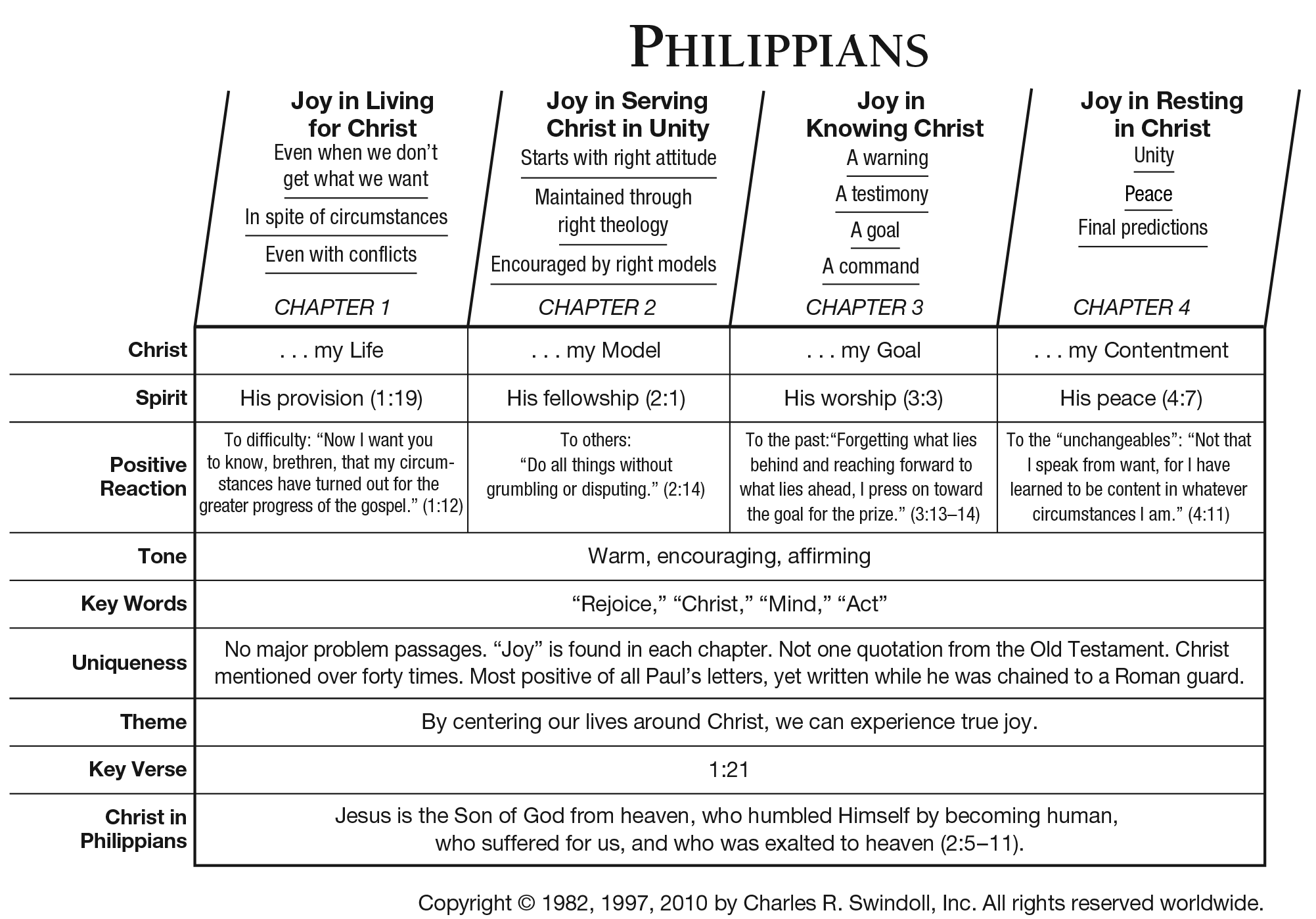
The apostle Paul wrote this letter to the Christians in Philippi, probably from Rome c. A.D. 62, while he was under house arrest.

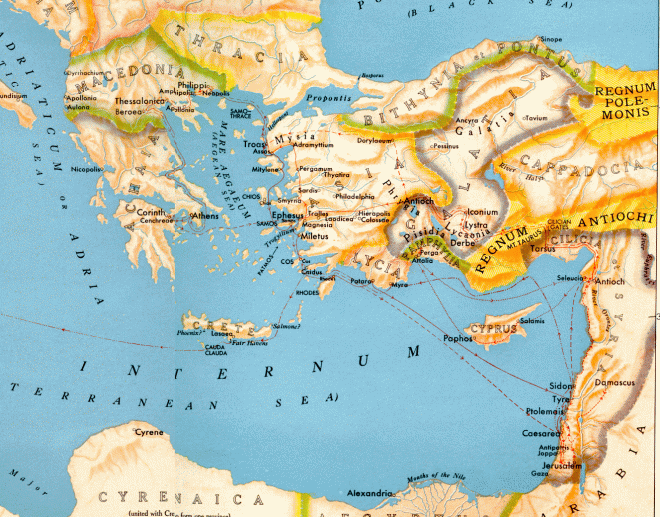
Philippi was a wealthy town, thanks to nearby gold and silver mines and a large number of (retired military) Roman citizens.  The church in Philippi was founded by Paul some eleven years before this letter, on his second missionary journey (Acts 16:11-40).  This was the first church established on the continent of Europe.

Philippians 1 consists of Paul speaking to the Philippians about their partnership in the gospel (their part primarily, but not wholly, through giving, vv. 3-11).  Then he lets them know that his difficult circumstances were working out for the advance of the gospel (vv. 12-17) and his confidence that, whether he lived or died, Christ would be glorified (vv. 18-26).  Then he encourages them to stand firm and be confident (vv. 27-30).

Since Paul was in prison awaiting trial, he had to face the fact that it was quite uncertain whether he would live or die; and to him it made no difference.

“Living,” he says, in his great phrase, “is Christ to me.”  For Paul, Christ had been the beginning of life, for on that day on the Damascus road it was as if he had begun life all over again. Christ had been the continuing of life; there had never been a day when Paul had not lived in his presence, and in the frightening moments Christ had been there to bid him be of good cheer (Acts 18:9-10).  Christ was the end of life, for it was towards his eternal presence that life ever led.  Christ was the inspiration of life; he was the dynamic of life.  To Paul, Christ had given the task of life, for it was he who had made him an apostle and sent him out as the evangelist of the Gentiles.  To him Christ had given the strength for life, for it was Christ’s all-sufficient grace that was made perfect in Paul’s weakness.  For him Christ was the reward of life, for to Paul the only worthwhile reward was closer fellowship with his Lord.  If Christ were to be taken out of life, for Paul there would be nothing left.

“For me,” said Paul, “death is gain”.  Death was entrance into Christ’s nearer presence.  There are passages in which Paul seems to regard death as a sleep, from which all men at some future general resurrection shall be wakened (1 Corinthians 16:51-52; 1 Thessalonians 4:14 and 16); but at the moment when its breath was on him Paul thought of death not as a falling asleep but as an immediate entry into the presence of his Lord.  If we believe in Jesus Christ, death for us is union and reunion, union with him and reunion with those whom we have loved and lost awhile.

The result was that Paul was swayed between two desires. “I am caught,” he says, “between two desires.”  As the Revised Standard Version has it: “I am hard pressed between the two.”

–William Barclay

My father’s favorite verse throughout most of his life was Romans 8:28, but toward the end of his life he claimed Philippians 1:21, “for me to live is Christ, to die is gain.” When we live much for Christ, we have much gain. When we live little for Christ, we have little gain. When we live not for Christ at all, we have no gain, but loss. Listen to the words of John Eadie:

“Christ, says the Apostle, shall be magnified in my body by life, ‘for to me to live is Christ.’ Christ and life were one and the same thing to him.

Might not the sentiment be thus expanded? For me to live is Christ:

—the preaching of Christ the business of my life
—the presence of Christ the cheer of my life
—the image of Christ the crown of my life
—the Spirit of Christ the life of my life
—the love of Christ the power of my life
—the will of Christ the law of my life
—and the glory of Christ the end of my life.

Christ was the absorbing element of his life. If he travelled, it was on Christ’s errand; if he suffered, it was in Christ’s service. When he spoke, his theme was Christ; and when he wrote, Christ filled his letters…

And when did the Apostle utter this sentiment? It was not as he rose from the earth, dazzled into blindness by the Redeemer’s glory, and the words of the first commission were ringing in his ears.

It was not in Damascus, while, as the scales fell from his sight, he recognized the Lord’s goodness and power, and his baptism proclaimed his formal admission to the church.

Nor was it in Arabia, where supernatural wisdom so fully unfolded to him the facts and truths which he was uniformly to proclaim. It sprang not from any momentary elation as at Cyprus, where he confounded the sorcerer, and converted the Roman proconsul.

No, the resolution was written at Rome in bonds, and after years of unparalleled toil and suffering. His past career had been signalized by stripes, imprisonment, deaths, shipwreck, and unnumbered perils, but he did not regret them.

He had been ‘in weariness and painfulness, in watchings often, in hunger and thirst, in fastings often, in cold and nakedness,’ but his ardour was unchilled; and let him only be freed, and his life prolonged, and his motto still would be—’For me to live is Christ.’

It did not repent the venerable confessor now, when he was old, infirm, and a prisoner, with a terrible doom suspended over him, that he had done so much, travelled so much, spoken so much, and suffered so much for Christ.

Nor was the statement like a suspicious vow in a scene of danger, which is too often wrung from cowardice, and held up as a bribe to the Great Preserver, but forgotten when the crisis passes, and he who made it laughs at his own timidity.

No. It was no new course the Apostle proposed—it was only a continuation of those previous habits which his bondage had for a season interrupted. Could there be increase to a zeal that had never flagged, or could those labours be multiplied which had filled every moment and called out every energy?

In fine, the saying was no idle boast, like that of Peter at the Last Supper—the flash of a sudden enthusiasm so soon to be drowned in tears. For the apostle had the warrant of a long career to justify his assertion, and who can doubt that he would have verified it, and nobly shown that still, as hitherto, for him to live was Christ?

He sighed not under the burden, as if age needed repose; or sank into self-complacency, as if he had done enough, for the Lord’s commission was still upon him, and the wants of the world were so numerous and pressing, as to claim his last word, and urge his last step.

It was such an one as Paul the aged, and now also a prisoner of Jesus Christ, who placed on record the memorable clause, inscribed also on his heart—’for me to live is Christ.'”

–John Eadie, A Commentary on the Greek Text of the Epistle of Paul to the Philippians (ed. W. Young; Second Edition.; Edinburgh: T&T Clark, 1884), 51–51-52.

May you and I live much for Christ today. May He be our life, our joy, our treasure and greatest pleasure.

M’Cheyne Bible Reading Plan, March 26

Today’s Bible readings are from Exodus 37, John 16, Proverbs 13 and Ephesians 6.

Exodus 37 speaks of the fabrication of the ark with its mercy seat (37:1-9), the table and its utensils (37:10-16), the lampstand and its utensils (37:17-24) and the altar of incense, anointing oil and the incense (37:25-29).

The ark was a chest made of wood and overlaid with pure gold.  It pointed to the humanity and deity of our Lord.  It contained the tablets of the law, the golden jar of manna, and Aaron’s rod that budded.  If applied to Christ, these things speak of Him as the One who said, “Your law is within my heart” (Psalm 40:8); as the bread of God come down from heaven (John 6:33); and as the Priest of God’s choosing, risen from the dead (Hebrews 7:24-26).  If applied to the people of Israel, they were all memorials of failure and rebellion. (William MacDonald)

The mercy seat was the lid of the ark.  It was also God’s throne, the place of His dwelling on earth.  When the cherubim looked down upon it, they did not see the Law or the jar of manna or the rod, all of which were reminders of Israel’s rebellions.  Rather, they saw the sprinkled blood, which enabled God to be merciful to rebellious sinners. (William MacDonald)

The bronze altar was the place of sacrifice.  Bronze speaks of sin and the perpetual fire (Lev. 1:5-7) on the altar symbolizes God’s judgment against sin.  Jesus died on an altar; it was called the cross.  He died for our sins on that cross.  He suffered pain for our sins.

The laver symbolizes our cleansing from sin – our holiness.  Once we are forgiven of our sins, God starts changing us to make us truly holy as He is holy (Phil. 2:12-13; 1 Pet. 1:16).  Water is symbolic of two concepts in scripture: 1) the Holy Spirit Who comes into our life, convicts us of sin (John 16:8) and starts living in us to change us (John 7:37-39); and 2) the Word of God which reveals to us our sin (John 15:3) and is useful for reproof, conviction, and instruction in righteousness (2 Tim. 3:16-17).  While the mirror at the bottom reminds us that we will still see our true sinful self (Rom. 7:24), it is also comforting because the symbolism reminds us that God knows we are not yet perfect in this life.  We have not lost our salvation; we are just not yet free from sin in this life.

The gold lampstand speaks of the One who revealed the Father to us – Jesus the light giver (Matt. 11:27).  He is the light of men.  The light was to burn perpetually.  Today, Jesus is not here in body but His Word is.  By reading and studying it we receive spiritual light.

The bread that was placed on the table represents God’s presence in our lives.

The altar of incense speaks of Christ being a perpetual sweet aroma of God.  It also suggests the present ministry of the Lord Jesus, interceding for us in heaven. (William MacDonald)

In John 16 Jesus is preparing His disciples for when He will no longer be with them.  It will be a time of persecution (16:1-4), but the Holy Spirit would be with them (16:5-15).

When Tyndale was persecuted and his enemies were out for his life because he sought to give the Bible to people in the English language, he said calmly, “I never expected anything else.” Jesus offered men his glory, but he offered them a cross as well. (William Barclary)

Jesus actually tells them that it will be to their “advantage” (v. 7) that the Holy Spirit would be with them rather than Jesus Himself.  As J. D. Greear puts it, “the Spirit inside you is better than the Jesus beside you.”

Four ministries of the Holy Spirit are mentioned here in John 16:

  1. The convicting work of the Holy Spirit (John 16:8-11).  This ministry is directed towards unbelievers.  “Sin is the truth about man, righteousness is the truth about God, judgment is the inevitable combination of these two truths.” (David Guzik)
  2. The guiding work of the Holy Spirit (John 16:12-13).  This primarily has to do with the Spirit’s work in the inspiration of NT Scriptures.
  3. The primary work of the Holy Spirit is to glorify Jesus Christ (John 16:14).  The Holy Spirit doesn’t magnify Himself, but Jesus.

As Arturo Azurdia has rightly said, “Jesus will be the sum and substance of the Spirit’s revelatory ministry. The predominant work of the Holy Spirit is to reveal and glorify Jesus Christ …”

4.  The disclosing work of the Holy Spirit (16:13, 14, 15) also has to do with the inspiration of NT Scripture.  This passage is what makes it foolish to say something like, “I’ll take what Jesus taught, but not what Paul and the others taught.”

Jesus also tells His disciples that they would see Him again, that He would “come back” from death (16:16-24).  Then, their joy would be full.

Finally, Jesus speaks of His ascension and return to the Father (16:25-33), again telling them that they would be facing persecution, but with the promise that Jesus has already won the victory (v. 33).

Proverbs 13 is another collection of maxims, again displaying the good fruits of living by wisdom.  This chapter begins with a familiar refrain:

1 A wise son hears his father’s instruction, but a scoffer does not listen to rebuke.

18 Poverty and disgrace come to him who ignores instruction, but whoever heeds reproof is honored.

Things are not always as they seem.  One may make themselves rich, or one may have money but live in fear because of the threats one faces (v. 8).

Let me hold lightly things of this earth:
Transient treasures, what are they worth?
Moths can corrupt them, rust can decay;
All their bright beauty fades in a day.
Let me hold lightly temporal things —
I, who am deathless, I, who wear wings.

Let me hold fast, Lord, things of the skies;
Quicken my vision, open my eyes!
Show me Thy riches, glory and grace,
Boundless as time is, endless as space.
Let me hold lightly things that are mine —
Lord, Thou hast given me all that is Thine!

–Martha S. Nicholson

Remember that Jesus chose to become poor to enrich us spiritually (2 Cor. 8:9).

Ephesians 6 continues Paul’s teaching on Spirit-filled relationships, addressing the parent-child relationship (6:1-4) and the master-slave relationship (6:6-9).

The last section of Ephesians is the “stand” section on spiritual warfare.  Paul tells us that our battle is “not against flesh and blood” but spiritual forces (v. 12).  We are not equipped for this battle in our own strength or wit, so we must put on God’s armor (most of these items were worn by the warrior God in the Old Testament Scriptures).

The problem with most Christians is that we live like we are on a playground when in fact we are engaged on a battlefield.

Image result for armor of god

David Jeremiah’s book Overcomer is a good explanation of what the pieces of spiritual armor are and how to use them.

Prayer is also a weapon of our warfare.  John Piper says “prayer is a wartime walkie-talkie, not a domestic intercom.  It exists for advancing the mission, not for calling the butler to turn up the thermostat….All requests serve the mission, or the thing malfunctions in our hand” (Put in the Fire for the Sake of Prayer)

God’s Indictment of Israel’s Priests, part 1 (Hosea 4:4-10)

We are in Hosea 4 today.  God is indicting Israel for their unfaithfulness to the covenant—playing the harlot with other gods and depending upon foreign nations for their protection.  What upsets Yahweh the most is that the very people that He called and depended upon to teach the people to worship Him alone and obey Him—the priests—were the very ones who were misleading the people.

So this next section in Hosea 4 is especially directed at us in ministry, we pastors who have the responsibility to teach our congregations God’s truth.  Listen to Hosea’s indictment against the priests…

4 Yet let no one contend, and let none accuse, for with you is my contention, O priest. 5 You shall stumble by day; the prophet also shall stumble with you by night; and I will destroy your mother. 6 My people are destroyed for lack of knowledge; because you have rejected knowledge, I reject you from being a priest to me. And since you have forgotten the law of your God, I also will forget your children. 7 The more they increased, the more they sinned against me; I will change their glory into shame. 8 They feed on the sin of my people; they are greedy for their iniquity.  9 And it shall be like people, like priest; I will punish them for their ways and repay them for their deeds. 10 They shall eat, but not be satisfied; they shall play the whore, but not multiply, because they have forsaken the LORD to cherish 11 whoredom

Hosea 4:4-5:7 is God’s indictment against the priests.  The crimes mentioned here are (1) failure to teach the law (4:6); (2) use of the sacrificial system to feed their own appetites (4:7-10); the practice of divination (v. 4:12); (4) offering sacrifices in the high places (4:13a); (5) participation in ritual sex orgies (4:13b-14); (6) encouraging drunken lewdness in connection with idol worship (4:17-19); (7) false trust in the sacrifices at the shrines (5:6); and (8) bearing of illegitimate children as the fruit of the pagan orgies (5:7).  That is quite a failure on the part of those who were supposed to teach Israel to be faithful to Yahweh!

This passage we’re beginning today has two sections—vv. 4-6 and vv. 7-10.  Both are judgment speeches in which accusations are interwoven with announcements of judgment.  In the first section, the indictment is failure to teach and keep the law; the punishment is rejection of the priestly status.  In the second section, the crime is hedonistic greed in the celebration of the sacrifices; the judgment, accordingly, is deprivation of any source of joy.

Israel’s guilt was so clear that the Lord forbade the people from denying His charge against them.  The charges Yahweh brings against the priests are undeniable and no one can rightly accuse Yahweh of being unfair in His judgments.

Yahweh’s contention is with the priests.  He will mention the prophets in v. 5 but this indictment is primarily laid at the feet of the priests.

In passages like Deuteronomy 17:9-12, Yahweh clearly commanded His people to listen to and submit to the priests, who would lead and help the people with the Word of God.  But in this case, it was the priests who were leading the people astray.

Therefore, the condition of the people in itself is evidence against the priests.  Thus Duane Garrett paraphrases…

“Even though this nation is full of blasphemers, liars, murderers, thieves, and adulterers (v. 2) there is no point in one person accusing or pointing the finger of blame at another.  When they accuse one another, your people are really bringing charges against the priest–they are evidence for what a poor job the priests have done.” (Garrett, Hosea-Joel, p. 116)

Ultimately, responsibility for the condition of the flock lays in the hands of the priest, or the pastor.

Malachi also brings a charge against the priests, comparing the calling Yahweh gave to Levi with the current negligence of the priests in his day:

5 My covenant with him was one of life and peace, and I gave them to him. It was a covenant of fear, and he feared me. He stood in awe of my name. 6 True instruction was in his mouth, and no wrong was found on his lips. He walked with me in peace and uprightness, and he turned many from iniquity. 7 For the lips of a priest should guard knowledge, and people should seek instruction from his mouth, for he is the messenger of the LORD of hosts.

8 But you have turned aside from the way. You have caused many to stumble by your instruction. You have corrupted the covenant of Levi, says the LORD of hosts, 9 and so I make you despised and abased before all the people, inasmuch as you do not keep my ways but show partiality in your instruction.”

Tom Constable does remind us that King Jeroboam I had appointed as priests people from any tribe and all walks of life in Israel (1 Kings 12:31; 13:33).  Thus, these priests may not even be from the lineage of Levi.  They certainly weren’t acting like it!

The New Testament also speaks of how God will hold leaders in the church responsible for the condition of the flock.  In Hebrews 13:17 we read

17 Obey your leaders and submit to them, for they are keeping watch over your souls, as those who will have to give an account.  Let them do this with joy and not with groaning, for that would be of no advantage to you.

Paul even warns that in the last days preachers will fail to teach the truth, but rather teach people what they want to hear, affirming their life choices instead of challenging them:

1 I charge you in the presence of God and of Christ Jesus, who is to judge the living and the dead, and by his appearing and his kingdom: 2 preach the word; be ready in season and out of season; reprove, rebuke, and exhort, with complete patience and teaching. 3 For the time is coming when people will not endure sound teaching, but having itching ears they will accumulate for themselves teachers to suit their own passions, 4 and will turn away from listening to the truth and wander off into myths.

The consequence of the lack of biblical teaching from the priests is that they, the prophets, and we assume the people as well, will all “stumble” (v. 5).  The priests may have thought themselves immune because of their spiritual calling and reputation, but they are not.  When the truth is not taught, everyone suffers.

This stumbling makes them ineffective and it happens “day and night,” in other words, “all the time.”  Stumbling at night is understandable, but stumbling in the day speaks of God’s judgment.  In essence, the blind are leading the blind (Matthew 15:14).

It may literally be the result of being drunk with wine and alludes to the image of Yahweh making his enemies drink wine on the day of his wrath.  In Jeremiah 25:15-28 for example, the nations must drink the cup of God’s wrath, get drunk and stagger, and fall to rise no more.  Thus, this seems very final.

Both types of spiritual leaders fail the people, so that ultimately the “mother,” that is, the nation, will be destroyed.  All the key institutions in Israel’s life—spiritual and political—will fail.

The key reason for national destruction is communicated in verse 6:

6 My people are destroyed for lack of knowledge; because you have rejected knowledge, I reject you from being a priest to me. And since you have forgotten the law of your God, I also will forget your children.

“My people are destroyed for lack of knowledge,” particularly their failure to know God.  This was mentioned back in v. 1 in the first indictment against Israel, that there was “no knowledge of God in the land.”  They failed to acknowledge Him as their God, instead turning to the Baals.  They forgot Him and all His blessings throughout their history, preferring to worship other gods.

This did not happen unconsciously, but was a conscious decision on their part—the priests “rejected knowledge” and “have forgotten the law of your God.”  Failure to teach the people rightly is always a serious offense to God (Matthew 18:6; James 3:1).  The preacher or teacher who sins in this way is not only responsible for his own misdeeds, but also of those whom he misled.

Pastors, this is our primary mission—to teach the Word so our people know and love and obey the true God.  If we fail in that, no matter what else we do well, we fail them and we fail God.

The since of the priests is primarily a sin of omission, but it is a disastrous omission that gives birth to every sin of commission and leads to the collapse of the priesthood and the destruction of the nation.  Their primary calling, in this passage, was to teach, not make sacrifices.  But they had failed to do that.

Priests, prophets and people stumble together, even in the daylight, because they cast off the knowledge of God and the restraint and guidance of God’s law.

It should be no surprise that there is a strong connection between knowing God and knowing His Word.  There is no knowledge of God without knowing the Word.  The better we know the Word, the better we know God.  The better we know God, the more our lives will be transformed towards righteousness and goodness and beauty.

So get into the Word of God!

We have time to watch television, to mindlessly surf the internet, to read novels, to go to movies, to go out for dinner, to spend evenings in conversations with friends, to shop for a long list of Christmas presents, to attend sports events, to take a weekend get away vacation and so on and so on — but oh, my, we are too busy to teach a Sunday School class!  We are too busy to participate in a weekly Bible Study!  We are too busy to spend 15 minutes each day in Bible reading and prayer!  Thus we are well-versed in temporal things, but suffering terribly from a lack of godly, holy, transforming knowledge that comes from God’s Word as the Holy Spirit points us to Jesus Christ.

Get into the Word of God and let it shape your understanding of God accurately so that you begin to reflect His glory.

18 And we all, with unveiled face, beholding the glory of the Lord, are being transformed into the same image from one degree of glory to another.  For this comes from the Lord who is the Spirit. (2 Cor. 3)

God’s response of judgment is to reject the priests and forget their children (v. 6).  To our western minds it always seems a bit unfair for the children to have to pay for the sins of their parents, but the solidarity of the family and the idea of corporate guilt and punishment was common in ancient Near East cultures.

Also, since the priesthood is inherited through one family, these children would grow up to be priests, and likely bad ones as well.

One would think that the increasing of the priesthood would be a good thing.  We bemoan the fact seminaries aren’t graduating as many preachers as is needed.  However, in Hosea 4:7 the multiplication of priests turned out to be a bad thing…

7 The more they increased, the more they sinned against me; I will change their glory into shame.

God had blessed the priests with increase (likely referring to children, but it could have broader reference to other kinds of blessing), but they took that blessing for granted and sinned all the more.

Doesn’t that sound familiar?  We live in what could be arguably called the most blessed nation on earth.  But what have we done with those blessings?  We have turned them around and used them to eliminate God from our lives, both politically and personally.

David Guzik reminds us

Blessing is a two-edged gift; it is obviously wonderful to be blessed, but it also brings more accountability and more opportunity for sin.

It would have been quite natural to think that the multiplication of priests, their increased influence, and the increased interest in worship would be signs of spiritual vitality.  But to the contrary, Hosea retorts that the more religious leadership the nation hand, the worse they became.

Their glory, their status and privileges, was about to be put to shame.  “The judgment is that someday God will bring the priests into disgrace in that he will cause the people to recognize them for the frauds they are and to despise them” (Garrett, Hosea-Joel, p. 119).

Another charge against these priests is that they were exploiting their worshipers.  The priest’s complicity in Israel’s sin is nowhere stated more forcefully than in verse 8.  There was an eagerness to get people to sin.  Hosea 4:8 says…

8 They feed on the sin of my people; they are greedy for their iniquity.

The priests were relishing the people’s wickedness in two ways.  First, they were making these offerings predominately to idols.  Second, the priests were benefiting from the sin offerings made.

In the religious system in which God established, the priests received their livelihood from portions of sacrificial offerings, whether animal or cereal and so they were encouraging the people to sin so that they would need to bring more offerings!

Contemporary charlatans who exploit the religious or emotional or physical needs of people for their own gain are as immoral and as responsible for the demise of genuine religious experience as were the corrupt priests before them.

Instead of the sacrifices being a means of repentance and grace, it had become a tool for permissiveness of the people and the gluttony of the priests.

The word “sin” in verse 8 could just as well refer to the “sin offering,” but in parallel with “iniquity” it is more likely referring to the act of sinning.

The last phrase is literally “they lift up their soul to their iniquity.”  Several times in the Psalms, to “lift up the soul” means to pray.  Thus, it is quite possible that this means that the priests were praying (if you could call it that) for the people to sin.

Thus it was all very shameful.

Hosea goes on to say…

9 And it shall be like people, like priest; I will punish them for their ways and repay them for their deeds.

I think what Hosea means is that even though the priests were more culpable before God, they would be treated equally.  There will be coming a day of judgment and none shall be spared.  That general judgment is made more specific in v. 10…

10 They shall eat, but not be satisfied; they shall play the whore, but not multiply, because they have forsaken the LORD to cherish

The theme is frustration almost to the point of annihilation.  Their bodily appetites will no longer be satisfied.  Like addicts, they will experience the law of diminishing returns.  The land will not produce crops.

They will enact sexual worship with the prostitutes of Baal, but bear no children.  This fulfills the grave promise of v. 6, “I will forget your children.”  They just won’t be born.

Ironically worship of Baal was supposed to insure abundance of resources and fertile wombs.  But they would reap what they had sown.  Now they will always be hungry and childless.

Yahweh will do this because they had stopped listening to and obeying Him by observing His law.  And the object if “to cherish” is found in verse 11.  They cherished harlotry.  Instead of loving God with all their heart, soul, mind and strength, they cherished the false gods.

Like we saw last week, when you break the first commandment to “have no other gods before me” you will soon be breaking them all.

David makes this contrast in Psalm 16.  Verse 4 says…

The sorrows of those who run after another god shall multiply

But in v. 16 he says…

in your presence there is fullness of joy; at your right hand are pleasures forevermore.

Do you want increasing sorrows, or ever-increasing joy?

Don’t forfeit the true and lasting joy for the fleeting pleasures given by the false gods of this age.

M’Cheyne Bible Reading Plan, March 25

Today’s Bible readings are from Exodus 36, John 15, Proverbs 12 and Ephesians 5.

For the construction of the tabernacle there was a cadre of skilled workmen (Exodus 36:1-2) and plenty of resources (36:3-7).  In fact, the people had such generous willingness to give that there was “more than enough” (v. 5) and Moses asked them to stop giving (vv. 6-7), every building manager’s dream!

This follows the pattern of God’s giving to us.  God gives us much more than we ever need, and our giving is simply a response to His. (David Guzik)

They then built the curtains (vv. 8-19), boards and bars (vv. 20-34) and veil and screen (vv. 35-38)–all the boundaries–from the materials provided by the people.

Dutch theologian Herman Witsius (1636 – 1708) notes that it took God six days to create the universe and it took the craftsmen of Israel six days to build the tabernacle.

In John 15 Jesus speaks of the intimate relationship we can have with God through the image of the vineyard.  In this image, the Father is the vinedresser, Jesus is the vine and we are the branches.  Abiding in Jesus, like a branch is connected to the vine–drawing life from it–is the way that we bear fruit.

The expectation is that we would bear fruit, even “more fruit” (v.2) and “much fruit” (v. 8).  We cannot bear fruit unless we stay attached to Jesus.

When branches (believers) don’t bear fruit they are “taken away.”   Is this parallel to v. 6 where they are “thrown away” and “thrown into the fire,” or something different.

James Montgomery Boice (among others) believes that the ancient Greek verb airo, translated, takes away is more accurately translated lifts up.  The idea is that the Father lifts up unproductive vines off of the ground (as was common in the ancient practices of vineyard care).  Those caring for ancient grape vines made sure to lift them up off the ground that they might get more sun and bear fruit better.

A branch lifted up

Also, according to Derrickson, “the viticulture process that Jesus described in verse 6 took place in the fall, whereas the process He mentioned in verse 2 happened in the spring” (Viticulture and John 15:1-6, Bibliotheca Sacra 153:609 (January-March 1996, p. 50-51).

But what about verse 6?  Is it referring to unfruitful believers or unbelievers being cast into hell, or does it refer to unfruitful believers who are now considered useless (not pressing the fire image too far)?

The image is dropped in vv. 12-17, but Jesus continues in the theme of a close relationship with him (as “friend”).  Here the emphasis is on loving one another, the prime fruit of an abiding disciple.

Jesus then talks about their relationship with the world (vv. 18-27), that the world will hate them, but the Spirit will be with them.  They shouldn’t expect anything but persecution from the world, because it hated (hates) Jesus as well.

Proverbs 12 speaks of the value of righteousness (12:1-12) and avoiding trouble (12:13-28).

In Proverbs, one who is right (or wise) in his own eyes sees no need to seek instruction or counsel from others and is thus also unwilling to listen to reproof.  Proverbs strongly warns against this (see 3:5-7), because no one is immune to self-deception (see 16:2; 21:2), which can lead to the nearly hopeless state of having a hard heart (see 26:12). (ESV Study Bible)

“Anxiety in a man’s heart weighs him down, but a good word makes him glad.” (12:25)

What good word can you speak into an anxious person’s life today?

Ephesians 5 continues the theme of progressive sanctification.  We are to “walk in love” (5:1-2) and “walk in the light” (5:3-20).  This will then affect all our relationships, beginning with marriage (5:21-33).

“All God’s gifts, including sex, are subjects for thanksgiving, rather than for joking.  To joke about them is bound to degrade them; to thank God for them is the way to preserve their worth as the blessings of a loving Creator.” (John Stott, Ephesians, p. 193)

Because we are light (new nature), we should walk in the light.  Part of that is continually discerning God’s will (5:10), making the most of every opportunity (5:16) and being filled with the Spirit (5:18).

“Be filled with the Spirit” (5:18) is a present, passive command.  This means that it is not optional, that it must be continuous (present tense) and that it happens to us.  A more precise translation is “be being kept filled with the Spirit.”

How are we filled with the Spirit?  There are no instructions here but we would assume that we must first confess our sins, then offer our bodies as living sacrifices, then ask the Spirit to take control of us.

Having explained the basic admonition to be filled with the Spirit (vv. 15-21), Paul next applied the implication of this exhortation to various groups of Christians.

He addressed six groups: wives and husbands (5:22-33), children and parents (6:1-4), and slaves and masters (6:5-9). In each of the three pairings, the first partner is responsible to be submissive or obedient (5:22; 6:1, 5).  However, the second partner is also to show a submissive spirit.  All are to relate to one another “as unto the Lord” (5:21).

The command to wives is to submit to their husbands, which I believe is the joyful disposition to support and respond to her husband’s leadership.

The command to husbands is to sacrifice themselves for their wives.  Husbands must take the responsibility to lead their wives, which is neither tyranny nor milquetoast.  If he loves her, he will lead her for her good.

This reflects the relationship between Christ and the church.  The church submits to Christ, Christ gave up His life for His bride.

Jesus also exhibits both submission (the way we show love to those above us in the hierarchy of life) and sacrifice (the way to show love to those equal to or below you in the hierarchy of life).  He submitted to His Father in the garden and died on the cross for us.

M’Cheyne Bible Reading Plan, March 24

Today’s Bible readings are from Exodus 35, John 14, Proverbs 11 and Ephesians 4.

Exodus 35-40 is the actual building of the tabernacle.  The plans had been given (25-31) so now they take up an offering to build it and the money pours in (35:1-29).  Moses prefaces his appeal for the materials to build the tabernacle with “Whoever is of a generous heart…” (v. 5).  They were willing to give, they gave what they could and gave it to the LORD.  Everything that was needed was provided because of willing, generous hearts.

Moses again recognized “Bezalel” and “Oholiab” as unusually skillful artisans, whom God had gifted and appointed to lead the construction work (35:30—36:2).

In John 14 Jesus seeks to comfort them at the news of His departure.  First, he tells them they will not be separated forever, that He is going to His Father’s house to prepare a place for them (just like what happened in the engagement period between Jewish groom and bride) and would return to take them there (vv. 1-4).

Then, he promises them the Holy Spirit (vv. 16-17), to be their comforter.  Jesus had been their comforter, now they would have someone just like Him but with two distinct differences: (1) he would never leave them and (2) he would live in them.  What a blessing, to never be without the Comforter!

Third, he promises them that like Him, though they might die, they would live (v. 19).  Death wasn’t the end, but a new beginning.  They would see Him risen from the dead and that should comfort them that they will rise from the dead.

Dwight L. Moody once told his friends

“Some day you will read in the papers, ‘D. L. Moody of East Northfield is dead.’  Don’t you believe a word of it!  At that moment I shall be more alive than I am now…”

And C. S. Lewis said of the children who had been the main characters in the Chronicles of Narnia series, that they had now grown to adulthood and died in a train accident:

“All their life in this world and all their adventures had only been the cover and the title page: now at last they were beginning Chapter One of the Great Story which no one on earth has read: which goes on for ever: in which every chapter is better than the one before.”

Finally, Jesus promises His disciples peace.  They would really need peace because Jesus would warn them that persecution was heading their way.  It would be God’s peace, not the world’s peace that was offered to them.  The world’s peace is shallow and short-lived.

I cannot imagine God pacing back and forth, wringing his hands, saying, “What now?  What am I going to do?”  He is always calm precisely because He is God and has everything, and I mean everything, under control.

It is that peace He gives us and we can experience it when we trust that God is with us and that He is working all things out for our good.

See Jack Dawson’s Peace in the Midst of the Storm for a visual demonstration of this kind of peace.  There is a video that explains some of the hidden imagery.

And Ron Hutchcraft tells this story (I don’t know if it is true)

Years ago a major art gallery sponsored a competition for painters.  They were offering prizes for the best painting on the subject of “Peace.”  As attenders browsed through the entries, most had decided that a one certain painting was almost sure to win.  It portrayed this lush green pasture under a vivid blue sky, with the cows grazing lazily and a little boy walking through the grass with his fishing pole over his shoulder.  It really made you feel peaceful.

But it came in second.  The painting that won was a real surprise.  The scene was the ocean in a violent storm.  The sky was ominous, the lightning was cutting across the sky, and the waves were crashing into the rock walls of the cliffs by the shore.  No peace.  But you had to look twice to understand what was going on.  There, about halfway up the cliff, was a birds’ nest, tucked into a tiny hollow in the rock.  A mother bird was sitting on that nest – with her little babies, tucked underneath her, sleeping soundly.  That was peace!

Anybody can have “peace” when the conditions are perfect, but we need the kind of peace that can weather the storms…and that is the peace that God gives.

Proverbs 11:1-8 focuses on matters of financial and personal security.  The riches of the wicked that will not save them (v. 4) and the false balance whereby a wicked man increases his income (v. 1) are contrasted with the just weight (v. 1) and righteousness (v. 4). Similarly, the pride (v. 2) and crookedness (v. 3) that lead people to ruin are contrasted with the humble attitude (v. 2) and integrity (v. 3) that guides people through the troubles of life.

11:5-6 parallel each other (The righteousness of the blameless/upright) and emphasize a common theme of the section: the faithfulness of the righteous guides (vv. 3a, 5a) and delivers them (see vv. 4a, 6a, 8a, 9b) from the fate of the wicked.

Wise investments are also the dominant theme of 11:16-31.  In 11:18 the wicked sows wickedness and reaps what he does not expect (“deceptive wages,” cf. Rom. 6:23): divine punishment rather than blessing.  The righteous, on the other hand, “sows righteousness” and reaps what he sows: blessing (cf. Gal. 6:7).  The former reward is often deceptive and disappointing, but the latter is truly satisfying.  Haman reaped a bitter harvest for his wicked sowing, whereas Jesus received nothing but glory for His sowing.

11:24-26 speaks of giving which is not loss, but gain.

If God rewards the righteous with blessings in this life (11:31, and He does, “how much more” will He repay wicked sinners before they die!  No one sins with impunity.  We reap what we sow.  God will judge every sin.

While ungodly people may appear to prosper and live carefree lives, they do not experience the blessing of fellowship with God, which is the greatest blessing human beings can enjoy in this life (cf. Phil. 3:7-11).  Job is an example of a righteous man who experienced great reward before he died, as did Abraham, David, Paul, and a host of others.  Several of the wicked kings of Israel and Judah illustrate the alternative.  Peter quoted this proverb (1 Pet. 4:18).

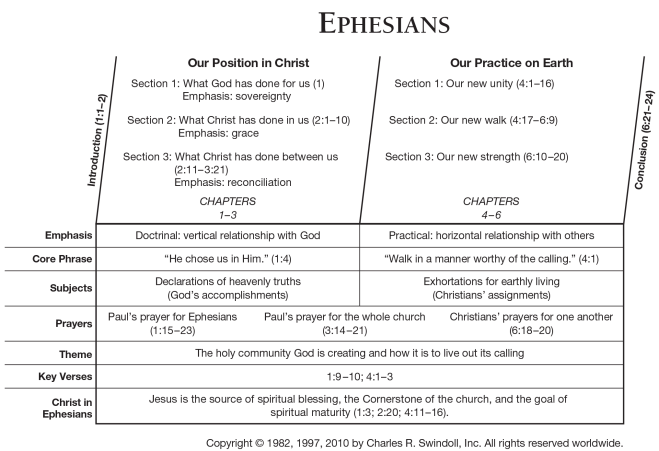
Ephesians 4 begins the practical portion of this epistle.  In chapters 1-3 Paul described what God has done for us and we might say that our position is in view and that we are seated in the heavenlies.  The dominant theme of Ephesians 4-5 is our walk, our practice, while Ephesians 6:10-20 calls us to stand.  The “therefore” at the beginning of 4:1 shows that our practice is based on our position, our character on our calling, imperatives are built on indicatives.

Ephesians 4:1-16 is organized in a large parallel known as a chiasm. The first part of this parallel (verses 1-6) deals with the unity of the church. The second part of this parallel (verses 7-16) deals with the diversity of the church.

Practical Unity (4:1-3)

Practical Diversity (4:12-16)
 
Doctrinal Unity (4:5-6) ————

Doctrinal Diversity (4:7-11)

Because the Trinity is united and everything God has done for us unites us, we are to be united.  The attitudes of humility, gentleness, patience and forbearance in love is our part.

But that unity is not uniformity.  We are all given different gifts and those gifts enable us to build up the body.  Spiritual leaders are given (v. 11) to equip the saints for ministry, not to do all the work themselves.

The goal is maturity and unity (diversity is not divisiveness) so that we are not carried away by every “wind of doctrine.”

So we are called to walk according to our calling–in unity and diversity, but we are also called to walk differently than the Gentiles (unsaved).  Having “learned Christ” (4:20) we are to (1) put off the old self, (2) be renewed in our minds, and (3) put on the new self.  This threefold pattern is carried through chapter 4 into chapter 5.

The Old Self

The New Self

Your former manner of life The new life in Christ
On its way to destruction Created anew
Rotting under the power of lust Increasing under the power of God
Controlled by lust Controlled by truth

Some have called Ephesians 4:25-32 Four Rules for Fighting Fair:

  1. Speak the truth to one another (v. 25)
  2. Reconcile quickly (vv. 26-27)
  3. Use edifying language (v. 29)
  4. Be willing to forgive (vv. 30-32)

In each case Paul tells them what to put off and what to put on, and usually gives a reason (renewing of the mind, understanding why).

For example, in Ephesians 4:25 Paul tells them to put away speaking falsehood (lying, deception) and put on telling the truth and then tells them “for we are members of one another.”  Since we are members of one another, lying rips the fabric of that relationship.

See if you can pick out each of the three steps in the remaining verses.


M’Cheyne Bible Reading Plan, March 23

Today’s readings are from Exodus 34, John 13, Proverbs 10 and Ephesians 3.

Exodus 34:6 is the first of many (Num. 14:18; Psa. 86:15; 103:8; 145:8; Joel 2:13) brief revelations of God’s character, what we might call the “softer side” of God.  The Lord “passed before him” as in 33:19, 22.  We don’t know what he saw, but he heard these wonderful words: “”The LORD, the LORD, a God merciful and gracious, slow to anger, and abounding in steadfast love and faithfulness” (Exodus 34:6).

This revelation of the character of God to Moses forever puts away the idea that there is a bad God of the Old Testament which is in contrast to the good God of the New Testament.  God’s character of love and mercy and grace is present in the Old Testament as well as in the New Testament. (David Guzik)

Moses’ immediate response was to bow low and worship (v. 8) and again appealed for God’s presence to go with them (v. 9).  So Yahweh renewed the covenant with Israel, promising to bring them victoriously into the land but commanding them neither to make covenants with the Canaanites nor worship their gods.  They were to keep the festivals (v. 18, 22-24) and sabbath (v. 21), dedicate the firstborn animal (vv. 19-20) and firstfruits (v. 26) to Yahweh.

Moses spent 40 days and nights (fasting!) with Yahweh (v. 28), and when he came down, his face was shining with God’s glory (v. 29).  Moses relayed God’s commands, then put a veil over his face (cf. 2 Cor. 3:7-18).

The blessing of God’s people rests on the faithful lovingkindness of God and the intercession of their leaders: Jesus Christ and human leaders. We cannot stress too much the importance of the kind of intercession that Moses modeled on this occasion. If God has given you a ministry of leadership, your intercession for those you lead, or your lack of it, will directly affect their welfare. (Thomas Constable)

John 13 begins the Upper Room Discourse (John 13-17).  Jesus is alone with His disciples (without Judas, the betrayer most of the time).  He wants to prepare them for living and ministering without Him.

First, Jesus shares the “last supper” with His disciples.  At the “first supper,” the feeding of the 5,000, the Jews wanted to exalt Jesus as King; at this supper, He identifies Himself as sacrifice.

John’s description of the time of the Last Supper seems to conflict with that of the Synoptics.  They present it as happening on Thursday evening, but many students of the fourth Gospel have interpreted John as locating it on Wednesday evening (13:1, 27; 18:28; 19:14, 31, 36, 42).  The Last Supper was a Passover meal that took place on Thursday evening.

Jesus begins by washing their feet, something a servant, or one of the disciples, should have done.  Jesus didn’t serve them because He felt inferior to them.  He knew (1) “that his hour had come to depart out of this world to the Father” (v. 1); (2) “that the Father had given all things into his hands, and (3) that he had come from God and (4) was going back to God” (v. 3).

Although He was the supreme and exalted Son of God, he “rose from supper. He laid aside his outer garments, and taking a towel, tied it around his waist” and began to wash the disciples’ feet.

Of course, we see here two people that are hard to serve: (1) someone who doesn’t want to be served, like Peter, and (2) someone who has (or will) hurt us, like Judas.  If I would have had foreknowledge that someone was going to betray me, I would have twisted their ankle.  But Jesus did not.

Jesus did this because “he loved them to the end” (to the uttermost) and he wanted to teach them a lesson of serving.  “Do like I have done to you.”

Jesus’ Ministry in the Upper Room is a… Picture of Jesus’ Humiliation and Exaltation
Jesus rose from supper, a place of comfort and rest Jesus rose from his throne in heaven, a place of comfort and rest
Jesus laid aside his garments Jesus laid aside his glory
Jesus took a towel and girded himself, ready to work Jesus took the form of a servant, ready to work
Jesus poured water in the basin, ready to cleanse Jesus poured out his blood to cleanse us from guilt and the penalty of sin
Jesus sat down against after washing their feet Jesus sat down at the right hand of God the father after cleansing us

Jesus then sends Judas away (vv. 18-20) and Judas departed (vv. 27-30).  I would assume that Jesus celebrated the “Lord’s Supper” after Judas departed.

Jesus gives them a “new commandment” (vv. 31-35).  The old commandment had to do with love as well, but it was “love your neighbor as yourself.”  This one aims higher–“love one another as I have loved you.”  In particular, serve one another like I just served you.

This chapter ends with the prediction of Peter’s denial (vv. 36-38).  Peter intended to die for Christ and wanted to, but in the end his will failed him.

We might say that Judas’ denial of Jesus was deliberate and planned; Peter’s denial of Jesus was accidental and spontaneous.  Peter’s denial was terrible, but it wasn’t the same as what Judas did. (David Guzik)

Before Peter could die for Jesus, Jesus must die for Peter.

Most of us don’t understand the weakness, the darkness, that resides within us.  Mark Sayer’s book on leadership, Facing Leviathan shows how neither the hero model of leadership nor the bohemian model of leadership really works, but rather this servant leadership expressed by Jesus.

Proverbs 10

The purpose of Proverbs 10:1-5 is to encourage the pursuit of one’s labors in righteousness, which excludes acquiring gain by unjust means (v. 2a) or squandering it by sloth (vv. 4-5).  At the center of these verses is the reason: The LORD does not let the righteous go hungry.  It is the Lord who provides (v. 3), and through righteousness he delivers not only from hunger but also from death(v. 2b).  The encouragement of the whole section to walk in righteousness is framed by the appeal to be a son who is wise (v. 1a) or prudent (v. 5a) rather than foolish (v. 1b) or shameful (v. 5b).

Although set in clusters, vv. 6-32 as a whole act to contrast the righteous and the wicked in order to illustrate that “righteousness” (v. 2) is the path for a wise son.

Proverbs 10:4 says “the hand of the diligent makes rich.”  While Proverbs 10:22 says “the blessing of the LORD makes rich.”  “The one notes the primary source of wealth; the other points to the instrumental source of wealth.  Neither can be effective without the other.  The sluggard looks for prosperity without diligence; the atheist looks for prosperity only from being diligent.” (Charles Bridges)

If you want to explore the Proverbs in more depth, you can receive Daily Proverb in your inbox each day.

Anybody up for a good mystery?  The New Testament has plenty.  This chart is from Thomas Constable…

NEW TESTAMENT REFERENCES TO “MYSTERIES”

(THINGS PREVIOUSLY UNKNOWN BUT NOW REVEALED)

Matt. 13:11 The secrets of the kingdom of heaven
Luke 8:10 The secrets (mysteries) of the kingdom of God
Rom. 11:25 Israel experiencing a hardening of heart
Rom. 16:25-26 The plan of salvation through Jesus Christ.
1 Cor. 4:1 New Testament revelation
1 Cor. 15:51 The Rapture
Eph. 1:9 God’s will
Eph. 3:2-3 The administration of God’s grace
Eph. 3:4 Christ
Eph. 3:9 The church
Eph. 5:32 Christ and the church
Col. 1:26 Christ in us, the hope of glory
Col. 1:27 Christ in us
Col. 2:2 Christ
Col. 4:3 Christ
2 Thess. 2:7 The secret power of lawlessness already at work
1 Tim. 3:9 The deep truths of the faith
1 Tim. 3:16 Godliness
Rev. 1:20 The seven stars (angels)
Rev. 10:7 The details of the Tribulation
Rev. 17:5 Babylon the great

Ephesians 3 is about the mystery which is the church.  Paul had introduced this subject in 2:11-22, talking about the “one new man” which God had created out of believing Jews and believing Gentiles.  A biblical “mystery” is something made known which had been unknown in the past (v. 5).

6 This mystery is that the Gentiles are fellow heirs, members of the same body, and partakers of the promise in Christ Jesus through the gospel.

This had not been revealed in the Old Testament.  Jesus referred to the church in Matthew 16:18, “I will build my church” and Matthew 18:17 “tell it to the church” but does not explain what He is referring to.  It was inaugurated on the day of Pentecost (Acts 2) when the Holy Spirit baptized believers into Jesus.

This mystery is not only significant for the church itself, but was an amazing spectacle to the “rulers and authorities in the heavenly places” (v. 10).

Paul’s prayer for the Ephesians is that their inner man, their spirit, might be strengthened to be able to comprehend the incomprehensible–the height, depth, length and breadth of Christ’s love for us.

These verses and other verses about God’s passionate love for us are vitally important for God to reveal to our hearts so that we “know and rely upon the love of God” (1 John 4:16) each moment.  When we are grabbed by God’s love, when we truly know it and feel it and rely upon it, then our love for Him will grow deeper and stronger, enabling us to say “no” to temptations and “yes” to God’s will.

And God is able to do this, if we ask

20 Now to him who is able to do far more abundantly than all that we ask or think, according to the power at work within us, 21 to him be glory in the church and in Christ Jesus throughout all generations, forever and ever.  Amen.

Take that by faith and pray for it.  Ask others to pray Paul’s prayer for you as well.


M’Cheyne Bible Reading Plan, March 22

Today’s readings are from Exodus 33, John 12, Proverbs 9 and Ephesians 2.

Exodus 33 consists of the people’s repentance (vv. 1-11); Moses’ intercession (vv. 12-16) and God’s agreement to go with Israel and reveal His glory to Moses (vv. 17-23).

Moses has just been informed that God would send Israel to Canaan with the promise of safe passage, with the Lord’s angel going before them, but without YHWH in their midst (Exodus 33:1-3).  Israel was overwhelmed with grief by this news (33:4-6).  God’s dwelling in their midst was what made them distinct, and now because of their stiff-necked sin, God was pulling back.

Are you disturbed at the prospect, however remote, that God’s presence might be withdrawn from your life because of your sin?

This separation is confirmed in 33:7-11, when Moses describes the kind of distant access Israel would be subjected to, now that the tabernacle plans had been destroyed (Exod 32:19).

When Moses intercedes, he prays for God’s presence, which is the most important thing (as we will see again in Numbers 13).  He prays according to God’s promises.  This is always important, that we link our prayers not to our merits or even our needs, but to God’s promises.  Moses also prays to learn more about God.

13 Now therefore, if I have found favor in your sight, please show me now your ways, that I may know you in order to find favor in your sight. Consider too that this nation is your people.”

Moses won a “yes” answer from God when he asked for the special presence of God to remain with Israel on the way to the Promised Land (Exodus 33:12-17).  He also won a confirmation of the promise from God and an affirmation of close relationship.  Yet he was still not satisfied. He wanted more in his personal relationship with God. (David Guzik)

This hunger for more is the true mark of revival.

A. W. Tozer, in his book The Pursuit of God has this prayer:

O God, I have tasted Your goodness, and it has both satisfied me and made me thirsty for more.  I am painfully conscious of my need of further grace.  I am ashamed of my lack of desire.  O God, the Triune God, I want to want You; I long to be filled with longing; I thirst to be made more thirsty still.  Show me Your glory, I pray, so I may know You indeed.  Begin in mercy a new work of love within me…  Give me grace to rise and follow You up from this misty lowland where I have wandered so long. In Jesus’ name.  Amen.

When Moses asks to see God’s glory (v. 18), God tells Moses that he will make His goodness pass before Moses (v. 19), but he cannot see God’s face or else die (v. 20).  Moses was placed in the cleft of the rock (v. 21) and saw Yahweh’s backside (v. 23).

Paul, in Philippians 3, wanted to be “found in Christ,” for that is the only place where we find protection from the wrath of God against our sins.

John 12 begins with Mary anointing Jesus’ feet with costly perfume and wiping them with her hair.

Love’s extravagance!

Let’s look at each part:

“Costly perfume” — According to the Archaeological Study Bible, one pint of nard would have cost about a year’s wage for a day-laborer.  Cheaper by far is one of the most expensive perfumes in the world today — Joy, by Jean Patou.  Henri Alméras designed and brewed the perfume in 1929.  He mixed jasmine odor and rose in the perfume.  Each 30 ml perfume in the bottle includes the extraction of 10,000 jasmine flowers combined with 28 dozen roses. It sells for only (!) $800 per ounce.

“anointed Jesus’ feet” — This was unusual.  Usually the head was anointed.

“wiped them with her hair” — This is almost scandalous.  A proper woman would not show her hair in a public setting.

Of course, Judas objected.  He began by stealing from the “common purse” and ultimately betrayed Jesus for thirty pieces of silver.

Every time we see Mary, she is down at Jesus’ feet (Luke 10:38-42 learning; John 11, praying; John 12 worshiping).  Barclay mentions three significant things communicated by Mary’s worship–it was extravagant; it was humble; it was unself-conscious.

John 12:12-36 is John’s record of the triumphal entry.  Jesus rode in on a donkey, a symbol of peace, when he could have ridden in on a horse, symbolizing war.

John is the only gospel writer to tell us that Greeks sought out Jesus.  They wanted to see Jesus.

“We would see Jesus.”  What a wonderful thought for pastors as they step into their pulpits.  And what a wonderful thought for each of us as we live our lives in front of our families, our neighbors, our co-workers.

Philip and Andrew presented them to Jesus.  His first response is that “the hour has come for the Son of Man to be glorified.”  Apparently this appearance of Gentiles before this Jewish Messiah was the tipping point.  Up until now it had not been his hear (John 2:4; 7:6, 30; 8:20).

Then Jesus said…

24 Truly, truly, I say to you, unless a grain of wheat falls into the earth and dies, it remains alone; but if it dies, it bears much fruit. 25 Whoever loves his life loses it, and whoever hates his life in this world will keep it for eternal life.

In order to bear spiritual fruit, we must die.  We cannot protect our life and experience growth in our life.  We must “hate” our life by putting ourselves at risk.

This chapter ends by showing the unbelief of the people (John 12:37-50).  So many signs had been performed, but they did not believe, so Jesus pronounces the Isaiah “curse” on them, which merely explains why they did not believe.

Part of the reason for their unbelief was the fear of man, that they would be unpopular if they did believe in Jesus (12:42-44).

David Guzik then summarizes the last verses:

These are the last words in John’s gospel from Jesus to the public.  In this last speech to the multitude, Jesus emphasized the themes of all His previous preaching in John.

He who sees Me sees Him who sent Me: Jesus stressed His unity with God the Father.

I have come as light into the world: Jesus stressed His own truthfulness, and the need man has to follow Jesus.

I do not judge Him: Jesus stressed His love and acceptance for the sinner; yet the word that I have spoken will judge Him — there are inescapable consequences for rejecting Jesus.

I have not spoken on My own authority: Jesus stressed His own submission to God the Father. His authority flowed from His submission to God the Father.

Proverbs 9

Proverbs 9 contrasts wisdom and folly in a very symmetrical structure.  Verses 1-6 correspond to verses 13-18 remarkably.  This chiastic form of presentation sets off the central verses (vv. 7-12) as the most important in the chapter.  Both Wisdom and Folly invite the youth to seek them.

The purpose of the similarity is to highlight the differences, which present Lady Wisdom as clearly desirable in all respects.  The description of Lady Wisdom is given more space (12 out of 18 verses), contains a summary of her teaching (vv. 6-10), and has her narrating the consequences of her way (vv. 11-12).  Notice her preparation in vv. 1-2.  She offers her own preparations (reality), whereas folly offers stolen goods (v. 17, illusion).

The description of Lady Folly, by contrast, while emphasizing the emptiness of her character (v. 13), lacks any of her crooked instruction (i.e., nothing follows the address and appeal in vv. 16-17), and has her end narrated about her rather than by her (v. 18).  (ESV Study Bible)

Unlike gracious Wisdom, who sends out her servants with invitations (v. 3), pompous Folly sits there like the queen of the town and expects us to be impressed (v. 14). She does have an undeniable appeal: “Stolen water is sweet” (v.17).  Our foolish hearts relish sin as exciting and glamorous.  But the truth is this: folly’s menu is water and bread (v. 17), sweetened only by “the fleeting pleasures of sin” (Heb. 11:25), while Wisdom’s feast is wine and meat (v. 2), leading to eternal life (v. 6).  (ESV Gospel Transformation Student Bible)

These two rival invitations bring this section of Proverbs to a climax.  The youth (reader) must now make a decision: Which one will he or she follow?

Wisdom has a starting place–the fear of the Lord.  G. Campbell Morgan wrote:

“We are ever beginning; every morning we start afresh; every task we take up is a new start; every venture in joy or in effort, must have its commencement.  Then let every beginning be in the fear of Jehovah.  That is Wisdom, and it leads in the way of Wisdom.”

And…

“In every city, on every street, by every door of opportunity, these two voices of wisdom and folly are appealing to men.  To obey the call of wisdom is to live.  To yield to the clamor of folly is to die.  How shall we discern between the voices?  By making the fear of Jehovah the central inspiration of life.  By yielding the being at its deepest to Him for correction and guidance.”

Ephesians 2 begins with the bad news (2:1-3)–before God’s grace presented Christ to us and enabled faith in us, we were dead (v. 1), disobedient (v. 2), depraved (v. 3) and doomed (v. 3).  BUT GOD–the most beautiful words on earth!

But God reversed all that…the good news is that now we made alive (v. 5a), seated in the heavenlies (v. 6) and will experience “immeasurable riches of his grace in kindness” throughout eternity (v. 7).

According to vv. 8-9 the basis of our salvation is God’s “grace” (unmerited favor and divine enablement; cf. Rom. 3:22, 25; Gal. 2:16; 1 Pet. 1:5).  The instrument by which we receive salvation is “faith” (i.e., trust in Christ).  Faith is not an act or work that earns merit with God, which He rewards with salvation.

What is the gift of God?  What does “that” or “this” refer back to?  Gift if neuter, but “grace” and “faith” are both feminine.  Probably it refers to the whole preceding clause that describes salvation (cf. 1:15; 3:1).

E. K. Simpson says…

“If we breathe, it is because life has been breathed into us; if we exercise the hearing of faith it is because our ears have been unstopped.  We are born from above.  Spiritual life is not of the nature of a subsidy supplementing dogged exertion or ruthless self-flagellation, but a largess from the overflowing well-spring of divine compassion, lavished on a set of spiritual incapables.”

Another truth to remember is that because we have not been saved by our good works, neither can we be lost by our bad works.

Verse 10 gives another reason salvation is not from man or by works.  Rather than salvation being a masterpiece that we have produced, regenerated believers are a masterpiece that God has produced.

“Good works” are not the roots from which salvation grows, but the fruit that God intends it to bear.  God has not saved us because of our works (vv. 8-9), but He has saved us to do good works (v. 10).  God saves us by faith for good works.  Good works are what God intended for us to practice, with His divine enablement.  He intended that we “would walk in them,” as a pedestrian walks along a path, even before He saved us (cf. 1:4).  This verse reveals that God is ultimately responsible for our good works (cf. Rom. 9:23; Phil. 2:13). (Thomas Constable)

I’ve quoted G. Campbell Morgan twice already today.  Here is another quote that expands on Ephesians 2:10…

“God has foreordained the works to which He has called you.  He has been ahead of you preparing the place to which you are coming and manipulating all the resources of the universe in order that the work you do may be a part of His whole great and gracious work.” (AZ Quotes)

Doesn’t that make you want to say “Yes” to all God has for you?

The remainder of Ephesians 2 shows that salvation is not merely about individual regeneration.  It is also about corporate reconciliation.  We are brought into a relationship not only with God, but with other believers.

Of course, the great dividing wall in the first century Mediterranean world was between Jews and Gentiles.  Of course, we talking about Gentile believers here.  However, the Jews were very ethnocentric (or racist).  It took a lot of convincing (Acts 10-11, 15) for Jewish Christians to believe that even Gentiles, if they believed, could be considered part of the same body, the body of Christ.

So Paul talks about the reality of that union of all believers, no matter what race, in Christ (vv. 11-13), then explained exactly what that involves (vv. 14-18) and ends with the consequences (vv. 19-22).

Prior to the cross, Gentiles were “separated from Christ, alienated from the commonwealth of Israel and strangers to the covenants of promise, having no hope and without God in the world” (2:12).

BUT NOW another wonderful intervention of God has occurred–“in Christ Jesus you who once were far off have been brought near by the blood of Christ” (2:13).  Everything that once divided them had been abolished.

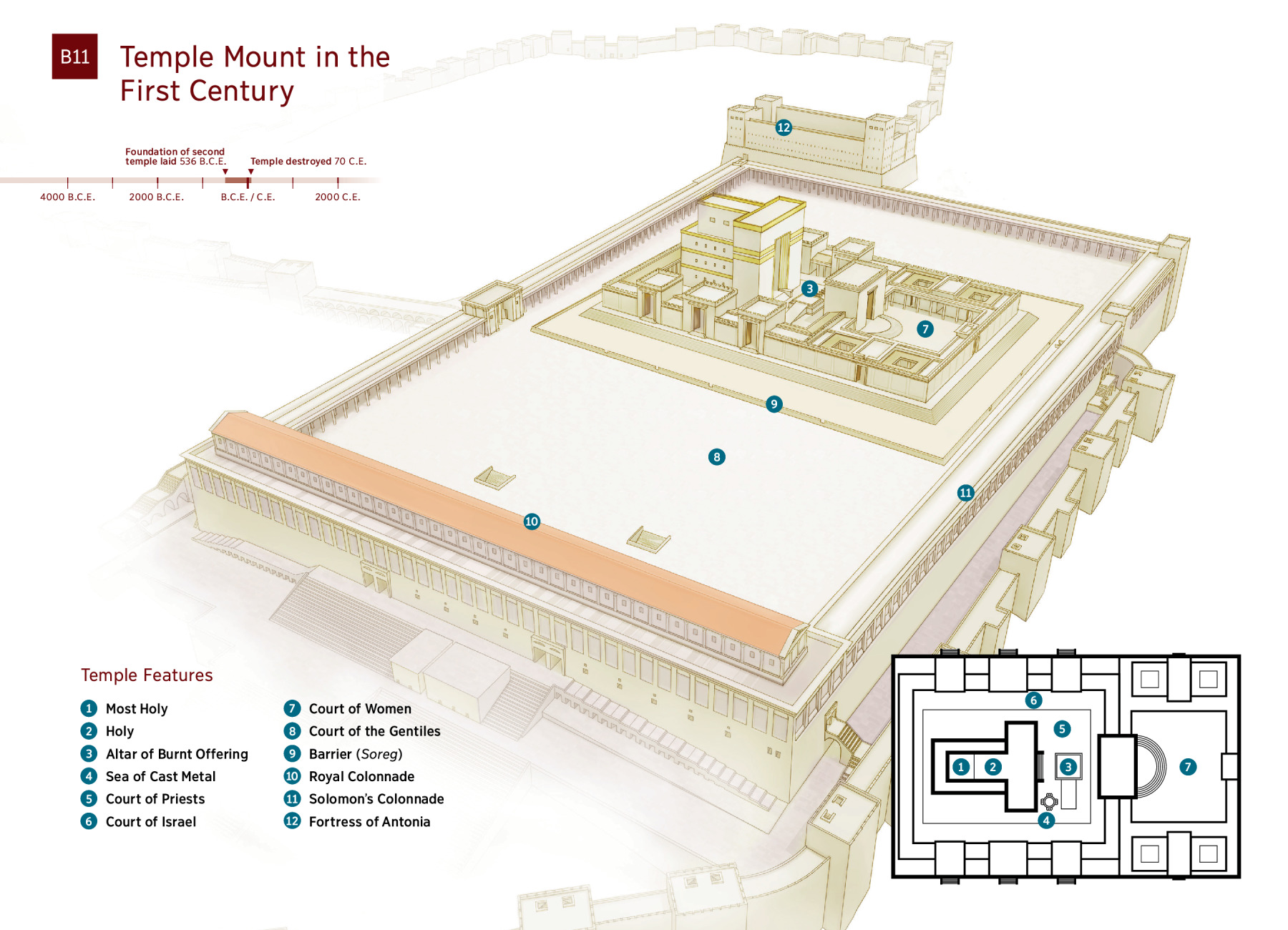
The “dividing wall” had been brought down just like the Berlin Wall in 1989.  The “dividing wall” (soreg) was the low-standing wall in the temple area that barred the Gentiles from getting too close to the temple.

This is the best image I could find of the temple mount.  It is from JW.org

During excavations of Jerusalem in 1871, two archaeologists, Clermont and Ganneau, discovered what is known as the Soreg Inscription. Written in Greek, the sign warns non-Jews to keep out of the temple area. It states:
 
“No foreigner is to enter the barriers surrounding the sanctuary. He who is caught will have himself to blame for his death which will follow.”

Image result for soreg

On the cross, Christ put to death the hostility between Israel and the other nations.

Thomas Constable writes:

Jesus Christ had two purposes in ending Jewish Gentile hostility.  First, He wanted to “create” one new man, the church (v. 6), out of the two former groups, Jews and Gentiles (v. 11).  Here the “new man” is not the individual believer but the church, the body of Christ (cf. 1:22-23; 1 Cor. 12:12-13; Col. 3:10-11; Heb. 12:23).  In the church, God does not deal with Gentiles as He did with Jews, nor does He deal with Jews as He did Gentiles.  Jews do not become Gentiles, nor do Gentiles become Jews.  Rather, God has created a whole new (Gr. kainon, fresh) entity: the church.

Jesus Christ’s second purpose for ending Jewish Gentile hostility was to bring (“reconcile”) Jewish and Gentile believers to Himself in “one body”: the church.  The Old Testament never spoke of Jewish and Gentile believers as being in “one body.”  Ironically, the Cross in one sense terminated Jesus, but Jesus terminated the enmity between Jews and Gentiles “with (through) the Cross.”  Not only have Jews and Gentiles experienced reconciliation with one another (vv. 14-15), but they have also experienced reconciliation with God by the Cross (v. 16).  The Cross satisfied God’s justice; it propitiated Him (cf. 1 John 2:2).

God’s plan for believers included the building of a new entity after Jesus Christ’s death, resurrection, and ascension (cf. Matt. 16:18).  It was to be the church.  The church is not just a continuation and modernization of Israel under a new name but a new creation (v. 15).  In the church, Jewish and Gentile believers stand with equal rights and privileges before God.  Membership in this new body is one of the great blessings of believers in the present age, along with individual blessings (vv. 1-10).  Paul glorified God for that blessing in this section of Ephesians.

John Stott enjoins us:

“I wonder if anything is more urgent today, for the honour of Christ and for the spread of the gospel, than that the church should be, and should be seen to be, what by God’s purpose and Christ’s achievement it already is—a single new humanity, a model of human community, a family of reconciled brothers and sisters who love their Father and love each other, the evident dwelling place of God by his Spirit.  Only then will the world believe in Christ as Peacemaker.  Only then will God receive the glory due to his name.

God’s Indictment of Israel (Hosea 4:1-3)

[Remember that this is a transcript for a radio broadcast, but longer than the actual broadcast.]

Thank you for joining me again in our study of the book of Hosea.  We have studied the first three chapters, which were more biographical in nature—using the marriage of Hosea and Gomer as a picture of God’s relationship with Israel.

Derek Kidner reminds us that…

[The book of Hosea] has begun to do what no other Old Testament book does quite so vividly: to speak of God and His people not primarily in terms of master and servant, or king and subjects (indispensable as these categories are), but as man and wife, with all that this implies of personal delight and potential hurt.

This approach is far from sentimental.  It sharpens guilt immeasurably by making it the betrayal of love; it shows the true motive of God’s persistence, so easily thought to be mere doggedness; and it deepens our understanding of repentance and renewal—for sins against love damage the very roots of a relationship, and are not healed by brisk apologies and hasty resolutions (The Message of Hosea, p. 45).

John Maxwell, a pastor and consultant who has written a number of books on leadership, has said, “Everything rises and falls on leadership.”  In this passage Hosea says it like this: “like people, like priest” in verse 9.  Much of the charges God lays out against Israel in Hosea 4 is directed against the priests, those who were given charge of educating Israel in God’s law.

Nothing is quite as revealing about a society, nor nearly so determinate, as the character of its leadership.  Israel, though God’s elect nation, was no exception.  The men in responsible positions of religious leadership—had failed to provide the caliber of leadership necessary to assure the national well-being.  The failure contributed to the nation’s religious and moral decline, and ultimately, to their devastation at the hands of Assyria.

But before God indicts the leaders, the priests in particular, lays a charge against the people of Israel.

Hosea 4:1-3 says…

1 Hear the word of the LORD, O children of Israel, for the LORD has a controversy with the inhabitants of the land. There is no faithfulness or steadfast love, and no knowledge of God in the land; 2 there is swearing, lying, murder, stealing, and committing adultery; they break all bounds, and bloodshed follows bloodshed. 3 Therefore the land mourns, and all who dwell in it languish, and also the beasts of the field and the birds of the heavens, and even the fish of the sea are taken away.

Any complacency which the happy ending of the first three chapters may have induced on the reader (if he has begun to picture God as the ever-accomodating husband), is now abruptly shattered.

Chapter 1 began with the words “the word of the Lord came to Hosea” and here in chapter 4, verse 1 we read “Hear the word of the Lord.”  This marks the beginning of a new section of the book.  Chapters 4—14 contain speeches that Hosea probably gave at various times in his long prophetic career.

Thomas McComiskey writes:

“At this point we leave the account of Hosea’s marriage and begin a new section, which extends to the end of the book and contains oracles of doom and hope.  Even in this section, however, we are never far from Hosea’s marriage, for it is always in the background and is the catalyst for his message to his people.  We see it in the references to the nation as mother and children, as well as in the numerous allusions to spiritual harlotry and adultery.”

Ronald Vandermay sees three attributes of God exhibited here: His holiness in chaps. 4-7; His justice in chaps. 8-10 and His love in chaps. 11-14.  “As God’s holiness demands that the nation of Israel receive an indictment for her sin, so also His justice requires that Israel should be punished.  But in the midst of these two great attributes a third is at work: the love of God, which has as its chief goal the restoration of God’s people to himself.

In this nearer context, Duane Garrett sees a threefold pattern in this structure indicating that Hosea’s three children continue to dominate the pattern of his prophecy.  So he sees the chapter 4, vv. 1-3 organized around Jezreel, due to the presence of murder in Israel.  The Lo-Ammi section is vv. 4-14, which address three groups and show the alienation between Israel and Yahweh.  Finally, there is Lo-Ruhamah, with three warnings for Judah and Israel.

This chapter may be divided into the charge of divine indignation (vv. 1-2) and its consequences (v. 3), charges particularly against the priests (vv. 4-11) and their followers because of gross idolatrous practices (vv. 12-14), capped off by a solemn warning to Judah not to follow in her sister’s footsteps (vv. 15-19).

Here Yahweh brings a legal charge against the Israelites for breaking the Mosaic covenant.  The offenses are stated in the negative in verse 1 and positively in verse 2.  This indictment is all the more telling because they are precisely what God pre-eminently looks for in our relationship with Him and one another.

Although not exactly a court case against Israel, this is the language being used here.  Thus, David Hubbard notes:

“Since a number of ingredients are lacking—a summons to witnesses (cf. Mi. 6:3-5), questions and answers about divine requirements (cf. Mi. 6:6-8)—it is more likely that the literary form compresses an argument or quarrel between Yahweh and the people rather than a scene of formal legal charges.”

Nevertheless, what charges God is bringing against Israel signal that they have broken covenant with God.  This is especially the language of verse 1…

There is no faithfulness or steadfast love, and no knowledge of God in the land

Essentially, Yahweh is saying, “I can’t trust you.”  How sad that sounds.

We know how vital trust is in any relationship, but especially in a marriage.  When that trust is broken, it may take a long time, and hard work, to win it back.  It doesn’t happen overnight.

First of all, there was no “faithfulness” in the land.  The word here is emeth, which can mean truthfulness in word or action.  Here is likely has the idea of integrity or faithfulness to the relationship  and the sanctity of it.

The Israelites might make promises, but they would be empty.  They might act, but their hearts were devious.

Second, there was no “steadfast love” in the land.  This is the word chesed, in Hebrew, the word often used to define the motivation behind making and keeping covenant.  With faithfulness gone, there was no steadfast love, and vice versa.

Covenant love will once again be operative when God draws the whole house of Israel back to Himself (2:19; 10:12; 12:6; Jeremiah 31:1-3; cf. Psalm 17:7; 25:6; 69:16; 103:4; Isaiah 63:7; Jeremiah 9:24; 16:5; 32:18).  Covenant love, or loyalty, is not simply a matter of fulfilling one’s duties to a covenant obligation; it is going beyond legal obligations to give kindness freely those with whom one relates.

Duane Garrett illustrates how this word is used.  He says…

When Lot proclaimed that the angels had shown him great chesed, in saving his life, he meant that they had given him mercy that he did not deserve, not that merely fulfilled some kind of duty to him (Gen. 19:19).  When Ruth offered herself in marriage to Boaz, he called it a great act of chesed, not meaning that she had fulfilled an obligation to him or to Naomi, but that she had gone far beyond what was required (Ruth 3:10).

The common thread here is that people are in relationship with one another, but that the person who shows chesed goes beyond basic requirements and freely gives kindness to the other.  Thus, chesed exists in a marriage when the husband goes beyond the minimal requirements of a husband’s obligations and shows real kindness to his wife. (Hosea, Joel, p. 119).

But more damning and more primary than these two deficits was that there was “no knowledge of God in the land.”  Any claim to it was already denied by the absence of the first two qualities.

Knowing God in the context of Hosea is deeply personal.  It is not knowing about God, although objective facts are involved, but knowing God in a deep, personal, intimate, experiential sense.  It is a personal relationship in which a person can honestly say, “You are my God” (Hosea 2:23).

It is also vitally important.  It was already mentioned in Hosea 2:8, 13 and 20; now here in Hosea 4:1, 6, 11, 14; in 5:4 and 15; Hosea 6:3 and 6; Hosea 8:2 and 13:6 and alluded to in several other places.

Not knowing God was Israel’s basic problem at this time, as indicated by Hosea 4:6:

My people are destroyed for lack of knowledge.

This is not knowledge of the law, or math or science, but specifically a knowledge of God.  A. W. Tozer said, “What comes into our minds when we think about God is the most important thing about us” and I would encourage you to read his little book The Knowledge of the Holy.

If you are more ambitious, I would encourage you to read J. I. Packer’s influential book, Knowing God.

When I was preaching through the attributes of God at Grace Bible Church a number of years ago, I made the distinction that we need to think both accurately and adequately about God.  Obviously, we need to think accurately about God.  We need to think of Him as the Bible presents Him, not as we would wish Him to be.  This is why God forbade making idols, because they could never capture the fullness of God’s perfections; instead caricaturing God by making one or a few attributes stand out to the exclusion of others.

But we also need to think adequately about God.  This is what I think increases our love for Him, our amazement and wonder of God.  For example, God is not just holy, but He is “holy, holy, holy.”  He is “rich in mercy,” “abounds in love” and “lavishes us with His grace.”  When we realize how over-the-top God is about us, our hearts are warmed and we experience that love that draws us into a deeper relationship with Him.

Unfortunately, that was not only missing in ancient Israel, but also our churches as well.

Derek Kidner comments:

“He is weighing Israel in the balance against faithfulness, kindness and the knowledge of God, only to find her wanting at every point: utterly light on all things that matter.  These three things lead us from the outskirts of goodness to its heart and centre, and at each point God finds in His people this fatal lack” (The Message of Hosea, p. 46).

As long as the knowledge of God was not found in the people of Israel, there would be no faithfulness and steadfast love in the life and activity of Israel.  Nor can there be in any other society, be it ancient or modern, because no society can possess “faithfulness” and “steadfast love” in the final analysis without a genuine knowledge of God.

Essentially the deficit of the heart attitudes in verse 1 reveal that Israel was breaking  the first table of the Ten Commandments, those directed towards Yahweh.

It is no wonder, then, that Israel was breaking the second table of the law as well.  Now put in the positive, Yahweh charges…

2 there is swearing, lying, murder, stealing, and committing adultery; they break all bounds, and bloodshed follows bloodshed.

We are accountable to both sins of omission (v. 1) and sins of commission (v. 2).

Did you notice that these have to do with the breaking of the sixth, seventh, eighth and ninth commandments?  The order differs from the two passages which lay out the Ten Commandments—Exodus 20 and Deuteronomy 5—and there is no clear indication why.

It may be to indicate the order of frequency, from greater to lesser.  On the other hand, it may have been put in this order for the purpose of showing, in ascending order, the danger to the community or for the provocation of the wrath of Yahweh.

In any case, the breaking of the commandments reflected the people’s attitude towards their covenantal responsibilities to one another.  Because they had no knowledge of God, they had no respect for one another.

All of these listed offenses are infinites in Hebrew, and E. B. Pusey explains what this signifies:

“The Hebrew form is very vivid and solemn.  It is far more forcible than if he had said, ‘They swear, lie, kill, and steal.’  It expresses that these sins were continual, that nothing else (so to speak) was going on; that it was all one scene of such sins, one course of them, and of nothing besides; as we say more familiarly, ‘It was all, swearing, lying, killing, stealing, committing adultery.'” (The Minor Prophets, 1:46).

This list makes us realize that God doesn’t distinguish, as we often do, between serious and light offenses.  We would likely shrug our shoulders at someone swearing, but think murder and adultery are especially wrong.  But God doesn’t distinguish the way we do.

Also, it is important to realize that these sins are reaching to the point of no return.  We never know where that is, but there is a point where God’s patience runs out.  Patience is, you realize, the only attribute of God that is not infinite.

When virtues are lacking, vices are present, each of which is represented by terms plucked verbatim from Israel’s law code.

Doesn’t this sound so much like the United States?  Having forbidden prayer and Bible reading from public schools, our schools have become dangerous places, with murders and sexual abuse.

Education expert William Jeynes spoke at the Heritage Foundation in Washington, D.C. on Aug. 13, 2014 and said…

“One can argue, and some have, that the decision by the Supreme Court – in a series of three decisions back in 1962 and 1963 – to remove Bible and prayer from our public schools, may be the most spiritually significant event in our nation’s history over the course of the last 55 years.”

On June 25, 1962, the United States Supreme Court decided in Engel v. Vitale that a prayer approved by the New York Board of Regents for use in schools violated the First Amendment because it represented establishment of religion. In 1963, in Abington School District v. Schempp, the court decided against Bible readings in public schools along the same lines.

Since 1963, Jeynes said there have been five negative developments in the nation’s public schools:

  • Academic achievement has plummeted, including SAT scores.
  • Increased rate of out-of-wedlock births
  • Increase in illegal drug use
  • Increase in juvenile crime
  • Deterioration of school behavior

Other facts included a comparison between the top five complaints of teachers from 1940-1962 — talking, chewing gum, making noise, running in the halls and getting out of turn in line – to rape, robbery, assault, burglary and arson from 1963 to present.

That last sentence sounds like it was taken right out of Hosea 4:2!  That is the consequence of removing the knowledge of God from our cultural life.

The first charge is “swearing,” which likely took the form of a curse, an imprecatory prayer or a man calling on Yahweh to support a falsehood.  It had the effect of denying faithfulness (v. 1) to one’s word.  It reflected a contempt for others.  It made real community an impossible dream.

Next, and likely occurring along with “swearing,” is “lying.”  This, too, deprives others of faithfulness.  It takes the form of dishonesty and deception.  It denies a person the right to fairness and justice in the market place, a court of law, or in any relationship.

If these first two, “swearing and lying” are a hendiadyes, then it refers to lying under oath.  But it is more likely that “swearing” breaks the third commandment and “lying” the ninth.

Paul shows us the importance of truthfulness in Ephesians 4:25 when he says…

25 Therefore, having put away falsehood, let each one of you speak the truth with his neighbor, for we are members one of another.

Paul’s reasoning for this “put off—put on” is the reality that lying rips the fabric of our relationships with one another.  There is no real community without truthfulness.

The third charge is “killing.”  Though the Old Testament allowed for divinely authorized killing of guilty persons, it denied a man the right to kill a fellow human being out of jealousy, hatred, revenge or lust.

But this was obviously happening in Israel.

This reflected a lack of steadfast love for their fellow countrymen and a lack of respect for human life and dignity.

The next thing with which they were charged was “stealing.”  Stealing denied a person’s right to material possessions that were entrusted to them by Yahweh, the ultimate owner of everything.

Finally, the people of Israel were charged with “adultery.”  This denied a person’s right to faithfulness and steadfast love within his own home.  Attacking the family in such a way, endangered the whole of society.

The verb in verse 2 is the term “break out,” so it is indicating that all these sins against one another run rampant, like an uncontrollable flood.  This is emphasized by “bloodshed follows bloodshed” as if it were an unstoppable force cascading down the mountain.  It is what Garrett believes signifies that this section is more closely related to Jezreel, because back in 1:4 Yahweh had declared, “I will bring the bloodshed of Jezreel upon the house of Jehu.”

Even though the primary blame will soon be placed in the lap of the religious leaders of Israel, the moral decline within the nation had become so widespread that the controversy was referred to as being “with the inhabitants of the land.”

There’s a movement going on within the realm of Christianity today where people are saying, “I don’t want to be known for what I am against, but what I am for.”  While that sounds good and noble, Eric Davis at Cripplegate, challenges that reasoning.  He says things like…

We don’t usually approach life that way, at least not wisely.  We teach our children what to avoid for their own good.  We hope our doctor is against things that are not good for us.

Also, to construct and conduct a good, stable society, we must be known for being against things.  We need to be against rape, pedophilia, sexual abuse.  We can’t just be for everything.

Actually, even the person who wants to be known for what they are for are also known for what they are against.  If you are for homosexuality, you are against heterosexuality.

Whatever the case may be, the person who wants to be known for what they are for cannot escape that they are known for what they are also against. The difference could simply be that it is more socially fashionable in certain sub-cultures to be known for being against the particular things that they are against. So, the real issue is not that they want to be known for what they are for, so much as it is that they want to be known for being for a particular subset of currently trendy ideologies.

More importantly, there are things that God wants us to be known for being against.  The Ten Commandments, for example, give us a list of ten things God is against.  The New Testament also has its lists of fleshly expressions it is against.  God is against false teaching as well.

Frankly, the ministries of men like Hosea, and all the Old Testament prophets as well as John the Baptist, were known primarily for what they were against.

Most emphatically, Jesus was known (and hated) for what he was against.  He was especially against the attitudes of self-promotion, self-actualization and self-glorifying among the religious leaders (Matthew 23:5-6).

Much of the content of the New Testament is against some sin or false teaching.  And finally, the desire to be known for what we are for rather than known for what we are against is primarily motivated by culture more than Scripture.

So, like God, we should be ready to rebuke these expressions of sin which break both the first and the second tables of God’s law.

These thoroughgoing violations of the terms of the royal covenant call for a commensurate judgment.  The word “therefore” at the beginning of verse 3 steels them to hear it, but hardly prepares them for its scope.

The judgment seems to be in the form of a drought, a sentence appropriate to their reliance upon Baal for rain and growth and harvest.  It will be so severe that “all who dwell in it languish.”  This was predicted by God in His covenant warnings back in Leviticus 26:13 and Deuteronomy 28:23-24.  This judgment extends to the animal kingdom as well, affecting all three domains (land, air and sea).  In Genesis 1, these are created in the reverse order.  That is also true in the dominion text in Genesis 1:28.

David Hubbard notes:

The annihilation of the animal kingdom is picture in language that outstrips the flood story, where at least representatives of each species were preserved (Gen. 6:18-22).  Hosea’s holocaust resembles closely Zephaniah’s (12:2-3) and echoes Genesis 1:30 in such a way that the appointed judgment for Israel’s sin is nothing less than the “reversal of creation.  Thus, Yahweh’s restoration, promised in 2:15-23, must include a covenant renewal with the entire animal kingdom (v. 18).

We know from Genesis 3 and Romans 8 that the destiny of all of God’s creation is tied to ours.  When we sinned, death and decay and all kinds of judgment fell upon the creation.  But when we are “brought in the glorious freedom of the children of God” (Romans 8:20), all creation will be made new.  Prior to that, there will be a time when man and animal and all creation will live together in peace and prosperity, according to Isaiah.

It is put vividly in Leviticus 18, where a catalogue of perversions culminates in a warning “lest the land vomit you out when you make it unclean, as it vomited out the nation that was before you” (18:28).  When man has no knowledge of God and no restraints in his violence against one another, we sacrifice the whole future for the cravings of a moment.

Anderson and Freedman summarize this portion by saying…

Yahweh’s ultimate passion is for chesed.  He has an unswerving commitment to covenant obligations.  The curses and blessings of the covenant work out in two contradictory directions–destruction and recreation.  The crisis in the mind of Yahweh is forced by fact, heartbreaking for him, that Israel’s chesed is so ephemeral–like morning mist, like clouds, insubstantial and speedily dissipated.  In contrast to this, Yahweh’s declaration is as certain as the daybreak.  In his chesed Yahweh is unalterably committed to two things: he will have a people of his own; and he will relentlessly punish the covenant violater.  These commitments collide and the collision leads to an impossible situation because the drive to punish and the drive to accept his people unconditionally are equally manifestations of his chesed, his determination to keep the promises he has made in both these areas.  He looked above all for a chesed in relation to match His own (6:6), but Israel’s chesed was like vapor (6:4a).  Hence Yahweh’s question to himself, “What shall I do?” (6:4)

For hundreds of years this question had grown in intensity.  The answer had been put off.  Yahweh was “slow to anger.”  He often relented and restrained Himself.  According to the analysis of Israel’s prophetic historians, toward the middle of the eighth century even the patience of Yahweh was exhausted.  At last the will for justice overcame the compassion which had hitherto restrained the divine anger.  The covenant curses are to be put into operation.  The punishment is describe in passages of unexampled horror.  They are made the more frightening because all secondary agents disappear, and the acts are ascribed to Yahweh himself.  He will rip, injure, hack and kill (5:14; 6:1, 5; cf. 11:9).

In Hosea we meet for the first time the clear statement of an astounding solution to this problem–Yahweh’s problem.  This solution satisfied both sides of his chesed.  Guilty Israel will be executed; that will satisfy covenant justice.  Then the people of Yahweh will be reconstituted through resurrection.  (Hosea, 328-329)

But that awaits full expression in Hosea 6.


M’Cheyne Bible Reading Plan, March 21

Today’s readings are from Exodus 32, John 11, Proverbs 8 and Ephesians 1.

Exodus 32 reveals Israel breaking covenant with Yahweh.  They had pledged their obedience, saying, “All that the LORD has spoken we will do, and we will be obedient” (Exodus 24:7) but here they reveal that, like us, our faithfulness is like the morning dew.

With Moses delayed upon the mountain, they impatiently desire a god to lead them onward.  Aaron plays along, offering to make an idol, a golden calf.

This ancient bronze bull figurine may have been covered in gold leaf

This ancient bronze bull figurine may have been covered in gold leaf.

Image result for golden calf mold

Dr. Curtis Ward thinks this may have been the mold used to make the calf idol.

The “calf” provided a visible symbol that the Israelites could and did identify as their “deliverer” (“This is your god, O Israel, who brought you up from the land of Egypt”).

“Throughout the remainder of the Pentateuch, the incident of the worship of the golden calf cast a dark shadow across Israel’s relationship with God, much the same way as the account of the Fall in Genesis 3 marked a major turning point in God’s dealing with humankind” (John Sailhammer, The Pentateuch, p. 310).

This is a serious offense against Yahweh, a betrayal of His redemption and covenant (cf. Acts 7:38-42).  He offered to destroy the Israelites and start over again with Moses (v. 10).  But Moses interceded (vv. 11-13) between Yahweh and the Israelites.  He reminded Yahweh of His actions for Israel in delivering them, how it would smear His name among the nations to destroy Israel now, and of His promises to Abraham, Isaac and Jacob.

So “the LORD relented.”  Some versions have “changed His mind.”  Does this deny God’s immutability or foreknowledge?  One way of looking at this is that it is an anthropopathism, a way of explaining God’s ways in terms of human emotions.  Another way of explaining it is that God didn’t really “change” His mind, but took a different path to reaching His foreordained conclusion.

Thomas Constable explains that approach…

Within the plan of God, however, He has incorporated enough flexibility so that, in most situations, there are a number of options that are acceptable to Him.  In view of Moses’ intercession, God proceeded to take a different course of action than He had previously intended.

Ephesians 1:11 says that God causes everything to work out the way He wants it to (cf. Rom. 8:28).  He foreordains what comes to pass, but Scripture doesn’t say that He foreordains how everything will come to pass, or when it will come to pass, or by whom it will come to pass.  Prayer and evangelism are two of the means that God has ordained, that is, human activity, whereby what He has foreordained comes to pass.  In these activities, people become partners with God in bringing His will to happen in the world.

Occasionally, my wife has called me at work and asked me to pick up a gallon on milk on my way home.  When this happens, I take a different route than I would normally, but I end up at home nonetheless.  Perhaps this is similar to how our praying affects God as He carries out His will.

That may not be satisfying to everyone, because the text does say, “God relented” or “changed his mind.”

See John Munro, “Prayer to a Sovereign God,” Interest 56:2 (February 1990):20-21; Thomas L. Constable, “What Prayer Will and Will Not Change,” in Essays in Honor of J. Dwight Pentecost, pp. 99-113; and Robert B. Chisholm Jr., “Does God ‘Change His Mind’?” Bibliotheca Sacra 152:608 (October-December 1995):387-99.

“In only two of the thirty-eight instances in the OT is this word used of men repenting. God’s repentance or ‘relenting’ is an anthropomorphism (a description of God in human forms [sic form]) that aims at showing us that he can and does change in his actions and emotions to men when given proper grounds for doing so, and thereby he does not change in his basic integrity or character (cf. Pss 99:6; 106:45; Jer 18:8; Amos 7:3, 6; Jonah 3:10; James 5:16). The grounds for the Lord’s repenting are three: (1) intercession (cf. Amos 7:1-6); (2) repentance of the people (Jer 18:3-11; Jonah 3:9-10); and (3) compassion (Deut 32:36; Judg 2:18; 2 Sam 24:16[; 1 Chron. 21:15])” (Walter Kaiser, Exodus, p. 479).

And Cole says…

“We are not to think of Moses as altering God’s purpose towards Israel by this prayer, but as carrying it out: Moses was never more like God than in such moments, for he shared God’s mind and loving purpose.”

So Moses confronts Aaron and Aaron makes excuses (32:21-24).  Moses offered the challenge, “Who is on the LORD’s side?” and the Levites responded.  They then went through the camp and killed 3,000 people.  Moses confronted the people with their “great sin,” offered to make atonement for them and went back to intercede with Yahweh (32:30-32).  God’s response is that He would deal with the sinners, but Moses was to lead them to the place they had been promised (32:33-35).

John 11

Although his close friend Lazarus was seriously ill (v. 2), Jesus did not immediately go to help him even though he dearly loved Lazarus and his sisters (vv. 3-5).

What does Jesus mean by “This sickness does not lead to death”?  If Lazarus was already dead (which is quite possible), this is still a weird way to say it.  Given the fact that Jesus will later promise a life that overcomes death (v. 26), He may have meant the “second death” (Rev. 20:6), eternal death.  Again, this is not a normal way to communicate this idea.

Spurgeon says that the Lord “speaks of things, not as they seem to be, nor even as they are in the present moment, but as they shall be in the long run.”

Jesus stayed another couple of days, so that Lazarus would be in the grave four days and this miracle would glorify God and the Son.

Why 4 days?  There was a Jewish custom that the spirit hovered around the body for three days, but left on the fourth.  In other words, Lazarus was REALLY DEAD.

When Jesus spoke of returning to Judea, His disciples thought it was a crazy idea (v. 8).  Jesus responded that He had time to do what needed to be done (v. 9) and that Lazarus would rise again (v. 10).  In this conversation, Jesus affirmed that Lazarus was dead.

“So we may learn that He often permits us to pass into profounder darkness, and deeper mysteries of pain, in order that we may prove more perfectly His power.” (G. Campbell Morgan)

So Jesus traveled to Bethany near Jerusalem.

When Jesus arrived, Martha expressed her faith that Jesus could have healed Lazarus, if he had gotten there sooner (vv. 21-22).  Jesus simply said…

23 Jesus said to her, “Your brother will rise again.”

Martha thought he meant the resurrection of the dead for all believers, but Jesus meant she would see him again in this life.  Jesus does, however, give the promise that all believers will rise.

“Death comes to the ungodly man as a penal infliction, but to the righteous as a summons to his Father’s palace: to the sinner it is an execution, to the saint an undressing.  Death to the wicked is the King of terrors: death to the saint is the end of terrors, the commencement of glory.” (Spurgeon)

When Mary came to meet Jesus, she was weeping and expressed her own faith that Jesus could have healed Lazarus (vv. 32-33).  When Jesus came to the tomb of Lazarus, he wept (11:35).

Photo from Gospel Devotions

This would be a typical tomb in the first century.  This would be inside a cave and bodies of family members would be wrapped and placed in one of the three burial chambers you see here.  After one year when the flesh has gone away, they would gather the bones in burial boxes (ossuaries) and put them on a “shelf” inside the family tomb.

In v. 33 we read that Jesus “was deeply moved in his spirit and greatly troubled.”  Both words have the idea of a guttural but vocal response of deep emotion.

It means that Jesus wasn’t so much sad at the scene surrounding the tomb of Lazarus. It’s more accurate to say that Jesus was angry.  Jesus was angry and troubled at the destruction and power of the great enemy of humanity: death.  Jesus would soon break the dominating power of death.

Jesus was angry, but at what?  The context provides some help in identifying the cause of His anger.  Evidently as Jesus viewed the misery that death inflicts on humanity and the loved ones of those who die, He thought of its cause: sin.  Many of “the Jews” present had come from Jerusalem, where Jesus had encountered stubborn unbelief.  The sin of unbelief resulted in spiritual death, the source of eternal grief and mourning.  Probably Jesus felt angry because He was face to face with the consequences of sin, and particularly unbelief. (Thomas Constable)

But He did weep as well.

His weeping doubtless expressed outwardly the sorrow that contemplation of sin and its consequences produced in His heart.  Jesus’ “tears” are proof of His compassion for fallen humanity (cf. Luke 19:41).

He could not have been weeping over the loss of His friend Lazarus, since He was about to restore him to life.  Likewise it is unlikely that He was just weeping compassionately with Martha and Mary, since He was about to turn their grief into rejoicing.  Nevertheless empathy undoubtedly played some part in Jesus’ weeping.

In the resurrection of Lazarus we see the supreme power of Jesus Christ over death, the final stronghold of Satan.

This miracle illustrated Jesus’ ability to empower people with new life (cf. 14:6).  He had previously raised the widow of Nain’s son (Luke 7:15), and brought Jairus’ daughter (Matt. 9:25; Mark 5:42; Luke 8:55) back to life, but Lazarus had been dead four days!

Some note that Lazarus’ resurrection is similar to our regeneration, while needed to be loosed from the grave clothes approximates our sanctification.

The chapter ends with two responses to this astounding miracle–belief and unbelief.  It’s just not true that miracles definitely produce faith.

Proverbs 8 is a defense of wisdom. The sage returned to the figure of Wisdom that he used at the beginning of this part of Proverbs (1:20).

The argument of this section develops as follows. Wisdom would be every person’s guide (vv. 1-5; cf. Gal 5:18, 22-23).  She is morality’s partner (vv. 6-13), the key to success (vv. 14-21), the principle of creation (vv. 22-31), and the one essential necessity of life (vv. 32-36).  Chapter 8 contains the longest sustained personification in the Bible.

Though described as with God, wisdom is not asserted to be God.  Such a presentation is consistent with personification, a literary metaphor in which a thing or an abstraction is represented as a person. (Common examples of personification in our ordinary lives include Mr. Clean, Aunt Jemima, the Jolly Green Giant, etc.)  So “Lady Wisdom”  is not the female side of God, nor is she a feminine deity in her own right. Instead she praises God; she calls people to heed her teachings and so to find life.  Wisdom shows the character of God, and God will give wisdom to all who learn from the Proverbs.

Some believe that vv. 30-31 describes the co-creative work of the Father and the Son, delighting in the creation.  Although it represents what actually happened, it is best not to equate wisdom with the Son, because in v. 22 it was created.

Ephesians 1 begins with an amazing description of our spiritual blessings in Christ (1:1-14), followed by a prayer that our eyes might be opened to these benefits (1:15-23).

2nd and 3rd Missionary Journeys

Ephesus is in the center of the map, on the western coast (Aegean Sea) of Asia Minor.  Ephesus was a wealthy port city in the Roman province of Asia.  It was a center of learning and was near several key land routes.

Paul’s first visit to Ephesus was on his second missionary journey (Acts 18:18-21).  It was a short visit around 52 A.D.  On his third missionary journey he spent nearly three years in Ephesus (Acts 19), then later returned to say farewell to the elders of the church (Acts 20:17-38.  He had great fondness for the Ephesian church.

The apostle Paul wrote this letter to the churches in Ephesus and the surrounding region c. A.D.62 while imprisoned in Rome (Acts 28). During this time he also wrote Colossians and Philemon.  All three letters were sent with Tychicus and Onesimus.  He would later write 1 and 2 Timothy to Timothy, the pastor of the Ephesian church.  And John writes to them in Revelation 2:1-7.

Book Chart, Swindoll

Paul tells us that those “in Christ” (a key phrase) receive these spiritual blessings: being chosen (v. 4), being predestined to adoption (v. 5), redeemed and forgiven (v. 7), given an inheritance (v. 11), sealed by the Spirit (v. 13) and He is the pledge of our inheritance (v. 14).

Note both the presence of the Trinity–the Father (vv. 3-6), the Son (vv. 7-12) and the Spirit (vv. 13-14) as well as the repeated “to the praise of his glorious grace/to the praise of his glory” (vv. 6, 12, 14).

Ephesians and Colossians, as well as 2 Peter, all communicate the completeness of what we already have in Christ:

  • Ephesians 1:3, “who has blessed us in Christ with every spiritual blessing in the heavenly places” (ESV)
  • Colossians 2:10, “you are complete in Him” (NKJV)
  • 2 Peter 1:3, “His divine power has given us everything we need for a godly life” (NIV)

Paul’s prayer in 1:15-23 reveals that we don’t need to ask for more, just ask that our blinders might come off in order to really see and experience all He has done for us.

What I Read in March 2019

Apologetics at the Cross: An Introduction to Christian Witness by Joshua D. Chatrow and Mark D. Allen is designed as a classroom textbook.

The first four chapters establish a foundation for apologetics at the cross by tracing the theme of apologetics through the Scriptures and then showing how it was used in Christian history.

The object of the book is to do apologetics differently.  Instead of being argumentative, be gentle; instead of coming in with all the answers, listen; instead of one approach, tailor it to the person.

How to Think: A Survival Guide for a World at Odds by Alan Jacobs

This book talks about how we think, and how we often think poorly and don’t often realize it.  It teaches us about thinking and how to think so as to rescue us from the divisiveness we see all around us today.

Othello

Is a story about jealousy and manipulation.  Iago, passed over for a promotion, first tries to set up Cassio for revenge, but also helps his friend Roderigo win back Desdemona.  So Iago manipulates through shrewd conversations to discredit Cassio and to make it look like Desdemona (Othello’s wife) has been unfaithful with Cassio.  As typical in Shakespeare, somebody dies.  Actually, almost everyone dies.  All because of jealousy, “the green-eyed monster.”

Gilead by Marilynne Robinson

I have to confess, I did not see what made this a Pulitzer Prize winning novel.  It is a story about fathers and sons and the impact of the Civil War.

Gay Girl, Good God by Jackie Hill Perry

This book describes Jackie’s same-sex attraction to girls and her struggle with giving that up.  It is a good book describing those struggles and how to please God with your sexual life.  It is also a good book describing the impact of the gospel and the struggles of sanctification.

Working the Angles by Eugene Peterson

Peterson identifies three practices which are missing from most pastor’s schedules but are vital for real pastoring–prayer, Bible reading and spiritual direction.