Yahweh’s Exasperation Over Israel’s Disloyalty (Hosea 6:4-6)

In many ways grace is what the book of Hosea is about.  Although Israel is consistently unfaithful and turns to idols and other nations for help instead of turning to their God, His heart is broken and He longs for their true return.

Our problem is that we don’t take sin seriously enough and our repentance, therefore, is insufficient.  We heard the words of Israel’s repentance last week.  They certainly sounded good.

1 “Come, let us return to the LORD. He has torn us to pieces but he will heal us; he has injured us but he will bind up our wounds. 2 After two days he will revive us; on the third day he will restore us, that we may live in his presence. 3 Let us acknowledge the LORD; let us press on to acknowledge him. As surely as the sun rises, he will appear; he will come to us like the winter rains, like the spring rains that water the earth.”

In these verses they express their intention to turn back to God for healing, expecting that He would revive them.  They believed that if they pressed on to know Him, He would return to them.  But, alas, their repentance never addressed their sin.  Sure, they wanted healing, but didn’t ask for forgiveness.  They wanted their circumstances fixed, but left their sin intact.

Listen to Yahweh’s response to this seemingly good repentance:

4 “What can I do with you, Ephraim?  What can I do with you, Judah?  Your love is like the morning mist, like the early dew that disappears. 5 Therefore I cut you in pieces with my prophets, I killed you with the words of my mouth— then my judgments go forth like the sun. 6 For I desire mercy, not sacrifice, and acknowledgment of God rather than burnt offerings.

In this text Yahweh speaks of his frustration with the transitory devotion of Israel (v. 4).  He then declares this is the reason for issuing judgments against them (v. 5) and proclaims that what He really wants is loyal love, not outward shows of religious zeal (v. 6).

You can hear the frustration, the cry of exasperated love in Yahweh’s voice.  G. Campbell Morgan calls this paragraph “The Difficulty of God.”

“What can I do with you, Ephraim?  What can I do with you, Judah?

One must not miss this outburst of emotion, like an anguished father not knowing what to do with his wayward child, or a husband agonizingly frustrated with his promiscuous bride (cf. 11:8Luke 15:20).

Campbell Morgan notes how startling this question is:

I can understand a man saying, What shall I do to be saved?  But here is God saying, What shall I do to save him?  This is not the cry of the human soul seeking after God.  It is the cry of God seeking after the human soul.  This is not the picture of a man in difficulty because he cannot find God.  It is the picture of God in difficulty because He cannot deal with man.

Both kingdoms were equally exasperating to God.

It is as if God should say, I have done my utmost, as in Isaiah 5:5 (where Yahweh expresses his consternation over a vineyard, a symbol of Israel, that produces only rotten grapes), Micah 5:3, and now am I at a standstill, and can scarce tell what to do more.  Again, it is like Jesus’ cry in Matthew 23:37…

37 “Jerusalem, Jerusalem, you who kill the prophets and stone those sent to you, how often I have longed to gather your children together, as a hen gathers her chicks under her wings, and you were not willing.

As the loving hen is always caring for her chickens, and calling them about her, that she may gather and guard them from the mischief of all predators; but they will persistently be straggling, and so perish; so if God’s people will not listen to his voice, if Israel will have none of him, what can he do less than give them up to their own hearts’ lusts?

He is perturbed at their seeming inability to acknowledge their sins and truly return to Him.  Because they were ungrateful of His blessings, they failed to love Him in return; instead loving other gods.

Your love is like the morning mist, like the early dew that disappears.

They declared their love, and they showed it…but for a brief moment.  Then they were on to their next sin, their next love affair with another god.  Like us, it was not that there was no faithfulness at all, just barely any at all.

As John Trapp says…

In a word, they were both false and fickle, unsteady and unstable, constant only in their inconstancy.  Hence this pathetic complaint of them; God knew not where to have them, and therefore not what to do with them.

This pathetic pattern of loyalty-disloyalty-punishment had lodged in Israel’s psyche since the days of the Judges.  Now, however, this malignancy of disloyalty had spread throughout the nation.

It is good to have mountain top experiences, those moments of ecstasy, but what God wants is the slow, constant producing of fruit in our lives.  When we trust in those brief, beautiful moments, then God says, “What else can I do with you?”

Growing out of verse 3, there is a striking contrast between Yahweh’s hesed, which rises like the sun, and Israel’s, which disappears like the morning dew.

The word “love” in v. 4 is hesed, the word that describes loyal love, covenant faithfulness, devotedness.  It is not the presence of sin that so perturbs Yahweh, but the absence of love.

Whatever faithfulness and devotion there was, quickly evaporated like the morning dew in summer.  It is as ephemeral as a cloud, quickly blown away.  Yes, both can be beautiful, but neither is constant.

Genuine repentance has an abiding element.

The only real hope for Israel is their Messiah, Jesus Christ.  But before Yahweh would send His Son, He sent His prophets.

5 Therefore I cut you in pieces with my prophets, I killed you with the words of my mouth— then my judgments go forth like the sun.

Throughout history God had sent them prophets to turn them back to Yahweh.  The priests had failed them, now the prophets have been sent to them.  God’s judgment goes out as a light, exposing their sins and idolatries.

The prophets would come, wielding the Word like a sword, bringing judgment and hope.  Hosea probably had in mind those earlier prophets of Israel, such as Elijah, Ahijah, Micaiah ben Imlah—prophets whose words were a sword.

The words of verse 6 take us back to the time of Samuel, while the “cutting in pieces” fits the time of Elijah.  It merely shows that faithfulness has been a longstanding problem with Israel.

By the way, the statement “my judgments go forth like the sun” is ironic, given the fact that Israel’s promise of return in vv. 1-3 depended upon Him coming to them “as the sun rises.”  What they hoped would bring healing, would instead bring judgment…at least for the immediate future.

The prophets would preach the word.  It is the Word of God that is powerful.  Hebrews 4:12 says…

12 For the word of God is alive and active. Sharper than any double-edged sword, it penetrates even to dividing soul and spirit, joints and marrow; it judges the thoughts and attitudes of the heart.

Just as a surgeon’s scalpel lays bare the flesh and organs, in order to bring healing, so God’s Word penetrates even deeper, into the soul and spirit, able to “judge the thoughts and attitudes of the heart.”  It exposes our motives behind our actions.

Jeremiah spoke of God’s Word as like a hammer; breaking the rock in pieces, like a winnow, separating wheat and chaff; like a consuming fire, destroying the chaff (Jere. 23:28ff).  The Word of God itself is performative (or in the words of Andersen and Freedman, “almost autonomous”), carrying within itself the power to transform.  Isaiah 55:10-11…

10 As the rain and the snow come down from heaven, and do not return to it without watering the earth and making it bud and flourish, so that it yields seed for the sower and bread for the eater, 11 so is my word that goes out from my mouth: It will not return to me empty, but will accomplish what I desire and achieve the purpose for which I sent it.

All we must do is preach the word, and it will do the work.  Martin Luther, the leader of the Protestant Reformation, once said…

“Take me, for example.  I opposed indulgences and all papists, but never by force.  I simply taught, preached, wrote God’s Word: otherwise I did nothing.  And then, while I slept or drank Wittenberg beer with my Philip of Amsdorf the Word so greatly weakened the papacy that never a prince or emperor did such damage to it.  I did nothing: the Word did it all.  Had I wanted to start trouble…. I could have started such a little game at Worms that even the emperor wouldn’t have been safe.  But what would it have been?  A mug’s game.  I did nothing: I left it to the Word.”

Isaiah goes on to describe the kind of transformation that the Word of God can effect:

13 Instead of the thornbush will grow the juniper, and instead of briers the myrtle will grow.  This will be for the LORD’s renown, for an everlasting sign, that will endure forever.”

It is impossible for a juniper to come from a thornbush, or a myrtle from thistles, but God’s Word can change the very nature of things, or people.  All we have to do is preach it.

Paul David Tripp, encouraging (and admonishing) pastors in his book Dangerous Calling, says,

The picture here is of fundamental, specific, and personal transformation.  When the Word of God, faithfully taught by the people of God and empowered by the Spirit of God, falls down, people become different.  Lusting people become pure, fearful people become courageous, thieves become givers, demanding people become servants, angry people become peacemakers, complainers become thankful, and idolaters come to joyfully worship the one true God (p. 51).

So God had sent Israel prophets.  Unfortunately, the words of the prophets sent to Israel were more judgment than transformation.  Their words were “deadly” and possibly refer to the covenant curses of Deuteronomy 30.

Yet what Israel found refuge in was religion, religious practices.  But Yahweh is always more concerned with reality over ritual, with relationship over religion.  Hosea 6:6 says…

6 For I desire mercy, not sacrifice, and acknowledgment of God rather than burnt offerings.

Andersen and Freedman note that the emotional verb “I desire” matches the early emotional expressions of disappointment and anguish (v. 4).

It is not that God wanted to do away with the sacrificial system (that would come later), but He is illustrating the higher importance of what goes on in the heart.  As Yahweh looked at their multiple sacrifices He saw no “loyal love” (this is the same word used in v. 4) and no real “acknowledgement” of God.

Sacrifices were meaningless, even offensive, unless offered out of a heart of love that demonstrated obedience to God’s Word (cf. 1 Sam. 15:22; Isa. 1:11-17; Amos 5:21-24; Mic. 6:6-8; Matt. 9:13; 12:7).

Jesus twice quoted this passage of Hosea to the religious leaders of His day (Matthew 9:13 and 12:7).  They also missed the heart of God, focusing on the wrong and superficial things.   Israel brought animals for sacrifice, but they never brought themselves as a living sacrifice (Rom. 12:1).  They missed what God really wants: a deep, close relationship with Him.

God wanted steadfastness over sacrifice and faithfulness over formality.  What they were doing, practicing rituals without real devotion, was meaninglessness and hypocritical.

Both Isaiah and Malachi called a stop to such sacrifices, because they were nauseating to God.  In Isaiah 1, Isaiah says…

11 “The multitude of your sacrifices— what are they to me?” says the LORD. “I have more than enough of burnt offerings, of rams and the fat of fattened animals; I have no pleasure in the blood of bulls and lambs and goats. 12 When you come to appear before me, who has asked this of you, this trampling of my courts? 13 Stop bringing meaningless offerings! Your incense is detestable to me. New Moons, Sabbaths and convocations— I cannot bear your worthless assemblies. 14 Your New Moon feasts and your appointed festivals I hate with all my being.  They have become a burden to me; I am weary of bearing them. 15 When you spread out your hands in prayer, I hide my eyes from you; even when you offer many prayers, I am not listening.  Your hands are full of blood!

Isaiah’s next words were a call to urgent repentance.

David recognized the greater value of a repentant heart over ritual sacrifices when he wrote (Psalm 51):

16 You do not delight in sacrifice, or I would bring it; you do not take pleasure in burnt offerings. 17 My sacrifice, O God, is a broken spirit; a broken and contrite heart you, God, will not despise.

Again, the prophets are not opposed to acts of worship, but merely recognizing that without a heart of loyal love behind it, it is worth nothing.

As Duane Garrett says…

In modern language one might appropriately rephrase this verse as: “I desire devotion and not hymn-singing, service and not sermons,” without thereby concluding that hymns and sermons were evil.

Or, in the words of Andersen and Freedman, “sacrifice is not denigrated; it is simply put in second place.”

Think about that as you worship this Sunday.  Whether you sing hymns or praise songs, is your heart engaged?  Are you singing from a heart that is deeply in love with Jesus, deeply grateful for all that He has done for you?  Are you singing from a heart ecstatic that your sins are forgiven?

Can you sing “I Surrender All” and really mean it?

This is what Yahweh looked for in Israel and Judah, and what Jesus looks for in us today.  He wants us to worship Him “in spirit and truth.”

Henry and Richard Blackaby, in their Experiencing God Day-by Day devotional, say…

No amount of activity for God will ever take the place of a heart that is right with Him.  Through the ages God’s people have been persuaded that they could please Him through their service and their offerings, regardless of their heart condition.  King Saul offered generous sacrifices, hoping God would overlook his disobedience (1 Samuel 15:22-23).  David may have assumed that after all he had done on God’s behalf, God would overlook his sin (2 Samuel 12:7-15).  Ananias and Sapphira thought that their generous gift to the church would compensate for their deceitfulness (Acts 5:1-11).  Paul was certainly one who had thought his zealousness would please God.  After his conversion, however, he concluded that even if he had faith to remove mountains, gave all he had to feed the poor, and offered his body to be burned for the sake of God, and yet had a heart that was not right, it would all be for nothing (1 Corinthians 13:1-13).

We are susceptible to the same misunderstanding as all of these people were.  We can be deceived into assuming God is more interested in our activity for Him than He is in the condition of our heart.  But His desire is that we devote ourselves to knowing Him and loving Him with all of our hearts.

Israel’s Faulty Repentance (Hosea 5:14-6:3)

Thank you for joining me again in our study of this great book of Hosea—this tragic love story played out on the human level between Hosea and Gomer, a story which is heartbreaking in itself—but also a story which illustrates the relationship between Yahweh and Israel, a much deeper betrayal in the spiritual realm.

Throughout Hosea we see Yahweh’s heart revealed—a heart that deeply desires to see genuine repentance from Israel, yet devastated by her continual unfaithfulness.  It reminds us how deeply God loves us as well, and how often He is disappointed by our own idolatries.

Today open your Bibles to the end of Hosea 5.  Yahweh has been predicting the destruction of Israel, judgment against their idolatries (turning to Baal rather than Yahweh for blessings and guidance) and their dependence upon other nations for protection rather than upon Yahweh.

Throughout chapter 5 it seems very obvious that Israel is on a path of destruction.  Despite many sacrifices, they would not longer be able to find Yahweh.  He would be to them the slow and gradual destruction illustrated by the “moth” and “dry rot” in v. 12 and the violent and ultimate death illustrated by being torn apart by a lion in vv. 14-15.

Let’s pick up our text in Hosea 5:14…

14 For I will be like a lion to Ephraim, and like a young lion to the house of Judah. I, even I, will tear and go away; I will carry off, and no one shall rescue. 15 I will return again to my place, until they acknowledge their guilt and seek my face, and in their distress earnestly seek me.

1 “Come, let us return to the LORD; for he has torn us, that he may heal us; he has struck us down, and he will bind us up. 2 After two days he will revive us; on the third day he will raise us up, that we may live before him. 3 Let us know; let us press on to know the LORD; his going out is sure as the dawn; he will come to us as the showers, as the spring rains that water the earth.” 4 What shall I do with you, O Ephraim?  What shall I do with you, O Judah?  Your love is like a morning cloud, like the dew that goes early away. 5 Therefore I have hewn them by the prophets; I have slain them by the words of my mouth, and my judgment goes forth as the light. 6 For I desire steadfast love and not sacrifice, the knowledge of God rather than burnt offerings.

Verse 14 adds another dimension to the judgment Yahweh would bring upon Israel.  Not only was there the slow, hidden, gradual process of destruction represented by the moth and dry rot, but there is also the ferocious and purposeful attack of a lion.

As a lion, He would tear them to pieces and carry them away in judgment, and there would be no one who could deliver them.  Egypt couldn’t.  No one could.

Israel fell to the Assyrians, in 722 B.C., after two previous Assyrian invasions (in 743 and 734-32 B.C.).  Judah escaped Assyria in 701 B.C., due to King Hezekiah’s trust in the Lord, but Babylonia finally fulfilled this prophecy to her in 586 B.C.

In verse 15 Hosea describes the lion retreating to its lair to finish off Israel.  All is lost.  All is hopeless.  No one and nothing could rescue them from this fate.  Just as no one could rescue an animal from the lion’s den, so Israel’s fate was sealed.

But notice that God’s judgment is not punitive, but restorative.  What is God’s purpose, God’s desire?  It is “until they acknowledge their guilt and seek my face, and in their distress earnestly seek me.”

Now, the big question in this passage is whether Hosea 6:1-3 expresses a genuine return by Israel?  Verses 4-6 show God’s disappointment in how shallow and transient it would be.  Does that mean it is not genuine, or just that it was short-lived?  I believe that it was genuine, at least among a remnant, but that, like us, their faithfulness was short-lived and shallow.  It was genuine, but not permanent.

Their return to Yahweh, pictured in vv. 1-3 of Hosea 6, seems to lack an acknowledgement of guilt.  They sought Yahweh to relieve them of their distress, but did not admit their sins and curry His forgiveness.  Many today want Jesus to fix their problems—to save their marriages, restore fulfillment in their jobs, to recover from sickness, but don’t come to Jesus desiring forgiveness for sins.

Some believe that vv. 1-3 represent the encouragement of the priests to the people.  They had failed to instruct the people in righteousness, which would have kept them from judgment, and now that judgment was upon them they urgently appeal to the people to turn back to Yahweh.  It would be too little, too late.

Again, the focus seems to be upon their wounds and seeking relief from national disaster, rather than focusing upon their sins and seeking forgiveness for their sins.  As David Garland says, “It did not reach to the real problem, sin, which could not be cared for in the healing and binding up.  It could only be cared for through genuine repentance.”

They do believe, however, that God can do what no one else could do.  No one could rescue them or help them, but Yahweh will heal them and bring them back to life.

Like us, they wanted this healing to come in a relatively short time “after two days…and on the third…”  They believed that God would speedily restore their former status.

This will eventually happen, but not so speedily as they hope.  This national resurrection, for resurrection is what they ask for…”he will raise us up that we may live before him” would also be prophesied by Ezekiel in the famous vision of the valley of dry bones and Daniel’s prediction…

12:1 “At that time shall arise Michael, the great prince who has charge of your people. And there shall be a time of trouble [the 7-year tribulation period], such as never has been since there was a nation till that time.  But at that time your people shall be delivered, everyone whose name shall be found written in the book. 2 And many of those who sleep in the dust of the earth shall awake, some to everlasting life, and some to shame and everlasting contempt.

That passage is speaking about a general resurrection at the end of the millennial kingdom.

Ezekiel 37 begins with Ezekiel seeing a valley full of bones, but they were dry as dust and really, fully dead.  There was no flesh upon them.

When Ezekiel prophesied to the dry bones, they began to come together and then be clothed with sinew and flesh and then skin.  But they were still dead bodies because they had no breath, no life in them.  Ezekiel then called for the Holy Spirit, the breath of God, to fill these still dead bodies, and they would come to life.

Yahweh interprets this vision for Ezekiel, saying…

11 Then he said to me, “Son of man, these bones are the whole house of Israel.  Behold, they say, ‘Our bones are dried up, and our hope is lost; we are indeed cut off.’ 12 Therefore prophesy, and say to them, Thus says the Lord GOD: Behold, I will open your graves and raise you from your graves, O my people. And I will bring you into the land of Israel. 13 And you shall know that I am the LORD, when I open your graves, and raise you from your graves, O my people.

The nation of Israel will someday come to life and return to the land of Israel.  At this time, God will forgive them their sins.  Although a partial fulfillment occurred in 1948 when the Jews returned from around the world to live in Israel, the fullest fulfillment of these verses will come in the end times when Israel en masse returns to the Lord through genuine repentance and spiritual cleansing.

The reference to three days, although not a direct reference to the resurrection of the Messiah, Jesus Christ, seems to be the only place Paul could be referring to when he says that Jesus rose “on the third day, according to the Scriptures” (1 Cor. 15:4).

Just as Christ rose and we will rise, so Israel will one day rise.  We will rise to eternal life in new resurrection bodies.  Israel will rise to endure the tribulation period (although seven years a relatively brief time) and then reign with their Messiah in the millennial kingdom of Christ.

Verse 3 contains the exhortation to “press on to know the Lord.”  The desire was there: “Let us know” and the recognition was present that it required personal effort, “let us press on to know the Lord.”  This makes up for what was previously lacking (any real life-changing knowing of God) and displaces their previous passionate pursuit of the Baals.

This, of course, was the essential element that was lacking in Israel’s corporate life at this time.  Back in 4:6 Hosea had said that they “rejected knowledge,” which verse 1 had clarified was “no knowledge of God in the land.”  With no knowledge of God—in other words they banished God from their thoughts, they had plunged into moral chaos, just as our culture has reaped the consequences of the “death of God” as proclaimed by Nietzsche.

Romans 1 indicates that when we deny God—His existence and His authority over all—then we reap the consequences of immorality, homosexuality and a depraved mind that readily excuses any and every sin.  We live in that culture today.

Although we may not be able to turn the tide in our culture, we certainly can pursue the knowledge of God in our own lives.  This is what Paul prayed for the Colossian when he made “increasing in the knowledge of God” (Col. 1:10) one of his prayers for them.

A.W. Tozer once said that “What comes into our minds when we think about God is the most important thing about us.”

What we believe about God has practical impact on our lives here and now, and throughout eternity.  In fact, the very essence of eternal life is “that they know you the only true God, and Jesus Christ whom you have sent” (John 17:3).

As Steve Altrogge probes…

When you go through a hard time, what you think about God will affect how you do.  Do you think God is sovereign and loving and good?  Do you think God is in control and always faithful?  Do you believe he loves you and is using this for your good?  Or do you think he’s uninvolved and uncaring?

When you’re tempted to sin, what you think about God will affect how you respond.  Do you believe God knows your every thought and sees your every action?  Do you believe he is holy and hates sin?  Or do you believe God doesn’t really know or care?

See, it makes a difference what we know and believe about God.  It would have made a difference in the way Israel had lived as well.  There is nothing more important than knowing God.  Jeremiah said…

23 Thus says the LORD: “Let not the wise man boast in his wisdom, let not the mighty man boast in his might, let not the rich man boast in his riches, 24 but let him who boasts boast in this, that he understands and knows me, that I am the LORD who practices steadfast love, justice, and righteousness in the earth. For in these things I delight, declares the LORD.”

In life and on our deathbeds, it doesn’t matter what we know, how powerful or how rich we are, if we know not Jesus Christ, we have everything to lose.  Paul was willing to give up all the former advantages he had inherited or achieved in Judaism, everything that had made him who he was, for the sake of knowing Jesus Christ.  Listen to his impassioned words in Philippians 3:

7 But whatever gain I had, I counted as loss for the sake of Christ. 8 Indeed, I count everything as loss because of the surpassing worth of knowing Christ Jesus my Lord. For his sake I have suffered the loss of all things and count them as rubbish, in order that I may gain Christ 9 and be found in him, not having a righteousness of my own that comes from the law, but that which comes through faith in Christ, the righteousness from God that depends on faith–10 that I may know him and the power of his resurrection, and may share his sufferings, becoming like him in his death, 11 that by any means possible I may attain the resurrection from the dead.

All the trophies of his past life—things to really be proud of—he tossed in the trash.  They were worthless now, compared to knowing Jesus Christ.  Graham Kendrick wrote a song, entitled Knowing You.  It goes like this:

All I once held dear, built my life upon
All this world reveres, and wars to own
All I once thought gain I have counted loss
Spent and worthless now, compared to this

Knowing you, Jesus
Knowing you, there is no greater thing
You’re my all, you’re the best
You’re my joy, my righteousness
And I love you, Lord

Now my heart’s desire is to know you more
To be found in you and known as yours
To possess by faith what I could not earn
All-surpassing gift of righteousness

Oh, to know the power of your risen life
And to know You in Your sufferings
To become like you in your death, my Lord
So with you to live and never die

So let us press on to know the Lord.  And let it be our lifelong pursuit, seeking every day to know Him better and deeper so that our present lives are shaped and conformed by what we know and our eternity is enriched by what we have begun.

Nothing brings us more pleasure, joy and delight both now and throughout eternity than knowing Jesus Christ.

As we pursue Him, He comes to us.  Hosea says, in verse 2 “his going out is sure as the dawn.”  Although it is a difficult sentence to translate, the use of “light” or “dawn” is surely positive in this context and it matches our pursuit.  Before, he had drawn away into his lair, now he comes out—not to tear again, but to heal.

The words “is sure” matches the certainty of the judgment that would come first.  Back in 5:9 the day of punishment upon Ephraim “is sure.”  Both the impending judgment and the ultimate reconciliation are sure and certain.  Thus as the dawn arises every morning, so He is sure to come.

Israel understood the benefits of this personal, intimate relationship with Yahweh.  It would be “as the showers, as the spring rains that water the earth.”  Adam Clarke remarks, ““The first, to prepare the earth for seed; this fell in autumn: the second, to prepare the full ear for the harvest; this fell in spring.”

And this is just God’s way.  He doesn’t just give us grace, he “lavishes us with grace.”  He wastes grace upon us like the prodigal’s father did.

One of the judgments, or figures of judgment that was soon to come was “drought.”  Certainly, without both the Fall and Spring rains, the early and latter rains, crops would dry up.  As significant as rain was for crops, so the coming of Yahweh would be for them—blessing and fruitfulness.

But, as David Hubbard reminds us, “They have faced their woundedness (v. 2; cf. 5:12-13) but not their waywardness.  Healing is sought, even resurrection, but not specific sin is mentioned.  This absence of repentance and failure to confess sins by name contrast with Hosea’s closing song of penitence (14:1-3).  And God’s complaint (vv. 4-5) seems to indicate His dismissal of the song as inadequate, whereas Israel’s final song is followed by Yahweh’s promise of love and healing and then by his own love song (14:4-7).

As noble as were the exhortations and encouragements found in 6:1-3, an essential factor was missing.  There was no clear word of repentance.  Though they may have intended their actions to convey an attitude of repentance, they seem to have reflected no more than sorrow and regret because they had suffered….Their only concern was with being healed and bound up—restored to their former wholeness.  There were not interested in being restored to a proper relationship with Yahweh. (David Garland)


M’Cheyne Bible Reading Plan, April 2

Today’s Bible readings are from Leviticus 5, Psalm 3-4, Proverbs 20 and Colossians 3.

Leviticus 5

The relationship of 5:1-13 to chapter 4 continues to be the subject of some debate. Wenham summarized this section well:

“The purification [sin] offering dealt with the pollution caused by sin.  If sin polluted the land, it defiled particularly the house where God dwelt.  The seriousness of pollution depended on the seriousness of the sin, which in turn related to the status of the sinner.  If a private citizen sinned, his action polluted the sanctuary only to a limited extent.  Therefore the blood of the purification offering was only smeared on the horns of the altar of burnt sacrifice.  If, however, the whole nation sinned or the holiest member of the nation, the high priest, sinned, this was more serious.  The blood had to be taken inside the tabernacle and sprinkled on the veil and the altar of incense.  Finally over the period of a year the sins of the nation could accumulate to such an extent that they polluted even the holy of holies, where God dwelt.  If he was to continue to dwell among his people, this too had to be cleansed in the annual day of atonement ceremony (see Lev. 16).”

Matthew Henry was one commentator who understood this section of instructions (5:1-13) as dealing with the cost of forgiveness:

“… the expense of the sin-offering was brought lower than that of any other offering, to teach us that no man’s poverty shall ever be a bar in the way of his pardon. No man shall say that he had not wherewithal to bear the charges of a journey to heaven.”

Thomas Constables notes:

Under the New Covenant, the blood of Jesus Christ cleanses the believer from all sin (cf. Heb. 9—10; 1 Pet. 1:2; 1 John 1:7; Rev. 7:14).  Thus this offering is now obsolete for the Christian.  However, sin in the believer’s life can grieve the indwelling Holy Spirit (Eph. 4:30).  Furthermore, the New Testament reminds us that judgment is still proportionate to responsibility (cf. Luke 12:48; James 3:1).  For us, confession is a prerequisite to cleansing for fellowship (1 John 1:9), even though Christ’s death has brought purification from sin’s defilement and condemnation.  Confession of particular sins also had to accompany the sin offerings in Israel (5:5).

The trespass offering (5:14-6:7) removed the guilt of certain sins that involved trespassing against God.  Trespassing means going beyond the limits of what is right.  The Hebrew word ‘asham, translated “guilt,” also means “reparation.”  It may be helpful to think of this offering as a “reparation” or a “compensation to repay God,” since other sacrifices also deal with guilt.

Both Psalms 3-4 speak of being able to sleep, even in the midst of danger.

Psalm 3:5 I lay down and slept; I woke again, for the LORD sustained me. 6 I will not be afraid of many thousands of people who have set themselves against me all around.

Psalm 4:8 In peace I will both lie down and sleep; for you alone, O LORD, make me dwell in safety.

David trusts in God for safety and protection.  He says ‘You are my shield’.  He knows he’ll be OK.  He remembers how Abram had fought off 5 great kings.  After battle God spoke: “I am your shield” (Gen. 15:1).

If you have trouble sleeping tonight, remember that God is a “shield about you” (Psa. 3:3).

Proverbs 20 is a continuation of wisdom sayings.

Verse 1 presents wisdom proven out in experience–when one is given to alcohol, anger is exacerbated and fights happen.

1 Wine is a mocker, strong drink a brawler, and whoever is led astray by it is not wise.

“A man who drinks too much on occasion is still the same man as he was sober. An alcoholic, a real alcoholic, is not the same man at all. You can’t predict anything about him for sure except that he will be someone you never met before.”

–Raymond Chandler, The Long Goodbye

“Alcohol ruined me financially and morally, broke my heart and the hearts of too many others. Even though it did this to me and it almost killed me and I haven’t touched a drop of it in seventeen years, sometimes I wonder if I could get away with drinking some now. I totally subscribe to the notion that alcoholism is a mental illness because thinking like that is clearly insane.”

–Craig Ferguson, American On Purpose

Verse 3 says…

3 It is an honor for a man to keep aloof from strife, but every fool will be quarreling.

To which Waltke says…

“The wise are more concerned to bring peace than a desire to be right, but the fool cannot restrain himself and at the first opportunity explodes and shows his teeth.”

“An unexamined life is not worth living” said Socretes, but who really knows himself?

5 The purpose in a man’s heart is like deep water, but a man of understanding will draw it out. 6 Many a man proclaims his own steadfast love, but a faithful man who can find? 9 Who can say, “I have made my heart pure; I am clean from my sin”? 24 A man’s steps are from the LORD; how then can man understand his way?”

It takes great discernment and wisdom to understand one’s heart (v. 5).  We might proclaim to be one way, but act the other (v. 6) and rarely evaluate our righteousness accurately (v. 9).  We rarely comprehend the directions we take in life (v. 24).

Colossians 3 picks up Paul’s argument that self-discipline of the body, observing special days, or mystical experiences do not sanctify, but rather remembering of unity with Christ, in His death and resurrection (vv. 1-4).  This is the foundation and power of our sanctification.  This is what is called definitive or positional sanctification.  United with Christ, we have His righteousness and power residing within.

But we must with practical righteousness by putting off those habits which do not belong to Christ (vv. 5-11).  Verse 12-17 describe the lifestyle of the “new man.”

12 Put on then, as God’s chosen ones, holy and beloved, compassionate hearts, kindness, humility, meekness, and patience, 13 bearing with one another and, if one has a complaint against another, forgiving each other; as the Lord has forgiven you, so you also must forgive. 14 And above all these put on love, which binds everything together in perfect harmony. 15 And let the peace of Christ rule in your hearts, to which indeed you were called in one body. And be thankful. 16 Let the word of Christ dwell in you richly, teaching and admonishing one another in all wisdom, singing psalms and hymns and spiritual songs, with thankfulness in your hearts to God. 17 And whatever you do, in word or deed, do everything in the name of the Lord Jesus, giving thanks to God the Father through him.

Verse 12 gives a command to those who already have been chosen, made holy (positionally) and are beloved of God.  God doesn’t love us because of what we do or don’t do, but because of what He has done.

Because these commands and virtues are played out in relationships (not alone), Paul explains how they affect marriages, families and work relationships (3:18-4:1).

The Consequences of Rejecting Yahweh (Hosea 5:8-14)

8 “Sound the trumpet in Gibeah, the horn in Ramah. Raise the battle cry in Beth Aven ; lead on, Benjamin. 9 Ephraim will be laid waste on the day of reckoning. Among the tribes of Israel I proclaim what is certain. 10 Judah’s leaders are like those who move boundary stones. I will pour out my wrath on them like a flood of water. 11 Ephraim is oppressed, trampled in judgment, intent on pursuing idols. 12 I am like a moth to Ephraim, like rot to the people of Judah. 13 “When Ephraim saw his sickness, and Judah his sores, then Ephraim turned to Assyria, and sent to the great king for help. But he is not able to cure you, not able to heal your sores. 14 For I will be like a lion to Ephraim, like a great lion to Judah. I will tear them to pieces and go away; I will carry them off, with no one to rescue them.

The setting has turned from a courtroom to a battlefield, as Benjamin is called to battle.

In this passage three consequences emerge from their rejection of Yahweh: (1) civil war with Judah (vv. 8ff; 5:8-6:6); (2) reliance upon international allies (v. 13) and (3) the chastening presence of God (vv. 14ff).

Notice first the certainly of this judgment upon Israel.  In verse 9 Hosea says, “I proclaim what is certain.”  It will definitely happen.

The war being presented in this passage was the Syro-Ephraimite war.  It was the war between Judah and Israel (with Syria as their ally).  It was the north against the south.

Image result for syro-ephraimite war

The Syro-Ephraimite War was a conflict that would be the catalyst for the prophesied scattering of Israel.  Choices made within the war led to the total destruction of Syria, the later fall of Israel, and to the subsequent captivity and deportation for most of Judah.

This war is spoken of in Isaiah 7:1-2…

1 When Ahaz son of Jotham, the son of Uzziah, was king of Judah, King Rezin of Aram and Pekah son of Remaliah king of Israel marched up to fight against Jerusalem, but they could not overpower it. 2 Now the house of David was told, “Aram has allied itself with Ephraim”; so the hearts of Ahaz and his people were shaken, as the trees of the forest are shaken by the wind.

Judah was one of the few states that retained her independence from a rapidly expanding Assyrian kingdom.

Pekah, king of Israel, and Rezin, king of Syria, endeavored to enlist Judah in a coalition to fight the Assyrians. When Ahaz, the king of Judah, refused to join their coalition, Pekah and Rezin combined their forces against Judah in an effort to replace Ahaz with a king more favorable to their cause.

Though often enemies, previous successful military coalitions between Syria, Israel, and Judah provided a powerful precedent for uniting against Assyria. Syria and Israel’s reaction to Judah’s refusal to join their coalition resulted in the Syro-Ephraimite War.  The downfall of these three countries stemmed from decisions made during this war.  Therefore, acknowledgement of this war is crucial to understanding the scattering and gathering of Israel.

Animosity between Syria, Israel, and Judah began before the death of Solomon and the separation of his kingdom (see 1 Kings 11:23–25; 1 Kings 12:4).  Solomon’s son Rehoboam became king of the Southern Kingdom of Judah while Jeraboam became king of the Northern Kingdom of Israel.  War quickly ensued between the two and Solomon’s vassal territories took the opportunity to establish independence.  The early kings of Israel and Judah were continually at war (see 1 Kings 14:30; 1 Kings 15:7, 16).

Many of the wars between Israel and Judah centered on their bordering territories—essentially the land of Benjamin.  Though Rehoboam’s successor, Abijam, at one point gained an upper hand, neither country gained clear lasting control over the area.  After King Baasha of Israel regained much of the land captured by Abijam, Asa, Abijam’s successor as king of Judah, removed the treasures from the temple.  He then gave them to Ben-Hadad I, the king of Syria, and entered into a treaty with him.  Ben-Hadad I accepted and then attacked Israel from the north.  The first coalition between these countries had favorable results. The attack diverted Israel’s attention from its conflict with Judah in the south to Damascus in the north giving Judah an opportunity to regain control over its borders.

Meanwhile to the east, Assyria was nearing the end of a century-long period of political and cultural stagnation.  Assyria began to expand under Adad-Nirari II and Ashurnarsipal II.  Recognizing this growing threat, many of the kingdoms within Lebanon, Palestine, and Syria formed a coalition to defend against Assyrian invasion.

Shalamasnesar III turned his forces to conquest in the West in 853 B.C. but was initially stymied at the Battle of QarQar.  Traditional enemies such as Ahab of Israel and Ben Hadad of Syria had become allies to resist the Assyrians.  It is also possible that Judah joined them.

After the death of Jeraboam II, king of Israel, in 746 B.C., the throne passed to five different kings within ten years. Jeraboam’s son, Zechariah, was killed by Shallum who was in turn murdered by Menahem.  Menahem gained stability and spared Israel from Assyrian conquest by voluntarily paying tribute and becoming a vassal state to Assyria.

In 737 B.C., Pekah, a captain in the Israelite army, usurped the throne of Pekiahah, who had inherited the throne of his father Menahem only months earlier.  Pekah distinguished his reign by rejecting Israelite vassalage to Assyria and joining with Syria in revolt.  They realized that individually or combined, neither of their countries had the military capability to successfully withstand the Assyrian army.  Thus, they sought to follow precedent in fighting Assyria by creating a coalition of nations.

Nearly all of the nations in the area sympathized with Syria and Israel’s views, since they also felt the yoke of Assyrian oppression.  Philistia and Edom both joined their effort.  Judah was the one essential nation that refused membership from the anti-Assyrian coalition.

The coalition apparently felt that to enlist Judah in their cause they would need to replace Judah’s king with a more cooperative ruler.  They chose the son of Tabeal, a member of Judah’s aristocracy who was governor of Gilead.  In Isaiah’s warning to Ahaz he explains Syria and Israel’s intention:

5 Aram, Ephraim and Remaliah’s son have plotted your ruin, saying, 6 “Let us invade Judah; let us tear it apart and divide it among ourselves, and make the son of Tabeel king over it.”

The coalition attacked Judah on three fronts.  Rezin and Pekah, along with the son of Tabeal, attacked northern Judah.  2 Chronicles 28:5, 6, 8 and 2 Kings 16:6 indicate that the casualties were substantial.

Rezin and Pekah then laid siege to Jerusalem. The Philistines and the Edomites, both traditional enemies of Judah, took advantage of Judah’s war in the north by attacking towns in the southeast and southwest.

Surrounded by enemy forces, Ahaz reacted by allying himself with Assyria. He took the silver and gold from the temple and the royal treasury and sent it to Tiglath-pileser with a pledge to serve him and a plea for his help against the coalition (2 Kings 16:7-8; 2 Chronicles 28:20-21).

In 733 B.C. the Assyrians sacked Damascus.  The Assyrians killed Rezin and deported many people from Damascus to Assyria.  In addition to taking Damascus, Tiglath-Pileser destroyed Rezin’s birth city, Hadara, and 520 other cities in the area making them “ like mounds after a flood.”  The independent kingdom of Syria was decimated.  The Assyrians provincialized Syria, splitting it into four provinces.  Damascus became a capital city of one of the provinces.

When Tiglath-Pileser attacked Israel he took much of its northern territory but did not proceed into the hill country and attack Samaria.

Hoshea offered tribute to Assyria and killed Pekah; thus Tiglath-Pileser recognized Hoshea as a cooperative ruler and officially accepted him as the king of Israel.

For its rebellion, Tiglath-Pileser deported many of Israel’s northern inhabitants and made provinces of Israel’s northern territory.

Not long after Tiglath-Pileser’s death in 727 B.C., Hoshea refused to pay his tribute. Shalamaneser V, Tiglath-Pileser’s son, rose up against Israel and imprisoned Hoshea.  He found that Hoshea had been in league with Egypt against Assyria.  For Hoshea’s defiance, Shalamaneser V began a three-year siege of Samaria (2 Kings 17).  In 722 B.C. his successor, Sargon II, completed the siege and deported its inhabitants.

Judah and Benjamin would be brought to their knees in 701 B.C. narrowly escaping, only to collapse a little more than a century later.

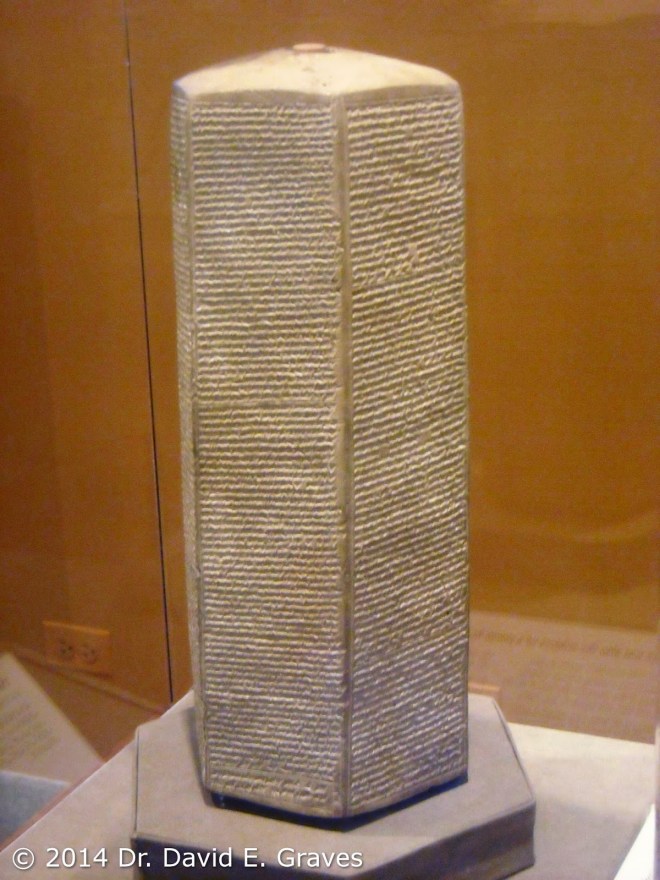
Image result for sennacherib's prism

Sennacherib’s Prism, , in which we find his account of his campaign into Judah.

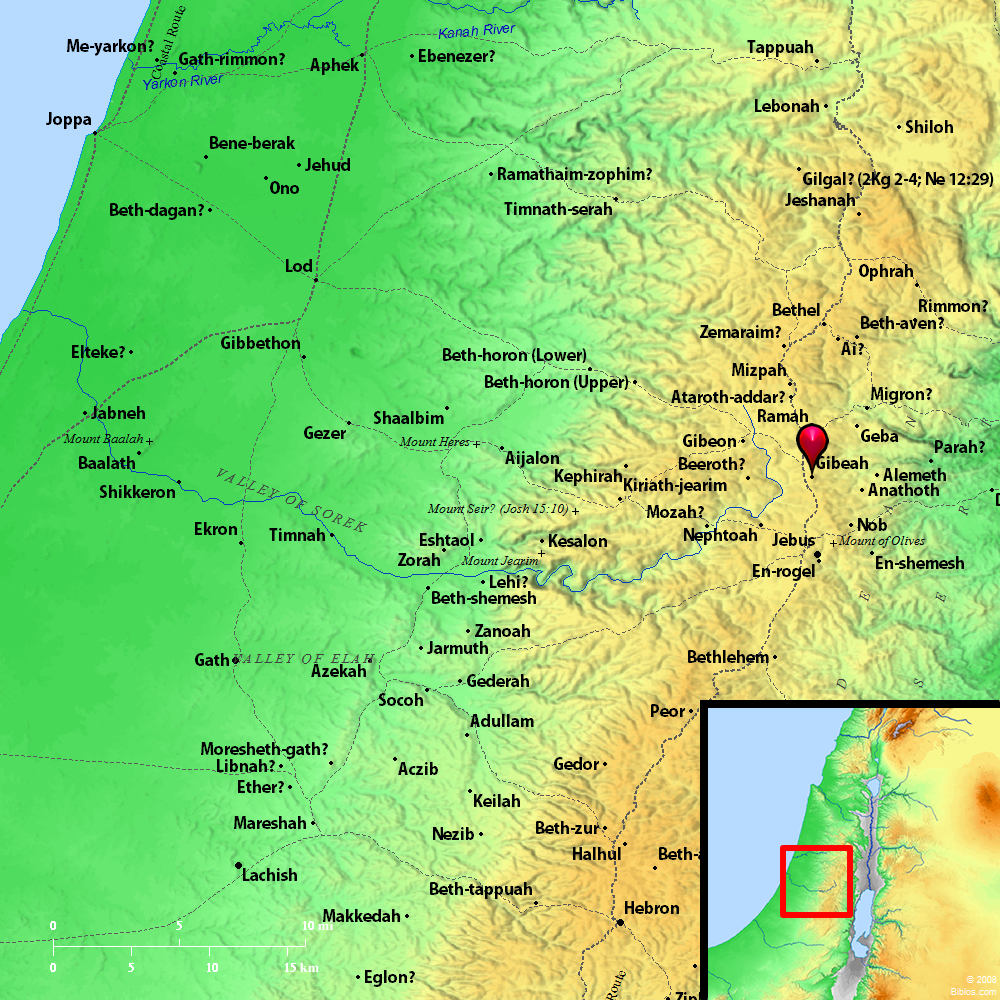
Getting back to Hosea, we see in v. 8 that the danger is directed to three cities: Gibeah and Ramah in northern Judah and in Beth-aven (Bethel) in southern Israel.

The alarms were to be set off to warn of invaders, which seem to be from the south.  The enemy is portrayed as advancing along the main mountain road from Jerusalem through Bethel and thereafter into the heart of Ephraim.  Gibeah, only three miles north of Jerusalem, is the first to be attacked; then Ramah, five miles north of Jerusalem; and finally Bethel, eleven miles north of Jerusalem, on the northern border of Benjamin.

Allocations of the 12 tribes of Israel.

Image result for tribe of benjamin

Rather than leading Ephraim into battle, as the tribe of Benjamin did in Deborah’s day (Judg. 5:14), the invader would pursue Benjamin as it did Ephraim.

When the Lord rebuked Ephraim for his sins (v. 9), he would become desolate throughout his tribal territories.  The Lord promised that this would surely happen (cf. Lev. 26:32-35).  This desolation, although effected by Assyria, was directed by Yahweh, as verses 12 and 14 point out.

Judah is not spared.  Their leaders “are like those who move boundary stones.”  It was a reprehensible deed in ancient Israel to mess with people’s property lines (Deut. 19:14; 27:17).   Constable says: “Judah had re-annexed Benjamite territory, thus violating the terms of the Mosaic Covenant regarding tribal allotments (cf. Deut. 19:14; 27:17).

What the leaders were doing was “like” this sin.  The leaders of Judah had moved the boundaries between right and wrong, true and false religion, and the true God and idols.

Ephraim is again addressed in v. 11.  Two verbs express their judgment: “oppressed, trampled in judgment,” while the end of the verse again points out their sin…“intent on pursuing idols.”

Israel would be destroyed, as we saw in our history lesson, and disintegrated.  The silent, but certain effects of God’s judgment are appropriately compared to both moth and dry rot in v. 12, destroying the political fabric (stability) of the land, as seen in the quick succession of kings in the latter days of Israel.

The Queen Mary was the largest ship to cross the oceans when it was launched in 1936.  Through four decades and a World War she served until she was retired, anchored as a floating hotel and museum in Long Beach, California.

During the conversion, her three massive smokestacks were taken off to be scraped down and repainted.  But on the dock they crumbled.  Nothing was left of the 3/4 inch steel plate from which the stacks had been formed.  All that remained were more than thirty coasts of paint that had been applied over the years.  The steel had rusted away.

That is the process of sin.  Most of the time, we don’t even realize that what we are doing is heaping up judgment, or discipline until it actually happens.  In Screwtape Letters, C. S. Lewis has Screwtape telling his nephew Wormwood…

“Indeed the safest road to Hell is the gradual one–the gentle slope, soft underfoot, without sudden turnings, without milestones, without signposts…

Let that be a warning to us.  While we think we are getting away with sin, even little sins, there will come a point when God just discipline us.

Verse 13 identifies the signature sin of this section of Hosea—pursuing other nations for help in battle.  Its not that alliances are always inappropriate, in this case it revealed that neither Ephraim nor Judah was trusting in God’s help.  This is the opposite of the confidence in God expressed by the Psalmist (Psalm 20):

7 Some trust in chariots and some in horses, but we trust in the name of the LORD our God.

Both Israel and Judah appealed to the king of Assyria for help, but he was unable to save them. King Ahaz of Judah did this (2 Kings 16:5-9), and so did King Menahem of Israel (2 Kings 15:19-20) and King Hoshea of Israel (cf. 2 Kings 17:3).  Rather than assisting, the Assyrians attacked both nations.

King Jareb (“The Avenging” or “The Great”) probably refers to Tiglath-Pileser III, with whom both Israel and Judah made alliances.

Honeycutt notes:

The implications are obvious: national character is more likely to produce stability than a foreign policy which flits from one another to another seeking international support (cf. Hos. 7:11).

Verse 14 adds another dimension to the judgment Yahweh would bring upon Israel.  Not only was there the slow, hidden, gradual process of destruction represented by the moth and dry rot, but there is also the ferocious and purposeful attack of a lion.

As a lion, He would tear them to pieces and carry them away in judgment, and there would be no one who could deliver them. Israel fell to the Assyrians, in 722 B.C., after two previous Assyrian invasions (in 743 and 734-32 B.C.). Judah escaped Assyria in 701 B.C., due to King Hezekiah’s trust in the Lord, but Babylonia finally fulfilled this prophecy to her in 586 B.C.


M’Cheyne Bible Reading Plan, April 1

Today’s Bible readings are from Leviticus 4, Psalm 1-2, Proverbs 19 and Colossians 2.

Leviticus 4 is about the sin offering (which stretches to 5:13).

DeCanio says…

It is important to recognize, as Lindsey (1985:180) points out, that although the sin offering and the guilt offering, subsequently discussed, are distinguishable, they clearly have some definite similarities.  This is especially the case with regards to their primary function as both can best be described as expiatory offerings.

Not all sins could be atoned for by means of a sin offering.  Only sins committed unintentionally (these could be sins of omission as well as sins of commission; see, for example, Num 15:22-23) could be atoned for with a sin offering.

The sin offering, however, did not cover were sins committed with a defiant attitude (see, for example, Num 15:30 which literally means “with a high hand”)—that is, sin with a purpose of being disobedient to God.

For such cases as these, no sin offering could be brought by an individual (Lindsey 1985:180).

The only hope for cleansing from such sins lay in the Day of Atonement ritual which provided yearly cleansing from “all their sins” (16:20), “so that they will be clean from all [their] sins” (16:30).

The sin offering, therefore, was applicable only for sin not done in a spirit of rebellion against Yahweh and His covenant stipulations, whether they were sins of ignorance (Lev. 4), sins without conscious intent (Lev. 5), or intentional but non-defiant sins (such as for manslaughter where the act is committed without premeditation).

The book of Psalms is the prayer book of Israel.  It is divided into five books.

Psalms 1 and 2 serve as introductions to the entire book of Psalms and Psalm 150 serves as a doxology for the entire book of Psalms.

Psalms 1-2 introduce the book’s main emphases:  the struggle to honor God and His greatness.  Psalm 1 contrasts the conduct and fate of the righteous and wicked.  The key difference is meditating on God’s law (1:3).  If we don’t meditate, we will naturally follow the way of the world (vv. 1-2).

What is meditation?  It is not the eastern concept of emptying one’s mind, but rather filling one’s mind with Scripture.  It represents a slow turning over and over of the Scripture in one’s mind, gazing at it from various angles, living with it, soaking in it.

We will only meditate on it if we love it.  Psalm 119:97: “Oh how I love your law! It is my meditation all the day.”

The wicked will never accept God’s sovereignty over their lives and will rebel (2:1-3).  God laughs at their feeble rebellion because He rules the earth and has established David’s throne forever.  Powerful earthly rulers come and go, God’s rule stands forever.  Thus, they should bow to David’s authority (2:10-12) and the ultimate “Anointed One,” Jesus Christ.

Proverbs 19 gives us some lessons about poverty and wealth:

1 Better is a poor person who walks in his integrity than one who is crooked in speech and is a fool.

Looks can be deceiving.  It is naturally assumed that a rich man is rich because of God’s favor and a poor man is poor because God is against him.  In reality, it is the integrity of the heart that makes a person really wealthy and blessed.

4 Wealth brings many new friends, but a poor man is deserted by his friend.

6 Many seek the favor of a generous man, and everyone is a friend to a man who gives gifts.  7 All a poor man’s brothers hate him; how much more do his friends go far from him! He pursues them with words, but does not have them.

This, again, is what naturally happens.  But of course, those “new friends” are there because of what they can gain, not give.  The proverb anticipates the Lord’s teaching to use of money to win friends and an eternal reward in the kingdom of God (Luke 18:1-9).

One of my favorite verses is 19:11

11 Good sense makes one slow to anger, and it is his glory to overlook an offense.

There are some sins we can overlook (cf. 1 Peter 4:8), chalk them up to human error or common mistakes.  Those we cannot, however, still need to be forgiven and not held onto.  It is a glory to be a person who is not easily offended.

In Colossians 2 Paul warns the Colossians about man-made philosophies that would undermine the gospel.  All these philosophies are nothing compared to Christ.  He alone is sufficient for our salvation, sanctification and glorification.

  • In Him “are hidden all the treasures of wisdom and knowledge” (2:3)
  • “In him the whole fullness of deity dwells bodily” (2:9)
  • “you have been filled in him, who is the head of all rule and authority” (2:10).
  • We have died to sin and been raised to life with Him (2:11-14).

6 Therefore, as you received Christ Jesus the Lord, so walk in him, 7 rooted and built up in him and established in the faith, just as you were taught, abounding in thanksgiving.

Thomas Constable has these charts:

 The Christian’s Walk

“Walk … worthy of the Lord” (1:10) “Walk in Him” (2:6)
·      Bearing fruit (1:10) ·      Firmly rooted (2:7)
·      Growing like a tree (1:10) ·      Being built up like a building (2:7)
·      Gaining strength (1:11) ·      Established (2:7)
·      Giving thanks (1:12) ·      Giving thanks (2:7)

 Summary of the believer’s completeness in Christ in 2:11-15

·      The domination of our flesh has been broken. (2:11)
·      Our former manner of life has ended. (2:12a)
·      We have been raised from spiritual death. (2:12b)
·      We have been given new life. (2:13a)
·      Our transgressions have been forgiven. (2:13b)
·      Our debt to God has been paid. (2:14)
·      Our spiritual enemy has been defeated. (2:15)

Verses 16-23 indicate that they were trying to overcome the flesh through asceticism and through mysticism.  Neither are effective.

Constable summarizes:

Four harmful teaching emphases of these false teachers are still with us today. The first harmful teaching is “higher” knowledge (Gnosticism).  Some examples are: so called scientific, archaeological, or paleontological “facts” that contradict Scripture, so called revelations that claim to be on a par with Scripture, and teaching that directly contradicts biblical revelation.  The second harmful teaching is the observance of laws to win God’s love (legalism).  Some examples are: salvation by works, teaching that puts Christians under the Mosaic Law, and teaching that says sanctification comes by keeping man-made rules.

The third harmful teaching is the belief that beings other than Christ must mediate between people and God (mysticism).  Some examples are: teachings that certain beings (e.g., angels, “saints,” ancestors) or experiences (e.g., glossolalia, hearing voices) can improve our relationship with God.  The fourth harmful teaching is the practice of abstaining from things to earn merit with God (asceticism).  Some examples are: fasting to force God’s hand, living in isolation to avoid temptation, and self-mutilation to mortify the flesh.

Jesus is ALL WE NEED.

God Knows Your Faithlessness (Hosea 5:3-7)

In the passage we’re looking at today, Israel’s apostasy is described through five basic areas of conduct.

3 I know all about Ephraim; Israel is not hidden from me. Ephraim, you have now turned to prostitution; Israel is corrupt. 4 “Their deeds do not permit them to return to their God. A spirit of prostitution is in their heart; they do not acknowledge the LORD. 5 Israel’s arrogance testifies against them; the Israelites, even Ephraim, stumble in their sin; Judah also stumbles with them. 6 When they go with their flocks and herds to seek the LORD, they will not find him; he has withdrawn himself from them. 7 They are unfaithful to the LORD; they give birth to illegitimate children. When they celebrate their New Moon feasts, he will devour their fields.

Whereas God’s infinite and intimate knowledge of us is normally a comforting thought, here it is terrifying.  David, for example, exulted in God’s knowledge of him.  In Psalm 139:1-6 he says…

1 You have searched me, LORD, and you know me. 2 You know when I sit and when I rise; you perceive my thoughts from afar. 3 You discern my going out and my lying down; you are familiar with all my ways. 4 Before a word is on my tongue you, LORD, know it completely. 5 You hem me in behind and before, and you lay your hand upon me. 6 Such knowledge is too wonderful for me, too lofty for me to attain.

Thus, later David invites God’s all-seeing eye to peer into his heart, even to see the darkness within him…

23 Search me, God, and know my heart; test me and know my anxious thoughts. 24 See if there is any offensive way in me, and lead me in the way everlasting.

Thus A. W. Tozer, in his little book The Knowledge of the Holy, says…

That God knows each person through and through can be a cause of shaking fear to the man that has something to hide – some unforsaken sin, some secret crime committed against man or God.  The unblessed soul may well tremble that God knows the flimsiness of every pretext and never accepts the poor excuses given for sinful conduct, since He knows perfectly the real reason for it.  “Thou hast set our iniquities before thee, our secret sins in the light of thy countenance.”  How frightful a thing to see the sons of Adam seeking to hide among the trees of another garden.  But where shall they hide?  “Whither shall I go from thy spirit? or whither shall I flee from thy presence?… If I say, Surely the darkness shall cover me; even the night shall be light about me.  Yea, the darkness hideth not from thee; but the night shineth as the day.”

On the other hand, Tozer goes on to point out the positive side of God’s complete knowledge of us…

And to us who have fled for refuge to lay hold upon the hope that is set before us in the gospel, how unutterably sweet is the knowledge that our Heavenly Father knows us completely.  No talebearer can inform on us, no enemy can make an accusation stick; no forgotten skeleton can come tumbling out of some hidden closet to abash us and expose our past; no unsuspected weakness in our characters can come to light to turn God away from us, since He knew us utterly before we knew Him and called us to Himself in the full knowledge of everything that was against us.  “For the mountains shall depart, and the hills be removed; but my kindness shall not depart from thee, neither shall the covenant of my peace be removed, saith the Lord that hath mercy on thee.”

The idea of God knowing us and our deeds is carried into the final book of the New Testament, in Revelation 2-3 God says several times…I know you.

In Revelation 2 and 3, Jesus communicates individual messages to seven different churches. Each message begins with the same two words: “I know.”  He is the first and the last, the Amen, the holy and true one who walks among his churches, and he knows.

“I know where you dwell.”  Jesus described Pergamum as “where Satan’s throne is.” It’s hard to imagine how bad the situation in that city had to be to warrant such a diagnosis and yet, there were saints–men and women who were holding fast to Jesus’ name and refusing to deny his faith. Wherever you are today, Jesus knows.

“I know your works.”  Christians sprinkled throughout Asia were faithfully serving, toiling on, patiently enduring.  In the eyes of the world, they had “little power,” but Jesus would continue to set before them open doors of opportunity.  “Do not fear.”  “Hold fast.”  “Be faithful.”  “I am coming.”  Wherever you are serving today, Jesus knows.

“I know your love.” Some had abandoned the love they had at first.  Others were lukewarm. Some had the reputation of being alive, but they were dead.  Jesus spoke hard-to-hear, straightforward rebukes to many.  “Wake up.”  “You are wretched, pitiable, poor, blind, and naked.” “Repent.”  But notice the heart behind the rebukes: “Those whom I love, I reprove and discipline.”  However you have stumbled, Jesus continues to patiently stand at the door and graciously knock with love in his heart for you.

“I know.” Jesus knows how to grant me the right to the tree of life. Jesus knows how to clothe you in white garments, give you a new name, and confess you before his Father.  Jesus knows how to keep us from being hurt by the second death.

The emphasis in Hosea 5 is on God himself, “I, I have known…”  It is the plaintive cry of a husband, one who deeply and intimately knows his wife, and yet here he sees in her the black treacherous heart.  God’s knowledge is never perfunctory and cold, but deep and emotive.

Here God says, “I know all about Ephraim; Israel is not hidden from me.”  Nothing escapes God’s attention, no outward pieties can cover over the blackened hearts of unfaithful Israel.  His knowledge is all-comprehensive.  Hebrews 4:13 says,

13 Nothing in all creation is hidden from God’s sight. Everything is uncovered and laid bare before the eyes of him to whom we must give account.

Derek Kidner reminds us:

To Hosea, of all the prophets, this was crucial; and elsewhere in the Old Testament the deep thrust of God’s knowledge, however painful it may initially be, is seen as something to be welcomed, for it means that He knows the worst, and yet persists with us.

Yahweh knew Israel well; He had not been deceived and fallen into a trap, as the Israelites had.  Though they may no longer know God (v. 4), He knows them through and through.

Of course, Israel did not seem to even be trying to hide their harlotries anymore, practicing them on hills and under trees.

Ephraim, you have now turned to prostitution; Israel is corrupt.

Ever since Jeroboam I had installed calf-idols Dan and Bethel, the institutions of Israel had been guiding the people into apostasy and immorality, with the result that they had all become defiled—loathsome to God.

Instead of humbling themselves before Yahweh, they flaunted their worship of false gods.  Due to their spirit of whoredom, the Israelites are incapable of either knowing or pursuing their covenant partner.

Theologically speaking, this may be labeled “total depravity,” in the sense that no aspect of the people’s collective personality is untouched by the spirit of spiritual apostasy.  Their inner minds lead to visible deeds, which make impossible any sense of repentance or turning to God.  It is this state of reprobation that they cannot change and, apart from an act of providential grace on God’s part, can never change.  At this stage, no simple appeal to listen will be heard, for they cannot listen.  In other words, the call to hear in verse 1 stands as a rhetorical witness against the people.  Their inability to heed is part of the complex of hardened rebellion.  It is as if they were criminally insane, psychopaths with no conscience, unable to function normally.  It takes more than prophetic appeal to reason with such people.  Other measures are required to wake them from their deathly stupor.

That near impossibility of return is expressed in these words in Hosea 5:4

4 “Their deeds do not permit them to return to their God.  A spirit of prostitution is in their heart; they do not acknowledge the LORD.

The Bible hold two truths in tension, as it does so often.  First, that repentance is always a possibility, and second, that corruption can so enslave a soul that repentance becomes a practical impossibility.  This verse focuses on that latter truth.

This “spirit of prostitution” (idolatry) had been first mentioned back in chapter 4:12…

A spirit of prostitution leads them astray; they are unfaithful to their God.

Something deeper is going on than merely the acts of spiritual harlotry.  Their very hearts, their inner spirits, had been given over to evil spirits who prompted and promoted, biasing and inclining them to a worship loathsome to Yahweh.  They were so ensnared, so addicted to sin, that their hearts were taken over.

Yahweh had been forgotten (2:15); they are totally ignorant of Him; the idea of returning to Him no longer enters their minds.  It cannot.

The word Paul used to describe such a condition is “hardening”; and that is exactly what had happened to northern Israel and would in time happen to the southern Israel also.  It would happen again when Jesus came.  He was rejected by His own.

Speaking of Israel as it existed at this juncture, Smith wrote that, “According to Hosea, return for Israel is now no longer a human possibility.”  He also elaborated the basic reasons why this was true: (1) sin robs a man of his faculty for God and of the strength of will to obey God; (2) the whole fabric of the nation’s social, economic, political, and religious life was interwoven with the lustful indulgences of paganism; and (3) there was no longer any true knowledge of God among the people.  Without that knowledge, it was impossible to achieve either any communion with God or any kind of human conduct consistent with the terms of their ancient covenant with Jehovah.

That they were unfaithful to “their God” makes the sin all the more grievous.  It amplifies their ingratitude.  He, whom they would not turn to, still owned them.  He, upon whom they turned their backs, still was good to them.  But they acknowledged it not.

Albert Barnes notes:

They did not turn to God,

(1) because the evil spirit held them, and so long as they allowed his hold, they were filled with carnal thoughts which kept them back from God.

(2) they did not know God; so that, not knowing how good and how great a good He is in Himself, and how good to us, they had not even the desire to turn to Him, for love of Himself, yea even for love of themselves.  They saw not, that they lost a loving God.

And John Trapp sounds this warning:

That is, they are so habituated and hardened in sinful practices, that they are not only disenabled to conversion, but evil affected thereunto: they stand across to all good; to their sinews of iron they have added bows of brass, Isaiah 48:4; to their sin they add rebellion, which is as bad as witchcraft, 1 Samuel 15:23; till at length they lose all passive power also of being converted, and so are transformed, as it were, into so many devils: having by custom contracted a necessity of sinning, they are become incurable; they neither will nor can return to their God

We do well to ask ourselves, “What is the dynamic, energizing power of my life—the reality of God’s Spirit, or an alien spirit hostile to the purposes and knowledge of God?”

Verse 5 points out the primary reason that their hearts are unwilling to turn back to Yahweh.  In addition to the spiritual forces of wickedness, it is their pride.  Proverbs continually warns us that pride comes before the fall and this is what we see illustrated in Israel’s history in verse 5:

5 Israel’s arrogance testifies against them; the Israelites, even Ephraim, stumble in their sin; Judah also stumbles with them.

Pride is the sin; stumbling is the consequence.  Whether intellectual pride, moral pride, or spiritual pride, the results are the same.  Through pride, we think of ourselves as “god” rather than man and do not bow down to Him.

Stumbling here is serious, meaning that they fell.  Not only did the Northern Kingdom fall to Assyria in 722 B.C. but they influenced Judah to follow in their footsteps.  Judah last another 150 years, but eventually fell to Babylon in 586 B.C.  Although Hosea seems to hope that Judah will avoid destruction, he realizes that his hope is vain.  This passage anticipates Ezekiel 23.

Their pride will “testify against them” in the court of national opinion as they fall to rival powers.

O, Israel would still be religious.  Verse 6 says…

6 When they go with their flocks and herds to seek the LORD, they will not find him; he has withdrawn himself from them.

Amos 5:4-5 contrasts authentic turning to Yahweh with pilgrimages to shrines.  There is evidence that the people were very religious during this era.  But no matter how many sacrifices they made (Micah speaks of “thousands of rams…ten thousand rivers of oil,” 6:7)…no matter how much they made sacrifice, ostensibly to “seek the Lord,” He would not be found.  They were not sincere in their seeking.  They didn’t come to Yahweh repenting of their sins.

Israel was treating Yahweh like Baal, redoubling their efforts to bend his will to theirs.  Instead of contrite heart, they brought gifts to their gods.

David noted that God didn’t want this.  In Psalm 51:16-17…

16 You do not delight in sacrifice, or I would bring it; you do not take pleasure in burnt offerings. 17 My sacrifice, O God, is a broken spirit; a broken and contrite heart you, God, will not despise.

God had withdrawn from them, not in the sense C. S. Lewis spoke of, where God withdraws in sense so that we might learn to trust Him and obey Him without any overt evidences of Him in the universe.

God had withdrawn because…

7 They are unfaithful to the LORD; they give birth to illegitimate children. When they celebrate their New Moon feasts, he will devour their fields.

Israel was faithless, turning their backs upon Yahweh, who had been so good to them, to pursue the Baals.  They were acting treacherously.  Isaiah 24:16b says it this way:

“The treacherous betray! With treachery the treacherous betray!”

Ultimate betrayal and disloyalty is what they had shown Yahweh.

Honeycutt says…

The repudiation of covenant bonds is akin to the rejection of national loyalty, as in the case of treason.  Israel’s action, or our own, was treasonable to the extent that it represented a basic betrayal of loyalty and commitment.

Israel’s treachery resulted in her giving birth to illegitimate children.  The metaphor looks back to the prostitution that 5:3 mentions.  It also implies that the apostasy of the Israelite culture and their leaders had given rise to a generation that could more accurately be called children of Baal than children of Yahweh.  They were “not my people” but Baal’s.  The term “illegitimate” is literally “foreign,” which can refer to sexual liaison outside of marriage or, as in the English, another nation or culture.  Hosea seems to employ both senses.  They were children of apostasy/adultery, and they were children of foreign gods.

They no longer acted like children of Yahweh, so He make that formal—that they no longer belonged to Him.

M’Cheyne Bible Reading Plan, March 31

Today’s Bible readings are from Leviticus 2-3, John 21, Proverbs 18 and Colossians 1.

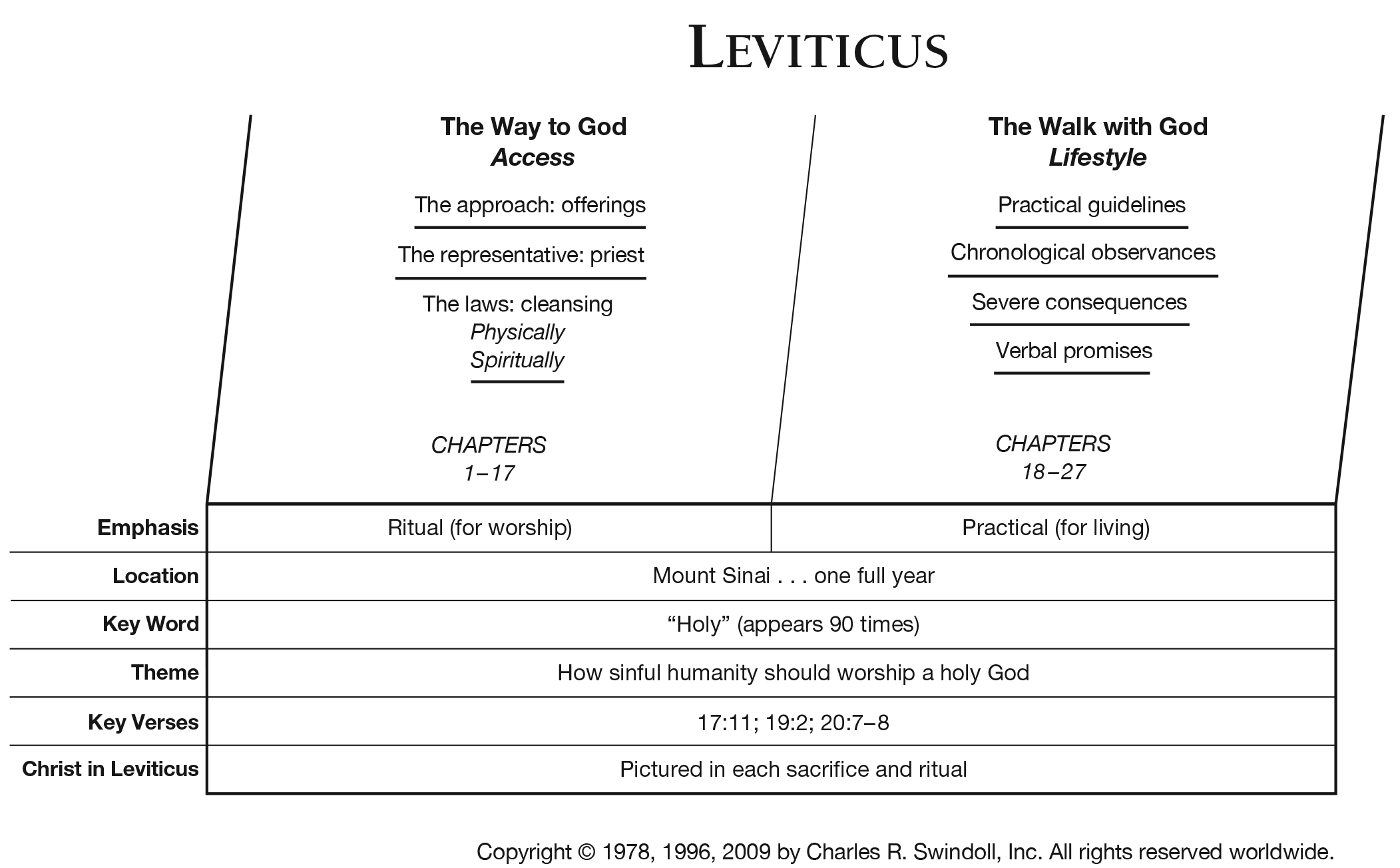
Leviticus 2-3 gives instructions for the meal (grain) offering (Lev. 2) and the peace offering (Lev. 3).

A meal offering always followed the official daily burnt offerings (cf. Exod. 29:39-40; Num. 28:3-6), and it often accompanied a peace offering (cf. Num. 15:3-5; 2 Kings 16:13).  It was only offered by itself on two occasions: as a priest’s offering (Lev. 7:12), and in the ritual used to determine a wife’s faithfulness or unfaithfulness to her husband (Num. 5:15).

Christ fulfilled the requirements of this sacrifice, too (John 8:29).  The fine flour suggests the perfection of His personality made perfect through suffering.  The oil suggests the Holy Spirit’s presence in His life, the frankincense the fragrance of His life brought out by the fires of testing, and the salt the incorruptibility of His character.  Honey, representing natural sweetness that sours, and leaven, which often represents sin and evil in Scripture, picture what was absent from His nature.

The “peace (fellowship [NIV], well-being [NRSV]) offering” is the third sacrifice of worship (Lev. 3).  It represented the personal fellowship between God and each Israelite person, and between believing Israelites, that resulted from the relationship that God had established with the redeemed individual (cf. Rom. 5:1).

Peace and fellowship resulted from redemption, and this act of worship highlighted those blessings from God.  This was an optional sacrifice; an Israelite could bring it if and when he desired.  Thus it was not one of the offerings that the priests presented daily in the tabernacle, though God did order its presentation at the Feast of Pentecost (Harvest, Weeks; 23:19).  Because it was voluntary, its offering became a festive occasion.

There were three different kinds of peace offerings: One was a “thanksgiving offering,” in which an Israelite expressed thanks for a particular blessing (7:12-15).  Another was a “votive offering,” that the Israelites could offer after an acute experience of distress—or joy—that had elicited a vow from him or her (cf. Jon. 2:9).  The third was a “freewill offering,” that the Israelite could offer as an expression of gratitude to God, without reference to any particular blessing (7:16-18).

Christ is the peace of believers, because of His sacrifice on the cross (Eph. 2:14).  All of the animals used in this offering have been thought by some to represent different aspects of the person of Christ: Animals from the “herd” (cattle) represent Christ as our burden-bearer.  The “lamb” stands for Him as our perfect sacrifice, and the “goat” suggests Him as the One who takes away sin.  The inward parts of these animals that were offered suggest that God sees the inner parts of Christ [his heart, integrity] as acceptable to Him.

John 21

This Gospel began with a theological prologue (1:1-18), and it ends with a practical epilogue. John concluded his narrative, designed to bring unbelievers to faith in Jesus Christ, in chapter 20.  Chapter 21 contains instruction for those who have come to faith in Him, and explains how they are to serve Him as they carry out their mission (20:21-23).

Jesus first appears to the seven disciples, performing the miracle of the large catch of fish, just as He did when he formally called them to follow Him (21:1-14; cf. Luke 5:1-11).

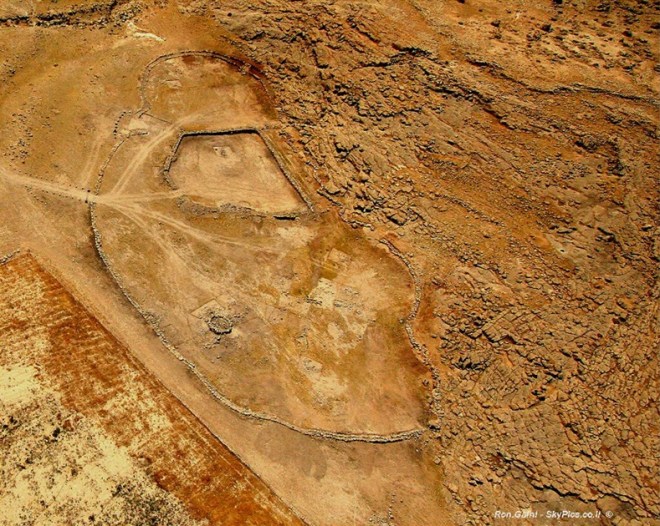
It is likely that this happened at the same place, as well, at Tabgha

Then Jesus deals particularly with Peter, piercing his heart with three questions, which caused Peter to have to deal with his three denials (21:15-19).

Henry and Richard Blackaby, in Experiencing God Day-by-Day:

Jesus has a wonderful way of restoring us when we fail Him!  He does not humiliate us.  He does not criticize us.  He does not ask us to make a resolution to try harder.  Rather, He takes us aside and asks us to reaffirm our love for Him.

Peter miserably failed his Lord when he fled with the other disciples from the Garden of Gethsemane.  Later, he publicly denied that he even knew Jesus.  Peter must have wondered if he was even capable of being Jesus’ disciple when he was unfaithful to Jesus in His most crucial hour.

You may be painfully aware that you have failed your Lord in many ways.  Perhaps you were not faithful.  Perhaps you disobeyed His word to you.  Perhaps you denied Him by the way you lived.  Jesus will not berate you.  He will not humiliate you.  He will ask you to examine your love for Him.  He asked Peter, “Do you love Me?”  If your answer, like Peter’s, is “Yes, Lord,” He will reaffirm His will for you.  If you truly love Him, you will obey Him (John 14:15).  Jesus does not need your resolutions, your re-commitments, your promises to try harder.  Jesus asks for your love.  Then your service to Him will be what He desires.

“Jesus Christ asks each one of us, not for obedience primarily, not for repentance, not for vows, not for conduct, but for a heart; and that being given, all the rest will follow.” (Alexander Maclaren)

The chapter ends with Jesus telling Peter not to be distracted by John’s calling, but to focus on his own calling (21:20-25).  David Guzik writes:

How easily we get distracted from our own responsibilities and calling by wondering about the details of someone else’s walk with the Lord.  We critique, we second-guess, we opine.  Jesus says to us what he said to Peter:  “What is that to you?”  Let us serve others, but mind our own business!

Proverbs 18 continues Solomon’s wisdom maxims.

1 Whoever isolates himself seeks his own desire; he breaks out against all sound judgment. 2 A fool takes no pleasure in understanding, but only in expressing his opinion.

These first two verses show the foolishness of separating oneself from community and not listening to counsel.  He will listen to no one but himself.  Lot would be a good example.  He separated himself from Abram and his example and counsel.

There are a number of sayings about the tongue in this set of proverbs:

2 A fool takes no pleasure in understanding, but only in expressing his opinion.

4 The words of a man’s mouth are deep waters; the fountain of wisdom is a bubbling brook.

Not that everyone’s speech is deep and meaningful! Rather, we reveal the depths of our heart by the words of our mouth.

6 A fool’s lips walk into a fight, and his mouth invites a beating. 

He who thinks by the inch and speaks by the yard deserves to be kicked by the foot!

7 A fool’s mouth is his ruin, and his lips are a snare to his soul.

“It is most remarkable that the apostle Paul, when analyzing man’s depravity, focuses on the little member and all that is linked to it—the throat, the tongue, the lips, and the mouth (Romans 3:13-14).” (Bridges)  Likewise, Isaiah realized that God was dealing primarily with his tongue (Isaiah 6:5-6).

8 The words of a whisperer are like delicious morsels; they go down into the inner parts of the body.

Because gossip is so tantalizingly tasty, those who should know better find it difficult to tell the whisperer to stop talking.

Image result for proverbs 18:8

Don’t partake!

Feast on the Word of God not the words of gossip.

13 If one gives an answer before he hears, it is his folly and shame. 

James tells us to be “quick to hear…slow to speak.”

20 From the fruit of a man’s mouth his stomach is satisfied; he is satisfied by the yield of his lips.

This is another way of saying you reap what you sow.

21 Death and life are in the power of the tongue, and those who love it will eat its fruits.

The tongue is very powerful.  This is a warning about being too talkative.

Notice Paul’s prayer in Colossians 1:9-11

9 And so, from the day we heard, we have not ceased to pray for you, asking that you may be filled with the knowledge of his will in all spiritual wisdom and understanding, 10 so as to walk in a manner worthy of the Lord, fully pleasing to him, bearing fruit in every good work and increasing in the knowledge of God. 11 May you be strengthened with all power, according to his glorious might, for all endurance and patience with joy,

We need “the knowledge of God’s will” so that we can “walk worthy of God” which is further defined as being “fully pleasing” to God, “bearing fruit in every good work and increasing in the knowledge of God.  We also need spiritual strength so that we can endure and be patient with joy.

Regarding v. 13

13 He has delivered us from the domain of darkness and transferred us to the kingdom of his beloved Son,

C. S. Lewis says…

“There is no neutral ground in the universe: every square inch, every split second, is claimed by God and counterclaimed by Satan.”

–C.S. Lewis

In Every Good Endeavor, Keller reminds his reader of the well-known line from Abraham Kuyper: “There is not a square inch in the whole domain of our human existence over which Christ, who is Sovereign over all, does not cry: ‘Mine!” (Quote from Kuyper’s inaugural address at the dedication of the Free University. Found in Abraham Kuyper: A Centennial Reader, ed. James D. Bratt (Eerdmans, 1998), 488).

Then, in vv. 15-19 we have the Christ hymn:

15 He is the image of the invisible God, the firstborn of all creation. 16 For by him all things were created, in heaven and on earth, visible and invisible, whether thrones or dominions or rulers or authorities–all things were created through him and for him. 17 And he is before all things, and in him all things hold together.  19 For in him all the fullness of God was pleased to dwell,20 and through him to reconcile to himself all things, whether on earth or in heaven, making peace by the blood of his cross.

Jesus Christ is God very God (v. 15) who created (v. 16) and sustains (v. 17) all things.  Complete deity dwells in him, that is it is his very nature.  And through His humanity we can be reconciled to God because He made peace by shedding his blood on the cross.

Regarding v. 24

24 Now I rejoice in my sufferings for your sake, and in my flesh I am filling up what is lacking in Christ’s afflictions for the sake of his body, that is, the church,

Realize that the word “afflictions” is never used of Christ’s suffering and death on the cross.  It likely refers to the afflictions he suffered while alive.  In that sense Paul could continue the afflictions of Christ.   J. T. Robertson notes:

“Paul attaches no atoning value whatever to his own sufferings for the church.”

It may be similar to what Christ said to Paul on the road to Damascus, “Why are you persecuting me?” (Acts 9:4).  By persecuting the church Paul was persecuting Christ.

Colossians 1:28-29 are two of my favorite verses on ministry:

28 Him we proclaim, warning everyone and teaching everyone with all wisdom, that we may present everyone mature in Christ. 29 For this I toil, struggling with all his energy that he powerfully works within me.

Verse 28 identifies my purpose–to present everyone mature in Christ before God.

Verse 29 reveals my power–it comes from God as I toil and struggle in ministry.

Condemnation of the Leadership of Israel (Hosea 5:1-2)

Welcome again to our study in the book of Hosea.  If you’ve been with this study from the beginning, you can see that it is a study rich in expressions of God’s love, but equally it confronts us with our sinfulness.

Hosea prophesied to Israel, in the decades before the Assyrians came and conquered Samaria and took them into captivity, spreading them throughout other people groups they had conquered.

One of the frightening things we see is that it is quite possible to take that one last step—and we don’t know when that might be—which sets us on a course that meets God’s wrath instead of His mercy.  In other words, that point of no return is really there—we just don’t know exactly where…and that is reason for us to be vigilant over our lives and never allow our hearts to grow hard or cold towards God, never allow sin to become a friend to us.

Today we’re beginning Hosea 5.  As we do, we face the frightening reality that there may come a point when we may seek God and not find him.  This is brought out most forcefully in Hosea 5:6

When they go with their flocks and herds to seek the LORD, they will not find him; he has withdrawn himself from them.

Finding the Lord always depends upon the attitude or manner in which we seek Him.  The Scriptures promise us that one “…will find him if you seek him with all your heart and with all your soul.”

When God withdraws, it is not that He is no longer there.  The Bible teaches us that God is everywhere present.  Jonah learned that the hard way.  But God is not present everywhere in the same way.  When God’s presence is taken away from us, it means we no longer sense His presence and the blessings of that presence.

Helmet Thielicke, the German theologian and writer wrote of the “silence of God,” when one experiences the awesome silence of God.  St. John of the Cross called it “the dark night of the soul” when all sensible experience of God’s presence is gone.

Now, God can mean those times of abandonment to deepen our faith and draw us closer to Him.  That is what C. S. Lewis was describing in the Screwtape Letters when Screwtape was instructed his nephew Wormwood in how to tempt and afflict his “patient” who had become a Christian.  It is in the chapter called The Law of Undulation.  In it they speak of troughs and peaks, the lows and highs we all experience.

To decide what the best use of it is, you must ask what use the Enemy wants to make of it, and then do the opposite.  Now it may surprise you to learn that in His efforts to get permanent possession of a soul, He relies on the troughs even more than on the peaks; some of His special favourites have gone through longer and deeper troughs than anyone else.  The reason is this.  To us a human is primarily good; our aim is the absorption of its will into ours, the increase of our own area of selfhood at its expense.  But the obedience which the Enemy demands of men is quite a different thing.  One must face the fact that all the talk about His love for men, and His service being perfect freedom, is not (as one would gladly believe) mere propaganda, but an appalling truth. He really does want to fill the universe with a lot of loathsome little replicas of Himself—creatures, whose life, on its miniature scale, will be qualitatively like His own, not because He has absorbed them but because their wills freely conform to His.  We want cattle who can finally become food; He wants servants who can finally become sons.  We want to suck in, He wants to give out.  We are empty and would be filled; He is full and flows over.  Our war aim is a world in which Our Father Below has drawn all other beings into himself: the Enemy wants a world full of beings united to Him but still distinct.

And that is where the troughs come in.  You must have often wondered why the Enemy does not make more use of His power to be sensibly present to human souls in any degree He chooses and at any moment.  But you now see that the Irresistible and the Indisputable are the two weapons which the very nature of His scheme forbids Him to use.  Merely to over-ride a human will (as His felt presence in any but the faintest and most mitigated degree would certainly do) would be for Him useless.  He cannot ravish.  He can only woo.  For His ignoble idea is to eat the cake and have it; the creatures are to be one with Him, but yet themselves; merely to cancel them, or assimilate them, will not serve.  He is prepared to do a little overriding at the beginning.  He will set them off with communications of His presence which, though faint, seem great to them, with emotional sweetness, and easy conquest over temptation.  But He never allows this state of affairs to last long.  Sooner or later He withdraws, if not in fact, at least from their conscious experience, all those supports and incentives.  He leaves the creature to stand up on its own legs—to carry out from the will alone duties which have lost all relish. It is during such trough periods, much more than during the peak periods, that it is growing into the sort of creature He wants it to be.  Hence the prayers offered in the state of dryness are those which please Him best.  We can drag our patients along by continual tempting, because we design them only for the table, and the more their will is interfered with the better. He cannot “tempt” to virtue as we do to vice.  He wants them to learn to walk and must therefore take away His hand; and if only the will to walk is really there He is pleased even with their stumbles.  Do not be deceived, Wormwood.  Our cause is never more in danger, than when a human, no longer desiring, but intending, to do our Enemy’s will, looks round upon a universe from which every trace of Him seems to have vanished, and asks why he has been forsaken, and still obeys.

But of course the troughs afford opportunities to our side also.  Next week I will give you some hints on how to exploit them,

Your affectionate uncle
SCREWTAPE

Well, if you are going through a particularly difficult time, feeling like God has abandoned you, I hope Lewis’ words are an encouragement to you.  BUT, I also want to emphasize that what Hosea is talking about has now gone beyond redemptive abandonment, to abandonment as judgment.

Listen to Hosea’s words in Hosea 5:1-7

1 “Hear this, you priests! Pay attention, you Israelites! Listen, royal house!  This judgment is against you: You have been a snare at Mizpah, a net spread out on Tabor. 2 The rebels are knee-deep in slaughter.  I will discipline all of them. 3 I know all about Ephraim; Israel is not hidden from me.  Ephraim, you have now turned to prostitution; Israel is corrupt. 4 “Their deeds do not permit them to return to their God.  A spirit of prostitution is in their heart; they do not acknowledge the LORD. 5 Israel’s arrogance testifies against them; the Israelites, even Ephraim, stumble in their sin; Judah also stumbles with them. 6 When they go with their flocks and herds to seek the LORD, they will not find him; he has withdrawn himself from them. 7 They are unfaithful to the LORD; they give birth to illegitimate children.  When they celebrate their New Moon feasts, he will devour their fields.

This passage shows that Israel had reached the point of no return.  Now grace can always find a way, but Israel was no seeking grace, they were using religion to twist God’s arm.

In verse 1 Hosea returns to the causative role that Israel’s leaders—both religious and political—had in the disintegration of covenant relationships.  Ineffective leadership does not excuse the failures of the people.  But it does clarify one reason for the erosion of genuine, Yahweh-focused religious commitment and the emergence of social faithlessness.

In vv. 1-2 Hosea identifies the participants (v. 1), isolates their practices (v. 2) and clarifies their punishment (v. 2).

The leaders of Israel—both religious and political—are uniquely responsible for the quality of justice in the land.  Notice that “Israelites,” literally “house of Israel” is sandwiched between “priests” and “royal house” in verse 1.  Some believe this is a third group, the clan leaders within each tribe.  But it may refer comprehensively to all the people of Israel.  They share the blame with the leaders.

Anderson and Freedman note that the royal house of Saul in the end failed to find God and turned to the witch of Endor (1 Sam. 28).  Hosea could be saying something similar about the last kings of Israel.

It is not possible to identify who the king of Israel was at this time, though some have guessed that it was Zechariah or Menahem.

Click the image to enlarge this chart of the prophets and kings of Israel and Judah

Notice as we move through these three responsible groups, the summons to hear grows more intense: “hear…pay attention…listen.”  Such words are used by God to call people to attention to hear the accusations of covenant breaking, but also of a parent or teacher as in the book of Proverbs.  It can precede accusation or instruction.

Now the phrase in the middle of verse 1, which both the NIV and ESV translate “this judgment is against you.”  Garrett suggests that it is more literally, “this judgment belongs to you.”  In other words, they were responsible for justice.

Ironically, it was the priests’ responsibility to discern and teach the law.  The clan chieftains were responsible for the local administration of justice.

But rather than promoting justice, they trapped people in a religious system that betrayed Yahweh and one another.  Hosea uses metaphors of a “snare” and a “net.”  Although charged with promoting justice, these leaders had perverted justice.

That religious defection is in view is clear from the towns mentioned—Mizpah, Tabor, and possibly another—Shittim.

There were several towns named Mizpah, but the one mentioned here is likely the one in the tribe of Benjamin ten miles north of Jerusalem.  Like Gilgal and Bethel, Mizpah was one of the principal cities on Samuel’s normal ministry circuit (1 Sam. 7).  A number of Astarte figurines, also known as Ashtoreth and Ishtar, dating back to the 8th century B.C. have been found there.

Image result for Mizpah

Bible Atlas

Tabor was the mountain further north, rising above the Jezreel Valley some 1,800 feet.  It is up near the Sea of Galilee.

Image result for mount tabor jerusalem map

This place which had been the scene of Deborah and Barak’s victory over the Sisera was evidently now another “high place” desecrated by worship of Baal.

Image result for Mizpah Tabor Shittim

Bible Atlas

Jezreel Valley from Nazareth Ridge, showing Mount Tabor, Endor, Nain and Hill of Moreh, bibleplaces

Verse 3 begins with a difficult to translate sentence: “The rebels are knee-deep in slaughter.”  Many believe a better translation is “and a pit they have dug in Shittim.”  “Pit” would correspond to “snare” and “net” and there was a place by that name.

Image result for Mizpah Tabor Shittim

Bible Atlas

Shittim was on the other side of the Jordan and was the last staging area before the invasion of the land (Joshua 2:1), thus very similar to Gilgal (cf. Micah 6:5 where they are linked).  It was the place of the Baal-Peor apostasy early in Israel’s history (Hosea 9:10), reported in Numbers 25.

Anderson and Freedman link this reference to Psalm 106, which has many affinities to Hosea.  Psalm 106:28 preserves the idiom from Numbers 25:3, 5 for “linking themselves to Baal-Peor.”  One of the primary references in Psalm 106 is to child sacrifice (Psalm 106:38).

“What the Moabites did originally at Peor, the kings of later Israel did at Mizpah and Tabor, and the rebellious leaders deeply corrupted themselves by offering child sacrifices at those places.”

Of course, child sacrifice was not limited to ancient Canaanite and Israelite cultures.  It is happening today, as mothers and fathers sacrifice their children on the altar of convenience and success.  It is really no different.

God’s response is “I will discipline all of them.”  Everyone was guilty, the priests and the people, the leaders and the people—all of them.  Neither the religious privileges of the priests, nor the multitude of the people, nor the civil dignity of the king, should exempt any from God‘s judgment.  The kings and the priests had hitherto been the judges; now they were summoned before Him, who is the Judge of judges, and the King of kings.

The guilt of both was enhanced, in that they, being so entrusted with it, had corrupted it. They had the greatest sin, as being the seducers of the people, and therefore have the severest sentence.  That is why James reminds us…

3:1 Not many of you should become teachers, my fellow believers, because you know that we who teach will be judged more strictly.

The word “discipline” here has overtones of teaching and instruction.  In other words, it’s not just punishment, but moral instruction.

It is what God promises to those who are really His children.  Even for us New Covenant believers discipline is an important part of our sanctification.

Lack of discipline, when we are living in sin, is a danger sign.  Hebrews 12:7-8 says…

7 Endure hardship as discipline; God is treating you as his children. For what children are not disciplined by their father? 8 If you are not disciplined—and everyone undergoes discipline—then you are not legitimate, not true sons and daughters at all.

Therefore, we should want discipline.  Hebrews 12:10 tells us that “God disciplines us for our good, in order that we may share in his holiness.”  So God has a redeeming, purifying purpose in disciplining us.

Of the many great examples of believers who have expressed the spiritual benefits they have received from suffering, one of the greatest examples is that of John Bunyan. While he sat in the Bedford prison for preaching the Gospel, Bunyan wrote of the pain he felt when he thought about his wife and blind daughter. Bunyan wrote:

I found myself a man, and compassed with infirmities; the parting with my wife and poor children hath oft been to me in this place as the pulling the flesh from my bones, and that not only because I am somewhat too fond of those great mercies, but also because I should have often brought to my mind the many hardships, miseries and wants that my poor family was like to meet with, should I be taken from them, especially my poor blind child, who lay nearer my heart than all I had besides; O the thoughts of the hardship I thought my blind one might go under, would break my heart to pieces.

Nevertheless Bunyan explained:

I never knew what it was for God to stand by me at all turns, and at every offer of Satan ‘to afflict me,’ &c. as I have found Him since I came in hither; for look how fears have presented themselves, so have supports and encouragements, yea, when I have started, even as it were at nothing else but my shadow, yet God, as being very tender of me, hath not suffered me to be molested, but would with one Scripture and another strengthen me against all; insomuch that I have often said, were it lawful, I could pray for greater trouble, for the greater comfort’s sake. Eccl. 7:14. 2 Cor. 1:5.

Again he wrote:

I never had in all my life so great an inlet into the Word of God as now; those Scriptures that I saw nothing in before, are made in this place and state to shine upon me; Jesus Christ also was never more real and apparent than now; here I have seen Him and felt Him indeed: O that word, “we have not preached unto you cunningly devised fables,” 2 Pet. 1:16; and that, “God raised Christ from the dead, and gave Him glory, that your faith and hope might be in God,” 1 Pet. 1:2, were blessed words unto me in this my imprisoned condition.

As we can see, discipline or suffering may be redemptive (teaching us), restorative (turning us back to God) or retributive (an expression of judgment).  It is retributive discipline that Israel would be facing.

M’Cheyne Bible Reading Plan, March 30

Today’s Bible readings are from Leviticus 1, John 20, Proverbs 17 and Philippians 4.

Some see Leviticus as the high point, or mid point, of the Pentateuch

Image result for pentateuch

walkwiththeword.org

Others see a chiastic structure, with Leviticus at the center, the most important spot in a chiasm.

Image result for pentateuch chart

Pastor Dave Online

And as for the structure of Leviticus itself, some see a chiastic structure.

Image result for leviticus

My Digital Seminary

Here is Chuck Swindoll’s book chart for Leviticus

Image result for leviticus

Juan Sanchez gives us Five Reasons to Preach through Leviticus.  Those five reasons are…

  1. Leviticus reminds us of the grace of our God and the cost of our sin (1–7).
  2. Leviticus exposes God’s grace in providing a mediator (8–10).
  3. Leviticus explains what God requires of those who approach him in worship (11–15).
  4. Leviticus foreshadows forgiveness of sin in the one mediator between God and man, the man Christ Jesus (16–17).
  5. Leviticus outlines how God’s people are to be holy as God is holy (18–27).

Image result for leviticus 1

The story of Leviticus picks up where Exodus left off.  Israel is still camped out at the base of Mount Sinai, and they will remain there all through the Book of Leviticus. (David Guzik)

In the covenant God made with Israel at Mount Sinai, there were three major facets.  The covenant included the law Israel had to obey, sacrifice to provide for breaking the law, and the choice of blessing or curse that would become the script for Israel’s history.

The sacrificial system was an essential element of the Mosaic covenant, because it was impossible to live up to the requirements of the law.  Sin was dealt with through sacrifice.  This was not the beginning of God’s sacrificial system.  Adam knew of sacrifice (Genesis 3:21), as did Cain and Abel (Genesis 4:3-4), Noah (Genesis 8:20-21) and Abraham (Genesis 22:9-13).  The idea of sacrifice to the gods was not unique to Israel.  Other nations and cultures practiced sacrifice, often ultimately involving human sacrifice.

Leviticus 1 begins with general instructions for offering offerings (1:1-2), then gives instructions for the burnt offerings (1:3-17).

In summary, the burnt offering was an act of worship in which the Israelite offered to God a whole animal.  The fire on the altar completely consumed it (the offered animal) as a “substitute” for the offerer, and as a symbol of his total personal self-sacrifice to God.  These sacrifices were voluntary on the Israelite’s part, as is “self-sacrifice” for the Christian (Rom. 6:12-13; 12:1-2; cf. Matt. 22:37; 1 Cor. 6:19).

Gordon Wenham notes:

“The burnt offering was the commonest of all the OT sacrifices.  Its main function was to atone for man’s sin by propitiating God’s wrath.  In the immolation [burning] of the animal, most commonly a lamb, God’s judgment against human sin was symbolized and the animal suffered in man’s place.  The worshiper acknowledged his guilt and responsibility for his sins by pressing his hand on the animal’s head and confessing his sin.  The lamb was accepted as the ransom price for the guilty man [cf. Mark 10:45; Eph. 2:5; Heb. 7:27; 1 Pet. 1:18-19].  The daily use of the sacrifice in the worship of the temple and tabernacle was a constant reminder of man’s sinfulness and God’s holiness.  So were its occasional usages after sickness, childbirth, and vows.  In bringing a sacrifice a man acknowledged his sinfulness and guilt.  He also publicly confessed his faith in the Lord, his thankfulness for past blessing, and his resolve to live according to God’s holy will all the days of his life” (Leviticus, p. 63).

We who are Christians, too, need to remember our need for daily forgiveness, confess our sins, and purpose to walk in God’s ways (cf. 1 John 1:7-9).

John 20

Jesus was crucified on Friday (or on Thursday by some accounts).  After His entombment, the tomb was sealed and guarded by Roman soldiers (Matt. 26:62-66).  On Sunday, “the first day of the week” Mary Magdalene went to the tomb to complete the burial work begun by Joseph and Nicodemus.

The Garden tomb, favored location by pilgrims but a discredited location by archaeologists.  Where Jesus was buried would have been a tomb like this.

When Mary saw the empty tomb, it is likely she first thought the grave had been robbed.  She observed enough to assume that had taken Jesus’ body away, then went and told Peter and John.  They ran to the tomb.

“Keep the Feast of the Resurrection.  Be a Peter or a John; hasten to the Sepulchre, running together, running against one another, vying in the noble race (cf. Jn. 20:3-4).  And even if you be beaten in speed, win the victory of zeal; not looking into the tomb, but going in.” (Saint Gregory the Theologian)

Amazingly, verse 9 says that the disciples “as yet did not understand the Scripture, that he must rise from the dead” even though verse 8 reported that John believed.  Apparently John believed based upon what he had seen (his experience), but later (cf. Luke 24) they would have additional reasons to believe, based upon the Scriptures and Jesus’ statements.

Thomas Constable provides a chart outlining the general chronological progression of the remaining post-resurrection appearances…

Jesus’ Post-resurrection Appearances

Easter morning
to Mary Magdalene (Mark 16:9-11; John 20:10-18)
to other women (Matt. 28:9-10)
to Peter (Luke 24:34; 1 Cor. 15:5)
Easter afternoon
to two disciples on the Emmaus road (Luke 24:13-32)
Easter evening
to about 12 disciples excluding Thomas (Mark 16:14; Luke 24:36-43; John 20:19-23)
The following Sunday
to 11 disciples including Thomas (John 20:26-28)
The following 32 days
to seven disciples by the Sea of Galilee (John 21:1-23)
to 500 people including the Eleven at a mountain in Galilee (Matt. 28:16-20; 1 Cor. 15:6)
to His half-brother James (1 Cor. 15:7)
to His disciples in Jerusalem (Luke 24:44-49; Acts 1:3-8; 1 Cor. 15:7)
to His disciples on Mount Olivet (Mark 16:19-20; Luke 24:50-53; Acts 1:9-12)

Edwin Blum notes…

“The fact that He appeared to Mary rather than to Pilate or Caiaphas or to one of His disciples is significant.  That a woman would be the first to see Him is an evidence of Jesus’ electing love as well as a mark of the narrative’s historicity.  No Jewish author in the ancient world would have invented a story with a woman as the first witness to this most important event.  Furthermore, Jesus may have introduced Himself to Mary first because she had so earnestly sought Him.  She was at the cross while He was dying (John 19:25), and she went to His tomb early on Sunday morning (20:1).”

In verse 16 Mary recognizes Jesus when He calls her by name.  There is something special and endearing about that.

The best explanation for Jesus’ admonition to Mary “”Do not cling to me, for I have not yet ascended to the Father” seems to be that Mary was holding onto Jesus as though she would never let Him go (cf. Matt. 28:9).  As Barrett put it, “. . . she is trying to recapture the past.”  Jesus either told her to stop doing that or, if He knew she was about to do it, He was telling her not to do it.  He was almost ready to disappear permanently.  The reason she should release Him was that He had not yet ascended to the Father.  He had other work to do first.  Only in heaven would it be possible for loving believers such as Mary to maintain contact with Jesus forever.

This view makes good sense of the text and harmonizes with Jesus’ invitation to Thomas (v. 27).  Thomas needed to touch Jesus to strengthen his faith.  Mary needed to release Him because she had no reason to fear losing Him.  This view is very similar to view four above. (Thomas Constable)

For Thomas’ doubt and interaction with Jesus, read Sherri Gragg’s article Jesus Can Handle Your Doubt.

Now Thomas believed as his fellow disciples had come to believe (cf. v. 25).  His confession is a model that John presented for all future disciples.  It is the high point of this Gospel (cf. 1:1, 14, 18).

Proverbs 17 continues wisdom maxims from Solomon.  Tom Constable entitles this chapter “peacemakers and trouble-makers.”

One of my favorites in this chapter is 17:9…

9 Whoever covers an offense seeks love, but he who repeats a matter separates close friends.

The NLT says it like this:

9 Overlook an offense and bond a friendship;
fasten on to a slight and—good-bye, friend!

To repeat an offense may refer to gossip, but it could also refer to harping on something.  We can cover over some offenses, others we need to forgive.  If it is something we can excuse to a person’s human limitations or understanding, or if we can see ourselves as capable of the same, we may be able to “overlook” it.  But if it is a deep wound that continues to hound our thoughts, we cannot merely overlook, we must work to forgive.

The next verse speaks to addressing that issue with the offending party (17:10):

A rebuke goes deeper into a man of understanding than a hundred blows into a  fool.

Another good verse related to conflicted relationships is Proverbs 17:14:

14 The beginning of strife is like letting out water, so quit before the quarrel breaks out.

A trickle is much easier to stop than a surging flood, so work to resolve a quarrel soon before it gets out of hand.

Philippians 4 begins with an exhortation to “stand firm in the Lord” (4:1-9) and then Paul discusses his own financial circumstances in light of the fact that the Philippians wanted to send him a gift (4:10-20).

Standing firm (cf. Eph. 6:13) involves living in harmony with one another (vv. 2-3), rejoicing on all occasions (vv. 4-7), and developing the quality of sweet reasonableness (vv. 8-9).

The context of these first nine verses seem to deal with a conflict between two women, Euodia and Synteche (whom I’ve nicknamed “You’re Odious” and “Soon Touchy”).  Notice that Paul deals with each individually.  No matter what “side” they were on, they each had a responsibility to deal with this conflict in a healthy way.

Whatever was the conflict between them, they are urged to “agree in the Lord.”  While unanimity is not always possible, unity is.  What they shared in common, they needed to stand in.

That they might need help is indicated by verse 3 where some person, possibly the pastor, was called to “help these women.”  Apparently they had been quite involved in serving the Lord along with others and it would be a shame to see them destroy their usefulness through conflict.

They were all to “rejoice in the Lord” (v. 4), but this is especially important when in conflict with someone.  Paul emphasizes this and it should be our “one thing” that we do–to find our joy in Jesus Christ.  Notice that “rejoice” is an action.  We rejoice with our mouths so that our hearts might increase in joy.

Verse 5 applies to this conflict by encouraging them to show “reasonableness” or “meekness” to one another.  The word has the idea of, while being in the right, not pressing that right.

I find that in a time of disagreement, we need to consider two things: (1) how important is the issue, to us, and (2) how important is the relationship to us?

Sometimes the issue is highly important and we might even have to sacrifice the relationship for the sake of the issue (the truth).  But sometimes the relationship is more important, or just as important (as in marriage, for example).  We can’t just sacrifice that relationship.

When the relationship is more important than the issue, it is easy to yield.  Paul is here encouraging us to yield (except I would say when the issue if very, very important).  Even then, we can show a respect and give in on any other issues that are less important.

Paul then encourages them to turn their worries into prayers.  When we are having conflict with someone, we will typically have a problem with (1) rejoicing, (2) showing gentleness, and (3) worrying.  We are to “cast those cares” on Jesus.

Image result for worries concerns phil moser

Phil Moser has an article explaining these three circles, borrowed from Dr. Nicholas Ellen.

Howard Hendricks called verses 2-6:

“. . . a five-part recipe for conflict resolution: (1) ‘Rejoice in the Lord,’ that is, get beyond yourselves and look to the Lord. (2) ‘Let your gentleness be evident to all.’ In other words speak with kindness to each other. (3) ‘Do not be anxious.’ Relax, and give it all to God. (4) ‘Be thankful.’ The simple act of expressing gratitude for our blessings takes the heat out of infection. (5) Present your requests to God. Prayer realigns us and restores peace . . .”

Paul stresses that we can take everything to God in prayer.

As it has been beautifully put: “There is nothing too great for God’s power; and nothing too small for his fatherly care.”  We can bring our prayers, our supplications and our requests to God; we can pray for ourselves.  We can pray for forgiveness for the past, for the things we need in the present, and for help and guidance for the future.  We can take our own past and present and future into the presence of God.  We can pray for others.  We can commend to God’s care those near and far who are within our memories and our hearts.

And every prayer must surely include thanks for the great privilege of prayer itself.  Paul insists that we must give thanks in everything, in sorrows and in joys alike.  That implies two things.  It implies gratitude and also perfect submission to the will of God.  It is only when we are fully convinced that God is working all things together for good that we can really feel to him the perfect gratitude which believing prayer demands.

William Barclay

One other thing, and that is that during conflict we must focus our minds on the right things.  This is what Paul says in vv. 8-9

8 Finally, brothers, whatever is true, whatever is honorable, whatever is just, whatever is pure, whatever is lovely, whatever is commendable, if there is any excellence, if there is anything worthy of praise, think about these things.

“True” (alethe) means valid, honest, and reliable (cf. Rom. 3:4).

  • “Honorable” or “noble” (semna) means worthy of respect (cf. Prov. 8:6; 1 Tim. 3:8, 11; Titus 2:2).
  • “Right” (dikaia) refers to what is just and upright.
  • “Pure” (hagna) denotes cleanness and connotes moral purity.
  • “Lovely” (prosphile) means what is amiable, agreeable, or pleasing.
  • “Of good repute” or “admirable” (euphema) refers to what is praiseworthy because it measures up to the highest standards.
  • “Excellent” (aretē), a term denoting consummate “excellence” or “merit” within a social context.  Here, “uncommon character worthy of praise, excellence of character, exceptional civic virtue.”
  • “Praiseworthy” (epainos), refers first to the act of praise, then to “a thing worthy of praise.”

What Paul describes here is a practical way to bring every thought into captivity to the obedience of Christ.  “This [verse] has been called the briefest biography of Christ.” (J. Vernon McGee)

9 What you have learned and received and heard and seen in me–practice these things, and the God of peace will be with you.

As a housewarming gift, we were given this:

Image result for preach lips life

The remainder of Philippians 4 speaks of Paul’s acknowledgement and appreciation of the Philippians’ desire to support him financially, but also that he has “learned the secret of contentment.”  That is what God strengthens us to do (v. 13), is to be content with what we have.  Contentment is not resignation, it is not grudging acceptance of what God has given us, but joyful celebration of what God has given us–whether plenty or little.

About verse 19 Spurgeon thought that this verse was a great illustration of that wonderful miracle in 2 Kings 4:1-7, where Elisha told the widow to gather empty vessels, set them out and pour forth the oil from the one small vessel of oil she had into the empty vessels.  She filled and filled and miraculously filled until every empty vessel was full.

  • All our need is like the empty vessels.
  • God is the one who fills the empty vessels.
  • According to His riches in glory describes the style in which God fills the empty vessels – the oil keeps flowing until every available vessel is filled.
  • By Christ Jesus describes the how God meets our needs – our empty vessels are filled with Jesus in all His glory.

And remember that Jesus is what we need most.

God’s Indictment against Israel’s Priests, part 3 (Hosea 4:15-19)

We are all influenced by someone, whether for good or for bad.  We have a had time going against the grain, swimming upstream against our culture.  Our teenagers have difficulty breaking from the pack.  We want to be liked; we want to be popular; we want to be in the “in” group.

But Scripture wisely reminds us that “bad company corrupts good morals” (1 Cor. 15:33) and Proverbs is full of warnings against blindly following the crowd or caving in to peer pressure.

Hosea is here encouraging Judah to learn from, not follow, the mistakes that Israel was making.

God’s people were dividing into two kingdoms at this point in history.  Ten tribes, called Israel or Ephraim, broke off under Jeroboam.  Hosea is addressing most of his charges against Israel.  Ultimately, they were taken into captivity in 722 B.C.

In the south were two tribes, Judah and Benjamin.  They had a few bad kings, but stayed faithful to Yahweh longer than their brothers to the north.  However, they were susceptible to idolatry as well, especially since their brothers had been practicing it.  This is why Hosea says, in Hosea 4:15-19…

15 Though you play the whore, O Israel, let not Judah become guilty. Enter not into Gilgal, nor go up to Beth-aven, and swear not, “As the LORD lives.” 16 Like a stubborn heifer, Israel is stubborn; can the LORD now feed them like a lamb in a broad pasture? 17 Ephraim is joined to idols; leave him alone. 18 When their drink is gone, they give themselves to whoring; their rulers dearly love shame. 19 A wind has wrapped them in its wings, and they shall be ashamed because of their sacrifices.

Yahweh has just about given up on Israel, but did not want Judah to follow in their footsteps.  Israel was involved in spiritual prostitution, worshiping other gods.  But if Judah follows in their footsteps, they too will become guilty.

So Yahweh tells Judah to (1) stay away from tempting situations, (2) leave them alone and (3) learn from their fate.

Judah was not to worship at the places that Israel had defiled with false gods.  Gilgal was the first important campsite after Israel crossed the Jordan as they entered the promised land (Joshua 5:9).  This camp served as their base of operations during the initial conquest of the Holy Land under Joshua.

Gilgal, Bible Atlas full page map

Interestingly, the word gilgal means “to roll.”  God instructed Joshua to have a man from each tribe pick up a stone from the middle of the Jordan in order to build a monument at Gilgal. This Hebrew name stands for “circle of standing stones.”

This directive is accompanied by a very important explanation of its purpose: “When your children ask in time to come, ‘What do those stones mean to you?’ then you shall tell them that the waters of the Jordan were cut off before the ark of the covenant of the LORD.  When it passed over the Jordan, the waters of the Jordan were cut off.  So these stones shall be to the people of Israel a memorial forever” (Joshua 4:6-7).

When the Israelites camped there, the new generation was circumcised there and because of their obedience God said to them

“Today I have rolled away the reproach of Egypt from you.”  And so the name of that place is called Gilgal to this day. (Joshua 5:9)

Recent archaeological discoveries in the Jordan Valley and the adjoining hills of Samaria appear to indicate that as Israel took possession of the land, they marked ownership of the land by building several structures that resemble a large foot print or sandal.

These unusual structures, studied extensively by Professors Adam Zertal and Dror Ben-Yosef of the University of Haifa, date to the Iron Age I period, based on pottery and animal bones found on-site.  They consist of two enclosed circles of stones that share a common border and, therefore, are joined together forming the shape of a foot print.

“The ‘foot’ structures that we found in the Jordan Valley are the first sites the people of Israel built upon entering Canaan and they testify to the biblical concept of ownership of the land with the foot.”

Bedhat esh-Sha'ab__A foot-shaped 'Gilgal'

In Deuteronomy 11:22-32, God promises the Israelites that if they obey his commandments, “Every place on which you set foot shall be yours.”  Also in Joshua 1:3 Yahweh said to Joshua…

3 Every place that the sole of your foot will tread upon I have given to you, just as I promised to Moses.

There are five such structures like this in the Jordan Valley.  So Gilgal was a sacred place for Israel.  It is where Samuel judged (1 Sam. 7:16).  It was the city where Saul’s kingship was affirmed (1 Samuel 11:14-15; 10:1, 8).  It was also the place to which David returned after Absalom’s attempted coup (2 Samuel 19:9-15, 40).  They were the first to reaffirm his rightful status as king.  Gilgal was also the place where Elijah was transported to heaven (2 Kings 2:1-14; 4:38-41).

But, when the kingdom split due to Solomon’s sin and Jeroboam took over the northern territories, Gilgal became a place of idol worship.  Thus both Hosea and Amos speak of its wickedness and corrupt worship (Hosea 9:15-17; 12:11-14; Amos 4:4-6; 5:1-6).

Finally, in the course of calling the people of Israel to account for their abandonment of the Lord, the prophet Micah reminded them of God’s care for them in their early days in Gilgal and elsewhere—thus bringing the story of Gigal full circle (Micah 6:1-5).

Bethel had an even richer history.  Abraham built one of his first altars there upon entering the land (Genesis 12:8).  It was the place where Jacob (Israel) received his dream of a stairway to heaven (Genesis 28:10-22).  It was commonly a place where Abraham and Jacob worshiped God (Genesis 12:8; 13:1-4; 28:10-22; 35:1-15).  Bethel was one of the first places in the Holy Land where the ark of the covenant of God was set up, and where the priests offered sacrifices and inquired of God (Judges 20:18, 26-28; 21:2).

But, when the northern kingdom seceded from the southern kingdom of Judah, its first king, Jereboam, set up golden calves at Bethel and Dan (the southern and northernmost locations in Israel).  The golden calf at Bethel made it more convenient for people to worship.  They would no longer be required to go all the way to Jerusalem to worship (1 Kings 12:25-33).

Bethel was located in the hill country, near the town of Ai, only 12 miles from Jerusalem.

So Yahweh is pleading with Judah not to make the same mistakes Israel made.  They were not to make pilgrimages to these sites, no matter how significant they had been in Israel’s history.  If they did, they would become guilty, just like Israel.  The word for “guilty” in verse 15 is guilt in relation to God.

Yahweh calls Bethel (“house of God”) Beth-Aven here.  Beth-aven means “house of iniquity” because they were persistently breaking the 2nd commandment, which prohibited worshiping God with idols at all.  Amos had changed this name back in Amos 5:5, saying “Bethel shall become Awen.  It had been transformed from a place of true devotion to Yahweh (back when Abraham and Jacob worshiped there) to a major center for the kind of worship which the prophet disapproved (Amos 3:14; 4:4; 5:5, 6, 7:10, 13).  Hosea shares Amos’ outrage at what has happened to this place, calling it Bethel twice (10:15, 12:5), and Beth Awen three times (4:15; 5:8; 10:5).

Kidner notes…

Amos, a lover of surprise, had ironically invited his readers to both these famous shrines to deepen their—guilt! ‘Come to Bethel and transgress…” (Amos 4:4).  Join our pilgrimage and earn a black mark!

Hosea’s variation on the theme gets under the skin at two fresh points.  It makes a wounding comparison, presenting Israel as no fit company for her smaller sister [the southern kingdom]; and it invents a nickname for the royal shrine: no longer Bethel, ‘house of God,’ but Beth-Aven, “house of evil”—for God cannot own such a place, or have His name bandied about by those who think of Him as Baal.

The remainder of verse 15 reveals that they were breaking the 3rd commandment as well.  They were treating God’s name profanely by making an oath they did not intend to keep and using the formula “as Yahweh lives” to bolster their credibility.

The right use of the name of Yahweh in making legitimate and honest oaths is nowhere condemned.  It was one of the privileges of the faithful Israelite (Deut. 6:13; 10:20).

But the false use of an oath was often used to avoid repentance.  It reveals stubbornness.  As Coffman says, it “was a device for lulling the conscience to sleep.”  You cannot keep the third commandment while breaking the first two!

Ronald Vandermey notes that “swearing by the Lord falsely in a place of idolatry was a sin because it associated the living God with idols (Lev. 19:12; Zeph. 1:1-5).

The fundamental charge in vv. 16-18 is that Israel had become incorrigible in its evil, shameful ways.  This is shown (1) in the simile of the stubborn heifer, (2) in their unbreakable attachment to idols, and (3) in their habitual debauchery of drunkenness and promiscuity.

Verse 16 pictures Ephraim as a heifer, which is ironic because Jeroboam erected golden calves for Israel to worship.  Thus, these calves were pictures of themselves.

They are a “stubborn heifer,” which cannot be treated in the same way as a lamb in a broad pasture.  You simply cannot lead them.

Because of their stubbornness Israel would have to be confined soon (“now), in captivity.  Not only would they be confined, but Yahweh could not minister to them (at least as a nation) as a shepherd normally would.

Hubbard says…

However much God would like to shepherd Israel with his wisdom, it seems he must, because of her continual intransigence, treat her as those dumb animals who will not respond to their master.

This reminds us of Jesus’ lament over Jerusalem in Matthew 23:37:

“O Jerusalem, Jerusalem, the city that kills the prophets and stones those who are sent to it!  How often would I have gathered your children together as a hen gathers her brood under her wings, and you would not!

I would have, but you would not, Jesus says.  You’ve made the fateful decision to reject Me and now I must reject you.

Since they willed not to follow their master, Yahweh would grant them their wish.  But their freedom would turn to ruin.  They would go unprotected and eventually be destroyed.  Thus Albert Barnes says…

Woe is it to that man, whom, when he withdraws from Christ‘s easy yoke, God permits to take unhindered the broad road which leadeth to destruction.

Sheep are gregarious creatures and do not do well when they are alone.  To be alone is a very precarious situation.  Soon, judgment would come and the land would be depopulated.  Only a very few would remain behind.

Ephraim–another name for Israel because it was the largest of the ten northern tribes—is captivated by the idols.  Remember the “spirit of whoredom” back up in verse 12 and their consulting of poles and sticks?  It is likely that along with their worship of false gods and involvement in sexual immorality was also attended by some attempted magic.

Those who meddle with this magic become trapped by it.  All of these complex of sins—idolatry, sexual immorality and magic, are powerful, powerful magnets, drawing devotees to want more and more and more.

When it says “Ephraim is joined to idols” it suggests a total merging, a strong bond.  It is similar to the idea in Genesis 2 (v. 24) where God says, “Therefore a man shall leave his father and his mother and hold fast to his wife.”  God is communicating there that the union between a husband and wife is to be permanent and indissoluble.

Likewise, nothing seemed to be able to break the bond between Ephraim and the Baalim.

Yahweh’s response to Ephraim is “leave him alone.”  This is a logical response to their enchantment and stubbornness.  Jamieson’s comment on this is:

“Leave him to himself.  Let him reap the fruits of his own perverse choice.  He is bent on his own ruin; leave him to his fate, lest instead of saving him thou shalt fall thyself.”

Let him go, like the father allowed his prodigal son to leave.

David Garland says

The greatest tragedy of all resulting from the failure of Israel’s leadership was, no doubt, that of the prophet’s being instructed to cease to minister to Israel (Ephraim).  Those unable to give up their idols deserved no less (4:17).  After all, the prophet’s words would only be wasted because they would fall upon deaf ears.  There appeared to be little likelihood now, that Israel would heed the prophet’s call.  Therefore, he was instructed to leave them alone, to leave them to their own choices. (Hosea, p. 43)

Paul says something very similar in Romans 1, indicating how a culture can devolve because God “gives them up” to their own desires—first to sexual immorality, then to homosexuality and ultimately to a depraved mind (Romans 1:18-32).

Listen, the worst thing God can do is to let you have your own wishes.  He knows what is best for you and has laid down guidelines on how to use your freedom within His Word and His law.  Listen to God.  Choose to obey Him and you will choose the path to greatest joy, both now and forever.

But there is a word of hope from Albert Barnes…

God will not, while there is hope, leave a man to sleep in sin; for so the numbness of the soul increases, until, like those who fall asleep amid extreme cold of the body, it never awakes

We should want and desire God’s disciplining hand upon us, while there is still time.

To whom is God through Hosea addressing the command “leave him alone?”  As I have mentioned, it most likely was the prophet himself.  Another possibility is that it is the priests who are being addressed—to stop misleading the people.

The final two verses in Hosea 4 seem to bring it back to the priests, and maybe in particular the high priest and transition us to chapter 5, which again picks up a charge against the priests.

The NASB has captured the first half of verse 18: “Their liquor gone, they play the harlot continually.”  Fueled and dazed by drink, they turned to idolatry, but they came up empty.  It did not fulfilled.  Possibly the draught had already made liquor scarce, and they, of course, turn to the false gods in another request for blessing.

Their rulers (lit. “shields”) dearly love shame.  How ironic!  Who would love shame except those intoxicated and enchanted by sin!  Judgment comes sweeping in in the final verse of Hosea 4…

19 A wind has wrapped them in its wings, and they shall be ashamed because of their sacrifices

Wind is a perfect figure for describing the sudden and violent nature of the judgment that will sweep helpless Israel into captivity before the Assyrians.  The use of the past tense is prophetic and shows that the judgment was as certain as if it had already occurred.

When God brought them out of captivity to Egypt, God “bore them on eagle’s wings” (Exodus 19:4), but now that they have abandoned him, he would abandon them as chaff before the wind.  They will be driven away into captivity, dispersed here and there.

Finally, while in captivity, they “shall be ashamed because of their sacrifices” and will turn away from idolatry.  Unfortunately, it would take captivity and ruin in order to learn this lesson well.

Shame when it comes prior to judgment can lead to renewal that effects new life and hope.  But shame after the fact of judgment leads only to regret.  Hosea’s advice to Judah remains sound:  seeing the destruction and shame wrought by apostasy and immorality, avoid such a way of life.

Unfortunately, Judah would eventually fall to their own shame and judgment.