Quotes to Ponder

“On the whole, I do not find Christians, outside of the catacombs, sufficiently sensible of conditions.  Does anyone have the foggiest idea what sort of power we so blithely invoke?  Or, as I suspect, does no one believe a word of it?   The churches are children playing on the floor with their chemistry sets, mixing up a batch of TNT to kill a Sunday morning.  It is madness to wear ladies’ straw hats and velvet hats to church; we should all be wearing crash helmets.  Ushers should issue life preservers and signal flares; they should lash us to our pews. F or the sleeping god may wake someday and take offense, or the waking god may draw us out to where we can never return. ” (Annie Dillard)

“It is not enough to hear a sermon, but you must eat it down, take in what it commands, and then it will purge your heart…Take the word and digest it, squeeze the juice of it into thy heart, and it will purge thee from all contrary corruption.” pg. 73- ‘Mans Guiltiness Before God” (Thomas Goodwin)

This is one of the passages I quote (not all of it) at funerals on John 14…

It is as if he had said, The truth is, I cannot live without you, I shall never be quiet till I have you where I am, that so we may never part again; that is the reason of it. Heaven shall not hold me, nor my Father’s company, if I have not you with me, my heart is so set upon you; and if I have any glory, you shall have part of it… Poor sinners, who are full of the thoughts of their own sins, know not how they shall be able at the latter day to look Christ in the face when they shall first meet with him. But they may relieve their spirits against their care and fear, by Christ’s carriage now towards his disciples, who had so sinned against him. Be not afraid, ‘your sins will he remember no more.’ … And doth he talk thus lovingly of us? Whose heart would not this overcome? (Thomas Goodwin, Works, 4.100, 105)

And John Piper’s

God is most glorified in you when you are most satisfied with Him.

God’s Charge against Israel’s Infidelity, part 1 (Hosea 2:2-3)

God’s Charge against Israel’s Infidelity, part 1 (Hosea 2:2-5)

We are in chapter 2 this morning, where we have a second series of judgment and redemption, just like we saw in Hosea 1:3-2:1.

This relationship was established at Mt. Sinai with the giving of the Law of the Old Covenant. In a passage describing the New Covenant in Jeremiah 31:32, the LORD refers to this marriage covenant (which Israel had broken). The New Covenant, He declares, will not be:

according to the covenant that I made with their fathers in the day that I took them by the hand to lead them out of the land of Egypt, My covenant which they broke, though I was a husband to them, says the LORD.

In this chapter Yahweh charges Israel with infidelity.  They have broken the covenant by worshiping other gods, in particular the Baals.  Therefore God is going to take some severe measures with them, but all for the purpose of reconciliation.  God will keep His promises to Abraham, no matter how fickle and faithless Israel might be.

Keep in mind, that throughout the book, Israel is being distinguished from Judah.  The southern kingdom still had about 150 years before they would be judged for their sins.  But for Israel, time had run out.

Having just excited Israel with the glory days that will come “in that day” of the future, Hosea now confronts them with their present reality, and the dark clouds of coming judgment.

As Derek Kidner says…

“The delightful ending of chapter 1 was totally unexpected, the surprise of it highlighting the sheer grace of God which it reveals.  Now in chapter 2 we move to the same climax, with an ending that is richly happy; but we see the divine Lover taking his time and using every art to win a response that will make the reconciliation genuine” (Hosea, p. 26).

Hosea 2:2-5 says…

2 “Plead with your mother, plead– for she is not my wife, and I am not her husband– that she put away her whoring from her face, and her adultery from between her breasts; 3 lest I strip her naked and make her as in the day she was born, and make her like a wilderness, and make her like a parched land, and kill her with thirst. 4 Upon her children also I will have no mercy, because they are children of whoredom. 5 For their mother has played the whore; she who conceived them has acted shamefully. For she said, ‘I will go after my lovers, who give me my bread and my water, my wool and my flax, my oil and my drink.’

We will call these verses “God’s charge against Israel’s infidelity.”

Ronald Vandermey notes that these four verses, Hosea 2:2-5, correspond in theme with Hosea 4-7, which deal with indictments against Israel for their sins.

The setting is like an informal courtroom.  The word “plead” (repeated twice for emphasis) in verse 2 can have the idea of accusing or charging someone with a crime.  But this doesn’t seem to be a formal, legal setting, but a personal one, like a family in crisis marriage counseling.  The NIV translates this word “rebuke,” which is a stronger concept.  Another possibility is “find fault with” or “denounce.”

A wrong has been done and a penalty incurred, but this is not a formal judicial setting.  According to the law, an adulterous woman could be put to death.  But Yahweh doesn’t do that, neither does Hosea.  Instead the broken covenant could be mended because Yahweh’s love is stronger than his wrath.  It is this theological reality which transforms the message of doom in 2:4-15 into the message of salvation in 2:16-25.

Notice that the children are being asked to take up the “case” with their mother.  This could be because God Himself did not deal directly with Israel, but through His prophets.  Or, it could signal that the parents are separated.  Hosea 2:7 along with 2:15 indicates that the wife (Gomer/Israel) had left the husband.  And, in purely human terms, the violent language used in v. 5 indicates a state of mind in which a personal meeting between husband and wife would be unendurable.

Also, it reminds us that although the nation will be judged for their idolatry, a righteous remnant may escape judgment.  Seven hundred years later, the apostle Paul will offer the same promise as he “contended” with the Israelites of his day (Romans 11:1-5).

The motivation to contend with their mother is that she is unlikely to give up her adulteries.

“She is not my wife, and I am not her husband” does not mean that God and Israel were formally divorced, but that they had not acted like, or enjoyed the privileges of the husband-wife relationship for some time.  For Hosea and Gomer that could be a few months or years, for God it had been decades.  Covenant breaking on the part of Israel involves severe punishment, but that punishment maintains the covenant, it doesn’t negate it.

Duane Garrett explains the dynamics here:

The Israelites believed that they were God’s people solely because they were Israelites.  God was in covenant with this nation, and their identity as Israelites assured them of their special place before God.  Now God declares that the bond between himself and their “mother” is void.  Israelites can become God’s people only by renouncing Israel!  The identity in which they had trusted had become the greatest impediment between them and God.  This is as great a blow to their religious underpinnings as is John the Baptist’s claim that God could raise up children of Abraham from the stones (Matt. 3:9). (Garrett, Hosea-Joel, p. 76).

It is similar to what the author of Hebrews is saying to us new covenant believers in Hebrews 12, where he uses the image of the father and son, but the principle is the same:

6 For the Lord disciplines the one he loves, and chastises every son whom he receives.” 7 It is for discipline that you have to endure.  God is treating you as sons.  For what son is there whom his father does not discipline? 8 If you are left without discipline, in which all have participated, then you are illegitimate children and not sons.

So the discipline which Yahweh brings upon Israel (vv. 6-15) is designed to be corrective and establishes His claim upon Israel.  He takes no initiative to dissolve the relationship.

It may seem like the relationship was severed to the wife, but it was not in the husband’s perspective.  Likewise, we might feel at times like we have sinned our salvation away.  But that is not our Father’s perspective, or our Bridegroom’s perspective.  Instead, they hold tightly to us.

I like what Francis Anderson and David Noel Freedman say:

“It is not possible to fit the clean break of a divorce in with the other things that are happening in this discourse.  The expectation of a new courtship, engagement, and marriage outlined in 2:16-22 certainly suggests that Hosea (Yahweh) will begin all over again.  But neither the mending of a broken relationship within marriage nor remarriage after divorce could ever be spoken of in such terms.  Hosea 2:16-22 requires miraculous transformation into a first marriage ‘ as in the time of her youth’ (v. 17).” (Hosea, p. 222).

Throughout this passage, and in the rest of Hosea, we see the very “human” ambivalence of Yahweh expressed in his feelings towards Israel.  On the one hand, anger and revulsion move against her depravity with the severest penalties; on the other hand, there is compassion and undiminished desire to have and to love.

So what we have here is more a separation, with conditions placed on the woman.  It was not a lawsuit in which divorce was sought, but reconciliation through punishment.

The reason the children are asked to plead with their mother is that she has “gone whoring” and committed “adultery.”  That was literally in the case of Gomer—she had sought out paramours and been sexually involved.  Israel had sought out other gods, worshiping and sacrificing to them.

Israel committed harlotries and adulteries (vv. 2, 5 and 13).  She did this by pursuing Baal, the Canaanite god of fertility.  The religion of Baal was both superstitious and sexual.  Worshipers believed that Baal was the one who caused their lands and wives to be fertile.  Therefore in an attempt to appease this god and cause him to bless their land, they engaged in immoral acts.  The Israelites had somehow bought into this religion and forsaken the true God, Yahweh. Thomas McComiskey comments on how this could have begun among the Israelites:

It began, perhaps, with something innocuous as the placing of an image of Baal in a farmer’s field.  This is what their Canaanite neighbors did to increase production.  It is what people did in this land, and it appeared to work.  Gradually the invisible Yahweh lost ground to the baals whom the people could see and handle, whose religion was concerned with the necessities of life more than rigid moral demands.  It was the baals, many Israelites came to believe, who fostered their crops and blessed them with children (The Minor Prophets: Hosea, Joel, Amos, vol. 1, p. 34).

At its core it was pragmatism, pure and simple. The Israelites pursued what they thought would produce results.  Therefore they combined elements of pagan ritual together with divine ordained elements of worship of the true God.

This is not unlike the modern church growth movement, whose question is not whether it is biblical or pleases God, but “Does it work?”  Like Baalism, we can fall for a religion of pragmatism, doing “what works,” what seems to give us what we need.

“The children are not brought into the picture to arouse their mother’s better feelings; there is no appeal to motherly instincts.  They symbolize the fact that relationships have broken down, but they are not merely agents to deliver the message.  They are involved.” (Anderson and Freedman, Hosea, p. 219)

What she has done in criminal and worthy of death, which was required by the Mosaic law.  That she is not put to death is an act of mercy and compassion on the part of Hosea (and Yahweh).

The marriage bond, never relinquished by Hosea (the covenant bond never relaxed by Yahweh) provides the basis for the next step toward rebuilding the marriage.  It is in fact, the invitation, the command, to repent.

The words “whoring” and “adultery” in v. 3 are plural, which could indicate the intensity and frequency of her actions, but more likely refer to the multiple accoutrements she wore in her pursuit of lovers.

The “whoring from her face” and “adultery between her breasts” likely referred to a veil,  jewelry and possibly perfume that was used in sexual trysts.

Some biblical clues as to the specific form of ornamentation or markings may be found in Jeremiah 4:30, which apparently pictures a prostitute’s lurid use of dress, jewelry and facial cosmetics; in the Song of Solomon 1:13, where the woman compares her lover’s embrace to a “bag of myrrh, that lies between my breasts”; and in Genesis 38:15, where Judah judged Tamar to be a harlot, “for she had covered her face.”

The removal of these items—badges of her adultery—could be a dramatic and vivid way to abandon her conduct.  These items, which would signal her availability, once removed would signal her rejection of such a status.

So she is called to make a clean break with her life of adultery.  But like so many of us, she is more likely to say “sorry” than to actually abandon her sins.

Instead of being put to death (stoned, according to the Mosaic Law, Lev. 20:10; Deut. 22:22), Gomer/Israel would be stripped to exhibit her shame.  Gomer had exposed herself to her lovers (v. 2), and now her husband would expose her for all to see.

Ezekiel 16:37 says…

37 therefore, behold, I will gather all your lovers with whom you took pleasure, all those you loved and all those you hated.  I will gather them against you from every side and will uncover your nakedness to them, that they may see all your nakedness.

Ezekiel expresses similar words to Judah in Ezekiel 16:1-5.  The parallel references to shameful nakedness in vv. 11b and 12a indicate that this is more than just indecent exposure.  Verse 3 goes on to say…

3 lest I strip her naked and make her as in the day she was born, and make her like a wilderness, and make her like a parched land, and kill her with thirst.

These verses indicate that what Yahweh intends to do with Israel is bring her former lovers (Assyria, Egypt, Babylon for Judah) and make Israel weak, helpless and ashamed in a day when they needed to show strength.

The day of the nation’s birth was the day of coming out of Egypt (Hosea 2:17).  In Ezekiel 16, the story begins on the natal day of the girl whom Yahweh found helpless in the desert and made his wife.  The idea presented here by the clause “as in the day she was born” connotes not only nakedness but also helplessness.

John Calvin says..

“He says that the Israelites were then born, when God delivered them from the tyranny of Egypt.  This then was the nativity of the people. And yet it was a miserable sight, when they fled away with fear and trembling, when they were exposed to their enemies: and after they entered the wilderness, being without bread and water, their condition was very wretched.” (Hosea)

Again, Calvin says…

“With regard to what the Prophet had in view, it was necessary to remind the Israelites here of what they were at their beginning.  For whence was their contempt of God, whence was their obstinate pride, but that they were inebriated with their pleasures?  For when there flowed an abundance of all good things, they thought of themselves, that they had come as it were from the clouds; for men commonly forget what they formerly were, when the Lord has made them rich.” (Hosea)

Some commentators see this “stripping” as the retrieval of everything a husband had provided for his bride (Ex. 21:10–11; cf. Hos. 2:9).

The phrases “make her like a wilderness” and “like a parched land” do not mean desolation of the land, but of discipline.  In the present context to be put back into the desert (or revert to the desert phase of national history) is to be expelled from the promised land.  It could also have the idea of becoming sterile and incapable of being able to bear other children.  Even though she craved more children, she would bear no more.

Israel will eventually lose everything—the land will be emptied and become a wasteland, the people will go into exile.  And often in the ancient world captives were taken away naked.

It is unlikely that Hosea cast Gomer out naked from the house, or made her strip down in the presence of former clients.  Verse 3 is more about God and Israel than Hosea and Gomer.

However, God would do that with Israel.  Because Israel willingly strips naked before the Baals and foreign nations to commit adultery with them, God forcibly expose them by the same powers in conquest.

The severity of this punishment is expressed in the last clause, “and kill her with thirst.”

The experience of thirst in the desert wanderings left a deep mark on Israel’s memories.  Some of the most severe times of testing and rebellious murmurings against Yahweh were associated with this dire lack of water.  There are two stories of Yahweh’s miraculous provision (Exodus 17:1-7 and Numbers 20:2-13) and they are often referred back to in the Psalms as proofs of Yahweh’s capacity for responsive love.

On the first of these occasions Israel accused Yahweh of bringing them up from Egypt “to kill me and my children and my animals with thirst,” exactly the words used here.  Compared to this, the measures threatened against the wife in the ensuring verses are less severe, dealing only with her possessions and circumstances.

Again, the grace of God is always there in the background.

Links I Like

The Danger of Mixing Culture with Biblical Faith by Tim Wiedlich

Aside from some interesting comments about Ethiopian culture, Tim talks about cultural elitism, saying…

The problem with mixing our biblical faith with our culture and history is that we lose the power in the message of the Bible. if we base our lives on what we think the Bible means, and it doesn’t mean that, our practice out of that belief will lack the power of God’s promise.

Another problem with mixing our faith and culture is that we will become cultural elitists who try to convert people to our culture in the name of Christ. Church History is full of examples, the Crusades, slavery, anti-semitism, prohibition.

The answer, he says, is Romans 12:1-2.

What You Need to Know About New York’s New Late-Term Abortion Law by Jessica Mouser

This article explains what the recent New York vote (and celebration) of the Reproductive Health Act.  The law allows medical practitioners to perform abortions up to the day of the birth, provided “there is an absence of fetal viability, or the abortion is necessary to protect the patient’s life or health.”  That “or” is the problem, as is “patient’s life or health” which can, and is, broadly defined (read “emotional health”).

New York Legalizes Baby Killing: A Woman’s Response

This article, by Hannah Graves, reflects on the recent vote by New York legislators to make abortions through even the third trimester a possibility, says that this is not the first time such a “law” has been made.  Exodus 2 describes the attempt to kill all male babies, and God’s miraculous deliverance.  Herod tried the same.  She suggests four practical steps to getting involved in saving the unborn.

3 Steps to Making Friends in a New Place, Jeremiah Biggs

It’s not easy to make friends when you enter a new place.  Jeremiah shares three steps to making new friends–(1) identify an interest, (2) establish a regular time of meeting with people around that interest and (3) then start inviting them to do things outside that interest.

Why Reproductive Health Care is Abhorrent Trash! Empire State Conservative Network

Dr. David McKnight, who is a board certified OB/GYN released this statement;

 “It appears that the State of New York has legislated that an unborn baby can now be killed at term. They did this joyfully and celebrated by illuminating the Freedom Tower in pink light. As a board-certified OB/GYN physician for over 30 years, I need to say publicly and unequivocally, that there is NEVER a medical reason to kill a baby at term. When complications of pregnancy endanger a mother’s life, we sometimes must deliver the baby early, but it ALWAYS with the intent of doing whatever we can to do it safely for the baby too. The decision to kill an unborn baby at term is purely for convenience. It is murder. And now it won’t be long before a struggling mother with a 1-month old baby will argue for the right to kill her baby too, because taking care of him or her is just too difficult and inconvenient. When you are willing to rationalize murder, why be subject to a timeline? God help us.”

M’Cheyne Bible Reading Plan, January 25

Today’s readings are Genesis 26, Matthew 25, Esther 2 and Acts 25.

Like father, like son.  A famine in the land (Genesis 26) causes Isaac to go to Gerar, to king Abimelech.  Sound familiar??  Isaac tried the same trick, passing off Rebekah as his sister (v. 7).  The only problem was, Isaac couldn’t resist enjoying time with her–Gotcha!

Isaac was blessed by God (vv. 12-14) causing Abimilech to say to Isaac, “Git!” (v. 16).  After moving away to the Valley of Gerar, Isaac had disputes over wells just like his father had experienced (vv. 18-22).  From there, Isaac moved to Beersheba (v. 23), where God renewed the covenant with him (v. 24) and Isaac worshiped (v. 25).  Abimilech was concerned about conflicts between him and Isaac so they covenanted together to live peacefully (vv. 26-33).

God’s blessing of Isaac, in a similar way to how He blessed Abraham, shows the continuation of the covenant and how God can be counted on from generation to generation.

isaac's journeys, bible-history

A concluding note is Esau’s marriage to Judith and Basemath, daughters of Hittites, which caused pain to his father and mother.

Matthew 25 consists of three parables–the parable of the virgins, emphasizing the need for preparation for Christ’s return (25:1-13), the parable of the talents, emphasizing the need to use what God has given you (25:14-30), and the parable of the sheep and goats, emphasizing the need to treat Israel well (25:31-46).

From the parable of the ten virgins, we see that disciples need to prepare for Messiah’s appearing as well as to anticipate that event.  Jesus was not calling for alertness in this parable, remaining awake when others sleep, as important as that is.  He was calling for preparation.  Preparing involves trusting in Jesus as the Messiah.  Many Jews in Jesus’ day were anticipating the appearance of Messiah and the inauguration of the kingdom.  However, they did not prepare, even though John the Baptist, Jesus, and Jesus’ disciples urged them to.  Those who did, became believing disciples of Jesus.

The same two types of Jews will exist during the Tribulation, before Messiah appears the second time.  The prudent disciple will be the one who makes the necessary preparation by trusting in Jesus.

The parable of the talents teaches us to be faithful stewards of all that God has given us.  Thus, the point of the parable of the 10 virgins, and the parable of the talents, is the same.  The difference is a matter of emphasis.  The emphasis of the first one is the importance of spiritual preparation, whereas the emphasis of the second is the importance of spiritual service.

The willingness to faithfully use those gifts proves whether or not one is a genuine believer.

All of us desire to hear Christ say, “Well done, good and faithful servant.”  Here are some ideas from an article “What Can I Do to One Day Hear: ‘Well Done, Thou Good and Faithful Servant’ When I Get to Heaven?” from compellingtruth.org:

  • Study God’s truth. 2 Timothy 3:16-17 says, “All Scripture is breathed out by God and profitable for teaching, for reproof, for correction, and for training in righteousness, that the man of God may be complete, equipped for every good work.”Put God’s truth into action. Tell others the Good News. Jesus left His disciples with a command to tell others about His saving grace and goodness and to make disciples of them (Matt. 28:18-20).

    Offer assistance to those less fortunate (1 John 3:17; James 1:27; 2:14-17).

    Forgive those who harm you. This instruction can be found in the Lord’s prayer (Matt. 6:12) and elsewhere (Matt. 18:21-22; Eph. 4:32; Col. 3:13).

    Help those around you. Paul wrote the Galatians that to “fulfill the law of Christ” Christians should “bear one another’s burdens” (Galatians 6:2). He also wrote, “So then, as we have opportunity, let us do good to everyone, and especially to those who are of the household of faith” (Galatians 6:10).

    Fellowship with other Christians and encourage one another in the faith ((Hebrews 10:24-25).

    Set your mind and heart on God. Rather than seeking earthly treasures, pursue that which has eternal value and store up treasures in heaven (Matthew 6:19-21).

    Remember that everything that is good that happens to you or comes your way, is due to God and His blessing (James 1:17). Give Him continual praise and thanks (Phil. 4:4-7; 1 Thess. 5:18).

    Obey. God desires you to follow Him. He has communicated with you through the Bible, His Word, and by the Holy Spirit. “We must obey God rather than men” (Acts 5:29). The New Testament is replete with practical instructions for living the Christian life—ways to love and honor God and ways to love and honor others. As we abide in Christ and learn to listen to the guidance of the Holy Spirit, we can be fruitful (John 10:1-11; 16:7-15; 1 Thess. 5:19)

    To please God and hear these words from Him, you must know Him. The best ways to know Him better are to read and study the Bible (both alone and with others), worship Him in community, spend time with Him in prayer, and ask Him for guidance.

    2 Peter 1:3-8 reminds us that God equips us to be faithful servants and gives us instructions for how to live a life that is fruitful for Him: “His divine power has granted to us all things that pertain to life and godliness, through the knowledge of him who called us to his own glory and excellence, by which he has granted to us his precious and very great promises, so that through them you may become partakers of the divine nature, having escaped from the corruption that is in the world because of sinful desire. For this very reason, make every effort to supplement your faith with virtue, and virtue with knowledge, and knowledge with self-control, and self-control with steadfastness, and steadfastness with godliness, and godliness with brotherly affection, and brotherly affection with love. For if these qualities are yours and are increasing, they keep you from being ineffective or unfruitful in the knowledge of our Lord Jesus Christ.”

The parable of the sheep and goats is a parable of the judgment of the nations, which will occur at the end of the tribulation.  Those people who survived the tribulation will be distinguished on the basis of how they treated “the least of these,” which seems to be the beleaguered Jews during the days leading up to the return of Christ.

This judgment happens at the end of the tribulation before the millennial reign of Christ.

31 “When the Son of Man comes in his glory, and all the angels with him, then he will sit on his glorious throne.

Jesus clarified the basis for judgment in vv. 25-40.  It would be the reception or rejection of the “King” as divinely seen in people’s reception or rejection of the King’s “brothers.”  The King’s “brothers” are probably His faithful disciples who fulfill His will by preaching the gospel of the kingdom during the Tribulation (cf. 12:48-49; 28:10; Isa. 58:7).  Most of these will be Jews, including the 144,000, though some may be Gentile converts as well (cf. Rev. 7:1-8; 14:1-5).  They will have become believers following the Rapture, since all believers alive on earth just before the Rapture will have already gone to be with Jesus.

Esther 2

The fact that God placed Esther in a position so she could deliver her people—even before they were in danger—shows His far-reaching providence at work for His chosen people.

The plan to replace Vashti is put in place (2:1-4)–a beauty pageant.  Esther gets involved, likely not realizing the danger it would put her in (2:5-11).  If successful, she would become the wife of a Gentile king; if not, she would be added to his harem.

Someone has said that “God permits what He hates, to accomplish what He loves.”

Esther is chosen as queen (2:12-20).  At Mordecai’s earlier command (2:10), she did not reveal her nationality.  Esther became queen in the winter of 479–478 B.C., four years after Vashti’s deposition (v. 16).

The final verses of this chapter (2:21-23), happens as the prologue to Haman’s plot to kill the Jews.  God made sure that Mordecai was recorded in Ahasuerus’ book of chronicles as a person who “saved” the king by exposing a plot to kill him.

Acts 25

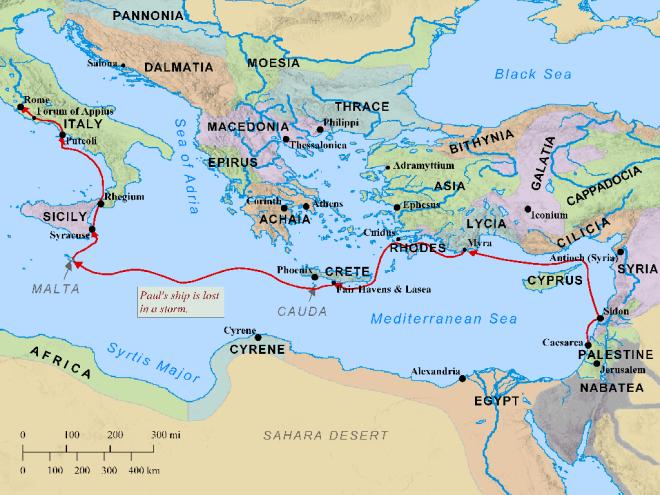
Festus arrives in Jerusalem and is accosted by the Jews there, asking him to deliver Paul to Jerusalem for trial (vv. 2-3).  They were intending to assassinate Paul (v. 3).  But Festus planned to hear Paul in Caesarea Maritima and offered to take “leading men” there to try Paul (vv. 4-5).

As soon as Paul was brought out (v. 7), the Jews shouted out their charges against him.  When he finally had a chance to talk he re-emphasized…

“Neither against the law of the Jews, nor against the temple, nor against Caesar have I committed any offense.”

When Festus asked if he would like to present his case in Jerusalem (v. 9), Paul appealed to Caesar (v. 11).  So Festus concluded, “To Caesar you have appealed; to Caesar you shall go” (v. 8).

When King Agrippa and Bernice came to Caesarea, Felix explained what was going on with Paul, and that he had appealed to Caesar.  He wasn’t sure what to do with Paul, so he brought him before Agrippa and Bernice so that maybe they could figure out how to charge Paul.

Thomas Constable has these notes about Agrippa, Bernice and Festus.

This “King Agrippa” was Marcus Julius Agrippa II, the son of Herod Agrippa I (12:1-11), the grandson of Aristobulus, and the great grandson of Herod the Great (Matt. 2:1). Herod the Great had tried to destroy the infant Jesus.  One of his sons, Antipas, Agrippa II’s great uncle, beheaded John the Baptist and tried our Lord.  Agrippa II’s father, Agrippa I, had executed James, the son of Zebedee and brother of John. He had also imprisoned Peter and died in Caesarea (ch. 12).  His son, Agrippa II, is the man Paul now faced.

Agrippa II had grown up in Rome, and was a favorite of Emperor Claudius.  He was the last in the Herodian dynasty, and has been considered the best of the Herods.  He was also a friend to Flavius Josephus, who served as governor of Galilee and a Roman general about this time.  Among his other powers, Agrippa II was superintendent of the Jerusalem temple, and he had the power to appoint Israel’s high priests.

At the time he visited Festus, “Agrippa” (II) was the king whom Rome had appointed over the territory northeast of the Judean province.  He lived in Caesarea Philippi (Dan of the Old Testament), which he renamed “Neronias” in honor of Nero.  Agrippa was about 30 years old at this time, and his sister, “Bernice” (Lat. Veronica), was one year younger.  He ruled this region from A.D. 50 to 70.  Drusilla, Felix’s wife, was Agrippa and Bernice’s younger sister.  Bernice was first married to her uncle Herod, King of Chalcis, and after he died, she lived with her brother, Agrippa, in a suspicious relationship.  She concluded her profligate life by a criminal connection with Titus, the conqueror of Jerusalem.

Agrippa and Bernice evidently visited Festus on this occasion to “pay their respects” to the new governor of their neighboring province.  Agrippa and Bernice were essentially favorable to the Jews.  They both tried to avert the Roman massacre of the Jews in A.D. 66-70.

herodian-family-tree

M’Cheyne Bible Reading Plan, January 24

Today’s readings are Genesis 25, Matthew 24, Esther 1 and Acts 24.

In Genesis 25 Abraham’s second wife, Keturah, and her children…

Image result for abraham and keturah

Abraham sent these sons “eastward” (v. 5) and then he died (vv. 7-8).  He was buried with Sarah “in the cave of Machpelah, in the field of Ephron the son of Zohar the Hittite, east of Mamre” (v. 9).

Image result for abraham and keturah map

Josephus tells us that “Abraham contrived to settle them in colonies; and they took possession of  Troglodytis [bet you didn’t know where that word came from!] and the country of Arabia the Happy, as far as it reaches to the Red Sea” (Antiquities, 1.15.1).  Abraham, in all probability, tried to keep them apart from Isaac to avoid conflict while fulfilling God’s commission to spread out and inhabit the globe (Genesis 1:27-28; 9:1; Josephus Antiquities 1.4.1-3).

Isaac settled at Beer-lahai-roi (v. 11).

isaac's journeys, bible-history

Genesis 25:12-18 are the generation of Ishmael…

Image result for Ishmael family tree

Then, the generations of Isaac, starting in verse 19 with the birth of Esau and Jacob (25:21-28) and the incident of Esau selling his birthright for lentil stew and bread, thus Esau despised his birthright (25:34).

Paul speaks of the birth of Esau and Jacob (Romans 9:10-13), highlighting God’s sovereign grace in election, for neither Esau nor Jacob were worthy of being chosen by God.

10 And not only so, but also when Rebekah had conceived children by one man, our forefather Isaac, 11 though they were not yet born and had done nothing either good or bad–in order that God’s purpose of election might continue, not because of works but because of him who calls–12 she was told, “The older will serve the younger.” 13 As it is written, “Jacob I loved, but Esau I hated.”

The writer of Hebrews focuses on Esau despising his birthright and adds…

15 See to it that no one fails to obtain the grace of God; that no “root of bitterness” springs up and causes trouble, and by it many become defiled; 16 that no one is sexually immoral or unholy like Esau, who sold his birthright for a single meal. 17 For you know that afterward, when he desired to inherit the blessing, he was rejected, for he found no chance to repent, though he sought it with tears.

I believe v. 17 speaks of him coming in to Isaac to be blessed, only to find out Isaac had blessed Jacob recorded in Genesis 27…

34 As soon as Esau heard the words of his father, he cried out with an exceedingly great and bitter cry and said to his father, “Bless me, even me also, O my father!” 35 But he said, “Your brother came deceitfully, and he has taken away your blessing.” 36 Esau said, “Is he not rightly named Jacob? For he has cheated me these two times.  He took away my birthright, and behold, now he has taken away my blessing.”  Then he said, “Have you not reserved a blessing for me?” 37 Isaac answered and said to Esau, “Behold, I have made him lord over you, and all his brothers I have given to him for servants, and with grain and wine I have sustained him.  What then can I do for you, my son?” 38 Esau said to his father, “Have you but one blessing, my father?  Bless me, even me also, O my father.”  And Esau lifted up his voice and wept.

Esau lost his birthright and received a sub-par blessing.

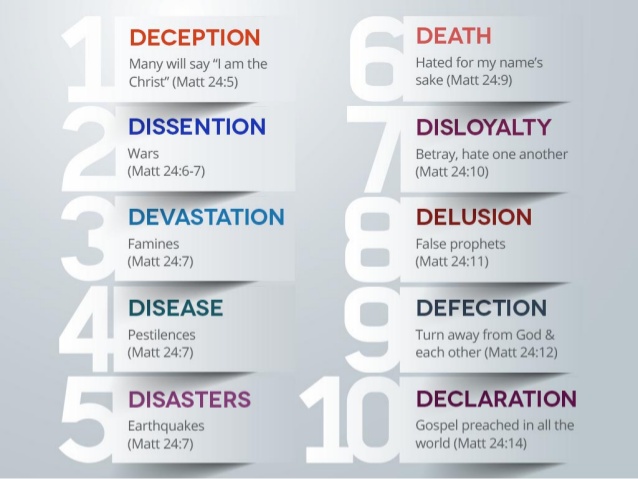
Matthew 24 is Jesus’ answer to the disciples wanting to know…

“Tell us, when will these things [destruction of Jerusalem] be, and what will be the sign of your coming and of the close of the age?” (24:3)

matthew 24 chart--10 factors of the end times

Jesus tells them that all the terrible things that are happening in vv. 5-7 are “but the beginning of the birth pains” (v. 8).  The beginning of “birth pangs” is the beginning of this Tribulation.  Some interpreters believed verses 4-8 describe the first half of the Tribulation and verses 9-14 the last half.

The 70th Week of Daniel 9
Seven Years
The Tribulation

  Great Tribulation
Time of Jacob’s Trouble
Beginning of Birth Pangs Hard-Labor Birth Pangs
First Half Second Half

Thomas Constable, Matthew

A comparison of the “beginning of birth pangs” and the first four seals in Revelation indicate that they are likely describing the same thing.

“Beginning of birth pangs
(Mt. 24)

First Four seals
(Rev. 6)

1. False messiahs who will mislead many (v. 5) 1. First seal: Rider on white horse, a false messiah (v. 2)
2. Wars, rumors of wars, nation rising against nation (vv. 6-7) 2. Second seal: Rider on red horse takes away peace from earth (vv. 3-4)
3. Famines (v. 7) 3. Third Seal: Rider on black horse holds balances, represents famine (vv. 5-6)
4. Death through famine, pestilences, and earthquakes (v. 7) 4. Fourth seal: Rider on pale horse, represents death through famine, pestilence, and wild beasts (vv. 7-8)

Thomas Constable, Matthew

The persecutions (24:9-13) and the spread of the gospel will take place in the second half of the tribulation.  With verse 15 Jesus goes back to the mid-point, the “abomination of desolation,” the greatest sign to the Jews.  It is a term Daniel used in Daniel 8:13; 9:27; 11:31; and 12:11.  It describes something that—because of its abominable character—causes the godly to desert the temple on its account.

What Daniel predicted will happen in those seven years will be a unique national distress for Israel (Dan. 12:1; cf. Jer. 30:7).  It will begin when a wicked ruler (Antichrist) signs a covenant with Israel (Dan. 9:27).  After three and a half years, the ruler would break the covenant and terminate worship in the temple.  He would end temple worship by setting up an abominable idol there (cf. 2 Thess. 2:4; Rev. 13:14-15).

This will cause a mass exodus from Jerusalem to the mountains.

21 For then there will be great tribulation, such as has not been from the beginning of the world until now, no, and never will be. 22 And if those days had not been cut short, no human being would be saved.  But for the sake of the elect those days will be cut short.

The return of Jesus Christ happens at the end of this seven years.  Jesus reminds them not to believe every so-called “Messiah” (24:23-26).  His coming will be obvious to all.

27 For as the lightning comes from the east and shines as far as the west, so will be the coming of the Son of Man.  29 “Immediately after the tribulation of those days the sun will be darkened, and the moon will not give its light, and the stars will fall from heaven, and the powers of the heavens will be shaken. 30 Then will appear in heaven the sign of the Son of Man, and then all the tribes of the earth will mourn, and they will see the Son of Man coming on the clouds of heaven with power and great glory.

What does the verse about the vultures mean (v. 28)?  And who is the corpse?  One view is that the vultures represent Jesus and the angels, come to pick clean the morally corrupt world.

31 And he will send out his angels with a loud trumpet call, and they will gather his elect from the four winds, from one end of heaven to the other.

The passage He referred to was Isaiah 27:12-13.  There Israel is in view, so Jesus must have been speaking about the gathering of Israelites again to the Promised Land at His Second Coming.  The four winds refer to the four compass points.  This regathering will involve judgment (13:39, 41; 24:40-41; 25:31; 2 Thess. 1:7-8). This regathering will set the stage for Messiah’s worldwide reign.

Jesus then describes the moral responsibilities that arise from these eschatological truths:

First, he gives four parables about being vigilant and watchful.  He talks about watching the fig tree when it is about to bear fruit (24:32-36), with a clarifying parable about the “days of Noah” in 24:37-39.  Then the parable of the one taken and one left behind (24:41-42) emphasizes that neither gender, nor occupation, nor close relationship, will prevent the separation for judgment (cf. 10:35-36).  The parable of the homeowner who could have stayed away to prevent theft (24:43-44) is preceded by an exhortation to stay awake.  We don’t know when He will come, so we have to stay ready.

There are three parables in this section to finish chapter 24 and continue to the end of chapter 25.  All of them refer to two types of disciples, the faithful and the unfaithful.

The parable of the two servants (24:45-51) illustrates the two attitudes that people during the Tribulation will have regarding Jesus’ return.

Esther 1

Esther, like Ruth, focuses upon a woman, a Jewish woman who under God’s sovereign hand became queen so that she could rescue her people.  God’s people are in exile, taken into exile by the Babylonians.  But in 539 B.C. the Medes and Persians defeated the Babylonians.

This book describes the most serious threat to the preservation of the Jewish race, equaled only by the Nazi holocaust.

Even though God is never mentioned in this book, He is clearly at work behind the scenes.  So the most basic answer to how to survive is God, He protects us.

The events of the Book of Esther took place during the Persian period of ancient Near Eastern history (539–331 B.C.) and during the reign of King Ahasuerus (also called Xerxes I) in particular (486–464 B.C.).  History portrays him as a lover of war, women and parties, and the book of Esther confirms this.

The first historical event to which the writer alluded seems to be Ahasuerus’ military planning session at which he plotted the strategy for his ill-fated campaign against Greece (1:3-21).  The king held this planning session in the winter of 483–482 B.C.

The last recorded event in Esther is the institution of the Feast of Purim that took place in 473 B.C.  Therefore the events recorded in the book span a period of about 9 or 10 years.  Leon Wood wrote that the book “covers the third to the twelfth years of Zerxes’ rule (483-471; Esther 1:3; 3:7).”

Under the Persian rule, there were three specific returns of Jews to the land of Judah.

  • The first was led by Zerubbabel and involved an initial rebuilding of the Temple in Jerusalem.
  • The second was led by Ezra who promoted a revival among the people.
  • The third was led by Nehemiah and involved the rebuilding of the defensive walls of Jerusalem.

Image result for returns to israel post-exilic esther

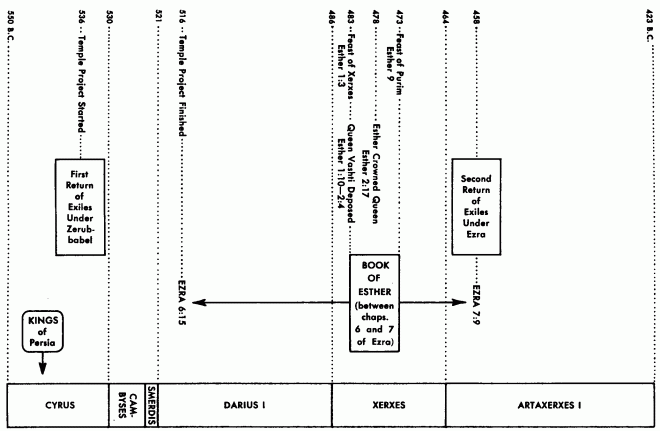
This timeline shows you where Esther fits, in the timeline between Zerubbabel’s return and the building of the temple Ezra’s return to build up the people.

esther timeline

List of the Kings of Persia from 550 BC to 330 BC
Persian Kings Period of Reign (Approx)
Cyrus II “the Great” 550-529 BC
Cambyses II 529-522 BC
Darius I 522-486 BC
Xerxes I (Ahasuerus) 486-465 BC
Artaxerxes I 465-425 BC
Xerxes II 425-424 BC
Darius II 423-404 BC
Artaxerxes II 404-359 BC
Artaxerxes III 359-338 BC
Arses 338-336 BC
Darius III 336-330 BC

https://www.bible-history.com/old-testament/persian-kings.html

Image result for map of the persian empire from cyrus to darius

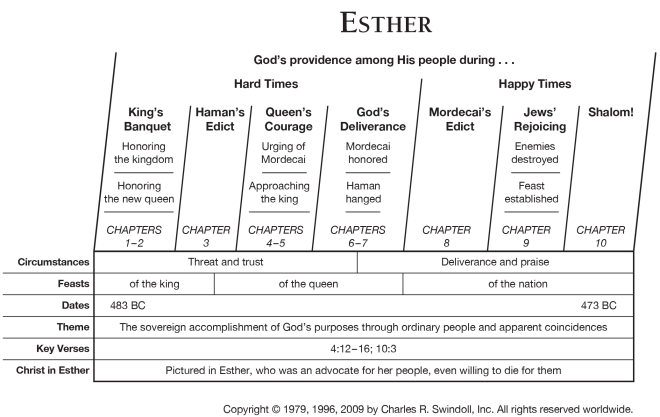
Here is Chuck Swindoll’s book chart of Esther…

book chart of esther, swindoll

Chapter 1 is the beauty pageant.  The first step is that Queen Vashti is deposed.  The king has a party (vv. 1-9), Vashti is deposed because of “lack of submission” (Esther 1:10-22).

The king gets drunk and orders his wife, Queen Vashti, to display her beauty for his guests (1:10-11).  We don’t know the precise dangers of this request, but she refused, infuriating the king (1:10).

Now drunk and angry, he seeks advice.  The reasoning is that other women might follow her rebellious example (1:17-18), therefore, she needs to be removed at once (1:19), so that all women will fear their husbands (1:20.  The king agrees and Vashti is deposed (1:21-22).

Acts 24: The delivery of the prisoner Paul to Caesarea marked the beginning of a two-year imprisonment in that city.  During this period he stated his case, and also the case for the Christian gospel, to two provincial governors and a king, fulfilling one aspect of the Lord’s prediction about his ministry (9:15).

In Acts 24, the high priest and some elders came to Caesarea to oppose Paul.  First, they tried to butter up Felix (24:2-4) before laying out their case against Paul.  He is a trouble-maker (v. 5) and profaner of the temple (v. 6), but you can examine him yourself (v. 7).  The charge of trouble-making gave the impression that Paul was guilty of sedition against Rome.

Paul also complimented Felix (v. 10), then answered one charge by saying he hadn’t been around long enough to cause trouble (v. 11).  In response to the third charge (v. 6), Paul replied that he had gone to Jerusalem “to worship” (v. 11).  Paul rebutted the second (v. 14) charge of leading a cult (v. 5), by explaining that his beliefs harmonized with the teachings of the Hebrew Scriptures (“the Law and . . . the Prophets”).  The real conflict between Paul and his accusers was religious in nature.  He mentions the resurrection (v. 15) and comments on how it encourages him to keep a clean conscience (v. 16).

Paul then said that he had come to the temple, not to desecrate it, but to bring an offering for the people (vv. 17-18a) and that his original accusers were not even present (vv. 18b-19).  There was no wrongdoing (v. 20) except that Paul had brought up the resurrection (v. 21).

Felix put off making a decision (v. 22) but gave Paul some freedom while he held him (v. 23).  Paul finally had the opportunity to speak to Felix about the gospel (vv. 24-28).

“Drusilla” was the youngest daughter of Herod Agrippa I, who had been king over Palestine from A.D. 37-44.  It was he who had authorized the death of James, the son of Zebedee (12:1-2), and had imprisoned Peter (12:3-11).  Drusilla was Felix’s third wife, whom he had married when she was 16 years old.  She was now (A.D. 57) 19.  She had previously been the wife of Azizus, the king of Emesa, a state within Syria, but Felix broke up that marriage to get her. (William Barclay, Acts, p. 187)

Felix himself had been married twice before, to princesses, the first of which was the granddaughter of Anthony and Cleopatra.  Felix used his marriages to advance his political career.  The Herods were, of course, Idumeans, part Israelite and part Edomite. Drusilla eventually died when Mt. Vesuvius erupted, along with her child by Felix.

Something about Paul and or his gospel seems to have fascinated Felix.  Someone commented that when Paul talked to Felix and Drusilla, enslaved royalty was addressing royal slaves.

Paul’s emphases in his interview with Felix and Drusilla were the same three things—that Jesus Christ had predicted the Holy Spirit would convict people about—that would bring them to faith.  These things were: sin (“self-control”), “righteousness,” and “judgment” (John 16:8-11).

Felix and Drusilla were notoriously deficient in all three of these areas.  It is not surprising that Felix became uneasy.  He apparently was willing to discuss theology but not personal morality and responsibility.  These subjects terrified him (Gr. emphobos).

Felix’s decision to postpone making a decision about his relationship to God is a common one.  Often people put off this most important decision until they cannot make it.  This is probably why most people who make decisions for Christ do so when they are young.  Older people normally become hardened to the gospel.  We do not know if Felix ever trusted in Christ; there is no evidence that he did.

The “two years” to which Luke referred were evidently the years of Paul’s detention in Caesarea.  Felix’s superiors relieved him of his position, because he had handled a conflict in Caesarea too harshly, between the Jewish and Gentile residents, which resulted in the suffering and death of innocent people.  Too many Jews had died or been mistreated.

His replacement, “Portius Festus,” served as procurator of Judea from A.D. 59 to 61. To appease the Jews, Felix “left Paul imprisoned.”  The apostle had become a political pawn in the will of God.

It is quite likely that, if Luke was with Paul at this time, he used these two years to do some of the research he referred to at the beginning of his two-part work (i.e., Luke-Acts; cf. Luke 1:3; Acts 1:1).  He may have even written his Gospel then, and some of Acts.

M’Cheyne Bible Reading Plan, January 23

Readings today are from Genesis 24, Matthew 23, Nehemiah 13 and Acts 23.

Abraham, in Genesis 24, is seeking a wife for Isaac.  He didn’t want a wife from the Canaanites and he didn’t want Isaac to return to the land he (Abraham) came from.  If a woman wouldn’t return from there to be Isaac’s wife, the servant was relieved of his duties.

10 Then the servant took ten of his master’s camels and departed, taking all sorts of choice gifts from his master; and he arose and went to Mesopotamia to the city of Nahor.

It is more than likely that Nahor is the name of Abraham’s brother who lived in Haran.  It was the city where Abraham’s brother Nahor lived with his son Laban, where Terah and Abraham made their home after they left the land of the Chaldees, where Terah died and from which Abraham left to go to that land God promised to him (Genesis 12:1-3).

Image result for genesis 24 map

Notice how the servant prayed, first generally (for success) and then specifically.

12 And he said, “O LORD, God of my master Abraham, please grant me success today and show steadfast love to my master Abraham. 13 Behold, I am standing by the spring of water, and the daughters of the men of the city are coming out to draw water. 14 Let the young woman to whom I shall say, ‘Please let down your jar that I may drink,’ and who shall say, ‘Drink, and I will water your camels’–let her be the one whom you have appointed for your servant Isaac. By this I shall know that you have shown steadfast love to my master.”

“Steadfast love” to Abraham meant that this servant knew that God would be faithful to keep His covenant promise to Abraham–to have many descendants.  That couldn’t happen if Isaac remained unmarried.

15 Before he had finished speaking

God was already answering his prayer.

And Rebekah did exactly as the servant had prayed

18 She said, “Drink, my lord.” And she quickly let down her jar upon her hand and gave him a drink. 19 When she had finished giving him a drink, she said, “I will draw water for your camels also, until they have finished drinking.” 20 So she quickly emptied her jar into the trough and ran again to the well to draw water, and she drew for all his camels.

Now this was no mean feat.  “Since camels could drink 25 gallons [and he had 10], the servant’s sign was sagacious (v. 14).  It tested Rebekah’s kindness, hospitality, industry, and willingness to help a stranger” (Thomas Constable)

After praying, the servant watched (because of the specificity of his prayer he knew exactly what to look for) and waited (which we often have to do), then he worshiped (vv. 25-26) and witnessed to Laban what the Lord had done (vv. 34-48).

“As we overhear the servant recount more details, we see that the miracle of God’s provision was even more grand than that suggested in the narrative itself” (John Sailhamer, Genesis, p. 177).

Rebekah went with the servant and united with Isaac in the field where he was meditating.  David Guzik mentions these comparisons between Genesis 24 and our “marriage” to Jesus:

  • A father desires a bride for his son.
  • A son was just accounted as “dead” and “raised from the dead.”
  • A nameless servant is sent forth to get a bride for the son.  The servant’s name is actually Eliezer, meaning “God of help” or “helper” (the Holy Spirit, John 14:16).
  • The lovely bride is divinely met, chosen, and called, and then lavished with gifts.
  • She is entrusted to the care of the servant until she meets her bridegroom.

Matthew 23 is Jesus pronouncing woes on the scribes and Pharisees.  Years ago I read a book by Jeff Vanvonderen and David Johnson called  The Subtle Power of Spiritual Abuse: Recognizing and Escaping Spiritual Manipulation and False Spiritual Authority Within the Church.  Part of it discussed the Pharisees in Matthew 23.

Jesus warns the crowd and his disciples not to follow the false leadership of the Pharisees (vv. 1-12), then directly pronounces woes upon those leaders for their deadly actions (see vv. 13-39).  They had rejected Him and now He was formally rejecting them.

Evidences of spiritual abuse:

  • They don’t practice what they preach (v. 3).
  • They require others to do things they won’t do (v. 4).
  • They want their righteousness to be seen (v. 5), so they are honored (v. 6) and greeted (v. 7)–more important than others.
  • They want to be called exalted and respected titles (v. 8-10).
  • They are not servant leaders (vv. 11-12).

There are seven “woes” in vv. 13-36.

  • They are religious charlatans, whose “religion” doesn’t get people into heaven (v. 13).  These focus particularly upon “works righteousness” ways to “salvation.”
  • Pious thieves, who “comfort” widows only to steal from them (v. 14).  It reminds me of prayer cloths sent to older people to persuade them to give more money.
  • Promoting legalism (v. 15).  The self righteousness of scribes & Pharisees was enough of a curse, but these converted Gentiles would be zealous for their new religion, and some in that zeal would surpass their teachers in self righteousness, and thus “twice as much a son of hell.”
  • Fake vows (vv. 16-22) are made when using religious artifacts to bolster your credibility, when in fact you have no intention of keeping your promises.  They were looking for loopholes, which Jesus consistently discouraged.  Just keep your word!

Image result for w. c. fields looking for loopholes

  • Missing the important things (vv. 23-24).  While it was commendable that they were meticulous to keep this law, they neglected the more important aspects of the law including justice, mercy and faithfulness.  They were distorting the will (focus) of God in the Scriptures for minutia.
  • Masked thieves (vv. 25-26).  They were careful to appear pious, but they were in reality taking advantage of people.  They needed, like we all do, an inside-out change.
  • Beautiful but dead (vv. 27-28).  These people looked great on the outside, but inside they were full of death–hypocrisy and lawlessness.  Many today claim to be “more tolerant,” “more compassionate,” but are hypocrites.
  • Pretentious superiority (vv. 29-31).  We all like to think we are better than others, but in reality our motivations betray the fact that we would do exactly as they did.

The Old Testament idea behind verse 32 is that God will tolerate only so much sin.  Sooner or later His patience (the only attribute of God that is not infinite) will run out.  Then He will act in judgment (cf. Gen. 6:3, 7; 15:16; cf. 1 Thess. 2:14-16).  Here Jesus meant that Israel had committed many sins—and incurred much guilt—by murdering the prophets.  When the Pharisees killed Jesus and His disciples (cf. v. 34), the cup of God’s wrath would be full, and He would respond in wrath.  The destruction of Jerusalem, and the worldwide dispersion of the Jews—resulted—in A.D. 70.

Notice that the primary sin aimed at in most of these verses was hypocrisy.  That is something that you and I are in danger of committing.  It is so much easier to focus on the externals, to “look good” there, than it is to really change our heart’s motivations and desires.

With a strong assertion of certainty, Jesus predicted that God’s judgment would “fall” (v. 35) on the “generation” of Jews that rejected Him.  This is Jesus’ formal, culminating rejection of Israel for rejecting Him as her Messiah.  “These things” refer to the outpouring of God’s wrath just revealed (vv. 33, 35).  That generation would lose the privilege of witnessing Messiah’s establishment of the kingdom, and the privilege of being the first to enter it by faith in Jesus.  Instead they would suffer the destruction of their capital city and the scattering of their population from the Promised Land (in A.D. 70).  The whole generation would suffer because the leaders acted for the people, and the people did not abandon their leaders to embrace Jesus as their Messiah (cf. Num. 13—14). (Thomas Constable)

After this stinging indictment of Israel and their leaders, Jesus’ heart breaks for Jerusalem, especially given the soon destruction in another nearly 40 years.

37 “O Jerusalem, Jerusalem, the city that kills the prophets and stones those who are sent to it! How often would I have gathered your children together as a hen gathers her brood under her wings, and you would not! 38 See, your house is left to you desolate. 39 For I tell you, you will not see me again, until you say, ‘Blessed is he who comes in the name of the Lord.'”

Carl Rasmussen, in his online article Why is the Hen Gathering Her Chicks? (Matt 23:37; Luke 13:34) that a farmer once explained…

He said that he had grown up on a farm and that a hen has a variety of informative “clucks.”  For example a certain clucking sound would call her chicks to eat.  He also said that as a prank, he would cut out a cardboard eagle or hawk, affix it to a long stick, and would then maneuver it so that the shadow of the bird of prey would fall within the vision of the hen.  Upon seeing [the shadow of the fake] bird of prey she would utter a special clucking sound that called her chicks to gather under her wings for protection from the danger!  This of course is what she would do when a real bird of prey was threatening her or her chicks.  (my paraphrase)

Jesus desired to protect them from danger, but they would not heed His voice and come to him.  On the cross, He spread His “wings” again, and all who come under Him will find rest and joy and peace and life.

Nehemiah 13 speak of reforms that Nehemiah instituted.

To understand when the events described in this chapter took place, it is necessary to read verses 1-7, not just verse 1.  Nehemiah returned to Artaxerxes in 432 B.C. (v. 6).  It was customary in the ancient Near East for kings to require their servants to return to them periodically to reaffirm their allegiance.  “Some time” later Nehemiah returned to Jerusalem (v. 6).  The text does not say how much later this was.

However, since the prophet Malachi reproved the Jews in Judah for the same sins Nehemiah described in this chapter, and conservative scholars usually date his prophecies about 432–431 B.C.  Therefore Nehemiah may very well have returned to Jerusalem about 431 B.C.

Undoubtedly he would have wished to return as soon as possible.

Each of the following reforms dealt with a violation of the covenant these people had just made with God (cf. 10:29-32)!

We see here that the slide into moral permissiveness is not new, it is normal.

Warren Wiersbe reminds us…

“General William Booth, founder of The Salvation Army, once said to a group of new officers, ‘I want you young men always to bear in mind that it is the nature of a fire to go out; you must keep it stirred and fed and the ashes removed.’”

Hosea has said of Israel’s loyalty, that it was like the morning dew (Hosea 6:4).

A lesser man would have said, “I give up on these people.  It is useless!”  But Nehemiah did not give up on them, but confronted them of their sins.

First, to deal with spiritual permissiveness, we must be aware of the problem areas.  Apparently no one else had done anything, allowing the moral slide to continue.  Apparently Ezra was dead by now, since Zadok is mentioned as “the scribe.”

The first problem was intermarriage.  According to Deuteronomy 23:3-4 neither an Ammonite or Moabite could enter the assembly of the Lord.

Apparently, Eliashib (possibly the high priest, 3:1, 20; 13:28) had cleaned out one of the temple storerooms and converted it into an apartment for Tobiah, because he was an influential friend and blood relative (13:7).  But he was an Ammonite and an enemy of the people of Jerusalem.

Nehemiah was very angry when he returned to Jerusalem and discovered this enemy of the faithful remnant living in the temple, so he threw him out.  Nehemiah’s anger was not only due to Tobiah’s presence in the temple, but also Eliashib’s lack of spiritual discernment and the recognition that the Israelite’s commitment had already disappeared.

The next problem was the lack of tithes to supply the Levites (13:10-14).

In Nehemiah 10:39 the people promised: we will not neglect the house of our God.  But later in Nehemiah 13:11, Nehemiah had to ask: Why is the house of God forsaken?  It was forsaken because Israel did not keep its promises before God.

Because the people had failed to bring their tithes to the temple, the Levites had to abandon their service in the temple to provide for their own physical needs.  This failure may have resulted in rooms standing vacant for Tobiah to occupy as well.

In response to Nehemiah’s reprimands, and Malachi’s preaching, the people began to tithe again (cf. Mal. 3:8-10).

Thus far all of Nehemiah’s reforms, following his return to Jerusalem, involved temple service.  Verse 14 records his prayer in view of these reforms (cf. 5:19).

The people had also failed to observe the Sabbath (13:15-22).  Foreign merchants were selling on the Sabbath and people wre preparing and transporting goods on that holy day.  Nehemiah rebuked them and locked the city gates on Sabbath.

Again, he asks God to remember him for his loyalty to the Mosaic law (13:22b).

Ultimately, Nehemiah gets to the problem of mixed marriages (13:23-29).

Nehemiah confronted this problem as Ezra had several years earlier (Ezra 9—10).  Evidently some of these Jews had divorced their Jewish wives to marry foreigners (Mal. 2:10-16).

The text records only Nehemiah’s words to the people, but since we know what kind of person he was, we can safely assume that he followed up his words with action.

The marriage of Joiada’s son to a foreigner (v. 28) was especially bad since he was the grandson of the high priest, and priests were to marry only Jewish virgins (Lev. 21:14).  Anyone in the high priestly lineage could become high priest, so this was especially dangerous.

In the ancient East, marriages involving prominent families were often arranged to secure political advantage and to form alliances.  Probably this was the case in the marriage of the high priest’s grandson and Sanballat’s daughter.

Again, a similar prayer by Nehemiah marks off this significant reform (v. 29; cf. v. 14).

As Nehemiah and Ezra were both reformers and typological mediators of Christ, their faithfulness are but shadows of the faithfulness of Christ.   It is Christ’s faithfulness which is remembered by the Father and truly eternal in the sense that Nehemiah and Ezra sought to achieve in the ancient Reformation.

Israel’s failure, in the very areas where they had made a strong commitment in chapter 10, just proves what Paul says in Romans 8:3

3 For what the law was powerless to do because it was weakened by the flesh, God did by sending his own Son in the likeness of sinful flesh to be a sin offering. And so he condemned sin in the flesh, 4 in order that the righteous requirement of the law might be fully met in us…

All of Nehemiah’s reforms mean nothing if Christ is removed from the picture.

Acts 23 continues Paul’s defense.  Evidently Paul intended to give his testimony again, this time to the Sanhedrin (“Council”).

Paul frequently claimed to have lived with a clear (“perfectly good”) “conscience before God” (cf. 20:18-21, 26-27; 24:16; Rom 15:19, 23; Phil. 3:6; 2 Tim. 4:7).  Here this claim meant he believed that nothing he had done, which he was about to relate, was contrary to the will of God contained in the Hebrew Scriptures.  Specifically, his Christian beliefs and conduct did not compromise his Jewish heritage.

Paul’s claim to uprightness so incensed “Ananias the high priest,” that he ordered a soldier to “strike Paul (him) on the mouth.”

Jewish law considered a person innocent until proved guilty, but Ananias had punished Paul before he had even been charged, much less tried and found guilty.  Paul reacted indignantly and uttered a prophecy of Ananias’ judgment that God fulfilled later.  A “whitewashed wall” was one that was frequently inferior on the inside, but looked good outwardly (cf. Ezek. 13:10-16; Matt. 23:27).

Was this disrespectful of the high priest?

Paul may not have known that it was the high priest who had issued the order to be slapped.  Some blame his eyesight, but that seems unlikely.  Paul somewhat apologizes in verse 5.

Then Paul changed tactics, dividing the crowd.  The Sadducees did not believe in the resurrection; the Pharisees did.  So you drop that word in this crowd and it is combustible.

Paul was undoubtedly wondering how he would ever get out of the mess in which he found himself.  At this critical moment, during the “night of the next day” (“following night”; Gr. te epiouse nykti), the Lord appeared to him again (cf. 9:4-6; 16:9; 18:9-10; 22:17-21; 27:23-24; Gen. 15:1) and “stood at his side.”  The Lord’s appearances to Paul all occurred at great crises in his life.

He assured the apostle that he would bear “witness in (at) Rome,” as he had already done in Jerusalem (1:8).  This revelation is essential to Luke’s purpose in writing Acts, and it certainly must have given Paul confidence as the events that followed unfolded.

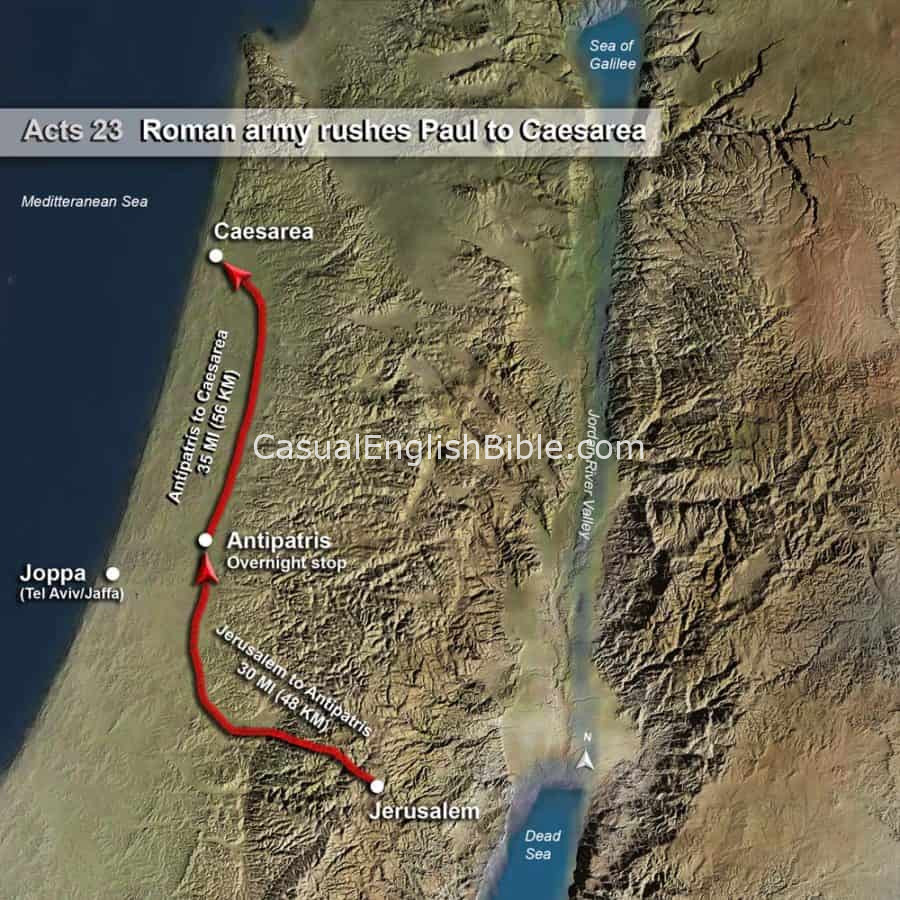
This was needed because the Jews were plotting to kill Paul (vv. 12-15), but Paul’s nephew heard of it (v. 16) and reported it to Paul.  Paul brought him to tell the tribune (vv. 17-21).  The tribune then planned to get Paul out of town that night and take him to Caesarea Maritima, to Felix (vv. 22-24).  A letter was written explaining about Paul and his situation to Felix (vv. 25-30), so they took Paul first to Antipatris (v. 31) and Caesarea (v. 33), to Felix.

Image result for Acts 23 map

Stephen Miller’s map for Acts 23.  Casual English Bible.

34 On reading the letter, he asked what province he was from. And when he learned that he was from Cilicia, 35 he said, “I will give you a hearing when your accusers arrive.” And he commanded him to be guarded in Herod’s praetorium.


M’Cheyne Bible Reading Plan, January 22

Today’s readings are from Genesis 23, Matthew 22, Nehemiah 12 and Acts 22.

The first 16 verses of Genesis 23 recounts Abraham bargaining for a burial plot for Sarah.  He wanted to pay for it, they wanted to give it to him.  Usually, people wanted to bury their loved ones in their homeland.  Abraham was indicating that he intended to stay in the land God gave to him.

Thomas Constable indicates:

Why did “Ephron” want to sell Abraham the entire plot of ground (“field”) in which the cave lay, rather than just the “cave” as Abraham requested (vv. 8-11)?

Hittite law specified that when a landowner sold only part of his property to someone else, the original owner had to continue to pay all taxes on the land.  However, if he sold the entire tract, the new owner was responsible to pay the taxes (cf. 1 Chron. 21:24).  Consequently, Ephron held out for the entire tract, knowing that Abraham needed to make his purchase quickly so he could bury Sarah.

Abraham’s willingness to pay, what appears to have been an unusually large price for the land, further demonstrates his faith (vv. 15-16).  An average field cost four shekels per acre, and garden land cost 40 shekels per acre.  Abraham was willing to pay “400 shekels”!  Of course, the text does not give the exact area of the property, but it appears to have been relatively small.

So Abraham buried Sarah there:

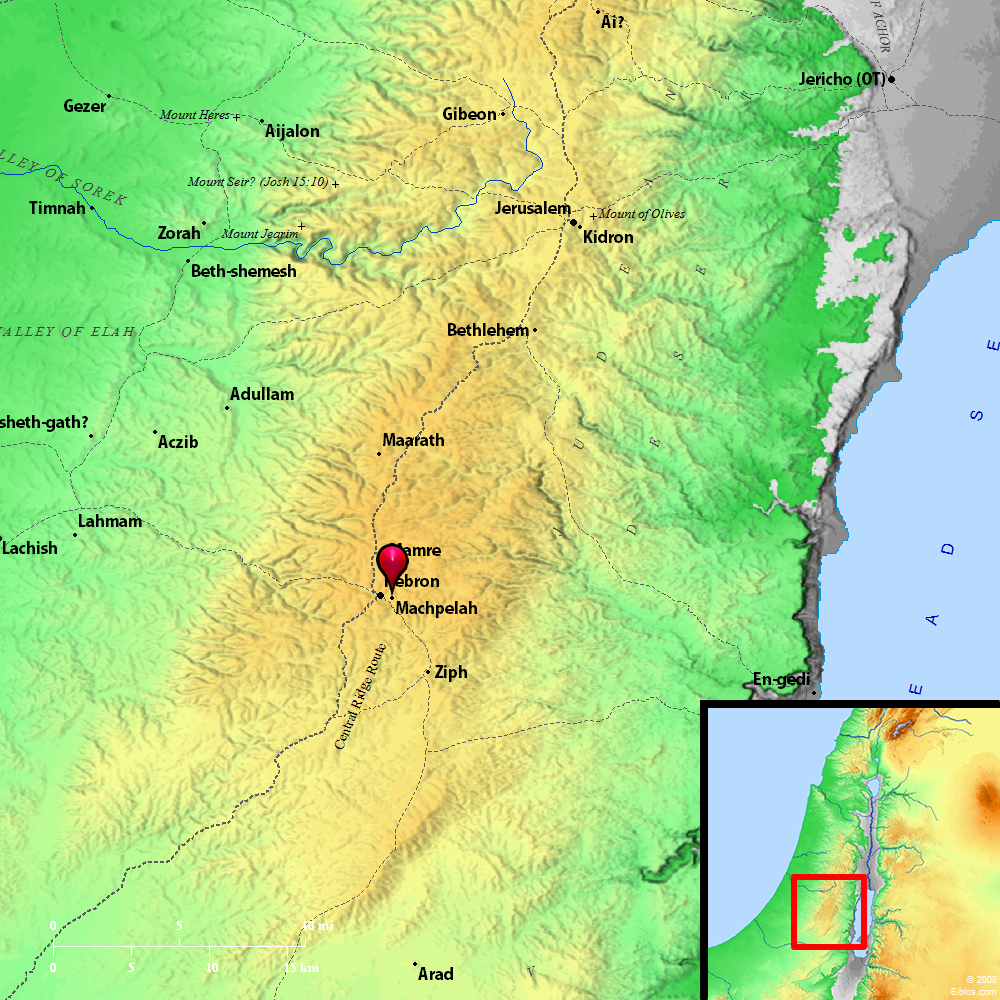
19 After this, Abraham buried Sarah his wife in the cave of the field of Machpelah east of Mamre (that is, Hebron) in the land of Canaan 20 The field and the cave that is in it were made over to Abraham as property for a burying place by the Hittites.

Bible Atlas

Matthew 22 begins with a parable of the wedding feast.

The three parables in this series are similar to three concentric circles in their scope.  The scope of the parable of the two sons encompassed Israel’s leaders (21:28-32).  The parable of the wicked tenant farmers exposed the leaders’ lack of responsibility, and their guilt, to the people listening in, as well as to the leaders themselves (21:33-46).  This last parable is the broadest of the three. It condemned the contempt with which Israel as a whole had treated God’s grace to her. (Thomas Constable)

The “king” represents God the Father.  “His son,” the bridegroom (cf. 9:15; 25:1), is Messiah.  The “wedding feast” is the messianic banquet that will take place on earth at the beginning of the kingdom (8:11-12; 25:1)  As in the previous parable, the “slaves” (Gr. douloi) of the king are His prophets (21:34-36).

The prophets announced the coming of the banquet and urged those whom God invited to it, the Jews, to prepare for it.  However, most of those who heard about it did not respond to the call to prepare for it.  The repetition of his invitation (vv. 4-5) displays his grace.  Some (read religious leaders) abused his servants (vv. 6-7).  Servants were sent out again, inviting “good” (Jews) and “evil” (Gentiles) until the hall was full (vv. 8-10).

So, who is the man who doesn’t possess wedding (clean) clothes?  A Jew who hoped to enter the kingdom based on his Jewishness?  A believer who had lost his salvation because of lack of righteousness in his life?  Or is it a believer who loses reward?

Well, since a true believer cannot lose their salvation and “weeping and gnashing of teeth” usually refers to hell, I would go with the first explanation.  Jesus was looking for faith and did not see it.

Next (vv. 15-22) was the object lesson with the coin.  Give honor to whom honor is due.

Then there was a question about the resurrection (vv. 23-33).  Jesus’ answer involved marriage in the resurrection and the reality of the resurrection (God, is God “of the living”).

What is Jesus saying in v. 30?

30 For in the resurrection they neither marry nor are given in marriage, but are like angels in heaven.

Jesus did not say that in the resurrection state, all memory of our former existence and relationships will end.  This is a conclusion some interpreters have drawn without warrant.  We will know who our husband or wife was.

Does “neither marry nor are given in marriage” mean only that there will be no new marriages in heaven?

Given the fact that Jesus is facing the question of exclusivity in marriage (which is definitely true now), I like what D. A. Carson says…

“The greatness of the changes at the Resurrection (cf. 1 Cor 15:44; Phil 3:21; 1 John 3:1-2) will doubtless make the wife of even seven brothers (vv. 24-27) capable of loving all and the object of the love of all—as a good mother today loves all her children and is loved by them.” (Matthew, pp. 461-462).

Neither did He say that we will become angels. We will not. We will be like the angels.

So we will know our wives, but since our Bridegroom is Jesus Christ, we may not have an exclusive relationship with our wives.  We will be able to have a relationship with them but we will also have similar relationships with many people–deep, intimate communion.

Does Our Marriage to Christ in Heaven Mean Our Earthly Marriage Partners Won’t Be Important to Us? by Randy Alcorn

Matrimony No More, Why the End of Marriage in Eternity is Good News, by John Piper

The next challenge (vv. 35-40) was “which is the great commandment in the Law?”  He might have been looking for Jesus to pick one out of 613 laws, which would undoubtedly spark an argument.  Instead, Jesus summarized the law in two commands–love God and love man.

Jesus sprang the last conundrum on them (vv. 41-46) with the question

“What do you think about the Christ [the Messiah]? Whose son is he?”

Jesus had previously asked His disciples a similar question about His identity (16:13, 15). Peter, speaking for the disciples, had given the proper full answer (16:16).  That response led to commendation (16:17-21).  The Pharisees’ improper response here led to condemnation (ch. 23). Everything hinges on one’s view of Jesus.

From their history and Scriptures they replied, “The Son of David.”

Jesus pointed out that the Pharisees’ answer contained a problem.  “How” could Messiah be David’s “son” if “David” called Him his “Lord”?  Jesus referred to Psalm 110, the most frequently quoted Old Testament chapter in the New Testament.  This was a psalm that David wrote, as is clear from the superscription.

Jesus regarded it as He regarded all the Old Testament, namely, inspired by the Holy Spirit (v. 43; cf. Acts 4:25; Heb. 3:7; 9:8; 10:15; 1 Pet. 1:21).  Jesus assumed that Psalm 110 was Davidic and Messianic, and the Pharisees agreed.  He referred to the psalm’s inspiration here to reinforce its correctness in the minds of His hearers.  David had not made a mistake when he wrote this.

The “right hand” is the position of highest honor and authority (cf. 19:28).

There is good evidence that almost all Jews in Jesus’ day regarded Psalm 110 as messianic.  Jesus’ point was that Messiah was not just David’s descendant, but He was God’s Son also.  This is a point that Matthew stressed throughout his Gospel (chs. 1—2; 3:17; 8:20; 17:5; et al.).  Jesus was bringing together the concepts that Messiah was the human son of David and the divine Son of God. (Thomas Constable)

With that, the religious leaders shut up.  They were bested, just like Satan left after Jesus bested him (Matthew 4:1-11).

Verse 46 finishes off this entire sub-section of the Gospel (21:23—22:46).  Israel had rejected her King.  Jesus had predicted this rejection (21:18-22).  It resulted from the series of confrontations with Israel’s leaders that happened on a single Wednesday in the temple courtyard.  Now the King would formally reject the nation, but not permanently in view of the promises to the patriarchs.

Nehemiah 12 actually continues what began in Nehemiah 11, the re-settling of some of the people into Jerusalem.  Then, in 12:27-47 we have the dedication of the wall.

This portion of the book resumes the historical narrative in chronological order from 11:2 where it stopped.  Probably the dedication took place soon after the covenant renewal ceremonies (chs. 8—10).

Levites were recruited to lead the worship (12:27-30).  They purified themselves before leading worship (12:30).

Bible Atlas

You can see Nephtoah and Geba (vv. 28-29) on the map above.  Notice that there are three Gilgals.  On this map Jerusalem is called Jebus (its name until David conquered it).  Beth-Azmaveth is just north of Anathoth.

One large choir mounted the city wall and walked around it counterclockwise, evidently beginning at the Valley Gate (vv. 31-37).  Appropriately, this was the gate from which Nehemiah had set out on his initial inspection of the wall (cf. 2:13).

Another choir mounted the wall, probably at the same place, and proceeded in a clockwise direction (vv. 38-39). Both groups appear to have sung as they walked (v. 42).

They met at the temple (vv. 40-42).  There the priests offered many sacrifices and the people rejoiced greatly (v. 43).

the route of nehemiah 12 choirs

This was the same wall that Tobiah had earlier claimed would be so weak that even a fox walking on it would break it down (4:3)!

Thus, Fensham says…

“The final consummation of Nehemiah’s work had been reached.  The city was protected by a wall and could resist any attempt of the neighboring nations to attack it.  This was one of the main reasons for the joy.  The other was that the people had demonstrated that they could perform a major task as a unit, and this proved to be a great stimulus to their morale.”

Acts 22:1-21 is Paul’s address to the Jews, while 22:22-30 is the violent reaction, Paul’s near-flogging and the summoning of the chief priests and all the council to examine Paul.

In this first of Paul’s five defenses, Luke’s apologetic interests come to the fore in highlighting the nonpolitical character of Christianity (contrary to other messianic movements of the day, cf. 21:38) and in presenting Paul’s mandate to the Gentiles as being the major reason for Jewish opposition to the gospel (cf. 22:10-22).

Paul needed to defend himself against the charge that he had been disloyal to his people, the Mosaic Law, and the temple (cf. 21:28).  His devout Jewish audience was especially skeptical of Paul since he was a Hellenistic Jew who fraternized with Gentiles.  This is an excellent example of the Holy Spirit giving the Lord’s servant the words to say on the spur of the moment, as Jesus had promised He would do (Matt. 10:16-20; Mark 13:9-11).

Jews had taken messages from God to Gentiles many times in Israel’s past (e.g., Jonah; the Pharisees, Matt. 23:15; et al.).  That revelation could not have been what infuriated Paul’s audience.  What upset them was that Paul was approaching Gentiles directly about the Messiah—without first introducing them to Judaism and its institutions.  This was equivalent to placing Gentiles on the same footing before God as Jews, and this was the height of apostasy to the traditional Jewish mind.  This is why Paul’s hearers reacted so violently and allowed him to say no more.

M’Cheyne Bible Reading Plan, January 21

Today’s readings are from Genesis 22, Matthew 21, Nehemiah 11, and Acts 21.

Here in Genesis 22 is where Abraham’s faith shines.

1 After these things God tested Abraham and said to him, “Abraham!” And he said, “Here am I.”

Two things about verse 1.  First, the words “after these things” signal to us not only did this come after the events of chapter 21, but likely after all the experiences that Abraham had with God.  With Isaac born, the long-awaited promise was fulfilled.  God was faithful to keep His promises.

Second, Abraham answers as any servant of God would, “Here am I.”  He doesn’t run and hide, intent upon his own interests, but responds immediately as a servant would.

2 He said, “Take your son, your only son Isaac, whom you love, and go to the land of Moriah, and offer him there as a burnt offering on one of the mountains of which I shall tell you.”

There was certainly no mistaking who God meant for Abraham to offer as a burnt offering.  Yahweh not only specifies that it is Isaac, “your only son” but goes for the jugular when saying, “whom you love.”  Was the issue that Isaac had become an idol in Abraham’s life??

Amazingly…

3 So Abraham rose early in the morning, saddled his donkey, and took two of his young men with him, and his son Isaac.  And he cut the wood for the burnt offering and arose and went to the place of which God had told him.

Abraham didn’t grip and complain.  He asked no questions.  He didn’t delay.  No matter how difficult a command this was to obey, Abraham “rose early in the morning” and got on the road.

The journey there must have been agonizing.  The silence was broken only once between Abraham and Isaac, when Isaac asked, “Behold, the fire and the wood, but where is the lamb for a burnt offering?” (22:7).

Abraham’s answer (God would provide a lamb) and his words earlier to his servants…

“I and the boy will go over there and worship and come again to you.” (22:5)

indicated that Abraham did believe that in some way God would rescue (or resurrect, Heb. 11:19) Isaac.

Abraham probably told his servants to “stay” behind (v. 5)—so they would not try to restrain him from killing Isaac. The three verbs that Abraham used (v. 5) are all intensive in Hebrew (cf. 12:2): “We are determined to go,” “We are determined to worship,” and “We are determined to return.” (Thomas Constable)

9 When they came to the place of which God had told him, Abraham built the altar there and laid the wood in order and bound Isaac his son and laid him on the altar, on top of the wood. 10 Then Abraham reached out his hand and took the knife to slaughter his son.

We see Abraham’s broken-hearted, but full obedience all the way up to verse 10, where he is about to plunge the knife into his sons’s breast.  Mercifully, God intervenes, satisfied that Abraham did put Him first.

11 But the angel of the LORD called to him from heaven and said, “Abraham, Abraham!” And he said, “Here am I.” 12 He said, “Do not lay your hand on the boy or do anything to him, for now I know that you fear God, seeing you have not withheld your son, your only son, from me.”

And, God did provide a substitute, a ram (v. 13), which was offered up “instead of his son.”  This passage prefigures the substitutionary sacrifice of Jesus Christ “instead of” us.

And it happened on Mount Moriah, which was in the northern part of Jerusalem.

city of david image labelled, galyn wiemers

That area is where the Temple Mount and Dome of the Rock are today, very near where Christ was crucified.

Image result for mount moriah generation word

These two images are from Galyn Wiemers, Generation Word

Thomas Constables notes that…

Every time Abraham made a sacrifice for God the Lord responded by giving Abraham more:

  1. Abraham left his homeland; God gave him a new one.
  2. Abraham left his extended family; God gave him a much larger family.
  3. Abraham offered the best of the land to Lot; God gave him more land.
  4. Abraham gave up the King of Sodom’s reward; God gave Abraham more wealth.
  5. Abraham gave up Ishmael; God made Ishmael the father of a multitude of Abraham’s posterity.
  6. Abraham was willing to give up Isaac; God allowed Isaac to live, and through him gave Abraham numerous seed.

In Matthew 21:1-17 Jesus presents Himself to Jerusalem as their king.  We call it the “triumphal entry” but it could just as well be called “the un-triumphal entry.”  Jesus came from Bethphage, to the Mount of Olives and in through the eastern gate of Jerusalem.map of triumphal entry

The people welcomed him as king (21:8-9) as he rode in on a donkey (fulfilling Zechariah 9:9) rather than the white horse of a conqueror.  He went to the temple and for the second time (cf. John 2), he upset the temple business (21:12-13), then he healed the sick and lame (21:14).  He left for the night to Bethany (21:17).  Returning through Bethphage the next morning, he saw a fig tree with “nothing on it but only leaves” (v. 19) when he expected figs.  He cursed the fig tree as a sign of what would happen to Jerusalem.

Coming back to the temple, the chief priests and elders questioned where Jesus got his authority, but He just turned them back with a question of His own. Telling the parable of the two sons (21:28-31a) Jesus compared the religious leaders to the disobedient son (14:31b-32).  He then told another parable (21:33-41), comparing them to the rebellious tenants who killed the son of the master.

The purpose of v. 42

42 Jesus said to them, “Have you never read in the Scriptures: “‘The stone that the builders rejected has become the cornerstone; this was the Lord’s doing, and it is marvelous in our eyes’?

was to use this Old Testament quote to show that though He would be rejected, he would become the cornerstone.

This quotation is from Psalm 118:22-23.  It probably originally described David, Jesus’ ancestor and type.  All of Israel’s leaders, including Samuel and Saul, had originally rejected David—but God chose him and made him the capstone (or “chief corner [stone]”) of the nation.

Verse 43 continues to explain the parable of the wicked tenant farmers. Because Israel’s leaders had failed in “producing the fruit” that God desired, and had slain His Son, He would remove responsibility and privilege from them, and give these to another “nation” or “people” (Gr. ethnei).  What God did was transfer the responsibility for preparing for the kingdom from unbelievers in Israel, and give it to a different group, namely, believers in the church (cf. Acts 13:46; 18:5-6; Rom. 10:19; 1 Pet. 2:9).

David Turner argued that those who received the responsibility were the faithful Jewish remnant represented by Jesus’ apostles.  This is a very similar view since Jesus’ apostles became the core of the church.

All this, of course, upset the religious leaders and they tried to seize Jesus right then, but could not because the people held Him in high esteem as a prophet.

Nehemiah also knew the bigger the population of Jerusalem, the greater the resources for defense and strength in battle.  He didn’t rebuild the walls just to see some conquering army come and break them down again!

Some leaders had already chosen to live in Jerusalem (v. 1).  Nehemiah initiated a plan to determine which one family in ten, of those not living in the city, would move into it (v. 1).  Additional immigrants volunteered to live there (v. 2).  There was a cross section of leaders, therefore, who lived in Jerusalem, while other leaders lived in the other towns of Judah (v. 3).

Most of the resident in town were from the tribe of Benjamin.   The towns south of Jerusalem, from the Hinnom Valley just south of the city as far as Beersheba, were those in the territory belonging to the tribe of Judah.  Those north of Jerusalem stretching to the neighboring province of Samaria were towns of Benjamin. These were the two sections of the Persian province of Yehud (Judah). Nehemiah mentioned 17 prominent towns in Judah here (vv. 25-30), and 15 in Benjamin (vv. 31-35).

The Levites lived among the general population, as when the Israelites first entered the Promised Land under Joshua, in order to be a good influence and to act as spiritual resource persons (v. 36).

Acts 21 recounts Paul’s journey to Jerusalem.

Thomas Constable summarizes this chapter by drawing the comparison with Jesus’ final journey to Jerusalem:

The third “we” section of Acts (21:1-18) is of theological importance because it focuses on Paul’s recapitulation of Jesus’ passion.  Note the similarities between Luke’s accounts of Jesus’ trip to Jerusalem and Paul’s.  Both stories involve a plot by the Jews and handing over to the Gentiles.  There were triple predictions along the way of suffering in Jerusalem in both cases.  Both Jesus and Paul steadfastly resolved to go there despite opposition, and both resigned themselves to God’s will.
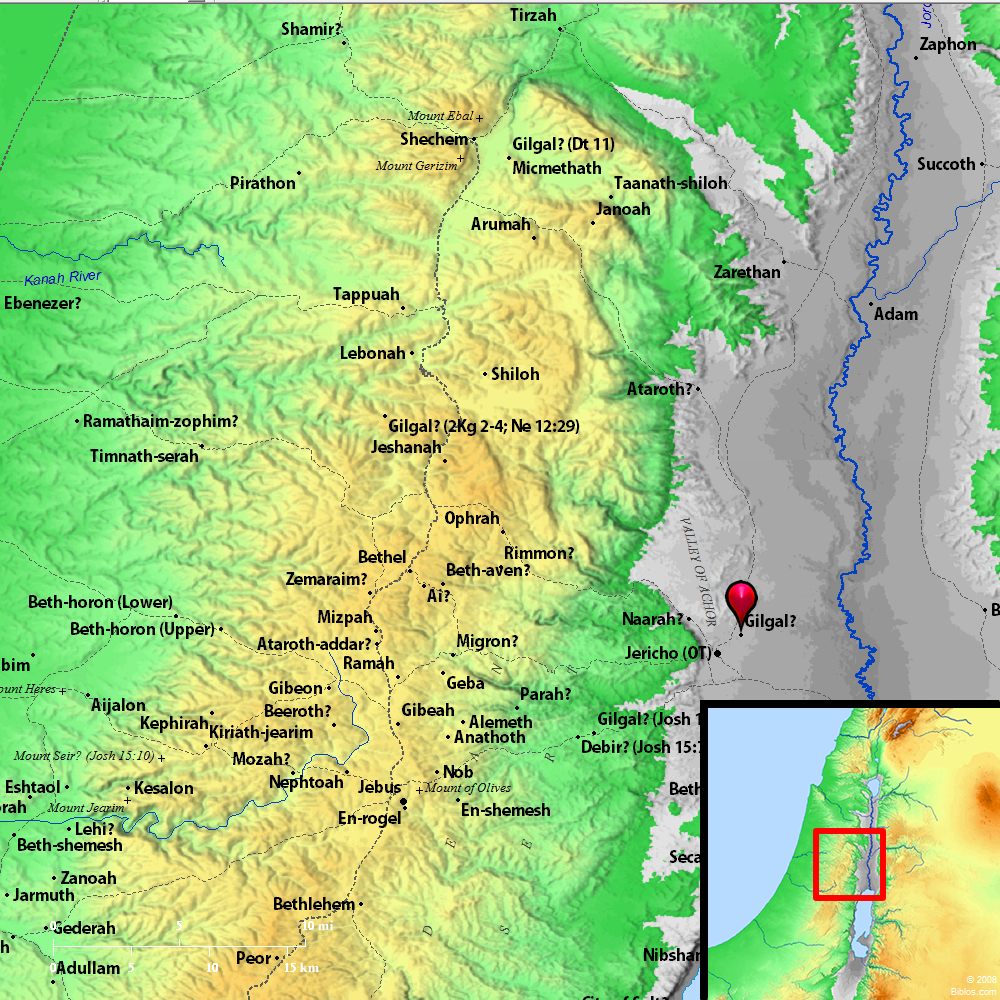
The first leg of this journey is from Miletus to Tyrepaul's 3rd missionary journey, stephen miller, casual english bible

1 And when we had parted from them and set sail, we came by a straight course to Cos, and the next day to Rhodes, and from there to Patara. 2 And having found a ship crossing to Phoenicia, we went aboard and set sail. 3 When we had come in sight of Cyprus, leaving it on the left we sailed to Syria and landed at Tyre, for there the ship was to unload its cargo.

Refugees from the persecution that followed Stephen’s martyrdom had evangelized Phoenicia (11:19).  Paul and his companions “stayed” in Tyre for “seven days,” fellowshipping with the Christians.  Even though he was in a hurry to get to Jerusalem, he was held captive by the schedule of the shipping industry.

Paul’s next stop (v. 7) was “Ptolemais” (Acco of the Old Testament and modern Acre, located on the north side of the bay of Haifa) lay 25 miles south of Tyre.  It was the southernmost Phoenician port.  There also Paul met with the local Christians, while stevedores unloaded and loaded his ship.  He finally reached Caesarea Maritima (v. 8).

There, for a second time (vv. 10-12 and v. 4), Paul was urged not to go to Jerusalem.

Why did Paul avoid the possibility of death in Corinth (20:3), and other places, but not here?  Paul’s purpose to deliver the collection, and thus to strengthen the unity of the Gentile and Jewish believers, would have failed if he had died on board a ship between Corinth and Jerusalem.  However, arrest in Jerusalem would not frustrate that purpose. For Paul, and eventually for his friends (v. 14), the Lord’s will was more important than physical safety (cf. Luke 22:42).  He believed the Spirit wanted him to go to Jerusalem (19:21; 20:22) so he “set his face” to go there (cf. Luke 9:51). (Thomas Constable)  His ultimate purpose was to get to Rome.

Jerusalem was about 65 miles southeast of Caesarea, a long two-day trip. “Mnason” evidently became a Christian early in the history of the church, perhaps on the day of Pentecost. He was a Hellenistic Jewish Christian from Cyprus, like Barnabas was.  As such, he would have been more open to entertaining a mixed group of Jewish and Gentile Christians, than many Hebrew Jewish Christians in Palestine would have been. Apparently he lived about halfway between Caesarea and Jerusalem.

Paul finally achieved the first phase of his plan to visit Jerusalem and then Rome (19:21). In doing so, he brought one chapter of his ministry to a close and opened another.  His return to Jerusalem was an essential part of God’s plan to send Paul to Rome. This plan unfolds in the rest of chapter 21.  In all, Paul traveled about 2,700 miles on his third missionary journey (cf. 14:28; 18:22).

Paul first met with James and the elders, reporting on the tremendous success of their missions trip, spreading the gospel into Greece.  The problem was, however, that news had spread that Paul was against circumcision.  So they proposed that he take four men and “purify yourself along with them and pay their expenses, so that they may shave their heads. Thus all will know that there is nothing in what they have been told about you, but that you yourself also live in observance of the law” (Acts 21:24).

Paul could do what the elders suggested, and did so without compromising his convictions, since the Jews did not regard taking a vow as essential for acceptance by God.  It was strictly voluntary.  They regarded circumcision, on the other hand, as essential.  However, Paul did not even object to circumcision as a custom (earlier he had Timothy circumcised, 16:3), though he did object to it as a rite essential for God’s acceptance (Gal. 2). (Thomas Constable)

However, Jews from Asia stirred up the crowds and they seized Paul in order to kill him.  Fortunately, a Roman “tribune of the cohort” (21:31) rescued him and brought him back to their barracks.  The chapter ends with a cliffhanger, since Paul identifies himself as a free Jew and asks to speak to the angry mob, but that’s where the chapter ends.  Tune in tomorrow.

M’Cheyne Bible Reading Plan, January 20

Today’s readings are from Genesis 21, Matthew 20, Nehemiah 10 and Acts 20.

In the first four verses of Genesis 21 we see God doing what He had promised (vv. 1-2) and Abraham doing as he was commanded (vv. 3-4).  There is the laughter of Sarah’s delight (vv. 6-7) and the laughter of Ishmael’s derision (vv. 8-9).  Sarah told Abraham to cast out Ishmael (v. 10) and God comforted Abraham in doing so (vv. 11-13, so Abraham did so (vv. 14a).

Ishmael lived in the wilderness of Paran…

nahal paran, negev, vitali kaspler

Nahal Paran, Negev, Vitali Kaspler

The story of Hagar and Ishmael continues in vv. 14b-21.  God heard the cry of the boy and answered Hagar’s prayer for deliverance.  Vv. 22-34 recount a contention between Abraham and Abimelech.

Matthew 20 begins with the parable of the vineyard (vv. 1-16), a beautiful story about grace.  Keep in mind that this comes very soon after the incident with the rich young ruler, Jesus’ teaching about how hard it is for the wealthy to enter the kingdom, and the disciples giving it all up to follow Jesus (Matthew 19).

No matter when a servant began serving, they all received a denarius.  A denarius was a normal day’s wage at that time.

Image result for jewish day 3rd hour

The first group began at 6 a.m. and worked until 6 p.m.  The second group began at 9:00 a.m. (3rd hour), the third group at noon (6th hour) and the last group started working at 5:00 p.m. (the 11th hour).

The order in which the landowner’s foreman paid the workers (“last to the first”) may imply that he took greater pleasure in rewarding those hired last.  In view of what he paid those hired late in the day, those who began working earlier expected to receive more than they had hoped for.  They grumbled against him because he had been “generous” (v. 15) to the latecomers and only just with them.

The early starters cited their hard working conditions as justification for their grievance.  Their error was that they had served for the pay they would receive, whereas those who served for only one hour did so simply trusting in the grace of their employer.

How do we feel when someone receives Christ after a lifetime of sin (or crime)?  Do we imagine them less worthy than we are?  Only if we don’t believe in salvation by grace.

Thomas Constable:

In view of the context, the 12 disciples correspond to the workers hired at the beginning of the day, the beginning of Jesus’ public ministry.  Those hired later correspond to other people who became Jesus’ disciples later in His ministry.  One of these people might have been the rich young man, if he had become a disciple (19:16-22).  Peter’s question about what the Twelve would receive (19:27) had implied that they should receive a greater reward, since their sacrifice had been, and later would be, greater.  This parable taught him that God would give him a just reward for his sacrificial labor for Jesus.  Nonetheless, God had the right to give just as great a reward [because of grace] to those whose service was not as long.

Jesus then pulls His disciples aside and tells them that He is going to Jerusalem to be crucified, then raised to life.  Instead of sympathizing with Jesus, the mother of James and John asked that her sons sit on Jesus’ right and left in the kingdom.

22 Jesus answered, “You do not know what you are asking. Are you able to drink the cup that I am to drink?”  They said to him, “We are able.”

The “cup” Jesus was referring to was the cup of His suffering.  Their answer shows that they did not immediately understand this.  Indeed, they would suffer (v. 23), but it was not Jesus’ privilege to grant a place of honor for these two.  Of course, the rest became indignant, because they believed that they were worthy of this honor, above the rest.

So Jesus reemphasized what He had been telling them all along–the values of the kingdom are upside down.  The last becomes first, the servant becomes the leader, and Jesus Himself would lay down his life for them.

Jesus was on his way from Jericho to Jerusalem (v. 29)

Wadi el Qelt, Blick in Richtung des Jordangrabens (Jericho)

This is a photo of the Wadi Qelt, which would be the road from Jericho to Jerusalem.  Jericho is on the lower plain at the top of the picture.  Of course, this is the same road that the parable of the Good Samaritan occurs on.

On the road just up from Jericho were two blind men, asking to be healed (Matthew 20:29-34).

Nehemiah 10 indicates that the people covenanted with God.

Nehemiah explained the agreement he previously referred to in 9:38 in this chapter. Conviction of sin (ch. 8) led to confession of sin (ch. 9) and resulted in a renewed covenant with God (ch. 10).

Verses 1-27 identifies the signers of the covenant.  The names in verses 2-8 are those of the heads of 21 priestly families (cf. 12:12-21).  Verses 9-13 record the names of 17 Levites.  Then the writer gave the names of 44 heads of other leading families (vv. 14-27).
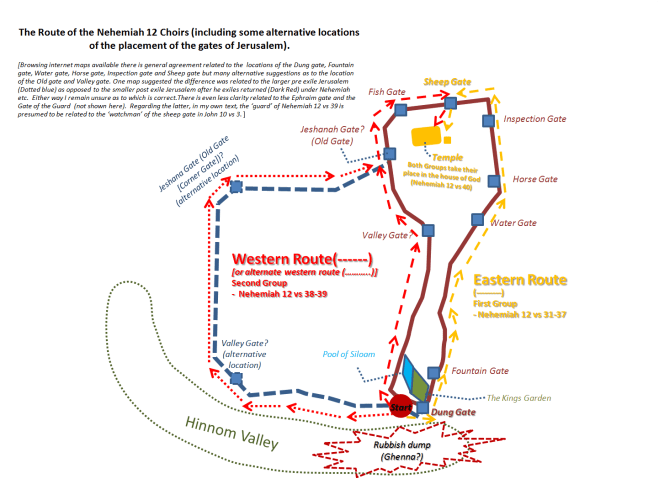
The rest of the restoration community joined those who signed their names pledging to obey the Mosaic Law (vv. 28-29).  The “curse” they took on themselves was submission to the curse that God promised would come on those who did not keep His Word (v. 29; Deut. 28:15-68).

These Jews promised, specifically, not to intermarry with pagans (v. 30) and to keep the Sabbath day and the sabbatical year (v. 31).  They further committed to support the temple service financially (vv. 32-34), to give their firstfruits to God (including their firstborn sons; vv. 35-37a), and to pay their basic tithe tax (vv. 37b-39).

The last sentence in verse 39 shows that the primary concern of the people was the worship that was the heart of their national life.

Unfortunately, Nehemiah will have to revisit all of these issues again in Nehemiah 13.

In Acts 20 Paul first checks in on some churches he planted (20:1-5) in Macedonia and Greece, before sailing back to Troas.

paul's 3rd missionary journey, stephen miller, casual english bible

Paul’s mega-long sermon put a boy to sleep (Eutyches) and he fell out the window.  Paul healed him.

For an article explaining while Paul went by land instead of sea, see Paul on the Road to Assos (Asia Minor/Turkey) by Carl Rasmussen.

You can see from the map above his other stops…

14 And when he met us at Assos, we took him on board and went to Mitylene. 15 And sailing from there we came the following day opposite Chios; the next day we touched at Samos; and the day after that we went to Miletus.

When he comes to Miletus he has a final, tearful but instructive, meeting with his elders from Ephesus (Acts 20:18-35).  These are good words about a pastor’s heart and ministry.

Three things that made Paul weep:

  • Christians who backslide (2 Cor. 2:4)
  • False teachers who lead the flock astray (Acts 20:29-31)
  • Unbelievers who would go to hell (Romans 9:2-3)

Links I Like

Principles for Pastoring Animals

I have never thought of this.  It was a quite interesting read and will help us pastors comfort those who have lost pets.

All We Did Was Survive

This is Scott Klusendorf’s status report on the abortion issue under Donald Trump.  He says, “Abortion is here to stay as long as millions of young Christians are uninformed, unequipped, and unconcerned.”

Gospel Doctrine; Gospel Culture

Ray Ortlund explains how doctrine informs our behavior.

Helping Your Teen Stay Emotionally Healthy on Social Media

Plenty of reports have noted a correlation between social media use and increased levels of depression and anxiety. So, how can parents help their teens stay emotionally healthy while using these platforms? Julie Masson suggests three things dads and moms can do.

Hanging in There – Or Hanging onto Christ?

This article by Sharon Sampson references a video of a hang gliding student who was not harnessed in and had to “hang on for dear life” until they could finally find a landing place.  I think the point of her article would could have added a third option to the title, “Or Held onto By Christ”?

But our security is not found in hanging on as tightly as we can, but in the hold that the Father and Son have on us.  From John 10…

27 “My sheep hear my voice, and I know them, and they follow me. 28 I give them eternal life, and they will never perish, and no one will snatch them out of my hand. 29 My Father, who has given them to me, is greater than all, and no one is able to snatch them out of the Father’s hand.30 I and the Father are one.”