M’Cheyne Bible Reading Plan, March 4

Today’s readings are from Exodus 15; Luke 18; Job 33 and 2 Corinthians 3.

Exodus 15 is the worship service after the Exodus.  It illustrates the difference between prose in Exodus 14 and poetry in Exodus 15.

This “song” retells the story in chapter 14 in much more figurative language.  In verses 1, 4 and 21 God is pictured as a mighty warrior who picks up in his hand the force of Pharaoh and hurls them into the sea.  Yet in chapter 14 the forces of Pharaoh are described as having followed the Israelites into the Red Sea and when the waters returned to their normal position the Egyptians were drowned.

We also see in verse 7 a description of God consuming the Egyptian like stubble.  But Pharaoh’s forces were not burned; they drowned!  This is no problem for the song composer because “consumed like stubble” is a common Old Testament metaphor for judgment and destruction (cf. Isaiah 5:24; 47:14; Joel 2:5; Obadiah 18; Nahum 1:10).

In the midst of the song is the phrase:

11 “Who is like you, O LORD, among the gods?  Who is like you, majestic in holiness, awesome in glorious deeds, doing wonders?

The Exodus had proven to them the uniqueness of God, preparing them emotionally for “you shall have no other gods before me” (Exodus 20:3).  The Exodus was not only an act of unparalleled strength, but great love…

13 “You have led in your steadfast love the people whom you have redeemed; you have guided them by your strength to your holy abode.

They correctly foretold of how this news would affect the peoples toward whom they would go…

14 The peoples have heard; they tremble; pangs have seized the inhabitants of Philistia. 15 Now are the chiefs of Edom dismayed; trembling seizes the leaders of Moab; all the inhabitants of Canaan have melted away. 16 Terror and dread fall upon them; because of the greatness of your arm, they are still as a stone, till your people, O LORD, pass by, till the people pass by whom you have purchased.

Charles Spurgeon notes:

“Notice, the song is all of God; there is not a word about Moses.  Read this song through, and neither Moses, nor Aaron, nor Miriam are in it: God is all in all.”

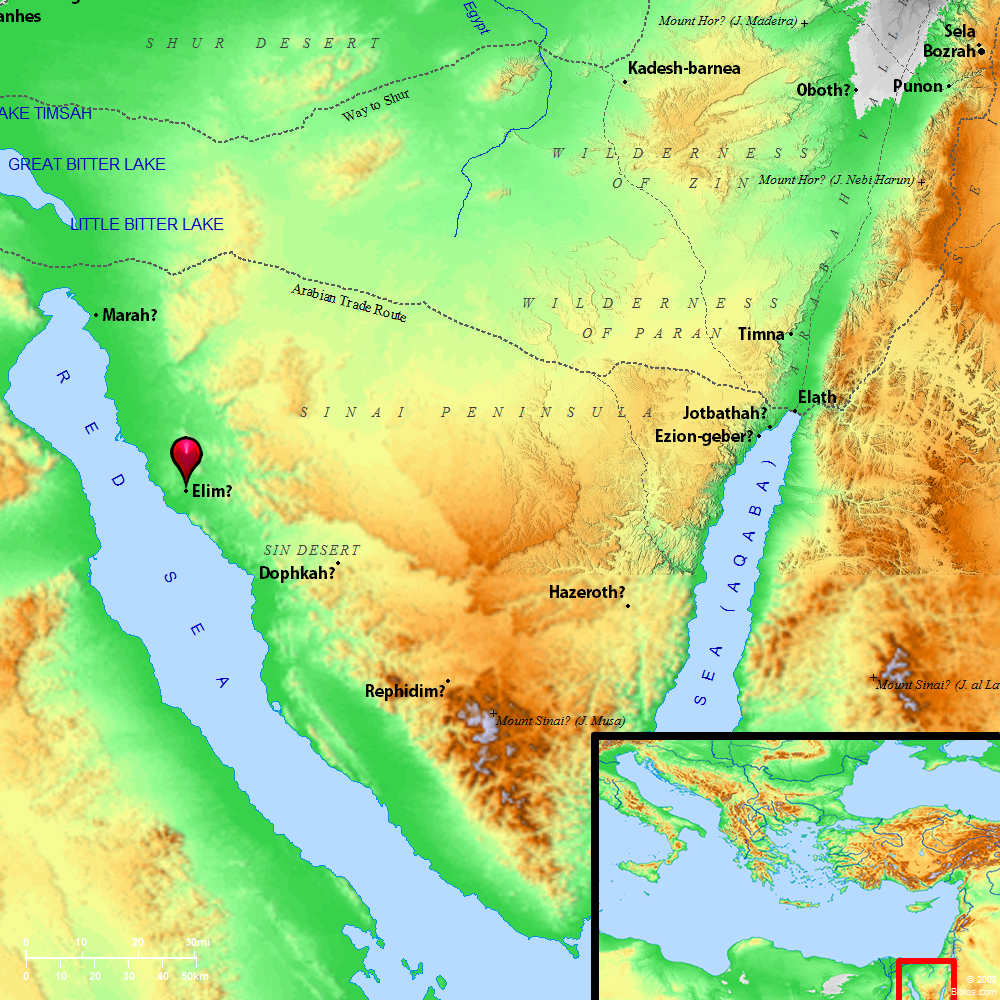
After this inspiring worship service, Israel set out and three days later “found no water.”  The first waters they came to were bitter, so they named it Marah (bitterness).  And then they grumbled.  Moses threw a log into the water and it became sweet.  From there they traveled to Elim, where there were 12 springs of water (v. 27).  God gave them a wonderful promise…

26 saying, “If you will diligently listen to the voice of the LORD your God, and do that which is right in his eyes, and give ear to his commandments and keep all his statutes, I will put none of the diseases on you that I put on the Egyptians, for I am the LORD, your healer.”

Even true believers, in seasons of sharp trial, will be tempted to fret, distrust, and murmur.  But in every trial we should cast our care upon the Lord, and pour out our hearts before him.  We shall then find that a submissive will, a peaceful conscience, and the comforts of the Holy Ghost, will render the bitterest trial tolerable, yea, pleasant.  Moses did what the people had neglected to do; he cried unto the Lord.  And God provided graciously for them.  He directed Moses to a tree which he cast into the waters, when, at once, they were made sweet.  Some make this tree typical of the cross of Christ, which sweetens the bitter waters of affliction to all the faithful, and enables them to rejoice in tribulation.

–from Matthew Henry’s Concise Commentary on the Bible, written in 1706

What bitterness might there be in your life?  Could the wood of the cross of Christ help change the bitter to sweet?  The promise is this:  “We know that God is always at work for the good of everyone who loves him ” (Romans 8:28, CEV).

Image result for elim sinai

BibleIsTrue.com by Lion Tracks Ministries
Luke 18 begins with the parable of the persistent widow (Luke 18:1-8).  We’ve all had times when we prayed and prayed and prayed and nothing happened.  Should we give up?  This parable encourages us to continue because God is generous.  The parable is an exhortation to persevere in the faith rather than apostatizing (i.e., turning away from it). God will vindicate His elect at the Second Coming (cf. Ps. 125:2-3; Rev. 6:9-11). That will be His ultimate answer to these prayers of His people, but immediate help before that coming is primarily in view in this parable.

Luke next developed the idea of “faith on the earth” that Jesus introduced in verse 8.  This whole section clarifies how people become believers.  This subject is a fitting conclusion to the part of Luke’s Gospel that deals with Jesus’ ministry on the way to Jerusalem (9:51—19:27).  Essentially, this section records Jesus’ teaching that salvation and eventual entrance into the kingdom come by God’s grace through faith, rather than by claims to legal righteousness.  The apostle Paul wrote about the process of justification (e.g., Rom. 3:21—5:21), but Luke’s concern was the recipients of it.

In 18:9-30, Luke illustrated entry into the kingdom of God from a position of deficiency, either of righteousness (18:9-14), or money (18:18-23).  The chapter ends with Jesus healing the blind man near Jericho (18:35-43).
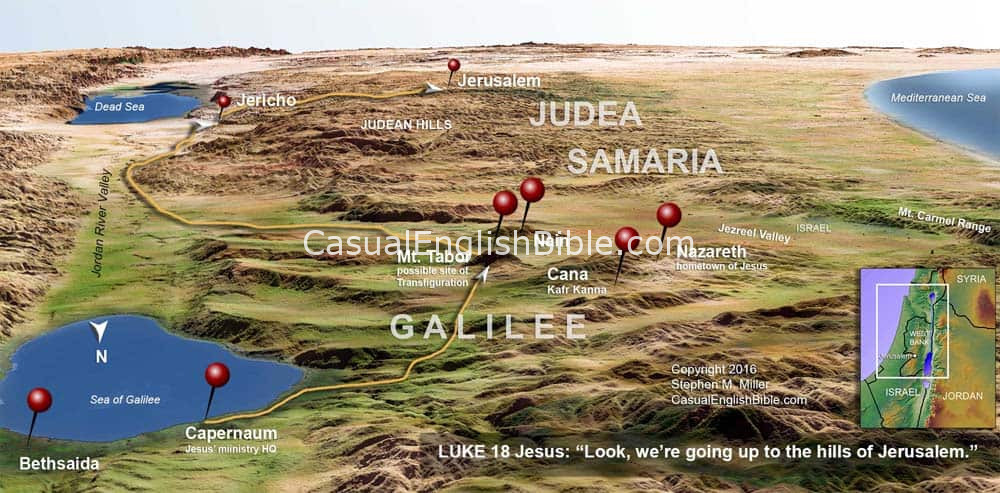
Stephen Miller

Job 33 is Elihu’s first speech to Job.  In summary, he told Job that God was not silent, as Job had charged, but that He was speaking through dreams and sickness to Job.  Rather than using suffering to punish Job for his sins, God was using it to prevent him from dying. Elihu said God was being merciful to Job.  The three counselors had said the purpose of suffering was punitive. Job’s wife, before them, had said Job was suffering because God was unfair.  Now Elihu offered a third solution: God was trying to teach Job something.  He said the purpose of suffering is pedagogical, educational.

Tom Constable has this chart

Elihu’s views contrasted with those of the three friends as follows.

THREE FRIENDS

ELIHU

Sin leads to suffering.

Suffering leads to sin.

Suffering is retributive.

Suffering is protective

Suffering is punitive.

Suffering is educational.

Job should repent.

Job should learn.

Job should initiate restoration.

God had initiated restoration.

Job did not respond to Elihu’s speech.  This is unusual, since he replied to his three friends’ speeches and to God’s speeches.  Perhaps Job was silent here, because he did not know how to respond to Elihu, and was overwhelmed by his arguments.  Or, perhaps, he was processing what Elihu had said when Elihu began speaking again.  Elihu had made a distinction that the three friends had not made.  He distinguished God’s punishment from His chastisement.  Elihu viewed God’s attitude toward Job more like that of a loving father than that of an impartial judge.

2 Corinthians 3 begins with Paul telling the Corinthians that they were Paul’s letter of commendation–the changes in their lives was proof that he was an apostle (3:1-3).

Harry Ironside said:

What makes a good letter?  First, a good letter must be legible, easy to read. Living epistles of Christ should be easily read, not confusing to the “reader.”  Second, a good letter should contain clear, definite statements.  Readers should not be baffled by the statements that the letter makes.  Third, a good letter should reveal the personality of the one who writes it.  Christian “letters” should also reveal the personality of Christ, who has made them and sent them to communicate His mind.

Paul then contrasts the old and new covenants, along with old and new covenant ministry.
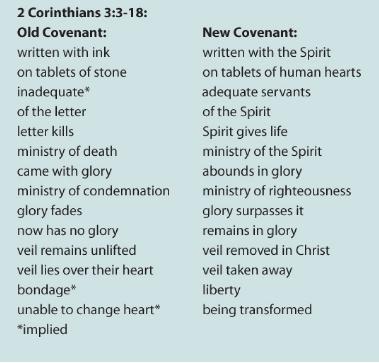
Image result for 2 corinthians 3 chart

Tom Constable says…

The New Covenant went into effect and replaced the Old Covenant when Jesus Christ died.  Some of its benefits began to bless all people immediately (vv. 6-11; cf. Heb. 10:1-18).  However, its other benefits, specifically those on Israel, will not take effect until God resumes dealing with Israel as a nation (Jer. 31:31-34).  This will happen when Jesus Christ returns to the earth and restores Israel as her Messiah.

SUMMARY OF CONTRASTS BETWEEN THE OLD AND NEW COVENANTS
1. economy (old) new v. 6
2. type letter spirit v. 6
3. results manward death life v. 6
4. vehicle stone Spirit v. 7
5. results Godward some glory greater glory vv. 7, 8, 10
6. purpose condemnation righteousness v. 9
7. duration temporary permanent v. 11

The new covenant ministry gives a greater sense of boldness (3:1-4:6).
M’Cheyne Bible Reading Plan, March 3

Today’s readings are from Exodus 14; Luke 17; Job 32 and 2 Corinthians 2.

Exodus 14 records the miraculous deliverance of Israel through the sea.  It is an event that stuck in the minds of the biblical writers so that you find it referred to as both as past event of God’s mighty deliverance and love, and as a future event, a “new exodus” when God will restore Israel to the land forever.

The location of the sites mentioned in verse 2 are debated.  Wherever Baal Zephon was, the god Zephon was believed to reign in power over the sea (like Neptune in Greek mythology).  Pharaoh thought he could gain victory (vv. 2-3) but once again Yahweh would display his power.

“Tell the people of Israel to turn back and encamp in front of Pi-hahiroth, between Migdol and the sea, in front of Baal-zephon; you shall encamp facing it, by the sea.

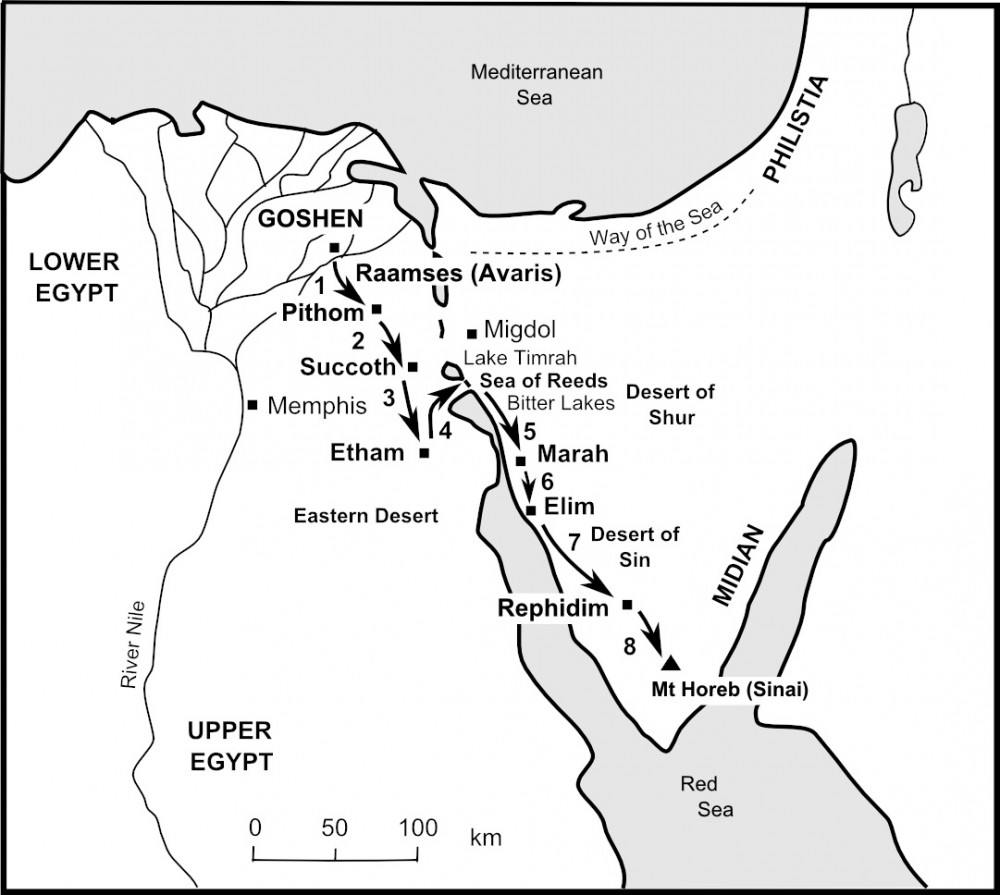
The words “turn back” lead some to believe that Israel turned north and the “sea” was a large lake.  However, it seems that the crossing took place farther south in view of the implication that it took the Israelites no less and no more than three days to reach Marah (15:22-23).  The evidence for the location of Marah seems a bit stronger.

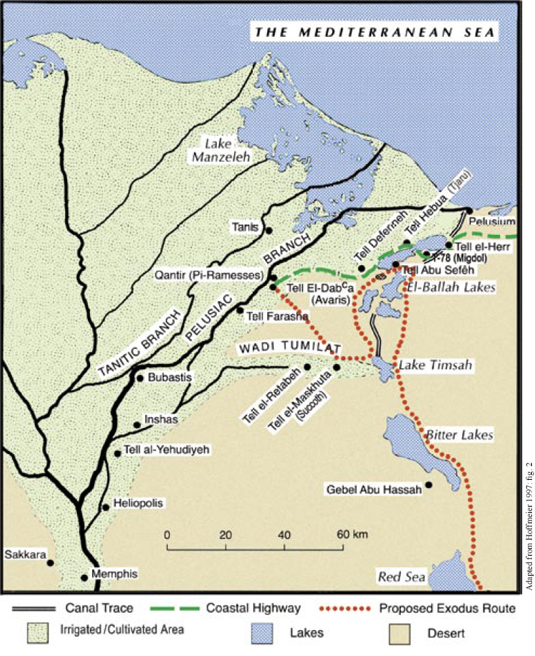
From Egypt to Sinai

Map 44 from thebiblejourney.org

The “Bitter Lakes” pictured in the map were likely much larger at that time.

Vv. 5-14 is the first of Israel’s many complaints against Moses and Yahweh that Moses recorded in Scripture.  It is the first of ten “murmurings,” that culminated in God’s judgment of them at Kadesh Barnea (v. 11; Num. 14:22-23).

Josephus wrote that the Egyptians pursued the Israelites with 600 chariots, 50,000 horsemen, and 200,000 footmen, all armed.  This may or may not be accurate (Moses wrote: “600 select chariots, and all the other chariots of Egypt with officers . . . all the horses and chariots of Pharaoh, his horsemen and his army,” vv. 7, 9).

Pharaoh’s overtaking the apparently helpless Israelites camping by the sea and shut in between the two is probably the origin of the popular idiom for a terrible dilemma:  “Between the devil (Pharaoh) and the deep blue (Red!) sea.”

–William MacDonald

Image result for Exodus 14

The strong east wind that God sent (v. 21) recalls the wind from God that swept over the face of the primeval waters in creation (Gen. 1:2).  One wonders if this wind may have been a tornado, and although tornados are usually a non-occurring weather event in that part of the world, this was a time in history when unusual weather events were happening.  Whatever means God used, it allowed Israel to pass through on dry ground and the waters collapsed upon the pursuing Egyptian army (cf. Psalm 106:7-12) and just at the right times, as Moses stretched out his hand.

The end result:

30 Thus the LORD saved Israel that day from the hand of the Egyptians, and Israel saw the Egyptians dead on the seashore. 31 Israel saw the great power that the LORD used against the Egyptians, so the people feared the LORD, and they believed in the LORD and in his servant Moses.

This miraculous deliverance produced “fear” (reverential trust) in Yahweh among the Israelites (v. 31). Their confidence in Moses as well as in God revived (cf. v. 10-12).

The Lord finished the Israelites’ liberation when He destroyed the Egyptian army.  The Israelites’ slavery ended when they left Egypt, but they only began to experience true freedom after they crossed the Red Sea.  The ten plagues had broken Pharaoh’s hold on the Israelites, but the Red Sea deliverance removed them from his reach forever.  God redeemed Israel on the Passover night, but He fully liberated Israel from slavery, finally, at the Red Sea.  In Christian experience, these two works of God—redemption and liberation—occur at the same time; they are two aspects of the same salvation, two sides of the same coin.

Jesus begins Luke 17 dealing with causing others to sin and forgiving others for sinning against us.  We are to watch ourselves that we don’t cause others to sin (17:1-3a) and we are to forgive a person IF they repent (17:3b-4).  We would all like to make excuses–in causing temptation, “but I didn’t know” and in forgiving others, “but this is the nth time!”

Believing it was a faith issue (and it is), they excused themselves for not having enough, but Jesus said, “you really only need a very, very small amount of faith.” (17:5-6).

Jesus then gives the parable of the unworthy servant.  Jesus told this parable to teach His disciples that warning sinning disciples, and forgiving those who sinned and repented: was only their duty.  It was not something for which they should expect a reward from God.  The Pharisees believed that their righteous deeds put God in their debt, as did many of the Jews.  God will indeed reward faithful service (12:35-37, 42-48).  However, that is not because His servants have placed Him in their debt, but because He graciously gives them more than what is just.

Jesus then told a parable about the importance of showing gratitude for the mercy God shows us (Luke 17:11-19).  This passage seems to indicate that the Jews were happy to receive the benefits of Jesus’ ministry, but were unwilling to thank Him or connect His goodness with God.

Jesus ends Luke 17 talking about the arrival of the kingdom, which would be preceded by terrible judgments.

Job 32

Now the fourth friend, Elihu, speaks up.  He has been silent all this time.  He was a fly on the wall.

Elihu was the youngest, and respected them all, but he was angry at both Job and his friends.

Elihu’s speeches set the stage for Yahweh’s response in chapters 38-42.

First, Elihu explains why he is speaking (32:6-22).  They had failed to refute Job and Job had refused to repent.  And, the three friends had fallen silent.

In the next four chapters (33—36 inclusive) Elihu proceeds to unburden himself.  He cites Job’s three major contentions in order to refute them: (1) that he is innocent (33:8, 9); (2) that God’s persecution is therefore an act of wanton power and injustice (33:10-11); and (3) that God has ignored his suffering by refusing to answer him (33:12-13).

2 Corinthians 2 Paul teaches something about forgiving an offender.  Some believe that this is the person disciplined by the church in 1 Cor. 5, but it is probably someone who had directly insulted Paul., challenging his apostolic authority.

Paul had forgiven the offender “in the presence of Christ,” and so they were to do the same.

Although 2:14-17 seems like a digression, it is a very triumphant expression of the victory of Christ.

14 But thanks be to God, who in Christ always leads us in triumphal procession, and through us spreads the fragrance of the knowledge of him everywhere. 15 For we are the aroma of Christ to God among those who are being saved and among those who are perishing, 16 to one a fragrance from death to death, to the other a fragrance from life to life.

William Barclay explains this image (pp. 204-206):

“In Paul’s mind there is the picture of a Roman Triumph and of Christ as a universal conqueror.  The highest honour which could be given to a victorious Roman general was a Triumph.  Before he could win it he must satisfy certain conditions.  He must have been the actual commander-in-chief in the field.  The campaign must have been completely finished, the region pacified and the victorious troops brought home.  Five thousand of the enemy at least must have fallen in one engagement.  A positive extension of territory must have been gained, and not merely a disaster retrieved or an attack repelled.  And the victory must have been won over a foreign foe and not in a civil war.

In an actual Triumph the procession of the victorious general marched through the streets of Rome to the Capitol in the following order.  First, there came the state officials and the senate.  Then there came the trumpeters.  Then there were carried the spoils taken from the conquered land.

For instance, when Titus conquered Jerusalem the seven-branched candlestick, the golden table of the shew-bread and the golden trumpets were carried through the streets of Rome.  Then there came pictures of the conquered land and models of conquered citadels and ships.  There followed the white bull for sacrifice which would be made.  Then there walked the wretched captives, the enemy princes, leaders and generals in chains, shortly to be flung into prison and in all probability almost immediately to be executed.  Then there came the lictors [minor judicial officials] bearing their rods, followed by the musicians with their lyres.  Then there came the priests swinging their censers with the sweet-smelling incense burning in them.

And then there came the general himself.  He stood in a chariot drawn by four horses.  He was clad in a purple tunic embroidered with golden palm leaves, and over it a purple toga marked out with golden stars.  In his hand he held an ivory sceptre with the Roman eagle at the top of it, and over his head a slave held the crown of Jupiter.  After him there rode his family, and finally there came the army wearing all their decorations and shouting Io triumphe! their cry of triumph.

As the procession moved through the streets, all decorated and garlanded, amid the shouting, cheering crowds, it was a tremendous day, a day which might happen only once in a lifetime.

That is the picture that is in Paul’s mind.  He sees the conquering Christ marching in triumph throughout the world, and himself in that conquering train.  It is a triumph which, Paul is certain nothing can stop.  We have seen how in that procession there were the priests swinging the incense-filled censers.  Now to the general and to the victors the perfume from the censers would be the perfume of joy and triumph and life; but to the wretched captives who walked so short a distance ahead it was the perfume of death, for it stood for the past defeat and their coming execution.  So Paul thinks of himself and his fellow apostles preaching the gospel of the triumphant Christ.  To those who will accept it, it is the perfume of life, as it was to the victors; to those who refuse it, it is the perfume of death as it was to the vanquished.  Of one thing Paul was certain—not all the world could defeat Christ.  He lived not in pessimistic fear, but in the glorious optimism which knew the unconquerable majesty of Christ.”

In light of this triumphant vision, Paul asks, “Who is sufficient for these things?”  He is overwhelmed by the vision of the triumphant Christ and wonders how it is possible that he should minister Christ’s message as an ambassador.  The answer will come in 3:5, “our sufficiency is from God.”

M’Cheyne Bible Reading Plan, March 2

Today’s readings are from Exodus 13; Luke 16; Job 31 and 2 Corinthians 1.

Exodus 13 deals with the dedication of Israel’s firstborn to the Lord (13:1-16) and the initial journey from Succoth to Etham (13:17ff).  Tomorrow we will observe their dramatic deliverance at the Reed Sea.

The dedication of every firstborn Israelite male baby was to take place after the nation had entered the Promised Land (vv. 5, 11-12).  This was originally to be a memorial of God’s redemption from Egyptian slavery, as were the feasts of Passover and Unleavened Bread (cf. 12:14).  However, God took the Levites for His special possession in place of the firstborn.  This happened at Mt. Sinai (Num. 3:12-13).  Consequently, this “firstborn dedication” never took place, but the Israelites did circumcise their sons and observe the Passover when they first entered the Promised Land (Josh. 5:4-7).

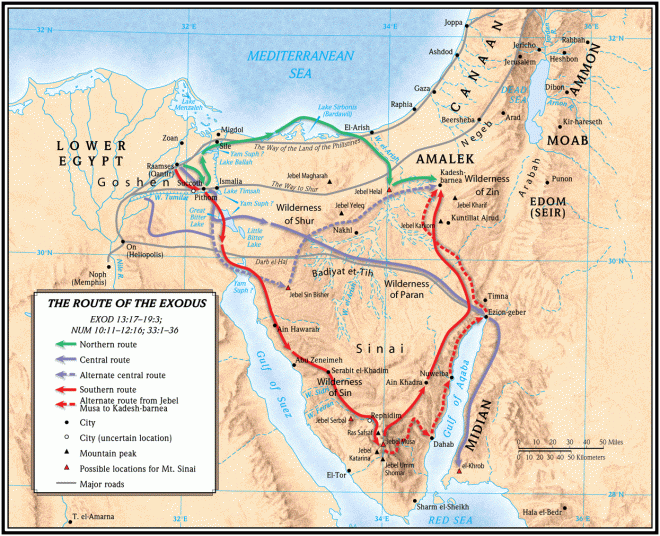
By the way, the route of the Exodus has several variations.  A newer, and quite popular internet proposal has Israel crossing the Gulf of Aqaba.  That is the purple route on the map below.

The Route of the Exodus, Swartzentrover

The traditional route is pictured in red above.

The Israelites now begin their migration from Egypt to Canaan.  The words “Red Sea” in v. 18 is actually “yam suph,” “sea of reeds.”  Apart from Exodus 14, the word suph appears four other times in the Hebrew Bible, always referring to a marshy plant.  The translation “Red Sea” (see it at the bottom of the map) comes from a mistranslation in the Septuagint Ερυθρὰ Θάλασσα. This map shows them crossing the northernmost part of what is today called the Suez Canal. 

Image result for route of the exodus

Another possible route is shown on this map from articles by Gary Byers on the Associates for Biblical Research website.  This takes into account the “turn back” command in Exodus 14:1.

Exodus northern route

Luke 16 begins with the very puzzling parable of the dishonest steward (16:1-15), then an equally puzzling statement about some taking the kingdom violently (16:16-18) and ends with the story of the rich man and Lazarus (16:19-31) which helps us understand what happens to people when they die.

The steward, about to be fired for either negligence or worse, quickly settles with some debtors for lesser amounts, thus satisfying the master and making friends.  The master (Jesus) then instructs us to be faithful in little things (vv. 10-12) and be careful not to fall in love with money (vv. 13-15) like the Pharisees had.

Jesus pronounces a “new era” in v. 16 and claims that those who enter must do so “forcibly” or “violently.”  “From the days of John the Baptist until now, the kingdom of heaven has been forcefully advancing (Greek biazo, middle or passive), and forceful men (biastes) lay hold (harpazo) of it.” (Matthew 11:12).  A number of Jesus’ teachings about the Kingdom indicate the radical nature of taking hold of the Kingdom. Let us look at a few:

  • Being born again (John 3:3, 7). If you’ve ever given birth or been present at a birth, then you know first hand that birth is a violent, radical event, “natural” though it may be.[4]
  • Cutting off your hand, plucking out your eye that causes you to sin (Mark 9:47).
  • Hating one’s family (Luke 14:26).
  • Bringing not peace, but a sword (Matthew 10:34).
  • Giving up everything for the treasure hidden in the field and for the pearl of great price (Matthew 13:44-46). Radical action was required of the rich young ruler (Mark 10:21).
  • Counting the cost of building a tower or waging war (Luke 14:28-33)

Too often we want the blessings of the Kingdom, but are not willing to do whatever it takes to follow Jesus.

Jesus tells about the rich man and Lazarus and their destinies after this life in 16:19-31.  I don’t believe this is a parable (because in no other parable is someone’s name used), but rather captured a real event.

Now, the point of the story is that the rich man (like the Pharisees) is condemned for loving money and neglecting the poor, but it is interesting to see what Jesus is saying about the afterlife here.

Apparently, when someone dies their bodies go into the ground and their immaterial (soul/spirit) goes to Sheol (Hebrew)/Hades (Greek).  But, there is a division in Sheol/Hades.  Whereas Lazarus goes to Abraham’s bosom and seems to be in comfort (v. 25), the rich man goes to a place of torment (v. 24, “in anguish in this flame”).  And, in Jesus’ words, there is a “great chasm…has been fixed” and “none may cross” (v. 26) so their destinies are sealed.

Mark Bailey summarizes:

“The dialogues from the afterlife in this passage reveal a series of vital truths that serve as correctives to some modern erroneous doctrines. (1) There is immediate consciousness after death; therefore soul sleep is not taught in the Bible. (2) Post-death destinies are irreversible; therefore there is no purgatory or second chance of salvation after death. (3) No one can lose or gain salvation after death. The decisions of this life are final and determinative. (4) The judgments that determine the eternal destinies of either torment or blessing are just. (5) Signs should never be sought as a substitute for the Word of God. The Word of God is the only adequate basis for faith (16:29; see Rom. 10:17).”

Now, however, when a believer in Christ dies, their soul/spirit goes immediately to heaven (Phil. 1:23; 2 Cor. 5:8; Luke 23:43).  When the rapture occurs, our bodies will join with our immaterial part (the real us) and be transformed according to 1 Cor. 15:51-53…

51 Behold! I tell you a mystery. We shall not all sleep, but we shall all be changed, 52 in a moment, in the twinkling of an eye, at the last trumpet. For the trumpet will sound, and the dead will be raised imperishable, and we shall be changed. 53 For this perishable body must put on the imperishable, and this mortal body must put on immortality.

The bodies of unbelievers will rise before the Great White Throne judgment in Revelation 20:13

And the sea gave up the dead who were in it, Death and Hades gave up the dead who were in them, and they were judged, each one of them, according to what they had done.

Job 31

While Job 29 focused on Job’s past track record, Job 31 exhibits his continuing innocence and integrity. Here we have proof that Job really was “blameless, upright, fearing God, and turning away from evil” (1:1). Job began by explaining the principles by which he had lived (vv. 1-4).

Most of the 14 sins that Job mentioned in this chapter were not heinous crimes but relatively minor deviations from the ethical ideal. They were covert rather than overt iniquities. Thus Job claimed innocence on the highest level of morality (cf. Matt. 5:27-28).

Having ended his final summation in defense of his innocence, Job rested his case and waited for God’s verdict. This is another climax in the book.

2 Corinthians  deals with Paul’s apostolic authority and his “badge” of apostleship, his sufferings.  Some commentators believe Paul wrote 1 Corinthians after his painful visit and after he wrote the severe letter.  I believe it is more probable that he wrote 1 Corinthians before these two events.  It is very difficult to reconstruct the details of Paul’s activities, since the data available to us is incomplete.

PAUL’S CORINTHIAN CONTACTS

Paul’s founding visit His “former letter” The Corinthians’ letter to him First Corinthians Paul’s “painful visit” His “severe letter” Second Corinthians Paul’s anticipated visit


2 Corinthians 1:1-11 speaks to that issue of suffering, telling us that God gives us His comfort so that we can comfort others.  No matter what kind or how bad our sufferings might be, God’s comfort can exceed them.  Paul had experienced a severe testing, nearly dying (vv. 9-10), but God had delivered him.

Philip Edgecombe Hughes, who wrote one of the best commentaries on 2 Corinthians, says…

“This is, indeed, a theme which provides a key to the whole epistle.  Is Paul assailed by anguish of spirit?  It is God who always leads him in triumph in Christ (3:13ff.).  Do we have the treasure of divine glory in earthen vessels?  It is that it may be seen that the exceeding greatness of the power is of God, and not of self (4:7ff.).  Is the Apostle always delivered unto death for Jesus’ sake?  It is that the life also of Jesus may be manifested in his mortal flesh (4:10ff.).  Is the outward man decaying? Yet the inward man is renewed day by day (4:16). . . . The climax is reached in the twelfth chapter where Paul explains how through the endurance of a ‘thorn in the flesh’ he was taught that God’s grace is all-sufficient and that His power is made perfect in weakness (12:7ff.).  This was a principle to which even our Lord submitted in providing our salvation, for He was crucified through weakness, but is alive through the power of God (13:4). It is a theme, therefore, which points to the unity of the epistle, and which in particular links the concluding to the opening chapter.”

Not only had Paul almost died (not good publicity for an apostle), but he had had to miss out on a visit to Corinth, both of which diminished their affections and his authority in their eyes.  Paul points out that he had acted sincerely (vv. 12-14) and consistently (vv. 15-22).  Paul had also acted out of love (1:23-2:4).

Links I Like

How Men and Women Spend Their Day

I followed this one from Tim Challies blog and was mesmerized for several minutes as these little cyan (women) and orange (men) balls moved (and sometimes exploded) from one activity to another.  It was no surprise that leisure was always the largest group of balls, until about 10:30 p.m., when sleep captured the schedule.

I’m Really Not Busy…

I do get Ian Paul’s blog Psephizo (which means “to calculate, to reckon”) regularly but I’m usually “too busy” to read it.  That is what Ian talks about in this practical blog, leaning on Eugene Peterson.  Congratulations, Ian, on being the Premier Digital Awards blogger of the year in 2017 and 2018.

A Sermon Notes Sheet for Children

Have young children in worship with you?  Here is a helpful article and Sermon Sheet for Young Children to help your child get the most out of it.  Instructions for printing are in the article.

Murder by Any Other Name

How does one group of people murder another and sleep at night?  Answer: they don’t.  German soldiers didn’t slaughter humans, Southern whites didn’t lynch humans, and Planned Parenthood isn’t killing humans either.  The key concept is not in the verbs, but the object of the verbs–they don’t consider them humans.


M’Cheyne Bible Reading Plan, March 1

Today’s readings from from Exodus 12:22-51; Luke 15; Job 30 and 1 Corinthians 16.

The Feast of Unleavened Bread began with the Passover meal (Exodus 12:15-20), and continued for seven more days (v. 15). The bread that the Jews used for these feasts contained no leaven (yeast), which made it like a cracker rather than cake in its consistency.  Here it not only reminded the Israelites, in later generations, that their ancestors fled Egypt in haste, before their dough could rise—it also reminded them that their lives should resemble the “unleavened bread” as redeemed people.

vv. 21-28 give the directions concerning the Passover.  The avenging angel came and killed the firstborn of the Egyptians (vv. 29-36) and Israel leaves Egypt (vv. 37-42).

The text is very definite that Israel was in Egypt “430 years, to the very day” (v. 41).  This probably refers to the time, beginning when Jacob entered Egypt with his family (1876 B.C.), to the day of the Exodus (1446 B.C.).  Tom Constable has this helpful graphic:

Luke 15 is one of my favorite passages in Scripture, giving the parables of the lost sheep (1 in 100), lost coin (1 in 10) and lost son (1 of 2), all exhibiting that lost people matter to God.

“Often I have asked friends to give me their first impression of Rembrandt’s Prodigal Son.  Inevitably, they point to the wise old man who forgives his son: the benevolent patriarch.

“The longer I look at ‘the patriarch’, the clearer it becomes to me that Rembrandt has done something quite different from letting God pose as the wise old head of a family.  It all began with the hands.  The two are quite different.  The father’s left hand touching the son’s shoulder is strong and muscular.  The fingers are spread out and cover a large part of the prodigal son’s shoulder and back.  I can see a certain pressure, especially in the thumb.  That hand seems not only to touch, but, with its strength, also to hold.  Even though there is a gentleness in the way the father’s left hand touches his son, it is not without a firm grip.

“How different is the father’s right hand!  This hand does not hold or grasp.  It is refined, soft, and very tender.  The fingers are close to each other and they have an elegant quality. It lies gently upon the son’s shoulder.  It wants to caress, to stroke, and to offer consolation and comfort. It is a mother’s hand….

“As soon as I recognized the difference between the two hands of the father, a new world of meaning opened up for me.  The Father is not simply a great patriarch.  He is mother as well as father.  He touches the son with a masculine hand and a feminine hand.  He holds, and she caresses. He confirms and she consoles.  He is , indeed, God, in whom both manhood and womanhood, fatherhood and motherhood, are fully present.  That gentle and caressing right hand echoes for me the words of the prophet Isaiah: “Can a woman forget her baby at the breast, feel no pity for the child she has borne?  Even if these were to forget, I shall not forget you.  Look, I have engraved you on the palms of my hands.”

–from Henri J. M. Nouwen’s book The Return of the Prodigal Son:  A Story of Homecoming, based on his contemplation of the painting by Rembrandt, above.

Of course, the story of the prodigal is really about the father.  He is excessive in his love to both sons.  Of course, point of the whole story started with the complaint of the Pharisees and scribes, “This man receives sinners and eats with them.”

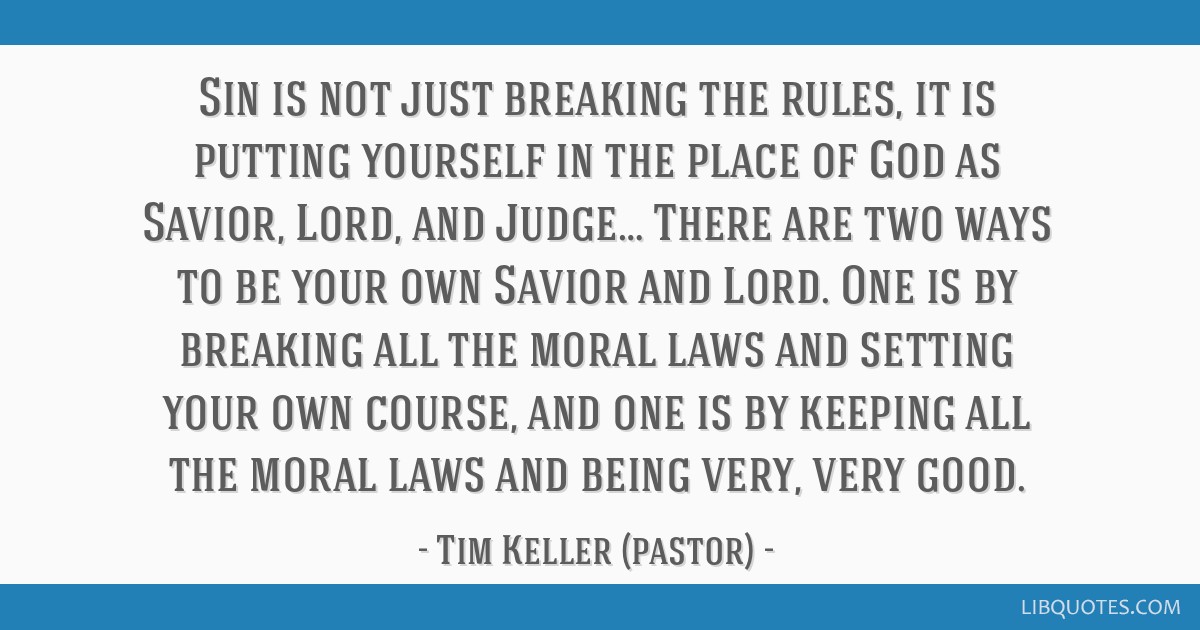
Tim Keller points out that both sons needed to be “saved.”  The younger son from his immorality, the older son from his morality.  One needs to repent not only of self-indulgent sins, but self-righteous morality.  Usually the harder person to reach is the self-righteous moralist.

Image result for tim keller prodigal quotes

Again, Tim Keller…

“Neither son loved the father for himself.  They both were using the father for their own self-centered ends rather than loving, enjoying, and serving him for his own sake.  This means that you can rebel against God and be alienated from him either by breaking his rules or by keeping all of them diligently.  It’s a shocking message: Careful obedience to God’s law may serve as a strategy for rebelling against God.”

Get his book The Prodigal God.

Image result for tim keller prodigal quotes moral immoral

While Job 29 focused on Job’s past track record, Job 30 focuses on his present misery.  Job was presently without respect (vv. 1-15), disregarded (vv. 16-23), and despondent (vv. 24-31).  He had formerly enjoyed the respect of the most respectable, but now he experienced the contempt of the most contemptible (vv. 1-15; cf. 29:8, 21-25).

J. Vernon McGee concludes: “He justifies himself instead of justifying God.  In fact, he blames God.  What is the problem of Job?  It is pride.”  If there is a sin in Job, it is this.

1 Corinthians 16 finishes the book.  All that remains is to give instructions for a collection to relieve the poor saints in Jerusalem, to discuss Paul’s travel plans, to prepare the way for Timothy’s visit, and give personal greetings.

As believers, we should give according to plan (“first day of every week”) and proportionately (“in keeping with his income”).  We see something similar in the Antioch church when word reached them of a need.

“The disciples, each according to his ability, decided to provide help for the brothers living in Judea.” (Acts 11:29)

Paul shares his tentative travel plans, with a balance of the words “if it seems advisable” (meaning Paul would weigh the pros and cons) and “if the Lord permits” (meaning Paul made no presumptions about the possibilities, cf. James 4:13-18).

As it turns out, the visits Paul proposed in 16:4-8 didn’t come to pass as soon as Paul hoped due to intervening circumstances.

I recently preached on Paul’s exhortation to men in 16:13-14

13 Be watchful, stand firm in the faith, act like men, be strong. 14 Let all that you do be done in love.

We need to be alert–regarding our marriage, our children and our culture.  We must stand firm in correct doctrine.  We must “act like men” or “be courageous” in standing firm in moral issues.  We must “be strong,” not against our family (abuse) but for our family.  And all of it must be tempered by love.

M’Cheyne Bible Reading Plan, February 28

Today’s readings are from Exodus  11:1-12:21; Luke 14; Job 29 and 1 Corinthians 15.

In Exodus 11:1-3 God speaks to Moses, telling him that this last plague would be decisive.  Pharaoh would let them go, in fact “drive you away completely” (v. 1).  Yahweh would give them favor in the eyes of the people and they would ask “every man of his neighbor and every woman of her neighbor, for silver and gold jewelry” (v. 2).

David Guzik justifies this by saying…

This is how the slaves of Israel received their “back wages” from their time of slavery, and how they did not leave Egypt empty-handed.

The final plague is the death of the firstborn, symbolic of the nation’s strength and vigor for the future.  This counters the attempt to kill all the male children of the Israelites (1:15-22).  Thomas Constable notes:

The theological lesson that Pharaoh and the Egyptians were to learn from this plague, was that Yahweh would destroy the “gods” that the Egyptians’ gods supposedly procreated (i.e., all their firstborn sons).  Pharaoh was a supposed “god,” and so was his firstborn son who would succeed him.  The Egyptians attributed the power to procreate to various gods.  Fertility was a “power” for which the Egyptians, as well as all ancient peoples, depended on their gods.  By killing the firstborn, Yahweh was demonstrating His sovereignty once again.  However, this plague had more far-reaching consequences, and was therefore more significant than all the previous plagues combined.

Someone has written:

I would like to shake my head at the hardness of Pharaoh’s heart and marvel at how he could be so unable to see the truth that is so clearly before him.   But when I consider my own situation, I cannot.   How often have I,  like Pharaoh, ignored God, over and over again, insisting that I see things clearly and that I am right?   Father, forgive.

God gave directions to the Israelites on how to rescue their firstborn from the avenging angel, through the celebration of Passover.  Abib is the first month in the Jewish calendar, corresponding to March-April in our calendar.  The spring was an appropriate time for the Exodus because it symbolized new life and growth. Israel had two calendars: one religious (this one) and one civil (23:16).  The civil year began exactly six months later in the fall.  The Israelites used both calendars until the Babylonian Captivity. After that, they used only the civil calendar.

The Passover was a communal celebration.  The Israelites were to observe it with their redeemed brethren, not alone (v. 4).  They celebrated the corporate redemption of the nation corporately (cf. Luke 22:17-20; 1 Cor. 11:23-29).

The sprinkling of “the blood” of the lamb on the sides and the top (“doorposts and lintel”) of the doorway into the house was a “sign” (symbolizing, to the passing death angel, that God’s redemptive protection applied to the household, and to the occupants, that they and their firstborn sons must be “passed over” because of the blood; “when I see the blood I will pass over you”; v. 7; cf. v. 13).  It had significance to the Jews. The door (doorway, the doorposts and lintel) represented the house (cf. 20:10; Deut. 5:14; 12:17; et al.).  The smearing of “the blood” on the doorposts and lintel with “hyssop” was an act of “expiation” (“cleansing”; cf. Lev. 14:49-53; Num. 19:18-19).  This act consecrated the houses of the Israelites as altars. They had no other altars in Egypt.

The entire ritual signified to the Jews that “the [lamb’s] blood” (“life poured out”; cf. Lev. 17:11) of a sinless, divinely appointed substitute, cleansed their sins and resulted in their setting apart (sanctification) to God.  The application of the blood—as directed—was a demonstration of the Israelites’ faith in God’s promise that He would pass over them (v. 13; cf. Heb. 11:28).

The Israelites were not to eat any uneaten parts of this meal again as leftovers (v. 10).  It was a special sacrificial meal, not just another dinner. Moreover, they were to eat it “in haste” (v. 11), as a “memorial” of the events of the night when they first ate it, the night when God provided deliverance for His people.

God told them to eat the Passover with their “sandals on [their] feet” and their “staff in [their] hand” (v. 11). This reinforced the sense of urgency with which they had to eat the meal.

We know from Paul that Christ is our Passover Lamb (1 Corinthians 5:7) and Peter said he was a “lamb without blemish and without spot” (1 Peter 1:19).

The Passover anticipated the death of Christ in at least seven particulars: (1) The Passover lamb had to be “without blemish” (v. 5), and Jesus was without sin.  (2) The Passover lamb had to be “a male” (v. 5), and Jesus was a male.  (3) The Passover lamb had to be young (“a year old”; v. 5), and Jesus was a young man.  (4) The Passover lamb had to be examined over a period of four days from its selection to its killing (“you shall keep it until the fourteenth day”; v. 6), and Jesus lived a meticulously examined life.  (5) The Passover lamb had to be slain in public (before “the whole assembly of the congregation”; v. 6), and Jesus died in public.  (6) The “blood” of the Passover lamb on the Israelites’ doorposts was “a sign” that God would not destroy the family’s firstborn (v. 7), and Jesus’ blood is the sign of His death, and that through that death, believers are saved from coming judgment.  (7) None of the bones of the Passover lamb were to be broken (vv. 5, 46), and none of Jesus’ bones were broken when He died (Ps. 34:20; John 19:33, 36), despite the brutality of His death (Thomas Constable).

Luke 14 has some great teaching about discipleship.  Once again, Jesus is excoriated for healing a man on the Sabbath.  Jesus again argues that what they would do for “a son or an ox that falls into a well” should be done for a man caught in a disease.

Jesus then talks about humility.  When you go to a feast, Jesus says, choose the lowest place.  You can only go up from there (14:7-11).  And if you throw a party, don’t just invite the rich, but give special place to the poor who cannot repay you (14:12-14).  The point of both parables is–“don’t exalt yourself.”  It is also about God’s grace in exalting the humble.

Jesus continues His parables about banquets, this time speaking of a great banquet with many invitations (14:17), however people give excuses about not attending (14:18-20), so the master tells them to go bring “the poor, the crippled, the blind and the lame (14:21), because he wants his house to be full (v. 23).  The original invitees (Israel, esp. the religious elite) would not be welcomed (v. 24).

Jesus ends this chapter speaking of the cost of discipleship–that it involved putting Jesus first above all others, even the closest relationships.  Jesus is using hyperbole, an overstatement, to make a point with maximum impact.  He uses this often:

  • Cutting off one’s hand (Matthew 5:29-30)
  • A camel passing through the eye of a needle (Matthew 19:24)
  • Accepting violence and robbery without resistance (6:29)
  • A timber in one’s eye (Luke 6:41-42)

Jesus states something in a striking, unforgettable way, a way that challenges us to stop and think.  No earthly tie, however close, must take precedence over our allegiance to and obedience of Jesus. He is Number One — by far!  No person even comes close!

Not only that, but following Jesus costs us our very own life.  We no longer belong to ourselves.  We are to deny ourselves (say “No” to ourselves) so we can say “Yes” to Jesus.  This involves carrying our cross, an instrument of shameful, excruciating death.

Therefore, we must count the cost ahead of time, like thinking through our marriage vows before we say them on our wedding day (vv. 28-33).

Ultimately, we must give up everything (v. 33).  Again, this is hyperbole, but it may be reality in some cases.  We see this attitude personified in some famous disciples:

  • Peter, James, and John leave their nets (5:11).
  • Levi leaves his lucrative tax collecting business (5:27-28).
  • Zacchaeus gives half his fortune to the poor (19:8).
  • The Rich Young Ruler is unwilling to renounce his wealth and follow, and goes sadly away (18:22).

When talking about salt losing its tang in 14:34-35 we must realize that the salt of Jesus’ day, obtained from the evaporating waters of the Dead Sea, was far from pure.  It was possible for the salts to be leached out and what is left becomes stale and useless.  True salt cannot be washed out, but what looked like salt could.  So, to summarize this final section of Luke 14:

Jesus looks at the large crowd traveling with him today, and he says:

  • Your allegiance to me must be complete; every other allegiance must pale before it.
  • You must be constantly ready to die for me, if necessary, as you follow me.
  • You must count the cost before you start to determine if you are committed enough to follow me. If you realize that you aren’t, then don’t even begin.
  • You must give up everything you have to follow me.
  • You must retain the distinctive flavor of uncompromised disciples.

In Job 29 Job looks back on his life, longing for the former days (vv. 1-11) and explaining why he enjoyed them (vv. 12-25).  Job’s fellowship with God evidently meant the most to him since he mentioned this blessing first (vv. 2-5a). “When the Almighty was yet with me” (v. 5) means when God had displayed His favor to Job (cf. Gen. 28:20).

In verses 7 through 10 pictured what was probably his daily routine.  Anderson says, “Job’s review of his life [in this chapter] is one of the most important documents in Scripture for the study of Israelite ethics.”

1 Corinthians 15 is the resurrection chapter.

The Corinthian church has another problem.  They don’t believe in the resurrection of the dead.  Yes, they believe that Christ was raised from the dead, but they don’t believe that this extends to the bodies of Christian believers.

Where did this thinking come from?  Probably, they are reflecting a typical Greek dualism between spirit (good) and body (bad).  This view seems to be reflected in Paul’s mission to Athens before he went to Corinth.

“‘… He has given proof of this to all men by raising him from the dead.’When they heard about the resurrection of the dead, some of them sneered, but others said, ‘We want to hear you again on this subject.'” (Acts 17:31b-32)

Paul approaches his argument as follows:

  1. Reestablishes the commonly-held belief that Jesus was raised from the dead (15:1-11).
  2. Shows the absurdity of their contradictory beliefs that Jesus was raised, but believers will not be (15:12-34).
  3. Explains the form in which the dead will be raised — bodily (15:35-58).

On the Gospel, D. A. Carson has a good article.

In vv. 12-19 Paul argues against the illogical consistency of the Corinthians’ belief about the resurrection.   Here’s Paul’s argument.

You preach Christ is raised from the dead
AND that there is no resurrection of the dead.
That is a logical contradiction.

If Christ has not been raised from the dead…

  1. Our preaching is useless
  2. Your faith is empty.
  3. Paul is a false witness.
  4. You are still in your sins.
  5. Those Christians who have died are lost.
  6. You are to be pitied, since you have no eternal hope.

I love verse 20, “But Christ has indeed been raised from the dead.”  If the NT had punctuation marks, Paul would have included several exclamation marks here.

Paul now turns to the second phase of his argument (15:20-24), that through the resurrection great blessings flow to mankind.  Using the idea of federal headship, Adam is our head, resulting in death, while Christ can be our head, resulting in resurrection.

When all resurrections have happened, the end will come (15:24-28) in which Christ will reign.

Then Paul turns again to exhorting the Corinthians on the importance of a hope in the resurrection of the believers (15:29-32).  I think the idea of “people baptized for [the dead]” does not mean that our baptism can change the status of the dead (and save them), but it speaks of someone being baptized in place of a martyred person.  Why would anyone want to be baptized into an outlawed movement, taking the place of other martyrs unless there was a resurrection from the dead?

Some philosophers (Epicureans) believed that if this life is all there is–then “eat and drink, for tomorrow, we die” (v. 32b).  This is not the type of company Christians want to keep.

In verses 35-49 Paul instructs them on the nature of the resurrection body.  Paul uses two analogies (seeds and types of bodies), which he then applies to the resurrection of the dead (vv. 42-44).

The Corinthians believed that they were alive in a new kind of “spiritual” existence from the time they trusted Christ.  This is the only type of resurrection they saw.  They did not believe that human bodies had any future beyond the grave.  Paul wrote to help them see that their physical bodies would be raised to continuing life, but that those bodies, while physical, would be of a different type than their present physical bodies.  They would be spiritual, but of a different type than what they thought of as spiritual.

Paul now returned to his analogy between Adam and Christ (cf. vv. 21-22) to reinforce his argument, which he had brought to a head in verse 44.  In vv. 50-58 Paul brought his revelation of the resurrection to a climax, in this paragraph, by clarifying what all this means for the believer in Christ.  Here he also dealt with the exceptional case of living believers’ transformation at the Rapture.  Transformation of each believer’s spirit, soul, and body is absolutely necessary for him or her to enter the spiritual mode of future existence.  This transformation will happen when Christ comes.

I love this victory cry that Paul gives near the end of 1 Corinthians 15:

54 When the perishable puts on the imperishable, and the mortal puts on immortality, then shall come to pass the saying that is written: “Death is swallowed up in victory.” 55 “O death, where is your victory? O death, where is your sting?” 56 The sting of death is sin, and the power of sin is the law. 57 But thanks be to God, who gives us the victory through our Lord Jesus Christ.

Paul concludes by encouraging them to remain faithful (v. 58).

M’Cheyne Bible Reading Plan, February 27

Today’s readings are from Exodus 10, Luke 13, Job 28, 1 Corinthians 14.

Exodus 10 begins by explaining again the purpose of the plague miracles:

1 Then the LORD said to Moses, “Go in to Pharaoh, for I have hardened his heart and the heart of his servants, that I may show these signs of mine among them, 2 and that you may tell in the hearing of your son and of your grandson how I have dealt harshly with the Egyptians and what signs I have done among them, that you may know that I am the LORD.”

The eighth plague, due to Pharaoh’s refusal to allow Israel to go and worship Him, was the locusts.  They would “eat what is left to you after the hail, and they shall eat every tree of yours that grows in the field” (v. 5).  When Pharaoh seemed willing to relent, he asked WHO would go.  When Moses explained that even the children would go, Pharaoh balked.  The result of the plague was: “Not a green thing remained, neither tree nor plant of the field, through all the land of Egypt” (V. 15).


A swarm of locusts in Egypt

Even though Pharaoh never exhibited a full repentance and submission to Yahweh, he would ask forgiveness for his individual acts of refusal.

16 Then Pharaoh hastily called Moses and Aaron and said, “I have sinned against the LORD your God, and against you. 17 Now therefore, forgive my sin, please, only this once, and plead with the LORD your God only to remove this death from me.”

Yahweh would relent, but He knew Pharaoh’s heart.  Again, Yahweh hardened Pharaoh’s heart (v. 20) and the ninth plague of darkness fell upon the land.  God was prying Israel from Pharaoh’s hands inch by inch, for this time he wouldn’t allow the flocks to go, but Moses said they were needed for sacrifices.  Pharaoh wouldn’t let them go.

I am much like Pharaoh, bargaining piece by piece with God, when He demands all of me.

Pharaoh and Moses do not part on good terms, and everything is set up for the final plague–the death of the firstborn.

When you see disasters in the news, do you sometimes think, “Well, they deserved it.”  I believe that is what some people thought when Hurricane Katrina hit New Orleans in 2005.  Luke 13 begins with Jesus using some current events where people seemed to be judged by God for their sins, but the main point He wanted His disciples to get out of it was that they repent.  And repentance may not be always available to us (vv. 6-8) as illustrated by the unfruitful fig tree.

Jesus, then, out of compassion, healed a crippled woman (vv. 10-13 but because He did it on the Sabbath the synagogue ruler tried to correct (and condemn) Jesus for working on the Sabbath.  But Jesus merely pointed out that we act kindly towards our animals on the Sabbath, then we should all the more act kindly towards a person bound up in disease (vv. 14-17).

Jesus then used two parables to identify the nature of the kingdom.  It was similar to a mustard seed (vv. 18-19) and to yeast (vv. 20-21) because although they began small, they developed into something large and significant.  Entrance into that kingdom would be through a narrow door (vv. 22-30), which Gentiles may do more than Israel!  Therefore, the kingdom itself may be postponed (vv. 31-35).  Jesus’ lament constituted a formal rejection of Israel for her rejection of her Messiah (cf. Matt. 23:37-39).

Job 28-31 continue Job’s soliloquies. Job’s three friends had nothing more to say, but Job did. He continued to talk about God’s wisdom (ch. 28) and to defend his own innocence (chs. 29—31).

Job 28 is a hymn to God’s wisdom.  Smick sees this chiastic structure:

Introduction (vv. 1-2): All treasure has a source

I.  First stanza (vv. 3-11): The discovery of treasure

     Refrain and response (vv. 12-14): Wisdom is elusive

II.  Second stanza (vv. 15-19): Wisdom as treasure

     Refrain and response (vv. 20-22): Wisdom is elusive

III. Third stanza (vv. 23-27): God and wisdom

Conclusion (v. 28): The source of wisdom

In this speech, Job demonstrated that his understanding of wisdom was greater than that of his three friends.  In chapter 28, Job gave evidence that he did fear God.  In chapter 29-31, he proceeded to give evidence that he also turned away from evil.

In 1 Corinthians 14 Paul corrects the Corinthians mistaken assumption that the gift of tongues was the most important gift.  Since love is the highest value, Paul argues, the unrestrained use of tongues in the Corinthian’s worship services is selfish; tongues (unless they are interpreted) edify only the tongues-speaker, not those around him or her.  This seems clear from vv. 1-4

1 Pursue love, and earnestly desire the spiritual gifts, especially that you may prophesy. 2 For one who speaks in a tongue speaks not to men but to God; for no one understands him, but he utters mysteries in the Spirit. 3 On the other hand, the one who prophesies speaks to people for their upbuilding and encouragement and consolation. 4 The one who speaks in a tongue builds up himself, but the one who prophesies builds up the church.

I know some want to justify speaking in tongues as a “prayer language” because Paul says in verse 2 that the “one who speaks in a tongue speaks not to men but to God,” but the reality is that Paul is not commending them for doing so, but rebuking them.  When tongues are not interpreted, so that others can benefit, “the one who speaks in a tongue builds himself up.”  Of course, that is not the purpose of a gift.  It is for the “common good” (1 Cor. 12:7).  Ultimately, what Paul is saying is that the church gets more benefit out of the gift of prophecy than the gift of tongues, they receive “upbuilding, encouragement and consolation” (v. 3b).

His conclusion in verse 12 is

12 So with yourselves, since you are eager for manifestations of the Spirit, strive to excel in building up the church.

Thus, it is especially true that in the church assembly, one should pursue speaking with the mind rather than in a tongue (v. 19).

Paul then goes on to say that tongues are a “sign not for believers but for unbelievers.”  Ideally, then, tongues are to be used in the marketplace in evangelistic contexts, not in the church service for worship or instruction.  Paul explains again the value of prophecy over tongues in vv. 23-25:

23 If, therefore, the whole church comes together and all speak in tongues, and outsiders or unbelievers enter, will they not say that you are out of your minds? 24 But if all prophesy, and an unbeliever or outsider enters, he is convicted by all, he is called to account by all, 25 the secrets of his heart are disclosed, and so, falling on his face, he will worship God and declare that God is really among you.

Apparently, the situation in v. 23 is what was regularly happening at Corinth–everybody was speaking in tongues (and it is assumed by that expression that there was no interpretation) and when an unbeliever enters, they think something is seriously wrong.  What Paul is saying is that the worship service is not the time or place for speaking in tongues.

Verse 26 seems to express the normal worship pattern in a 1st century church:

26 What then, brothers?  When you come together, each one has a hymn, a lesson, a revelation, a tongue, or an interpretation.  Let all things be done for building up.

Surely there was order, as is expressed in the following verses, but it seemed to be very interactive with a mixture of different gifts operating.  It looks very different from today’s services, where one person up front leads or speaks and everyone follows together.  Of course, this was before the New Testament was completed and circulated, so services were very oral, although surely OT Scripture was part of it.

Paul then gives instructions on how to incorporate tongues or prophecy into the service.  There was to be order (vv. 27, 29, “two or three”), interpretation of tongues (v. 27, which v. 28 makes absolutely necessary), evaluation (v. 29) and control (vv. 27, 30-32).  Why?

33 For God is not a God of confusion but of peace.

Paul then discusses the participation of women in worship.  I know this doesn’t sound politically correct to many people but Paul says that instead of speaking in the worship service they should interact with their husbands at home.  Hey guys, this assumes that you are taking spiritual leadership and have the ability to disciple your wife.

When all is said and done, Paul wants them to know that this is not meant to keep them from speaking in tongues (v. 39), just doing things “decently and in order” (v. 40).


What I Read in February 2019

Leonardo da Vinci by Walter Isaacson

Isaacson reveals da Vinci as a genius, not only a revolutionary in painting, but in several sciences (optics, hydrology, anatomy).  It can rightly be said that da Vinci, if he had ever published his notebooks, would be credited with many of the breakthrough “theories” that later were developed by others, such as Newton and Bernoulli.

Isaacson concludes his book by noting several principles of creativity we can learn from da Vinci’s life.  I’m just listing them without much explanation.  They are on pages 519-524.

  1. Be curious, relentlessly curious.

  2. Seek knowledge for its own sake.

  3. Retain a childlike sense of wonder.

  4. Observe.

  5. Start with the details.

  6. See things unseen.

  7. Go down rabbit holes.

  8. Get distracted.

  9. Respect facts.

  10. Procrastinate.

  11. Let the perfect be the enemy of the good (don’t settle).

  12. Think visually.

  13. Avoid silos (think across disciplines).

  14. Let your reach exceed your grasp (be a visionary).

  15. Indulge fantasy.

  16. Create for yourself, not just for patrons.

  17. Collaborate.

  18. Make lists.

  19. Take notes, on paper.

  20. Be open to mystery.

Christianity at the Crossroads by Michael Kruger

This book is about the second century, a significant century in which Christianity distinguished itself from Judaism (chap 1), faced both political and intellectual persecution (chap 2), began to develop a definite ecclesiology (chap 3), warded off heresies (chaps 4-5) by developing a “rule of faith” (a doctrinal summary), became a “bookish” movement with the beginnings of a common core canon even though the culture was still very oral and not very literate (chaps 6-7).

M’Cheyne Bible Reading Plan, February 26

Today’s readings are from Exodus 9, Luke 12, Job 27, 1 Corinthians 13.

Exodus 9 continues the plagues against Egypt.  In vv. 1-7 the fifth plague is some kind of disease like anthrax, was more severe than the preceding ones, in that it affected the personal property of the Egyptians for the first time.  The only new element in this fifth report is the notice that Pharaoh “sent” (messengers) to Goshen to check on the predicted exclusion of the Israelites’ livestock from the epidemic (v. 7).

The sixth plague consisted of painful boils on the Egyptians (vv. 8-12).  Their gods could not give them relief.   This is the first time we read that “God (the LORD) hardened Pharaoh’s heart” (v. 12).  One might assume that God only hardens us after we harden our own hearts.  But God had predicted the judgments that result from hardening in Genesis 15 and Exodus 2.

The seventh plague, in vv. 13-35 was God sending the worst hailstorm Egypt had ever experienced (“a very heavy hail,” never before seen in Egypt; vv. 18, 24), and accompanied it with “thunder,” “fire” (lightning?), and “rain” (vv. 23, 34).  These two crops (flax and barley) are in bud in late January and early February in lower (northern) Egypt, which enables us to identify the time of year when this plague took place.

In Luke 12 begins with a warning against hypocrisy (vv. 1-3, continuing from Luke 11:45).  The goal of a hypocrite is to be seen as something they are not.  They project an image of themselves that is better than or different than they really are.

Jesus next prepares his disciples for inevitable suffering and possible martyrdom (vv. 4-12).  Rather they fearing their persecutors, they should “fear” God more.  God had greater care for them than anything else in creation and they should confess Him.  Repudiating one’s faith in Jesus is a serious offense (v. 10).  The Holy Spirit would help them give testimony on these occasions (vv. 11-12) so they didn’t need to worry about that.  Bottom line:  testify to Christ even when you are in real danger of losing your life.

Jesus then warns them against greed and tells them the parable of the rich fool (vv. 13-21).  Desiring wealth could draw them away from Christ just as much as life-threatening persecution, maybe even more so.  Also, don’t worry about your life, because God will take care of you (vv. 22-34).

To remove their worries Jesus reminded them first that life consists of more than material possessions (vv. 22-24).  Second, He told them that worry is foolish because it cannot effect objective change (vv. 25-28).  Third, He noted that worry characterizes pagans (vv. 29-31).  Then He encouraged them with an incentive not to fear, namely: that God would give them the kingdom (v. 32).  Finally, He urged them to transfer their assets from earth to heaven.  This would give them immediate peace as well as eventual reward (vv. 33-34).

Jesus then teaches His disciples about the importance of readiness (vv. 35-40) and faithfulness (vv. 41-48) in preparation for their Master’s return.  There will be a time of intense persecution (vv. 49-59) in which they will have to decide for Jesus.

In Job 27 Job denies his friends’ wisdom.  He affirmed his own innocence (vv. 1-6), wished that his enemies would suffer the fate of the wicked (vv. 7-23).

J. Vernon McGee says…

“We can sum up the methods of his friends.  Eliphaz was the voice of experience. He used what would be called today the psychological approach.  This is the approach of the power of positive thinking. It adopts a cheerful attitude.  Bildad was the traditionalist and he used the philosophical approach. This would be the approach of several of the seminaries today.  They use the philosophical approach, but that doesn’t help anyone.  Zophar was a religious dogmatist. He thought he knew all about God.  He sounds like some of us fundamentalists, by the way.  All of us would fall into the category of one of these friends.  As we have seen, not one of his friends had been able to help him.

1 Corinthians 13 is typically called “the love chapter.”  It begins with three verses (vv. 1-3) showing the supreme importance of love.  Essentially, it doesn’t matter what gift or gifts you have, if you exercise them without love, there is no profit.  All of this shows that the manifestation of charismata, spiritual gifts, is not the true sign of the Spirit, rather love is.

Then, Paul reveals some characteristics of agape love, fleshing it out so we know how to “love” someone.

4 Love is patient and kind; love does not envy or boast; it is not arrogant 5 or rude. It does not insist on its own way; it is not irritable or resentful; 6 it does not rejoice at wrongdoing, but rejoices with the truth. 7 Love bears all things, believes all things, hopes all things, endures all things. 8 Love never ends.

Paul then shows the permanence of love in comparison to both gifts and virtues (vv. 8b-13).  After two positives, “patient and kind,” Paul tells us what love is NOT in v. 4b-6).  Maybe he does this because it is easier for us to see these negative attitudes and realize that we are not acting in a loving manner.  Paul finishes this section by using the were “all, always, never” to again call us up short in our interactions with others.

Put your own name in vv. 4-7 every time it says “love.”  Then put Jesus’ name in and meditate on how much and how well He loves you.

Phil Ryken has an excellent book, Loving the Way Jesus Loves, which expounds many of these qualities in 1 Corinthians 13.  You can also find the sermons upon which this book was based at here.

The point of this beautiful classic exposition of love is this: We should value and give attention to the cultivation and practice of love, even more than to that of even the so-called “greatest” spiritual gifts (cf. 12:31).  The other gifts, as important as they are, are only partial and temporary.  As love is the greatest of the virtues that will endure forever, so the gift of tongues is the least of all the gifts.  It will last only a short time.

That the gift of tongues was the “problem” gift is further explained in 1 Corinthians 14 where Paul contrasts prophecy to tongues as a greater gift.  Apparently, those who spoke in tongues were exalting themselves and their gifts as of greatest importance, both in the argument and in the assembly.