M’Cheyne Bible Reading Plan, March 16

Today’s readings are from Exodus 27, John 6, Proverbs 3 and Galatians 2.

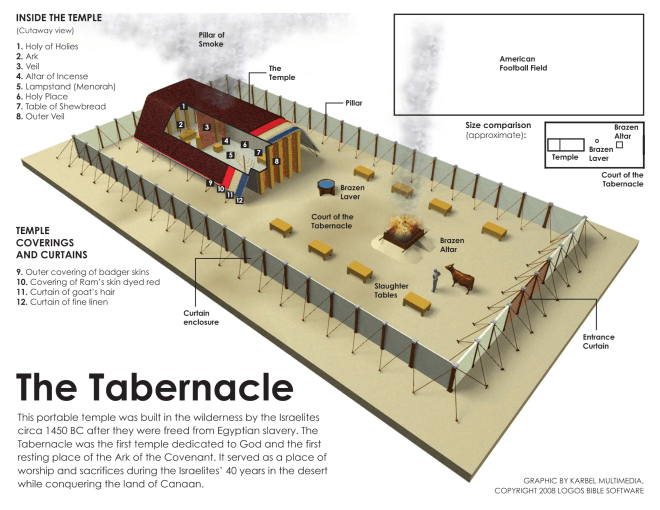
The Tabernacle

Exodus 27 gives the specifications for the bronze altar, court of the Tabernacle, and the oil for the lamps (27:1-21).  The bronze altar (27:1-8) points to Jesus Christ as the willing substitute sacrifice.

Brazen Altar

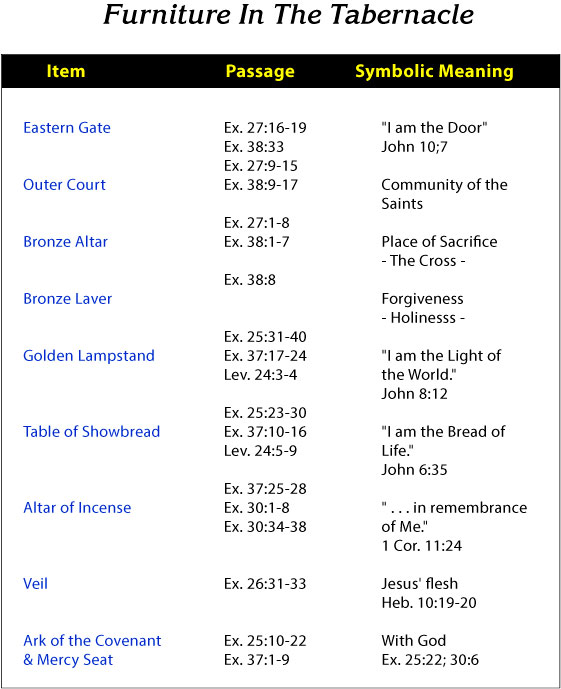
Symbolic meaning of the furniture in the tabernacle

The layout of the court is given in 27:9-19.  Notice that there was only one way in (John 14:6; Acts 4:12; John 10:9—Jesus the gate).

Entrance into tabernacle

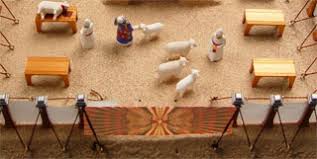
Tabernacle model from outside courtyard, bibleplaces

Finally, the type of oil is specified (27:20-21) that the priests were to prepare and use in the tabernacle.  The priests had to trim the wicks and refill the oil in the lamps on the lampstand, in the holy place, every evening—to make them “burn continually.” Thus there was “light” in the holy place all night long (cf. Lev. 24:3; 1 Sam. 3:3).

John 6 begins with the feeding of the 5,000, one of the only miracles recorded in all four gospels.  Jesus is at the high point of His public ministry.  Excitement continues to build, but so does opposition.

This picture, from Ferrell Jenkins, shows the Plain of Bethsaida in the depressed green area in the middle left.

This sign demonstrated Jesus’ identity as the Son of God, and it prepared for Jesus’ revelation of Himself as the Bread of Life (vv. 22-59).


Thomas Constable notes:

Notice that this sign illustrates three solutions to problems that people typically try. First, Philip suggested that money was the solution to the problem (v. 7).  Second, Andrew looked to people for the solution (v. 9).  Third, Jesus proved to be the true solution (v. 11).  A fourth solution appears in the other Gospel accounts of the miracle (Matt. 14:15; Mark 6:36; Luke 9:12): get rid of the problem.  The disciples told Jesus to send the people away, to let them fend for themselves (cf. Matt. 15:23).

William Barclay says, “Jesus needs what we can bring him.  It may not be much but he [asks for] it.  It may well be that the world is denied miracle after miracle and triumph after triumph because we will not bring to Jesus what we have and what we are.   If we would lay ourselves on the altar of his service, there is no saying what he could do with us and through us.  We may be sorry and embarrassed that we have not more to bring—and rightly so; but that is no reason for failing to bring what we have.  Little is always much in the hands of Christ.”

Jesus then sends His disciples across the Sea of Galilee.  He is not initially with them, but walks out to them in the midst of a storm.

Craig Groeschel said, “Never let the presence of a storm ca use you to doubt the presence of God.”

Proverbs 3

Proverbs 3 and 4 are the theological center of the book, encouraging the pursuit and reliance upon God’s wisdom.  Children are encouraged to trust in the Lord (3:1-12), pursue wisdom (3:13-26) and experience its blessings, and treat their neighbor in love (3:27-30).

The trust of the wise son (vv. 5-6) comes from heeding sound teaching (vv. 1-4), and it leads to confident obedience (vv. 7-9).  Even though the price one has to pay for wisdom (i.e., life within the will of God) includes submitting to God’s discipline (vv. 11-12), it is worth it (vv. 13-20).  In verses 21-35 we can see the quality of love in the wise son.

It is important, but sometimes difficult, for us to remember that the Lord loves us (not in spite of, but) through discipline (vv. 11-12).

C. S. Lewis illustrates the truth by noting that an artist may not take much trouble over a picture drawn to amuse a child, but he takes endless effort over his great work of art that he loves.  Leonardo da Vinci labored for many years over the Mona Lisa, in effect never really finishing it.

Galatians 2 begins with Paul stresses his independence from the other apostles in general (2:1-10) and Peter in particular (2:11-21).  Paul speaks of his meeting with the Jerusalem church leaders.  He did so to establish for his readers that, although he was not dependent on anyone but God for his message and ministry, he preached the same gospel the other apostles did.

Paul next (vv. 11-21) mentioned the incident in which he reproved Peter, the Judaizers’ favorite apostle, to further establish his own apostolic authority, and to emphasize the truth of his gospel.  He rebukes Peter because his “conduct was not in step with the truth of the gospel.”  The gospel calls us to live and interact with others in a certain way–through grace.

Peter had been freely eating with Gentiles UNTIL some important Jews from Jerusalem arrived.  Then he avoided them, wanting to please “the circumcision party.”  By his actions Peter was denying the truth of the gospel, which is ” person is not justified by works of the law but through faith in Jesus Christ” (v. 16).

Verse 16 contains three statements.  Each statement deals with this same truth of justification.  The first statement is general.  The second. statement is personal.  The third statement is universal.

General

Personal

Universal

A man is not justified by the works of the law but through faith in Christ Jesus We have believed in Christ Jesus, that we may be justified by faith in Christ, and not by the works of the Law By the works of the Law shall no flesh be justified

John Stephenson

“To give a short definition of a Christian:  A Christian is not somebody who has no sin, but somebody against whom God no longer chalks sin, because of his faith in Christ.  This doctrine brings comfort to consciences in serious trouble.”

–Martin Luther

Regarding vv. 17-18 David Guzik says…

How is it a sin to build again a way to God through the Law of Moses?  In many ways, but perhaps the greatest is that it looks at Jesus, hanging on the cross, taking the punishment we deserved, bearing the wrath of God for us, and says to Him, “That’s all very nice, but it isn’t enough.  Your work on the cross won’t be good enough before God until I’m circumcised and eat kosher.”  What an insult to the Son of God!

Of course, this is the great tragedy of legalism.  In trying to be more right with God, they end up being less right with God.  This was exactly the situation of the Pharisees that opposed Jesus so much during His years of earthly ministry.  Paul knew this thinking well, having been a Pharisee himself (Acts 23:6).

Galatians 2:20 is a favorite verse of mine:

20 I have been crucified with Christ.  It is no longer I who live, but Christ who lives in me.  And the life I now live in the flesh I live by faith in the Son of God, who loved me and gave himself for me.

What happened to me in the past, when I believed in Christ?  I was crucified.  The old me died and I no longer live (as that person).  Now Christ lives in me.  When I believe that (trust that truth moment by moment), He can live through me and His life produces practical righteousness in my life.


M’Cheyne Bible Reading Plan, March 15

Today’s readings are from Exodus 26, John 5, Proverbs 2 and Galatians 1.

Exodus 26 continues with the instructions for the furnishings of the tabernacle., dealing with the coverings and curtains for the tabernacle (26:1-14), the framing systems (26:15-30) and the two barriers–the veil between the holy place and holy of holies and the screen for the doorway (26:31-37).

This veil separates the Holy place from the Holy of Holies. Knowing the use of these colors, you recognize that they represent the entrance into a heavenly (blue), royal (purple) and redemptive (scarlet) area, for beyond this veil is the very presence of the King!  It was four inches thick!  This is what makes Matthew 27:50-51 so fantastic!

Image result for torn veil

We move through the veil by Jesus, the new and living way (Hebrews 9:11-12; 22-24).

In John 5 Jesus heals a man at the pool of Bethesda (Jerusalem) on the Sabbath.

Image result for pool of bethesda

Land of the Bible

Jesus was there for a feast, likely Passover.  There were three Jewish feasts which every Jewish male within fifteen miles of Jerusalem was obligated to attend.  Those feasts were Passover (remembering God leading them out of slavery in Egypt), Pentecost (remembering God giving them the law at Mt. Sinai), and Tabernacles (remembering God sustaining them in the wilderness).

At the pool of Bethesda Jesus asks a 38-year invalid what seems a strange question, “Do you want to be healed?” (v. 6).  That seems like a “duh” question, but it really gets to the heart of all our struggles.  Do we really want to get well?

The man immediately explained all the efforts he had taken, to no avail.

Calvin writes: “The sick man does what we nearly all do. He limits God’s help to his own ideas and does not dare promise himself more that he conceives in his mind.”

Jesus asked him to obey a simple command (the impossible) and the man did obey and was healed.

Problem–it was the sabbath and the Jews objected to the timing of the healing.  Verse 16 explains…

And this was why the Jews were persecuting Jesus, because he was doing these things on the Sabbath.

The following chart is from Tom Constable, showing the controversies between Jesus and the Jewish leaders in chronological order.

SABBATH CONTROVERSIES

Event

Matthew Mark Luke

John

The disciples plucked ears of grain in Galilee.

12:1-8

2:23-28

6:1-5

Jesus healed a paralytic at the Pool of Bethesda in Jerusalem.

5:1-18

Jesus healed a man with a withered hand in Capernaum.

12:9-14

3:1-6

6:6-11

Jesus referred to the Jews circumcising on the Sabbath.

7:22-23

Jesus healed a man born blind in Jerusalem.

9:1-34

Jesus healed a woman bent over in Judea.

13:10-17

Jesus healed a man with dropsy in Perea.

14:1-6

What Jesus said next blew their minds–Jesus was calling God his own Father, “making himself equal to God.”  In the remainder of the chapter Jesus explains why this is, in fact, reality.

  • Jesus does exactly what He sees His Father doing (vv. 19-20).
  • Jesus and the Father do the same (divine) works (vv. 21-23)
  • Most importantly, the Son gives resurrection life (vv. 24-27)
  • Therefore, He will judge you (vv. 28-30)
  • There is more than one, even more than two witnesses (vv. 31-39): the testimony of Jesus (vv. 31-32), John the Baptist (vv. 33-35), the miracles (v. 36); the Father (v. 37-38) and the Scriptures (v. 39).

Their unbelief is due to their need for man’s approval (vv. 40-44) and even their beloved Moses testified against them (vv. 45-47).

I am trying here to prevent anyone saying the really foolish thing that people often say about Him: I’m ready to accept Jesus as a great moral teacher, but I don’t accept his claim to be God.  That is the one thing we must not say.  A man who was merely a man and said the sort of things Jesus said would not be a great moral teacher.  He would either be a lunatic—on the level with the man who says he is a poached egg—or else he would be the Devil of Hell.  You must make your choice.  Either this man was, and is, the Son of God, or else a madman or something worse.  You can shut him up for a fool, you can spit at him and kill him as a demon or you can fall at his feet and call him Lord and God, but let us not come with any patronising nonsense about his being a great human teacher. He has not left that open to us. He did not intend to. . . . Now it seems to me obvious that He was neither a lunatic nor a fiend: and consequently, however strange or terrifying or unlikely it may seem, I have to accept the view that He was and is God.

–C. S. Lewis in Mere Christianity

John omitted many events in the life of Jesus—between John 5:47 and 6:1—that the Synoptic evangelists recorded as happening. These include the resumption of Jesus’ Galilean ministry (Matt. 5—7; 8:5-13, 18, 23-34; 9:18-35; 10:1—13:53; 14:1-12; Mark 2:23—6:30; Luke 6:1—9:10a).

Proverbs 2 extends the urgency of gaining wisdom.  It first contrasts the typical disregard for wisdom and truth at the end of chapter 1 by urging…

1 My son, if you receive my words and treasure up my commandments with you, 2 making your ear attentive to wisdom and inclining your heart to understanding; 3 yes, if you call out for insight and raise your voice for understanding, 4 if you seek it like silver and search for it as for hidden treasures, 5 then you will understand the fear of the LORD and find the knowledge of God.

It almost seems a circular activity–the fear of the Lord is the beginning of wisdom (1:7) and by seeking wisdom “you will understand the fear of the Lord” (2:5).

There are two dangers every young man faces–sexual temptations and temptations to do evil.  This is why wisdom is so important, because it can guard you and deliver you.

Proverbs 2:16-19, Proverbs 5; Proverbs 6:23-35 and Proverbs 7 as well as a variety of one-liners, explain the ways of sexual seduction as well as the consequences.  I would encourage you to read these passages and write down a list of consequences you would face by getting sexually involved with someone you are not married to.

See John Piper’s article ANTHEM: Strategies for Fighting Lust for practical help in overcoming this very common temptation (for both men and women).

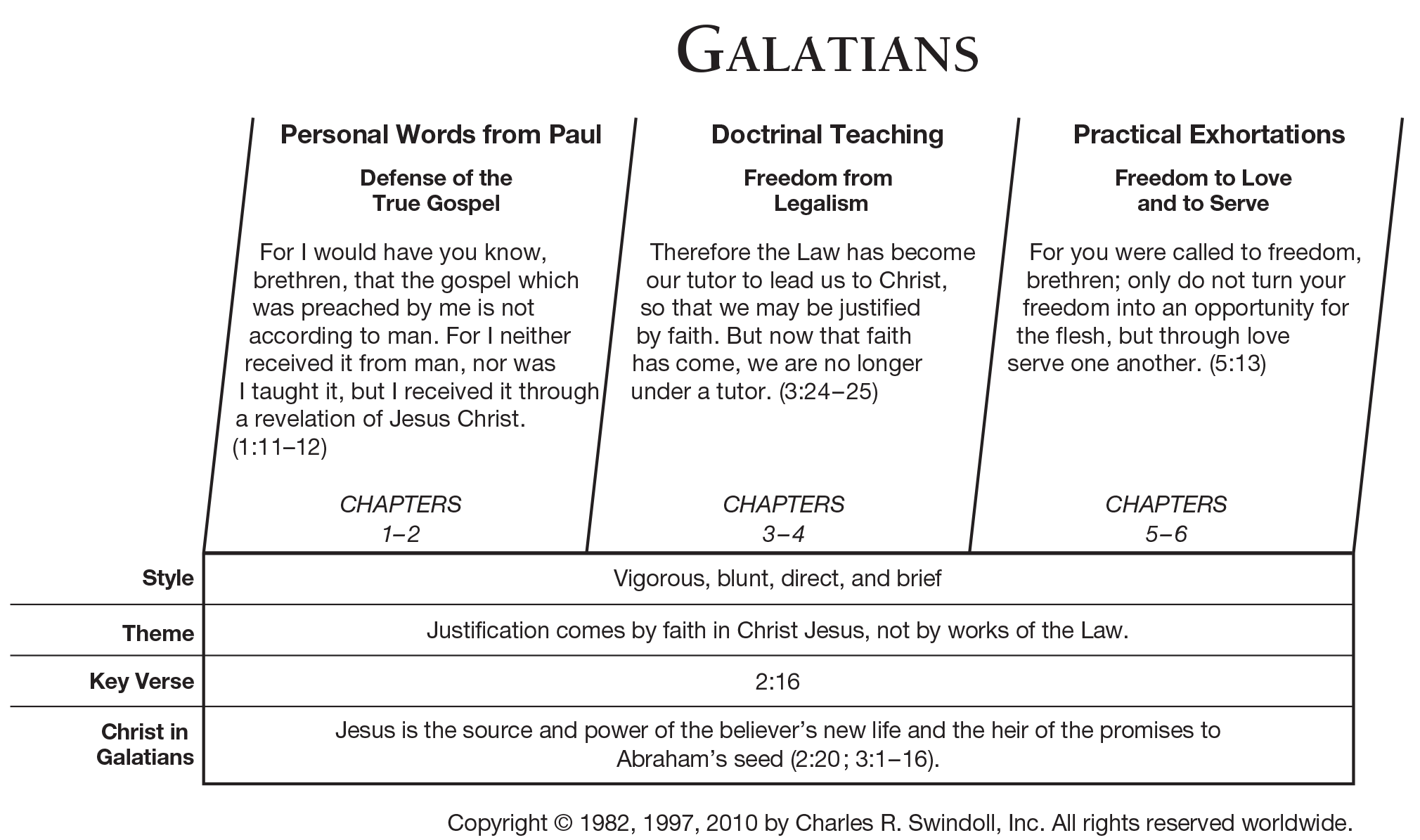
Galatians is the defense of the good news.  Christians at Galatia, many of whom were Jews, steeped in Judaism all their lives, were in danger of moving back into depending upon the law.  Galatians is written to show that we do not depend upon the law for either salvation or sanctification.

John W. Lawrence calls it the “Magna Carta of Christian liberty.”

Martin Luther: The Epistle to the Galatians is my Epistle. I have betrothed myself to it. It is my Katie – it is my wife.

Speaking of Luther’s use of the book of Galatians, Godet says: This was the pebble from the brook which, like another David, he went forth to meet the papal giant and smite him in the forehead. In this epistle Luther found the secret of his own deliverance. Taking this as his weapon, he plunged into the fearful conflict with the Papistry and religious materialism of his time.

John Stephenson shows the comparison between Paul’s two great defenses of the gospel:

Galatians


Romans

Passionate and emotional Calm reflection
Christianity on the battlefield Christianity in the study
One of the earlier epistles One of the later epistles
Justification through faith defended from attacks Justification through faith set forth systematically
Our Declaration of Independence Our Constitution

False teachers have convinced the Galatians that they are required to be circumcised. The result is division within their church (5:15).  Paul gives numerous reasons why they should return to the simple truth of the gospel.

ESV Study Bible

Paul’s letter to the Galatians was likely written to the churches he had established during his first missionary journey (Acts 13:1-14:28).  He probably wrote the letter from his home church in Antioch in Syria, sometime before the Jerusalem council (Acts 15:1–31) around 48 A.D.


As we see frequently in Paul’s epistles, Paul identifies himself as an apostle and then defends his calling, which was “not from men nor through man, but through Jesus Christ and God the Father, who raised him from the dead” (v. 1).

Unlike most of Paul’s epistles, however, Paul neither calls them “saints” nor thanks God for them.  Why is this?  It is because he has received news that they are in the process of turning from the faith. They are denying that the death of Christ was sufficient in and of itself to save them.

Paul’s gospel in Galatians is basically stated in vv. 3-4 as…

who gave himself for our sins to deliver us from the present evil age, according to the will of our God and Father, 5 to whom be the glory forever and ever. 

John Stephenson points out that the gift of the gospel was that Jesus “gave himself for our sins.”

The error of the Galatians was over this very point.  They felt that the work of Christ on the cross was not enough to take away their sins.  They thought that they had to add something to the work of Christ.  But Christ’s sacrifice was able to accomplish what it was designed to do.

Who gave… Himself… for our sins
So that He might rescue… Us… from this present evil age

The goal of the gospel is “to deliver us from the present evil age” (sanctification).

The plan of the gospel came from “the will of our God and Father,” not from our intellect or desires.

The result of the gospel is the “glory” of God “forever and ever.”

The gospel is good news, not good advice.  It tells us what God has done for us, not what we need to do for God.  However, some were teaching that what God had done was not enough.  What they were preaching was not the gospel, but an anti-gospel.

It didn’t matter who was preaching it…Jesus + anything = damnation.

Paul gives his conversion testimony and how he came to be called to preach the gospel in vv. 11-21.

Paul concludes this section of his argument.  He is an apostle.  His authority is independent of anyone in Jerusalem.  His authority is from God and his message is from God.  He has demonstrated that his gospel could not have come…

(a) BEFORE his conversion because he was against that message.

(b) AFTER his conversion because he met with none of the other apostles.

And, as we shall see in chapter 2, when he finally did have some significant interaction with Peter, it was not a case of Peter giving revelation to Paul, but Paul giving revelation to Peter.

M’Cheyne Bible Reading Plan, March 14

Today’s readings are from Exodus 25, John 4, Proverbs 1 and 2 Corinthians 13.

Exodus 25 begins God’s instructions to Israel on building and furnishing the tabernacle.

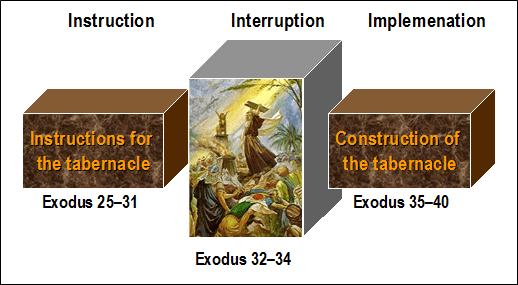
Outline chart for Exodus 25-40, Charles Savelle

Thomas Constable points out:

Moses usually employed one of four different terms to describe the “tabernacle,” each of which emphasizes one of its purposes, though other names also appear:

  1. “Sanctuary” (25:8) means “place of holiness,” and stresses the transcendence of Israel’s God as an Exalted Being who is different from His people.  However, this verse also states that such a God would “dwell among” His people.
  2. “Tabernacle” (25:9) means “dwelling place,” and emphasizes God’s purpose of abiding near His people. T he tabernacle looked like the other nomads’ tents that the Israelites lived in.  They would have thought of it as “God’s tent” among their tents. It had furniture, just as their tents did.

“Just as they lived in tents, so God would condescend to ‘dwell’ in a tent.”

  1. “Tent of Meeting” (26:36; 29:42-43; 35:21) also stresses the immanence of God. God “met” with Moses and the Israelites in this tent.  The verb translated “meeting” means a deliberate prearranged rendezvous, rather than a casual accidental meeting.  Some scholars believe that the “tent of meeting” was a different structure different than the “tabernacle,” and that it was always outside the camp of Israel.
  2. “Tabernacle (or Tent) of Testimony” (38:21; Num. 9:15; 17:7, 8) indicates that the structure was the repository of the Law.  Moses sometimes referred to the ark of the covenant as the “ark of the testimony” (25:22), because it contained the “two tablets of the testimony” (31:18), on which were inscribed the Ten Commandments.  The Ten Commandments are the “testimony.”  They were the essential stipulations of the Mosaic Covenant, the “heart” of the relationship between God and His people.

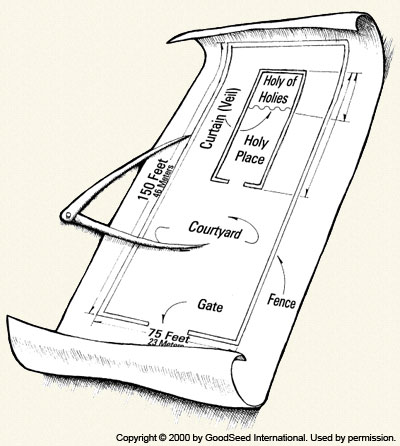
God gives a specific plan for building the tabernacle.  Its layout, construction and furnishings are all very significant.

Tabernacle plan

It begins with collecting materials needed to build the tabernacle (25:1-9).

Item Symbolic Meaning References
Gold Deity 1 Cor 3:12, Rev 21:18-21
Silver Redemption Ex 36:2430:15
Brass/Bronze Judgement Ex 27:2Num 21:9Rev 1:15
Blue Heavens/Heavenly nature Ex 25:426:3128:31
Purple Kingly/Royalty John 19:2Rev 17:4
Scarlet Blood Sacrifice Lev 14:4Josh 2:18Isa 1:18
Fine Linen Righteousness Lev 6:10Rev 19:8
Goats/Rams Hair Atonement Gen 15:9Ex 12:5
Acacia Wood Jesus’ Humanity Ex 26:15Isa 53:2
Oil Holy Spirit Lev 14:16, Psa 47:7

The construction and furnishing of the tabernacle begins with the central piece, the ark of the covenant (25:10-22).

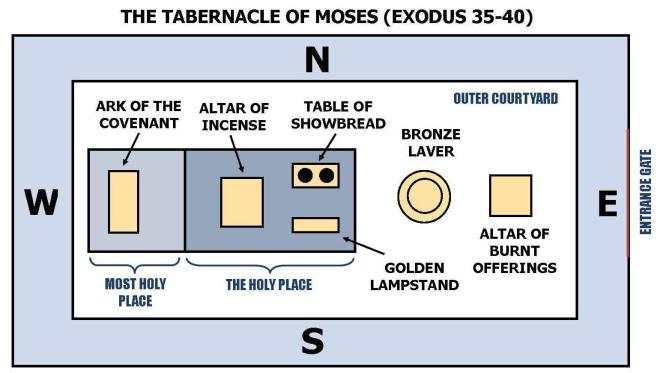
Tabernacle floor plan

Constable notes:

Note that the order in which Moses described the things associated with the tabernacle in the text, is not what one would normally expect.  For example, we would expect that after the description of the altar of burnt offerings, we would have a description of the laver.  The altar of burnt offerings was the major piece of furniture in the courtyard, and the first one the Israelite would meet as he entered the courtyard.  Then the laver was the second most prominent item, because it would catch the Israelite’s eye next.  It was also the object between the altar and the tabernacle.  However, instead, we read about the altar of burnt offerings, then the priestly vestments, then the consecration of Aaron, and then finally the laver.

This order is due to the two emphases in the revelation: First, Moses was describing things that primarily manifest God, and second, things dealing with His people’s fellowship with God.  So the author was first describing things in the “holy of holies (Most Holy Place)” where God dwelt, then things in the “Holy Place,” then finally things in the courtyard.  This order, therefore, focuses attention on the presence of Yahweh among His people, which was the most important feature of Israel’s life.  The tabernacle itself also reflects the importance of Yahweh’s presence at the center of His people.

Ark of the Covenant

The first item God told Moses to build was the ark, later called the Ark of the Covenant.  This was the most important single item associated with the tabernacle, modeled after the throne of God in heaven.   Acacia wood is harder and darker than oak. It is also very durable because wood-eating insects avoid it.   Imagine the ark to be about 3 3/4 feet long and 2 1/4 feet wide and high.

Inside were a pot of manna (reminding them of God’s provision), Aaron’s rod which budded (reminding them of Moses as their God-appointed leader) and the tables of the covenant.

God would meet them at the “mercy seat,” the place of atonement, atop the ark.  In Romans 3:25, the Greek word for propitiation (hilasterion) is also used in the Septuagint (an early translation of the Old Testament from Hebrew into Greek, read in the days of the New Testament) for the “mercy seat,” it might be said “Jesus is our mercy seat” – He is the place and the means of our redemption.

In vv. 23-30 Moses is shown the instructions for building the table of showbread.

Table of Shewbread

The priests placed twelve loaves (large pieces) of unleavened bread, called “the bread of the Presence,” in two rows or piles on this table, where they remained for seven days.  Evidently the bread was stacked in two piles, like pancakes.  The priests substituted twelve fresh loaves for the old bread each Sabbath (Lev. 24:5-8).  The term “bread of the Presence” (v. 30) means that these loaves lay before God’s presence in the tabernacle.  The Israelites did not offer this food for Yahweh to eat, as the pagans offered food to their gods. (Constable)

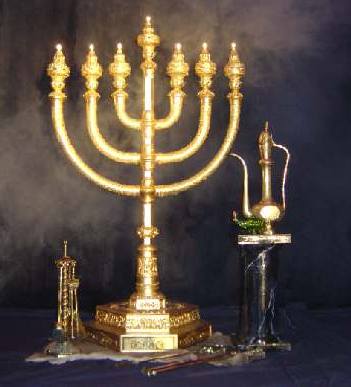
Next was the golden lampstand (25:31-40). This piece of furniture was probably similar in size to the table of showbread (v. 39).  It stood “opposite [that] table” (26:35) in the holy place, against the south (left) wall.  It weighed about 75 pounds (“a talent of pure gold”).  The tabernacle craftsmen fashioned it in the form of a stylized plant or tree, probably an almond tree.  It connoted life and fertility.

Menorah

Like the showbread, the burning “lamps” may have symbolized both the character of God and the calling of Israel.

John 4 is Jesus’ interaction with the woman at the well at Sychar.  Unlike others who skirted around Samaria, Jesus went right through it.  He had a mission.

Jesus broke through several social-cultural barriers here–talking to a hated Samaritan and a woman no less, who was of ill repute.  A good Jewish man did not speak in public to women he did not know.  A rabbi did not speak to any woman in public–not his mother, nor his wife.

Yet, she there was an emptiness in her life, signaled by multiple sexual partners.  Jesus peered deeper and touched a spiritual nerve.  She was looking for love but not in the right places.

Jesus offers spiritual water, something that would eternally satisfy, the presence of the Holy Spirit (4:13-14).

Even though she dodges and feints with personal disclosures and religious arguments, Jesus calls to her heart and reveals Himself as Messiah.  This is the only occasion before his trial that Jesus explicitly acknowledges that he is the Messiah — and he tells it to a woman, a Samaritan woman, an immoral Samaritan woman.

Nicodemus contrasts with the Samaritan woman in many ways. As John portrayed them in his narrative, they seem to typify Jews and non-Jews as well as the normal reactions of those groups to Jesus.

CONTRASTS BETWEEN NICODEMUS AND THE SAMARITAN WOMAN
  Nicodemus The Samaritan Woman
Sex Male Female
Race Pure Jewish Mixed Gentile
Social status Highly respected, ruler, teacher Not respected, servant, learner
Place Jewish territory Samaritan territory
Time At night About noon
Condition Darkness Light
Setting Indoors Outdoors
Occasion Pre-planned Spontaneous
Subject New birth Living water
Initiator Nicodemus Jesus
Conversation Faded out Continued strong
Result Unbelief Belief
Consequence No witness to others Witness to others

When the disciples return with food, Jesus says “I have food to eat that you do not know about” (v. 32), then explains, “My food is to do the will of him who sent me and to accomplish his work” (v. 34).  In other words, this is what brings deepest satisfaction, to work alongside my Father.

Then Jesus points out to His disciples the potential of the harvest (likely because a large number of Samaritans were coming towards them).  The harvest is plentiful.  In Matthew’s gospel Jesus will later tell them to pray for laborers in the harvest.

So at the woman’s simple statement in v. 29, “Come, see a man who told me all that I ever did.  Can this be the Christ?” many Samaritans believed, due to her testimony (v. 39) and Christ’s teaching (v. 41).  They gave a clearer understanding of who Jesus was that many religious Jews, “we know that this is indeed the Savior of the world” (v. 42).

Jesus then went on to Galilee, to Capernaum.

The healing of the official’s son (4:46-54) completes a cycle in John’s Gospel. Jesus performed His first sign in Cana (2:1), and now He returned and did another miracle there (v. 46).  There is even a second reference to Capernaum (2:12; 4:46).

John’s account of Jesus’ first miracle in Cana (2:11) ended with a reference to the weak faith of the Jews that rested only on miracles (2:23-25). His account of Jesus’ second miracle in Cana (4:54) opens with a similar reference (4:45, 48).

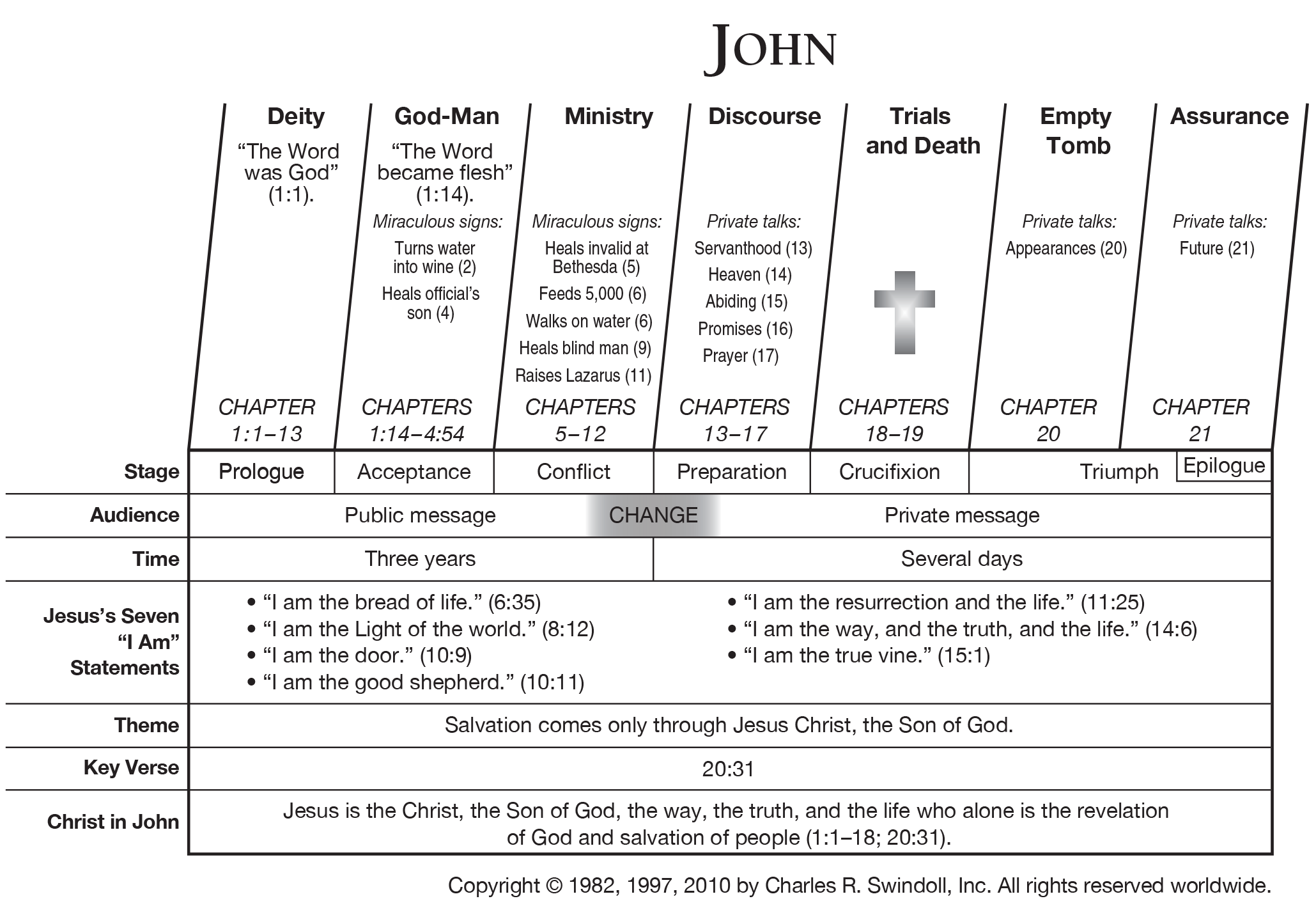
The shaded portions show where the Gospel of John fits in the timeline of Jesus’ life.

Proverbs is a book of wisdom sayings, written mainly by Solomon.  The kingdom of Israel was at its highest pinnacle of glory.  The glory of the world was Israel and the glory of Israel was Jerusalem and the glory of Jerusalem was the Temple that Solomon had built.  It was one of the wonders of the ancient world.

The absolute quiet and prosperity of the reign of Solomon (the man of peace), as described in 1 Kings 4:20, would naturally be conducive to the growth of a sententious philosophy; whereas the constant wars and dangerous life of David had called forth the impassioned eloquence of the Psalms.

–Charles J. Ellicott (1819-1905)

What is a proverb?  A proverb is a concise, memorable staying about life.

Proverbs are statements that paint a small word picture of what life is like or should be like.  A proverb is a snapshot of life.  However, as with every snapshot, a proverb does not always represent what life always looks like.  One picture does not capture everything.  A good proverb, like a good snapshot, captures what is typical.

Richard Trench, commenting on proverbs in general, believed that a proverb always has four characteristics: shortness, sense, salt, and popularity.

For the most part, the Proverbs are given in the form of couplets. The clauses of these couplets are related in terms of parallelism. Most poetry in the Hebrew language was not made up of rhyming words, but of rhyming thoughts and ideas. There are three major types of parallelism used in the Proverbs.

Type

Scriptural Example

Description

Repetitious Parallelism (Synonymous) To know wisdom and instruction,

To discern the sayings of understanding. (Proverbs 1:2).

The first line makes a statement of truth; then the second line restates and reinforces the principle given in the first clause.
Contrastive Parallelism (Antithetic) The fear of the Lord is the beginning of knowledge;

Fools despise wisdom and instruction. (Proverbs 1:7).

The first line makes a statement of truth; then the second line gives a corollary – the same truth stated in opposite terms.
Completive Parallelism (Synthetic) The Lord has made everything for its own purpose,

Even the wicked for the day of evil. (Proverbs 16:4).

The first line makes a statement of truth. The second line then adds to the original thought, expanding it so that it brings out a new truth.

One thing to remember is that proverbs are not promises.  They are not guarantees, but express how things generally work in God’s moral universe.

The purpose of the book of Proverbs is to encourage a young man (“son”) to gain wisdom (1:2-5).  Wisdom is skillful living–gaining and putting God’s understanding into practice in our responsibilities, relationships and opportunities.  We gain wisdom first by “fearing God” (1:7) which I believe means that we take God seriously, deadly seriously.  We acknowledge that He exists, that He has the right to tell us how to live, that He watches how we live and will hold us accountable.

The first nine chapters of Proverbs are “wisdom poems” that urge the reader to pursue wisdom.  The main section of Proverbs—the concise, memorable statements of two or three lines—begins in 10:1.  Proverbs often seem to be mere observations about life, but their deeper meanings will reveal themselves if the following questions are kept in mind: (1) What virtue does this proverb commend? (2) What vice does it disapprove of? (3) What value does it affirm?

After the introduction Solomon begins to instruct his “son.”

Consider what God reveals here (1:8-8:32) in the three spheres of life dealt with in the book: the home, friendship, and the world.  In the home, the child must learn wisdom.  In friendship, the youth must apply wisdom.  In the world, the adult must demonstrate wisdom.

The first sphere is that of the home (cf. 1:8-9).  God did not teach the responsibility of the father and mother here, but took for granted that they would instruct their children.  The child needs to hear parental instruction to live in the fear of the Lord.

Young children cannot grasp abstract concepts.  For them God is incarnate in father and mother.  Fathers and mothers reflect the image of God to their children.  Both parents are necessary to reveal God to the child fully.  Children see some of God’s characteristics in the mother’s attitudes and actions (cf. Matt. 23:37).  They see other aspects of God’s character in the father.

Parents do not have to try to teach their young child systematic theology.  They just need to live in the fear of God themselves, and their child will learn what he or she needs to learn about God for that stage of their life—just by observing mom and dad.

For example, when small children see their parents loving one another, it prepares them to understand God’s love. This by no means is meant to exclude verbal instruction.  My point is that young children learn wisdom by observing their parents as well as by listening to them.  We all exert influence in two ways: with our words and with our works (actions).

The second sphere of life is friendship (cf. 1:10-19).  The day must come when the child, in the natural process of development, moves out into a wider circle of experience.

The Bible presents two duties that children have to their parents.  When the child’s sphere of life is his home, he is to obey his parents.  However, that duty does not continue forever.  When he moves into the larger sphere of life outside the home, his duty is to honor his parents.  This duty does continue forever.

When a child enters this second stage of life, guided at first by parental council, but then finally on its own, wisdom gives important instruction (cf. 1:10).  He should avoid certain friendships.  He should beware of people who seek to make friends with him because they have selfish interests and unscrupulous motives.  There are many warnings in Proverbs against people who are not true friends.  There is no more important stage in a young person’s development than when he or she begins to choose companions.

Then, and from then on, he or she must follow the wisdom that comes from the fear of the Lord.  The youth must submit to the Lord’s wisdom, having learned that in the home, to succeed in the larger arenas of life.  The choice of a mate is one of these companion decisions.  Parents should help their children with these values, and qualities to look for in a mate.

The third stage of life is the world, symbolized in Proverbs by the street, the gates, and the city (cf. 1:20-33; chs. 2—9).

In 1:8-19 a parent warns his son about false friendships.  Children need help in pursuing the right friendships.  Some friendships are dangerous and destructive.  These bad friendships attempt to encourage young people to leave behind their parents’ values.

The warning itself appears twice (vv. 10, 15).  A description of how the dangerous appeal will come (vv. 11-12) follows the first admonition to not heed it (v. 10).  Three reasons for ignoring it (vv. 16-18) follow the repetition of the warning (v. 15).  The final verse is a conclusion (v. 19; cf. Job 8:13).

1:20-33 gives wisdom’s first appeal.  Here we have wisdom personified (later we will encounter Dame Folly).  Wisdom calls out to the simple ones, the scorners (scoffers, mockers, NIV), and the fools (v. 22).  This section introduces the progression of foolishness.

Everyone begins as a simple child, naïve and open to every influence and suggestion.  Unless one listens to instruction, learns to fear God and gains prudence, he or she will become a fool, someone who cannot discern danger and continually gets in trouble.  If one doesn’t respond to discipline, then they become a scorner, someone who thinks they know everything and will no longer listen to instruction or respond positively to discipline.

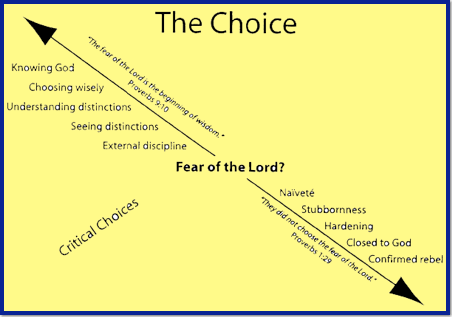
The Choice

John Kitchen’s helpful chart shows the progression, either towards knowing God or rebelling against God.  This chart shows that we don’t get to either end in a single choice or short time.

But notice how the simple person and fool respond to God’s instruction:

24 Because I have called and you refused to listen, have stretched out my hand and no one has heeded, 25 because you have ignored all my counsel and would have none of my reproof…

These verses point out four reasons that we typically reject reproof:

  1. stubborn willfulness (v. 24) “you refused to listen”
  2. insensitivity (v. 24) “no one paid attention”
  3. indifference (v. 25) “neglected” with an “I don’t care” attitude
  4. defensiveness (v. 25) “not want”

If they wouldn’t listen to God’s instructions, he would not hear their prayers when they fell into trouble.  They would “eat the fruit of their way.”

In 2 Corinthians 13 Paul tells the Corinthians to examine themselves before he comes to them.  He was preparing to come to them for the third time.  His apostolic authority was settled; was their faith secured?

“Examine yourselves, to see whether you are in the faith.  Test yourselves.  Or do you not realize this about yourselves, that Jesus Christ is in you?–unless indeed you fail to meet the test!” (2 Corinthians 13:5)

Perry Brown notes:

“The logic of Paul’s argument is compelling: If the Corinthians wanted proof of whether Paul’s ministry was from Christ, they must look at themselves, not him, because Paul had ministered the gospel to them (Acts 18:1-11; 1 Cor. 2:1-5).”

D. A. Carson has articulated what we know all too well, that “there are millions of professing believers in North America today (to say nothing of elsewhere) who at some point entered into a shallow commitment to Christianity, but who, if pushed, would be forced to admit they do not love holiness, do not pray, do not hate sin, do not walk humbly with God.  They stand in the same danger as the Corinthians; and Paul’s warning applies to them no less than to the Corinthian readers of this epistle” (178).

How do we examine ourselves?  I believe our primary assurances comes from God’s promises about our salvation (John 5:24; 10:28-30; Romans 8:1, 30, 38-39; 1 Peter 1:5), secondly through the testimony of the Holy Spirit (Romans 8:17) and thirdly through our obedience (1 John).

M’Cheyne Bible Reading Plan, March 13

Today’s readings are from Exodus 24, John 3, Job 42 and 2 Corinthians 12.

In Exodus 24 the covenant between God and Israel is ratified (24:1-11).  Moses told the people all God had commanded, they agreed to it (v. 3) and he wrote them down.  They ratified the covenant with sacrifices (vv. 4-7) and the people again pledged their obedience (v. 7).

In vv. 9-11 Moses, Aaaron and his sons and 70 elders were ate and drank with God, enabled to see Him without dying.  While it is possible that they only saw his feet, or a part of Him, God was definitely merciful to them.

24:12-31:18 give directions for God’s continued dwelling with the Israelites.

Now that Israel had entered into a blood covenant with God, God purposed to dwell among His people (cf. John 1:14).  Correspondingly, God now dwells among Christians by His Holy Spirit, since Jesus Christ has ratified the New Covenant by shedding His blood.

The spectacular vision of “the glory of the LORD” on the mountain, “like a consuming fire” (v. 17), should have caused the Israelites to have greater respect for God’s revelation than they demonstrated later (cf. 32:1-8).

John 3 records Jesus’ interaction with Nicodemus (3:1-21), followed by John the Baptist’s reaction to Jesus (3:22-30) and an explanation of Jesus’ preeminence (3:31-36).

The soteriological concept of “new birth” or regeneration, is introduced to Nicodemus (a religious Jew) as the way in which a person takes part in the kingdom of God (3:3) and as something Nicodemus should have known about (3:10).

In His description of new birth, Jesus recalled a familiar theme from Old Testament promises of the New Covenant (Deut. 30:1-6; Jeremiah 23:1-8; 31:31-34; 32:37-41; Ezekiel 36:16-28; 37:11-14; 37:21-28).

“All over the New Testament this idea of rebirthre-creation occurs.” (Barclay)

  • 1 Peter speaks of being born anew by God’s great mercy (1 Peter 1:3).
  • 1 Peter speaks of being born anew from an imperishable seed (1 Peter 1:22-23).
  • James speaks of God bringing us forth by the word of truth (James 1:18).
  • Titus speaks to us of the washing of regeneration (Titus 3:5).
  • Romans speaks of dying with Jesus and rising anew (Romans 6:1-11).
  • 1 Corinthians speaks of new believers as new-born babes (1 Cor. 3:1-2).
  • 2 Corinthians speaks of us being a new creation in Jesus (2 Cor. 5:17).
  • Galatians says that in Jesus we are a new creation (Galatians 6:15).
  • Ephesians says the new man is created after God in righteousness (Eph. 4:22-24).
  • Hebrews says that at the beginning of our Christian life we are like children (Heb. 5:12-14).

There is fleshly birth and spiritual birth, Jesus is saying.  We all experience physical birth through no effort of our own, but experiencing spiritual birth is dependent upon the movement of the Holy Spirit.

“A man may cast away many vices, forsake many lusts in which he indulged, and conquer evil habits, but no man in the world can make himself to be born of God; though he should struggle never so much, he could never accomplish what is beyond his power.  And, mark you, if he could make himself to be born again, still he would not enter heaven, because there is another point in the condition which he would have violated — ‘unless a man be born of the Spirit, he cannot see the kingdom of God.’” (Spurgeon)

A picture of Jesus’ crucifixion was Moses’ lifting up of the serpent in the wilderness.  The serpent in Numbers 21 was made of bronze, indicating judged sin.  Jesus, who knew no personal sin, was condemned as a sinner because He bore our sins.

People were saved not by doing something, but simply in looking.  Likewise, salvation comes to us not by doing, but simply looking.  Isaiah 45:22 says, “Look to Me, and be saved, all you ends of the earth!”

Alexander Maclaren said:

“He must die because He would save, and He would save because He did love.”

We are condemned, ultimately, not because we sin, but because we don’t believe in the provision God has made for our salvation (3:18).  The reason we are not saved, is because we love darkness and hate the light.

There are four prominent “musts” in John 3.

  • The Sinner’s must: you must be born again (John 3:7).
  • The Savior’s must: so must the Son of Man be lifted up(John 3:14).
  • The Sovereign’s must: He must increase (John 3:30).
  • The Servant’s must: I must decrease (John 3:30).

–David Guzik

Like John 3:16 earlier, John 3:36 makes it clear…

36 Whoever believes in the Son has eternal life; whoever does not obey the Son shall not see life, but the wrath of God remains on him.

Job’s response to God in 42:1-6 shows that he has learned more about God and His ways.

He was aware as never before that God had all power and all wisdom. This resulted in an attitude of awe and submission (v. 2). He saw that it was foolish for him to question God’s actions. God knew what He was doing even though Job did not.

By quoting God’s first question back to Him (v. 3a; 38:2), Job meant: “You were exactly right in asking, ‘Who is this that hides counsel without knowledge?’  That is just what I have been doing.”  He admitted having spoken presumptuously (v. 3b-c).

Job also repeated what God had said when He began each of His speeches (v. 4; 38:3; 40:7).  God had asked for Job’s reply.  Now Job gave it. However, it was not the courtroom accusation he had said he wanted to deliver to God. It was instead a confession of his own folly.

Job had had limited, secondhand knowledge of God (“my ears had heard of you”), but now he has “seen” and has more spiritual insight.  This greater understanding of God helped him to understand himself better.  He saw both God and himself more realistically.

Job evidently not only withdrew his charges against God but also despised and rejected his attitude of pride.  Job had previously expressed remorse over his losses, but now he grieved over his sins.  Job’s repentance seems to have been more than turning from his sorrowful condition.  He changed his mind and abandoned his rebellious pride and arrogance toward God.

Our best answer to suffering is to know God as He is.

The book closes as it opened, with a prose explanation by the inspired human writer. He gave us important information about Job’s friends (vv. 7-9) and then Job’s fortunes (vv. 10-17).

See the three main features of the epilogue—transformation [of Job as regards his character], vindication [of Job before his friends], restoration [to Job of his former prosperity, and far more].

In the epilogue God first addresses Job’s friends.  He evidently excludes Elihu because he had more faithfully represented God than the others had.

The error of Eliphaz, Bildad, and Zophar was limiting God’s sovereignty.  By asserting that God always punishes the wicked and rewards the righteous in this life, they were limiting God and committing a sin that required a sacrifice for atonement (covering).  Modern prosperity theology advocates should take note!

God is sovereign in his exercise of grace.

Job evidently forgave his friends as God had forgiven him (cf. Matt. 6:12), and prayed for them as a priest (cf. 1:5; Matt. 5:44).  Job stood as a mediator between his friends and God.  He had previously felt the need of a mediator himself.

Rather than judging Job, God accepted him because he was indeed His “servant,” not the rebel that his friends accused him of being. The writer used the word “servant” four times in these verses. Job had served God, among other ways, by being the vehicle through whom God brought the revelation of this book to its readers. Job not only obtained God’s favor himself, but he became the instrument of God’s grace to sinners.

Then, in vv. 10-17, God restores Job’s fortunes.

Item Before After Total
Sheep 7,000 7,000 14,000
Camels 3,000 3,000 6,000
Yoke of Oxen 500 500 1,000
Female Donkeys 500 500 1,000
Sons 7 7 14
Daughters 3 3 6
Age in Years 70 140 210

Notice that God began to prosper Job again after he interceded for his friends (v. 10), not just after he repented. His willingness to pray for his enemies showed the genuineness of the transformation that had taken place in his heart. He no longer felt antagonistic toward God but accepting of his enemies (cf. Matt. 6:15).

The Lord increased all that Job possessed twofold (v. 10).

Does the fact that God eventually blessed Job materially in life for his godliness prove Job’s three friends were right after all?  Is the basis of man’s relationship with God really retribution?

No, God did not reward Job in life primarily because he was good but because God is gracious. The basis of people’s relationship with God is grace.

The Book of Job does not deny the fact that God blesses the righteous.  However, it shows that this principle has exceptions if we look at life only this side of the grave.  Because God is sovereign He can deal with anyone as He chooses for reasons only He knows.  Nevertheless He always deals justly (cf. Rom. 9:14).

Warren Wiersbe concludes…

“This chapter assures us that, no matter what happens to us, God always writes the last chapter. Therefore, we don’t have to be afraid. We can trust God to do what is right, no matter how painful our situation might be. . . .

“His [Job’s] greatest blessing was knowing God better and understanding His working in a deeper way.”

2 Corinthians 12 begins with Paul’s “boast” of going up to the third heaven.  David Platt pointed out a few years ago, when one of the books about out-of-body trips to heaven was popular, that Paul “heard things that cannot be told, which man may not utter” (12:3).

What Paul really boasted in was his own weakness, because it was through his weakness that God’s strength could be manifest, so that He would receive the glory.

Some things to note about Paul’s experience:

  • We do not know what the “thorn…in the flesh” was.
  • That thorn was “given” to Paul to keep him from conceit.  God will ruthlessly deal with our pride.
  • Even Paul did not get all his prayers answered.  At least not in the way he initially wanted.
  • Paul adjusted his praying, desiring grace in weakness rather than strength.

The true heart of a pastor is found in verse 15:

15 I will most gladly spend and be spent for your souls.

Paul was having to prove to them that, unlike the other “super apostles,” he was not taking advantage of them.

M’Cheyne Bible Reading Plan, March 12

Today’s readings are from Exodus 23, John 2, Job 41 and 2 Corinthians 11.

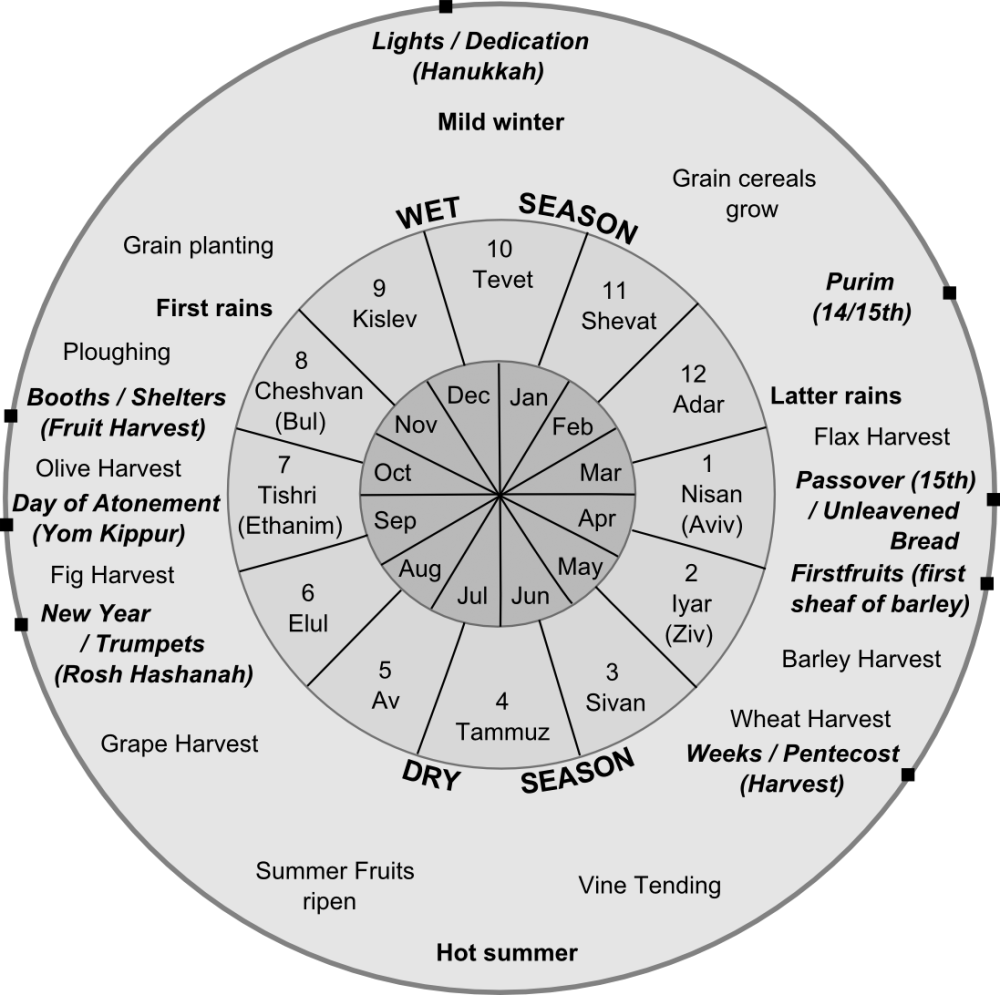
Exodus 23 begins case laws with laws about justice (23:1-9), then describes the religious life of this new theocratic nation, Israel.  First, the Sabbath (23:10-13), then the three national feasts: Passover/Unleavened Bread, Firstfruits, and Ingathering (Pentecost) (23:14-17).

Image result for jewish calendar

Image result for calendar of Jewish feasts

This is followed by laws about sacrifices and offerings to God (23:18-19).  Finally, God promises His presence and blessing as long as they are obedient (23:20-23).

John 2 includes two main events–the wedding at Cana (2:1-12) and Jewish cleansing the temple in Jerusalem (2:13-22).

Kirbeth Cana would be on the first “hill” beyond the olive trees.  The “hill” is actually a “tel,” a layering of city remains from different ages.

The wedding at Cana of Galilee provided the opportunity for Jesus to do His first miracle.  John specifically calls them “signs” because the objective was not merely to show off, or even to meet people’s needs, but to reveal the true identity of Jesus.

It was a major social faux pas. “To fail in providing adequately for the guests would involve social disgrace. In the closely knit communities of Jesus’ day such an error would never be forgotten, and would haunt the newly married couple all their lives.”

–Merrill Tenney

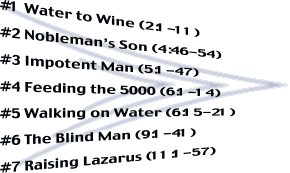
Jesus gently rebuked His mother’s request to help, because his “hour has not yet come” (v. 4), yet He went ahead and gave instructions that resulted in an abundance of really good wine.  So this was Jesus’ “first” of seven signs.

Image result for seven signs in the book of john

13 The Passover of the Jews was at hand, and Jesus went up to Jerusalem.

John alone recorded that “Jesus went up to Jerusalem,” topographically again, for three separate “Passover” celebrations.  He referred to a second Passover in 6:4, and to a third one in 11:55; 12:1; 13:1; 18:28, 39; and 19:14.  Some interpreters believe that he mentioned a fourth Passover in 5:1, but this seems unlikely.  This first one was evidently the Passover of April 7, A.D. 30, the first one after Jesus began His public ministry.

While there Jesus saw the buying and selling, and the extravagant prices.  Though Jesus’ action was violent, it evidently did not constitute a threat to the peace in the temple area. Roman soldiers from the adjoining Antonia Fortress would have intervened quickly if it had (cf. Acts 21:31-32).  Jesus was forceful but not cruel.  There is no indication that He injured anyone with His fairly harmless scourge of cords (Gr. phragellion ek schoinion).

Tom Constable explains…

The Old Testament predicted that Messiah would come and purify the Levites (Mal. 3:1-3; cf. Zech. 14:21).  Jesus’ action perhaps recalled these prophecies to the godly in Israel who may have wondered if Jesus was the Messiah.  His actions here did not fulfill these prophecies, however, which appear in millennial contexts.  Jesus will yet return to the temple that will be standing in Jerusalem, when He returns at His Second Coming, and purify the Levites serving there then.  This will be preparation for His messianic reign that will follow.

The disciples saw Jesus’ zeal, perhaps recalling Psalm 69:9.  But the Jews wanted Jesus to produce some sign to prove His authority.  Jesus gave them a sign, but not the kind they wanted.  They wanted some immediate demonstration of prophetic authority.  Instead, Jesus announced a miracle that would vindicate His authority after He died.  He would rise again.

John 2 ends with a somewhat cryptic statement.

23 Now when he was in Jerusalem at the Passover Feast, many believed in his name when they saw the signs that he was doing. 24 But Jesus on his part did not entrust himself to them, because he knew all people 25 and needed no one to bear witness about man, for he himself knew what was in man.

Many believed in Jesus, but Jesus did not believe in them.  Why?  Because He knew all people and whether they were genuine.  This seems to set us up for John 3 and 4 as Jesus encounters a religious Jew and an immoral Samaritan.  What was in their hearts?

Ralph Wilson notes:

Seeing the miracles prompted initial faith in many people (the verb is pisteuō, “to believe”) — and that was good, so far as it went.  But faith that rests on miracles alone, and doesn’t mature to embrace Jesus and follow him, is shallow and fickle.

Job 41

Yahweh’s purpose in directing Job’s attention to such inexplicable animals on land (Behemoth) and in the water (Leviathan) seems to have been almost the same as His purpose in His first speech.  He intended to humble Job by reminding him of his very limited power and wisdom, compared with God’s, so Job would submit to His Lordship.

One might conclude after reading these speeches of Yahweh that God is not very compassionate. He may seem more concerned about establishing His own glory than about Job’s suffering.  However, we need to remember that God could have said nothing.

Furthermore, by directing Job’s thinking as He did, God did what was best for Job, the truly loving thing.  He did not just give him answers to specific questions but a larger vision of Himself that would transform Job’s life forever after.

2 Corinthians 11 continues Paul’s defense of his apostolic authority.  Paul defends his credentials, though it appears as foolishness.  It is important that the Corinthian Christians understand and trust Paul’s apostolic credentials because Paul is jealous with a godly jealousy for their hearts.  It is important that the Corinthian Christians understand and trust Paul’s apostolic credentials because Paul knows they are attracted to the false apostles who preach another Jesus.

Paul feels like he has to defend himself against the super-apostles.  Even Satan can appear as an angel of light (v. 14).  Ultimately, Paul reveals that his apostolic credentials are the scars he has borne (vv. 22-33).

Alan Redpath reminds us:

“Such is the price that Paul paid.  How does that react upon you?  Do you congratulate yourself that you have escaped it?  One week of such living and we would be done, but Paul went through it for a lifetime and gloried in his infirmities.”

M’Cheyne Bible Reading Plan, March 11

Today’s readings are from Exodus 22, John 1, Job 40 and 2 Corinthians 10.

Exodus 22 is filled with case laws, laws of restitution in vv. 1-15 and social or religious laws vv. 16-31.  Throughout this chapter, God is taking laws which were already enacted in the ancient Middle East (for example, the Code of Hammurabi), and making them more humane.  Justice would be served, but mercy is present also.

John’s gospel is different from the other three (synoptic gospels).  It begins not with the birth of Christ, but His pre-existence.

Each of the Gospels emphasizes a different origin of Jesus.

  • Matthew shows Jesus came from Abraham through David, and demonstrates that He is the Messiah promised in the Old Testament (Matthew 1:1).
  • Mark shows Jesus came from Nazareth, demonstrating that Jesus is a Servant (Mark 1:1).
  • Luke shows Jesus came from Adam, demonstrating that Jesus is the Perfect Man Luke 3:23-38).
  • John shows Jesus came from heaven, demonstrating that Jesus is God.

Even though John was written last (in the early 90’s A.D.), it does not “complete” the gospels, for John recognized that the story of Jesus was so big that it can never be completed (John 21:25).

John 1 begins with a prologue in vv. 1-18, which stretches back before time to speak of the Word.  This is related to the Hebrew concept of “wisdom” and the Greek word logos spoke of the organizing principle of the universe.  John shows that the real logos has always existed with God and was with God (by His side) and was/is God.

Some point out the lack of the Greek article with God (theos) in verse 1, translating it, “and the Word was a god,” making him less than God, a created god.  However, any predicate noun that has no article is not indefinite unless the context dictates.  In fact, John could not have used the article with theos because to do so would have made in a controvertible statement (meaning you could say it back and forth) and John certainly did not mean “God was the Word” as if minimizing God to the second person of the Godhead.  This God created everything (v. 3) and John says, “I mean EVERYTHING” so that He could not have been one of the created things.

Another common theme in John is light and darkness.  In Christ was light and the darkness could not overcome/comprehend it–both are true.  John the Baptist was a witness to that light (vv. 6-8).

The meaning of verse 9 is that the true Light comes into the world and enlightens everyone.  Everyone lives under the spotlight of God’s illuminating revelation in Jesus Christ since the Incarnation (cf. 1 John 1).  His light clarifies the sinfulness and spiritual need of human beings.  Those who respond to this convicting revelation positively experience salvation.  Those who reject it and turn from the light will end up in outer darkness.

Although the Jews (on the whole) rejected Jesus, anyone who receives him will have eternal life as God’s children (vv. 10-12).  This new relationship does not come about through physical descent (just because you are a Jew racially), nor of human desire, but of God and His will.

Vv. 14-18 speak of Jesus’ incarnation, that the eternal Word “became flesh.”  Notice the contrast with verse 1.  Jesus always “was” God, but at a point in time in space-time history “became” a man–He put on flesh, a human nature.

Jesus’ relationship to the Father is unique.  He is Jesus’ Son par excellence.  He is the “only begotten”–which is actually a poor translation.  The Greek verb gennao means “to give birth.”  But the word in John 1:14, 18 is monogenous with one nu (n), not two.  So this word comes not from gennao, but from genes (which means “race,” or “kind”).  So a better translation is “one of a kind.” (the NIV has “one and only”).

Jesus is “full of grace and truth.”  It is hard to be “full of grace and truth.”  Most of us, by temperament, are either gracious or truthful.  Some people (like me) are sometimes too gracious (read lenient, permissive), with others are too truthful (read brutal, cruel).  But Jesus always had the perfect balance–and fullness–of both.

Verses 19-29 presents the testimony of John the Baptist as a witness to the light (1:6-8).  While baptizing in the Jordan, John was questioning as to whether He was the Coming One.

The Jordan near Bethany Beyond-the Jordan (to be distinguished from the Bethany near the Mount of Olives).  It was in this area that John was baptizing.

John admits that he is not the Messiah, but the Messiah is coming and when he saw Jesus he said, “Behold, the Lamb of God, who takes away the sin of the world!” and indicates that this is the one of whom he was speaking.

At the very dawn of his ministry, Jesus is greeted with words that remind him of his destiny: His sacrificial agony on the cross for the sin of mankind.  The shadow of the cross was cast over the entire ministry of Jesus.

John realized that he was lower than Jesus, his younger cousin, in calling.  He felt unworthy to untie his shoes.  David Guzik explains…

Among Rabbis and their disciples, there was a teacher-student relationship that had the potential for abuse.  It was entirely possible that a Rabbi might expect unreasonable service from their disciples.  One of the things which was considered “too low” for a Rabbi to expect from his disciples was the untying of the Rabbi’s sandal strap.  John says he is unworthy to do even this.

The chapter ends (vv. 35-51) with Jesus interacting for the first time with some of his potential disciples, several of whom had been John’s disciples.

Andrew came to Jesus because of John’s proclamation about the Lamb of God.  Then Peter came to Jesus because of his brother’s witness.  “Come and see” is the simplest invitation we can give.

In the next verses, Philip will come to Jesus as a result of a direct invitation from Christ, and Nathanael will come to Jesus when Jesus showed himself so great in relation to Nathanael’s small question.  Our Lord will meet us wherever we are and draw us to himself with gentleness and graciousness.  May we be eager to follow Jesus!

Even today, one of the best ways to help someone believe is simply to bring them to Jesus.  Word-of-mouth advertising is always the best.

Thomas Constable notes:

At least 16 different names and titles of Jesus appear in chapter one: the Word (vv. 1, 14), the Light (vv. 7-9), the Only Begotten of the Father (v. 14), Jesus Christ (v. 17), the Only Begotten God (v. 18), the Lord (v. 23), the Lamb of God (vv. 29, 36), a Man (v. 30), the Son of God (v. 34), Rabbi (Teacher, vv. 38, 49), Messiah (v. 41), Jesus of Nazareth (v. 45), the son of Joseph (v. 45), the Son of God (v. 49), the King of Israel (v. 49), and the Son of Man (v. 51). Clearly one of John’s purposes in this Gospel was to draw attention to who Jesus is.

Job 40

Job’s first response to God is that he was dumbfounded.  Earlier he had wanted to challenge God in court; now he has nothing to say.

So God speaks again (40:6-41:34).

After Job’s first response, God narrows his focus down to Job’s acute problem.  The verse Job 40:8 seems to be the closest we get to understanding what actual sin Job might have committed: “Will you condemn Me that you may be justified?” God asks.  How easily righteousness can slip over into self-righteousness and accusing God.

This second divine discourse is similar to, yet different from, the first.  It began as the first one did with a challenge to Job (40:6-14; cf. 38:1-3), but it did not end with one (cf. 40:1-2).  In the first speech Yahweh spoke of His inanimate creation and of His animate creation, specifically 10 animals.  In the second speech He concentrated on only two creatures: Behemoth (“great beast”) and Leviathan (“sea monster”).

God does not want to crush Job, but to instruct him.  He challenges Job to refute him (40:6-14) and then asks Job questions (40:15-41:34).

In 2 Corinthians 10 Paul begins defending his apostleship (chaps 10-12).  He pleads with them and hopes that the Corinthians will change their attitude towards him and his apostolic authority so that he can come to them in gentleness, not severity (vv. 1-2).

Unlike his opponents, the “super-apostles” who were trying to win the Corinthians’ loyalty, Paul did not minister in the flesh, but with divine weapons.  They are the only ones who can tear down Satanic strongholds.

3 For though we walk in the flesh, we are not waging war according to the flesh. 4 For the weapons of our warfare are not of the flesh but have divine power to destroy strongholds. 5 We destroy arguments and every lofty opinion raised against the knowledge of God, and take every thought captive to obey Christ, 6 being ready to punish every disobedience, when your obedience is complete.

Redpath writes of a practical way to battle with spiritual weapons and break down a stronghold: “When the thought comes and the person is reported to have said what he has said, and the unkindness has been passed over to us, and the criticism has been made, whereas carnality would say, ‘Counterattack!’ spirituality recognizes that nothing that any person could ever say about any one is really one hundredth part as bad as the truth if he only knew it.  Therefore, we have no reason to counterattack, but one good reason to submit and to forget.”

“Taking every thought captive” means that we don’t have to surrender to our thoughts and the voices in our head.  We take them captive by first preaching to ourselves the gospel and then asking our commander for marching orders.

Paul speaks of his authority as an apostle in vv. 8-11, how a ministry should be measured in vv. 9-16, and ends with the vital importance of the Lord’s commendation upon a minister’s ministry (vv. 17-18).

Let me close with a quote from Eugene Peterson.  I am currently reading Working the Angles, and this quote is similar but not from that book:

As it turns out, the people I serve would often prefer an idol who would do what they want done rather than do what God, revealed in Jesus, wants them to do.  In our present culture, the sharp distinction between a job and a vocation is considerably blurred.  How do I, as a pastor, prevent myself from thinking of my work as a job that I get paid for, a job that is assigned to me by my denomination, a job that I am expected to do to the satisfaction of my congregation?  How do I stay attentive to and listening to the call that got me started in this way of life – not a call to make the church attractive and useful in the American scene, not a call to help people feel good about themselves and have a good life, not a call to use my considerable gifts and fulfill myself, but a call like Abraham’s ‘to set out for a place…not knowing where he was going’, a call to deny myself and take up my cross and follow Jesus, a call like Jonah’s to go at once to Nineveh, ‘a city he detested’, a call like Paul’s to ‘get up and enter the city and you will be told what to do’?

Gracious Cleansing of Israel’s Infidelity, part 4 (Hosea 2:21-23)

Did you know that this past Wednesday was National Proposal Day?  If you’re sitting, just waiting for something to happen, it is a day to stand up and go out and propose to your girl.

Like I said last week, the wedding bells are ringing.  God will reconcile with Israel, taking the initiative to, effectively, say “I do” to Israel, expecting the reciprocal response of an “I do” in return.

Let’s read this whole passage of God’s gracious cleansing of Israel’s infidelity and we will focus this morning on vv. 21-23…

14 “Therefore, behold, I will allure her, and bring her into the wilderness, and speak tenderly to her. 15 And there I will give her her vineyards and make the Valley of Achor a door of hope. And there she shall answer as in the days of her youth, as at the time when she came out of the land of Egypt.  16 “And in that day, declares the LORD, you will call me ‘My Husband,’ and no longer will you call me ‘My Baal.’  17 For I will remove the names of the Baals from her mouth, and they shall be remembered by name no more.  18 And I will make for them a covenant on that day with the beasts of the field, the birds of the heavens, and the creeping things of the ground. And I will abolish the bow, the sword, and war from the land, and I will make you lie down in safety.  19 And I will betroth you to me forever. I will betroth you to me in righteousness and in justice, in steadfast love and in mercy.  20 I will betroth you to me in faithfulness. And you shall know the LORD. 21 “And in that day I will answer, declares the LORD, I will answer the heavens, and they shall answer the earth,  22 and the earth shall answer the grain, the wine, and the oil, and they shall answer Jezreel,  23 and I will sow her for myself in the land. And I will have mercy on No Mercy, and I will say to Not My People, ‘You are my people’; and he shall say, ‘You are my God.'”

Verses 16-25 sum up God’s resolution with courtship, betrothal, covenant-making, exchange of vows and giving of new names.

So here at the end of this wonderful reconciling work of God with Israel, which will take place “in that day” (vv. 16, 21), which is yet a future day, Yahweh and Israel will be reunited as husband and wife forever.  This is God’s promise to Israel.

And they all lived happily ever after.  Well, they will, in the future.  Again, vv. 21-23 say…

21 “And in that day I will answer, declares the LORD, I will answer the heavens, and they shall answer the earth,  22 and the earth shall answer the grain, the wine, and the oil, and they shall answer Jezreel,  23 and I will sow her for myself in the land. And I will have mercy on No Mercy, and I will say to Not My People, ‘You are my people’; and he shall say, ‘You are my God.'”

Notice that like v. 16, verse 21 begins with the words “in that day.”

The phrase “in that day” recalls the prophetic theme of the “day of the Lord,” an especially common theme in the Minor Prophets. Each prophet views it from a slightly different angle.  To Joel, the “day of the Lord” is a terrible day, akin to a locust plague, a day of darkness and judgment, yet whoever calls on Yahweh will be saved (Joel 2:30–32).  To Amos, it is a day that Israelites (Hosea’s contemporaries) should dread, not desire (Amos 5:18–20), as it will involve terrible climactic judgment.  Similarly, Malachi asks, “Who can endure the day of his coming?” (Mal. 3:2), implying that it is a day to be dreaded. Zephaniah foresees a day so severe that nothing will survive (Zeph. 1:2–18).

In this chapter of Hosea, however, the focus is on positive aspects of that day.  We read of a future time of wedded bliss between Israel and the Lord.  A renewed marriage contract is envisioned that will last forever.

If vv. 16-20 picture the betrothal of Israel to Yahweh, vv. 21-23 depict the consummation, in which Israel becomes Yahweh’s.

Notice here at the end of chapter 2 that all the judgments against the children of Gomer in chapter 1, will be reversed.  Jezreel, instead of being scattered (as in exile), will be sown (v. 23) in the land to remain there.  God will show mercy on Lo Ruhammah, little “No Mercy” and will call those who were no longer God’s people “My people” and they will respond “You are my God.”

In short, the judgments symbolized in the names of Hosea’s three children (vv. 22–23) are outstripped by the restored glories the Lord will give. Truly this is a God “merciful and gracious, slow to anger, and abounding in steadfast love and faithfulness” (Ex. 34:6).

David Murray calls these tear-drying, heart-rejoicing, dream fulfilling words of hope.  They echo the words of the Song of Songs, “I am my beloved’s and he is mine.”  Something of the fullness of Israel’s experience may be reflected in the grand Christian hymn by Wade Robinson, “In a love, which cannot cease, I am His and He is mine.”

But let’s go back to verse 21.  What is all this “answering” that’s going on in vv. 21-22?

God will answer the cries of heaven, and it will rain again.  The rain will answer the need of the land, and it will be productive again.  The earth will answer the need of grain and oil, and they will flourish again.

Creation, though majestic and powerful, always obeys the will of its Master.  Derek Kidner notes that “the world is a single, close-knit composition, intelligible in principle.  And it does not make the blunder of exalting that system by denying its fount and origin.  So we are not left with a mechanistic world on the one hand, nor with a God who keeps us guessing on the other, but with a world we can explore and a God we can trust and serve responsibly within it.”

This chain of giving from heaven to earth encourages Israel to trace the links all the way back to God.  The success of every request to supply need encourages Israel to bring her own requests to God.

For too long Israel’s great sin was the worship of Baal, the heathen god of fertility.  They prayed to him for fruitful fields and also attributed the results to this idol.  For too long, God would say, “I don’t hear you.”  Israel failed to bring their requests and their thanks to Him.  He did not hear them.  As He waited over Israel, listening—nothing.  Nothing but deafening silence. For this, Israel was to be judged.

But “in that day” God would hear.  In that day she would forget about Baal and know Yahweh.  And in that day God will respond with all the blessings He had promised to Abraham.

The mention of “heavens” and “earth” show that ultimately this is not merely a national restoration, but the whole universe will be restored (Rev. 21:1).

In speaking to the earth, Israel’s former difficulties will be reversed: grain, wine, and oil, which had once been taken away (vv. 5, 8-9) will be replenished.  When our relationship with God is where it is supposed to be, God abundantly supplies and pours out blessings upon us.

Has God been hovering over your life and hearing nothing?  He is listening but saying, “I don’t hear.”  “I don’t hear prayer for daily bread.  I don’t hear thanks.”  You are attributing your blessings to your own strength, to luck, or to sheer coincidence.  You are patting yourself on your back rather than praising God with your lips.  The golden chain of prayer, providence, and praise has broken down.

But God is saying, “I will hear.” He is coming to break your Baal.  When it lies shattered before you, you begin to look heavenward, prayer is stuttered and stammered heavenward, and heaven replies, “Now I hear. And you will be heard.”

Notice once again the “I will” statements of verse 23.

23 and I will sow her for myself in the land. And I will have mercy on No Mercy, and I will say to Not My People, ‘You are my people’; and he shall say, ‘You are my God.'”

Restoration is not based upon Israel’s efforts, but God’s determined actions.

“Jezreel” (“God Plants” or “God Sows”) here personifies the nation of Israel as a whole, though its area was also the traditional “breadbasket” of the Northern Kingdom.  Israel in the past had cried to Baal, the Canaanite god of rain and fertility, but he had not helped.

Biblical Assyria was at its peak during the time of Jonah, just before the fall of Israel in 722BC (see Jonah 1:1).  In 733 BC, Tiglath-Pileser III of Assyria invaded Israel and captured Galilee (see 2 Kings 15:29).  Two years later, he captured Damascus and killed King Rezin of Syria.  In 724BC, King Shalmaneser V of Assyria laid seige to Samaria, and Israel fell to the Assyrians two years later (see 2 Kings 17:5-6).  They were assimilated into far-flung corners of the Assyrian Empire, literally “scattered abroad.”

But in that day, having returned to the Lord by responding to His wooing, the Israelites would then appeal to Him as the true God of fertility, and He would respond by sending rain.  And they would again by sown into the land.

“I will not have mercy” are the most terrifying words a sinner can hear from the mouth of the Lord.  These words will destroy the souls of the unrepentant sinner on the Day of Judgment.  These words will echo round the chambers of hell forever: “I will not have mercy.  And who can argue with them?

Those who spend their earthly days saying, “I don’t want mercy,” can hardly complain when at the end of their days God grants them their request eternally, “You didn’t want mercy, and so you will not have mercy.” These words dash every dream and quash every hope, “I will not have mercy.” Oh, mercy-spurning sinner, will this be your death-sentence?

But here is hope, despairing soul.  Israel was just like you; she refused mercy time and time again.  She was judged by the removal of mercy in foreign exile (Hos. 1:6).  But God will look down in pity on her merciless condition and say, “I will have mercy upon her that had not obtained mercy.”  What a turning point!  What tear-drying, heart-rejoicing, dream-fulfilling words of hope!

Go to the Lord and say, “I have not obtained mercy because I did not need nor want mercy.  But now I desperately need it and earnestly want it.  I abandon all my imagined merit.  Oh Lord, be merciful to me, the sinner.”

And wait, what do you hear?   Can it be, “I will have mercy upon her that had not obtained mercy”?

And dear Christian of many years, recall what turned your life around.  It wasn’t your merit or will; it was God’s mercy and God’s will.  It was when He said—oh, blessed moment—“I will have mercy upon her that had not obtained mercy.”

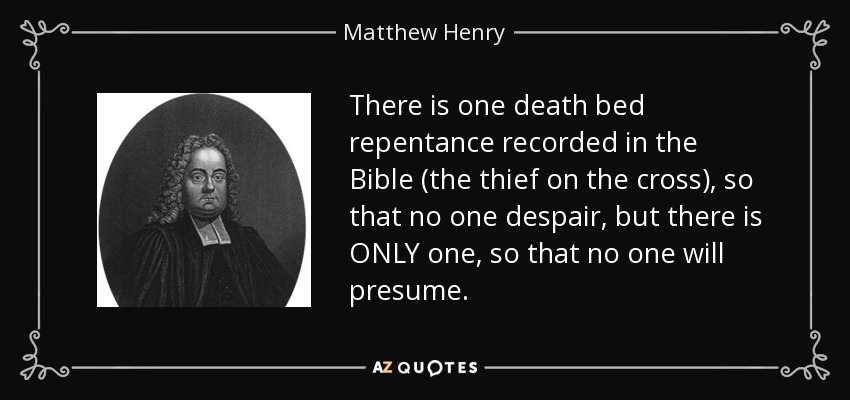
Matthew Henry comments: “God’s mercy must not be despaired of anywhere on this side hell.”

In the book of Romans Paul struggles with how it can be that his beloved people have largely abandoned the salvation provided for them, while the barbarians and profane peoples who cared nothing for God—and were his enemies in times past by plundering and devastating the people of the covenant—are now taking Jesus as their own and enjoying a salvation never imagined or envisioned.  Paul’s was an upside-down world, where those destined for glory found judgment, while those destined for judgment found glory.

Paul explains this by citing the book of Hosea, in which those who were not God’s people now are, while those who were his people no longer are:

What if God, desiring to show his wrath and to make known his power, has endured with much patience vessels of wrath prepared for destruction, in order to make known the riches of his glory for vessels of mercy, which he has prepared beforehand for glory—even us whom he has called, not from the Jews only but also from the Gentiles? As indeed he says in Hosea,

“ Those who were not my people I will call ‘my people,’

and her who was not beloved I will call ‘beloved.’”

“ And in the very place where it was said to them, ‘You are not my people,’

there they will be called ‘sons of the living God.’” (Rom. 9:22–26)

As Paul goes on to say, the Gentiles experience such things because they have faith in Jesus (Rom. 9:30–33).  It is only through him that we can know the Lord, enter into relationship with him, and boldly proclaim, “You are my God!”

So we can see that God is not merely addressing ancient Israel here, but also us.  These things constitute “the grace” as 1 Peter 1:10 puts it “that was to be yours.”

God offers to you and me a deep, interpersonal relationship that is mirrored in the deepest, most intimate relationship we know in this life—that of husband and wife.  God has declared Himself, reconciling Himself to us through Jesus Christ.  2 Corinthians 5:18-20 says…

18 All this is from God, who through Christ reconciled us to himself and gave us the ministry of reconciliation; 19 that is, in Christ God was reconciling the world to himself, not counting their trespasses against them, and entrusting to us the message of reconciliation. 20 Therefore, we are ambassadors for Christ, God making his appeal through us. We implore you on behalf of Christ, be reconciled to God.

In the beginning, Adam and Eve and God had perfect, genuine fellowship.  But Adam and Eve rebelled against God, turning their backs on Him.  In response, God, whose eyes are too pure to behold sin, turned away from us.

Isaiah 59:2 says

2 but your iniquities have made a separation between you and your God, and your sins have hidden his face from you so that he does not hear.

But God took the first step, sending His Son Jesus Christ to become the satisfaction for our sins.  He died in our place so that God could look upon us in love.  But just because Jesus died on the cross doesn’t mean we are forgiven unless we turn back to God, repenting of our sins (asking His forgiveness) and believing that Jesus’ death on the cross was both necessary and sufficient for me.

That is why Paul, and Hosea, are urging, “Be reconciled to God.”

Our culture of identity politics and intersectionality emphasizes all the differences between people.  But in God’s eyes, there is only one primary difference: “My people” and “Not my people.”  That’s it, just two categories, two simple, but vital, differences.

Here, Yahweh will woo Israel, declare Himself her husband, and she will respond, “You are my God!”  What a bold declaration, like a wedding vow, “I take you to be my husband.”

How about you?  Do you say this? If He owns you as His, will you be ashamed or hesitant to own Him as yours?

He says to them, “Thou art my people, whom I will own and bless, protect and provide for;’’ and they shall say, “Thou art my God, whom I will serve and worship, and to whose honour I will be entirely and for ever devoted.’’ (Matthew Henry)

“Not mercied” name reversed without any response; but “not my people’s” name-change calls for an answer.  Israel will boldly and gladly embrace “You are my God”; what about you?

To affirm that Yahweh was their God is to confess that He is their Savior, to submit to Him as their only King, to worship Him as the One Who alone is worship, and to awaken the truth that they had once rejected.

So the latter part of this chapter proclaims the mind-blowing truth that the overwhelming desire of Yahweh is not to destroy those who reject or turn from Him, but for their redemption and restoration.  Yahweh had embarked upon an endless quest to win Israel to Himself, just as Jesus came to seek and save the lost.

That was good news in Jesus’ day; it is good news for us today.

M’Cheyne Bible Reading Plan, March 10

Today’s readings are from Exodus 21, Luke 24, Job 39 and 2 Corinthians 9.

Thomas Constables notes that there were a number of different law codes already in existence before Exodus 20ff.  He says…

The Mosaic Covenant presupposes this cumulative body of legal literature.  So it was not given as a comprehensive legal system to a people living without any laws.  Rather, it was a series of instructions God gave—as Israel’s King—for His people to govern their behavior in certain specific matters.  This fact explains why the Torah (lit. “Instruction,” i.e., the Law of Moses) does not contain fundamental instruction in many basic areas of law, such as monogamy.  The instructions in the Law of Moses confirmed certain existing laws, cancelled other laws, and changed still others, for the Israelites, as the will of God for them.

First, Moses is given some laws clarifying slavery.  First, a general law concerning Hebrew (kinsmen) slaves is given in 21:2-4, commanding freedom in the 7th year.  Then, in 21:5-6 Moses discusses the case of someone who wants to remain a slave, a bond slave, for life.  Finally, vv. 7-11 discuss the rights of female slaves.  Actually, these rights were pretty amazing when every other culture didn’t even give free women all these rights.

I’m reading a book right now called The Civil War as a Theological Crisis by Mark Noll.  He argues that prior to and during the Civil War, both sides used the Bible to either justify slavery or abolish slavery.  This unfortunately caused a public loss of confidence in the Bible to answer basic questions and rendered religion ineffective for shaping broad policy in the public arena.  It truly was a watershed moment that led to the secularizing of American philosophical and political thought.

The fact is, slavery was a given in the ancient world (even until the New Testament).  Although God never dismantles it, He does regulate it so that it preserves the dignity of those who became slaves.  And, the slavery of the Bible was not racially motivated.

Luke 24, Christ is Risen!

The women come to the tomb, see the stone removed, and angels tell them that Jesus was alive–He had risen from the dead just as He had said (9:22, 43-45; 18:31-33).  Upon this news Peter ran to the tomb (v. 12)

Two unnamed disciples were on the road to Emmaus (24:13-35).  We don’t know if they were going home or going to witness to others, or what.  David Bivens has an excellent article at Jerusalem Perspective.  He believes that they were on the way to Qaloniyeh.

Aerial photograph of Jerusalem’s environs from Gustaf Dalman’s Hundert deutsche Fliegerbilder aus Palästina (Gütersloh: Bertelsmann, 1925). Superimposed on the photograph is the approximate route of the Emmaus-Jerusalem road marked in red. Part of the route is hidden from view as the road descends into the valley as it approaches Qalunya.

Aerial photograph of Jerusalem’s environs from Gustaf Dalman’s Hundert deutsche Fliegerbilder aus Palästina (Gütersloh: Bertelsmann, 1925). Superimposed on the photograph is the approximate route of the Emmaus-Jerusalem road marked in red. Part of the route is hidden from view as the road descends into the valley as it approaches Qalunya.

These two men were discussing what had happened in Jerusalem, likely in disappointment, when Jesus appears.  Jesus wanted them to tell Him what they knew.  They expressed that Jesus had died and was supposed to have risen from the dead that day, but seemingly did not.  Jesus rebukes them for being “slow to believe” and proceded to teach them a unique short course in Old Testament Christology.

When Jesus broke bread with them, then their eyes were opened and they realized they had been with the risen Jesus!  They reflect how their hearts had been “warmed” while Jesus was speaking to them.  So they left back to Jerusalem to tell others.

Jesus then appears to His disciples in Jerusalem (24:36-49).  This made it crystal clear to them that Jesus had risen from the dead.  Jesus again gave His disciples a short course on OT Christology:

44 Then he said to them, “These are my words that I spoke to you while I was still with you, that everything written about me in the Law of Moses and the Prophets and the Psalms must be fulfilled.” 45 Then he opened their minds to understand the Scriptures, 46 and said to them, “Thus it is written, that the Christ should suffer and on the third day rise from the dead, 47 and that repentance and forgiveness of sins should be proclaimed in his name to all nations, beginning from Jerusalem.

And He instructed them to go out as witnesses and promised them the empowerment of the Holy Spirit (24:48-49; Acts 1:8).

In Job 39 God continues to rebuke Job for challenging Him when he understood so little.  God had turned to the animal world at the end of chapter 38 and continues it here.  God points out six mammals and four birds—only one of which was evidently a domesticated creature in Job’s day: the horse (38:39—39:30). T hey include “the ferocious, the helpless, the shy, the strong, the bizarre, the wild.”  They illustrate God’s creative genius and His providential care.  The animal world exists for partially unknown reasons, not merely to meet the needs of humankind. People cannot explain why animals live as they do.  This is another mystery that only God understands fully.

ANIMALS REFERENCES QUESTIONS
Lion and raven 38:39-41 How do they get food?
Goat and deer 39:1-4 How do they bear young?
Donkey and ox 39:5-12 How are they tamed?
Ostrich and horse 39:13-25 Why do they act strangely?
Hawk and vulture 39:26-30 How do they fly?

John Piper, in his book The Pleasures of God, indicates that God takes pleasure in his creation, based on Psalm 104:31.  When He created it, he rejoiced every day in the “good” quality of His creative work.  He takes pleasure in His creation because it reflect His glory (Psalm 19:1-6), wisdom (Psalm 104:24), power (Isaiah 40:26).

I love what G. K. Chesterton once said:

“Because children have abounding vitality, because they are in spirit fierce and free, therefore they want things repeated and unchanged.  They always say, “Do it again”; and the grown-up person does it again until he is nearly dead.  For grown-up people are not strong enough to exult in monotony.  But perhaps God is strong enough to exult in monotony.  It is possible that God says every morning, “Do it again” to the sun; and every evening, “Do it again” to the moon.  It may not be automatic necessity that makes all daisies alike; it may be that God makes every daisy separately, but has never got tired of making them.  It may be that He has the eternal appetite of infancy; for we have sinned and grown old, and our Father is younger than we.”

God’s point in asking Job to consider each of these animals was this. Even upon careful examination, there are many things about their individual characteristics, behavior, purpose, and life that people simply cannot explain.  It is quite possible that we haven’t even discovered all the varieties of animals and plants and rocks that God has created.

God rarely used legal metaphors in His speeches to Job, which Job had so often utilized.  From now on, Job stopped using them.  This is an important observation because it shows that the basis of Job and God’s relationship was not a legal one, as Job had assumed.  A legal relationship requires just compensation by both parties for what each of them has done to the other.  The basis of God’s dealings with Job was gracious, not legal (cf. 1 Cor. 6:7).

2 Corinthians 9 continues Paul’s discussion of giving.  John Piper has another video explaining 2 Cor. 6-11.Money Talks

The amazing thing is that God gives on the front and and the back end–we can’t lose when we give!

7 Each one must give as he has decided in his heart, not reluctantly or under compulsion, for God loves a cheerful giver.

  • Give as God leads your heart to give.
  • Give without hesitation.
  • Give because you want to.
  • Give to please God.

Dividends from God…

  • It grows our righteousness (9:8-10)
  • It meets the need of the saints (9:12)
  • It results in thanksgiving to God (9:11-15)

M’Cheyne Bible Reading Plan, March 9

Today’s readings are from Exodus 20; Luke 23; Job 38 and 2 Corinthians 8.

Exodus 20:1-17 is the first giving of the Ten Commandments (cf. Deut. 5).  These ten “words” can be divided either four and six, the first four dealing with our vertical relationship with God (“love the Lord your God with all your heart…soul…mind”) and the last six dealing with our horizontal relationships with mankind (“love your neighbor as yourself”).  However, some divide it five and five.

Notice that the commandments are prefaced by Exodus 19 (“I carried you on eagle’s wings) and Exodus 20:1-2, which tells Israel who God is and what He has done for them.  We always have to be careful to keep the indicative before the imperative in Scripture.  This is why Paul’s epistles generally have several doctrinal chapters explaining to his readers what God has done for them before he ever gets to the commands detailing what we must do for God.  We are not saved by works, by keeping the commandments.  We are saved through the work of Jesus Christ on the cross, and now we obey out of glad and grateful hearts.

While we are no longer “under the law” (Romans 6:14) as believers, these commands are helpful for us as a way to flesh out what it means to love God and love our neighbor.

When God says, “You shall have no other gods before me,” on the positive side He is saying, “You have me!”

When God tells Israel not to make or worship images, on the positive side He is saying, you know all about me from the Word.

Of course, some commands, like “do not murder” and “do not commit adultery” are fleshed out more deeply in the Sermon on the Mount, so that murder and lust also violate these commandments.

Truly, we cannot keep the commandments, and thus the law condemns us and our only recourse is to run to the cross.

Jesus fulfilled the law for us, so we could obey it in Him: That the righteous requirement of the law might be fulfilled in us who do not walk according to the flesh but according to the Spirit. (Romans 8:4)

“The great message of the Christian faith is, therefore, that we are free from the Law’s condemnation in order that we may be able to fulfill its obligation by the power of [Jesus] within us.” (Alan Redpath)

The response of Israel to the ten commandments was somewhat sad:

18 Now when all the people saw the thunder and the flashes of lightning and the sound of the trumpet and the mountain smoking, the people were afraid and trembled, and they stood far off 19 and said to Moses, “You speak to us, and we will listen; but do not let God speak to us, lest we die.” 20 Moses said to the people, “Do not fear, for God has come to test you, that the fear of him may be before you, that you may not sin.” 21 The people stood far off, while Moses drew near to the thick darkness where God was.

Out of fear, the people gave up their own opportunity to enter God’s presence personally, and asked Moses to be their proxy, their go-between.  It is similar to people today depending only upon paid professionals to read and explain God’s Word to them.  They miss out on the joys of hearing God’s voice personally.

We already have a Mediator, Jesus Christ (1 Tim. 2:4), who takes care of all our condemnation so that we can enjoy a personal, face-to-face, heart-to-heart relationship with God through Jesus.

Hebrews 4:16 Let us then with confidence draw near to the throne of grace, that we may receive mercy and find grace to help in time of need.

Hebrews 10:22 let us draw near with a true heart in full assurance of faith, with our hearts sprinkled clean from an evil conscience and our bodies washed with pure water.

Tom Constable explains how the final verses of chapter 20 introduce the regulations to come.

This pericope serves as an introduction to 42 judgments in 21:1—23:12. A similar section to this introduction, following the 42 judgments section, repeats the emphases of the introduction and forms a conclusion to the judgments (23:13-19).

Prohibition of idolatry
(20:22-23)
Proper forms of worship
(20:24-26)
42 judgments
(21:1—23:12)
Prohibition of idolatry
(23:13)

Proper forms of worship
(23:14-19)

This chapter ends with regulations for making and serving at an altar.

Yahweh permitted His people to build commemorative worship altars at the locations where He granted special theophanies, that is, manifestations of His presence.  These were in addition to the altars at Israel’s central sanctuary (the tabernacle and later the temple; cf. Judg. 6:25-27; 13:15-20; 1 Sam. 9:11-14; 16:1-5; 1 Kings 18:30-40).  They were to build these special altars, both for formal worship and for special occasions (e.g., Josh. 8:30; Judg. 6:25-26), out of earth or uncut stone.

Luke 23 begins with Jesus’ trial before Pilate and Herod (23:1-25).  He bounces back and forth between Pilate (23:1-7 and  13-25) and Herod (23:8-12).  Both the leaders and the people are responsible for Jesus’ crucifixion.

The light green line shows Jesus being taken from the house of Caiaphas to Pilate (at David’s Citadel).  Ferrell Jenkin’s blog has a picture of some steps Jesus might have taken.

This is a picture from Bible Walks (Todd Bolen), showing the Armenian Church.  Underneath this church is possibly where Jesus stood before Caiaphas.

Image result for herod's palace jerusalem

A model of Herod’s Palace

The white line represents Jesus being taken from Pilate to Herod (Hasmonean Palace).

The yellow line is Jesus going back to Pilate.

The green line is the pathway from Pilate’s condemnation to the cross.

(All the above maps are from gospeldevotions.wordpress.com, Luke 23)

Luke’s account of the crucifixion (23:26-49) includes a prophecy of the fate of Jerusalem (vv. 29-31), more emphasis on the men who experienced crucifixion with Jesus (vv. 39-43), and less reporting on the crowd that mocked Jesus. It climaxes with Jesus’ final prayer of trust in His Father (v. 46), and the reactions of various people to His death (vv. 47-49).

Where was Jesus crucified?  All four gospels mention a place…

Matthew 27:33 …they came to a place called Golgotha, which means Place of a Skull…

Mark 15:22 Then they brought Jesus to the place called Golgotha, which means the place of a skull.

Luke 23:32 When they came to the place that is called The Skull, they crucified Jesus there with the criminals, one on his right and one on his left.

John 19:17 So they took Jesus, and carrying the cross by himself he went out to what is called The Place of the Skull, which in Hebrew (Aramaic) is called Golgotha. 18 There they crucified him with two others, one on either side, with Jesus between them.

There is a place west of Jerusalem that could be the place, although scholars disagree.

David Guzik reminds us…

During the 12 hours between 9 p.m. Thursday and 9 a.m. Friday, Jesus suffered many things, both physically and in the high-stress challenges that took a toll on Him physically.

i. Jesus suffered great emotional stress in the Garden of Gethsemane, as indicated when His sweat became like great drops of blood (Luke22:44). “Although this is a very rare phenomenon, bloody sweat (hematidrosis or hemohidrosis) may occur in highly emotional states or in persons with bleeding disorders.  As a result of hemorrhage into the sweat glands, the skin becomes fragile and tender.” (Edwards)

ii. Jesus suffered the emotional stress of abandonment by His disciples.

iii. Jesus suffered a severe physical beating at the home of the high priest.

iv. Jesus suffered a sleepless night.

v. Jesus suffered, being forced to walk more than two and a half miles.

vi. All of these factors made Jesus especially vulnerable to the effects of scourging.

vii.  Then he was scourged.

viii.  He was too weak to carry his own cross very far.

ix.  He was crucified.

The first words Luke records from Jesus’ mouth while on the cross was “Father, forgive them, for they do not know what they do.”  After all that Jesus had already suffered, and now the cross with its excruciating pain and shame, Jesus thinks not of himself, but of others.

“Jesus crucified is the touchstone revealing what the world is: ‘The people stood beholding’ in stolid indifference; the rulers, who wanted religion but without a divine Christ crucified for their sins, mocked (Mt. 27:41); the brutal ‘railed at him’ (v. 39), i.e. reviled Him; the conscious sinner prayed (v. 42); and the covetous sat down before the cross and played their sordid game (Mt. 27:35-36). The cross is the judgment of this world (Jn. 12:31).” (New Scofield Bible)

Regarding the salvation of one of the thieves, Ellis says…

“When the two malefactors were hanged beside the Lord, the one was no better than the other. . . . It is only the grace of God in the cross of Christ that can instantly transform a reviling sinner into an attitude of saving faith and confession. The repentant thief began to see (1) the justice of his own punishment (v. 41); (2) the sinless character of Christ (v. 41); (3) the Deity of Christ (v. 42); (4) a living Christ beyond the grave (v. 42); and (5) a kingdom beyond the cross, with Jesus as its coming King (v. 42).”

Image result for thief on the cross only one

Luke also records the last words of Jesus on the cross, “Father, into your hands I commend my spirit.”  In this prayer, Jesus offered Himself to God as a sacrifice for the sins of the world.  Jesus voluntarily laid His life down; no one took it from Him (John 10:15-18; cf. John 15:13).

David Guzik:

This shows that Jesus gave up His life when He wanted to and how He wanted to.  No one took His life from Him; He gave it up when His work was finished.  Jesus is not a victim we should pity, but a conqueror we should admire.

Rather save your pity for those who reject the complete work of Jesus on the cross at Calvary; for those preachers who do not have the heart of Paul in 1 Corinthians 1:23, when he proclaimed the center of the Christian message: we preach Christ crucified.

JESUS’ WORDS ON THE CROSS

  Matthew Mark Luke John
“Father, forgive them.”     23:34  
“Today you shall be with me in paradise.”     23:43  
“Woman, behold your son,” and “Behold, your mother.”       19:26-27
“My God, my God, why have you forsaken me?” 27:46 15:34    
“I thirst.”       19:28
“It is finished.”       19:30
“Father, into your hands I commend my spirit.” 27:50   23:46  

David Guzik writes:

The tearing of the temple veil signified at least two things. First, now we have free access to the throne of grace by the cross. Second, no one should ever think again that God dwells in temples made with hands.

Thomas Constable notes:

Luke highlighted Jesus’ innocence in a number of ways that the other Gospel writers did not.  He recorded that Pilate declared Him innocent four times (vv. 4, 14, 15, 22).  He also noted Herod’s testimony to Jesus’ innocence (v. 15).  He contrasted Jesus’ innocence with Barabbas’ guilt (v. 25).  He recorded the thief’s testimony to Jesus’ innocence (v. 41).  He also included the centurion’s confession of Jesus’ innocence (v. 47).  Finally he noted the reaction of the crowd, which showed that many of them believed He was innocent (v. 48).  Obviously Luke wanted to convince his readers that Jesus died as an “innocent” man, not as a guilty sinner.

Luke 23 ends with Jesus’ burial (23:50-56).

Luke dated his action as late Friday afternoon.  The “preparation (Gr. paraskeue) day” was the day before “the Sabbath,” which began at sundown on Friday.

Jesus was buried in the tomb of Joseph of Arimethea, a “rich man” according to Matthew 27:57, fulfilling Isaiah 53:9…

9 And they made his grave with the wicked and with a rich man in his death, although he had done no violence, and there was no deceit in his mouth.

Job 38 (finally) begins God’s address to Job.

Finally, God spoke to Job and gave revelation that Job had been demanding for so long (cf. 13:22; 31:35).  There was now no need for the middleman that Job had requested who could mediate between them (cf. 9:33; 16:19).  Yahweh spoke directly to Job, and Job had the opportunity to respond directly to God.

What God did not say to Job is as surprising as what He did say.  He did not mention Job’s suffering, He gave no explanation of the problem of evil, He did not defend Himself against Job’s charge of injustice, and He made no comment on the retributive principle.

God simply revealed Himself to Job and his companions to a greater degree than they had known, and that greater revelation silenced them.  He proved Himself to be the truly wise Person.

God’s role in His speeches was not that of a defendant on trial, whom Job the prosecutor charged with injustice. Rather, He was the Prosecutor asking the questions of Job, the defendant. Instead of giving Job answers, God asked him more than 70 unanswerable questions and proved Job both ignorant and impotent.

Since Job could not understand or determine God’s ways with nature, he obviously could not comprehend or control God’s dealings with people.  Who is the truly wise person?  It is not Job, or his three older friends, or his younger friend, Elihu, but God.  He alone is truly wise.

God’s first speech occurs in 38:1-40:2

God began His speech with a challenge to His opponent’s understanding, as the five human debaters on earth had done.  He accused Job of clouding the truth about Him by saying things that were not true. Job should have defended God’s justice rather than denying it, since he claimed to be God’s friend. His lack of adequate revelation led to this error.

Likewise, every believer should be slow to affirm that he knows God’s will about the affairs of an individual’s life, his own or someone else’s.  We still do not know all the facts concerning why God is allowing what takes place.  God then told Job to prepare for a difficult job: to explain His ways in nature.  If God had done wrong, Job must have known what was right!

So God asks Job a series of questions in 38:4-39:30.

As Job’s friends had done, God began to break Job down blow by verbal blow. Finally all his pride was gone. However, where Job’s friends had failed, God succeeded.

With regard to the created world and the animal world, Job could not explain how they came into existence or how they experience life.  Neither could Job explain the mysteries of creation (38:4-7), the boundaries of the sea (38:8-11), the nature of the earth (38:12-17), the nature of light and darkness (38:18-24), the nature of rain (38:25-30), the constellations (38:31-33), nor the clouds and weather and the human mind (38:34-38), nor could Job understand or master the animal kingdom (38:39-41).

God’s first speech began and ended with a challenge to Job.  Job had found fault with God for allowing him to suffer when he was godly.  He had said he wished he could meet God in court to face Him with His injustice and to hear His response (13:3, 15).  Now God asked Job if he still wanted to contend with Him after God had reminded him of His power and wisdom.

“Since Job is not knowledgeable enough to discover why things take place on earth as they do, he is left with a decision—either to trust Yahweh, believing that he wisely rules his created world, or to pursue his complaint that exalts himself above Yahweh. Yahweh leaves the initiative with Job either to believe him or to continue to accuse him.“

Job’s first response to God is that he was dumbfounded.  Earlier he had wanted to challenge God in court; now he has nothing to say.

2 Corinthians 8-9 gives some wonderful principles of giving.  Since it is “more blessed to give than to receive” it is vital that we gain insight into giving.

  • Giving is totally due to grace, not law (8:4, 6, 7, 9, 16, 19; 9:8, 14).  See also 8:8 and 9:7.
  • First give yourself to God (8:5).
  • Give in response to Christ’s giving to you (8:9).
  • Give from sincere desire (8:8).
  • Give as much as you are able, and even beyond (8:3, 11, 12).
  • Give joyfully (8:2; 9:7).
  • Giving is a result of spiritual growth (8:7) and leads to growth (9:8-11)


Gracious Cleansing of Israel’s Infidelity (Hosea 2:19-20)

Wedding bells are ringing here at the end of Hosea 2.  The divorce language which appeared in verse 2 (“she is not my wife, and I am not her husband”), has been reversed by God in v. 16 (“And in that day, declares the LORD, you will call me ‘My Husband,’…”).  Their judgment, which began in 722 B.C. with the fall of Samaria and continues today, will be intensified during the tribulation period until all those who are remaining at the end of that time will “look upon him whom they have pierced” (Zech. 12:10) and mourn in repentance and thus “all Israel will be saved” (Romans 11:29).

So Hosea 2 ends with these beautiful words, words of reconciliation and blessing…

19 And I will betroth you to me forever. I will betroth you to me in righteousness and in justice, in steadfast love and in mercy. 20 I will betroth you to me in faithfulness. And you shall know the LORD. 21 “And in that day I will answer, declares the LORD, I will answer the heavens, and they shall answer the earth, 22 and the earth shall answer the grain, the wine, and the oil, and they shall answer Jezreel, 23 and I will sow her for myself in the land. And I will have mercy on No Mercy, and I will say to Not My People, ‘You are my people’; and he shall say, ‘You are my God.'”

These words fulfill the Abrahamic covenant.  God will keep His promises to the children of Abraham.  Notice once again the repetitive “I wills” in this passage.  Though Israel is faithless, He remains faithful.

This reminds me of the new covenant promise in 2 Timothy 2:13

if we are faithless, he remains faithful–for he cannot deny himself.

The address now turns from “them” (the animals and nations, in v. 18) to “you,” marking Yahweh’s personal assurances to Israel.

David Hubbard notes that the language of vv. 19-20 is legal and contractual in nature.  The word “betroth” is much more formal than “go, take” (1:2), or “go, love” (3:1) or even “I will speak tenderly” and “she shall answer” (2:14-15).  It goes beyond the courtship of verse 14 to make a formal commitment.

It is not a simple business contract, nor a treaty between nations, which requires no love at all.  It is not the reestablishment of the covenant rights of Israel, but rather the beginning of a love relationship between Yahweh and His people such as they had never known before.  It is the new covenant.

In Israelite marriages “betroth” would involve negotiations with parents or their representatives (2 Samuel 3:12-15), including settlement of the proper bride-price which the suitor would pay to the bride’s family (2 Samuel 3:14).  An interval of time would pass between the betrothal and the consummation of the relationship (Deut. 20:7; 28:30), but in that interval she is considered to belong officially to the intended (Deut. 22:23-27) and to belong to him for life (as the “forever” in Hosea 2:19 should be interpreted).

The Lord is promising you that the union is unbreakable. As He said in the days of His flesh: “And I give to them eternal life; and they shall never perish, neither shall any man pluck them out of my hand” (John 10:28).

Jeremiah Burroughs put it this way: “The bond of union in a believer runs through Jesus Christ, is fastened upon God, and His Spirit holds the other end of it so that it can never be broken.”  Therefore, when the Devil whispers, “You’ve really done it now.  That’s it.  It’s all over!,” take these precious divine words and rebuke him with them, “I will betroth you to me for ever.”

The intensity of Yahweh’s strong intention and deep desire to betroth Israel to himself is conveyed by Hosea’s triple use of this term in vv. 19-20.  Though Israel had rendered herself totally unworthy of even Yahweh’s attention, yet He declares that He would treat them as if their adulteries had never happened.

It would be as though Yahweh and Israel began life anew as husband and wife.  They would return to the courtship days and start again as an engaged couple.

Grammatically, the five nouns mentioned in vv. 19-20 (“I will betroth you to me in righteousness and in justice, in steadfast love and in mercy. I will betroth you to me in faithfulness.”) could be considered the bride-price paid by Yahweh for his bride.  Some would add “forever” from verse 19 as indicating another attribute—God’s eternality.

However, this obligation and the marriage metaphor cannot be pressed.  Yahweh does not pay this to any “father” because He is Israel’s only parent, as Hosea 11:1 reminds them.

This, of course, reminds us new covenant believers that a price was paid for us to become the “bride of Christ.”  Mark 10:45 says…

“For even the Son of Man came not to be served but to serve, and to give his life as a ransom for many.”

David Hubbard says…

What these words do depict is everything that Yahweh brings to the relationship, all the attributes which make for a covenant stamped by loyalty and integrity and love.  Without reserve, in the fullness of who He has shown himself to be, he renews His permanent commitment to His bride. (Hosea, p. 95)

These attributes come only from the Lord (Ex. 34:6–7) and are precisely what Israel desperately lacks.  The indissolubility of this marriage bond is guaranteed by each of these divine characteristics.

Ladies, this should be a reminder to you that the most important thing you can look for in a husband is not his good looks, his sex appeal, his educational level or his earning potential, but his character.  Look for a man with these qualities.  Cultivate these qualities yourself.

Derek Kidner asks, “Are these the qualities which God will bring to His side of the marriage, or those that He will implant in us, His people?”  His answer is “surely both.”  Israel had certainly lacked these qualities, and that is what led to the failure of their relationship in the first place.

The New Covenant, promised in Ezekiel 36 and Jeremiah 31, indicate that these qualities are not only the character qualities that God will bring to this relationship, but qualities that Israel (and us) will have because He will give us His Spirit, who will move us to obeying the law, thus producing these qualities.

“Righteousness” and “justice” are the first pair of attributes (cf. Amos 5:7, 24; 6:12).

“Righteousness” describes Yahweh’s commitment to be all that His covenant role as Sovereign and Savior demands and to relate to her in strength, loyalty and uprightness in all His dealing swith her.

The Hebrew word sedeq points to the straightness of God’s own character (Job 36:3), His administration of justice (Jere. 11:20) and He rescue from enemy attack (Psalm 35:24, 28).

Derek Kidner says, “God’s righteousness is creative, stepping in to put the very worst things right” (Hosea, p. 35) and notes that it is often paired with “salvation” or “deliverance” (e.g., Isa. 51:5-8; Psalm 98:2).

So, in every sense, righteousness is a gift from God; and never more so than when it means His bestowing of acceptance and acquittal on us; or in Paul’s expression, “justification.”

As Martin Luther discovered, we naturally think of God’s righteousness as the moral quality that we must achieve if we are to have a relationship with God.  It was for this reason that Luther hated both righteousness and God.  But he says that meditating on Romans 1:17, “I began to understand that ‘righteousness of God’ as that by which the righteous lives by the gift of God, namely by faith, and this sentence, “the righteousness of God is revealed” to refer to a passive righteousness, by which the merciful God justifies us by faith.”

In other words, righteousness was no longer a goal to be achieved, but a gift to be received.

David Murray says…

Though you specialize in unrighteousness, He specializes in righteousness.  Let His righteousness be your comfort, not your terror.  As He betroths you to Him, He clothes you in pristine, pure, divine righteousness.  He sees no spot in you.

The second quality Yahweh will bring to this new relationship is “justice.”  It means “the ruling of a judge.”  While human judgments may be shallow and even unfair, God’s justice is “like the depths of the sea” (Psalm 36:6, GNB)—vast, profound and inexhaustible in wisdom.

According to David Hubbard:

Justice centres in Yahweh’s fairness in all his relationships to his people, as he honours their obedience and corrects their waywardness, without whimsy or arbitrariness.

We prefer that people be just with us—making decisions for our good, compassionately tending to our grievances and pains.

Abraham, when interceding for the people of sin-filled Sodom and Gomorrah, asked,

25 Far be it from you to do such a thing, to put the righteous to death with the wicked, so that the righteous fare as the wicked!  Far be that from you!  Shall not the Judge of all the earth do what is just?”

We all have a sense of justice, but it is nothing like God’s justice.  He always does what is right and equitable, even when it doesn’t seem like it.  J. I. Packer, in his wonderful book on God’s attributes, Knowing God, says…

“…God’s work as Judge is part of His character… It shows us also that the heart of the justice which expresses God’s nature is retribution, the rendering to men, what they have deserved; for this is the essence of the judge’s task. To reward good with good, and evil with evil, is natural to God. So, when the New Testament speaks of the final judgment, it always represents it in terms of retribution. God will judge all men, it says, ‘according to their works’ (Matthew 16:27; Revelation 20:12f).”

Some believe that God’s justice is cruel and unfair.  The alternative they propose, not to judge the world, makes God out to be morally indifferent. To counter them, Packer asks, “Would a God who did not care about the difference between wrong and right be a good and admirable Being?”  I don’t think so.

“Steadfast love” and “mercy” form the second pair of attributes that God brings to the relationship and then forms in us by the Spirit’s work in our lives.

You know how, after many years of marriage, a couple can begin to somewhat look alike, or at least act alike?  This is what happens in our relationship with God, the more exposure to Him makes us more and more like Him.

These two qualities, “steadfast love” and “mercy,” express the strong internal affection from which the former (righteousness and justice) should proceed, and the high degree of interest which God would take in His recovered people.

“Steadfast love,” the Hebrew word hesed, speaks of covenant loyalty.  Deeper than the feelings one has toward their beloved, is the all-out, never failing commitment made to them.  It is the motive behind doing good, forgiving, sticking it out when love is not reciprocated or when a spouse has become a liability in some way.

The Hebrew word here is often used to describe the gracious motivation behind God’s covenants with sinners.  All such covenants are started by grace and sustained by grace.

“Mercy” shows tenderness and compassion to those who are weak, needy, or afflicted.  The Hebrew is rahamim, recalling the daughter’s name which comes from the same root.  Remember Lo Ruhammah, “no mercy”?

God will show mercy to Israel, and that mercy will turn her into Ruhammah, “mercied.”

It is a word that expresses the deep feelings of a mother for her child, the turning over of the stomach when we see disaster and tragedy, or someone else’s pain.

To remove any doubts from Israel’s mind, Yahweh crowns the whole by a gracious assurance that His engagement and thus His future marriage, would be “faithfully” performed.  This word conveys Yahweh’s utter dependability, the reliability of His character, meaning that one can count on His promises to be fulfilled.

Other faults, lack of other qualities, may put a marriage under strain, but this one is decisive.  When it is missing, the marriage dissolves.  Of course, God had been faithful all along, but in promising it again, it invokes assurance to faithless Israel of Yahweh’s commitment to them, but also promises to create this quality in them.

When Israel has received the full impact of experiencing these attributes in God’s dealings with them, they will “know the Lord.”  This reverses “me she forgot” back in v.  13.  This is one of the crowning promises of the New Covenant (Jere. 31:34).  This is not only a promise that God will reveal himself to them more fully than ever, but that he will give them a heart to know him; they shall know him in another manner.  They shall all be taught of God to know him.”

Though “to know” can be used to express the intimacy of marriage, as in Genesis 4:1, here it means that Israel will make the appropriate response to Yahweh’s overtures by committing herself just as fervently and faithfully in terms of covenant love as he has.  The verb “to know” in v. 20 is as climactic as it is in 6:3, where it is the end result of returning to Yahweh.

Knowledge of God, knowing God, is obviously very important in the book of Hosea.

When Jesus prayed for His disciples in the garden, he said,

3 And this is eternal life, that they know you the only true God, and Jesus Christ whom you have sent.

Knowing God in Christ, that deep intimate knowledge which comes from relatedness, that is the essence of eternal life.

But more vital than that is God’s knowing us.  That is what, according to Paul, is the key factor in our salvation.  To the Galatians, in chapter 4 verse 9, speaking of their conversion to Christ,

9 But now that you have come to know God, or rather to be known by God,

Again, J. I. Packer, in Knowing God, a book I would recommend you all to read, in addition to The Knowledge of the Holy by A. W. Tozer, Packer says…

What matters supremely, therefore, is not, in the last analysis, the fact that I know God, but the larger fact which underlies it—the fact that he knows me.

I am graven on the palms of his hands [Isa. 49:16].

I am never out of his mind.

All my knowledge of him depends on his sustained initiative in knowing me.

I know him because he first knew me, and continues to know me.

He knows me as a friend, one who loves me; and there is no moment when his eye is off me, or his attention distracted from me, and no moment, therefore, when his care falters.

This is momentous knowledge.

There is unspeakable comfort—the sort of comfort that energizes, be it said, not enervates—in knowing that God is constantly taking knowledge of me in love and watching over me for my good.

There is tremendous relief in knowing that his love to me is utterly realistic, based at every point on prior knowledge of the worst about me, so that no discovery now can disillusion him about me, in the way I am so often disillusioned about myself, and quench his determination to bless me. (Knowing God, pp. 41-42)

Remember what Jesus said, to some apparently religious people, who were doing some amazing things in ministry…

“On that day many will say to me, ‘Lord, Lord, did we not prophesy in your name, and cast out demons in your name, and do many mighty works in your name?’  And then will I declare to them, ‘I never knew you; depart from me, you workers of lawlessness.’” (Matt. 7:22–23)