Daniel’s Deliverance and Darius’ Delight (Daniel 6:21-23)

God had delivered Daniel from the hungry lions.  Because of his righteousness and faithfulness and because of God’s grace, God had answered Daniel’s prayer for “help” in his time of need.

If there had been sin in Daniel’s life, God may not have answered.  I say “may not,” because He is sovereign and God could still overcome our sinfulness.  But the reality is, sin does shut God’s ears to our prayers.

King David wrote, “If I had cherished sin in my heart, the Lord would not have listened” (Psalm 66:18).  And Peter wrote, “Husbands, in the same way be considerate as you live with your wives, and treat them with respect as the weaker partner and as heirs with you of the gracious gift of life, so that nothing will hinder your prayers” (1 Peter 3:7).

If we cherish sin in our heart, meaning that we delight in it and coddle it and refuse for a time to repent of it, our prayer life will be negatively impacted.  Even not respecting our wives can hinder our prayers.  So we first need to confess our sins and repent of our sins.

Even Daniel will later pray, “We do not make requests of you because we are righteous, but because of your great mercy” (Daniel 9:18).

Well, fortunately the king did not have to wait long for an answer, although he may not have answered right away.  This may have been because Daniel was still sound asleep!

Daniel’s voice was much more peaceful and confident than Darius’ plaintive cry.

Suddenly, out of the darkness, Daniel’s untroubled voice greeted the king and answered his question: “My God sent his angel and shut the lions’ mouths, and they have not harmed me, because I was found blameless before him; and also before you, O king, I have done no harm.”  No harm. 

Unlike Darius, who called this God “your God” (v. 20), Daniel was unashamed to call him “my God.”  Daniel doesn’t say “my parent’s God” or “my friends’ God.”  He says it was “my God.”  This is the covenantal relationship that God had promised to Israel and to us under the new covenant, “I will be your God and you will be my people.”

After the exile from Eden and the dispersion of the nations from Babel, God approaches Abraham to make His covenant, “to be God to you and to your offspring after you” (Gen 17:7).  Though Adam and Noah had some form of covenant relationship with God, the promise “to be God to you” is first used after the Babel event.  If God is intentionally comparing Himself to the gods of the nations, this only makes sense!

In the Exodus, the Covenant Formula is connected to God’s revelation of His personal name YHWH, the LORD: “I will take you to be my people, and I will be your God, and you shall know that I am the LORD your God, who has brought you out from under the burdens of the Egyptians” (Ex 6:7).

Jeremiah recognizes this. His prophecy reiterates the Covenant Formula three times.  The first two times, Israel’s idolatry is highlighted, and Jeremiah is told not to intercede for them (Jer 7, 11).  The third time, however, the Covenant Formula is connected to the promise of a Messianic Mediator: “Their prince shall be one of themselves; their ruler shall come out from their midst; I will make him draw near, and he shall approach me, for who would dare of himself to approach me? declares the LORD. And you shall be my people, and I will be your God” (Jer 30:21, 22).

By the indwelling Spirit of God, believers have become the beneficiaries of all these promises (2 Cor 6:16, 18), and when Christ returns, they will be fully realized: “And I heard a loud voice from the throne saying, ‘Behold, the dwelling place of God is with man. He will dwell with them, and they will be his people, and God himself will be with them as their God… The one who conquers will have this heritage, and I will be his God and he will be my son’” (Rev 21:3, 7).

Daniel was always quick to give God the glory (Dan. 6:22; see 2:27-28; 4:25; 5:21-23).

Daniel began with the typical “O King, live forever,” which in other cases may seem nothing more than a mere formality, but here seems to be the heartfelt affection of Daniel towards this king who obviously cared for what happened to him.  Daniel knew that the king did not intend this to happen to him.  And it shows that Daniel never intended to be disloyal to the king but intended to serve him.

Hearing Daniel’s voice was enough to indicate that he was alive, but Daniel wished to witness to him how it had happened.  God had sent his angel to deliver him.

James Graham imagines what might have happened that night in the lions’ den:

“As the guards closed the aperture and went their way, Daniel slid gradually to the floor of the den. The big lions that had come bounding from their cabins at the inflow of light all stop suddenly short as a steed reined up by a powerful hand on the bridle. The initial roars died away as they formed a solid phalanx and looked toward this man who stood in their caverns. Others of the great beasts yawned and laid down on the floor, but not one made a move to advance toward their visitor. ‘Thanks be unto Jehovah,’ breathed the prophet. ‘He has stopped the mouths of these fierce beasts that they will do me no harm,’ and he sat down on the floor of the den and leaned his back against the wall to make himself comfortable for the night.

Soon two cub lions moved in his direction, not stealthily or crouching as though to attack, but in obvious friendliness, and one lay on each side of Daniel as though to give him warmth and protection in the chilly dungeon.  Presently their mother, an old lioness, crept over and lay in front of the prophet.  He gently stroked their backs as they each turned their heads and licked his hand….Enclosed by the lioness and her cubs, the head of the patriarch was gradually pillowed on the back of one of the cubs as the four slept soundly in perfect peace and tranquility” (The Prophet Statesman, quoted on Donald Campbell, Daniel: Decoder of Dreams, pp. 74-75).

The angel not only closed the mouths of the lions but kept Daniel company throughout the night!  We don’t always know when angels are present with us (Heb. 13:2), but we do know that they are present to minister to us (Heb. 1:14).

It is possible that this heavenly emissary had been just as visible to Daniel as the fourth person in the fiery furnace had been to Nebuchadnezzar.  The same ministering spirit sent to accompany and aid them was with Daniel.

David encourages us by telling us, “The angel of the Lord encamps around those who fear him, and delivers them.  The young lions suffer want and hunger; but those who seek the Lord lack no good thing.” (Psalm 34:7, 10).  Maybe Daniel remembered this verse.  Daniel had experienced God’s miraculous and providential protection before.

The New Testament tells us that we, too, face a lion, Satan.  We are told, “Your adversary the devil prowls around like a roaring lion, seeking someone to devour.  Resist him, firm in your faith, knowing that the same kinds of suffering are being experienced by your brotherhood throughout the world” (1 Peter 5:8-9).

Daniel proclaims:

My God sent his angel and shut the lions’ mouths, and they have not harmed me, because I was found blameless before him; and also before you, O king, I have done no harm” (Dan. 6:22).

“A believer who knows how to kneel in prayer has no problem standing in the strength of the Lord” (Warren Wiersbe, Weirsbe Bible Commentary: OT Volume, p. 1366).

Daniel is not averse to declaring his innocence of the charges against him, but of prior importance to him is his innocence before God.  And even before asserting that, he gives God full credit for his survival.

When we go against the “laws of the land,” when we practice civil disobedience, we’d better be sure that we are remaining “blameless before [God],” that we are doing what is right and just in His eyes.  What Daniel cared most about was the approval of God above all else.  He feared God more than man and violated a temporary mandate in order to follow God in his daily pattern of prayer.

But, in reality, Daniel had not rebelled against the king.  He knew that the king had been tricked into this decree forbidding prayer to anyone but the king.  Daniel was still loyal to this king.  

Amazing, isn’t it?  God is sovereign over all things.  Hungry lions around Daniel didn’t eat him because “My God sent his angel and shut the lions’ mouths.”  Angels are “ministering spirits” (Heb. 1:14) who serve at God’s command and although His power is greater, it was their power that shut the mouths of the lions because it pleased God to do that.

“How the angel stopped the lions’ mouths, whether by the brightness of his presence, or threatening them with his finger (Numbers 22:27, 33), or by making a rumble amongst them like that of an empty cart upon the stones, or by presenting unto them a light fire (which things lions are said to be terrified with), or by causing in them a satiety, or by working upon their fantasy, we need not inquire,” says John Trapp.

As in the deliverance of Daniel’s three Jewish friends (3:25, 28), God had used an angel to rescue Daniel.  The lions spared Daniel not because they lacked an appetite but because an angel shut their mouths (cf. Heb. 11:33).

As with Daniel’s three friends, it is possible that this was “the angel of the Lord” who was with Daniel and protected him.

A teacher once asked a Sunday school class if they thought Daniel was afraid, and one little girl answered, “I don’t think he was scared, ‘cause one of the lions was the Lion of the tribe of Judah who was in there with him.” That child knew her Bible. (David Jeremiah, Handwriting on the Wall, p. 126).

His claim of being “blameless” does not mean that he was sinless, only that he was not guilty of this charge of disloyalty to the king.  Although Daniel defended his innocence, he didn’t need to.  Darius knew the score.  Daniel did break the king’s law, but he did not go against the king or against the king’s best interests.  Daniel is an example of obedient disobedience.  Daniel’s lack of harm corresponded to his lack of blame: before God and before the king, Daniel had committed no act worthy of death in the lions’ den.

“Daniel’s faithfulness got him into trouble (v. 10); his faith got him out of it (see Heb. 11:33)” (The Nelson Bible, p. 1431).

“This miracle takes its position among that series of marvellous events in Old and New Testament history in which the life and work of isolated distinguished messengers of revelation appear, by virtue of Divine grace, to have restored the paradisaical dominion of man over nature, so that the beasts of the desert yield him a ready obedience as their rightful lord.  We class here, prior to the time of Daniel, the ravens of Elijah (1 Kings 17:4) and the bears of Elisha (2 Kings 2:24); and in N. T. times, the sojourning of the Saviour with the beasts of the desert, immediately subsequent to his temptation (Mark 1:13), Paul’s escape from injury by the viper on the island of Malta (Acts 28:5; cf. Mark 16:18)” (Zockler, The Book of the Prophet Daniel, p. 146).

Just because the angel had stopped the mouths of the lions doesn’t mean that Daniel would have been completely safe, for they still had dangerous claws.  But Daniel was not harmed in any way.

Ancient monuments discovered in the ruins of Babylon reveal several depictions of prisoners being eaten by lions.  An inscription and a stone carving of lions killing prisoners were also discovered near Daniel’s tomb at Susa, Iraq (Albert Barnes, Notes on the Book of Daniel, p. 273.  The monuments were discovered by Capt. Robert Mignan of the East India Company a century and a half ago.)

Now we see Darius’ delight.

“Then the king was exceedingly glad, and commanded that Daniel be taken up out of the den” (Dan. 6:23a)

The king’s distress (vv. 14, 18) gave way to exceeding gladness.  When we see God’s amazing, providential power displayed in our lives, it should produce joy, exceeding great joy!

Actually, anytime God shows His grace towards us, and we should notice it, then give thanks to Him for it, our hearts will be filled with joy.

Are you missing joy in your life?  Then be observant.  See how God has been gracious to you.  Don’t forget to give thanks and you will begin to experience joy.  (The Greek words charis, eucharisteo and cara are the words for “grace,” “giving thanks,” and “joy.”  See how God connects them and shows how it is a progression?)

“The quality of gratitude has become an academic sensation, with psychologists learning that it has the power to literally change the presets of our personalities.  There’s a heavenly algorithm to it.  It’s a way of calculating grace.  Counting your blessings lets you multiply joy, subtract sorrow, and gain the dividends of a balanced mind.  It changes the factors of life, alters the equations, and rounds up the heart” (Robert J. Morgan, Mediterranean Sea Rules, p. 90).

The king was exceedingly glad because he still had his trusted president available for service, he was relieved of guilt feelings towards him, and he would not have to live with a memory that the trickery of Daniel’s accusers had worked.  Maybe he was also very glad that Daniel’s God had proven to be so powerful and sovereign.

Commanding that Daniel be “taken up out of the den” probably shows that Darius was too impatient to unseal the stone placed over the ground-level entrance to the lion’s den.

“So Daniel was taken up out of the den, and no kind of harm was found on him, because he had trusted in his God” (Dan. 6:23b).

God rescued Daniel from the lions.  “For the eyes of the LORD run to and fro throughout the whole earth, to give strong support to those whose heart is blameless toward him” (2 Chron. 16:9).  Daniel’s heart was blameless because he was trusting in God’s power and protection and was living for God’s glory.

So Darius had Daniel extracted from the den, and undoubtedly marveled that he had sustained no injuries whatsoever.  The repetition of this idea of “no harm” (cf. v. 22) likely means that the king checked Daniel over thoroughly and examined him carefully and found it incredible that one could spend a whole night with the lions and escape unharmed.  Certainly all who witnessed the miracle (including some of his accusers) had to be enormously impressed at the discovery that Daniel had suffered no injury whatsoever.

The same had been true of his three friends and their experience in the fiery furnace (cf. 3:27).  Compare the accounts of Peter’s and Paul’s releases from prison in Acts 12 and 16.  Some see Daniel’s deliverance as typical of the faithful remnant’s deliverance during the future days of Antichrist’s sway.

Prayer unleashes the power of God to do his will, but we must believe he will do amazing things.  “Now to him who is able to do immeasurably more than all we ask or imagine, according to his power that is at work within us . . .” (Ephesians 3:20). 

Jesus said to his disciples:

Have faith in God. I tell you the truth, if anyone says to this mountain, “Go, throw yourself into the sea,” and does not doubt in his heart but believes that what he says will happen, it will be done for him. Therefore I tell you, whatever you ask for in prayer, believe that you have received it, and it will be yours. (Mark 11:22-24)

We don’t get God to do our will by believing or claiming.  He is not a vending machine serving our needs.  God is sovereign and committed to working out His will, not ours.  But faith is needed in our prayers.  Faith is a basic trust that God does hear and answer prayer.

Daniel had prayed without doubting (James 1:6-8) and God answered.

The king had seen God’s power manifested in Daniel’s rescue and he was delighted.

Our text is clear to tell us the reason for Daniel’s deliverance, “because he had trusted in his God.”  This statement was generally true of Daniel throughout his whole life, but never more so evident and effective than in this case.  And Darius witnessed it.

Michael Andrus says, “In 1 Peter, a New Testament epistle that majors on suffering, we read that “For this is a gracious thing, when, mindful of God, one endures sorrows while suffering unjustly” (1 Peter 2:19).  It is commendable because that is what Jesus did and we should follow in His steps.  Though Jesus was absolutely sinless (which none of us can claim), it says that “When he was reviled, he did not revile in return; when he suffered, he did not threaten, but continued entrusting himself to him who judges justly” (1 Pet. 2:23).  That’s the key—knowing whom to trust when you’re treated unfairly.  Put your trust in Jesus.

The Judean exile had survived the night, as Darius had hoped, so the king ordered Daniel to “be taken up out of the den,” much to the chagrin of the high officials and satraps who had conspired to put him there.  Their plans had failed.

When Daniel emerged, “no kind of harm was found on him, because he had trusted in his God.”  This degree of protection parallels the story of Shadrach, Meshach, and Abednego, who emerged from the fiery furnace without singed hair, damaged cloaks, or even the smell of smoke on them (3:27).

It was because both Daniel and his friends trusted God.  “Though his cause was righteous and he was unjustly accused, those things alone did not protect him before the lions.  Daniel needed a living, abiding faith in God, even in the most difficult circumstances” (David Guzik).  It is not our faith, per se, but the object of our faith that makes the difference.  Daniel “had trusted in his God.”

It may seem that Darius violated his own royal injunction by removing Daniel, but in fact the king had followed the letter of the new law precisely.  The injunction stipulated that violators would be cast into the den of lions (6:7, 12), but it did not instruct the king on what to do if the violator survived!  Darius followed the law, and acted in response to a circumstance the law did not address.  This whole ordeal demonstrated his commitment “to the law of the Medes and Persians” while at the same time displaying his authority as king.

Daniel’s rising from the den is a picture of resurrection from the dead, just as Isaac’s deliverance from near-sacrifice is described as a figurative resurrection by the author of Hebrews (Heb. 11:19).  The same concept is found in Jesus’ interpretation of the story of Jonah (Matt. 12:40; cf. Jonah 2:1-10).  It assures us that, whatever the danger and the outcome of our trials, ultimately we, too, will rise from the dead.

Darius’ Anticipation (Daniel 6:19-20)

Welcome back to our study of Daniel.  We are in that familiar story about Daniel in the lion’s den.  We saw last week that Daniel has indeed been cast into the lion’s den.

16 Then the king commanded, and Daniel was brought and cast into the den of lions. The king declared to Daniel, “May your God, whom you serve continually, deliver you!”  17 And a stone was brought and laid on the mouth of the den, and the king sealed it with his own signet and with the signet of his lords, that nothing might be changed concerning Daniel.  18 Then the king went to his palace and spent the night fasting; no diversions were brought to him, and sleep fled from him.

We ended by noting the differences between Daniel and Darius on this night, that while Darius could not sleep, Daniel likely slept like a baby, protected from harm by God’s sovereign protection.

In contrast to Nebuchadnezzar, who showed no compassion for Daniel’s three friends and wanted them to die, Darius spent a fitful night without food, entertainment, or sleep.  His sleep “fled” from him.  “Apparently the king rolled and tossed in his bed, his mind going over the plight of Daniel, the fruitlessness of his efforts to deliver him, the craft of the accusers, his own stupidity in being tricked, and the measures he might take in retaliation against the schemers” (Leon Woods, A Commentary on Daniel, p. 170).

There was a lot on Darius’ mind.  No wonder he couldn’t sleep.

Have you ever laid awake wishing you had said or done things differently, or stewing over what someone had done to you?  I’ve had night when thoughts swirled in my head—things that others have said or done to me, things that I should have said or done (or wished I hadn’t said or done).  We all have worries or regrets that keep us awake at nights.  Paul tells us to turn those over to God (Phil. 4:6-7) and Peter tells us to “cast your cares” upon Him (1 Pet. 5:7).

Being in distress Darius returned to his palace and “spent the night fasting” and avoiding any diversions.  There was no eating and no entertainment.  No music or dancing girls to take his mind off his troubles.  His mind was preoccupied with Daniel and what was to become of him.  He was obviously worried about Daniel.

While it is unlikely that he spent time praying to Daniel’s God, he might have prayed to his own gods.  Our text doesn’t say, only that he “fasted” and couldn’t sleep.  What else do you do?

Some do find it possible that Darius, through previous interactions with Daniel, was beginning to believe in Daniel’s God.  Perhaps this fledgling believer was praying, as best he knew how, to the Most High God.  William Peel imagines him praying his first prayer, maybe something like this:

“Most High God of Daniel and the Hebrew exiles, I don’t even know if You exist.  Daniel says you rescue and save, and he trusts You implicitly.  He says Your dominion reaches throughout the earth even into this palace, and I guess into the lions’ den.  If You are who Daniel believes You to be, rescue my friend from the power of the lions.”

We do know that later (Isa. 45:1-6) Cyrus (and these two names may be referring to the same person) is one of God’s elect servants, so it is possible that even now he is praying to God himself.

Without any resources to save Daniel, the king was put in a hard place—forcing him to turn to the only remaining resource: Daniel’s God.  The king found himself in a “divine squeeze” with only one place to turn.

“Why does God bother people?  Why does God agitate people?  Because He loves people, He wants people, men and women, to enter into a right relationship with Him.  And if a person is not in a right relationship with Him, He sics what we would call the hounds of heaven on that person and just keeps annoying them over and over and over again until they reach a point where they trust in what Jesus has done for them and they become saved at that point. Aren’t you glad that God loves us enough to bother us?” (Woods, Daniel)

Have you ever woken up in the middle of the night and couldn’t go back to sleep?  Is it possible that God is trying to get your attention to pray about something or to re-think some situation?

Even though Darius had made a rash decision that put him in this predicament, it seems that God had sovereignly planned this so that Darius would now find himself at wits end, with nary a thing that he could do to change things, and in his desperation he would have to turn to God.

His mind was occupied with Daniel’s predicament, and nothing could distract him from these thoughts, not even sleep.  Undoubtedly, Daniel had a better night’s rest than Darius.  We can be sure that Daniel prayed in the lions’ den, because it was simply his habit to pray. 

Notice the stark contrast between this powerful king and a convicted criminal.  While Darius could not sleep, Daniel slept like a baby.  As James Montgomery Boice says, with the lions’ mouths shut and Daniel’s accusers outside, Daniel was in “the safest place in all of Babylon” (Daniel: An Expositional Commentary, p. 71).

“Now verse 18 is the most beautiful illustration of two men, two different situations, one with the Word, one without the Word.  Over here you have Darius; here you have Daniel.  Darius is in a palace, Darius in his environment has wealth, power, Darius has all the means for human enjoyment.  Darius has everything that most people could want.  Daniel is in a dirty den, a den of lions, full of manure, full of dead bodies that have been thrown down there, the flies are eating the skin off the people that had been thrown down there before, I just want you to get the picture of it, and it’s not just the sweet little den that you see in your Sunday School material.  Sunday School artists never did read the Word too carefully and when they come to these scenes they don’t present them in all their gore.  Now the Holy Spirit, when He writes Scripture He lets it all hang out so you’ll get the point. (Clough, Lessons on Daniel, 22:278).  Yet here is Darius, stressed and distressed; and there is Daniel in perfect peace.  Daniel refused to surrender to fear, for He had heard of the way his friends had been delivered from the fiery furnace.  Daniel may have meditated on Psalm 4:8 while surrounded by the lions.  “In peace I will both lie down and sleep, for You alone, O Lord, make me dwell in safety.”

It just reminds us that peace and joy are not dependent upon our circumstances, they are the fruit of the Spirit’s work within us and can be present no matter what we are going through.  This is why Paul and Silas could sing hymns in the night while sitting in stocks and in prison.

This is why Paul explained to the Philippians, who had sent some financial support his way:

I have learned, in whatever situation I am, to be content. 12 I know how to be brought low, and I know how to abound. In any and every circumstance, I have learned the secret of facing plenty and hunger, abundance and need. 13 I can do all things through him who strengthens me. (Phil. 4:11b-13).

Daniel didn’t need to start praying when he was cast into the lion’s den, for that was his continual habit.  Even before he entered the lions’ den he had been consistently praying.  G. Campbell Morgan, known as the “Prince of Expositors,” points out: “When our lives are centred in God, we can ever afford to leave circumstances to the compulsion of the One in Whom we trust.  The occasional is always affected by the habitual.”  If we practice to trust God in believing prayer, then when the more difficult trials come, we will continue to trust Him.

Perhaps Daniel prayed Psalm 22:21-22 “Save Me from the lion’s mouth… I will declare Your name to My brethren; in the midst of the assembly I will praise You.”  These are words of David and Christ on the cross, but every believer may apply them when we face terrible trials.

Well dawn arrived like molasses in January, but at first light the king jumped out of bed and ran to the “tomb.”  He was eager to discover what had happened to this man who trusted in his God.

I remember as a teenager listening to Pat Terry’s song Daniel, and at this point it went like this:

Early in the morning when the sun came up
The king was feeling down
He went to the lions’ den, he looked in the window
And what do you think he found?
Oh, Daniel was leading all the lions in a hymn
They were clapping their big brown paws
He said an angel of the Lord done arrived last night
And he clamped them lions’ jaws.

Yes, Darius got up at daybreak and went in haste to the lion’s den.  We can imagine him just waiting in anticipation for the first glimmer of dawn so he could see how Daniel fared.  Was Daniel still there, whole and not torn to the bone, or was Daniel hidden in the bellies of the lions?

If he had had no faith at all that Daniel’s God could deliver, he probably wouldn’t have bothered.  But he was there…and quickly.  He didn’t send a messenger, he himself ran to the lion’s den.  Again, this man was no spring chicken himself, being 62 years of age (Dan. 5:31).

[Evidently one night in the lions’ den was the minimum sentence that the law required…likely because nothing would be left but a few bones picked clean.  So the king had fulfilled the principle of Medo-Persian law because he had not revoked the penalty of casting a violator into the den of lions.]

Darius would have been unable to see into the lion’s den because it would have been completely dark down in that hole, so he called out to Daniel, “O Daniel, servant of the living God, has your God, whom you serve continually, been able to deliver you from the lions?” (6:20)

Would there be an answer as his question echoed in the well of the lion’s den?

As he neared the lion’s den he cried out in anguish, with a loud, troubled voice from the top opening:

 “O Daniel, servant of the living God, has your God, whom you serve continually, been able to deliver you from the lions?” (Dan. 6:20)

There must have been some belief there, or he wouldn’t have bothered to call out.  Who else had ever survived a night in the lion’s den?  Once again, he made reference to Daniel’s “continual service” to his God.  This is what had gotten Daniel into trouble, but it is also what Darius found so commendable in Daniel.

Darius knew that Daniel worshiped “the living God,” and he wanted to know if his God had indeed delivered him from the lions.  That God is a “living God” is significant.  It is obviously here a contrast to the deadness of the idols that everyone else worshipped.  If Daniel’s God was alive then He could act in his behalf!  The living God could keep His servant alive.  The king regarded Daniel’s fate as a test of whether his God was really alive or just an unproved supposition, like all the deities the non-Jews worshipped.  If the Hebrew God really existed, He would preserve His faithful servant from death…and if anyone deserved well from his God, it was Daniel.

Unlike the idols (and the god of Deism), our God is intimately involved in the everyday matters of life. He numbers the hairs on our head (Matt. 10:30; Luke 12:7; Luke 21:18), knows when seemingly insignificant creatures perish (Matt. 10:29; Luke 12:6), and hears those who call out to Him.

By preserving Daniel all night amidst the lions, God had demonstrated His active intervention, preventing the mauling and death of Daniel by these lions.  Daniel’s miraculous preservation in the midst of voracious beasts provided undeniable evidence that the God of Israel is indeed the living God!

The issue of God’s ability to deliver was previously voiced in the narrative of the three faithful friends of Daniel, who declared to Nebuchadnezzar, “Our God whom we serve is able to deliver us from the burning fiery furnace” (3:17).  Chapters 3 and 6, each evoking God’s ability to deliver his servant(s) from death, are paired in the Aramaic chiasm of the book, and furthermore, the two chapters are arranged chiastically, with each central section (3:16-18; 6:18-20) reporting dialogue concerning God’s ability to deliver.

There, in Daniel 3:16-18, we read:

16 Shadrach, Meshach, and Abednego answered and said to the king, “O Nebuchadnezzar, we have no need to answer you in this matter.  17 If this be so, our God whom we serve is able to deliver us from the burning fiery furnace, and he will deliver us out of your hand, O king.  18 But if not, be it known to you, O king, that we will not serve your gods or worship the golden image that you have set up.”

These three Hebrew men were convinced that God “is able to deliver us from the burning fiery furnace, and he will deliver us out of your hand, O king,” but at the same time they acknowledged and even accepted the fact that this may not be God’s will.  They didn’t know that God would deliver them, but were confident that He could deliver them.

Here in Daniel 6 we see some of the same language:

19 Then, at break of day, the king arose and went in haste to the den of lions. 20 As he came near to the den where Daniel was, he cried out in a tone of anguish.  The king declared to Daniel, “O Daniel, servant of the living God, has your God, whom you serve continually, been able to deliver you from the lions?”

“Has your God, Daniel, been able to deliver you from the lions?”  As before, God was not only able, but willing.  Not only could He deliver his servants, but He did!

Daniel’s preservation among the beasts foreshadows the preservation of believers and the Jewish nation during the Great Tribulation, when the beasts revealed to the Apostle John in the book of Revelation hold sway over the world (Rev. 13:1, 11).  It will be a terrible time in which to live, but God is still able, even then, to protect His people.

God is still able to protect His children today.

When John Paton was a missionary in New Hebrides in the mid 1800s, hostile natives surrounded his mission headquarters one night, intent on burning the Paton Family out and killing them.  John and his wife prayed all during the terror-filled night that God would deliver them.  When daylight came, they were amazed to see the attackers [inexplicably] had left.

A year later, the chief of the tribe converted to Jesus Christ.  Rev. Paton, remembering what had happened, asked the chief what had kept him and his men from burning down the house and killing them.  The chief replied in surprise, “Who were all those men you had with you there?”  The missionary answered, “There were no men there; just my wife and I.”

The chief argued that they had seen many men standing guard — hundreds of big men in shining garments with drawn swords in their hands.  They seemed to circle the mission station, and they were afraid to attack.  Only then did John Paton realize that God had sent His angels to protect them.  The chief agreed there was no other explanation.

Paul Dye was a missionary abducted by Columbian guerillas in 1985.  He had flown in to Puinave village because Tim Cain was sick and needed medical help.  Little did they know that they were flying into a trap.  The guerillas commandeered the airplane and forced Paul to fly them to another location.  Unaware of where he was, with the plane parked some distance away, Paul awaited an opportunity to escape.  Fortunately, he had remembered to get a second key and hide it in his shoe.

One night, he snuck out of camp, making little noise and God kept every guard asleep.  He made it to the plane, but had to remove debris and take off in the dark.  In the air he could fly by instruments but did not know where he was.  Running out of gas, he knew he had to put the plane down…and ended up landing in a pasture just before a fence, in about the only place he could land between forest and gullies.  Yes, God can still deliver us today.

Again, Darius seems to have a budding faith in the one True God, Daniel’s God.  First, he expressed the strong wish that Daniel’s God would deliver him and then ran to the “tomb” to see, showing that he really believed that God could deliver Daniel.  Second, when Daniel’s response from below indicated that he was alive, Darius is not said to have been amazed, as though not really believing this might happen, but only “very glad” at the good news.  Thirdly, he then issues the remarkable decree recorded (vv. 25-27), much like the earlier decree of Nebuchadnezzar, calling on people of his domain to give respect to this God.  So, these may be indications that Darius had faith in Daniel’s God, at least to deliver Daniel.

Darius’ Regrets (Daniel 6:14-18)

We are in the book of Daniel, chapter 6, that famous story of Daniel in the lion’s den.  But we haven’t gotten quite that far yet.

Daniel has been trapped, as was desired by his jealous co-workers, but a hasty decision made by King Darius “that whoever makes petition to any god or man for thirty days, except to you, O king, shall be cast into the den of lions” (Dan. 6:7).  Of course, Daniel couldn’t do that.  He wasn’t about to pray to any man, for he knew the true God and would pray only to Him.

Doing that, however, got him in trouble with the law.

11 Then these men came by agreement and found Daniel making petition and plea before his God. 12 Then they came near and said before the king, concerning the injunction, “O king! Did you not sign an injunction, that anyone who makes petition to any god or man within thirty days except to you, O king, shall be cast into the den of lions?” The king answered and said, “The thing stands fast, according to the law of the Medes and Persians, which cannot be revoked.” 13 Then they answered and said before the king, “Daniel, who is one of the exiles from Judah, pays no attention to you, O king, or the injunction you have signed, but makes his petition three times a day.”

Their conspiracy worked.  Daniel was destined to be Cat Chow!

But Darius was troubled.

14 Then the king, when he heard these words, was much distressed and set his mind to deliver Daniel.  And he labored till the sun went down to rescue him. 15 Then these men came by agreement to the king and said to the king, “Know, O king, that it is a law of the Medes and Persians that no injunction or ordinance that the king establishes can be changed.”

First, he didn’t want to lose Daniel, a man he greatly respected and trusted.  Second, he likely was distressed that he had made such a rash decision and that he had been shortsighted to sign the decree.  He realized he had been duped and railroaded into this decision.

One of the lessons we can learn from this scenario is the danger of making rash decisions.  The king had been flattered by this request from his officials, and likely somewhat pressured into making it since “everybody” thought this was a super idea, but he didn’t take the time to think through the consequences. If he seriously thought of himself as “god” earlier, he certainly felt helpless now.

Proverbs 18:13 says, “If one gives an answer before he hears, it is his folly and shame.”

Proverbs 20:25 says, “It is a snare to say rashly, ‘It is holy,’ and to reflect only after making vows.”

Ecclesiastes 5:4-5 warns us: “When you vow a vow to God, do not delay paying it, for he has no pleasure in fools. Pay what you vow.  It is better that you should not vow than that you should vow and not pay.”

Herod would find himself in a similar position hundreds of years later—regretting his vow to Herodias’ daughter compelling him to reluctantly sever the head of John the Baptist (Mark 6:26).

Whatever the reason, it seems the king failed to thoughtfully evaluate the situation.  “He should have asked himself, ‘Why all this sudden show of loyalty to me?  Why isn’t Daniel among those who propose this law?  What would the long-term results of this be? Do the officers who propose it have any ulterior motives?’  But flattery was stronger than reflection in this case, and the outrage was committed” (Daniel Feinberg, A Commentary on Daniel: The Kingdom of the Lord).

Nebuchadnezzar had become angry with Daniel’s three friends when they refused to idolize him (3:19), but Darius became angry with himself for signing the decree (cf. 2:1; 3:13; 5:6, 9).  This shows how much he respected and valued Daniel.

We can be sure that he wasn’t happy with Daniel’s enemies, but he knew that ultimately he was responsible.  Like Darius, our foolish decisions often haunt us.  Often all we can do is pray and ask God to mercifully and miraculously intervene when we make foolish decisions.

“How often it is that we are blinded to the nature of our actions until we encounter their irrevocable consequences!” (Edward Dennett, Daniel the Prophet: and the Times of the Gentiles, p. 85).

Years ago, while living in Washington, D. C., I read a leadership book by Peter Senge entitled The Fifth Discipline.  In it he talked about the “law of unintended consequences.”  The law of unintended consequences, often cited but rarely defined, is that actions of people — and especially of government—always have effects that are unanticipated or unintended.   Of course, some of those outcomes can be positive, but often they are negative.

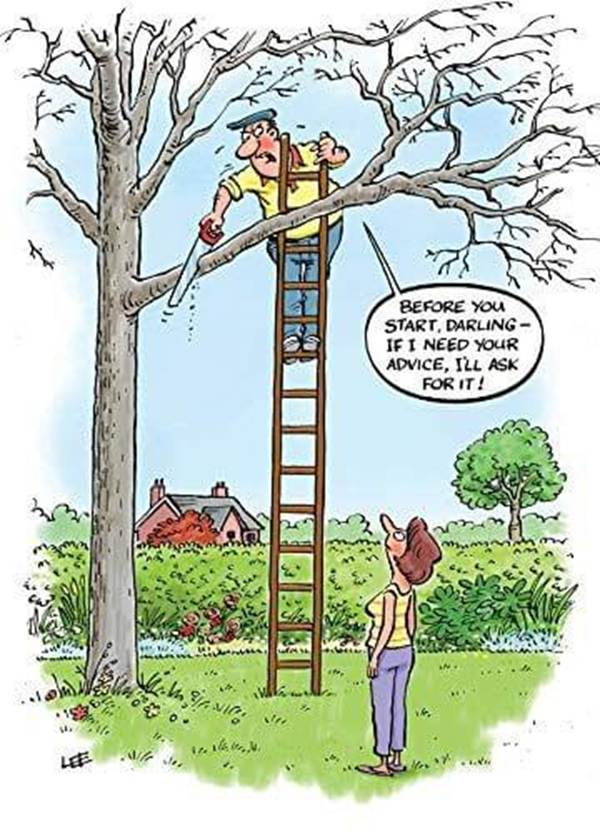
Or we’ve all seen a cartoon or a Facebook or YouTube reel which illustrates the foibles of those trying to trim or cut down a tree.

Darius tried to get himself, and Daniel, out of this predicament.  He strove from noon to sunset trying to think of a way to rescue Daniel.  We don’t know if he met with his lawyers to see if there was a loophole he could exploit, or whether he had the authority to set it aside, or maybe there had been past cases where a case like this had been rescinded.  What about a presidential pardon?  What if we over-feed the lions or put Daniel in a suit of armor?

Could it be that God would save him?  In all probability Darius had also heard of the deliverance of Daniel’s three comrades from Nebuchadnezzar’s fiery furnace.  Would God to the same for Daniel?

He labored “till the sun went down” trying to find a way to rescue Daniel.  But he could not.  Humanly speaking, there was no possible way for Daniel to survive this ordeal.  The law was the law was the law.

According to ancient eastern custom, the execution was carried out on the evening of the day that the accusation was made and found valid, when “the sun went down.”

Typically, during all this, Daniel remained quiet.  While everyone else was screaming and accusing, Daniel let his integrity speak for him,  After all, his name was Daniel, “God is my judge.”  He humbled himself under the mighty hand of God and waited, just like Jesus did, “When he was reviled, he did not revile in return; when he suffered, he did not threaten, but continued entrusting himself to him who judges justly” (1 Pet. 2:23).

Ultimately, Darius had to condemn Daniel to the lion’s den.

Seeing his distress, the high officials and satraps don’t want Darius to reneg on his decision.  For a third time they come in concert.  Daniel’s accusers remind the king that he could not change the statute once it had been signed into law. 

“Then these men came by agreement to the king and said to the king, ‘Know, O king, that it is a law of the Medes and Persians that no injunction or ordinance that the king establishes can be changed’” (Dan. 6:15).

Using words similar to verse 8, they reminded him that Medo-Persian ordinances could not be revoked, and Darius himself had already used the language of irrevocability (v. 12); despite his desire to spare Daniel, doing so would be going against “the law of the Medes and Persians.”  To do so would undermine the very foundation of his kingdom.

Darius couldn’t do that.  The king relinquished his efforts at stalling to find a way of deliverance for Daniel.  Unable to set aside or overrule his immutable decree, the king was forced to enact the prescribed sentence.  In this, we see an admirable aspect of the king’s character: he recognizes his legal obligation, though it runs counter to his great personal desire.  As friend and admirer of Daniel he would release him, but as king of Medo-Persia he must enforce the law.  He must do what was “right” in the eyes of the law and thus in his own eyes.

“Though absolutely blameless, Daniel was thrown into the den of lions.  He suffered because of the jealousy of others” (Edward J. Dennett, Daniel the Prophet: and the Times of the Gentiles, p. 85). 

With all possibilities for delivering Daniel exhausted, Darius finally gave the order for Daniel to be cast to the lions.  So “Then the king commanded, and Daniel was brought and cast into the den of lions.  The king declared to Daniel, “May your God, whom you serve continually, deliver you!” (Dan. 6:16)

“They had him!  Or so they thought!  They forgot that he was praying to and asking for help from the God who delivers” (William Peel, Living in the Lion’s Den Without Being Eaten, p. 151).

At this time in history, lions were hunted by royalty of Babylonia and Persia (Donald Wiseman, Nebuchadnezzar and Babylon, p. 112).  Lions were captured alive and placed within royal zoos (Shea, Daniel and the Lion of Babylon, p. 70).

The lions’ den appears to have been a large pit in the ground with an opening above that a large stone sealed, probably in order to keep people from stumbling into it.  Such pits were commonly used as cisterns to store water or as prisons. We notice that Daniel had to be lifted up out of it (v. 23), and others when thrown into it fell down toward its bottom (v. 24). 

“Its construction may therefore have been similar to that of the fiery furnace, upon the whole (see on chap. 3:6)—an opinion which seems to derive additional support from the manner in which Darius was enabled to converse with Daniel while in the den, even before the stone was removed from its opening (v. 21 et seq.).”  (Zöckler, The Book of the Prophet Daniel, p. 144).

A number of scholars consider that these “lions dens” not only had a whole at the top, but one on the side as well, for the purpose of bringing lions in and taking refuse out.

“This den was a cesspool is what it was; you had decaying human flesh in this place; it was the execution chamber and that is where Daniel spent his evening.”  (Clough, Lessons on Daniel, 22.287).

Darius’ idea seems to have been that he had wanted to save Daniel, but had failed.  Now Yahweh must save him. “May your God, whom you serve continually, deliver you!”  This was, at least, a vague hope of Darius.  We do not know, of course, if Darius knew about Yahweh’s deliverance of Daniel’s three friends.  But Daniel certainly did.

There are significant parallels and contrasts between the words that take Daniel’s three friends to the furnace (3:15–18) and those that take Daniel to the lion pit. There the king asked, “Who ever is the god who could deliver you from my power?”  Here the king declares, “Your God, whom you honor so consistently, he must deliver you” (compare his acknowledgment of “the living God” in v 21 [20]).

Darius had a kind of faith, but it was faith born out of Daniel’s trust in the Lord.  The idea was, “I tried my best to save you Daniel, but I failed.  Now it is up to your God.”  And he seemed to believe that Daniel’s God could rescue him!

Darius knew Daniel’s testimony, that he “served” [his God] continually.”  Oh, what a testimony, to be known by the world as someone who consistently and constantly serves the God of heaven even in the face of sacrificing one’s life.

Many of us occasionally represent God well with godly character and wisdom before the world, but then invariably counter-act the good by then making bad choices.  Daniel’s testimony was made by continual service.

Bound by the iron-clad wording of the royal injunction, Darius ordered that Daniel be cast into the lions’ den.   But notice that he appealed to Daniel’s God to deliver him.

He told Daniel, “May your God, whom you serve continually, deliver you!”  This statement recognized Daniel’s devotion to God and expressed Darius’s hope that the punishment would fail through his God’s deliverance.  It may also signal a budding faith in Darius’ heart.

However, Stephen Miller explains: “The KJV and NASB construe this statement as a prediction that God “will rescue” Daniel, whereas the NIV and NRSV consider the declaration to be a wish on Darius’s part that God “may . . . rescue” him.  The verb (an imperfect form of šêzib) may be translated in either manner.  Since Darius was an unbeliever, the king would not have had sufficient faith in Yahweh to affirm that Daniel would certainly be delivered, and v. 20 indicates that the king was not positive Daniel would be saved.  The words express the king’s hope” (Stephen R. Miller, Daniel, p. 185)

“[Daniel] had been faithful in praying, leaving the matter in God’s hands.  Now it seemed that God was not to spare him.  Many years before, it had seemed the same to Daniel’s three friends as they had faced the fiery furnace.  Knowing the kind of person Daniel was, however, one can believe that he faced the challenge no less courageously than they” (Leon Wood,  A Commentary on Daniel, p. 167).

“For Daniel and his three Hebrew friends, faith was a commitment to omnipotence, not outcome.  As the three friends said before being thrown in the fiery furnace, God is able to save, whether He chooses to or not.  In either case, our trust is in Him and whatever outcome He deems best.  That’s a faith that surely pleases God” (David Jeremiah, Agents of Babylon, p. 190).

“Now the beautiful thing about this is Darius is forced into the position of having to trust the Lord.  See how effective and efficient God works; the whole situation looks like it’s messed up; everything is falling apart, and what happens?  In the end Darius has to trust the Lord; a tremendously efficient teaching system” (Clough, Lessons on Daniel, 21:280).

Leon Wood contends, regarding the wish that Darius voiced, “shows that Daniel had been busy in witnessing to him, as he had been years earlier to Nebuchadnezzar and Belshazzar….Darius clearly had been impressed with Daniel’s faithfulness in life behavior to his God; no doubt a telling factor in molding the king’s own thinking.  One’s life conduct is so important if his oral testimony is to be effective” (A Commentary on Daniel, p. 168).

Darius had kept his end of the matter by ordering Daniel, an exile from Judah now in his eighties, to be thrown to the lions.  If Daniel’s God happened to intervene and deliver the faithful servant, it was out of the king’s hands.

To secure the lions’ den, “A stone was brought and laid on the mouth” of it, and then Darius sealed it “with his signet and the signet of the lords.”  No one would chance trying to rescue Daniel, and Daniel himself certainly would be unable to escape: breaking the king’s seal without authorization would warrant death.  And Darius knew that Daniel had powerful enemies who would seek to kill him if the lions didn’t.  In this case, not only the king’s signet, but also those of the lords, were used, indicating that approval of both parties would be needed to remove the stone.

Like Pilate, hundreds of years later (Matt. 27:55-56), a stone was laid over the entrance (Dan. 6:17) and the king officially authorized the securing of the chamber so that interlopers could not affect the seemingly certain outcome: neither Daniel nor Jesus would ever be seen again.   That was the intention.  Daniel’s night in the den and his raising from peril do serve as an analogy, or type for the death and resurrection of Jesus.

In the sovereignty of God, the stone was sealed to vouch the miraculous nature of Daniel’s preservation.  With Daniel’s fate sealed, the conspirators went home to celebrate.  But with Daniel’s God on the throne, while the king of Babylon tossed and turned (Dan. 6:18), the King of kings protected Daniel from harm.  Even with all the danger surrounding him, Daniel likely got a good night’s sleep.

When an Evil Plan Comes Together (Daniel 6:11-13)

Several of Daniel’s co-workers were jealous of his rise to power.  Daniel was being placed basically second-in-command.  Being an outsider made this inconceivable to them and no one likes to be bypassed when promotions are being made.  While they could find no skeletons in his closet with regard to his work life, they did come up with a plan to trap Daniel.  Knowing that Daniel would continue to pray faithfully to his God, they tricked king Darius into signing a decree that “that whoever makes petition to any god or man for thirty days, except to you, O king, shall be cast into the den of lions” (Dan. 6:7).

Over the last three weeks we’ve seen that this did not deter Daniel at all from praying at his window three times a day as was his habit.  He knew that the injunction had been made and still prayed to the only true God.

10 When Daniel knew that the document had been signed, he went to his house where he had windows in his upper chamber open toward Jerusalem. He got down on his knees three times a day and prayed and gave thanks before his God, as he had done previously. 11 Then these men came by agreement and found Daniel making petition and plea before his God. 12 Then they came near and said before the king, concerning the injunction, “O king! Did you not sign an injunction, that anyone who makes petition to any god or man within thirty days except to you, O king, shall be cast into the den of lions?” The king answered and said, “The thing stands fast, according to the law of the Medes and Persians, which cannot be revoked.” 13 Then they answered and said before the king, “Daniel, who is one of the exiles from Judah, pays no attention to you, O king, or the injunction you have signed, but makes his petition three times a day.”

Ligon Duncan reminds us that temptation that Daniel faces is part of a larger Satanic strategy.  The satraps, yes, were tempting Daniel because they wanted to get him out of the way.  But the satraps were just dupes for Satan.  Satan himself was simultaneously working in the designs of these petty officials.  Satan was simultaneously attempting to vex Daniel’s soul and to use his own integrity as leverage against God’s kingdom in the time of Darius.  Satan had been attempting to wear out and wear down Daniel since the first day of the captivity and this is just yet another expression of Satan’s assaults on Daniel.  As Sinclair Ferguson has said, “Temptation to compromise is never an isolated incident in our spiritual life, but it is part of the larger strategy of Satan against us.”

It is quite possible that Daniel’s willingness to not compromise, but to stand firm in His principles, which brought him into a very dangerous situation, one that the true God rescued him from, was just the testimony that Darius needed to push him, humanly speaking, in the direction of allowing the Jews to return to Jerusalem.

We may never realize how important it is for us to maintain our integrity, even in the smallest of activities, so that God can receive the glory and His work can be done.  God would use this heathen ruler Darius to release His people from exile.

Daniel 6:10-13 is framed by an inclusio: Daniel violated the injunction by praying three times a day (v. 10), and the conspirers informed Darius that Daniel had violated the injunction by praying three times a day (v. 13).

It’s remarkable how people can work together quickly and efficiently to do evil but find it so much more difficult to get together to do any good!  “Their feet are swift to shed blood,” says Paul (Rom. 3:15), quoting Isaiah 59:7.

The conspirators knew where Daniel lived, and they conspired to go to his home and catch him in the act of praying to God.  It would be difficult to universally enforce the new royal injunction regarding prayer, but the jealous leaders were not interested in the prayer habits of the masses.  They cared only about Daniel.  He was their target.  He was the one they wanted to bring down.

If they observed him from outside his own residence, which seems most likely, he may not have even known that they were there though he could have easily suspected it.  The implication is that they went immediately to the king with this information.

Since Daniel’s habit was to pray three times a day with his windows open, the conspirers needed only to observe whether Daniel maintained his practice.  Evidence of his thrice-daily prayer pattern would have been visible to onlookers below and, given his character, it was unlikely he would deny the charge if it were brought up.

Events were working just as they had planned.  The trap was ready to be sprung.  The high officials and satraps who had previously manipulated Darius now came to him and underhandedly inquired whether they correctly understood the injunction.  “Just so we know for sure, what was the injunction again?”

It may have been hard for them to keep their composure and their overeagerness likely gave away their glee in asking this question.  Notice how they presented the situation to the king as if they had nothing to do with it.

“Did you not sign an injunction, that anyone who makes petition to any god or man within thirty days except to you, O king, shall be cast into the den of lions?” (Dan. 6:11)

The king confirmed their understanding, insisting the injunction could not be revoked.  He affirmed that “the thing stands fast, according to the law of the Medes and Persians, which cannot be revoked” (Dan. 6:12b).  Now, with the king’s repeated affirmation that the law was in place and could not be altered, they were ready to reveal the victim.

[In the book of Daniel, the Medes are mentioned before the Persians (c.f. Dan. 5:28; 6:8, 12, 15; 8:20) indicating that the events of this chapter transpired during the early stages of Medo-Persian alliance (539-537 B.C.), when the Medes still retained ascendancy over the Persians.  Likely in the first year of Darius’ reign. 

By the time the book of Esther was written (450-331 B.C.), the Persians had attained the more prominent role (as predicted by Dan. 8:3; 20) and are mentioned before the Medes (Est. 1:3, 14, 18-19; 10:2).

There is historic evidence documenting the permanent nature of Persian law. Approximately one hundred years after the rule of Darius, the book of Esther provides further witness to the unchangeable nature Medo-Persian law (Est. 1:19; 8:8).]

Whereas in Nebuchadnezzar’s Babylon the king reigned supreme, in Medo-Persia the king was subject to previously-established law and could not overturn it.  Some commentators see Darius’ inability to change the law—the fact that he was bound by his own law—as one aspect of the inferiority of the Medo-Persian kingdom (represented by silver, Dan. 2:32, 39) in comparison with the Neo-Babylonian kingdom (represented by gold, Dan. 2:32, 37).

According to the book of Esther, the king’s decree had to be put into writing and sealed before it was considered immutable: “You yourselves write a decree concerning the Jews, as you please, in the king’s name, and seal it with the king’s signet ring; for whatever is written in the king’s name and sealed with the king’s signet ring no one can revoke” (Est. 8:8).

It seems the king had been easily convinced to sign the decree.  It may have appealed to his pride (a common malady of kings in this book).  It was early in his reign over Babylon and the king likely viewed the decree as a means of asserting his authority over the populace, a quick way to guarantee their allegiance.

The law was irrevocable.  There was nothing King Darius could do to reverse it.

[“The rigidity of the Medo-Persian law was not always a bad thing.  Later, in the days of Ezra, the adversaries of Judah wrote letters to Ahasuerus, the Persian king, slandering the Jews and endeavoring to have a decree signed to present the Jews from continuing with the work of reconstruction.  They succeeded (Ezra 4:1-24).  Later, the decree of Cyrus was found the original document that led to the repatriation of the Jews in the Promised Land.  That changed the whole picture.  The original decree had to stand.  The law of the Medes and Persians guaranteed that.  Then Cyrus threw the weight of his administration behind the original decree and added clauses that greatly helped the continuation of the work in Israel (Ezra 5:1-6, 15) (John Phillips, Exploring the Book of Daniel, p. 103).]

No loophole in the ironclad law of the Medes and Persians could be found to release Daniel.

Having reminded the king of the irrevocability of his law, they then identified Daniel as a violator of that law.  The conspirators had the king right where they wanted him; it was time to expose Daniel as a lawbreaker: “Daniel, who is one of the exiles from Judah, pays no attention to you, O king, or the injunction you have signed, but makes his petition three times a day.”  

They showed no respect to Daniel who held a higher office than they did, but disdainfully called him “one of the exiles from Judah” (Dan. 6:13, niv). These proud men didn’t realize that God was with His exiled people and within the next twenty-four hours would vindicate His servant (Warren Wiersbe, Be Resolute, p. 78).

They accused Daniel of knowingly ignoring not only the injunction but the king himself.  In other words, this was not just a legal violation, but a personal offense.  Of course, these charges were not true.  Daniel intended no disrespect for the king, but he had a higher respect for God.  They accused Daniel of rebellion.  They thought they had “check mate.”

Notice that they described Daniel as “one of the exiles from Judah” (cf. 2:25; 5:13), rather than as a royal cabinet minister.  They imply that Daniel’s rebellion was due to him being a Jew.  “Now he’s showing his true nature by disloyalty to you, King Darius.”  Maybe they were implying that Darius had been foolish to appoint Daniel to such an exalted position.

And it was a subtle reminder that he was formally a slave.  He was “one of the exiles” from that country Nebuchadnezzar had defeated not once, not twice, but three times.  They were evidently hoping that Daniel’s Jewish nationality, religion and background would contribute to Darius’ distaste for him.  They also used almost the same words that Shadrach, Meshach, and Abed-nego’s accusers had used against them, when they charged Daniel with disregarding the king (cf. 3:12).

The other ministers may imply that as a foreigner he cannot really be trusted, or that as an exile his maintaining his alien religious practices is a political act, an act of rebellion; but the hint of anti-Semitism may be stronger here than it was in vv. 4–6

When God’s people adhere to God’s priorities, it can be misinterpreted as an intentional slight to secular positions of authority. It is not that we disregard others—Jesus commands us to serve others with humility and love our neighbors—but that we consider God (the Creator) to be on an entirely different plane than men (mere creatures).  We must please God and when that commitment collides with our allegiance to men, it is that allegiance to men that must give way.

When our lives reflect God’s priorities we can expect persecution in response.  God’s people in every age have been falsely accused, cruelly persecuted, and unjustly killed.  “Yes, and all who desire to live godly in Christ Jesus will suffer persecution” (2 Tim. 3:12, NKJV).  The Puritan preacher Henry Smith said, “God examines with trials, the devil with temptations and the world with persecutions.”  Another Puritan, Richard Baxter, said that God’s people should be more concerned that they deserved the persecution than that they be delivered from it, because deserving it would be evidence of their faithfulness to the Lord.

We will never fit in—we are different, by God’s design.  He wants us to be different, to be set apart for His glory.  This was the very thing Haman despised and emphasized in his complaint concerning the Jews:

Then Haman said to King Ahasuerus, “There is a certain people scattered abroad and dispersed among the peoples in all the provinces of your kingdom.  Their laws are different from those of every other people, and they do not keep the king’s laws, so that it is not to the king’s profit to tolerate them.” (Esther 3:8)

Notice how similar Haman’s accusations are:  they violate our laws and have no respect for us.

And that is the dilemma we face when we go against the flow of our culture.  We cannot live in ways that violate God’s law, no matter what our government says.  But we can disobey in a respectful way, in a way that shows that we still value the very people who are against us.

Our refusal to endorse the world’s ungodly programs and skewed priorities will inevitably be viewed as a threat to secular society.

“If you were of the world, the world would love you as its own; but because you are not of the world, but I chose you out of the world, therefore the world hates you” (John 15:19)

These men emphasized that Daniel “pays no attention to you, O king, or the injunction you have signed, but makes his petition three times a day.”  They bend the truth here.  Of the three charges, only the last one was actually true.  Even then, they had not seen him pray three times that day, but knowing his habit, they assumed, it based upon observing his one time of prayer that day.

So, the conspiracy was working, Daniel was trapped.  Darius was also trapped.  Maybe his response surprised the conspirators.  “Then the king, when he heard these words, was much distressed…” (Dan. 6:14a).  This is not the reaction they had hoped for.

The king is displeased: perhaps with Daniel, for ignoring his injunction; perhaps with the ministers, for engineering Daniel’s downfall; perhaps with himself, for being manipulated by them into becoming the victim of his own power and authority; perhaps with the situation in general into which he is now cornered (cf. Herod, Mark 6:26).

On the contrary, Darius “was much distressed and set his mind to deliver Daniel.”  He did not want Daniel to die, and he spent the rest of the day seeking a way to rescue him.  Like Nebuchadnezzar, Darius had a high regard for Daniel, probably an affection for him as well.  Darius had known Daniel too long and well to believe any such charges of disloyalty, even if brought by his officers.

So this greatly distressed him.  First, he didn’t want to lose Daniel, a man he greatly respected and trusted.  Second, he likely was distressed that he had made such a rash decision and that he had been shortsighted to sign the decree.  He realized he had been duped and railroaded into this decision.

While most versions present this as “distress within himself,” the KJV and NKJV translate “distressed with himself.”  That may be true as well.  If so, it is an admirable quality in King Darius.  Instead of blaming others, he knew that he was at fault.  Yes, he had been trapped, but he took responsibility for unwittingly making this law.

Darius realizes that he is trapped.  He cannot suspend the law for Daniel, else he risks the collapse of social order and perhaps even the state itself.

Darius will learn some things from this, as any leader should when they make decisions that backfire.  But we will look at that next week.

Daniel’s Courageous Devotion, part 3 (Daniel 6:10)

Over the last two weeks we’ve been examining Daniel’s courageous devotion in Daniel 6:10.  In this verse, although Daniel knew the consequences, he continued to pray to God as was his normal habit.

That verse reports:

When Daniel knew that the document had been signed, he went to his house where he had windows in his upper chamber open toward Jerusalem. He got down on his knees three times a day and prayed and gave thanks before his God, as he had done previously.

We’ve observed so far that (1) Daniel did this knowingly (“when Daniel knew…”), (2) Daniel did this obediently (“toward Jerusalem), and (3) Daniel did this habitually (“as he had done previously”).

Fourth, Daniel prayed humbly before God.  Daniel fell to his knees.  Again, verse 10 says “He got down on his knees three times a day and prayed and gave thanks before his God, as he had done previously.”  There are many biblical postures for prayer: including standing, lifting hands, sitting, kneeling, bowing, and lying prostrate.  While no specific posture is mandated, these physical positions often reflect the heart’s attitude towards God and are thus chosen to reflect that attitude. That he “kept on kneeling” (a participle in Aramaic), of course, provided his antagonistic observers with an unmistakable indication of what he was doing. 

This must have been Daniel’s normal practice.  If he had stood to pray, maybe his enemies would not have been able to tell he was praying.

But why did Daniel kneel?  Well, kneeling, in particular, indicates humility, recognizing that we are in the presence of greatness that should be feared and revered.  It also indicates submission to that authority.  And it also expresses neediness and dependence upon the generosity of that king.  We are in the presence of a King who may or may not choose to grant our petition.  Whether he does may depend upon our humble attitude.

Eugene Peterson writes: “The physical act of bowing “my knees before the Father” (Eph. 3:14) is an act of reverence.  It is also an act of voluntary defenselessness.  While on my knees I cannot run away.  I cannot assert myself.  I place myself in a position of willed submission, vulnerable to the will of the person before whom I am bowing…I become less so that I can be aware of more” (Experiencing Resurrection, p. 154).  This “more,” of course, is the moreness, the greatness of the One to whom we are directing our prayers, who can do “far more abundantly than all that we ask or think,” according to Paul in Ephesians 3:20.

Do you view Him as a great and all-powerful and fearsome Potentate, One who with one word could extinguish your life or grant your petition?  Or do you perceive Him as a doting grandfather bound to give us whatever we ask?  When we see the elders in heaven worshipping God in Revelation, we read, “the twenty-four elders fall down before him who is seated on the throne and worship him who lives forever and ever,” after casting their crowns before him they cry out.

11 “Worthy are you, our Lord and God,
    to receive glory and honor and power,
for you created all things,
    and by your will they existed and were created.”

We shouldn’t rush into God’s presence and spout out our wishes as if he were a vending machine, but humbly bow before him in honor and reverence as the King of kings and Lord of lords, as the blessed and only Potentate, the Creator of heaven and earth, the majestic, glorious God of heaven.

“Our culture does not help us to smash our graven image of the casual god.  Our culture proclaims that God must be the essence of tolerance; He is chummy rather than holy; the ‘man upstairs’ rather than my Father for Jesus’ sake.  So long as our novelty license plates declare that “God is my co-pilot’ we can be sure that we have not yet seen the King, Yahweh of hosts” (Dale Ralph David, 1 Samuel, pp. 67-68).

Daniel’s kneeling posture, reminiscent of Solomon’s at the temple dedication, indicated his absolute dependence on Yahweh as a supplicant.  Normally the Jews stood when they prayed (cf. 1 Chron. 23:30; Neh. 9; Matt. 6:5; Mark 11:25; Luke 18:11, 13), but they kneeled—and sometimes prayed with their faces on the ground—when they felt a more urgent need for Yahweh’s help (cf. 1 Kings 8:54; Ezra 9:5; Luke 22:41; Acts 7:60; 9:40; 20:36; 21:5).

Although Scripture records prayers offered in a variety of positions, the condition of the heart should always be that of humility (Luke 18:13) and it is the condition of the heart that is of utmost importance.  Quoting Isaiah 29:13 Jesus said of the religious leaders of his day “‘This people honors me with their lips, but their heart is far from me” (Matt. 15:8).  We see the difference between the proud Pharisee and the penitent tax-collector in Luke 18:9-14.

We see in the next verse that Daniel is “asking God for help” (v. 11).  Likely, he is turning to God for aid because he anticipates trouble from the decree.  He knew that violating it could mean that his life was in danger.  Whether he asked for deliverance or for the strength to withstand death or to understand God’s ways, he was crying out to God for “help.”

Fifth, Daniel prayed thankfully.  Daniel mixed prayers for “help” (v. 11), with giving “thanks” (v. 10) and the form of the word means he “kept on praising.”  He not only kept on asking God for His intervention (cf. Matt. 7:7-8), but kept on thanking him for answering his prayers.  All this while being served as Cat Chow to some hungry lions!    He has the confidence that God would answer his prayers for deliverance, or if not, to usher him into glory.  No matter what, he was grateful to God for His presence and help.

There is always something to be thankful for.  Tom Felton, in Our Daily Bread, November 30, 2024, writes:

Raw fish and rainwater.  An Australian sailor named Timothy survived on only those provisions for three months.  Marooned on his storm-damaged catamaran, he was losing hope—bobbing 1,200 miles from land in the Pacific Ocean.  But then the crew of a Mexican tuna boat spotted his ailing boat and rescued him.  Later, the thin and weather-beaten man declared, “To the captain and fishing company that saved my life, I’m just so grateful!”

Here’s another illustration:

Ravensbruck was known as one of the worst German concentration camps during World War II.  When Corrie ten Boom and her sister Betsie found themselves imprisoned there, they were disgusted to discover that their barracks were infested with fleas.

When Corrie began to complain, Betsie insisted that they instead give thanks, quoting 1 Thessalonians 5:18, “In every thing give thanks: for this is the will of God in Christ Jesus concerning you.”  With some persuasion, Corrie finally joined her sister in thanking God for the fleas.  By the way, it was because of the fleas that the sisters and their inmates were able to have a Bible study and prayer time uninterrupted by German guards.

As the apostle Paul wrote, may God help us “give thanks in all circumstances” (1 Thessalonians 5:18).  We love to give thanks when God gives, not so much when He takes away.  We need to learn to do both.

Now understand, we don’t give God thanks for all things.  Not everything that happens to us or our loved ones is good.  But we can still give thanks in all things, in the midst of going through even the bad times.  Why?  Because we know that “for those who love God all things work together for good, for those who are called according to his purpose.”  Again, not all things are good, but all things—both good and bad—God works together for our good and for His glory.

Maybe Daniel praised the God of heaven for his many years of service, for the visions God had given him of the future, and even for preserving his soul even if his body were to be eaten up by lions.  He recognized that not all of God’s answers to prayer arrive in this life, to preserve our physical well-being.  There are even greater answers to come!

Perhaps he thanked God, that being a eunuch, he didn’t have a wife and six kids to leave widowed and orphaned.  I’m pretty sure he thanked God he didn’t have to face the lions alone.  One of the most common things believers say to me at times of bereavement or great trial is, “I don’t know how anyone could face this without the Lord.”  Daniel didn’t have to. 

Spurgeon wisely says, “Prayer and praise should always go up to heaven arm in arm, like twin angels walking up Jacob’s ladder, or like kindred aspirations soaring up to the Most High.”

We must remember that God doesn’t always promise to keep us out of trials, but often to walk with us through the trials (cf. Isa. 43:2).  While Daniel could have prayed for his enemies eyes to be blinded from his practice of prayer, the way God was answering was something even better—being preserved through the trial of being served as cat food.

We know that offering our prayers up to God with thanksgiving is a key factor in helping us overcome the anxieties of our hearts (Phil. 4:6-7).

Daniel certainly had a copy of Jeremiah’s prophecies (cf. Dan. 9:1-2) and he was gladly thanking God for fulfilling His promise to return His people from exile.  Jeremiah had written that God had promised to hear such prayers—if they were sincere and wholehearted—to restore the fortunes of the Jews, and to re-gather them to the Promised Land (Jer. 29:10-14).

Cyrus issued his decree allowing the Jews to return from exile in 538 B.C. (2 Chron. 36:22-23; Ezra 1:1-4).  The events of Daniel 6 must have happened just before or shortly after this great turning point in Israel’s history.  The events recorded in this chapter may even have played some part in Cyrus’ decision to favor the Jews.

Sixth, Daniel prayed “three times a day,” knowing that though a little prayer is good, much prayer is far better.  Praying three times a day was evidently the practice of godly Jews dating back to David, if not before then (cf. Ps. 55:16-17).  Morning and evening prayers may now have been considered an expedient substitute for morning and evening sacrifice—no longer possible while the temple stood in ruins.

Charles Spurgeon clarifies, “That does not tell you how often he prayed, but how often he was in the posture of prayer.  Doubtless he prayed 300 times a day if necessary – his heart was always having commerce with the skies; but thrice a day he prayed formally.”

“Shadrach, Meshach, and Abednego refuse positive homage to the image of the world power (ch. 3); Daniel will not yield it even a negative homage, by omitting for a time the worship of God (ch. 6)” (Jamieson, Robert; A. R. Fausset; and David Brown. Commentary Practical and Explanatory on the Whole Bible, p. 738).  It is much easier for us to refuse to bow down to this world’s idols than it is to positively engage in the worship of God consistently.  It is easier to say “No” to the negative on an infrequent basis than “Yes” to the positive as a daily practice.  It is easier to deny ourselves once than to engage ourselves over and over again in the same positive practice.

David Jeremiah says that the key to Daniel’s life is contained in one verse that is profound in its simplicity.  It is the last verse of Daniel 1 in the King James Version and simply says, “And Daniel continued…”  No matter what his age, from teenager to senior citizen, Daniel continued constantly.  He made certain things a disciplined habit in his life, such as prayer and the study of the Hebrew Scriptures.  You and I would do well to imitate his consistency in spiritual disciplines.

“While Daniel’s consistency of life and testimony has been evident throughout the book of Daniel, here we learn the inner secret.  In spite of the pressures of being a busy executive with many demands upon his time, Daniel had retired to his house three times a day to offer his prayers for the peace of Jerusalem as well as for his personal needs.  This was not the act of a person courting martyrdom but the continuation of a faithful ministry in prayer which had characterized his long life” (John Walvoord, Daniel: The Key to Prophetic Revelation, p. 138)

Spending time in God’s Word and prayer, although it requires you to take away time from other busy pursuits, is your lifeline.  When you encounter personal attacks or trials and tribulation in life, if you have not strengthened your spirit through regular interaction with God’s life-giving Word and interaction with your Father in prayer, you will fail or quit.

I would not be the pastor of Grace Bible Church today if I had not regularly read God’s Word and prayed with and been prayed for by a group of people from Grace Bible Church.  I would surely have quit, not being willing to continue under the stress and pressure of conflict in the ministry.

“It is a common observation that those who have no regular habits of prayer very seldom do much praying.  It is well for God’s people purposefully and deliberately to set aside and faithfully adhere to a definite prayer schedule.  Prayer is thus recognized as a [sic] important part of the Christian life and given the place which it deserves” (D. Edmond Hiebert, Working with God: Scriptural Studies in Intercession, p. 110).

There was never a better time not to “pray three times a day” or to pray silently and privately.  While we may have been tempted to adjust our routine to adapt to this new decree, Daniel did not.

After all, a person can pray anywhere, right?  A person can pray with his eyes open.  A person can pray with the door shut (or the window shut).  Daniel could have simply gone to bed and shut his eyes and prayed silently before sleeping.  He could have reserved all his prayers for the dark of nighttime.  Surely I can skip a few days, right?  Just think of all the excuses which we would probably opt for…but Daniel did not.

Even if no one else could observe his compromise, he would know.  And, of course, God would know.  Daniel understood that pragmatism and flexibility are often effective tools of temptation employed by the devil and empowered by our own rationalizations.  To his credit, Daniel chose principle over pragmatism.

James 4:17 reminds us, “So whoever knows the right thing to do and fails to do it, for him it is sin.”

Any alteration in Daniel’s known habitual practice in the worship of God would have testified of his willingness to please men rather than God, fearing the censure of men over fearing the disapproval of God.

Finally, notice that Daniel is alone here.  Previously, in chapters 1 and 2, he had the camaraderie of his three friends.  While he was definitely the leader, they had been supportive friends and had been there for him.  Now, likely because they had passed away earlier, they were no longer with Daniel.

It is harder to stand alone.  Isn’t it?  We gain strength from having friends around us, as Solomon says in Ecclesiastes 4:9-12…

Two are better than one, because they have a good reward for their toil. 10 For if they fall, one will lift up his fellow. But woe to him who is alone when he falls and has not another to lift him up! 11 Again, if two lie together, they keep warm, but how can one keep warm alone? 12 And though a man might prevail against one who is alone, two will withstand him—a threefold cord is not quickly broken.

Oh how precious are friends in the faith who will stand with us when we face the lions.  This makes me appreciate Daniel even more, because he didn’t benefit from that supportive network of friends and depended upon God alone in this situation.

And God promises that He will be there, even if no one else stands with us.  “I will never leave you nor forsake you,” he say (Heb. 13:5).  So the writer of Hebrews goes on to say, “The Lord is my helper; I will not fear; what can man do to me?”

Paul reflected upon his own (near) loneliness (Luke was with him) in 2 Timothy 4.  So he says “At my first defense no one came to stand by me, but all deserted me. May it not be charged against them!  But the Lord stood by me and strengthened me…” (2 Tim 4:16-17a).

The statement “One man with God is always in the majority…” is attributed to the Scots religious reformer John Knox.   The idea is that in the face of insurmountable odds, even if you only have God on your side, you will prevail.  Danel believed that.

Conclusion:

“The most important part of a believer’s life is the part that only God sees, our daily private time of meditation and prayer.  ‘You pray as your face is set,’ said British theologian P. T. Forsythe, ‘towards Jerusalem or Babylon.’  Most of the world begins the day looking toward the world and hoping to get something from it, but the Christian believer looks to the Lord and His promises and enters each new day by faith.  Outlook determines outcome, and when we look to the Lord for His guidance and help each day, we know that the outcome is in His hands and we have nothing to fear.  ‘Real true faith is man’s weakness leaning on God’s strength,’ said D. L. Moody, and we might add, man’s weakness transformed into God’s strength (Heb. 11:34), (Warren Wiersbe, Weirsbe Bible Commentary: OT Volume, p. 1366).

Daniel’s contemporary, Ezekiel, places Daniel in the same circle as Noah and Job, great intercessors (Ezekiel 14:14, 20).  We will get to hear another of Daniel’s prayers in chapter 9.

Daniel found himself in the position many Christians have faced throughout history: having to distinguish between sin and crime.  The culture had now legalized sin and criminalized righteous behavior.  They were calling good evil and evil good (Isa. 5:20).

Bob Deffinbaugh comments:  A friend of mine once remarked, “A lot of crimes are not sins, and a lot of sins are not crimes.”  Our text indicates he was absolutely right.  In the sixth chapter of Daniel, this righteous man is convicted of a crime which is not a sin. Daniel purposefully committed this crime because he did not wish to commit a sin, which was not a crime. (Deffinbaugh, Daniel: Relating Prophecy to Piety).

Today abortion is not a crime, but protesting at an abortion clinic is.  However, abortion is a sin, and protesting is a righteous, life-affirming action.

Daniel rightly understood this as an issue of faithfulness to God’s higher law and chose to walk the difficult path of civil disobedience.

Daniel’s Courageous Devotion, part 2 (Daniel 6:10)

In our study of Daniel 6 we are now looking at Daniel’s prayer life.  Even though it is just one verse in our text it is packed full of information.  That verse is Daniel 6:10.

10 When Daniel knew that the document had been signed, he went to his house where he had windows in his upper chamber open toward Jerusalem. He got down on his knees three times a day and prayed and gave thanks before his God, as he had done previously.

Last week we noted that Daniel prayed “when [he] knew that the document had been signed.”  Daniel was not caught unawares, but knew the score.  He realized that this was a test of his loyalty to God, his faith in God and his obedience to God.  He knew that his life might be in danger.

Second, Daniel “went to his house where he had windows in his upper chamber open toward Jerusalem.”  We cannot be certain when the lions’ den episode occurred relative to Daniel’s intercession for Israel and Gabriel’s answer of the seventy sevens, in the first year of Darius (Dan. 9).  But that information from Gabriel and Jeremiah’s prophecy may have influenced Daniel’s prayer “toward Jerusalem.”  It is likely that this was his regular practice.

The direction of his prayer demonstrated his faith in God’s word, “declaring the end from the beginning, and from ancient times things not yet done, saying, ‘My counsel shall stand, and I will accomplish my purpose” (Isa. 46:10).  Daniel believed that God’s prophecies would be fulfilled, that God was able to do what He had promised (Rom. 4:21).

Windows facing Jerusalem were a symbol of hope for return from exile.  It was also the place of sacrifice even though there were sacrifices no longer being conducted.  It represented Daniel’s hope in God’s promises, that they were about to be fulfilled.

Psalm 137 speaks of the heart-felt ties that the Jews felt towards Jerusalem:

1 By the waters of Babylon,
    there we sat down and wept,
    when we remembered Zion.
On the willows there
    we hung up our lyres.
For there our captors
    required of us songs,
and our tormentors, mirth, saying,
    “Sing us one of the songs of Zion!”

How shall we sing the Lord’s song
    in a foreign land?
If I forget you, O Jerusalem,
    let my right hand forget its skill!
Let my tongue stick to the roof of my mouth,
    if I do not remember you,
if I do not set Jerusalem
    above my highest joy!

Faithful Jews in Babylon, although they had not been in Jerusalem for decades, “remembered Zion” (v. 1) and valued it as their “highest joy” (v. 6).  Being separated from Zion made them “weep” (v. 1).

Although Jesus Christ would later emphasize that the place of worship is not nearly as important as truly spiritual worship (John 4:20-24), the inner worship of the heart, at this time Jerusalem was the center of God’s activity and worship.

Solomon had prayed at the dedication of the temple that if God’s people were ever exiled and then repented “with all their heart and with all their soul in the land of their enemies, who carried them captive, and [prayed] to you toward their land” (1 Kings 8:48), then God would hear from heaven and forgive them and grant them compassion (vv. 49-50).  

When the heavens are shut up and there is no rain because your people have sinned against you, and when they pray toward this place and confess your name and turn from their sin because you have afflicted them, then hear from heaven and forgive the sin of your servants, your people Israel.  Teach them the right way to live, and send rain on the land you gave your people for an inheritance. (1 Kings 8:35-36)

Daniel knew the curse of exile was temporary.  Moreover, he knew that since Babylon had now been conquered, the return was imminent.  Daniel prayed, believing that God would keep His promises to Israel.  Excitement rose within his heart!

Jerusalem was the place where God promised to place His name (1 Kings 8:29; 11:36; 2 Kings 23:27; 2 Chron. 33:4, 7; cf. Dan. 9:19), where His shekinah glory dwelt between the cherubim, over the mercy seat of the ark situated within the Holy of Holies in the temple.  Praying toward the place where God had chosen to place his name (the temple in Jerusalem) is emphasized by repetition in Solomon’s prayer of dedication: 1 Kings 8:33, 38, 42, 44, 48; 2 Chron. 6:38.  Later, Daniel begins his magnificent prayer of repentance in chapter 9, “Then I set my face toward the Lord God” (Dan. 9:3)—possibly another reference to praying in the direction of Jerusalem.

Even though this shekinah cloud had forsaken the temple prior to the Fall of Jerusalem in 587 (Ezek. 11:23), Daniel knew that the Lord had promised to return there (cf. Ezek. 43:2) and to restore Jerusalem (Jere. 29:10, 14).  “The exiled Jews no longer had the temple and the priesthood, but God was still on the throne and would hear their cries for help” (Warren Wiersbe, The Wiersbe Bible Commentary: OT Volume, p. 1365).

Smith summarizes the centrality of Jerusalem to Scripture and history:

“To no city on earth have such titles of glory and honor been divinely given; to no city has been such guilt attached as to it—this city which crucified our Lord.  Of no city are such prophecies of tragedy and tribulation uttered; toward this city will the armies of the earth march in hatred of God’s peace.  Toward that same city will nations move, seeking the law of the Lord; from that city will flow blessings to the whole earth.  Satan hates this city.  Christ wept over it.  The Holy Spirit descended upon its believers [there].  The nations will be irresistibly drawn to it for war.  Christ will there reign.  And Heaven will bring to a glorious and eternal fulfillment all the promises relating to it” (Wilbur M. Smith, Israeli/Arab Conflict and the Bible, p. 163)

I think that Daniel knew that prayers make a difference.  God is sovereign, but He has so designed that His sovereign will would be carried out (normally) by intermediate means—like prayer, preaching, witnessing, etc.  Prayer really does make a difference.

In 1940 Vincent and Margaret Crossett were missionaries in Mainland China.  They struggled against poverty and paganism in a remote village in order to tell others about Jesus.  The work was very slow and difficult, but after much sacrifice a small church was established. The church was no larger than a small Bible study group.  Right on the threshold of this small triumph for the kingdom of God, Satan began his work.  The Communist takeover of China during the Cultural Revolution forced all missionaries to leave China.

The Crossetts hated to leave.  Their fledgling flock of believers hardly seemed ready to withstand the coming onslaught.  An atheistic, dictatorial government dedicated to wiping out all Christian influence was beginning its rule with ruthless power.  How could the little church survive?  From the world’s perspective there was nothing anyone could do.  The church seemed destined to die.  But Vincent and Margaret did not see through the world’s eyes.  They saw through the eyes of faith that their God was faithful to those who honor him.  The Crossetts…continued to do their duty.  Though the missionaries were chased out, their prayers were not.  For nearly forty years the Crosetts daily kept their prayer window opened toward China.  They dutifully prayed in faith that God would one day triumph over Communism.  The Crosetts heard nothing of their Chinese friends for forty years, but still they faithfully prayed for God to be victorious in the church they had left behind.

Finally the walls of China came down.  As the political climate changed, the nation was opened to western visitors.  The Crossetts returned to the village where they had left the tiny, straggling group of believers.  There was no small church in the village anymore!  Instead, from that Bible study had grown a church of four thousand people!  This body of believers had planted dozens of other churches as well, each with a membership of at least a thousand.  All the Crossetts did was pray with their prayer window open to the focus of their prayer — China. The God of Daniel is alive and well. (Rodney Storz, Daniel: The Triumph of God’s Kingdom).

But I don’t believe Daniel was only praying for his own people and their return to Jerusalem.  Following Jeremiah’s encouragement, he would be praying for his king and the kingdom in which he was now living, in Babylon under the Medo-Persian king.  Jeremiah had specifically said, “But seek the welfare of the city where I have sent you into exile, and pray to the Lord on its behalf, for in its welfare you will find your welfare” (Jere. 29:7).

Likewise, we are to pray for our own country and its leaders.  Paul tells Timothy, “First of all, then, I urge that supplications, prayers, intercessions, and thanksgivings be made for all people,for kings and all who are in high positions, that we may lead a peaceful and quiet life, godly and dignified in every way. This is good, and it is pleasing in the sight of God our Savior, (1 Tim. 2:1-3).

Also, Daniel wasn’t trying to be conspicuous by praying with his windows open.  Remember that these windows were situated up high and were small.  Daniel wasn’t trying to show off his spirituality, even for the sake of being a good witness.  He wasn’t doing his righteousness to be seen by men (Matt. 6:1-18).  He was just doing what he normally did (and these men likely knew this because they had seen him do it before).

They must have situated themselves at a vantage point to be able to see Daniel at his window praying to God.

Third, facing Jerusalem in his upper room, Daniel “got down on his knees three times a day and prayed and gave thanks before his God, as he had done previously.”   During one of those previous times, Daniel had received the revelation of the seventy weeks (Dan. 9:1-3, 20-27), a revelation that would have strengthened his resolve during exile.  While his own life may be in danger, he knew that succeeding generations would be able to return to the land.

“As he had done previously” or “as was his custom,” shows that Daniel did not alter his behavior after finding out about the royal injunction.  This was his habitual practice.  He is not flaunting his rebellion in the face of the king’s orders; it is just his business as usual, his standard operating procedure, his habitual practice of the discipline of prayer.  He didn’t just start praying at this time to show off to others or to exhibit his rebellion.  That was not his intention.  He didn’t start praying because now his life was in danger. That was not his fear.

Daniel habitually prayed three times a day.  There are not many of us who pray every day, let alone three times a day.  But Daniel did not interrupt that pattern just because his life may be in jeopardy. 

It is vital for us to establish a daily time for prayer and to be serious about it.  Paul encourages us to “pray without ceasing,” which must mean that we carry a spirit of prayer with us throughout our daily activities.  But few will do that who do not start by making prayer an intentional practice at some regular time several days a week if not every day of the week.

You may wonder how to pray.  There are a variety of prayer acronyms that help, such as ACTS.  The A stand for adoration, worshiping God by proclaiming that “there is none like You” or expanding on his attributes (grace, goodness, holiness, majesty, etc.)  The C stand for confession of our sins, just admitting the things we have done—ether by commission or omission—that have broken God’s laws, in our actions, words, thoughts, desires or motivations.  The T stands for thanksgiving, remembering to thank God for answered prayers, for the spiritual blessings we have in Christ and for all the blessings He has so richly bestowed upon us.  The S stands for supplication, asking God for His supply, His strength, His grace, His forgiveness, just anything that we need.

If you need help learning how to pray, the best help you can get is from the prayer book of Israel, the book of Psalms.  There you can learn language for expressing your desires towards God, even expressing your doubts, fears and anxieties.

The words to “kneel,” “pray” and “give thanks” in verse 10 are all participles, indicating continuous action.  “Even his visit in the den of lions would not have interrupted the practice, because he was there for only one night; and he probably prayed then even more than ordinary” (Leon Wood, A Commentary on Daniel, p. 163).  I think we would have!

“Observe, it is not said that he opened his windows; it is quite the contrary, ‘His windows being open;’—to shut them now would be cowardice; whereas to have opened them, if he had previously been in the habit of keeping them closed, would have been to court persecution,—a foolhardy thing, which the child of God is never called upon to do” (Harry Ironside, Lectures on the Prophet Daniel, p. 102).

Others perhaps considered it risky for Daniel to pray as was his custom.  But Daniel knew that the safest thing he could do was radically obey God.

David Guzik reminds us: “It isn’t hard to see why people are men-pleasers; it seems as if people have the power to hire or fire us, to break our hearts, to slander us, to make our lives generally miserable.  The power to obey God and stand for Him comes from a settled understanding that God is really in control.”

We don’t know how long Daniel had been practicing such prayerful devotion, but it is reasonable to assume he had maintained such a practice throughout his decades in Babylon.   No matter what ruler he served, no matter what empire was in power, no matter what rank he held, no matter how many friends or enemies he made, no matter how acceptable or risky his devotion, Daniel was a man of prayer and he would continue praying.  Prayer was his lifeline.  It was one of the factors that kept him faithful to God even in exile.

Daniel could have given himself some excuses to stop praying for the time being.  He could have gotten busy in his schedule, or “needed” some extra sleep.  He could have prayed only twice that day.  After all, he was an old man!

There was once a sign over the desk of a retirement center chaplain that read, “If you are too busy to pray, then you are too busy.”

It is so important to be faithful in prayer, especially as leaders of a church to pray for the church.  We dare not be lax in praying, for Satan is not lazy in his attacks!  And it is important for the people of the church to be praying to its leaders.  Leaders who are not prayed for will be preyed upon!

Charles Spurgeon, the 19th century English preacher, was known as the “Prince of Preachers.”  It is not at exaggeration to say that thousands came to Christ through His preaching.  A group of young ministers came one day to visit his church.  After showing them the massive sanctuary, Spurgeon offered to show them his “boiler room.”  The guests were not interested at all because boiler rooms were not pleasant places to visit.  They were hot and dirty; usually located down in the basement.  In Spurgeon’s time, steam was the power source of the day; boiler rooms were the powerhouses, the driving forces of everything.  Spurgeon led the young ministers down to the basement where they found about one hundred people in prayer.  “This,” Spurgeon said with a smile, “is my boiler room.”  Whenever Spurgeon was asked the secret of his ministry he always replied, “My people pray for me.” 

“Prayer is the greatest of all forces, because it honours God and brings Him into active aid” says E. M. Bounds.  Daniel looked at the promises of God and asked God to act on those promises.  You and I can do the same today.

Daniel’s Courageous Devotion, part 1 (Daniel 6:10)

Daniel has proven himself to be completely faithful in his public life.  We’ve seen that in the first four verses of Daniel 6.  Those who sought to destroy Daniel’s credibility could find nothing in his work life to accuse him.  He was completely faithful.  There was neither corruption nor negligence.  He didn’t do things which cost his king nor did he fail to do those things which would bring kingdom success.

This must have really frustrated these political leaders.  Daniel, a foreigner, a Jew, had been promoted above them.  They couldn’t stand him, so they plotted against him.  But they couldn’t find any “dirt” on him.  There were no skeletons in his closet.  He was “clean as a whistle.”

The conclusion of those who sought to destroy Daniel was “We shall not find any ground for complaint against this Daniel unless…unless we find it in connection with the law of his God” (Dan. 6:5).  So they finagle their way to get Daniel in trouble by encouraging King Darius to make a law that no one should pray to anyone other than Darius himself for the next 30 days (Dan. 6:6-9).

If we cannot find anything in Daniel’s public work life to bring him down, we will use his private religious convictions against him.

Then these high officials and satraps came by agreement[a] to the king and said to him, “O King Darius, live forever! All the high officials of the kingdom, the prefects and the satraps, the counselors and the governors are agreed that the king should establish an ordinance and enforce an injunction, that whoever makes petition to any god or man for thirty days, except to you, O king, shall be cast into the den of lions. Now, O king, establish the injunction and sign the document, so that it cannot be changed, according to the law of the Medes and the Persians, which cannot be revoked.” Therefore King Darius signed the document and injunction.

That law then became public knowledge.  And, of course, Daniel knew about it as well.  His response is detailed in this next verses.  Although he could possibly lose his life, he boldly stood up for his convictions.  Knowing that the edict meant he should not be praying to anyone except for Darius, knowing that this edict was irrevocable, and knowing that it could cost him his life, he continued to pray to his God.

10 When Daniel knew that the document had been signed, he went to his house where he had windows in his upper chamber open toward Jerusalem. He got down on his knees three times a day and prayed and gave thanks before his God, as he had done previously.

What a wonderful passage of Scripture!  What a daring response of faith by Daniel!

Of course, we know the rest of the story: Daniel will keep praying and be thrown into the lion’s den, BUT God will rescue him.

But Daniel doesn’t know that yet.  With no guarantee of a miraculous deliverance from God’s mouth, Daniel just does what he knows to do…keep obeying God.

Here we see Daniel’s bravery and faithfulness to God.  That Daniel was a praying man, we’ve seen throughout the book of Daniel (Dan. 2:17-18; 6:10; 9:3ff; 10:12).  So, he didn’t allow even the possibility of being thrown to the lions to keep him from his normal practice of praying three times a day.  David wrote of praying three times a day as well (Ps. 55:17-18). Of course, this isn’t a rule. The psalmist also says that he prays “seven times” a day (Ps. 119:164).

It does, however, make us examine our own prayer lives.  We know that we are to “pray without ceasing” (1 Thess. 5:17).  Yet how often do we find ourselves going through most of the day without even uttering a single prayer to God?  Most of us are very conscious that our prayer lives languish and are lacking in both frequency and fervor.  There is much that we can learn from Daniel here.

What does it take to keep us from praying?  Certainly no edict from man is required to lessen our prayer lives.  Instead, our own business, opportunities for company or leisure or hobbies are enough to occupy our time and attention.

Unlike Daniel, we don’t need to fear that our lives might be in danger because we continue praying to God.  In fact, an article in the Journal of Religious Health, July 29, 2023 found that among those with chronic illnesses those who prayed on a daily basis or more were significantly more likely to survive over 6 years compared with those who prayed less often.  Just imagine how healthy we would be if we prayed three times a day, or “without ceasing”?

Daniel did not lessen his practice, nor did he hide his practice, but, as usual, opened up his windows to the west, towards Jerusalem, and thus anyone could see him.  However, windows in ancient Near Eastern cities were normally small, high, and had a lattice covering, so Daniel was probably not praying with his window open in order to be seen by others (Joyce G. Baldwin, Daniel, An Introduction and Commentary, p. 129).  Jesus reminds us not to practice our righteousness in order to be seen in Matthew 6:1-18).  If we do that, Jesus says, we will be paid in full by the recognition and praise of men.  Whereas, if we pray in secret, we receive God’s reward.

“As I see it, Daniel had three choices: (1) cease to pray, (2) close the window and pray in secret; or (3) pray as usual.

Each choice had a tremendous price tag.  Ceasing to pray would have cost him his fellowship with God—the one Person who could deliver him.  Praying in secret or silence would have cost him his ability to influence those around him.  Whatever his motives, everyone else would have thought he had sacrificed his relationship with God in order to save his hide.  The third option, praying as usual, would cost him his life if the conspirators had their way.  Taking the lesser of the three sacrifices, he chose to put his life on the altar of security.  Daniel prayed ‘just as he had done before’” (William Peel, Living in the Lion’s Den Without Being Eaten, p. 151).

Like his three friends who, when the music had been played, had defiantly remained vertical while everyone else in the kingdom was horizontal, Daniel refused to put safety over courage, fear over faith, or self over God, and he bow down horizontal instead of standing to hide his religious convictions.  In other words, Daniel’s friends were standing when everyone else was kneeling and Daniel was kneeling when everyone else was standing.  For both of them, as for us, it is less about body posture than about the posture of their hearts—they were wholly devoted to God and trusting in God.

During the fiery furnace incident which befell his three companions, no mention was made of Daniel.  Now the three companions go unmentioned.  Perhaps, by this time, they were no longer living.  But this also points out that for the first time in the book of Daniel, Daniel stood alone.  Solitary obedience is much harder than obeying God with even a few friends.

The heroes of our faith, men like Noah, Joseph, Elijah and John the Baptist all had to stand alone.  When William Carey, known as the father of the modern missionary movement, felt called by God to take the Gospel to India, few others encouraged him.  Even his wife was reluctant to go.  There were no parades for him on his way out of town, but his long and lonely obedience ultimately changed a nation and the history of missions.

Many of us are not spiritually strong enough to stand alone.  We need to help and support and prayers and encouragement of others to help us to stand strong.  Wise Solomon reminds us that it is better not to have to do it alone.  In Ecclesiastes 4:9-11 he writes:

Two are better than one, because they have a good reward for their toil. 10 For if they fall, one will lift up his fellow. But woe to him who is alone when he falls and has not another to lift him up! 11 Again, if two lie together, they keep warm, but how can one keep warm alone? 12 And though a man might prevail against one who is alone, two will withstand him—a threefold cord is not quickly broken.

The contrast between Daniel 3 and Daniel 6 from a negatively worded command (Daniel 3: do not worship other gods) to a positively worded one in Daniel 6: do worship the true God. . . . this account supplements the message of Daniel 3 by reminding readers that not only is it imperative to avoid idolatry even in the face of persecution, but believers also cannot compromise the one true faith by neglecting the regular worship of the true God, even when that worship exposes believers to persecution and death.  Neglecting to worship God is as much a denial of the true God as bowing down to idols.

Some might think, “Well, Daniel was an old man on the last leg of his life, he really didn’t have much to lose.”  But the fear of being torn apart by wild animals has no age limit.  “Chances are, whether you are 18 or 80 being thrown into a lions’ den ranks right up with being pushed into a piranha pond on the list of ways you don’t want to leave this life” (Amir Tsarfati, Discovering Daniel, p. 120).

Let’s take a closer look at Daniel’s courageous stand, at his faithful devotion to the God of Israel.

First, Daniel “knew that the document had been signed.”  He heard of it, read it and knew that it carried the seal and authority of the king.  He knew that it was an irrevocable law.  He knew the penalty for disobeying it.  So Daniel was immediately faced with a difficult decision.

Either the king spoke directly to his leaders about it—since probably not all 120 satraps had been present for the meeting with Darius in verses 6–9—or Daniel found out indirectly from a royal representative.  But he clearly “knew” about the document, and he knew that the law of the Medes and Persians was inviolable.  It could not be repealed.

Daniel wasn’t caught unaware.  He wasn’t “trapped” unknowingly in his exercise of spiritual disciplines.  He continued to pray, knowing the document had been signed, knowing the price he would have to pay.

Daniel was confronted with a test of loyalties.  He was normally a loyal subject of his king, yet he knew that the King of Kings always deserved an even higher loyalty, the utmost loyalty.  As the apostles conclude in Acts 5:29, “We must obey God rather than men.”  When there is a clear command of the Lord to be obeyed, nothing man can demand should keep us from our duty.  Daniel thus refused to give to the government the measure of obedience that belongs to God alone.

In some cases, the believer is required to abstain from government-mandated behavior (as in the refusal of Daniel’s companions to bow before the idol in chapter 3). In other cases, as here, the believer must continue behavior declared unlawful by the government (continue in prayer and worship of God).

It was not only a test of loyalty, but also a matter of obedience.  To pray to man was to treat him as a god, thus was idolatry.  Daniel knew that praying to the king would violate the law of God (Exod. 20:3).  God alone was to be worshiped and prayed to.  The other nations worshiped and prayed to their gods.  At times, even the king was considered to be a “god.”

Wilson sums up available evidence under this head by saying: “The kings of Egypt were worshipped as such from immemorial times.”  Such attitudes naturally passed from one nation to another.  He adds: “That kings should be called gods is witnessed by Pharaohs, Ptolemies, Seleucids, Herods, and Cæsars.”  What did the ancients mean when they raised what seems to us to be so entirely impossible a claim?  In the first place, they had a rather inferior conception of what a god was.  Consequently they could conceive of mortals as being sons of the deity, for according to old legends in many a case a god, or at least a demigod appearing as a mortal, had been about on the earth, consorting with the daughters of men. (H. C. Leupold, Exposition of Daniel).  Think of the Greek and Roman gods consorting with men and women.

It is the characteristic feature of every one of these world empires.  Nebuchadnezzar and Darius took the lead.  In the one which followed, the Graeco-Macedonian, we find Antiochus Epiphanes, who took the same place.  In the Roman Empire we have emperors and others, like Herodes, claiming divine honors; in papal Rome the popes claim infallibility.  And in apostate Protestantism the deification of man appears likewise.  (Arno Clemens Gaebelein, The Prophet Daniel: A Key to the Visions and Prophecies of Daniel, pp. 65-66). 

The state’s intrusion of the place of divinity is an attribute of the kingdom of man characterizing numerous periods of history.  It is prevalent in systems of government promoting atheism (e.g., humanism and secular materialism—as in our own country today) and secularism.  “Man is the measure of all things” is a famous statement attributed to the ancient Greek philosopher Protogoras.  That was reinforced by Alexander Pope’s Essay on Man.

But Daniel wasn’t about to pray to a man.  He understood the bankruptcy of that practice.

Alexander Maclaren warns us: “Unless you are prepared to be in the minority, and now and then to be called ‘narrow,’ ‘fanatic,’ and to be laughed at by men because you will not do what they do, but abstain and resist, then there is little chance of your ever making much of your Christian profession.”  Daniel stands out because he would not back down.

This passage shows that we always have a choice.  We are never in a place where we have no option except to give in to temptation.  God will always provide a way of escape (1 Cor. 10:13).  The pressures may be great, the choice may be difficult, but we can still choose to obey God.  Early in life Daniel had chosen to be obedient and here we see him doing the same.

Before he was a teenager standing up against a powerful king and his demands.  Now he is an old man.  Can’t he just rest on his laurels and coast?  Can’t he give in and go along?  Most people his age would just want to live out the rest of their days in peace.

We see here how important it was for Daniel to establish a pattern of obedience early in his life.  He probably had been a child in Judah learning the Torah and practicing Judaism faithfully under his parent’s guidance even before he was taken to Babylon.  Once in Babylon, as a young man (Dan. 1), he was tempted to cut corners to win the king’s favor.  At that point, what was at stake was likely that he would become a slave rather than a celebrated advisor to the king if he failed the test.

Now Daniel is faced with another test with higher stakes.  Now he could lose his life if he disobeyed the king’s edict.  But because Daniel had early on practiced obedience to God when the stakes were lesser, he had the courage now to stand for God when the stakes were higher.

What about you, have you established a pattern of obedience to God in your life?  Blessed are those who learn that habit early in life.  How important it is for us as parents to emphasize to our children the importance of obedience, both to God as the ultimately authority and to other human authorities as well, including obedience to parents.

So, wherever Daniel was and however he happened to hear of the decree, he went to his house at noon and knelt down and prayed, just like he always did.

If Daniel should now change his practice, either not praying or praying with the windows closed, “those knowing him and his habits, including especially his hostile colleagues, would think that he had ceased, and this would spoil his testimony before them.  He had been an open witness before, both in word and life practice; he must continue now lest all that he had done before to influence others to faith in the true God should be for naught.  The existence of a continued testimony was more important [to Daniel] than the existence of his life!” (Leon Wood, A Commentary on Daniel, p. 163).

Darius Signs an Injunction, part 2 (Daniel 6:4-9)

Daniel’s enemies, those who had been passed up for promotion when Darius promoted Daniel to the supreme position, were trying to find some reason to sabotage his position.  However, as we noted last time “they could find no ground for complaint or any fault, because he was faithful, and no error or fault was found in him” (Dan. 6:4).  He was a man of integrity.

The root word of integrity is integer, a whole number.  It is not divisible nor disjointed.  Integrity is somehow about wholeness, integration, completeness.  It means that our inner and outer life reflect the same values.  They match.  What we say we believe we really believe and our actions prove it.  If you say something, but don’t mean it, that’s not integrity.  If you promise to do something, but don’t follow through, that’s not integrity.  They don’t match up.

Integrity is not about being perfect but about being consistent and authentic in all areas of life.  It means not compartmentalizing your life into different segments where you act differently in different situations or before different audiences.  Instead, it is about being the same person in every situation, fostering trust and authenticity. 

The opposite of integrity would be “two-faced” or a hypocrite, an actor wearing a mask or playing a part.  What you see is not necessarily what you get.  A person may be saying one thing and doing another, or they say one thing to one person but equivocate with another.

We call this hypocrisy, which involves knowing the truth but not acting on it.  That Greek word expresses the idea of someone wearing a mask, presenting an image that is not in accord with reality.

Our problem is that we compartmentalize.  We wall off one part of our life from another part.  We pretend that we are “OK” in public or we hide our private lives where we still coddle our sins.

A wife will ask how her husband could commit the act of betrayal without thinking about her or the family?  This is how: men compartmentalize their lives to the point where the singular focus of one area is all encompassing and becomes a barrier to his comingling the other compartments.  The boxes are distinct and separate; there is very little overlap.  When we’re in one box, we aren’t in another.

Women’s brains are not made that way (which doesn’t mean you always act with integrity).  Mark Gungor, in Laughing Your Way to a Better Marriage, demonstrates that women’s brains are an inter-connected mix of thoughts (like spaghetti) in which everything relates to everything else.  I imagine women can still compartmentalize, but not nearly as easily as us men.

We find the Bible placing high emphasis on the importance of integrity. The book of Proverbs alone presents numerous passages about virtues like integrity and honesty. Here are some examples:

The security of integrity. Living and working with integrity provide safeguards against consequences of acting wrongly. “Whoever walks in integrity walks securely but he who makes his ways crooked will be found out” (Proverbs 10:9).  That’s a scary thought, isn’t it?  But being found out might be the most liberating thing that could happen to us.

“The integrity of the upright guides them, but the crookedness of the treacherous destroys them” (Proverbs 11:3).  One version has: “the unfaithful are destroyed by their duplicity.”

“Righteousness guards him whose way is blameless, but sin overthrows the wicked” (Proverbs 13:6).

The person who compartmentalizes their lives so that they may look good but are pursuing unhealthy habits in private, trade that security for insecurity, the fear that at any moment someone may see the “real me.”

The strong foundation of integrity.  As a solid foundation stabilizes a house, integrity serves as a strong foundation for a business – and also for individual lives. “Truthful lips endure forever, but a lying tongue lasts only a moment” (Proverbs 12:19).  “By justice a king gives a country stability, but one who is greedy for bribes tears it down” (Proverbs 29:4, NIV).

The Christian accountant should not fudge the numbers.  The Christian salesman should not exaggerate how good the product is.  The employee who loves Jesus should not be a slave to his work, which should be a lower priority than his family and his faith.

Once I noticed a program on CBS Sport’s website for watching the NCAA Men’s Basketball Tournament that takes place every March.  It’s called “March Madness.”   One of the advertised features of this program was that it had a “Boss Button.”  The boss button allowed the watcher to close the video screen on their work computer where they were watching the basketball game and quickly open a fake spreadsheet at the click of a button.  It was designed to encourage people to watch while at work.  But what is that?  Doing this in secret without permission is stealing from the company.

Dwight David Eisenhower, the Supreme Commander of the Allied Expeditionary Force in Europe during World War II and our 34th President, spoke of the necessity of integrity for leadership when he said:

“In order to be a leader, one must have followers, and to have followers one must have confidence.  Hence the supreme quality for a leader is unquestioned integrity.  Without it no real success is possible, no matter whether it is a section gang, on a football field, in an army, or in an office   If one’s associates find him guilty of phoniness, if they find that the individual lacks forthright integrity, he will fail.  His teachings and actions must square with each other.  The first great need therefore is integrity.”

“When Daniel was given a job to do, the king knew it would be done thoroughly with excellence, and nothing would be left undone.  The king did not have to look over his shoulder all the time or worry about whether the job would be done” (Rodney Storz, Daniel: The Triumph of God’s Kingdom).

“Both Joseph and Daniel were envied and hated because of their impeachable integrity in both their personal and private lives.  The world has cause to be grateful for such men” (John Phillips, Exploring the Book of Daniel, p. 99).

David Guzik notes: “Sometimes today a candidate or nominee for political office is set under this kind of scrutiny, but imagine looking as hard as you can at a public servant in office some 50 years and finding nothing wrong.  No fraudulent expense accounts.  No intern scandals.  No questionable business deals.  No gifts from lobbyists.  No accusations from his staff.”  No spot on his record!  No skeletons in his closet!  So now they have to make up something.

Today molecular biologists can trace our traits and lifestyle habits.  Our lives leave visible traces that point to who we are and whom we represent.  Although we struggle and aren’t perfect, when people around us “swab” our lives, may they find visible traces of integrity and devotion to Jesus as He guides us. 

The other two vice presidents and all the satraps burned with anger and jealousy.  They did not understand the truth of James 4:1-2, “What causes quarrels and what causes fights among you?  Is it not this, that your passions are at war within you? You desire and do not have, so you murder.”  Or James 3:16, “For where jealousy and selfish ambition exist, there will be disorder and every vile practice.”

Their anger intensified when they realized that they could not find even one skeleton in his closet or find one fault in his work ethics to accuse him of in order to have him removed from office.  So they began their fiendish plot to find some other way to get rid of him.

Their jealousy led them to agree, “We shall not find any ground for complaint against this Daniel unless we find it in connection with the law of his God” (Dan. 6:5)  “Verse 5 is the most magnificent tribute a man can win.  If a hostile, jealous, watching world can discover nothing against a man save his devotion to his God, that man is truly Christlike,” says E. M. Blaiklock (E. M. Blaiklock, Today’s Handbook of Bible Characters, p. 275).  As Warren Wiersbe says, “It is certainly a commendable thing when people possess character so impeccable that they can’t be accused of doing wrong except in matters relating to their faith” (The Wiersbe Bible Commentary: OT Volume, p. 1365).  May this be true of you and me!

Daniel’s opponents tried to find supporting evidence of his wrong-doing.  They struck out in Daniel’s public and private life, so now they turn to his religious life.  They had assumed he was like them, participating in some form of graft.  To their surprise, his record was as clean as his reputation.  Daniel’s manner of life was a sharp rebuke to them, so they sought another way to topple him.

In 1 Peter 2:12 we are told: “Keep your conduct among the Gentiles honorable, so that when they speak against you as evildoers, they may see your good deeds and glorify God on the day of visitation.”  Daniel lived in such a way.  These evil men realized they could find no flaw in Daniel, so they had to resort to accusing him on the ground of his religion (6:5).

As William Heslop observes, “Never was a loftier tribute pain to mortal man than the enemies of Daniel paid to him that day.  What a tremendous tribute to the trustworthiness of this public servant!  The religion of Daniel operated with such power as to exclude everything in his conduct which might furnish a handle with which he might be accused and justly hurt” (Leon Wood, A Commentary on Daniel, p. 150).

So, if Daniel’s faithfulness was unwavering, maybe they could use that very faithfulness against him.  Knowing that he was a man of principle and consistency, they sought to trap him in that very consistency. 

F. B. Meyer states: “The supreme test of goodness is not in the greater but in the smaller incidents of our character and practice; not what we are when standing in the searchlight of public scrutiny, but when we reach the firelight flicker of our homes; not what we are when some clarion-call rings through the air, summoning us to fight for life and liberty, but our attitude when we are called to sentry-duty in the gray morning, when the watch-fire is burning low.  It is impossible to be our best at the supreme moment if character is corroded and eaten into by daily inconsistency, unfaithfulness, and besetting sin” (Our Daily Walk. Christianity Today, v. 36, n. 10).

Well, they knew Daniel to be not only an exemplary “employee,” but also a committed “religious man.”  His faith had not been hidden either, but evident to all.  He wasn’t a “secret Christian.”

“Their idea was really quite brilliant.  If you can’t attack a man for his faults, find a way to take him out using his strengths.  Even more than his loyalty to the king, Daniel was loyal to his God.  If there was a way to use what was, in their minds, an out-of-sync hierarchy, it would be sure to bring the old Jew down” (Amir Tsarfati, Discovering Daniel, p. 117).  “Like the plot against the Jews recorded in the book of Esther, the plot against Daniel the intercessor was an attack on the whole Jewish race” (Warren Wiersbe, The Wiersbe Bible Commentary: OT Volume, p. 1365).

So they came up with their scheme.  To paraphrase a brilliant author, “Then they got an idea.  An awful idea.  The governors and straps had a wonderful, awful idea” (Dr. Seuss, The Grinch Who Stole Christmas).

Obviously, they knew about his religious commitment and practice, which means that Daniel had not been a secret worshiper of God.  He had never hidden his faith in order to avoid trouble and remain in office up until now.  Also, they were convinced that his degree of commitment to his religious practice was great enough to keep him from changing that habit even when faced by the penalty of death.  It is clear that there were not primarily interested in his changing his ways and compromising his habits, but rather in trapping him in those very habits so that he could be executed.  The whole plot rested on Daniel’s stubborn commitment to his God.

Sam Storms notes: “Often, if there is no risk of loss or painful consequences, one will never know if one has integrity.  One will never know if what motivates you is moral conviction or moral convenience until you are forced to suffer loss for standing your ground or keeping your word” (Integrity, November 6, 2006, www.enjoyinggodministries.com).  Daniel’s stubborn commitment to God’s glory would come at a cost.

The word for “law” in verse 5 indicates that Daniel’s practice of praying three times a day reflected his understanding of the law of God.  No matter what, Daniel was determined to obey God’s laws.

Society-at-large benefits from the righteous behavior of God’s people in its midst (Mat. 5:13; Luke 14:34; Rom. 13:1-7; Eph. 4:28; 1 Thess. 4:11; 1 Tim. 5:8).  Still, non-believers seek ways to oppose righteousness because righteous behavior exposes their lawlessness (light exposes darkness, John 1:5, 2 Cor. 6:14).  Being under the sway of the wicked one (1 John 5:19), they contrive to manipulate the laws of the land to entrap the faithful by declaring righteous behavior as unlawful and unlawful behavior as commendable (Prov. 28:4; Psa. 12:8; Isa. 5:20; Mic. 3:2; Mal. 2:17; Rom. 1:32; 1 Pet. 3:15-16).  We see that in our culture today, don’t we?

“A common situation develops at this point: jealousy leads men to attack a colleague who is more competent than themselves.  In this case the ordinary feelings are sharpened by another factor that is noticed frequently in this book of Daniel.  Because a man is of the kingdom of God, therefore the kingdom of this world drives its members to display a bitterness in their assault that surpasses anything that might have been in evidence had the issues been between men outside of God’s kingdom.  Speaking more plainly, the devil stirs the fires of natural hatred to a fiercer heat as soon as God’s children are involved. . . . in no case can a man of God live a consistent life in the world without making apparent the fact that his life is separate from what the world does and countenances.  And whenever the world becomes aware of this difference she resents it and finds her animosities stirred” (H. C. Leupold, Exposition of Daniel).

So the officials and satraps came up with the plan.  They conspired together, they “came in concert,” and brought a plan to the king which caught him unaware.  In the vein of “the enemy of my enemy is my friend,” in a show of solidarity, these men brought their hidden scheme to the king.  The idea expressed by “came in concert” implies conspiracy.  The word is used in Psalm 64:2 and Psalm 55:14 for “secret counsel,” something dark and sinister.

They addressed him with the common expression “O King Darius, live forever!”  Through flattery, these leaders hoped to manipulate the king unwittingly to facilitate Daniel’s demise. 

They made it seem that all the important people (which was an exaggeration, no, an outright lie, for Daniel was not included) that the king valued had agreed that a royal ordinance should be made concerning prayer: “Whoever makes petition to any god or man for thirty days, except to you, O king, shall be cast into the den of lions” (Dan. 6:7).  The next thirty days would be “King Darius Month.”

If the enemies of Daniel knew him, they also knew Darius.  They knew that they could appeal to Darius’ personal vanity and his desire for a unified kingdom.  This would be like a pledge of allegiance by all the subjects in his kingdom—no matter what their ethnic or religious loyalties might be.

The nature of their request accomplished two goals.  First, it flattered the king, as prayer would be made to him for thirty days, and such flattery increased the likelihood of his consent.  For thirty days he would be the people’s acknowledged god!  Who wouldn’t want the praise and adoration of the masses?  Many of us idolize fame and acclaim and praise and adoration for ourselves.  Darius was human and no different from you and me.

Adam Clarke concludes, “What pretense could they urge for so silly an ordinance?  Probably to flatter the ambition of the king, they pretend to make him a god for thirty days; so that the whole empire should make prayer and supplication to him and pay him Divine honours!  This was the bait; but their real object was to destroy Daniel.”

“The probability is that Darius regarded this act as a pledge of loyalty to himself and a token of their desire to respect his authority to the utmost” (John Walvoord, Daniel: The Key to Prophetic Revelation, p. 137)

“The action of Darius was both foolish and wicked.  What led him to yield to the request of the ministers can only be conjectured, but probably he was greatly influenced by the claim of deity which many of the Persian kings made” (Edward J. Young, The Prophecy of Daniel: A Commentary, p. 134).

Not only might this flatter Darius, but it would also solidify in the minds of the populace that they were no longer under Babylonian rule and Babylonian kings, but a Medo-Persian king.

Gleason Archer Jr. says, “The suggested mode of compelling every subject in the former Babylonian domain to acknowledge the authority of Persia seemed a statesmanlike measure that would contribute to the unification of the Middle and Near East. The time limit of one month seemed reasonable.” 

Second, by focusing on the matter of prayer, these leaders were certain that they could use Daniel’s faithfulness against him.  They were confident that if Darius issued an order contrary to Daniel’s devotion, Daniel would remain faithful to “the law of his God” (v. 5) and would therefore continue to pray.  I find it quite possible that they had seen Daniel praying before.

Third, by limiting the time to “thirty days,” they felt confident that they could both entrap Daniel and allow themselves the freedom to pray to their gods again once the time was up.

Fourth, they add some peer pressure to the mix.  Verse 7 says, “All the high officials of the kingdom, the prefects and the satraps, the counselors and the governors are agreed” on what the king should do.  Again, this was an outright lie.  Daniel obviously wasn’t there and likely there were other satraps absent.  But even kings and presidents bow to peer pressure.  That’s what lobbyists aim to do!

But whoever really prays to a man?  In reality, many more do than we might imagine.  The story is told of a little boy who was saying his bedtime prayers.  He asked Jesus to bless his mommy, daddy, and little sister.  He asked Jesus to help him in school the next day.  Then he closed his prayer with a loud voice, asking Jesus to get him a new bicycle.  When his mother asked why he said the last part of his prayer so loudly, he answered, “I wanted to be sure Daddy heard me.”

Do you sometimes send messages to other people when you are praying, preach in your prayers?  This is tempting for church leaders to do, to get their people in line, or husbands to corral their wives when they believe they are being rebellious.  But that is never the purpose of prayer.  Be courageous enough to address “those rebels” outside of your praying!

The conspirators knew that an incentive for obedience might be necessary, so they suggested that violators “be cast into the den of lions.”  With the fear of death hanging over them, all the people should comply.

What was a “den of lions”?  The Ancient Near Eastern cultures venerated, hunted and captured lions.  They usually kept them in an excavated cave which one door on ground level to introduce new lions to the den and to carry out refuse.  Another “door” or hole was on the top, usually with a grate to keep anyone from accidentally falling in.

Then, to seal the deal, the high officials and satraps insisted that Darius “establish the injunction and sign the document, so that it cannot be changed, according to the law of the Medes and the Persians, which cannot be revoked” (Dan. 6:8).  You see, under Babylonian rule it was rex les: the king is law.  He made the laws and could break them or change them at a whim.  But in Persia: it was lex rex: the law is king.  So once the king made the law, he also was subject to it and could not change it.

The decrees of a Persian king were unchangeable because he was thought to speak for the gods, who could never be wrong and thus never needed to change their minds.

This reference to the “Medes and the Persians” (v. 8) is further textual testimony to the unity of Medo-Persia at this time in history.

What appealed to these leaders was the irrevocable nature of Medo-Persian injunctions; otherwise the king might change his mind, when he discovered that Daniel was a violator.  They knew that Daniel was a favorite (because once again God had shown him “favor”).

Now the conspirators knew that they had Darius in the palm of their hand.   “So King Darius put the decree in writing” (6:9).

The conspirators successfully manipulated Darius (v. 9); all they needed now was time for Daniel to violate this royal injunction, get himself in trouble with the law, and be thrown to the lions.

Charles Spurgeon pointedly comments: “Suppose the law of the land were proclaimed, ‘No man shall pray during the remainder of this month, on pain of being cast into a den of lions,’ – how many of you would pray?  I think there would be rather a scanty number at the prayer-meeting.  Not but what the attendance at prayer-meetings is scanty enough now!  But if there were the penalty of being cast into a den of lions, I am afraid the prayer-meeting would be postponed for a month, owing to pressing business, and manifold engagements of one kind and another.”

I believe he’s correct, sadly.

But it was this prayer-fellowship with Yahweh that had safeguarded Daniel from the corrupting influences of Babylonian culture all these years.  He wasn’t going to stop now.  To rationalize any compromise just to preserve his role in government would have been easy, but Daniel would not.

Darius Signs an Injunction (Daniel 6:4-9)

We are in Daniel 6, the historical story of Daniel in the lions’ den.  But he’s not there yet.  As we learned in vv. 1-3, Darius was about to appoint Daniel as the supreme leader of the land, over everyone else but Darius himself.

Then we read…

Then the high officials and the satraps sought to find a ground for complaint against Daniel with regard to the kingdom, but they could find no ground for complaint or any fault, because he was faithful, and no error or fault was found in him. Then these men said, “We shall not find any ground for complaint against this Daniel unless we find it in connection with the law of his God.”

Then these high officials and satraps came by agreement to the king and said to him, “O King Darius, live forever! All the high officials of the kingdom, the prefects and the satraps, the counselors and the governors are agreed that the king should establish an ordinance and enforce an injunction, that whoever makes petition to any god or man for thirty days, except to you, O king, shall be cast into the den of lions. Now, O king, establish the injunction and sign the document, so that it cannot be changed, according to the law of the Medes and the Persians, which cannot be revoked.” Therefore King Darius signed the document and injunction.

Once it became clear just how much favor Daniel had garnered with King Darius, the other high officials and satraps “sought to find a ground for complaint against Daniel with regard to the kingdom” (v. 4).  As soon as Daniel’s peers heard of the king’s plan to promote him, they determined to sabotage his success.  They thought, “Surely, as long as Daniel had been around, there were some skeletons in his closet.”

The accusers’ (note the plural “presidents and satraps”) plan was similar to that of the Babylonian officials who had tried to topple Shadrach, Meshach, and Abed-nego (ch. 3). They knew that Daniel was a God-fearing man who did not worship pagan idols.  So, they laid a trap for him believing that he would remain faithful to his faith, to his God.

Collusion often arises when the ungodly are exposed by the people of God.  They then band together.  Daniel had no intention of competing with or discrediting these other officials, but such is the inevitable result of his superior performance.  It is impossible to shine for the kingdom of light without exposing the kingdom of darkness.  Much like Herod and Pilate at the crucifixion of Jesus, competing leaders temporarily bury their differences in order to attack a mutual enemy.

These officials sought to turn Darius against Daniel, figuring that this would open up the “slot” for one of them to fill.  You see, they are all jockeying for position.  Each one wants to move higher up the food chain.  Make no mistake, they are not friends, not in normal circumstances.  And yet here they are all united in their determination to get rid of Daniel.  This is the work of the enemy, Satan.  A believer with a strong testimony will attract opposition from many sides.

This passage illustrates 2 Timothy 3:12, Paul’s warning to Timothy: “Indeed, all who desire to live a godly life in Christ Jesus will be persecuted…”  Persecution should be expected.  We should not be “surprised” by it (1 Pet. 4:12).  It is no “stranger” to the man or woman who seeks to follow Christ faithfully.

Their jealousy parallels the animosity of “certain Chaldeans” toward “the Jews” in 3:8-12.  Anti-Semitism appears to have been at least a part of their jealousy (cf. v. 13; 3:12).

They looked for some basis for making an accusation against Daniel, something that would put him in disfavor with the king.  It isn’t by accident the Greek title for the Devil is διάβολος [diabolos]: from δια [dia] (“against”) + βολος [bolos] (“to throw”).  He is the “accuser of the brethren” (Rev. 20:10) and those in his kingdom are eager to follow in his footsteps.  As Joseph Seiss says, “It is the nature of the devil to be the accuser of the good and of those who are favored for their worth; and all his children have the same family trait” (Seiss, Voices from Babylon; or, the Records of Daniel the Prophet, p. 164).

The problem for the jealous leaders was that they could find no fault in Daniel to expose. His faithfulness was so constant and so evident that they had no grounds on which to accuse him before the king. 

Our text says, “but they could find no ground for complaint or any fault, because he was faithful, and no error or fault was found in him” (Dan. 6:4).  In other words, they couldn’t find any faults by either commission OR omission in Daniel’s behavior.  The word for “error” (shalu) carries the thought of neglect; being used, for instance, in Ezra 4:22, “Take heed now that you fail not to do this.”  Daniel was found without guilt both as to the way he did things and in not neglecting matters that should be done.

No corruption and no negligence—what a reputation for any employee!  This “report card” is what any of us would love to possess.  Daniel was not only capable of doing the job (v. 3), but a man of high integrity (v. 4) and a man under authority.

Corruption is doing things that will hurt your employer, usually financially.  Negligence is failing to do what will help your employer, again usually financially.  Corruption refers to dishonest or illegal behavior, such as taking bribes or engaging in fraudulent practices. Negligence, on the other hand, refers to a failure to exercise the care that a reasonable person would exercise, resulting in harm or loss.  Whereas corruption is more deliberate; negligence is more carelessness.  Behind both of them is selfishness and laziness.

I’ve seen what corruption can do in a country like Haiti.  There, millions of dollars were pumped into their economy by the United States with nothing to show for it.  Those monies were pocketed by corrupt officials.  Even at the airport you have to pay bribes.

Negligence not only costs businesses because of lost productivity, but workplace injuries multiply.  Medical expenses for injured employees, compensation claims and the cost of increased insurance premiums can quickly add up. Indirect costs such as lost productivity and the expenses associated with training new employees due to high turnover rates further exacerbate the financial strain on a company just due to negligence.

Daniel’s co-workers spied on everything and they had more than seventy years of data to pour over.  They checked his paperwork, his finances, queried his contacts, checked out his house and possessions, all the while looking for dirt.  Most investigations would be able to turn up plenty of dirt because as the saying goes, “everyone has a skeleton in their closet.”

But the private investigator couldn’t find anything.  Nothing showed up on the wiretaps or phone records.  A computer guru couldn’t find anything suspicious in his digital footprint; nothing on Babylonian Facebook, Twitter, or email.  There was no porn on his hard drive, no Internet searches for bad stuff found in his search history.  He was clean as a whistle.

Let me ask you this: If a group of people were determined to get rid of you, what would they find on you?  What if you couldn’t successfully hide everything, would you be disqualified?

As followers of Jesus, this ought to be the goal we strive to reach.  This is what should be “normal” for us.  It shouldn’t be the reserve of super saints only.  And yet our cynicism of character extends even to fellow followers of Jesus, especially ones who have achieved high positions of leadership in denominations or over large churches. Bill Hybels is still fresh in many minds, along with Steve Lawson and Tony Evans.   These were our heroes, yet they, like us, have clay feet.   But if Daniel could do it in an age before the Holy Spirit gave him the kind of help He does to us and in a culture which gave him no support to follow the true God, we who have the Spirit dwelling in our very hearts and our church fellowship and at least some cultural support should find it to be no problem.  So…how do we do it? 

They found absolutely nothing on Daniel!  Daniel had been faithful from the beginning up to the present day.  His commitment to God (Daniel 1:8) made him the ideal employee who always faithfully served whatever king was in power.

Imagine if all the followers of Jesus just got those three things right what a difference it would make in our culture!  Imagine being totally trustworthy.  We never broke confidence and consistently did what we said we would do.  We’ve all but given up on having leaders we can actually trust.  Followers of Jesus ought to be the ones to change this impression. 

Imagine if there was no negligence among us.  We always did what we were responsible to do and never left anything undone through laziness or disregard.  We got things done on time and completed everything we were given to accomplish, even if no one was watching and we received no bonus for doing it. 

How many elected leaders get into office and get so focused on the trappings of the position that they forget about doing what they actually signed up to do.?  Again, we Christians ought to be the ones to stop that trend no matter the position we hold. 

Imagine if there was no corruption in us.  We always did what was right and couldn’t be persuaded to do what was wrong no matter how sweet the offer was.  How many folks have a price at which they are willing to forego their professed values in favor of whatever is offered in exchange for it?  These are mercenaries.  As soon as we reveal ourselves to be mercenaries, our values are gone and we are worshiping money, not God.  Mercenaries sow cultural cynicism.  Followers of Jesus can have no part in that. 

Leon Wood notes: “This is remarkable.  Because of his position, Daniel must have been responsible in many areas, with many different people working under him.  Yet he and apparently his staff, were found to be free from fault.  He must have engaged people of integrity and then inspired them by his own exemplary life and ability that nothing wrong, either in efficiency or morality, could be found” (A Commentary on Daniel, p. 158).

Today when good men refuse to run for office it is because of ubiquitous investigative reports looking for dirt.  It seems absolutely incredible that Daniel’s accusers could find nothing on Daniel.  They found him faithful—he was trustworthy; honest—there was no corruption; and diligent—no negligence could be found.  What a contrast to Daniel’s accusers!

Clarence Macartney has imagined the conversation that might have taken place between Daniel’s would-be accusers:

One of them says, “Let us ‘frame’ Daniel.  Let us forge letters and bring them to the king, stating that Daniel has been in treasonable correspondence with foreign princes and that he plans to rebel against Darius and overthrow his dynasty.”  But one of the others answers: “No, there is no use in trying that.  Daniel has served too long and too loyally under three kings…for anyone to believe such a charge against him as that.  Then another makes this suggestion: “Daniel has charge of the finances of the realm.  Let us charge him with…dishonesty.”  But another answers, “That, too, will be in vain.  No charge against the honesty of Daniel, who has handled the funds of three kingdoms will be entertained for a moment….Then the third conspirator comes forward with his suggestion:  There is only one plan that will work.”  “What is that?” asks the others.  “We must devise some plan,” says he, “by which Daniel’s loyalty to the king will be brought into collision with his loyalty to God….We will persuade Darius to sign a decree to the effect that for thirty days no prayer shall be made to any man or to any God save Darius.  That will do the business; for if there is anything that is certain, it is that Daniel will never obey such a decree.”

As H. A. Ironside says,

Themselves corrupt, they tried to find occasion against him, taking it for granted that he was actuated by the same selfish motives as they were. But though they endeavored in every way to obtain proof of some dereliction of duty on his part, concerning which they might accuse him to the king, they at last were forced to confess, “We shall not find any occasion against this Daniel, except we find it against him concerning the law of his God” (Lectures on Daniel the Prophet, 2nd ed., p. 99).

But we’re getting a little ahead of ourselves.

Daniel was not sinless, but in the eyes of these men (his enemies), he was blameless (a quality to which elders should aspire, 1 Tim. 3:2).  You and I, every man, should aspire to be blameless.

Now, a person might assume that a faultless individual would be praised or even emulated by others.  But such a view would be naive—out-of-touch with the Biblical reality of sin.

“Plato was of [the] opinion that if perfect truth and virtue were to come from heaven and manifest their real glory among men, all would at once bow down and worship them.  But he did not understand the depths of human depravity.  Perfect truth and virtue did come from heaven in the person of Jesus Christ, and stood before the eyes of men for years and years in untainted beauty and glory; but the children of this world, rulers and mobs, cried, ‘Away with Him!’ and crucified Him” (Joseph Seiss, Voices from Babylon; or, the Records of Daniel the Prophet, p. 169).

The Apostle John says this about the incarnation of Jesus:

19 And this is the judgment: the light has come into the world, and people loved the darkness rather than the light because their works were evil. 20 For everyone who does wicked things hates the light and does not come to the light, lest his works should be exposed. (John 3:19-20)

In the same way, by virtue of God’s blessing on his life and his irreproachable character, Daniel was a beacon of light amidst the pagan darkness.  He was an obstacle to those who desired to profit from their political positions through unethical means.  They “loved the darkness.”  Thus, they hated Daniel and tried to get him removed because his life convicted them of their own sins.

In Daniel they found neither corruption nor negligence, neither a failure of commission or omission, and they hated him for it.  The same with Jesus.  “Caiphas and his crowed looked in vain for some infraction of any one of the 613 commandments of the Mosaic Law, scouring the private and public life of the Lord Jesus in their hopeless quest.  There was nothing” (John Phillips, Exploring the Book of Daniel, p. 99).  That backfired too.

We are aware that corruption is very common among government officials.  Lord Acton well said, “Power corrupts, and absolute power corrupts absolutely.”

Here is a list of the corruption found among members of the 100th U.S. Congress (researched by Rodney Storz).

  • 29 arrested for spousal abuse;
  • 7 convicted of fraud;
  • 19 arrested for writing bad checks;
  • 117 bankrupted two or more businesses;
  • 14 arrested on drug charges;
  • 8 arrested on shoplifting charges;
  • 21 with lawsuits against them;
  • 84 charged with driving while intoxicated.

Daniel was neither corrupt (intentionally doing things that served himself), nor negligent (failing to do the things that would help the king and his kingdom).  How few of us would deserve an A+ in both “no corruption” and “no negligence.”  But Daniel did!

Calvin notes that this is not Daniel’s own estimation of himself, but the voice of the Holy Spirit.  It is not only what the evil spies could not deny in Daniel’s example, but the witness of the Holy Spirit here in Daniel 6 that this was the reality in Daniel’s life.

The fact that this is recorded in Scripture shows that this was not only man’s estimation of Daniel, but God’s estimation as well.  Even before the very watchful eyes of God which see everything, Daniel was a man of integrity.  For a man, there are very few compliments that hold higher merit than being called a man of integrity. 

Because Daniel is a man of integrity, he had nothing to fear.  It is noteworthy that Daniel had nothing to fear from his colleagues’ close probing of how he executes his office.  He knew they were not going to find anything against him.

Daniel Wins Darius’ Favor (Daniel 6:1-3)

If you grew up in church like I did, you remember those flannelgraph stories of Bible characters.  Not every story could be pictured through flannelgraph, but one of the easiest stories to show and tell was Daniel in the lion’s den.

Daniel 6 is an amazing story of God’s sovereign protection of His servant and a favorite Sunday school story of how God stopped the mouths of lions.  Daniel never aimed to be a spectacular hero of the faith, just aspired to be faithful and dependable.  Daniel had been faithfully serving the Lord in pagan Babylon for nearly seventy years. He was now about eighty—three to eighty-five years old.  He never preached a revival like Jonah, or turned the nation around like Josiah, but he just plodded on, reading the Scriptures, praying and serving.

“The iniquity of world rulers during the ‘times of the Gentiles’ has not yet been examined to the last detail.  These monarchs have sponsored idolatry in the past, and they will again in the prophetic future.  They became deranged by their senseless, overbearing pride in the past, and they will again in the predicted future.  They were blatantly impious in their desecration of holy things in the past, and they will be again in the foretold future. … But that is not all; there is yet a final touch.  Man will finally seek to displace God altogether” (Feinberg, Daniel: The Kingdom of the Lord, p. 73).

Verse 31 of Daniel 5 marks an historic transition.  On October 12, 539 B. C., Belshazzar reigned as king of Babylon.  On October 13, Darius the Mede took over at the age of sixty-two.  Bible scholars have disagreed over whether Darius and Cyrus were the same person (maybe a name like Julius Caesar) or whether Darius was the general who reigned for a short period of time in Babylon before Cyrus took over.

Daniel himself was around 85 at this time.  In his life, the words of Psalm 92:14 concerning righteous men had been fulfilled, “They will still bear fruit in old age, they full of sap and green.” 

What we observe in Daniel 6 is that certain leaders under King Darius conspire to accuse Daniel (vv. 1-5).  They convince the king to sign a thirty-day ordinance that prayer be made only to him and that those who refuse be cast into a den of lions (vv. 6-9).  Daniel, however, maintains his practice of prayer to God (v. 10), and, thus, Darius orders him to be thrown into the den (vv. 10-17).  The next morning Darius learns that God has saved Daniel from the lions (vv. 18-22) and then he orders that Daniel be removed from the den and the accusers and their families be thrown into it instead (vv. 23-24).  A new decree orders everyone to tremble and fear before Daniel’s God (vv. 25-27). (Expository Commentary)  Amazing story, isn’t it?  And like all the stories in God’s Word, it truly happened.

As with most of the book of Daniel, each chapter is written in the form of a chiasm, a literary device in which the beginning and ending statements match, as well as others throughout the chapter.

The narrative begins and ends with Daniel experiencing favor under the reign of Darius (1 and 1’).  Between these descriptions of Daniel prospering are two occasions of Darius issuing a command, or decree.  Darius signs a document stating that everyone must pray only to him for thirty days (2), but later he decrees that people are to tremble before Daniel’s God (2’).  Conspirators go to Darius to accuse Daniel of violating the law about prayer (3), but in an ironic and fitting twist to the story, the accusers themselves are thrown into the lions’ den (3’).

King Darius cannot renege on his ordinance to punish anyone who prays to someone other than him, so he is greatly distressed when the conspirators accuse Daniel (4).  The king’s distress turns to great relief and gladness, however, when he learns that Daniel has been spared from death (4′).  Even though Darius had reluctantly ordered Daniel’s death (5), God had sent an angel to close the mouths of the lions and thus deliver Daniel (5′).

The center of the chiasm is Darius’s sleepless night and hasty return to the den the next morning (6).  These verses (vv. 18-20) may have been placed at the center of the chapter because they indicate the king’s hope that Daniel would survive: “O Daniel, servant of the living God, has your God, whom you serve continually, been able to deliver you from the lions?” (v. 20).  The previous events in chapter 6 lead up to that suspenseful and hopeful question, and everything that happens afterward proves that the power of God has indeed delivered his servant. (Expository Commentary)

Chapter 6 is the first narrative in the book that takes place under the Medo-​Persian Empire.  The events of chapters 1-5 were under Babylonian kings; now the Medo-​Persians rule.  

This chapter marks the end of the historical portion of the book. The remaining chapters concern prophetic revelation unfulfilled during Daniel’s lifetime.

Chapter 6 is also part of the book’s Aramaic chiasm (chs. 2-7), strategically matching chapter 3, where another divine deliverance took place, Daniel’s three friends from the fiery furnace.

Darius Shows Favor to Daniel (6:1-3)

In vv. 1-3 the new king, Darius, shows favor to Daniel.

According to Daniel 5:31, Darius the Mede was sixty-two when he conquered Babylon (in 539 B.C.).  This conqueror was the ruler of the Medo-Persian empire, located in modern-day Iran, which means “the land of the Aryans.”  These Aryan-speaking people settled on the highland around 1500 B.C. 

This means that Darius was born around the same time that Daniel had been taken captive by Nebuchadnezzar!

The two Aryan tribes that attained the greatest importance were the Medes and the Persians.  The Medes dominated the Persians until Cyrus the Great conquered the Medes around 559 B.C.  He gave the Medes and the Persians equal power so that foreigners spoke of either the Persians and the Medes (Esther 1:19) or “the Medes and Persians” (Daniel 5:28).  We know from history that Cyrus the Great conquered Babylon in 539 B.C.

This is the second kingdom (the chest and arms of silver) represented in Nebuchadnezzar’s vision in Daniel 2 and the ram with two horns in Daniel 8.  See also Daniel 7.

Daniel 6 begins with these words:

1 It pleased Darius to set over the kingdom 120 satraps, to be throughout the whole kingdom; and over them three high officials, of whom Daniel was one, 

It is likely that Darius established the structure of Medo-Persian government in the first year of his reign.  It was his responsibility to appoint administrators over the whole territory recently won from the Babylonians.  Since Darius’ rule over Babylon was relatively short-lived, this governmental reorganization occurred soon after the fall of Babylon to Medo-Persia.  

Why did it “please” Darius to make Daniel one of the three “presidents” of Babylon?  Leon Wood suggests, “Perhaps Darius recognize the honor which Belshazzar had bestowed on Daniel that last night before the fall of Babylon.  It may be, too, that the king had learned of Daniel’s remarkable prediction of that fall and believed that such a man could make a valuable contribution to his new government” (A Commentary on Daniel, p. 156).  Obviously Daniel was a capable administrator.  That has been proven throughout the book.  As we have noted (chapter 4), he likely played a major role in helping Nebuchadnezzar’s administration stay intact during the seven years of Nebuchadnezzar’s insanity.

Part of this governmental structure involved 120 satraps “to be throughout the whole kingdom.”  In charge of these 120 satraps were “three high officials, of whom Daniel was one.”  Daniel’s humility and unwillingness to compromise to gain a promotion in chapter 5 now results in an unsought promotion because of divine favor.

Thus, Daniel was appointed a “leader of leaders.”  He was now the top banana, the head honcho, court guy numero uno.  And that would get under the skin of others who thought themselves worthy of that honor.

The remainder of verse 2 highlights Daniel’s role in this new government.  Notice that all the satraps would now report to Daniel:

to whom these satraps should give account, so that the king might suffer no loss.

Officers of any king were supposed to serve to the benefit of the kingdom, and Darius made his appointments accordingly.  An important function of government was the collection and administration of taxes within the king’s realm (see Ezra 4:13).  This, however, provided ample opportunity for graft and embezzlement as monies funneled through the levels of government.

It appears that the king suspected that some officials were participating in graft and bribery and the revenue stream was being compromised.  Convinced of Daniel’s integrity, he may have sought to use him to expose and stem this financial loss.  If true, this would only fuel more fury and opposition by Daniel’s peers who feared exposure of their own graft and bribery.

It is possible that Darius also somehow knew of Daniel’s trustworthy service to king Nebuchadnezzar.  He believed that in Daniel’s hands his kingdom would not experience political intrigue or financial loss.  There would be no skimming with Daniel in charge.  In addition, he believed that in Daniel’s hands his kingdom would prosper.  Again, Darius is attempting to solidify the organizational structure of his new kingdom. 

Furthermore, if he learned of Daniel’s prediction regarding Belshazzar’s downfall, he presumably would have trusted Daniel even more.  It would seem like, at least to him, that Daniel was “in his corner.”

And thus Daniel served as a top official in at least three administrations spanning 6 decades.  He brought real value to every employer he had ever served.  That is something that all of us should seek to do.  Whoever you work for, you should concentrate on bringing real value to your employer.  Make him or her look good and it will also pay off for you.  Teach your children to go above and beyond, adding real value to the business.

We don’t know how long Daniel served in this role, possibly just a couple of years.  But then, Darius planned to promote Daniel even further.

When a kingdom changes, everything is new and no one knows the former administration.  Would one really expect, then, to read verse 3?

 Then this Daniel became distinguished above all the other high officials and satraps, because an excellent spirit was in him. And the king planned to set him over the whole kingdom.

Here was this old man showing how valuable he was, above everybody else!  He didn’t let anything slow him down!

Daniel apparently had some time in office under Darius to “distinguish” himself “above all the other high officials and satraps.”  The Aramaic uses a participle here to indicate continuing action, he was “regularly distinguishing himself over the other two presidents, as well as the 120 satraps” (Leon Wood, A Commentary on Daniel, p. 157).  So it may have been a few months, but probably not much longer, before Darius decided to make this decision to promote Daniel even higher.

Daniel would have distinguished himself in his competency in the job, in his integrity in doing his job in a way that never took advantage of the king but always did what would benefit the king, and even in his early eighties, Daniel was a man with remarkable capacity.  This was on small task the king was giving him, administrating a large land mass roughly half the size of the United States—in a day before cell phones, email or fax machines!

Again we notice the “excellent spirit” that stood out and caused others to take notice (cf. 5:12)..  Daniel’s “excellent spirit” was manifested by the quality of his work and provided a natural testimony that was evident to others. “Do you see a man skillful in his work?  He will stand before kings; He will not stand before obscure men” (Prov. 22:29).

Now in his eighties, Daniel still stood out from others, just as he had as a teenager (1:17-20).  Daniel understood his position within the pagan government was by God’s providential design.  He served under successive pagan kings with the same diligence as if serving God directly.

Paul tells Christian slaves in Colossians 3:22-24: “Bondservants, obey in everything those who are your earthly masters, not by way of eye-service, as people-pleasers, but with sincerity of heart, fearing the Lord.  Whatever you do, work heartily, as for the Lord and not for me, knowing that from the Lord you will receive the inheritance as your reward.  You are serving the Lord Christ.”

This “excellent spirit” likely refers to the integrity and skill by which he accomplished his work for the king.  Just as the excellency of God expresses the brilliance of His perfections (all His attributes as they work together), so Daniel’s “excellency” was a reflection of that “glory” of God.  But “excellent spirit” could also refer to the attitude with which Daniel did his work.  He always did it diligently, faithfully and joyfully.

The Aramaic word yatar carries the idea of pre-eminence.  Here was someone whose spirit was pre-eminent over the flesh.  He was a man who walked in the spirit.  When your spirit joined with the Spirit of God takes the leadership role over the flesh you have an excellent spirit.  It will not be so much a trait that you see in yourself but that others notice in you.

Believers make their maximum testimony in organizations by showing their spiritual stability; doing a good job, yes, but the one thing that should characterize a believer is that he is reliable, that when given a job to do he does the best that he can do with what he’s got.  He may not have as much skill as the man next door; he may not be as high IQ as the next person, you don’t have to worry about that, God doesn’t expect you to do something with things that you don’t have but God does expect you to do everything you can with what you’ve got.  And the result is an impact for Jesus Christ.  You do your job as unto the Lord; Colossians 3 gives some New Testament counterpart instructions on this; do your job as unto the Lord, not as unto man [Col. 3:23] (Clough, Lessons in Daniel, 20:271).

Do you possess an excellent spirit?  Would others say that you have an excellent spirit?  What can you do to pursue an excellent spirit?

Darius was so impressed with Daniel that he planned to promote him to his highest rank yet: a position “over the whole kingdom.”  Only Darius would be of higher rank.  This plan, however, was about to be sabotaged by some jealous co-workers.  Every had any of those?  Someone has said that jealousy is the tribute mediocrity pays to genius.  Jealousy is what motivated Joseph’s brothers to sell him into slavery (Acts 7) and what drove the religious leaders to crucify Christ (Matt. 27:18).

The greatest tribute to Daniel was the fact that those fellows who worked with him knew what he was and tried in every way to get rid of him, but they could not.

Alexander McClaren expresses the wonder of Daniel’s character in the midst of the culture he lived in:

“It’s remarkable that a character of such beauty and consecration as Daniel’s could be rooted and grow out of the court where Daniel was.  For this court was half shambles and half pigsty.  It was filled with luxury and sensuality and lust and self-seeking and idolatry and ruthless cruelty.  And in the middle of this there grow up that fair flower of character, pure and stainless by the acknowledgement of his enemies” (David Jeremiah, The Handwriting on the Wall, p. 115-116).

The promotion of Daniel by Darius also says much about the leadership of Darius as king.  It is a rare thing and a blessing when a king or other high-level leader recognizes and advances truly-qualified individuals, not promoting them in return for bribery or political favors or prejudices.

No wonder Daniel provoked the jealousy of others.  Not only was he “practically perfect in every way” but they were being passed up for promotion by this Jew!  And they were very, very race-conscious, like most people throughout history.  But it wasn’t just jealousy that motivated them.  It was also Daniel’s honesty and scrupulousness.  His good example magnified their bad example.  He made them look bad and could easily have gotten them in trouble.

It is quite possible that Cyrus was already looking with favor upon the request of the Jews for release or had already promulgated the decree cited in Ezra 1:2-4 (which is dated in Ezra 1:1 as the “first year of Cyrus king of Persia,” i.e., c. 539-538), when all this is going on.

Daniel was a righteous person, but this did not shield him from persecution, just as Jesus and Paul warned their disciples.  Once again, things were about to get hairy, literally.

Things are looking good, but the Enemy is about to attack.