We are in the book of Daniel, chapter 6, that famous story of Daniel in the lion’s den. But we haven’t gotten quite that far yet.
Daniel has been trapped, as was desired by his jealous co-workers, but a hasty decision made by King Darius “that whoever makes petition to any god or man for thirty days, except to you, O king, shall be cast into the den of lions” (Dan. 6:7). Of course, Daniel couldn’t do that. He wasn’t about to pray to any man, for he knew the true God and would pray only to Him.
Doing that, however, got him in trouble with the law.
11 Then these men came by agreement and found Daniel making petition and plea before his God. 12 Then they came near and said before the king, concerning the injunction, “O king! Did you not sign an injunction, that anyone who makes petition to any god or man within thirty days except to you, O king, shall be cast into the den of lions?” The king answered and said, “The thing stands fast, according to the law of the Medes and Persians, which cannot be revoked.” 13 Then they answered and said before the king, “Daniel, who is one of the exiles from Judah, pays no attention to you, O king, or the injunction you have signed, but makes his petition three times a day.”
Their conspiracy worked. Daniel was destined to be Cat Chow!
But Darius was troubled.
14 Then the king, when he heard these words, was much distressed and set his mind to deliver Daniel. And he labored till the sun went down to rescue him. 15 Then these men came by agreement to the king and said to the king, “Know, O king, that it is a law of the Medes and Persians that no injunction or ordinance that the king establishes can be changed.”
First, he didn’t want to lose Daniel, a man he greatly respected and trusted. Second, he likely was distressed that he had made such a rash decision and that he had been shortsighted to sign the decree. He realized he had been duped and railroaded into this decision.
One of the lessons we can learn from this scenario is the danger of making rash decisions. The king had been flattered by this request from his officials, and likely somewhat pressured into making it since “everybody” thought this was a super idea, but he didn’t take the time to think through the consequences. If he seriously thought of himself as “god” earlier, he certainly felt helpless now.
Proverbs 18:13 says, “If one gives an answer before he hears, it is his folly and shame.”
Proverbs 20:25 says, “It is a snare to say rashly, ‘It is holy,’ and to reflect only after making vows.”
Ecclesiastes 5:4-5 warns us: “When you vow a vow to God, do not delay paying it, for he has no pleasure in fools. Pay what you vow. It is better that you should not vow than that you should vow and not pay.”
Herod would find himself in a similar position hundreds of years later—regretting his vow to Herodias’ daughter compelling him to reluctantly sever the head of John the Baptist (Mark 6:26).
Whatever the reason, it seems the king failed to thoughtfully evaluate the situation. “He should have asked himself, ‘Why all this sudden show of loyalty to me? Why isn’t Daniel among those who propose this law? What would the long-term results of this be? Do the officers who propose it have any ulterior motives?’ But flattery was stronger than reflection in this case, and the outrage was committed” (Daniel Feinberg, A Commentary on Daniel: The Kingdom of the Lord).
Nebuchadnezzar had become angry with Daniel’s three friends when they refused to idolize him (3:19), but Darius became angry with himself for signing the decree (cf. 2:1; 3:13; 5:6, 9). This shows how much he respected and valued Daniel.
We can be sure that he wasn’t happy with Daniel’s enemies, but he knew that ultimately he was responsible. Like Darius, our foolish decisions often haunt us. Often all we can do is pray and ask God to mercifully and miraculously intervene when we make foolish decisions.
“How often it is that we are blinded to the nature of our actions until we encounter their irrevocable consequences!” (Edward Dennett, Daniel the Prophet: and the Times of the Gentiles, p. 85).
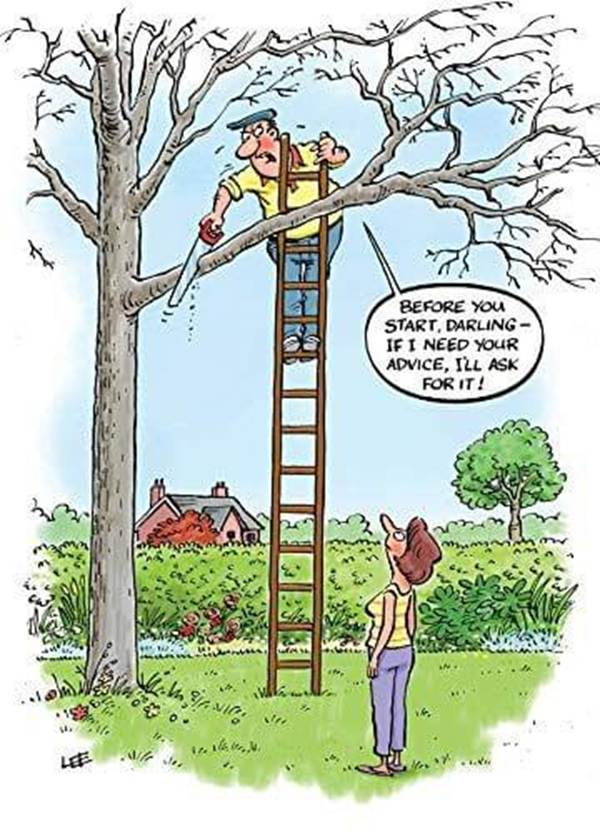
Years ago, while living in Washington, D. C., I read a leadership book by Peter Senge entitled The Fifth Discipline. In it he talked about the “law of unintended consequences.” The law of unintended consequences, often cited but rarely defined, is that actions of people — and especially of government—always have effects that are unanticipated or unintended. Of course, some of those outcomes can be positive, but often they are negative.

Or we’ve all seen a cartoon or a Facebook or YouTube reel which illustrates the foibles of those trying to trim or cut down a tree.
Darius tried to get himself, and Daniel, out of this predicament. He strove from noon to sunset trying to think of a way to rescue Daniel. We don’t know if he met with his lawyers to see if there was a loophole he could exploit, or whether he had the authority to set it aside, or maybe there had been past cases where a case like this had been rescinded. What about a presidential pardon? What if we over-feed the lions or put Daniel in a suit of armor?
Could it be that God would save him? In all probability Darius had also heard of the deliverance of Daniel’s three comrades from Nebuchadnezzar’s fiery furnace. Would God to the same for Daniel?
He labored “till the sun went down” trying to find a way to rescue Daniel. But he could not. Humanly speaking, there was no possible way for Daniel to survive this ordeal. The law was the law was the law.
According to ancient eastern custom, the execution was carried out on the evening of the day that the accusation was made and found valid, when “the sun went down.”
Typically, during all this, Daniel remained quiet. While everyone else was screaming and accusing, Daniel let his integrity speak for him, After all, his name was Daniel, “God is my judge.” He humbled himself under the mighty hand of God and waited, just like Jesus did, “When he was reviled, he did not revile in return; when he suffered, he did not threaten, but continued entrusting himself to him who judges justly” (1 Pet. 2:23).
Ultimately, Darius had to condemn Daniel to the lion’s den.
Seeing his distress, the high officials and satraps don’t want Darius to reneg on his decision. For a third time they come in concert. Daniel’s accusers remind the king that he could not change the statute once it had been signed into law.
“Then these men came by agreement to the king and said to the king, ‘Know, O king, that it is a law of the Medes and Persians that no injunction or ordinance that the king establishes can be changed’” (Dan. 6:15).
Using words similar to verse 8, they reminded him that Medo-Persian ordinances could not be revoked, and Darius himself had already used the language of irrevocability (v. 12); despite his desire to spare Daniel, doing so would be going against “the law of the Medes and Persians.” To do so would undermine the very foundation of his kingdom.
Darius couldn’t do that. The king relinquished his efforts at stalling to find a way of deliverance for Daniel. Unable to set aside or overrule his immutable decree, the king was forced to enact the prescribed sentence. In this, we see an admirable aspect of the king’s character: he recognizes his legal obligation, though it runs counter to his great personal desire. As friend and admirer of Daniel he would release him, but as king of Medo-Persia he must enforce the law. He must do what was “right” in the eyes of the law and thus in his own eyes.
“Though absolutely blameless, Daniel was thrown into the den of lions. He suffered because of the jealousy of others” (Edward J. Dennett, Daniel the Prophet: and the Times of the Gentiles, p. 85).
With all possibilities for delivering Daniel exhausted, Darius finally gave the order for Daniel to be cast to the lions. So “Then the king commanded, and Daniel was brought and cast into the den of lions. The king declared to Daniel, “May your God, whom you serve continually, deliver you!” (Dan. 6:16)
“They had him! Or so they thought! They forgot that he was praying to and asking for help from the God who delivers” (William Peel, Living in the Lion’s Den Without Being Eaten, p. 151).
At this time in history, lions were hunted by royalty of Babylonia and Persia (Donald Wiseman, Nebuchadnezzar and Babylon, p. 112). Lions were captured alive and placed within royal zoos (Shea, Daniel and the Lion of Babylon, p. 70).
The lions’ den appears to have been a large pit in the ground with an opening above that a large stone sealed, probably in order to keep people from stumbling into it. Such pits were commonly used as cisterns to store water or as prisons. We notice that Daniel had to be lifted up out of it (v. 23), and others when thrown into it fell down toward its bottom (v. 24).
“Its construction may therefore have been similar to that of the fiery furnace, upon the whole (see on chap. 3:6)—an opinion which seems to derive additional support from the manner in which Darius was enabled to converse with Daniel while in the den, even before the stone was removed from its opening (v. 21 et seq.).” (Zöckler, The Book of the Prophet Daniel, p. 144).
A number of scholars consider that these “lions dens” not only had a whole at the top, but one on the side as well, for the purpose of bringing lions in and taking refuse out.
“This den was a cesspool is what it was; you had decaying human flesh in this place; it was the execution chamber and that is where Daniel spent his evening.” (Clough, Lessons on Daniel, 22.287).
Darius’ idea seems to have been that he had wanted to save Daniel, but had failed. Now Yahweh must save him. “May your God, whom you serve continually, deliver you!” This was, at least, a vague hope of Darius. We do not know, of course, if Darius knew about Yahweh’s deliverance of Daniel’s three friends. But Daniel certainly did.
There are significant parallels and contrasts between the words that take Daniel’s three friends to the furnace (3:15–18) and those that take Daniel to the lion pit. There the king asked, “Who ever is the god who could deliver you from my power?” Here the king declares, “Your God, whom you honor so consistently, he must deliver you” (compare his acknowledgment of “the living God” in v 21 [20]).
Darius had a kind of faith, but it was faith born out of Daniel’s trust in the Lord. The idea was, “I tried my best to save you Daniel, but I failed. Now it is up to your God.” And he seemed to believe that Daniel’s God could rescue him!
Darius knew Daniel’s testimony, that he “served” [his God] continually.” Oh, what a testimony, to be known by the world as someone who consistently and constantly serves the God of heaven even in the face of sacrificing one’s life.
Many of us occasionally represent God well with godly character and wisdom before the world, but then invariably counter-act the good by then making bad choices. Daniel’s testimony was made by continual service.
Bound by the iron-clad wording of the royal injunction, Darius ordered that Daniel be cast into the lions’ den. But notice that he appealed to Daniel’s God to deliver him.
He told Daniel, “May your God, whom you serve continually, deliver you!” This statement recognized Daniel’s devotion to God and expressed Darius’s hope that the punishment would fail through his God’s deliverance. It may also signal a budding faith in Darius’ heart.
However, Stephen Miller explains: “The KJV and NASB construe this statement as a prediction that God “will rescue” Daniel, whereas the NIV and NRSV consider the declaration to be a wish on Darius’s part that God “may . . . rescue” him. The verb (an imperfect form of šêzib) may be translated in either manner. Since Darius was an unbeliever, the king would not have had sufficient faith in Yahweh to affirm that Daniel would certainly be delivered, and v. 20 indicates that the king was not positive Daniel would be saved. The words express the king’s hope” (Stephen R. Miller, Daniel, p. 185)
“[Daniel] had been faithful in praying, leaving the matter in God’s hands. Now it seemed that God was not to spare him. Many years before, it had seemed the same to Daniel’s three friends as they had faced the fiery furnace. Knowing the kind of person Daniel was, however, one can believe that he faced the challenge no less courageously than they” (Leon Wood, A Commentary on Daniel, p. 167).
“For Daniel and his three Hebrew friends, faith was a commitment to omnipotence, not outcome. As the three friends said before being thrown in the fiery furnace, God is able to save, whether He chooses to or not. In either case, our trust is in Him and whatever outcome He deems best. That’s a faith that surely pleases God” (David Jeremiah, Agents of Babylon, p. 190).
“Now the beautiful thing about this is Darius is forced into the position of having to trust the Lord. See how effective and efficient God works; the whole situation looks like it’s messed up; everything is falling apart, and what happens? In the end Darius has to trust the Lord; a tremendously efficient teaching system” (Clough, Lessons on Daniel, 21:280).
Leon Wood contends, regarding the wish that Darius voiced, “shows that Daniel had been busy in witnessing to him, as he had been years earlier to Nebuchadnezzar and Belshazzar….Darius clearly had been impressed with Daniel’s faithfulness in life behavior to his God; no doubt a telling factor in molding the king’s own thinking. One’s life conduct is so important if his oral testimony is to be effective” (A Commentary on Daniel, p. 168).
Darius had kept his end of the matter by ordering Daniel, an exile from Judah now in his eighties, to be thrown to the lions. If Daniel’s God happened to intervene and deliver the faithful servant, it was out of the king’s hands.
To secure the lions’ den, “A stone was brought and laid on the mouth” of it, and then Darius sealed it “with his signet and the signet of the lords.” No one would chance trying to rescue Daniel, and Daniel himself certainly would be unable to escape: breaking the king’s seal without authorization would warrant death. And Darius knew that Daniel had powerful enemies who would seek to kill him if the lions didn’t. In this case, not only the king’s signet, but also those of the lords, were used, indicating that approval of both parties would be needed to remove the stone.
Like Pilate, hundreds of years later (Matt. 27:55-56), a stone was laid over the entrance (Dan. 6:17) and the king officially authorized the securing of the chamber so that interlopers could not affect the seemingly certain outcome: neither Daniel nor Jesus would ever be seen again. That was the intention. Daniel’s night in the den and his raising from peril do serve as an analogy, or type for the death and resurrection of Jesus.
In the sovereignty of God, the stone was sealed to vouch the miraculous nature of Daniel’s preservation. With Daniel’s fate sealed, the conspirators went home to celebrate. But with Daniel’s God on the throne, while the king of Babylon tossed and turned (Dan. 6:18), the King of kings protected Daniel from harm. Even with all the danger surrounding him, Daniel likely got a good night’s sleep.

 Grace Still Amazes