God’s Charge against Israel’s Infidelity, (Hosea 2:4-5)

God’s Charge against Israel’s Infidelity, part 2 (Hosea 2:4-5)

We’re dealing with Israel’s infidelity and God’s charge against Israel.

By Hosea’s day Israel had already formed a strong attachment to the Canaanite god Baal. Indeed, as early as their wilderness journey some Israelites had become infatuated with Baal and even indulged in the heinous rituals associated with his worship (Num. 25:3-5).

As Cole points out, “Baal … would become the primary antagonist to Yahweh for the hearts of the people of Israel from this setting to the end of the two Israelite kingdoms.” (Dennis Cole, Numbers, p. 437).

Once in the land some of the people even built an altar to Baal (Judg. 6:25-34) and by the era of the divided kingdom Baalism became the chief besetting sin of the people (e.g., 1 Kings 16:31-33; 18:16-40, etc.). Therefore, his worship is often condemned in the latter prophets (e.g., Jer. 2:8; 7:9; 11:11-17; 32:26-35; Zeph. 1:4).

The whole passage, Hosea 2:2-5 reads…

2 “Plead with your mother, plead– for she is not my wife, and I am not her husband– that she put away her whoring from her face, and her adultery from between her breasts; 3 lest I strip her naked and make her as in the day she was born, and make her like a wilderness, and make her like a parched land, and kill her with thirst. 4 Upon her children also I will have no mercy, because they are children of whoredom. 5 For their mother has played the whore; she who conceived them has acted shamefully. For she said, ‘I will go after my lovers, who give me my bread and my water, my wool and my flax, my oil and my drink.’

So in verse 3, God, instead of stoning or burning Israel because of her infidelity, “strips her naked and makes her as in the day she was born,” indicating that he will make her helpless and ashamed before her idols as well as before the nations she once trusted to save them.

Although in ancient Mesopotamia the denuding of a wife appears to have played a role in the divorce proceedings, the stripping of Israel naked may be explained metaphorically as referring to the devastating of Israel’s land in order to destroy its food supply.  Whether such was to occur through draught, plague, or by foreign invaders is not specified.  Such a sentence would make good sense because Israel is guilty of wrongly attributing the produce that she enjoyed to the false deities, which she worshiped.

John Schultz notes:

In threatening to strip Gomer and expose her nakedness, God threatens to remove the cover of sin.  When Adam and Eve fell into sin, they confessed to feeling naked before God (Gen. 3:7-10).  God provided a form of atonement for their sin by covering their nakedness with the skin of an animal.  Gomer’s nakedness represents the removal of this cover of atonement.  A human being, standing naked before God, is exposed to the fatal radiation of God’s holiness. Without the cover of the righteousness of Jesus Christ we would be hopelessly lost. Yet, sin that is exposed to the light does not survive. In the words of the apostle Paul: “But all things become visible when they are exposed by the light, for everything that becomes visible is light” (Eph. 5:13).

The severity of this punishment is expressed in the last clause, “and kill her with thirst.”  The cutting off of this most basic necessity is exceedingly dire.

The experience of thirst in the desert wanderings left a deep mark on Israel’s memories.  Some of the most severe times of testing and rebellious murmurings against Yahweh were associated with this dire lack of water.  There are two stories of Yahweh’s miraculous provision (Exodus 17:1-7 and Numbers 20:2-13) and they are often referred back to in the Psalms as proofs of Yahweh’s capacity for responsive love.

On the first of these occasions Israel accused Yahweh of bringing them up from Egypt “to kill me and my children and my animals with thirst,” exactly the words used here.  Compared to this, the measures threatened against the wife in the ensuring verses are less severe, dealing only with her possessions and circumstances.

Again, the grace of God is always there in the background.

In verse 4 her children, once graced in 1:10-2:1 will again be judged.

4 Upon her children also I will have no mercy, because they are children of whoredom.

The Lord now comes close to each individual, after having spoken in general of the whole people.

These appear to be the children born to her in her adultery, after the three children born in chapter 1.  Unfortunately, the children bear the consequences of the mother’s choices.  Since Gomer stands for the nation and her children individual Israelites this means that the judgment will extend down to individual citizens.

No one wants to admit that he is part of a society that is decadent and that he himself is decadent along with it.  They must renounce their perverse society and religion, in order to become a righteous remnant, similar to what Isaiah did when he said, “I am a man of unclean lips, and I dwell among a people of unclean lips” (Isa. 6:5).

We need to ask ourselves today whether our culture, even our Christian subculture, might be leading us away from God today.

“The culture of Israel, particularly its political and religious leadership, is here metaphorically the prostitute mother of the Israelite people.  This culture has given birth to a generation who has no right to call Yahweh their father….They had lost all connection with what it meant to be the keepers of the covenant.  Their “mother” had taught them nothing but greed, immorality, and idolatry.  Yahweh looked at this misbegotten generation and in effect declared them to be Baal’s offspring and not his” (Duane Garrett, Hosea-Joel, p. 79)

In the context implies that the promiscuous mother has disgraced her children along with herself.

5 For their mother has played the whore; she who conceived them has acted shamefully.

This is the reason given for the disaster which would come upon the people of Israel.

Although she had become an object of shame, there is no indication that she felt ashamed of her actions.

And the reason that Israel went to the Baals, is found is the last part of verse 5:

For she said, ‘I will go after my lovers, who give me my bread and my water, my wool and my flax, my oil and my drink.’

This sin is repeated down in verse 13, but extends even further.

13 And I will punish her for the feast days of the Baals when she burned offerings to them and adorned herself with her ring and jewelry, and went after her lovers and forgot me, declares the LORD.

John Calvin notes that the words “she said,” indicates that she does this with premeditation and intentionally.  She doesn’t fall into adultery mistakenly or by accident, but intentionally plans it.

Notice the intent and vigor behind the woman saying “I will go after my lovers” or “let me go after my lovers.”  It expresses intense, passionate love.  It also indicates that it wasn’t the lover who approached her, but she went after them.  Every word aggravates the shamelessness.

Albert Barnes further explains:

Amid God‘s chastisements, she encourages herself, “Come, let me go,” as people harden and embolden, and, as it were, lash themselves into further sin, lest they should shrink back, or stop short in it.  “Let me go after.”  She waits not, as it were, to be enticed, allured, seduced.  She herself, uninvited, unbidden, unsought, contrary to the accustomed and natural feeling of woman, follows after those by whom she is not drawn, and refuses to follow God who would draw her (see Ezekiel 16:31-34).

David Murray comments:

God’s “I will” is always coming into conflict with our “I will.”  Instead of, “Not my will, but your will be done,” we assert, “Not your will, but my will be done.”  Instead of asking God, “What will you have me to do?” we, as it were, look God in the eye and wonder, “What will I have you to do?” [for me]

Hosea’s repeated re-assertion of the “I will of God” was rendered necessary by the daringly disobedient “I will” of Israel.  Here, Hosea portrays Israel as a wife with a perfect husband. He lovingly brings her home all she needs.  He opens the door and puts bread, water, wool, flax, oil, and drink on the table.  She takes all these gifts and packs them away in her cupboards.  But then she walks straight past her loving husband without so much as a “thank you,” and walks out the door, saying, “I will go after my lovers, that give me my bread and my water, my wool and my flax, mine oil and my drink.”

Israel took the loving gifts and ignored the loving Giver.  Worse, she attributed the loving gifts to the enemies and opponents of the loving Giver.  And then, as if that was not bad enough, she turned her back on the loving Giver, and went to praise and party with “lovers” who were actually enemies not only of herself but also of the loving Giver.

Confused believer, surely you must confess that you have reenacted this scene many times in your life.  The Lord has been a perfect Husband to you and has richly blessed you in His love.  But, instead of saying “I will go after my Lover,” you have said, “I will go after my lovers.”  You have taken His gifts and ignored Him.

How many times have you bypassed opportunities to worship and pray in order to go after worldly pastimes and pleasures?  Are these your lovers?  What has TV ever done for your soul?  Did sport die for you?  Does music ever live to make intercession for you?  Does your investment portfolio love you with an everlasting love?  Have your friends laid down their lives for you?  Turn away from what is turning you away from Christ.  Resolve by His grace, “I will go after my Lover.” [Jesus Christ]

The plural “lovers” in v. 5 matches the “Baals” of vv. 13 and 17.  Israel was praying to and worshiping the Baals because they (mistakenly) believed that it was from them that all the blessings of life flow.

Canaanite religion offered people more apparent control over their own well-being, for the provision of food and clothing was guaranteed by manipulation of divine powers through quasi-magical fertility rites.

Albert Barnes, speaking of her “lovers,” notes…

These she professed that she loved, and that they, not God, loved her.  For whoever receives the gifts of God, except from God and in God‘s way, receives them from devils.  Whoso seeks what God forbids, seeks it from Satan, and holds that Satan, not God, loves him; since God refuses it, Satan encourages him to possess himself of it. Satan, then, is his lover.

The remedy for this faulty thinking is knowing that it is God alone who has the power of life and death, God alone who is the source of “every good and perfect gift” and to regularly thank Him for His benefits (Psalm 103).

Also, notice the repetition of the word “my” in verse 5: “my bread and my water, my wool and my flax, my oil and my drink.”

David Allen Hubbard notes that “the participial style with which she chants the list of gifts makes her words a hymn to the Baals” (Hosea, p. 82).  In other words, this statement is a worship song sung to her god.  It just shows that we worship, even when we don’t intend to.

“She is conscious that she hath not these things by her own power, but is beholden to some other for them; but not remembering Him (as was commanded) who had “given her power to get wealth, and richly all things to enjoy,” she professes them to be the gifts of her lovers.” (Albert Barnes)

The mistake made by the woman in verse 5c is twofold. First, Yahweh is the sole giver of everything, but (second) He never ceases to be the owner of everything.  It was a mistake for her to consider Baal the giver; equally a mistake for her to consider herself the owner.

We need to continually remind ourselves, because we have this tendency as well, that we are mere stewards of ALL the gifts that God has given to us—monetarily and otherwise.

We also need to consistently remind ourselves that the true source of every gift in life is not my own ability to work, my own ingenuity, even my own religious service, but the free grace of God.

Part of God’s correction of this double error, down in vv. 8-9 is to take back all that is His and to make it evident that these gifts do not come from the Baals.

The basic commodities of life are in view in 5b.  Bread and water are the simplest necessity of our diet.  The fallacy of believing that Baal controls water (the rain) will be demonstrated when Yahweh kills her “with thirst” (v. 3).

Wool and flax are the two main fibers of Israelite textiles.  They come from pastoral and agricultural sources, again denying Baal jurisdiction of animal husbandry and farming.

Oil, like olive oil was used for diet, but it could also be used for anointing (and was likely used this way in cultic ceremonies with the Baals).

“Drink” is often translated “liquors” and likely does have the sense of an intoxicating beverage.  In Hosea 4:1 Hosea complains about the abuse of intoxicating beverages.

“Oil and liquors” likely denote luxuries.

She attributed to false gods the gifts which God had given to her.  This was great ingratitude to God, and a high insult to his holy majesty.

John Gill notes that even…

in the times of Christ, they ascribed not only their enjoyment of temporal good things, but their righteousness, life, and salvation, to their observance of traditions, rites, and ceremonies, and the externals of religion.

It wasn’t an external idol they were bowing to, but the idol of themselves, their self-righteousness.

It might help us see the sense of what Hosea is saying here by reversing the order:

5c  She entertains the wrong belief about the sources of life’s necessities.

5b  She resolves to chase after these lovers who provide these things.

5a  She disgraces herself.

4b  Her children become “children of whoredom” (or a better word would be promiscuity).

4a  Her children are not to be pitied.

Matthew Henry gives this insight about the verses 4-5

She that boasted so much of her bread and water, her oil and her drinks, which her lovers had given her, shall not have so much as necessary food.  The land shall not afford subsistence for the inhabitants, for want of the rain of heaven; or, if it do, it shall be taken from them by the enemy, so that the rightful owners shall perish for want of it.

Some understand it thus: I will make her as she was in the wilderness, and set her as she was in the desert land, where she was sometimes ready to perish for thirst.  So it explains the former part of the verse: I will set her as in the day that she was born; for it was in the vast howling wilderness that Israel was first formed into a people.  They shall be in as deplorable a condition as their fathers were, whose carcases fell in the wilderness, and in this respect, worse, that then the children were reserved to be heirs of the land of promise, but now I will not have mercy upon her children, for their mother has played the harlot.

And John Schultz adds this:

After the people of Judah were taken into captivity to Babylon, Jeremiah records a similar reaction to his preaching by the people who had been left behind: “Then all the men who knew that their wives were burning incense to other God’s , along with all the women who were present–a large assembly–and all the people living in Lower and Upper Egypt, said to Jeremiah, We will not listen to the message you have spoken to us in the name of the LORD!  We will certainly do everything we said we would: We will burn incense to the Queen of Heaven and will pour out drink offerings to her just as we and our fathers, our kings and our officials did in the towns of Judah and in the streets of Jerusalem.  At that time we had plenty of food and were well off and suffered no harm.  But ever since we stopped burning incense to the Queen of Heaven and pouring out drink offerings to her, we have had nothing and have been perishing by sword and famine.  The women added, When we burned incense to the Queen of Heaven and poured out drink offerings to her, did not our husbands know that we were making cakes like her image and pouring out drink offerings to her? ” (Jeremiah 44:15-19)

How deceived we can be!

Warren Wiersbe makes this application for us today.

Unfaithfulness to the Lord is a serious sin, just as unfaithfulness to one’s mate is a serious sin.  The man who says he’s 90 percent faithful to his wife isn’t faithful at all.  As Israel was tempted to forsake God for idols, the church is tempted to turn to the world system that hates God and wants nothing to do with God.

We must be careful not to love the world (1 John 2:15-17), be friendly with the world (James 4:4), become spotted by the world (James 1:27) or conform to the world (Romans 12:2).  Each believer and each local church must remain true to Jesus Christ the Bridegroom until He returns to take His bride to the heavenly wedding (2 Cor. 11:1-4; Eph. 5:22-33; Rev. 19:6-9). (One volume OT Commentary, p. 1395).

What I read in January, 2019

These are the books I finished in January, 2019.  Some of these books I started in 2018.

The Coddling of the American Mind: How Good Intentions and Bad Ideas are Setting Up a Generation for Failure, by Greg Lukianoff and Jonathan Haidt (Penguin Press, 2018)

This book is one of the most important books in explaining what is happening in society, in particular the American campuses, today.  It examines what has happened on college campuses between 2013-2016 as the iGen has been in school.

The books begins with Three Great Untruths (Whatever doesn’t kill you makes you weaker; always trust your feelings; life is a battle between good people and bad people).  Although these untruths might seem innocuous, they have proven very dangerous, especially on college campuses today.  They illustrate what each of these untruths mean and how they are present among college students today.

In part 3 they examine six possible causes for a culture of safetyism:

rising political polarization and cross-party animosity

rising levels of teen anxiety and depression (with a primary link to “screen time,” especially on cell phones)

changes in parenting practices–removing anything of danger to children

the decline of free play–with teaches social skills

the growth of campus bureacracy

and a rising passion for social justice in response to major national events, combined with changing ideas about what social justice requires.

The book ends with some practical suggestions about how to produce wiser kids, wiser universities and wiser societies.

This is a book that parents and educators should read.

The Prayer That Turns the World Upside Down: The Lord’s Prayer as a Manifesto for Revolution, R. Albert Mohler (Thomas Nelson, 2018)

This book takes up the petitions of the Lord’s Prayer in a very informative and practical way.  If you want to improve your prayer life, there is no better way than to pray the prayer that Jesus taught His disciples to pray.

Overcomer: 8 Ways to Live a Life of Unstoppable Strength, Unmovable Faith, and Unbelievable Power, David Jeremiah (Thomas Nelson, 2018)

Sandwiched between chapters on David (chapter 1) and Jesus Christ (chapter 10) are eight chapters on the armor of God.  The book is full of illustrations.  Preachers will especially enjoy it.


M’Cheyne Bible Reading Plan, February 1

Today’s readings are Genesis 33, Mark 4, Esther 9-10 and Romans 4.

Now the showdown between Jacob and Esau.  Esau was coming with 400 men (v. 1).  This time Jacob gets out front, bows down…

4 But Esau ran to meet him and embraced him and fell on his neck and kissed him, and they wept.

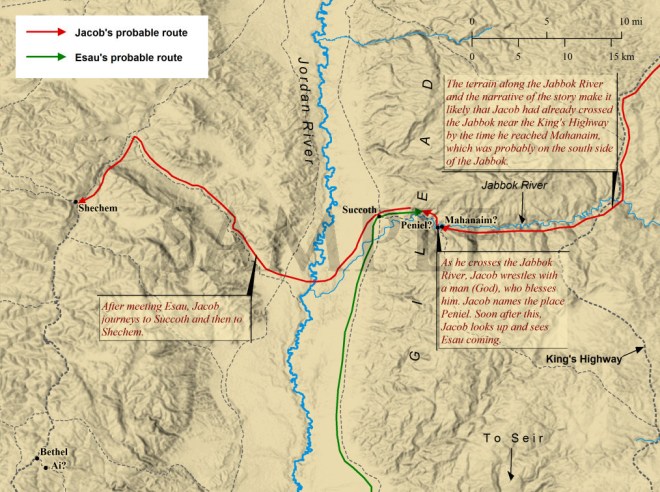
This is not what Jacob expected.  Esau inquired about Jacob’s family (vv. 6-7) and the purpose for the gifts Jacob had sent ahead (v. 8).  Esau wanted to journey “home” (v. 12), but Jacob begged to go slower.  So Esau returned to Seir, in Edom, while Jacob went to Succoth.

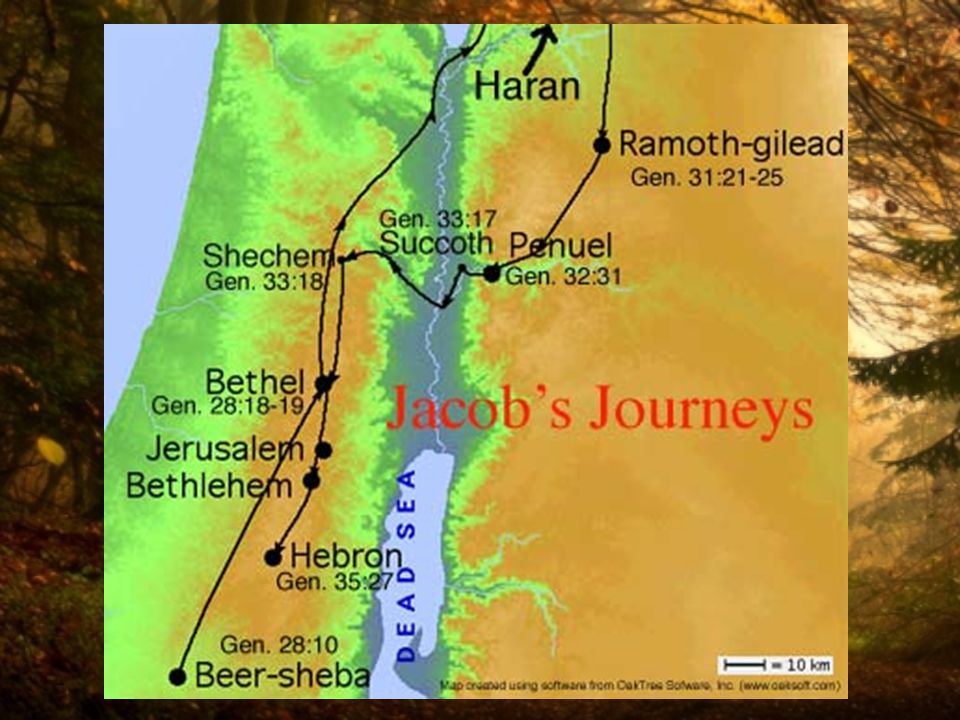
jacobreturnstocanaan

Finally Jacob came to Shechum, back in the promised land.  However, as we will see in the sordid events of Genesis 34, he should have moved on to Bethel or Hebron.

Mark 4 is where Jesus begins to tell parables.  Remember that the purpose of a parable is to give insight to some, but to hide the truth from others (Mark 4:11-12).  So Jesus tells the parable of the sower and the seed, which only finds one good soil.  I’m not sure if this is a discouragement or an encouragement to preachers.  Only 1/4 of the seed I plant will bear fruit, but at least 1/4 will!

Jesus goes deeper into parables and understanding them.  He encourages them (and us) to “pay close attention.”  On the other hand, through the parable of growing seed (vv. 27-29) Jesus seems to be encouraging the sower to sow the seed and then not worry about it.  You don’t have to go dig it up again to see if it’s growing.

Martin Luther said about this text: “After I preach my sermon on Sunday, when I return home, I drink my little glass of Wittenberg beer and I just let the gospel run its course.”  I like that.

Luther said that after he pounded on the pulpit and expounded the gospel, he would go home and pull out the Sunday newspaper, and pull out his glass of warm Wittenberg beer and start to drink it and enjoy the afternoon.  Luther knew that the power of his sermon was not based on the power of his theological acuity.  He knew that the power of his sermon was not based on his eloquence or his abilities.  He knew that the power of the sermon would have no effect whatsoever unless the very Word of God got into a person’s heart.  Luther knew that he couldn’t do that.  It was the Holy Spirit who did that. Luther keenly understood the power of the Word.

–Edward F. Markquart, The Mustard Seed

Also, in v. 11 Jesus had said that the ones who will understand parables are those who have “been given the secret of the kingdom of God.”  It is something that God gives, a gift.

The parable of the mustard seed (Mark 4:30-32) emphasizes that the kingdom may start out tiny in size, yet grow huge.

Image result for mustard seed

from Garden in Delight

After this Jesus took his disciples out on a boat at night on the Sea of Galilee (vv. 35-41).  A storm arose that would have swamped the boat.  Jesus was asleep and seemed not to care.  But when He awoke He stilled the storm with a word.  He is that powerful.

Sometimes when we go through exceeding difficulties, we wonder where Jesus is and whether He cares.  But He is there and He will arise and come to our aid.

Esther 9-10 records the Jews rescue from extermination (by getting the upper hand).

9:1-19 records their self-defense.

Realize that the uncovering of the plot, the hanging of Haman and his sons, and the second decree, all was meant to discourage the enemies of the Jews from attacking in the first place.

A large number of attackers were killed (nearly 76,000 over all).

Almost twice as many people died in the royal precincts of Susa as in the rest of the city.  The word “capital” in verse 6 really refers to the acropolis, the royal section of the capital city of Susa.

ENEMIES KILLED BY THE JEWS
Number Place Date References
500 men in the acropolis of Susa Adar 13 (March 7) 9:6, 12
75,000 people in other parts of the empire Adar 13 (March 7) 9:16
300 men in Susa Adar 14 (March 8) 9:15

Chuck Swindoll comments:

“The Jews were free to strike back without reservation, in retaliation.  But it is clear that they applied self-control. The Jews certainly defended themselves against their enemies, against those who attempted to wipe out their race, but the Jews resisted the temptation to go too far.  They had been given permission to take material advantage of their enemies’ defeat, but they refused to do that.  They held back.  Think of it this way: Not only did the Jews gain mastery over their enemies, they gained mastery over themselves.”

Warren Wiersbe uses a play on words to say, “The tables having been turned, the tables could now be spread.”

Evidently Mordecai issued the decree establishing the Feast of Purim some time after the slaying of the Jews’ enemies (v. 20). His proclamation united the two days on which the Jews had defended themselves (Adar 13 and 14) into one holiday. During the inter-testamental period the Jews called Adar 14 “Mordecai Day” (2 Maccabees 15:36, RSV), but they discarded this special designation later. Modern Jews celebrate Purim on the evening of Adar 14 (in March). It is their most festive and popular holiday. Esther is the only Old Testament book not found among the texts used by the Essene community at Qumran, probably because this community did not observe Purim.

Purim is the plural of pur, meaning “lot.” (cf. 3:12)

Probably Esther sent her decree (v. 29), confirming Mordecai’s previous declaration of the official Jewish holiday (vv. 20-21), to encourage its firm establishment. Her letter evidently began, “Words of peace and truth” (v. 30).  There was likely considerable resistance within the conservative Jewish community to adding another national festival to those prescribed in the Torah.

The book ends by speaking of the exaltation of Mordecai in position and influence within the Persian empire.

It is quite possible that God’s name is left out of the book of Esther because neither Esther nor Mordecai were particularly religious Jews.  Yet, it still shows God’s determination to preserve His people, even when they were disobedient.

As Karen Jobes writes, “Beneath the surface of even seemingly insignificant human decisions and events, an unseen and uncontrollable power is at work that can be neither explained nor thwarted.”

Romans 4

Abraham was the most important forefather of Israel.  Paul began this chapter by showing that God declared Abraham righteous not because of works, but because of the Abraham’s faith.

Romans 4:4-5 contrast faith and works.  Work yields wages that the person working deserves. Faith receives a gift (Romans 4:4; lit. grace, Gr. charin) that the person believing does not deserve. Incredibly, God justifies those who not only fail to deserve justification but deserve condemnation because they are “ungodly” (NASB) or “wicked” (NIV Romans 4:5; cf. Romans 3:24). This is how far God”s grace goes (cf. Deut. 25:1)!

Not only Abraham, but David’s experience illustrates justification by faith as well (vv. 6-8).  The issue, to the Jews, was circumcision.  Was it necessary to be circumcised to be justified?  Paul says no, Abraham believed and was justified even before he was circumcised (vv. 9-11), which is true not only of Abraham but all who follow his example and believe (v. 12).

No one is able to keep the law, so it’s a good things we aren’t justified by keeping the law (vv. 13-15).  And justification does not come from being a physical descendant of Abraham, but rather comes to those who imitate his faith (vv. 16-17).

Vv. 18-22 shows us what kind of faith Abraham had.  He believed when it seemed impossible (v. 18), facing the facts (not ignoring the facts, v. 19).  And although the text says twice that he did not “weaken” (v. 19) or “waver” (v. 20) it also says that he “grew strong in his faith,” (which must mean that it wasn’t always strong, as we read in Genesis).  Note that it is his faith which “gives glory to God.”

I believe that it is our faith in God, more than anything else, which gives God glory.  My worship, my love, my service, my contributions, my mission trips–all those are things that I do for Him.  But I trust Him to do something for me, and that glorifies Him more.

I believe v. 21 gives the best definition of faith…

21 fully convinced that God was able to do what he had promised.

Faith looks to the promise and the power of God.  Faith can have many levels of strength, but the strongest faith is “fully convinced.”

The remaining verses (vv. 22-25) apply Abraham’s example again to the issue of justification.

M’Cheyne Bible Reading Plan, January 31

Today’s readings are from Genesis 32, Mark 3, Esther 8 and Romans 3.

Wrestling with God.  Many of wrestled with God.  Not necessarily in a physical way like Jacob did, but emotionally and volitionally.  Jacob had been wrestling since before he was born (Genesis 25:26; Hosea 12:3-4).

Sometimes we just do not want to surrender to God.  We want our own way.

Jacob was a man who had largely taken care of himself–usually through cunning and manipulation.  But God was still dealing with Jacob.

Jacob responds to an angelic visitation (vv. 1-2) and begins preparations to meet Esau.  Suffice it to say, Jacob was not looking forward to seeing Esau again.  Their last interaction had Esau wanting to kill Jacob.

So Jacob, again living as a practical atheist, takes care of the situation the best he knew how–by dividing into separate caravans with gifts for Esau, hoping to soften him up.  Jacob did this because he was afraid (v. 7), in fact “greatly afraid and distressed.”  This, despite the fact that God had promised to protect him when he left (Genesis 28:13-15).  Had Jacob forgotten these promises: was he living like a practical atheist?

When you don’t believe in God, that He loves you and is in control of all things, then you are all alone in this unfriendly world and it is all up to you.  No wonder there is so much fear and anxiety in the world today!  But Christians can live like atheists, forgetting that God loves us and is in control and promises to work “all things together for our good.”

But Jacob did pray.  He does repeat back to God His promises.  He asked for deliverance (32:9-12).  And then he proceeded on with his plan (32:13-21).  Jacob was willing to surrender gifts, but not himself.

Spurgeon comments on v. 12

“But you said, ‘I will surely do you good…'”

What force is in that plea! He was holding God to His word—”You said.”

The attribute of God’s faithfulness is a splendid horn of the altar to lay hold upon; but the promise, which contains the attribute and something more, is mightier still—”You said, I will surely do you good.”  Would He say it and then not do it?

If you have a divine promise, you need not plead it with an “if”; you may urge it with certainty. The Lord meant to fulfill the promise or He would not have given it. God does not give His words merely to keep us quiet and to keep us hopeful for a while with the intention of putting us off in the end; but when He speaks, it is because He means to do as He has said.

Spurgeon, Morning and Evening, April 18

So Jacob sends all his possessions across the river Jabbok and God starts a fight.

jabbokriverwithpossiblesiteofpenuelnearfordwherejacobcrossed28gen3222292cbibleplaces

This is likely the valley that Abraham had come through, from east to west, entering the promised land in Genesis 12.

jacobreturnstocanaan

24 And Jacob was left alone.  And a man wrestled with him until the breaking of the day. 25 When the man saw that he did not prevail against Jacob, he touched his hip socket, and Jacob’s hip was put out of joint as he wrestled with him. 26 Then he said, “Let me go, for the day has broken.”  But Jacob said, “I will not let you go unless you bless me.”

It is God who wrestled with Jacob.  God is always the initiator in our liberation.  And before he blessed Jacob, he touched Jacob’s thigh.  God has to break a person before that person will surrender.  The Christian community really ought to talk more about surrender than about consecration, because human beings resist God to the end and then must ask him to break the resistance and take control of their lives and hearts.  God broke Jacob so he had a crippled leg, and then God came and began to bless him.

I never knew a person who was filled with the Holy Ghost who did not have some brokenness in him.  We want to stand straight and be self-contained and poised, but God cannot use us or bless us when we are in that position.  He wants to break us so that instead of our own power, we have the Holy Spirit’s power.  Are you willing to be broken for him?  This is the toughest of all battles, but it determines whether we will be free or in bondage.

We need to have our own Peniel where we meet Jesus face-to-face.  We must see ourselves for what we truly are.  We must cry out to God for heart cleansing, and we must let him come and fill us with His Spirit.  We must allow him to break us so he can make us into prevailers, conquerors, and overcomers.

Dennis F. Kinlaw, The Day with the Master

Lord, I cannot let Thee go,
Till a blessing Thou bestow:
Do not turn away Thy face,
Mine’s an urgent, pressing case.

Dost Thou ask me who I am?
Ah! my Lord, Thou know’st my name;
Yet the question gives a plea
To support my suit with Thee.

Thou didst once a wretch behold,
In rebellion blindly bold,
Scorn Thy grace, Thy power defy:
That poor rebel, Lord, was I.

Once a sinner, near despair,
Sought Thy mercy seat by prayer;
Mercy heard, and set him free:
Lord, that mercy came to me.

Many days have passed since then,
Many changes I have seen;
Yet have been upheld till now;
Who could hold me up but Thou?

Thou hast helped in every need;
This emboldens me to plead:
After so much mercy past,
Canst Thou let me sink at last?

No, I must maintain my hold;
’Tis Thy goodness makes me bold;
I can no denial take,
When I plead for Jesus’ sake.

–John Newton

And another quote, this time from Jonathan Edwards:

“It is very apparent from the Word of God that he is wont often to try the faith and patience of his people, when they are crying to him for some great and important mercy, by withholding the mercy sought for a season; and not only so, but at first to cause an increase of dark appearances.  And yet he without fail at last succeeds those who continue instant in prayer with all perseverance and ‘will not let him go except he blesses’ (Genesis32:26).”

In other words:

An obvious pattern in the Bible is that God tests the faith and stamina of his people as they cry out in prayer for some significant mercy.  He tests them by withholding the mercy they are asking for.  Not only that, but first he makes things worse, sending them discouraging setbacks.  But count on it – he will eventually prosper those who push through in urgent prayer without quitting and will not take no for an answer.

Jonathan Edwards, “A Call to United Extraordinary Prayer,” in Works (Edinburgh, 1979), II:312.

One of the ways we receive greater blessing is to press for it, not to be content with where we are.  Even after Jacob was injured, he would not let go of God.

You can only win with God by surrendering and letting Him win over you.  We win by surrendering.

After this wrestling match with God, Jacob walked straighter in his life with the limp, than he had before without it.

In Mark 3 Jesus first heals a man with a withered hand, on the Sabbath, which according to the religious leaders, was work, therefore verboten (forbidden).  He was saddened by their hard hearts (v. 5) and they began to plot to kill him (v. 6).  How quickly people’s opinions change, how fickle we are.  One moment for, another against.

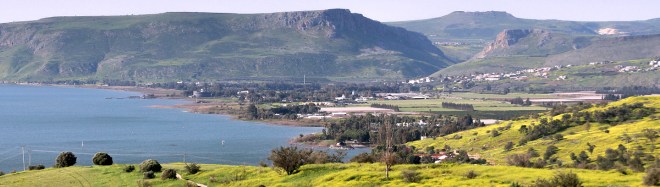
So Jesus got away, but crowds followed.  Again, for the moment, he was the darling of the crowds.  He healed the sick and cast out demons.  Later, he went up on a mountain to pray.  I believe that was Mt. Arbel, there near Capernaum.thearbelingalilee2cwillisbritt

Here is the easternmost bluff of Mount Arbel, overlooking the Sea of Galilee.  Many believe Matthew’s tax table was at that crook in the road to the left of Mount Arbel.

Photo by Willis Britt

There, according to Luke 6:12 Jesus spent all night praying before naming the apostles.  In Mark 3:13 where he calls his disciples up to the mountain is more likely the place where Jesus preached the “Sermon on the Mount,” pictured below (bottom left).

mountofbeatitudes28loveisrael.com29

The photo is from loveisrael.com

Verse 13 says he “called those whom he desired,” but we know that He had prayed about this issue all night long (Luke 6:12), so He was also choosing those whom the Father had chosen.

The crowds kept pressing in on Jesus (v. 20) so that he couldn’t eat.  His family thought he was out of his mind (v. 21) and the scribes claimed he was “possessed by Beelzebul” (v. 22).  All in all, not a very good day.  I would have fallen apart, probably gone into hiding never to come out again.

But, He dealt with the scribes (vv. 23-30), then His family, saying that His real family was those who “do the will of God” (v. 34).

Esther 8

Even though Haman was now dead, the Jews were not yet safe. This section of the text records what Esther and Mordecai did to ensure the preservation of the Jews who then lived throughout the vast Persian Empire. The death of Haman is not the major climax of the book.

Esther and Mordecai are rewarded (8:1-2) and Esther makes request to the king that they be allowed to defend themselves (since the law of the Medes and Persians was inviolable and could not be changed).

The first decree, to destroy the Jews, had gone out on April 17, 474 B.C. (3:12).  Ahasuerus published this second one, allowing the Jews to defend themselves, on June 25, 474 B.C.  Thus, the Jews had over eight months to prepare for the day their enemies might attack them, which was March 7, 473 B.C.

Evidently, Mordecai read the second decree at a public meeting in Susa. Contrast the Jews’ reaction here with their response to the first decree (3:15). God had blown away the dark cloud that had hung over their heads.  And the Jews celebrated (8:15-17).

While God’s work in the book of Esther is always behind the scenes, it comes through loud and clear.

In the infinite wisdom of the Lord of all the earth, each event falls with exact precision into its proper place in the unfolding of His divine plan.  Nothing, however small, however strange, occurs without His ordering, or without its particular fitness for its place in the working out of His purpose; and the end of all shall be the manifestation of His glory, and the accumulation of His praise.

B. B. Warfield

Romans 3 culminates Paul’s “bad news” that we are all under sin.  The Gentiles were condemned by creation (1:18-32), the moralist by the law, written in stone and in the heart (2:1-16).  Now Paul says that “all have sinned and fall short of the glory of God.”

The Jews had wonderful advantages over all the nations, but had squandered them (3:1-8).  There was no excuse.  David Guzik says about the rationalization in verse 5:

Paul was familiar with the line of thinking that says, “God is in control of everything.  Even my evil will ultimately demonstrate His righteousness.  Therefore God is unjust if He inflicts His wrath on me, because I’m just a pawn in His hand.”

In theory, the most dramatic example of someone who might ask this question is Judas.  Can you hear Judas make his case? “Lord, I know that I betrayed Jesus, but You used it for good.  In fact, if I hadn’t done what I did, Jesus wouldn’t have gone to the cross at all. What I did even fulfilled the Scriptures.  How can You judge me at all?”  The answer to Judas might go like this: “Yes, God used your wickedness but it was still your wickedness. There was no good or pure motive in your heart at all. I t is no credit to you that God brought good out of your evil. You stand guilty before God.”

–David Guzik

Paul then launches into the apex of his argument that all are sinners in 3:9-18, quoting passages from the Old Testament.  Warren Wiersbe calls this passage “An X-ray study of the lost sinner, from head to foot.”  The law, far from justifying us, points out our sinfulness in bold relief (v. 20).

J.B. Phillip’s paraphrase of this phrase: It is the straight-edge of the Law that shows us how crooked we are.

But, there is a way to be righteous.  Righteousness is a free gift offered by God to those who trust in Jesus.  I love these verses…

21 But now the righteousness of God has been manifested apart from the law, although the Law and the Prophets bear witness to it–22 the righteousness of God through faith in Jesus Christ for all who believe. For there is no distinction: 23 for all have sinned and fall short of the glory of God, 24 and are justified by his grace as a gift, through the redemption that is in Christ Jesus, 25 whom God put forward as a propitiation by his blood, to be received by faith. This was to show God’s righteousness, because in his divine forbearance he had passed over former sins. 26 It was to show his righteousness at the present time, so that he might be just and the justifier of the one who has faith in Jesus.

God’s justice was maintained in that sin was punished, but He could now justify us because Christ had been “put forward as a propitiation by his blood to be received by faith” (v. 25).  Those who believe, God can justly justify.  But only those who believe.

This excludes boasting (vv. 27-28) and upholds the law (vv. 29-31).

M’Cheyne Bible Reading Plan, January 30

Today’s Bible readings are from Genesis 31, Mark 2, Esther 7 and Romans 2.

In Genesis 31 Jacob heads back home to the promised land.  Laban was upset with him (v. 2) and God told him to return home “and I will be with you” (v. 3). This is the best promise one can have.  So it was a good time to go.

Because of Laban’s displeasure, Jacob felt like he had to leave on the sly, so he told Rachel and Leah how he had come to have more flocks than Laban and that God wanted him to return (vv. 4-13), so Rachel and Leah respond…

“Is there any portion or inheritance left to us in our father’s house? 15 Are we not regarded by him as foreigners? For he has sold us, and he has indeed devoured our money.  16 All the wealth that God has taken away from our father belongs to us and to our children. Now then, whatever God has said to you, do.”

This might have been the first time Leah and Rachel ever agreed on anything.  Apparently Laban had already spent their potential inheritance and they were all too glad to leave, especially since God had blessed them with wealth (v. 16)

Rachel and Leah complain about the loss of their inheritance because of their father’s dishonorable behavior.   Consider for a moment the inheritance our Heavenly Father is keeping safe for you.   Can the thought of that inheritance encourage you to good thoughts, words, and deeds today?

Praise be to the God and Father of our Lord Jesus Christ! In his great mercy he has given us new birth into a living hope through the resurrection of Jesus Christ from the dead, and into an inheritance that can never perish, spoil or fade—kept in heaven for you, who through faith are shielded by God’s power until the coming of the salvation that is ready to be revealed in the last time.
–1 Peter 1:3-5 (NIV)

Also…

Rachel and Leah were wrong to look to their father Laban for their portion or inheritance (Genesis 31:14) once they were married to Jacob.  He now was their portion and inheritance.  “Since you are saved and joined to Christ, appraise the world and ask, ‘Is there yet any portion for me?’  If you think there is, you are mistaken” (Barnhouse).

Jacob leaves secretly, without saying goodbye, and headed towards the mountains of Gilead, going across the desert on camels.

Image result for camels on the arabian desert

https://youngzine.org/news/history/camel-genes-shaped-ancient-trade

Image result for mountains of gilead

The mountains of Gilead are in Jordan, east of the Jordan river.

Laban pursued Jacob to the hill country of Gilead.  He was upset because Jacob had “driven away my daughters like captives of the sword” (v. 26), which was certainly hyperbole and he was not allowed to give a going away party (vv. 27) or bid them farewell (v. 28).  And also, Jacob had stolen “my gods” (v. 30).

In all this Laban could not do any harm to Jacob because God had warned him not to (vv. 24, 29).

Jacob admitted to being afraid that Laban would “take your daughters from me by force” (v. 31) and challenged Laban that if anyone was found with “your gods shall not live” (v. 32).

Laban searched every tent but did not find his idols.  Rachel sat on them and claimed to be experiencing her “time of the month” (vv. 34-35).  Of course, Jacob then expressed his incense at Laban accusing him of taking his gods (vv. 36-37) and then unloaded on Laban all the pent up frustrations he had experienced serving him (vv. 38-42).  Although Jacob was accurate in his report, Laban still felt the sting of losing his family (v. 43) and made a covenant with Jacob (vv. 44-54) to protect his daughters.  The Laban left (v. 55).

“Amid much that is sad and even sordid in this story… amid craft, deceit, and lying on almost every side, we cannot fail to see the hand of God overruling and making even the wrath of man to praise Him.” (Griffith Thomas, cited in Barnhouse)

God kept his promise to Jacob to bring him safely back to the land, in spite of human opposition and his own failures, just like He will bring us to our eternal home, in spite of satanic opposition and our own failures.

But why did God allow Jacob’s family to keep the idols?

Also, what does it say about Jacob’s faith, that he said in verse 42, that “unless the God of my father, the God of Abraham and the Fear of Isaac had been with me…”that he did not claim God as his own?

Mark 2:1-12 is one of my favorite stories.  It is the story of four friends who take a paralytic to Jesus.  They do everything they can, including digging through the roof, to get their friend in front of Jesus.  The text says that Jesus “saw their faith (v. 5) and forgave the man’s sins, then healed him to show the teachers of the law that he did have authority to forgive sins (vv. 6-12).

9 Which is easier: to say to this paralyzed man, ‘Your sins are forgiven,’ or to say, ‘Get up, take your mat and walk’?

An interesting question!   Of course, it is impossible for humans to forgive a man all his sins or heal him on the spot of his paralysis.  For God, on the other hand, both are easy.   In another way, though, it is easier to say “Your sins are forgiven” because that is invisible.  To say, “Stand up” demands clear proof which would be satisfied only when the man begins walking.

After this, Jesus calls Matthew, the tax collector (hear “boo, hiss”) is called by Jesus.  The Jewish people held them to be traitors (on the side of Rome) and extortionists, taking more than was required to line their own pockets.  Therefore, they were despised.  But Jesus called him anyway.

Apparently Matthew invited Jesus, and many of his other non-savory friends, to eat together (vv. 15-16).  Jesus was glad to be there, for these were people who knew they were “sick” (v. 17).  Jesus was a friend of sinners.

Small groups today sometimes host “Matthew Parties,” an intentional outreach to neighbors and friends to a meal, some fun event, with someone sharing their testimony or a short gospel presentation.

In three discussions, first about fasting (vv. 18-22) and then about the Sabbath (vv. 23-27) and picking grain on the Sabbath (vv. 25-28).  In the first he told parables indicating that change was coming, making the Jewish religious practices out of date and irrelevant.

Jesus came to introduce something new, not to patch up something old.  This is what salvation is all about.  In doing this, Jesus doesn’t destroy the old (the law), but He fulfills it.

In Ezra 7 Esther’s banquet comes to a close and she reveals her true identity.


PARTY!

But Haman, I’m afraid the meal won’t agree with you . .

At the banquet, Esther asks the king to spare her people from someone who wanted to destroy them (7:1-4).

Esther was in a very dangerous position.  Not only did she now identify herself with a minority group that Haman had represented to the king as subversive, but she also accused one of his closest confidential advisers of committing an error in judgment.

“She understands full well the delicate and precarious nature of her position.  The threat against her and her people has two perpetrators, Haman and the king, and both are present with her.  She must somehow fully expose the culpability of Haman, while at the same time never appearing in any way to be bringing any charges against the king.  Hence, her response is extremely well thought out and presented with the utmost tact.”

–Frederic W. Bush, Word Biblical Commentary

When the king asks “Where is he—the man who has dared to do such a thing?” Esther points to Haman (7:5-6).  Esther was not afraid to tell it like it is: “A foe and enemy!  This wicked Haman!” (v. 6)

The king, in rage leaves the room, and Haman falls upon Esther, begging for mercy (7:7).  When the king re-enters the room, he sees Haman “molesting” the Queen (7:8).  When Harbona, one of the king’s eunuchs, mentioned the pole set up to impale Mordecai, the king commands “Impale him [Haman] on it.”  And he was (7:9-10).  Ironically, this type of death was an ancient precursor of crucifixion.

When anyone works against God, he falls into his own trap. “Perhaps the greatest example of this was when Satan thought that he won by getting the crowd to crucify Jesus, but the cross turned out to be the instrument of his defeat” (David Guzik)

Romans 2 sentences the religious Jews to the same condemnation as the Gentiles in chapter 1.

When we judge others, we condemn ourselves, just like the Pharisee did in Luke 18:10-14.  We cannot escape the judgment of God (v.3), so we need to respond to His kindness by repenting (v. 4), else we experience God’s wrath (v. 5-6).

“Notice, dear friends, that the Lord does not drive you to repentance. Cain was driven away, as a fugitive and a vagabond, when he had killed his righteous brother Abel; Judas went and hanged himself, being driven by an anguish of remorse because of what he had done in betraying his Lord; but the sweetest and best repentance is that which comes, not by driving, but by drawing: ‘The goodness of God leadeth thee to repentance.’” (Spurgeon)

Even the very moral person falls short of God’s standard of righteousness (vv. 6-10).  Is Paul saying here that we can earn eternal life “by patience in well-doing seek for glory and honor and immortality”?  Paul probably meant that if a person obeys God perfectly, he or she will receive eternal life.  But that is not possible.  Those who do not obey God perfectly receive wrath.  Later he willclarify that no one can obey God perfectly, so all are under His wrath (Romans 3:23-24).

The Gentiles do not have the Mosaic Law in the sense that God did not give it to them.  Therefore He will not judge them by that Law.  The Jews in Paul”s day did have it, and God would judge them by it (Romans 2:12).

Even Gentiles who do not have the Mosaic Law know that they should do things that are right and not do things that are wrong (Romans 2:14).  It is written in the Law, but also on our consciences (2:15).

In summary, to convict any self-righteous person of his guilt before God, Paul reminded his readers of three principles by which God will evaluate all people.

  • He will judge righteously, in terms of reality, not just appearance (Romans 2:2).
  • He will judge people because of their deeds, what they actually do both covertly and overtly (Romans 2:6).
  • Moreover He will judge impartially, not because of how much or how little privilege they enjoyed but how they responded to the truth they had (Romans 2:11).

Paul had been speaking of Jews, included in the larger category of “good people,” in Romans 2:1-16, but now he identified them by name. The Jews were very self-righteous. Paul explained the basis of their boasting in vv. 17-20.  Verses 21-24 indicates some of their sins.  Additionally, they depended upon circumcision, which was to no avail (vv. 25-27).  The important thing was to have a circumcised heart (vv. 28-29).

In Romans 2:17-29 Paul’s point was that perfect obedience is more important that religious privilege.  Even though the Jews boasted in outward matters, the law and circumcision, they were guilty of failing God inwardly, as were the Gentiles.  Really a God-fearing Gentile was more pleasing to God than a disobedient Jew because God delights in obedience.

M’Cheyne Bible Reading Plan, January 29

Today’s readings are from Genesis 30, Mark 1, Esther 6, and Romans 1.

Infertility (actually barrenness) seems to have been a problem among the matriarchs (Sarah, Genesis 16:2; 30:2; Rebekah, Genesis 25:21; and Rachel, Genesis 29:1; 30:22-24).  There are only five women in the whole Old Testament identified as “barren” (Hannah, 1 Samuel 1:5-6; and Samson’s mother (Judges 13:1-3).

God had told Adam to “be fruitful and multiply” (Gen. 1:28) and children were a blessing (Psalm 127:3-4).  Biblical women who experience periods of barrenness often understand their inability to conceive as a divine withholding of blessing, a punishment, or even a curse.

But in the case of these three women, barrenness provided an opportunity for God to work in a miraculous way.

In the Rachel and Leah saga, the narrator tells us “When Yahweh saw that Leah was unloved, he opened her womb; but Rachel was barren” (Gen. 29:31). He later “remembers” Rachel and “opens her womb,” allowing her to conceive and bear her son Joseph (Gen. 30:22-24).

Cynthia R. Chapman notes:

Socially, barrenness as presented in several biblical stories caused a woman to experience reproach and even a form of social death. Sarah and Rachel found barrenness so stigmatizing that each offered her handmaid as a surrogate to her husband in the hopes that she might be built up through a son born through surrogacy. Rachel understood conception as her only path toward life, crying out to her husband, “Give me children, or I shall die!” When she finally bore Joseph, her hard-won first son, she proclaims, “God has taken away my reproach” (Gen 30:1, Gen 23). Similarly, when Elizabeth, the mother of John the Baptist, conceived despite being old and barren, she announced, the Lord “has taken away the disgrace that I have endured among my people” (Luke 1:7, Luke 1:25).

Rachel”s reaction to her barrenness and Jacob’s response contrast with how Rebekah and Isaac, and Sarah and Abraham behaved in similar circumstances.  Sarah resorted to a custom acceptable in her culture, though contrary to God”s will, to secure an heir for Abraham (cf. Gen. 16:1-2). Isaac prayed that God would open Rebekah”s womb and waited (Gen. 25:21). Rachel and Jacob followed the example of Sarah and Abraham.

Rachel’s first reaction was to give her handmaiden Bilhah as a surrogate, who bore two children to Jacob (vv. 1-8).  Zilpah, Leah’s maid, then bore two more (vv. 9-13).  The score was now Leah 6, Rachel 2 (but not really).

Rachel’s second reaction was to try mandrakes, thought to help a woman conceive, in exchange for Leah sleeping again with Jacob.  End result: Leah 7, Rachel 2 (but not really).

Finally, in vv. 22-24, God “listened to her and opened her womb” (v. 22) and she gave birth to Joseph, saying, “God has taken away my reproach.”

Verses 25-43 recounts how Jacob became rich, at Laban’s expense.  Jacob, seemingly trying to outsmart Laban, was really blessed by the grace of God.  His flocks grew, and this caused problems with Laban.  But that’s for another chapter.

The lesson of this chapter is that even when we depend upon our own machinations and schemes to help ourselves, our only real help comes from God, who hears and acts.

Mark 1 begins “The beginning of the gospel of Jesus Christ, the Son of God.”  The good news of Jesus Christ.

Possibly Mark began his Gospel as he did to recall the opening verse of Genesis.  The good news about Jesus Christ provides a beginning of as great significance as the creation of the cosmos.  When Jesus” came to earth and began His ministry, God created something new.  This Gospel presents a new beginning in which God revealed good news about Jesus Christ. (Thomas Constable)

John the Baptist comes on the scene (Mark 1:1-8).  He is the forerunner to the Messiah, preparing the way for people to hail him as King.

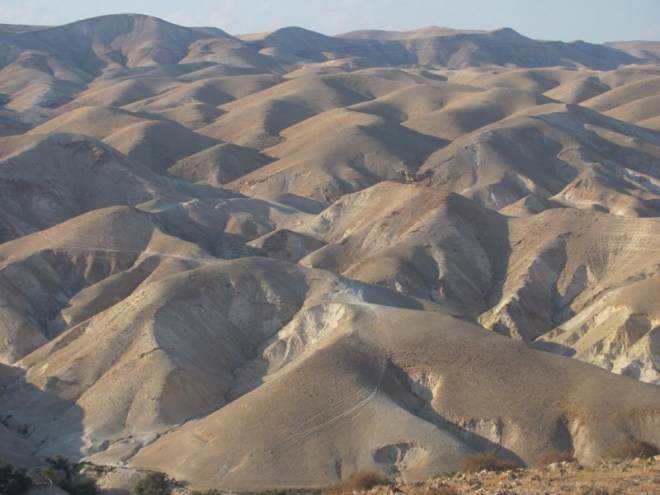
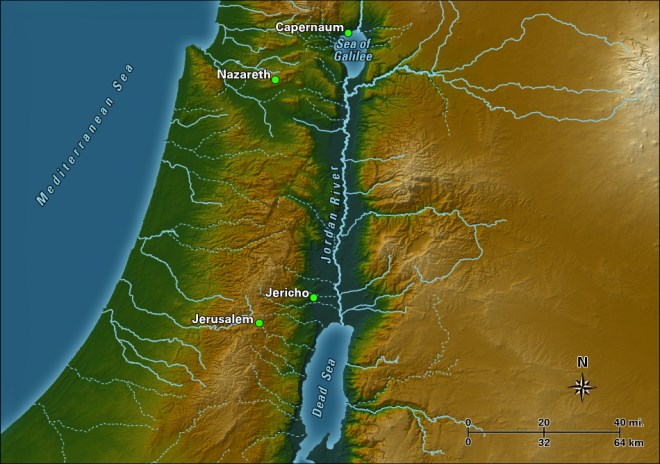
John’s ministry took place in the Judean wilderness, east of the central mountain range upon which Jerusalem sat.

judean desert, biblicalisraeltours

Biblical Israel Tours

John was baptizing people in the Jordan river when they gave evidence of repentance.

jordan river

jordan river (near where jesus was baptized), ebibleteacher

Jesus comes to John to be baptized (in a place near the picture above)

10 And when he came up out of the water, immediately he saw the heavens being torn open and the Spirit descending on him like a dove. 11 And a voice came from heaven, “You are my beloved Son; with you I am well pleased.”

Ann Spangler and Lois Tverberg, in their book Sitting at the Feet of Rabbi Jesus have this to say about this portion of Scripture.  It is about the rabbinic habit of “stringing pearls.”

Believe it or not, God himself seems to enjoy “stringing pearls.”  Do you remember the scene in which Jesus is being baptized by his cousin John?  Listen to how the Father spoke from heaven at Jesus’ baptism (Mark 1:11):  “You are my Son, whom I love; with you I am well pleased.”  At face value this seems like a simple, though wonderful, affirmation.  But it’s so much more than that.  Did you catch all the references?  If not, here they are:

  • “You are my Son” is from Psalm 2:7:  “He said to me, ‘You are my Son; today I have become your Father.’”
  • “whom I love” is from Genesis 22:2:  “Take your son, your only son, Isaac, whom you love, and go to the region of Moriah.  Sacrifice him there as a burnt offering on one of the mountains I will tell you about.”
  • “with you I am well pleased”  is from Isaiah 42:1:  “Here is my servant, whom I uphold; my chosen one in whom I delight; I will put my Spirit on him and he will bring justice to the nations.”

What was God saying by making use of these quotations?  To answer this question, you need to know two things:  the context from which each passage is drawn and the way in which the people of that time understood the passage.  Both Psalm 2 and Isaiah 42 were understood as powerful messianic prophecies.  In Psalm 2, God makes a royal proclamation announcing his Son, the King of kings who would rule over the whole earth.

But in Isaiah 42, God speaks about his “servant” (also understood to be the Messiah).  Paradoxically, God’s Messiah is both a king and a servant.  This passage from Isaiah also proclaims that God’s Spirit is upon his servant.  How fitting since the Father utters these words as the Spirit descends upon Jesus in the Jordan River.

The reference “whom I love” is likely drawn from Genesis 22, one of the most poignant scenes in the Old Testament.  Abraham is about to sacrifice Isaac out of obedience to God.  Genesis heightens the drama by emphasizing how precious Isaac is to Abraham, foreshadowing the Father’s own feelings for his only Son.  When Jesus is baptized in the Jordan, the Father is saying, “Here is my precious son, my Isaac,” hinting at the sacrifice he will soon ask of Jesus.

In just three brief quotes from the Scriptures, God speaks of Jesus as a king, a servant, and his Son, who will become a sacrifice.  When God speaks, he packs a lot into his words!  And be sure to notice where the three passages come from:  the Torah (Genesis 22), the Prophets (Isaiah 42), and the Psalms (Psalm 2).  Just like the rabbis, God links together the words from the three parts of Scripture.  By quoting all three, he is proclaiming that the entire Scriptures point to Jesus as their fulfillment.

pp. 43-45

I think these words are words fathers should speak into their children’s lives (especially their sons).  He identified him as “my son,” that he loved him and that he was proud of him.  There are no greater gifts a father can give his son than these–identity, love and affirmation.

And, by the way, the Father affirmed His Son before He had done anything!

12 The Spirit immediately drove him out into the wilderness.

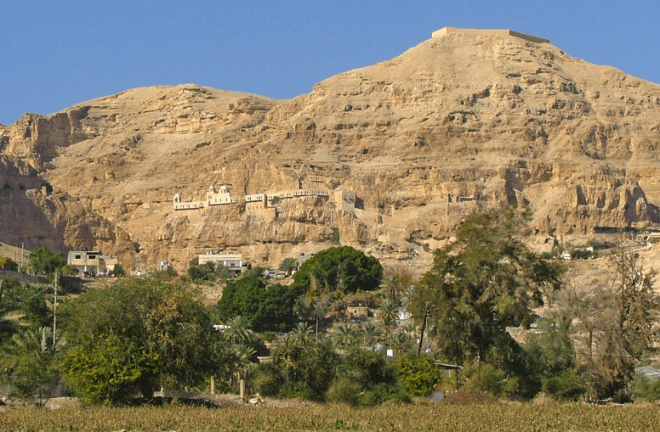
Some think the mount of temptation was right outside Jericho.mount of temptation above jericho

Jesus then starts his ministry by calling his first disciples (vv. 14-20).  Mark omitted Jesus” year of early Judean ministry (John 1:15-4:42), as did the other Synoptic evangelists. He began his account of Jesus” ministry of service in Galilee, northern Israel (Mark 1:14-6:6a).

“The time is fulfilled, and the kingdom of God is at hand; repent and believe in the gospel” (Mark 1:15) summarizes Jesus’ whole ministry in Galilee.  The Messianic could begin, Jesus says, but only through repentance and faith.

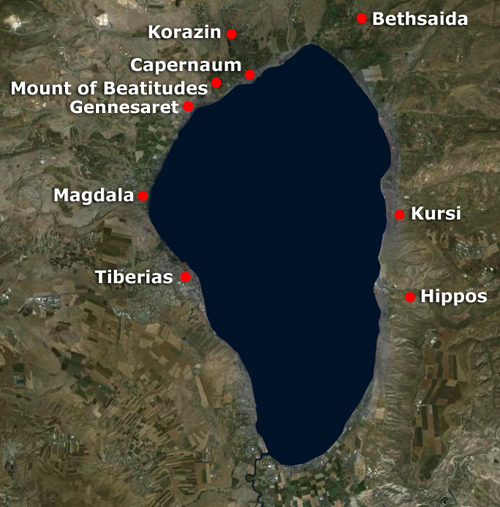
sea of galilee map, a. d. riddle

Map by A. D. Riddle

The area around the Sea of Galilee was the scene of much of Jesus’ 3-year ministry.  He lived in Capernaum and here he met his first group of disciples, fishermen.

The command/invitation “follow me” would likely have thrilled the hearts of these men.  Likely passed over for promotion to rabbinic school, they were given a new opportunity to follow a rabbi, and this one they had heard about–he was healing the sick, giving sight to the blind, casting out demons.  He was the real deal!

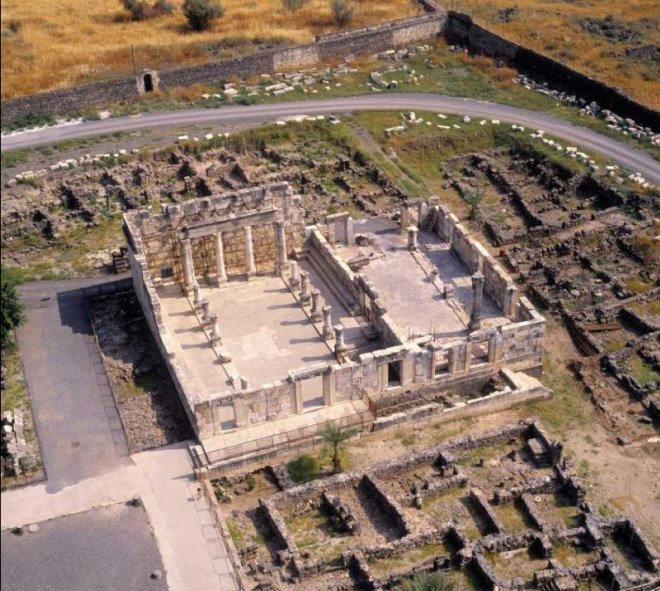
Verse 21-28 capture Jesus’ teaching and healing ministry in the Capernaum synague.aerial view of capernaum synagogue

This is a reconstruction of 4th century synagogue, likely on the same site as the synagogue Jesus taught in.

Jesus taught with authority, cast out a demon, and grew in popularity (vv. 21-28), when to Simon’s house and healed his mother-in-law (vv. 29-31), then healed many otherss (vv. 32-34).  All-in-all, a productive, but long and tiring day.

That’s what makes Mark 1:35 stand out…

35 And rising very early in the morning, while it was still dark, he departed and went out to a desolate place, and there he prayed.

Even Jesus, the almighty creator of heaven and earth, needed to get away, get alone where it was quiet, and pray.  How much more do we need to get away early in the morning, to pray.

Grassmick notes:

“Mark selectively portrayed Jesus at prayer on three crucial occasions, each in a setting of darkness and aloneness: near the beginning of his account (Mark 1:35), near the middle (Mark 6:46), and near the end (Mark 14:32-42).  All three were occasions when He was faced with the possibility of achieving His messianic mission in a more attractive, less costly way.  But in each case He gained strength through prayer.”

This time in help helped Jesus focus on the Father’s will for Him.  He was always careful to follow the Father’s plan.  Even though He was popular here, Jesus knew He had to move on.

38 And he said to them, “Let us go on to the next towns, that I may preach there also, for that is why I came out.”

We go to God in prayer to get orders from our commander and remind us why we are here today and what we are to do next.

Esther 6

Meanwhile (6:1-3), the king couldn’t sleep (cf. Daniel 6:18 for another king who couldn’t sleep), and asked for a boring book to be brought to him (the Congressional Record), to put him to sleep.  There, the king realized that he had never honored Mordecai for his loyalty.

This was a remarkable example of Providence in action.  King Ahasuerus can not sleep, and he can choose 20 different diversions to fill his sleepless night – but he commands that a book be brought to him and read.  The one commanded to bring the book could have brought any one book of the records of the chronicles, but he brought one particular book.  The book could be opened to any page, but it was opened to the exact page telling the story of Mordecai and how he saved the King from assassination.  God guided every step along the way.

–David Guzik

While Satan was putting it into the heart of Haman to contrive Mordecai’s death; God was putting it into the heart of the king to honor Mordecai.

Normally, this king quickly rewarded people who did him special services.  Herodotus gave two examples of Xerxes doing this. [Note: Herodotus, 8:85,9:107.]  Consequently, when he discovered that he had overlooked Mordecai”s favor, the king moved speedily to rectify the oversight.

Haman enters the court, ready to ask the King to impale Mordecai, and the king asks, “What should be done for the man the king delights to honor?” (v. 6).

Thinking the king was talking about him, Haman suggests dressing him in a royal robe, setting him upon a horse from the king’s stable led by someone, and having people bow down in honor (6:7-9).

The king says, “Go and do this for Mordecai,” which Haman does, and then goes home in shame, where his wife “prophesies” that these events show that he will go down in flames!  Then he had to go to the banquet. (6:10-14)

Esther 6:14 means that Haman hastened to go to the banquet.  He did not want to be late.  It does not mean that he was reluctant to go and that the eunuchs needed to hurry him along.  He evidently looked forward to the banquet as an opportunity to lift his spirits, little realizing that it would be the scene of his exposure and condemnation.

Romans has always stood at the head of Paul’s letters, and rightly so. Since Acts ends with Paul’s arrival in Rome, it is logical to have the Epistle section of the New Testament begin with the apostle’s letter to the Roman church, written before he visited the Christians there. More decisively, Romans is the most important book theologically in the whole New Testament, being as close to a systematic theology as will be found in God’s word.

–William MacDonald

Romans is the Paul’s greatest letter.

Augustine was converted reading a single verse from Romans 13:14.  Martin Luther also, meditating on Romans 1:17.  John Wesley “felt my heart strangely warmed. I felt I did trust in Christ” hearing someone reading Luther’s Preface to the Epistle to the Romans.

“All roads in the Bible lead to Romans, and all views afforded by the Bible are seen most clearly from Romans, and when the message of Romans gets into a person’s heart there is no telling what may happen.”  (J. I. Packer, in the last chapter of Knowing God).

Paul showed how human beings lack God’s righteousness because of our sin (1–3), receive God’s righteousness when God justifies us by faith (4–5), demonstrate God’s righteousness by being transformed from rebels to followers (6–8), confirm His righteousness when God saves the Jews (9–11), and apply His righteousness in practical ways throughout our lives (12–16).

In Romans 1 Paul begins with his introduction 1:1-17, with his typical salutation (vv. 1-7), identifying the writer (1:1), introducing the subject of the letter (1:2-5) and greeting the original readers (1:6-7).

Paul had not yet met these Christians in Rome and expresses his desire to see them (vv. 8-15).

Paul gives his thanksgiving for their faith (vv. 8-9) and expresses his desire to see them (v. 10).  He felt an obligation to preach the gospel to them (vv. 14-15).

Why “preach the gospel” to them?  Weren’t they already Christians?  It is possible that some of them were unclear about the gospel.  Or it is possible that, like us, the gospel is never something we leave behind, but need to delve deeper into.

In his article, “The Centrality of the Gospel,” Tim Keller helpfully elucidates the all too simple but all to neglected diagnosis of our spiritual ‘issues’.

We never “get beyond the gospel” in our Christian life to something more “advanced.”  The gospel is not the first “step” in a “stairway” of truths, rather, it is more like the “hub” in a “wheel” of truth.  The gospel is not just the A-B-C’s but the A-Z of Christianity.  The gospel is not just the minimum required doctrine necessary to enter the kingdom, but the way we make progress in the kingdom.

We are not justified by the gospel and then sanctified by obedience, but the gospel is the way we grow (Gal. 3:1-3) and are renewed (Col. 1:6). It is the solution to each problem, the key to each closed door, the power through every barrier (Rom. 1:16-17).  It is very common in the church to think as follows.  “The gospel is for non-Christians.  One needs it to be saved.  But once saved, you grow through hard work and obedience.”  But Col. 1:6 shows that this is a mistake. Both confession and “hard work” that is not arising from and “in line” with the gospel will not sanctify you-it will strangle you.  All our problems come from a failure to apply the gospel.  Thus when Paul left the Ephesians he committed them “to the word of his grace, which can build you up” (Acts 20:32).

The main problem, then, in the Christian life is that we have not thought out the deep implications of the gospel, we have not “used” the gospel in and on all parts of our life.  Richard Lovelace says that most people’s problems are just a failure to be oriented to the gospel-a failure to grasp and believe it through and through. Luther says, “The truth of the Gospel is the principle article of all Christian doctrine. . . . Most necessary is it that we know this article well, teach it to others, and beat it into their heads continually.”  The gospel is not easily comprehended.  Paul says that the gospel only does its renewing work in us as we understand it in all its truth.  All of us, to some degree live around the truth of the gospel but do not “get” it.  So the key to continual and deeper spiritual renewal and revival is the continual re-discovery of the gospel.  A stage of renewal is always the discovery of a new implication or application of the gospel-seeing more of its truth.  This is true for either an individual or a church.

Starting in v. 16-17 serve as a bridge introducing us to the first major section of Romans–that all men are under sin (1:18-3:20)

16 For I am not ashamed of the gospel, for it is the power of God for salvation to everyone who believes, to the Jew first and also to the Greek. 17 For in it the righteousness of God is revealed from faith for faith,as it is written, “The righteous shall live by faith.”

It was the “righteousness of God” that first caused Luther to hate God, for it was what God (impossibly) required of us.  But then it dawned upon him that this righteousness was not something he had to achieve, but something that could be received.  It was a gift of God.  The theme of Romans 1:18-5:11 is that God imputes (credits) righteousness into our moral account when we believe in Jesus Christ.

In August of 1513, a monk lectured on the book of Psalms in a seminary, but his inner life was nothing but turmoil.  In his studies, he came across Psalm 31:1:  In Thy righteousness deliver me.  The passage confused him; how could God’s righteousness do anything but condemn him to Hell as a righteous punishment for his sins?  Luther kept thinking about Romans 1:17, which says that in the gospel, the righteousness of God is revealed through faith for faith; as it is written, “He who through faith is righteous shall live” (Habakkuk 2:4). 

The monk went on to say: “Night and day I pondered until . . . I grasped the truth that the righteousness of God is that righteousness whereby, through grace and sheer mercy, he justifies us by faith.  Therefore I felt myself to be reborn and to have gone through open doors into paradise . . .  This passage of Paul became to me a gateway into heaven.”

Martin Luther was born again, and the reformation began in his heart.

–David Guzik

Paul first elaborates on the sinfulness of humanity (1:18–3:20), demonstrating the universal need of righteousness.

Here in Romans 1:18-32 Paul is saying that everyone is responsible for the revelation they have received through creation.  It is undeniable and therefore everyone is without excuse.

But because mankind chooses to worship the creation over the creator, we have degenerated into adulterers (vv. 24-25), into homosexuals (vv. 26-27) and finally into a depraved mind (vv. 28-32).  The consistent phrase in these verses is “God gave them up” to reap the fruits of their own desires.

In each of these cases, mankind is venerating something (usually sex) above God.


Quotes to Ponder

“Speak up for those who cannot speak for themselves; ensure justice for those being crushed. Yes, speak up for the poor and helpless, and see that they get justice.”  -Proverbs 31:8-9 NLT


“In keeping silent about evil, in burying it so deep within us that no sign of it appears on the surface, we are implanting it, and it will rise up a thousand fold in the future. When we neither punish nor reproach evildoers, we are not simply protecting their trivial old age, we are thereby ripping the foundations of justice from beneath new generations.”
― Aleksandr Solzhenitsyn, The Gulag Archipelago

Graeme Goldsworthy on one defective concept of Jesus Christ that is fairly common among evangelical Christians:

[I]n some circles, Jesus is conceived of a really not human at all.  I hasten to add that mostly we evangelicals would deny that we hold to heretical views, even though we then express them in word and song!  Thus the chorus ending, “You ask me how I know he lives; he lives within my heart.”  Yet to ignore the fact that Jesus is bodily in heaven and sends his Spirit to us (Rom. 8:9-11), is to be in danger of focusing our faith on what is happening within us rather than on the objective, finished work of the Son of God (Col. 3:1; Heb. 9:24).  Soon our feelings and spiritual euphoria become the means for gauging our spiritual health and for having assurance of salvation.  Faith then becomes faith in our feelings of having Jesus “in our hearts.”  We must remember that we know that Christ lives because the Bible tells us so, not because of a subjective feeling of having Jesus “in me.”  The same biblical word informs and assures us of the power of Christ in his gospel to save and to give us the grace of perseverance until our earthly life’s end.

From The Son of God and the New Creation

“If you need a guide for your ongoing relationship with God, read Psalms.”
― Jim George

“The more deeply we grow into the psalms and the more often we pray them as our own, the more simple and rich will our prayers become.”
― Dietrich Bonhoeffer

M’Cheyne Bible Reading Plan, January 28

Today’s readings are Genesis 29, Matthew 28, Esther 5 and Acts 28.  Today we end Matthew and Acts.

In Genesis 29, unlike in Genesis 24, when Jacob goes to Haran to look for a wife he doesn’t pray.  However, he wasn’t a slacker.  He rolled the stone away and watered Rachel’s sheep.  Find out that Rachel belonged to Laban he rejoiced, but didn’t worship.

Bruce Waltke notes that this present scene (29:1-14) is “chiefly about God’s providence versus Jacob’s prayerlessness” (Waltke, Genesis, p. 402).

So Jacob marries…two daughters of Laban.  One he loved, Rachel, but Laban tricked him and gave him Leah first, thus forcing Jacob to work for him seven more years for Rachel.

David Guzik notes:

It was possible for Jacob to be fooled because of the wedding customs of the day.  According to those customs the wife was veiled until she was finally alone with her husband in the “honeymoon suite.”  If it was dark by the time Jacob and his new bride were alone together (something Laban would not have difficulty arranging), it helps explain how Jacob was fooled.

And Thomas Constable says…

Jacob had pretended to be his older brother, and now Leah pretended to be her younger sister.  Laban and Leah deceived Jacob as Jacob and Rebekah had deceived Isaac.  Perhaps Jacob”s eating and drinking at the feast had clouded his mind (Genesis 29:22).

As Jacob had deceived Isaac by taking advantage of his inability to see due to poor eyesight (Genesis 27:36), so Laban deceived Jacob by taking advantage of his inability to see in the dark tent (Genesis 29:25).

The “bridal week” was the week of feasting that followed a marriage (Gen. 29:27; cf. Judges 14:12; 14:17). Jacob received Rachel seven days after he had consummated his marriage to Leah (cf. Genesis 29:28, 30).

The Hebrew name “Rachel” means “ewe,” and “Leah” means “cow.”  Ironically, Laban treated them as cattle and used them for bargaining and trading.

“Zilpah” means “small nose,” and “Bilhah” means “carefree.”  Jacob married two women in eight days.  The Mosaic Law later prohibited marrying two sisters at the same time (Leviticus 18:18). Bigamy and polygamy were never God”s will, however (Genesis 2:24).

Notice that Jacob was behaving like his parents, who each favored one son above the other, by favoring one of his wives above the other.  In both cases serious family problems followed.

Then Jacob began to have children, by one wife, then another.

Image result for jacob's son and their names

Image result for jacob's son and their names

There was definitely jealousy and competition between Rachel and Leah, and later between their sons.

Matthew 28–Christ is risen

he is risen!

What Happened on the Cross

by John Damascene (c. 675 – 749)

By nothing else except the death of our Lord Jesus Christ
has death been brought low:

The sin of our first parent destroyed,
hell plundered,
resurrection bestowed,
the power given us to despise the things of this world,
even death itself,
the road back to the former blessedness made smooth,
the gates of paradise opened,
our perfected nature seated at the right hand of God,
and we made children and heirs of God.

Here for Steven Green’s Christ the Lord is Risen Today.

garden tomb in jerusalem

“Mary Magdalene and the other Mary went to see the tomb” (Matt. 28:1) and the angel said to them ““Do not be afraid, for I know that you seek Jesus who was crucified.  He is not here, for he has risen, as he said. Come, see the place where he lay” (vv. 5-6).  Hallelujah!

An angel had announced the Incarnation, and now an angel announced the Resurrection (Matt. 1:20-23); cf. Matt. 18:10).

7 Then go quickly and tell his disciples that he has risen from the dead, and behold, he is going before you to Galilee; there you will see him. See, I have told you.” 8 So they departed quickly from the tomb with fear and great joy, and ran to tell his disciples.

“Fear and great joy,” what would you feel, knowing your Lord, whom you have been with for at least a couple of years, whom you have seen doing miracles, teaching God’s truth, casting out demons…has come back!

They should “go quickly” because this was great news indeed.

Of all the possible reasons for the tomb being open and empty that the women could have imagined, the angel clarified the one true explanation.  Jesus had risen from the dead.  The angel reminded them that Jesus had predicted His resurrection (cf. Matthew 16:21; 17:23; 20:18-19).  He then invited them to come and see where He had lain and to go and tell the other disciples that He had risen from the dead.

Now, the guards and religious elders concocted a story (read “fake news”) that the disciples had stolen Jesus’ body, if anybody asked (28:11-15).

Jesus then commissioned his disciples to go make more disciples (28:16-20).

Notice the repetition of “all” in vv. 18-20 : all authority, all nations, all things, and all the days.

We make disciples by going, baptizing and teaching.  And notice, it is “teaching them to obey all that I have commanded you.”  Teaching without application does not fulfill the great commission.  Call people to do something!

We have His authority (v. 18) and His presence with us always.  There are no excuses.  We have everything we need.

Here is a good word from Francis Chan…

Esther 5

Chapters 5-7 carry us to the climax of our story.  They show how God providentially preserved and protected His people.

Chapter 5 is about Esther’s wisdom in preparing an audience with the king and exposing Haman as the enemy of the Jews, and thus of the Persian Empire.

Here we have an example of how God controls the hearts of kings (Prov. 21:1).

Esther prepares a first banquet (5:1-8), inviting Haman as well.  Esther does not reveal her petition at this time, but requests another banquet the following day.

Literally the Hebrew says, “so we may do the word of Esther.”  This is a deliciously ironic twist on a king who only three chapters before was terrified that women might not do the word of their husbands.  Vashti was banished for not coming when the king called, but now Esther has gotten away with coming when the king did not call.  The king who worried about women obeying their husbands is now obeying his wife, and ordering Haman to obey her as well.  And to add irony to irony, Haman not only obeys a woman, but delights in being hosted by a Jew—a Jew passing as a Persian so splendidly that she puts the lie to all he said about her people’s disruptiveness.

–Patricia K. Tull

Esther. why wait?  The king has asked you for your request, twice!  The enemy is right there beside you!  Every day your fellow Jews are suffering!

BUT! — God will use the next 24 hours to accomplish important things!  The king will have insomnia, and Haman will initiate a construction project. . .

What are you waiting for the Lord to do for you?  As you wait, God is at work on your behalf.

“Wait on the Lord” (Psalm 27:14; 33:20-22; 62:5; 130:5-6; Isaiah 40:30-31; Lamentations 3:25; Isaiah 30:18

Haman leaves on cloud nine, but that quickly disappears when he sees Mordecai and Mordecai does not rise or show fear in his presence (5:9).  Haman goes home, boasting to family and friends that he was rich, that he alone was invited to Queen Esther’s banquet, and yet complaining that Mordecai the Jew does not bow to him (5:10-13).

His wife Zeresh suggests that he set up a pole and ask the king the next day to have Mordecai impaled upon it (5:14).  No, Haman apparently had not read Proverbs Proverbs 26:27…

Whoever digs a pit will fall into it, and a stone will come back on him who starts it rolling.

Well, this is a pole, not a pit.  Whatever.

Acts 28, Paul finally gets to Rome.  28:1-10 tells us that Paul and those on his ship stayed first in Malta, where they were treated well by the people, but Paul was bitten by a snake.  They thought, “bad luck,” but when he didn’t die they changed their minds and thought he was a god (28:4-6).  Paul then healed Publius’ father (v. 8) and several others (v. 9) so that Paul was honored by the people (v. 10).

After three months they sailed sailed to Syracuse and stayed there for three days (v. 11-12).

acts 28--paul arrives in rome, bob's boy's christianity blog

13a And from there we made a circuit and arrived at Rhegium.

Notice that they missed going through the Straits of Messina.

strait of messina, wikipedia

The waters there are treacherous.

ers2 radar view of strait of messian

So much so that in Greek mythology, a six-headed monster named Scylla lived on the Italian Peninsula and would pull sailors up and devour them if they came within her grasp, while an all-consuming whirlpool called Charybdis, on the Sicilian side, would suck passersby to their deaths.

steering a couse through the strait of messian, between scylla and charybdis

In Homer’s Odyssey, Odysseus and his crew confronted the two monsters while navigating through the Strait.  Emphasizing the dangers of the narrow Strait – 32 kilometres long and from 3 to 16 kilometres wide – it was only possible to avoid one of the monsters by sailing closely to the other.  Odysseus navigated his ship through safely, but Scylla managed to catch and devour six of his men.

But Paul didn’t go that way.

13b And after one day a south wind sprang up, and on the second day we came to Puteoli.

Image result for Puteoli

Notice that Puteoli is not far from Mount Vesuvius and Pompeii.  Mt. Vesuvius erupted in 79 A.D., destroying both Pompeii and Herculaneum.

mount vesuvius

Mount Vesuvius Today, Italy Magazine

harbor of puteoli 1, carl rasmussen

Puteoli Harbor, Carl Rasmussen

14 There we found brothers and were invited to stay with them for seven days. And so we came to Rome.  15 And the brothers there, when they heard about us, came as far as the Forum of Appius and Three Taverns to meet us. On seeing them, Paul thanked God and took courage.

News of Paul”s arrival preceded him to Rome.  An entourage of believers traveled down the Appian Way, one of the major roads in Italy, 33 miles south to the Three Taverns, a resting spot.  There some of them waited while the more energetic among them proceeded another 10 miles to Appii Forum, a market town.

There Paul met his first Roman Christians.  He had sent them his epistle to the Romans three years earlier (in A.D. 57) from Corinth during his third missionary journey.  This group of greeters would have been a great encouragement to Paul who had looked forward so long to ministering in Rome (Rom. 15:22-29).  Their reception led Paul to thank God.  The trip from Malta probably took three weeks.

Paul was placed under house arrest (28:20) this first time in Rome (v. 16) and was allowed visitors.  He explained why he was in Rome (vv. 17-22) so many came to hear him (vv. 23) and there was the typical response:

24 And some were convinced by what he said, but others disbelieved.

So Paul, quoting Isaiah 6 (vv. 25-27) about their hardness of heart, turned to the Gentiles (v. 28)

Acts 28:28 is probably the ultimate climax of Acts.  It summarizes the main theme of the book. Having presented the gospel to the Jews in Rome, and having witnessed their rejection of it, Paul now focused his ministry again on the Gentiles (cf. Acts 13:46-52; 18: 6; Rom. 1:16).  Until “the times of the Gentiles” run their course and Messiah”s second advent terminates them, Gentiles will be the primary believers of the gospel (cf. Romans 11:19-26).

Luke -Acts is basically a story about a mission.  Acts 28:28 comments on the mission”s future.  The narrative prepares for this comment by reports of the Gentiles” friendly response to Paul on the voyage and the Roman Jews” contrasting response.  When we recognize the careful reflection on the possibilities of mission among both Gentiles and Jews in Acts 27-28 , the impression that the ending of Acts is abrupt and unsuitable is considerably reduced.” [Note: Tannehill, 2:343. See also Ladd, “The Acts . . .,” pp.  1177-78.]

30 He lived there two whole years at his own expense, and welcomed all who came to him, 31 proclaiming the kingdom of God and teaching about the Lord Jesus Christ with all boldness and without hindrance.

With this expression [i.e, unhindered], which is literally Luke”s last word in Acts , he is saying that largely through Paul”s activities, the Church is now on the march, and nothing can stop it, echoing Jesus words, “I will build my church and the gates of hell shall not prevail against it.”

Victory in Matthew 28 and Acts 28.


M’Cheyne Bible Reading Plan, January 27

Today’s readings are from Genesis 28, Matthew 27, Esther 4 and Acts 27.

Isaac sends Jacob away to Paddan-Aram (Haran), to find a wife.  He didn’t want Jacob to “take a wife from the Canaanite women” (Genesis 28:1).  He sends him away with a repetition of the covenant God made with Abraham (28:3).

jacob's journey to haran and back, headwater's christian resources

Esau (28:6-9) observes Isaac telling Jacob not to take a wife from among the Canaanites, so he marries again (cf. 26:34-35).  He marries one of one of Abraham’s descendants (a granddaughter, who was Ishmael’s daughter “Mahalath”).  “Mahalath” (“Dance,” v. 9) is evidently another name for, and the same woman as, “Basemath,” Ishmael’s daughter (36:2).

Meanwhile, Jacob went to Laban’s house in Haran.  Traveling up the Way of the Patriarchs he slept for the night and he had a dream of a ladder, with angels ascending and descending on it (vv. 11-12) and there God covenanted with Jacob…

13 And behold, the LORD stood above it and said, “I am the LORD, the God of Abraham your father and the God of Isaac.  The land on which you lie I will give to you and to your offspring. 14 Your offspring shall be like the dust of the earth, and you shall spread abroad to the west and to the east and to the north and to the south, and in you and your offspring shall all the families of the earth be blessed. 15 Behold, I am with you and will keep you wherever you go, and will bring you back to this land. For I will not leave you until I have done what I have promised you.”

Impressed by the dream and God’s presence (vv. 16-17), he took his stone pillow, make a pillar (v. 18) upon which he poured oil in worship and named the place Bethel.  This place already had a history of significance for the family of Abraham.

  • Near Bethel, Abraham built one of the first altars mentioned in the Bible, and there he “invoked the name of the Lord.” (Genesis 12:8)
  • After Abraham had fled to Egypt to escape a famine in the Holy Land, he returned to the same place near Bethel, and once again invoked the name of the Lord. (Genesis 13:1-4)
  • Laterm, after Jacob’s return to the Holy Land, Bethel was the second place where he and his family settled. There he set up an altar to God, and God spoke to him. (Genesis 35:1-15)

In response to God’s promises to Jacob, Jacob says…

20 Then Jacob made a vow, saying, “If God will be with me and will keep me in this way that I go, and will give me bread to eat and clothing to wear, 21 so that I come again to my father’s house in peace, then the LORD shall be my God, 22 and this stone, which I have set up for a pillar, shall be God’s house.  And of all that you give me I will give a full tenth to you.”

Jacob is trying to bargain with God.  He’s still trying to do it his own way, not yet living by faith.  Jacob’s life is in chaos, not unlike ours when the Spirit calls us.

Matthew 27 recounts the crucifixion of Jesus.  Jesus is led away to Pilate (27:1-2).

david's citadel--where pilate would have met with jesus

David’s citadel, where Pilate might have met with Jesus, or possibly…

location of antonio fortress in relation to temple mount

close up of antonio fortress

Judas regrets his decision to betray Jesus (27:3-4) and throws the money away.  Judas’ remorse was incomplete.  It was like what Paul expresses in 2 Corinthians 7:9-11…

9 As it is, I rejoice, not because you were grieved, but because you were grieved into repenting. For you felt a godly grief, so that you suffered no loss through us. 10 For godly grief produces a repentance that leads to salvation without regret, whereas worldly grief produces death. 11 For see what earnestness this godly grief has produced in you, but also what eagerness to clear yourselves, what indignation, what fear, what longing, what zeal, what punishment!  At every point you have proved yourselves innocent in the matter.

the hinnom valley, where judas hanged himself

The Valley of Hinnom, where Judas hanged himself

After Jesus’ initial answer to Pilate’s first question, Jesus remained silent.  Pilate asked, “Are you the King of the Jews?” Jesus said, “You have said so.”  After that, Jesus was silent.  That is contrasted later in the passage with the shouts of the crowd.

Only Luke reported that now Pilate sent Jesus to Herod Antipas for questioning (Luke 23:6-12).  Herod then returned Jesus to Pilate.  Pilate then tried to substitute another prisoner for Jesus, Barabbas (vv. 15-21.  The religious leaders would not hear of it.  Then Pilate’s wife warned him to have nothing to do with Jesus because of a dream she had (v. 19).

The crowds shouted “Crucify him!” (vv. 22-23), so Pilate symbolically washed his hands of the whole matter (vv. 24-25).  Pilate tried to claim innocence (v. 26) and the Jewish people gladly accepted their guilt (v. 27).  Neither of them knew what they were talking about.

Jesus was first scourged (v. 28) and sent to be crucified.

roman scourge, bible historyscourging, scott woodward

The whip (flagrum or flagellum) consisted of several single or braided leather thongs of variable lengths, in which small iron balls or sharp pieces of sheep bones were tied at intervals.

As the Roman soldiers repeatedly struck the victim’s back with full force, the iron balls would cause deep contusions, and the leather thongs and sheep bones would cut into the skin and subcutaneous tissues. Then, as the flogging continued, the lacerations would tear into the underlying skeletal muscles and produce quivering ribbons of bleeding flesh.  Pain and blood loss generally set the stage for circulatory shock.  The extent of blood loss may well have determined how long the victim would survive on the cross.

During the 12 hours between 9 PM Thursday and 9 AM Friday, he had suffered great emotional stress (as evidenced by hematidrosis), abandonment by his closest friends (the disciples), and a physical beating (after the first Jewish trial).  Also, in the setting of a traumatic and sleepless night, had been forced to walk more than 2.5 miles (4.0 km) to and from the sites of the various trials.  These physical and emotional factors may have rendered Jesus particularly vulnerable to the adverse hemodynamic effects of the scourging.

27 Then the soldiers of the governor took Jesus into the governor’s headquarters, and they gathered the whole battalion before him.  28 And they stripped him and put a scarlet robe on him, 29 and twisting together a crown of thorns, they put it on his head and put a reed in his right hand. And kneeling before him, they mocked him, saying, “Hail, King of the Jews!” 30 And they spit on him and took the reed and struck him on the head.

crown of thorns

Thomas Constable explains:

The Sanhedrin and or its servants had abused Jesus as a false Messiah (26:67-68). Now Pilate’s soldiers abused Him as a false king.  Ironically, Jesus was everything He was mocked for being: Messiah and King of Israel.  The “scarlet robe” (Gr. chlamys) they put on Jesus (v. 28) was probably the reddish purple cloak that Roman military and civil officials wore.  Perhaps the thorny spikes that the soldiers wove into a circle (“crown of thorns”) resembled the one on Tiberius Caesar’s head, on Roman coins, that consisted of palm branches.

The imperfect tense of the Greek verb translated “beat” means they beat Jesus on the head repeatedly (cf. Isa. 52:14).

Of course, this robe, which was later torn off, would have been stuck to Jesus’ body by the drying blood.  This would have been worse than body waxing!

31 And when they had mocked him, they stripped him of the robe and put his own clothes on him and led him away to crucify him. 32 As they went out, they found a man of Cyrene, Simon by name. They compelled this man to carry his cross.

Jesus was able to carry the crossbeam of His cross until He passed through the city gate (cf. Mark 15:21; John 19:17).  Normally crucifixions took place outside the city wall (cf. Lev. 24:14; Num. 15:35-36; 1 Kings 21:13; Acts 7:58), which symbolized additional rejection (cf. Heb. 13:13).

Evidently some women offered Jesus some wine to drink, to which they had added myrrh to decrease His pain (Mark 15:23).  Jesus refused it after tasting it, because He chose to endure the cross fully conscious.

It would be appropriate to read Isaiah 53 here.

The Romans normally tied or nailed the victim to the crossbeam of his cross.  In Jesus’ case they did the latter.

nail driven in hand

They would then hoist the crossbeam and the prisoner up onto the upright member of the cross. Next they would fasten the crucified person’s feet to the upright, by tying with a rope, or nailing them with a large spike.

nailing in foot

The Romans constructed crosses in various shapes: an X, a T, or, as in Jesus’ case, the traditional T with the upright extending above the crossbeam (v. 37). Sometimes the victim was only a few inches off the ground, but Jesus appears to have been a few feet higher (v. 48; John 19:29).

cross

35 And when they had crucified him, they divided his garments among them by casting lots.

Normally victims would be crucified naked, except for a loincloth.  The four executioners took the criminal’s clothes for themselves.  These would have been his shoes, his turban, his girdle, his inner garment, and his outer cloak or robe.  In Jesus’ case, they cast “lots” for His robe (“garments”), fulfilling Psalm 22:18 (cf. John 19:23-24).  This happened in the late morning on Friday (Mark 15:25; John 19:14).

The Romans reserved crucifixion for the worst criminals from the lowest classes of society.  Roman citizens were exempt from crucifixion unless Caesar himself ordered it.  For the Jews, crucifixion was even more horrible because it symbolized a person dying under God’s curse (Deut. 21:23).  Israel’s leaders hung up those who had died under God’s curse for others to see and learn from. Jesus bore God’s curse for the sins of humankind, so that people would not have to experience that curse (Galatians 3:13).

Jesus was mocked by the soldiers (vv. 37-38), by passersby (vv. 39-40), the religious leaders (vv. 41-43) and then the thiefs (v. 44), one of whom later stopped mocking and asked to be remembered.  Matthew did not record that anyone spoke in Jesus’ defense.

45 Now from the sixth hour there was darkness over all the land until the ninth hour.

From noon to 3 p.m. an abnormal darkness covered the land.  No matter how it happened, it symbolized judgment–first on Jesus as the sin-bearer, but also upon the Jews.  At this time Jesus “cried out” the words of Psalm 22:1, because He felt like His Father was abandoning Him when He “(became) sin for us” (2 Cor. 5:21) and bore God’s full wrath against sin.

Separation from the Father must have been the worst part of the Cross for Jesus who had never before experienced anything but intimate fellowship with His Father.

Since Jesus was God, I do not believe that He experienced actual separation from God the Father.  However, when the Father poured out His wrath on His Son—who took upon Himself the sins of the world—and for that moment and for that reason the relationship between the Father and the Son became different.  Jesus became the focal point of God’s judgment on mankind’s sin (cf. Rom. 3:21-26; 2 Cor. 5:21).  It was terrible and terrifying for Jesus.

The crowd thought Jesus was calling out to Elijah (vv. 47-49) and Jesus “cried out again with a loud voice and yielded up his spirit” (v. 50).

51 And behold, the curtain of the temple was torn in two, from top to bottom. And the earth shook, and the rocks were split.

The curtain spoken of here is the curtain which separated the Holy of Holies from the other portion of the Temple known as the Holy Place.  It was 40 cubits (60 feet) long, and 20 (30 feet) wide, of the thickness of the palm of the hand (Edersheim, The Life and Times of Jesus the Messiah, 2:611; idem, Sketches of Jewish Social Life, p. 197).

The tearing happened at 3:00 p.m., the time of the evening incense offering.  A priest would normally have been standing in the holy place offering incense when it tore (cf. Luke 1:8-10).  Some early non-biblical Jewish sources also report unusual phenomena in the temple 40 years before its destruction in A.D. 70, one of which is the temple curtain tearing. (Robert L. Plummer, “Something Awry in the Temple?  The Rending of the Temple Veil and Early Jewish Sources that Report Unusual Phenomena in the Temple around AD 30,” Journal of the Evangelical Theological Society 48:2 (June 2005):301-16)

“The fact that this occurred from top to bottom signified that God is the One who ripped the thick curtain. It was not torn from the bottom by men ripping it” (Barbieri, Forty Days with the Gospel of Matthew, Vol. 2, p. 90.)

This was a supernatural act that symbolized the opening of access to God and the termination of the Mosaic system of worship.  This event marked the end of the old Mosaic Covenant and the beginning to the New Covenant (cf. 26:26-29).  Jesus Himself now replaced the temple (cf. 26:61).  He also became the Great High Priest of His people.  The rent veil also prefigured the physical destruction of the temple, a necessary corollary to its spiritual uselessness from then on.

Then we have these two strange verses:

52 The tombs also were opened. And many bodies of the saints who had fallen asleep were raised, 53 and coming out of the tombs after his resurrection they went into the holy city and appeared to many.

The resurrection of these “saints” (OT believers?) happened “after his resurrection” but are likely mentioned here to show the incredible power of the crucifixion and its connection to the resurrection.  Who they were is unclear.  Were they raised “like Lazarus” to die again?

There was a confession by the centurion who, with awe, said that “Truly this was the Son of God.” (v. 54).  Joseph was given permission to take and bury the body of Jesus (vv. 57-61).  A guard was set upon the tomb “lest his disciples go and steal him away and tell the people, ‘He has risen from the dead,'” (v. 64).

Low in the grave He lay—
  Jesus my Savior!
Waiting the coming day—
  Jesus my Lord!

Esther 4

When Mordecai heard about the decree he reacted strongly, possibly because he felt responsible for it!

Notice that Mordecai put on sackcloth, wept aloud and fasted (v. 1).  There is no mention of prayer, but that does not definitely mean that he did not pray.  Jews around the provinces did the same (v. 2)

Esther finds out about Mordecai’s mourning, and becomes distressed herself (4:4).

Mordecai told Hathach what had happened with Haman and gave him a text of the annihilation decree, which Hathach reported to Esther (4:5-9).

Esther then sent work back to Mordecai that she would seek a time and way to approach the king (4:10-11).

Mordecai encouraged her not to shirk her responsibility to be involved in delivering her people (4:12-14). Here he utters those challenging words: “And who knows but that you have come to your royal position for such a time as this” (4:14)

We too get a choice to rise up to the situation in faith or slink back in fear and remain silent.  Will we obey the voice of God and speak and act for His glory or remain mute and motionless hoping that no one will notice?  If God is calling you to something and you remain silent, God will find another way… but you will miss out on how God wanted to use you for His purpose and lose the reward that would have been yours.

She responds to Mordecai’s challenge by asking for fasting (and we assume prayer) and then swallows her fears and says, “If I perish, I perish.” (4:15-17).

Finally Esther begins to see the depth of the problem and the need to follow Mordecai’s instructions no matter what the cost.  And it could potentially cost.  We shouldn’t underestimate the step that Esther took here and so it isn’t surprising that all the Jews in Susa are asked to fast for three days concerning Esther’s next move.  At the end of that time, Esther will do something that was not lawful to do (even for the Queen!) – she will go before the king unannounced.  If all goes well, he will extend the golden sceptre to her and she will find favour in his sight.  If the king is in the wrong mood, she will die.  It is a huge step of faith but one she is resolved to do!  ‘If I perish, I perish’ are the words on her lips as she takes each step of the journey.

John Gill comments on Esther’s abandonment to God’s will saying: “and if I perish, I perish; signifying, that she readily and cheerfully risked her life for the good of her people; and if such was the pleasure of God, that she should lose it, she was content, and acquiesced in his will, leaving herself entirely in his hands, to dispose of her as he thought fit.”

Again, the lack of references to God, or even prayer, indicate that God works behind the scenes to fulfill His promises even when people are far from Him and disobedient.

Acts 27 recounts Paul’s voyage to Rome, a true adventure.  Luke gives us an amazing amount of detail in this chapter, exhibiting it’s historical accuracy.

Toward the end of the nineteenth century a group of Scottish unbelievers decided to expose errors in the Bible.  They designated one of their number to visit all the places Luke mentioned that Paul visited with a view to proving the record in Acts inaccurate.  The man chosen was Sir William Ramsay who, after thorough study of the matter, concluded that Luke was accurate in every detail. [Note: Ironside, Lectures on . . ., pp 618-19.] Ramsay became a Christian and wrote several books on Acts and Paul in defense of God”s Word.

The circumstances of Paul’s Voyage to Rome were far different than for his earlier travels.  Before, he was a free man; this time, he was a prisoner of the Romans (Acts 21:27-26:32).

The Journey to Rome began in early fall of about 60 AD and ended the following spring of about 61 AD after a shipwreck near Malta.  The entire voyage is recorded in Acts chapters 27 and 28.

paul's voyage to rome, ferrell jenkins blog

Paul sails from Caesarea to Crete in vv. 1-8.

Most likely Paul sailed from Caesarea.  His ship originated from the port of Adramyttium just south of Troas opposite the island of Lesbos.  It was a coastal vessel that docked at most ports along the northeastern Mediterranean shoreline.  Sidon (v. 3) stood about 70 miles north of Caesarea.  So far, so good.

Prevailing winds in the Mediterranean during spring and fall usually blow from west to east and often from the northwest.  Consequently this ship sailed north up the east side of the island of Cyprus (cf. Acts 21:3).  Proceeding north it came to the coast of Cilicia and turned west passing Pamphylia and landing at Myra in Lysia, the southernmost region in the province of Asia. This was a 14-day journey by ship that spanned about 500 miles. [Note: Eckhard J. Schnabel, Early Christian Mission, 2:1266.]

Image result for Myra ferrell Jenkins

Harbor of Andriake, Ferrell Jenkins

andriake map

6 There the centurion found a ship of Alexandria sailing for Italy and put us on board. 7 We sailed slowly for a number of days and arrived with difficulty off Cnidus, and as the wind did not allow us to go farther, we sailed under the lee of Crete off Salmone.

This was a grain ship (Acts 27:38) that had accommodations for at least 276 passengers (Acts 27:37).  There were no ships devoted exclusively to passenger travel at this time. (Ben Witherington, The Acts of the Apostles: A Socio-Rhetorical Commentary, p. 759.)

According to a contemporary description, these large ships were usually 180 feet long, 50 feet wide, and 44 feet deep from the deck to the hold. [Note: Lionel Casson, Ships and Seamanship in the Ancient World, pp. 158-59.]

Still good sailing, so far.

apostle paul and the greek island of crete (cob-net.org)

They figured the lee (south) side of the island of Crete would give them protection from the strong northeasterly winds.  They were wrong.

 8 Coasting along it with difficulty, we came to a place called Fair Havens, near which was the city of Lasea.

Fair Havens

Fair Havens, Ferrell Jenkins

Evidently the captain waited for some time for the weather to improve in Fair Havens.  The “Fast” refers to the day of Atonement that fell in the fall each year, sometimes as late as early October.  People considered it dangerous to travel by sea between mid-September and mid-November, and the harbors closed for the winter from mid-November to mid-February.

Paul, a seasoned sea-traveler,  had already experienced shipwreck three times (2 Cor. 11:25).  He recommended staying through the winter at Fair Havens.

Verse 9-26 describe the storm at sea.

The centurion had the final word.  Grain ships of this kind were part of a fleet that was under the control of the Roman government even though private individuals owned the ships.  The pilot (captain) and the owner (rather than captain) carried more influence with the centurion than Paul did.  Fair Havens was suitable for wintering but not as desirable as Phoenix (modern Phineka, or possible Lutro).

“Euroquilo” means northeastern.  The wind changed from a mild southerly breeze to a violent northeasterly gale.  This wind drove Paul”s ship southwest away from Crete and the harbor at Phoenix.

15 And when the ship was caught and could not face the wind, we gave way to it and were driven along.

The small island of Clauda (modern Gavdos or Gozzo) lay south of Crete about 23 miles.  There appears to have been no adequate harbor there. However this island did provide enough temporary shelter for the sailors to haul the trailing rowboat (dinghy) on board.  Another safety measure was to feed ropes over the bow and hold them up against the ship”s hull from each side.  Drawn up tight under the ship these ropes helped to reinforce the internal braces of the hull.

The “shallows of Syrtis” (v. 17) might refer to areas of quicksand off the northern coast of Africa, or possibly shallow seas choked by seaweed.

The Greek word translated “sea anchors” (or “gear,” v. 17) simply means equipment and can refer to any gear, perhaps some of the sails and rigging here (cf. Acts 27:40).  With no stars they couldn’t navigate.  They were truly “at the mercy of the winds.”

Evidently the ship was taking on so much water that the captain decided to jettison the wheat on board as well as other cargo and all but the most essential tackle (cf. Jonah 1:5).  He kept some wheat on board probably for ballast as well as for food (Acts 27:38).

” All hope of our being saved was at last abandoned” (v. 20).  Now, I can remember one person saying, years ago, is that the reason for this comes from the KJV of verse 15 “we let her drive.”

Paul presumably mentioned his former advice at Fair Havens not to gloat, but to encourage his fellow travelers to believe what he was about to tell them.  What he had predicted had taken place, and what he was about to predict would also.  An angelic visitor now confirmed God’s former assurance to Paul that he would reach Rome (Acts 23:11).  He told Paul that all on board would reach land safely by running aground.

The winds and currents had carried Paul”s ship in a northwesterly direction from the south-central Mediterranean (vv. 27-28).  The sailors may have smelled the land, which sailors can do, or they may have heard the waves breaking on shore.

Shipwreck (vv. 27-44).  As they neared land, the crew (probably the first to suspect landfall) attempted to abandon ship.  They were caught, however, and the ship’s boat was cut away.  These men would be the only hope for everyone else were they to land the ship.

All on board needed to eat to gain strength for the work of getting ashore that lay ahead.  Paul gave thanks to God publicly for the food (cf. 1 Tim. 4:4-5).  This would have helped all present to connect their deliverance with God.

They lightened their load (v. 38) and eventually landed on a sandy beach (the second-best possible place to dock a boat!).  Although English versions say “reef” (v. 41), the Greek word does not specify it as a coral reef, but more like a sand bar.  Everyone, all 276 of them, eventually made it to shore safely.

maltese islands, acts 27 blog

Thomas Constable notes:

A British yachtsman and scholar who was familiar with the parts of the Mediterranean Sea that Paul covered on this journey retraced Paul”s route in the first part of the nineteenth century. His book relates his experiences and findings.  It is fascinating reading and confirms the accuracy of Luke”s references in this chapter. [James Smith, The Voyage and Shipwreck of St. Paul.]

This unusually dramatic and vivid chapter stresses God”s sovereign control over circumstances to bring His will to pass, specifically that Paul should minister in Rome.  It reminds us of Jesus” ability to control the winds and the waves of Galilee to accomplish His will and to communicate His identity.  He had sent His disciples into a storm (Luke 8:22-25)) just as He had sent Paul.

Jesus had predicted that He would build His church and that Hades” gates would not overwhelm it (Matthew 16:18).  This chapter shows to what lengths God will go to remain faithful to His promises.

M’Cheyne Bible Reading Plan, January 26

Today’s readings are Genesis 27, Matthew 26, Esther 3 and Acts 26.

In Genesis 27 Jacob tricks Isaac and Esau gets a lesser blessing.  Isaac apparently “lives to eat,” as expressed in v. 9, “delicious food for your father such as he loves” and v. 14 “his mother prepared delicious food such as his father loved.”  That is probably an inordinate (abnormal) love, such that made Isaac favor Esau.  It blinded him from seeing Esau’s own weakness for food back in Gen. 25:29-34.

So Isaac was not merely physically blind.  And this is what has always puzzled me–why could he not tell it was Jacob rather than Esau?  The answer is that Isaac was also spiritually blind to Esau’s faults.

Robert Gonzales also points out that Isaac’s own love for food and favoritism towards Esau, required that he confer the blessing “in secret,” instead of in front of the whole family (Genesis 49).  When we have an idol, we hide our behaviors.

Did Isaac know that Yahweh “love Jacob but hated Esau”?  Was he ignorant of what he should have known, or was he purposefully going against God?  Either way, he was in dangerous territory.

While this doesn’t excuse Jacob and Rebekah’s sin, it does show that God will get His way, even through the sins of people.  Maybe Isaac eventually bowed to this, for when Esau did come in, Isaac didn’t revoke Jacob’s blessing, but gave Esau another, lesser blessing.

As a result of all of this, Esau hated Jacob and would have killed him if Rebekah had not sent him away to Haran.

Photo of modern Haran by Leon Mauldin.

jacob's journey to haran and back, headwater's christian resources

I got this chart from Cheri Gregory on the internet…

genesis 27, meddling vs. helping chart, cheri gregory

Matthew 26 begins the passion of Christ.  Passover was coming (v. 2) and a plot was being hatched (vv. 3-4).

Bible Atlas

matthew 26 1-16, bethany

Bethany, 1800s

Jesus was in Bethany in the house of Simon (v. 5) and was anointed (vv. 6-13).  Most believe this is the same event as in John 12, so it was the Saturday before the crucifixion.

John recorded that Lazarus was there, his sister Martha helped with the serving, and their sister Mary was the woman who broke the vial and anointed Jesus’ head (and feet, John 12:2-3).  Perhaps Matthew did not mention them by name in order to keep Jesus central in his story. John further recorded that the pound of perfume cost 300 denarii, about one year’s wages for a working man (John 12:3, 5).  Matthew and Mark just said it was “very” expensive (“costly”).

That was a big issue for Judas who saw this as a waste (v. 8).  Apparently it was the tipping point for him, for he went to the chief priests to see what he could get as his “severance pay” (vv. 14-16).  He needed his “golden parachute” because he could see that this venture was going nowhere.  The “30 pieces of silver” they agreed to pay Judas was a paltry sum (in contrast to the “high price” at which Mary evaluated Jesus, v. 9), and fulfilled Zechariah 11:12.  The amount constituted a month’s wages, if the silver pieces were denarii, which seems likely.

upper room, carl rasmussen

Traditional Upper Room, photo by Carl Rasmussen

Jesus gave directions to prepare for Passover (vv. 17-19), then celebrated Passover with His disciples (vv. 20-29), after the betrayer left (vv. 21-25).  So Judas was not there went they celebrated “the Lord’s Supper.”

Thomas Constable notes:

As the first Passover looked forward to deliverance and settlement in the Promised Land, so the Lord’s Supper looked forward to deliverance and settlement in the promised kingdom.  Disciples are to observe the Lord’s Supper only until He returns (1 Cor. 11:26).  Then we will enjoy the messianic banquet together with our Savior and King (Isa. 25:6; cf. Matt. 8:11).  Probably Jesus spoke these words after drinking the third cup of the Passover ritual.

gethsemane, land of the bible

Garden of Gethsemane

Afterward they went out to the Mount of Olives (v. 30), where Jesus predicted Peter’s betrayal (vv. 31-35) and then asked them to watch and pray with Him (vv. 36-45).  Of course, they could not stay awake as Jesus faced his “dark night of the soul.”  Faced with alienation from the Father, He asked that the “cup be passed” from Him (v. 39).  But at every step, Jesus was willing to submit to the Father’s will.

what would jesus drink_ (matthew 26 39; john 18 11), nick batzig

agony in gethsemane__a tale of three gardens, jeffrey c. waddington

five reasons the father silently said ‘no’ to the son in gethsemane, thabiti anyabwile

the agony of gethsemane__the most amazing and terrifying scene in the bible, nathan cherry

Then, the soldiers, with Judas, came to arrest Jesus (vv. 40-56) and brought him to Caiaphas, the officiating high priest (v. 57).

model of caiaphas' house

This is a model of Caiaphas’s house

This is the first of six trials of Jesus.  There are so many abrogations of the law in these trials.

Image result for 6 trials of Jesus

Image result for 6 trials of Jesus

These are just the four trials that occur in the Gospel of Mark, but they highlight some of the illegalities.

Matthew stressed Jesus’ righteousness for his readers by highlighting the injustice of His trials.

58 And Peter was following him at a distance (and that was the problem).

The lawyers had to interview several people (“false witnesses”) before they finally found “two” of them that would agree on a charge against Jesus.  This was another way that Matthew stressed Jesus’ innocence. Interpreting with wooden literalism, one might take Jesus’ words as a threat to desecrate the temple, but Jesus had spoken metaphorically (John 2:19-21).  He had meant that He was the true temple, the place where people met God and where God met them.  Most ancient Near Eastern people regarded the desecration of a temple as a capital offense, and the Jews shared this viewpoint (cf. Jer. 26:1-19).  Jesus had not, as far as the Gospel records go, said that He would or could destroy the temple.  He had said, “[You] destroy the temple . . . Nor had He said that He would rebuild the Jerusalem temple. (Thomas Constable)

When asked directly, Jesus agreed that He was ” the Christ, the Son of God” (v.63) and added “from now on you will see the Son of Man seated at the right hand of Power and coming on the clouds of heaven.” (v. 64).  They treated this as blasphemy (v. 65) and sentence Him to death (v. 65), then they spit on Him and slapped him (v. 66), then mocked him (v. 67).

The chapter ends with Peter’s three denials.

if it could happen to peter… (matthew 26), nicholas batzig

According to John 18:17 it appears that Peter’s denials took place at the house of Annas, the former High Priest.  However, according to Matthew 26:69 Peter’s denials took place at the home of Caiaphas, the current High Priest and son-in-law of Annas.  Obviously, these are two different homes with two different men presiding.

The solution, however, is not difficult to see.  In John 18:5 Peter makes his first denial of the night at the house of Annas during Jesus’ first Jewish hearing.  Then he follows the crowd with Jesus over to the house of Caiaphas where Peter makes his further denials during the second Jewish hearing (Matt 26:69–75; Mark 14:66–72; Luke 22:55–65; John 18:25–27).  So where did Peter deny Jesus?  First, right outside the doorway of Annas’ house and then sitting in the courtyard of Caiaphas’ house while warming himself by a fire.

Reconstruction of a 1st century AD house in Jerusalem, in the wealthy quarter of the city

Model of a house excavated from the ruins of 1st century Jerusalem. It may have belonged to Annas.
If so, Jesus was questioned in one of the small side-rooms or in a corner of the courtyard.

Jesus-story.net

In Esther 3:1 Haman gets promoted.  He is an Agagite, a long line of Jew haters.

King Saul, a Benjamite, failed to destroy King Agag, an Amalekite (1 Samuel 15); but Mordecai, also a Benjamite (2:5), destroyed Haman, an Amalekite.

Haman was proud, egotistical and spiteful.  He had all the God-hated characteristics of Proverbs 6:16-19.

Mordecai angers Haman by refusing to bow down to him (3:2), which infuriated Haman and causes him to overreach in seeking to eliminate the Jews altogether.  (It is possible that he could have successfully executed Mordecai, but he wants to do more!)

His pride wounded, Haman made a proposal to exterminate the Jews.  (Neither the king nor Haman knew that Esther was a Jew.)

He cast lots to determine the day most favorable for wiping out the Jews.  This was like reading his horoscope.  However, God controls the cast of the die (Prov. 16:33).  A day is set far enough in advance to allow the Jews to prepare to defend themselves.

Haman makes a request to the king to exterminate a people group (doesn’t mention the Jews by name) and contribute 10,000 talents of silver to the king’s treasury (possibly attained by looting the massacred people).  Vv. 8-9

In 3:10-15 the king gives permission and signs it with his seal, making it inviolable.

Swindoll drew three lessons from this section of the book:

“First, from Mordecai we learn: Never forget there will always be someone who will resent your devotion to the Lord. Second, from Haman we learn: Never underestimate the diabolical nature of revenge. . . . Third, from Ahasuerus: Never overestimate the value of your own importance.

In Acts 26 Paul makes his defense before Agrippa.  Paul explains his own background as a Pharisee (26:4-5).  The real issue of contention, Paul says, is the resurrection of the dead (26:6-8).  Then he goes through his testimony of opposition to Jesus at first (26:9-12), his conversion and calling on the road to Damascus (26:13-17).  I love v. 18

18 to open their eyes, so that they may turn from darkness to light and from the power of Satan to God, that they may receive forgiveness of sins and a place among those who are sanctified by faith in me’ [Jesus].

Paul was obeidient to his calling (vv. 19-20), but the Jews opposed him (v. 21).  But Paul will use every opportunity he can to proclaim the gospel (vv. 22-23).

Festus believed Paul was out of his mind (v. 24), but Paul assured him he was thinking rationally (v. 25).  Then he addressed King Agrippa, “do you believe the prophets? I know that you believe” (v. 27, cf. v. 3).  Agrippa felt some conviction (v. 28) to which Paul hope that ALL would “become such as I am–except for these chains” (v. 29).

A conference among the three of them determined that Paul had done nothing wrong, and could have been set free had he not appealed to Rome (vv. 30-32).  Thomas Constable says…

Luke implied that everyone present concurred that Paul was completely innocent.  This had previously been the verdict of the Pharisees (23:9), Claudius Lysias (23:29), and Festus (25:25).  Now Agrippa, a Roman ruler with Jewish blood in his veins who was sympathetic to the Jews, voiced the same opinion (v. 32).  In Agrippa’s opinion, Paul did not even need to be in prison, much less die for what he had done.

Now Paul is headed for Rome!  What a ride he will have!