M’Cheyne Bible Reading Plan, February 8

Today’s readings are from Genesis 41, Mark 11, Job 7 and Romans 11.

In Genesis 41 Joseph finally gets his opportunity.  Pharoah has dreams which bother him but his wise men couldn’t interpret them.  Joseph could and did.  Joseph was careful to give the credit to God in v. 28 “God has shown to Pharaoh what he is about to do” and in v. 32 “And the doubling of Pharaoh’s dream means that the thing is fixed by God, and God will shortly bring it about.

Joseph also had a plan (vv. 33-36) which pleased Pharoah (v. 37) and Pharoah made Joseph second-in-command to carry out these plans–which would save Egypt, make them a power, and save Joseph’s family as well.

Take every opportunity to give God the credit for His providence.

Mark 11:1-11 is Mark’s account of the triumphal entry.

map of triumphal entry

Mark chose to record four events: the Triumphal Entry (Mark 11:1-11), the cursing of the fig tree (Mark 11:12-14), the cleansing of the temple (Mark 11:15-19), and the lesson of the cursed fig tree (Mark 11:20-25).  These events happened on three successive days (Monday through Wednesday) as the writer noted.

The cursing of the fig tree, when it appeared it should have fruit, illustrates the cursing of the nation for not bearing the fruit of repentance and faith in their Messiah.

Tom Constable notes:

“Withered from the roots” means that death was spreading through the tree beginning from its sources of nourishment.  The roots of the tree correspond to the religious leaders of the nation.  Death would pass from them to the whole generation of unbelieving Jews.”

In Job 7:1-6 Job is describing his miseries.  But Job begins to pray (7:7-21).

If Romans 9 presents Israel’s past and Romans 10 her present, Romans 11 speaks of Israel’s future.  Paul explains that Israel’s rejection is not final (11:1-10).  There is always a remnant.  Paul then describes that Gentiles can be saved because of Israel, because of their rejection.  But he goes on to explain that the inclusion of Gentiles is to drive Israel to jealousy, so that they will be saved.  Eventually, “all Israel will be saved” (Romans 11:26), which I take to mean all surviving Jews at the end of the tribulation.  On reflection of God’s display of sovereign mercy Paul bursts into praise (11:33-36).

M’Cheyne Bible Reading Plan, February 7

Today’s Bible readings are from Genesis 39-40 (because I was supposed to do Gen. 35 and 36 together), Mark 10, Job 6 and Romans 10.

Genesis 39 is the temptation and successful overcoming of temptation by Joseph.

Verse 1 restates the end of chapter 37, that Joseph had been taken to Egypt.  He had been sold to Potiphar.  God immediately began to bless Joseph, which caused Potiphar to make him head of the whole house.

2 The LORD was with Joseph, and he became a successful man, and he was in the house of his Egyptian master. 3 His master saw that the LORD was with him and that the LORD caused all that he did to succeed in his hands. 4 So Joseph found favor in his sight and attended him, and he made him overseer of his house and put him in charge of all that he had.

The key is “The LORD was with Joseph.”  This is a consistent refrain (v. 2, 3, 21, 23) in this chapter.  Now remember, Joseph was a slave.  He was, in some sense, imprisoned.  Yet God was blessing him in that place.  That is why we need to trust God, that even in terrible situations, He is with us and makes us successful.

Joseph, being handsome and successful, attracts the attention of Potiphar’s wife, some we would call a “single married woman.”  She made eyes at Joseph, then made an enticing suggestion “come to be with me.”

Joseph seemed to be doing several things that would help him remain pure and faithful (Notice these, guys!):

First, he let his faith be known.  Potiphar and others knew that Joseph was blessed because of his relationship with God (39:3) which means that Joseph must have given verbal credit to God.

Second, Joseph kept busy.  One does not advance the way Joseph did without being a busy worker.  An old Turkish proverb says, “Men are usually tempted by the devil, but an idle man positively tempts the devil.”

Third, Joseph was careful not to be alone with Potiphar’s wife.

Why did this red-blooded young man say no to an available (and probably beautiful) woman?

Verses 8 and 9 give us two more answers:

First, he remembered that he belonged as a slave to Potiphar and she belonged to Potiphar as his wife.

That is in verse 8-9a:

8 But he refused. “With me in charge,” he told her, “my master does not concern himself with anything in the house; everything he owns he has entrusted to my care. 9 No one is greater in this house than I am.  My master has withheld nothing from me except you, because you are his wife.

Second, Joseph remembered that, above all, he belonged to God.

How then could I do such a wicked thing and sin against God?” (v. 9b)

Joseph knew it was sin and called it a sin.

Well, she still made her move, and Joseph did what we all have to do at some point: RUN FORREST RUN!

But, Joseph paid the price for doing the right thing.  You don’t always get rewarded…right away.  But God had not forgotten Joseph, even though he was thrown into prison.

In Genesis 40 Joseph sits in prison.  God is with him however and makes him successful there.  Joseph doesn’t focus upon his own problems, but notices the faces of two men–a baker and cupbearer.  They had both been “fired” by Pharoah.  Joseph interpreted their dreams–one good news, the other bad and asked the cupbearer to remember him before Pharoah.  He agrees, but forgets, causing Joseph to spend more years in prison.  But God was with him.  Better days would come.

Mark 10 begins with the discussion of divorce (10:2-11).  Again, Jesus confirms God’s good idea of lifelong marriage (quoting Genesis 2).  It is not a contract of temporary convenience and not a union that may be dissolved at will.

Jesus also instructs them about wealth (10:17-31), spurred by the situation with a rich, young man who was unwilling to give up his wealth (10:17-22).  Is giving up our wealth a condition for following Jesus?  Apparently it was for this man, for it had become his idol.  You cannot serve God and money.

Jesus again predicts His passion (vv. 32-34), which causes the disciples to jockey for important positions in the kingdom, and so he teaches them about serving and being last, rather than first.  Jesus, of course, is the greatest example, giving up his own life as a “ransom for many.”

Job 6 is Job’s response to Eliphaz, which will extend into chapter 7.  Job felt like the only thing that made his suffering bearable was that he could complain about them (6:1-7).  He believed God’s words (6:10) but acknowledged that he had no hope and no help to live.  His friends definitely were not helping (vv. 14-23) so he invites them to identify which sin he is being punished for (vv. 24-30).  Job was confident he had not sinned.

Romans 10:3 says…

3 For, being ignorant of the righteousness of God, and seeking to establish their own, they did not submit to God’s righteousness.

This was the problem for religious Jews, and religious people today.  As Tim Keller says, there are unsaved immoral people and unsaved moral people.  Sometimes it is not our sin which separates us and keeps us from salvation, but our self-righteousness.

In v. 14 Paul asks a series of questions that shows that there is no salvation without faith and there is no faith without the proclamation of the gospel.

  • to call, one must believe
  • to believe, one must hear
  • to hear, someone must preach
  • to preach, someone must be sent


Grievous Consequences of Israel’s Infidelity, part 1 (Hosea 2:6-8)

Over the last couple of weeks here on Grace Still Amazes we’ve been looking at God’s Charge against Israel’s Infidelity.  Israel, like Gomer, was pursuing other lovers, believing that those lovers provided for her the necessities and even the luxuries of life.  In reality, however, it was Yahweh who had provided these things for his bride, Israel and He was about to take them back.

Keep in mind that even in judgment, God would be gracious to Israel.

So we’re going to start in verse 6 this morning, and we’re going to be looking at the grievous consequences of Israel’s infidelity.

6 Therefore I will hedge up her way with thorns, and I will build a wall against her, so that she cannot find her paths. 7 She shall pursue her lovers but not overtake them, and she shall seek them but shall not find them.  Then she shall say, ‘I will go and return to my first husband, for it was better for me then than now.’ 8 And she did not know that it was I who gave her the grain, the wine, and the oil, and who lavished on her silver and gold, which they used for Baal. 9 Therefore I will take back my grain in its time, and my wine in its season, and I will take away my wool and my flax, which were to cover her nakedness. 10 Now I will uncover her lewdness in the sight of her lovers, and no one shall rescue her out of my hand. 11 And I will put an end to all her mirth, her feasts, her new moons, her Sabbaths, and all her appointed feasts. 12 And I will lay waste her vines and her fig trees, of which she said, ‘These are my wages, which my lovers have given me.’ I will make them a forest, and the beasts of the field shall devour them. 13 And I will punish her for the feast days of the Baals when she burned offerings to them and adorned herself with her ring and jewelry, and went after her lovers and forgot me, declares the LORD. 14 “Therefore, behold, I will allure her, and bring her into the wilderness, and speak tenderly to her. 15 And there I will give her her vineyards and make the Valley of Achor a door of hope. And there she shall answer as in the days of her youth, as at the time when she came out of the land of Egypt.

Verses 6, 9 and 14 all begin with the word “therefore,” indicating that what is predicted here is God’s judgment upon Israel’s pursuit of other gods, in particular the Baals.  God’s first judgment against Israel was to place obstacles in her way, painful obstacles, that would hopefully cause her to turn back to God.  This is the purpose of God’s discipline in our lives as well—not to drive us away, but to encourage us to turn back to Him.

Verses 6-8 describe the futility that characterizes infidelity.

The obstacles in verse 6 are the “hedge” and the “wall.”  Job employs the term “hedge up” to refer to God’s providential care for His people (Job 1:10; 10:11-12), and this same providential care is in evidence in Hosea as God chooses to remove all temptations from his wife.  Thus, any attempt to pursue other lovers will be met with frustration.

Hedges

Albert Barnes says…

“Thorns” then may be the pains to the flesh, with which God visits sinful pleasures, so that the soul, if it would break through to them, is held back and torn; the “wall” may mean, that all such sinful joys shall be cut off altogether, as by bereavement, poverty, sickness, failure of plans, etc.

Keil and Delitzsch believe that this refers to the distress and tribulation of exile…

in which, although Israel was in the midst of idolatrous nations, and therefore had even more outward opportunity to practise idolatry, it learned the worthlessness of all trust in idols, and their utter inability to help, and was thus impelled to reflect and turn to the Lord, who smites and heals (Hosea 6:1).

Notice the “I wills” of God here—“I will hedge up her way with thorns, and I will build a wall against her…”  This is in response to what Israel said in verse 5—“I will go after my lovers…”  It is the will of sinners to rebel against God and pursue other gods; it is the will of God to make it hard on His people to run after other gods.  Israel would be shut in to “paths of righteousness” instead of veering off to run after her lovers.

“How like the unfulfilled desires of contemporary persons: individuals who appear to have everything but who have nothing that brings genuine satisfaction.  To a restless, searching, unsatisfied generation, the words of Hosea are uniquely appropriate: Failure to live out a dynamic relationship with God and with the community of faith brings an accompanying lack of satisfaction” (Roy L. Honeycutt, Hosea & His Message, pp. 13-14).

Of course, we don’t like hedges and walls placed in our path when we are intent on sin.  We would prefer a clear path towards sin.

God will guarantee us a path out of temptation, but never a path towards temptation.  He will not make it easy for us to sin, but difficult.

In 1 Corinthians 10:13 Paul tells us

13 No temptation has overtaken you that is not common to man. God is faithful, and he will not let you be tempted beyond your ability, but with the temptation he will also provide the way of escape, that you may be able to endure it.

Thorns, since the initial curse, have signified the difficulties resulting from sin.  But, there is often mercy even in God’s harshest judgments.  Without the “thorns” of difficulty that scratch us, pierce us, and pain us, would we ever hate the sin which caused them? Would we ever want to be free from the sin of this world?  Would we ever cry out for our wounds to be healed and our pains relieved?

Keil notes:

All such hindrances to idolatry and wickedness, as visible here in the case of old Israel, have their counterpart in God’s cursing of the ground for Adam’s sake (Genesis 3:17, 19), and the continuation of such divine interference with nature as a means of human discipline throughout history, a divine action still visible today.  The wretchedness of the entire world, groaning in the anguish of sin, debauchery, idolatry, violence and poverty at the time when “The Dayspring from on High” entered our earth-life in Bethlehem, is but a larger picture of what is here primarily focused upon the old Israel.

Our great and good Shepherd sends pain-filled difficulties into our lives to frustrate our sinful desires and directions.  Perhaps your ambition made an idol of your job.  But now you have lost your job.  God has hedged up your way with thorns.  Perhaps you were proud of your family.  But now a son has rebelled against you.  God has hedged up your way with thorns.  Perhaps vanity was puffing you up.  But now God has sent disease into your body.  God has hedged up your way with thorns.

These are painful experiences which pierce deep into our hearts and minds.  But they are sent in love to stop us from going farther away, to make us examine our wounds, to cry for help and healing, and to turn us back to God’s pathway.

Times of plenty, when “everything’s going my way” dull our senses to the illusory nature of these gods and their gifts.  Like Israel, we mistake God’s gifts for the work of our hands, the ingenuity of our minds, the luck of our gambles.  Especially in our scientific, secular world, we are unlikely to attribute to God what we can imagine might come from human innovation and technology.

Only when life falls apart and health fails and relationships dissolve and people turn their backs on us do we begin to see the shallowness and emptiness of what this world and its gods can give us.

And notice again God’s purpose in all this.  It was not to destroy Israel, but to restore her.  “One way of persuading Israel to return to Yahweh was to convince her that the things she longed for would never be realized through the Baalim” (David Garland, Hosea, p. 27)

God doesn’t want Israel to “find her paths” back to the Baalim.  Her familiar pathway to her gods was now altered by hedges and walls, all to keep Israel to himself.

Stuart finds in this metaphor of the hedge and the wall an allusion to the confining of “a dumb animal who tends to wander off from its owner (cf. 4:16 where Israel is called a ‘stubborn heifer;’ 8:9)” and suggests that the threatened restraining will be realized in progressive foreign encroachment, which eventually will lead to Israel’s subjugation.

And John Trapp notes…

Man is fitly compared to a wild ass’s colt used to the wilderness, snuffing up the wind at her pleasure, rude and unruly, untamed and untractable, Jeremiah 2:24, Job 11:12.

He goes on to say…

To be kept by hedges and fences within a pasture, seems to such no small punishment: neither count they anything liberty but licentiousness; or a merry life, unless they may have the devil their playfellow: but the devil plays at no small games:  he plays indiscriminately, he lies in wait for the precious life, as that harlot, Proverbs 6:26; nothing less will content him.  In great wisdom, therefore, and no less mercy to men’s souls, doth God restrain, and bind them by afflictions that they may not run wild as they would nor feed upon the devil’s commons, which would fatten them indeed, but for the slaughter.

Israel’s God, and our God, is a jealous God.  He told Israel at their beginning, “You shall not no other gods before me” (Exodus 20:3).  No other gods—no rivals, no colleagues.  He will not share His glory with another and He will not share us with another.  Just as no husband shares his wife with another, God will not share us with another.

He will hedge up our ways and wall us off from other lovers so that we will be frustrated and feel the emptiness of our pursuits.

Verse 7 goes on to say…

7 She shall pursue her lovers but not overtake them, and she shall seek them but shall not find them.

The words rendered “follow after and seek” (רדך, בקשׁ ) are intensive (Piel form) and express “eager, vehement pursuit,” and “diligent search.”

Thus, Albert Barnes comments:

She shall seek far and wide, minutely and carefully, everywhere and in all things, and shall fail in all….The sinful soul will too often struggle on, in pursuit of what God is withdrawing, and will not give over, until, through God‘s persevering mercy, the fruitless pursuit exhausts her, and she finds it hopeless.  Oh the willfulness of man, and the unwearied patience of God!

According to John Calvin, this verse shows just how hard and obstinate their hearts were.  Though it be more difficult now to pursue other gods, pursue them they will.  In “mad zeal” (like an animal in heat) they will pursue their lovers, but to not avail.

Like the blinded Sodomites groping at the door, or Pharoah pursuing Israel into the wilderness after ten plagues, or Balaam who had an angel stand in his path, they do not learn from their sufferings, but instead push stubbornly on.

This led Matthew Henry to note:

Crosses and obstacles in an evil course are great blessings, and are so to be accounted.  They are God’s hedges, to keep us from transgressing, to restrain us from wandering out of the green pastures, to withdraw man from his purpose (Job 33:17), to make the way of sin difficult, that we may not go on in it, and to keep us from it whether we will or not.  We have reason to bless God both for restraining grace and for restraining providences.

The reality is, Israel and Gomer would still try to pursue their lovers, but would no longer be able to overtake them.  There is emphasis on sustained, aggressive and intentional action on the part of Israel.  No initiative is pictured from the lovers, no seduction from them.  How pathetic!  Her lovers are not seeking her out, not seducing her to do something she doesn’t want to do.

They would always be out of reach.  Israel would seek them but not find them.

Yes, Israel might be able to burrow her way through the hedge and climb over the wall, but even then, those gods will not be found.  They will not answer, like the Baalim on Mount Carmel.  They cannot be found.  They have “left the building.”

As James Burton Coffman reminds us, a non-entity cannot be found.

How different from pursuing God, for He promises flirtatious Israel in Jeremiah 29:

12 Then you will call upon me and come and pray to me, and I will hear you. 13 You will seek me and find me, when you seek me with all your heart. 14 I will be found by you, declares the Lord, and I will restore your fortunes and gather you from all the nations and all the places where I have driven you, declares the Lord, and I will bring you back to the place from which I sent you into exile.

On the other hand, the Baalim would never provide anything but constant disappointment.  Contentment would only result from covenant faithfulness to Yahweh.

“I escaped not Thy scourges,” says Augustine, as to his pagan state, “for what mortal can?  For Thou wert ever with me, mercifully rigorous, and with most bitter alloy all my unlawful pleasures, that I might seek pleasure without alloy.  But where to find such, I could not discover, save in Thee, O Lord, who teachest by sorrow, and woundest us, to heal, and killest us, lest we die from Thee” (Conf. ii. 4).

Israel’s attempts to get what she needed from foreign nations and their gods would come to naught.  But that disappointment is a blessing.  At the end of verse 7 says…

7b Then she shall say, ‘I will go and return to my first husband, for it was better for me then than now.’

At first glance this seems a glad and direct contrast to verse 5.  There Israel had said, “I will go after my lovers” with a rebellious heart; but here “I will go and return to my first husband” with a repentant heart.  Similar words, but worlds apart, for they represent a 180 degree change.

This is God’s desire, and why he treats them with severity.

It anticipates what will ultimately happen, the promise of verse 16

16 “And in that day, declares the LORD, you will call me ‘My Husband,’ and no longer will you call me ‘My Baal.’

Israel will ultimately be restored.

Given the context, however, I believe this is an incomplete or insincere repentance.  It has the language of repentance, to “return to my first husband,” but neither Israel nor Gomer seemed to follow through.  As David Hubbard says, “Much has to happen before that repentance is a reality.”

She only “says” that she would return.  Unlike the Prodigal, who “came to his senses” and started the journey home, she seems to toy with this thought in her mind but never follow through on it.

Exposed to the meaninglessness and futility of life apart from God, she seems to decide to return to her “first husband,” to Yahweh, as opposed to the Canannite gods.  But this doesn’t seem to be the reality, yet.  They would have to suffer more in order to truly return to Yahweh.

Notice also the reason that she thinks about returning….” for it was better for me then than now.”  She was only interested in going back because it was better for her, more to her advantage, more convenient to her.  She was ever looking after her own advantage, not the glory of her covenant God.  (Although this is similar to the prodigal’s own desire to find food in the Father’s house.)

If her repentance was real, as with the Prodigal, God would come running.  But instead, he will afflict them with further judgments until they truly repent.

Again, this is the form of genuine repentance…”I will return.”  Albert Barnes, quoting someone, says…

“Mostly, when we cannot obtain in this world what we wish, when we have been wearied with the impossibility of our search of earthly desires, then the thought of God returns to the soul; then, what was before distasteful, becomes pleasant to us; He whose commands had been bitter to the soul, suddenly in memory grows sweet to her, and the sinful soul determines to be a faithful wife.”

Notice finally the sad refrain of verse 8

8 And she did not know that it was I who gave her the grain, the wine, and the oil, and who lavished on her silver and gold, which they used for Baal.

This is the reason that Israel’s repentance, at this stage, is but a fleeting aspiration.  They still believed it was the other gods who had been good to them, not Yahweh himself.

Israel, due to their zeal in pursuing idols, really believed that their grain, wine and oil, came from these agricultural gods, rather than Yahweh.  They were deluded into thinking that their “silver and gold” came from either their devotion to their gods, or their own efforts.

And beyond that, they then turned around and used God’s gifts to worship Baal.  As James Burton Coffman says…

[The] very wealth which God had bestowed upon Israel was used to build, ornament, promote and worship the vulgar old god of the Canaanites, Baal!  Gold was used for images of that so-called `god’, as when Jeroboam I manufactured and installed the golden calves at Dan and at Bethel.  Such wealth was also lavished upon the building of pagan shrines, the support of the pagan priesthood, etc.  Thus, the very wealth which God had bestowed upon them became, in their hands, the instrument of their dishonoring him.

This word “know” is an important one in the theology of the book of Hosea.  To “know the Lord” is the true goal.  Here, however, they are ignorant, willfully ignorant of God and his goodness, believing instead that other lovers had been the source of blessing.

It sounds eerily like the words of Jesus, crying out to a nation that rejected Him again, the true God…

41 And when he drew near and saw the city, he wept over it, 42 saying, “Would that you, even you, had known on this day the things that make for peace! But now they are hidden from your eyes.  (Luke 19:41-42)

Israel didn’t know, because they chose not to know.

I want to end today with a prayer from Scotty Smith’s book Heavenward:

The Gift of Precious Providential Thornbushes

Posted: 25 Feb 2017 08:55 PM PST, Scotty Smith

I will block her path with thornbushes; I will wall her in so that she cannot find her way. She will chase after her lovers but not catch them; she will look for them but not find them. Then she will say, “I will go back to my husband as at first, for then I was better off than now.” Hosea 2:6-7 

Lord Jesus, I’ve praised you for the kaleidoscopic foliage decorating the mountains of Switzerland, the wind-dancing sea oats covering the dunes of Florida’s Gulf, and the über-intense green painting the cliffs of Northern Ireland. But today, I praise you for the gift of thornbushes. They’re not pretty, but they are precious—as you make quite clear in these verses from Hosea.

Jesus, you love us so much that when we love you less, you come after us with bulldog-tenacity and uncomfortable providences.  You are unrelenting in your commitment to rescue our hearts from broken cisterns and worthless idols—from anything to which we run and cling, when your love and grace don’t seem to be enough.

Continue to block our path when we begin chasing after lesser gods and other lovers.  Hedge us in like a formidable fortress, when we let our longings or lusts, pain and fear have more power over our hearts than the gospel.  When we set our heart’s GPS for any destination but you, Jesus, cause us to lose our bearings and way.

That you are jealous for us is the greatest compliment you could ever pay us, Jesus.  Who are we that the Lord of glory would make us his Bride?  Who are we that you would rejoice over us with the festive joy, the impassioned delight, and the desire-filled gaze of a Bridegroom?

We long for the Day when we’ll never again need to say, “I will go back to my husband as at first“—the Day you return to finish making all things new.  Until that Day, Lord Jesus, keep us sane, centered, and satisfied, through the riches of the gospel.  So very Amen we pray, in your holy and loving name.


Links I Like

Here are some links from this week…

Self-Control, the Leader’s Make-or-Break Virtue, by Drew Dyck

Something that we all need.  A fruit of the Spirit, yes, but also a virtue that we don’t hear enough about, that we can build through habits.

More Than a Game, Less Than a God–A Christian Perspective on Celebrating the Super Bowl Together, by Bruce Ashford

How appropriate for Super Bowl Sunday, especially after preaching on Exodus 20:3 today!

What We’re Missing in the Ralph Northam Scandal, by Russell Moore

There’s been a lot said about Ralph Northam’s statement and whether he really was advocating infanticide.  Russell Moore reminds us of another important point–that the abortion culture and racial injustice are the same issue.

I Learned to Read the Bible through Tears, by Vaneetha Rendall Risner

Martin Luther once said that true Bible reading or study consists of Oratio, meditatio, tentatio” (prayer, meditation, trial).  This article from Vaneetha Rendall Risner is her testimony of the value of trials in helping her understand Scripture.  This article is from Desiring God and I could include a helpful link from them every week!


M’Cheyne Bible Reading Plan, February 6

Today’s Bible readings are from Genesis 38, Mark 9, Job 5 and Romans 9.

Genesis 38 moves away from the Joseph story (Gen. 37-50) and highlights the character and line of Judah, the Messianic line.  Through his Adullamite wife Hirah, Judah has several children.  The firstborn, Er, he procured a wife, Tamar (38:6).  But Er was wicked and the LORD put him to death, so Judah told Onan to fulfill his Levirate duties (Duet. 25:5-10) and bring forth a grandson (and a son for Tamar), but God put him to death too.  They were both wicked.

Since Judah never provided a son for Tamar to bear children with (perhaps he thought she was a black widow), she pretended to be a prostitute.  Judah went in to her.  He gave her a pledge of payment.  When she was found to be pregnant and Judah condemned her, she brought forth the pledge and Judah acknowledges his own fault in not taking care of her.  She gave birth to Perez and Zerah.

Mark 9 begins with the transfiguration of Jesus.  Some would see Jesus in (partial) glory, and of course John would see Him in greater glory in the vision of Revelation 1. Jesus also heals a demon-possessed boy that His disciples could not.  Jesus seems to rebuke both the crowds and His disciples as “faithless.”

The response of the father to Jesus’ statement that He could do anything for one who believes is a classic, “I do believe, but help me overcome my unbelief!”

Isn’t that what we all feel?  We all experience a mixture of faith and doubt.  We do need Jesus (or the Spirit) to help us “overcome” our unbelief.

Jesus once again predicts His death (9:30-32) and explains to his disciples, who were jockeying for position and status, that the first will be last and it would be better to be a servant.  Jesus then points out the folly of their sectarian attitude (vv. 38-40) and the serious danger of causing “little ones” to fall into sin (vv. 41-48).

Job 5 is more of the same, the continuation of Eliphaz’ speech from chapter 4.  On and on he goes, trying to prove that–since Job was suffering, he must have sinned.

Eliphaz reminds Job that God will graciously restore those who repent of their sins and turn to him.  This, of course, is absolutely true.  The problem is that Job had not sinned.

We should learn from this speech not to judge another person”s relationship with God by what they may be experiencing, whether it be adversity or blessing.

The reliability of God’s Word is foundational to our hope of justification, sanctification and glory (Romans 1-8).  God’s Word also hasn’t failed with regard to Israel (Romans 9:6) and that is what Romans 9-11 is about, showing how God’s Word towards Israel is true, even though much of Israel at that time was unsaved.

Although Paul’s primary concern is to vindicate God’s righteousness, he prefaces his remarks by expressing his own deep sorrow over Israel’s unrepentant state (9:1-5).  Then he details how God has dealt with the nation in the past (9:6-33).  In essence, God’s choice was completely sovereign and gracious (9:1-29), as can be seen in Israel’s very history (9:6-13), as well as on the basis of the principle of God’s sovereignty (9:14-29).  Further, they have rejected their Messiah by clinging to the Law (9:30-33).

Notice the questions in Romans 9, and the answers God gives:

  • To the question—Is God unjust?—he replies with Moses’ words that God will be merciful and compassionate to whomever he chooses (v. 15; citing Exod. 33:19).
  • To the questions—“Why does he still find fault?  For who can resist his will?”—Paul replies that we have no right to question God or his ways (Romans 9:20).

Although some believers hold that God chooses us because he foresees our choice of him, Paul excludes both human will and effort in salvation (v. 16).  Instead, he asserts God’s freedom to show mercy to or harden “whomever he wills” (v. 18).  God is the One with the will and effort that can effect salvation.  God has rights as Creator to choose as he desires.  He is the divine potter who fashions “vessels of wrath prepared for destruction” and “vessels of mercy, which he has prepared beforehand for glory” (vv. 22-23).


M’Cheyne Bible Reading Plan, February 5

Today’s readings are Genesis 37, Mark 8, Job 4 and Romans 8.

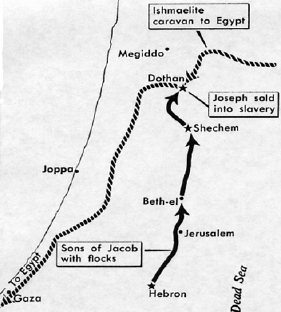
Jacob and his family are living in Hebron (35:27).  In Genesis 37 Joseph gives a bad report on his brothers (v. 2).  Jacob’s favoritism and Joseph’s dreams made him more hated by his brothers (37:3-11).

When Joseph’s brothers are watching their flocks near Shechem, Joseph is sent to see how they were doing (opportunity for another bad report??).  Joseph found them at Dothan.  Tell Dothan is located in the northern Samaria Hills on the eastern side of the Dothan Valley some 13.6 miles north of Shechem.

Bible Atlas

Image result for dothan israel

A view of the west side of Tel Dotan.  Ferrell Jenkins

They initially conspired to kill Joseph, but threw him in a pit.  Reuben thought he would later return to rescue Joseph, but in the meantime the brothers sold him to some Ishmaelite/Midianite traders on their way to Egypt.

They put some blood on Jacob’s garment, returned it to Jacob and said, “This we have found; please identify whether it is your son’s robe or not” (v. 32).  And Jacob believed that his son was dead.

Here are five symptoms of a dysfunctional family:

1. Estrangement—Family members who avoid other family members.

2. Anger—It may be expressed or repressed.

3. Lack of Trust—Seen in faulty patterns of communication.

4. Deception—Inability to speak the truth to other family members.

5. Unhealthy Secrecy—Refusal to face the truth.

Do you see all of these in Genesis 37?  But take heart, God can redeem dysfunctional families.

The chapter ends with Joseph in the house of Potiphar, “captain of the guard” and apparently wealthy (he had many slaves).

Didn’t Jesus just do this miracle, feeding thousands of people with a small amount of food?  And the disciples still hadn’t learn to trust Jesus fully (Mark 8:1-19).

Again he takes them in a boat “to the district of Dalmanutha” (v. 10).  Some believe this is in the same area as Magadan, in the northwest corner of the Sea of Galilee.  There, Jesus is challenged to give a sign, to which Jesus refuses (vv. 11-12).  Then He instructs His disciples to beware of the leaven (bad teaching) of the Pharisees, which they misinterpret (maybe they were hungry) (vv. 13-21).

When they reach Bethsaida, Jesus heals a blind man in two stages (vv. 22-26).  Why?  I believe it was to illustrate that the Jewish people, including the disciples at this point, were not understanding, they didn’t yet have spiritual sight and a further work must be done to open their eyes.

Jesus and his disciples continued traveling north (vv. 27-29) from Bethsaida toward Caesarea Philippi, where Herod Philip lived, that stood about 25 miles away.  The disciples confessed their belief that Jesus was Lord near the place where the pagans confessed that Caesar was Lord.  According to Matthew’s gospel, Peter’s ability to correctly confess that Jesus was the Christ, the Son of the Living God, was because God revealed it to him (Matthew 16

The timing of this question in Jesus” ministry was very important.  The disciples had believed that Jesus was the Messiah from the beginning of their contact with Him (John 1:41, 51).  However their understanding of the Messiah then was the traditional one of their day, namely, that of a political leader.  The multitudes likewise failed to understand that Jesus was much more than that. The religious leaders were becoming increasingly antagonistic.  The disciples were about to receive new revelation regarding Jesus that would have costly implications for them.  Therefore it was necessary for them to confess Jesus’ identity clearly and unmistakably now.

Jesus then teaches them about discipleship,  Just as He was destined for the cross, so each of them must “deny himself and take up his cross and follow me” (Mark 8:34).  Be willing to give up your life for greater gain.

Job 4 begins the first cycle of speeches between Job and his friends.  Each cycle consists of speeches by Eliphaz, Bildad, and Zophar, in that order, interspersed with Job’s reply to each address.  This pattern continues through the first two cycles of speeches (chs. 4—14 and 15—21) but breaks down in the third when Zophar failed to continue the dialogue.

Throughout the three cycles of speeches, Job’s friends did not change their position.  They believed that God rewards the righteous and punishes sinners in this life, the theory of retribution.  They reasoned that all suffering is punishment for sin, and since Job was suffering, he was a sinner.  They believed that what people experience depends on what they have done (cf. John 9:2).  While this is true often, it is not the fundamental reason we experience what we do in life, as the Book of Job proceeds to reveal.

Job 4 is Elphaz’s first speech.  Why do bad things happen to good people?  Eliphaz makes three false assumptions:

  1. Good and innocent people never suffer (see v. 7).
  2. Those who suffer are being punished for their sins (v. 8)
  3. Job, because he was suffering, must have done something wrong in God’s eyes.  Job must repent (5:8)

Romans 8 is the Mount Everest of this great epistle.  The first part (vv. 1-17) deal with the contrast between the flesh and the Spirit.  It gives the secret for overcoming the struggle presented in Romans 7–the presence of the Holy Spirit in our lives.  The second part (vv. 18-39) deal with the contrast between suffering and glory.  We may suffer significantly now, but we will definitely experience greater glory in heaven, because of that suffering.

Romans 8:1 tells us we are free from the guilt of sin.

Romans 8:2 tells us we are free from the power of sin.

What we could not do for ourselves, God did for us (v. 3) so that now, through union with Christ, all the requirements of the law are fully met in us (v. 4).

Those who live according to the flesh or have the mind of the flesh are unbelievers.

The Spirit indwells us at conversion (Romans 8:9), frees us from the law of sin and death (v. 2), puts life in our bodies (v. 11), mortifies the flesh (v. 13), leads us (v. 14), bears witness with our spirit that we are indeed God’s children (v. 16).

Do the math, Paul says next, whatever sufferings we endure now, will be rewarded with glory far beyond compare.  If we put our sun on the suffering side (quite a large and significant object, because our sufferings may be quite difficult to endure), then we must put Canis Majoris on the glory side.  Now, Canis Majoris is so large that if our sun was the size of a golf ball, Canis Majoris would be the size of Mount Everest.  Even from the mountains around Mena, you would be unable to see a golf ball in the valley.

Then Paul says that all creation is up on tiptoes, awaiting that moment when we are revealed in glory (v. 19).  Why?  Because that means it will be renewed (vv. 20-21).  Also, it is the time when we come into our full adoption and receive our resurrection bodies (vv. 22-23).

When Paul says that God works “all things together for our good” (v. 28), it doesn’t mean that everything that happens to us is good.  God takes the good things (like reading our Bibles, praying, and fellowship with believers) and the bad things (trials, irritations, even temptations) and works them all together for good.  The “good” that God is working toward, according to v. 29, is that we become more like Jesus Christ.  That is the process that God has guaranteed, from predestination to glorification (v. 30).

Paul ends the chapter asking (and answering) four questions:

  • Is God for me?  Of course, He already has done the hardest thing (not sparing His one and only beloved Son), so He is committing to “graciously give us all things,” which I think in the context is “all things” that contribute to us becoming more like Jesus.
  • “Who shall bring any charge against God’s elect?” v. 33  Some of them would be charged with treason (worshiping Jesus instead of Caesar) or cannibalism (eating the body and blood of Jesus), but it is “God who justifies.”  The highest judge in all the universe says, “Not guilty!  You are righteous.”
  • “Who is to condemn?” (v. 34)  This goes a step beyond charging with a crime.  This is sentencing.  Now, Satan is our accuser, but cannot condemn (see v. 1).  Instead, we have Jesus praying for us.  He is our intercessor, our advocate (1 John 2).  Like He prayed for Peter, that his “faith would not fail,” He prays for us.
  • Finally ” Who shall separate us from the love of Christ?” (v. 35)  Paul lists several things that maybe they thought proved that Christ didn’t love them–“tribulation, or distress, or persecution, or famine, or nakedness, or danger, or sword” but even though they really experienced these things (v. 36) we turn out to be super-conquerors (v. 37) because there is absolutely nothing that can separate us from the love of Christ! (vv. 38-39)

M’Cheyne Bible Reading Plan, February 4

Today is my wife’s birthday.  Happy birthday Becky!!!

Today’s readings are from Genesis 36, Mark 7, Job 3 and Romans 7.

Genesis 36 gives the genealogy of Esau’s family.

from Logos Bible Software

Back in Genesis 27 Isaac gave Esau a blessing that stated:

39“Your dwelling will be
away from the earth’s richness,
away from the dew of heaven above.
40 You will live by the sword
and you will serve your brother.
But when you grow restless,
you will throw his yoke
from off your neck.” (NIV)

And this passage shows that this is exactly what happened.  This passage shows that God was keeping His promises.  Even though Lot, Ismael and Esau were not part of the promised line, their descendants multiplied.  Also, Esau’s descendants moved away from the land, while Jacob’s (born in Padan-Aram) moved into the land.  Esau’s line developed kings long before Jacob’s did.

Mount Seir

Image result for Mount Seir

Related image

www.thealeph-tavproject.com

Mark 7 illustrates once again how the Jewish religious leaders took little things and made them extremely important, and difficult.  The issue in vv. 1-5 is that they criticized Jesus’ disciples for not washing their hands before they ate.  Now, likely your parents taught you to wash your hands before eating.  But this isn’t for health reasons, but for ritual (religious) reasons.

David Guzik explains…

For these ceremonial washings, special stone vessels of water were kept, because ordinary water might be unclean.  To wash your hands in this special way, you started by taking at least enough of this water to fill one and one-half egg shells.  Then, you poured the water over your hands, starting at the fingers and running down towards your wrist.  Then you cleansed each palm by rubbing the fist of the other hand into it.  Then you poured water over your hands again, this time from the wrist towards the fingers.

really strict Jew would do this not only before the meal, but also between each course.

The rabbis were deadly serious about this.  They said that bread eaten with unwashed hands was no better than excrement.  One rabbi who once failed to perform the ritual washing was excommunicated.  Another rabbi said that the sin of eating with unwashed hands was equal to that of lying with a harlot.   Another rabbi was imprisoned by the Romans, and he used his ration of water for ceremonial cleansing instead of drinking, nearly dying of thirst.  He was regarded as a great hero for this sacrifice.

Jesus confronted them with their hypocrisy–presenting clean external appearances but having a heart that was “far from me.”

Legalists like to take actions that are not commanded in Scripture and make them commands to obey, while at the same time ignoring (or arguing against) the real commands of Scripture (Mark 7:1-13).  Legalists want to appear righteous, but their hearts are not clean.

Jesus leaves Galilee to go to Tyre.  There, he marvels at the faith of a Syro-Phoenician woman and casts a demon out of her little girl (vv. 25-29).  Then, he goes back down to the Decapolis and healed a deaf man (vv. 30-35).

37 And they were astonished beyond measure, saying, “He has done all things well. He even makes the deaf hear and the mute speak.”

Job’s continued pain brought him from the silent, submissive attitude in chapter 2, to an assertive and angry expression in chapter 3.

First, he wishes that he had not been born (3:1-10).

Evidently the reason Job longed for nonexistence was his failure to understand his relationship with God or his place in the universe.  Job did not know as much about life and death as he assumed (cf. Job 38:2, 17).  Job does not aim for theological accuracy here, as much as expressing the deep agonies of the sufferer’s heart.

Second, Job wishes he had died at birth (3:11-19), and last he wishes he could die then (3:20-26).

Job was bitter (v. 20) but not out of control.  He was angry with God (v. 23) but not cursing God.

The writer used the same Hebrew word to describe Job as one “hedged in” by God with darkness and disfavor (v. 23) that Satan used to describe Job as one whom God had “made a hedge about” to protect him from evil (1:10).

Job was in despair but not defiant toward God.  He was feeling his pain intensely but not accusing God of being unjust.  His grief had not yet descended to its lowest depths.

“Where in the world will you find a sadder strain of more hopeless, uncontrolled, and unbroken lamentation and mourning?” (Bradley) Yet, “Such outpouring is a far more healthy thing for the soul than dark and silent brooding.” (Morgan)

Notice that although Job wanted to die (a common human response to pain), he did not attempt suicide.  People usually attempt suicide when they have lost all hope.  The pressure of pain squeezes out the memories of past pleasures and blessings.  The present agony becomes so overwhelming that sufferers often cannot see hope beyond it.

This might be hard to hear, but extreme pain may be the will of God for some people.  But we must remember that God will walk with us through our sufferings and that our present sufferings are not worth comparing to our future glory (Romans 8:18; 2 Corinthians 4:16).

Romans 7, in its description of the person who desires to keep God’s law, yet cannot, has spawned many interpretations.

Paul first gives an analogy from marriage to illustrate the believer’s new relationship, or non-relationship, with the law.  Legally, a person is no longer married after death.  We died, and are therefore no longer legally bound to the law.  Now we are bound to Christ.

Then Paul talks about his relationship with the law in vv. 7-25.  Some believe this is an unbeliever speaking, others that it is Paul alone, or a representative Paul.  I believe that it is a believer speaking.

First of all, this person hates the sin they are doing, which seems unlikely for an unbeliever, who loves the darkness (John 3:19).  He says in verse 15, “I do the very things I hate.”   In verse 19, “the evil I do not want is what I keep on doing.”   In verse 21 he says, when I want to do right, evil lies close at hand.”  These are the words of someone who hates sin and wants to please God.

Second, he humbly and honestly acknowledges the struggle he still faces.  He calls his actions evil in Romans 7:19, 21. He says that, “nothing good dwells in me” (Rom. 7:18). He calls himself a “wretched man” in Romans 7:24.

Third, he is happiest when he is obedient to God.  In verse 22, Paul shouts a truth that is only true for born-again believers. He says, “For I delight in the law of God, in my inner being.” Like the man in Psalm 1, His delight is in the law of the Lord.  He understands that true joy is only found in those who listen to and obey God’s Word.

Fourth, he is hoping for heaven.  After walking through the despair of the Christian life, the knowledge of the fact that he will never be fully successful in his quest to put to death the deeds of the flesh, his only solution for it all is to rejoice in the deliverance found in Jesus Christ (Rom. 7:25).  Until then, he (we) will struggle with sin.

Joni Eareckson Tada, who has constantly battled pain throughout her life, said it best when she said,

“Don’t be thinking that for me in Heaven, the big deal after I get to see Jesus is to get my new body, no, no, no I want a glorified heart!  I want a glorified heart that no longer twists the truth, resists God, looks for an escape, gets defeated by pain, becomes anxious or worrisome, manipulates my husband with precisely timed phrases…”

The above arguments and quote from Joni is from an article by Jordan Standridge.

M’Cheyne Bible Reading Plan, February 3

(Actually, to be honest, this was done on February 4.)

Today’s readings are Genesis 35, Mark 6, Job 2 and Romans 6.

Genesis 35 forms the formal conclusion to the Jacob Story that began in Genesis 25.  Genesis 35 is a travelogue of Jacob and his camp from Shechem to Hebron, a severance of the marked by four burials—three actual (of those who died), and one symbolic.

Image result for genesis 35 map

Abe Kuruvilla notes:

One of the key elements of this chapter is the reappearance of God to Jacob and the reiteration of divine blessing upon him (35:1, 9–11). Yahweh had certainly been God to Jacob as he had promised in Gen 28:13–15; the problem here was that Jacob was not making Yahweh his God as he had promised he would (28:20–22). This was an important act that needed to be done, a keeping of Jacob’s prior promise to God. Jacob realizes, perhaps guiltily, that God had kept his part of the bargain, but he, Jacob, had not; it was his turn now.

In a sense, Jacob’s journey is only complete after he has kept his promise to God to worship him for what he had done for him. God’s word had now been fulfilled to Jacob, and the latter, in turn, was reminded to keep his vow to the former (28:3–15, 21; 31:3, 13; 32:12 and 35:7, 14).  And Jacob complies; God’s word (35:1–2) is precisely followed by the patriarch (35:3–4).  And part of this involved the putting away of foreign gods that Jacob’s caravan had accumulated over the years (35:2–4).  Jacob clearly recognized the implications of worshipping God (35:1), and the ramifications of keeping his word to recognize Yahweh as his God (28:20–22): no other God, but Yahweh.

Job 2 is the second test of Job.  Satan had not been successful in getting Job to turn against God.  But now he says to God…

“Skin for skin!  All that a man has he will give for his life. 5 But stretch out your hand and touch his bone and his flesh, and he will curse you to your face.”

So God gave permission to Satan to afflict Job’s flesh, to take away his health, but not his life.

We don’t know for sure what the disease was, but it was severe, painful and lasted several months (29:2; 7:3).  Other passages in Job reveal how painful and terrible this disease was (Job 30:17, 27-28, 30; 7:4, 5b, 14; 19:17, 18, 20; 16:16).

Steven Lawson writes: “More than one person has withstood tragedy only to fall apart under the onslaught of pain.”  Is that what would happen with Job???

Still, Job did not curse God, but worshipped him (v. 10).  Satan was wrong again; God was right.

These two tests reveal much about Satan. He is accountable to God. God knows Satan’s thoughts. Satan is an accuser of the righteous. He knows what is going on in the world and in the lives of individuals, though there is no evidence in Scripture that he can read people’s minds. He has great power over individuals and nature, but his power is subject to the sovereign authority of God. He is not omnipresent, nor omniscient, nor omnipotent. He can do nothing without God’s permission, and God’s permission involves limitations on him. God remains aware of what His people are experiencing in connection with Satan’s activity.

Job actually experienced seven tests: (1) the destruction of his oxen, donkeys, and servants (1:13-15); (2) the loss of his sheep and servants (1:16); (3) the loss of his camels and servants (1:17); (4) the death of his children (1:18-19); (5) the loss of his health (2:7-8); (6) the antagonism of his wife (2:9); and the hurtful, critical, and accusatory explanations from his friends (2:11—37:24).

I love Spurgeon’s summary of this section, where he says…

As good as Job was at the beginning of the book, he will be a better man at the end of it.  He was better in character, humbler, and more blessed than before.

“Foolish devil! He is piling up a pedestal on which God will set his servant Job, that he may he looked upon with wonder by all ages. . . Oh! how many saints have been comforted in their distress by this history of patience!  How many have been saved out of the jaw of the lion, and from the paw of the bear by the dark experiences of the patriarch of Uz.

O arch fiend, how art thou taken in thine own net!  Thou hast thrown a stone which has fallen on thine own head. Thou madest a pit for Job, and hast fallen into it thyself; thou art taken in thine own craftiness.” (Spurgeon)

Enter Job’s “comforters” (vv. 11-13).  They were a good small group in these ways–they came to Job (apparently quite a distance), they sympathized (covered their heads with dust) and did not speak for seven days.

But on the other hand, these men will mercilessly attack Job’s character, and he will suffer more from their tongues than any attack of his foes.  But for now they are helpful.

The prologue (chs. 1—2) sets the stage for what follows by informing us, the readers, that Job’s suffering was not due to his sins. None of the characters in the story knew this fact except God and Satan. We also see the heavenly dimension and the spiritual warfare taking place—that were also unknown to the human characters in this drama.

Mark 6 begins with Jesus’ rejection at Nazareth.  Although the people are “amazed” (v. 2) at His teaching, they cannot accept the idea that He could be the Messiah (v. 3).  So Jesus could not do many miracles there (v. 5) and was “amazed” at their unbelief (v. 6).

Jewish unbelief (Mark 6:6) and Gentile belief (Luke 7:9) both caused Christ to marvel.

Jesus then sends out His disciples on a mission trip (vv. 6b-13).  This shows that Jesus did not merely teach His disciples in a classroom setting, filling notebooks with principles and concepts, but in real-life situations.  This was “on-the-job training,” which involved going out and doing what they had seen Jesus do, then being debriefed.

John the Baptist was beheaded (vv. 14-29) and when the disciples returned from their mission trip (v. 30), Jesus wanted to get away for awhile by themselves (v. 31).  But, people found them and followed them, and out of a heart of compassion Jesus taught them (v. 34) throughout the day.

Late in the day they needed to eat.  The disciples thought to send them away, but Jesus challenged them to feed them (vv. 36-37).  Of course, they looked only at their own resources and believed it was impossible (v. 37b).  They found “five loaves and two fish,” hardly enough for a small family.

Why did Mark mention the “green grass” in v. 39?  Possibly to call attention to the fact that this Man who had compassion on people who had no shepherd had come to be their Shepherd and lead them to “lie down in green pastures” (Psalm 23:2).

Well, when Jesus blessed this small meal, it became more than enough to feed 5,000 men (probably up to about 20,000 total people) and with twelve baskets left over, just to remind the disciples that Jesus was able to take what little we have and make it more than enough.

When the disciples go out on the boat, a storm came up and they were in serious trouble.  So Jesus came walking to them on the water and calmed the storm, simply by his presence (v. 51).

“They were totally amazed, 52 for they still didn’t understand the significance of the miracle of the loaves. Their hearts were too hard to take it in.”

Job 2

Romans 6 continues Paul’s discussion of sanctification.  Why should we no longer continue in sin?  Not because we might lose our salvation, but because our relation to sin has fundamentally changed.  We died to sin.  United to Christ by faith, we died with Him, were buried with Him and rose with Him.

That is what we are to know (vv. 6, 9) and now we are to reckon upon that reality and “present yourselves to God as those who have been brought from death to life, and your members to God as instruments for righteousness” (v. 13).

Now we have a new master.  Once we were slaves to sin, now we are freed from sin.  But we are not freed from sin to be our own master, but to obey righteousness.  Although we are no longer slaves to sin, no longer imprisoned by it, we can still listen to the voice of temptation.  Instead “present your members as slaves to righteousness leading to sanctification” (v. 19).  There are no benefits to sin in this passage.

Paul brought his thoughts on this subject to a summary conclusion in verse 23.  The principle stated here is applicable to both believers and unbelievers.  It contrasts the masters, sin and God, with the outcomes, death and eternal life.

Paul also distinguished the means whereby death and life come to people.  Death is the wage a person earns by his or her working, but eternal life is a gift free to those who rely on the work of Another.

Wages normally maintain life, but these wages result in death.  Employers usually pay them out regularly and periodically rather than in a lump sum.  Death also comes to the sinner regularly and periodically during the sinner’s lifetime, not just when he or she dies.

M’Cheyne Bible Reading Plan, February 2

(Actually, to be honest, this was done on February 4.)

Today’s readings are Genesis 34, Mark 5, Job 1 and Romans 5.

Genesis 34 is the sordid story of Dinah’s rape and her brothers’ act of vengeance.  One Jewish tradition has it that, after this event,  Dinah never spoke another word for the rest of her life.

Our job, as men, is to step up and speak out for the women in our lives.  Over the past couple of years we’ve seen and heard many cases where women have been abused in some way. In this case, Jacob did nothing and Simeon and Levi over-reacted, similar to David and Absalom in 2 Samuel 13.

Thomas Constable notes that this chapter is significant for four reasons:

1. It explains why Jacob passed over Simeon and Levi for special blessing.

2. It shows the importance of keeping the chosen seed separate from the Canaanites. [Note: See Calum M. Carmichael, “Forbidden Mixtures,” Vetus Testamentum 32:4 (1982):394-415.]

“The law [of Moses] said that Israel was not to intermarry with the Canaanites or make treaties with them but was to destroy them because they posed such a threat.  This passage provides part of the rationale for such laws, for it describes how immoral Canaanites defiled Israel by sexual contact and attempted to marry for the purpose of swallowing up Israel.” [Note: Ross, Creation and . . ., p. 569.]

3. It gives a reason for the sanctification of Jacob”s household that follows (Genesis 35:2, 4).

4. It demonstrates the sovereign control of God.

Regarding Jacob’s fear in v. 30, Gordon Wenham remarks:

“Of course, fear is natural in such a situation, but the reasons Jacob gives for damning his sons betray him. He does not condemn them for the massacre, for abusing the rite of circumcision, or even for breach of contract.  Rather, he protests that the consequences of their action have made him unpopular.  Nor does he seem worried by his daughter”s rape or the prospect of intermarriage with the Canaanites.  He is only concerned for his own skin.” [Note: Wenham, Genesis 16-50 , p. 316. Cf. 19:8.]

Mark 5 tells us about three miracles of Jesus–casting a demon out of a man into swine (vv. 1-20), and then two miracles of healing intertwined (vv. 21-43).

Mark and Luke called this area the country of the Gerasenes, but Matthew called it the country of the Gadarenes.  Gergesa (also referred to as Gersa and Kersa, Kursi) was a small village about midway on the eastern shore of the lake.  Gadara was a larger town six miles southeast of the lake”s southern end.  This incident apparently happened somewhere near both towns on the southeast coast of the lake.

Sea of Galilee towns

Miracle of the swine hill, from across the Sea of Galilee

View across the Sea of Galilee to the cliffs of Kursi

This double miracle taught the disciples that Jesus not only had the power to control nature (Mark 4:35-41) and demonic spirits (Mark 5:1-20) but also death. These were important revelations to those who had exercised some faith in Him. They learned that Jesus was more than a man and even more than the greatest of the prophets. Undoubtedly God used these revelations to enable the disciples to see that Jesus was the divine Messiah (Mark 8:29).

Job 1

Book Chart of Job, Swindoll

Job was possibly a contemporary of Abraham.  It is possibly the first book written.

Job was a righteous man of integrity and he prayed for his children as they partied.  There was nothing inherently sinful in what they were doing, but Job offered a burnt offering in case they sinned.

“What a beautiful example is furnished by Job to Christian parents!  When your girls are going among strangers, and your boys into the great ways of the world, and you are unable to impose your will upon them, as in the days of childhood, you can yet pray for them, casting over them the shield of intercession, with strong cryings and tears.  They are beyond your reach; but by faith you can move the arm of God on their behalf.”
— F. B. Meyer

Then Satan shows up and accuses Job of loyalty to God only because God had blessed Job with good gifts.  So the Lord allowed Satan to take anything away from him except his physical health.  As reports came to Job of loosing his portfolio and then his progeny, Job chose to worship God instead of blaming Him.  I love this verse…

21 And he said, “Naked I came from my mother’s womb, and naked shall I return.  The LORD gave, and the LORD has taken away; blessed be the name of the LORD.”

In this first round of spiritual warfare Satan was singularly unsuccessful in shaking Job from his standing in faith. Job successfully battled against spiritual attack and fulfilled the exhortation that would come many hundreds of years later from the Apostle Paul: that you may be able to withstand in the evil day, and having done all, to stand (Ephesians 6:13).  Job made his stand —

  • against fear and did not give into panic.
  • against make-believe pretending and appropriately mourned.
  • against pride and humbled himself before God.
  • against self and decided to worship God.
  • against a time-bound mindset and chose to think in terms of eternity.
  • against unbelief and did not give into vain questionings of God.
  • against despair and saw the hand of God even in catastrophe.
  • against anger and did not blame God.

— David Guzik

Romans 5 begins with five wonderful results of justification by faith.

  • If we were justified by works, we could have no peace with God.  Peace with God only comes through the reconciling work of Jesus Christ.
  • If we were justified by works, we would not stand in an atmosphere of grace (v. 2a) but be continually needing to justify ourselves before God through our good works.
  • If we were justified by works, we could not boast in our hope of being glorified with God, but would continually be worried about whether we would even be with God in eternity (v. 2b)
  • If we were justified by works we would automatically interpret our sufferings as God’s punishment, but being justified by faith we can be sure that our sufferings are for our greater good (vv. 3-4).
  • If we were justified by our works we would question God’s love towards us, wondering if we had done enough to deserve it; but being justified by grace, God’s love floods our hearts through the Spirit (v. 5).

Christ died for us while we were weak and unable to help ourselves (v. 6), while we were “still sinners” and hadn’t change one iota (vv. 7-9), and even while we were His enemies (v. 10) actively standing against Him.

The last portion of Romans 5 details what we are “in Adam” and “in Christ.”  Here is a helpful chart

Contrast of Characters (Romans 5 12-21)

We might think it unfair that we are classed with Adam in sin and death, but no one argues that it is unfair to be classed with Christ in righteousness and life.  This linkage to Jesus Christ is the foundation for our sanctification.

Quotes to Ponder

This first quote is about prayer from Ray Ortlund’s Christ is Deeper Still blog…

“Maintenance prayer meetings are short, mechanical and totally focused on physical needs inside the church or on personal needs of the people present.  But frontline prayer has three basic traits: a) a request for grace to confess sins and humble ourselves, b) a compassion and zeal for the flourishing of the church, and c) a yearning to know God, to see his face, to see his glory.”

Tim Keller, “Kingdom-centered Prayer,” Redeemer Report, January 2006.

Here are some quotes about idolatry:

“Whatever your heart clings to and confides in, that is really your God, your functional savior. ”
― Martin Luther

“If you uproot the idol and fail to plant the love of Christ in its place, the idol will grow back.”
― Tullian Tchividjian, Jesus + Nothing = Everything

“By giving us control, our new technologies tend to enhance existing idols in our lives. Instead of becoming more like Christ through the forming and shaping influence of the church community, we form, and shape, and personalize our community to make it more like us. We take control of things that are not ours to control. Could it be that our desire for control is short-circuiting the process of change and transformation God wants us to experience through the mess of real world, flesh and blood, face-to-face relationships?”
― Tim Challies, The Next Story: Life and Faith after the Digital Explosion

“Mindset of the man too busy: I am too busy BEING God to become LIKE God.”
― Mark Buchanan, The Holy Wild: Trusting in the Character of God

“Idolatry’ is the practice of seeking the source and provision of what we need either physically or emotionally in someone or something other than the one true God. It is the tragically pathetic attempt to squeeze life out of lifeless forms that cannot help us meet our real needs.”
― Scott J. Hafemann, The God of Promise and the Life of Faith: Understanding the Heart of the Bible

“Could it be that desire for a good thing has become a bad thing because that desire has become a ruling thing?”
― Paul David Tripp

“Idolatry is attached to everything. All of our bitterness, all our impurity, all our malice, all of our problems, everything that troubles us is a result of idolatry. And what is idolatry? It’s taking a good thing and making it an ultimate thing.”
― Timothy Keller

“Possibly the most debilitating deception of all is to create a god of my own making, fool myself into believing that this limp god of mine is the true God, and then construct the entirety of my life on this flamboyantly fictional character. Possibly the most devastating realization of all is when the real God shows up, and in the showing up all of this come crashing down.”
― Craig D. Lounsbrough

“Detecting and destroying idols is an ongoing battle.”
― Brad Bigney, Gospel Treason: Betraying the Gospel with Hidden Idols

“The true god of your heart is what your thoughts effortlessly go to when there is nothing else demanding your attention.”
― Timothy J. Keller, Counterfeit Gods: The Empty Promises of Money, Sex, and Power, and the Only Hope that Matters

“If your deepest feelings are reserved for something other than Almighty God, then that something other is an emotional idol… if you get more excited about material things than the simple yet profound fact that your sin was nailed to the cross by the sinless Son of God, then you’re bowing down to Tammuz.”
― Mark Batterson, All In: You Are One Decision Away From a Totally Different Life

“If we love someone more than we love God, it is worse than inordinate – it is idolatry.
When God is first in our hearts, all other loves are in order and find their rightful place.”
― Elisabeth Elliot

“Images of the Holy easily become holy images — sacrosanct. My idea of God is not a divine idea. It has to be shattered time after time. He shatters it Himself. He is the great iconoclast. Could we not almost say that this shattering is one of the marks His presence? The Incarnation is the supreme example; it leads all previous idea of the Messiah in ruins.”
― C.S. Lewis

“People make crummy gods.”
― Matt Chandler

“We are molding Jesus into our image. He’s beginning to look a lot like us because, after all, that is who we are most comfortable with. The danger now is when we gather in our church buildings to sing, and lift up our hands in worship, we may not actually be worshiping the Jesus of the Bible. Instead, we may be worshiping ourselves.”
― David Platt, Radical: Taking Back Your Faith from the American Dream

“Idolatry, like all sin, is devastating to the soul. It cuts us off from the comforts of grace, the peace of conscience, and the joy that is to be our strength.”
― Elyse M. Fitzpatrick, Give Them Grace: Dazzling Your Kids with the Love of Jesus

“To the extent that we are trapped by the overvaluing, idealizing tendency, we are not free fully to celebrate the limited but real goods of creation. Idolatry by definition is not an accurate assessment of creaturely goods, but an overvaluing of them so as to miss the richness of their actual, limited values. If I worship my tennis trophies, my Mondrian, my family tree, my Kawasaki, or my bank account, then I do not really receive those goods for what they actually are – limited, historical, and finite – goods which are vulnerable to being taken away by time and death. When I pretend that a value is something more than it is, ironically I value it less appropriately than it deserves. Biblical psychology invites us to relate ourselves absolutely to the absolute and relatively to the relative.”
― Thomas C. Oden, Guilt Free

“Suffering always reveal idols of the heart.”
― James MacDonald, Christ-Centered Biblical Counseling: Changing Lives with God’s Changeless Truth

“Shall I say of you that you worship the image of your God that you have in your mind, but not your God?”
― Margaret Landon, Anna and the King of Siam

“The greatest idol I will never truly remove is self.”
― Pastor James Wilson