M’Cheyne Bible Reading Plan, February 23

Today’s readings are from Exodus 5, Luke 8, Job 22, 1 Corinthians 9.

(I just realized today that I’m a day off on the plan.  I should be on Exodus 6, Luke 9, Job 23 and 1 Corinthians 10).  So…

Exodus 5-6 indicate that Moses’ first attempts to rescue his people met with dismal failure.  In Exodus 5 Aaron and Moses go to Pharoah and ask him to let them go into the wilderness to worship (temporarily). Pharoah responds by making their work much more difficult and the people return to Moses and complain that their lives are harder now.  Of course, Moses did what we all do…

22 Then Moses turned to the LORD and said, “O Lord, why have you done evil to this people?  Why did you ever send me?

And the LORD responds (Exodus 6)

1 But the LORD said to Moses, “Now you shall see what I will do to Pharaoh; for with a strong hand he will send them out, and with a strong hand he will drive them out of his land.”

When all human help has failed, and the soul, exhausted and despairing, has given up hope from man, God draws near and says, I AM.  –F. B. Meyer

Yahweh rehearses the covenant promises (vv. 2-4), then repeats that He has heard their cries and seen their afflictions (v. 5) so He will deliver them (vv. 6-8).  Through it all, he wanted to show Israel “that I am the LORD your God” (v. 7).  In this revelation, God promised He would do three things for Israel:

1.  He would deliver the Israelites from their Egyptian bondage (v. 6). Moses communicated this in a threefold expression, suggesting the completeness of the deliverance: “I will bring you out from under the burdens of the Egyptians . . . I will deliver you from their bondage . . . I will redeem you with an outstretched arm and with great judgments.”

2. He would adopt Israel as His nation (“I will take you for My people, and I will be your God,” v. 7). This took place at Sinai (19:5).

3. He would bring Israel into the Promised Land (“I will bring you to the land . . . and I will give it to you for a possession,” v. 8).

The people, however, didn’t want to listen to Moses, so God sent Moses back to Pharaoh.

Image result for exodus 6 genealogy

In the tribe of Levi there were three families–Gershon, Kohath and Marari.  Each of these families would be given specific duties in the service of the Lord and His tabernacle.

In Luke 8 Jesus begins to speak in parables.  His purpose is to reveal truth to some and conceal it from others (cf. Luke 8:9-10; Matthew 13:10-17).  Luke’s account is shorter than Matthew’s, limiting himself to two parables–the parable of the soils and the parable of the lamp, emphasizing the importance of hearing, obeying and proclaiming the Word of God.

The emphasis in the parable of the soils seems to be on their present response to the Word of God, be it belief or unbelief—not the ultimate outcome of their response, namely, their eternal salvation.  The salvation of the second and third seeds is difficult to determine.  They may appear to be saved and not, or may be saved, but fail in many ways.

In 8:19-21 Jesus declares that His true family are those who do His Word.  Jesus was not dishonoring His human family members, but honoring those who obey God.  It is not ecstatic experiences that draw us close to Jesus, but obedience to His Word.

In the remainder of Luke 8 Jesus exhibits His power over a stormy sea (nature, 8:22-25), over the demons (Luke 8:26-39) and over diseases and death (Luke 8:40-56).  All of these miracles show His divine nature.

In Luke 9 Jesus prepares and sends out his disciples on a “mission trip” (Luke 9:1-6).  They were to trust God for their provision and go to the house of Israel.  Sandwiched between Herod’s question about Jesus’ identity (9:7-9) and Peter’s confession of Jesus’ true identity (9:18-27) is the feeding of the 5,000 (9:10-17).

As if to emphasize the truth of Peter’s confession and seal His “departure” Jesus is transfigured before three disciples (9:28-36).  After dealing with their disciples’ failure to exorcise demons from a boy (9:37-43a), Jesus again announces his betrayal (9:43b-45).

In contrast to Jesus’ humble submission to the Father’s will, the disciples jockey for position in the kingdom and seek put a stop to the ministries those outside the group (9:46-50).

Luke 9:51 begins the long, final section of Luke’s gospel (9:51-19:27), in which he “sets His face towards Jerusalem” and the cross.  The central section focuses on the parables of the kingdom and its growth in 13:18-21 and the coming judgment on the Jews for rejecting Jesus as Messiah (13:22-35).

There are 23 parables in 9:51—19:27. This is over half of all the parables in Luke’s Gospel. Jesus gave most of the parables in this section to His disciples, but other non-disciples, who were following Him to Jerusalem to get help of various kinds from Him, were also present. That is why He used parables to teach His disciples: to reveal and to conceal truth.

Parables in Luke 9:51—19:27

The good Samaritan 10:30-37
The shameless friend 11:5-8
The strong man’s house 11:21-22 (cf. Matt. 12:29; Mark 3:27)
The rich fool 12:16-21
The faithful servants 12:36-38
The two servants 12:42-42 (cf. Matt. 24:45-51)
The barren fig tree 13:6-9
The mustard seed 13:18-19 (cf. Matt. 13:31-32; Mark 4:30-32)
The yeast hidden in meal 13:20-21 (cf. Matt. 13:33)
The seats at the wedding feast 14:7-11
The great banquet 14:15-24
The tower builder 14:28-30
The king going to battle 14:31-33
The lost sheep 15:4-7 (cf. Matt. 18:12-14)
The lost coin 15:8-10
The prodigal son 15:11-32
The shrewd manager 16:1-9
The rich man and Lazarus 16:19-31
The unworthy servant 17:7-10
The one taken and the one left 17:34-35 (cf. Matt. 24:40-42)
The persistent widow 18:1-8
The Pharisee and the tax collector 18:9-14
The minas 19:11-27

Jesus begins to teach His followers what it means to be a disciple, starting with toleration (9:51-56) and self-denial (9:57-61).

Job 22-23

The three cycles of speeches in Job are like three rounds in a boxing match, though the competition in this case was intellectual rather than physical.  In round one of the debate, Job’s friends probed his intellect, and in round two they probed his conscience. In round three, they probed specific issues.

We could summarize the criticisms of Job’s three companions in their speeches as follows.

CYCLE

ACCUSATION AGAINST JOB

FIRST “You are a sinner and need to repent.”
SECOND “You are wicked and God is punishing you.”
THIRD “You have committed these specific sins.”

So Job 22 is Eliphaz’s third speech.  He speaks to Job’s social sins, taking advantage of the poor (22:6-11), which Job will deny in 31:16-22.  Eliphaz proceeded next to judge Job’s motives (22:12-20. He assumed Job had concluded that because God was far away in heaven, he would get away with sin on earth. However, Job had affirmed God’s omniscience (21:22).  So Eliphaz demands that Job repent (22:21-30).

Job replies in chapters 23 and 24.  Job still wanted to make his case before God (23:1-7) because he still maintained his innocence (Job 23:8-12).  God’s irresistible power and inscrutable behavior made Job afraid (23:13-17). Job 23:10 expresses this precious truth:

10 But he knows the way that I take; when he has tried me, I shall come out as gold.

Amy Carmichael, in Whispers of His Power, writes:

It is good to see how Job turns from the misunderstanding of man to the perfect understanding of God.  He cannot see Him or find Him, but — glorious “but” — He knoweth the way that I take.  And in the end Job did come forth as gold.

And David Guzik writes:

With wonderful faith, Job seemed at this fleeting instant to understand what he could and should in his present crisis.  He understood that:

– God still observed Job carefully and had not forgotten him (He knows the way that I take).
– God had a purpose in the crisis, and the purpose was not to punish Job (when He has tested me)
– God would one day bring the trial to an end (I shall come forth)
– God would bring something good would from it all (I shall come forth as gold)
– God still valued Job; only precious metal is put through the fire (as gold)

1 Corinthians 9 and 10

Evidently the Corinthian Christians had misunderstood Paul’s policy of limiting the exercise of his activities to help others (8:13).  Some in the church had apparently concluded that because he did not exercise his rights, he therefore did not have them: for example, his right to material support (cf. 2 Cor. 12:13).  His apparently vacillating conduct also raised questions in their minds about his full apostolic authority.

So he identifies himself as an apostle (9:1-2) and talks about his rights as an apostle (9:3-14).  But, for the sake of the gospel, he limited his rights (9:15-23) and encouraged them to do the same (9:24-27).

David Guzik points out:

Here we see Paul’s real heart.  Paid or not paid, it did not matter to him.  What mattered was the work of the gospel.  Was it more effective for the gospel if Paul should receive support?  Then he would receive it.  Was it more effective for the gospel if Paul should work to support himself?  Then he would do that.  What mattered was that the gospel not be hindered in any way.

Paul used athletic metaphors often (cf. Philippians 3:12-14; 2 Timothy 2:5; 4:7; Galatians 5:7 and possibly Romans 11:11).  See also Hebrews 12:1-3, a non-Pauline text.

24 Do you not know that in a race all the runners run, but only one receives the prize? So run that you may obtain it. 25 Every athlete exercises self-control in all things.  They do it to receive a perishable wreath, but we an imperishable. 26 So I do not run aimlessly; I do not box as one beating the air. 27 But I discipline my body and keep it under control, lest after preaching to others I myself should be disqualified.

Some principles about the Christian life from these verses:

  1. All of us have a race to run.  The Christian life is a race.  Not a sprint, but a marathon.
  2. Not everyone receives a prize.  Unlike today, when children get a prize just for participating, we only get a prize by winning.
  3. To win we must “exercise self-control in all things.”  In every area of life we must exercise self-control if we are to win the prize.
  4. Our race is more important because we run to win an “imperishable” prize.
  5. We run/fight with purpose, not haphazardly.  Do you have a plan for your spiritual race?
  6. It is possible to be disqualified from the race.  I don’t believe that this means we will lose our salvation, but lose the reward associated with winning.

The point here is that the Corinthians must be serious about their mission, as serious as athletes are about their training (and as Paul is about his preaching).

Paul then moves into Israel’s failure to faithfully run the race, and how they lost in 1 Corinthians 10:1-13.  They had many advantages (vv. 1-4), but were idolaters, immoral and grumblers (vv. 5-10).  We MUST learn from their example and not stumble and fall (vv. 11-13).

We fight temptation with Jesus’ power, like the girl who explained what she did when Satan came with temptation at the door of her heart: “I send Jesus to answer the door. When Satan sees Jesus, he says, ‘Oops, sorry, I must have the wrong house.’”

Image result for 1 corinthians 10 chart

Whereas involvement in idolatry for the Israelites had involved judgment, here in 10:14-23 Paul acknowledges that food offered to idols is offered to demons (vv. 19-20).  Paul is very firmly telling the Corinthians that they cannot participate in idolatry and then take part in communion without provoking the wrath of a jealous God.

The Corinthians were arguing for the right to attend pagan religious meals.  They even viewed pagan temple attendance as a way of building their “weaker” brethren.  aul responded that attending pagan meals was wrong on two counts: it was unloving, and it was incompatible with life in Christ, which their participation at the Lord’s Table symbolized.  He forbade any relationship with the demonic.

Like in chapter 8, Paul affirms that we have freedom, but that freedom should be limited by love for others (vv. 27-28) and the glory of God (vv. 29-31).  Thus, they (and we) should imitate Paul (1 Cor. 11:1).

Thomas Constable notes the chiastic structure in these verses:

A         The criterion stated: the good of others (10:23-24)

            B         Personal freedom explained (10:25-27)

                        C         The criterion illustrated: love governing liberty (10:28-29a)

            B’        Personal freedom defended (10:29b-30)

A’        The criterion generalized: that all may be saved (10:33—11:1)

Need help in making decisions?

Image result for 1 corinthians 10 chart

M’Cheyne Bible Reading Plan, February 22

Today’s readings are from Exodus 4, Luke 7, Job 21, 1 Corinthians 8.

In Exodus 4 Moses continues to make excuses.  In other words, Moses keeps beating around the bush.

Bible commentator G. Campbell Morgan has written:  “We are ever prone, when God is calling us to some high service, to say ‘But,’ and this to introduce our statement of the difficulties as we see them.”

God likes to use what you already have…what you’ve got in your hand.

Image result for Moses excuses

Back when I was in high school, I remember hearing Ken Medema, a fantastic blind piano player, playing his song Moses.

Moses should have obeyed the Lord in simple dependence, knowing that His commands are His enablements.  God never asks us to do anything without giving us the power to do it.  Because Moses was not satisfied with God’s best, he had to take God’s second best—that is, having Aaron be his spokesman.  Moses thought that Aaron would be a help, but he later proved to be a hindrance in leading the people to worship the golden calf (chapter 32).

–William MacDonald

So Moses returns to Egypt.  He is now 80 years old (Exodus 7:7), two-thirds of his life over.  But God will use him greatly in the time he has left.  Take heart!  No matter how long God takes to train you, He can do more in those weeks, months or years you have left than you could imagine!

21 The LORD said to Moses, “When you return to Egypt, see that you perform before Pharaoh all the wonders I have given you the power to do. But I will harden his heart so that he will not let the people go.

Notice again (v. 21) that although there will be this mysterious interplay between God hardening Pharaoh and Pharaoh hardening his own heart in chapters 7-10, we have the prediction here that “I will harden his heart…”

David Guzik explains…

We might say that it was both God and Pharaoh; but whenever God hardened Pharaoh’s heart, He never did it against Pharaoh’s will.  Pharaoh never said, “Oh, I want to do what is good and right and I want to bless these people of Israel” and God answered, “No, for I will harden your heart against them!”  When God hardened, He allowed Pharaoh’s heart to do what Pharaoh wanted to do – God gave Pharaoh over to his sin (Romans 1:18-32).

But before Moses arrives in Egypt we have this strange passage:

24 At a lodging place on the way, the LORD met Moses and was about to kill him. 25 But Zipporah took a flint knife, cut off her son’s foreskin and touched Moses’ feet with it. “Surely you are a bridegroom of blood to me,” she said. 26 So the LORD let him alone. (At that time she said “bridegroom of blood,” referring to circumcision.)

God made Moses very ill because he had apparently not circumcised at least one of his two sons.  This was the sign of the Abrahamic covenant and as a leader of Israel, Moses could not forego this.  God’s sentence for this sin of omission (an Israelite failing to have his son circumcised) was death (“cut off from his people,” cf. Gen. 17:14).

Was God prepared to put to death His carefully prepared deliverer just because of this?

Apparently this was the final stage of preparation.  God was bringing Moses to a place of recognizing God’s ultimate sovereignty over all.  It was Moses’ Jabbok.

The “bridegroom of blood” figure (v. 26) evidently means the following: Apparently Zipporah regarded her act of circumcising her son as the factor that removed God’s hand of judgment from Moses, and restored him to life and to her again. It was as though God had given Moses a second chance, and he had begun life as her husband all over again, as a bridegroom (cf. Jonah). (Thomas Constable)

In Luke 7 we see Jesus’ compassion in healing the Centurion’s daughter (7:1-10), raising the widow of widow of Nain’s dead son (7:11-17), then He deals with John the Baptist’s doubts about who He was (7:18-23) and spoke highly of John (7:24-28).  However, He then condemns an unbelieving generation (7:29-35) and Simon the Pharisee for showing Him no love (7:36-50).

The Centurion showed unusual faith, the text says nothing about the widow’s faith.  John’s faith is wavering and the woman’s faith encourages her to do something risky.

Image result for woman washing Jesus feet figurine

This is one of my favorite passages.  I preached on it years ago at East Evangelical Free Church in Wichita, Kansas and Sherry Cowan gave me the above figurine.  I still have it in my office at church.

She, though a well-known sinner, treated Jesus with love and honor, whereas Simon gave no evidence of love.  Jesus confronts us with the reality that “whoever has been forgiven little loves little.”  The greater your sense of your sin and God’s forgiveness of it, the more love you will have for Christ.

Job 21 is Job’s second reply to Zophar.

After the first cycle of speeches, Job responded to a point each of his friends had made, namely, that God consistently blesses the righteous and blasts the unrighteous.  After this second cycle of speeches, Job again replied to a point each accuser had made: that the wicked suffer destruction in this life.

Here Job tells them that the wicked don’t always suffer.  Sometimes they live in peace and prosperity (21:7-16).  They die, but so do the righteous, because we’re all sinners (21:17-26), yet they may live their whole lives in prosperity (21:27-34).  Job’s account is more realistic than that of his friends.

But, this was not going to stop Job’s friends, if you can still call them that.

John Trapp says…

“God is pleased to do wonderful contradictory things in man’s reason; so that we must needs confess an unsearchableness in his ways. . . . In this work of his, human reason is blinder than a mole.”

1 Corinthians 8 begins Paul discussion about the issue of eating meat offered to idols, which will carry us through 11:1.  Gordon Fee gives us this background information:

“That going to the temples is the real issue is supported by the fact that the eating of cultic meals was a regular part of worship in antiquity.  This is true not only of the nations that surrounded Israel, but of Israel itself.  In the Corinth of Paul’s time, such meals were still the regular practice both at state festivals and private celebrations of various kinds.  There were three parts to these meals: the preparation, the sacrifice proper, and the feast.  The meat of the sacrifices apparently was divided into three portions: that burned before the god, that apportioned to the worshipers, and that placed on the ‘table of the god,’ which was tended by cultic ministrants but also eaten by the worshipers.  The significance of these meals has been much debated, but most likely they involved a combination of religious and social factors.  The gods were thought to be present since the meals were held in their honor and sacrifices were made; nonetheless, they were also intensely social occasions for the participants.  For the most part the Gentiles who had become believers in Corinth had probably attended such meals all their lives; this was the basic ‘restaurant’ in antiquity, and every kind of occasion was celebrated in this fashion

“The problem, then, is best reconstructed along the following lines. After their conversion—and most likely after the departure of Paul—some of them returned to the practice of attending the cultic meals. In his earlier letter Paul forbade such ‘idolatry’; but they have taken exception to that prohibition and in their letter have made four points:

“(1) They argue that ‘all have knowledge’ about idols [i.e., that there are no such things, so participation in these meals is not an issue, cf. vv. 1, 4]. . . .

“(2) They also have knowledge about food, that it is a matter of indifference to God (8:8) . . .

“(3) They seem to have a somewhat ‘magical’ view of the sacraments; those who have had Christian baptism and who partake of the Lord’s Table are not in any danger of falling (10:1-4).

“(4) Besides, there is considerable question in the minds of many whether Paul has the proper apostolic authority to forbid them on this matter. In their minds this has been substantiated by two factors: first, his failure to accept support while with them; and second, his own apparently compromising stance on idol food sold in the marketplace (he abstained when eating with Jews, but ate when eating with Gentiles; cf. 9:19-23).

It is a passage directed toward those whose have their facts right but hearts wrong. Here Paul addresses the intelligent but unloving.

–Francis Chan

So Paul is telling the Corinthians that love should supersede knowledge.  In other words, just because you know something is OK to do, doesn’t mean you should do it.  One must love God and their brothers and sisters in Christ.  There is, in reality, only one true God.  Therefore, the idols are not really gods.  But, it is more important to not put a stumbling block in front of your brother. (Go back to Romans 14 for a deeper discussion of the conscience.)

Thomas Constable provides this illustration of how to put these principles into practice:

In the United States, the law permits a driver to turn right at most stoplights, provided there is no oncoming traffic.  Turning right into oncoming traffic would pose a danger to others.  The driver must make his or her decision to turn right, or to wait, on the basis of the welfare of everyone concerned.  Just so, Christians must choose to exercise their liberty on the basis of the welfare of everyone concerned.

The issue in this chapter is not that of offending someone in the church.  Paul dealt with that subject in 10:31—11:1 and Romans 14.  It is, rather, doing something that someone else might repeat to his or her own hurt (“causing my brother to stumble”). Paul dealt with an attitude in the Corinthians.

Our American culture idolizes our freedom to do what we want.  Paul is saying that there is a higher value than personal freedom.  There are times we need to curtail our freedom so as not to lead others into sin.


Grievous Consequences of Israel’s Infidelity, part 3 (Hosea 2:11-13)

Grievous Consequences of Israel’s Infidelity, part 3 (Hosea 2:11-13)

Over the last couple of weeks we’ve been looking at the grievous consequences of Israel’s infidelity, their adulterous relationship with the Baalim, the Canannite gods, breaking their covenant with Yahweh.

Yahweh, the husband, will put hedges and walls around her, to keep her from getting to her lovers, but then has to take a step further and remove the necessities of life that had been given her, but she believed they were gifts of the Baals, and used them in their making the idols and worshiping them.

I like how Adam Clarke explained it…

And how often are the gifts of God’s bounty perverted into means of dishonoring him!  God gives us wisdom, strength, and property; and we use them to sin against him with the greater skill, power, and effect!  Were the goods those of the enemy, in whose service they are employed, the crime would be the less.  But the crime is deeply engrained, when God’s property is made the instrument to dishonor himself.

God will uncover their folly and shame, as Albert Barnes says…

But the folly of sin is veiled amid outward prosperity, and people think themselves, and are thought, wise and honorable and in good repute, and are centers of attraction and leaders of society, so long as they prosper; as it is said, “For though, while he lives, he counts himself blessed –and though you get praise when you do well for yourself–” Psalm 49:18. But as soon as God withdraws those outward gifts, the mask drops off, and people, being no longer dazzled, despise the sinner, while they go on to hug the sin.

Let’s look again at vv. 9-13

9 Therefore I will take back my grain in its time, and my wine in its season, and I will take away my wool and my flax, which were to cover her nakedness. 10 Now I will uncover her lewdness in the sight of her lovers, and no one shall rescue her out of my hand. 11 And I will put an end to all her mirth, her feasts, her new moons, her Sabbaths, and all her appointed feasts. 12 And I will lay waste her vines and her fig trees, of which she said, ‘These are my wages, which my lovers have given me.’  I will make them a forest, and the beasts of the field shall devour them. 13 And I will punish her for the feast days of the Baals when she burned offerings to them and adorned herself with her ring and jewelry, and went after her lovers and forgot me, declares the LORD.

We talked last time about how God would take back the necessities of life right at the time of harvest, and remove what they needed, either through drought or by invasion.  This would serve to “uncover her lewdness” and shame her in the eyes of her lovers.  No one would come to their rescue, because they cannot.  They are not real.

The very first commandment to Israel was “you shall have no other gods before me.”  Israel was breaking that commandment as well as the second.  They were worshiping “other gods,” other than Yahweh, and they were making and using idols for worship.

So God is bringing the covenant curses, found in Deuteronomy 28, against Israel.  Notice the heavy emphasis in these verses on what God will do…

  • “Therefore I will return and take away My grain in its time and My new wine in its season, and will take back My wool and My linen, given to cover her nakedness.” v. 9
  • “Now I will uncover her lewdness in the sight of her lovers, and no one shall deliver her from My hand.” v. 10 (exposing her wickedness to her lovers)
  • I will also cause all her mirth to cease, her feast days, her New Moons, her Sabbaths– all her appointed feasts.” v. 11 (when in Captivity these days would cease)
  • “And I will destroy her vines and her fig trees, of which she has said, ‘These are my wages that my lovers have given me.’ So I will make them a forest, and the beasts of the field shall eat them.” v. 12 (removal of national blessings)
  • I will punish her for the days of the Baals to which she burned incense. She decked herself with her earrings and jewelry, and went after her lovers; but Me she forgot,” says the LORD.” v. 13 (the final word)

Now let’s turn our attention to vv. 11-13 this morning, as Hosea continues to express God’s judgment against Israel.

Verse 11 speaks of the worship events and activities…

11 And I will put an end to all her mirth, her feasts, her new moons, her Sabbaths, and all her appointed feasts.

We can easily miss the significance of the Israelite ritual life.  Ward remarks: “No institution of public life occupies a comparable role as a molder of human behavior.  The functions analogous to those of church, school, press, and theatre resided in the single instrumentality of the annual covenantal celebration” (Hosea, p. 31).  These were Israel’s expressions of love and gratitude to Yahweh and were occasions of joy.

Yet Israel had forsaken the temple of God; despised His priests; received from Jeroboam others whom God had not chosen; altered, at least, one of the festivals; celebrated all, where God had forbidden; and worshiped the Creator under the form of a brute creature in Dan and Bethel.

And in the midst of that, Israel kept up her religious observances.  Yet their hearts were far from God.  And God hated it.

Listen to the words of Yahweh in Isaiah 1:11-

11 “What to me is the multitude of your sacrifices? says the LORD; I have had enough of burnt offerings of rams and the fat of well-fed beasts; I do not delight in the blood of bulls, or of lambs, or of goats. 12 “When you come to appear before me, who has required of you this trampling of my courts? 13 Bring no more vain offerings; incense is an abomination to me.  New moon and Sabbath and the calling of convocations– I cannot endure iniquity and solemn assembly. [they just don’t mix] 14 Your new moons and your appointed feasts my soul hates; they have become a burden to me; I am weary of bearing them. 15 When you spread out your hands, I will hide my eyes from you; even though you make many prayers, I will not listen; your hands are full of blood.

Hands full of blood, hearts going after other gods…

So God will put an end to all of this.

The middle three of these refer to the yearly, monthly and weekly religious celebrations.  The annual festivities (“her feasts”) were closely geared to the agricultural and pastoral year.  The first and last seem to form a hendiadys—all her merry festivals, which caps off the list.

Hosea makes a clever play on words here. God would “put an end to” Israel’s worship observances, including the “weekly Sabbath festivities and all her appointed festivals.” The Hebrew root shābat underlies both the verbal phrase “put an end to” and the Sabbath (God’s appointed day of rest).

Joy, and especially joy in worship, was a hallmark of Israelite religion.  This was the duty of God’s people, to rejoice in His presence, with dancing and music, singing and cheering.  The absence of these events does not imply disapproval of such enjoyment.

Notice also that each of these feasts and special days are called “her mirth, her feasts, her new moons, her Sabbaths and all her appointed feasts, indicating that Yahweh no longer countenanced these religious observances as His.  Because Israel’s worship practices had become syncretistic, they were mere ritual observances at best and a mockery of God’s exclusive standards.

Unaware that their outward performances of these religious rituals had been rejected by God, God was determined to put this pretense to an end.  As Duane Garrett says, “The tragedy is not that so many were desperately licentious but that so many had fallen so far from God and did not know it” (Hosea-Joel, p. 84).

No hint is given here as to what events cause the cessation of these activities.  The ruination of crops (v. 11) and of fruit trees (v. 14) would certainly take the enthusiasm out of these harvest festivals.

Their total suspension would mean that society itself had ceased to function.

Verse 12 then picks up several motifs from the preceding warnings.

12 And I will lay waste her vines and her fig trees, of which she said, ‘These are my wages, which my lovers have given me.’

The devastation of the orchards resembles the desolation of the desert (v. 3b) and prepares them for v. 16.  Her statement that “they” (her children) are the fee which her lovers “gave” her resembles the belief that the lovers gave her the necessities of life (v. 5b), which also matches their designation as “children of whoredom” (v. 4).

God will “lay waste” her vines and her fig trees.  These were often used to symbolize the blessings of the covenant relationship with Yahweh (Isa 5:2-6; Jer 2:21; Mic 4:3-4; Zech 3:10; cf. Matt 21:18-21, 28-46).

Isaiah (5:1-2) portrays Israel as God’s vineyard and Jeremiah calls Israel a “choice vine” (Jer. 2:21).  Wine, the fruit of the vine, figured prominently in Israel’s drink offering, which symbolized the fruitfulness of a life willingly poured out for God (Lev. 23:12-13; Num. 6:17).  Unfortunately, the vine and its fruit could also become corrupt (e.g., Isa. 5:2-7), especially by becoming entangled in idolatry (Hos. 10:1).  Therefore, God would be forced to destroy his vineyard (cf. Jer. 6:9; Mic. 1:6; Zeph. 1:13) as is the case that Hosea presents here.

Together with the vine the fig tree often depicted God’s blessings upon an obedient people (e.g., 1 Kings 4:25).

“During Solomon’s lifetime Judah and Israel, from Dan to Beersheba, lived in safety, each man under his own vine and fig tree.”

Thus the fruitful fig tree is what may be expected in that future era of God’s established reign on earth (Mic. 4:4; Zech. 3:10).  Like the fruit of the vine, the fig tree could show promise of a tasteful experience. Israel had been like this; but alas, it had become distasteful before God because of its shameful idolatry (Hos. 9:10; 10:1-2).  When God judges his fig tree and vine, they will produce fruit fit only for animals.  A double meaning is possible here.  Not only would Israel’s land become an “uncultivated thicket,” fit only for wild animals, but the land’s produce will be seized by foreign invaders.

This is not merely a failure of seasonal crops, but a disaster on the scale of Isaiah 7:23-24, in which the land reverts to a wilderness.

I will make them a forest, and the beasts of the field shall devour them.

Fields will revert to jungles, and the fact that wild animals now devour them indicates that the people are too few to resist them.  The land will be denuded and depopulated.

So God will denude the land, which will cause their worship to stop, and will expose their weakness to their enemies.

Again, God does this because Israel continues to attribute their gifts—whether basic necessities or luxuries—to the Baalim rather than to God Himself.

So God says…

13 And I will punish her for the feast days of the Baals when she burned offerings to them and adorned herself with her ring and jewelry, and went after her lovers and forgot me, declares the LORD.

All the verbs but the first (“I will punish…”) are present continuous action.  Israel was consistently worshiping the Baalim.

The Baals refers to any of several Canaanite gods, probably the male gods.  Usually it was a reference to Hadad, the storm god.  Baal-Hadad was likely the god designated in the contest between Elijah and the prophets of Baal on Mount Carmel.  That contested turned on producing a bolt of lightning out of heaven to consume a sacrifice.

The “feast days of the Baals” would be those times that Israel had committed adultery by worshiping Baal instead of Yahweh.  On the national level, Israel’s Baal days could go back to the first apostasy in the desert.

Burning of incense and wearing “her ring and jewelry” are aspects of their worship of Baal.  She decked herself as a harlot out to worship her gods.  The earlier statement of resolution “Let me go off after my lovers…” we then expect a statement of fulfillment—“and [she] went after her lovers…” which is precisely what we have here.

As does much else in this chapter, the woman putting on jewelry and going after lovers functions on at least two levels.  It is Israel going after her paramours, but it is also probably the women of Israel wearing sacred jewelry and going to the Baal shrines.

It is also possible that this is a reference to the piece of jewelry worn by the great warrior-virgin-mother-sorceress, and equally fitting as a badge of her devotees.  Friedman and Anderson note that “such ornamentation is met in the iconography of [the goddess] Anat at Ugarit, and the decoration of her breasts with jewels comes in for special mention when she is preparing herself for seductive lovemaking (Hosea, p. 261).

“A portrayal of a goddess called Qudshu-Astarte-Anath shows her naked except for bracelets, collar, and band across the chest connecting with a girdle around the waist.  It may be that the female devotees of Baal dressed like this divine consort, and that the worship of some Canaanite goddess, still detectable in the biblical texts, persisted side by side with Baal worship” (Friedman and Anderson, Hosea, p. 261).

The ring was likely a nose ring and the jewelry went over the heart.

The punishment meant here is that since Israel had turned their back on Yahweh, He would turn His back on them.

The most grievous sin in all that Israel had done, and the one which pierces the heart of Yahweh the most is found in the last sentence in verse 13, Israel “went after her lovers and forgot me.”

The emphasis in this last sentence is “me they forgot,” placing “me” right up next to “lovers” to show the exceeding contrast.  The lovers (false gods) are not worthy to be remembered, but they pursue them.  “Me they forgot.”  This forgetting is willful and culpable.

Though He had rescued them out of Egypt and taken them to be His precious possession, though He had borne them up on eagle’s wings (Exodus 19:6), though He had prospered them and protected them from their enemies, though He had dealt kindly and bountifully with them, though He had forgiven them time and time again for their sins, yet the memory of Him was buried in their hearts and minds.

John Calvin notes:

There is then here an implied comparison between the Israelites whom God had joined to himself, and other nations who had known nothing of true religion, nor understood who the true God was. It was indeed no wonder for the Gentiles to be deceived by the impostures of Satan: but it was a monstrous ingratitude for the Israelites, who had been rightly taught and long habituated to the pure worship of God, to cast away the recollection of him.

How terrible for God’s own people, whether Israel then or the church today, to forget God, to forget how good and gracious and kind He has been to us.

M’Cheyne Bible Reading Plan, February 21

Today’s readings are from Exodus 3, Luke 6, Job 20, 1 Corinthians 7.

While in Midian, Moses takes care of his father-in-law’s sheep, likely learning more about his background from Jethro.  When he is nearly 80, while tending to his flock across the semi-arid desert near “Horeb, the mountain of God” he happened upon a burning bush, which spoke to him.

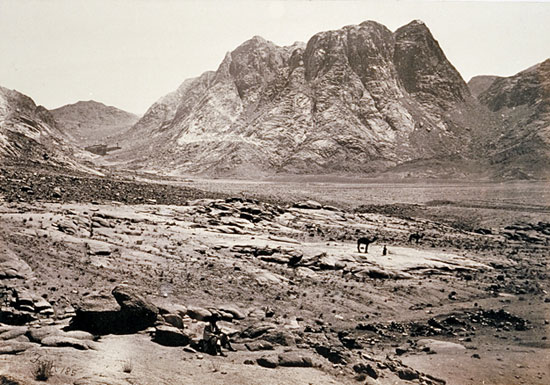
“Horeb, the mountain of God” is believed to be the same as Mount Sinai.  There have been debates about whether Mt. Sinai was east of the Gulf of Aqaba, or on the Sinai peninsula.  The map below shows both possible locations.  I believe it was on the Sinai peninsula.

Mount Horeb full page map, Bible Atlas

Bible Atlas

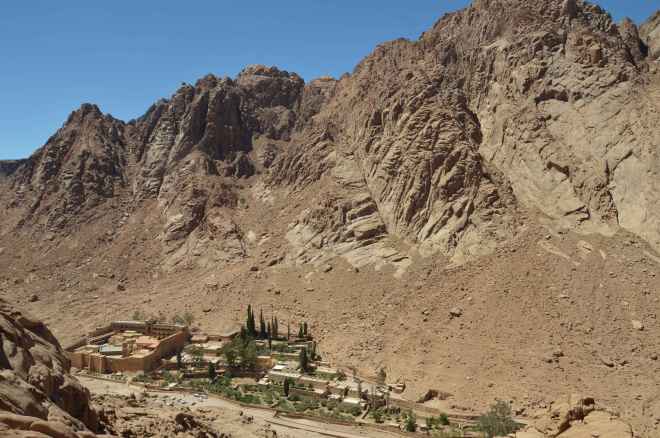
Below are pictures of the traditional site, the one on the Sinai Peninsula

Mount Serabit

Mount Horeb, St. Catherine's Monastery

St. Catherine’s Monastery

Thomas Constables notes the significance of God’s revelatory event:

This was the first time that God had revealed Himself to Moses, or anyone else as far as Scripture records, for over 430 years (v. 4).  Later in history, God broke another 400-year long period of prophetic silence, when John the Baptist and Jesus appeared to lead an even more significant “exodus.”

God’s first words was Moses’ name.  The fact that it is repeated twice indicates the urgency of this communication.

God identified himself as “the God of your father, the God of Abraham, the God of Isaac, and the God of Jacob” (v. 6) and Moses rightly hid his face.  God acknowledges that He has seen Israel’s afflictions and heard their cries and was going to deliver them from Egypt to return to the land promised to Abraham (vv. 7-8).

Here is the first instance of calling the land promised to Abraham, the land “flowing with milk and honey.”

John Walton, in Bible Backgrounds, says…

Exactly what kind of prosperity does the biblical expression refer to?  It probably does not refer to the most common forms of agriculture, such as the cultivation of grains.  Rather, the “milk” most likely refers to animal husbandry and the use of animal byproducts for food and clothing.  Sheep were important for their wool and meat, but goats may have been more important.  They provide twice as much milk as sheep, and their hair and hides could be used for tents, clothing, carpets, and even satchels for holding liquids.  The “honey” refers to horticulture—the cultivation of fruits and vegetables.  “Honey” in Israel is more commonly the syrup from grapes and dates than the substance produced by bees.

Here’s the catch Moses–YOU are the one to go to Pharaoh and demand that he let my people go (v. 10).  But Moses said, “Not likely, Lord.  I’m not Your man.”  God then promises Moses His presence, which should have been enough (v. 12), but Moses lays a condition down–who do I tell the people you are?  If you are really with me, who are you?

David Guzik points out…

When God revealed Himself to man in the days of the patriarchs it was often associated with a newly revealed name or title for God.

  • Abraham, in the encounter with Melchizedek, called on God Most High (Genesis 14:22)
  • Abraham later encountered Almighty God (Genesis 17:1)
  • Abraham came to know the Lord as Everlasting God(Genesis 21:33), and The-Lord-Will-Provide (Genesis 22:14)
  • Hagar encountered You-Are-the-God-Who-Sees (Genesis 16:13)
  • Jacob met El Elohe Israel (Genesis 33:20), and El Bethel (Genesis 35:7)

So if Moses were to come to the elders of Israel as a representative of God, it would be logical for them to wonder, “By what name did He reveal Himself to you?”

14 God said to Moses, “I AM WHO I AM.” And he said, “Say this to the people of Israel, ‘I AM has sent me to you.'”

Here is the covenant name of God, YHWH, which could be translated “I am who I am” or “I will be who I will be.”  It signifies that God is self-existent, eternal, unchanging and sovereign. It is the same concept that Jesus used in His “I am” statements in the Gospel of John.

He is the same God who cut covenants with Abraham, Isaac and Jacob (v. 15).

God instructed Moses to tell this to the elders of Israel, that this same God had seen their afflictions and promised to bring them back to Canaan and take possession of that land.  He told Moses that Pharaoh would not let them go, so God would do mighty wonders and “after that he will let you go” (v. 20) and the people will send you out with favors (vv. 21-22).

Notice that before we even get into the discussion about whether God hardened Pharaoh’s heart or Pharaoh hardened his own heart, God had said back in Genesis 15:13-14 to Abraham…

13 Then the LORD said to him, “Know for certain that for four hundred years your descendants will be strangers in a country not their own and that they will be enslaved and mistreated there. 14 But I will punish the nation they serve as slaves, and afterward they will come out with great possessions.

And here God told Moses that Pharaoh would not let them God until God did mighty wonders.  So it has been predicted that Pharaoh would be difficult to persuade and that God would ultimately punish them.

Luke 6 continues Jesus’ run-ins with the Pharisees (6:1-5).  Leon Morris says of this pericope…

The interesting thing about Jesus’ approach is that He was not simply arguing that repressive regulations should be relaxed and a more liberal attitude adopted: He was saying that His opponents had missed the whole point of this holy day.  Had they understood it they would have seen that deeds of mercy such as His were not merely permitted—they were obligatory (cf. Jn. 7:23f.).

“Any application of the Sabbath Law which operates to the detriment of man is out of harmony with God’s purpose.” (G. Campbell Morgan)

This incident also serves to manifest Jesus’ authority.

On another Sabbath (Luke 6:6-11) Jesus healed a man and showed that with all the regulations they had placed on Sabbath observance, they had missed the point.

In the remainder of Luke 6, Jesus chooses (Luke 6:12-16), then teaches (6:17-49) His disciples through the Sermon on the Mount (called here the “sermon on the plain,” likely a higher plateau).

Notice the importance Jesus put on selecting the right men, by praying all night (Luke 6:12).  These were the men who would carry on what He had done, and without them, the work of Jesus would never extend through the whole world. No wonder Jesus gave this an entire night of prayer.

Is the mountainside Jesus went to Mount Arbel?

Image result for across sea of galilee

jesus-story.net

Mount Arbel is that ridge to the left of Tiberias.  The sermon may have taken place on that higher flat area to the north of Mount Arbel.

Jesus begins his sermon with “upside-down blessings” (6:20-23).  These would sound very strange to their eyes because they would never have imagined that being poor, hungry, sad and hated would be “blessed.”  However, Luke was showing that the kingdom was not just for the rich, well fed, happy and social approved.  It included the “bottom rung” of society.  The opposite side of the coin is expressed through “woes” in vv. 24-26.

A major aspect of Christ’s kingdom is “enemy love.”  It is easy to love the lovable, loving and lovely.  But Christ calls us to love our enemies by blessing them, praying for them and doing them good (6:27-35).  We are always to show mercy (6:36-38).

Jesus then gives two parables, both revolving around seeing.  We must be able to see to lead others, teach others.  And we must get the telephone pole out of our own eye in order to get the splinter out of someone else’s eye.  In other words, examine yourself first, identify your own faults, before you confront someone with theirs.

Then Jesus gives another parable, the only good trees produce good fruit.  In other words, a fundamental change in nature must happen before anyone can produce good fruit.  The truth about the nature of our hearts is exposed by the words that come out of our mouths.

Christ’s final exhortation is that we cannot afford only to hear Jesus’ words and do nothing about them.  We must obey them, or ultimately disaster will happen and knock us down.  Trials prove us–one way of the other.

Job 20 is Zophar’s second speech.  This speech must have hurt Job more than any that his friends had presented so far. Zophar was brutal in his attack.  He continued the theme of the fate of the wicked that Eliphaz and Bildad had emphasized.  However, whereas Eliphaz stressed the distress of the wicked and Bildad their trapped position, Zophar elaborated on the fact that wicked people lose their wealth (which is exactly what had happened to Job).

Verse 5 is Zophar’s thesis statement:

the exulting of the wicked is short, and the joy of the godless but for a moment?

Whatever triumphs the wicked man has are short-lived, but ultimately they will experience misery and a dark destiny.

1 Corinthians 7 is Paul’s instruction on singleness and marriage.

First, singleness.  Paul says that singleness is a gift (1 Cor. 7:7), although not everyone has it.  Singles have two advantages that married people don’t have: they are spared the “troubles” of marriage (1 Cor. 7:28) and can devote themselves more fully to God’s work (1 Cor. 7:32-34).  However, Paul also says that singleness can be hard.  They are likely to face a lifelong battle with loneliness and sexual temptation.  Finally, singleness is not necessarily permanent and ultimately we will be married to our Bridegroom.

Now marriage.  Sexual relations are only to be practiced within marriage (1 Cor. 7:2).  This is an obligation of husband and wife (1 Cor. 7:3-4) only to be abstained from

except perhaps by mutual consent and for a time, so that you may devote yourselves to prayer. Then come together again so that Satan will not tempt you because of your lack of self-control (1 Cor. 7:5)

There should be no separation (I believe in the context this means divorce) initiated by wife or husband, even if unequally yoked.  It is possible to reconcile in any situation (1 Cor. 7:10-14).  Paul makes an allowance should an unbelieving spouse leave (1 Cor. 7:15).

Paul gives a general principle in v. 20

20 Each one should remain in the condition in which he was called.

This seems to apply to a person who is single, or married, or divorced.  Paul goes on to provide these hopeful words…

24 So, brothers, in whatever condition each was called, there let him remain with God.

Yet, what if you receive a “new calling”?  This seems to be what Paul is allowing for in v. 28.

28 But if you do marry, you have not sinned, and if a betrothed woman marries, she has not sinned.

If you are married, you must become committed to pleasing your spouse (1 Cor. 7:33).  This is what makes a ministry marriage difficult.

33 But the married man is anxious about worldly things, how to please his wife, 34 and his interests are divided.  And the unmarried or betrothed woman is anxious about the things of the Lord, how to be holy in body and spirit.  But the married woman is anxious about worldly things, how to please her husband.

Paul definitely seems to favor singleness and allow marriage, to secure “undivided devotion to the Lord” (v. 35) and greater happiness (v. 40).  So “he who refrains from marriage will do even better” (v. 38).

Paul clearly allows remarriage in the case of the death of a spouse (v. 39).  Whether the abandoned or the one whose spouse committed adultery are allowed to remarry is not clarified.


Links I Like

Here are some links from this week…

Unsung Heroes of the Church by Nicholas Batzig

Here is an article about “ruling elders” who help those of us who are “teaching elders” or preachers.  In some churches these men need to rise up to this challenge.  For those who are, bless you.

How My View of Scripture Changed

This article shows the importance of faithful Bible preaching and listening to expository sermons.

Raising Pro-Life Children in a Culture of Death

This doesn’t say all that needs to be said about helping our children develop a biblical worldview about persons, but it’s a start.

Mr. Spock’s Lessons in Logical Fallacies

We live in a world that argues through emotions and cliches and calling one another names, instead of using logic.  Many times, when people do argue (past one another) they use logical fallacies.  I love create ways to teach difficult (or sometimes boring) concepts.  I got this one from Stephen Bedard.

M’Cheyne Bible Reading Plan, February 20

Today’s readings are from Exodus 2, Luke 5, Job 19, 1 Corinthians 6.

As a “young man” of 40, the prince sees a Hebrew slave being beaten by an Egyptian overseer.  In anger, Moses kills the Egyptian official.  Fearing retribution from the pharaoh (and, perhaps, death threats from his jealous stepbrothers), Moses flees to Midian.

God had to teach Moses that he must not trust in his own ability, but instead rely on God’s strategy and strength, and obey His commands.  So God drove Moses out of Egypt, through the circumstances described here, to “the desert (land) of Midian,” where He proceeded to teach His servant these lessons.

Gulf of Suez and Southern Sinai Peninsula

Midian would be the area beneath the Gulf of Aqaba, and above the clouds.

The fact that Moses later chose to identify with the Israelites, rather than the Egyptians, is remarkable in view of his Egyptian privileges and background.  His parents must have had a strong influence on him beginning very early in his life (cf. Joseph).  We should never underestimate the power of parental influence even early in life.

Moses rescues some shepherdesses and waters their flocks at a well. Their father invites Moses (who is clearly a well-educated Egyptian) to stay, so Moses marries one of his daughters, Zipporah, and settles down for the next forty years to raise a family in exile in Midian.

Meanwhile, the children of Israel still suffer and they cried out to God for help.  The prayers (“cry for help”) of the Israelites in their bondage touched God’s heart (“God heard their groaning”), and He began anew to act for them (“God remembered . . . God took notice”; cf. 3:7-9).  Remembering His covenant with the patriarchs, God acted for the Israelites by commissioning Moses.  And God still used Moses, despite the sin of murder.  God’s grace IS AMAZING!

Luke 5 records the calling of the first disciples (5:1-11) and Jesus’ controversies with the Pharisees (which will stretch into chapter 6).  Jesus was teaching near the Sea of Galilee (near Tagbha) and entered into a boat, pushed off from shore, to capture the audio effect of being in a natural amphitheater.

Now it was time for an object lesson.

4 And when he had finished speaking, he said to Simon, “Put out into the deep and let down your nets for a catch.”

Peter could have come up with any number of possible excuses.

– “I worked all night and I’m tired.”
– “I know a lot more about fishing than some…carpenter.”
– “Everyone knows that the best fishing is at night, not in the day time.”
– “All these crowds and loud teaching has scared the fish away.”
– “We already washed our nets for the day.”
– “Jesus may know religion but He doesn’t know fishing.”

But Peter did what Jesus asked and “they enclosed a large number of fish, and their nets were breaking” (Luke 5:6).  Summoning their partners in another boat to help and finding both boats filled to the brim and about to sink, Peter fell down at Jesus’ knees, saying

“Depart from me, for I am a sinful man, O Lord.”

He recognized Jesus was more than just a man, more than a mere teacher.  So Jesus issued a new challenge, a new calling, a new commission, “from now on you will be catching men.”  I’m not sure if Peter and the guys knew what Jesus was saying, but they “left everything and followed him.”

I remember Doug Greenwold telling us at GBC how every young man’s dream was to become attached to a rabbi and one day teach the law.  But only one or two out of every group got the opportunity to advance up the ladder, so very, very few made it to being able to follow a leading rabbi.  These men had given up on that dream, followed in their fathers’ footsteps, taken up the family business…until today.  Now they are being called by a truly amazing rabbi, to do something new–catch men.

Regarding the rest of this chapter, Thomas Constable writes:

One of Luke’s purposes in his Gospel, and in Acts, appears to have been to show why God stopped working particularly with Israel—and began working with Jews and Gentiles equally in the church.  The Jewish leaders’ rejection of Jesus was a major reason for this change.  The conflict between them is an important feature of this Gospel.

This section of the Gospel (through 6:11) includes six incidents.  In the first one, Jesus served notice to the religious leaders in Jerusalem that the Messiah had arrived. In the remaining five paragraphs, the Pharisees found fault with Jesus or His disciples.  Mark stressed the conflict that was mounting, but Luke emphasizes the positive aspects of Jesus’ ministry that led to the opposition.

Jesus first cleanses a leper, someone who was unclean (5:12-16).  This was a Messianic act and thus it announced the arrival of the Messiah.  Jesus had the authority (like God) to forgive sins, proven by healing the paralytic brought by four friends (Luke 5:17-26).

The religious leaders were correct.  Only God “can forgive sins.”  They were just unwilling to go the extra step and believe that Jesus was God.

Luke reveals the grace of Jesus in dealing with a leper, a paralytic and now a tax collector.  He delivers them from lifelong uncleanness, a physical handicap, and now social ostracism and materialism.  He shows grace.

Luke 5 ends with Jesus’ perspective on fasting.  There are times it is appropriate to fast.  But Jesus’ disciples did not because the bridegroom was with them and it was a time for joy.

V. 36 illustrates with parables the fact that His coming introduced a radical break with former religious customs.  He did not come to patch Judaism up but to inaugurate a new order.

The second illustration (vv. 37-38) adds the fact that the new order, that Jesus had come to bring, has an inherently expanding and potentially explosive quality.  The gospel and Christianity would expand to the whole world.  Judaism simply could not contain what Jesus was bringing, since it had become too rigid due to centuries of accumulated tradition.

The religious leaders refused to even try Jesus’ way, believing that their old way was better.

Job 19 is Job’s reply to Bildad.  Although he continues to feel sorry for himself (19:1-6) and complained that God had attacked him (19:7-20), Job still interacts with God and expressed some hope in the afterlife.

25 For I know that my Redeemer lives, and at the last he will stand upon the earth. 26 And after my skin has been thus destroyed, yet in my flesh I shall see God, 27 whom I shall see for myself, and my eyes shall behold, and not another. My heart faints within me!

Who is it that Job puts confidence in, that he shall ultimately “see”?  Throughout the book Job has been asking for an advocate or arbiter with God, so it seems to be this other person.

The advocate of 16:19 was in heaven.  This opens the possibility for a divine witness, as mentioned earlier.  Nevertheless Job called him a man, and this points to a person other than God.  The word “redeemer” in Hebrew (goel) means one who provided legal protection for a close relative who could not defend himself or herself.

He believed in life after death, but he evidently did not know about the certain resurrection of the body.  This revelation came from God after Job’s lifetime (cf. Isaiah 26:19; Dan. 12:2; 1 Cor. 15).

Having made this breakthrough of faith in God, Job seems less frantic hereafter in the book. He now saw his sufferings in the light of eternity, not just in his lifetime. When we can help people gain this perspective on their sufferings, we will find that they, too, find some relief.

This Savior we have known much of our lives, will be the one we will see in heaven, not a stranger.  Take comfort in that.

David Guzik’s title for 1 Corinthians 6 is lawsuits (6:1-11) and loose living (6:12-20).  Christians should avoid lawsuits it at all possible.  It’s not good to air our dirty laundry in public.  We should be able to take care of things privately, within the church and within respectful relationships.

It takes a gentle and magnanimous spirit to follow v. 7, “Why not rather suffer wrong?  Why not rather be defrauded?”

God’s great work for us in Jesus Christ is described in three terms.

You were washed:  We are washed clean from sin by the mercy of God (Titus 3:5). We can have our sins washed way by calling on the name of the Lord (Acts 22:16). We are washed by the work of Jesus on the cross for us (Revelation 1:5) and by the Word of God (Ephesians 5:26).

You were sanctified:  We are set apart, away from the world and unto God, by the work of Jesus on the cross (Hebrews 10:10), by God’s Word (John 17:19), by faith in Jesus (Acts 26:18), and by the Holy Spirit (Romans 15:16).

You were justified:  We are declared “just” before the court of God; not merely “not guilty,” but declared to be “just” before Him. We are justified by God’s grace through the work of Jesus on the cross (Romans 3:24), by faith and not by our own deeds (Romans 3:28).

–David Guzik

Notice that the sin of homosexuality is placed among other sins that need forgiveness and sanctification.  In that sense it is no different.  However, Romans 1 pointed out that homosexuality is also “against nature.”  In that sense it is different.  But, like all these other sins, it is something a person can be forgiven for and sanctified (to be separate) from, and justified fully by grace.

Our body is the temple of the Holy Spirit.  Therefore, even though there may be things that are legal to do, they are not helpful and could very well be enslaving (1 Cor. 6:12).  Our body is not meant for sexual immorality like it is meant for food (v. 13).  Our bodies are meant for the Lord Jesus Christ (v. 13b).  Our bodies are members of Christ (v. 15).

Therefore, we are to “flee from sexual immorality” (1 Cor. 6:18), which is a sin “against his own body” and a violation of the “temple of the Holy Spirit” (vv. 18-19).

Our bodies belong to God, not ourselves (listen women who are thinking of having an abortion), because Jesus laid down His life and paid the price for us.  He not only claims our spirit and soul, but our bodies from the slave market of sin.

M’Cheyne Bible Reading Plan, February 19

Today’s readings are from Exodus 1, Luke 4, Job 18, 1 Corinthians 5.

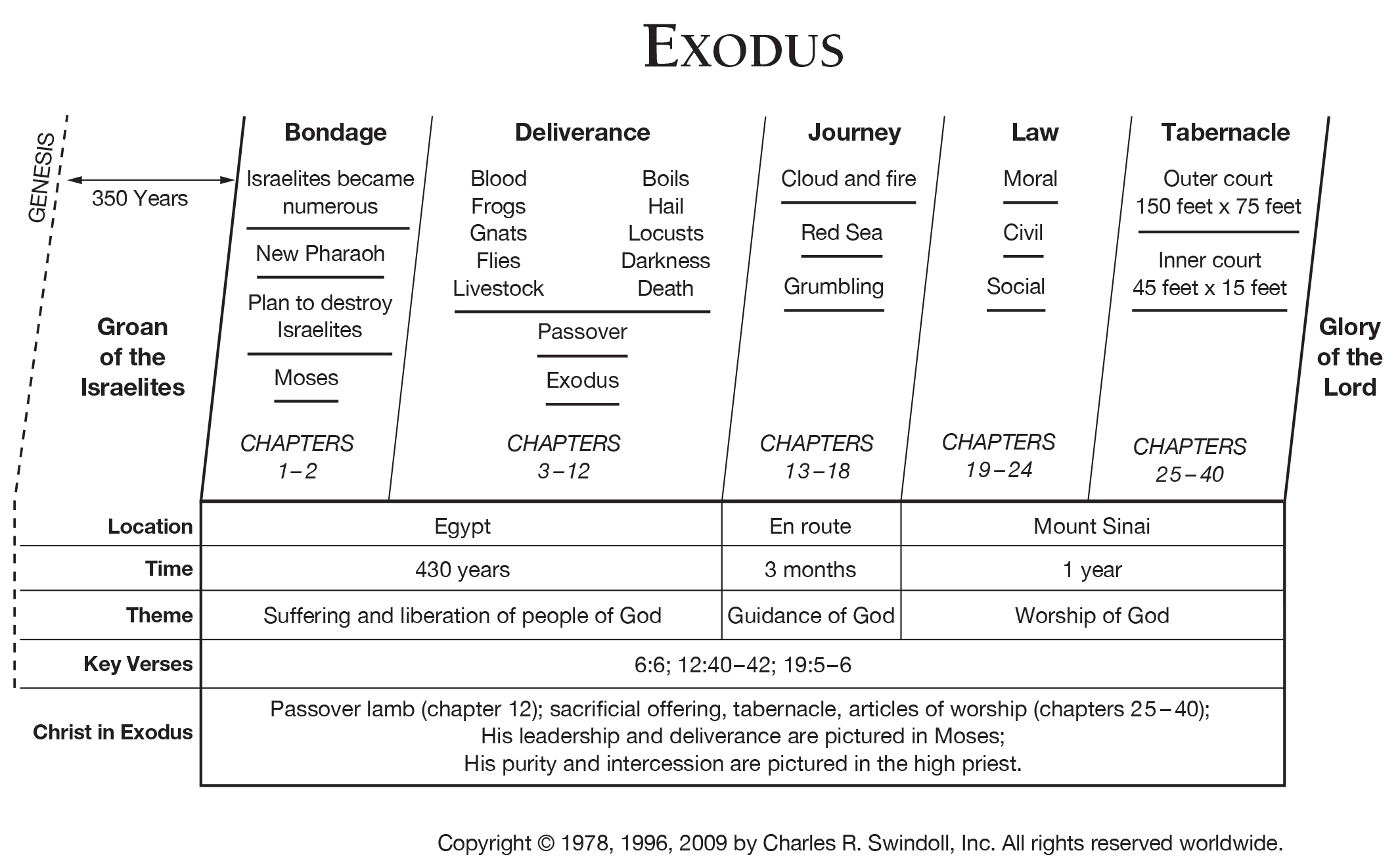
Image result for exodus book chart

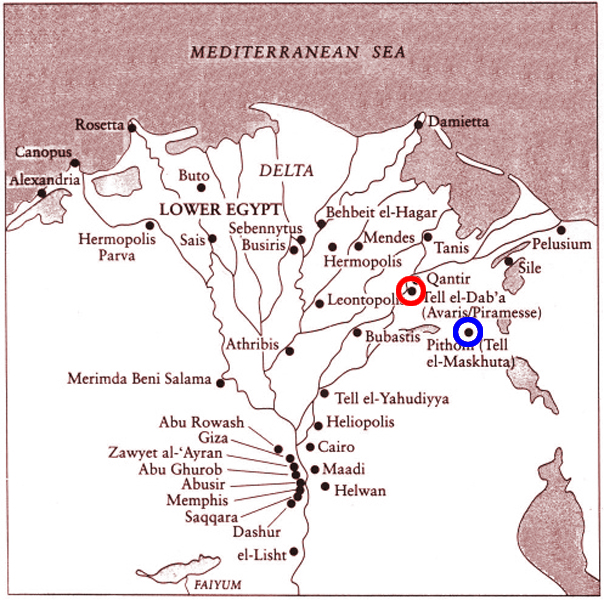
Israel has been in Egypt 430 years now.  A king “who did not know Joseph” (v. 8, likely Thutmose I) feared the Israelites and enslaved them, forcing them to build cities.  “They built for Pharaoh store cities, Pithom and Raamses” (v. 11b) and had cruel taskmasters.

Delta Region

12 But the more they were oppressed, the more they multiplied and the more they spread abroad. And the Egyptians were in dread of the people of Israel.

So they made their lives even more bitter.

The king of Egypt enlisted Shiprah and Puah, Hebrew midwives, to kill the males being born.

17 But the midwives feared God and did not do as the king of Egypt commanded them, but let the male children live.

When Pharaoh called them on it, they said that Hebrew women give birth too fast, before the midwives could arrive.

So what do we do with this?  It seems obvious that the midwives lied, because v. 17 says they specifically “did not do as the king of Egypt commanded them, but let the male children live.”  Yet, v. 20 tells us that “God dealt well with the midwives” and even “gave them families” because they “feared God” (v. 21) instead of fearing the king.

Some believe that they didn’t actually lie.  That the Hebrew women did in fact, not call the midwives.

Others believe that this was not a direct lie, but withholding part of the information.

Some answer this question by adopting “graded absolutism.”  Although there are absolutes (lying is always a sin), yet in cases of protecting a life the higher value of human life excuses the lower value of truth telling.  A similar situation happens with Rahab.

All in all, it is safe to say that God did not reward the midwives for lying, but for rescuing these children from death.

Thomas Constable notes:

Pharaoh launched three successive plans to reduce the threat of the sizable Hebrew population, that had then become larger and stronger than the Egyptian ruling class (v. 9).

The first plan (plan A) was to make the Hebrews toil hard in manual labor. Normally a population grows more slowly under oppression than in prosperous times.  However, the opposite took place in the case of the Israelites (“the more they afflicted them, the more they multiplied”; v. 12).  Physical oppression also tends to crush the spirit, and in this objective the Egyptians were somewhat successful (2:23-24).

Plan B consisted of ordering the Hebrew midwives to kill all the male Hebrew babies at birth.  This second plan “miscarried” too.

The intent of plan C was also to do away with the male Hebrew babies (v. 22). However, instead of relying on the Hebrew midwives, Pharaoh called on “all his subjects (people)” to throw “every” Hebrew boy (“son”) that was “born into the Nile” River.  Since the Egyptians regarded the Nile as a manifestation of deity, perhaps Pharaoh was making obedience to his edict an act of worship for the Egyptians.  This plan evidently failed too.

Nothing Pharaoh tried worked!  God was protecting Israel.

Immediately upon being baptized and having a “mountain top” experience, the Holy Spirit thrusts Jesus into the Judean wilderness.

1 And Jesus, full of the Holy Spirit, r eturned from the Jordan and was led by the Spirit in the wilderness 2 for forty days, being tempted by the devil. 

THE FIRST ADAM

THE SECOND ADAM

THE APPEAL

“The tree was good for food.” (Gen. 3:6) “Tell this stone to become bread.” (Luke 4:3) “The lust of the flesh” (1 John 2:16)
“It was a delight to the eyes.” (Gen. 3:6) “He (Satan) . . . showed Him (Jesus) all the kingdoms of the world.” (Luke 4:5) “The lust of the eyes” (1 John 2:16)
“The tree was desirable to make one wise.” (Gen. 3:6) “Cast yourself down from here.” (Luke 4:9) “The pride of life” (1 John 2:6)

Jesus succeeded where Adam failed.  When Hebrews says that Jesus was “in every respect has been tempted as we are” yet without sin it probably doesn’t mean that He has endured every single instance of temptation, but every kind of temptation (multiple times).

Alfred Eidersheim also noticed some comparisons with Moses and Elijah, the great lawgiver and prophet:

“Moses fasted in the middle, Elijah at the end, Jesus at the beginning of His ministry. Moses fasted in the Presence of God; Elijah alone; Jesus assaulted by the Devil. Moses had been called up by God; Elijah had gone forth in the bitterness of his own spirit; Jesus was driven by the Spirit. Moses failed after his forty day’s fast, when in indignation he cast the Tables of the Law from him; Elijah failed before his forty day’s fast; Jesus was assailed for forty days and endured the trial. Moses was angry against Israel; Elijah despaired of Israel; Jesus overcame for Israel.”

One thing that Luke adds to the temptation account is in v. 13: “he departed from him until an opportune time.”  Satan is always looking for the most opportune moment to tempt us.  Some use the acronym HALT to indicate those moments–hungry, angry, lonely, tired.

Note that Jesus was successful because His mind was saturated with the Word of God and He was able to quote it (use the sword) to battle Satan’s deceptions.

Jesus then began his ministry in and around Galilee, beginning in Nazareth, his hometown.  However, after reading Isaiah 61:1-2 and saying that He fulfilled it (was the Messiah), the people wanted to throw him off a cliff.

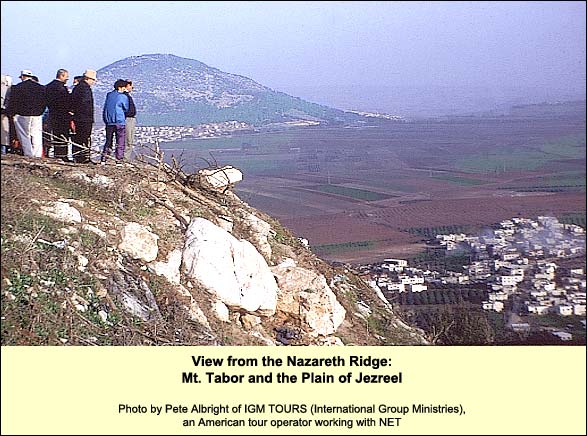
View from the Nazareth Ridge__Mt. Tabor and the Plain of Jezreel, Pete Albright

Thomas Constable notes:

Jesus allowed the crowd to drive Him out of town, and “to the brow of the hill” (cliff), near where Nazareth stood. Later, He allowed another crowd to drive Him out of Jerusalem, and nail Him to a cross. However, this was not the time for Him to die, and Nazareth was not the place.

Jesus then moves to Capernaum (home of Peter, Andrew, James and John) and made this His base of operations.  He began his ministry there doing several miracles: (1) exorcising a demoniac (4:31-37), (2) healing Peter’s mother-in-law (4:38-39), and (3) many others after sundown (4:40-41) and He preached (4:42-44).

Job 18 is Bildad’s second speech.  He scolds Job for making himself better than his friend (18:1-4) and then talks about the plight of the wicked (18:5-21)–their life now and their ultimate destiny are both desparable.

Bildad painted four vivid pictures of the death of the wicked in this passage: a light put out (vv. 5-6), a traveler trapped (vv. 7-10), a criminal pursued (vv. 11-15), and a tree rooted up (vv. 16-21).

Tom Constable says…

Often when we counsel suffering people it is more important to help them think about God and talk to Him than it is to get them to adopt all of our theology. Job’s companions seem to have given up on Job because he would not agree with their theological presupposition. They failed to give him credit for being sincere in his desire to come to terms with God.

In 1 Corinthians 5 Paul rebukes the church at Corinth because there was a man involved in incest (v. 1) and they had just let it go (v. 2-3).  So Paul commands them to exercise church discipline.  Assuming they had already taken the first two steps of discipline in Matthew 18:15-16 and he had not repented, they are now to “deliver this man to Satan for the destruction of the flesh” (v. 5).  Doing nothing would allow sin to spread, like leaven (vv. 6-8).

William Barclay says…

“An easy-going attitude to sin is always dangerous.  When we cease to take a serious view of sin we are in a perilous position.  It is not a question of being critical and condemnatory; it is a question of being wounded and hurt.  It was sin that crucified Jesus Christ; it was to free people from sin that Christ died.”

Paul had determined to “deliver” the man “to Satan for the destruction of his flesh.”  Probably Paul meant that he had delivered the man over to the world, which Satan controls, with God’s permission of course, for bodily chastisement that might even result in his premature death.

Though this man’s conduct was clearly sinful, and needed severe correction, Paul does not write him off as forever lost – the effective use of church discipline may yet see him to salvation.

How do we practice this today?  I don’t think it means we call down Satan’s judgment upon a person, but that when we must excommunicate someone from the support and authority of the local church, we are, in effect, turning them over to Satan.

Now, the purpose of this severe act was “so that his spirit may be saved in the day of the Lord.”  Apparently, some people need to be shocked by the seriousness with which the church takes sin by exercising church discipline even to the point of excommunication, so that a person may either see their need for true salvation, or repent of their sins to prove their salvation.

How are we to separate ourselves from sexual sin (and sinners)?  We cannot separate ourselves from the sexually immoral who live all around us, but we are to separate from a “so-called brother” who is involved in sexual immorality (and other things like greed, idolatry, reviling, drunkenness and stealing).  That’s a pretty long list and I’m not sure many churches have exercised any form of church discipline for most of these sins.


M’Cheyne Bible Reading Plan, February 18

Today’s readings are from Genesis 50, Luke 3, Job 16-17, 1 Corinthians 4.

Joseph had many reasons to be angry.  He had been sold into slavery, thrown in prison for doing what was right, forgotten, confronted with his past every time his brothers showed up.  He had many reasons  for tears as well, when he was down in the pit, when he saw Benjamin, and later his father.  And now Jacob has died.

But what might have made Joseph most sad was what his brothers say here in Genesis 50.  Afraid that Joseph will now take revenge on them for all they had done to him and the trouble they had caused him, and said…

15b “What if Joseph holds a grudge against us and pays us back for all the wrongs we did to him?” 16 So they sent word to Joseph, saying, “Your father left these instructions before he died: 17 ‘This is what you are to say to Joseph: I ask you to forgive your brothers the sins and the wrongs they committed in treating you so badly.’  Now please forgive the sins of the servants of the God of your father.” 

And Joseph wept, again.  I think it is because Joseph had forgiven them, years ago.  Maybe while in prison, maybe when they showed up in Egypt the first or second time, certainly by the time they all moved to Egypt.  Yet they couldn’t believe it.  There was still a wall built between them because they couldn’t believe they were forgiven.

18 His brothers then came and threw themselves down before him. “We are your slaves,” they said. 19 But Joseph said to them, “Don’t be afraid.  Am I in the place of God? 20 You intended to harm me, but God intended it for good to accomplish what is now being done, the saving of many lives. 21 So then, don’t be afraid.  I will provide for you and your children.”  And he reassured them and spoke kindly to them.

This is one of the more poignant passages in all of Scripture.  Joseph did not intend them to be his slaves.  He recognized what God had intended all along–that this was a good thing God had been doing.  He promised to do kindness and he spoke kindly to them.

Does God weep, like Joseph, when we hold on to guilt and shame and refuse to believe that we are forgiven?  Does he weep when we fear Him and His reprisal?  He paid the price so that we could be fully forgiven and come boldly to His throne of grace.

Picture Jesus pulling you up to your feet and pointing to His sacrifice for your sins.  He doesn’t judge you any longer and doesn’t want you to be afraid.  He will care for you.

Luke 3 records the ministry of the forerunner of the Messiah, John the Baptist (3:1-20) and the preparatory baptism of Jesus (3:21-22).  The chapter concludes citing the genealogy of Jesus back to Adam (3:23-38).

John came calling the people to repentance, to make an about face, turning from their sins.  John looked strange and had a provocative method.  Repentance was individualized, proven in that people share, that they be fair with each other, and that they not be mean and cruel; that they be happy with what they get.

John was bold, confronting Herod’s immorality, causing him to be put in prison and later loosing his head.  John didn’t let potential dangers prohibit him from preaching the truth.

In the baptism of Jesus we see the Trinity.  Father, Son and Holy Spirit are equally God but individually persons (3:21b-22).

Job 16-17 is Job’s response to Eliphaz.  He is showing increasing disinterest in what they are saying, moving quickly to distress in how God was treating him (16:6-17) and his desire to have a representative in heaven (16:18-17:2).  This is not a direct reference to, but a prefiguring of the reality that we under the new covenant do have an advocate with the Father, Jesus Christ the righteous one (1 John 2:3).

Job’s friends having not “been there” for Job in the sense he wanted (bond provider), again expresses his despair in the face of death (17:6-16).  Even though Job rues the day he was born (chap 3) and here believes the grace is the “only home I hope for” (v. 13), he never contemplates suicide.

1 Corinthians 4 first deals with the true nature of Paul’s apostleship (4:1-13).  He saw himself as a “servant of God (Christ)” even though he had God-given authority and would be judged by God, not man.

Unfortunately, the viewpoint of the Corinthians was more like natural, unsaved people.  They wanted to be honored, but the apostles were dishonored in the world.

Paul was not trying to humiliate them, but bring them along as their spiritual father (4:14-15).  He encouraged them to imitate him (4:16).  How many of us could encourage others to imitate us?


M’Cheyne Bible Reading Plan, February 17

Today’s readings are from Genesis 49, Luke 2, Job 15 and 1 Corinthians 3.

As Jacob blessed Joseph’s two sons in Genesis 48, he now blesses his own sons in Genesis 49.  Some of these are not so much “blessings” as they are prophecies regarding what God will do with these tribes in the future (David Guzik).

Reuben, though firstborn, he forfeited his rights due sleeping with his father’s concubine Bilhah (Genesis 35:22).

Simeon and Levi, due to their cruelty in dealing with the men of Shechem in retaliation for the rape of their sister Dinah (Genesis 34:25-29), receive a curse instead of a blessing (v. 7).

Judah, the fourth born, receives the major blessing, and will be the progenitor of the Messianic King.  Jesus comes from the tribe of Judah (cf. Rev. 5:4-5)

Zebulon would settle towards the sea.

Issachar would be a large tribe, but because of its position would often be raided by foreign armies and became slave labor.

Image result for division of twelve tribes in the land

Dan will be a judge.  Samson came from the tribe of Dan.  But Dan was a troublesome tribe. They introduced idolatry into Israel (Judges 18:30). Jeroboam set up one of his idolatrous golden calves in Dan (1 Kings 12:26-30) and later Dan became a center of idol worship in Israel (Amos 8:14).

Gad would be raided and be raiders.  Life would be turmoil for them.

Asher would provide royal delicacies of food.  Their allotment contained some of the most fertile land in Canaan.

Naphtali “is a doe let loose that bears beautiful fawns.”  Not sure what that means.

Joseph, and his two sons, obtained the double portion of the birthright.

Benjamin produced many warriors in Israel’s history and demonstrated the most warlike character among the tribes.

Verses 29-33 record instructions for the burial of Jacob.  Jacob again expressed his faith in God”s promises that Canaan would be the Israelites’ homeland by requesting burial in the Cave of Machpelah near Hebron (cf. Genesis 47:29-31; Genesis 48:21-22).

Luke 2 records the birth of Christ (2:1-19), his circumcision and presentation in the temple (vv. 21-24), Simeon’s pronouncement (vv. 25-35), Anna’s testimony (vv. 36-38), Jesus’ growth (vv. 39-40) and his being found asking questions and listening to the teachers at the temple as well as answering their questions (vv. 41-52).

10 And the angel said to them, “Fear not, for behold, I bring you good news of great joy that will be for all the people. 11 For unto you is born this day in the city of David a Savior, who is Christ the Lord.

The news of Jesus’ birth is “good news.”  It is the gospel.  It brings “great joy.”  Even here at the beginning of Luke’s gospel, he reveals that Jesus came not just for the Jews, but “for all the people.”  Yet, He is a Jewish Savior, born “in the city of David,” in the line of David.  Simeon will call Jesus “a light for revelation to the Gentiles, and for glory to your people Israel” (2:32).

The three titles given to him are Savior, Christ and Lord.

There were differing responses to the birth of Jesus: (1) the angels sang, (2) the shepherds told, (3) Mary treasured (and we know from Matthew that Herod trembled).

Mary “treasured up all these things in her heart” (vv. 19, 51).  And later she told Luke about these things.

In Job 15 Eliphaz speaks again.  Same song, fourth verse.  He again levels his criticisms against Job (15:1-13) and believes Job deserves judgment (15:14-35).

Eliphaz felt insulted that Job, a younger man, had rejected the wisdom of his older friends.  This was an act of disrespect on Job’s part, and Eliphaz interpreted it as a claim to superior wisdom.  Job had made no such claim, however; he only said he had equal intelligence (12:3; 13:2).  He did not claim to know why he was suffering as he was, only that his friends’ explanation was wrong.  Eliphaz interpreted Job’s prayers of frustration to God as rebellion against God (vv. 12-13), which they were not.  We need to be careful to avoid this error too.  Eliphaz was correct in judging all people to be corrupt sinners (v. 14), but he was wrong to conclude that Job was suffering because he was rebelling against God. (Tom Constable)

Adam Clarke writes:

“Poor Job!  What a fight of affliction had he to contend with!  His body wasted and tortured with sore disease, his mind harassed by Satan; and his heart wrung with the unkindness, and false accusations of his friends.  No wonder he was greatly agitated, often distracted, and sometimes even thrown off his guard.  However, all his enemies were chained; and beyond that chain they could not go.  God was his unseen Protector, and did not suffer his faithful servant to be greatly moved.”

In 1 Corinthians 3 Paul begins to address the root of the Corinthian’s problem–they were not living according to the Spirit, but according to the flesh.  There seem to be four types of people referred to in vv. 1-3: unbelievers (psychikos), believers (pneumatikos), immature believers (sarkinos), and carnal believers (sarkikos).

A saved person can behave like a Christian or like a non-Christian.  Paul called the Christian who behaves like a non-Christian “carnal.”  Galatians 5:16 proves that there is such a thing as the carnal Christian: “Walk by the Spirit and you will not carry out the desires of the flesh.”  To turn this verse around, it is possible for a Christian not to walk by the Spirit and so to carry out the desires of the flesh: to be a carnal believer.

Tom Constable has this chart:

In vv. 5-17 Paul indicates how his readers should view him and his fellow workers (unlike 1:12-13).  All men are on the same level, under God.  God is the one responsible for growth.

Christ is also the foundation.  There is no Christian life without Christ as the foundation.  Upon that foundation we can build–with gold, silver and precious stones, or wood, hay and stubble.  The fire will prove which it is.

This passage is talking about rewards we will receive in heaven.  We will stand before the judgment seat of Christ (NOT the Great White Throne in Rev. 20) and be evaluated for our service record (NOT our sins).

The fire will prove whether the things we’ve done for Christ will last.  I believe there are stay-at-home moms who will receive as great or even greater rewards for their service to Christ by loving their families, as pastors or missionaries who preach the gospel regularly.

Why?  What is the difference between gold, silver and precious stones, which last, and wood, hay and stubble, which are burned up?

I believe it depends upon two factors:  Why are we doing these acts of service?  What strength are we depending upon?

When we do anything for the glory of God and good of others and we do it in the strength which God supplies rather than our own, I believe we are building rewards that last.

By the way, Paul is not speaking of purgatory here.  It is the works that are burned by fire, not the person.

Note also that a person who is saved, may build very little upon the foundation of Christ.  Notice that Paul says he (or she) is still saved…

15 If anyone’s work is burned up, he will suffer loss, though he himself will be saved, but only as through fire.

We are saved by grace, not by works.  But we were saved for good works.  When we pursue good works for God’s glory and in God’s strength, we gain eternal reward.

Paul gives a very strong warning to church splitters in 1 Cor. 3:16-17.  Just as in the ancient world defacing or destroying a temple was a capital offense, so God will send serious discipline to those who tears down a church.

“There are three types of builders—the wise man (vv. 12, 14), the unwise (v. 15), and the foolish, who injures the building (v. 17).

The apostle now (vv. 18-23) combines the threads of his argument, which began at 1:18, and drew a preliminary conclusion.  If his readers insisted on taking the natural view of their teachers and continued to form coteries of followers, they would limit God’s blessing on themselves needlessly.  Rather than their belonging to Paul or Apollos, both Paul and Apollos, and much more, belonged to them because they were Christ’s and Christ is God’s.

M’Cheyne Bible Reading Plan, February 16

Today’s readings are from Genesis 48, Luke 1:39-80, Job 14 and 1 Corinthians 2.

When Jacob was close to dying, Joseph went to him with his two sons, Manasseh and Ephraim (Gen. 48:1).  Jacob recounted how God had made a covenant with him like the covenant with Abraham (vv. 3-4), then gave a blessing to Joseph’s sons, claiming them for his own (v. 5).  When it came time to give them his blessing, we find him choosing Ephraim (the youngest) over Manasseh…

13 And Joseph took them both, Ephraim in his right hand toward Israel’s left hand, and Manasseh in his left hand toward Israel’s right hand, and brought them near him. 14 And Israel stretched out his right hand and laid it on the head of Ephraim, who was the younger, and his left hand on the head of Manasseh, crossing his hands (for Manasseh was the firstborn).

This, of course, mirrored his own experience, being second-born, but receiving the birthright and blessing (through manipulation).

This completes a wonderful work regarding Jacob’s recognition of God’s presence his life.

  • I am with you (Genesis 28:15): God gives the young believer every possible assurance of His presence and grace
  • I will be with you (Genesis 31:3): God expects the growing believer to trust He will be with us, even when we only have the promise of His presence
  • God . . . has been with me (Genesis 31:5): God gives a glorious testimony to the mature believer, able to say how God has been with us, even when we haven’t felt His presence in the way we wished
  • God will be with you (Genesis 48:21): God gives the mature believer the opportunity to encourage others with the promise of God’s presence

–David Guzik

Matt Champlin’s article “A Biblical Theology of Blessing in Genesis” (Themelios 42.1)

In Luke 1:39-45 Mary goes to visit Elizabeth.  When Elizabeth heard Mary’s greeting, “the baby leaped in her womb,” when Elizabeth explains in v. 44 as the joy of John over meeting his Lord (v. 43).

Notice that Elizabeth did not call this response movement within her as her own body, or some inanimate tissue, but “the baby.”  It is the ordinary Greek word for baby (brephos) and is the same word used in Luke 2:16 to refer to Jesus outside the womb.  Here is a picture at week 6

Image result for baby at 7 1/2 weeks

You cannot possibly say that this is a piece of tissue.  It is a human being at a young stage of development, but still a human being.

Earlier, in Luke 1:14-15 the angel said, “And you will have joy and gladness, and many will rejoice at his birth, for he will be great before the Lord. And he must not drink wine or strong drink, and he will be filled with the Holy Spirit, even from his mother’s womb.”  So that leap is not only a leap of joy but a leap of Holy-Spirit-inspired joy.  Only persons can be filled with the Spirit.

After this meeting comes Mary’s Magnificat (Luke 1:46-56) in which she praises God for choosing an insignificant person like her, echoing the prayers of Hannah in 1 Samuel 2.  Then, John the Baptist is born (Luke 1:57-66) and Zechariah’s sings his song of praise (1:67-80).

The whole song naturally falls into two parts. The first (verses 68-75) is a song of thanksgiving for the realization of the Messianic  hopes of the Jewish nation; but to such realization is given a characteristically Christian tone.

The second part of the canticle is an address by Zechariah to his own son, who was to take so important a part in the scheme of the Redemption; for he was to be a prophet, and to preach the remission of sins before the coming or the Dawn from on high. The prophecy that he was to “go before the face of the Lord to prepare his ways” (v. 76) was of course an allusion to the well-known words of Isaiah 40:3, which John himself afterwards applied to his own mission (John 1:23), and which all three Synoptic Gospels adopt (Matt. 3:3; Mark 1:2; Luke 3:4).

In Job 14 Job ponders the grave and the afterlife.  Life is fleeting (v. 2).  The days of his life are in God’s hands (v. 5).  Job’s conception of the afterlife is nothingness (v. 10), spent in Sheol (v. 13).  Job wonders if there could be a resurrection (v. 14a), but waits for some kind of “renewal” or “change” (v. 14b).  There does seem to be hope expressed in v. 15.

But, when Job considers the power of God, he seems to despair (Job 14:16-22).  David, a millennia later, will have a more hopeful expectation of the afterlife, saying things like…

8 I have set the LORD always before me; because he is at my right hand, I shall not be shaken. 9 Therefore my heart is glad, and my whole being rejoices; my flesh also dwells secure. 10 For you will not abandon my soul to Sheol, or let your holy one see corruption. 11 You make known to me the path of life; in your presence there is fullness of joy; at your right hand are pleasures forevermore. (Psalm 16:8-11)

6 Surely goodness and mercy shall follow me all the days of my life, and I shall dwell in the house of the LORD forever. (Psalm 23:6)

15 But God will ransom my soul from the power of Sheol, for he will receive me. Selah (Psalm 49:15)

24 You guide me with your counsel, and afterward you will take me into glory.(Asaph, Psalm 73:24)

1 Corinthians 2 begins by exalting God’s wisdom above man’s (2:1-

2 For I resolved to know nothing while I was with you except Jesus Christ and him crucified.

H. B. Charles, at Together for the Gospel 2018, told a story of a church which had the motto “We preach Christ crucified,” but after a couple of years, the word “crucified” was covered up by ivy, then the word “Christ” until finally only “We preach” was showing.  Charles then said, “People can hear a lot of sermons and miss Christ crucified.”

Here is H. B. Charles’ message The Message of the Cross from T4G 2018.

Enough

If you know Christ and him crucified, you know enough to make you happy, supposing you know nothing else. And without this, all your other knowledge cannot keep you from being everlastingly miserable.

–George Whitefield, in a sermon on 1 Cor. 2:2 in 1739, in The Sermons of George Whitefield (ed. Lee Gatiss; Crossway, 2012), 2:238

I heard of a young pastor (obviously not St. Paul!) who was trying to impress the congregation with his clergy vestments and what he had accomplished in order to wear them.  So during the children’s sermon he asked the kids, “Why do I wear this white collar?”  One child answered loudly, “Because it kills fleas and ticks for up to five months.”

It is the Holy Spirit who reveals God’s wisdom (1 Cor. 2:6-16).  Without the help of the Holy Spirit, spiritual messages (the Word, the message of the cross) cannot be received.  It is like a radio that cannot tune in and receive what has been transmitted.  Until the Holy Spirit opens the spiritual ears (through regeneration) a person cannot hear the gospel.  Oh, they can hear it (sound waves hitting their ears) but cannot understand and believe it.

“Human ears cannot hear high-frequency radio waves; deaf men are unable to judge music contests; blind men cannot enjoy beautiful scenery, and the unsaved are incompetent to judge spiritual things, a most important practical truth.” [Note: S. Lewis Johnson, “1 Corinthians.” In The Wycliffe Bible Commentary, p. 1233.]