M’Cheyne Bible Reading Plan, February 28

Today’s readings are from Exodus  11:1-12:21; Luke 14; Job 29 and 1 Corinthians 15.

In Exodus 11:1-3 God speaks to Moses, telling him that this last plague would be decisive.  Pharaoh would let them go, in fact “drive you away completely” (v. 1).  Yahweh would give them favor in the eyes of the people and they would ask “every man of his neighbor and every woman of her neighbor, for silver and gold jewelry” (v. 2).

David Guzik justifies this by saying…

This is how the slaves of Israel received their “back wages” from their time of slavery, and how they did not leave Egypt empty-handed.

The final plague is the death of the firstborn, symbolic of the nation’s strength and vigor for the future.  This counters the attempt to kill all the male children of the Israelites (1:15-22).  Thomas Constable notes:

The theological lesson that Pharaoh and the Egyptians were to learn from this plague, was that Yahweh would destroy the “gods” that the Egyptians’ gods supposedly procreated (i.e., all their firstborn sons).  Pharaoh was a supposed “god,” and so was his firstborn son who would succeed him.  The Egyptians attributed the power to procreate to various gods.  Fertility was a “power” for which the Egyptians, as well as all ancient peoples, depended on their gods.  By killing the firstborn, Yahweh was demonstrating His sovereignty once again.  However, this plague had more far-reaching consequences, and was therefore more significant than all the previous plagues combined.

Someone has written:

I would like to shake my head at the hardness of Pharaoh’s heart and marvel at how he could be so unable to see the truth that is so clearly before him.   But when I consider my own situation, I cannot.   How often have I,  like Pharaoh, ignored God, over and over again, insisting that I see things clearly and that I am right?   Father, forgive.

God gave directions to the Israelites on how to rescue their firstborn from the avenging angel, through the celebration of Passover.  Abib is the first month in the Jewish calendar, corresponding to March-April in our calendar.  The spring was an appropriate time for the Exodus because it symbolized new life and growth. Israel had two calendars: one religious (this one) and one civil (23:16).  The civil year began exactly six months later in the fall.  The Israelites used both calendars until the Babylonian Captivity. After that, they used only the civil calendar.

The Passover was a communal celebration.  The Israelites were to observe it with their redeemed brethren, not alone (v. 4).  They celebrated the corporate redemption of the nation corporately (cf. Luke 22:17-20; 1 Cor. 11:23-29).

The sprinkling of “the blood” of the lamb on the sides and the top (“doorposts and lintel”) of the doorway into the house was a “sign” (symbolizing, to the passing death angel, that God’s redemptive protection applied to the household, and to the occupants, that they and their firstborn sons must be “passed over” because of the blood; “when I see the blood I will pass over you”; v. 7; cf. v. 13).  It had significance to the Jews. The door (doorway, the doorposts and lintel) represented the house (cf. 20:10; Deut. 5:14; 12:17; et al.).  The smearing of “the blood” on the doorposts and lintel with “hyssop” was an act of “expiation” (“cleansing”; cf. Lev. 14:49-53; Num. 19:18-19).  This act consecrated the houses of the Israelites as altars. They had no other altars in Egypt.

The entire ritual signified to the Jews that “the [lamb’s] blood” (“life poured out”; cf. Lev. 17:11) of a sinless, divinely appointed substitute, cleansed their sins and resulted in their setting apart (sanctification) to God.  The application of the blood—as directed—was a demonstration of the Israelites’ faith in God’s promise that He would pass over them (v. 13; cf. Heb. 11:28).

The Israelites were not to eat any uneaten parts of this meal again as leftovers (v. 10).  It was a special sacrificial meal, not just another dinner. Moreover, they were to eat it “in haste” (v. 11), as a “memorial” of the events of the night when they first ate it, the night when God provided deliverance for His people.

God told them to eat the Passover with their “sandals on [their] feet” and their “staff in [their] hand” (v. 11). This reinforced the sense of urgency with which they had to eat the meal.

We know from Paul that Christ is our Passover Lamb (1 Corinthians 5:7) and Peter said he was a “lamb without blemish and without spot” (1 Peter 1:19).

The Passover anticipated the death of Christ in at least seven particulars: (1) The Passover lamb had to be “without blemish” (v. 5), and Jesus was without sin.  (2) The Passover lamb had to be “a male” (v. 5), and Jesus was a male.  (3) The Passover lamb had to be young (“a year old”; v. 5), and Jesus was a young man.  (4) The Passover lamb had to be examined over a period of four days from its selection to its killing (“you shall keep it until the fourteenth day”; v. 6), and Jesus lived a meticulously examined life.  (5) The Passover lamb had to be slain in public (before “the whole assembly of the congregation”; v. 6), and Jesus died in public.  (6) The “blood” of the Passover lamb on the Israelites’ doorposts was “a sign” that God would not destroy the family’s firstborn (v. 7), and Jesus’ blood is the sign of His death, and that through that death, believers are saved from coming judgment.  (7) None of the bones of the Passover lamb were to be broken (vv. 5, 46), and none of Jesus’ bones were broken when He died (Ps. 34:20; John 19:33, 36), despite the brutality of His death (Thomas Constable).

Luke 14 has some great teaching about discipleship.  Once again, Jesus is excoriated for healing a man on the Sabbath.  Jesus again argues that what they would do for “a son or an ox that falls into a well” should be done for a man caught in a disease.

Jesus then talks about humility.  When you go to a feast, Jesus says, choose the lowest place.  You can only go up from there (14:7-11).  And if you throw a party, don’t just invite the rich, but give special place to the poor who cannot repay you (14:12-14).  The point of both parables is–“don’t exalt yourself.”  It is also about God’s grace in exalting the humble.

Jesus continues His parables about banquets, this time speaking of a great banquet with many invitations (14:17), however people give excuses about not attending (14:18-20), so the master tells them to go bring “the poor, the crippled, the blind and the lame (14:21), because he wants his house to be full (v. 23).  The original invitees (Israel, esp. the religious elite) would not be welcomed (v. 24).

Jesus ends this chapter speaking of the cost of discipleship–that it involved putting Jesus first above all others, even the closest relationships.  Jesus is using hyperbole, an overstatement, to make a point with maximum impact.  He uses this often:

  • Cutting off one’s hand (Matthew 5:29-30)
  • A camel passing through the eye of a needle (Matthew 19:24)
  • Accepting violence and robbery without resistance (6:29)
  • A timber in one’s eye (Luke 6:41-42)

Jesus states something in a striking, unforgettable way, a way that challenges us to stop and think.  No earthly tie, however close, must take precedence over our allegiance to and obedience of Jesus. He is Number One — by far!  No person even comes close!

Not only that, but following Jesus costs us our very own life.  We no longer belong to ourselves.  We are to deny ourselves (say “No” to ourselves) so we can say “Yes” to Jesus.  This involves carrying our cross, an instrument of shameful, excruciating death.

Therefore, we must count the cost ahead of time, like thinking through our marriage vows before we say them on our wedding day (vv. 28-33).

Ultimately, we must give up everything (v. 33).  Again, this is hyperbole, but it may be reality in some cases.  We see this attitude personified in some famous disciples:

  • Peter, James, and John leave their nets (5:11).
  • Levi leaves his lucrative tax collecting business (5:27-28).
  • Zacchaeus gives half his fortune to the poor (19:8).
  • The Rich Young Ruler is unwilling to renounce his wealth and follow, and goes sadly away (18:22).

When talking about salt losing its tang in 14:34-35 we must realize that the salt of Jesus’ day, obtained from the evaporating waters of the Dead Sea, was far from pure.  It was possible for the salts to be leached out and what is left becomes stale and useless.  True salt cannot be washed out, but what looked like salt could.  So, to summarize this final section of Luke 14:

Jesus looks at the large crowd traveling with him today, and he says:

  • Your allegiance to me must be complete; every other allegiance must pale before it.
  • You must be constantly ready to die for me, if necessary, as you follow me.
  • You must count the cost before you start to determine if you are committed enough to follow me. If you realize that you aren’t, then don’t even begin.
  • You must give up everything you have to follow me.
  • You must retain the distinctive flavor of uncompromised disciples.

In Job 29 Job looks back on his life, longing for the former days (vv. 1-11) and explaining why he enjoyed them (vv. 12-25).  Job’s fellowship with God evidently meant the most to him since he mentioned this blessing first (vv. 2-5a). “When the Almighty was yet with me” (v. 5) means when God had displayed His favor to Job (cf. Gen. 28:20).

In verses 7 through 10 pictured what was probably his daily routine.  Anderson says, “Job’s review of his life [in this chapter] is one of the most important documents in Scripture for the study of Israelite ethics.”

1 Corinthians 15 is the resurrection chapter.

The Corinthian church has another problem.  They don’t believe in the resurrection of the dead.  Yes, they believe that Christ was raised from the dead, but they don’t believe that this extends to the bodies of Christian believers.

Where did this thinking come from?  Probably, they are reflecting a typical Greek dualism between spirit (good) and body (bad).  This view seems to be reflected in Paul’s mission to Athens before he went to Corinth.

“‘… He has given proof of this to all men by raising him from the dead.’When they heard about the resurrection of the dead, some of them sneered, but others said, ‘We want to hear you again on this subject.'” (Acts 17:31b-32)

Paul approaches his argument as follows:

  1. Reestablishes the commonly-held belief that Jesus was raised from the dead (15:1-11).
  2. Shows the absurdity of their contradictory beliefs that Jesus was raised, but believers will not be (15:12-34).
  3. Explains the form in which the dead will be raised — bodily (15:35-58).

On the Gospel, D. A. Carson has a good article.

In vv. 12-19 Paul argues against the illogical consistency of the Corinthians’ belief about the resurrection.   Here’s Paul’s argument.

You preach Christ is raised from the dead
AND that there is no resurrection of the dead.
That is a logical contradiction.

If Christ has not been raised from the dead…

  1. Our preaching is useless
  2. Your faith is empty.
  3. Paul is a false witness.
  4. You are still in your sins.
  5. Those Christians who have died are lost.
  6. You are to be pitied, since you have no eternal hope.

I love verse 20, “But Christ has indeed been raised from the dead.”  If the NT had punctuation marks, Paul would have included several exclamation marks here.

Paul now turns to the second phase of his argument (15:20-24), that through the resurrection great blessings flow to mankind.  Using the idea of federal headship, Adam is our head, resulting in death, while Christ can be our head, resulting in resurrection.

When all resurrections have happened, the end will come (15:24-28) in which Christ will reign.

Then Paul turns again to exhorting the Corinthians on the importance of a hope in the resurrection of the believers (15:29-32).  I think the idea of “people baptized for [the dead]” does not mean that our baptism can change the status of the dead (and save them), but it speaks of someone being baptized in place of a martyred person.  Why would anyone want to be baptized into an outlawed movement, taking the place of other martyrs unless there was a resurrection from the dead?

Some philosophers (Epicureans) believed that if this life is all there is–then “eat and drink, for tomorrow, we die” (v. 32b).  This is not the type of company Christians want to keep.

In verses 35-49 Paul instructs them on the nature of the resurrection body.  Paul uses two analogies (seeds and types of bodies), which he then applies to the resurrection of the dead (vv. 42-44).

The Corinthians believed that they were alive in a new kind of “spiritual” existence from the time they trusted Christ.  This is the only type of resurrection they saw.  They did not believe that human bodies had any future beyond the grave.  Paul wrote to help them see that their physical bodies would be raised to continuing life, but that those bodies, while physical, would be of a different type than their present physical bodies.  They would be spiritual, but of a different type than what they thought of as spiritual.

Paul now returned to his analogy between Adam and Christ (cf. vv. 21-22) to reinforce his argument, which he had brought to a head in verse 44.  In vv. 50-58 Paul brought his revelation of the resurrection to a climax, in this paragraph, by clarifying what all this means for the believer in Christ.  Here he also dealt with the exceptional case of living believers’ transformation at the Rapture.  Transformation of each believer’s spirit, soul, and body is absolutely necessary for him or her to enter the spiritual mode of future existence.  This transformation will happen when Christ comes.

I love this victory cry that Paul gives near the end of 1 Corinthians 15:

54 When the perishable puts on the imperishable, and the mortal puts on immortality, then shall come to pass the saying that is written: “Death is swallowed up in victory.” 55 “O death, where is your victory? O death, where is your sting?” 56 The sting of death is sin, and the power of sin is the law. 57 But thanks be to God, who gives us the victory through our Lord Jesus Christ.

Paul concludes by encouraging them to remain faithful (v. 58).

M’Cheyne Bible Reading Plan, February 27

Today’s readings are from Exodus 10, Luke 13, Job 28, 1 Corinthians 14.

Exodus 10 begins by explaining again the purpose of the plague miracles:

1 Then the LORD said to Moses, “Go in to Pharaoh, for I have hardened his heart and the heart of his servants, that I may show these signs of mine among them, 2 and that you may tell in the hearing of your son and of your grandson how I have dealt harshly with the Egyptians and what signs I have done among them, that you may know that I am the LORD.”

The eighth plague, due to Pharaoh’s refusal to allow Israel to go and worship Him, was the locusts.  They would “eat what is left to you after the hail, and they shall eat every tree of yours that grows in the field” (v. 5).  When Pharaoh seemed willing to relent, he asked WHO would go.  When Moses explained that even the children would go, Pharaoh balked.  The result of the plague was: “Not a green thing remained, neither tree nor plant of the field, through all the land of Egypt” (V. 15).


A swarm of locusts in Egypt

Even though Pharaoh never exhibited a full repentance and submission to Yahweh, he would ask forgiveness for his individual acts of refusal.

16 Then Pharaoh hastily called Moses and Aaron and said, “I have sinned against the LORD your God, and against you. 17 Now therefore, forgive my sin, please, only this once, and plead with the LORD your God only to remove this death from me.”

Yahweh would relent, but He knew Pharaoh’s heart.  Again, Yahweh hardened Pharaoh’s heart (v. 20) and the ninth plague of darkness fell upon the land.  God was prying Israel from Pharaoh’s hands inch by inch, for this time he wouldn’t allow the flocks to go, but Moses said they were needed for sacrifices.  Pharaoh wouldn’t let them go.

I am much like Pharaoh, bargaining piece by piece with God, when He demands all of me.

Pharaoh and Moses do not part on good terms, and everything is set up for the final plague–the death of the firstborn.

When you see disasters in the news, do you sometimes think, “Well, they deserved it.”  I believe that is what some people thought when Hurricane Katrina hit New Orleans in 2005.  Luke 13 begins with Jesus using some current events where people seemed to be judged by God for their sins, but the main point He wanted His disciples to get out of it was that they repent.  And repentance may not be always available to us (vv. 6-8) as illustrated by the unfruitful fig tree.

Jesus, then, out of compassion, healed a crippled woman (vv. 10-13 but because He did it on the Sabbath the synagogue ruler tried to correct (and condemn) Jesus for working on the Sabbath.  But Jesus merely pointed out that we act kindly towards our animals on the Sabbath, then we should all the more act kindly towards a person bound up in disease (vv. 14-17).

Jesus then used two parables to identify the nature of the kingdom.  It was similar to a mustard seed (vv. 18-19) and to yeast (vv. 20-21) because although they began small, they developed into something large and significant.  Entrance into that kingdom would be through a narrow door (vv. 22-30), which Gentiles may do more than Israel!  Therefore, the kingdom itself may be postponed (vv. 31-35).  Jesus’ lament constituted a formal rejection of Israel for her rejection of her Messiah (cf. Matt. 23:37-39).

Job 28-31 continue Job’s soliloquies. Job’s three friends had nothing more to say, but Job did. He continued to talk about God’s wisdom (ch. 28) and to defend his own innocence (chs. 29—31).

Job 28 is a hymn to God’s wisdom.  Smick sees this chiastic structure:

Introduction (vv. 1-2): All treasure has a source

I.  First stanza (vv. 3-11): The discovery of treasure

     Refrain and response (vv. 12-14): Wisdom is elusive

II.  Second stanza (vv. 15-19): Wisdom as treasure

     Refrain and response (vv. 20-22): Wisdom is elusive

III. Third stanza (vv. 23-27): God and wisdom

Conclusion (v. 28): The source of wisdom

In this speech, Job demonstrated that his understanding of wisdom was greater than that of his three friends.  In chapter 28, Job gave evidence that he did fear God.  In chapter 29-31, he proceeded to give evidence that he also turned away from evil.

In 1 Corinthians 14 Paul corrects the Corinthians mistaken assumption that the gift of tongues was the most important gift.  Since love is the highest value, Paul argues, the unrestrained use of tongues in the Corinthian’s worship services is selfish; tongues (unless they are interpreted) edify only the tongues-speaker, not those around him or her.  This seems clear from vv. 1-4

1 Pursue love, and earnestly desire the spiritual gifts, especially that you may prophesy. 2 For one who speaks in a tongue speaks not to men but to God; for no one understands him, but he utters mysteries in the Spirit. 3 On the other hand, the one who prophesies speaks to people for their upbuilding and encouragement and consolation. 4 The one who speaks in a tongue builds up himself, but the one who prophesies builds up the church.

I know some want to justify speaking in tongues as a “prayer language” because Paul says in verse 2 that the “one who speaks in a tongue speaks not to men but to God,” but the reality is that Paul is not commending them for doing so, but rebuking them.  When tongues are not interpreted, so that others can benefit, “the one who speaks in a tongue builds himself up.”  Of course, that is not the purpose of a gift.  It is for the “common good” (1 Cor. 12:7).  Ultimately, what Paul is saying is that the church gets more benefit out of the gift of prophecy than the gift of tongues, they receive “upbuilding, encouragement and consolation” (v. 3b).

His conclusion in verse 12 is

12 So with yourselves, since you are eager for manifestations of the Spirit, strive to excel in building up the church.

Thus, it is especially true that in the church assembly, one should pursue speaking with the mind rather than in a tongue (v. 19).

Paul then goes on to say that tongues are a “sign not for believers but for unbelievers.”  Ideally, then, tongues are to be used in the marketplace in evangelistic contexts, not in the church service for worship or instruction.  Paul explains again the value of prophecy over tongues in vv. 23-25:

23 If, therefore, the whole church comes together and all speak in tongues, and outsiders or unbelievers enter, will they not say that you are out of your minds? 24 But if all prophesy, and an unbeliever or outsider enters, he is convicted by all, he is called to account by all, 25 the secrets of his heart are disclosed, and so, falling on his face, he will worship God and declare that God is really among you.

Apparently, the situation in v. 23 is what was regularly happening at Corinth–everybody was speaking in tongues (and it is assumed by that expression that there was no interpretation) and when an unbeliever enters, they think something is seriously wrong.  What Paul is saying is that the worship service is not the time or place for speaking in tongues.

Verse 26 seems to express the normal worship pattern in a 1st century church:

26 What then, brothers?  When you come together, each one has a hymn, a lesson, a revelation, a tongue, or an interpretation.  Let all things be done for building up.

Surely there was order, as is expressed in the following verses, but it seemed to be very interactive with a mixture of different gifts operating.  It looks very different from today’s services, where one person up front leads or speaks and everyone follows together.  Of course, this was before the New Testament was completed and circulated, so services were very oral, although surely OT Scripture was part of it.

Paul then gives instructions on how to incorporate tongues or prophecy into the service.  There was to be order (vv. 27, 29, “two or three”), interpretation of tongues (v. 27, which v. 28 makes absolutely necessary), evaluation (v. 29) and control (vv. 27, 30-32).  Why?

33 For God is not a God of confusion but of peace.

Paul then discusses the participation of women in worship.  I know this doesn’t sound politically correct to many people but Paul says that instead of speaking in the worship service they should interact with their husbands at home.  Hey guys, this assumes that you are taking spiritual leadership and have the ability to disciple your wife.

When all is said and done, Paul wants them to know that this is not meant to keep them from speaking in tongues (v. 39), just doing things “decently and in order” (v. 40).


What I Read in February 2019

Leonardo da Vinci by Walter Isaacson

Isaacson reveals da Vinci as a genius, not only a revolutionary in painting, but in several sciences (optics, hydrology, anatomy).  It can rightly be said that da Vinci, if he had ever published his notebooks, would be credited with many of the breakthrough “theories” that later were developed by others, such as Newton and Bernoulli.

Isaacson concludes his book by noting several principles of creativity we can learn from da Vinci’s life.  I’m just listing them without much explanation.  They are on pages 519-524.

  1. Be curious, relentlessly curious.

  2. Seek knowledge for its own sake.

  3. Retain a childlike sense of wonder.

  4. Observe.

  5. Start with the details.

  6. See things unseen.

  7. Go down rabbit holes.

  8. Get distracted.

  9. Respect facts.

  10. Procrastinate.

  11. Let the perfect be the enemy of the good (don’t settle).

  12. Think visually.

  13. Avoid silos (think across disciplines).

  14. Let your reach exceed your grasp (be a visionary).

  15. Indulge fantasy.

  16. Create for yourself, not just for patrons.

  17. Collaborate.

  18. Make lists.

  19. Take notes, on paper.

  20. Be open to mystery.

Christianity at the Crossroads by Michael Kruger

This book is about the second century, a significant century in which Christianity distinguished itself from Judaism (chap 1), faced both political and intellectual persecution (chap 2), began to develop a definite ecclesiology (chap 3), warded off heresies (chaps 4-5) by developing a “rule of faith” (a doctrinal summary), became a “bookish” movement with the beginnings of a common core canon even though the culture was still very oral and not very literate (chaps 6-7).

M’Cheyne Bible Reading Plan, February 26

Today’s readings are from Exodus 9, Luke 12, Job 27, 1 Corinthians 13.

Exodus 9 continues the plagues against Egypt.  In vv. 1-7 the fifth plague is some kind of disease like anthrax, was more severe than the preceding ones, in that it affected the personal property of the Egyptians for the first time.  The only new element in this fifth report is the notice that Pharaoh “sent” (messengers) to Goshen to check on the predicted exclusion of the Israelites’ livestock from the epidemic (v. 7).

The sixth plague consisted of painful boils on the Egyptians (vv. 8-12).  Their gods could not give them relief.   This is the first time we read that “God (the LORD) hardened Pharaoh’s heart” (v. 12).  One might assume that God only hardens us after we harden our own hearts.  But God had predicted the judgments that result from hardening in Genesis 15 and Exodus 2.

The seventh plague, in vv. 13-35 was God sending the worst hailstorm Egypt had ever experienced (“a very heavy hail,” never before seen in Egypt; vv. 18, 24), and accompanied it with “thunder,” “fire” (lightning?), and “rain” (vv. 23, 34).  These two crops (flax and barley) are in bud in late January and early February in lower (northern) Egypt, which enables us to identify the time of year when this plague took place.

In Luke 12 begins with a warning against hypocrisy (vv. 1-3, continuing from Luke 11:45).  The goal of a hypocrite is to be seen as something they are not.  They project an image of themselves that is better than or different than they really are.

Jesus next prepares his disciples for inevitable suffering and possible martyrdom (vv. 4-12).  Rather they fearing their persecutors, they should “fear” God more.  God had greater care for them than anything else in creation and they should confess Him.  Repudiating one’s faith in Jesus is a serious offense (v. 10).  The Holy Spirit would help them give testimony on these occasions (vv. 11-12) so they didn’t need to worry about that.  Bottom line:  testify to Christ even when you are in real danger of losing your life.

Jesus then warns them against greed and tells them the parable of the rich fool (vv. 13-21).  Desiring wealth could draw them away from Christ just as much as life-threatening persecution, maybe even more so.  Also, don’t worry about your life, because God will take care of you (vv. 22-34).

To remove their worries Jesus reminded them first that life consists of more than material possessions (vv. 22-24).  Second, He told them that worry is foolish because it cannot effect objective change (vv. 25-28).  Third, He noted that worry characterizes pagans (vv. 29-31).  Then He encouraged them with an incentive not to fear, namely: that God would give them the kingdom (v. 32).  Finally, He urged them to transfer their assets from earth to heaven.  This would give them immediate peace as well as eventual reward (vv. 33-34).

Jesus then teaches His disciples about the importance of readiness (vv. 35-40) and faithfulness (vv. 41-48) in preparation for their Master’s return.  There will be a time of intense persecution (vv. 49-59) in which they will have to decide for Jesus.

In Job 27 Job denies his friends’ wisdom.  He affirmed his own innocence (vv. 1-6), wished that his enemies would suffer the fate of the wicked (vv. 7-23).

J. Vernon McGee says…

“We can sum up the methods of his friends.  Eliphaz was the voice of experience. He used what would be called today the psychological approach.  This is the approach of the power of positive thinking. It adopts a cheerful attitude.  Bildad was the traditionalist and he used the philosophical approach. This would be the approach of several of the seminaries today.  They use the philosophical approach, but that doesn’t help anyone.  Zophar was a religious dogmatist. He thought he knew all about God.  He sounds like some of us fundamentalists, by the way.  All of us would fall into the category of one of these friends.  As we have seen, not one of his friends had been able to help him.

1 Corinthians 13 is typically called “the love chapter.”  It begins with three verses (vv. 1-3) showing the supreme importance of love.  Essentially, it doesn’t matter what gift or gifts you have, if you exercise them without love, there is no profit.  All of this shows that the manifestation of charismata, spiritual gifts, is not the true sign of the Spirit, rather love is.

Then, Paul reveals some characteristics of agape love, fleshing it out so we know how to “love” someone.

4 Love is patient and kind; love does not envy or boast; it is not arrogant 5 or rude. It does not insist on its own way; it is not irritable or resentful; 6 it does not rejoice at wrongdoing, but rejoices with the truth. 7 Love bears all things, believes all things, hopes all things, endures all things. 8 Love never ends.

Paul then shows the permanence of love in comparison to both gifts and virtues (vv. 8b-13).  After two positives, “patient and kind,” Paul tells us what love is NOT in v. 4b-6).  Maybe he does this because it is easier for us to see these negative attitudes and realize that we are not acting in a loving manner.  Paul finishes this section by using the were “all, always, never” to again call us up short in our interactions with others.

Put your own name in vv. 4-7 every time it says “love.”  Then put Jesus’ name in and meditate on how much and how well He loves you.

Phil Ryken has an excellent book, Loving the Way Jesus Loves, which expounds many of these qualities in 1 Corinthians 13.  You can also find the sermons upon which this book was based at here.

The point of this beautiful classic exposition of love is this: We should value and give attention to the cultivation and practice of love, even more than to that of even the so-called “greatest” spiritual gifts (cf. 12:31).  The other gifts, as important as they are, are only partial and temporary.  As love is the greatest of the virtues that will endure forever, so the gift of tongues is the least of all the gifts.  It will last only a short time.

That the gift of tongues was the “problem” gift is further explained in 1 Corinthians 14 where Paul contrasts prophecy to tongues as a greater gift.  Apparently, those who spoke in tongues were exalting themselves and their gifts as of greatest importance, both in the argument and in the assembly.

M’Cheyne Bible Reading Plan, February 25

Today’s readings are from Exodus 8, Luke 11, Job 25-26, 1 Corinthians 12.

In Exodus 8 the LORD brings three plagues upon Egypt–frogs (8:1-15), gnats (8:16-19) and flies (8:20-32).  The frogs and gnats the Egyptian magicians could reproduce (but could not get any of them to go away).  Moses clarifies that Israel needs to go three days into the desert (v. 27) and warns Pharaoh not to “cheat again” (v. 29) by going back on his word to let Israel go.  But Pharaoh “hardened his heart” (vv. 15, 32).

The point of these contests is found in v. 10 “you may know that there is no one like the LORD our God.”  It was to prove that Yahweh was the supreme God, in fact the only God.  Pharaoh seems to recognize that when he says, “plead for me” in v. 28, but promptly hardens his heart again (v. 32).

In Luke 11 begins with a discipleship lesson on prayer, Jesus first teaching them a prayer pattern (what we typically call “the Lord’s prayer” but might be better called “the disciples prayer”).  It is patterned in such a way that we focus first on God and His desires before we focus on our own needs.  However, those needs are important.

Then, Jesus teaches about the importance of understanding the generosity of God when we pray.  God is not hesitant or stubborn about giving us what we need.  He is even more generous than the typical person was in their culture at that time.  Not only that, but notice the repetition (4x) in verses 5-8 of the word “friend.”

Doug Greenwold taught us this passage in Sunday school and said that the man in v. 8 gives to his friend not because of his friend’s boldness, but because of his own sense of honor, not wanting to be shamed.  We are to keep on praying (vv. 9-11) because we know that God is more than willing to answer.  He is even more conscious of our needs and willing to give us good gifts than our own fathers! (vv. 11-13).

Ralph Wilson has this helpful outline for the following section:

Jesus casts out a demon, and most of the crowds marvel, but

    1. Some accuse him of driving out demons by the power of Satan himself (dealt with in 11:17-28)
    2. Others ask for a sign from heaven (dealt with in 11:29-32)

He answers the accusation of casting out demons by the power of Satan in three ways: (11:17-22)

    1. If Satan were attacking his own forces, he would soon defeat himself.
    2. Jewish exorcists (of whom his opponents approved) would be subject to the same criticism.
    3. Jesus casts out demons by overpowering Satan who is oppressing the person.

Then he states emphatically that there is no place for neutrality in the war against Satan (11:23-28)

    1. Those who don’t gather with Jesus, scatter
    2. Unless the “house” of an exorcised person is inhabited and guarded, it will fall to demonic forces again.
    3. Freedom from Satan is only possible through obedience to God’s word.

Jesus then taught the disciples about spiritual warfare (overpowering the strong man, vv. 14-28).  Jesus first indicates that two kingdoms are at war and that only God could defeat Satan (vv. 14-20).  Then He indicated that it is not enough to cast out the strong man.  One must also replace that presence with another (in particular, Jesus Christ).  As Thomas Constable says, “A formerly demon-possessed person, who did not believe on Jesus, was in greater danger after his exorcism than he was before it.  The expelled demon could return to inhabit his or her spiritually empty spirit with additional demons.”

Jesus then gave them the “sign of Jonah.”  The point of comparison seems to be Jonah’s three days in the fish’s stomach and Jesus’ death and burial in the tomb, to be raised to life on the third day.  Matthew’s Gospel spells out the point of comparison with great clarity: “For as Jonah was three days and three nights in the belly of a huge fish, so the Son of Man will be three days and three nights in the heart of the earth” (Matthew 12:40).  The sign of Jonah is the sign of the Resurrection.

The Queen of Sheba, a foreigner from far-off present-day Yemen, visits Solomon and acknowledges his wisdom and his God (1 Kings 10).  She is a foreigner but she believes.  The residents of Nineveh are foreigners and yet they believe and repent.

Jesus’ point is that if foreigners can believe and acknowledge God, what excuse do Jews have who can see the Son of God teaching in their midst, and yet meet him with resistance rather than repentance?  Jesus states that his ministry is even greater than Jonah’s was, and yet his people still do not repent.

Jesus then ends Luke 11 by pronouncing six woes on the Pharisees (vv. 37-54).

Job 25-26 give the remainder of Bildad’s speech and then Job’s reply (chaps. 26-27).  The brevity of Job 25 shows that the friends were running out of arguments against Job.

Bildad seems to have abandoned the earlier theme of the wicked person’s fate because of what Job had just pointed out.  Instead, he merely emphasized the sinfulness and insignificance of all people, and God’s greatness.  Perhaps he hoped Job would admit to being a sinner, since the whole human race is unclean.  He felt Job was absurd in thinking that he could argue before God.

Job 26 begins a long speech by Job, in comparison to Bildad’s short speech.  Job began by rebuking Bildad’s attitude (vv. 1-4).  Sarcastically he charged Bildad with the same weakness and inability Bildad had attributed to all men (vv. 2-3).  Bildad’s words were not profound but quite superficial (v. 4).

Next, Job picked up the theme of God’s greatness that Bildad had introduced (vv. 5-14).  Job’s beautiful description of God’s omnipotence in these verses shows that he had a much larger concept of God than Bildad did (cf. 25:3, 5-6).

So Roy Zuck says…

“God’s power over and knowledge of Sheol, His creation of outer space and the earth, His control of the clouds, His demarcating of the realms of light and darkness, His shaking of the mountains, His quelling of the sea, His destruction of alleged opposing deities—to call these accomplishments the bare outlines or fragmentary sketches of God’s activities [v. 14] gives an awareness of the vast immensity and incomprehensible infinity of God! (Job, p. 119)

1 Corinthians 12 is the first of three chapters on spiritual gifts.  Apparently there was a problem at Corinth in that people were exalting one gift above others.  This was wrong on several counts.  Paul does not want us ignorant about spiritual gifts (12:1), so he gave them this instruction.

First, Paul wanted them to know that although they had experienced “divine utterances” while Gentiles serving pagan gods (demons), truly inspired speakers will affirm Jesus’ lordship (vv. 2-3).

Second, spiritual gifts are given by the Triune God.  Difference gifts are given to different people (vv. 4-6).

Third, the purpose of any spiritual gift is to build up others (v. 7).

Fourth, Paul identifies some of the gifts given (vv. 8-10) but they are all given by the Spirit, “as he determines” (v. 11).

Fifth, like a human body consists of different parts with different functions, so does the spiritual body (v. 12) and we were all baptized into that body (v. 13).

Sixth, every part is needed within the body (vv. 14-25) and every part affects the others (vv. 26-27).

Seventh, not everyone will be gifted in the same way (vv. 28-31).

Finally, there is a better way, a more fundamental reality, than any spiritual gift (v. 31), which will be explained in 1 Cor. 13.

Gracious Cleansing of Israel’s Infidelity, part 1 (Hosea 2:14-15)

Growing up at First Baptist Church here in Mena, one of the hymns we would sing was Philip Bliss’ Wonderful Words of Life.  The first verse goes…

Sing them over again to me,
Wonderful words of life,
Let me more of their beauty see,
Wonderful words of life;
Words of life and beauty
Teach me faith and duty.

And the last verse…

Sweetly echo the Gospel call,
Wonderful words of life;
Offer pardon and peace to all,
Wonderful words of life;
Jesus, only Savior,
Sanctify us forever.

This morning we turn the corner in Hosea chapter 2.  For the first thirteen verses Hosea has been the voice of Yahweh pronouncing judgment upon Israel for her idolatries.  His objective was always restorative.  He wanted Israel to repent and return to Him, but they would not.  They had forgotten Him.

Today we’re going to begin to look at the gracious cleansing of Israel’s infidelity.  God would act in their behalf.  Listen to these wonderful words of life in Hosea 2:15-23.

14 “Therefore, behold, I will allure her, and bring her into the wilderness, and speak tenderly to her. 15 And there I will give her her vineyards and make the Valley of Achor a door of hope.  And there she shall answer as in the days of her youth, as at the time when she came out of the land of Egypt. 16 “And in that day, declares the LORD, you will call me ‘My Husband,’ and no longer will you call me ‘My Baal.’ 17 For I will remove the names of the Baals from her mouth, and they shall be remembered by name no more. 18 And I will make for them a covenant on that day with the beasts of the field, the birds of the heavens, and the creeping things of the ground.  And I will abolish the bow, the sword, and war from the land, and I will make you lie down in safety. 19 And I will betroth you to me forever. I will betroth you to me in righteousness and in justice, in steadfast love and in mercy. 20 I will betroth you to me in faithfulness.  And you shall know the LORD. 21 “And in that day I will answer, declares the LORD, I will answer the heavens, and they shall answer the earth, 22 and the earth shall answer the grain, the wine, and the oil, and they shall answer Jezreel, 23 and I will sow her for myself in the land.  And I will have mercy on No Mercy, and I will say to Not My People, ‘You are my people’; and he shall say, ‘You are my God.'”

Like verses 6 and 9 verse 14 begins with the word “therefore,” showing that this is a consequence of the previous actions taken by Yahweh to bring Israel to repentance.  He had tried frustrating her ways, and that didn’t work; He had tried desolating her land and exposing her shame, but that didn’t work either.  Ultimately, Israel would go into captivity.

But thankfully, that isn’t he end of the story.  It is precisely at this juncture, at the depth of Israel’s degradation and debauchery, with no hope in sight, that Yahweh injects the possibility of forgiveness and reconciliation, the hope of a new beginning and a renewal of the “first love” relationship that had characterized Israel’s earlier days in the wilderness (cf. 2:1ff; 14-15).

The movement of the text leaves us unprepared for the surprise awaiting us in verse 14.  The accusations and the “and forgot me” at the end of v. 13 leaves us ready for the impending announcement: “I will forget her and her children.  I’m done with her.”

Instead, we are startled by a bouquet of promises which includes:

  • A second exodus and conquest (vv. 14-15)
  • An eradication of all mention of Baals (vv. 16-17)
  • An assurance of security from the attacks of both man and beast (v. 18)
  • A new betrothal and marriage (vv. 19-20) and
  • Cosmic prosperity as the sign of the renewed covenant (vv. 21-23)

This “therefore” and what follows is a word of miracle; it is a marvel, a wonderous act of God; a lightning bolt of grace from beyond the grave.

Mercy always triumphs judgment with God.  There is always good news, a gospel, with God.

Yahweh was fulfilling promises He had made centuries before.

To gain Israel, God did what Israel could not do; God did what no force on earth could do.  God destroyed the power of Egypt, the Lord broke the arm of the most powerful nation and ruler on the planet.  God humiliated the gods of Egypt.  Her husband having rescued her from Egypt prepared a place for his new bride.  He drove out the nations and gave her a land flowing with milk and honey.

Her husband remained utterly faithful, unchanging in his goodness. He never varied from the least promise.  Yet Israel proved herself again and again unfaithful. She showed herself unfaithful before she even entered the land.  She danced about a golden calf just after she entered into covenant with the Lord of Heaven and Earth.  It is as if she cheated on her husband on their wedding night.

And for hundreds of years she again and again strayed, denying her marriage, denying her covenant and chasing after gods who are no god.  All the while, her maker, her creator and husband did her good.

Her adultery was inexplicable; yet a madness gripped Israel.  Her children were monsters: she was married to the best of all husbands and yet claimed demons as the source of good.

And so, as we read in Hosea, God finally pronounces judgment upon his wicked bride. God condemns the wife whom he loved – unlovely as she was.  A husband with whom she could find no fault.

God says, he will have no mercy upon her children; he will hedge up her way with thorns; he will put an end to her mirth; he will “punish her for the feats days of the Baals”.  He will punish her, because she “forgot me, declares the LORD”.

This is the end, the resolution of the problem.  The wife has rejected the marriage; the husband has sent her away.  This is the end promised by God in the Covenant.  If Israel rejects the Covenant, there will be a curse.  And now the curse has come.

This is the end of the story: it is a sad end.  The marriage which began in a rescue ends in a rejection.  This is the end of the movie, the credits role.

But here we read the word

Therefore

We don’t expect this and so, as Matthew Henry says, “God’s thoughts and ways of mercy are infinitely above ours; his reasons are all fetched from within himself, and not from any thing in us; nay, his goodness takes occasion from man’s badness to appear so much the more illustrious…”

This word of grace is followed by a word of marvel, “behold.”  “Behold” Yahweh was about to do something wonderful, something marvelous.

Notice also the continuation of the “I wills” of God.  For salvation to happen to Israel, God takes the initiative and does most of the work.  Our salvation is the same.  God takes the initiative to make a sacrifice for us and draw us, doing all the work in Christ on the cross, so all we have to do is receive it by faith, trust in the finished work of Christ.  So notice all the “I wills” in this passage…

I will allure her (2:14)
I will…bring her into the wilderness and speak comfort to her (2:14)
I will give her vineyards from there, and the valley of Achor for a door of hope (2:15)
I will take away the names of Baalim out of her mouth (2:17)
I will make a covenant for them with the beasts of the field (2:18)
I will betroth you to me (2:19)
I will betroth you to me forever (2:19)
I will betroth you to me in righteousness (2:19)
I will betroth you to me…in judgment (2:19)
I will betroth you to me…in lovingkindness (2:19).
I will hear (2:21).
I will sow her for myself in the earth (2:23)
I will have mercy upon her that had not obtained mercy (2:23)
I will say to them which were not my people, You are my people (2:23)

So the first two “I wills” at the beginning of verse 14 is “I will allure her, and bring her into the wilderness, and speak tenderly to her.”  How different these words, words of grace, than the previous words of stripping her naked and exposing her shame!

I will allure her and speak words of comfort to her are the words of a lover, seeking to do all He can to bring her back home.

These are words of pursuit, of initiative, or reckless love.  Here is the stark contrast, “she forgot me, but I, for my part, will allure her.”

“Allure” can be as strong as to suggest enticement (Judges 14:15; 16:5) or even seduction (Exodus 22:16).  Albert Barnes says…

God uses, as it were, Satan‘s weapons against himself.  As Satan had enticed the soul to sin, so would God, by holy enticements and persuasiveness, allure her to Himself. God too hath sweetnesses for the penitent soul, far above all the sweetnesses of present earthly joys; much more, above the bitter sweetnesses of sin.

God would show her something of His Beauty, and make her taste of His Love, and give her some such glimpse of the joy of His good-pleasure, as should thrill her and make her, all her life long, follow after what had, as through the clouds, opened upon her.

God will allure her into the wilderness.  Here “allure her” is paralleled with “speak tenderly,” , or endearingly, which can also be used in romantic contexts, such as in Genesis 34:3 and Ruth 2:13.  It also calls to mind Joseph’s words of kindness to his brothers, comforting them that he would not take vengeance upon them but look after them (Genesis 50:21)…

15 When Joseph’s brothers saw that their father was dead, they said, “What if Joseph holds a grudge against us and pays us back for all the wrongs we did to him?” 16 So they sent word to Joseph, saying, “Your father left these instructions before he died: 17 ‘This is what you are to say to Joseph: I ask you to forgive your brothers the sins and the wrongs they committed in treating you so badly.’ Now please forgive the sins of the servants of the God of your father.” When their message came to him, Joseph wept. 8 His brothers then came and threw themselves down before him. “We are your slaves,” they said. 19 But Joseph said to them, “Don’t be afraid. Am I in the place of God?  20 You intended to harm me, but God intended it for good to accomplish what is now being done, the saving of many lives. 21 So then, don’t be afraid. I will provide for you and your children.”  And he reassured them and spoke kindly to them.

Albert Barnes compares this to the new covenant promises of a new heart, new spirit and a new ability to obey the law (Ezekiel 36:26-27; Hebrews 8:10).

Isaiah also calls out to Judah with the kind words of Yahweh in Isaiah 40:

1 Comfort, comfort my people, says your God. 2 Speak tenderly to Jerusalem, and cry to her that her warfare is ended, that her iniquity is pardoned, that she has received from the LORD’s hand double for all her sins.

“He will allure them with the promises of his favour, as before he had terrified them with the threatenings of his wrath, will speak friendly to them, both by his prophets and by his providences, as before he had spoken roughly” (Matthew Henry).

Judgment had been public–exposing her to her lovers; but these inviting words are spoken in privacy, to her heart.

One might see some parallels here with the prodigal son.  There the father receives the son back without probation and will full privileges of sonship.  But here, instead of waiting upon his wife to return, Yahweh actually goes into the wilderness and pursues her.

He longed to have Israel back; therefore, He refused to give her up.  He would pursue her without ceasing.  He would use every avenue, every means, to help her to see that He should  be the object of her affection, and that she would never find the longings of her heart met in another.

The “wilderness” (v. 14) and “door of hope” in the “valley of Achor” (v. 15) take Israel back to the “honeymoon” period where Israel was first betrothed to Yahweh.  It takes Israel back to the Exodus and conquest.

The wilderness, of course, had a double meaning.  It could either signify her life in ruins, as back in vv. 3 and 12, or it could speak of her first days with Yahweh.  Here, it offers the second by way of the first.  Life would come through death, restoration would come through exile.

“He had destroyed her vines (v. 12), but now he will give her whole vineyards, as if for every vine destroyed she should have a vineyard restored, and so be repaid with interest…Note, God has vineyards of consolation ready to bestow on those who repent and return to him; and he can give vineyards out of a wilderness, which are of all others the most welcome, as rest to the weary. ” (Matthew Henry).

Jeremiah expresses this yearning to return to the “honeymoon” time in Jeremiah 2:2-3:

2 “Go and proclaim in the hearing of Jerusalem: “This is what the LORD says: “‘I remember the devotion of your youth, how as a bride you loved me and followed me through the wilderness, through a land not sown. 3 Israel was holy to the LORD, the firstfruits of his harvest; all who devoured her were held guilty, and disaster overtook them,’ ” declares the LORD.

The wilderness was not only the place, historically, of first love, but it was a place where there would be no Baals to seduce her.

What is the significance of the “valley of Achor”?  If we go back to the book of Joshua, we know that the “valley of Achor” stood between conquering Israel and the Promised Land.  They had just defeated Jericho and were marching into the highlands of Canaan, through a valley.  Most people believe it was the Wadi Qilt.  It would be the most natural valley for them to travel from Jericho.

Wadi Qilt

Photo: Wadi Qilt. Courtesy of the Pictorial Library of Bible Lands

Their next target was the city of Ai, a much smaller city than Jericho, an easy target, or so they thought.  They were defeated.  Joshua was told by Yahweh that the reason for their defeat was that someone had taken articles from Jericho that had been declared “devoted” to the Lord.  So Joshua searched and discovered that it was Achan had taken a cloak and some silver and gold.

And they brought them up to the Valley of Achor.  25 And Joshua said, “Why did you bring trouble on us?  The LORD brings trouble on you today.”

Achan’s sin was in seizing things that God had said were “taboo.”  By analogy, the Israelites of Hosea’s day were calling “mine” God’s gifts and believing them to given by the Baals instead.  But the grace of God here in Hosea He reverses the meaning of Achor; instead of signifying punishment for greed, it would become a place of restoration.

The word “Achor” means trouble.  So this valley, a valley of hope that would lead them into the promised land to conquer it and possess it, had, right here at the beginning, become a valley of trouble.

But, this valley, the valley of trouble, would again become a “door [or portal] of hope.”  It would not just be forgotten, but forever renamed.  It signified that Yahweh would again bring Israel to their inheritance, and this time finally and completely.  Though they must go through trouble (their exile), they would once again be restored to their inheritance.

When sin was eradicated in Achan’s death, Israel’s fortunes turned, and they went on to conquer the land.  The valley which formerly had blocked the way to successful entry now becomes the highway to it.

Andersen and Freedman make a connection between “hope” here in Hosea 2:15 with a similar sounding word “cord” in Joshua 2:18 and 21 in relation to the scarlet cord that Rahab put out to indicate her allegiance and faith to Israel.  Is it possible that in promising “hope” to fallen Israel, Hosea is making a wordplay that alludes to salvation of another prostitute, Rahab?

This reminds us that often we have to go through a time of trouble in order to come to our door of hope.  Thank God that we don’t end in the valley of trouble, but walk through that into the door of hope!  Just like David says, “Even though I walk through the valley of the shadow of death,” so we will walk through that valley into eternal life.

Isaiah 65:10 also refers to the Valley of Achor and explains that the Valley of Achor would become a place of rest.

“Sharon will become a pasture for flocks, and the Valley of Achor a resting place for herds, for my people who seek me.”

What a great irony that a valley filled with rocks would become a place where the weary went to rest.  God, in His grace, can transform a rocky path into a resting place.

And God promises that when he brings Israel into the wilderness and when judgment is done and hope is renewed that “there she shall answer,” she will respond, she will renew her loyalty to her husband Yahweh.

For Hosea, Yahweh’s memories of the wilderness are poignant.  For example, in Hosea 9:10 we see

10 Like grapes in the wilderness, I found Israel. Like the first fruit on the fig tree in its first season, I saw your fathers. But they came to Baal-peor and consecrated themselves to the thing of shame, and became detestable like the thing they loved.

There was a time when God looked upon Israel and could see their love for Him, fleeting and fickle as it was.

Also, in Hosea 13:5 we read…

5 It was I who knew you in the wilderness, in the land of drought;

So yes, the desert can be a place of deprivation, but it can also be a place of renewal.  In fact, the annual feast of Tabernacles, in which Israel was to re-enact their time of wilderness wanderings, was to be a time of joyful celebration and should have protected them, if they would have practiced it meaningfully, from moving to the Baals.

The festival was a reminder to Israel that they were aliens in the land and depended upon Yahweh for everything and everything they had was a gift from Yahweh who had conquered the gods of Canaan.

Israel’s “coming out” of Egypt speaks of the exodus, embracing the wilderness wanderings and possession of Canaan in the past.

The mention of Egypt also prepares the way for the role that Egypt will play in Hosea’s messages.  As in verse 13, Egypt serves as a reminder of God’s loving rescue of an enslaved people (11:1; 12:9, 13; 13:4).  In contrast, Egypt for Hosea’s hearers carried the threat of return to that house of bondage, an eradicating of the exodus (cf. 7:16; 8:15; 9:3, 6; 11:5, 11).  In all of those passages, except for the first, Egypt is paired with Assyria as the land of potential captivity.

Both Egypt and Assyria were sought as allies against one another.  To court either country at the price of disloyalty to Yahweh was to court disaster.  Poised between her past deliverance from Egypt and her threatened return to Egypt (Assyria), Israel must pursue a wiser course than political maneuvering.

One sign of hope on Israel’s part are the words “there she shall answer.”  Israel will respond.  Some versions translate the verb “sing,” although it is usually translated reply or respond.

So Matthew Henry explains:

This plainly refers to that triumphant and prophetic song which Moses and the children of Israel sang at the Red Sea, (Exod. 15:1) .  When they are delivered out of captivity they shall repeat that song, and to them it shall be a new song, because sung upon a new occasion, not inferior to the former.  God had said (v. 11) that he would cause all her mirth to cease, but now he would cause it to revive: She shall sing as in the day that she came out of Egypt.  Note, When God repeats former mercies we must repeat former praises; we find the song of Moses sung in the New Testament, Rev. 15:3.

M’Cheyne Bible Reading Plan, February 24

Today’s readings are from Exodus 7, Luke 10, Job 24, 1 Corinthians 11.

Exodus 7 begins the ten plagues upon Egypt, culminating in the death of the firstborn.  These plagues were not merely the means by which Israel was released from Egypt, but the means by which Yahweh was proved to be the supreme God.

7:5 And the Egyptians will know that I am the LORD when I stretch out my hand against Egypt and bring the Israelites out of it.”

Again, before any of these signs and plagues, God had said…

3 But I will harden Pharaoh’s heart, and though I multiply my signs and wonders in Egypt,  4 he will not listen to you. Then I will lay my hand on Egypt and with mighty acts of judgment I will bring out my divisions, my people the Israelites.

This is matched down in verses 13-14, after Moses’ rod became a snake and the Egyptian magicians imitated it…

13 Yet Pharaoh’s heart became hard and he would not listen to them, just as the LORD had said. 14 Then the LORD said to Moses, “Pharaoh’s heart is unyielding; he refuses to let the people go.

Psalm 78:43 places the scene of the plagues in northern Egypt near Zoan.

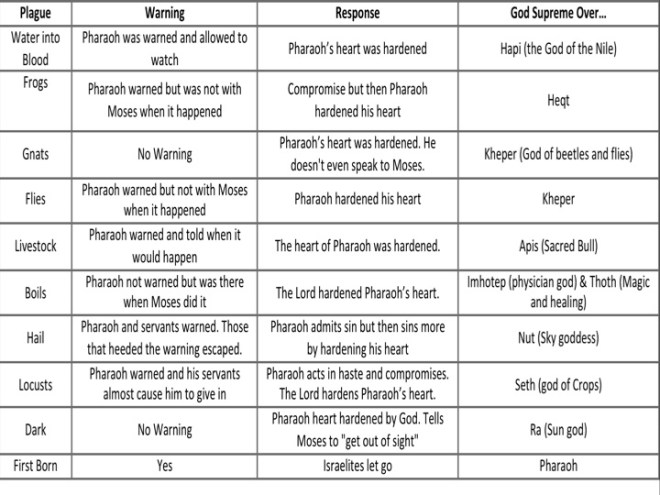
Ten plagues chart

Many students of the plagues have noticed that they appeared in sets of three.  The accounts of the first plague in each set (the first, fourth, and seventh plagues) each contain a purpose statement in which God explained to Moses His reason and aim for that set of plagues (cf. 7:17; 8:22; 9:14).

These plagues also all took place in the morning, possibly suggesting a new beginning. God had announced His overall purpose for the plagues in 7:4-5.

The last plague in each set of three came on Pharaoh without warning, but Moses announced the others to him beforehand.

The first set of three plagues apparently affected both the Egyptians and the Israelites, whereas the others evidently touched only the Egyptians.

Here in Exodus 7 Moses turned the water of the Nile to blood, so that the fish died and it one could not drink it (vv. 20-21, cf. Psalm 105;29), but the magicians were able to mimic this wonder as well.

David Guzik notes:

The Egyptian god Khnum was said to be the guardian of the Nile, and this showed he was unable to protect his territory.  The god Hapi was said to be the spirit of the Nile, and was brought low by this plague.  The great god Osiris was thought to have the Nile as his bloodstream; in this plague he truly bled.  The Nile itself was worshipped as a god, and there are papyri recording hymns sung in praise of the river.

John L.  Davis says…

“Those who venerated Neith, the eloquent warlike goddess who took a special interest in the lates, the largest fish to be found in the Nile, would have had second thoughts about the power of that goddess.  Nathor was supposed to have protected the chromis, a slightly smaller fish.  Those Egyptians who depended heavily on fish and on the Nile would indeed have found great frustration in a plague of this nature.”

None of these were the major gods of Egypt.

Luke 10 begins with Jesus sending out the 72.  Having sent out the 12 in chapter 9, he continues to train His disciples with OJT.  David Guzik notes the importance of Jesus’ encouragement to pray in v. 2

Jesus commanded them to pray; the work before them was great and could not be accomplished without much prayer. Specifically, they were to ask the Lord of the harvest to send out laborers into His harvest. This speaks powerfully to:

· The need for prayer in the work of evangelism (therefore pray)

· The maker of the harvest (the Lord of the harvest)

· The need for workers in the work of evangelism (laborers)

· The calling of God for the work of the harvest (to send out)

· The nature of harvest participation, work (laborers)

· The need to recognize Whom the harvest belongs to (His harvest)

So they go on their trip and return in v. 17 eager to share the results.  But as great as victory over injury, and especially over demons was, a greater cause for rejoicing was the Seventy’s assurance that God would reward them—with heaven itself, plus additional heavenly rewards (v. 20).

Jesus also expressed joy over the sovereign choice of His father to reveal truth and conceal it (vv. 21-24).  Revelation of truth happens because of God’s “good pleasure” (v. 21) to whom the “Son chooses to reveal” (v. 22).

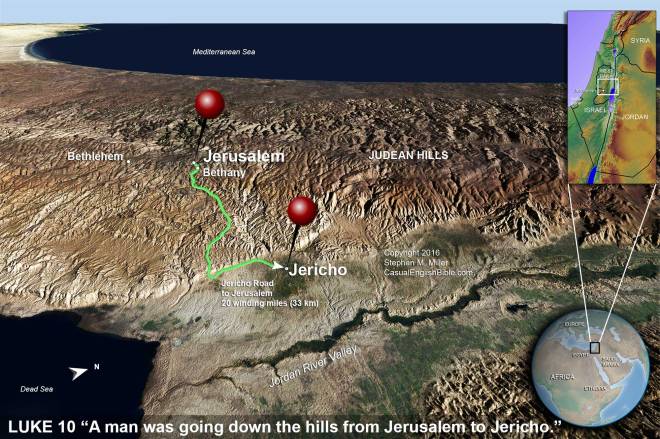
Jesus then tells the story of the Good Samaritan (10:25-37).  It was prompted by a lawyer’s question “What shall I do to inherit eternal life?”  Jesus directs him to the law–loving God totally and loving one’s neighbor.  Wanting to justify himself, he asked “Who is my neighbor?”  So Jesus said, “Let me tell you.”

Good Samaritan, Stephen Miller

This map is from Casual English Bible by Stephen Miller

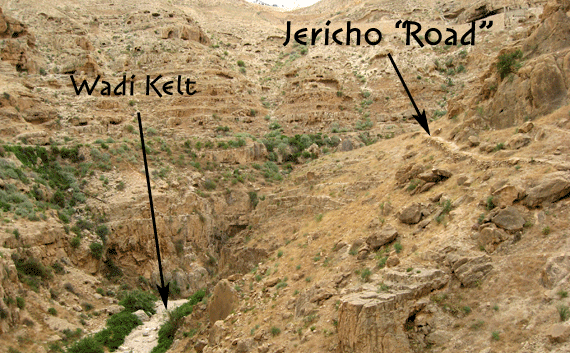
Jericho road in Wadi Kelt

In telling this story Jesus is illustrating that we do not limit the circle of our neighbor.  We focus on being a neighbor to anyone in need.

Jesus finishes this chapter commending Mary for choosing “the better part” of sitting at Jesus’ feet and listening to Him teach.  While serving Christ is not being denigrated here, Jesus is saying that it is even more important to spend time with Him.  We need a rhythm of service and solitude.

Charles Spurgeon, in his Morning and Evening devotional, comments:

Her fault was not that she served:  the condition of a servant well becomes every Christian.  Nor was the fault that she had “much serving.”  We cannot do too much.  Let us do all that we possibly can; let head, and heart, and hands, be engaged in the Master’s service.  It was no fault of hers that she was busy preparing a feast for the Master.  Happy Martha, to have an opportunity of entertaining so blessed a guest; and happy, too, to have the spirit to throw her whole soul so heartily into the engagement.  Her fault was that she grew “cumbered with much serving,” so that she forgot Him, and only remembered the service.  She allowed service to override communion, and so presented one duty stained with the blood of another.

We ought to be Martha and Mary in one:  we should do much service, and have much communion at the same time.  For this we need great grace.  It is easier to serve than to commune.  Joshua never grew weary in fighting with the Amalekites; but Moses, on the top of the mountain in prayer, needed two helpers to sustain his hands.  The more spiritual the exercise, the sooner we tire in it.

Beloved, while we do not neglect external things, we ought also to see to it that we enjoy living, personal fellowship with Jesus.  See to it that sitting at the Saviour’s feet is not neglected, even through it be under the specious pretext of doing Him service.  The first thing for our soul’s health, the first thing for His glory, and the first thing for our own usefulness, is to keep ourselves in perpetual communion with the Lord Jesus, and to see that the vital spirituality of our religion is maintained over and above everything else in the world.

In Job 24 Job continues to express his rejoinder to Eliphaz. Thomas Constable summarizes…

Job could not understand why God did not always judge overt sin quickly (24:1-12).  Most people still have the same question.  He mentioned three sins specifically: removing boundary landmarks and thereby appropriating someone else’s land, stealing flocks of sheep, and mistreating the weak.  Job could not see why God seemingly ignored the perpetrators of these terrible sins, yet afflicted him so severely.  Neither could he see why God did not judge sinners who practiced secret atrocities, specifically: murderers, adulterers, and burglars (24:14-17).

These confusing verses evidently are saying that God sometimes does not punish the wicked during their lifetime (vv. 18-21), and that the “valiant”—powerful authorities, either good or bad—have no guarantee or “assurance of life” in their God-given yet tenuous “security” (vv. 22-24).  Probably Job was reflecting that God does indeed punish them in death if not in life.  What bothered him was why God did not punish them sooner.  Even with more revelation than Job enjoyed, we still have great difficulty understanding God’s ways generally, and why He does what He does in specific individual lives particularly.  God’s wisdom is still unfathomable.

1 Corinthians 11 deals with issues regarding worship–how women are involved and how to appropriately celebrate the Lord’s Supper and the agape feast.  Paul speaks of a hierarchy which extends even to the Trinity in v. 3…

3 But I want you to understand that the head of every man is Christ, the head of a wife is her husband, and the head of Christ is God.

So submission is modeled in the Trinity and extends throughout all relationships.  In this context only the marriage relationship is addressed, but other passages show that we must submit as well to our bosses, to government, to church leaders.

To indicate just how difficult this passage is to decipher, here are links to four articles, all from the same website, but not all reaching the same conclusions.

About vv. 11-12 Ray Stedman writes:

Paul carefully declares that man and woman cannot exist without each other.  They are equal as persons, distinct as sexes, functioning in a divinely given order in order to demonstrate to all the delight of God in his creation and redemption of mankind.  If we will carefully think that through we shall find it is a very powerful argument for equality of persons and distinctives of role.

Paul then deals with the Lord’s Supper in vv. 17-34.  He needed to correct some abuses (vv. 17-26), which abused the poor (vv. 17-22, 33-34) by over-indulging while the poor got little or nothing, and abusing the Lord by not taking the Lord’s Supper in a worthy manner (vv. 23-32).

The selfish attitude that marked the Corinthian church comes through strongly in this section of the epistle.  It manifested itself in a particularly ugly display at the Lord’s Table.  Paul dealt with it severely, both for the sake of the reputation of the Savior, and for the welfare of the saints.

William Barclay writes:

We must be clear about one thing.  The phrase which forbids a man to eat and drink unworthily does not shut out the man who is a sinner and knows it.  An old highland minister seeing an old woman hesitate to receive the cup, stretched it out to her, saying, “Take it, woman; it’s for sinners; it’s for you.”  If the Table of Christ were only for perfect people none might ever approach it.  The way is never closed to the penitent sinner.  To the man who loves God and his fellow men the way is ever open, and his sins, though they be as scarlet, shall be white as snow.

M’Cheyne Bible Reading Plan, February 23

Today’s readings are from Exodus 5, Luke 8, Job 22, 1 Corinthians 9.

(I just realized today that I’m a day off on the plan.  I should be on Exodus 6, Luke 9, Job 23 and 1 Corinthians 10).  So…

Exodus 5-6 indicate that Moses’ first attempts to rescue his people met with dismal failure.  In Exodus 5 Aaron and Moses go to Pharoah and ask him to let them go into the wilderness to worship (temporarily). Pharoah responds by making their work much more difficult and the people return to Moses and complain that their lives are harder now.  Of course, Moses did what we all do…

22 Then Moses turned to the LORD and said, “O Lord, why have you done evil to this people?  Why did you ever send me?

And the LORD responds (Exodus 6)

1 But the LORD said to Moses, “Now you shall see what I will do to Pharaoh; for with a strong hand he will send them out, and with a strong hand he will drive them out of his land.”

When all human help has failed, and the soul, exhausted and despairing, has given up hope from man, God draws near and says, I AM.  –F. B. Meyer

Yahweh rehearses the covenant promises (vv. 2-4), then repeats that He has heard their cries and seen their afflictions (v. 5) so He will deliver them (vv. 6-8).  Through it all, he wanted to show Israel “that I am the LORD your God” (v. 7).  In this revelation, God promised He would do three things for Israel:

1.  He would deliver the Israelites from their Egyptian bondage (v. 6). Moses communicated this in a threefold expression, suggesting the completeness of the deliverance: “I will bring you out from under the burdens of the Egyptians . . . I will deliver you from their bondage . . . I will redeem you with an outstretched arm and with great judgments.”

2. He would adopt Israel as His nation (“I will take you for My people, and I will be your God,” v. 7). This took place at Sinai (19:5).

3. He would bring Israel into the Promised Land (“I will bring you to the land . . . and I will give it to you for a possession,” v. 8).

The people, however, didn’t want to listen to Moses, so God sent Moses back to Pharaoh.

Image result for exodus 6 genealogy

In the tribe of Levi there were three families–Gershon, Kohath and Marari.  Each of these families would be given specific duties in the service of the Lord and His tabernacle.

In Luke 8 Jesus begins to speak in parables.  His purpose is to reveal truth to some and conceal it from others (cf. Luke 8:9-10; Matthew 13:10-17).  Luke’s account is shorter than Matthew’s, limiting himself to two parables–the parable of the soils and the parable of the lamp, emphasizing the importance of hearing, obeying and proclaiming the Word of God.

The emphasis in the parable of the soils seems to be on their present response to the Word of God, be it belief or unbelief—not the ultimate outcome of their response, namely, their eternal salvation.  The salvation of the second and third seeds is difficult to determine.  They may appear to be saved and not, or may be saved, but fail in many ways.

In 8:19-21 Jesus declares that His true family are those who do His Word.  Jesus was not dishonoring His human family members, but honoring those who obey God.  It is not ecstatic experiences that draw us close to Jesus, but obedience to His Word.

In the remainder of Luke 8 Jesus exhibits His power over a stormy sea (nature, 8:22-25), over the demons (Luke 8:26-39) and over diseases and death (Luke 8:40-56).  All of these miracles show His divine nature.

In Luke 9 Jesus prepares and sends out his disciples on a “mission trip” (Luke 9:1-6).  They were to trust God for their provision and go to the house of Israel.  Sandwiched between Herod’s question about Jesus’ identity (9:7-9) and Peter’s confession of Jesus’ true identity (9:18-27) is the feeding of the 5,000 (9:10-17).

As if to emphasize the truth of Peter’s confession and seal His “departure” Jesus is transfigured before three disciples (9:28-36).  After dealing with their disciples’ failure to exorcise demons from a boy (9:37-43a), Jesus again announces his betrayal (9:43b-45).

In contrast to Jesus’ humble submission to the Father’s will, the disciples jockey for position in the kingdom and seek put a stop to the ministries those outside the group (9:46-50).

Luke 9:51 begins the long, final section of Luke’s gospel (9:51-19:27), in which he “sets His face towards Jerusalem” and the cross.  The central section focuses on the parables of the kingdom and its growth in 13:18-21 and the coming judgment on the Jews for rejecting Jesus as Messiah (13:22-35).

There are 23 parables in 9:51—19:27. This is over half of all the parables in Luke’s Gospel. Jesus gave most of the parables in this section to His disciples, but other non-disciples, who were following Him to Jerusalem to get help of various kinds from Him, were also present. That is why He used parables to teach His disciples: to reveal and to conceal truth.

Parables in Luke 9:51—19:27

The good Samaritan 10:30-37
The shameless friend 11:5-8
The strong man’s house 11:21-22 (cf. Matt. 12:29; Mark 3:27)
The rich fool 12:16-21
The faithful servants 12:36-38
The two servants 12:42-42 (cf. Matt. 24:45-51)
The barren fig tree 13:6-9
The mustard seed 13:18-19 (cf. Matt. 13:31-32; Mark 4:30-32)
The yeast hidden in meal 13:20-21 (cf. Matt. 13:33)
The seats at the wedding feast 14:7-11
The great banquet 14:15-24
The tower builder 14:28-30
The king going to battle 14:31-33
The lost sheep 15:4-7 (cf. Matt. 18:12-14)
The lost coin 15:8-10
The prodigal son 15:11-32
The shrewd manager 16:1-9
The rich man and Lazarus 16:19-31
The unworthy servant 17:7-10
The one taken and the one left 17:34-35 (cf. Matt. 24:40-42)
The persistent widow 18:1-8
The Pharisee and the tax collector 18:9-14
The minas 19:11-27

Jesus begins to teach His followers what it means to be a disciple, starting with toleration (9:51-56) and self-denial (9:57-61).

Job 22-23

The three cycles of speeches in Job are like three rounds in a boxing match, though the competition in this case was intellectual rather than physical.  In round one of the debate, Job’s friends probed his intellect, and in round two they probed his conscience. In round three, they probed specific issues.

We could summarize the criticisms of Job’s three companions in their speeches as follows.

CYCLE

ACCUSATION AGAINST JOB

FIRST “You are a sinner and need to repent.”
SECOND “You are wicked and God is punishing you.”
THIRD “You have committed these specific sins.”

So Job 22 is Eliphaz’s third speech.  He speaks to Job’s social sins, taking advantage of the poor (22:6-11), which Job will deny in 31:16-22.  Eliphaz proceeded next to judge Job’s motives (22:12-20. He assumed Job had concluded that because God was far away in heaven, he would get away with sin on earth. However, Job had affirmed God’s omniscience (21:22).  So Eliphaz demands that Job repent (22:21-30).

Job replies in chapters 23 and 24.  Job still wanted to make his case before God (23:1-7) because he still maintained his innocence (Job 23:8-12).  God’s irresistible power and inscrutable behavior made Job afraid (23:13-17). Job 23:10 expresses this precious truth:

10 But he knows the way that I take; when he has tried me, I shall come out as gold.

Amy Carmichael, in Whispers of His Power, writes:

It is good to see how Job turns from the misunderstanding of man to the perfect understanding of God.  He cannot see Him or find Him, but — glorious “but” — He knoweth the way that I take.  And in the end Job did come forth as gold.

And David Guzik writes:

With wonderful faith, Job seemed at this fleeting instant to understand what he could and should in his present crisis.  He understood that:

– God still observed Job carefully and had not forgotten him (He knows the way that I take).
– God had a purpose in the crisis, and the purpose was not to punish Job (when He has tested me)
– God would one day bring the trial to an end (I shall come forth)
– God would bring something good would from it all (I shall come forth as gold)
– God still valued Job; only precious metal is put through the fire (as gold)

1 Corinthians 9 and 10

Evidently the Corinthian Christians had misunderstood Paul’s policy of limiting the exercise of his activities to help others (8:13).  Some in the church had apparently concluded that because he did not exercise his rights, he therefore did not have them: for example, his right to material support (cf. 2 Cor. 12:13).  His apparently vacillating conduct also raised questions in their minds about his full apostolic authority.

So he identifies himself as an apostle (9:1-2) and talks about his rights as an apostle (9:3-14).  But, for the sake of the gospel, he limited his rights (9:15-23) and encouraged them to do the same (9:24-27).

David Guzik points out:

Here we see Paul’s real heart.  Paid or not paid, it did not matter to him.  What mattered was the work of the gospel.  Was it more effective for the gospel if Paul should receive support?  Then he would receive it.  Was it more effective for the gospel if Paul should work to support himself?  Then he would do that.  What mattered was that the gospel not be hindered in any way.

Paul used athletic metaphors often (cf. Philippians 3:12-14; 2 Timothy 2:5; 4:7; Galatians 5:7 and possibly Romans 11:11).  See also Hebrews 12:1-3, a non-Pauline text.

24 Do you not know that in a race all the runners run, but only one receives the prize? So run that you may obtain it. 25 Every athlete exercises self-control in all things.  They do it to receive a perishable wreath, but we an imperishable. 26 So I do not run aimlessly; I do not box as one beating the air. 27 But I discipline my body and keep it under control, lest after preaching to others I myself should be disqualified.

Some principles about the Christian life from these verses:

  1. All of us have a race to run.  The Christian life is a race.  Not a sprint, but a marathon.
  2. Not everyone receives a prize.  Unlike today, when children get a prize just for participating, we only get a prize by winning.
  3. To win we must “exercise self-control in all things.”  In every area of life we must exercise self-control if we are to win the prize.
  4. Our race is more important because we run to win an “imperishable” prize.
  5. We run/fight with purpose, not haphazardly.  Do you have a plan for your spiritual race?
  6. It is possible to be disqualified from the race.  I don’t believe that this means we will lose our salvation, but lose the reward associated with winning.

The point here is that the Corinthians must be serious about their mission, as serious as athletes are about their training (and as Paul is about his preaching).

Paul then moves into Israel’s failure to faithfully run the race, and how they lost in 1 Corinthians 10:1-13.  They had many advantages (vv. 1-4), but were idolaters, immoral and grumblers (vv. 5-10).  We MUST learn from their example and not stumble and fall (vv. 11-13).

We fight temptation with Jesus’ power, like the girl who explained what she did when Satan came with temptation at the door of her heart: “I send Jesus to answer the door. When Satan sees Jesus, he says, ‘Oops, sorry, I must have the wrong house.’”

Image result for 1 corinthians 10 chart

Whereas involvement in idolatry for the Israelites had involved judgment, here in 10:14-23 Paul acknowledges that food offered to idols is offered to demons (vv. 19-20).  Paul is very firmly telling the Corinthians that they cannot participate in idolatry and then take part in communion without provoking the wrath of a jealous God.

The Corinthians were arguing for the right to attend pagan religious meals.  They even viewed pagan temple attendance as a way of building their “weaker” brethren.  aul responded that attending pagan meals was wrong on two counts: it was unloving, and it was incompatible with life in Christ, which their participation at the Lord’s Table symbolized.  He forbade any relationship with the demonic.

Like in chapter 8, Paul affirms that we have freedom, but that freedom should be limited by love for others (vv. 27-28) and the glory of God (vv. 29-31).  Thus, they (and we) should imitate Paul (1 Cor. 11:1).

Thomas Constable notes the chiastic structure in these verses:

A         The criterion stated: the good of others (10:23-24)

            B         Personal freedom explained (10:25-27)

                        C         The criterion illustrated: love governing liberty (10:28-29a)

            B’        Personal freedom defended (10:29b-30)

A’        The criterion generalized: that all may be saved (10:33—11:1)

Need help in making decisions?

Image result for 1 corinthians 10 chart

M’Cheyne Bible Reading Plan, February 22

Today’s readings are from Exodus 4, Luke 7, Job 21, 1 Corinthians 8.

In Exodus 4 Moses continues to make excuses.  In other words, Moses keeps beating around the bush.

Bible commentator G. Campbell Morgan has written:  “We are ever prone, when God is calling us to some high service, to say ‘But,’ and this to introduce our statement of the difficulties as we see them.”

God likes to use what you already have…what you’ve got in your hand.

Image result for Moses excuses

Back when I was in high school, I remember hearing Ken Medema, a fantastic blind piano player, playing his song Moses.

Moses should have obeyed the Lord in simple dependence, knowing that His commands are His enablements.  God never asks us to do anything without giving us the power to do it.  Because Moses was not satisfied with God’s best, he had to take God’s second best—that is, having Aaron be his spokesman.  Moses thought that Aaron would be a help, but he later proved to be a hindrance in leading the people to worship the golden calf (chapter 32).

–William MacDonald

So Moses returns to Egypt.  He is now 80 years old (Exodus 7:7), two-thirds of his life over.  But God will use him greatly in the time he has left.  Take heart!  No matter how long God takes to train you, He can do more in those weeks, months or years you have left than you could imagine!

21 The LORD said to Moses, “When you return to Egypt, see that you perform before Pharaoh all the wonders I have given you the power to do. But I will harden his heart so that he will not let the people go.

Notice again (v. 21) that although there will be this mysterious interplay between God hardening Pharaoh and Pharaoh hardening his own heart in chapters 7-10, we have the prediction here that “I will harden his heart…”

David Guzik explains…

We might say that it was both God and Pharaoh; but whenever God hardened Pharaoh’s heart, He never did it against Pharaoh’s will.  Pharaoh never said, “Oh, I want to do what is good and right and I want to bless these people of Israel” and God answered, “No, for I will harden your heart against them!”  When God hardened, He allowed Pharaoh’s heart to do what Pharaoh wanted to do – God gave Pharaoh over to his sin (Romans 1:18-32).

But before Moses arrives in Egypt we have this strange passage:

24 At a lodging place on the way, the LORD met Moses and was about to kill him. 25 But Zipporah took a flint knife, cut off her son’s foreskin and touched Moses’ feet with it. “Surely you are a bridegroom of blood to me,” she said. 26 So the LORD let him alone. (At that time she said “bridegroom of blood,” referring to circumcision.)

God made Moses very ill because he had apparently not circumcised at least one of his two sons.  This was the sign of the Abrahamic covenant and as a leader of Israel, Moses could not forego this.  God’s sentence for this sin of omission (an Israelite failing to have his son circumcised) was death (“cut off from his people,” cf. Gen. 17:14).

Was God prepared to put to death His carefully prepared deliverer just because of this?

Apparently this was the final stage of preparation.  God was bringing Moses to a place of recognizing God’s ultimate sovereignty over all.  It was Moses’ Jabbok.

The “bridegroom of blood” figure (v. 26) evidently means the following: Apparently Zipporah regarded her act of circumcising her son as the factor that removed God’s hand of judgment from Moses, and restored him to life and to her again. It was as though God had given Moses a second chance, and he had begun life as her husband all over again, as a bridegroom (cf. Jonah). (Thomas Constable)

In Luke 7 we see Jesus’ compassion in healing the Centurion’s daughter (7:1-10), raising the widow of widow of Nain’s dead son (7:11-17), then He deals with John the Baptist’s doubts about who He was (7:18-23) and spoke highly of John (7:24-28).  However, He then condemns an unbelieving generation (7:29-35) and Simon the Pharisee for showing Him no love (7:36-50).

The Centurion showed unusual faith, the text says nothing about the widow’s faith.  John’s faith is wavering and the woman’s faith encourages her to do something risky.

Image result for woman washing Jesus feet figurine

This is one of my favorite passages.  I preached on it years ago at East Evangelical Free Church in Wichita, Kansas and Sherry Cowan gave me the above figurine.  I still have it in my office at church.

She, though a well-known sinner, treated Jesus with love and honor, whereas Simon gave no evidence of love.  Jesus confronts us with the reality that “whoever has been forgiven little loves little.”  The greater your sense of your sin and God’s forgiveness of it, the more love you will have for Christ.

Job 21 is Job’s second reply to Zophar.

After the first cycle of speeches, Job responded to a point each of his friends had made, namely, that God consistently blesses the righteous and blasts the unrighteous.  After this second cycle of speeches, Job again replied to a point each accuser had made: that the wicked suffer destruction in this life.

Here Job tells them that the wicked don’t always suffer.  Sometimes they live in peace and prosperity (21:7-16).  They die, but so do the righteous, because we’re all sinners (21:17-26), yet they may live their whole lives in prosperity (21:27-34).  Job’s account is more realistic than that of his friends.

But, this was not going to stop Job’s friends, if you can still call them that.

John Trapp says…

“God is pleased to do wonderful contradictory things in man’s reason; so that we must needs confess an unsearchableness in his ways. . . . In this work of his, human reason is blinder than a mole.”

1 Corinthians 8 begins Paul discussion about the issue of eating meat offered to idols, which will carry us through 11:1.  Gordon Fee gives us this background information:

“That going to the temples is the real issue is supported by the fact that the eating of cultic meals was a regular part of worship in antiquity.  This is true not only of the nations that surrounded Israel, but of Israel itself.  In the Corinth of Paul’s time, such meals were still the regular practice both at state festivals and private celebrations of various kinds.  There were three parts to these meals: the preparation, the sacrifice proper, and the feast.  The meat of the sacrifices apparently was divided into three portions: that burned before the god, that apportioned to the worshipers, and that placed on the ‘table of the god,’ which was tended by cultic ministrants but also eaten by the worshipers.  The significance of these meals has been much debated, but most likely they involved a combination of religious and social factors.  The gods were thought to be present since the meals were held in their honor and sacrifices were made; nonetheless, they were also intensely social occasions for the participants.  For the most part the Gentiles who had become believers in Corinth had probably attended such meals all their lives; this was the basic ‘restaurant’ in antiquity, and every kind of occasion was celebrated in this fashion

“The problem, then, is best reconstructed along the following lines. After their conversion—and most likely after the departure of Paul—some of them returned to the practice of attending the cultic meals. In his earlier letter Paul forbade such ‘idolatry’; but they have taken exception to that prohibition and in their letter have made four points:

“(1) They argue that ‘all have knowledge’ about idols [i.e., that there are no such things, so participation in these meals is not an issue, cf. vv. 1, 4]. . . .

“(2) They also have knowledge about food, that it is a matter of indifference to God (8:8) . . .

“(3) They seem to have a somewhat ‘magical’ view of the sacraments; those who have had Christian baptism and who partake of the Lord’s Table are not in any danger of falling (10:1-4).

“(4) Besides, there is considerable question in the minds of many whether Paul has the proper apostolic authority to forbid them on this matter. In their minds this has been substantiated by two factors: first, his failure to accept support while with them; and second, his own apparently compromising stance on idol food sold in the marketplace (he abstained when eating with Jews, but ate when eating with Gentiles; cf. 9:19-23).

It is a passage directed toward those whose have their facts right but hearts wrong. Here Paul addresses the intelligent but unloving.

–Francis Chan

So Paul is telling the Corinthians that love should supersede knowledge.  In other words, just because you know something is OK to do, doesn’t mean you should do it.  One must love God and their brothers and sisters in Christ.  There is, in reality, only one true God.  Therefore, the idols are not really gods.  But, it is more important to not put a stumbling block in front of your brother. (Go back to Romans 14 for a deeper discussion of the conscience.)

Thomas Constable provides this illustration of how to put these principles into practice:

In the United States, the law permits a driver to turn right at most stoplights, provided there is no oncoming traffic.  Turning right into oncoming traffic would pose a danger to others.  The driver must make his or her decision to turn right, or to wait, on the basis of the welfare of everyone concerned.  Just so, Christians must choose to exercise their liberty on the basis of the welfare of everyone concerned.

The issue in this chapter is not that of offending someone in the church.  Paul dealt with that subject in 10:31—11:1 and Romans 14.  It is, rather, doing something that someone else might repeat to his or her own hurt (“causing my brother to stumble”). Paul dealt with an attitude in the Corinthians.

Our American culture idolizes our freedom to do what we want.  Paul is saying that there is a higher value than personal freedom.  There are times we need to curtail our freedom so as not to lead others into sin.