M’Cheyne Bible Reading Plan, March 30

Today’s Bible readings are from Leviticus 1, John 20, Proverbs 17 and Philippians 4.

Some see Leviticus as the high point, or mid point, of the Pentateuch

Image result for pentateuch

walkwiththeword.org

Others see a chiastic structure, with Leviticus at the center, the most important spot in a chiasm.

Image result for pentateuch chart

Pastor Dave Online

And as for the structure of Leviticus itself, some see a chiastic structure.

Image result for leviticus

My Digital Seminary

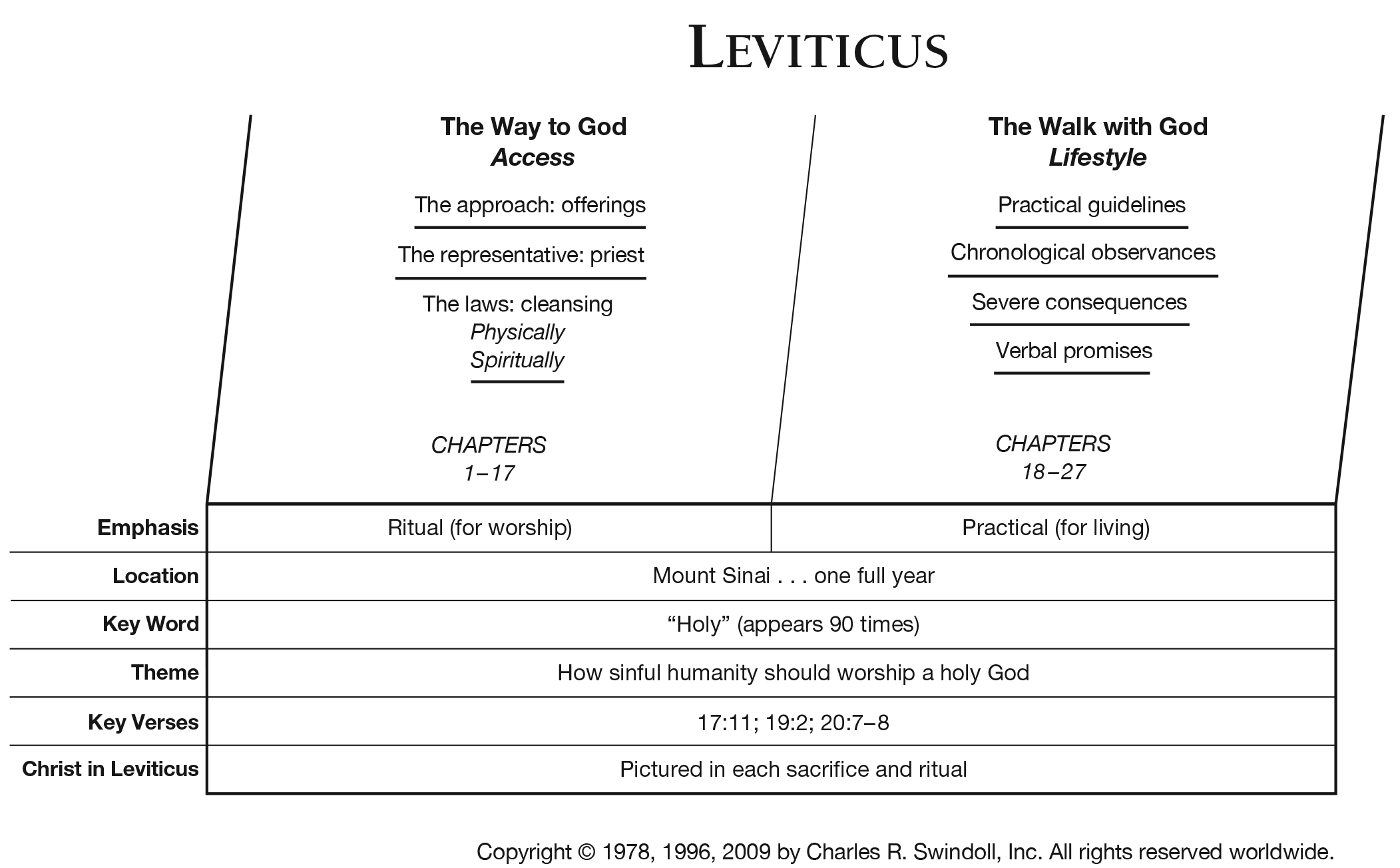
Here is Chuck Swindoll’s book chart for Leviticus

Image result for leviticus

Juan Sanchez gives us Five Reasons to Preach through Leviticus.  Those five reasons are…

  1. Leviticus reminds us of the grace of our God and the cost of our sin (1–7).
  2. Leviticus exposes God’s grace in providing a mediator (8–10).
  3. Leviticus explains what God requires of those who approach him in worship (11–15).
  4. Leviticus foreshadows forgiveness of sin in the one mediator between God and man, the man Christ Jesus (16–17).
  5. Leviticus outlines how God’s people are to be holy as God is holy (18–27).

Image result for leviticus 1

The story of Leviticus picks up where Exodus left off.  Israel is still camped out at the base of Mount Sinai, and they will remain there all through the Book of Leviticus. (David Guzik)

In the covenant God made with Israel at Mount Sinai, there were three major facets.  The covenant included the law Israel had to obey, sacrifice to provide for breaking the law, and the choice of blessing or curse that would become the script for Israel’s history.

The sacrificial system was an essential element of the Mosaic covenant, because it was impossible to live up to the requirements of the law.  Sin was dealt with through sacrifice.  This was not the beginning of God’s sacrificial system.  Adam knew of sacrifice (Genesis 3:21), as did Cain and Abel (Genesis 4:3-4), Noah (Genesis 8:20-21) and Abraham (Genesis 22:9-13).  The idea of sacrifice to the gods was not unique to Israel.  Other nations and cultures practiced sacrifice, often ultimately involving human sacrifice.

Leviticus 1 begins with general instructions for offering offerings (1:1-2), then gives instructions for the burnt offerings (1:3-17).

In summary, the burnt offering was an act of worship in which the Israelite offered to God a whole animal.  The fire on the altar completely consumed it (the offered animal) as a “substitute” for the offerer, and as a symbol of his total personal self-sacrifice to God.  These sacrifices were voluntary on the Israelite’s part, as is “self-sacrifice” for the Christian (Rom. 6:12-13; 12:1-2; cf. Matt. 22:37; 1 Cor. 6:19).

Gordon Wenham notes:

“The burnt offering was the commonest of all the OT sacrifices.  Its main function was to atone for man’s sin by propitiating God’s wrath.  In the immolation [burning] of the animal, most commonly a lamb, God’s judgment against human sin was symbolized and the animal suffered in man’s place.  The worshiper acknowledged his guilt and responsibility for his sins by pressing his hand on the animal’s head and confessing his sin.  The lamb was accepted as the ransom price for the guilty man [cf. Mark 10:45; Eph. 2:5; Heb. 7:27; 1 Pet. 1:18-19].  The daily use of the sacrifice in the worship of the temple and tabernacle was a constant reminder of man’s sinfulness and God’s holiness.  So were its occasional usages after sickness, childbirth, and vows.  In bringing a sacrifice a man acknowledged his sinfulness and guilt.  He also publicly confessed his faith in the Lord, his thankfulness for past blessing, and his resolve to live according to God’s holy will all the days of his life” (Leviticus, p. 63).

We who are Christians, too, need to remember our need for daily forgiveness, confess our sins, and purpose to walk in God’s ways (cf. 1 John 1:7-9).

John 20

Jesus was crucified on Friday (or on Thursday by some accounts).  After His entombment, the tomb was sealed and guarded by Roman soldiers (Matt. 26:62-66).  On Sunday, “the first day of the week” Mary Magdalene went to the tomb to complete the burial work begun by Joseph and Nicodemus.

The Garden tomb, favored location by pilgrims but a discredited location by archaeologists.  Where Jesus was buried would have been a tomb like this.

When Mary saw the empty tomb, it is likely she first thought the grave had been robbed.  She observed enough to assume that had taken Jesus’ body away, then went and told Peter and John.  They ran to the tomb.

“Keep the Feast of the Resurrection.  Be a Peter or a John; hasten to the Sepulchre, running together, running against one another, vying in the noble race (cf. Jn. 20:3-4).  And even if you be beaten in speed, win the victory of zeal; not looking into the tomb, but going in.” (Saint Gregory the Theologian)

Amazingly, verse 9 says that the disciples “as yet did not understand the Scripture, that he must rise from the dead” even though verse 8 reported that John believed.  Apparently John believed based upon what he had seen (his experience), but later (cf. Luke 24) they would have additional reasons to believe, based upon the Scriptures and Jesus’ statements.

Thomas Constable provides a chart outlining the general chronological progression of the remaining post-resurrection appearances…

Jesus’ Post-resurrection Appearances

Easter morning
to Mary Magdalene (Mark 16:9-11; John 20:10-18)
to other women (Matt. 28:9-10)
to Peter (Luke 24:34; 1 Cor. 15:5)
Easter afternoon
to two disciples on the Emmaus road (Luke 24:13-32)
Easter evening
to about 12 disciples excluding Thomas (Mark 16:14; Luke 24:36-43; John 20:19-23)
The following Sunday
to 11 disciples including Thomas (John 20:26-28)
The following 32 days
to seven disciples by the Sea of Galilee (John 21:1-23)
to 500 people including the Eleven at a mountain in Galilee (Matt. 28:16-20; 1 Cor. 15:6)
to His half-brother James (1 Cor. 15:7)
to His disciples in Jerusalem (Luke 24:44-49; Acts 1:3-8; 1 Cor. 15:7)
to His disciples on Mount Olivet (Mark 16:19-20; Luke 24:50-53; Acts 1:9-12)

Edwin Blum notes…

“The fact that He appeared to Mary rather than to Pilate or Caiaphas or to one of His disciples is significant.  That a woman would be the first to see Him is an evidence of Jesus’ electing love as well as a mark of the narrative’s historicity.  No Jewish author in the ancient world would have invented a story with a woman as the first witness to this most important event.  Furthermore, Jesus may have introduced Himself to Mary first because she had so earnestly sought Him.  She was at the cross while He was dying (John 19:25), and she went to His tomb early on Sunday morning (20:1).”

In verse 16 Mary recognizes Jesus when He calls her by name.  There is something special and endearing about that.

The best explanation for Jesus’ admonition to Mary “”Do not cling to me, for I have not yet ascended to the Father” seems to be that Mary was holding onto Jesus as though she would never let Him go (cf. Matt. 28:9).  As Barrett put it, “. . . she is trying to recapture the past.”  Jesus either told her to stop doing that or, if He knew she was about to do it, He was telling her not to do it.  He was almost ready to disappear permanently.  The reason she should release Him was that He had not yet ascended to the Father.  He had other work to do first.  Only in heaven would it be possible for loving believers such as Mary to maintain contact with Jesus forever.

This view makes good sense of the text and harmonizes with Jesus’ invitation to Thomas (v. 27).  Thomas needed to touch Jesus to strengthen his faith.  Mary needed to release Him because she had no reason to fear losing Him.  This view is very similar to view four above. (Thomas Constable)

For Thomas’ doubt and interaction with Jesus, read Sherri Gragg’s article Jesus Can Handle Your Doubt.

Now Thomas believed as his fellow disciples had come to believe (cf. v. 25).  His confession is a model that John presented for all future disciples.  It is the high point of this Gospel (cf. 1:1, 14, 18).

Proverbs 17 continues wisdom maxims from Solomon.  Tom Constable entitles this chapter “peacemakers and trouble-makers.”

One of my favorites in this chapter is 17:9…

9 Whoever covers an offense seeks love, but he who repeats a matter separates close friends.

The NLT says it like this:

9 Overlook an offense and bond a friendship;
fasten on to a slight and—good-bye, friend!

To repeat an offense may refer to gossip, but it could also refer to harping on something.  We can cover over some offenses, others we need to forgive.  If it is something we can excuse to a person’s human limitations or understanding, or if we can see ourselves as capable of the same, we may be able to “overlook” it.  But if it is a deep wound that continues to hound our thoughts, we cannot merely overlook, we must work to forgive.

The next verse speaks to addressing that issue with the offending party (17:10):

A rebuke goes deeper into a man of understanding than a hundred blows into a  fool.

Another good verse related to conflicted relationships is Proverbs 17:14:

14 The beginning of strife is like letting out water, so quit before the quarrel breaks out.

A trickle is much easier to stop than a surging flood, so work to resolve a quarrel soon before it gets out of hand.

Philippians 4 begins with an exhortation to “stand firm in the Lord” (4:1-9) and then Paul discusses his own financial circumstances in light of the fact that the Philippians wanted to send him a gift (4:10-20).

Standing firm (cf. Eph. 6:13) involves living in harmony with one another (vv. 2-3), rejoicing on all occasions (vv. 4-7), and developing the quality of sweet reasonableness (vv. 8-9).

The context of these first nine verses seem to deal with a conflict between two women, Euodia and Synteche (whom I’ve nicknamed “You’re Odious” and “Soon Touchy”).  Notice that Paul deals with each individually.  No matter what “side” they were on, they each had a responsibility to deal with this conflict in a healthy way.

Whatever was the conflict between them, they are urged to “agree in the Lord.”  While unanimity is not always possible, unity is.  What they shared in common, they needed to stand in.

That they might need help is indicated by verse 3 where some person, possibly the pastor, was called to “help these women.”  Apparently they had been quite involved in serving the Lord along with others and it would be a shame to see them destroy their usefulness through conflict.

They were all to “rejoice in the Lord” (v. 4), but this is especially important when in conflict with someone.  Paul emphasizes this and it should be our “one thing” that we do–to find our joy in Jesus Christ.  Notice that “rejoice” is an action.  We rejoice with our mouths so that our hearts might increase in joy.

Verse 5 applies to this conflict by encouraging them to show “reasonableness” or “meekness” to one another.  The word has the idea of, while being in the right, not pressing that right.

I find that in a time of disagreement, we need to consider two things: (1) how important is the issue, to us, and (2) how important is the relationship to us?

Sometimes the issue is highly important and we might even have to sacrifice the relationship for the sake of the issue (the truth).  But sometimes the relationship is more important, or just as important (as in marriage, for example).  We can’t just sacrifice that relationship.

When the relationship is more important than the issue, it is easy to yield.  Paul is here encouraging us to yield (except I would say when the issue if very, very important).  Even then, we can show a respect and give in on any other issues that are less important.

Paul then encourages them to turn their worries into prayers.  When we are having conflict with someone, we will typically have a problem with (1) rejoicing, (2) showing gentleness, and (3) worrying.  We are to “cast those cares” on Jesus.

Image result for worries concerns phil moser

Phil Moser has an article explaining these three circles, borrowed from Dr. Nicholas Ellen.

Howard Hendricks called verses 2-6:

“. . . a five-part recipe for conflict resolution: (1) ‘Rejoice in the Lord,’ that is, get beyond yourselves and look to the Lord. (2) ‘Let your gentleness be evident to all.’ In other words speak with kindness to each other. (3) ‘Do not be anxious.’ Relax, and give it all to God. (4) ‘Be thankful.’ The simple act of expressing gratitude for our blessings takes the heat out of infection. (5) Present your requests to God. Prayer realigns us and restores peace . . .”

Paul stresses that we can take everything to God in prayer.

As it has been beautifully put: “There is nothing too great for God’s power; and nothing too small for his fatherly care.”  We can bring our prayers, our supplications and our requests to God; we can pray for ourselves.  We can pray for forgiveness for the past, for the things we need in the present, and for help and guidance for the future.  We can take our own past and present and future into the presence of God.  We can pray for others.  We can commend to God’s care those near and far who are within our memories and our hearts.

And every prayer must surely include thanks for the great privilege of prayer itself.  Paul insists that we must give thanks in everything, in sorrows and in joys alike.  That implies two things.  It implies gratitude and also perfect submission to the will of God.  It is only when we are fully convinced that God is working all things together for good that we can really feel to him the perfect gratitude which believing prayer demands.

William Barclay

One other thing, and that is that during conflict we must focus our minds on the right things.  This is what Paul says in vv. 8-9

8 Finally, brothers, whatever is true, whatever is honorable, whatever is just, whatever is pure, whatever is lovely, whatever is commendable, if there is any excellence, if there is anything worthy of praise, think about these things.

“True” (alethe) means valid, honest, and reliable (cf. Rom. 3:4).

  • “Honorable” or “noble” (semna) means worthy of respect (cf. Prov. 8:6; 1 Tim. 3:8, 11; Titus 2:2).
  • “Right” (dikaia) refers to what is just and upright.
  • “Pure” (hagna) denotes cleanness and connotes moral purity.
  • “Lovely” (prosphile) means what is amiable, agreeable, or pleasing.
  • “Of good repute” or “admirable” (euphema) refers to what is praiseworthy because it measures up to the highest standards.
  • “Excellent” (aretē), a term denoting consummate “excellence” or “merit” within a social context.  Here, “uncommon character worthy of praise, excellence of character, exceptional civic virtue.”
  • “Praiseworthy” (epainos), refers first to the act of praise, then to “a thing worthy of praise.”

What Paul describes here is a practical way to bring every thought into captivity to the obedience of Christ.  “This [verse] has been called the briefest biography of Christ.” (J. Vernon McGee)

9 What you have learned and received and heard and seen in me–practice these things, and the God of peace will be with you.

As a housewarming gift, we were given this:

Image result for preach lips life

The remainder of Philippians 4 speaks of Paul’s acknowledgement and appreciation of the Philippians’ desire to support him financially, but also that he has “learned the secret of contentment.”  That is what God strengthens us to do (v. 13), is to be content with what we have.  Contentment is not resignation, it is not grudging acceptance of what God has given us, but joyful celebration of what God has given us–whether plenty or little.

About verse 19 Spurgeon thought that this verse was a great illustration of that wonderful miracle in 2 Kings 4:1-7, where Elisha told the widow to gather empty vessels, set them out and pour forth the oil from the one small vessel of oil she had into the empty vessels.  She filled and filled and miraculously filled until every empty vessel was full.

  • All our need is like the empty vessels.
  • God is the one who fills the empty vessels.
  • According to His riches in glory describes the style in which God fills the empty vessels – the oil keeps flowing until every available vessel is filled.
  • By Christ Jesus describes the how God meets our needs – our empty vessels are filled with Jesus in all His glory.

And remember that Jesus is what we need most.

God’s Indictment against Israel’s Priests, part 3 (Hosea 4:15-19)

We are all influenced by someone, whether for good or for bad.  We have a had time going against the grain, swimming upstream against our culture.  Our teenagers have difficulty breaking from the pack.  We want to be liked; we want to be popular; we want to be in the “in” group.

But Scripture wisely reminds us that “bad company corrupts good morals” (1 Cor. 15:33) and Proverbs is full of warnings against blindly following the crowd or caving in to peer pressure.

Hosea is here encouraging Judah to learn from, not follow, the mistakes that Israel was making.

God’s people were dividing into two kingdoms at this point in history.  Ten tribes, called Israel or Ephraim, broke off under Jeroboam.  Hosea is addressing most of his charges against Israel.  Ultimately, they were taken into captivity in 722 B.C.

In the south were two tribes, Judah and Benjamin.  They had a few bad kings, but stayed faithful to Yahweh longer than their brothers to the north.  However, they were susceptible to idolatry as well, especially since their brothers had been practicing it.  This is why Hosea says, in Hosea 4:15-19…

15 Though you play the whore, O Israel, let not Judah become guilty. Enter not into Gilgal, nor go up to Beth-aven, and swear not, “As the LORD lives.” 16 Like a stubborn heifer, Israel is stubborn; can the LORD now feed them like a lamb in a broad pasture? 17 Ephraim is joined to idols; leave him alone. 18 When their drink is gone, they give themselves to whoring; their rulers dearly love shame. 19 A wind has wrapped them in its wings, and they shall be ashamed because of their sacrifices.

Yahweh has just about given up on Israel, but did not want Judah to follow in their footsteps.  Israel was involved in spiritual prostitution, worshiping other gods.  But if Judah follows in their footsteps, they too will become guilty.

So Yahweh tells Judah to (1) stay away from tempting situations, (2) leave them alone and (3) learn from their fate.

Judah was not to worship at the places that Israel had defiled with false gods.  Gilgal was the first important campsite after Israel crossed the Jordan as they entered the promised land (Joshua 5:9).  This camp served as their base of operations during the initial conquest of the Holy Land under Joshua.

Gilgal, Bible Atlas full page map

Interestingly, the word gilgal means “to roll.”  God instructed Joshua to have a man from each tribe pick up a stone from the middle of the Jordan in order to build a monument at Gilgal. This Hebrew name stands for “circle of standing stones.”

This directive is accompanied by a very important explanation of its purpose: “When your children ask in time to come, ‘What do those stones mean to you?’ then you shall tell them that the waters of the Jordan were cut off before the ark of the covenant of the LORD.  When it passed over the Jordan, the waters of the Jordan were cut off.  So these stones shall be to the people of Israel a memorial forever” (Joshua 4:6-7).

When the Israelites camped there, the new generation was circumcised there and because of their obedience God said to them

“Today I have rolled away the reproach of Egypt from you.”  And so the name of that place is called Gilgal to this day. (Joshua 5:9)

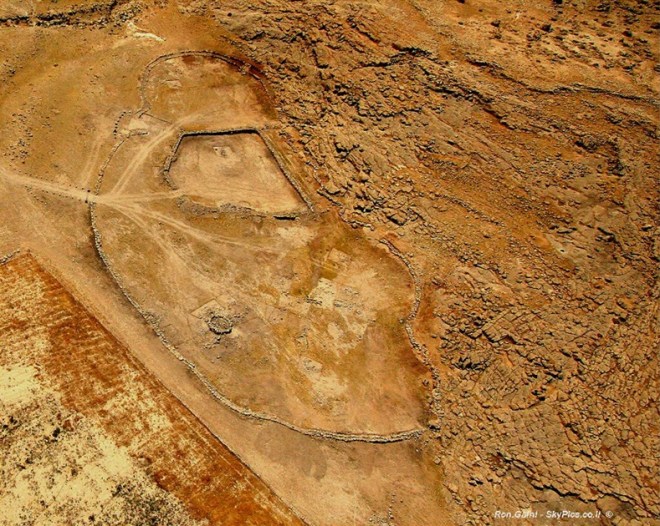
Recent archaeological discoveries in the Jordan Valley and the adjoining hills of Samaria appear to indicate that as Israel took possession of the land, they marked ownership of the land by building several structures that resemble a large foot print or sandal.

These unusual structures, studied extensively by Professors Adam Zertal and Dror Ben-Yosef of the University of Haifa, date to the Iron Age I period, based on pottery and animal bones found on-site.  They consist of two enclosed circles of stones that share a common border and, therefore, are joined together forming the shape of a foot print.

“The ‘foot’ structures that we found in the Jordan Valley are the first sites the people of Israel built upon entering Canaan and they testify to the biblical concept of ownership of the land with the foot.”

Bedhat esh-Sha'ab__A foot-shaped 'Gilgal'

In Deuteronomy 11:22-32, God promises the Israelites that if they obey his commandments, “Every place on which you set foot shall be yours.”  Also in Joshua 1:3 Yahweh said to Joshua…

3 Every place that the sole of your foot will tread upon I have given to you, just as I promised to Moses.

There are five such structures like this in the Jordan Valley.  So Gilgal was a sacred place for Israel.  It is where Samuel judged (1 Sam. 7:16).  It was the city where Saul’s kingship was affirmed (1 Samuel 11:14-15; 10:1, 8).  It was also the place to which David returned after Absalom’s attempted coup (2 Samuel 19:9-15, 40).  They were the first to reaffirm his rightful status as king.  Gilgal was also the place where Elijah was transported to heaven (2 Kings 2:1-14; 4:38-41).

But, when the kingdom split due to Solomon’s sin and Jeroboam took over the northern territories, Gilgal became a place of idol worship.  Thus both Hosea and Amos speak of its wickedness and corrupt worship (Hosea 9:15-17; 12:11-14; Amos 4:4-6; 5:1-6).

Finally, in the course of calling the people of Israel to account for their abandonment of the Lord, the prophet Micah reminded them of God’s care for them in their early days in Gilgal and elsewhere—thus bringing the story of Gigal full circle (Micah 6:1-5).

Bethel had an even richer history.  Abraham built one of his first altars there upon entering the land (Genesis 12:8).  It was the place where Jacob (Israel) received his dream of a stairway to heaven (Genesis 28:10-22).  It was commonly a place where Abraham and Jacob worshiped God (Genesis 12:8; 13:1-4; 28:10-22; 35:1-15).  Bethel was one of the first places in the Holy Land where the ark of the covenant of God was set up, and where the priests offered sacrifices and inquired of God (Judges 20:18, 26-28; 21:2).

But, when the northern kingdom seceded from the southern kingdom of Judah, its first king, Jereboam, set up golden calves at Bethel and Dan (the southern and northernmost locations in Israel).  The golden calf at Bethel made it more convenient for people to worship.  They would no longer be required to go all the way to Jerusalem to worship (1 Kings 12:25-33).

Bethel was located in the hill country, near the town of Ai, only 12 miles from Jerusalem.

So Yahweh is pleading with Judah not to make the same mistakes Israel made.  They were not to make pilgrimages to these sites, no matter how significant they had been in Israel’s history.  If they did, they would become guilty, just like Israel.  The word for “guilty” in verse 15 is guilt in relation to God.

Yahweh calls Bethel (“house of God”) Beth-Aven here.  Beth-aven means “house of iniquity” because they were persistently breaking the 2nd commandment, which prohibited worshiping God with idols at all.  Amos had changed this name back in Amos 5:5, saying “Bethel shall become Awen.  It had been transformed from a place of true devotion to Yahweh (back when Abraham and Jacob worshiped there) to a major center for the kind of worship which the prophet disapproved (Amos 3:14; 4:4; 5:5, 6, 7:10, 13).  Hosea shares Amos’ outrage at what has happened to this place, calling it Bethel twice (10:15, 12:5), and Beth Awen three times (4:15; 5:8; 10:5).

Kidner notes…

Amos, a lover of surprise, had ironically invited his readers to both these famous shrines to deepen their—guilt! ‘Come to Bethel and transgress…” (Amos 4:4).  Join our pilgrimage and earn a black mark!

Hosea’s variation on the theme gets under the skin at two fresh points.  It makes a wounding comparison, presenting Israel as no fit company for her smaller sister [the southern kingdom]; and it invents a nickname for the royal shrine: no longer Bethel, ‘house of God,’ but Beth-Aven, “house of evil”—for God cannot own such a place, or have His name bandied about by those who think of Him as Baal.

The remainder of verse 15 reveals that they were breaking the 3rd commandment as well.  They were treating God’s name profanely by making an oath they did not intend to keep and using the formula “as Yahweh lives” to bolster their credibility.

The right use of the name of Yahweh in making legitimate and honest oaths is nowhere condemned.  It was one of the privileges of the faithful Israelite (Deut. 6:13; 10:20).

But the false use of an oath was often used to avoid repentance.  It reveals stubbornness.  As Coffman says, it “was a device for lulling the conscience to sleep.”  You cannot keep the third commandment while breaking the first two!

Ronald Vandermey notes that “swearing by the Lord falsely in a place of idolatry was a sin because it associated the living God with idols (Lev. 19:12; Zeph. 1:1-5).

The fundamental charge in vv. 16-18 is that Israel had become incorrigible in its evil, shameful ways.  This is shown (1) in the simile of the stubborn heifer, (2) in their unbreakable attachment to idols, and (3) in their habitual debauchery of drunkenness and promiscuity.

Verse 16 pictures Ephraim as a heifer, which is ironic because Jeroboam erected golden calves for Israel to worship.  Thus, these calves were pictures of themselves.

They are a “stubborn heifer,” which cannot be treated in the same way as a lamb in a broad pasture.  You simply cannot lead them.

Because of their stubbornness Israel would have to be confined soon (“now), in captivity.  Not only would they be confined, but Yahweh could not minister to them (at least as a nation) as a shepherd normally would.

Hubbard says…

However much God would like to shepherd Israel with his wisdom, it seems he must, because of her continual intransigence, treat her as those dumb animals who will not respond to their master.

This reminds us of Jesus’ lament over Jerusalem in Matthew 23:37:

“O Jerusalem, Jerusalem, the city that kills the prophets and stones those who are sent to it!  How often would I have gathered your children together as a hen gathers her brood under her wings, and you would not!

I would have, but you would not, Jesus says.  You’ve made the fateful decision to reject Me and now I must reject you.

Since they willed not to follow their master, Yahweh would grant them their wish.  But their freedom would turn to ruin.  They would go unprotected and eventually be destroyed.  Thus Albert Barnes says…

Woe is it to that man, whom, when he withdraws from Christ‘s easy yoke, God permits to take unhindered the broad road which leadeth to destruction.

Sheep are gregarious creatures and do not do well when they are alone.  To be alone is a very precarious situation.  Soon, judgment would come and the land would be depopulated.  Only a very few would remain behind.

Ephraim–another name for Israel because it was the largest of the ten northern tribes—is captivated by the idols.  Remember the “spirit of whoredom” back up in verse 12 and their consulting of poles and sticks?  It is likely that along with their worship of false gods and involvement in sexual immorality was also attended by some attempted magic.

Those who meddle with this magic become trapped by it.  All of these complex of sins—idolatry, sexual immorality and magic, are powerful, powerful magnets, drawing devotees to want more and more and more.

When it says “Ephraim is joined to idols” it suggests a total merging, a strong bond.  It is similar to the idea in Genesis 2 (v. 24) where God says, “Therefore a man shall leave his father and his mother and hold fast to his wife.”  God is communicating there that the union between a husband and wife is to be permanent and indissoluble.

Likewise, nothing seemed to be able to break the bond between Ephraim and the Baalim.

Yahweh’s response to Ephraim is “leave him alone.”  This is a logical response to their enchantment and stubbornness.  Jamieson’s comment on this is:

“Leave him to himself.  Let him reap the fruits of his own perverse choice.  He is bent on his own ruin; leave him to his fate, lest instead of saving him thou shalt fall thyself.”

Let him go, like the father allowed his prodigal son to leave.

David Garland says

The greatest tragedy of all resulting from the failure of Israel’s leadership was, no doubt, that of the prophet’s being instructed to cease to minister to Israel (Ephraim).  Those unable to give up their idols deserved no less (4:17).  After all, the prophet’s words would only be wasted because they would fall upon deaf ears.  There appeared to be little likelihood now, that Israel would heed the prophet’s call.  Therefore, he was instructed to leave them alone, to leave them to their own choices. (Hosea, p. 43)

Paul says something very similar in Romans 1, indicating how a culture can devolve because God “gives them up” to their own desires—first to sexual immorality, then to homosexuality and ultimately to a depraved mind (Romans 1:18-32).

Listen, the worst thing God can do is to let you have your own wishes.  He knows what is best for you and has laid down guidelines on how to use your freedom within His Word and His law.  Listen to God.  Choose to obey Him and you will choose the path to greatest joy, both now and forever.

But there is a word of hope from Albert Barnes…

God will not, while there is hope, leave a man to sleep in sin; for so the numbness of the soul increases, until, like those who fall asleep amid extreme cold of the body, it never awakes

We should want and desire God’s disciplining hand upon us, while there is still time.

To whom is God through Hosea addressing the command “leave him alone?”  As I have mentioned, it most likely was the prophet himself.  Another possibility is that it is the priests who are being addressed—to stop misleading the people.

The final two verses in Hosea 4 seem to bring it back to the priests, and maybe in particular the high priest and transition us to chapter 5, which again picks up a charge against the priests.

The NASB has captured the first half of verse 18: “Their liquor gone, they play the harlot continually.”  Fueled and dazed by drink, they turned to idolatry, but they came up empty.  It did not fulfilled.  Possibly the draught had already made liquor scarce, and they, of course, turn to the false gods in another request for blessing.

Their rulers (lit. “shields”) dearly love shame.  How ironic!  Who would love shame except those intoxicated and enchanted by sin!  Judgment comes sweeping in in the final verse of Hosea 4…

19 A wind has wrapped them in its wings, and they shall be ashamed because of their sacrifices

Wind is a perfect figure for describing the sudden and violent nature of the judgment that will sweep helpless Israel into captivity before the Assyrians.  The use of the past tense is prophetic and shows that the judgment was as certain as if it had already occurred.

When God brought them out of captivity to Egypt, God “bore them on eagle’s wings” (Exodus 19:4), but now that they have abandoned him, he would abandon them as chaff before the wind.  They will be driven away into captivity, dispersed here and there.

Finally, while in captivity, they “shall be ashamed because of their sacrifices” and will turn away from idolatry.  Unfortunately, it would take captivity and ruin in order to learn this lesson well.

Shame when it comes prior to judgment can lead to renewal that effects new life and hope.  But shame after the fact of judgment leads only to regret.  Hosea’s advice to Judah remains sound:  seeing the destruction and shame wrought by apostasy and immorality, avoid such a way of life.

Unfortunately, Judah would eventually fall to their own shame and judgment.


God’s Indictment against the Priests, part 2 (Hosea 4:11-14)

I welcome you to turn with me to Hosea 4.  We’ve been studying this book for the past several months, going verse-by-verse to mine the riches of God’s Word.  This morning we’re going to look at vv. 10-14, which describe what happens to people who turn away from the knowledge of God.

10 They shall eat, but not be satisfied; they shall play the whore, but not multiply, because they have forsaken the LORD to cherish 11 whoredom, wine, and new wine, which take away the understanding. 12 My people inquire of a piece of wood [wooden idols], and their walking staff [divining rod] gives them oracles. For a spirit of whoredom has led them astray, and they have left their God to play the whore. 13 They sacrifice on the tops of the mountains and burn offerings on the hills, under oak, poplar, and terebinth, because their shade is good.  Therefore your daughters play the whore, and your brides commit adultery. 14 I will not punish your daughters when they play the whore, nor your brides when they commit adultery; for the men themselves go aside with prostitutes and sacrifice with cult prostitutes, and a people without understanding shall come to ruin. 15 Though you play the whore, O Israel, let not Judah become guilty. Enter not into Gilgal, nor go up to Beth-aven, and swear not, “As the LORD lives.” 16 Like a stubborn heifer, Israel is stubborn; can the LORD now feed them like a lamb in a broad pasture? 17 Ephraim is joined to idols; leave him alone. 18 When their drink is gone, they give themselves to whoring; their rulers dearly love shame. 19 A wind has wrapped them in its wings, and they shall be ashamed because of their sacrifices.

Although we talked about v. 10 last week, I want you to notice how its message of judgment matches that of verse 18.  Verse 10 said…

10 They shall eat, but not be satisfied; they shall play the whore, but not multiply, because they have forsaken the LORD to cherish 11 whoredom

While verse 18 says…

18 When their drink is gone, they give themselves to whoring; their rulers dearly love shame.

So Israel’s judgment has to do with being unsatisfied, even with the basics of life, and prostituting themselves to other gods.

In these verses Yahweh gives three illustrations of Israel’s dementedness: (1) consulting wooden omens for guidance; (2) being engrossed in idolatry; and (3) engaging in sexual immorality.  In both Old and New Testaments, one of the chief characteristics of false teachers is sexual immorality.

Now, moving on to verse 11.  There Hosea gives a proverbial type statement: “Prostitution, wine, and new wine take away the heart” as the King James and NASB says.  It reflects back to the issue of the priests and prophets “stumbling” back up in verse 5 and anticipates the next section in which the prophet mourns the degenerate state of the people.

It reminds me of Paul’s exhortation in Ephesians 5:18, “And do not get drunk with wine, for that is debauchery, but be filled with the Spirit…”  We can choose to “lose ourselves” to wine, or to the Spirit.

The heart, of course, is our control center—our reasoning ability, our affections and our strength of will to choose.  Debauchery, whether spiritually through idolatry or physically through strong drink, ruins the heart.

As Derek Kidner notes:

In itself, the proverb about whoredom and wine makes the point that what unbridled drinking does to blur the mind, unbridled sex will also do in a more subtle way.

Of course, all sin openly practiced and indulged results in the same destruction of the sinner; but Hosea probably focused upon this because, “It describes the excesses which were committed by the people on the festival days at the Baal shrines” (John Mauchline)

So, they lacked discernment because they gave themselves to intoxication, then they turned to omens for direction.

One aspect of their idolatry is mentioned in vv. 12-13a—they were consulting superstitions for guidance.  It begins with people consulting a “tree” and ends with them offering sacrifices underneath the trees because the shade “is good.”

12 My people inquire of a piece of wood, and their walking staff gives them oracles. For a spirit of whoredom has led them astray, and they have left their God to play the whore. 13 They sacrifice on the tops of the mountains and burn offerings on the hills, under oak, poplar, and terebinth, because their shade is good.

Instead of consulting God for direction, they were consulting pieces of wood.  The terms used here are representative; they stand for the many types of omen taking employed in the ancient world.  Casting arrows into the air and observing the pattern formed when they fell to earth, examining the liver of an animal, observing the flight of birds, and many other means were also used to determine the future and the will of a god.

Keil explains the ancient practice:

“Two rods were held upright, and then allowed to fall while incantations were uttered; and the oracle was inferred from the way in which they fell, whether backwards or forward, to the right or to the left.”

People today use Tarot cards, Ouiji boards and horoscopes.

By contrast, David would often “inquire of the Lord” and use the authorized Urim and Thummim to discern God’s will.  Although God did allow the casting of lots.

In essence, they were abandoning normative revelation for the passing fad of the day.  They were trading the living God for a divining stick.  Habakkuk’s comment on this absurdity is quite appropriate: “Woe to him who says to a piece of wood, ‘Awake!’” (Hab. 2:19)  It is foolish.

The trees here are likely the Asherah pole.  The Canaanite goddess Asherah, functioned as El’s consort as the mother of the gods.

God had promised, back in Deuteronomy 18:14-15:

14 for these nations, which you are about to dispossess, listen to fortune-tellers and to diviners. But as for you, the LORD your God has not allowed you to do this. 15 “The LORD your God will raise up for you a prophet like me from among you, from your brothers–it is to him you shall listen–

Hosea focuses on taking omens from a tree and sticks because it links to another lamentation in this poem—going to sacred groves.  He sees this omen seeking as foolish and as debasing for a human.

How blind to the loving providence of God are those who could seriously resort to such pagan devices as those mentioned here.  The immoralities of their idolatrous worship had closed the windows of their minds, and they groped about in darkness.

The “spirit of prostitution” in verse 12 is both literal—in acts of sacred prostitution, and metaphorical—in acts of giving love to other gods.  Consorting with temple prostitutes would take people further away from God, not bring them closer.

By the way, I don’t think the phrase “spirit of prostitution” is naming for us a particular kind of demon.  Some believe that there is a “lying spirit,” an “unclean spirit,” a “spirit of jealousy,” a “Jezebel spirit,” different demons behind different sins.  I think this phrase is merely telling us that behind sin, in general, are often demonic forces.

Israel’s idolatry was metaphorically like adultery, literally “against” the LORD.  Every sacrifice made to a pagan god was like an act of brazen adultery.  The picture is striking when we consider what a faithful and good husband the LORD is to His people.  Adultery is never excusable, but is even more heinous against a good, faithful, loving spouse.

The picture is striking when we consider how Israel wanted to add pagan gods to their worship of the LORD.  It isn’t as if Israel officially said, “We want to leave the LORD, and now serve only pagan gods.”  Instead, Israel wanted to add the worship of pagan gods to their worship of the LORD.  God received this the same way a husband would if his wife said, “I want you to still be my husband, I just want to take on a few more lovers also.” (David Guzik)

Interestingly, the characteristic act for the priests is “stumbling,” a reference to their downfall (v. 5), but the characteristic act of the laity is passive—that they are led astray.

Duane Garrett explains…

The closing of the poem, that the shade is “good” where they worship, is not an accidental comment but implies that the cults were in some ways truly appealing to the average person. (Hosea-Joel, p. 123).

He goes on to explain that these would be idyllic places, away from the restraints of temple morality, but rather “getting back to nature” and engaging in sexual relations.  In words open to no reason for misunderstanding, Hosea characterized the men as having sexual relations with both common harlots and cult prostitutes associated with their compromised worship.

This is why Josiah found it necessary to close down all rural shrines in 2 Kings 23:8-9.  It is why God established a place of worship—Jerusalem—in an attempt to keep worship from becoming profaned.

This, combined with a belief that these gods and their rites had the power to insure good crops and healthy births in their flocks and herds, made for a religion as irresistible as it was corrupting.  The real tragedy, however, was not merely that these rites led to various kinds of immorality; it was that people went to the shrines and consulted trees and stones with a sense of piety and reverence. (Duane Garrett, Hosea-Joel, p. 123).

Worshiping on hill tops made people feel like they were “closer to their gods” and worshiping under the “shade” shows they worshiped at their convenience.  Hubbard believes that Hosea might be jeering at religious activities in sites whose only benefit is the relief they offer from the sun.

God had specifically commanded that upon their entry into Canaan, the Israelites should “utterly destroy” all of the places of pagan worship on the mountaintops and high hills and under every green tree (Deut. 12:2); but instead of obeying God, they set up their own pagan idol worship in exactly the same places (2 Kings 17:10-11).

Going back for a moment to the phrase “spirit of prostitution,” we can see that the driving force behind all this is Satan himself.  When we leave God’s leading in the Word of God, we subject ourselves to Satan’s leading.

Thus Kidner declares…

Whatever excuse there might be for these other nations, for Israel there was none.  Their infatuation was deliberate, a surrender to a ‘spirit of harlotry’ that had all the excitement of an elopement or an orgy.  This, they felt, was freedom!  Instead of high demands on mind and will there were the myths and magic of the corn god.  Instead of the remoteness of the temple, so unfairly situated in the rival capital, Jerusalem, there was the appeal of hilltop sanctuaries to local pride and superstition.

Not only are the men involved, but the remainder of verse 13 makes it clear that…

Therefore your daughters play the whore, and your brides commit adultery.

Seldom does one find a more depressing portrait of depraved life than this father-daughter-wife scene in which all are involved in immoral sexual behavior.

By allowing their daughters to play the harlot, the Israelites willfully sinned against the Mosaic law that forbade the daughters of Israel from participating in the cult prostitution (Deut. 23:17) (H. Ronald Vandermey, Hosea, p. 40).

This society has gone as sex-mad as our own, with promiscuous adolescents and with marriages violated from the start.  And who has set the example?  Who is ultimately to blame?  Not the women, but the men.

Several years ago I watched a very disturbing documentary about sex trafficking called Nefarious.  It talked about sex trafficking in Europe, Southeast Asia and in the United States.  As I watched this it was driven home to me more and more that the reason we have prostitution, the reason we have strip clubs, the reason we have pornography is because of the lust and greed of men.  Not women, but men.

It is time for us men to repent, because we are the nexus, we are the turning point.  When we men repent and say “no” to our lusts and greed, then things will begin to change.  Then marriages will be stronger and society will become stronger.  Then all these sexually based sins will lose their power.

Hosea then says…

14 I will not punish your daughters when they play the whore, nor your brides when they commit adultery; for the men themselves go aside with prostitutes and sacrifice with cult prostitutes, and a people without understanding shall come to ruin.

This does not mean that God would allow such conduct, justifying it upon the basis of their husbands and fathers also being sinners; but it has the effect of saying, “I will not punish them apart from you, but I will overthrow all of you in total destruction.” This clause should therefore be read in conjunction with the last, “a people without understanding shall come to ruin.”

As Eugene Peterson puts it…

But I’m not going after your whoring daughters
or the adulterous wives of your sons.
It’s the men who pick up the whores that I’m after,
the men who worship at the holy whorehouses—

They were merely following the example left by the men in their lives.

Verse 14 is in fact a landmark in moral history, says Derek Kidner, by its refusal to treat a man’s sexual sins more leniently than a woman’s.

That double standard had been brutally taken for granted, long before, by Jacob’s fourth son Judah, who thought nothing of visiting a prostitute but reacted to his daughter-in-law’s apparent unchastity with “Bring her out, and let her be burned.” (Gen. 38:24) (Kidner, The Message of Hosea, p. 53).

Here is the only place in Hosea where “cult prostitutes” are mentioned.  Some argue that this is not literally the case, but that the word is being used as a pun to strengthen the idea of Israel as a wayward woman.

The actual word here is a “holy one.”  Obviously these people have turned upside down what it meant to be holy!

Here is their root problem, they are “a people without understanding.”  The idea of Hosea 4:6 is repeated here, “My people are destroyed for lack of knowledge” because they rejected knowledge.  The priests rejected knowledge, the people reject knowledge.

Without understanding they could not perceive the real issues of their day or the root causes for their destruction.  Thus, they were doomed.  Without understanding God and His word, God’s people are destined for destruction.

God had revealed Himself to them, and had given to them His law, and was still sending to them His prophets, so that they could have known and understood God‘s will, had they willed.

E.B. Pusey notes…

“It is the last punishment of persevering sinners, that God leaves them to prosper in their sins and in those things which help them to sin [cf. Rom. 1]” (1:53)

Hence, we are taught to pray, “Correct me, O LORD, but in justice; not in anger…” (Jere. 10:24).

The priests had influenced the people, but they had chosen this immoral direction.  All the while, it is leading them to ruin.

He is God and I Am His

This poetic piece is found several places on the internet, with some adaptations:

He is God, and I am His

He is the First and Last, the Beginning and the End!
He is the keeper of Creation and the Creator of all!
He is the Architect of the universe and the Manager of all times.

He always was, He always is, and He always will be…
Unmoved, Unchanged, Undefeated, and never Undone!

He was bruised and brought healing!
He was pierced and eased pain!
He was persecuted and brought freedom!
He was dead and brought life!
He is risen and brings power!
He reigns and brings Peace!

The world can’t understand him,
The armies can’t defeat Him,
The schools can’t explain Him,
and the leaders can’t ignore Him.

Herod couldn’t kill Him,
The Pharisees couldn’t confuse Him,
and the people couldn’t hold Him!
Nero couldn’t crush Him,
Hitler couldn’t silence Him,
The New Age can’t replace Him,
and Oprah can’t explain Him away!

He is light, love, longevity, and Lord.
He is goodness, Kindness, Gentleness, and God.
He is Holy, Righteous, mighty, powerful, and pure.

His ways are right, His word is eternal,
His will is unchanging, and His mind is on me.

He is my Redeemer, He is my Savior,
He is my guide, and He is my peace!
He is my Joy, He is my comfort,
He is my Lord, and He rules my life!

I serve Him because His bond is love,
His burden is light, and His goal for me is abundant life.

I follow Him because He is the wisdom of the wise,
the power of the powerful, the ancient of days,
the ruler of rulers, the leader of leaders,
the overseer of the overcomers, and the sovereign Lord
of all that was and is and is to come.
And if that seems impressive to you, try this for size.

His goal is a relationship with ME!
He will never leave me, never forsake me,
Never mislead me, never forget me, never overlook me,
and never cancel my appointment in His appointment book!

When I fall, He lifts me up!
When I fail, He forgives!
When I am weak, He is strong!
When I am lost, He is the way!
When I am afraid, He is my courage!
When I stumble, He steadies me!
When I am hurt, He heals me!
When I am broken, He mends me!
When I am blind, He leads me!
When I am hungry, He feeds me!

When I face trials, He is with me!
When I face persecution, He shields me!
When I face problems, He comforts me!
When I face loss, He provides for me!
When I face Death, He carries me Home!

He is everything for everybody, everywhere,
every time, and every way.

He is God,
He is faithful.
I am His, and He is mine!

Jesus in Every Book of the Bible

This is from Dr. James Merritt’s blog:

The Bible, from cover to cover, answers the question, “Who is this Jesus?”
In the Old Testament:

In Genesis, He is the Creator God.
In Exodus, He is the Redeemer.
In Leviticus, He is your sanctification.
In Numbers, He is your guide.
In Deuteronomy, He is your teacher.
In Joshua, He is the mighty conqueror.
In Judges, He gives victory over enemies.
In Ruth, He is your kinsman, your lover, your redeemer.
In I Samuel, He is the root of Jesse.
In 2 Samuel, He is the Son of David.
In 1 Kings and 2 Kings, He is King of Kings and Lord of Lords.
In 1st and 2nd Chronicles, He is your intercessor and High Priest.
In Ezra, He is your temple, your house of worship.
In Nehemiah, He is your mighty wall, protecting you from your enemies.
In Esther, He stands in the gap to deliver you from your enemies.
In Job, He is the arbitrator who not only understands your struggles, but has the power to do something about them.
In Psalms, He is your song–and your reason to sing.
In Proverbs, He is your wisdom, helping you make sense of life and live it successfully.
In Ecclesiastes, He is your purpose, delivering you from vanity..
In the Song of Solomon, He is your lover, your Rose of Sharon.
In Isaiah, He is the mighty counselor, the prince of peace, the everlasting father, and more. He’s everything you need.
In Jeremiah, He is your balm of Gilead, the soothing salve for your sin-sick soul.
In Lamentations, He is the ever-faithful one upon whom you can depend.
In Ezekiel, He is your wheel in the middle of a wheel–the one who assures that dry, dead bones will come alive again.
In Daniel, He is the ancient of days, the ever- lasting God who never runs out of time.
In Hosea, He is your faithful lover, always beckoning you to come back–even when you have abandoned Him.
In Joel, He is your refuge, keeping you safe in times of trouble.
In Amos, He is the husbandman, the one you can depend on to stay by your side.
In Obadiah, He is Lord of the Kingdom.
In Jonah, He is your salvation, bringing you back within His will.
In Micah, He is judge of the nation.
In Nahum, He is the jealous God.
In Habakkuk, He is the Holy One.
In Zephaniah, He is the witness.
In Haggai, He overthrows the enemies.
In Zechariah, He is Lord of Hosts.
In Malachi, He is the messenger of the covenant.

In the New Testament:
In Matthew, He is king of the Jews.
In Mark, He is the servant.
In Luke, He is the Son of Man, feeling what you feel.
In John, He is the Son of God.
In Acts, He is Savior of the world.
In Romans, He is the righteousness of God.
In I Corinthians, He is the rock that followed Israel.
In II Corinthians, He the triumphant one, giving victory.
In Galatians, He is your liberty; He sets you free.
In Ephesians, He is head of the Church.
In Philippians, He is your joy.
In Colossians, He is your completeness.
In I Thessalonians, He is your hope.
In II Thessalonians, He is your glory.
In I Timothy, He is your faith.
In II Timothy, He is your stability.
In Titus He is your reason for serving.
In Philemon, He is your benefactor.
In Hebrews, He is your perfection.
In James, He is the power behind your faith.
In I Peter, He is your example.
In II Peter, He is your purity.
In I John, He is your life.
In II John, He is your pattern.
In III John, He is your motivation.
In Jude, He is the foundation of your faith.
In Revelation, He is your coming King.

M’Cheyne Bible Reading Plan, March 29

Today’s Bible readings are from Exodus 40, John 19, Proverbs 16 and Philippians 3.

Exodus 40

The Israelites erected “the tabernacle of the tent of meeting” on the first day of the first month, almost exactly one year after the Israelites left Egypt (vv. 2, 17).  This was about nine months after Israel had arrived at Mt. Sinai (cf. 19:1).

Here “the tent of meeting” does not refer to the smaller tent that preceded the “tabernacle,” as it does in some places earlier in Exodus (especially in chapters 25 and 33), but to the “tabernacle” structure proper.

First, the text narrates God’s command to erect the tabernacle (vv. 1-15).  Moses’ obedience to this command follows (vv. 16-33).  Seven times in this chapter we read that Moses did exactly as (“according to all that” or “just as”) the LORD had commanded him (vv. 19, 21, 23, 25, 26, 29, 32; cf. Heb. 3:5).

John Stevenson points out…

The reason that the design of the Tabernacle was so important was because the earthly pattern reflected a heavenly reality.

  1. The Epistle to the Hebrews speaks of a “true tabernacle which the Lord pitched” in contrast to the one erected by the Israelites in the Wilderness (Hebrews 8:2).
  2. The earthly Tabernacle was merely a copy and a shadow of the heavenly things (Hebrews 8:5).
  3. The earthly Tabernacle was a mere temporary symbol (Hebrews 9:8-9).
  4. Jesus did not enter into the physical Tabernacle which was a mere copy of the true one, “but into heaven itself, now to appear in the presence of God for us” (Hebrews 9:24).

When the tabernacle stood complete, God descended in “the cloud” that so “filled the tabernacle,” that neither Moses nor anyone else could enter it (vv. 34-39).  The presence of the Lord continued to be with the people of Israel throughout their entire sojourn in the Wilderness (v. 38).

The Book of Exodus ends with great hope and trust in God.  Though Israel was in the middle of a desolate desert, had fierce enemies in the Promised Land, and were weak and liable to sin and rebellion, God was with them.  This gave them great cause for faith and confidence. (David Guzik)

The book of Exodus is the history of God’s people during the year between their deliverance from Egypt and the erection of the tabernacle at Mount Sinai.   It begins with groaning and ends in glory, with God at work throughout.   What situation has you groaning, that you need to have end in deliverance and glory?

God’s presence dwells gloriously in the work and walk of those who are willingly and diligently obedient, seeking the holiness of the Lord!   As God graciously did wonderfully for the Israelites, he will also do wonderfully for you, according to his purposes!

John 19 continues Pilate’s examination (vv. 1-16) of Jesus, through the crucifixion (vv. 17-30 and burial (vv. 31-42) of Jesus.

Pilate incorrectly hoped that if he scourged (Gr. emastigosen) Jesus, this would satisfy the Jews (cf. vv. 4-6; Luke 23:16).

Image result for scourgingImage result for scourging

Thomas Constable says…

There were three forms of flogging (scourging) that the Romans administered.  The lightest of these, the fustigatio, was a light whipping that only hooligans experienced.  The second, the flagellatio, was a severe flogging that criminals who were guilty of more serious crimes received.  The third, the verberatio, was the most brutal.  The worst criminals, including those sentenced to crucifixion, underwent this scourging.

Evidently Jesus received the first or second of these floggings at this time, namely, before His sentencing. He received the third type after His sentencing (v. 16; cf. Matt. 27:26; Mark 15:15).

Scourging was a legal preliminary to every Roman execution, and only women and Roman senators or soldiers (except in cases of desertion) were exempt.  In regard to crucifixion, the goal of the scourging was to weaken the victim to a state just short of collapse and death.  As the Roman soldiers repeatedly struck the victim’s back with full force, the iron balls would cause deep contusions, and the leather thongs and sheep bones would cut into the skin and subcutaneous tissues.  Then, as the flogging continued, the lacerations would tear into the underlying skeletal muscles and produce quivering ribbons of bleeding flesh.  Pain and blood loss generally set the stage for circulatory shock.  The extent of blood loss may well have determined how long the victim would survive the cross. (David Guzik)

Next, a crown of thorns was placed upon Jesus’ head.

19 2, the Sala tree, from which a crown of thorns can be made

Crown of thorns, Dee Savage

The Roman soldiers viewed Jesus as a pretender to the throne of Israel, and despised Him as a loser. The Sanhedrin members would have been equally happy to see Jesus ridiculed—and beaten—for what they considered to be His fraudulence. The Jews who followed Jesus would have felt outraged and hurt by Jesus’ treatment. The believing reader sees the irony in the situation because Jesus really was the King of the Jews (cf. Isa. 50:6; 52:14—53:6). (Thomas Constable)

Although Pilate had found Jesus “not guilty” (vv. 4-5) and had Him scourged, the crowds were stirred up to call for His crucifixion.

The Jewish leaders’ objections to Jesus were both political and religious.  Until now, they had been stressing the political implications of Jesus’ claims to Pilate.  Sensing that they were not going to receive the desired sentence against Jesus with this approach, they shifted their emphasis to the religious claims that Jesus had made.

Actions speak louder than words.  Funny — they wanted a Messiah to save them from the Romans, yet now they embrace Caesar as their king.

Actions speak louder than words.  After declaring several times that he could find no guilt in Jesus, Pilate yields to the crowds and lets them kill an innocent man.

Although Pilate still was hesitant for several reasons, he ultimately released Jesus to be crucified.

“You may do today exactly what Pilate did.  He is simply an example of a man who lacks decision of character, who does not possess the courage of his convictions, who tries to compromise with wrong, who disobeys conscience through fear of personal loss.” (Charles Erdman)

Image result for crucifixion medical

Image result for crucifixion medical

Archaeologists discovered in 1968 the remains of a man crucified in Jesus’ era.  The study of the remains revealed that the victim was nailed to the cross in a sitting position, both legs over sideways, with the nail penetrating the sides of both feet just below the heel.  The arms were stretched out, each stabbed by a nail in the forearm. Dr. Nico Hass, Hebrew University anatomy professor described it as “a compulsive position, a difficult and unnatural posture,” meant to increase the agony of the sufferer. (Tenney and others)

According to Dr. William Edwards in the Journal of the American Medical Association, death from crucifixion could come from many sources: acute shock from blood loss, being too exhausted to breathe any longer, dehydration, stress-induced heart attack, or congestive heart failure leading to a cardiac rupture.  If the victim did not die quickly enough, the legs were broken, and the victim was soon unable to breathe and died of suffocation.

The unique material in John’s account of Jesus’ crucifixion includes the controversy about the superscription over Jesus’ cross (vv. 19-22) and several references to the fulfillment of prophecy (vv. 24, 28-29; cf. vv. 36-37).  John was also the only Gospel writer to record Jesus’ care for His mother (vv. 25-27), His sixth cry before His death (v. 30), and the piercing of His side (v. 34).

The inscription on Jesus’s Cross was “in Hebrew, in Latin, and in Greek.”  These were the three great languages of the ancient world and they stood for three great nations.  In the economy of God every nation has something to teach the world, and these three stood for three great contributions to the world and to world history.  Greece taught the world beauty of form and of thought; Rome taught the world law and good government; the Hebrews taught the world religion and the worship of the true God.  The consummation of all these things is seen in Jesus.  In him was the supreme beauty and the highest thought of God.  In him was the law of God and the kingdom of God.  In him was the very image of God. All the world’s seekings and strivings found their consummation in him.  It was symbolic that the three great languages of the world should call him king.

–William Barclay

The chart below is from Thomas Constable:

JESUS’ WORDS ON THE CROSS

  Matthew Mark Luke John
“Father, forgive them.”     23:34  
“Today you shall be with me in paradise.”     23:43  
“Woman, behold your son,” and “Behold, your mother.”       19:26-27
“My God, my God, why have you forsaken me?” 27:46 15:34    
“I thirst.”       19:28
“It is finished.”       19:30
“Father, into your hands I commend my spirit.” 27:50   23:46

Jesus’ final word (tetelestai in the ancient Greek) is the cry of a winner.  Jesus had finished the eternal purpose of the cross.  It stands today as a finished work, the foundation of all Christian peace and faith, paying in full the debt we righteously owe to God. (David Guzik)

“When I Survey the Wondrous Cross” — one of the most poignant, moving hymns ever sung.  It was written by Isaac Watts and first published in Hymns and Spir­it­u­al Songs in 1707.  Charles Wes­ley reportedly said he would give up all his other hymns to have written this one.  HERE  it is sung by Kathryn Scott, with pictures of “the whole realm of nature” by C. E. Price.Image result for crucifixion medical

Zechariah 12:10   (NIV)

Mourning for the One They Pierced

“And I will pour out on the house of David and the inhabitants of Jerusalem a spirit of grace and supplication. They will look on me, the one they have pierced, and they will mourn for him as one mourns for an only child, and grieve bitterly for him as one grieves for a firstborn son.”

A Roman period tomb with a rolling stone, discovered near Mount Carmel in Israel.

David Guzik comments on the importance of the tomb:

In God’s plan this burial of Jesus was so important that it is said to be one of the essential components of the gospel itself (1 Corinthians 15:3-4). We can consider many reasons for this.

· This burial fulfilled the Scripture.  Isaiah 53:9 says, And they made His grave with the wicked; so that meant the Messiah would be buried in a grave – and He was.

· This burial fulfilled the promise, the prediction of Jesus. Jesus said that He, like Jonah, would be buried away for three days (Matthew 12:40), and so it had to be fulfilled.

· This burial demonstrated that Jesus was truly dead; it was proof of the glory of the coming resurrection.  No one could tell Joseph of Arimathea or Nicodemus that Jesus did not really die.

· This burial was important because burial spices and preparations protected His holy body from decay; as it was said in Psalm 16:10: You will not allow Your Holy One to see decay.

· This burial gave both Joseph of Arimathea and Nicodemus a way to proclaim their relationship with Jesus; it called them out of their state of secret discipleship.

· This burial and the days of Jesus in the tomb tested the faith and devotion of the disciples; it made them die a certain kind of death for those days they knew Jesus lay in the tomb.

· This burial and the days of Jesus in the tomb were ways to prove that at the cross Jesus defeated not only sin, but also death. The burial and the empty tomb show that Jesus conquered sin and death.

· The days in the tomb were important because there was important work for Jesus to do during that time in the tomb.  1 Peter 3:20 tells us that Jesus went and preached to the spirits in prison; though there isn’t as much explanation on all this as we would like to have, it seems that as the body of Jesus lay lifeless in the tomb, His Spirit went to Hades, the abode of the dead.  There He led the faithful dead to heaven, in light of His then-completed work on the cross.  He also preached a message of judgment and coming condemnation to the evil spirits that were imprisoned in the depths.

· This burial was another great and final connection of the Son of God with the humility of man.  There was a transaction aspect to the great work of Jesus on the cross; but there was so much more.  There is also a radical identification aspect; where Jesus connects with you in every way possible, and He invites you to connect with Him.  He was buried with us, in the humiliation of utter humanness.  We are buried with Him – spiritually by faith, ceremonially by baptism. He identified with us; we by faith identify with Him.

Jesus was buried in a tomb in a garden, and Tasker says:

“The fall of the first Adam took place in a garden; and it was in a garden that the second Adam redeemed mankind from the consequences of Adam’s transgression.” (Tasker)

Proverbs 16 emphasizes God’s sovereignty in the following verses:

1 The plans of the heart belong to man, but the answer of the tongue is from the LORD.

“The response of human beings cannot escape divine dominion. Human beings are totally dependent upon him, even though they are at the same time morally responsible agents. The Old Testament thinkers did not attempt to solve that conundrum, which later theologians explored under the theme of freedom of will. The ancients expressed the dilemma, that they must have seen (pace Whybray), but they lived with it [cf. Deut. 30:15-19].” (Murphy, pp. 119-120)

A somewhat obscure proverb which recognizes that man has to exercise his own reason in making his plans, but that he is dependent on the Lord for the answer of the tongue.  Dr. Perowne’s interpretation is most likely the correct one.  He says: “The implied moral of the proverb is, If we cannot do the less without God, do not attempt to do the greater without Him.” (G. Campbell Morgan)

3 Commit your work to the LORD, and your plans will be established.

“God is in no sense obligated to do what we want—divine freedom is the central theme of these sayings [about dependence on God]—but we have no hope at all of seeing our plans take shape unless we depend on Him for grace and guidance.” (David Hubbard)

4 The LORD has made everything for its purpose, even the wicked for the day of trouble.

“The general meaning is that there are ultimately no loose ends in God’s world: everything will be put to some use and matched with its proper fate. It does not mean that God is the author of evil.” (Derek Kidner)

“The free actions of men create no situation by which God would be surprised and compelled to something which was not originally intended by Himself.  That is what the above proverb says: the wicked also has his place in God’s order of the world.” (Franz Delitzsch)

9 The heart of man plans his way, but the LORD establishes his steps.

“People frequently think they are having their own way, when in reality the Lord is leading them with ‘bit and bridle,’ through strange paths, for their discipline and blessing at last [cf. Jer. 10:23].” (Harry Ironside)

“A man may plan his road to the last detail, but he cannot implement his planning, unless it coincides with Yahweh’s plan for him.” (Bruce Waltke)

“A man can and does devise his own way under the direction of his heart.  If desire be evil, the way devised is evil. If desire be good, the way devised is good. But that is not all the truth about life.  This is also true: ‘Jehovah directeth his steps’… That is to say that no man can step outside the government of God, no man can devise a way that enables him to escape from God.” (G. Campbell Morgan)

This is true with both good and bad plans. “The point is the contrast between what we actually plan and what actually happens—God determines that.  As Paul later said, God is able to do abundantly more than we ask or think (Ephesians 3:20).” (Allen Ross)

“As rational agents we think, consult, act freely.  We are dependent agents, and the Lord exercises his own power in permitting, overruling, or furthering our actions.  Thus man proposes, and God disposes.” ( Charles Bridges)

There is a phrase in Jewish oral tradition that says, “May you be covered in the dust of your rabbi.”   The idea was that if a disciple walked behind his rabbi on the dusty roads, he would get covered in his dust.  In other words, you were following him so closely, to be so much like him, that you were glorified to be covered with the dust he left behind.  That is how close a disciple wanted to be to his rabbi.  That is how the Lord can establish our steps.

33 The lot is cast into the lap, but its every decision is from the LORD.

“There is no such thing as chance; God determines how things will turn out.  He controls how thrown dice turn up.” (Thomas Constable)

We can see this clearly in the story of Jonah, especially where the sailors cast lots to determine who was responsible for the storm (Jonah 1:7; cf. Lev. 16:8; Num. 26:55; Josh. 7:16-18; 18:10; 1 Sam. 14:41; Acts 1:26). The Book of Esther also records the casting of lots, which turned out in favor of the Jews in spite of Haman’s plot.

Waltke connected Proverbs 16:33 back to 16:32: “Ultimately, the Lord, not the disciple’s self possession alone, rules his destiny, as illustrated by ‘the lot.

In Philippians 3 Paul is careful to explain to the Philippians to “put no confidence in the flesh.”  In other words, do not lean on your own good behavior.  “The flesh” can either a positive force encouraging us to obey God, or a negative force inclining us towards disobedience.  Either way it is dangerous.  One way is morality, the other is immorality.  Both damn us.

Paul identifies several “trophies” of his past life when he was trying (as hard as he could) to be good before God through his own efforts (his flesh moving him to obey God).  David Guzik describes well all these trophies…

Paul first lists four things that were his possessions by birth.

  • Paul was circumcised the eighth day in accordance with Leviticus 12:3. Check.
  • Paul was of the stock of Israel, a descendant of Abraham, Isaac and Jacob, and an heir to God’s covenant with them. Check.
  • Paul was of the tribe of Benjamin, a distinguished tribe. Benjamin was distinguished by the fact that it gave Israel her first king, Saul (1 Samuel 9:1-2).  It was the tribe that aligned itself with faithful Judah when Israel divided into two nations at the time of Rehoboam (1 Kings 12:21).  It was also the tribe that had Jerusalem in its boundaries (Judges 1:21). Check.
  • Paul was a Hebrew of the Hebrews.  This contrasts him with the Jews who embraced Greek culture as it spread through the Mediterranean. In that time, many Jews became ashamed of their Jewishness and tried to live and act as much like Greeks as they could, sometimes even to the point of having their circumcision cosmetically restored or hidden so they could enjoy the Roman public baths without being noticed as Jews.  Check plus.

Paul lists three things that were his by personal choice and conviction.

  • Concerning the law, a Pharisee:   This tells us that among an elite people (the Jews), he was of an elite sect (the Pharisees), who were noted for their scrupulous devotion to the law of God.   “There were not very many Pharisees, never more than six thousand, but they were the spiritual athletes of Judaism.  Their very name means The Separated Ones.   They had separated themselves off from all common life and from all common tasks in order to make it the one aim of their lives to keep every smallest detail of the Law” (Barclay).   The concern that Pharisees had for keeping the law is reflected in passages like Matthew 23:23.
  • Concerning zeal, persecuting the church:  Paul was not merely an intellectual opponent of perceived heresies, he was an active fighter against them – even in his blindness to God.   Paul’s observation that the Jews of his day have a zeal for God, but not according to knowledge (Romans 10:2) was of course true of his own life before God confronted him on the road to Damascus.
  • Concerning the righteousness which is in the law, blameless:  This shows that Paul achieved the standard of righteousness which was accepted among the men of his day – though this standard fell short of God’s holy standard.   By man’s interpretation of the law, there were those who were deceived into thinking that they really were blameless, like the rich young ruler (Luke 18:18-23).

If he were in school, his teacher would have given him an A+.  If in Sunday school, his teacher would have been him seven gold stars.

In summary, if anyone could lay claim to pleasing God by law-keeping and the works of the flesh, it was Paul.  He was far more qualified than his legalizing opponents were to make such a claim.

But what did Paul do?  He threw all those trophies to his excellent goodness in the trash heap.

7 But whatever gain I had, I counted as loss for the sake of Christ. 8 Indeed, I count everything as loss because of the surpassing worth of knowing Christ Jesus my Lord. For his sake I have suffered the loss of all things and count them as rubbish, in order that I may gain Christ 9 and be found in him, not having a righteousness of my own that comes from the law, but that which comes through faith in Christ, the righteousness from God that depends on faith–10 that I may know him and the power of his resurrection, and may share his sufferings, becoming like him in his death, 11 that by any means possible I may attain the resurrection from the dead.

Paul had learned that the only thing that mattered was Jesus Christ.  Paul wanted Christ more than all the notoriety he would gain for his excellent goodness.  All Paul wanted was to “be found in him,” just like Martin Luther when he discovered that righteousness was not something he had to gain, but a gift that was given to him in Christ.

To be united to Christ, to be “in Christ” was the most significant matter to Paul.  For it is in Christ that we have a “righteousness of my own that comes from the law, but that which comes through faith in Christ, the righteousness from God that depends on faith.”

“While Christ did not consider God-likeness to accrue to his own advantage, but ‘made himself nothing,’ so Paul now considers his former ‘gain’ as ‘loss’ for the surpassing worth of knowing Christ.  As Christ was ‘found’ in ‘human likeness,’ Paul is now ‘found in Christ,’ knowing whom means to be ‘conformed’ (echoing the morphe of a slave, 2:7) to his death (2:8).  Finally, as Christ’s humiliation was followed by God’s ‘glorious’ vindication of him, so present ‘suffering’ for Christ’s sake will be followed by ‘glory’ in the form of resurrection.  As he has appealed to the Philippians to do, Paul thus exemplifies Christ’s ‘mindset,’ embracing suffering and death.  This is what it means ‘to know Christ,’ to be ‘found in him’ by means of his gift of righteousness; and as he was raised and exalted to the highest place, so Paul and the Philippian believers, because they are now ‘conformed to Christ’ in his death, will also be ‘conformed’ to his glory.” (Gordon Fee, Paul’s Letter to the Philippians, p. 315).

Now, having received that gift of righteousness, Paul puts as much effort into attaining the “high call” of God as an Olympic athlete would.  He will still striving for that “perfection.”  We are all still a work in progress.

“Just as a little child is a perfect human being, but still is far from perfect in all his development as man, so the true child of God is also perfect in all parts, although not yet perfect in all the stages of his development in faith.” (Muller)

Paul tells us to stay focused–“this one thing I do” and give it all we’ve got “straining forward” so that we can reach that goal.

Notice also that we lay hold of the prize “because Christ Jesus has made me his own” (v. 12).

I think the prize is to know and become like Christ.   Thus in this context the prize is “the full and complete gaining of Christ, for whose sake everything else has been counted loss.” O’Brien concludes,

“The greatest reward is to know fully, and so to be in perfect fellowship with, the one who had apprehended him on the Damascus road.  And this prize Paul wants his readers also to grasp.”

Paul calls the Philippians to imitate him, instead of others (vv. 15-20).  Can you ask someone (your disciples) to imitate you?

There were “enemies of the cross” for whom Paul wept.

“I never read that the apostle wept when he was persecuted.  Though they ploughed his back with furrows, I do believe that never a tear was seen to gush from his eye while the soldiers scourged him.  Though he was cast into prison, we read of his singing, never of his groaning. I do not believe he ever wept on account of any sufferings or dangers to which he himself was exposed for Christ’s sake.  I call this an extraordinary sorrow, because the man who wept was no soft piece of sentiment, and seldom shed a tear even under grievous trials.” (Spurgeon)

But he rejoiced in the prospects of those who genuinely believed in Jesus Christ (3:20-21).  Their citizenship is in heaven.  Their prince will come for them.  And they will be given new bodies.

M’Cheyne Bible Reading Plan, March 28

Today’s Bible readings are from Exodus 39, John 18, Proverbs 15 and Philippians 2.

Exodus 39 describes the priest’s clothing.

  • The ephod 39:2-7 (cf. 28:6-12)
  • The breastplate 39:8-21 (cf. 28:15-29)
  • The robe 39:22-26 (cf. 28:31-34)
  • The other accessories 39:27-31 (cf. 28:39-40, 42)

Note the repetition of the fact that the craftsmen followed the Lord’s instructions to Moses precisely (“just as the LORD had commanded Moses”; vv. 1, 5, 7, 21, 26, 29, 31).

The builders and craftsmen then presented (39:32-43) the finished tabernacle items to Moses. The fact that he listed them again in the text reflects their importance.  The statement that they did their work “just as the LORD had commanded Moses” brackets the section (vv. 32, 42).  As in the Creation narrative (Gen. 1:28), a blessing concludes the tabernacle construction narrative (“So Moses blessed them”; v. 43).

John 18 begins John’s perspective on the passion of Christ.  B. F. Westcott (p. 249) shows that John emphasized three things in his account of Jesus’ Passion: (1) The voluntariness of Christ’s sufferings (cf. 18:4, 8, 11; 36; 19:28, 30). (2) The fulfillment of a divine plan in His sufferings (cf. 18:4, 9, 11, 19:11, 24, 28). (3) The majesty that shone through His sufferings (cf. 18:6, 20-23, 37; 19:11, 26-27, 36-37).

Jesus had gone across the Kidron Valley to the Garden of Gethsemane and is arrested (18:1-11) there.

The Kidron Valley.  The Garden of Gethsemane is uphill to the right.

Garden of Gethsemane olive trees, bibleplaces

Garden of Gethsemane, on the Mount of Olives.

David Guzik notes: “A sinless Man in an appointed garden was about to do battle with Satan’s representative (Luke 22:3).  The first time this happened, the sinless man failed.  The Second Adam would not fail.

John alone records that the soldiers “fell back.”  Adam Clarke comments: ““Our Lord chose to give them this proof of his infinite power, that they might know that their power could not prevail against him if he chose to exert his might, seeing that the very breath of his mouth confounded, drove back, and struck them down to the earth.”  Yet Jesus willingly went with them.

Jesus’ trial before Annas is only mentioned by John (18:12-27), intertwined with Peter’s denials (vv. 15-18, 25-27) .  It is the first of Jesus’ six trials.  The two charts below are from Tom Constable…

JESUS’ RELIGIOUS TRIAL


Matthew

Mark Luke

John

Before Annas       18:12-14, 19-24
Before Caiaphas 26:57-68 14:53-65 22:54, 63-65  
Before the Sanhedrin 27:1 15:1 22:66-71  
JESUS’ CIVIL TRIAL
Before Pilate 27:2, 11-14 15:1-5 23:1-5 18:28-38
Before Herod Antipas     23:6-12  
Before Pilate 27:15-26 15:6-15 23:13-25 18:39—19:16

THE HIGH PRIESTS OF ISRAEL

(ca. A.D. 6-36)

ANNAS (ca. A.D. 6-15) Unofficial high priest with Caiaphas during Jesus’ trial (Luke 3:2; John 18:13, 24)

Unofficial high priest who, with Caiaphas, tried Peter and John (Acts 4:6)

ELEAZAR (ca. A.D. 16-17) Son of Annas whose name does not appear in the New Testament
CAIAPHAS (ca. A.D. 18-36) Son-in-law of Annas

Official high priest during Jesus’ earthly ministry (Luke 3:2; Matt. 26:3, 57; John 11:49-50)

With Annas tried Peter and John (Acts 4:6)

John then records the two trials before Pilate (18:28-19:16).  John reported much more about Jesus’ trial before Pilate than did any of the other Gospel writers.   This trial (more like an interview) took place either in Herod’s former palace on the western wall of the city, or in the Fortress of Antonia.  It likely took place early in the morning, between 6:00 and 7:00 a.m.

The Jews stayed outside the Praetorium, to remain ritually clean.

Ironically, these Jews were taking extreme precautions to avoid ritual defilement, while at the same time preparing to murder the Lamb of God who takes away the sins of the world (cf. 2 Sam. 11:4).

The Jews hesitated to bring the charge of blasphemy against Jesus, because Pilate might dismiss it as unworthy of his consideration (cf. Acts 18:12-16).  They evidently did not accuse Him of treason, either, because this too would have incited His many followers, and they would have had difficulty proving it.  Consequently they did not name the charge, but they assumed it was serious, and implied that Pilate should trust them and “rubber stamp” their decision.  Thus, Pilate just handed Jesus back to them to deal with in their religious courts.

V. 32 notes the Jews’ admission that they could not put anyone to death was in harmony with the sovereign plan of God.  Jesus had predicted that He would die by crucifixion, not by stoning (cf. 12:32-33).  The Romans were the only ones who could condemn a person to death by crucifixion.  The Jews did stone people to death for blasphemy (e.g., Acts 6:11; 7:58), but these seem to have been instances of mob violence rather than independent legal action.  They probably also wanted Jesus crucified because the Mosaic Law regarded such a death as proof of God’s curse (Deut. 21:22-23).

So the trial continues, with Pilate focusing on the question of Jesus’ kingship (vv. 33-38a).  Jesus, of course, was a king, but not of this world and its kingdoms.

John condensed the scene (18:38b-40) in which: Pilate declared Jesus innocent, the Jews accused Jesus further, Jesus replied nothing, and Pilate marveled at Jesus’ silence (Matt. 27:12-14; Mark 15:3-5; Luke 23:4-6).  He simply related Pilate’s verdict (v. 38b): “I find no guilt in Him.”

John also omitted the account of Jesus’ appearance before Herod Antipas, that followed this verdict and preceded Pilate’s offer to release Barabbas in Jesus’ place (Luke 23:6-12).  The result of this selection of material is that John kept the focus of the reader’s attention on Jesus and Pilate.

Proverbs 15 continues with more wisdom maxims.  Like scattered throughout the Proverbs, there are many references here to the tongue and speaking (vv. 1, 2, 4, 7, 8, 23, 26, 29

Regarding the above verse, John Trapp wrote:

“If saints be sad, it is because they are too busy here below, and, Martha-like, troubled about many things, with neglect of that one thing necessary.”  And…

“Riches, though well got, are but as manna, those that gathered less had no want, and those that gathered more, it was but a trouble and annoyance to them.

Philippians 2 stresses unity.  The basis for that unity is found in 2:1-4, which is illustrated in the example of Christ (2:5-11), then later Paul (2:17-18), Timothy (2:19-24) and Epaphroditus (2:25-30.  It all of these examples humility is stressed.

3 Do nothing from rivalry or conceit, but in humility count others more significant than yourselves. 4 Let each of you look not only to his own interests, but also to the interests of others.

Paul is pleading with the Philippians to live in harmony, to lay aside their discords, to shed their personal ambitions and their pride and their desire for prominence and prestige, and to have in their hearts that humble, selfless desire to serve, which was the essence of the life of Christ. His final and unanswerable appeal is to point to the example of Jesus Christ.

So the follower of Christ must think always, not of himself — but of others, not of his own glory — but of the glory of God.

–William Barclay

In Philippians 2:12-13 Paul lays out one of the fundamental principles of spiritual development.  We are responsible to “work out” our salvation (not “work for” it), but we only work out what God is working in.  Notice 2:13…

13 for it is God who works in you, both to will and to work for his good pleasure.

Being a New Covenant believer, indwelt by the Holy Spirit, God puts within us both the desire (“to will”) and the power (“to work”) to glorify Him in our choices, motives,  affections, imaginations, words, and behaviors.

M’Cheyne Bible Reading Plan, March 27

Today’s Bible readings are from Exodus 38, John 17, Proverbs 14 and Philippians 1.

Exodus 38 presents the construction of the altar (38:1-7) and laver (38:8), then the courtyard (38:9-20).  The rings and poles (38:5-7) made the tabernacle portable.  They were not supposed to stay in the Sinai desert, but move to the land God had promised to Abraham.

The materials to build the tabernacle included slightly over a ton of gold (v. 24), almost four tons of silver (vv. 25-28), and about two and a half tons of bronze (vv. 29-31)!

Some wonder where Israel got all these resources out in the middle of the desert.  But Exodus 12:36 reminds us that the children of Israel left Egypt with great resources because they had plundered the Egyptians, who willingly gave Israel what amounted to back wages for their years of slavery. (David Guzik)

John 17 is the high priestly prayer of Jesus.  This is more “the Lord’s prayer” than the one Jesus taught His disciples to pray.  Jesus begins by praying for himself (17:1-5), asking the Father to glorify Him now in death and resurrection as He had shared the Father’s glory in eternity past.  Then He prays for His disciples (17:6-19), who had been given to Christ by the Father and He now asks the Father to keep them and sanctify them.  Finally, the prayer telescopes out to all others who would believe on Jesus through their message (17:20-27).  He prays for their unity and that they would be marked with glory.

From this prayer Jesus was to go straight out to the betrayal, the trial, and the Cross. He was not to speak to his disciples again. It is a wonderful and a precious thing to remember that before those terrible hours his last words were not of despair but of glory.

–William Barclay

Edwin Blum notes:

“Jesus prayed for His disciples before He chose them (Luke 6:12), during His ministry (John 6:15), at the end of His ministry (Luke 22:32), here (John 17:6-19), and later in heaven (Rom. 8:34; Heb. 7:25).” (Edwin Blum, “John” in The Bible Knowledge Commentary, p. 331)

J. Vernon Mcgee summarized what this prayer says about believers and the world: (1) they are given to Christ out of the world (v. 6), (2) left in the world (v. 11), (3) not of the world (v. 14), (4) hated by the world (v. 14), (5) kept from the evil one (v. 15), (6) sent into the world (v. 18), and (7) manifested in unity before the world (v. 23)

Proverbs 14 is another chapter of wisdom maxims. The following notes are from the ESV Study Bible…

Verses 5-7 refer to character manifested, in part, through speech: the faithful vs. false witness (v. 5), the scoffer (v. 6), the lack of words of knowledge from a fool (v. 7), and the implication that such words can be found with a man of understanding (v. 6).

Verses 8-15 is framed by verses that contrast the approach of the prudent (vv. 8a, 15b) with that of fools (v. 8b) and the simple (v. 15a).  It is prudent to recognize that appearances can be deceptive (a person’s exterior vs. the state of the heart, vv. 10, 13; the solidity of the house vs. the tent, v. 11; and a way that seems right, v. 12) and that whatever the appearance, the path of one’s life has consequences consistent with how it is walked.

The wise gives thought to his path and turns away from evil (cf. ESV footnote on cautious with the use of this phrase in 3:7; 16:6). In contrast, the fool is reckless on his path (14:16b), a quality of heart that is aggravated further by a quick temper and results in his being hated (v. 17) for its ruinous effects.

The apostle Paul wrote this letter to the Christians in Philippi, probably from Rome c. A.D. 62, while he was under house arrest.

Philippi was a wealthy town, thanks to nearby gold and silver mines and a large number of (retired military) Roman citizens.  The church in Philippi was founded by Paul some eleven years before this letter, on his second missionary journey (Acts 16:11-40).  This was the first church established on the continent of Europe.

Philippians 1 consists of Paul speaking to the Philippians about their partnership in the gospel (their part primarily, but not wholly, through giving, vv. 3-11).  Then he lets them know that his difficult circumstances were working out for the advance of the gospel (vv. 12-17) and his confidence that, whether he lived or died, Christ would be glorified (vv. 18-26).  Then he encourages them to stand firm and be confident (vv. 27-30).

Since Paul was in prison awaiting trial, he had to face the fact that it was quite uncertain whether he would live or die; and to him it made no difference.

“Living,” he says, in his great phrase, “is Christ to me.”  For Paul, Christ had been the beginning of life, for on that day on the Damascus road it was as if he had begun life all over again. Christ had been the continuing of life; there had never been a day when Paul had not lived in his presence, and in the frightening moments Christ had been there to bid him be of good cheer (Acts 18:9-10).  Christ was the end of life, for it was towards his eternal presence that life ever led.  Christ was the inspiration of life; he was the dynamic of life.  To Paul, Christ had given the task of life, for it was he who had made him an apostle and sent him out as the evangelist of the Gentiles.  To him Christ had given the strength for life, for it was Christ’s all-sufficient grace that was made perfect in Paul’s weakness.  For him Christ was the reward of life, for to Paul the only worthwhile reward was closer fellowship with his Lord.  If Christ were to be taken out of life, for Paul there would be nothing left.

“For me,” said Paul, “death is gain”.  Death was entrance into Christ’s nearer presence.  There are passages in which Paul seems to regard death as a sleep, from which all men at some future general resurrection shall be wakened (1 Corinthians 16:51-52; 1 Thessalonians 4:14 and 16); but at the moment when its breath was on him Paul thought of death not as a falling asleep but as an immediate entry into the presence of his Lord.  If we believe in Jesus Christ, death for us is union and reunion, union with him and reunion with those whom we have loved and lost awhile.

The result was that Paul was swayed between two desires. “I am caught,” he says, “between two desires.”  As the Revised Standard Version has it: “I am hard pressed between the two.”

–William Barclay

My father’s favorite verse throughout most of his life was Romans 8:28, but toward the end of his life he claimed Philippians 1:21, “for me to live is Christ, to die is gain.” When we live much for Christ, we have much gain. When we live little for Christ, we have little gain. When we live not for Christ at all, we have no gain, but loss. Listen to the words of John Eadie:

“Christ, says the Apostle, shall be magnified in my body by life, ‘for to me to live is Christ.’ Christ and life were one and the same thing to him.

Might not the sentiment be thus expanded? For me to live is Christ:

—the preaching of Christ the business of my life
—the presence of Christ the cheer of my life
—the image of Christ the crown of my life
—the Spirit of Christ the life of my life
—the love of Christ the power of my life
—the will of Christ the law of my life
—and the glory of Christ the end of my life.

Christ was the absorbing element of his life. If he travelled, it was on Christ’s errand; if he suffered, it was in Christ’s service. When he spoke, his theme was Christ; and when he wrote, Christ filled his letters…

And when did the Apostle utter this sentiment? It was not as he rose from the earth, dazzled into blindness by the Redeemer’s glory, and the words of the first commission were ringing in his ears.

It was not in Damascus, while, as the scales fell from his sight, he recognized the Lord’s goodness and power, and his baptism proclaimed his formal admission to the church.

Nor was it in Arabia, where supernatural wisdom so fully unfolded to him the facts and truths which he was uniformly to proclaim. It sprang not from any momentary elation as at Cyprus, where he confounded the sorcerer, and converted the Roman proconsul.

No, the resolution was written at Rome in bonds, and after years of unparalleled toil and suffering. His past career had been signalized by stripes, imprisonment, deaths, shipwreck, and unnumbered perils, but he did not regret them.

He had been ‘in weariness and painfulness, in watchings often, in hunger and thirst, in fastings often, in cold and nakedness,’ but his ardour was unchilled; and let him only be freed, and his life prolonged, and his motto still would be—’For me to live is Christ.’

It did not repent the venerable confessor now, when he was old, infirm, and a prisoner, with a terrible doom suspended over him, that he had done so much, travelled so much, spoken so much, and suffered so much for Christ.

Nor was the statement like a suspicious vow in a scene of danger, which is too often wrung from cowardice, and held up as a bribe to the Great Preserver, but forgotten when the crisis passes, and he who made it laughs at his own timidity.

No. It was no new course the Apostle proposed—it was only a continuation of those previous habits which his bondage had for a season interrupted. Could there be increase to a zeal that had never flagged, or could those labours be multiplied which had filled every moment and called out every energy?

In fine, the saying was no idle boast, like that of Peter at the Last Supper—the flash of a sudden enthusiasm so soon to be drowned in tears. For the apostle had the warrant of a long career to justify his assertion, and who can doubt that he would have verified it, and nobly shown that still, as hitherto, for him to live was Christ?

He sighed not under the burden, as if age needed repose; or sank into self-complacency, as if he had done enough, for the Lord’s commission was still upon him, and the wants of the world were so numerous and pressing, as to claim his last word, and urge his last step.

It was such an one as Paul the aged, and now also a prisoner of Jesus Christ, who placed on record the memorable clause, inscribed also on his heart—’for me to live is Christ.'”

–John Eadie, A Commentary on the Greek Text of the Epistle of Paul to the Philippians (ed. W. Young; Second Edition.; Edinburgh: T&T Clark, 1884), 51–51-52.

May you and I live much for Christ today. May He be our life, our joy, our treasure and greatest pleasure.

M’Cheyne Bible Reading Plan, March 26

Today’s Bible readings are from Exodus 37, John 16, Proverbs 13 and Ephesians 6.

Exodus 37 speaks of the fabrication of the ark with its mercy seat (37:1-9), the table and its utensils (37:10-16), the lampstand and its utensils (37:17-24) and the altar of incense, anointing oil and the incense (37:25-29).

The ark was a chest made of wood and overlaid with pure gold.  It pointed to the humanity and deity of our Lord.  It contained the tablets of the law, the golden jar of manna, and Aaron’s rod that budded.  If applied to Christ, these things speak of Him as the One who said, “Your law is within my heart” (Psalm 40:8); as the bread of God come down from heaven (John 6:33); and as the Priest of God’s choosing, risen from the dead (Hebrews 7:24-26).  If applied to the people of Israel, they were all memorials of failure and rebellion. (William MacDonald)

The mercy seat was the lid of the ark.  It was also God’s throne, the place of His dwelling on earth.  When the cherubim looked down upon it, they did not see the Law or the jar of manna or the rod, all of which were reminders of Israel’s rebellions.  Rather, they saw the sprinkled blood, which enabled God to be merciful to rebellious sinners. (William MacDonald)

The bronze altar was the place of sacrifice.  Bronze speaks of sin and the perpetual fire (Lev. 1:5-7) on the altar symbolizes God’s judgment against sin.  Jesus died on an altar; it was called the cross.  He died for our sins on that cross.  He suffered pain for our sins.

The laver symbolizes our cleansing from sin – our holiness.  Once we are forgiven of our sins, God starts changing us to make us truly holy as He is holy (Phil. 2:12-13; 1 Pet. 1:16).  Water is symbolic of two concepts in scripture: 1) the Holy Spirit Who comes into our life, convicts us of sin (John 16:8) and starts living in us to change us (John 7:37-39); and 2) the Word of God which reveals to us our sin (John 15:3) and is useful for reproof, conviction, and instruction in righteousness (2 Tim. 3:16-17).  While the mirror at the bottom reminds us that we will still see our true sinful self (Rom. 7:24), it is also comforting because the symbolism reminds us that God knows we are not yet perfect in this life.  We have not lost our salvation; we are just not yet free from sin in this life.

The gold lampstand speaks of the One who revealed the Father to us – Jesus the light giver (Matt. 11:27).  He is the light of men.  The light was to burn perpetually.  Today, Jesus is not here in body but His Word is.  By reading and studying it we receive spiritual light.

The bread that was placed on the table represents God’s presence in our lives.

The altar of incense speaks of Christ being a perpetual sweet aroma of God.  It also suggests the present ministry of the Lord Jesus, interceding for us in heaven. (William MacDonald)

In John 16 Jesus is preparing His disciples for when He will no longer be with them.  It will be a time of persecution (16:1-4), but the Holy Spirit would be with them (16:5-15).

When Tyndale was persecuted and his enemies were out for his life because he sought to give the Bible to people in the English language, he said calmly, “I never expected anything else.” Jesus offered men his glory, but he offered them a cross as well. (William Barclary)

Jesus actually tells them that it will be to their “advantage” (v. 7) that the Holy Spirit would be with them rather than Jesus Himself.  As J. D. Greear puts it, “the Spirit inside you is better than the Jesus beside you.”

Four ministries of the Holy Spirit are mentioned here in John 16:

  1. The convicting work of the Holy Spirit (John 16:8-11).  This ministry is directed towards unbelievers.  “Sin is the truth about man, righteousness is the truth about God, judgment is the inevitable combination of these two truths.” (David Guzik)
  2. The guiding work of the Holy Spirit (John 16:12-13).  This primarily has to do with the Spirit’s work in the inspiration of NT Scriptures.
  3. The primary work of the Holy Spirit is to glorify Jesus Christ (John 16:14).  The Holy Spirit doesn’t magnify Himself, but Jesus.

As Arturo Azurdia has rightly said, “Jesus will be the sum and substance of the Spirit’s revelatory ministry. The predominant work of the Holy Spirit is to reveal and glorify Jesus Christ …”

4.  The disclosing work of the Holy Spirit (16:13, 14, 15) also has to do with the inspiration of NT Scripture.  This passage is what makes it foolish to say something like, “I’ll take what Jesus taught, but not what Paul and the others taught.”

Jesus also tells His disciples that they would see Him again, that He would “come back” from death (16:16-24).  Then, their joy would be full.

Finally, Jesus speaks of His ascension and return to the Father (16:25-33), again telling them that they would be facing persecution, but with the promise that Jesus has already won the victory (v. 33).

Proverbs 13 is another collection of maxims, again displaying the good fruits of living by wisdom.  This chapter begins with a familiar refrain:

1 A wise son hears his father’s instruction, but a scoffer does not listen to rebuke.

18 Poverty and disgrace come to him who ignores instruction, but whoever heeds reproof is honored.

Things are not always as they seem.  One may make themselves rich, or one may have money but live in fear because of the threats one faces (v. 8).

Let me hold lightly things of this earth:
Transient treasures, what are they worth?
Moths can corrupt them, rust can decay;
All their bright beauty fades in a day.
Let me hold lightly temporal things —
I, who am deathless, I, who wear wings.

Let me hold fast, Lord, things of the skies;
Quicken my vision, open my eyes!
Show me Thy riches, glory and grace,
Boundless as time is, endless as space.
Let me hold lightly things that are mine —
Lord, Thou hast given me all that is Thine!

–Martha S. Nicholson

Remember that Jesus chose to become poor to enrich us spiritually (2 Cor. 8:9).

Ephesians 6 continues Paul’s teaching on Spirit-filled relationships, addressing the parent-child relationship (6:1-4) and the master-slave relationship (6:6-9).

The last section of Ephesians is the “stand” section on spiritual warfare.  Paul tells us that our battle is “not against flesh and blood” but spiritual forces (v. 12).  We are not equipped for this battle in our own strength or wit, so we must put on God’s armor (most of these items were worn by the warrior God in the Old Testament Scriptures).

The problem with most Christians is that we live like we are on a playground when in fact we are engaged on a battlefield.

Image result for armor of god

David Jeremiah’s book Overcomer is a good explanation of what the pieces of spiritual armor are and how to use them.

Prayer is also a weapon of our warfare.  John Piper says “prayer is a wartime walkie-talkie, not a domestic intercom.  It exists for advancing the mission, not for calling the butler to turn up the thermostat….All requests serve the mission, or the thing malfunctions in our hand” (Put in the Fire for the Sake of Prayer)

God’s Indictment of Israel’s Priests, part 1 (Hosea 4:4-10)

We are in Hosea 4 today.  God is indicting Israel for their unfaithfulness to the covenant—playing the harlot with other gods and depending upon foreign nations for their protection.  What upsets Yahweh the most is that the very people that He called and depended upon to teach the people to worship Him alone and obey Him—the priests—were the very ones who were misleading the people.

So this next section in Hosea 4 is especially directed at us in ministry, we pastors who have the responsibility to teach our congregations God’s truth.  Listen to Hosea’s indictment against the priests…

4 Yet let no one contend, and let none accuse, for with you is my contention, O priest. 5 You shall stumble by day; the prophet also shall stumble with you by night; and I will destroy your mother. 6 My people are destroyed for lack of knowledge; because you have rejected knowledge, I reject you from being a priest to me. And since you have forgotten the law of your God, I also will forget your children. 7 The more they increased, the more they sinned against me; I will change their glory into shame. 8 They feed on the sin of my people; they are greedy for their iniquity.  9 And it shall be like people, like priest; I will punish them for their ways and repay them for their deeds. 10 They shall eat, but not be satisfied; they shall play the whore, but not multiply, because they have forsaken the LORD to cherish 11 whoredom

Hosea 4:4-5:7 is God’s indictment against the priests.  The crimes mentioned here are (1) failure to teach the law (4:6); (2) use of the sacrificial system to feed their own appetites (4:7-10); the practice of divination (v. 4:12); (4) offering sacrifices in the high places (4:13a); (5) participation in ritual sex orgies (4:13b-14); (6) encouraging drunken lewdness in connection with idol worship (4:17-19); (7) false trust in the sacrifices at the shrines (5:6); and (8) bearing of illegitimate children as the fruit of the pagan orgies (5:7).  That is quite a failure on the part of those who were supposed to teach Israel to be faithful to Yahweh!

This passage we’re beginning today has two sections—vv. 4-6 and vv. 7-10.  Both are judgment speeches in which accusations are interwoven with announcements of judgment.  In the first section, the indictment is failure to teach and keep the law; the punishment is rejection of the priestly status.  In the second section, the crime is hedonistic greed in the celebration of the sacrifices; the judgment, accordingly, is deprivation of any source of joy.

Israel’s guilt was so clear that the Lord forbade the people from denying His charge against them.  The charges Yahweh brings against the priests are undeniable and no one can rightly accuse Yahweh of being unfair in His judgments.

Yahweh’s contention is with the priests.  He will mention the prophets in v. 5 but this indictment is primarily laid at the feet of the priests.

In passages like Deuteronomy 17:9-12, Yahweh clearly commanded His people to listen to and submit to the priests, who would lead and help the people with the Word of God.  But in this case, it was the priests who were leading the people astray.

Therefore, the condition of the people in itself is evidence against the priests.  Thus Duane Garrett paraphrases…

“Even though this nation is full of blasphemers, liars, murderers, thieves, and adulterers (v. 2) there is no point in one person accusing or pointing the finger of blame at another.  When they accuse one another, your people are really bringing charges against the priest–they are evidence for what a poor job the priests have done.” (Garrett, Hosea-Joel, p. 116)

Ultimately, responsibility for the condition of the flock lays in the hands of the priest, or the pastor.

Malachi also brings a charge against the priests, comparing the calling Yahweh gave to Levi with the current negligence of the priests in his day:

5 My covenant with him was one of life and peace, and I gave them to him. It was a covenant of fear, and he feared me. He stood in awe of my name. 6 True instruction was in his mouth, and no wrong was found on his lips. He walked with me in peace and uprightness, and he turned many from iniquity. 7 For the lips of a priest should guard knowledge, and people should seek instruction from his mouth, for he is the messenger of the LORD of hosts.

8 But you have turned aside from the way. You have caused many to stumble by your instruction. You have corrupted the covenant of Levi, says the LORD of hosts, 9 and so I make you despised and abased before all the people, inasmuch as you do not keep my ways but show partiality in your instruction.”

Tom Constable does remind us that King Jeroboam I had appointed as priests people from any tribe and all walks of life in Israel (1 Kings 12:31; 13:33).  Thus, these priests may not even be from the lineage of Levi.  They certainly weren’t acting like it!

The New Testament also speaks of how God will hold leaders in the church responsible for the condition of the flock.  In Hebrews 13:17 we read

17 Obey your leaders and submit to them, for they are keeping watch over your souls, as those who will have to give an account.  Let them do this with joy and not with groaning, for that would be of no advantage to you.

Paul even warns that in the last days preachers will fail to teach the truth, but rather teach people what they want to hear, affirming their life choices instead of challenging them:

1 I charge you in the presence of God and of Christ Jesus, who is to judge the living and the dead, and by his appearing and his kingdom: 2 preach the word; be ready in season and out of season; reprove, rebuke, and exhort, with complete patience and teaching. 3 For the time is coming when people will not endure sound teaching, but having itching ears they will accumulate for themselves teachers to suit their own passions, 4 and will turn away from listening to the truth and wander off into myths.

The consequence of the lack of biblical teaching from the priests is that they, the prophets, and we assume the people as well, will all “stumble” (v. 5).  The priests may have thought themselves immune because of their spiritual calling and reputation, but they are not.  When the truth is not taught, everyone suffers.

This stumbling makes them ineffective and it happens “day and night,” in other words, “all the time.”  Stumbling at night is understandable, but stumbling in the day speaks of God’s judgment.  In essence, the blind are leading the blind (Matthew 15:14).

It may literally be the result of being drunk with wine and alludes to the image of Yahweh making his enemies drink wine on the day of his wrath.  In Jeremiah 25:15-28 for example, the nations must drink the cup of God’s wrath, get drunk and stagger, and fall to rise no more.  Thus, this seems very final.

Both types of spiritual leaders fail the people, so that ultimately the “mother,” that is, the nation, will be destroyed.  All the key institutions in Israel’s life—spiritual and political—will fail.

The key reason for national destruction is communicated in verse 6:

6 My people are destroyed for lack of knowledge; because you have rejected knowledge, I reject you from being a priest to me. And since you have forgotten the law of your God, I also will forget your children.

“My people are destroyed for lack of knowledge,” particularly their failure to know God.  This was mentioned back in v. 1 in the first indictment against Israel, that there was “no knowledge of God in the land.”  They failed to acknowledge Him as their God, instead turning to the Baals.  They forgot Him and all His blessings throughout their history, preferring to worship other gods.

This did not happen unconsciously, but was a conscious decision on their part—the priests “rejected knowledge” and “have forgotten the law of your God.”  Failure to teach the people rightly is always a serious offense to God (Matthew 18:6; James 3:1).  The preacher or teacher who sins in this way is not only responsible for his own misdeeds, but also of those whom he misled.

Pastors, this is our primary mission—to teach the Word so our people know and love and obey the true God.  If we fail in that, no matter what else we do well, we fail them and we fail God.

The since of the priests is primarily a sin of omission, but it is a disastrous omission that gives birth to every sin of commission and leads to the collapse of the priesthood and the destruction of the nation.  Their primary calling, in this passage, was to teach, not make sacrifices.  But they had failed to do that.

Priests, prophets and people stumble together, even in the daylight, because they cast off the knowledge of God and the restraint and guidance of God’s law.

It should be no surprise that there is a strong connection between knowing God and knowing His Word.  There is no knowledge of God without knowing the Word.  The better we know the Word, the better we know God.  The better we know God, the more our lives will be transformed towards righteousness and goodness and beauty.

So get into the Word of God!

We have time to watch television, to mindlessly surf the internet, to read novels, to go to movies, to go out for dinner, to spend evenings in conversations with friends, to shop for a long list of Christmas presents, to attend sports events, to take a weekend get away vacation and so on and so on — but oh, my, we are too busy to teach a Sunday School class!  We are too busy to participate in a weekly Bible Study!  We are too busy to spend 15 minutes each day in Bible reading and prayer!  Thus we are well-versed in temporal things, but suffering terribly from a lack of godly, holy, transforming knowledge that comes from God’s Word as the Holy Spirit points us to Jesus Christ.

Get into the Word of God and let it shape your understanding of God accurately so that you begin to reflect His glory.

18 And we all, with unveiled face, beholding the glory of the Lord, are being transformed into the same image from one degree of glory to another.  For this comes from the Lord who is the Spirit. (2 Cor. 3)

God’s response of judgment is to reject the priests and forget their children (v. 6).  To our western minds it always seems a bit unfair for the children to have to pay for the sins of their parents, but the solidarity of the family and the idea of corporate guilt and punishment was common in ancient Near East cultures.

Also, since the priesthood is inherited through one family, these children would grow up to be priests, and likely bad ones as well.

One would think that the increasing of the priesthood would be a good thing.  We bemoan the fact seminaries aren’t graduating as many preachers as is needed.  However, in Hosea 4:7 the multiplication of priests turned out to be a bad thing…

7 The more they increased, the more they sinned against me; I will change their glory into shame.

God had blessed the priests with increase (likely referring to children, but it could have broader reference to other kinds of blessing), but they took that blessing for granted and sinned all the more.

Doesn’t that sound familiar?  We live in what could be arguably called the most blessed nation on earth.  But what have we done with those blessings?  We have turned them around and used them to eliminate God from our lives, both politically and personally.

David Guzik reminds us

Blessing is a two-edged gift; it is obviously wonderful to be blessed, but it also brings more accountability and more opportunity for sin.

It would have been quite natural to think that the multiplication of priests, their increased influence, and the increased interest in worship would be signs of spiritual vitality.  But to the contrary, Hosea retorts that the more religious leadership the nation hand, the worse they became.

Their glory, their status and privileges, was about to be put to shame.  “The judgment is that someday God will bring the priests into disgrace in that he will cause the people to recognize them for the frauds they are and to despise them” (Garrett, Hosea-Joel, p. 119).

Another charge against these priests is that they were exploiting their worshipers.  The priest’s complicity in Israel’s sin is nowhere stated more forcefully than in verse 8.  There was an eagerness to get people to sin.  Hosea 4:8 says…

8 They feed on the sin of my people; they are greedy for their iniquity.

The priests were relishing the people’s wickedness in two ways.  First, they were making these offerings predominately to idols.  Second, the priests were benefiting from the sin offerings made.

In the religious system in which God established, the priests received their livelihood from portions of sacrificial offerings, whether animal or cereal and so they were encouraging the people to sin so that they would need to bring more offerings!

Contemporary charlatans who exploit the religious or emotional or physical needs of people for their own gain are as immoral and as responsible for the demise of genuine religious experience as were the corrupt priests before them.

Instead of the sacrifices being a means of repentance and grace, it had become a tool for permissiveness of the people and the gluttony of the priests.

The word “sin” in verse 8 could just as well refer to the “sin offering,” but in parallel with “iniquity” it is more likely referring to the act of sinning.

The last phrase is literally “they lift up their soul to their iniquity.”  Several times in the Psalms, to “lift up the soul” means to pray.  Thus, it is quite possible that this means that the priests were praying (if you could call it that) for the people to sin.

Thus it was all very shameful.

Hosea goes on to say…

9 And it shall be like people, like priest; I will punish them for their ways and repay them for their deeds.

I think what Hosea means is that even though the priests were more culpable before God, they would be treated equally.  There will be coming a day of judgment and none shall be spared.  That general judgment is made more specific in v. 10…

10 They shall eat, but not be satisfied; they shall play the whore, but not multiply, because they have forsaken the LORD to cherish

The theme is frustration almost to the point of annihilation.  Their bodily appetites will no longer be satisfied.  Like addicts, they will experience the law of diminishing returns.  The land will not produce crops.

They will enact sexual worship with the prostitutes of Baal, but bear no children.  This fulfills the grave promise of v. 6, “I will forget your children.”  They just won’t be born.

Ironically worship of Baal was supposed to insure abundance of resources and fertile wombs.  But they would reap what they had sown.  Now they will always be hungry and childless.

Yahweh will do this because they had stopped listening to and obeying Him by observing His law.  And the object if “to cherish” is found in verse 11.  They cherished harlotry.  Instead of loving God with all their heart, soul, mind and strength, they cherished the false gods.

Like we saw last week, when you break the first commandment to “have no other gods before me” you will soon be breaking them all.

David makes this contrast in Psalm 16.  Verse 4 says…

The sorrows of those who run after another god shall multiply

But in v. 16 he says…

in your presence there is fullness of joy; at your right hand are pleasures forevermore.

Do you want increasing sorrows, or ever-increasing joy?

Don’t forfeit the true and lasting joy for the fleeting pleasures given by the false gods of this age.