Israel Reaps the Whirlwind, part 7 (Hosea 9:11-17)

Over the last seven weeks we’ve heard Hosea tell Israel how they had sown the wind and they were about to reap the whirlwind.  Hosea gives example after example of how God was reversing the blessings of the covenant and they would be experiencing its curses.  We noted last week how they may have wanted so much more, but were settling for less.

So let’s dive back into Hosea 9, starting back in v. 10

10 Like grapes in the wilderness, I found Israel. Like the first fruit on the fig tree in its first season, I saw your fathers. But they came to Baal-peor and consecrated themselves to the thing of shame, and became detestable like the thing they loved. 11 Ephraim’s glory shall fly away like a bird– no birth, no pregnancy, no conception! 12 Even if they bring up children, I will bereave them till none is left. Woe to them when I depart from them! 13 Ephraim, as I have seen, was like a young palm planted in a meadow; but Ephraim must lead his children out to slaughter. 14 Give them, O LORD– what will you give? Give them a miscarrying womb and dry breasts. 15 Every evil of theirs is in Gilgal; there I began to hate them. Because of the wickedness of their deeds I will drive them out of my house. I will love them no more; all their princes are rebels. 16 Ephraim is stricken; their root is dried up; they shall bear no fruit. Even though they give birth, I will put their beloved children to death. 17 My God will reject them because they have not listened to him; they shall be wanderers among the nations.

Of course, one of the reasons Israel worship Baal is that he was a fertility god—promising fertile crops and wombs.  Therefore, listen to Yahweh’s judgment against them…

11 Ephraim’s glory shall fly away like a bird– no birth, no pregnancy, no conception! 12 Even if they bring up children, I will bereave them till none is left. Woe to them when I depart from them! 13 Ephraim, as I have seen, was like a young palm planted in a meadow; but Ephraim must lead his children out to slaughter. 14 Give them, O LORD– what will you give? Give them a miscarrying womb and dry breasts.

In ancient near Eastern cultures, it was considered a curse to be barren and devastating to lose one’s children.  Glory means “weighty, substantive,” and can be a name for Yahweh himself, the departure of which is surely a supreme disaster.  But here it refers to their children, the glory of parents.

The glory of the Ephraimites, in this case their numerous children, would fly away like a bird, suddenly and irretrievably.  They will experience both barrenness and bereavement.  Ephraim is receiving the proper punishment for falsely crediting her fertility to Baal.

The text emphasizes the departure of Yahweh in order to make the point that it is he, not Baal, who has given them successful pregnancies and healthy, thriving children.  Without God’s aid their children will languish (Duane Garrett, Hosea-Joel, p. 200).

First, barrenness.  Stated in reverse order, there would be “no birth, no pregnancy, no conception!”  None of the steps necessary for national survival will work.  Calvin notes that Yahweh’s judgment did not come all at once, but by degrees, with Yahweh’s vengeance at last reaching the highest point.

This is an ironic play on the name “Ephraim” here, which sounds somewhat like the Hebrew word meaning “twice fruitful.”  The Ephraimites had looked to Baal for the blessing of human fertility, but Yahweh would in turn withhold it in judgment. Ephraim, the doubly fruitful, would become Ephraim, the completely fruitless.

Then, in v. 12, “even if they bring up children, I will bereave them till none is left.”  No children, no future.  Ultimately, extinction.  As Deuteronomy 32:25 forewarned, the death of living children would occur through the ravages of war.

Whereas v. 11 is unclear as to the cause of their barrenness, their bereavement is definitely from the hand of Yahweh himself, “I will bereave them till none is left.”

To seal this threat Yahweh adds a brief “woe,” which contains no mention of the crime (v. 10 has taken care of that), but announces the grief in store for Israel—the felt and final departure of Yahweh.

The Prophet means by these words, that men become miserable and accursed, when they alienate themselves from God, and when God takes away from them his favour. (John Calvin)

It is an expression of ultimate judgment because Yahweh has departed from them.  When Israel departs from Yahweh, He departs from them.

Hubbard says…

The threat to be active in depriving them of children (v. 12a) and to withdraw from them are one and the same act.  It is Yahweh’s vital presence that makes possible the cycles of life; for him to withdraw is a sentence of death (Hosea, p. 176).

Verse 13 again expresses the disappointment with Israel

13 Ephraim, as I have seen, was like a young palm planted in a meadow; but Ephraim must lead his children out to slaughter.

In the past, Yahweh had cared for them tenderly, but now their children will be led out to slaughter.  A pleasant meadow of peace will become a place of slaughter.

Calvin notes the dangers of such blessings of peace and prosperity when he says…

Hosea here confirms his previous statements that the Israelites in vain trusted in their present condition, for the Lord could reverse their prosperity whenever it pleased him.  Men, we know, harden themselves in their vices, when they enjoy their wishes and when they are sunk in pleasures; for prosperity is not without reason often compared to wine, because it inebriates men; nay, rather it dementates them.

These leads Hosea to a painful prayer in v. 14…

14 Give them, O LORD– what will you give? Give them a miscarrying womb and dry breasts.

“There comes a time, when the only thing left is drastic surgery” (Jacob M. Meyers)

Anderson and Freedom note:

Here the prophet is not holding back the wrath of God by intercession as Amos (Amos 7) and Jeremiah (15:11) did.  On the contrary, he is urging Yahweh to proceed with extreme penalties, endorsing what Yahweh says in vv. 12 and 16 about murdering children (Hosea, p. 544).

Hosea asks God to take away their children, that there would be no newborns among them.  But why?

Maybe Hosea had been poised to ask God to give them something else, something more desirable, something that would help them survive.  Instead, he asks that children would die in the womb and never be born.  Why is that?

Several suggest that what Hosea was asking for was mercy.  He was asking that no children would be born to suffer through the consequences of the judgment that was coming upon Israel.

How terrible is that?  But that is the plight of those who depart from God and turn to other gods, hoping that they will satisfy their desires, but end up settling for less.  We reap what we sow.  Israel, who had worshiped the fertility gods and allied themselves with other nations to avoid war, would face infertility and war, exactly what they hoped to avoid.

The combination of “womb” and “breasts” is a pairing that describes human fruitfulness (cf. Gen. 49:25).  It reverses the blessing of Jacob upon the Joseph tribes (Gen. 49:25).  It also hints back to the sexual nature of their idol worship.

They could have had so much more, but settled for less.  They would not become the glorious people of God’s elective race, but would become nothing more than castaways, “wanderers among the nations” (v. 17).
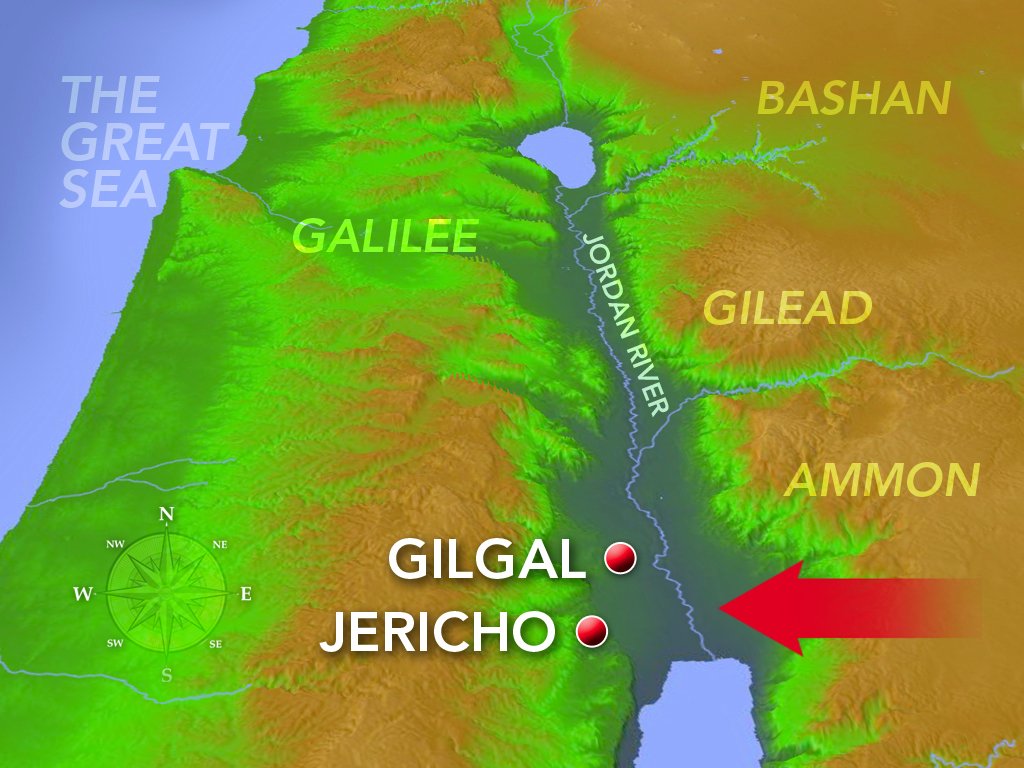
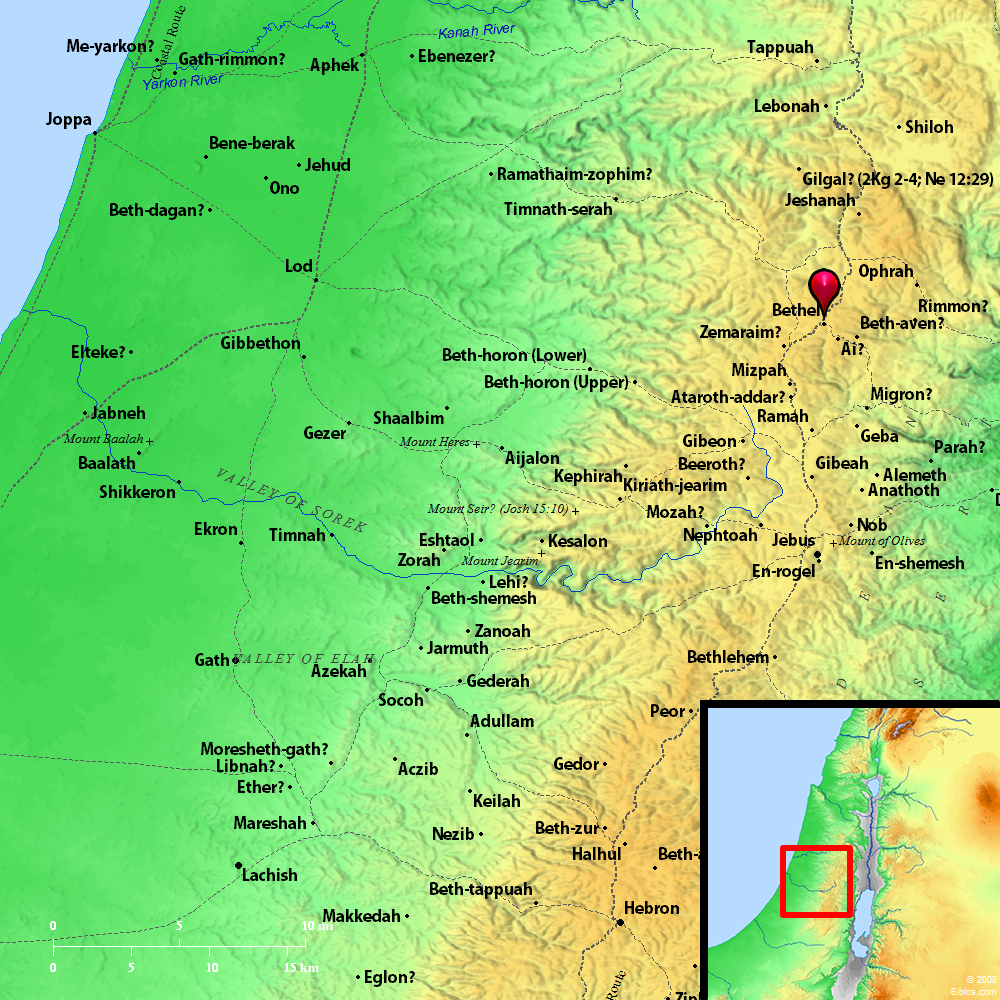
As we move into the last paragraph of Hosea 9, Hosea focused upon another piece of Israel’s geography—Gilgal.

15 Every evil of theirs is in Gilgal; there I began to hate them. Because of the wickedness of their deeds I will drive them out of my house. I will love them no more; all their princes are rebels. 16 Ephraim is stricken; their root is dried up; they shall bear no fruit. Even though they give birth, I will put their beloved children to death. 17 My God will reject them because they have not listened to him; they shall be wanderers among the nations.

Thomas McComiskey notes:

“The previous section (vv. 10-14) began with a tender expression of Yahweh’s love.  This section (vv. 15-17) begins with an affirmation of his hatred.  The previous section looked back to the wilderness; this section looks back to Gilgal.  Hosea views God as acting in history; thus historical events and the geographical sites where they occurred become vehicles of divine truth.  The events of the exodus from Egypt spoke volumes about God, as did the events that took place in the wilderness and at Gilgal.  To Hosea God’s response to the people at those places forever remains as crystallized truth about the nature of God.” (“Hosea.” In The Minor Prophets: An Exegetical and Expositional Commentary, 1:1-237. 3 vols. Edited by Thomas Edward McComiskey. Grand Rapids: Baker Books, 1992, 1993, and 1998, p. 154).

What the Israelites did at Gilgal caused the Lord to hate them.  This is covenant terminology meaning He opposed them and rejected them; personal emotion is not the main point.

He did so because they practiced “every evil” there.  “Gilgal is the quintessential city of Israel—it contained every evil that the book of Hosea condemns” (Garret, Hosea-Joel, p. 202).  It was their “wickedness,” particularly their practice of the pagan fertility cult (cf. 4:15; 12:11) that God was driving them from “His house.”  They had disgraced God’s house by preferring the altars of Baal, thus they would be driven from the temple where Yahweh’s presence actually dwelt.

The decision to drive Israel from its land is presented under the imagery of being forced out of a house. Israel has forgotten that where they lived was God’s land where He, too, dwelled.  As Gomer was put out of Hosea’s house for a period of time (Hos. 2:7), so Israel will be driven out of the Lord’s “house” because of its infidelity and rebellious ways.

Yahweh would drive His people out of the land, as He had expelled Adam and Eve and the Canaanites, because they had sinned and had adopted the ways of sinners. He would love (choose to bless) them no more, as He had in the past, because all their leaders rebelled against Him.

As mentioned before in Hosea 4:15, God despised the city of Gilgal as a center of idolatry in Israel.  At one time, Gilgal was a place where prophets were trained under Elijah and Elisha (2 Kings 2:1; 4:38).  But in Hosea’s day it had become a center of false worship (Hosea 4:15, 12:11; Amos 4:4, 5:5).

Gilgal had been the place where, in rebellion, the Israelites had chosen a human king to be “like the nations” (1 Samuel 11:14-15; cf. 1 Sam. 8:7; Hos. 3:4; 8:3-7; 8:4; 10:3, 7, 15) and it had become the place for a shrine to Baal (4:15; Amos 4:4; 5:5; cf. Hos. 12:4).  Thus, this place symbolized a double rejection of divine sovereignty and true, divine worship.  Notice that the end of verse 15 emphasizes “all their princes are rebels.”

Amos, with barbed mockery (Amos 4:4), cries out…

4 “Come to Bethel, and transgress; to Gilgal, and multiply transgression; bring your sacrifices every morning, your tithes every three days;

Roy Honeycutt reminds us that Yahweh’s rejection of Israel “had its beginning as early as Gilgal.  Sin is no temporary and relatively insignificant occurrence; it is deeply ingrained in historical existence, reaching far back into the realm of the community of faith.  This is not to excuse a given generation.  But it is to suggest that one wrestles with powers far greater and farther reaching than a personal failure.” (Hosea and His Message, p. 65)

Thus, God would drive them out forcefully.  In most places where this term garash is used, aside from in the book of Genesis, it describes what God did to the inhabitants of Canaan when Israel entered the land.  It was a reversal of the glorious conquest under Joshua.

Thus, Hubbard says…

There is a quiet irony about Yahweh’s threat, I will drive them out, since it echoes the promises given to Israel at the exodus and conquest (Exod. 23:29-30; Joshua 24:18; Judges 2:3; 6:9) and reverses them. (Hosea, 178).

In the book of Genesis, it parallels with Adam and Eve being driven out of the Garden of Eden for their sin (Gen. 3:24) just like Israel would be driven out of the “pleasant meadow” (9:13) that God had planted for Ephraim.

A second parallel is found in the correspondence between verse 15 and the request of Sarah that Abraham would drive out Hagar and her son Ishmael (Gen. 21:10).  Like Hosea’s son Lo-ammi (“not my people”), Israel would be driven out from the presence of God’s love.

Achtemeier expresses the situation well: “From the first, as a political entity among other nations, the Israelites spurned their God.  God therefore now spurns them, and the people shall become “wanderers among the nations,” verse 17, without homeland, without God, without future” (Minor Prophets,1:83-84).  They would be reverting to their original status as wanderers.

David Hubbard notes:

There may be a hint that Yahweh, an aggrieved husband, is banishing his faithless wife (cf. on 9:1-3).  Yet another metaphor possibly implied in God’s rejection of Israel from my house is that of an offended Host, who has offered impeccably generous hospitality to his guest only to have the guest prove ungrateful, abusive and disloyal.

This picture of Yahweh as host is expressed in Psalm 23:5-6

5 You prepare a table before me in the presence of my enemies; you anoint my head with oil; my cup overflows. 6 Surely goodness and mercy shall follow me all the days of my life, and I shall dwell in the house of the LORD forever.

This is what Israel was forfeiting by putting their trust in pagan gods and kings.

Verse 16 emphasizes once again that one of the severe judgments Israel would face would be the loss of a generation—they would be unable to give birth to children and what children they did have would be taken away from them.

In the language that began back in v. 10 and will be picked up again in verse 1 of chapter 10, Israel is pictured as a vine—one that was given all the resources it needed to bear good fruit, but instead bore poisonous fruit in wickedness and idolatries.

So now they would be fruitful no more.  “Their root is dried up; they shall bear no fruit” repeats the judgment from verse 11, whereas “Even though they give birth, I will put their beloved children to death” hearkens back to v. 12.

Hubbard makes reference to the presence of child sacrifice in Israel at the time and says that “God’s judgment may have been a gesture both to condemn it and to forestall it.  The children belonged to Him; He would go to any length to prevent their consecration to the gods of Canaan” (Hosea, p. 179).

That word “beloved” emphasizes just how precious their children were to them and how devastating their loss would be.  It also reminds me that God did not spare His own beloved Son to die in our place so that we would not have to endure eternal separation from God.

As an outcast, Ephraim, the doubly fruitful plant, would dry up and bear no more fruit.  She had tapped into the wrong source of nourishment and would therefore wither and die.

David Hubbard acknowledges

Again, God reverses the historic meaning of Ephraim’s name which spoke of the fruitfulness (Heb. root prh) promised by God to Jacob (Gen. 48:3-6) and by Jacob to Joseph (Gen. 49:22).  Hosea enjoyed punning on Ephraim’s name both as a sign of judgment (cf. here and 8:9) and restoration (cf. 14:8) (Hubbard, Hosea, pp. 178-179)

A final parallel use of garash may be found in the relation between verse 17 and the story of Cain in Genesis 4:14.  Just as God drove out Cain from His presence and caused him to be a fugitive in the earth, so also God decreed that Israel would be driven out and “shall be wanderers among the nations” (v. 17).  They had already wandered from Him (7:13) by seeking help from Egypt and Assyria; now wandering among the nations (cf. 7:8), whose pagan practices they had aped (9:1) was to become their way of life (cf. “wild ass wandering alone,” 8:9).  From the time of Hosea’s threat until the present the vast majority of Israel’s daughters and sons have listed Diaspora as their address.

“My God” at the beginning of verse 17 captures both the prophet’s intimate relationship with Yahweh and the people’s distance from Yahweh (cf. 8:2; 9:8)

McComiskey rightly points out that the judgment associated with verses 15-17 reflects the punishment for sin and covenant violation expressed in the law:  “This section of the prophecy (9:15-17) appears to be a crystallization of Deuteronomy 28:62-64.  That passage affirms the diminution of the population should they fail to obey God…. The concept of wandering among the nations occurs in Deuteronomy as well…. (v. 64, NRSV). Hosea had the unhappy task of announcing to his people that the curses of Deuteronomy were soon to overtake them (McComiskey, “Hosea,” 157).

The rejection which is called for here in v. 17 harks back to Samuel’s denunciation of Saul in 1 Samuel 15:23, “Because you have rejected the word of the Lord, he has also rejected you from being king.”  The tie in with Saul is strengthened by the fact that they “have not listened” to Yahweh.

“As has been true in any generation, those today who fail to hearken unto the voice of the Lord will walk alone into the misery of eternal separation from God.  Spiritual and physical death await such persons!” (H. Ronald Vandermey, Hosea-Joel, p. 60).

Like Hosea with Gomer, the only hope for restoration was first to judge Ephraim, to drive them out so that eventually they would return.

This is exactly what the Lord promised under the terms of the Old Covenant (Deuteronomy 30:24-28).  Thankfully, we can come to God by faith in a new covenant, where He promises to forgive us and remember our sins no more.

Hebrews 10:16-17

“This is the covenant that I will make with them
after those days, declares the Lord:
I will put my laws on their hearts,
and write them on their minds,”

then he adds,

“I will remember their sins and their lawless deeds no more.”
Israel Reaps the Whirlwind, part 6 (Hosea 9:10)

For several weeks now we have listened to Hosea telling Israel that they will soon reap what they have sown.  This week, like last week, we will see that Israel’s apostasies and idolatries are actually rooted way back in their history.  Their deviancy from God’s will was not a recent, sudden habit, but one that percolated below the surface and shot up regularly throughout their history, like the geyser Old Faithful.  So this section of Hosea’s prophecies takes a look back into Israel’s history…

10 Like grapes in the wilderness, I found Israel. Like the first fruit on the fig tree in its first season, I saw your fathers. But they came to Baal-peor and consecrated themselves to the thing of shame, and became detestable like the thing they loved. 11 Ephraim’s glory shall fly away like a bird– no birth, no pregnancy, no conception! 12 Even if they bring up children, I will bereave them till none is left. Woe to them when I depart from them! 13 Ephraim, as I have seen, was like a young palm planted in a meadow; but Ephraim must lead his children out to slaughter. 14 Give them, O LORD– what will you give? Give them a miscarrying womb and dry breasts. 15 Every evil of theirs is in Gilgal; there I began to hate them. Because of the wickedness of their deeds I will drive them out of my house. I will love them no more; all their princes are rebels. 16 Ephraim is stricken; their root is dried up; they shall bear no fruit. Even though they give birth, I will put their beloved children to death. 17 My God will reject them because they have not listened to him; they shall be wanderers among the nations.

Following 9:1-9, which describes famine conditions, this text goes a step further and foresees not just the ruin of crops but the obliteration of the next generation of Israelites.

In the next four sections of Hosea’s prophecies, Israel is presented as a nation which had such promise, such potential, but all in all it had not materialized.  These four main divisions, as noted by David Hubbard, are signaled by metaphors that describe Israel’s past relationship with God.  They were as…

  • Grapes in the wilderness (9:10-17)
  • A luxuriant vine (10:1-10)
  • A trained heifer (10:11-15)
  • A beloved child (11:1-11)

In each section, the tone of nostalgia and hope is offset by shock at Israel’s apostasy.  It is a tragic reversal, a grave comparison between the fruitful intimacy that once was (even for a brief time) and the barren apostasy which now existed.  Thus, announcements of judgment dominate these sections.

The agricultural imagery of the first two sections (9:10-10:10) link it back to Hosea’s dominate metaphor of “sowing the wind and reaping the whirlwind.”  Israel’s early innocence is pictured as grapes and figs, but those are replaced by a withered root (9:16) and weeds (10:4) and thistles (10:8; cf. 9:6).

But that Israel had betrayed that early intimacy is evident through a litany of places of sin: Baal-Peor (9:10; cf. Num. 25:1-9)), Gilgal (9:15; cf. 1 Sam. 11:14-15), Bethel (called Aven in 10:8; cf. on 4:15), Gibeah (10:9; cf. on 9:8), Admah and Zeboiim (11:8; cf. Gen. 10:19; 14:1-17; Deut. 29:23).

The section begins with the tender reminiscence of Israel’s past, with Yahweh saying, “I found Israel.”

In the early days of Israel’s history in the wilderness, the Lord took great delight in His people, as one rejoices to find grapes in a desert or the first figs of the season.  These delights, whether unexpected or expected, were Yahweh’s experience with early Israel, which both Jeremiah (2:2-3) and Ezekiel (16:6-14) remember so ardently.

Grapes speaks of refreshment.  One does not expect to find edible grapes in the desert.  Found in the wilderness connotes both joyful surprise at finding such delight in an unlikely place and his provision for Israel in that desolate setting.

Adam Clarke says…

“While they were faithful, they were as acceptable to me as ripe grapes would be to a thirsty traveler in the desert.”

Remember that for Hosea, the wilderness represents both the picture of coming judgment and the exodus honeymoon that Yahweh anticipates with Israel in the distant future.

Likewise, the figs stand for refreshment.  Hubbard notes “Waiting all winter and spring is difficult but waiting for the five or six years necessary for a tree to bear delectable fruit cannot help but put an edge to the farmer’s appetite when the first ripe figs appear.  So God recalls His delight at His new covenant relation with Israel’s ancestors” (Hosea, p. 174).

But like Hosea’s marriage to Gomer, that cherished relationship was disappointingly cut short.

Both metaphors point to the belief that great things would come from this new find—a prospect what would soon be dispelled.  This same movement from joy to despair is found in the Song of Moses (Deut. 32).  Both Moses and Hosea disclose the treacherous way in which the people of Israel abused the love of God and both announce that such idolatry and harlotry will be punished by exile and death (H. Ronald Vandermey, Hosea, p. 58).

But the mood of the verse quickly turns, from delight to deep disappointment.

When they came to Baal-Peor, where they worshipped Baal and committed ritual sex with the Moabite and Midianite women (Num. 25), they became as detestable to Yahweh as the idols they loved.  They failed to reach their potential.

This first instance of Baal worship set the pattern of Israel’s idolatry that followed in the land and resulted in her present judgment.

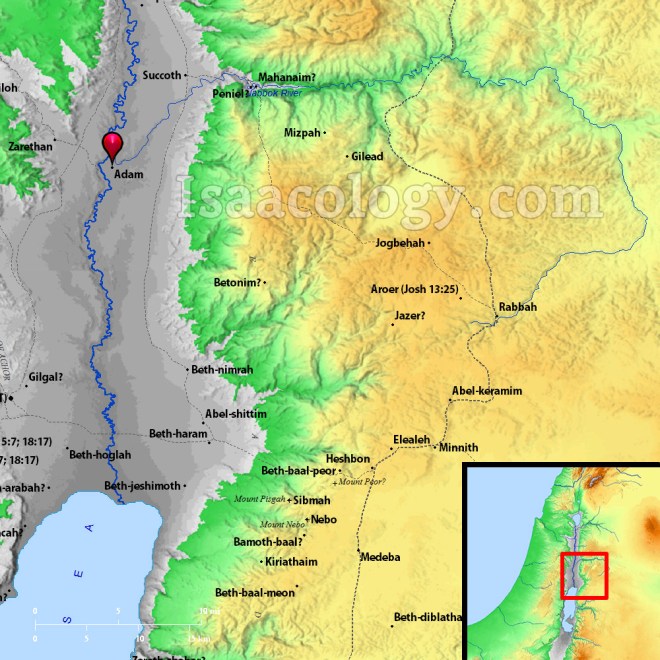
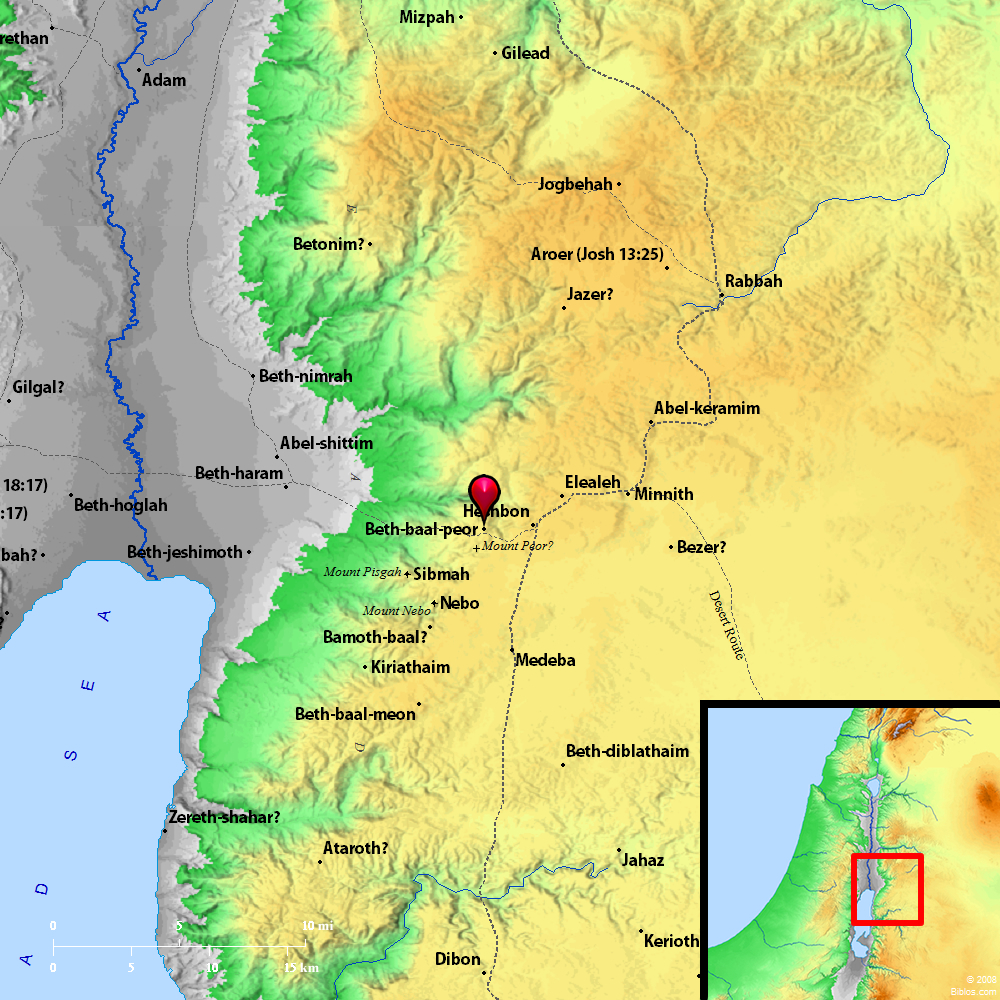
Baal-Peor holds a prominent place in Israel’s “geography of shame” (Hubbard). Israel was right on the edge of the land that Yahweh had promised to them, encamped at Abel-shittim.  Baal-peor refers to the mountain in Moab from which Balaam, at Balak’s repeated request, was supposed to curse Israel (Numbers 23:27-28).  Unable to accomplish this, Balaam finally suggested to Balak a plan that did work.

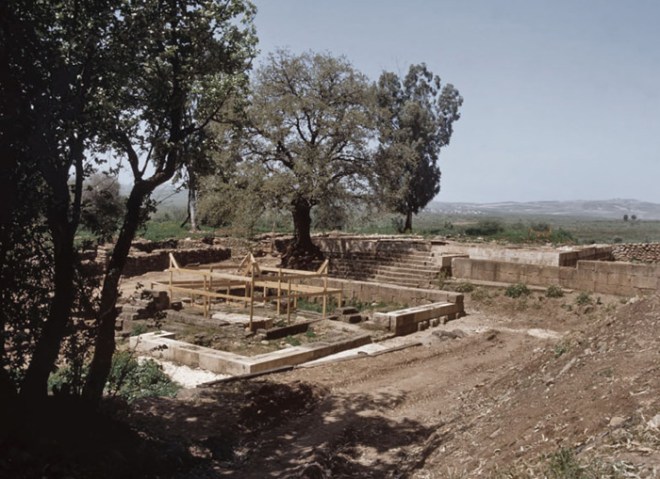
bibleatlas.org

biblicalgeographicdotcom

[The plains of Moab (Shittim) would be the dark area in the middle, while Baal-Peor would be on the mountain heights to the right.]

Numbers 25 records this event…

1 While Israel lived in Shittim, the people began to whore with the daughters of Moab. 2 These invited the people to the sacrifices of their gods, and the people ate and bowed down to their gods. 3 So Israel yoked himself to Baal of Peor. And the anger of the LORD was kindled against Israel.

“It was not only the Moabite women but their local Baal that had seduced the men of the exodus; and we have already heard Hosea’s protests against the same two levels of adultery in his day” (Derek Kidner, The Message of Hosea, p. 88).

That chapter ends with Yahweh telling Moses to take vengeance upon the Midianites:

16 And the LORD spoke to Moses, saying, 17 “Harass the Midianites and strike them down, 18 for they have harassed you with their wiles, with which they beguiled you in the matter of Peor

The only reason the plague stopped was because Phineas rammed his spear through an Israelite man and a Midianite woman caught in the act (Numbers 25:7-15).

Reference to this event served two purposes:  First, it reminds that reader that Israel had already begun its apostasy to Baal before it even entered into the land.  Second, it shows the kind of drastic action that had to be taken to put this kind of immorality to a halt.

Psalm 106:28-29 recounts:

Then they yoked themselves to the Baal of Peor,
and ate sacrifices offered to the dead;
they provoked the Lord to anger with their deeds,
and a plague broke out among them.

Furthermore, the psalm goes on to describe the child sacrifice that would be involved with the Baal cult:

36 They served their idols, which became a snare to them. 37 They sacrificed their sons and their daughters to the demons; 38 they poured out innocent blood, the blood of their sons and daughters, whom they sacrificed to the idols of Canaan, and the land was polluted with blood.

As Duane Garrett says…

The psalm brings out the hideous paradox of the fertility cult: a major objective of the cult was to enable women to give birth to many healthy children, but that same cult consumed children in ritual sacrifice (Hosea-Joel, p. 200).

To me this sounds very similar to our current culture, which glorifies sex without either marriage (through pre-marital sex and adultery) or children (through abortion), thus sacrificing those very children, the blessing of their womb, so they can continue to flaunt God’s instructions about sex.

There, they “consecrated themselves,” vowing their loyalty to false gods.  They yoked themselves to Baal, a thing of shame.  The prophets linked Baal with shame (bosheth).  They even transformed the name Ish-baal (the name of a man found in 1 Chronicles 8:33) into Ish-bosheth (“man of shame,” found in 2 Samuel 2:8).

The Lord labels the Israelites’ depraved conduct at Baal-peor with the word shame (Hebrew bosheth), which is the same term used to describe the effect of Baalism on the land of Israel (Jer. 11:13) (H. Ronald Vandermey, Hosea, p. 58)

Thus, when one worships idols (and we all do), it is an abomination to God and results in shame.  Thus Calvin says, “The Prophet, I doubt not, connects here the Israelites with idols and with Baal-peor itself, that he might strip them of all that holiness which they had obtained through God’s favour.”

Hubbard notes the significance of this event:

Biblical faith saw the Baal-Peor episode as far more than a causal dalliance.  It shook the structure of the covenant to its very foundations and for a reason that Hosea explains: the character of the one whom we worship rubs off on us. (Hubbard, Hosea, p. 175).

This truth is repeated in Psalm 115:8, speaking of idols, says…

Those who make them become like them; so do all who trust in them.

Likewise, Jeremiah plaintively asks a question which links the shame along with the reflective nature of our worship, in Jeremiah 2:5

5 Thus says the LORD: “What wrong did your fathers find in me that they went far from me, and went after worthlessness, and became worthless?

We are made to reflect God and His glory, not other gods in their shame. [https://www.tms.edu/blog/gods-glory-on-display/]

In Philippians 2:15 Paul likens us to shining stars, and the word shine means to reflect.  The scientific term is albedo.  It’s a measurement of how much sunlight a celestial body reflects.  The planet Venus, for example, has the highest albedo at .65.  In other words, 65 percent of the light that hits Venus is reflected.  Depending on where it’s at in its orbit, the almost-a-planet Pluto has an albedo ranging from .49 to .66.  Our night-light, the moon, has an albedo of .07.  Only seven percent of sunlight is reflected, yet it lights our way on cloudless nights.

In a similar sense, each of us has a spiritual albedo.  The goal?  One hundred percent reflectivity.  We, who with unveiled faces all reflect the Lord’s glory, are being transformed into his likeness with ever-increasing glory, which comes from the Lord.  You cannot produce light.  You can only reflect it. (Mark Batterson, If: Trading Your If Only Regrets for God’s What If Possibilities (Baker Books, 2015), page 220)

We are made to reflect God and His glory.

That is why Yahweh commanded Israel to “have no other gods before me.”  Let’s pause a moment and see just how significant this is.

Greg Beale titled his landmark book We Become What We Worship.  His thesis is simple: “What people revere, they resemble, either for ruin or for restoration.”  We either revere the world and are conformed to the sinful patterns of the world, or we revere God and are progressively conformed into his likeness.

Ligon Duncan, in a sermon on Psalm 97 entitled, “You Become Like What You Worship,” notes that…

If you worship money, you will become greedy and stingy.  Now, nobody sets out to worship money.  You don’t sit down one day and say, ‘You know, I think I’ll worship money.’  But you might start out by worshiping self-security.  Or you might set out by worshiping finding material security in what you have, and it leads to the worship of money…which does not make you more human, it makes you less human.  It doesn’t make you more noble, it makes you greedy and stingy and ungenerous.

If you worship sex, you’ll become more and more self-obsessed and narcissistic.  Now nobody sits down one day and says, ‘I think I’m going to worship sex.’  But they may start out by saying, ‘I desire gratification for myself above other concerns,’ and suddenly they find themselves, whether they realize it or not, worshiping sex.  And they don’t become better people, they become self-absorbed people.

If you worship power, you’ll become scheming and heartless.  And we could go on and on down the list.  What you desire determines what you will become.  And if you set your desires on anything other than the true God, you will become like that, and it will not be pretty.  Desire that is set on the right object — the one true God — ennobles and grows a human being.  Desire set on the wrong thing corrupts us and debases us.

So be careful what you worship, for it will change you.  You will develop desires and habits which drive you farther and farther away from God’s design for you.

Kierkegaard, the Danish philosopher, told a story about a goose who was wounded and who landed in a barnyard with some chickens.  He played with the chickens and ate with the chickens.  After a while that goose thought he was a chicken.  One day a flight of geese came over, migrating to their home.  They gave a honk up there in the sky, and he heard it.

Kierkegaard said, “Something stirred within the breast of this goose.  Something called him to the skies.  He began to flap the wings he hadn’t used, and he rose a few feet into the air.  Then he stopped, and he settled back again into the mud of the barnyard.  He heard the cry, but he settled for less.”

Leighton Ford, “Hope for a Great Forever,” Preaching Today, Tape No. 96.

That is us.  When we worship other gods, we invariably settle for less.  Even though there is a yearning in our hearts to live differently, to rise above, we settle for less.  That’s our life, settling for less.

Israel Reaps the Whirlwind, part 5 (Hosea 9:6-9)

Over the last four weeks we’ve been seeing how Hosea keeps pounding the message in—telling the Israelites that they will reap what they sow.  This is a basic law of nature and of life.  It is a lesson that we must learn as well.  We cannot afford to think that we can get away with sowing to the flesh and get away with it.  We will eventually reap what we sow, and what we reap will be worse than what we’ve sown.

The next portion of Hosea’s prophecy we’re going to look at this morning is Hosea 9:6-9…

6 For behold, they are going away from destruction; but Egypt shall gather them; Memphis shall bury them.  Nettles shall possess their precious things of silver; thorns shall be in their tents. 7 The days of punishment have come; the days of recompense have come; Israel shall know it. The prophet is a fool; the man of the spirit is mad, because of your great iniquity and great hatred. 8 The prophet is the watchman of Ephraim with my God; yet a fowler’s snare is on all his ways, and hatred in the house of his God. 9 They have deeply corrupted themselves as in the days of Gibeah: he will remember their iniquity; he will punish their sins. 10 Like grapes in the wilderness, I found Israel. Like the first fruit on the fig tree in its first season, I saw your fathers.  But they came to Baal-peor and consecrated themselves to the thing of shame, and became detestable like the thing they loved. 11 Ephraim’s glory shall fly away like a bird– no birth, no pregnancy, no conception! 12 Even if they bring up children, I will bereave them till none is left. Woe to them when I depart from them! 13 Ephraim, as I have seen, was like a young palm planted in a meadow; but Ephraim must lead his children out to slaughter. 14 Give them, O LORD– what will you give? Give them a miscarrying womb and dry breasts. 15 Every evil of theirs is in Gilgal; there I began to hate them. Because of the wickedness of their deeds I will drive them out of my house.  I will love them no more; all their princes are rebels. 16 Ephraim is stricken; their root is dried up; they shall bear no fruit.  Even though they give birth, I will put their beloved children to death. 17 My God will reject them because they have not listened to him; they shall be wanderers among the nations.

Actually v. 6 gives a reason for the exasperation that Israel will express while in captivity that was expressed in verse 5.

5 What will you do on the day of the appointed festival, and on the day of the feast of the LORD?

The previous verses had indicated that Israel would be taken into captivity and while there would be unable to provide sacrifices to Yahweh or enjoy their feast days.  These significant events would be taken away from Israel.

Verse 6 expresses a reason for their exasperation:

6 For behold, they are going away from destruction; but Egypt shall gather them; Memphis shall bury them. Nettles shall possess their precious things of silver; thorns shall be in their tents.

The Israelites would leave their land because of the destruction Yahweh would send.  Egypt and Memphis, as two undertakers, would bury the exiles.  Failing to trust in Yahweh for protection, believing Egypt would protect the coming destruction, would be a deadly mistake.

Memphis (near modern Cairo) was an Egyptian city famous as a burial site because of the pyramid tombs there.

As Andersen and Freedman point out, “The reference to Egypt has a sinister note, and the feminine verbs show that Egypt and Memphis are the subjects of the activity, and not just the location.  The Israelites will not conduct their own burial rites. Even the patriarchs, through living in Egypt, could be taken back to Canaan for burial in the family cemetery; Joseph’s bones were brought back in due time.  This privilge will be denied the Israelites of the present generation.  It will be their final defilement to be buried in a pagan cemetery” (Hosea, p. 530)

Thus, God’s exiled people will “succeed” only in leaving behind all that was precious to them including the tents (their homes) where they lived.  Back in the land of Israel, thorns and thistles would grow up, overgrowing all their treasures and their households.

Duane Garrett notes how giving their silver to Egypt, only to die there, is a reversal of the “plundering of the Egyptians” when Israel left Egypt.  “Indeed, this entire text can be taken to be an undoing of the exodus and thus an erasure of Israel’s redemption history” (Hosea-Joel, p. 194)

Yahweh had warned them of these curses back in Deuteronomy 28:36-46.  The ravages of an invading army and then insects (Deut. 28:42) would turn once fertile lands into wilderness.  The land has been rendered uninhabitable.

Derek Kidner says…

Israel’s judgment would be all too fitting (you reap what you sow).  For her political flirtations she would have her fill of foreign loves, her people captive in Assyria and fugitives in Egypt.  For her religious flirtations, too, she would pay the proper price of having scattered her favours everywhere: her people ending up with nothing fit for God, and nowhere to hold their beloved festivals (The Message of Hosea, p. 85).

Hosea brings the first portion of this oracle (vv. 7-9) to a close by warning his hearers that the days of threatened judgment with all of their drastic conditions (vv. 1-6) were even now close at hand.  It was time for Israel to receive the reward of its infidelity, to reap what they had sown.

7 The days of punishment have come; the days of recompense have come; Israel shall know it.

One cannot abandon Yahweh without impunity.

Repetition (as “Babylon is fallen, is fallen,” and as Ezekiel 7:5-7, the prophet tells them, “The end is come, is come, is come”; and so some ten or twelve times) and the use of the past tense both emphasize the certainty of this coming doom.  Israel shall “know it” likely means Israel would experience it.  As E. B. Pusey explains:

“Israel would not know by believing it; now it should know, by feeling it.” (The Minor Prophets, 1:91)

Blinded by their own folly, God’s people have considered the prophets, whom God has sent to warn them, to be but fools and madmen (v. 7).  Although they are God’s appointed “watchmen,” to care for and warn the people of danger, yet they face only danger themselves for the godly stand they have taken (v. 8).

Another reason for her judgment was that the Israelites had regarded the prophets whom the Lord had sent to them as demented fools (cf. 2 Kings 9:11; Jer. 29:26-27).  This likely included Hosea.

The prophet is a fool; the man of the spirit is mad, because of your great iniquity and great hatred. 8 The prophet is the watchman of Ephraim with my God; yet a fowler’s snare is on all his ways, and hatred in the house of his God.

Likely verse 7 are words in the mouths of the kings, princes, priests and people.  They believed that the prophets were fools and wind bags.  The word “prophet” means a “seer,” but the people believe they are unreliable guides because they cannot “see” the future.  Likewise, the word “spirit” is ruach, meaning breath or wind.  Thus, they believed these “wind bags” were demented.

“Out of his head, chattering senselessly, prompted neither by wisdom nor the divine word—so ran the popular estimate of the prophet” (David Hubbard, Hosea, p. 169)

Even Jesus was accused of being demon possessed! (John 7:20; 8:48).  That’s why he told us to expect such reaction from most people.

Boice notes:

“They said in effect, ‘Who in his right mind would prophesy a judgment like this when we are in the midst of such a bountiful harvest, in itself a proof of God’s blessing?’”

As Roy Honeycutt reminds us…

“Prophets of any generation are liable to be written off as “fools” and “mad” when the content of their message is inconsistent with prevalent practices by the people.  The prophet well acceptable to the masses is well characterized by Micah:

“If a man should go about and utter wind and lies, saying, ‘I will preach to you of wine and strong drink,’ he would be the preacher for this people.’” (Micah 2:11) (Hosea and His Message, p. 62)

Why do people react this way?  Because they are living in sin and thus hate the truth.  They prefer to live in the darkness.  “Because of the character of their own lives, people cannot bear exposure and condemnation.  When truth becomes relevant to one’s sin, self-defense distracts that the prophet be discredited as a fool and a madman” (Roy Honeycutt, Hosea and His Message, p. 63).

Amos said of the same generation:

5:10 They hate him who reproves in the gate, and they abhor him who speaks the truth.

Jesus says in John 3:

19 And this is the judgment: the light has come into the world, and people loved the darkness rather than the light because their works were evil. 20 For everyone who does wicked things hates the light and does not come to the light, lest his works should be exposed.

David Hubbard says…

“As is typical of our human behavior, when we cannot acknowledge our guilt we may react towards our accusers with anger.  Hosea’s critics answered sharply not because they thought he was wrong but because, deep down, they knew he was right” (Hosea, p. 159)

So it has always been true that we hide our sins and do not want them exposed.  Whenever someone addresses our sins we are more likely to discredit them than listen to them.

But God has a better name than “fool” for his man.  The real profession of a prophet was to be a “watchman,” to give Israel warnings of the consequences of their actions and the reality of coming judgment.  “The prophet scans history, warning the people of impending doom, certain that his own life will be either validated or condemned according to the fidelity with which he fulfills his role (cf. Ezek. 33:2ff)” (Roy Honeycutt, Hosea and His Message, p. 63).

Verse 8 looks longingly back into the past when even Ephraim had been a watchman with my God.

Notice that Hosea had said that a prophet was a watchman of Ephraim “with my God.”  UItimately, we all, but especially prophets, play to an audience of one.  It is God whom we must please, not the people. (Although Hubbard believes this means that the prophet was privy to the divine council where he heard first-hand Yahweh’s word, Hosea, p. 170).

The vindication of a prophet comes from God, not man.  And God would judge Israel for their unrepentant attitudes.

Prophets have to commit their cause to God, as Jeremiah said…

11:20 But, O LORD of hosts, who judges righteously, who tests the heart and the mind, let me see your vengeance upon them, for to you have I committed my cause.

Jesus himself had the same attitude, as Peter reminds us and encourages us to follow:

21 For to this you have been called, because Christ also suffered for you, leaving you an example, so that you might follow in his steps. 22 He committed no sin, neither was deceit found in his mouth. 23 When he was reviled, he did not revile in return; when he suffered, he did not threaten, but continued entrusting himself to him who judges justly.

Whenever someone attacks us, or criticizes us unjustly, we simply “entrust ourselves to him who judges justly,” we leave it in his hands.  This is also what Paul outlined in Romans 12:

19 Beloved, never avenge yourselves, but leave it to the wrath of God, for it is written, “Vengeance is mine, I will repay, says the Lord.”

If you remember our teaching on Romans 12 and Ephesians 4, we noticed that Paul is saying that someone who maintains a bitter spirit, allows Satan a foothold (the Greek word is topos, a place) in our lives and relationships, whereas someone who is willing to forgive and allow God to deal with the other person in justice, gives “room” (topos) to God to work.

So whether you are a prophet or just a man on the street, whenever we are attacked, we commit ourselves to the one who judges justly, and that leaves room for God to work in our lives and relationships.

It is difficult to know whether the last line in verse 8 describes the prophets, that snares have been set for them because those who should love him (people “in the house of God”) hate him instead.

Thus Constable says…

Ephraim had tried to entangle the prophets God had sent the people, like a hunter catches birds in a net.  Thus there was nothing but hostility in the land of Israel between the Ephraimites and the true prophets of Yahweh.  Ephraim saw nothing as a prophet and criticized the prophets for preaching what they saw, namely: coming judgment.

The other possibility is that it describes Israel, that the snare is for them because God has rejected their worship.

Duane Garrett notes that Yahweh himself is a “snare and a trap” for the inhabitants of Jerusalem in Isaiah 8:14 and says…

“The point in this ext is that the prophets, in speaking to the unrepentant people, would not be the means of their salvation but of their downfall, similar to Paul’s understanding of his own ministry as the “smell of death’ to those who are perishing (2 Cor. 2:15-16)” (Hosea-Joel, p. 196)

In the remainder of chapter 9 Hosea will point to two places in Israel’s history (Gibeah and Gilgal), where Israel sinned greatly against Yahweh and one another.  The tragedy at Gibeah is mentioned first in verse 9, Gilgal in v. 14.

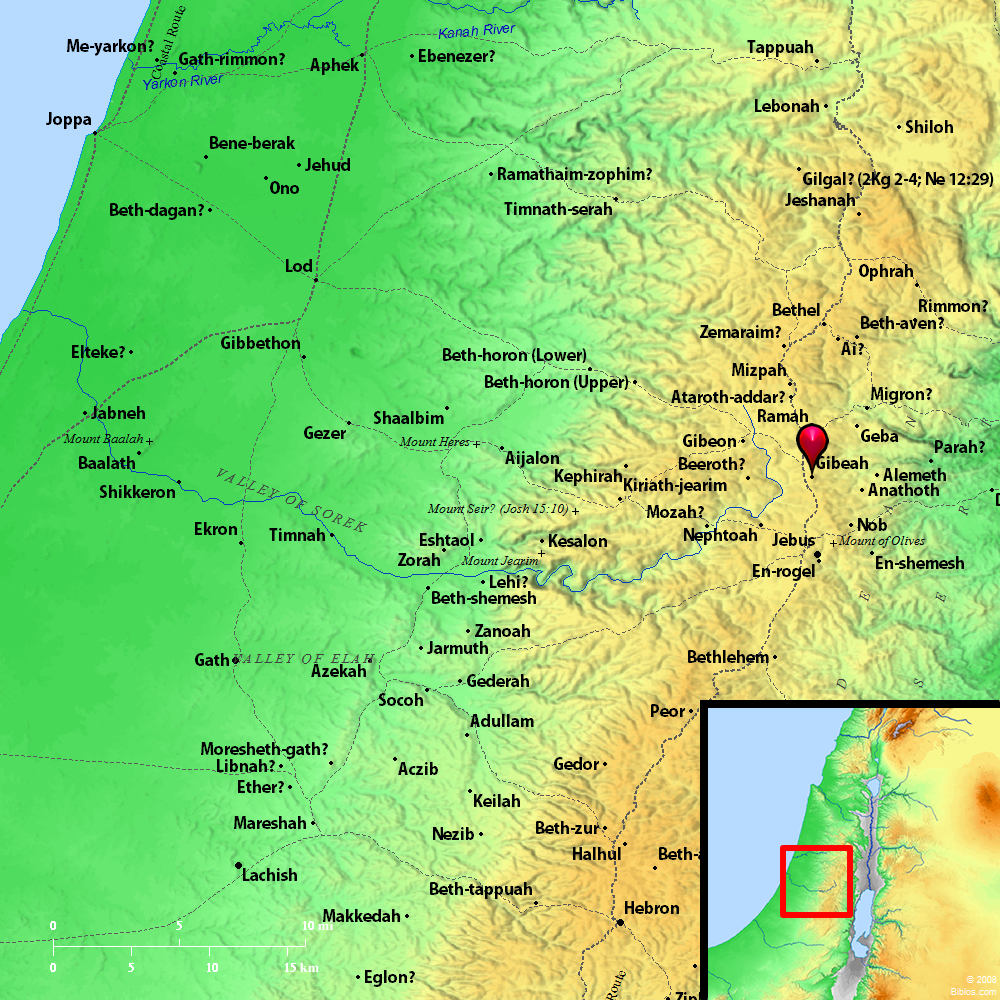
Gibeah (meaning ‘hill’) was a city in the hill country just to the north of Jerusalem. Situated alongside the main road from Bethlehem to Shechem (see Judges 19:10-15), the site of ancient Gibeah has been identified as Tel el-Ful 3 miles / 5 km north of Jerusalem, and next to the modern Israeli settlement at Pisgat Ze’ev. After the conquest of Canaan by the Israelites in c.1406 BC, Gibeah was allocated to the tribe of Benjamin (see Joshua 18:28).

Subsequently, Gibeah became the site of what might be regarded as the only ‘civil war’ in the history of Israel. The story of the Levite and his concubine (see Judges 19:1-30) may seem strange to modern ears, but in the days of the ‘Judges’, it was quite common for a man to have a ‘concubine’ as well as a wife. A concubine had the legal status of a marriage partner, but had less esteem than a wife and was treated more like a servant. When the Levite’s concubine was gang raped and left for dead on the doorstep of his overnight host at Gibeah, the other Israelite tribes decided to bring the unrepentent men of Gibeah to account for this atrocious crime. In the ensuing Battle of Gibeah, most of the tribe of Benjamin were wiped out – which resulted in the Benjamites subsequently being the smallest of the twelve tribes (see 1 Samuel 9:21).  (The Bible Journey)

9 They have deeply corrupted themselves as in the days of Gibeah: he will remember their iniquity; he will punish their sins.

What Hosea is referring to is the rape of a Levite’s concubine by the men of Gibeah in Judges 19 (the whole story is in Judges 19-21).  This is a sordid time in Israel’s history, a time when “everyone was doing what was right in their own eyes” (Judges 17:6; 21:25) being a “law unto themselves.”  Here, an outrage was committed that had “never happened or been seen from the day that the people of Israel came up out of the land of Egypt until this day” (Judges 19:30).  Ephraim has fallen to the level of the most corrupt generation in Israel’s history.  Hosea will return to this event in 10:9.

Because of their sin, the tribe of Benjamin was almost wiped out, only 600 survived.  Not only was the sin similar, but the their judgment would be just as devastating and complete.

As Kidner points out, this story leaves Sodom and Gomorrah with nothing they could teach this city!

As Garrett remarks, “Hosea declares that the people of his day have fallen to the level of this most corrupt generation of Israel’s history” (Hosea-Joel, p. 196).

Hosea is saying that the Israelites of his day have just as “deeply corrupted themselves.”  They had hit rock bottom in their corruption.

Because of their deep corruption, Yahweh “will remember their iniquity; he will punish their sins.”

Kidner points out, to our great joy, how that sentence is the exact opposite of the promise of the New Covenant, where Jeremiah 31:34 says, “I will forgive their iniquity, and I will remember their sins no more.”

But for now time had come when God could no longer withhold His just judgment of Israel for their sins. Israel has prostituted itself beyond recall.  Not only are God’s people guilty of violating their covenant with Yahweh (cf. Hos. 2:18-23; 4:1, 12; 5:4-7; 6:7; 8:1-6) via their entrenched idolatry (cf. 4:14-19; 5:1; 8:4-6), but this has led to moral corruption at every level (cf. 5:10-11; 6:8-10; 7:1-10).  Simply put, Israel has become a prostitute (cf. 4:14-19; 5:3-4; 6:10), a thing forbidden in God’s law (Deut. 23:17).

Unfortunately, Israel has come to regard God’s law as “something totally unknown to them” (Hos. 8:12).  Because God’s people no longer acknowledge Him (cf. 4:1; 6:3) and in their infidelity have pursued their own idolatrous and immoral ways, it was now time for God to “repay them for their sins” (v. 9).

Harry Ironside reminds us…

“Sin never dies a natural death; it must be thoroughly judged.  Like leaven, it [must be] stopped by fire—by ‘judgment,’ self-judgment or God’s judgment; for sin ever works on until it is judged.  When indulged in by an individual, or permitted in a company, it continues working, though often imperceptibly, until it is judged, either in oneself, or by God’s people, or by God Himself.” (Notes on the Minor Prophets, pp. 71-72)

And George Robinson notes…

“One general lesson is taught by Hosea of ever permanent worth, namely, that inward corruption in a nation is more dangerous to its existence than their external enemies.   And a kindred lesson closely related to this is: that the truest of all patriots is he who, like Hosea, identifies himself with his people, sorrows over their calamities as though they were his own, and repents for their sins as though he had committed them himself.” (The Twelve Minor Prophets, p. 26)


Israel Reaps the Whirlwind, part 4 (Hosea 9:1-5)

Hosea 9 is where we are today in our study of the book of Hosea.  After sowing the wind for two centuries, the nation of Israel is granted in Hosea 9-10 a glimpse of the whirlwind that will sweep her into judgment.  Throughout this section we see how God’s judgment in each case is a fulfillment of the reap-sow principle.

1 Rejoice not, O Israel! Exult not like the peoples; for you have played the whore, forsaking your God. You have loved a prostitute’s wages on all threshing floors. 2 Threshing floor and wine vat shall not feed them, and the new wine shall fail them. 3 They shall not remain in the land of the LORD, but Ephraim shall return to Egypt, and they shall eat unclean food in Assyria. 4 They shall not pour drink offerings of wine to the LORD, and their sacrifices shall not please him.  It shall be like mourners’ bread to them; all who eat of it shall be defiled; for their bread shall be for their hunger only; it shall not come to the house of the LORD. 5 What will you do on the day of the appointed festival, and on the day of the feast of the LORD? 6 For behold, they are going away from destruction; but Egypt shall gather them; Memphis shall bury them.  Nettles shall possess their precious things of silver; thorns shall be in their tents. 7 The days of punishment have come; the days of recompense have come; Israel shall know it. The prophet is a fool; the man of the spirit is mad, because of your great iniquity and great hatred. 8 The prophet is the watchman of Ephraim with my God; yet a fowler’s snare is on all his ways, and hatred in the house of his God. 9 They have deeply corrupted themselves as in the days of Gibeah: he will remember their iniquity; he will punish their sins. 10 Like grapes in the wilderness, I found Israel. Like the first fruit on the fig tree in its first season, I saw your fathers.  But they came to Baal-peor and consecrated themselves to the thing of shame, and became detestable like the thing they loved. 11 Ephraim’s glory shall fly away like a bird– no birth, no pregnancy, no conception! 12 Even if they bring up children, I will bereave them till none is left.  Woe to them when I depart from them! 13 Ephraim, as I have seen, was like a young palm planted in a meadow; but Ephraim must lead his children out to slaughter. 14 Give them, O LORD– what will you give? Give them a miscarrying womb and dry breasts. 15 Every evil of theirs is in Gilgal; there I began to hate them. Because of the wickedness of their deeds I will drive them out of my house. I will love them no more; all their princes are rebels. 16 Ephraim is stricken; their root is dried up; they shall bear no fruit. Even though they give birth, I will put their beloved children to death. 17 My God will reject them because they have not listened to him; they shall be wanderers among the nations.

Derek Kidner summarizes:

The sentencing of Israel to a wandering existence, in the final verse, will round off a chapter which has fully paved the way to it.  This people has been restless enough, ogling one nation after another; heedless enough, dismissing as madmen its look-out men, the prophets; fickle enough, forsaking the LORD for Baal even from the days of Moses.

Most scholars believe the setting for this portion of Hosea is the fall harvest.  Duane Garrett suggests further that it is possible that Hosea had in mind the festival of the 15th day of the 8th month that was established by Jeroboam II in order to insure the loyalty of the Israelites to the northern shrines (1 Kings 12:32).  Since it is called the “feast of Yahweh” is was likely a counterfeit to the Feast of Tabernacles (Lev. 23:39-43) (Hosea, p. 193).

That is what makes Hosea’s first statement so shocking, “Rejoice not!”  It was to be a time of great joy and gladness, for it signaled God’s blessing and enough food so that survival was no longer the top priority and daily focus.

Hubbard notes:

The autumn harvest festival was a sacrament of life for them, a symbol of their expectations of survival, a proof of the soundness of their religious zeal.  The more bountiful the crops—the grain for a year’s supply of bread (v. 1), the must (v. 2) for a year’s stock of wine, the olives whose oil supplied their food, light, hygiene and medication—the more affirmed was Israel in the lightness of their religion.  (Hosea, p. 165)

Instead, there seems to be the failure of the harvest.  Instead of seeking Yahweh’s blessing, they had turned to the fertility gods, the Baals.  But this time these gods would fail the Israelites and their joy would disappear.

If Yahweh allowed their apostasy to be accompanied by material prosperity, they would only dig themselves more deeply into their pagan habits.  Intervention was necessary; Yahweh’s chosen means was exile (Hubbard, Hosea, p. 165).

The opening, “Rejoice not!” reads like an inversion of what would have been the normal harvest proclamation, something like “Rejoice, Israel, for Yahweh has given you a harvest!”

Joel 2:23-24, for example, reads:

23 “Be glad, O children of Zion, and rejoice in the LORD your God, for he has given the early rain for your vindication; he has poured down for you abundant rain, the early and the latter rain, as before. 24 “The threshing floors shall be full of grain; the vats shall overflow with wine and oil.”

But those days were gone.

Israel the harlot thought that the fertility cult would give her prosperity, but she received only barrenness.

Duane Garrett points out:

Hosea interprets the failed harvest under three points.  The first is that the bad harvest, as a sign of Yahweh’s displeasure, indicates that greater calamities—military defeat and exile—are on the horizon (vv. 1-3).  Second, he draws the people’s attention to another adversity that accompanies famine conditions, namely, the inability of the people and priesthood to make suitable offerings to God (vv. 4-6).  Third, he asserts that the people had dismissed the prophets when they warned that such troubles were coming (vv. 7-9).  In linking a failed harvest to military defeat, and in regarding the famine as especially calamitous because it brought about the end of sacrifice and offering to Yahweh, Hosea’s words call to mind Joel’s prophecy [in Joel 2].  In confronting an Israelite establishment that was dismissive of Yahweh’s prophets, Hosea’s experience paralleled that of Amos and many other prophets. (Hosea-Joel, p. 190)

The statement “exult not like the peoples” has the idea of not working yourself into a frenzy.  The worship of pagan nations often involved ecstatic and frenzied worship, like the cutting of the prophets of Baal in the showdown on Mt. Carmel in 1 Kings 18.  Their frenzied worship would do no good; Yahweh would not listen to them.

Why? “For you have played the whore, forsaking your God.”  Their harvest has failed because they had sought the blessing of other gods instead of Yahweh.

The prophet envisioned Israel as a “harlot,” committing adultery on a threshing floor by worshipping idols there.  “Threshing floors” and “winepresses” were common places throughout Canaan where ritual prostitution had taken place for centuries.  It was through these rites that the worshippers sought to stimulate the gods to engage in sex and so bestow fruitfulness on them and their land.

The “wages of the prostitute at every threshing floor” has a hint of desperation and has a double meaning.  “It is literally the immoral acts that often accompanied the party atmosphere of the harvest, but it is also figuratively the large harvest that the fertility cult ostensibly promised.  The supposed benefits of this fertility cult were sexual license and agricultural prosperity, but like so many of Satan’s seductions, they proved to be illusory.

Instead

2 Threshing floor and wine vat shall not feed them, and the new wine shall fail them.

What Yahweh gives, He can take away.  Their freedom and their survival were gifts they had spurned and now would forfeit.

There shall be neither grain nor wine.  They will reap nothing.  Historically, this spoke of the ravages of their occupation by Assyria and the famines that Yahweh brought upon them.

This judgment upon the land was a signal of the exile that Israel would be forced into.  Like Joel, famine is a precursor to military defeat and exile.

3 They shall not remain in the land of the LORD, but Ephraim shall return to Egypt, and they shall eat unclean food in Assyria.

Behind this text stands Deuteronomy 28:38-41, where famine conditions are the last stroke of divine punishment prior to the departure of the people into captivity.  There, before God brought them into the promised land, Moses warned them…

38 You shall carry much seed into the field and shall gather in little, for the locust shall consume it. 39 You shall plant vineyards and dress them, but you shall neither drink of the wine nor gather the grapes, for the worm shall eat them. 40 You shall have olive trees throughout all your territory, but you shall not anoint yourself with the oil, for your olives shall drop off. 41 You shall father sons and daughters, but they shall not be yours, for they shall go into captivity.

This passage went on to warn them…

45 “All these curses shall come upon you and pursue you and overtake you till you are destroyed, because you did not obey the voice of the LORD your God, to keep his commandments and his statutes that he commanded you. 46 They shall be a sign and a wonder against you and your offspring forever. 47 Because you did not serve the LORD your God with joyfulness and gladness of heart, because of the abundance of all things,  48 therefore you shall serve your enemies whom the LORD will send against you, in hunger and thirst, in nakedness, and lacking everything. And he will put a yoke of iron on your neck until he has destroyed you. 49 The LORD will bring a nation against you from far away, from the end of the earth, swooping down like the eagle, a nation whose language you do not understand, 50 a hard-faced nation who shall not respect the old or show mercy to the young. 51 It shall eat the offspring of your cattle and the fruit of your ground, until you are destroyed; it also shall not leave you grain, wine, or oil, the increase of your herds or the young of your flock, until they have caused you to perish. 52 “They shall besiege you in all your towns, until your high and fortified walls, in which you trusted, come down throughout all your land.  And they shall besiege you in all your towns throughout all your land, which the LORD your God has given you.

63 And as the LORD took delight in doing you good and multiplying you, so the LORD will take delight in bringing ruin upon you and destroying you. And you shall be plucked off the land that you are entering to take possession of it. 64 “And the LORD will scatter you among all peoples, from one end of the earth to the other, and there you shall serve other gods of wood and stone, which neither you nor your fathers have known.  65 And among these nations you shall find no respite, and there shall be no resting place for the sole of your foot, but the LORD will give you there a trembling heart and failing eyes and a languishing soul 66 Your life shall hang in doubt before you.  Night and day you shall be in dread and have no assurance of your life.

These covenant curses were just over the horizon for Israel, soon to be experienced.

Israel had turned for help to her neighbors (Egypt and Assyria) instead of turning to Yahweh.  Because Israel had “sowed” a fondness for mixing with her neighbors, the Lord is arranging for her to enjoy those pleasures on a more “full time” basis—in exile.  You reap what you sow!

Now, in stating that Israel will “return to Egypt” Hosea is primarily indicating that Israel had forfeited the right to the freedom she had enjoyed and would return to an “Egypt-like” bondage.

Moses had commanded the people never to return to Egypt, a law they had transgressed frequently.

But Israel’s bondage would occur in a place far worse than Egypt, in the land of Assyria.  In Assyria, Israel would reap the deserved reward for ignoring Yahweh’s law and would be required to “eat unclean food” there.

The two phrases “Yahweh’s land” and “unclean food” relate to each other.  Because they have defiled themselves in idolatries, they will be unfit for residence in the holy land and will instead eat defiled food in a foreign land.

For far too long all the foods that Israel had presented and consumed had been unclean before Yahweh, because she had failed to present to Him the firstfruits of each food (cf. Exod 22:29; 23:19; 34:22-26; Lev. 23:10-17).

She would eat defiled food in a defiled land because she had defiled herself with sin.  She would reap what she had sown.

The ramifications of living in uncleanness are envisioned in vv. 4-5.

4 They shall not pour drink offerings of wine to the LORD, and their sacrifices shall not please him.  It shall be like mourners’ bread to them; all who eat of it shall be defiled; for their bread shall be for their hunger only; it shall not come to the house of the LORD. 5 What will you do on the day of the appointed festival, and on the day of the feast of the LORD?

Israel had not truly been sacrificing to the Lord in her own homeland, so therefore she will endure the penalty of knowing that all sacrifices offered in foreign captivity will be void of any meaning (v. 4).

Opportunities for legitimate worship would end in exile since Israel had corrupted legitimate worship in the land. Drink offerings of wine, which accompanied certain sacrifices, would cease (cf. Num. 15:1-12), and sacrifices offered there would be unacceptable to Yahweh.

Any offerings they made in the shrines during times of drought would be of very poor quality and thus unusable as offerings.

The phrase “like mourner’s bread to them” refers to the fact that those who are in mourning, and who must deal with the burial of a dead body, contaminate the food they touch with uncleanness and it could not be used to serve God.

The food would be good only for eating and not for offering.  Such bread might be suitable for human consumption, but it was unacceptable as an offering to God.

Charles Feinberg notes:

Israel is this hour still suffering the predicament of verse 4, “not pleasing to God, because the reconciliation brought about through Christ’s sacrifice has not yet been received by faith (see Romans 10:1-4).”

 Verse 5 is expressed as bewilderment:

5 What will you do on the day of the appointed festival, and on the day of the feast of the LORD?

The answer is “nothing,” for they will be no more.  The effect upon Israel during the normal times of her feasts days would be the grief felt by a parent on the birthday of a recently deceased child or on a wife on the anniversary of a recently deceased husband.

John Trapp expresses it well:

How will you be able to support yourselves, to keep your hearts from dying within you, when you call to mind and consider your former solemnities and festivities, which now (alas!) in your captivity you are utterly deprived of?  There was a time when you went with the multitude to the house of God, with the voice of joy and praise, with a multitude that kept holy day, Psalms 42:4, with dancing, eating, drinking, and joy, Deuteronomy 16:14-15, 21:19-20.  But now the scene is altered; your singing is turned into sighing, your mirth into mourning, your joy into heaviness; and you must needs hold yourselves so much the more miserable, that you have been happy.

We don’t realize how significant a loss this was to the Israelites.  Their pattern of festivals, stories and customs gave structure to their life and identities, the disintegration of which would leave them totally adrift.

Israel Reaps the Whirlwind, part 3 (Hosea 8:11-14)

Welcome again to our study of the book of Hosea.  Like most of the Old Testament prophets, Hosea is largely a book which levels accusations against Israel and shows how worthy they were of the judgment they received.

We’ve been looking, over the last three weeks, at how Israel was reaping the consequences of their infidelities towards Yahweh, primarily through making and then worshipping idols, and also turning to foreign nations to secure allies against other enemies, instead of turning to and trusting in Yahweh for protection.

The last three verses of Hosea 8 reinforce these accusations once again…

11 Because Ephraim has multiplied altars for sinning, they have become to him altars for sinning. 12 Were I to write for him my laws by the ten thousands, they would be regarded as a strange thing. 13 As for my sacrificial offerings, they sacrifice meat and eat it, but the LORD does not accept them. Now he will remember their iniquity and punish their sins; they shall return to Egypt. 14 For Israel has forgotten his Maker and built palaces, and Judah has multiplied fortified cities; so I will send a fire upon his cities, and it shall devour her strongholds.

Hosea shows the hypocrisy of their worship in vv. 11 and 13, their lack of obedience in v. 12 and their lack of trust in v. 14.

Verse 11 indicates that quantity never supersedes quality.  Ephraim had plenty of altars.  These altars were supposed to be places where people would confess and forsake their sins; instead, they were places that encouraged sinning.

This is true of all religion—it is not how much we do of some religious act, but what we mean by it.

Not only are these religious acts thoughtless, they were motivating them to further sin.  Back in chapter 4 Hosea had accused the priests with these words…

4 Yet let no one contend, and let none accuse, for with you is my contention, O priest. 5 You shall stumble by day; the prophet also shall stumble with you by night; and I will destroy your mother. 6 My people are destroyed for lack of knowledge; because you have rejected knowledge, I reject you from being a priest to me. And since you have forgotten the law of your God, I also will forget your children. 7 The more they increased, the more they sinned against me; I will change their glory into shame. 8 They feed on the sin of my people; they are greedy for their iniquity.

More sacrifices for sin meant more food for the priests, so they encouraged people in their sins, received more sacrifices, and ate and grew fat.

Also, many of the new altars they were building was not to worship Yahweh at all, but to engage in the worship of other gods.  In both cases, more altars simply meant more sinning.

In spiritual things, it is never the quantity that is important, but the quality.  Is it genuine?  Is it done in faith?  Is it done in love?

The church is told by Paul in 1 Corinthians 3 that it is not the amount of works we do in His name, but the quality of them that survives the fires of judgment.

12 Now if anyone builds on the foundation with gold, silver, precious stones, wood, hay, straw– 13 each one’s work will become manifest, for the Day will disclose it, because it will be revealed by fire, and the fire will test what sort of work each one has done. 14 If the work that anyone has built on the foundation survives, he will receive a reward. 15 If anyone’s work is burned up, he will suffer loss, though he himself will be saved, but only as through fire.

Some will serve Christ in very public ways, doing many acts of service for many years, but when the day of judgment comes, it could well be that the majority of those acts of service are “wood, hay and straw” and after fire of judgment will be a smoldering pile of ashes.  On the contrary, someone may come to Christ and have only a few days or months in which to serve Him, yet find themselves with much treasure because it was “gold, silver and precious stones.”  It is not the quantity, but the quality that matters.

So what makes the difference?  I believe that the primary difference between wood, hay and straw vs. gold, silver and precious stones is that one is done for my own glory and the other is done for Christ’s glory.  Another difference may be that one is done in my own strength which is not rewarded, but service done in conscious dependence upon Jesus Christ (1 Peter 4:10-11) is rewardable.

The second accusation that Yahweh makes against Israel is that they were not obeying His commands.

12 Were I to write for him my laws by the ten thousands, they would be regarded as a strange thing.

David Hubbard points out that…

This verse is poignant, sarcastic and hyperbolic all at once.  It deliberately exaggerates God’s law-giving activity to show the magnitude of Israel’s sin of rejecting the law (Hosea, p. 162).

Just as quantity didn’t matter in v. 11, so it doesn’t matter here.  But here the issue is God’s laws.  Yahweh had given them to the law in written form.  The Spirit guided the prophets to write God’s laws to guide the Israelites in worship and life.

God had not actually given then “ten thousands” of laws, but Hosea is merely pointing out the incongruity that with all that God had given them through special revelation, they were claiming “I don’t know this guy.”

Ironically, they were treating God’s law as something foreign and strange to them, while importing foreign and strange gods from other cultures.  It indicates how deaf they had become to all appeal and instruction from Yahweh.

Their 180-degree error was this:  Assyria, who should have been considered foreign was courted with a prostitute’s pay (vv. 9-10), but the laws of Yahweh written for Israel’s guidance and blessing were gainsaid as alien, even pagan, and worthless. (Hubbard, Hosea, p. 163)

The priests had so little respect for the Torah, however, and the people were so poorly taught (cf. 4:6) that some regarded the Torah as the religious laws of some foreign land! (Duane Garrett, Hosea-Joel, p.187).

Are you treating the Word of God as a stranger?  The less we spend time with and in the Word of God, the more strange and foreign it may seem to us, not maybe so much to our thinking, but to our affections and aspirations.  It just doesn’t fit with our desires anymore.

We too easily become “conformed” to this world and its perspectives and ways of thinking, so that the Word of God seems strange to us.  We must consistently renew our minds with God’s Word so that we are transformed into the likeness of Christ.

Thus Spurgeon warns us…

“If this be the Word of God, what will become of some of you who have not read it for the last month?  Most people treat the Bible very politely… When they get home, they lay it up in a drawer till next Sunday morning; then it comes out again for a little bit of a treat and goes to chapel; that is all the poor Bible gets in the way of an airing.   That is your style of entertaining this heavenly messenger. There is dust enough on some of your Bibles to write “damnation” with your fingers.”

God’s Word should not become strange and foreign either to our thoughts or our desires.  Our feelings about the Word of God should be like the Psalmist’s in Psalm 119:103-104:

How sweet are your words to my taste, sweeter than honey to my mouth!
Through your precepts I get understanding; therefore I hate every false way.

Don’t allow God’s Word to become alien to you, whether through disuse or through disobedience!  As you read, seek to be a doer and not just a hearer, for James tells us that those who only hear deceive themselves—they think they are nearer to God and more pleasing to Him than they actually are.

For Israel, as God’s Word, God’s voice, became more and more strange to them, they would find their strength devoured by strangers (v. 7).  When we fail to devour God’s Word, judgment will devour us.

Third, Hosea again points to their worship, telling them that Yahweh no longer regards their sacrifices.  They mean nothing to Him.

13 As for my sacrificial offerings, they sacrifice meat and eat it, but the LORD does not accept them.  Now he will remember their iniquity and punish their sins; they shall return to Egypt.

Yahweh would not accept or take delight in their offerings, even though they were his (“my sacrificial offerings”), because they brought them not in order to seek forgiveness, but to cover their continuing sin.  It may have salved their conscience, but it did not cleanse their souls.

David Hubbard points out that “for a people whose standard diet was cereal and vegetable, the savoury, fragrant meat of the sacrifices was mouth-watering beyond resistance” (Hosea, p. 163).

Consequently, He would call them into judgment for their sins and punish them.

He would not accept their sin offerings (because they were not genuine) but would remember and hold them accountable for their sins.  He would punish them for the sins they were trying to cover up with their religious acts.

Sacrifices were common (v. 11), but they were mere ritual.  They did not reflect a heart that was truly repentant over sin.

Derek Kidner indicates that this was a common complaint of the prophets, such as Amos (5:21ff), Micah (6:6ff) and Isaiah (1:11ff).  He then points out…

Paul had to warn us of something very similar (1 Cor. 11:27).  It seems to be an occupational disease of worshippers to think more of the mechanics than the meaning of what we do; more of getting it right than of getting ourselves right; and this can degenerate from thoughtlessness into something worse, ranging from cynical detachment, if we are sophisticated, to religious superstition if we are not.  What the prophets show us is heaven’s strong reaction to such attitudes: that this parody of worship is not simply valueless, as we might have guessed, but insulting and even sickening to God, attracting the very judgment it is supposed to avert (The Message of Hosea, p. 81).

“Does not accept” means that God is insulted and turns his back on their sacrifices.  God rejects their sacrifices, rather than accept them; He remembers their sin rather than forgetting it; and He sends them away into exile—the ultimate expression of His displeasure.

Duane Garrett points out this this reality may have been the exact opposite of the priestly blessing given at their sacrifices.  It may have been something like this:

“Yahweh has accepted them.  He will not remember their iniquity but will pardon their sins.  He is Yahweh, you brought them out of Egypt.”

The two verbs “remember” and “punish” show how personally God is involved in reckoning with Israel’s paganized and patronizing worship, no matter what secondary means of judgment he may use.

In judgment Yahweh would send them back “to Egypt,” where they used to live as slaves before He redeemed them in the Exodus (cf. 9:3).  Thomas Constable suggests that perhaps the Lord meant that He would send them to an Egypt-like place, which Assyria proved to be (cf. 11:5; Deut. 28:68).  They would experience the kind of bondage they knew in Egypt, wherever that bondage might occur.  They would return to the pre-covenant bondage they had experienced in Egypt.

Robert Chisholm:

“In the deliverance from Egyptian bondage Israel had experienced God’s grace.  Having spurned that grace, she would return to slavery.”

They would spiritually retrace their steps to Egypt long before they did physically.

Later, in Hosea 11, Hosea will point out this contrast:

1 When Israel was a child, I loved him, and out of Egypt I called my son.

This “return to Egypt” in a spiritual sense, is fulfilled in their captivity to Assyria, as 11:5 points out:

5 They shall not return to the land of Egypt, but Assyria shall be their king, because they have refused to return to me.

There, in this latter chapter, a word of grace shows up, in Hosea 11:11:

11 they shall come trembling like birds from Egypt, and like doves from the land of Assyria, and I will return them to their homes, declares the LORD.

God has not done this yet, but He has promised it and will fulfill it in the latter times when he gathers the children of Israel out of all the countries to which they have been scattered.

Finally, Israel’s self-reliance is seen in their dependence upon their own fortresses.

14 For Israel has forgotten his Maker and built palaces, and Judah has multiplied fortified cities; so I will send a fire upon his cities, and it shall devour her strongholds.

Notice that both Israel and Judah are complicit in this expression of self-reliance.  Behind their dependence upon palaces and fortified cities is the deeper issue of having “forgotten his Maker.”

To forget is much more than a mere lapse of memory.  It is a deliberate rejection of all that Yahweh had done for them.  It was a failure to remember and recognize that Yahweh was their Savior, neither allies nor armaments.

Israel’s forgetting in v. 14 is set in direct contrast to Yahweh’s remembering in v. 13.

What they have forgotten specifically in this accusation is who made them a nation.  With Psalm 100:3, Hosea uses Maker not in the sense of creator, but in the sense of initiator of the covenant, implementer of the exodus, giver of the law, provider of the land, protector of the people (Hubbard, Hosea, p. 164).

Derek Kidner marks the contrast between Israel now, and how Nehemiah would experience God in the post-exilic days:

Nehemiah, building his wall and carefully deploying his little work-force, showed the right priorities in his order of the day: “Do not be afraid of them [their enemies].  Remember the Lord, who is great and awesome, and fight for your brothers, your sons, your daughters, your wives, and your homes.” (Nehemiah 4:14).

David reminded Israel of this important contrast in Psalm 20:7…

7 Some trust in chariots and some in horses, but we trust in the name of the LORD our God.

The stronghold was the most secure place within the city, it’s central citadel (1 Kings 16:18; 2 Kings 15:25; Psalm 48:3; Isaiah 25:4).  Ephraim trusted religious shrines for security; Judah her armaments. Both will prove to be futile.

As for Judah’s “fortified cities,” the brutal answer to them was only a generation away.  There were 46 of them, according to Sennacherib, and their fate is told in a single verse in 2 Kings (18:13).

In the fourteenth year of King Hezekiah, Sennacherib king of Assyria came up against all the fortified cities of Judah and took them.

The only one to survive was Jerusalem and that only because Hezekiah humbled himself and prayed to Yahweh for deliverance.  2 Kings 19:30 tells us…

Your prayer to me about Sennacherib king of Assyria I have heard.

Image result for lachish reliefs

Lachish Relief

The Lachish reliefs are a set of Assyrian reliefs depicting the Assyrian victory over Judah in 701 B.C.  The single inscription which identifies the location depicted in the reliefs reads: “Sennacherib, the mighty king, king of the country of Assyria, sitting on the throne of judgment, before (or at the entrance of) the city of Lachish (Lakhisha). I give permission for its slaughter”.

Image result for sennacherib's campaign against Judah

Roy Honeycutt points out that the last sentence is in the Hebrew perfect tense, literally, I have sent a fire upon his cities, and it has devoured her strongholds.”  Although the judgment is obviously in the future, Hosea presents it as if it has already happened, thus cementing the certainty of that coming judgment.

Israel Reaps the Whirlwind, part 2 (Hosea 8:7-10)

Thank you for joining me today in our study of Hosea—a love story turned tragic.  Yahweh, who had betrothed Israel to Himself in covenant, finds Israel totally and persistently unfaithful.  Thus, he must judge them.

Derek Kidner notes…

“If there is one theme that unifies the diversity of this chapter, it is that of Israel’s dangerous self-reliance, with its self-appointed kings, its man-made calf, its expensive allies, its own version of religion, and its impressive fortresses.  What God makes of all this, and what kind of test it could survive, these people have not troubled themselves to ask” (Derek Kidner, The Message of Hosea, p. 75).

D. A. Carson says…

PERHAPS THE SINGLE ELEMENT that holds together the various sins condemned in Hosea 8 is human self-reliance.

How about it?  When push comes to shove, do you tend to depend upon yourself—your own ingenuity, your own strength, your own efforts?  Or do you turn to God—trusting and depending upon Him and His help?

Today we pick up Hosea 8 in verse 7…

7 For they sow the wind, and they shall reap the whirlwind.  The standing grain has no heads; it shall yield no flour; if it were to yield, strangers would devour it. 8 Israel is swallowed up; already they are among the nations as a useless vessel. 9 For they have gone up to Assyria, a wild donkey wandering alone; Ephraim has hired lovers. 10 Though they hire allies among the nations, I will soon gather them up.  And the king and princes shall soon writhe because of the tribute. 11 Because Ephraim has multiplied altars for sinning, they have become to him altars for sinning. 12 Were I to write for him my laws by the ten thousands, they would be regarded as a strange thing. 13 As for my sacrificial offerings, they sacrifice meat and eat it, but the LORD does not accept them.  Now he will remember their iniquity and punish their sins; they shall return to Egypt. 14 For Israel has forgotten his Maker and built palaces, and Judah has multiplied fortified cities; so I will send a fire upon his cities, and it shall devour her strongholds.

Israel had forgotten her Maker.  They had put Yahweh out of their minds in favor of the Baals, gods of their own making.

Verse 7 climaxes the condemnation for not depending upon or worshipping Yahweh with a promise that Israel will suffer greatly for her sins.

7 For they sow the wind, and they shall reap the whirlwind.

We reap what we sow.  We don’t reap the same day we plant.  We reap more than we sow.  Israel would sow the wind and reap the whirlwind.

This moral law of action and consequence is just as certain as the physical laws which govern the operation of the universe.  Yet we often ignore it.

H. Ronald Vandermey notes: “The two centuries that Israel sowed the wind have yielded two millenia in which she has reaped the whirlwind (cf. 9:17). The divine law of the harvest will be meted out” (Hosea, Amos, p. 53).

Israel will finally learn that God is a God of justice and righteousness and rules a moral universe in which sin has its natural consequences that must be paid.  In reflecting on this passage, Kyle Yates has acknowledged: “Unforeseen terrors are in store for the one who has carelessly plunged into sin” (Preaching from the Prophets, p. 77).

But who sows wind?  Isn’t that a silly idea?  You can’t sow wind.

But that’s just the point.

Israel was sowing nothingness, nothing that mattered, nothing that would last.  They were wasting opportunities.  By turning first to idols and then to other nations, they were investing in emptiness.

Ironically, they sow the wind by trusting in Assyria for help against Egypt, then (although this is outside the purview of the book of Hosea) they reap the whirlwind as Assyria turns against them and destroys and exiles them.

We see this happen on a personal, and even a national scale, as little sins and offenses snowball and become huge problems and even wars.

Ethan Longhenry comments:

Hosea may have been perceived as a cantankerous lunatic in 752 BCE, but after the whirlwind of 722 it was painfully obvious just how accurate he was (Hosea 14:9). The benefit of hindsight we have regarding the failings of the people of the God before us proves relatively useless to us if we do not apply it in foresight of our current situation. May we seek to ascertain those ways in which we are not really trusting in God but trust in our own strength or in the ways of the world, turn and repent, and be saved in Christ!

In the figure of “sowing the wind and reaping the whirlwind” we have two laws in view: the law of the harvest and the law of multiplication.  According to the law of the harvest, you reap what you sow. If you sow wheat, you reap wheat; if you sow weeds, you reap weeds; if you sow wind, you reap wind. The law of the harvest operates in the spiritual and moral realms as well as the physical. “Do not be deceived, God is not mocked; for whatsoever a man sows, that he will also reap” (Galatians 6:7).  The people of Israel had invested their time and resources and energies into that which would bring no eternal benefits.  The folly and futility of their self-centered, idolatrous way of life is succinctly captured in the figure of “sowing wind.”

Am I sowing to the wind?  If I made a list of all the things I’ve done this week, how many of them will really matter in eternity?

The law of multiplication means that you get back more than you put in. Sow a few wheat seeds and you reap a field of wheat; sow a few dandelion seeds and you reap a “golden lawn”; sow the wind and you reap a whirlwind! “Whirlwind implies not only more wind; it implies devastating and destructive wind.

Several years ago I was trying to help a young man who had drinking problems and had been involved in domestic abuse, trying to get his life back together.  He was complaining that it seemed to be taking so long for things to turn around.  I occurred to me, and I told him so, that he had dug a deep pit for himself with all his bad habits, and he wouldn’t be able to climb out with just a few weeks of Bible reading.

We don’t reap the same day we sow.  It takes time for the harvest to come in.  This is what makes it so difficult.  We sow to the flesh, and we don’t reap destruction that day…it may not come for weeks or months, even years.  Thus, we grow more emboldened to sin, because we aren’t reaping destruction right away.

On the other hand, we often get discouraged when sowing to the spirit, that we don’t reap life and peace and other good benefits right away.  We live in an instant society which expects results quickly, and it is hard for us to stick to tasks that don’t pay off right away.  But we must.

Also, we sometimes complain that the sentence doesn’t fit the crime, that we are experiencing judgment that is worse than our sins.  Certainly it seems that way.  But usually our sin was sown over a long period of time, unfelt by us until we experience the contracted period of judgment.

Hosea 12:1 will again speak of Israel “feeding on the wind.”  What does that mean?  Have you ever tried to eat a “wind sandwich” or “wind fingers”?  Wind will never satisfy our hunger.  There is no sustenance and there are no nutrients in wind.

Israel was feeding itself with the “good things” of the “good life” and listening to the words of the false prophets saying, “peace, peace,” but it was all wind.  They stuffed themselves with the allurements and attractions of the surrounding pagan nations and filled themselves with the all-too-appealing words of the false prophets.  But they ended up empty and starved.

Is it not true that this is also quite possible today?  Isn’t it common to fill up on this world’s delights and end up feeling empty?  We see it all the time.  The woman at the well was a woman who tried to fill her emptiness with husbands.  Jesus showed her that even the fact that she had to come to the well to draw water every day was a form of relying on this world to satisfy.  Only living water from Jesus could truly satisfy, and she eventually believed that was satisfied.

The remainder of verse 7 says…

The standing grain has no heads; it shall yield no flour; if it were to yield, strangers would devour it.

He’s saying, you are going to look out at your fields, and see nothing grow to maturity.  In the end, all your work will produce nothing.  And if that weren’t frustration enough, even if you were to get yield from your crops, foreigners would come in a swoop it up and enjoy it instead of you.

This emptiness of fields would come, according to Kidner, either “as the fertility cult of Baal failed its devotees (see v. 7a, b with 2:5, 9), or as the punitive armies stripped the land (v. 7c).

This compact pseudo-sorites has parallels elsewhere.  This all indicate that there is no final survivor.  For example, Joel 1:4 says…

What the cutting locust left, the swarming locust has eaten. What the swarming locust left, the hopping locust has eaten, and what the hopping locust left, the destroying locust has eaten.

Yahweh wants them to know that the frustration they will feel, that nothing in life is working, is due to them “sowing the wind,” depending upon idols and allies to provide life and health and security for them.

Not only will Israel’s crops be swallowed up by invaders, but they would be as well.

8 Israel is swallowed up; already they are among the nations as a useless vessel.

Being “swallowed up” is a figure of judgment, as Satan seeks to devour us (1 Peter 5:8).  It speaks of a final end.  The cup, which has no value anymore, and is destined to be thrown away, is the first of three images (donkey, paying whore, v. 9) which convey that all their attempts to gain help from other nations will merely make them helpless in the end.

At some point, the nations would no longer be interested in draining away (cup image) the wealth of Israel through tributary payments and would happily discard them once those resources were drained away cf, 7:9; Isa. 1:7).

As long as Israel remained faithful to Yahweh, he made sure that anyone who tried to devour them got devoured themselves, as Jeremiah recounts:

2:3 Israel was holy to the LORD, the firstfruits of his harvest.  All who ate of it incurred guilt; disaster came upon them, declares the LORD.”

Psalm 124 also speaks of God’s protection in this way…

1 If it had not been the LORD who was on our side– let Israel now say–2 if it had not been the LORD who was on our side when people rose up against us, 3 then they would have swallowed us up alive, when their anger was kindled against us; 4 then the flood would have swept us away, the torrent would have gone over us; 5 then over us would have gone the raging waters.

Yahweh longed to be their protection, but they would not turn to Him.  They thought they knew a better way, that they could take care of themselves.

Israel, who right now enjoyed a land of their own, and national sovereignty, would soon be “among the nations,” scattered in exile.  Those nations from whom they had curried favor, would consider them a “useless vessel.”

Back in 7:16 Hosea had predicted this sad judgment: that they would face derision in the land of Egypt.  John Trapp says, “To have Egyptians deride us, and that for sin, is a heavy judgment.  So here, to be disdained and vilified by such, as an old broken vessel, fit for none but unclean uses.

And why is this?  Verse 9 tells us.

9 For they have gone up to Assyria, a wild donkey wandering alone; Ephraim has hired lovers.

Emissaries had been sent to Assyria to secure protection.  This possibly happened under Menahem (cf. 2 Kings 15:19-20).

Israel had depended upon Assyria for help, instead of turning to Yahweh.  They would become useless and foolish because they had failed to depend upon the Lord.

Jamieson points out that…

“Usually foreigners coming to Israel’s land were said to ‘go up‘; here it is the reverse, to intimate Israel’s sunken state, and Assyria’s superiority.”

“The main context here is foreign policy, but the main issue is faith–and fidelity. As the last chapter shows (7:11ff), Israel was gambling on one hunch after another, forever changing sides and (as our verse 10 points out) desperately bidding for influential friendships” (Kidner, The Message of Hosea, p. 80).

Anderson and Freedman also note the geographic reference, saying…

“In relation to the Exodus and Egypt generally, verb usage is commonly “to do down” (to slavery and Egypt) and “to come up” (to freedom and from Egypt.”

Two figures of speech indicate the nature of Israel’s dependence upon foreign powers for protection.  First, they are “a wild donkey wandering alone.”  This indicates that they were being stubbornly willful in turning away from Yahweh to Assyria.  They were like a stubborn ass intent upon following its own path.  It will not listen to Yahweh.

The description of Israel “wandering alone” indicates that although Israel had joined itself to Assyria in hopes of remaining independent, they would soon by all alone, with no help from anyone.

Secondly, Israel is compared to a harlot, but even worse than a harlot.  Not only did she pimp herself out to other gods and other nations, but she paid them to do so, rather than being paid.  She gained no benefit whatsoever from the union.

Ezekiel 16:33 records as an extreme of depravity the situation in which the prostitute pays men to make love to her.

Whereas Yahweh’s nature is to graciously and freely give, the idols and nations demanded payment in order to provide necessities and protection.

David Hubbard says that this verse…

“points to the picture of a people so lonely, so cut off from covenant roots, that they are no longer attractive (cf. “useless vessel” in v. 8) and now have to pay others to give them the attention they crave.:

This corresponds to Jeremiah’s later picture of Judah’s lust combines the two images:

2:24 a wild donkey used to the wilderness, in her heat sniffing the wind!  Who can restrain her lust?  None who seek her need weary themselves; in her month they will find her.

Hosea points out the reality of what would happen in their dependence upon Assyria…

10 Though they hire allies among the nations, I will soon gather them up.  And the king and princes shall soon writhe because of the tribute.

Hiring allies would do them no good whatsoever.  Even though Assyria would be the one to conquer them and take them away, it was Yahweh who is ultimately responsible for gathering them up into exile.

The “gathering up” mentioned in verse 10 is not the gathering up of Israel from the nations in salvation (as predicted for some future time in 1:10), but gathering Israel to the nations for judgment.

This verse came about as a result of Tiglath-Pilesar’s foray into Israel in 734 B.C.  During the Syro-Ephraimite war against Judah, Ahaz appealed to Assyria for help (the impact for Judah would be felt later).

The Assyrian King, while not really needing it to act, had an open invitation to invade the Northern Kingdom with support from Judah to the South. The Assyrian armies began to deal one by one with the rebellious nations. In 734, Tiglath-Pileser’s armies decimated the Philistine territories along the coast southwest of Judah, cut off any assistance from Egypt to the south, and then turned back north to deal with Israel. By 733 the Assyrians had taken most of the northern territories of Israel and surrounding areas, and were poised to take Samaria, the northern capital (2 Kings 15:29). Later, they would strike further north and ravage the Syrian territories.

It makes sense that, at this point, that Pekah was assassinated by Hoshea who took control of the Northern Kingdom.  During the reign of Hoshea, the aristocracy would writhe because of tribute that was due Assyria.  When Hoshea (732-724 B.C.) came to the throne, he immediately surrendered the Northern Kingdom to Shalmaneser V (some think this was Shalmaneser IV), the new king of Assyria, and paid tribute (2 Kings 17:1-3).  This action probably saved Samaria from destruction, at least for a while, but only put the Northern Kingdom more firmly in the grasp of the Assyrians.

There was no doubt still a faction within Israel that wanted independence.  While Hoshea had acted to save what remained of the nation, he eventually saw what he thought was an opportunity to break free of Assyrian control.  He made an alliance with Egypt, thinking he could rely on them for military assistance, and withheld tribute from Assyria (2 Kings 17:4).  But Egypt at this time was weak and was worthless as a military ally.

As H. Ronald Vandermey says…

Although the imposition of tribute upon the people had led to “suffering for awhile,” a greater suffering was soon coming in the form of activity. (Hosea-Amos, p. 54)

Shalmaneser’s army attacked the reduced Israelite Kingdom in 724, captured most of the land, and took Hoshea prisoner.  Only Samaria remained.  It was besieged for 3 years, and was finally taken in 721 (2 Kings 17:5-6).  The city was destroyed, the northern Kingdom transformed into a province of the Assyrian Empire, a number of the people taken as prisoners or exiles to Assyria, and other people resettled in the captured territory (2 Kings 17:24-34).

The Northern Kingdom had ceased to exist. Even though there were continued prophetic dreams of a restored and unified Kingdom (for example, Ezek 37:18-22) it would forever disappear from history.  The writer of 2 Kings gives a long theological evaluation of the fall of the Northern Kingdom, attributing their demise to faithlessness to their covenant with Yahweh in worshipping other gods (2 Kings 17:7-18), which is exactly as Hosea predicted.

David Hubbard summarizes:

They have a habit of dependency on foreign support which they can no longer afford.  The proverb of sowing and reaping with which this section began will more than come true in Ephraim’s experience. (Hosea, p. 161)

One wonders what Hosea would say to us today, in the US of A.  Would he warn us of turning our backs on him and engaging in worthless lives, even giving approval to wickedness? (This is what a culture does as it goes swirling down the drain, according to Paul in Romans 1:18-32, see esp. v. 32).

If so, we may “reap the whirlwind” ourselves.  It is time to turn now and begin sowing to the Spirit, engaging in activities that will have value for eternity.

Links I Like

Sin is Cosmic Treason by R. C. Sproul

It is sometimes difficult, especially for those of us who grew up in Christian homes, to feel the gravity of our sinfulness.  R. C. Sproul calls it “cosmic treason.”

5 Steps to Feeling Better About Killing Unborn Children by Grah

Have you ever wondered at how anyone could possibly justify killing a child?  Of course, one way is to redefine them as sub-human, not fulling human.  But this article identifies five anesthetic justifications: (1) Use cold, scientific, dissociative terms; (2) major in women and forget the foetus; (3) ignore the evils of “service providers” such as Planned Parenthood; (4) speak about victory, progress, and triumphs; and (5) believe the lies.

Israel Reaps the Whirlwind, part 1 (Hosea 8:1-6)

Thank you for joining me today in our study of the book of Hosea.  I know that these messages have primarily focused upon the sad news of judgment, judgment, judgment.  Just realize that this is the place that Israel had come to—they had rejected God and His ways so long, that now was the time of judgment.

Hosea is writing in the couple of decades prior to the sack of Samaria by Assyria in 722 B.C.  These last two decades were filled with intrigue and assassinations, with having to pay tribute to Assyria and growing weaker economically, with defeat in battle and a society that was falling apart.

In a word, they were reaping what they had sown.  Verse 7 in Hosea 8 says, “For they sow the wind, and they shall reap the whirlwind.”  In Galatians 6, Paul spells it out a little more in depth:

7 Do not be deceived: God is not mocked, for whatever one sows, that will he also reap. 8 For the one who sows to his own flesh will from the flesh reap corruption, but the one who sows to the Spirit will from the Spirit reap eternal life. 9 And let us not grow weary of doing good, for in due season we will reap, if we do not give up.

Paul is focused upon the positive truth—keep on working, for you will reap a good harvest.  Hosea is focusing upon the negative side—keep on sinning, and you will reap the kind of harvest you do not want!

Listen to Hosea’s words in Hosea 8:

1 Set the trumpet to your lips!  One like a vulture is over the house of the LORD, because they have transgressed my covenant and rebelled against my law. 2 To me they cry, “My God, we–Israel–know you.” 3 Israel has spurned the good; the enemy shall pursue him. 4 They made kings, but not through me.  They set up princes, but I knew it not. With their silver and gold they made idols for their own destruction. 5 I have spurned your calf, O Samaria.  My anger burns against them. How long will they be incapable of innocence? 6 For it is from Israel; a craftsman made it; it is not God. The calf of Samaria shall be broken to pieces. 7 For they sow the wind, and they shall reap the whirlwind.  The standing grain has no heads; it shall yield no flour; if it were to yield, strangers would devour it. 8 Israel is swallowed up; already they are among the nations as a useless vessel. 9 For they have gone up to Assyria, a wild donkey wandering alone; Ephraim has hired lovers. 10 Though they hire allies among the nations, I will soon gather them up.  And the king and princes shall soon writhe because of the tribute. 11 Because Ephraim has multiplied altars for sinning, they have become to him altars for sinning. 12 Were I to write for him my laws by the ten thousands, they would be regarded as a strange thing. 13 As for my sacrificial offerings, they sacrifice meat and eat it, but the LORD does not accept them.  Now he will remember their iniquity and punish their sins; they shall return to Egypt. 14 For Israel has forgotten his Maker and built palaces, and Judah has multiplied fortified cities; so I will send a fire upon his cities, and it shall devour her strongholds.

Hosea 8 explains the tragic results of a nation who had forgotten their maker.  The relationship between Yahweh and Israel was unique, going all the way back to the call of Abraham, and in another way to the Exodus event.

Yahweh rescued them out of Egypt and “found” them in the desert and betrothed them to Himself through covenant.  Hosea presents those early days (even though by no means perfect) as the honeymoon period.  Israel was Yahweh’s bride, his luxuriant vine (Hosea 10:1).  But before long, delight gave way to disappointment, because she forgot the one who rescued her, who betrothed her.

They forgot the covenant and turned to idols.  They treated God’s laws as “strange things.”  “She substituted other gods for Yahweh, made other contracts to take the place of the covenant, and put her faith in her own devices…” (David Garland, Hosea, p. 59).

In verse 1 Yahweh brings another word of judgment against “the house of the Lord.”  He is not talking about the temple in Jerusalem, but the nation of Israel, in particular, the northern ten tribes known as Israel and Ephraim.

Back in Hosea 7:9 Hosea had said…

Strangers devour his strength, and he knows it not; gray hairs are sprinkled upon him, and he knows it not.

So here the Lord commanded Hosea to announce coming judgment by telling him to put a trumpet to his lips.  The blowing of the shophar would alert them to an imminent threat, that an invader, Assyria, was coming (cf. 5:8).  Israel’s enemy would swoop down on the nation as an eagle (or vulture) attacking its prey (cf. 5:14; Deut. 28:49).  The image suggests swiftness and a voracious appetite.

A “[vulture] … over the house of the LORD” is a way of saying that Jerusalem is as good as dead: the carrion eaters are already gathering for their feast. The people might be living in relative prosperity and peace, but the ominous signs were there for those with eyes to see. (D. A. Carson)

The reason for this judgment was Israel’s transgression (an overt overstepping) of Yahweh’s covenant (the Mosaic Covenant) and the nation’s rebellion against His Law (the Mosaic Law; cf. 7:13).

The ESV Study Bible has this clarification:

Note that he says “transgressed,” not “annulled” (cf. 6:7).  The Lord had not “annulled” his covenant with Israel; she was still his estranged wife.  While it was a foregone conclusion that Israel would violate the covenant, provisions for reconciliation were put in place (Lev. 26:40–45Deut. 31:27–29; cf. Deut. 30:1–10).

The covenant between Yahweh and Israel stands at the heart of this passage.  It is mentioned in this indictment, implied in the “law” and the covenant cry “we know you” as well as the form of judgment against them.

Hosea is Yahweh’s response to Israel’s cry in verse 2: “My God, we—Israel—know you.”  Hosea 8 proves the hypocrisy of this claim.  Pious words without a changed heart could not reverse the planned judgment.

“We know you God.”  It is possible that this very cry was used as they worshipped the Baals!

It is a reliance on birth and breeding reminiscent of the Jewish leaders in Jesus’ day saying, “we are descendants of Abraham”; “we are disciples of Moses.  We know…” (John 8:33; 9:28f).  The divine reply in both cases is “your actions drown out your words.”

The same test is applied to us in 1 John 2:4: “Whoever says “I know him” but does not keep his commandments is a liar, and the truth is not in him,”

In verse 2 the Israelites claimed that they acknowledged (knew) the authority of their God, but their transgressions and rebellion proved that they did not (cf. 4:1, 6; 5:4).  Their knowledge of Him was only historical and traditional (cf. John 8:33), not vital and relational.

This is important.  The reality is that there will be many, many church goers even, to whom on that day Jesus will say, “Depart from me, I never knew you.”

In that context of that chilling statement are people who claimed to work, even do miracles, in Jesus’ name.  Surely, we would say, these are God’s people.  But God says, “I never knew you.”

Eugene Peterson’s The Message, says it like this:

“Knowing the correct password—saying ‘Master, Master,’ for instance—isn’t going to get you anywhere with me.  What is required is serious obedience—doing what my Father wills.  I can see it now—at the Final Judgment thousands strutting up to me and saying, ‘Master, we preached the Message, we bashed the demons, our God-sponsored projects had everyone talking.’  And do you know what I am going to say?  ‘You missed the boat.  All you did was use me to make yourselves important.  You don’t impress me one bit.  You’re out of here.’”

That is why Paul, in Philippians 3, casts aside all his pedigree and achievements, and counted them as trash, compared to “the surpassing worth of knowing Christ Jesus my Lord.”  From then on, Paul made it his highest aim and deepest determination to know Christ.  And a big part of that meant being “found in him, not having a righteousness of my own that comes from the law, but that which comes through faith in Christ, the righteousness from God that depends on faith” (Phil. 3:9).

Do you know Jesus Christ?  Does He know you?

You may be a Sunday school teacher, a preacher, a lifelong missionary, but do you know Him?  Do you have a personal relationship with Jesus Christ by faith?  It starts with being “found in him,” not trusting in yourself and your own efforts, but fully and solely trusting in the work of Jesus Christ in your behalf.

Do you know Christ in this way?

You can know all about him.  You can quote theologians and have a precise doctrinal statement, but do you know Him?

Israel didn’t know Yahweh, not in this way.  They knew about Him, they knew the Scriptures, but they were not trusting in Him.

The Israelites cried out, “God, we know you.”  But they were living in their delusions; God did not know them, and they did not know God.  This possibility makes us cry out for our own hearts to be sincere and truly seeking the Lord.

Verse 3 then explains what happens when one has no personal relationship with Yahweh—we reject what is good.

Because Israel had rejected the good (i.e., the Lord’s moral and ethical requirements), an enemy would pursue him (cf. Deut. 28:45).

Do you realize that God’s laws set up boundaries that are good for you?  Many people rebel against God’s laws today, thinking that they restrict our freedom to pursue our own good.  In reality, God sets up these boundaries (like sex only within marriage between a husband and wife) to protect us and give us the greatest joy.

But Israel was rejecting the good.  They were choosing to do their own thing, whenever and however they wanted…and the result was that they experienced the bad.

In Hosea, the bad they would experience would be the appearance of the “vulture,” in this context likely a reference to Assyria.  They were the prey.  These “lovers” whom Israel had turned to would turn and devour them.

When we reject the good, we fall for a bargain that is no bargain and end up paying for it.

One of the ways they showed they were rejecting the good, is that they “made kings, but not through me.  They set up princes, but I knew it not.” (v. 4a).  This is referring to that tumultuous decade in which four kings had been assassinated.  The word “they” in they made kings is emphatic.  It was them, not God, who determined who would be king.

The problem is that they did not consult God in setting up kings and princes.  They flaunted their autonomy and did it themselves, at their own whim.  It was not that Yahweh had no idea what was going on, but that they did not include Him in the process.

James Montgomery Boice warns: ““To choose leaders without the direction of God is not only sinful, it is foolish.  Those who follow their own wisdom in the choice of leaders inevitably get what they deserve.”

Stuart reminds us…

“Yahweh alone determines who can be king either by charismatic gifts or by direct revelation through a prophet.  He gives kings to the nations (e.g., 1 Kgs 19:15-16); they do not decide who their kings will be. … The king was Yahweh’s representative or regent, not the people’s choice.” (Douglas Stuart, Hosea-Jonah, Word Biblical Commentary, p. 131).

Kidner notes:

“This disastrous king-making was part of a long series in Scripture, starting as far back as Abimelech, that ‘bramble’ only fit to start a forest fire (Judges 9:15) and reaching its spiritual climax in the cry, ‘Not them man, but Barabbas!; (Jon 18:40).  That cry is echoed wherever the voice of the people (our vaunted democracy) drowns the voice of God; where we set up leaders and regimes supposedly answerable only to ourselves, where we treat even the moral law as subject to the vote or to the climate of opinion” (Derek Kidner, The Message of Hosea, p. 77).

God was to determine who would be their king by appointing the first in a monarchic line. He chose Saul (1 Sam. 9:17), and later appointed David (1 Sam. 16:13).  Even among the northern kings He was active, supporting such kings as Jehu (2 Kings 9:6).  But in the dark days of assassination, opportunists were not interested in the choice of the living God.  Violently seizing political power had nothing to do with justice or righteousness.  And the people of Israel seemed to approve.

But that wasn’t the worst of it.  They also “made idols.”  These man-made gods had an even longer history than there man-appointed kings, going back to the foot of Mount Sinai where Aaron made a golden calf (Exodus 32:1ff).

They took their silver and gold, and cast them in the form of some creature and then worshipped them, thinking that they would provide fertile crops and fertile wombs and protect them from their enemies.

Instead, it would end up in “destruction.”  The idea behind this word is to be “cut off.”  As a covenant was “cut” when it was made and enacted, so the judgment for violating it was to be “cut off.”

What does the bull represent?  Brute strength and sexual potency–power and pleasure–two of the gods of our own (well, all) age.  These are qualities that a corrupt heart and society idolizes.

Samaria’s calf was situated at Bethel.  Hosea clearly links the calf of Bethel with the citizens of Samaria when he describes their mourning at its departure in 10:5-6.

What are you making, or choosing, that will end up in your own destruction?

Just as Israel rejected the good laws of God (v. 2), verses 5-6 indicate that Yahweh will reject the calf they worship.

5 I have spurned your calf, O Samaria.  My anger burns against them. How long will they be incapable of innocence? 6 For it is from Israel; a craftsman made it; it is not God. The calf of Samaria shall be broken to pieces.

[Actually, there is debate over whether the phrase means that Israel had spurned their calf, having finally seen the lie in it, or that the calf had spurned Israel, but the most likely reading is that Yahweh spurns Israel’s calf.]

The calf spoken of is likely the golden calf that Jeroboam erected both in Dan (the far north) and in Bethel (near the border between Ephraim and Judah).  Jeroboam wanted to make it easier for them to worship.  Instead of having to travel all the way to Jerusalem to worship, they could worship “closer to home.”  This is referred to in 1 Kings 12:28-30…

28 So the king took counsel and made two calves of gold. And he said to the people, “You have gone up to Jerusalem long enough. Behold your gods, O Israel, who brought you up out of the land of Egypt.” 29 And he set one in Bethel, and the other he put in Dan. 30 Then this thing became a sin, for the people went as far as Dan to be before one.

There is evidence of the worship of the calf at Tel Dan in northern Israel today.

From the ESV Archaeology Bible…

Excavations at Tel Dan have uncovered the ritual center from the time of Jeroboam I (930–910 BC).  The installation lay at the northern edge of the mound near the city spring. It was built upon previous pagan cult centers at the site.  The Israelite sanctuary had three principal parts: a square enclosure that included a sacrificial altar, a series of side rooms for storage and administration, and a podium that served as a high place for the housing and worship of the golden calf.  The high place or bamah was a monumental edifice measuring more than 50 feet (15 m) long and constructed of ashlar masonry.  The sacrificial altar to the south of the podium/high place was rectangular in shape, measured c. 16 by 19 feet (4.8 by 5.7 m), and was also built of ashlar blocks.

Later in the ninth century BC the cult installation at Dan was rebuilt on a grander scale.  The podium/high place was enlarged, a new paved courtyard was built around the podium and the altar, and numerous rooms were added to the complex.  It is not certain who did the rebuilding, although it may have been King Ahab, who did much monumental building throughout the land of Israel.  In any event, the expansion of the structure at this time probably reflected an increase in its use and importance for the northern kingdom.

28.Hosea.indd


The calf Jeroboam erected, however, became a stumbling block to Israel.  It failed to represent Yahweh in the first place (breaking the 2nd commandment), and soon became the symbol for the worship of Baal.  Yahweh rejected this “god” in the form of a calf.

Archaeologists have found sculptures of Baal standing on a bull.

“Your calf is rejected” “is literally ‘your calf stinks.’” (Wood)  That’s what God thought of their idols!

Yahweh is infuriated.  The honor of a jealous God has been offended just like in Exodus 32 where both Moses and Yahweh were incensed by Aaron’s golden calf.  His righteous countenance has been set ablaze and will only be quenched by Israel’s full return (11:9; 14:4).

“That burning wrath, not forgiving love, is Yahweh’s disposition here is due both to the lack of Israel’s penitence and to the intensity of their sin” (David Hubbard, Hosea, pp. 157-158).

His anger burns against Israel because of their idolatry, and He asks, “How long will they be incapable of innocence?”

All idols are man-made.  God did not make this idol, or any other.  This is the irony of it all—that a “god” would be worthy of worship when you and I are its creators!  It is foolish, that’s what it is.

They made it, it is not God.  They should have known that it was not God, but they believed the lie.

Hosea’s charge continues: Israel is “incapable of innocence” (8:5b).  What will it take for this situation to change?  Verse 6 may be an insight into the psychology of idolatry.  As long as the image remains, it will influence the people in a certain way.  The calf had become a universal psychosis: the people imagined that it represented God.  They knew that a craftsman made it; they knew it was their own creation.  But as long as it remained, they were unable to conceive of God apart from it—they could not be “innocent” before him.  The only cure for this spiritual situation was to forcibly remove the idol.  Thus, it will be “broken to pieces.” (ESV Expository Commentary)

Then, at the end of v. 6, Yahweh pronounces judgment against this idol.  As the calf-idol in Aaron’s day was pulverized, so this idol shall be broken to pieces (compare also 2 Kings 23:15).

Worshipers cannot autonomously ignore his commands forever and be blessed by him.  Idols and false gods, on the other hand, do not require an inner change of heart.  They do not demand a monogamous relationship.  Why would they care how many other gods are worshiped?  But Israel’s Maker considers all other objects of faith to be rivals for the hearts and minds of his people and thus an evil influence, a source of spiritual adultery. (ESV Expository Commentary)

As Hosea will go on to explain throughout this chapter, the places of worship (“altars”), presumably set up for the purpose of taking care of their sins, seeking forgiveness, instead become occasions for further sin (8:11).  “This was so because the primary motive for these sacrifices was not the restoration of a right relationship with Yahweh, it was an effort at satisfying their insatiable desires” (David Garland, Hosea, p. 60).

Israel’s worship is unacceptable. Judgment must fall (v. 13). Such judgment will indeed befall not only God’s people who rebel against him but also those from any people who reject him. But those who look to his Son Jesus Christ in contrition for deliverance find the cross of Calvary to be the location of their judgment—what they deserve at the end of history has befallen Christ in the middle of history (1 Pet. 3:18). (ESV Gospel Transformation Study Bible)

Why There Was No Hope of Recovery for Israel (Hosea 7)

Today we’re going to take a deeper dive into Hosea chapter 7:

1 When I would heal Israel, the iniquity of Ephraim is revealed, and the evil deeds of Samaria; for they deal falsely; the thief breaks in, and the bandits raid outside. 2 But they do not consider that I remember all their evil.  Now their deeds surround them; they are before my face. 3 By their evil they make the king glad, and the princes by their treachery. 4 They are all adulterers; they are like a heated oven whose baker ceases to stir the fire, from the kneading of the dough until it is leavened. 5 On the day of our king, the princes became sick with the heat of wine; he stretched out his hand with mockers. 6 For with hearts like an oven they approach their intrigue; all night their anger smolders; in the morning it blazes like a flaming fire. 7 All of them are hot as an oven, and they devour their rulers.  All their kings have fallen, and none of them calls upon me. 8 Ephraim mixes himself with the peoples; Ephraim is a cake not turned. 9 Strangers devour his strength, and he knows it not; gray hairs are sprinkled upon him, and he knows it not. 10 The pride of Israel testifies to his face; yet they do not return to the LORD their God, nor seek him, for all this. 11 Ephraim is like a dove, silly and without sense, calling to Egypt, going to Assyria. 12 As they go, I will spread over them my net; I will bring them down like birds of the heavens; I will discipline them according to the report made to their congregation. 13 Woe to them, for they have strayed from me!  Destruction to them, for they have rebelled against me!  I would redeem them, but they speak lies against me. 14 They do not cry to me from the heart, but they wail upon their beds; for grain and wine they gash themselves; they rebel against me. 15 Although I trained and strengthened their arms, yet they devise evil against me. 16 They return, but not upward; they are like a treacherous bow; their princes shall fall by the sword because of the insolence of their tongue.  This shall be their derision in the land of Egypt.

Roy Hunnicutt summarizes Israel’s sins here as corrupt (vv. 1-7), compromised (vv. 8-10), capricious (vv. 11-13) and careless (vv. 15-16).

Here is the situation—and it’s really this way all the way through the book of Hosea—Yahweh wants to restore Israel.  God wants to save them, to favor them.  But every time He seeks to do so, they shove their sins in His face.  They betray Yahweh with deepest treacheries.  They consistently behave in ways that make it impossible for God to restore them.

How about you?  Do you live in patterns of persistent sin?  Are you missing out on God’s blessing because you are in love with your sin?  Are you nursing a grudge?  Listen to the chilling words of Hebrews 12:15

15 See to it that no one fails to obtain the grace of God; that no “root of bitterness” springs up and causes trouble, and by it many become defiled;

Grace may be all around us, but we can miss it if we allow a “root of bitterness” to take root and spring up.

Israel was missing out on God’s gracious restoration because their loyalty was shallow, as we saw back in Hosea 6:4-11.  Now, at the very moment God would heal Israel, the continuing corruption of the people was revealed (vv. 1-2).  They believed their sins were hidden, secret.

The Puritan Jeremiah Burroughs warned us:

Take heed of secret sins.  They will undo thee if loved and maintained: one moth may spoil the garment; one leak drown the ship; a penknife stab and kill a man as well as a sword; so one sin may damn the soul; nay, there is more danger of a secret sin causing the miscarrying of the soul than open profaneness, because not so obvious to the reproofs of the world; therefore take heed that secret sinnings eat not out good beginnings.

On the other hand, listen to the prayer of Christina Rossetti:

O Lord, grant us grace never to parley with temptation, never to tamper with conscience, never to spare the right eye, or hand, or foot that is a snare to us; never to lose our souls, though in exchange we should gain the whole world.

Instead of Israel taking heed to their lives and aligning themselves in obeying God’s will, their sins just kept piling up, a stench in God’s nostrils.  “If it were not for the full payment for sin made upon Calvary, we too would stand eternally unacceptable before God” (H. Ronald Vandermay, Hosea, p. 48).

Instead, 1 Peter 3:18 comforts us…

18 For Christ also suffered once for sins, the righteous for the unrighteous, that he might bring us to God…

What can God do?  When people continue in unrepentant sin, He cannot forgive.  He must judge.  Here in Hosea, every time that God is at the point of restoring His people, fresh evidences of corruption surface.

Israel’s chronic ailment, disloyalty to God, had now spread like a cancer into the social and political systems of the land.  From verses 1-3 we can observe that the whole kingdom—from priests to princes to people—were “living a lie.”

Israelite society was enjoying an early version of the “new morality,” encouraged political corruption, and winked at the rising crime rate.  Verse 1 tells us “they deal falsely; the thief breaks in, and the bandits raid outside.”

But there is a tragic flaw in in all their sinning—the people didn’t consider the reality that all their wickedness was clearly seen by Yahweh.  They are “before my face,” or maybe we would say it today “in my face.”  But even worse, they are “remembered” by Yahweh.  He takes it into account.

The excuse “everybody’s doing it” will not cover their sins.  Just let that sink in…No matter how private your sin, no matter how prevalent it is in society, God sees it and He will judge it.  Listen to these verses, scattered throughout Scripture…

Rev 3:1 “I know your works.  You have the reputation of being alive, but you are dead. 2 Wake up, and strengthen what remains and is about to die, for I have not found your works complete in the sight of my God.

Pro 15:3  The eyes of the LORD are in every place, keeping watch on the evil and the good.

Psa 69:5  O God, you know my folly; the wrongs I have done are not hidden from you.

Don’t be deceived.  You will reap what you sow.

God cannot “forget” our sins until they are forgiven.  There is a precious promise for those who come to God under the New Covenant: For I will forgive their iniquity, and their sin I will remember no more (Jeremiah 31:34).  We often wish that time would make God forget our sin, but it doesn’t.  Only the atoning substitute of Jesus, crucified in our place under the New Covenant makes God forget our sin.

The effect that the breakdown in religious and moral standards had on the political powers of the land is delineated in vv. 3-7.  Rather than rising above the wickedness, the kings and princes were willing participants in the thrill of doing “what was right in their own eyes.”

They are compared to an oven, which gets hotter and hotter until it blazes out destructively.  Their ambitions, left unchecked, would lead to a series of assassinations.  Apparently, this was fueled by alcohol, as verse 5 says they were “heated by wine.”  It seems that it was the inebriation of the princes, like the sleep of the oven watcher, that left their sovereign to the mercy of the plotters.

“On the day of our king” (v. 5) likely refers to the anniversary of a coronation date, a date that Derek Kidner notes should have had the stamp of greatness and celebration on it, rising to the vision of such a Psalm as 72

1 Give the king your justice, O God, and your righteousness to the royal son! 6 May he be like rain that falls on the mown grass, like showers that water the earth! 7 In his days may the righteous flourish, and peace abound, till the moon be no more!

Instead, it was an orgy of passions and ambitions for power.  Passions would flare into murder, stirred by wine.  “With such a fever running at every level of society, it was no coincidence that Israel’s last three decades were a turmoil of intrigue, as one conspirator after another hacked his way to the throne, only to be murdered in his turn,” says Derek Kidner (The Message of Hosea, p. 71).

In verse 7, Hosea wails, “all their kings have fallen,” a reference not only to the murders of Zechariah, Shallum, Pekahiah, and Pekah, but also to the disastrous reign of Menahem, who allowed Israel to become a vassal state of Assyria (2 Kings 15:19) and then prophetically to Hoshea, who would soon by imprisoned by Assyria (2 Kings 17:4) and be the last of the kings of Israel.

A continuing dynasty, as existed in Judah, never succeeded in the North.  The reason was that none of the Israelites sought the Lord.  Yes, they offered sacrifices, but not to Yahweh.  They tried everything else, but didn’t cry out to the Lord.

Verses 8-16 give us a third reason for the inability of Yahweh to restore Israel to favor and the blessings of the covenant—their dependence upon other nations for their security.  Instead of turning to Yahweh to be their protector, they were foolishly playing one nation against another, first going to Assyria against Egypt and then Egypt against Assyria.  This political roulette would backfire against them.

In the wilderness God had chosen Israel to be a nation holy and separate unto Himself.  He didn’t want them to associate with or depend upon the other nations because of the inevitable contamination it would bring (Numbers 23:9; Deuteronomy 33:28).

But, in the words of Hosea 7:8 “Ephraim mixes himself with the peoples…”  In particular, instead of turning to and trusting in Yahweh to be their protector, Ephraim had turned to other nations.

Yahweh compares Ephraim to an “unturned cake” in v. 8.  Ephraim had mixed itself with the pagan nations like unleavened dough mixed with leaven, so she was like a pancake that the cook had not turned over, all burnt and black on one side, and soggy and runny on the other.  In other words, she was only half-baked, worthless, not what God intended or what could nourish others.  She was hard and crusty toward Yahweh but soft and receptive toward other nations and their gods.

Ephraim was now useless to God and to their mission to be a light to the nations.

Security could only be found in Yahweh and trusting in Him.

Nothing is more foolish than thinking you are strong when you are not.  It is like Samson shorn of his locks trying to fight off the Philistines.  Israel’s foolishness is seen in that they don’t realize how weak they are.

Hosea says…

9 Strangers devour his strength, and he knows it not; gray hairs are sprinkled upon him, and he knows it not.

Roy Hunnicutt explains:

“A note of tragedy rests in the [repeated] fact that ‘he knows it not.’  There are fewer more pathetic situations than one in which in individual loses power and influence without being aware of it himself.  Consequently he becomes as joke or a buffoon at best, a fool at worst” (Roy Hunnicutt, Hosea and His Message, p. 47).

The fact is that Israel’s strength had been steadily drained away through the tributes Menahem had been paying to Assyria, and by the disastrous and costly Syro-Ephraimite war, in which she allied with Syria (Isaiah 7:2) and lost.

Now Ephraim is like a man who believes he is still young and strong, but doesn’t see or admit age creeping up on him, and she will be soundly defeated by Assyria.  She will have no strength to stand because Yahweh is no longer in her corner.

Israel was finished.  Everyone know it before she did.  Life was swiftly ebbing away.  She had come upon her last days, but was not aware of it.

“This is the way of compromise.  It saps your strength without your awareness, until suddenly you are no more than a joke among those who see you as you actually are, a buffoon or a fool who cannot see what compromise has done” (Roy Hunnicutt, Hosea and His Message, p. 47).

Ironically, they believed that they hid their sins from Yahweh, but He knows (v. 2), and they themselves did not know their own weaknesses (v. 9).

All the warning signs are there—just like gray hairs—but Ephraim remains ignorant.  Even the testimony of the Lord their God, the “pride of Israel,” could not provoke this apostate nation to reverse her course and seek the Lord.

It makes me wonder just how far down this path the United States of America has transgressed.

What kept them from turning back to Yahweh?  Their pride.  They believed they could figure it out themselves and take care of it themselves.  They didn’t need God.  Verse 10 says…

10 The pride of Israel testifies to his face; yet they do not return to the LORD their God, nor seek him, for all this.

Instead of taking pride in Yahweh, they took pride in themselves.  Despite all of Yahweh’s overtures to them, they ignored him, despite “all this.”

Lack of proper response to God is a dominant theme of this entire section:

  • and none of them calls upon me (v. 7)
  • and he knows it not (v. 9, 2x)
  • nor do they seek him for all this (v. 10)
  • but they speak lies against me (v. 13)
  • they do not cry to me from their heart (v. 14)
  • they rebel against me (v. 14)
  • yet they devise evil against me (v. 15)

“No wonder that God has to keep turning up the volume of his judgment, a judgment implied in for (or ‘in’) all this, until it reaches an intensity that captures Israel’s attention.  Only after judgment has reached the terrifying magnitude of destruction of the entire kingdom and the exile of its people will the seeking and retuning take place (3;5: 11:10; 14:1-2)” (David Hubbard, Hosea, pp. 148-149).

So Hosea introduces another simile to describe how Ephraim was acting and why it was impossible for God to restore them to favor…

11 Ephraim is like a dove, silly and without sense, calling to Egypt, going to Assyria. 12 As they go, I will spread over them my net; I will bring them down like birds of the heavens; I will discipline them according to the report made to their congregation.

Ephraim flies first to one nation, then to another, uncertain about where to turn, displaying no loyalty and no sense.  She kept faith with no one, least of all with God, but changed alliances with every shift of the political wind.

The words “without sense” are literally “without heart.”  It expresses the lack of heart towards God which then resulted in silly and foolish decisions.  The fear of the Lord is the beginning of wisdom.  Fear of man makes one foolish.

The true senselessness of her foreign policy is shown by Ephraim’s crying out to her natural enemies Egypt and Assyria in times of distress.

An historical example of that occurred during the time of Pekah, who sent to Egypt for assistance while under the vassalship of Assyria.  For his disloyalty to Assyria, Pekah lost both his country and his life (2 Kings 15:29-30).

As is announced in verse 12, Ephraim’s freedom to pursue the help of other nations was fast coming to an end.  With Ephraim now securely trapped in Yahweh’s net, the Lord finally would chastise them “according to the report made to the congregation.”

Whereas earlier in vv. 8-9 judgment was a matter of natural cause and effect–stupid conduct receives dire results (Galatians 6:7), verse 12 reminds us that Yahweh is also directly involved in bringing judgment against Israel.

The word “chastise” or discipline, is the term normally used for the training of a child.  It does not represent destruction, but the warnings and disciplinary acts of a parent.  It is quite possible that this is referring to all of God’s past acts of giving them the law and sending them prophets to rebuke them.

The report made to the congregation likely refers to the spelling out of covenant blessings and curses back in Deuteronomy 32.  The tragedy is that Israel could have lived under God’s blessing and favor, enjoying the land and long lives.  Instead, they had chosen death and destruction.

Verse 13 rehearses the Lord’s utter chagrin that Israel had strayed from him and rebelled against him.

13 Woe to them, for they have strayed from me!  Destruction to them, for they have rebelled against me!

The case against Ephraim (and Judah) has been built up, charge upon charge, until the evidence is overwhelming.  The wicked skirmishes between north and south (5:8-12), the foolish overtures to Assyria (5:13), the empty ploy of shallow repentance (6:1-3), the priestly plots of violence and assassinations (6:7-10; 7:3-7), Ephraim’s stupid foreign policies (7:8-12)–these have all left Yahweh no recourse but to announce the advent of his judgment, yet he does so with great pain and no joy.

For the people’s transgressions, Yahweh pronounces a “woe” upon them, a word of judgment normally reserved for judgments upon heathen nations.  Such a woe is well deserved because of Israel’s treacherous betrayal of Yahweh’s love and grace.

The word “strayed” is better translated “fled,” to indicate a deliberate attempt to escape God’s sovereignty, which is magnified by the word “rebelled.”

Plaintively Yahweh cries, “I would redeem them, but they speak lies against me.”

He would reclaim them once again.  He would rescue them as He had before.  This word redeem should remind them of God’s gracious act and mighty power in saving them out of Egypt.  Yahweh would do that again, He wanted to, but he cannot.

How do they “speak lies”?  In that they pretended to worship Yahweh, but instead worshipped other gods.

14 They do not cry to me from the heart, but they wail upon their beds; for grain and wine they gash themselves; they rebel against me.

That they had again returned to their worship of the Baals is evident by the words “beds” (where they engaged in ritual prostitution, Mic. 2:1), “grain and wine” (the gifts they sought from the Baals, Hosea 2:8, 9, 22) and “gash themselves” (the ritual cutting in hopes of gaining Baal’s attention, 2 Kings 18:28; Jere. 16:6).

Idolatry itself is the greatest lie, lying about God and who He really is, or who is really God.

What can God do with the insincere?  What can he do?  Nothing.

“They rebel against me” not only summarizes the unrelenting waywardness of vv. 13-14 but of the whole section beginning back in 5:8.

To rebel against God is bad enough, but what the Lord is repeatedly pointing out throughout Hosea (both in his own life and through his prophecies) is that they are sinning against love–the greatest, most faithful love that exists.

The betrayal of it all is expressed again in verse 15

15 Although I trained and strengthened their arms, yet they devise evil against me.

Yahweh was the one to found them in the desert.  God had redeemed them, fought for them, trained them and strengthened them to take a land for themselves.  They had prospered under God.

But now, their hearts are so warped that they “devise evil against” the very one who had so lovingly helped them.  They plot in their hearts treason and betrayal against God!

The language here speaks of Yahweh’s parental grief at having put so much effort into training and helping Israel, only to have them turn on him.

That Israel’s dependence upon other nations for help was a personal affront to God is driven home by the repeated: “rebelled against me,” “speak lies against me” (v. 13), “do not cry to me,” “rebel against me” (v. 14) and “devise evil against me” (v. 15).

So Hosea bemoans:

16 They return, but not upward;

Oh, they go to worship, but not to worship Yahweh.  They go for themselves, not for His glory.  So they are like a “treacherous bow” which can never hit its target.  Unlike some of the other similes, this produce a life or death situation.  When you can’t depend upon your weapon in battle, you’re a goner.

Return is what is needed, but Israel cannot even get that right.

The indictment against Israel closes with a few broken lines that fall on the page like tears from one with a broken heart.  No matter how much Yahweh did for Israel, they betrayed him by joining forces with the side of evil.  But all Israel did for herself ultimately failed her, like a treacherous bow betrays the archer.

[A deceitful bow never hits its target.  That is the picture Paul uses with the word “sin” (hamartia) in Romans 3:23.  Sin always “misses the mark” of God’s glory.]

Without Yahweh, who was Israel’s strength (Psalm 28:7), they would fall helplessly prostrate at the feet of her captors.  God wanted to redeem them again, but they would fall at sword-point, matching their own destructive role in the collapse of the monarchy (7:3-7).  In other words, they will reap what they sow.

Egypt, watching Ephraim’s pro-Assyrian policy reduced to shambles, will have the last laugh (v. 15).

“For Hosea, who treasured the rich grace manifested in the exodus (13:4-5) and who longed for Israel’s new answer which would signal a new exodus (2:14-15), letting the last word of this substantial section (5:8-7:16) go to Egypt must have been painful indeed” (David Hubbard, Hosea, p. 153).

Further Evidences of Faulty Repentance (Hosea 6:7-7:16)

In Hosea 6 we’ve seen an apparent, though shallow, repentance of Israel, seeking God’s healing.  However, God’s appraisal of their repentance is that it was “like a morning cloud, like the dew that goes early away.”  He wanted “steadfast love,” something that would not only last, but would also express a deep and real change in their hearts.

Starting in 6:7, Hosea again enumerates the sins of Israel and Judah, illustrating why they were ripe for judgment.  Verse 7 begins with a strong contrast from what God desired from them.  He wanted “steadfast love” and “knowledge of God”…

7 But like Adam they transgressed the covenant; there they dealt faithlessly with me. 8 Gilead is a city of evildoers, tracked with blood. 9 As robbers lie in wait for a man, so the priests band together; they murder on the way to Shechem; they commit villainy. 10 In the house of Israel I have seen a horrible thing; Ephraim’s whoredom is there; Israel is defiled. 11 For you also, O Judah, a harvest is appointed, when I restore the fortunes of my people.

Aside from the brief dramatization of the nation’s return to God pictured in 6:1-3, we pick up the detailing of Israel’s sins and Yahweh’s leveling of judgments against Israel that began in chapters 4 and 5.

The section begins with the charge that Israel had “transgressed the covenant” (6:7a).  That is, they had broken some covenant, the breaking of which was said to be “like Adam.”

This could refer to the literal, historical father of the human race, who “broke covenant” by disobeying God’s direct order not to eat from the fruit of the “tree of the knowledge of good and evil.”  If it is a reference to Adam, it just represents the first in an endless stream of human beings who have broken covenant with their God.

Also, it would highlight the high place of blessing that Adam occupied, as God’s crowning creation in the garden, only to turn away from God’s blessing.

And, as Adam was driven from God’s presence in the garden because of his sin, so Israel would be driven from their homeland.

Another possibility is that this refers to some unknown covenant betrayal at a place called Adam.  References to other place-names in verses 8 and 9 may support this view.

Map showing Adam and Gilead

The town of Adam was on the east bank of the Jordan River in Gilead, about one-third of the way north between the Dead Sea and the Sea of Galilee, near the Jabbok tributary.  It is mentioned in Joshua 3:16 as the place where the waters stood in a heap when the Jordan parted.

In this case, it could refer to the Mosaic covenant, which was broken at that place.

Duane Garrett suggests that, although it is the place that is focused upon here, the prophet is also making a pun based on the name of the original transgressor.  His meaning is, “Like Adam (the man) they break covenants; they are faithless to me there (in the town of Adam).”

The result is that they “transgressed the covenant,” the agreement between them and their sovereign and “dealt faithlessly with me.”  That last statement, along with 8:1 (“they have transgressed my covenant and rebelled against my law”) makes it virtually certain that the “covenant” in view is the Mosaic covenant.

In addition, the kinds of sins and curses pronounced in the Sinai covenant dovetail precisely with the warnings of the prophet: the end of agricultural prosperity, military disaster, foreign exile, the demise of their offspring, and a return to slavery in Egypt.  In sum, the crisis in Israel was Israel’s failure to keep covenant.

Israel’s sins are worse than simply violating the code of law: they repudiate the gracious covenant that is the foundation of their life and hope and relationship with the living God.

But what is the treachery to which he refers?  Hosea 6:8–9 might provide the answer, if we understand verse 8 as referring to Adam—which was in the region of “Gilead”—as the “city of evildoers” and verse 9 as describing the act of evil committed there: priests murdering Israelites on their way to Shechem.  This would indeed be treachery against the covenant under which Israel lived (Ex. 20:13).

Gilead, mentioned in v. 8, is another of Hosea’s allusions to former glories (Judg. 10:17–11:11).  It is the mountainous area extending north and south of the river Jabbok east of the river Jordan.  There was also a city in that region, east of Mizpeh, often called Ramoth-Gilead.  The name Gilead first appears in the biblical account of the last meeting of Jacob and Laban (Genesis 31:21-22), which Laban accused Jacob of treachery.

The Bible records the war, during the time of the judges, between the Gileadites and Ammon, under the leadership of Jephthah the Gileadite (Judg. 11), which resulted in bloody conflict between the Gileadites and the Ephraimites (ibid. 12:1–6).

from the Satellite Bible Atlas

Garrett points out that the word “evildoers” in v. 8 is awen, which is sometimes used as a word play on Bethel, Beth-awen,” instead of the house of God, the house of evil.

Bethel was the place where Jacob had fled Esau in Canaan, and met God (Genesis 28:11-22).  Gilead, therefore, as the place where he was caught by Laban as he returned to Canaan, and as the region where he met the angel of God while preparing to face Esau, corresponds to Bethel as the end of Jacob’s flight corresponds to its beginning.

Bible Atlas

It is evident, therefore, that Hosea is working the story of Jacob into his prophecy; he will return to this story in 12:2-4.  The point here appears to be that the Israelites have taken on the worst characteristics of Jacob—selfishness and cunning—without having his redeeming experiences—encounters with God. (Duane Garrett, p. 163).

Jacob’s descendants, instead of being transformed into Israel, into people of God, remained Jacob, so that they remain “tracked with blood.”

On the road to Shechem, the primary religious and political center of Israel, the priests became involved in a conspiracy to assassinate defenseless people.  Whether this is actual or hyperbole, it expresses how degraded the priesthood had become.

Again, there is telling history there, for it was at Shechem that Dinah was raped and her brothers avenged her by having the men of the city circumcised and then slaughtering them (Genesis 34).  The assertion that the priests carry out a wicked plan appropriately describes the deceit of Simeon and Levi at Shechem.

The word for villainy (Hb. zimmah) is a powerful term for human depravity.  Elsewhere it refers to the vilest of sexual sins (e.g., Lev. 18:17; 19:29; Judges 20:5-6; Job 31:9-11).

Shechem and Ramoth-Gilead were cities of refuge where people could supposedly flee for safety (cf. Josh. 20:1-2, 7-8), but instead they had been contaminated by blood.  Those fleeing for refuge were being cut down on the road before they reached safe haven.  Shechem stood on the route between Samaria and Bethel, therefore many pilgrims traveled through Shechem.

“The times were so evil, in fact, that even the religious leaders joined hands with the robbers to plunder and murder the helpless population.” (David Garland, p. 51).

The Lord had observed a horrible thing.  The Israelites as a whole had practiced harlotry by going after pagan gods and had thus made themselves unclean.  Religious apostasy combined with sexual immorality, so both forms of harlotry are doubtless in view.

Whenever the first table of the law is broken, men justify breaking the second.  If God is practically dead, anything goes.

There action validates God’s amazement expressed in vv. 4-6.  What can God do with a people who affirm repentance (vv. 1-3), but act in such vile, inhumane ways…violating covenant with God and man?

All of this seems to have been current events, since Hosea gives so little information about them and there are no antecedents in biblical history.  David Hubbard believes it encapsulates “a momentous event in which priests collaborated in a conspiracy, perhaps against the royal family,  Gilead was remembered as the launching site for at least one such plot: in his coup d’état against Pekahiah, Pekah was joined by “fifty men of the Gileadites” (2 Kings 15:25).  He believes that this event connects with the Syro-Ephraimite war and the references in 7:3-7 of the baker’s oven.

Hubbard also believes that the “whoredom” of Ephraim mentioned in v. 10 is more likely, in this context, to refer not to their worship of the Baals, but rather their failure to trust Yahweh for protection, expressed by courting other nations as allies.

In Hos. 6:11 a harvest is appointed.  Expressed in such a way, it was as sure as the judgment against Ephraim mentioned in 5:9.

A harvest, which is supposed to depict joy will instead depict tragedy.  Thus it is a “harvest” of judgment (cf. Joel 3:13Rev. 14:18–19).

Yet the hope of eventual restoration was clear, as v. 11 ends with “when I restore the fortunes of my people.”  This would be another type of harvest, a harvest marked by blessing and restoration, and that is the one primarily in view here.  Like most of the prophets, messages of judgment are mixed with, or concluded with, messages of hope.  Yahweh’s longing to show mercy is expressed in his desire to return Israel, his battered and beleaguered people (5:10-14), i.e., the entire land (cf. on 1:9-2:1; 2:23; 4:1, 6, 8, 12) to a robust state of social, spiritual, and material health.

God’s desire is to “heal Israel,” as expressed in Hosea 7:1, to bring them back to life again.

Although there was a partial fulfillment in the return of the Jews to Judah after the Babylonian captivity, the fuller fulfillment awaits the return that will occur during the tribulation and millennial kingdom.

When those judgments are completed, at some future time a convicted and purged nation will once more be deserving of the title “My people.”

God is warning Judah to learn from history, to learn from the sins and judgments against Israel.  But Judah had not learned any lessons and would soon head down the same path to judgment.

Scholars agree that v. 11b, “whenever I restore the fortunes of my people” goes with 7:1 “whenever I would heal Israel.”  It speaks of the merciful heart of God who will one day accomplish these miracles, but could not at the moment.

Why, look at the secret, hidden sins of Israel which were being thrust out into the open:

1 When I would heal Israel, the iniquity of Ephraim is revealed, and the evil deeds of Samaria; for they deal falsely; the thief breaks in, and the bandits raid outside. 2 But they do not consider that I remember all their evil.  Now their deeds surround them; they are before my face. 3 By their evil they make the king glad, and the princes by their treachery. 4 They are all adulterers; they are like a heated oven whose baker ceases to stir the fire, from the kneading of the dough until it is leavened. 5 On the day of our king, the princes became sick with the heat of wine; he stretched out his hand with mockers. 6 For with hearts like an oven they approach their intrigue; all night their anger smolders; in the morning it blazes like a flaming fire. 7 All of them are hot as an oven, and they devour their rulers.  All their kings have fallen, and none of them calls upon me. 8 Ephraim mixes himself with the peoples; Ephraim is a cake not turned. 9 Strangers devour his strength, and he knows it not; gray hairs are sprinkled upon him, and he knows it not. 10 The pride of Israel testifies to his face; yet they do not return to the LORD their God, nor seek him, for all this. 11 Ephraim is like a dove, silly and without sense, calling to Egypt, going to Assyria. 12 As they go, I will spread over them my net; I will bring them down like birds of the heavens; I will discipline them according to the report made to their congregation. 13 Woe to them, for they have strayed from me!  Destruction to them, for they have rebelled against me!  I would redeem them, but they speak lies against me. 14 They do not cry to me from the heart, but they wail upon their beds; for grain and wine they gash themselves; they rebel against me. 15 Although I trained and strengthened their arms, yet they devise evil against me. 16 They return, but not upward; they are like a treacherous bow; their princes shall fall by the sword because of the insolence of their tongue.  This shall be their derision in the land of Egypt.

Israel’s domestic sins is the focus of the first seven verses of Hosea 7.  The Lord longed to heal Israel, but when He thought about doing so, new evidences of her sins presented themselves.  The prophets He had sent to them were mainly ineffective in stemming the tide of rebellion.  The response had largely been rejection and hardening of hearts.

Verse 1 indicates that they were lying to one another and stealing from each other, thus breaking covenant with one another.

They hoped (v. 2) that God wouldn’t notice and hold their sins against them, but their wickedness is flaunted before His face and He couldn’t ignore it even if He wanted to.  Whatever direction He turned, their sins were “in His face.”

God cannot “forget” our sins until they are forgiven.  There is a precious promise for those who come to God under the New Covenant: For I will forgive their iniquity, and their sin I will remember no more (Jeremiah 31:34).  We often wish that time would make God forget our sin, but it doesn’t.  Only the atoning substitute of Jesus, crucified in our place under the New Covenant makes God forget our sin.

The political leaders, who should have encouraged the people to act in justice and kindness, and led the way in behaving thus, instead rejoiced that the people were sinning because it made it easier for them to get away with sinning.

This phrase, together with princes have made him sick (Hosea 7:5) and all their kings have fallen (Hosea 7:7) probably all refer to one of the successful assassination plots against the throne of Israel during the ministry of Hosea.  Since there were four kings violently overthrown during his ministry, it’s hard to exactly know which one he means.

Verses 4-7 indicate that Israel’s heart was still inflamed towards their idols.  They are compared to an oven, first heated to cook, but left untended, grows into an uncontrolled fire.  Paul used the same image of “burning with lust” in 1 Corinthians 7:5.

“Like every revolutionary state that has no faith in anything beyond itself, Israel was burning up in its own anger” (James Luther Mays, Hosea: A Commentary, pp. 106-107).

The princes eagerly plotted to overthrow the king.  Their anger with him smoldered for a long time and was not obvious to him, like a fire hidden in an oven (v. 4), but at the proper time it flared up and consumed him and his supporters.  Hosea saw this happen four times.  Shallum assassinated Zechariah, Menahem assassinated Shallum, Pekah assassinated Pekahiah, and Hoshea assassinated Pekah (2 Kings 15:10, 14, 25, 30).

A continuing dynasty, as existed in Judah, never succeeded in the North.  The reason was that none of the Israelites sought the Lord.  Even though they offered sacrifices (5:6), it was empty ritual.

Since this prophecy is undated, we do not know when Hosea gave it, but it must have been during the tumultuous times when Israel’s final kings reigned (ca. 752-722 B.C.).

Yahweh compares Ephraim to an “unturned cake” in v. 8.  Ephraim had mixed itself with the pagan nations like unleavened dough mixed with leaven, so she was like a pancake that the cook had not turned over, all burnt and black on one side, and soggy and runny on the other.  In other words, she was only half-baked, worthless, not what God intended or what could nourish others.  She was hard and crusty toward Yahweh but soft and receptive toward other nations and their gods.

Foreign alliances had sapped Ephraim’s strength rather than adding to it, but the Israelites were ignorant of this.  Like the first showing of gray hairs, they live in ignorance and denial.  Therefore, v. 10, they in their pride would not go to Yahweh for help.  Instead, like a silly dove, they flit about from one nation (Egypt—2 Kings 17:3-4) to another (Assyria—2 Kings 15:29).  So (v. 13) the Lord pronounced doom on the Israelites because He would judge them for straying from Him like sheep from their Shepherd.

The final verses of Hosea 7 indicate that Israel returned, but not to the Lord.  They recognized their plight, but instead of confessing their sin and seeking Yahweh, they turned to other nations for help.

When God’s hand is against man, he easily sees he has a problem but often does not see it as sin against the LORD.  So when Israel had problems, they wailed upon their beds, but not to the LORD.  They sought remedies, but not from the Most High.

They try every trick they know, every new self-help fad, every new idea from a talk show host or television doctor — but they dismiss God as useless and irrelevant.

Thus, Yahweh says that Israel is like a “treacherous bow” which can no longer shoot straight.  Rather than being able to shoot at their enemies, they “shot” their own leaders, assassinating their kings.

How about you, are you a flaming oven of passion for the wrong things?  Are you a flitting bird, moving from one “solution” to another instead of turning to God?  Are you an unturned cake, hard towards God but soft towards the world?  Are you a treacherous bow, harming those you should be protecting?