We are in Daniel 7:13-14. The Ancient of Days has appeared on the scene in the end times to deal with the “little horn,” the Antichrist. The climax of the vision is now seen by Daniel. Again, it is heaven rather than earth that is in view.
In contrast to, and in victory over, the kingdom of the Son of Man decisively and completely takes the place of these earthly kingdoms and the “times of the Gentiles” comes to a close. Daniel’s greatest thrill is not the defeat of the Antichrist, but the exaltation of the true Son of God.
13 “I saw in the night visions,
and behold, with the clouds of heaven
there came one like a son of man,
and he came to the Ancient of Days
and was presented before him.
14 And to him was given dominion
and glory and a kingdom,
that all peoples, nations, and languages
should serve him;
his dominion is an everlasting dominion,
which shall not pass away,
and his kingdom one
that shall not be destroyed.
Daniel’s vision was a vision of heaven (cf. Rev. 5:1-10). Did you notice some significant things about the Trinity in v. 13?
There are two thrones. Two divine figures—one old and one apparently young. The young figure is to be the redeemer and eternal ruler of the world. Sounds like the Father and the Son, doesn’t it?
In Daniel’s night vision, “with the clouds of heaven there came one like a son of man, and he came to the Ancient of Days and was presented before him.” This figure is described with a simile (“like a son of man”), as were the four beasts (vv. 4-8). Clouds are the garment of deity (Exod. 13:21; Matt. 17:5; 26:64; Rev. 1:7). Psalm 104:3 says, “He makes the clouds his chariot,” and Isaiah 19:1 says, “Behold, the Lord is riding on a swift cloud.”
Because Jesus commonly used the title “Son of Man” to describe Himself, this is the most frequently quoted verse from Daniel in the New Testament. It is very significant that Jesus used this title above all others when describing Himself—some 31 times in Matthew alone. For example, in Mark 15:60-62 we read…
60 And the high priest stood up in the midst and asked Jesus, “Have you no answer to make? What is it that these men testify against you?” 61 But he remained silent and made no answer. Again the high priest asked him, “Are you the Christ, the Son of the Blessed?” 62 And Jesus said, “I am, and you will see the Son of Man seated at the right hand of Power, and coming with the clouds of heaven.”
“Although Messiah had already been named as God’s ‘Son’ in previous prophetic utterances (cf. [2 Sam. 7:14;] Ps. 2:7, 12; Prov. 30:4), He is now given a name that emphasizes His true and total identification with mankind,” with us. (John C. Whitcomb, “Daniel” in Everyman’s Bible Commentary series, p. 99), the Son of Man. We know that this was the point of the incarnation, as Hebrews 2:14-15 reports…
14 Since therefore the children share in flesh and blood, he himself likewise partook of the same things, that through death he might destroy the one who has the power of death, that is, the devil, 15 and deliver all those who through fear of death were subject to lifelong slavery.
Jesus referred to himself most commonly as “Son of Man” to “refer to Himself (John 1:51; 6:53), to describe His authority and earthly ministry (Mark 2:10, 28), to anticipate His suffering and death (Matthew 26:45; John 3:14), and to predict His future exaltation and glory (Matthew 13:41-42; 26:64)” (Amir Tsarfati, Discovering Daniel, p. 142).
“Thus the coming Messiah would not only be the true David, but He would also be the true Son of man, combining in His person the high calling of humanity and the position reserved alone for God” (Walter C. Kaiser Jr., Toward an Old Testament Theology, p. 246).
The One like a son of man has similarities with human beings, as the title Son of Man implies. In his earthly ministry, it was the “human” aspect of the son of man that was prominent. IN Eugene Peterson’s words: “This Son of Man was dinner with a prostitute, stops off for lunch with a tax collector, wastes time blessing children when there were Roman legions to be chased from the land, heal unimportant losers and ignores high-achieving Pharisees and influential Sadducees” (Eugene Peterson, Reverses Thunder: The Revelation of John and the Praying Imagination, p. 30).
However, this “son of man” also comes with clouds of heaven, which elsewhere in Scripture describes exactly how God has appeared on earth (cf. Exod. 13:21-22; 19:9, 16; 1 Kings 8:10-11; Ps. 18:10; Isa. 19:1; Jer. 4:13; Ezek. 10:4; et al.). Thus, this One like a son of man appears to be a God-man (cf. Phil. 2:6-7), both fully man and fully God. “He taught as one with unparalleled authority (Matt. 7:29), he forgave people their sins (Luke 5:24), and he spoke of possessing a kingdom (John 18:36). Both divine and human aspects are present because Jesus is the son of man and Son of Man, very man and very God” (Iain Duguid, “Daniel,” in The Reformed Expository Commentary, p. 118).
The phrase “son of man” recalls passages like Psalm 8:3-4, where the creation story is evoked, in particular the creation of man (cf. Gen. 1:26-31; 2:7). The psalmist addresses God, stating that he created man
a little lower than the heavenly beings
and crowned him with glory and honor.
You have given him dominion over the works of your hands;
you have put all things under his feet. (Psa. 8:5-6)
Adam, of course, lost dominion when he opted to follow Eve in eating from the tree of the knowledge of good and evil. That dominion was now in the hands of Satan, which is why he could legitimately tempt Jesus with “the kingdoms of the world” (Luke 4:5). If Jesus would have bowed down and worshipped Satan, He would no longer be God. The devil would be God. He’d be Satan’s lackey.
This doesn’t mean that all God’s authority had been transferred into Satan’s hands. Rather, because of the Fall, Satan’s realm of delegated authority was the earth (1 John 5:19; Eph. 2:1-2; 2 Cor. 4:4; John 14:30). But we can know that God is greater (1 John 4:4) and we can be super-conquerors through Christ (Rom. 8:36-38).
The phrase “son of man” should be understood against this backdrop—just as Adam was given dominion over the beasts (Gen. 1 26-28), so was this son of man. He came to the Ancient of Days (Dan. 7:13) to receive dominion over everything (v. 14)—even the beasts (vv. 4-8)!—but his dominion would be everlasting, whereas theirs (Adam and Eve’s) was temporary. This “one” who “came to the Ancient of Days” was like a new Adam, the last Adam.
He came “with the clouds of heaven,” denoting glory and deity (cf. Psa. 18:11-14; Isa. 19:1; Ezek. 32:7-8; Joel 2:1-2; Nahum 1:2-8; Zeph. 1:14-15). In the OT, God’s presence in a cloud denoted glory, judgment, and vindication. So when “one like a son of man” came “with the clouds of heaven” to the “Ancient of Days,” the scene as a whole denoted both glory and deity.
A parallel appears in Revelation 1:7, which states, “Behold, he cometh with clouds,” in fulfillment of Acts 1 where in His ascension He was received by a cloud (Acts 1:9) and the angels say that he will “come in like manner as ye have seen him go into heaven” (Acts 1:11).
John has a vision of this Son of Man in heaven after the resurrection in Revelation 1:12-20.
To this “son of man” is given authority, glory and sovereign power. The first, “dominion,” (shalton), refers to His ruling authority; the second, “glory” (yeqar), speaks of the honor that accompany that authority, and the third, “kingdom” (malku), designates the organized form of His government. “Christ is granted all the features of absolute rule, in parallel with that exercised by rulers of the preceding empires” (Leon Wood, A Commentary on Daniel, p. 193).
These attributes are not simply the authority and sovereignty that God gives to human kings such as Nebuchadnezzar (see Dan. 5:18), for this son of man also receives the worship of all peoples’ nations, and languages (see Dan. 7:14). Thus, he cannot merely be an angel or personified representative of Israel. This son of man is given an everlasting and indestructible dominion, a sovereignty that belongs to God himself.
This is not the spiritual dominion of Christ in the hearts of believers, which is true of this current age, but rather a literal rule on earth.
God the Father is going to give the Son of Man the nations of the world. In Psalm 2:8 God is speaking to Jesus Christ. He says, “Ask of me, and I will make the nations your heritage, and the ends of the earth your possession.”
And near the end of the tribulation period, loud voices in heaven will cry out, “The kingdom of the world has become the kingdom of our Lord and of his Christ, and he shall reign forever and ever” (Rev. 11:15).
All peoples, nations and languages will come to “serve” or “worship” the Son of Man. All throughout the book of Daniel the primary issue is whether His people will worship Him alone, even at the possible cost of their lives. “All through the first part of Daniel’s book the friends are willing to die rather than give palach to anything but the one true God” (Amir Tsarfati, Discovering Daniel, p. 140). In the future, “every knee will bow and every tongue confess that Jesus is Lord.”
To the one like a son of man “was given dominion and glory and a kingdom, that all peoples, nations, and languages should serve him” (Dan. 7:14a). This, of course, is a fulfillment of the Davidic Covenant (2 Samuel 7:16, “And your house and your kingdom shall be made sure forever before me. Your throne shall be established forever.”) and is predicted by the angel to Mary in Luke 1:33, “and he will reign over the house of Jacob forever, and of his kingdom there will be no end.”
Gleason Archer Jr. points out, “This refers, not to his inherent sovereignty over the universe as God the Son (as consubstantial and co-eternal with the Father and the Holy Spirit), but to his appointment as absolute Lord and Judge by virtue of his atoning ministry as God incarnate—the one who achieved a sinless life (Isa 53:9), paid the price for man’s redemption (Isa 53:5-6), and was vindicated by his bodily resurrection as Judge of the entire human race (Acts 17:31; Rom 2:16)” (Gleason Archer Jr., “Daniel,” in Daniel-Minor Prophets. Vol. 7 of The Expositor’s Bible Commentary, p. 91).
The description of Him as being worthy of ruling all nations is obviously in keeping with many passages in the Bible referring to the millennial rule of Jesus Christ, as for instance, Psalm 2:6-9 and Isaiah 11.
His dominion will be total and would never be revoked: “His dominion is an everlasting dominion, which shall not pass away, and his kingdom one that shall not be destroyed” (Dan. 7:14b). While Christ’s kingdom on earth would last 1,000 years (Rev. 20:2, 3, 5, 6), His rule over His kingdom will not end at that time, merely change (1 Cor. 15:28).
God the Father’s intention in giving the Son of Man this authority (cf. Matt. 28:18) was that all peoples, nations, and languages should serve Him; He was to have global rule over everyone. Furthermore His kingdom would last forever, in contrast to the preceding four kingdoms. Succeeding kingdoms destroyed preceding kingdoms, but no kingdom will ever destroy the Son of Man’s kingdom (cf. Ps. 2:6-9; 72:11; Isa. 11; Rev. 19:15-16; 20:1-6). This is a fifth and final kingdom, corresponding to the stone cut out without hands in chapter 2 that destroys the fourth kingdom and all preceding kingdoms.
This connection of “one like a son of man” to a “kingdom” parallels chapter 2, where “a stone was cut out by no human hand, and it struck the image on its feet of iron and clay, and broke them in pieces” (2:34), and “the stone that struck the image became a great mountain and filled the whole earth” (2:35). This stone represented “a kingdom that shall never be destroyed, nor shall the kingdom be left to another people. It shall break in pieces all these kingdoms and bring them to an end, and it shall stand forever” (2:44). In both chapter 2 and chapter 7, four temporary earthly kingdoms are followed by God’s everlasting kingdom, and thus the “stone” of 2:34-35 is paralleled by the “one like a son of man” of 7:13.
Daniel 7:13-14 constitutes one of the most important passages for authors of the NT. Did you know that Jesus took his most frequently used title, “Son of Man,” from this passage?
Some would say that Jesus’ first coming, his death on the cross and his resurrection established this kingdom. However, he did not overthrow the Roman kingdom, for it lasted until 410 A. D. A gradual victory of the gospel over the whole Roman empire doesn’t fit the suddenness and violence with which this kingdom replaces the Roman kingdom. If we take the destruction of the first three empires literally and can show in history how they were completely replaced suddenly by the succeeding kingdom, then the fifth kingdom should replace the fourth in the same way, literally and suddenly.
Old Testament prophets often foretold of the Messiah’s coming, sometimes intermixing the first coming with the second coming. Daniel, Isaiah and Jeremiah all looked into the future and saw the coming of Jesus Christ as Messiah, but their prophecies seem to teach us that what happens at the Second Coming happened at the same time as the first coming.
For example, Jesus quotes Isaiah 61:1-2 at Nazareth in his first “sermon”:
1The Spirit of the Lord God is upon me,
because the Lord has anointed me
to bring good news to the poor;
he has sent me to bind up the brokenhearted,
to proclaim liberty to the captives,
and the opening of the prison to those who are bound;
2 to proclaim the year of the Lord’s favor,
and the day of vengeance of our God;
Interestingly, in Luke 4:18-19, when Jesus quoted this passage and said, “Today this Scripture has been fulfilled in your hearing” (Luke 4:21), he left off the last line, “and the day of vengeance of our God.” Why? Because it did not apply to Christ’s first coming; rather it will be fulfilled when Christ comes again.
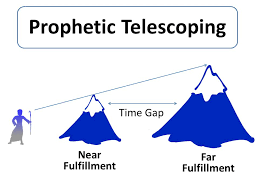
When the prophet was given the prophecy, he couldn’t see the time gap between the fulfillments. Sometimes that time gap was only a few years or decades, but in the case of Isaiah 61:1-2 or Isaiah 9:6-7, the gap between the fulfillments is nearly 2,000 years.
The bestial dream of the fourth beast had to do with the Roman Empire, still future to Daniel by nearly 400 years, but the details about the little horn and his activities have not happened yet in history, but rather speak of a future time, at which time Christ will return again.
Kingdoms of the World vs. Kingdom of Christ
David Jeremiah, in The Handwriting on the Wall, points out several differences between these two kingdoms, which Augustine called the kingdom of man and the kingdom of God.
First, the kingdoms of this world are limited. It is limited in scope and limited in duration. Christ’s kingdom is unlimited.
While these kingdoms in Daniel 7 were considered “world empires” according to the acknowledged areas of civilization at the time, Jesus’ kingdom will, in fact, encompass “all peoples, nations, and languages” (Dan. 7:14).
Worldly kingdoms have a beginning and an end. They all have a life span. They do not last forever. In contrast, the kingdom of Christ “is an everlasting dominion, which shall not pass away…” (Dan. 7:14). This fact has been emphasized over and over in this book (cf. Dan. Other kingdoms were ultimately conquered; Christ’s kingdom will never be conquered.
Second, although kingdoms in the past, whether in history or folklore, have been considered “Camelots,” the highest perfection of humanity, the kingdom of Christ is truly unique. It will be a glorious kingdom with a glorious King. David Jeremiah says, “we have never seen anything like what God has in store when He sets up His kingdom” (p. 142).
Third, Christ’s kingdom will be united under one King, whereas man’s kingdoms experience inner turmoil and rebellions. In fact, human history has seen very few decades in which someplace a war is going on. Christ will rule in righteousness and justice. [However, we do read of a final rebellion by Satan in Revelation 20, which shall be quickly and easily squelched by Christ.)


