Rodney Storz introduces this section with the following story:
Shortly before his death, Charles Haddon Spurgeon preached a sermon on the Second Coming of Christ. He said, “Brethren, no truth ought to be more frequently proclaimed, next to the first coming of the Lord, than His Second Coming; you cannot thoroughly set forth all the ends and bearings of the first advent if you forget the second” (Charles H. Spurgeon, Spurgeon’s Sermons on the Second Coming, ed. David Otis Fuller (Grand Rapids, MI: Zondervan, 1943), Preface)
Toward the end of his ministry he preached much on the Second Coming and the millennial reign of Christ, but it was not always that way. Early in his ministry he wrote, “I scarcely think it would be justifiable for me to spend my time upon prophetic studies for which I have not the necessary talent, nor is it the vocation to which my Master has ordained me” (Ibid, p. 6).
Most laymen and many preachers would have the same attitude, believing it requires special talents to be able to interpret Bible prophecy. But Paul did write:
We have not received the spirit of the world but the Spirit who is from God, that we may understand what God has freely given us. . . . The man without the Spirit does not accept the things that come from the Spirit of God, for they are foolishness to him, and he cannot understand them, because they are spiritually discerned. (1 Corinthians 2:12, 14)
The fact is “All Scripture is breathed out by God and profitable for teaching, for reproof, for correction, and for training in righteousness, that the man of God may be complete, equipped for every good work” (2 Timothy 3:16-17). ALL of God’s Word is inspired by God and every part is “profitable” to us. And Paul is saying in 1 Corinthians 2 that God’s Spirit is able to illumine our minds so that we can understand God’s Word. It is possible to understand prophetic books like Daniel and Revelation. The apocalyptic references and symbolism make it harder, but not impossible. Paul tells us to “Think over what I say, for the Lord will give you understanding in everything” (2 Tim. 2:7). We do our part of studying the Scriptures and God will “give [us] understanding.”
One of the things that makes the study of prophecy somewhat confusing is trying to determine not only what is meant by the prophecy, but to whom and when it refers. Peter explains…
10 Concerning this salvation, the prophets who prophesied about the grace that was to be yours searched and inquired carefully, 11 inquiring what person or time[a] the Spirit of Christ in them was indicating when he predicted the sufferings of Christ and the subsequent glories. 12 It was revealed to them that they were serving not themselves but you, in the things that have now been announced to you through those who preached the good news to you by the Holy Spirit sent from heaven, things into which angels long to look (1 Peter 1:10-12).
Since it is our calling to preach “the whole counsel of God” (Acts 20:27) and roughly 30% of the Bible is prophetic, then we must preach the prophetic portions of Scripture as well. That is not all we should preach, but it is obviously important enough for God to communicate it to us, then we should treat it as important to our study and exposition.
Again, Second Timothy 3:16 says, “All Scripture is God-breathed and is useful for teaching, rebuking, correcting and training in righteousness.”
Fortunately, Charles Spurgeon changed his thinking about prophecy, partially through the influence of Puritan writers. He said in a later sermon:
I find that the most earnest of the Puritanic preachers did not hesitate to dwell upon this mysterious subject. I turn to Charnock, who did not hesitate to speak of the conflagration of the world and of the millennial reign of Christ on earth. I turn to Richard Baxter and I find him making a barbed arrow out of the doctrine of the coming of the Lord, and thrusting this great truth into the very heart and conscience of unbelievers, as though it were heaven’s own sword. I do not think therefore I need tremble very much if the charge should be brought against me of bringing before you an unprofitable subject. It shall profit if God shall bless the Word; and if it be God’s Word we may expect His blessing if we preach it all. But He will withdraw His blessing if we refrain from teaching any part of His counsel because in our pretended wisdom, we fancy that it would not have practical effect” (Ibid, p. 7)
Obviously preaching about eschatology is a battleground, with different approaches and interpretations abounding. Sometimes people get very worked up about their interpretations and how others are “dead wrong.” Sometimes people just walk away in confusion and disappointment in their inability to understand it. When we talk about eschatology (last things), it encompasses not only Daniel and other Old Testament prophetic writings, but the teachings of Paul, Peter and John as well.
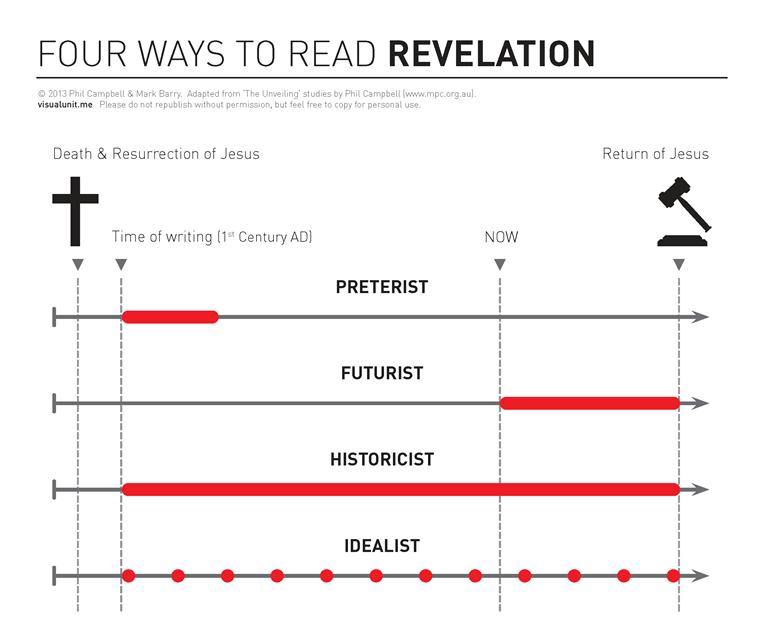
The Preterist Approach
The preterist interprets all prophecies regarding Christ’s coming and his kingdom as being fulfilled in the past.
Specifically, the preterist believes that John wrote Revelation in the first century to address the situation faced by the church at that time. All the events of Revelation, therefore, including the return of Christ and his kingdom, were fulfilled in the early centuries.
In the Preterist view, John’s prophecy should be interpreted in relation to the persecution of the church in Asia Minor, which is part of the Roman Empire. The fall of Jerusalem (A.D. 70) or the fall of Rome (A.D. 476) is a significant event, because John is predicting the fall of one of these cities (Rev. 18).
Of course, we believe that Revelation 2-3 do refer to churches in existence at the time of John’s writing. However, it is practically impossible to identify the predictions of what happens during the seal, trumpet and bowl judgments with events in the early centuries. Preterists have tried, but most of their correlations lack sound reasoning or historical confirmation.
The Historicist Approach
Historicist interpreters relate the book of Revelation to specific historical events throughout history. Some attempt to show how Revelation predicts events from the first century up until their own time. For example, E. B. Elliott relates the judgments associated with the trumpets (Rev. 8:6-9:21) to events “beginning with the attacks on the Western Roman Empire by the Goths [in A.D. 395] and concluding with the fall of the Eastern empire to the Turks [in A.D. 1453].”
A common goal of these interpreters is to show that most of Revelation’s prophecies have been fulfilled and they are very keen in showing how these events are being fulfilled in their own historical era. It makes for very compelling preaching.
The Idealist Approach
The idealist approach differs radically from the historicist. It would be attractive to someone who is tired of conflicting attempts to pinpoint how Revelation is fulfilled in specific past or future events.
Instead, idealism focuses on major themes (not historical events) which can be applied to our lives today. They desire to bring out the relevance of the book’s message for the Christian life and worldview. They do not try to line up the events of prophecy with history at all. They just point out the lessons we can learn.
The Futurist Approach
The futurist approach takes seriously John’s self-proclaimed outline for the book of Revelation, “Write therefore the things that you have seen, those that are and those that are to take place after this” (Rev. 1:19). The futurist approach sees most of the book of Revelation as to be fulfilled in some way in the future.
The primary disagreements have to do with the timing of the rapture and the second coming, and whether the kingdom is a literal, 1,000-year reign of Christ on earth or something else.
Now let’s look at the major views about biblical prophecy. We will start with…
Amillennialism
“Amillennialism” comes from the word “millennial,” which means a thousand years, but attaching the “a” prefix to indicate no millennium, or at least no thousand-year millennium on earth. It’s not that they do not believe in the kingdom of Christ, but they make it a spiritual kingdom that began with Christ’s resurrection and ascension and continues since then.
G. K. Beale is a good example of an amillennialist who is at least somewhat of a futurist. According to him, the judgments associated with the first four seals (Rev. 6:1-8), the first six trumpets (8:6-9:21), and the first five bowls (16:1-11) began to occur after the ascension of Christ to heaven (12:5) and continue until the great day of God’s wrath (6:17).
The great day of God’s wrath occurs at the end of time when Christ comes back. Consequently, the judgments associated with the end and the second coming of Christ include the sixth and seventh seals, the seventh trumpet, and the sixth and seventh bowls.
Similarly, the three and a half year reign of the Beast (Rev. 13) is a symbolic time period. It begins with the ascension and exaltation of Christ (12:5-6) and continues until Christ defeats the Beast (Rev. 19).
Amillennialists, like Beale, have a distinctive interpretation of the millennium (20:1-6). They see the millennium as spanning the same time period when most of the judgments and the reign of the Beast occur. The millennium is a symbolic time period that begins with the exaltation of Christ. It continues until Satan is released from the abyss to gather his troops to fight against the armies of Christ one last time. This means that Revelation 20:7-10 is a second presentation of the events of Revelation 19:17-21. Thus, the millennium is already underway. It is not a literal 1,000 years, but symbolic of this whole time period from the ascension to the final rebellion. Christians already enjoy a spiritual resurrection and are ruling with Christ in heaven according to the amillennialist.
Dispensational Premillennialist
The dispensational premillennialist camp has been quite influential in Evangelical circles. Dispensational interpreters are known for four emphases.
First, they emphasize the pretribulational rapture of the church. According to this view, “Christ’s return will occur in two stages: the first one for his church, which will be spared the Great Tribulation; the second one in power and glory to conquer his enemies.” As a result, the rapture of the church must occur sometime in Revelation before the beginning of the Great Tribulation. The church is promised to be saved from “the wrath to come” (1 Thess. 1:10), because “God has not destined us for wrath” (1 Thess. 5:9; cf. also Rev. 3:10).
Second, they also emphasize the distinction between ethnic Israel and the church. The believing Gentiles have been “grafted in” to the vine (Rom. 11:17) and so they enjoy some of the spiritual benefits of the New Covenant (Ezek. 36:25-27), but not all of the blessings mentioned in Ezekiel 36. This sharing of the spiritual blessings is to make Israel jealous so that they will believe (Rom. 11:14) so that at the return of Christ “all Israel will be saved” (Rom. 11:25-27). After Revelation chapter 3 John does not use the word “church,” but does refer to the “elect,” a term that has broader reference than only the church.
Therefore, when John speaks about “Israel” in Revelation 7:4, he is speaking about ethnic Israel and not about the church. The tribulation period, according to Jeremiah 30:7, is the “a time of distress for Jacob,” a time of refining and revival for Israel.
Third, they are committed to premillennialism. Premillennialists believe that Christ will come back to conquer the Beast (Rev. 19:11-21). After that victory, he will set up his kingdom and rule with his people for 1,000 years (Rev. 20:1-10). It is during that time that the Satan is chained and only released near the end of that time (Rev. 20:1-10). Premillennialism takes the sequencing of the book of Revelation seriously as well as literally interpreting the numbers.
Fourth, dispensational interpreters are generally committed to interpreting prophecies literally. As a result, they usually favor a literal, rather than symbolic, interpretation of the numbers in the book of Revelation. It is obvious to see that numbers in the first chapters are taken literally, as each of the “seven” churches are referenced and treated individually, as the seals, trumpets and bowls are enumerated and take place sequentially, and as the 144,000 Jewish witnesses are identified as 12,000 from each tribe. A plain reading of Scripture would take those numbers literally.
Historical Premillennialism
Historic premillennialism is a view that was championed by George Ladd. The adjective “historic” in historic premillennialism refers to Ladd’s contention that some early Church Fathers were clearly premillennial, but none of them believed in the pretribulational rapture of the church. The list of proponents includes names of such second-century church fathers as Papias, Irenaeus, and Justin Martyr. Papias was a contemporary of Polycarp, who was discipled by John, the author of Revelation. As a result, the chief distinctive of historic premillennialism is belief in a single return of Christ that will take place before his millennial reign.
Historic premillennialist believe that the church will be raptured at the second coming of Christ and thus the church will be present on earth during the tribulation. Even so, Revelation assures Christians that they are secure with God even if they die a martyr’s death (Rev. 11:1-2; 12:11) and God will protect them from his wrath on the Beast and his followers (Rev. 7:3-4).
Historic premillennialists are open to the idea that the numbers in Revelation are symbolic, like the amillennnialist. In addition, they stress the continuity between Israel and the church. The historic premillennialist diverges from the amillennialist when it comes to interpreting the millennial reign of Christ (Rev. 20:1-6).

Those are the views of New Testament scholars and theologians regarding how to interpret what the Bible says about end time events. I hope you will do more study to see which view most aligns with Scripture.


