We’re looking at Daniel’s vision of the four beasts in Daniel 7 today. Verses 1-8 read…
I In the first year of Belshazzar king of Babylon, Daniel saw a dream and visions of his head as he lay in his bed. Then he wrote down the dream and told the sum of the matter. 2 Daniel declared, “I saw in my vision by night, and behold, the four winds of heaven were stirring up the great sea. 3 And four great beasts came up out of the sea, different from one another. 4 The first was like a lion and had eagles’ wings. Then as I looked its wings were plucked off, and it was lifted up from the ground and made to stand on two feet like a man, and the mind of a man was given to it. 5 And behold, another beast, a second one, like a bear. It was raised up on one side. It had three ribs in its mouth between its teeth; and it was told, ‘Arise, devour much flesh.’ 6 After this I looked, and behold, another, like a leopard, with four wings of a bird on its back. And the beast had four heads, and dominion was given to it. 7 After this I saw in the night visions, and behold, a fourth beast, terrifying and dreadful and exceedingly strong. It had great iron teeth; it devoured and broke in pieces and stamped what was left with its feet. It was different from all the beasts that were before it, and it had ten horns. 8 I considered the horns, and behold, there came up among them another horn, a little one, before which three of the first horns were plucked up by the roots. And behold, in this horn were eyes like the eyes of a man, and a mouth speaking great things.
Four beasts “came up out of the great sea.” These were nations closest to the Mediterranean sea, and as we said last time, the sea represented chaos, out of which the Gentile nations arise.
“Those great beasts, which are four, are four kings which arise out of the earth” (Dan. 7:17).
Unlike Nebuchadnezzar’s vision of a man composed of valuable metals (Daniel 2:31), Daniel sees a sequence of voracious beasts. What looks attractive and impressive from the perspective of man, when seen by God’s piercing gaze (Rev. 1:14; 2:38; 19:12), turns out to be much different. Its true nature is revealed (Rev. 2:18). They are truly beastly.
James Montgomery Boice asks: “What is more characteristic of the kingdoms of this world’s history: the properly functioning state of Romans 13 or the corrupt, devouring state of Revelation 13?” (Daniel: An Expositional Commentary, p. 76).
The characteristics of the beasts seen by Daniel combine in the beast seen by John hundreds of years later.
Then I stood on the sand of the sea. And I saw a beast rising up out of the sea, having seven heads and ten horns, and on his horns ten crowns, and on his heads a blasphemous name. Now the beast which I saw was like a leopard, his feet were like [the feet of] a bear, and his mouth like the mouth of a lion. The dragon gave him his power, his throne, and great authority. (Rev. 13:1-2, emphasis added).
Daniel then writes about these beasts in the subsequent verses (vv. 4-8). Each beast was numbered and described, and then some activity is described.
The Four Beasts of Daniel 7
| The Number | The Description | The Activity |
| First beast (7:4) | “like a lion and had eagles’ wings” | “Its wings were plucked off, and it was lifted up from the ground and made to stand on two feet like a man, and the mind of a man was given to it.” |
| Second beast (7:5) | “like a bear. . . . raised up on one side . . . [with] three ribs in its . . . teeth” | “It was told, ‘Arise, devour much flesh.’” |
| Third beast (7:6) | “like a leopard, with four wings of a bird on its back. And the beast had four heads” | “Dominion was given to it.” |
| Fourth beast (7:7) | “terrifying and dreadful and exceedingly strong. It had great iron teeth; . . . and it had ten horns” | “It devoured and broke in pieces and stamped what was left with its feet.” |
The first beast was “like a lion and had eagles’ wings.”
Notice that these are not normal animals that you would find in the wild or in a zoo, but composite creatures that illustrate various characteristics of these kingdoms.
“The monarchy vision of Nebuchadnezzar (ch. 2) covers the same order of fulfillment as Daniel’s beast vision, but with this difference: Nebuchadnezzar saw the imposing outward power and splendor of ‘the times of the Gentiles’ (Lk. 21;24; cp. Rev. 16:19 …), whereas Daniel saw the true character of Gentile world government as rapacious and warlike, established and maintained by force. It is remarkable that the heraldic insignia of the Gentile nations are all beasts or birds of prey” (The New Scofield Reference Bible, p. 907).
Because of the parallelism with chapter 2, this animal matches the “head of gold” on the image in Nebuchadnezzar’s dream, which represented Babylon and more specifically, Nebuchadnezzar.
It is important to understand that the period of time depicted in both Nebuchadnezzar’s dream and Daniel’s vision is anchored at each end in relation to Jewish rule from the throne of David in Jerusalem. Both begin with the overthrow of Davidic rule (by Nebuchadnezzar) and both end with the restoration of Davidic rule (by Jesus). While other kingdoms of significance to Israel (e.g., Egypt, Assyria) had arisen prior to Nebuchadnezzar’s Babylon, they are not in view in chapters 2 or 7 because they did not interrupt Jewish rule in the line of David on the throne in Jerusalem.
In chapter 2, the symbols were taken from inanimate objects; here in chapter 7, they are taken from the animate. In chapter 2, King Nebuchadnezzar saw the splendor of world empires portrayed in the dazzling statue of a man, while the Kingdom of God was symbolized by a stone. By contrast, in chapter 7, Daniel’s vision reveals the animalistic character of world empires and the fact that it is only in the Kingdom of God that man’s full dignity is realized—in the Son of Man” (Charles Lee Feinberg. Daniel: The Kingdom of the Lord, pp. 83-84).
| DANIEL 2 | DANIEL 7 | ||
| Head of gold | BABYLON (626-539 B.C.) | Lion | (v.4) |
| Chest of silver | MEDES/PERSIANS (539-330 B.C.) | Bear | (v.5) |
| Thighs of bronze | GREECE (330-63 B.C.) | Leopard | (v.6) |
| Legs of iron | ROME (63 B.C.-430 A.D.) | ||
| (The kingdom of God comes initially.) | |||
| ANTICHRIST | Terrifying Beast | (vv. 7-28) | |
| (The kingdom of God comes in fullness.) | |||
In other OT passages, Nebuchadnezzar was compared to a lion (Jere. 4:7-13; 50:17) and the Babylonian armies to eagles (Lam. 4:19; Ezek. 17:3; Hab. 1:8), so in Daniel 7:4 the use of “lion” and “eagle” is consistent with terminology used to describe Nebuchadnezzar and Babylon. These images denote predators who can easily (lion-like quality) and quickly (eagle-like quality) overcome their prey. Indeed, this is what King Nebuchadnezzar did, quickly and easily conquering other kingdoms and cities.
In much of ancient literature, Babylon’s symbol is a lion with eagle’s wings. The Ishtar Gate gave access to the city’s processional street whose walls were lined with enameled lions.
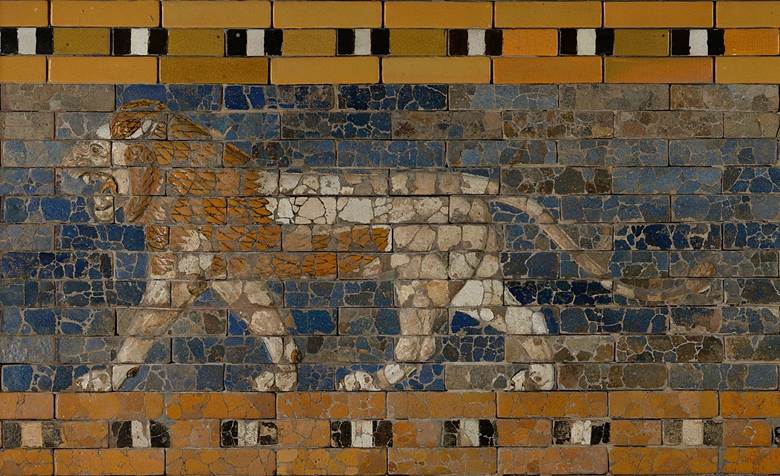
The Lion of Babylon from a portion of the Processional Way leading to the Ishtar Gate
Another commonality with Nebuchadnezzar’s image and Daniel’s vision is that they both begin with the higher ranking kingdom, the head of gold and the winged lion. The lion is the king of beasts and the eagle is king of the birds. Gold is the most precious metal.
Andy Woods makes the point that God’s supernatural assistance is described as being carried on eagle’s wings in various places (Exod. 19:4; Deut. 32:10-13; Isa. 40:30-31; Rev. 12:13-14), thus having eagle’s wings could represent God’s support of this kingdom during the reign of Nebuchadnezzar, whom God, through Jeremiah, refers to as “My servant” (Jer. 25:9; 27:6; 43:10).
Each of these beasts arise up out of the stormy sea, riding in power on the crest of a tidal wave of war. Nebuchadnezzar’s reign had been a string of continual conquests of other nations and peoples.
But as Daniel beheld the eagle-winged lion, three actions took place: “Its wings were plucked off, and it was lifted up from the ground and made to stand on two feet like a man, and the mind of a man was given to it.” The passive verbs suggest divine action taken upon Nebuchadnezzar, and the three events evoke chapter 4, where King Nebuchadnezzar was given the mind of a beast for a time (4:16, 33); but when the allotted punishment was fulfilled, God restored his normal mind (v. 34).
According to Daniel 4:33, during Nebuchadnezzar’s punishment his hair grew as long as eagles’ feathers, and his nails grew out like birds’ claws. In punishment, Nebuchadnezzar’s “wings were plucked off,” but when Nebuchadnezzar repented, he “was lifted up from the ground and made to stand on two feet like a man, and the mind of a man was given [back] to [him].”
In speaking of its “eagle wings,” he meant that king Nebuchadnezzar was exalted, and that his glory was lifted up against God. Then he says “its wings were plucked off,” i.e., that his glory was destroyed; for he was driven out of his kingdom. . . . the words, “A man’s heart was given it, and it was made stand upon the feet of a man,” mean that he came to himself again, and recognised that he was but a man, and gave the glory to God. (Hippolytus, On Daniel, p. 178).
But then he was “lifted up from the ground,” pointing to the event in which Nebuchadnezzar lifted his eyes to heaven (Dan. 4:31) and then sovereignty (“made to stand”) and authority (“mind of a man was given back to him.”)
Fruchtenbaum suggests the attributes of a man denotes a shift in the empire’s characteristics concerning conquest.
As much as possible that a man could become a beast, Nebuchadnezzar became one; as close as a beast could become a man, so did Babylon eventually lose its beast-like nature. Babylon eventually lost its beast-like nature as it moved from lust of conquest to the building of culture. (Arnold Fruchtenbaum, The Footsteps of Messiah, p. 27).
Interestingly, only the descriptions of the first and last beasts make reference to man. Here it is a man’s heart—speaking of humaneness. There it is a man’s eyes—denoting intelligence, possibly even craftiness (Dan. 7:8, 20). The ruler of the first Gentile kingdom, having been humbled as a beast, is restored as a man. The ruler of the final Gentile kingdom, the antichrist, having eyes like a man (extreme intelligence), but behaves as a beast (Rev. 13:7). His intelligence will lend itself to scheming and craftiness that enables him to do what he wants to do and follow what Satan has planned for him (Dan. 7:11, 25; Rev. 13:5-6).
Both rulers are contrasted with the “One like the Son of Man” (Dan. 7:13), as if to raise the question: which type of man will ultimately rule over God’s creation? A sinful man from the earth? Or the one-and-only sinless man from heaven (John 3:13, 31; 6:33, 38, 41-42)?
“Although Daniel in this vision does not dwell on the fall of Babylon, described in detail in chapter 5, the decline of Babylon and the rise of The Medo-Persian Empire is implied. Other prophets spoke at length on the fall of Babylon. From the reference to the tower of Babel in Genesis 11, there is no biblical mention of Babylon until the major prophets, Isaiah, Jeremiah, and Ezekiel discuss Babylon’s future. Isaiah describes the fall of Babylon as similar to that of Sodom and Gomorrah (Is 13:1-22), with particular mention of the Medes in Isaiah 13:17-19. A future destruction of Babylon at the second coming of Christ seems to be indicated in Isaiah 13:20-22 (cf. Rev 17). Another extended prophecy about Babylon is found in Isaiah 47.
Jeremiah who witnessed the capture of Jerusalem by the Babylonians refers to Babylon throughout his prophecy, of which the most important sections are Jeremiah 25:11-14; 29:10; 50:1-51:62. The last three long chapters of Jeremiah are devoted entirely to Babylon. Ezekiel, himself a captive, is occupied with Babylon (Eze 17:12-24), and predicts like Jeremiah Babylon’s conquest of Egypt (Eze 29:18-20; 30:10-25; 32:1-32). Daniel, writing later, ties together these prophecies about Babylon” (John Walvoord, https://walvoord.com/article/248)
The second beast was “like a bear. . . . raised up on one side . . . [with] three ribs in its . . . teeth” (Dan. 7:5). The Old Testament writers spoke of the bear as the most formidable beast of prey in Canaan after the lion (cf. 1 Sam. 17:34; Amos 5:19; cf. 2 Kings 2:24; Hos. 13:8). Remember that David killed both a lion and a bear. This was no cuddly teddy bear, but a ferocious predator.
A bear is ponderous and slow, but achieves its objectives through sheer strength and brute force, seeking to crush its victims in its embrace. As Driver expresses it, “In the O. T. it is spoken of as being, next to the lion, the most formidable beast of prey known in Palestine (1 Sam. 17:34; Am. 5:19; cf. 2 Ki. 2:24; Hos. 13:8); at the same time, it is inferior to the lion in strength and appearance, and is heavy and ungainly in its movements” (S. R. Driver, The Book of Daniel, p. 82).
When Xerxes marched against Greece, he took two and a half million troops with him; the movement of this mass of men looked more like a migration than an army. Even Persian’s last and most pacific king brought more than half a millions men to the Battle of Issus and two years after their defeat was able to find another million men for his final battle.
From the chaotic waters rose a second beast, “like a bear. It was raised up on one side. It had three ribs in its mouth between its teeth; and it was told, ‘Arise, devour much flesh.’”
Being “raised up on one side” is likely a reference to the ascendancy of the Persian Empire over the Medes. This is represented in Daniel 8 by two horns, one (Persian) higher than the other (Dan. 8:3, 20). The ram with its unequal horns is identified as “The kings of Media and Persia” (Dan 8:20).
The overall stress for this beast is on conquest; and Medo-Persia did take over far more land than any prior kingdom, reaching finally all the way from the Indus River on the east to Egypt and the Aegean on the west.
Some versions begin this verse with “Suddenly,” as if to emphasize the swiftness with which Babylon fell to the Medes and Persians.
If the first metal (gold) and animal (a winged lion) both refer to Babylon in chapters 2 and 7, then the second animal most reasonably corresponds to the second metal—Medo-Persia, which conquered Babylon in 539 B. C., under the reign of Cyrus.
Bear are more ponderous lions in their movements, also a characteristic of Medo-Persia with its large armies. [The Persian empire] wielded vast masses of human strength on their enemies; their armies varied from 300,000 on slighter expeditions to a million. Darius’ army, with which he marched through the desolate regions of Scythia, was counted at 700,000, exclusive of his fleet of 600 ships, which would add a naval force of 120,000 men. Xerxes’ expedition against Greece resembled more the emigration of vast hordes, than an army; they were calculated at above two million and a half of fighting men. Artaxerxes Longimanus, his successor, gathered two armies, each it is said, exceeding 300,000 men, to subdue the single province of Egypt. (Pusey, Daniel the Prophet, p. 73).
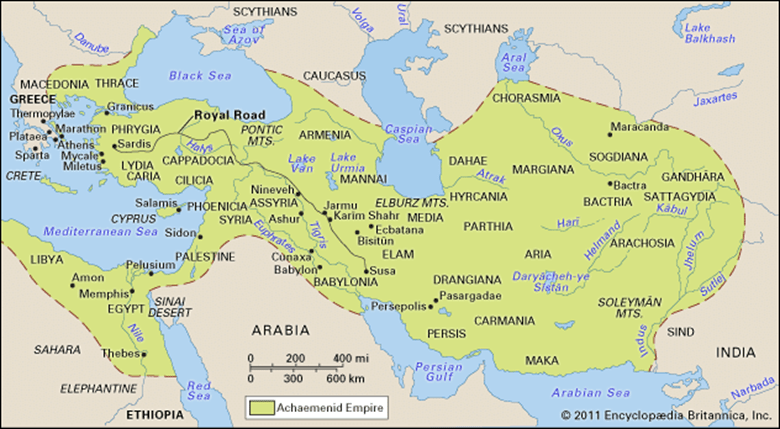
https://www.britannica.com/place/Media-ancient-region-Iran
The bear raised up on one side illustrates that the Persian Empire soon became dominant over the Medes. The three ribs the bear has in its mouth pictures the three major kingdoms conquered by the Medo-Persian empire. They were Lydia (546 B.C.), Babylon (539 B. C.), and Egypt (525 B. C.). Of course, Daniel would not, himself, have been able to perceive these things. Peter tells us that Old Testament prophets.
Concerning this salvation, the prophets, who spoke of the grace that was to come to you, searched intently and with the greatest care, trying to find out the time and circumstances to which the Spirit of Christ in them was pointing when he predicted the sufferings of Christ and the glories that would follow. It was revealed to them that they were not serving themselves, but you. (1 Peter 1:10-12).
We have a much clearer picture and understanding because we can look back and correlate this with actual historical events.
Rodney Storz points out:
We need to remember two important things about predictive prophecy as we study Daniel 7 — 12. First, prophecy does give us important details about the future that God says we need to know in advance, so when they occur we are ready. God wanted Israel to understand something about the Medo-Persian Empire, so the people would know for certain who was in control of human history. Persia would become stronger than the Medes and would conquer three major kingdoms.
The second thing we need to understand is that we should never speculate as to how prophecies yet future to us might be fulfilled. Can you imagine Daniel trying to speculate what the bear raised up on its side with three ribs in his mouth meant? He could never have guessed; and if he tried to speculate, he might throw people off track because they would get the speculations in their mind and miss the real fulfillment.
For example, John tells us in Revelation 13:18 that the number of the Antichrist, or the Beast, will be 666. Some have said that means the Antichrist will have three names, and each name will have six letters in each name. (I remember hearing that Ronald Wilson Reagan might fit the bill.) But the prophecy doesn’t say that 666 means three names with six letters each; so we might miss the real person if we are looking for the wrong thing. We should just know what to look for, and it will be clear when it happens.
In the interpretation of Daniel’s vision (7:15-28), nothing is made of the bear and rib imagery of verse 5, but the ferocious nature of the beast is clear by the description of its prey’s ribs sticking out of its mouth. The bear has already devoured, and then it is told to devour more. This apparently refers to the additional conquests of the Medes and Persians in the years which followed the fall of Babylon.
Just as the passive verbs in verse 4 suggested divine action, so also is the command in verse 5 from God. The Medo-Persian Empire was God’s instrument for judgment on Babylon and deliverance of his exiled people. The bear would discover how Babylon tasted!
Daniel would receive more information about the second beast/kingdom in Daniel 8.


