Some people really love Bible prophecy and want to know whether what happened today is a sign of the rapture or the return of Christ. In fact, it’s common knowledge among pastors that if you want to attract people to church, just preach on the end times or on sex, or as J. D. Greear joked, entitle a sermon “Will there be sex in the end times?”
Most of you who grew up in church know that at least 25% of the Bible is prophetic. Not all of that deals with our future. Some of it has already been fulfilled, some of it will be fulfilled for those who go through the tribulation, but there are passages that apply to those of us who are alive today.
Today we are starting Daniel chapter 7.
For a variety of reasons, “modern commentators are generally agreed that chapter 7 is the single most important chapter of the Book of Daniel.” [W. S. Towner, Daniel, INT (Atlanta: John Knox, 1984), 91] Porteous calls it “the heart of the Book of Daniel,” [N. W. Porteous, Daniel, OTL (Philadelphia: Westminster, 1965), 95] and Heaton declares, “It would be no exaggeration to say that this chapter is one of the most important passages of the OT.” [E. W. Heaton, The Book of Daniel, TBC (London: SCM Press, 1956), 169.] . . . First, Dan. 7 marks the literary turning point of the book from historical accounts to visions. . . . Second, the chapter is important because of its enormous impact on subsequent Jewish literature. . . . Third, it is of extreme significance prophetically. Walvoord rightly maintains: “As interpreted by conservative expositors, the vision of Daniel provides the most comprehensive and detailed prophecy of future events to be found anywhere in the Old Testament.” [J. F. Walvoord, Daniel: The Key to Prophetic Revelation (Chicago: Moody, 1971), 145.]
Many people enjoy the adventures of Daniel and his friends in the first six chapters of Daniel, but tend to avoid the mysterious visions of chapters 7-12. Others, however, love the prophetic portions of Daniel and could skip over the stories and their practical applications. Admittedly, visions of the future can be quite daunting. Even Daniel “was troubled in spirit, and the visions that passed through my mind disturbed me” (Dan. 7:15).
But let’s push through our fears the way Daniel did. Daniel 7:16 says, “I approached one of those standing there and asked him the true meaning of all this. So he told me and gave me the interpretation of these things” (emphasis added). He was asking an angel, but we do not know any angels. At least I do not. So who can we ask? We need to ask the Lord himself as we meditate on his Word. Psalm 119:18 is our prayer: “Open my eyes, that I may behold wonderous things out of your law.” In 2 Timothy 2:7 Paul says, “Reflect on what I am saying, for the Lord will give you insight into all this.” So pray for insight and think about it, mediate on it. This won’t answer every question, but it will go a long way to helping you understand Scripture.
This chapter would reinforce for the Israelites, either in Babylon or back in Jerusalem, that God was in control of even the mightiest empires of the world. God had not abandoned His chosen nation.
At the time of this vision, Daniel and his people remained captive under the thumb of Babylon. Meanwhile, Jerusalem, the city of promise where God had placed his name, had lain in ruins for more than three decades (587-533 B.C.). The prophetic information given to Daniel in this chapter established the certainty that God would restore Israel: not only to end the Babylonian Captivity as Jeremiah had predicted (Jer. 29:10 cf. Daniel 9:2), but also at the very end of the age when the Messiah would rule from the throne of David.
The remaining chapters of Daniel detail Israel’s future and can be summarized in pairs: two coming dictators (chaps. 7-8), two critical delays (chaps. 9-10) and two complete disclosures (chaps. 11-12).
In this chapter Daniel receives a vision of four beasts rising out of the sea, the fourth beast being more fearsome than the others, and its little horn evoking concern (7:1-8). These beasts will terrorize God’s people.
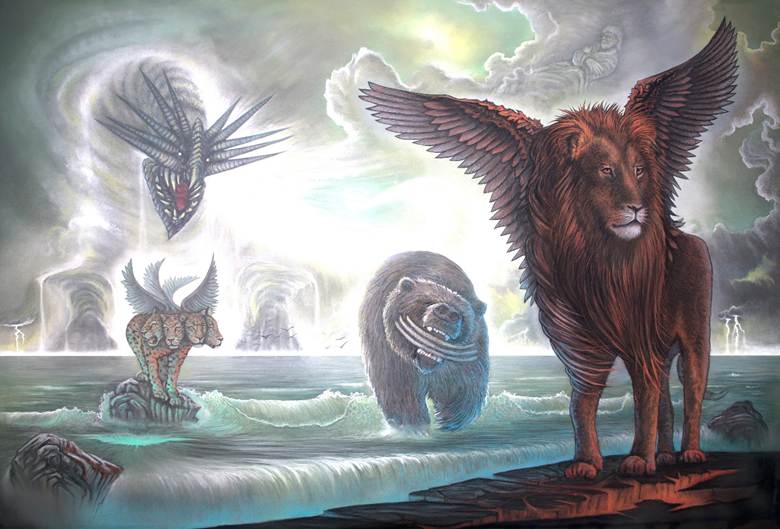
https://www.spiritandtruth.org/teaching/Book_of_Daniel/commentary/htm/chapters/07.html
Shifting from the sea to heaven, Daniel’s vision continues with the Ancient of Days judging the fourth beast (vv. 9-12). Then “one like a son of man” receives everlasting dominion over all (vv. 13-14). An angel explains that the four beasts are kings and that the saints will receive an everlasting kingdom (vv. 15-18). Daniel learns more about the fourth beast and its little horn (vv. 19-27).
Chapter 7 is a transition to the exclusively visionary section of the book (chs. 7-12). Daniel was the sole recipient of these visions, with no report of a king receiving them first.
This last half of the book consists of four visions: chapters 7, 8, 9, and then chapters 10-12. Each vision occurred in a different year (cf. 7:1; 8:1; 9:1; 10:1) and location (cf. 7:1; 8:27; 9:3; 10:4), but they did not occur chronologically following the events at the end of chapter 6. Rather, the four visions in chapters 7-12 occurred concurrently with the events of chapters 1-6 and are given in chronological order below. However, if Darius and Cyrus are not the same person, then chapters 10-12 do occur after chapters 1-6.
Years and Locations of the Visions of Daniel 7–12
| The Vision | The Year of the Vision | Where Daniel Was | Dates |
| Daniel 7 | “the first year of Belshazzar king of Babylon” (7:1) | In his house (7:1) | 553 B. C. |
| Daniel 8 | “the third year of the reign of King Belshazzar” (8:1) | In his house (8:27) | 550 B. C. |
| Daniel 9 | “the first year of Darius the son of Ahasuerus” (9:1) | In his house (9:3, 21) | 539-538 B. C. |
| Daniel 10-12 | “the third year of Cyrus king of Persia” (10:1) | By a river (10:4) | 536-535 B. C. |
This chart is from the ESV Expository Commentary and assumes Darius and Cyrus were the same person. The column with dates was added from Tom Constable’s website.
Daniel would have been in his 80s by this time. “God does not reveal all His truths at once, even to the wise, but reserves much for age and experience” (Joyce Baldwin, Daniel, An Introduction and Commentary, p. 138).
1. Daniel Sees a Vision of Four Beasts from the Sea and Two Figures in Heaven (7:1-14)
a. Daniel Sees Four Beasts like Animals Who Exercise Dominion (7:1-8)
Daniel had a vision in “the first year of Belshazzar king of Babylon,” around 553 BC. Thus, the vision of chapter 7 occurs between chapter 4, which deals with the humbling of Nebuchadnezzar, and chapter 5, which deals with the humbling of Belshazzar. Thus, Daniel has known for some time that the Medo-Persian empire would replace the Babylonian Empire on the world stage.
Notice that Daniel calls Belshazzar “king of Babylon.” Nabonidus, his father, was king over the empire, but Belshazzar was ruling in Babylon. This, again, is why Daniel was promised to be “third ruler” in the kingdom (Dan. 5:16).
It was fitting that this vision of the downfall of world empires should come to the prophet during the reign of the last king of Babylon. God gave it to him 50 years after the similar revelation of the great image in chapter 2 given to Nebuchadnezzar (cf. Gen. 41:25, 32).
Daniel is about 65, which is encouraging to me that God still uses older people. God is never finished with us even in our old age. I like Psalm 92:14, “They will still bear fruit in old age, they will stay fresh and green” (Psalm 92:14 NIV). Don’t stop serving the Lord, even if you don’t have the energy you formerly had. Don’t believe that He can’t use you because you are “past your expiration date.”
What many consider as the two most significant prophetic books of the Bible, the Old Testament book of Daniel and the New Testament book of Revelation, were written by older believers who remained faithful in their walk with God in their advanced years. The last three chapters of the book of Daniel were given when Daniel was 86 years old and John received the revelation of Jesus Christ (Rev. 1:1) when he was in his 90s.
The vision consists of activity in the sea (vv. 1-8) and in heaven (vv. 9-14). A situation with the fourth beast (vv. 7-8) provokes God’s response (vv. 9-14). In verses 1-8, Daniel gives the year of the vision and then describes four beasts that rose up from the sea. The fourth beast receives the most attention (vv. 7-8).
The four beasts are four empires. According to Daniel 7:17 and 23, these beasts correspond to kingdoms and the kings who rule them.
These empires exist one after another. The fourth beast “was different from all the beasts that were before it” (Dan. 7:7). The fourth beast will devour the “whole earth” (Dan. 7:23), which leaves no place for other beasts at the same time. The phrase “after this” in Daniel 7:6-7, explaining the sequence of beasts, confirms that the beasts will reign consecutively.
Belshazzar was the last king of Babylon; the night of his blasphemous banquet was both the night of his death and the night the Medo-Persians seized control of Babylon (5:30-31). In the Aramaic chiasm of the book (chs. 2-7), a comparison of chapters 2 and 7 reveals that the vision in the former occurred under Nebuchadnezzar (2:1), the first king of Judah’s exile, while the vision in the latter occurred under Belshazzar (7:1), the last Babylonian king of Judah’s exile (cf. 5:31). Thus, during the first and last Babylonian kings of Judah’s exile, God gave visions of four earthly kingdoms. Other visions in the book pertain to only some of these kingdoms.
Here, unlike the other dreams in the book (chapters 2 and 4), Daniel received this vision directly from God. Daniel saw the vision at night “as he lay in his bed.” He then “wrote down the dream,” which formed the record of the dream found in vv. 2-28.
Why did Daniel write it down? Because it was not just for him, but for generations of Israelites yet to be born. The dream given to Daniel contains information God meant to be preserved for our day and beyond: even to the time of the fulfillment of events revealed within the dream—at the Second Coming of Jesus Christ. As such, the record Daniel wrote is permanent.
Daniel’s purpose in writing is akin to that of Isaiah, “Now go, write it before them on a tablet, And note it on a scroll, That it may be for time to come, Forever and ever: . . .” (Isa. 30:8). The source of Daniel’s dream and visions was not his own thoughts or imaginings, but the very Spirit of God (Dan. 4:8; 5:12; 6:2). God’s Word is sure and stands forever (Isa. 40:8; Matt. 5:17).
This vision will build upon the dream of Nebuchadnezzar in Daniel 2.
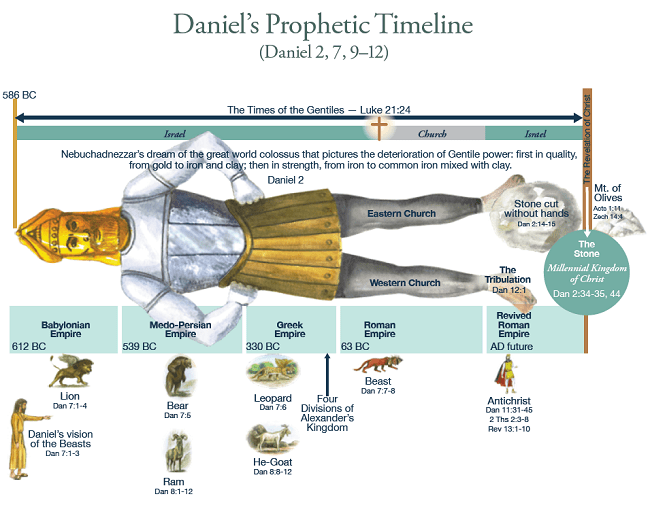
Philip Jensen compares all the prophecies in Daniel and shows their correlation:
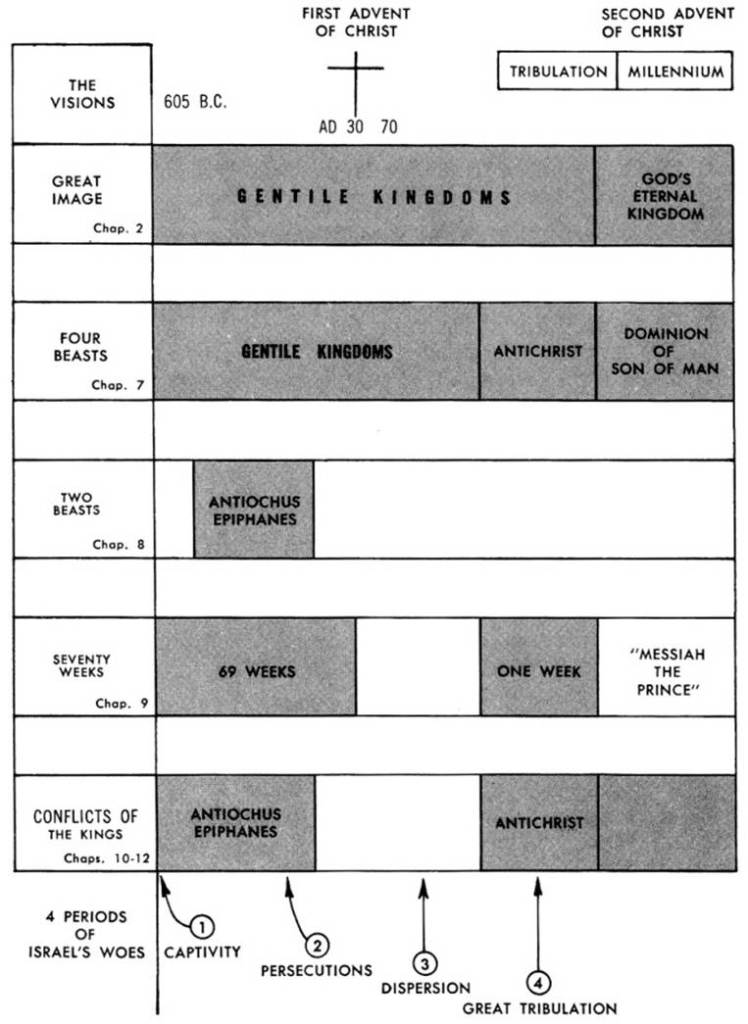
One reason God may have revealed the same sequence of kingdoms in several separate chapters is that two or three is the number of witness (Gen. 42:25, 32; cf. Deut. 19:15; Matt. 18:16).
Andy Woods has this chart showing the comparisons between the two chapters.
Daniel saw “four winds of heaven” (v. 2) stirring up the great sea. These were winds from the north, south, east, and west, every direction, almost like a whirlwind. “To the Hebrews the sea was both dangerous and mysterious, a restless element but not beyond the Lord’s power to tame” (Joyce Baldwin). The “sea” was viewed by the ancient Hebrews as a realm of chaos, disorder and rebellion (cf. Genesis 1:2; Job 38:8-10; Psa. 104:6-7), and now that realm was pulsing with activity. The winds roused four different beasts from the waters.
The sea is sometimes used as a picture of Gentile nations (Psalm 74:13, Psalm 89:9, Isaiah 57:20).
“Unlike many ancient peoples, such as the Phoenicians, the Israelites were not mariners. They preferred terra firma. In the Israelite imagination, voiced in her poetry, the sea is emblematic of restless evil, chaos and death….Almost every OT reference to ships and sailing entails Gentiles in some way….How fitting, therefore, that when Jesus called his first Jewish disciples to be ‘fishers of men,’ he did so in ‘Galilee of the Gentiles,’ where they were casting their nets into the sea (Matt. 4:15-19). On a ship, the Messiah demonstrated his power over ‘the wind and the sea’ (Matt 8:26)” (Chad Bird, Unveiling Mercy, p. 226)
John Phillips notes: “The ‘four winds of the heaven’ symbolize four great angel princes (Rev. 7:1-3; 9:14-15), those ‘principalities’ of Satan, who rule over the four nations that were to seize world power. They are the ‘powers of the air,’ the force of the Evil One against which we strive today in prayer (Eph. 6:12). They are subject to Satan (Eph. 2:2) and through them he holds the nations of the earth in chain” (Exploring Daniel, pp. 112-113).
David Jeremiah says, “When Daniel in his vision looks at this great sea of humanity, it is being blown from the four corners of the earth, depicting political strife and uprisings, wars and bloodshed among the nations. He sees the nations in unrest, which is the everlasting human condition” (The Handwriting on the Wall, p. 133).
The sea was also considered to be the natural home of monsters such as Leviathan, the multiheaded monster of ancient mythology (see Psa. 74:13-14), all enemies of God.
Daniel saw “the great sea,” quite probably the Mediterranean Sea (cf. Num. 34:6-7; Josh. 1:4; 9:1; Ezek. 47:10; et al.), stirred up by the four winds (or spirits) of heaven (v. 2; cf. Jer. 23:19; 49:36; Zech. 6:1-6; Rev. 7:1-3; et al.). The sea in Scripture, and in ancient Near Eastern thinking, represented the unorganized mass of humanity: the populace of the earth (v. 17; cf. Isa. 8:6-8; 17:12-13; 57:20; 60:5; Jer. 6:23; 46:7-8; 47:2; Matt. 13:47; Luke 21:25; Rev. 13:1; 17:1, 15; 21:1; et al.). The Mediterranean world seems to be particularly in view, since the sea was the Mediterranean Sea.
“God often used the wind as a means to attain His ends (Gen 8:1: Ex 10:13-19; 14:21; 15:10; Num 11:31; I Ki 18:45; 19:11). … Of more than 120 references in the Bible to wind (more than 90 in the O.T. and about 30 in the N.T.), well over half are related to events and ideas which reflect the sovereignty and power of God. In Daniel, wind is uniformly used to represent the sovereign power of God, which is the viewpoint of the book” (John F. Walvoord, Daniel: The Key to Prophetic Revelation, p. 152, cf. Gen. 1:2). Commentators agree that the four winds are under the ultimate control of God—they recognize the overarching sovereignty of God.
The “sea” is likely referring to the Mediterranean Sea. However, global aspects of the vision seen by Daniel [four winds (Dan. 7:2), eventual world-wide dominion of the final beast (Dan. 7:23)] in combination with those seen by John [all the world worships the final beast (Rev. 13:3), the waters upon which the Harlot sits (Rev. 17:1) are “peoples, multitudes, nations, and tongues” (Rev. 17:15)] argue for understanding the Great Sea as representing the global population.
But why does it say in v. 17 that “These four great beasts are four kings who shall arise out of the earth” if v. 3 says they arise “out of the sea”? Obviously, since we are talking about kings, they symbolically arise out of chaos and disorder, but naturally arose upon dry land. The images of “sea” and “earth” are therefore not contradictory, but complimentary.
“Those great beasts, which are four, are four kings which arise out of the earth” (Dan. 7:17).


