Daniel 7 records Daniel’s vision of the four beasts, representing the four ancient kingdoms of Babylon, Medo-Persia, Greece and Rome. Daniel also sees some things about the fourth beast that would not be fulfilled in the near future (our past) but in the future yet to be.
The angel then addressed the interpretation of the fourth beast (v. 23), the ten horns (v. 24), and the little horn’s blasphemous activity and divine judgment (vv. 25-27).
23 “Thus he said: ‘As for the fourth beast,
there shall be a fourth kingdom on earth,
which shall be different from all the kingdoms,
and it shall devour the whole earth,
and trample it down, and break it to pieces.
24 As for the ten horns,
out of this kingdom ten kings shall arise,
and another shall arise after them;
he shall be different from the former ones,
and shall put down three kings.
25 He shall speak words against the Most High,
and shall wear out the saints of the Most High,
and shall think to change the times and the law;
and they shall be given into his hand
for a time, times, and half a time.
26 But the court shall sit in judgment,
and his dominion shall be taken away,
to be consumed and destroyed to the end.
27 And the kingdom and the dominion
and the greatness of the kingdoms under the whole heaven
shall be given to the people of the saints of the Most High;
his kingdom shall be an everlasting kingdom,
and all dominions shall serve and obey him.’
The angel declared that the fourth beast (cf. vv. 7-8) “shall be a fourth kingdom on earth, which shall be different from all the kingdoms, and it shall devour the whole earth, and trample it down, and break it to pieces.” This was not new information.
In v. 24 the angel interprets the ten horns: “Out of this kingdom ten kings shall arise.” The ten kings represent not ten different kingdoms but rulers within the same kingdom (Rome). “The ten-nation confederacy of the future anticipated in these prophecies would naturally be considered a revival of the Roman Empire if for no other reason than that it is portrayed as an integral part of the fourth empire” (John F. Walvoord, “Revival of Rome,” Bibliotheca Sacra 126:504 (October-December 1969):317-28).
Here the dual identification of the beasts with kings and kingdoms becomes indisputable. The fourth beast does not only represent a king (v. 17), but also a kingdom. The angel repeated the facts already revealed (v. 7), but he clarified that the previous description referred to a kingdom.
This renewal of the fourth kingdom is symbolized in Revelation by the beasts of Revelation 13:1-10 and 17:1-18. Leon Wood gives the following reasons for equating the two: “First, that the two beasts of Revelation 13 and 17 are the same is argued by the facts that: (1) they both have seven heads and ten horns (13:1; 17:3); (b) they both are violently opposed to God (13:1, 6; 17:14); and (c) they both effect persecution on God’s saints (13:7; 17:6). Second, that the kingdom represented in Daniel 7 is the same as the kingdom represented by the beasts of either Revelation 13 or 17 is argued by: (a) that the symbolism of the lion, bear, and leopard is repeated in the beast of Revelation 13 (v. 2), as though this beast, like the fourth of Daniel 7, recapitulated in some real sense, the Babylonian, Medo-Persian, and Greek empires; (b) that all three are opposed to God, blaspheming His name (Dan. 7:25; Rev. 13:1, 6; 17:3); (c) that all three beasts have ten horns; (d) that both the beast of Revelation 13 (vv. 5-6) and Daniel 7 (vv. 7, 25) speak great things against God; (e) that all three wear out the saints (Dan. 7:25; Rev. 13:7; 17:6); and (f) that both the beast of Revelation 13 (v. 5) and of Daniel 7 (v. 25) maintain great power for three and one-half years” (A Commentary on Daiel, p. 199).
The issue among biblical scholars of different eschatological persuasions is whether the number “ten” is literal or symbolic. I believe this is a literal number. Nothing in the context demands that we take this number symbolically.
Notice that they all arise and interact with one another at the same time, not sequentially in history. The horns grow from the head of the beast while it is still alive.
When the angel says it “will devour the whole earth” the Old Testament generally uses this term to refer “to the entire territory of the Near and Middle East that in any way relates to the Holy Land.” However, given that this is referring to an end-times king and kingdom and events, the possibility of a “one-world government under a worldwide dictator” is a greater possibility.
Another horn would arise after these ten, “different from the former ones, . . . [to] put down three kings” (v. 24). Since the previous horns represented kings, the other horn that arose must surely represent a king as well.
The text has stated that three kings were “put down” (v. 24), “fell” (v. 20), and “were plucked up by the roots” (v. 8). The use of different verbs make it challenging to conclude exactly what happened to the kings, although all the images together suggest death by the little horn’s hand or decree.
Verse 25 then speaks of an 11th horn, or king. This eleventh king will speak out against the Most High (God).
The focus of the little horn’s actions was opposition to God and his people. His “words against the Most High” (v. 25) is equivalent to the “mouth speaking great things” (vv. 8, 11, 20). It surely represents blasphemous statements directed against God and His worship. Leon Wood comments: “The word for “against” is literally “at the side of” (letsad), indicating that the little horn will seek to raise himself as high as God and make pronouncements accordingly, which implies making them contrary to what God would make (cf. 11:36, 27; 2 Thess. 2:4)” (A Commentary on Daniel, p. 201).
By the way, the title “Most High” or “Most High God” had appeared earlier, in chapters 4 and 5 (4:17, 24, 25, 32, 34; 5:18, 21), which reported God’s judgments against Nebuchadnezzar and Belshazzar, and now the appearance of “Most High” in chapter 7 is likewise in a context of judgment against the little horn.
The notion of “wear[ing] out the saints” (v. 25, same group as vv. 18, 22) implies a longer period of trial for God’s people, a season requiring endurance and faithfulness on their part. Leon Wood states: ““To wear out the saints means to harass them continually so that life becomes a wretched existence.” The Antichrist will wear down the saints by persecution (cf. 2 Thess. 2:8-9; Rev. 12:13-17; 13:1-10, 16-17).
Gleason Archer Jr., adds, “Such continual and protracted pressure far more effectively breaks the human spirit than the single moment of crisis that calls for a heroic decision. It is easier to die for the Lord than to live for him under constant harassment and strain.” Isn’t that true?
One of the little horn’s actions against God and His people is his attempt “to change the times and the law.” That shall be his plan (“think to…”). “The times” likely reflect Jewish sabbaths and festivals prescribed in the law.
Gleason Archer recorded an interesting account of an unsuccessful attempt during the French Revolution to replace the Christian (Gregorian) calendar with a Revolutionary calendar (“Daniel,” p. 94. See also Kenneth Scott Latourette, A History of Christianity, p. 1010; Earle E. Cairns, Christianity Through the Centuries, p. 424. Similar efforts by the Russians in more recent times have also proved ineffective (H. C. Leupold, Exposition of Daniel, p. 324; Cairns, p. 477).
Seventh Day Adventists believe that this refers to the Papacy which “changed the times and law” by moving the Lord’s day from Saturday to Sunday. Some traditional Seventh-Day Adventists therefore regard Sunday worship as the sign of the Antichrist.
No matter how drastic the situation, however, God remained sovereign and God’s people “shall be given into his hand for a time, times, and half a time.” The passive “shall be given” is what is known as a divine passive, indicating that God is the agent determining that this “wearing out” will happen only for a limited time. He knows how much anyone can bear (1 Cor. 10:13). The horn, like everything and everyone else, remains subject to the Most High. The saints may have been in the hand of the horn, but the saints and the horn were both in the hand of God.
What is meant by “time, times, and half a time”? Again, much depends upon whether we take this literally or symbolically. If literally, it is generally agreed to be 3 ½ years, with “time” being one year, “times” adding two more, and then “half a time.”
Back in Daniel 4 “seven times” (4:16, 23, 25) means seven years and the word for year is the same as here. This same phrase is used in 12:7 and is matched in 12:11 to the 1,290 days and the 1,335 days of Daniel 12:12, both of which are just over three and one-half years. Revelation 13:1-10 says that the Antichrist will have power for 42 months (v. 5). Also, the Antichrist breaks covenant with Israel in the middle of the 70th week (seven years) in Daniel 9:26-27). That would be, of course, 3 ½ years.
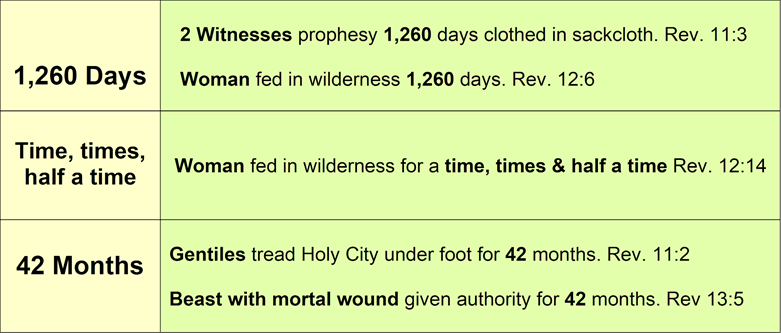
This phrase is used in Revelation (11:2-3, 12:6 and 13:5) to refer to half of the last seven-year period of man’s rule on this earth (the seventieth week of Daniel), the second half, which is called “the great tribulation” in Matthew 24:21. Whereas the first three and one-half years of the Tribulation will be bad, the second three and one-half years will be worse, because this king (Antichrist) will be persecuting believers in God.
Joseph Seiss notes: “”Our Lord ministered on earth three and a half years, and the Antichrist shall enact his Satanic ministry for the same length of time” (Joseph A. Seiss, Voices from Babylon: Or the Records of Daniel the Prophet, p. 311).
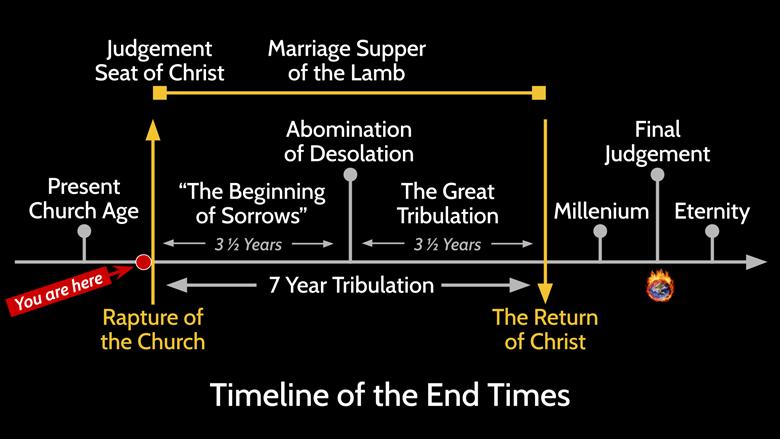
https://nolimits.church/millennium-eternity
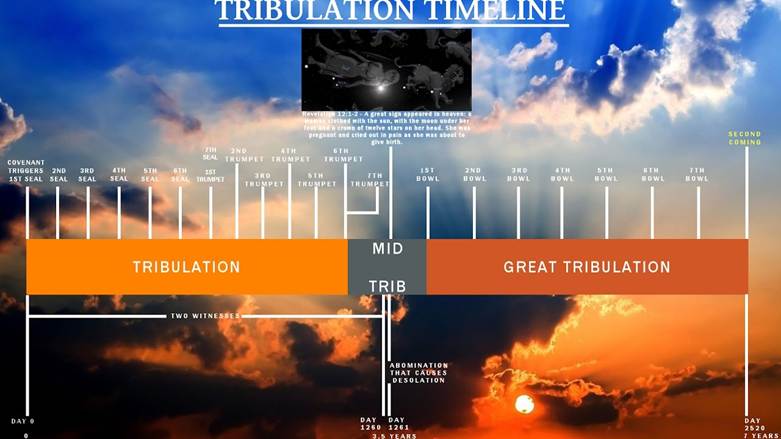
Here is a chart showing the timing of the judgments in the book of Revelation.
Fruchtenbaum understood the fourth kingdom to consist of five stages: (1) the united stage, in which the Roman Empire existed until A.D. 364, (2) the two-division stage, from A.D. 364, when the Roman Emperor Valentinian split the empire into eastern (Byzantine) and western (Roman) parts, which continues to the present day, (3) the one-world-government stage, which is yet to come, (4) the ten-division stage, and (5) the Antichrist stage (Arnold Fruchtenbaum, The Book of Daniel. 2nd ed., pp. 281-84).
“This is the justice that the tribulation martyrs were calling for during the fifth seal judgment. From under the altar, they pleaded with God, who was on His throne, crying out to Him, “They cried out with a loud voice, “O Sovereign Lord, holy and true, how long before you will judge and avenge our blood on those who dwell on the earth?” (Rev. 6:10). The “how long” is answered here in Daniel 7, “time, times and half a time.”
Verse 26 tells us that the Most High brought judgement on the little horn. The angel declared, “The court shall sit in judgment,” referring to the Ancient of Days taking His seat on the fiery throne-chariot (vv. 9-10). After 3 ½ years God will remove Antichrist’s dominion and destroy it forever (v. 11; 2 Thess. 2:8; Rev. 19:20).
This is picked up again in Revelation 20:1-3…
1 Then I saw an angel coming down from heaven, holding in his hand the key to the bottomless pit and a great chain. 2 And he seized the dragon, that ancient serpent, who is the devil and Satan, and bound him for a thousand years, 3 and threw him into the pit, and shut it and sealed it over him, so that he might not deceive the nations any longer, until the thousand years were ended. After that he must be released for a little while.
This is the fifth kingdom, the stone that became a mountain in Nebuchadnezzar’s dream.
The removal of dominion from the little horn and the statement of destruction recall the event of v. 11; God had granted dominion and then had taken it away. The true King of the Earth will then take His place.
The results of this judgment had positive implications for the saints, just as Daniel had seen in v. 22. The angel promised:
27 And the kingdom and the dominion
and the greatness of the kingdoms under the whole heaven
shall be given to the people of the saints of the Most High;
his kingdom shall be an everlasting kingdom,
and all dominions shall serve and obey him.’
The good news is that persecution would not be the last word for the saints! After the judgment of the little horn, they will reign with the Most High (cf. Rev. 20:4, 6).
Notice that this kingdom immediately follows the fourth kingdom (Rome). Because the kingdom of Jesus immediately succeeds this fourth kingdom, no event in the past answers this prediction in the smallest degree. Certainly, the church did not cause a sudden and catastrophic fall of the Roman Empire. “It is questionable whether the Roman Empire had any serious opposition from the Christian church or that the growing power of the church contributed in a major way to its downfall.” (Walvoord)
So Christ’s kingdom comes after the rise of the fourth kingdom, the future fourth kingdom and after the ten horns and the rise of the little horn during the Tribulation period. Verses 13, 14 and 27 speak of this as the inauguration of this kingdom, not its close. All of this shows that this is not referring to something true today, but a kingdom that will be established in the future.
Also, notice that this kingdom is “under the whole heaven.” It is on earth, not in heaven.
The Son of Man’s kingdom will be endless and worldwide. The kingdom is not just the rule of the saints; it is the rule of the Highest One in which the saints participate. Note that the kingdom is described as belonging to the Son of Man (v. 14) and to the Highest One. This implies that they are one.
David Guzik points out: There are three options in interpreting the kingdom’s establishment here:
- There is no fulfillment; Daniel is in error.
- The fulfillment is symbolic [and occurred] in church history.
- The fulfillment is literal, and yet future.
The terms “dominion” and “under the whole heaven” indicate that what the saints will inherit is a fulfillment of the creation mandate in Genesis 1 on earth. There, God had commanded humanity
26 Then God said, “Let us make man in our image, after our likeness. And let them have dominion over the fish of the sea and over the birds of the heavens and over the livestock and over all the earth and over every creeping thing that creeps on the earth.”
The final part of verse 27 shows that even in this situation, the ruling dominion of the sants does not undermine or take the place of the rule of God Most High. According to Revelation 20:6 “will reign with him for a thousand years.” In contrast to the previous beast kingdoms, God’s kingdom would be everlasting, “and all dominions shall serve and obey him.”
Having reached the end of the vision and its interpretation (Daniel 7:2-27), we should observe the seven subjects of the vision and how they were described by the angel in his interpretation. This is presented in the following table.
The Seven Subjects of the Vision of Daniel 7
| The Subject . . . | . . . from the vision | . . . in the interpretation |
| Four Beasts Rise from the Sea | vv. 1-8 | v. 17 |
| Son of Man Receives Kingdom | vv. 9-14 | vv. 18, 27 |
| The Fourth Beast | vv. 7, 19 | v. 23 |
| The Ten Horns | vv. 7, 20 | v. 24 |
| The Little Horn | vv. 8, 20-21 | vv. 24-25 |
| The Court Judgment | vv. 9-12, 22 | v. 26 |
| Everlasting Kingdom for the Saints | vv. 13-14, 22 | v. 27 |
Daniel was not given enough information to know the exact identity of the fourth beast, its ten horns, or the little horn (just like he did not know who would be the Greek or Roman generals and rulers), but later Scripture may shed some light on this question. In Revelation 13 a beast rises out of the sea “with ten horns and seven heads, with ten diadems on its horns and blasphemous names on its heads” (Rev. 13:1). Note the presence of ten horns and the tone of blasphemy associated with this “beast.” John even describes it with animal characteristics: “The beast that I saw was like a leopard; its feet were like a bear’s, and its mouth was like a lion’s mouth” (Rev. 13:2). These animals allude back to Daniel 7:4-6, with John naming the animals in reverse order. John (like Daniel) then gives attention to its mouth: “The beast was given a mouth uttering haughty and blasphemous words, and it was allowed to exercise authority for forty-two months” (Rev. 13:5; cf. Dan. 7:8, 11, 20). Even the period of time—“forty-two months”—matches the “time, times, and half a time” of Daniel 7:25 if a single “time” equals one year, because forty-two months equal three and a half years. During this time the beast “was allowed to make war on the saints and to conquer them” (Rev. 13:7), recalling the terrible opposition inflicted on the saints by the little horn (Dan. 7:21, 25).
So it seems very likely that this “little horn” is none other than the future Antichrist.
But Daniel is alarmed by these thoughts (v. 28)
“Here is the end of the matter. As for me, Daniel, my thoughts greatly alarmed me, and my color changed, but I kept the matter in my heart.”
After recording the angelic interpreter’s words, Daniel wrote, “Here is the end of the matter,” forming an inclusio with the beginning of the chapter (v. 1) and signaling the completion of what he had seen and heard.
In accord with the fearsome nature of the beast and the terror that the saints would have to endure, he admits, “My thoughts greatly alarmed me, and my color changed, but I kept the matter in my heart.” Convinced that God’s revelation to him was the truth and would actually come to pass, Daniel naturally was deeply bothered by it. Not every word of God’s word will bring us comfort, sometimes it will bring us discomfort.
Despite being informed that the saints would be vindicated and God’s kingdom would be established, Daniel still feared, and his alarm was evident in his discoloration. (This response forms an inclusio with the beginning of the interpretation section; cf. v. 15.) Both the vision and its interpretation had left Daniel deeply unsettled, but he continued to ponder what he saw and what the angel said (cf. Luke 2:19).
Culver summarized the evidence for the premillennial understanding of chapter 7 as follows.
“(1) Messiah’s kingdom follows Antichrist’s appearance (here described in personal rather than institutional terms), and destruction. [This] person has not yet appeared. This appears to make post- and a-millennial schemes identifying the Church with the Kingdom unfeasible. (2) The kingdom of Messiah here follows the Gentile kingdoms; it is at no time contemporary with them. It must, therefore, be still future. (3) The kingdom of Christ succeeds a final form of Gentile dominion which has not yet appeared. (4) The Messianic kingdom is external in aspect here, not a kingdom in men’s hearts, as Church-Kingdom theology require. (5) This kingdom is in some sense Israelitish (cf. vv. 7, 22, 25, 27 with 8:24). The ‘saints’ or holy people referred to here are Israel and no other. The Church is not a Jewish kingdom” (Robert Culver, “Daniel” in The Wycliffe Bible Commentary, p. 791).
I do believe, however, based on Revelation 20, that all saints of every age will be able to enjoy the millennial kingdom on earth.
Amir Tsarfati says, “If Daniel had known what was coming next, he likely would have relished the relative tameness of this first vision. Two years later, he would have a second vision that would leave him physically sick for days” (Amir Tsarfati, Discovering Daniel, p. 151).
James Montgomery Boice identifies the practical lessons we can learn from Daniel 7.
1. God rules in history. Nebuchadnezzar believed his kingdom would never be destroyed, but it was, and so was each successive human empire. The bestial empires of history may roar and be frightening for awhile, but God is in control and eventually His kingdom will rule and reign on earth.
2. The kingdom of Jesus Christ will triumph over the kingdoms of this world and will endure forever. This idea was present in Nebuchadnezzar’s vision, the stone which struck and crushed the image and became a mountain. Here in Daniel 7, the “stone” is personified as the “Son of Man.” Remember that Jesus predicted, “For as lightning that comes from the east is visible even in the west, so will be the coming of the Son of Man” (Matt. 24:27).
3. The saints of the Most High will reign with Jesus. This is stated in Daniel 7:27, that the kingdom “shall be given to the people of the saints of the Most High” and confirmed in Revelation 20:4, “They came to life and reigned with Christ for a thousand years” and Revelation 20:6, “and they will reign with him for a thousand years.”
Application
Chapter 7 reminds us that the victory of the saints is inseparably tied to the victory of the Son of Man. The responsibility of the people of God is not to achieve victory but to live in light of Christ’s victory. The saints conquer the Accuser “by the blood of the Lamb and by the word of their testimony, for they loved not their lives even unto death” (Rev. 12:11). The call to the saints is one of endurance (cf. Rev. 13:10). Their faithful testimony may lead to their martyrdom, and thus it may appear that they have been conquered, but a feature of apocalyptic literature is the unmasking of worldly and heavenly realities. The dragon may rage against God’s people, but when the veil is pulled back, his raging cannot reverse the victory Christ has secured through his death and resurrection.

