M’Cheyne Bible Reading Plan, March 11

Today’s readings are from Exodus 22, John 1, Job 40 and 2 Corinthians 10.

Exodus 22 is filled with case laws, laws of restitution in vv. 1-15 and social or religious laws vv. 16-31.  Throughout this chapter, God is taking laws which were already enacted in the ancient Middle East (for example, the Code of Hammurabi), and making them more humane.  Justice would be served, but mercy is present also.

John’s gospel is different from the other three (synoptic gospels).  It begins not with the birth of Christ, but His pre-existence.

Each of the Gospels emphasizes a different origin of Jesus.

  • Matthew shows Jesus came from Abraham through David, and demonstrates that He is the Messiah promised in the Old Testament (Matthew 1:1).
  • Mark shows Jesus came from Nazareth, demonstrating that Jesus is a Servant (Mark 1:1).
  • Luke shows Jesus came from Adam, demonstrating that Jesus is the Perfect Man Luke 3:23-38).
  • John shows Jesus came from heaven, demonstrating that Jesus is God.

Even though John was written last (in the early 90’s A.D.), it does not “complete” the gospels, for John recognized that the story of Jesus was so big that it can never be completed (John 21:25).

John 1 begins with a prologue in vv. 1-18, which stretches back before time to speak of the Word.  This is related to the Hebrew concept of “wisdom” and the Greek word logos spoke of the organizing principle of the universe.  John shows that the real logos has always existed with God and was with God (by His side) and was/is God.

Some point out the lack of the Greek article with God (theos) in verse 1, translating it, “and the Word was a god,” making him less than God, a created god.  However, any predicate noun that has no article is not indefinite unless the context dictates.  In fact, John could not have used the article with theos because to do so would have made in a controvertible statement (meaning you could say it back and forth) and John certainly did not mean “God was the Word” as if minimizing God to the second person of the Godhead.  This God created everything (v. 3) and John says, “I mean EVERYTHING” so that He could not have been one of the created things.

Another common theme in John is light and darkness.  In Christ was light and the darkness could not overcome/comprehend it–both are true.  John the Baptist was a witness to that light (vv. 6-8).

The meaning of verse 9 is that the true Light comes into the world and enlightens everyone.  Everyone lives under the spotlight of God’s illuminating revelation in Jesus Christ since the Incarnation (cf. 1 John 1).  His light clarifies the sinfulness and spiritual need of human beings.  Those who respond to this convicting revelation positively experience salvation.  Those who reject it and turn from the light will end up in outer darkness.

Although the Jews (on the whole) rejected Jesus, anyone who receives him will have eternal life as God’s children (vv. 10-12).  This new relationship does not come about through physical descent (just because you are a Jew racially), nor of human desire, but of God and His will.

Vv. 14-18 speak of Jesus’ incarnation, that the eternal Word “became flesh.”  Notice the contrast with verse 1.  Jesus always “was” God, but at a point in time in space-time history “became” a man–He put on flesh, a human nature.

Jesus’ relationship to the Father is unique.  He is Jesus’ Son par excellence.  He is the “only begotten”–which is actually a poor translation.  The Greek verb gennao means “to give birth.”  But the word in John 1:14, 18 is monogenous with one nu (n), not two.  So this word comes not from gennao, but from genes (which means “race,” or “kind”).  So a better translation is “one of a kind.” (the NIV has “one and only”).

Jesus is “full of grace and truth.”  It is hard to be “full of grace and truth.”  Most of us, by temperament, are either gracious or truthful.  Some people (like me) are sometimes too gracious (read lenient, permissive), with others are too truthful (read brutal, cruel).  But Jesus always had the perfect balance–and fullness–of both.

Verses 19-29 presents the testimony of John the Baptist as a witness to the light (1:6-8).  While baptizing in the Jordan, John was questioning as to whether He was the Coming One.

The Jordan near Bethany Beyond-the Jordan (to be distinguished from the Bethany near the Mount of Olives).  It was in this area that John was baptizing.

John admits that he is not the Messiah, but the Messiah is coming and when he saw Jesus he said, “Behold, the Lamb of God, who takes away the sin of the world!” and indicates that this is the one of whom he was speaking.

At the very dawn of his ministry, Jesus is greeted with words that remind him of his destiny: His sacrificial agony on the cross for the sin of mankind.  The shadow of the cross was cast over the entire ministry of Jesus.

John realized that he was lower than Jesus, his younger cousin, in calling.  He felt unworthy to untie his shoes.  David Guzik explains…

Among Rabbis and their disciples, there was a teacher-student relationship that had the potential for abuse.  It was entirely possible that a Rabbi might expect unreasonable service from their disciples.  One of the things which was considered “too low” for a Rabbi to expect from his disciples was the untying of the Rabbi’s sandal strap.  John says he is unworthy to do even this.

The chapter ends (vv. 35-51) with Jesus interacting for the first time with some of his potential disciples, several of whom had been John’s disciples.

Andrew came to Jesus because of John’s proclamation about the Lamb of God.  Then Peter came to Jesus because of his brother’s witness.  “Come and see” is the simplest invitation we can give.

In the next verses, Philip will come to Jesus as a result of a direct invitation from Christ, and Nathanael will come to Jesus when Jesus showed himself so great in relation to Nathanael’s small question.  Our Lord will meet us wherever we are and draw us to himself with gentleness and graciousness.  May we be eager to follow Jesus!

Even today, one of the best ways to help someone believe is simply to bring them to Jesus.  Word-of-mouth advertising is always the best.

Thomas Constable notes:

At least 16 different names and titles of Jesus appear in chapter one: the Word (vv. 1, 14), the Light (vv. 7-9), the Only Begotten of the Father (v. 14), Jesus Christ (v. 17), the Only Begotten God (v. 18), the Lord (v. 23), the Lamb of God (vv. 29, 36), a Man (v. 30), the Son of God (v. 34), Rabbi (Teacher, vv. 38, 49), Messiah (v. 41), Jesus of Nazareth (v. 45), the son of Joseph (v. 45), the Son of God (v. 49), the King of Israel (v. 49), and the Son of Man (v. 51). Clearly one of John’s purposes in this Gospel was to draw attention to who Jesus is.

Job 40

Job’s first response to God is that he was dumbfounded.  Earlier he had wanted to challenge God in court; now he has nothing to say.

So God speaks again (40:6-41:34).

After Job’s first response, God narrows his focus down to Job’s acute problem.  The verse Job 40:8 seems to be the closest we get to understanding what actual sin Job might have committed: “Will you condemn Me that you may be justified?” God asks.  How easily righteousness can slip over into self-righteousness and accusing God.

This second divine discourse is similar to, yet different from, the first.  It began as the first one did with a challenge to Job (40:6-14; cf. 38:1-3), but it did not end with one (cf. 40:1-2).  In the first speech Yahweh spoke of His inanimate creation and of His animate creation, specifically 10 animals.  In the second speech He concentrated on only two creatures: Behemoth (“great beast”) and Leviathan (“sea monster”).

God does not want to crush Job, but to instruct him.  He challenges Job to refute him (40:6-14) and then asks Job questions (40:15-41:34).

In 2 Corinthians 10 Paul begins defending his apostleship (chaps 10-12).  He pleads with them and hopes that the Corinthians will change their attitude towards him and his apostolic authority so that he can come to them in gentleness, not severity (vv. 1-2).

Unlike his opponents, the “super-apostles” who were trying to win the Corinthians’ loyalty, Paul did not minister in the flesh, but with divine weapons.  They are the only ones who can tear down Satanic strongholds.

3 For though we walk in the flesh, we are not waging war according to the flesh. 4 For the weapons of our warfare are not of the flesh but have divine power to destroy strongholds. 5 We destroy arguments and every lofty opinion raised against the knowledge of God, and take every thought captive to obey Christ, 6 being ready to punish every disobedience, when your obedience is complete.

Redpath writes of a practical way to battle with spiritual weapons and break down a stronghold: “When the thought comes and the person is reported to have said what he has said, and the unkindness has been passed over to us, and the criticism has been made, whereas carnality would say, ‘Counterattack!’ spirituality recognizes that nothing that any person could ever say about any one is really one hundredth part as bad as the truth if he only knew it.  Therefore, we have no reason to counterattack, but one good reason to submit and to forget.”

“Taking every thought captive” means that we don’t have to surrender to our thoughts and the voices in our head.  We take them captive by first preaching to ourselves the gospel and then asking our commander for marching orders.

Paul speaks of his authority as an apostle in vv. 8-11, how a ministry should be measured in vv. 9-16, and ends with the vital importance of the Lord’s commendation upon a minister’s ministry (vv. 17-18).

Let me close with a quote from Eugene Peterson.  I am currently reading Working the Angles, and this quote is similar but not from that book:

As it turns out, the people I serve would often prefer an idol who would do what they want done rather than do what God, revealed in Jesus, wants them to do.  In our present culture, the sharp distinction between a job and a vocation is considerably blurred.  How do I, as a pastor, prevent myself from thinking of my work as a job that I get paid for, a job that is assigned to me by my denomination, a job that I am expected to do to the satisfaction of my congregation?  How do I stay attentive to and listening to the call that got me started in this way of life – not a call to make the church attractive and useful in the American scene, not a call to help people feel good about themselves and have a good life, not a call to use my considerable gifts and fulfill myself, but a call like Abraham’s ‘to set out for a place…not knowing where he was going’, a call to deny myself and take up my cross and follow Jesus, a call like Jonah’s to go at once to Nineveh, ‘a city he detested’, a call like Paul’s to ‘get up and enter the city and you will be told what to do’?

Gracious Cleansing of Israel’s Infidelity, part 4 (Hosea 2:21-23)

Did you know that this past Wednesday was National Proposal Day?  If you’re sitting, just waiting for something to happen, it is a day to stand up and go out and propose to your girl.

Like I said last week, the wedding bells are ringing.  God will reconcile with Israel, taking the initiative to, effectively, say “I do” to Israel, expecting the reciprocal response of an “I do” in return.

Let’s read this whole passage of God’s gracious cleansing of Israel’s infidelity and we will focus this morning on vv. 21-23…

14 “Therefore, behold, I will allure her, and bring her into the wilderness, and speak tenderly to her. 15 And there I will give her her vineyards and make the Valley of Achor a door of hope. And there she shall answer as in the days of her youth, as at the time when she came out of the land of Egypt.  16 “And in that day, declares the LORD, you will call me ‘My Husband,’ and no longer will you call me ‘My Baal.’  17 For I will remove the names of the Baals from her mouth, and they shall be remembered by name no more.  18 And I will make for them a covenant on that day with the beasts of the field, the birds of the heavens, and the creeping things of the ground. And I will abolish the bow, the sword, and war from the land, and I will make you lie down in safety.  19 And I will betroth you to me forever. I will betroth you to me in righteousness and in justice, in steadfast love and in mercy.  20 I will betroth you to me in faithfulness. And you shall know the LORD. 21 “And in that day I will answer, declares the LORD, I will answer the heavens, and they shall answer the earth,  22 and the earth shall answer the grain, the wine, and the oil, and they shall answer Jezreel,  23 and I will sow her for myself in the land. And I will have mercy on No Mercy, and I will say to Not My People, ‘You are my people’; and he shall say, ‘You are my God.'”

Verses 16-25 sum up God’s resolution with courtship, betrothal, covenant-making, exchange of vows and giving of new names.

So here at the end of this wonderful reconciling work of God with Israel, which will take place “in that day” (vv. 16, 21), which is yet a future day, Yahweh and Israel will be reunited as husband and wife forever.  This is God’s promise to Israel.

And they all lived happily ever after.  Well, they will, in the future.  Again, vv. 21-23 say…

21 “And in that day I will answer, declares the LORD, I will answer the heavens, and they shall answer the earth,  22 and the earth shall answer the grain, the wine, and the oil, and they shall answer Jezreel,  23 and I will sow her for myself in the land. And I will have mercy on No Mercy, and I will say to Not My People, ‘You are my people’; and he shall say, ‘You are my God.'”

Notice that like v. 16, verse 21 begins with the words “in that day.”

The phrase “in that day” recalls the prophetic theme of the “day of the Lord,” an especially common theme in the Minor Prophets. Each prophet views it from a slightly different angle.  To Joel, the “day of the Lord” is a terrible day, akin to a locust plague, a day of darkness and judgment, yet whoever calls on Yahweh will be saved (Joel 2:30–32).  To Amos, it is a day that Israelites (Hosea’s contemporaries) should dread, not desire (Amos 5:18–20), as it will involve terrible climactic judgment.  Similarly, Malachi asks, “Who can endure the day of his coming?” (Mal. 3:2), implying that it is a day to be dreaded. Zephaniah foresees a day so severe that nothing will survive (Zeph. 1:2–18).

In this chapter of Hosea, however, the focus is on positive aspects of that day.  We read of a future time of wedded bliss between Israel and the Lord.  A renewed marriage contract is envisioned that will last forever.

If vv. 16-20 picture the betrothal of Israel to Yahweh, vv. 21-23 depict the consummation, in which Israel becomes Yahweh’s.

Notice here at the end of chapter 2 that all the judgments against the children of Gomer in chapter 1, will be reversed.  Jezreel, instead of being scattered (as in exile), will be sown (v. 23) in the land to remain there.  God will show mercy on Lo Ruhammah, little “No Mercy” and will call those who were no longer God’s people “My people” and they will respond “You are my God.”

In short, the judgments symbolized in the names of Hosea’s three children (vv. 22–23) are outstripped by the restored glories the Lord will give. Truly this is a God “merciful and gracious, slow to anger, and abounding in steadfast love and faithfulness” (Ex. 34:6).

David Murray calls these tear-drying, heart-rejoicing, dream fulfilling words of hope.  They echo the words of the Song of Songs, “I am my beloved’s and he is mine.”  Something of the fullness of Israel’s experience may be reflected in the grand Christian hymn by Wade Robinson, “In a love, which cannot cease, I am His and He is mine.”

But let’s go back to verse 21.  What is all this “answering” that’s going on in vv. 21-22?

God will answer the cries of heaven, and it will rain again.  The rain will answer the need of the land, and it will be productive again.  The earth will answer the need of grain and oil, and they will flourish again.

Creation, though majestic and powerful, always obeys the will of its Master.  Derek Kidner notes that “the world is a single, close-knit composition, intelligible in principle.  And it does not make the blunder of exalting that system by denying its fount and origin.  So we are not left with a mechanistic world on the one hand, nor with a God who keeps us guessing on the other, but with a world we can explore and a God we can trust and serve responsibly within it.”

This chain of giving from heaven to earth encourages Israel to trace the links all the way back to God.  The success of every request to supply need encourages Israel to bring her own requests to God.

For too long Israel’s great sin was the worship of Baal, the heathen god of fertility.  They prayed to him for fruitful fields and also attributed the results to this idol.  For too long, God would say, “I don’t hear you.”  Israel failed to bring their requests and their thanks to Him.  He did not hear them.  As He waited over Israel, listening—nothing.  Nothing but deafening silence. For this, Israel was to be judged.

But “in that day” God would hear.  In that day she would forget about Baal and know Yahweh.  And in that day God will respond with all the blessings He had promised to Abraham.

The mention of “heavens” and “earth” show that ultimately this is not merely a national restoration, but the whole universe will be restored (Rev. 21:1).

In speaking to the earth, Israel’s former difficulties will be reversed: grain, wine, and oil, which had once been taken away (vv. 5, 8-9) will be replenished.  When our relationship with God is where it is supposed to be, God abundantly supplies and pours out blessings upon us.

Has God been hovering over your life and hearing nothing?  He is listening but saying, “I don’t hear.”  “I don’t hear prayer for daily bread.  I don’t hear thanks.”  You are attributing your blessings to your own strength, to luck, or to sheer coincidence.  You are patting yourself on your back rather than praising God with your lips.  The golden chain of prayer, providence, and praise has broken down.

But God is saying, “I will hear.” He is coming to break your Baal.  When it lies shattered before you, you begin to look heavenward, prayer is stuttered and stammered heavenward, and heaven replies, “Now I hear. And you will be heard.”

Notice once again the “I will” statements of verse 23.

23 and I will sow her for myself in the land. And I will have mercy on No Mercy, and I will say to Not My People, ‘You are my people’; and he shall say, ‘You are my God.'”

Restoration is not based upon Israel’s efforts, but God’s determined actions.

“Jezreel” (“God Plants” or “God Sows”) here personifies the nation of Israel as a whole, though its area was also the traditional “breadbasket” of the Northern Kingdom.  Israel in the past had cried to Baal, the Canaanite god of rain and fertility, but he had not helped.

Biblical Assyria was at its peak during the time of Jonah, just before the fall of Israel in 722BC (see Jonah 1:1).  In 733 BC, Tiglath-Pileser III of Assyria invaded Israel and captured Galilee (see 2 Kings 15:29).  Two years later, he captured Damascus and killed King Rezin of Syria.  In 724BC, King Shalmaneser V of Assyria laid seige to Samaria, and Israel fell to the Assyrians two years later (see 2 Kings 17:5-6).  They were assimilated into far-flung corners of the Assyrian Empire, literally “scattered abroad.”

But in that day, having returned to the Lord by responding to His wooing, the Israelites would then appeal to Him as the true God of fertility, and He would respond by sending rain.  And they would again by sown into the land.

“I will not have mercy” are the most terrifying words a sinner can hear from the mouth of the Lord.  These words will destroy the souls of the unrepentant sinner on the Day of Judgment.  These words will echo round the chambers of hell forever: “I will not have mercy.  And who can argue with them?

Those who spend their earthly days saying, “I don’t want mercy,” can hardly complain when at the end of their days God grants them their request eternally, “You didn’t want mercy, and so you will not have mercy.” These words dash every dream and quash every hope, “I will not have mercy.” Oh, mercy-spurning sinner, will this be your death-sentence?

But here is hope, despairing soul.  Israel was just like you; she refused mercy time and time again.  She was judged by the removal of mercy in foreign exile (Hos. 1:6).  But God will look down in pity on her merciless condition and say, “I will have mercy upon her that had not obtained mercy.”  What a turning point!  What tear-drying, heart-rejoicing, dream-fulfilling words of hope!

Go to the Lord and say, “I have not obtained mercy because I did not need nor want mercy.  But now I desperately need it and earnestly want it.  I abandon all my imagined merit.  Oh Lord, be merciful to me, the sinner.”

And wait, what do you hear?   Can it be, “I will have mercy upon her that had not obtained mercy”?

And dear Christian of many years, recall what turned your life around.  It wasn’t your merit or will; it was God’s mercy and God’s will.  It was when He said—oh, blessed moment—“I will have mercy upon her that had not obtained mercy.”

Matthew Henry comments: “God’s mercy must not be despaired of anywhere on this side hell.”

In the book of Romans Paul struggles with how it can be that his beloved people have largely abandoned the salvation provided for them, while the barbarians and profane peoples who cared nothing for God—and were his enemies in times past by plundering and devastating the people of the covenant—are now taking Jesus as their own and enjoying a salvation never imagined or envisioned.  Paul’s was an upside-down world, where those destined for glory found judgment, while those destined for judgment found glory.

Paul explains this by citing the book of Hosea, in which those who were not God’s people now are, while those who were his people no longer are:

What if God, desiring to show his wrath and to make known his power, has endured with much patience vessels of wrath prepared for destruction, in order to make known the riches of his glory for vessels of mercy, which he has prepared beforehand for glory—even us whom he has called, not from the Jews only but also from the Gentiles? As indeed he says in Hosea,

“ Those who were not my people I will call ‘my people,’

and her who was not beloved I will call ‘beloved.’”

“ And in the very place where it was said to them, ‘You are not my people,’

there they will be called ‘sons of the living God.’” (Rom. 9:22–26)

As Paul goes on to say, the Gentiles experience such things because they have faith in Jesus (Rom. 9:30–33).  It is only through him that we can know the Lord, enter into relationship with him, and boldly proclaim, “You are my God!”

So we can see that God is not merely addressing ancient Israel here, but also us.  These things constitute “the grace” as 1 Peter 1:10 puts it “that was to be yours.”

God offers to you and me a deep, interpersonal relationship that is mirrored in the deepest, most intimate relationship we know in this life—that of husband and wife.  God has declared Himself, reconciling Himself to us through Jesus Christ.  2 Corinthians 5:18-20 says…

18 All this is from God, who through Christ reconciled us to himself and gave us the ministry of reconciliation; 19 that is, in Christ God was reconciling the world to himself, not counting their trespasses against them, and entrusting to us the message of reconciliation. 20 Therefore, we are ambassadors for Christ, God making his appeal through us. We implore you on behalf of Christ, be reconciled to God.

In the beginning, Adam and Eve and God had perfect, genuine fellowship.  But Adam and Eve rebelled against God, turning their backs on Him.  In response, God, whose eyes are too pure to behold sin, turned away from us.

Isaiah 59:2 says

2 but your iniquities have made a separation between you and your God, and your sins have hidden his face from you so that he does not hear.

But God took the first step, sending His Son Jesus Christ to become the satisfaction for our sins.  He died in our place so that God could look upon us in love.  But just because Jesus died on the cross doesn’t mean we are forgiven unless we turn back to God, repenting of our sins (asking His forgiveness) and believing that Jesus’ death on the cross was both necessary and sufficient for me.

That is why Paul, and Hosea, are urging, “Be reconciled to God.”

Our culture of identity politics and intersectionality emphasizes all the differences between people.  But in God’s eyes, there is only one primary difference: “My people” and “Not my people.”  That’s it, just two categories, two simple, but vital, differences.

Here, Yahweh will woo Israel, declare Himself her husband, and she will respond, “You are my God!”  What a bold declaration, like a wedding vow, “I take you to be my husband.”

How about you?  Do you say this? If He owns you as His, will you be ashamed or hesitant to own Him as yours?

He says to them, “Thou art my people, whom I will own and bless, protect and provide for;’’ and they shall say, “Thou art my God, whom I will serve and worship, and to whose honour I will be entirely and for ever devoted.’’ (Matthew Henry)

“Not mercied” name reversed without any response; but “not my people’s” name-change calls for an answer.  Israel will boldly and gladly embrace “You are my God”; what about you?

To affirm that Yahweh was their God is to confess that He is their Savior, to submit to Him as their only King, to worship Him as the One Who alone is worship, and to awaken the truth that they had once rejected.

So the latter part of this chapter proclaims the mind-blowing truth that the overwhelming desire of Yahweh is not to destroy those who reject or turn from Him, but for their redemption and restoration.  Yahweh had embarked upon an endless quest to win Israel to Himself, just as Jesus came to seek and save the lost.

That was good news in Jesus’ day; it is good news for us today.

M’Cheyne Bible Reading Plan, March 10

Today’s readings are from Exodus 21, Luke 24, Job 39 and 2 Corinthians 9.

Thomas Constables notes that there were a number of different law codes already in existence before Exodus 20ff.  He says…

The Mosaic Covenant presupposes this cumulative body of legal literature.  So it was not given as a comprehensive legal system to a people living without any laws.  Rather, it was a series of instructions God gave—as Israel’s King—for His people to govern their behavior in certain specific matters.  This fact explains why the Torah (lit. “Instruction,” i.e., the Law of Moses) does not contain fundamental instruction in many basic areas of law, such as monogamy.  The instructions in the Law of Moses confirmed certain existing laws, cancelled other laws, and changed still others, for the Israelites, as the will of God for them.

First, Moses is given some laws clarifying slavery.  First, a general law concerning Hebrew (kinsmen) slaves is given in 21:2-4, commanding freedom in the 7th year.  Then, in 21:5-6 Moses discusses the case of someone who wants to remain a slave, a bond slave, for life.  Finally, vv. 7-11 discuss the rights of female slaves.  Actually, these rights were pretty amazing when every other culture didn’t even give free women all these rights.

I’m reading a book right now called The Civil War as a Theological Crisis by Mark Noll.  He argues that prior to and during the Civil War, both sides used the Bible to either justify slavery or abolish slavery.  This unfortunately caused a public loss of confidence in the Bible to answer basic questions and rendered religion ineffective for shaping broad policy in the public arena.  It truly was a watershed moment that led to the secularizing of American philosophical and political thought.

The fact is, slavery was a given in the ancient world (even until the New Testament).  Although God never dismantles it, He does regulate it so that it preserves the dignity of those who became slaves.  And, the slavery of the Bible was not racially motivated.

Luke 24, Christ is Risen!

The women come to the tomb, see the stone removed, and angels tell them that Jesus was alive–He had risen from the dead just as He had said (9:22, 43-45; 18:31-33).  Upon this news Peter ran to the tomb (v. 12)

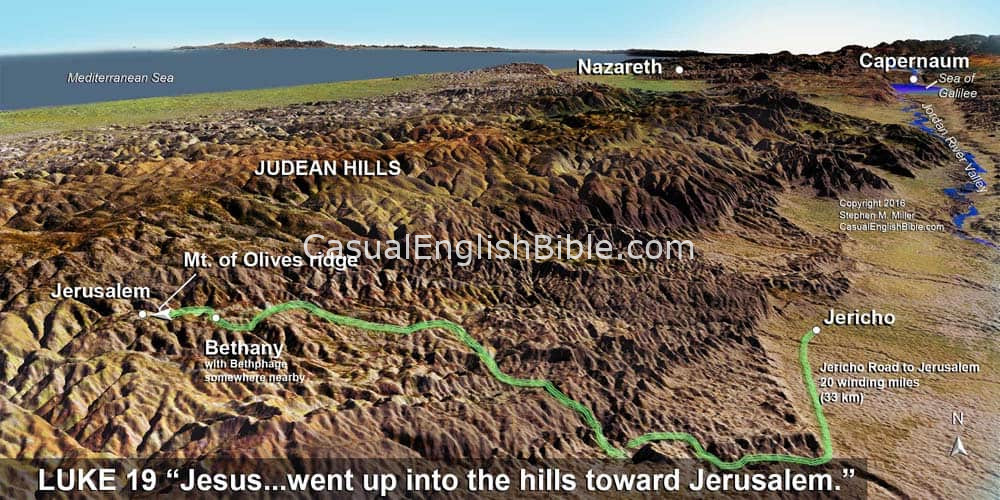
Two unnamed disciples were on the road to Emmaus (24:13-35).  We don’t know if they were going home or going to witness to others, or what.  David Bivens has an excellent article at Jerusalem Perspective.  He believes that they were on the way to Qaloniyeh.

Aerial photograph of Jerusalem’s environs from Gustaf Dalman’s Hundert deutsche Fliegerbilder aus Palästina (Gütersloh: Bertelsmann, 1925). Superimposed on the photograph is the approximate route of the Emmaus-Jerusalem road marked in red. Part of the route is hidden from view as the road descends into the valley as it approaches Qalunya.

Aerial photograph of Jerusalem’s environs from Gustaf Dalman’s Hundert deutsche Fliegerbilder aus Palästina (Gütersloh: Bertelsmann, 1925). Superimposed on the photograph is the approximate route of the Emmaus-Jerusalem road marked in red. Part of the route is hidden from view as the road descends into the valley as it approaches Qalunya.

These two men were discussing what had happened in Jerusalem, likely in disappointment, when Jesus appears.  Jesus wanted them to tell Him what they knew.  They expressed that Jesus had died and was supposed to have risen from the dead that day, but seemingly did not.  Jesus rebukes them for being “slow to believe” and proceded to teach them a unique short course in Old Testament Christology.

When Jesus broke bread with them, then their eyes were opened and they realized they had been with the risen Jesus!  They reflect how their hearts had been “warmed” while Jesus was speaking to them.  So they left back to Jerusalem to tell others.

Jesus then appears to His disciples in Jerusalem (24:36-49).  This made it crystal clear to them that Jesus had risen from the dead.  Jesus again gave His disciples a short course on OT Christology:

44 Then he said to them, “These are my words that I spoke to you while I was still with you, that everything written about me in the Law of Moses and the Prophets and the Psalms must be fulfilled.” 45 Then he opened their minds to understand the Scriptures, 46 and said to them, “Thus it is written, that the Christ should suffer and on the third day rise from the dead, 47 and that repentance and forgiveness of sins should be proclaimed in his name to all nations, beginning from Jerusalem.

And He instructed them to go out as witnesses and promised them the empowerment of the Holy Spirit (24:48-49; Acts 1:8).

In Job 39 God continues to rebuke Job for challenging Him when he understood so little.  God had turned to the animal world at the end of chapter 38 and continues it here.  God points out six mammals and four birds—only one of which was evidently a domesticated creature in Job’s day: the horse (38:39—39:30). T hey include “the ferocious, the helpless, the shy, the strong, the bizarre, the wild.”  They illustrate God’s creative genius and His providential care.  The animal world exists for partially unknown reasons, not merely to meet the needs of humankind. People cannot explain why animals live as they do.  This is another mystery that only God understands fully.

ANIMALS REFERENCES QUESTIONS
Lion and raven 38:39-41 How do they get food?
Goat and deer 39:1-4 How do they bear young?
Donkey and ox 39:5-12 How are they tamed?
Ostrich and horse 39:13-25 Why do they act strangely?
Hawk and vulture 39:26-30 How do they fly?

John Piper, in his book The Pleasures of God, indicates that God takes pleasure in his creation, based on Psalm 104:31.  When He created it, he rejoiced every day in the “good” quality of His creative work.  He takes pleasure in His creation because it reflect His glory (Psalm 19:1-6), wisdom (Psalm 104:24), power (Isaiah 40:26).

I love what G. K. Chesterton once said:

“Because children have abounding vitality, because they are in spirit fierce and free, therefore they want things repeated and unchanged.  They always say, “Do it again”; and the grown-up person does it again until he is nearly dead.  For grown-up people are not strong enough to exult in monotony.  But perhaps God is strong enough to exult in monotony.  It is possible that God says every morning, “Do it again” to the sun; and every evening, “Do it again” to the moon.  It may not be automatic necessity that makes all daisies alike; it may be that God makes every daisy separately, but has never got tired of making them.  It may be that He has the eternal appetite of infancy; for we have sinned and grown old, and our Father is younger than we.”

God’s point in asking Job to consider each of these animals was this. Even upon careful examination, there are many things about their individual characteristics, behavior, purpose, and life that people simply cannot explain.  It is quite possible that we haven’t even discovered all the varieties of animals and plants and rocks that God has created.

God rarely used legal metaphors in His speeches to Job, which Job had so often utilized.  From now on, Job stopped using them.  This is an important observation because it shows that the basis of Job and God’s relationship was not a legal one, as Job had assumed.  A legal relationship requires just compensation by both parties for what each of them has done to the other.  The basis of God’s dealings with Job was gracious, not legal (cf. 1 Cor. 6:7).

2 Corinthians 9 continues Paul’s discussion of giving.  John Piper has another video explaining 2 Cor. 6-11.Money Talks

The amazing thing is that God gives on the front and and the back end–we can’t lose when we give!

7 Each one must give as he has decided in his heart, not reluctantly or under compulsion, for God loves a cheerful giver.

  • Give as God leads your heart to give.
  • Give without hesitation.
  • Give because you want to.
  • Give to please God.

Dividends from God…

  • It grows our righteousness (9:8-10)
  • It meets the need of the saints (9:12)
  • It results in thanksgiving to God (9:11-15)

M’Cheyne Bible Reading Plan, March 9

Today’s readings are from Exodus 20; Luke 23; Job 38 and 2 Corinthians 8.

Exodus 20:1-17 is the first giving of the Ten Commandments (cf. Deut. 5).  These ten “words” can be divided either four and six, the first four dealing with our vertical relationship with God (“love the Lord your God with all your heart…soul…mind”) and the last six dealing with our horizontal relationships with mankind (“love your neighbor as yourself”).  However, some divide it five and five.

Notice that the commandments are prefaced by Exodus 19 (“I carried you on eagle’s wings) and Exodus 20:1-2, which tells Israel who God is and what He has done for them.  We always have to be careful to keep the indicative before the imperative in Scripture.  This is why Paul’s epistles generally have several doctrinal chapters explaining to his readers what God has done for them before he ever gets to the commands detailing what we must do for God.  We are not saved by works, by keeping the commandments.  We are saved through the work of Jesus Christ on the cross, and now we obey out of glad and grateful hearts.

While we are no longer “under the law” (Romans 6:14) as believers, these commands are helpful for us as a way to flesh out what it means to love God and love our neighbor.

When God says, “You shall have no other gods before me,” on the positive side He is saying, “You have me!”

When God tells Israel not to make or worship images, on the positive side He is saying, you know all about me from the Word.

Of course, some commands, like “do not murder” and “do not commit adultery” are fleshed out more deeply in the Sermon on the Mount, so that murder and lust also violate these commandments.

Truly, we cannot keep the commandments, and thus the law condemns us and our only recourse is to run to the cross.

Jesus fulfilled the law for us, so we could obey it in Him: That the righteous requirement of the law might be fulfilled in us who do not walk according to the flesh but according to the Spirit. (Romans 8:4)

“The great message of the Christian faith is, therefore, that we are free from the Law’s condemnation in order that we may be able to fulfill its obligation by the power of [Jesus] within us.” (Alan Redpath)

The response of Israel to the ten commandments was somewhat sad:

18 Now when all the people saw the thunder and the flashes of lightning and the sound of the trumpet and the mountain smoking, the people were afraid and trembled, and they stood far off 19 and said to Moses, “You speak to us, and we will listen; but do not let God speak to us, lest we die.” 20 Moses said to the people, “Do not fear, for God has come to test you, that the fear of him may be before you, that you may not sin.” 21 The people stood far off, while Moses drew near to the thick darkness where God was.

Out of fear, the people gave up their own opportunity to enter God’s presence personally, and asked Moses to be their proxy, their go-between.  It is similar to people today depending only upon paid professionals to read and explain God’s Word to them.  They miss out on the joys of hearing God’s voice personally.

We already have a Mediator, Jesus Christ (1 Tim. 2:4), who takes care of all our condemnation so that we can enjoy a personal, face-to-face, heart-to-heart relationship with God through Jesus.

Hebrews 4:16 Let us then with confidence draw near to the throne of grace, that we may receive mercy and find grace to help in time of need.

Hebrews 10:22 let us draw near with a true heart in full assurance of faith, with our hearts sprinkled clean from an evil conscience and our bodies washed with pure water.

Tom Constable explains how the final verses of chapter 20 introduce the regulations to come.

This pericope serves as an introduction to 42 judgments in 21:1—23:12. A similar section to this introduction, following the 42 judgments section, repeats the emphases of the introduction and forms a conclusion to the judgments (23:13-19).

Prohibition of idolatry
(20:22-23)
Proper forms of worship
(20:24-26)
42 judgments
(21:1—23:12)
Prohibition of idolatry
(23:13)
Proper forms of worship
(23:14-19)

This chapter ends with regulations for making and serving at an altar.

Yahweh permitted His people to build commemorative worship altars at the locations where He granted special theophanies, that is, manifestations of His presence.  These were in addition to the altars at Israel’s central sanctuary (the tabernacle and later the temple; cf. Judg. 6:25-27; 13:15-20; 1 Sam. 9:11-14; 16:1-5; 1 Kings 18:30-40).  They were to build these special altars, both for formal worship and for special occasions (e.g., Josh. 8:30; Judg. 6:25-26), out of earth or uncut stone.

Luke 23 begins with Jesus’ trial before Pilate and Herod (23:1-25).  He bounces back and forth between Pilate (23:1-7 and  13-25) and Herod (23:8-12).  Both the leaders and the people are responsible for Jesus’ crucifixion.

The light green line shows Jesus being taken from the house of Caiaphas to Pilate (at David’s Citadel).  Ferrell Jenkin’s blog has a picture of some steps Jesus might have taken.

This is a picture from Bible Walks (Todd Bolen), showing the Armenian Church.  Underneath this church is possibly where Jesus stood before Caiaphas.

Image result for herod's palace jerusalem

A model of Herod’s Palace

The white line represents Jesus being taken from Pilate to Herod (Hasmonean Palace).

The yellow line is Jesus going back to Pilate.

The green line is the pathway from Pilate’s condemnation to the cross.

(All the above maps are from gospeldevotions.wordpress.com, Luke 23)

Luke’s account of the crucifixion (23:26-49) includes a prophecy of the fate of Jerusalem (vv. 29-31), more emphasis on the men who experienced crucifixion with Jesus (vv. 39-43), and less reporting on the crowd that mocked Jesus. It climaxes with Jesus’ final prayer of trust in His Father (v. 46), and the reactions of various people to His death (vv. 47-49).

Where was Jesus crucified?  All four gospels mention a place…

Matthew 27:33 …they came to a place called Golgotha, which means Place of a Skull…

Mark 15:22 Then they brought Jesus to the place called Golgotha, which means the place of a skull.

Luke 23:32 When they came to the place that is called The Skull, they crucified Jesus there with the criminals, one on his right and one on his left.

John 19:17 So they took Jesus, and carrying the cross by himself he went out to what is called The Place of the Skull, which in Hebrew (Aramaic) is called Golgotha. 18 There they crucified him with two others, one on either side, with Jesus between them.

There is a place west of Jerusalem that could be the place, although scholars disagree.

David Guzik reminds us…

During the 12 hours between 9 p.m. Thursday and 9 a.m. Friday, Jesus suffered many things, both physically and in the high-stress challenges that took a toll on Him physically.

i. Jesus suffered great emotional stress in the Garden of Gethsemane, as indicated when His sweat became like great drops of blood (Luke22:44). “Although this is a very rare phenomenon, bloody sweat (hematidrosis or hemohidrosis) may occur in highly emotional states or in persons with bleeding disorders.  As a result of hemorrhage into the sweat glands, the skin becomes fragile and tender.” (Edwards)

ii. Jesus suffered the emotional stress of abandonment by His disciples.

iii. Jesus suffered a severe physical beating at the home of the high priest.

iv. Jesus suffered a sleepless night.

v. Jesus suffered, being forced to walk more than two and a half miles.

vi. All of these factors made Jesus especially vulnerable to the effects of scourging.

vii.  Then he was scourged.

viii.  He was too weak to carry his own cross very far.

ix.  He was crucified.

The first words Luke records from Jesus’ mouth while on the cross was “Father, forgive them, for they do not know what they do.”  After all that Jesus had already suffered, and now the cross with its excruciating pain and shame, Jesus thinks not of himself, but of others.

“Jesus crucified is the touchstone revealing what the world is: ‘The people stood beholding’ in stolid indifference; the rulers, who wanted religion but without a divine Christ crucified for their sins, mocked (Mt. 27:41); the brutal ‘railed at him’ (v. 39), i.e. reviled Him; the conscious sinner prayed (v. 42); and the covetous sat down before the cross and played their sordid game (Mt. 27:35-36). The cross is the judgment of this world (Jn. 12:31).” (New Scofield Bible)

Regarding the salvation of one of the thieves, Ellis says…

“When the two malefactors were hanged beside the Lord, the one was no better than the other. . . . It is only the grace of God in the cross of Christ that can instantly transform a reviling sinner into an attitude of saving faith and confession. The repentant thief began to see (1) the justice of his own punishment (v. 41); (2) the sinless character of Christ (v. 41); (3) the Deity of Christ (v. 42); (4) a living Christ beyond the grave (v. 42); and (5) a kingdom beyond the cross, with Jesus as its coming King (v. 42).”

Image result for thief on the cross only one

Luke also records the last words of Jesus on the cross, “Father, into your hands I commend my spirit.”  In this prayer, Jesus offered Himself to God as a sacrifice for the sins of the world.  Jesus voluntarily laid His life down; no one took it from Him (John 10:15-18; cf. John 15:13).

David Guzik:

This shows that Jesus gave up His life when He wanted to and how He wanted to.  No one took His life from Him; He gave it up when His work was finished.  Jesus is not a victim we should pity, but a conqueror we should admire.

Rather save your pity for those who reject the complete work of Jesus on the cross at Calvary; for those preachers who do not have the heart of Paul in 1 Corinthians 1:23, when he proclaimed the center of the Christian message: we preach Christ crucified.

JESUS’ WORDS ON THE CROSS

  Matthew Mark Luke John
“Father, forgive them.”     23:34  
“Today you shall be with me in paradise.”     23:43  
“Woman, behold your son,” and “Behold, your mother.”       19:26-27
“My God, my God, why have you forsaken me?” 27:46 15:34    
“I thirst.”       19:28
“It is finished.”       19:30
“Father, into your hands I commend my spirit.” 27:50   23:46  

David Guzik writes:

The tearing of the temple veil signified at least two things. First, now we have free access to the throne of grace by the cross. Second, no one should ever think again that God dwells in temples made with hands.

Thomas Constable notes:

Luke highlighted Jesus’ innocence in a number of ways that the other Gospel writers did not.  He recorded that Pilate declared Him innocent four times (vv. 4, 14, 15, 22).  He also noted Herod’s testimony to Jesus’ innocence (v. 15).  He contrasted Jesus’ innocence with Barabbas’ guilt (v. 25).  He recorded the thief’s testimony to Jesus’ innocence (v. 41).  He also included the centurion’s confession of Jesus’ innocence (v. 47).  Finally he noted the reaction of the crowd, which showed that many of them believed He was innocent (v. 48).  Obviously Luke wanted to convince his readers that Jesus died as an “innocent” man, not as a guilty sinner.

Luke 23 ends with Jesus’ burial (23:50-56).

Luke dated his action as late Friday afternoon.  The “preparation (Gr. paraskeue) day” was the day before “the Sabbath,” which began at sundown on Friday.

Jesus was buried in the tomb of Joseph of Arimethea, a “rich man” according to Matthew 27:57, fulfilling Isaiah 53:9…

9 And they made his grave with the wicked and with a rich man in his death, although he had done no violence, and there was no deceit in his mouth.

Job 38 (finally) begins God’s address to Job.

Finally, God spoke to Job and gave revelation that Job had been demanding for so long (cf. 13:22; 31:35).  There was now no need for the middleman that Job had requested who could mediate between them (cf. 9:33; 16:19).  Yahweh spoke directly to Job, and Job had the opportunity to respond directly to God.

What God did not say to Job is as surprising as what He did say.  He did not mention Job’s suffering, He gave no explanation of the problem of evil, He did not defend Himself against Job’s charge of injustice, and He made no comment on the retributive principle.

God simply revealed Himself to Job and his companions to a greater degree than they had known, and that greater revelation silenced them.  He proved Himself to be the truly wise Person.

God’s role in His speeches was not that of a defendant on trial, whom Job the prosecutor charged with injustice. Rather, He was the Prosecutor asking the questions of Job, the defendant. Instead of giving Job answers, God asked him more than 70 unanswerable questions and proved Job both ignorant and impotent.

Since Job could not understand or determine God’s ways with nature, he obviously could not comprehend or control God’s dealings with people.  Who is the truly wise person?  It is not Job, or his three older friends, or his younger friend, Elihu, but God.  He alone is truly wise.

God’s first speech occurs in 38:1-40:2

God began His speech with a challenge to His opponent’s understanding, as the five human debaters on earth had done.  He accused Job of clouding the truth about Him by saying things that were not true. Job should have defended God’s justice rather than denying it, since he claimed to be God’s friend. His lack of adequate revelation led to this error.

Likewise, every believer should be slow to affirm that he knows God’s will about the affairs of an individual’s life, his own or someone else’s.  We still do not know all the facts concerning why God is allowing what takes place.  God then told Job to prepare for a difficult job: to explain His ways in nature.  If God had done wrong, Job must have known what was right!

So God asks Job a series of questions in 38:4-39:30.

As Job’s friends had done, God began to break Job down blow by verbal blow. Finally all his pride was gone. However, where Job’s friends had failed, God succeeded.

With regard to the created world and the animal world, Job could not explain how they came into existence or how they experience life.  Neither could Job explain the mysteries of creation (38:4-7), the boundaries of the sea (38:8-11), the nature of the earth (38:12-17), the nature of light and darkness (38:18-24), the nature of rain (38:25-30), the constellations (38:31-33), nor the clouds and weather and the human mind (38:34-38), nor could Job understand or master the animal kingdom (38:39-41).

God’s first speech began and ended with a challenge to Job.  Job had found fault with God for allowing him to suffer when he was godly.  He had said he wished he could meet God in court to face Him with His injustice and to hear His response (13:3, 15).  Now God asked Job if he still wanted to contend with Him after God had reminded him of His power and wisdom.

“Since Job is not knowledgeable enough to discover why things take place on earth as they do, he is left with a decision—either to trust Yahweh, believing that he wisely rules his created world, or to pursue his complaint that exalts himself above Yahweh. Yahweh leaves the initiative with Job either to believe him or to continue to accuse him.“

Job’s first response to God is that he was dumbfounded.  Earlier he had wanted to challenge God in court; now he has nothing to say.

2 Corinthians 8-9 gives some wonderful principles of giving.  Since it is “more blessed to give than to receive” it is vital that we gain insight into giving.

  • Giving is totally due to grace, not law (8:4, 6, 7, 9, 16, 19; 9:8, 14).  See also 8:8 and 9:7.
  • First give yourself to God (8:5).
  • Give in response to Christ’s giving to you (8:9).
  • Give from sincere desire (8:8).
  • Give as much as you are able, and even beyond (8:3, 11, 12).
  • Give joyfully (8:2; 9:7).
  • Giving is a result of spiritual growth (8:7) and leads to growth (9:8-11)


Gracious Cleansing of Israel’s Infidelity (Hosea 2:19-20)

Wedding bells are ringing here at the end of Hosea 2.  The divorce language which appeared in verse 2 (“she is not my wife, and I am not her husband”), has been reversed by God in v. 16 (“And in that day, declares the LORD, you will call me ‘My Husband,’…”).  Their judgment, which began in 722 B.C. with the fall of Samaria and continues today, will be intensified during the tribulation period until all those who are remaining at the end of that time will “look upon him whom they have pierced” (Zech. 12:10) and mourn in repentance and thus “all Israel will be saved” (Romans 11:29).

So Hosea 2 ends with these beautiful words, words of reconciliation and blessing…

19 And I will betroth you to me forever. I will betroth you to me in righteousness and in justice, in steadfast love and in mercy. 20 I will betroth you to me in faithfulness. And you shall know the LORD. 21 “And in that day I will answer, declares the LORD, I will answer the heavens, and they shall answer the earth, 22 and the earth shall answer the grain, the wine, and the oil, and they shall answer Jezreel, 23 and I will sow her for myself in the land. And I will have mercy on No Mercy, and I will say to Not My People, ‘You are my people’; and he shall say, ‘You are my God.'”

These words fulfill the Abrahamic covenant.  God will keep His promises to the children of Abraham.  Notice once again the repetitive “I wills” in this passage.  Though Israel is faithless, He remains faithful.

This reminds me of the new covenant promise in 2 Timothy 2:13

if we are faithless, he remains faithful–for he cannot deny himself.

The address now turns from “them” (the animals and nations, in v. 18) to “you,” marking Yahweh’s personal assurances to Israel.

David Hubbard notes that the language of vv. 19-20 is legal and contractual in nature.  The word “betroth” is much more formal than “go, take” (1:2), or “go, love” (3:1) or even “I will speak tenderly” and “she shall answer” (2:14-15).  It goes beyond the courtship of verse 14 to make a formal commitment.

It is not a simple business contract, nor a treaty between nations, which requires no love at all.  It is not the reestablishment of the covenant rights of Israel, but rather the beginning of a love relationship between Yahweh and His people such as they had never known before.  It is the new covenant.

In Israelite marriages “betroth” would involve negotiations with parents or their representatives (2 Samuel 3:12-15), including settlement of the proper bride-price which the suitor would pay to the bride’s family (2 Samuel 3:14).  An interval of time would pass between the betrothal and the consummation of the relationship (Deut. 20:7; 28:30), but in that interval she is considered to belong officially to the intended (Deut. 22:23-27) and to belong to him for life (as the “forever” in Hosea 2:19 should be interpreted).

The Lord is promising you that the union is unbreakable. As He said in the days of His flesh: “And I give to them eternal life; and they shall never perish, neither shall any man pluck them out of my hand” (John 10:28).

Jeremiah Burroughs put it this way: “The bond of union in a believer runs through Jesus Christ, is fastened upon God, and His Spirit holds the other end of it so that it can never be broken.”  Therefore, when the Devil whispers, “You’ve really done it now.  That’s it.  It’s all over!,” take these precious divine words and rebuke him with them, “I will betroth you to me for ever.”

The intensity of Yahweh’s strong intention and deep desire to betroth Israel to himself is conveyed by Hosea’s triple use of this term in vv. 19-20.  Though Israel had rendered herself totally unworthy of even Yahweh’s attention, yet He declares that He would treat them as if their adulteries had never happened.

It would be as though Yahweh and Israel began life anew as husband and wife.  They would return to the courtship days and start again as an engaged couple.

Grammatically, the five nouns mentioned in vv. 19-20 (“I will betroth you to me in righteousness and in justice, in steadfast love and in mercy. I will betroth you to me in faithfulness.”) could be considered the bride-price paid by Yahweh for his bride.  Some would add “forever” from verse 19 as indicating another attribute—God’s eternality.

However, this obligation and the marriage metaphor cannot be pressed.  Yahweh does not pay this to any “father” because He is Israel’s only parent, as Hosea 11:1 reminds them.

This, of course, reminds us new covenant believers that a price was paid for us to become the “bride of Christ.”  Mark 10:45 says…

“For even the Son of Man came not to be served but to serve, and to give his life as a ransom for many.”

David Hubbard says…

What these words do depict is everything that Yahweh brings to the relationship, all the attributes which make for a covenant stamped by loyalty and integrity and love.  Without reserve, in the fullness of who He has shown himself to be, he renews His permanent commitment to His bride. (Hosea, p. 95)

These attributes come only from the Lord (Ex. 34:6–7) and are precisely what Israel desperately lacks.  The indissolubility of this marriage bond is guaranteed by each of these divine characteristics.

Ladies, this should be a reminder to you that the most important thing you can look for in a husband is not his good looks, his sex appeal, his educational level or his earning potential, but his character.  Look for a man with these qualities.  Cultivate these qualities yourself.

Derek Kidner asks, “Are these the qualities which God will bring to His side of the marriage, or those that He will implant in us, His people?”  His answer is “surely both.”  Israel had certainly lacked these qualities, and that is what led to the failure of their relationship in the first place.

The New Covenant, promised in Ezekiel 36 and Jeremiah 31, indicate that these qualities are not only the character qualities that God will bring to this relationship, but qualities that Israel (and us) will have because He will give us His Spirit, who will move us to obeying the law, thus producing these qualities.

“Righteousness” and “justice” are the first pair of attributes (cf. Amos 5:7, 24; 6:12).

“Righteousness” describes Yahweh’s commitment to be all that His covenant role as Sovereign and Savior demands and to relate to her in strength, loyalty and uprightness in all His dealing swith her.

The Hebrew word sedeq points to the straightness of God’s own character (Job 36:3), His administration of justice (Jere. 11:20) and He rescue from enemy attack (Psalm 35:24, 28).

Derek Kidner says, “God’s righteousness is creative, stepping in to put the very worst things right” (Hosea, p. 35) and notes that it is often paired with “salvation” or “deliverance” (e.g., Isa. 51:5-8; Psalm 98:2).

So, in every sense, righteousness is a gift from God; and never more so than when it means His bestowing of acceptance and acquittal on us; or in Paul’s expression, “justification.”

As Martin Luther discovered, we naturally think of God’s righteousness as the moral quality that we must achieve if we are to have a relationship with God.  It was for this reason that Luther hated both righteousness and God.  But he says that meditating on Romans 1:17, “I began to understand that ‘righteousness of God’ as that by which the righteous lives by the gift of God, namely by faith, and this sentence, “the righteousness of God is revealed” to refer to a passive righteousness, by which the merciful God justifies us by faith.”

In other words, righteousness was no longer a goal to be achieved, but a gift to be received.

David Murray says…

Though you specialize in unrighteousness, He specializes in righteousness.  Let His righteousness be your comfort, not your terror.  As He betroths you to Him, He clothes you in pristine, pure, divine righteousness.  He sees no spot in you.

The second quality Yahweh will bring to this new relationship is “justice.”  It means “the ruling of a judge.”  While human judgments may be shallow and even unfair, God’s justice is “like the depths of the sea” (Psalm 36:6, GNB)—vast, profound and inexhaustible in wisdom.

According to David Hubbard:

Justice centres in Yahweh’s fairness in all his relationships to his people, as he honours their obedience and corrects their waywardness, without whimsy or arbitrariness.

We prefer that people be just with us—making decisions for our good, compassionately tending to our grievances and pains.

Abraham, when interceding for the people of sin-filled Sodom and Gomorrah, asked,

25 Far be it from you to do such a thing, to put the righteous to death with the wicked, so that the righteous fare as the wicked!  Far be that from you!  Shall not the Judge of all the earth do what is just?”

We all have a sense of justice, but it is nothing like God’s justice.  He always does what is right and equitable, even when it doesn’t seem like it.  J. I. Packer, in his wonderful book on God’s attributes, Knowing God, says…

“…God’s work as Judge is part of His character… It shows us also that the heart of the justice which expresses God’s nature is retribution, the rendering to men, what they have deserved; for this is the essence of the judge’s task. To reward good with good, and evil with evil, is natural to God. So, when the New Testament speaks of the final judgment, it always represents it in terms of retribution. God will judge all men, it says, ‘according to their works’ (Matthew 16:27; Revelation 20:12f).”

Some believe that God’s justice is cruel and unfair.  The alternative they propose, not to judge the world, makes God out to be morally indifferent. To counter them, Packer asks, “Would a God who did not care about the difference between wrong and right be a good and admirable Being?”  I don’t think so.

“Steadfast love” and “mercy” form the second pair of attributes that God brings to the relationship and then forms in us by the Spirit’s work in our lives.

You know how, after many years of marriage, a couple can begin to somewhat look alike, or at least act alike?  This is what happens in our relationship with God, the more exposure to Him makes us more and more like Him.

These two qualities, “steadfast love” and “mercy,” express the strong internal affection from which the former (righteousness and justice) should proceed, and the high degree of interest which God would take in His recovered people.

“Steadfast love,” the Hebrew word hesed, speaks of covenant loyalty.  Deeper than the feelings one has toward their beloved, is the all-out, never failing commitment made to them.  It is the motive behind doing good, forgiving, sticking it out when love is not reciprocated or when a spouse has become a liability in some way.

The Hebrew word here is often used to describe the gracious motivation behind God’s covenants with sinners.  All such covenants are started by grace and sustained by grace.

“Mercy” shows tenderness and compassion to those who are weak, needy, or afflicted.  The Hebrew is rahamim, recalling the daughter’s name which comes from the same root.  Remember Lo Ruhammah, “no mercy”?

God will show mercy to Israel, and that mercy will turn her into Ruhammah, “mercied.”

It is a word that expresses the deep feelings of a mother for her child, the turning over of the stomach when we see disaster and tragedy, or someone else’s pain.

To remove any doubts from Israel’s mind, Yahweh crowns the whole by a gracious assurance that His engagement and thus His future marriage, would be “faithfully” performed.  This word conveys Yahweh’s utter dependability, the reliability of His character, meaning that one can count on His promises to be fulfilled.

Other faults, lack of other qualities, may put a marriage under strain, but this one is decisive.  When it is missing, the marriage dissolves.  Of course, God had been faithful all along, but in promising it again, it invokes assurance to faithless Israel of Yahweh’s commitment to them, but also promises to create this quality in them.

When Israel has received the full impact of experiencing these attributes in God’s dealings with them, they will “know the Lord.”  This reverses “me she forgot” back in v.  13.  This is one of the crowning promises of the New Covenant (Jere. 31:34).  This is not only a promise that God will reveal himself to them more fully than ever, but that he will give them a heart to know him; they shall know him in another manner.  They shall all be taught of God to know him.”

Though “to know” can be used to express the intimacy of marriage, as in Genesis 4:1, here it means that Israel will make the appropriate response to Yahweh’s overtures by committing herself just as fervently and faithfully in terms of covenant love as he has.  The verb “to know” in v. 20 is as climactic as it is in 6:3, where it is the end result of returning to Yahweh.

Knowledge of God, knowing God, is obviously very important in the book of Hosea.

When Jesus prayed for His disciples in the garden, he said,

3 And this is eternal life, that they know you the only true God, and Jesus Christ whom you have sent.

Knowing God in Christ, that deep intimate knowledge which comes from relatedness, that is the essence of eternal life.

But more vital than that is God’s knowing us.  That is what, according to Paul, is the key factor in our salvation.  To the Galatians, in chapter 4 verse 9, speaking of their conversion to Christ,

9 But now that you have come to know God, or rather to be known by God,

Again, J. I. Packer, in Knowing God, a book I would recommend you all to read, in addition to The Knowledge of the Holy by A. W. Tozer, Packer says…

What matters supremely, therefore, is not, in the last analysis, the fact that I know God, but the larger fact which underlies it—the fact that he knows me.

I am graven on the palms of his hands [Isa. 49:16].

I am never out of his mind.

All my knowledge of him depends on his sustained initiative in knowing me.

I know him because he first knew me, and continues to know me.

He knows me as a friend, one who loves me; and there is no moment when his eye is off me, or his attention distracted from me, and no moment, therefore, when his care falters.

This is momentous knowledge.

There is unspeakable comfort—the sort of comfort that energizes, be it said, not enervates—in knowing that God is constantly taking knowledge of me in love and watching over me for my good.

There is tremendous relief in knowing that his love to me is utterly realistic, based at every point on prior knowledge of the worst about me, so that no discovery now can disillusion him about me, in the way I am so often disillusioned about myself, and quench his determination to bless me. (Knowing God, pp. 41-42)

Remember what Jesus said, to some apparently religious people, who were doing some amazing things in ministry…

“On that day many will say to me, ‘Lord, Lord, did we not prophesy in your name, and cast out demons in your name, and do many mighty works in your name?’  And then will I declare to them, ‘I never knew you; depart from me, you workers of lawlessness.’” (Matt. 7:22–23)

M’Cheyne Bible Reading Plan, March 8

Today’s readings are from Exodus 19; Luke 22; Job 37 and 2 Corinthians 7.

Exodus 19 is the preparation for the giving of the Mosaic covenant (Exodus 19:1-24:11).  Israel is at Mount Sinai (Mt. Horeb).  The Lord had liberated Israel from bondage in Egypt, but now He adopted the nation into a special relationship with Himself.

At Sinai, Israel received the Law and the tabernacle.  The Law facilitated the obedience of God’s redeemed people, and the tabernacle facilitated their worship.  Thus the Law and the tabernacle deal with the two major expressions of the faith of the people redeemed by the grace and power of God: obedience and worship.

The Mosaic Covenant is an outgrowth of the Abrahamic Covenant, in the sense that it was a significant, intimate agreement between God and Abraham’s descendants.  By observing it, the Israelites could achieve their purpose as a nation.  This purpose was to both experience God’s blessing, and to be a blessing to all the nations of the earth (Gen. 12:2).  In contrast to the Abrahamic Covenant, Israel now had responsibilities to fulfill in order to obtain God’s promised blessings (v. 5).  The Mosaic Covenant was, therefore, a conditional covenant. The Abrahamic Covenant—as well as the Davidic and New Covenants that contain expansions of the promises in the Abrahamic Covenant—was unconditional.

John Walvoord wrote:

“The major difference between the Mosaic covenant and the Abrahamic covenant is that the former was conditional and also was ad interim, that is, it was a covenant for a limited period, beginning with Moses and ending with Christ. . . .

“In contrast to the other covenants, the Mosaic covenant, though it had provisions for grace and forgiveness, nevertheless builds on the idea that obedience to God is necessary for blessing.  While this to some extent is true in every dispensation, the Mosaic covenant was basically a works covenant rather than a grace covenant.  The works principle, however, was limited to the matter of blessing in this life and was not related at all to the question of salvation for eternity.”

The Israelites arrived and “camped” at the base of (“in front of”) “the mountain,” where God would give them the Law, about three months after they had left Egypt, in May-June (v. 1).  The mountain in the Sinai range, that most scholars have regarded as the mountain peak referred to in this chapter, stands in the southeastern part of the Sinai Peninsula (although this is disputed by some).  Its name in Arabic is Jebel Musa, “Mountain of Moses.”
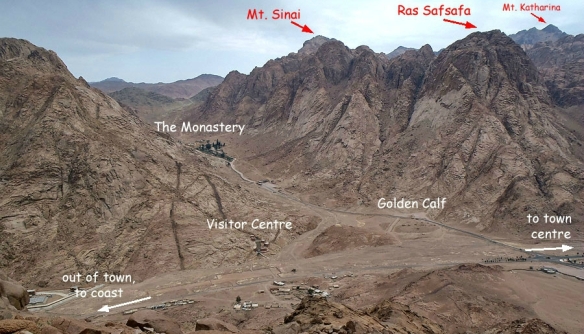
Image result for jebel musa

Dr. Curtis D. Ward

Image result for jebel musa

Image result for jebel musa

Dr. Curtis D. Ward

The nation stayed at Mt. Sinai 11 months (Num. 10:11). The record of their experiences here continues through Numbers 10:10.

Many reliable scholars have considered verses 3-6 to be the very heart of the Pentateuch, because they contain the classic expression of the nature and purpose of the theocratic covenant that God made with Israel, the Mosaic Covenant.

“The meaning of this covenant is expounded in the introductory verses of chapter 19: the covenant is an election, ‘you belong to me from among all peoples’; it is a bond, the people will have with Yahweh the particularly close bond of belonging which characterizes the priestly function; it is an obedience, for if Yahweh is king, the members of the people can only be the subjects who will follow him everywhere he leads (Ex. 15.18; Num. 23.21; Dt. 33.5; Jg. 8.23).”

God’s promise to Israel here (vv. 5-6) went beyond what He had promised Abraham. If Israel would be obedient to God, He would do three things for the nation (cf. Josh. 24:15):

  1. Israel would become God’s special treasure (“My own possession”; v. 5).  This means that Israel would enjoy a unique relationship with God compared with all other nations.  This was not due to any special goodness in Israel, but strictly to the sovereign choice of God.
  2. Israel would become a “kingdom of priests” (v. 6).  This is the first occurrence in Scripture of the word “kingdom” as referring to God’s rule through men on earth.

“This is to be no ordinary kingdom where men will rule upon earth in their own right, but rather a kingdom ‘unto me,’ that is, unto Jehovah.  In other words, whatever else its characteristics may be, it is to be, first of all, God’s kingdom.”

A priest stands between God and people.  Israel could become a nation of “mediators” standing between God and the other nations, responsible for bringing them to God and God to them.  Israel would not be a kingdom run by politicians, depending on strength and wit, but one of priests, depending on faith in Yahweh: a “servant nation” rather than a ruling nation.

  1. Israel would become “a holy nation” (v. 6). “Holy” means “set apart” and therefore “different.”  The Israelites would become different from other peoples, because they would devote themselves to God, and separate from sin and defilement as they obeyed the law of God.

The reaction of Israel was understandably positive, and God approved it (Deut. 5:27-28).  They wanted what God offered them.  However, they seriously overestimated their own ability to keep the covenant, and they vastly underestimated God’s standards for them.  This twin error is traceable to a failure to appreciate their own sinfulness and God’s holiness.  The Mosaic Law would teach them to appreciate both more realistically (cf. Deut. 5:29).

God again (19:16-25) used the symbol of fire to reveal Himself on this mountain (3:2-5).  Dr. Curtis Ward notes the difference in color on the top of Jebel Musa:
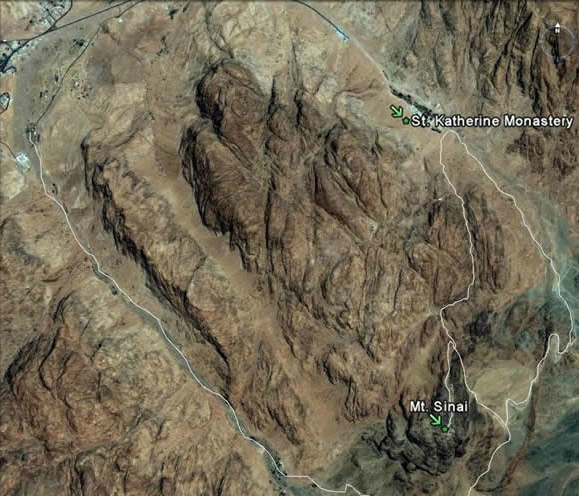
Mount Sinai, Aerial view, Black top, scorched Jebel Musa

See the darker color of earth at the green arrow.

“…And the mountain burned with fire unto the midst of heaven, with darkness, clouds, and thick  darkness.”
…….Deuteronomy 4:11

” And the LORD spake unto you out of the midst of the fire: ye heard the voice of the words, but saw no similitude; only ye heard a voice. And he declared unto you his covenant, which he commanded you to perform, even ten commandments; and he wrote them upon two tables of stone.”
……Deuteronomy 4:12-13

Comparative ancient Near Eastern studies have revealed that the covenant form and terminology that God used to communicate His agreement with Israel were common in Moses’ day. There were two basic types of formal covenants in the ancient Near East: parity (between equals) and suzerainty (between a sovereign and his subjects). The Mosaic Covenant was a suzerainty treaty. Such agreements characteristically contained a preamble (v. 3), historical prologue (v. 4), statement of general principles (v. 5a), consequences of obedience (vv. 5b-6a), and consequences of disobedience (omitted here).

God gave the Mosaic Law to the Israelites for several purposes:

  1. To reveal the holiness of God (1 Peter 1:15)
  2. To reveal the sinfulness of man (Gal. 3:19)
  3. To reveal the standard of holiness required of those in fellowship with God (Ps. 24:3-5)
  4. To supervise physical, mental, and spiritual development of redeemed Israelites until they should come to maturity in Christ (Gal. 3:24; Ps. 119:71-72)
  5. To be the unifying principle that made the establishment of the nation possible (Exod. 19:5-8; Deut. 5:27-28)
  6. To separate Israel from the nations in order to enable them to become a kingdom of priests (Exod. 19:5-6; 31:13)
  7. To make provision for forgiveness of sins and restoration to fellowship (Lev. 1—7)
  8. To make provision for a redeemed people to worship by observing and participating in the yearly festivals (Lev. 23)
  9. To provide a test that would determine whether one was in the kingdom (theocracy) over which God ruled (Deut. 28)
  10. To reveal Jesus Christ.

Tom Constable summarizes our relationship to the law:

The whole Mosaic Law, in all of its parts, was given to the nation of Israel, not to the church (cf. 19:3).  Israel was a physical nation: with a homeland, a capital city (eventually), citizens composed of Jews and naturalized proselytes, and believers and nonbelievers.  The church is a spiritual nation: with no homeland on this earth, no capital city on earth, citizens composed of Jews and Gentiles without distinction, and believers only.

What is the Christian’s relationship to the Mosaic Law?  We are not under it (Rom. 10:4; 1 Cor. 9:20; Gal. 5:18; Heb. 7:12).  It is not the code that regulates the behavior of believers today, though 9 of the Ten Commandments have been incorporated into (repeated in) the covenant under which we live, the exception being the fourth commandment.  Are Christians under any code of laws, like the Israelites were?  Yes.  Paul referred to our code of laws as the Law of Christ (Gal. 6:2; 1 Cor. 9:21).  Other names are the Law of Liberty (James 1:25; 2:12) and the New Covenant (2 Cor. 3:6; Heb. 8:8, 13; 12:24).

There are similarities and differences between the Law of Moses and the Law of Christ.  They both contain positive and negative commands.  Some of the commands in both are identical, but other commands appear in one code but not the other.  Similarly, there are many of the same commands in English law as there are in American law.  For example, it is illegal to commit murder under both codes of law.  But there are also significantly different commands.  For example, under English law it is illegal to drive on the right hand side of the road, but under American law it is illegal to drive on the left side.  The empowerment of the Holy Spirit is not the only difference between the two covenants, as some Christians assume.

What value does the Mosaic Law have for Christians today?  All Scripture is profitable (2 Tim. 3:16), and the Mosaic Law is part of Scripture.  The Mosaic Code had two main purposes: regulatory and revelatory.  Calvin called these their ceremonial and moral purposes.  The Mosaic Law does not regulate or rule over the lives of Christians, as it did the lives of the Israelites (Gal. 4:8-11), but it does reveal much about God, man, and our relationship.  Therefore we should read and study this portion of Scripture, even though we are not obligated to keep all of the commands (i.e., observe all its ceremonies).

We can tell which ones we are to keep by comparing the Law of Moses with the Law of Christ.  The “Law of Christ” consists of all the teaching that Christ gave, both during His earthly ministry, and through His apostles and prophets after He went back to heaven (cf. Acts 1:1-2).  Principles revealed in the Mosaic Law can help us to clarify our responsibilities as well.  For example, we can learn what it means to “love our neighbor” by observing how God wanted the Israelites to treat non-Israelites.

Were the Israelites saved by keeping the Mosaic Law?  No.  They were saved by faith, not by works (Rom. 3:18-30).

Luke 22 begins the passion section in Luke’s gospel.  It begins with the celebration of Passover and the Lord’s Supper (22:1-23).  First, is the plot to arrest Jesus (22:1-2), in which Judas conspires, for thirty pieces of silver (22:3-6), then preparation for the Passover (22:7-13).

The Jews slew their Passover lamb on the fourteenth of Nisan and ate it after sundown.  Sundown began the fifteenth.  The fourteenth would have been Thursday until sundown.  Verse 7 marks the transition to Thursday from Wednesday, the day on which Jesus had His controversy with the leaders in the temple and gave the Olivet Discourse.

This map represents the assumed location of the upper room.  The salmon line represents Jesus leaving Bethany, but it should go into the temple mount instead of around it.

Image result for upper room location

Israel Institute of Biblical Studies Blog

Of course, this is not the way it would have looked when Jesus and the disciples celebrated the Lord’s Supper there, nor is it definitely the location.

Image result for upper room location

In vv. 14-18 Jesus celebrates the Passover meal with His disciples.

Jesus’ great desire (Gr. epithymia epethymesa, lit. “with desire I have desired,” v. 15 ) to eat this meal with the Twelve was due to the teaching that He would give them. It also arose from the fact that this would be His last fellowship meal with them. It was also the last “Passover” to be celebrated under the old Mosaic Covenant.

About vv. 17-18 and the drinking of the cup, Tom Constable explains:

There were four times that participants in the Passover meal drank together, commonly referred to as “four cups.”  The Passover opened with a prayer of thanksgiving, followed by the drinking of the first cup.  Then the celebrants ate the bitter herbs and sang Psalms 113—114.  Next they drank the second cup and began eating the lamb and unleavened bread.  Then they drank the third cup and sang Psalms 115—118.  Finally they would drink the fourth cup. The “cup” in view in this verse may have been the first of the four.  If it was, Jesus evidently did not participate in the drinking of the following three cups (v. 18).

The other Gospel writers did not refer to the first cup, so this may have been the third cup, the so-called “cup of redemption.”  This view assumes that Jesus participated in the drinking of the first and second cups, which would have been normal.  “From now on” or “again” (v. 18) could mean either “after this cup” or “after this Passover.”  I favor the view that Jesus was referring to the “cup,” not the Passover, and that this was the third cup.  Luke rearranged the order of events in the upper room considerably, as comparison with the other Gospels seems to indicate.  Matthew and Mark have Jesus saying what Luke recorded in these verses—just after what Luke recorded in verse 20.

Jesus invested the common elements of unleavened bread and diluted wine with new significance.  The “bread” represented His “body” given sacrificially for His disciples.  The disciples were to eat it, as He did, symbolizing their appropriation of Him and their consequent union with Him.  The “cup,” representing what was in it, symbolized the ratification of the “New Covenant” with Jesus’ “blood” (Jer. 31:31-34; cf. Exod. 24:8).

Luke placed Jesus’ announcement of His betrayal after the institution of the Lord’s Supper, whereas Matthew and Mark located it before that event in their Gospels.  The effect of Luke’s placement is that the betrayal appears especially heinous in view of Jesus’ self-sacrifice for His disciples.  The connecting link is the reference to Jesus’ death.

Whether Judas participated in the Lord’s Supper is unclear in Luke’s gospel.  Matthew and Mark (also John 13:21-35) have him leaving before the Lord’s Supper, taking only the sop” which is associated with the Passover Meal.  Since the Lord’s Supper is a memorial of Christ’s redemption for believers it would not seem appropriate for Judas to have shared in it.

Jesus then takes this opportunity to teach His disciples, for the last time (in John it’s called The Upper Room Discourse, John 13-17).  He will touch on regular themes like humility (22:24-27) and rewards for faithfulness (22:28-30).  He also predicts Peter’s denial and has that wonderful prayer

31 “Simon, Simon, behold, Satan demanded to have you,that he might sift you like wheat, 32 but I have prayed for you that your faith may not fail. And when you have turned again, strengthen your brothers.”

Of course, Peter had confidence in himself (v. 33) but Jesus knew that needed to be put through the fire (1 Peter 1:6-7) so that what was really valuable–faith in Christ alone–would become more dominant.

The blue line represents the probable route back to Gethsemane.

Jesus predicted that opposition would arise (Luke 22:35-38) and this was promptly followed by His arrest (22:39-53).  First, Jesus took His disciples to the Mount of Olives to pray (22:39-46).  Here Jesus prays, struggling to take the “cup” of the wrath of God so much that he “sweat” drops of blood (22:44).

According to Debra Predow, this was the first of seven times Jesus shed His blood.  I had never realized all the times Jesus shed His blood.  Her applications may be a little stretched, but it is interesting.

Judas’ betrayal occurs in 22:47-53.  Luke highlighted Judas’ hypocrisy in betraying Jesus “with a kiss,” the sign of friendship (cf. Gen. 27:26-27; 2 Sam. 15:5; 20:9; Prov. 7:13; 27:6), plus the fact that Jesus knew Judas’ purpose.  Jesus prohibited His own disciples from striking back (22:49-50).

The trials of Jesus stretch throughout the night and next morning in Luke 22:54-23:25.

The following table (from Tom Constable) identifies the aspects of Jesus’ two trials that each evangelist recorded.

JESUS’ RELIGIOUS TRIAL


Matthew

Mark Luke

John

Before Annas 18:12-14, 19-24
Before Caiaphas 26:57-68 14:53-65 22:54, 63-65
Before the Sanhedrin 27:1 15:1 22:66-71
JESUS’ CIVIL TRIAL
Before Pilate 27:2, 11-14 15:1-5 23:1-5 18:28-38
Before Herod Antipas 23:6-12
Before Pilate 27:15-26 15:6-15 23:13-25 18:39—19:16

While Jesus is being tried before Caiaphas, Peter denies Jesus three times (22:54-60).   Immediately, a rooster crows.  Luke alone records that “the Lord turned and looked at Peter (22:61).  Luke’s unique reference to His turning and looking at Peter adds to the shock effect of the moment.  The word that Luke used to describe Jesus’ looking usually means: to look with interest, love, or concern (Gr. emblepo).  Peter suddenly “remembered” what Jesus had predicted earlier that evening (v. 34) and, undoubtedly, his profession of loyalty to Jesus (v. 33).

The realization of his unfaithfulness in this light, along with Jesus’ teaching on the importance of faithfulness, caused Peter to leave the courtyard and to weep tears of bitter remorse.

The mockery in vv. 63-65 likely happened during the trial before Caiaphas, while Peter was denying Him.

Following the informal interrogations by Annas and Caipahas, Jesus is brought before the Sanhedrin (the 70 member ruling council in religious matters) early on Friday morning.  Harold Hoehner, who specialized in chronology, believes it it was April 3, 33 A.D.

Evidently the Sanhedrin members wanted to send Jesus on to Pilate for trial as early as they “lawfully” could. he Sanhedrin normally met in a building not far to the west of the western wall of the temple.

They asked if Jesus claimed to the the Messiah (22:67-68).  He did claim to be “Son of Man,” which had Messianic implications (22:69-70) and they proclaimed that blasphemy (22:71), for He claimed to be equal to God.

The night, and the trials, are not over.

Job 37 is the finale of Elihu.  Here Elihu continues to speak of God’s high descriptions of God.   In verses 1-13 he cited more examples of God’s working in nature that we cannot comprehend fully (37:5).

We can learn that He does these things for different purposes. (37:7).  Sometimes God does them for people’s benefit or harm, but sometimes He does them simply for the sake of His world (37:13).

At this point, Elihu turned again to apply these truths to Job’s situation (37:14-24).  He urged Job to be humble before such a great God (37:14-20).  Instead of dictating to God, Job should learn a lesson about the mystery of suffering from His wondrous acts in nature.  No one can find God, but we can count on Him to be just (37:21-23). Job also needed to fear God (37:24)

In his four speeches, Elihu introduced a different reason for suffering: God has things to teach people that they can only learn through pain.  He also described God in terms that suggest he may have had a more realistic, fuller concept of God than Job’s three friends did.  All the same, neither Elihu nor the other three men had adequate insight into Job’s situation.  They could not have had it unless God revealed to them what had transpired in His heavenly court (chs. 1—2).

Elihu’s words are closer to the truth and set the stage for God’s fuller special revelation of Himself that follows in chapters 38—42.  Generally, Elihu emphasized the positive aspects of God’s character, whereas the other three comforters emphasized the negative aspects.  Elihu saw God more as a teacher, whereas the other men spoke of Him as a judge.

2 Corinthians 7 continues the appeal to open their hearts to Paul and his authority, and stay away from “unequal yokes” with unbelievers.  The final verse of chapter 16 spoke of the promise of an intimate relationship with God as Father, so 7:1 continues…

1 Since we have these promises, beloved, let us cleanse ourselves from every defilement of body and spirit, bringing holiness to completion in the fear of God.

Holiness is God’s purpose in saving us, as witnessed in these verses:

“For he chose us in him before the creation of the world to be holy and blameless in his sight.” (Ephesians 1:4)

 “May he strengthen your hearts so that you will be blameless and holyin the presence of our God and Father when our Lord Jesus comes with all his holy ones.” (1 Thessalonians 3:13)

“For God did not call us to be impure, but to live a holy life.” (1 Thessalonians 4:7, in the context of immoral sexual behavior)

“Make every effort to live in peace with all men and to be holy; without holiness no one will see the Lord.” (Hebrews 12:14)

“As obedient children, do not conform to the evil desires you had when you lived in ignorance. 15 But just as he who called you is holy, so be holy in all you do; for it is written: ‘Be holy, because I am holy.'” (1 Peter 1:14-16)

Paul then repeats his appeal to the Corinthians (7:2).  He was encouraged by their initial response (7:3-4).  He then talks about his recent struggles (7:5) and his comfort through Titus (7:6-7).

In verses 8-10 he speaks of the “severe letter” he had sent and its results.

PAUL’S CORINTHIAN CONTACTS

Paul’s founding visit His “former letter” The Corinthians’ letter to him First Corinthians Paul’s “painful visit” His “severe letter” Second Corinthians Paul’s anticipated visit

Paul admitted that he had regretted sending the severe “letter” after he had done so. He had subsequently thought that it was too harsh.  Fortunately his readers responded to it as he had hoped they would, though it had “caused” them some pain (“sorrow”) at first.  Fortunately it had not led the church into excessive discouragement but genuine “repentance.”  The Corinthian believers had changed their thinking and their behavior.

The apostle then added a somewhat philosophical reflection on two possible responses to criticism and their consequences.  The proper response, God’s will, results in a change of mind (“repentance”), which leads to deliverance from the bad situation (“salvation” in the temporal sense here), “without” later “regret.”  The improper response, the world’s typical superficial response, does not result in a change of mind (repentance), but leads to resentment and bitterness (ultimately “death” in the temporal sense).  Suffering in itself does not necessarily benefit us.  It proves to be a good thing for us only as we respond to it properly (cf. James 1:2-4).

Image result for true repentance

Paul identified several good things that had come to his Corinthian readers, because they had responded properly (with “godly sorrow”) to his recent rebuke.  Their response had yielded “earnestness” (seriousness of purpose), the desire to prove themselves worthy (“what vindication of yourselves”), and righteous “indignation” at the affront to Paul. It had further resulted in: concern (godly “fear”) over their behavior and its effects, a “longing” to see Paul again, a determination (“zeal”) to make things right, and a correction of their error (“avenging of wrong”).  The church had now put itself in the right, having been in the wrong: “you demonstrated yourselves to be innocent in the matter.”

M’Cheyne Bible Reading Plan, March 7

Today’s readings are from Exodus 18; Luke 21; Job 36 and 2 Corinthians 6.

Exodus 18 describes a family reunion between Moses and his family, including his father-in-law, who had brought his family from Midian to the Sinai wilderness.  Here he offers Moses this advice:

13 The next day Moses sat to judge the people, and the people stood around Moses from morning till evening. 14 When Moses’ father-in-law saw all that he was doing for the people, he said, “What is this that you are doing for the people?  Why do you sit alone, and all the people stand around you from morning till evening?” 15 And Moses said to his father-in-law, “Because the people come to me to inquire of God; 16 when they have a dispute, they come to me and I decide between one person and another, and I make them know the statutes of God and his laws.” 17 Moses’ father-in-law said to him, “What you are doing is not good. 18 You and the people with you will certainly wear yourselves out, for the thing is too heavy for you. You are not able to do it alone. 19 Now obey my voice; I will give you advice, and God be with you! You shall represent the people before God and bring their cases to God, 20 and you shall warn them about the statutes and the laws, and make them know the way in which they must walk and what they must do. 21 Moreover, look for able men from all the people, men who fear God, who are trustworthy and hate a bribe, and place such men over the people as chiefs of thousands, of hundreds, of fifties, and of tens. 22 And let them judge the people at all times.  Every great matter they shall bring to you, but any small matter they shall decide themselves.  So it will be easier for you, and they will bear the burden with you. 23 If you do this, God will direct you, you will be able to endure, and all this people also will go to their place in peace.”

This was excellent advice, and maybe even more amazing is that Moses “listened…and did all that he had said.”  It is sometimes difficult for leaders to take advice.  We don’t like to be told that we’re doing something wrong.

But Jethro got first-hand knowledge of what Moses was doing by observing him all day long.  He noticed the effect that a day of intense ministry had on Moses.  He didn’t rebuke/instruct Moses until he had first-hand knowledge of all the facts.

Besides, the advice Jethro gave could immediately be seen to have positive impact both on Moses and on the people.  Maybe it hadn’t occurred to Moses, yet, to do this, or possibly Moses had a “messiah complex” and really believed that no one could do it better than him.  The reality is, when pastors over-function, the people naturally under-function.

Third, Jethro spells out all the benefits that could come of this new division of labor:

So it will be easier for you, and they will bear the burden with you. 23 If you do this, God will direct you, you will be able to endure, and all this people also will go to their place in peace.”

Luke 21 continues with Jesus teaching in the temple on Wednesday of the passion week.  His practice is mentioned in v. 37

37 And every day he was teaching in the temple, but at night he went out and lodged on the mount called Olivet.

This chapter begins with Jesus drawing His disciples’ attention to a poor widow who gave all she had (21:1-4) and then transitions into talking about the future of the beautiful temple (21:5-38).  It deals with the tribulation (21:5-19) and return of the Messiah (21:20-27), so it was important for His disciples to be ready, to watch and pray (21:28-36).

David Guzik reminds us about giving, that…

The value of a gift is determined by what it cost the giver; this is what made the widow’s gift so valuable.  David refused to give God that which cost me nothing (2 Samuel 24:24).

It is unlikely that we have ever given in the spirit of sacrifice as this widow.

The beautiful stones on the temple wall would shine brightly in the evenings and mornings.

Here is a model of the temple as it would have been at the time of Jesus and His disciples.

When the disciples praised its grandeur to Jesus (v. 5), the temple was in the midst of an eighty-three-year building program.  Started about 20 B.C., it continued until A.D. 63-64, just a few years before Jerusalem’s fall in A.D. 70.  Assuming an A.D. 33 date for the crucifixion, the program was over fifty years old at the time the disciples marveled at it.  The temple clearly made a deep impression on all who visited it.  Josephus gives detailed descriptions of its beauty (Jewish Wars 1.21.1 401; 5.5.1-6 184-227; Antiquities 15.11.1-7 380-425).  The Roman historian Tacitus also describes the temple as containing great riches (History 5.8.1).  Some of its stones were 12 to 60 feet in length, 7.5 feet in height and 9 feet in width (Josephus Jewish Wars 5.5.1-2 189-90 gives these measurements in cubits; a cubit is eighteen inches).  The temple loomed over the city like a “snow clad mountain” (Josephus Jewish Wars 5.5.6 223).  Not only was the building impressive, but it was decorated with gifts from other countries and had elegantly adorned doors and gates of fine craftsmanship (Josephus Jewish Wars 5.5.3-5 206-18).

No wonder the disciples felt national pride as they surveyed the awesome temple, exclaiming at its beautiful stones and . . . gifts dedicated to God.  Surely something so magnificent and God-honoring, something that had taken so long to build, would last a very long time.  God’s presence finally had a secure home.

Jesus’ response must have come like a knife in the heart: “As for what you see here, the time will come when not one stone will be left on another; every one of them will be thrown down.”  It is hard for us to appreciate the effect on Jewish ears of what Jesus predicts here. . .  The magnificent temple, the center of the nation’s worship and the sacred locale of God’s presence, will be destroyed and turned into a heap of rubble. Centuries of worship and years of reconstruction will be brought to an end.  The only way this can occur is if Jerusalem is overrun.

–from The IVP Commentary on Luke

Oh, no, they must have though, here we go again!

When the Romans were done with Jerusalem in 70 A.D., not a single Jew was left alive in the city.  The Romans eventually renamed the city Aelia Capitolina, and for many years would not allow a Jew to even enter what was formerly known as Jerusalem, except on one day a year—the anniversary of the fall of the city and the destruction of the temple, when Jews were invited to come and mourn bitterly.

–David Guzik

This was certainly terrifying and shocking news to the Jewish people.  This is why Jesus had wept over the city in Luke 19:41-44.

As great as the temple was, Jesus never hesitated to claim that He was greater than the temple (Matthew 12:5).  For man Jews of that day, the temple had become an idol-it subtly began to mean more to the people than God Himself did.  God has a habit of destroying our idols.

Good things can become the worst idols; and sometimes God sours even good things that we have allowed to become our idols.

David Guzik

Of course, all of this points to a far greater destruction which will occur in the end times (the tribulation).  But just as these disciples escaped the destruction of 70 A. D. so Jesus’ disciples in the end times can escape the far greater destruction that will come.

In Job 36 Elihu continues his diatribe against Job.  It will stretch into Job 37.  He is making up for lost time!  Of all Elihu’s discourses, this one is the most impressive because of his lofty descriptions of God.

From Tom Constable:

Four times in this chapter and twice in this section (vv. 1-25) Elihu said, “Behold” (vv. 5, 22, 26, 30).  In each case, he then proceeded to say something important about God. After this, he applied that truth.

Elihu’s first affirmation was that God is mighty and merciful (vv. 5-10), and He uses suffering to instruct people.  This is Elihu’s fundamental thought in all of his speeches.  There are two possible responses to God’s teaching, he said: hearing (v. 11) and not hearing (v. 12), and each has consequences.  Elihu developed these responses and consequences further, first the response of the godless (vv. 13-14), and then that of the godly (vv. 15-16).

Essentially, the godless typically become angry, and refuse to turn to God for help, and this often leads to a life of shame and an untimely death (vv. 13-14).  The righteous who suffer, on the other hand, more often turn to God, submit to His instruction, learn from it, and live (v. 15).

Finally, Elihu applied these points to Job, and warned him against responding to his sufferings like the ungodly (vv. 16-21).  Specifically, Job should avoid anger and scoffing and not let the large price he was paying for his God-sent education (i.e., humble submission to divine chastisement, the “ransom,” v. 18) divert him from godly living.

Elihu’s next major declaration about God, introduced by the second “Behold” (v. 22), was that He is a sovereign and supremely wise “teacher” (vv. 22-23).  Elihu’s application to Job was that he should worship God rather than murmuring, complaining, and pitying himself (vv. 24-25). Worship would enable him to learn the lessons that God was teaching him. The introverted (chiastic) structure of verses 22-26 emphasize the fact that God is worthy of praise.

Elihu focused next on God’s activities in nature.  There may be references to autumn conditions in 36:27-33, winter in 37:1-13, and summer in 37:17-18.  Perhaps the Hebrews thought of three seasons rather than four.

Elihu’s third “Behold” (36:26) draws attention to the infinite wisdom of God.  No one can understand how or why He deals with nature as He does (36:29).

The fourth “Behold” (36:30) affirms a similar point.  God uses rain to bring both blessings and curses on people. Lightning and thunder declare God’s presence even if people cannot fully understand when or why they come as they do.

Having introduced the idea of God’s sovereign control over all things as reflected in His control of nature (36:26-33), Elihu will elaborate on these thoughts in chapter 37.

Really, verses 1 and 2 of 2 Corinthians 6 should go with the previous chapter on the ministry of reconciliation God has given to us and our plea to be reconciled to God.

1 Working together with him, then, we appeal to you not to receive the grace of God in vain. 2 For he says, “In a favorable time I listened to you, and in a day of salvation I have helped you. “Behold, now is the favorable time; behold, now is the day of salvation.

It is possible to “receive the grace of God in vain,” for it to come up empty, to have no effect.  When God’s Spirit begins to convict us and woo us, that is the grace of God.  To say “no” when that happens is dangerous.

Paul’s personal ministry to the Corinthians was commended by hardships (6:4-5), by godly character (6:6) and Spirit-driven ministry (6:7), through paradoxical ministry (6:8-10) so open wide your hearts to us (6:11-13) and do not be unequally yoked with unbelievers (6:14-18).  This will naturally lead into the commands to pursue holiness in 7:1-2.

The fact is, genuine apostolic ministry was hard and contained many troubles.  Paul will come back to this in chapter 11.  Since these were tests of character, they proved Paul’s integrity and authenticity as an apostle.

6:11-7:6 are therefore an appeal by Paul for the Corinthians to put their confidence in Paul, instead of these “super apostles”

Craig Keener notes:

“. . . in Roman politics and ancient Mediterranean culture in general, friendship included accepting the friend’s friends as one’s friends and his enemies as one’s enemies (e.g., Iamblichus Pyth. Life 35.248-49). How then can the Corinthians be reconciled with God if they mistrust his agent (cf. 6:14-16; Matt 10:40; Ex 16:8)?”

Regarding the arguments against forming binding relationships with unbelievers, Tom Constable writes:

Paul was not saying that Christians should break off all association with unbelievers (cf. 1 Cor. 5:9-10; 10:27).  He had previously encouraged the saved partner in a mixed marriage to maintain the marriage relationship as long as possible (1 Cor. 7:12-16).  He had also urged his fellow Christians, as ambassadors of Christ, to evangelize the lost (5:20).  Rather, here Paul was commanding that Christians form no binding interpersonal relationships with non-Christians, that resulted in their spiritual defilement.  This is an extension to human beings, of the principle underlying the prohibition against breeding or yoking an ox and a donkey together, in Leviticus 19:19 and Deuteronomy 22:10.  Such alliances can prevent the Christian from living a consistently obedient Christian life.

The fulfillment of God’s will must be primary for a believer.  Obviously some relationships with pagans do not pose a threat to our faithfulness to God.  Where they do, the Christian must maintain his or her relationship with Christ, even it if means forfeiting relationships with unbelievers.  There is a conceptual parallel here with what Jesus (Matt. 22:21; Mark 12:17; Luke 20:25), Paul (Rom. 13:1-7; Titus 3:1-2), and Peter (1 Pet. 2:13-17) taught about the believer’s relationships with God and the state.  We should obey both authorities unless they conflict, in which case we must obey God.

Paul set forth the folly of such behavior by pointing out five contrasts. Each contrast, in the form of a question, expects a negative answer.  All of them point out the incompatibility and incongruity of Christian discipleship and heathenism. Paul supported the last of these with quotations from the Old Testament (vv. 16b-18).

The main reason for Paul’s prohibition is that Christians belong to Christ.  We already have a binding relationship with Him, and we must not be unfaithful to Him by going after another.

Is this passage a warning against dating, or marrying, an unbeliever (if you are a believer)?

The reference to temples and idols suggests that Paul is still addressing the Corinthians’ tendency to try to blend the worship of God with the activities that went on the pagan temples.  In other words, the people wanted to be Christian while still partaking of all the activities that marked the worship of the Greek gods.  The attitude seemed to be that they could be spiritually Christian “inside” while the physical body could still enjoy the wild pagan lifestyle of Corinth.

I would say that this passage can apply to marriage, that when two people are united together in marriage they exercise tremendous influence over one another and therefore to be married to an unbeliever, while not sinful, is not wise.

M’Cheyne Bible Reading Plan, March 6

Today’s readings are from Exodus 17; Luke 20; Job 35 and 2 Corinthians 5.

Exodus 17

In Exodus 14, the people of Israel had walked on dry ground through the walled-off Red Sea.  In Exodus 15, the bitter waters of Marah had been miraculously made sweet.  Beginning in Exodus 16, the perfect amount of manna from heaven was being provided each and every morning for forty years.  Three chapters, back-to-back-to-back, that contain absolutely incredible miracles.

Valley of Rephidim, linearconcepts

The assumed site of Rephidim, photo by linearconcepts

Yet, when they could not find water at Rephidim, they grumbled again, asking “is the Lord among us or not?”  How quickly they forgot!  How quickly we forget.  We experience God’s provision and sometimes miracles, yet consistently question, “Where is God when I need him?”

God told Moses to strike a rock at Horeb and water would flow out.

He opened the rock, and water gushed out; it flowed through the desert like a river. (Psalm 105:41 ESV)

He struck the rock so that water gushed out and streams overflowed. Can he also give bread or provide meat for his people?” (Psalm 78:20 ESV)

1 Corinthians 10:1-4 (Amplified Bible)

For I do not want you to be ignorant, brethren, that our forefathers were all under and protected by the cloud [in which God’s Presence went before them], and every one of them passed safely through the [Red] Sea,

And each one of them [allowed himself also] to be baptized into Moses in the cloud and in the sea [they were thus brought under obligation to the Law, to Moses, and to the covenant, consecrated and set apart to the service of God];

And all [of them] ate the same spiritual (supernaturally given) food,

And they all drank the same spiritual (supernaturally given) drink. For they drank from a spiritual Rock which followed them [produced by the sole power of God Himself without natural instrumentality], and the Rock was Christ.

In vv. 8-16 Amalek comes out to fight against the Israelites.  Amalek was one of the southernmost tribes and it is quite possible that at this time their territory extended far south to the are of Mt. Sinai.  Amalek was a descendant of Esau.

Image result for Amalek

Amalek was always at enmity with Israel.  This is the first, but certainly not the last time that Amalek will strike at Israel.

Here Joshua is sent out with the troops while Moses prays.  He raises his arms and two men are there to hold them up as they tire.  While they are raised, Israel prevails.  It illustrates how vitally important prayer is in any battle, especially spiritual warfare.

17-12-cartoon

Keil and Delitzsch note:

“The lifting up of the hands has been regarded almost with unvarying unanimity by Targumists, Rabbins, Fathers, Reformers, and nearly all the more modern commentators, as the sign or attitude of prayer. . . . The lifting up of the staff secured to the warriors the strength needed to obtain the victory, from the fact that by means of the staff Moses brought down this strength from above, i.e., from the Almighty God in heaven; not indeed by a merely spiritless and unthinking elevation of the staff, but by the power of his prayer, which was embodied in the lifting up of his hands with the staff, and was so far strengthened thereby, that God had chosen and already employed this staff as the medium of the saving manifestation of His almighty power.  There is no other way in which we can explain the effect produced upon the battle by the raising and dropping . . . of the staff in his hands. . . . God had not promised him miraculous help for the conflict with the Amalekites, and for this reason he lifted up his hands with the staff in prayer to God, that he might thereby secure the assistance of Jehovah for His struggling people.  At length he became exhausted, and with the falling of his hands and the staff he held, the flow of divine power ceased, so that it was necessary to support his arms, that they might be kept firmly directed upwards . . . until the enemy was entirely subdued.”

Vv. 14-16 is the first of five instances in the Pentateuch where we read that Moses wrote down something at the LORD’s command (“Write this in a book as a memorial”; cf. 24:4, 7; 34:27; Num. 33:1-2; Deut. 31:9, 24).

God promised the eventual destruction of the Amalekites (“I will utterly blot out the memory of Amalek”), in order to strengthen Joshua’s faith in God’s help against all of Israel’s enemies (v. 14).  Later God commanded him to exterminate (“blot out the memory of”) the Amalekites after he had conquered Canaan (Deut. 25:19).  This explains why God commanded Saul to finish the job (1 Samuel 15:2-3) and took away his kingship (ultimately) because he disobeyed.

The Bible mentions the Amalekites for the last time in 1 Chronicles 4:43, when a remnant of them perished in Hezekiah’s day.  Some believe that Haman descended from Amalekite stock, although some more recent commentators cast doubt on that.

Luke 20 recounts Jesus teaching in the temple, answering and asking questions, telling parables.  Luke presented Jesus’ teachings in the temple as beginning with opposition from the religious leaders and leading on to Jesus’ condemnation of them.  He evidently wanted to highlight the reasons for God’s passing over Israel to deal with Gentiles equally in the present era.  All of what follows in this section happened on Wednesday of “passion week.”

First, the religious leaders question Jesus’ authority (20:1-8).  This was an important issue and this passage establishes Jesus’ authority beyond a doubt.

“If you do not recognize authority when you see it, He said in effect, no amount of arguing will convince you of it.” (Geldenhuys)

Then, in the parable of the wicked tenant farmers (20:9-19) Jesus taught that Israel’s religious leaders who had authority were mismanaging their authority. It also affirmed Jesus’ authority, not just as a prophet, but as God’s Son.  The leaders had expressed fear of death (v. 6). Jesus now revealed that He would die but would experience divine vindication.  The parable contains further teaching on the subject of proper stewardship as well (cf. 19:11-27).

This was followed by the question of tribute to Caesar (20:20-26).  Jesus wasn’t really teaching against the government.  The early Christians, like Jesus, suffered because of false accusations that they opposed their government, but this was generally untrue.

The denarius, a small silver Roman coin, was the usual wage for one day's work.

All was brought to a climax the challenges to Jesus’ authority in the teaching regarding the resurrection (20:27-40).  The Sadducees didn’t believe in a literal resurrection (that’s why they were sad, you see).  Jesus teaches that there will be a resurrection.

To prove His point, Jesus cited a verse from the Pentateuch, which His critics respected greatly (Exod. 3:6; cf. Acts 7:32).  His point was that “Moses” spoke of God as presently being “the God of Abraham, . . . Isaac, . . . and Jacob”—all of whom had died.  He inferred from this that God could only be their God—then—if they would rise from the dead eventually. God will raise all people eventually.  “All live to Him” in that sense.  Therefore “to Him all are alive” (NIV). Abraham, Isaac, and Jacob, whose souls are presently alive, will experience bodily resurrection at the Second Coming, and will live in the kingdom as “sons of the resurrection” (v. 36).

Jesus’ questioners having fallen silent, He now took the offensive and asked them a question (Luke 20:40-44).  Its purpose was to clarify the identity of the Messiah.  He is both a descendant of David and the Lord of David (thus divine).

Jesus ends by condemning the scribes of immoral behaviors (20:45-47).

Job 35 continues with Elihu’s accusations against Job.  This time, Elihu focuses on Job’s self-righteousness.  He asked Job is he was indeed more righteous than God (35:1-3) and rightly claimed that God is more exalted than Job (35:4-8).  Therefore, since Job was proudly exalting himself, he could not expect God to answer him (35:9-12).  After all, Job’s talk was empty (35:13-16).

Elihu saw that God had not yet answered Job yet, at least not in any way that Job had hoped.  Therefore he said “Job opens his mouth in vain.”  The idea was, “Job, if you were really a godly man, then God would have answered you by now.  The fact that He hasn’t shows your ungodliness.”

Many of God’s faithful have endured the “dark night of the soul” (originally coined by St. John of the Cross) when life was painful and God seemed absent or silent. Admittedly, if you google that expression, you will come up with a lot of new age, or mystic, explanations and expressions.

Lewis describes those times in the Screwtape letters under the title The Law of Undulation:

You must have often wondered why the Enemy does not make more use of His power to be sensibly present to human souls in any degree He chooses and at any moment.  But you now see that the Irresistible and the Indisputable are the two weapons which the very nature of His scheme forbids Him to use.  Merely to override a human will (as His felt presence in any but the faintest and most mitigated degree would certainly do) would be for Him useless.  He cannot ravish.  He can only woo.  For His ignoble idea is to eat the cake and have it; the creatures are to be one with Him, but yet themselves; merely to cancel them, or assimilate them, will not serve.  He is prepared to do a little overriding at the beginning.  He will set them off with communications of His presence which, though faint, seem great to them, with emotional sweetness, and easy conquest over temptation.  Sooner or later He withdraws, if not in fact, at least from their conscious experience, all those supports and incentives.  He leaves the creature to stand up on its own legs– to carry out from the will alone duties which have lost all relish.  It is during such trough periods, much more than during the peak periods, that it is growing into the sort of creature He wants it to be.  Hence the prayers offered in the state of dryness are those which please Him best.  We can drag our patients along by continual tempting, because we design them only for the table, and the more their will is interfered with the better.  He cannot ‘tempt’ to virtual as we do to vice.  He wants them to learn to walk and must therefore take away His hand; and if only the will to walk is really there He is pleased even with their stumbles.  Do not be deceived, Wormwood.  Our cause is never more in danger than when a human, no longer desiring, but still intending, to do our Enemy’s will, looks round upon a universe from which every trace of Him seems to have vanished, and asks why he has been forsaken, and still obeys.

I just love that last sentence.  It almost makes me cry every time I read it.

2 Corinthians 5 starts by contrasting the earthly body (“tent,” which is temporary), to the heavenly, resurrection body (“house,” permanent).  Paul has already talked about, primarily with the Corinthians themselves:

  1. Paul has already introduced resurrection a few verses previously at 4:14.
  2. Paul taught the Corinthians about resurrection bodies extensively in a previous letter, especially:

“For the perishable must clothe itself with the imperishable, and the mortal with immortality. When the perishable has been clothed with the imperishable, and the mortal with immortality, then the saying that is written will come true: ‘Death has been swallowed up in victory.'” (1 Corinthians 15:53-54)

  1. The vocabulary of “groaning” (5:2) is found in conjunction with resurrection, “the redemption of our bodies” in Romans 8:18-24, written about the same time as 2 Corinthians.
  2. The vocabulary of “being clothed” (5:2, 4) is found with resurrection bodies in the passage quoted above (1 Corinthians 15:53).

This bodily resurrection is guaranteed by the Spirit (5:5).  Paul expresses a longing for home in 5:6-8.  Heaven is our true home and arriving there will be “better by far” (Phil. 2:23) and constant, complete joy (Psalm 16:11).

Right now we…

  • Walk by faith, not by sight (5:8).  So many people want to “see” and experience God.  But we “see” with our ears, believing God’s Word.
  • Make it our aim to please the Lord (5:9).  I believe pleasing goes beyond mere obedience.  We obey when we do what is commanded, we please when we anticipate the needs and desires of someone.
  • Prepare to stand before the judgment seat of Christ (5:10).  This judgment, also mentioned in 1 Cor. 3:12-15 is NOT the same thing as the Great White Throne Judgment in Revelation 20.  Our judgment is a judgment of our “service record,” what we have done for Christ.  If it stands the judgment, we win reward.  The Great White Throne judgment is for unbelievers, first of all identifying that their names are not in the book of life, then opening the books (pl.) and evaluating their “sin record.”  We are not judged for sins at the judgment seat of Christ and cannot be condemned (Romans 8:1).
  • Persuade men to believe the gospel (5:11a).  We do not know whether we have the future to share the gospel, only today.

Christ’s love compels us to take up this ministry of reconciliation (5:14-15).  In this section, Paul identified two motives for Christian service: an awareness of our accountability to God (v. 11), and the example of Jesus Christ (v. 14).  Jesus is both our Judge and our Savior, and His two roles should have an impact on how we live.

God is able to take all that was old, broken and dysfunctional, and make it new.  When we put our faith in Jesus Christ alone, we change.  We become a new creation.

Tom Constable notes:

Obviously there is both continuity and discontinuity that takes place at conversion (justification).  Paul was not denying the continuity.  We still have the same physical features, basic personality, genetic constitution, parents, susceptibility to temptation (1 Cor. 10:14), sinful environment (Gal. 1:4), etc.  These things do not change.  He was stressing the elements of discontinuity (“old things passed away”): perspectives, prejudices, misconceptions, enslavements, etc. (cf. Gal. 2:20).  God adds many “new things” at conversion, including: new spiritual life, the Holy Spirit, forgiveness, the righteousness of Christ, as well as new viewpoints (v. 16).

The Christian is a “new creature” (a new man, Rom. 6) in this sense: Before conversion, we did not possess the life-giving Holy Spirit, who now lives within us (Rom. 8:9).  We had only our sinful human nature.  Now we have both our sinful human nature and the indwelling Holy Spirit.  This addition makes us an essentially “new” person, since the Holy Spirit’s effects on the believer are so far-reaching.  We also possess many other riches of divine grace that contribute to our distinctiveness as believers.  Lewis Sperry Chafer listed 33 things that the Christian receives at the moment of justification.

We have been given the ministry of reconciliation. One of my beloved Bible college professors, Charles “Spud” Willoughby, used to illustrate reconciliation with the eye symbol.  Reconciliation (eye symbol illustration), Charles Willoughby

Reconciliation removes a barrier to our salvation, but it does not by itself accomplish our salvation.  Thus, God can be reconciled to the world through Christ, but that doesn’t mean everyone is saved.  God has “committed” the message (“word”) of this provision to those who have experienced reconciliation, and our (the church’s) “ministry of reconciliation” is to present it to all people (Matt. 28:19-20).

We are ambassadors.  We don’t make this message up or change it, but authoritatively declare the words of the One who sent us.  Part of our message is the offer of this reconciliation and our pleading our hearers to “be reconciled to God.”

Verse 21 condenses the grounds for Paul’s appeal, and expresses it in another paradox. This verse explains the “how” of full reconciliation and takes us to the very heart of the atonement.

Image result for 2 Corinthians 5:21 john hardin

This verse expresses the great exchange, the wonderful truth of double imputation and substitutionary atonement.  Although Christ knew no sin, was completely free of sin, God made Him to be sin (imputed our sins to His account) for our sakes.  Then, upon believing in Jesus Christ, God credits His righteousness to our account.

Thus, Paul will appeal in 6:1-2, TODAY is the day of salvation.

M’Cheyne Bible Reading Plan, March 5

Today’s readings are from Exodus 16; Luke 19; Job 34 and 2 Corinthians 4.

Exodus 16 recounts Israel’s beginning wanderings in the desert.  At least they have a definite destination, Mt. Sinai (also called Mount Horeb).  This chapter records another crisis in the experience of the Israelites, as they journeyed from Goshen to Mt. Sinai, that God permitted and used to teach them important lessons.  In this chapter, God is teaching the Israelites that they can trust Him to provide their “daily bread.”

The people were hungry and God provided manna from heaven.  Who knows from whence our blessings may flow.  God can do exceedingly, abundantly beyond all that we could ask for or dream of.

They were instructed to gather only enough for that day, each day, but to gather two days worth of food on the sixth day (thus not working on the sabbath).  Of course, this was a test (v. 4)–would they trust God enough not to gather more than they needed each day?  Verse 35 indicates that God provided manna for Israel all throughout the forty years of wandering.

So God provided quail in the morning and manna in the evening.  Of course, someone decided to leave some for the next day (squirrel it away in a bank account for a rainy day) and it spoiled.  Then, of course, some did not gather enough for two days on the sixth day and went out to find manna on the seventh day, but could not.

Much is made of Israel’s grumbling in this chapter.  We grumble when we forget God and are consumed by our circumstances.

Exodus 16:23 is Israel’s first observance of the sabbath.  It was, of course, embedded in the creation week (Genesis 2) and would be codified into law a few weeks later on Mount Sinai (Exodus 20).

Here is Spurgeon’s Morning and Evening devotional on Exodus 16:21…

Work hard to maintain a sense of your entire dependence upon the Lord’s good will and pleasure for the continuance of your richest enjoyments. Never try to live on the old manna, nor seek to find help in Egypt.  All must come from Jesus or you are undone forever.  Old anointings will not suffice to impart unction to your spirit; your head must have fresh oil poured upon it from the golden horn of the sanctuary, or it will cease from its glory.

Today you may be upon the summit of the mount of God, but He who has put you there must keep you there or you will sink far more speedily than you imagine.  Your mountain only stands firm when He settles it in its place; if He hides His face, you will soon be troubled.  If the Savior should see fit, there is not a window through which you see the light of heaven that He could not darken in an instant.  Joshua bade the sun stand still, but Jesus can shroud it in total darkness.  He can withdraw the joy of your heart, the light of your eyes, and the strength of your life; in His hand your comforts lie, and at His will they can depart from you.

Our Lord is determined that we shall feel and recognize this hourly dependence, for He only permits us to pray for “daily bread,” and only promises that our strength will be equal to our days.  Is it not best for us that it should be so, that we may often repair to His throne and constantly be reminded of His love?

Oh, how rich the grace that supplies us so continually and does not refrain itself because of our ingratitude!  The golden shower never ceases; the cloud of blessing tarries evermore above our dwelling.  O Lord Jesus, we would bow at Your feet, conscious of our utter inability to do anything without You, and in every favor that we are privileged to receive, we would adore Your blessed name and acknowledge Your unexhausted love.

Amen!

Jason Hardin also has a good devotional on this passage that is worth reading.

Luke 19 records Jesus going up from Jericho to Jerusalem.

As he was going through Jericho, he encounters Zacchaeus, a hated tax collector, up in a sycamore tree.

Image result for sycamore tree in jericho

This is the traditional tree in Jericho.

Zaccheus displayed traits of the tax collector in the parable of the Pharisee and the tax collector (18:9-14).  They shared the same despised occupation, the same sense of personal need, and the same childlike humility and receptivity toward God.  He also resembles the rich young ruler (18:18-23).  He, too, had wealth, but his response to Jesus was precisely the opposite of that other rich man.  His salvation is a great example of the truth that with God all things are possible (18:25-27).

Zaccheus, moreover, demonstrated the same faith in Jesus, and consequent insight into his responsibility to follow Jesus and glorify God, that the blind man did (18:35-43).  His story brings together many themes that Luke interwove, in this section, in which he showcased the recipients of salvation (18:9—19:27).

The key verse of the Gospel of Luke is verse 10: “the Son of Man came to seek and save the lost.”

Tom Constable concludes:  “Throughout this Gospel, Luke presented Jesus as appealing primarily—though not exclusively, of course—to the poor, the lame, the demon-possessed, the blind, etc.: the marginalized in that society.  Those were the people who were looking for deliverance.  Does this emphasis not say something to Christians today about whom we should be seeking out?  That these same unfortunate types of people are still the most ready to accept the salvation that Jesus came to bring?

This parable in Luke 19:11-27 serves in Luke’s narrative as a conclusion to the section on salvation’s recipients (18:9—19:27).  It provides something of a denouement (i.e., a final unraveling of the plot), following the excellent example of Zaccheus’ faith and the summary statement describing Jesus’ ministry.

In this teaching to the people, who were observing His meal with the tax collector, Jesus taught several important lessons.  He repeated His coming rejection and future return, and He clarified the time when the kingdom would appear.  He also explained the duty of His disciples during His absence from the earth.  Both the nation of Israel and the disciples had duties to Jesus.  This parable summarizes Jesus’ teaching on this subject.

This parable is similar, of course, to the parable of the talents in Matthew 25:14-30, but there are some differences.  The parable of the talents (Matt. 25:14-30) teaches us that God gives everyone a different amount to invest for His glory.  Some people have more intelligence, or talent, or money than others.  The parable of the minas teaches that God gives all His servants the same opportunity to invest for His glory.  Everyone has only one life.

Both believers and unbelievers play a part in both parables. Both parables advocate belief in Jesus, faithfulness, and preparedness, and they both show that God will deal with all people justly, graciously, and generously.

The teaching of the parable is quite clear.  Jesus was not going to begin His reign as Messiah immediately.  He was going away and would return later to reign.  During His absence His servants, believing disciples, need to invest what God has given them for His glory.  He will reward them in proportion to what they have produced for Him.  This parable teaches that everyone is accountable to God, and everyone will receive what he or she deserves from the King.  It provided a warning for the unbelievers in Jesus’ audience, as well as believers, in view of the postponement of the kingdom.

This parable clarifies that, while salvation and entrance into the kingdom come by faith in Jesus, rewards for service rest on the believer’s work.


Image result for triumphal entry map

The presentation of Israel’s king in the triumphal entry occurs in 19:28-40 as well as his final ministry in Jerusalem expressed through his sorrowful lament (19:41-44) and cleansing the temple (19:45-46).  This is the second time that Jesus cleansed the temple, once at the beginning of his ministry (John 2) and here at the end (Luke 19).

In Job 34 Elihu speaks again.  He inaccurately summarizes Job’s arguments for his own innocence and then highlights the unyielding righteousness of God (34:10-15) and the moral order of the world (34:16-20).  Since God’s ways are perfect (34:21-30), Elihu advises Job on what he should have said (34:31-33).  Instead, Job’s sins have multiplied before God and God is bound to judge (34:34-37).

Much of what Elihu said in this speech was true. Nevertheless, as the other critics, he incorrectly assumed Job was lying about his innocence. As we know from the first two chapters, Job was not suffering because he had sinned.

2 Corinthians 4 emphasizes that our competence for ministry comes from God.  We face strong spiritual forces (2 Cor. 4:4) and we are clay pots.  BUT, we hold a great treasure.  Our importance does not lie in ourselves, but the message we carry.

There was a time in ministry when I felt like a failure.  But God mercifully brought to me three passages of Scripture, either through my own reading or through others who loved me.  First, I was reading a book on leadership that talked about how Jesus said, “except a grain of wheat fall into the ground and dies, it abides by itself alone, but if it dies, it bears much fruit.”  It was OK to die.

Second, my sister-in-law directed my attention to Paul’s words later in 2 Corinthians 12 where he says, “when I am weak You are strong.”  It was OK to be weak.  I’ve needed that passage and quoted it several times when my mind isn’t working and I need to preach.

Third, I was reading an article by Philip Yancey in which a handicapped girls gave the valedictorian speech and quoted 2 Cor. 4:7, “we have this treasure in earthen vessels.”  It is OK to be handicapped.

Paul talked about the greatness of the gospel message in 2 Corinthians 3.  And he contrasts that with the weakness of the gospel messenger in 4:7.

So Mike Ricardi, writing at Cripplegate, says…

See: God delights to use humble, weak, common people to proclaim His Gospel, because most fundamentally, God is committed to showcasing the beauty of His own glory.  If He were to place the treasure of His Gospel in an ornate treasure chest decorated with precious stones, the glory of the container might compete with the glory of the content.  But by committing the Gospel treasure to earthen vessels, He magnifies the brilliance and the beauty of the Gospel message by setting it against the backdrop of weak and suffering messengers.

So the high-powered, wheeling-and-dealing, self-sufficient, gifted-communicator, professional-and-polished ministers actually detract from the glory and power of God in Gospel ministry.  Because when they see “results,” people wonder whether it was God’s power or their ingenuity that accomplished those things.  But Paul has nothing. He’s beaten, homeless, hungry, thirsty; he’s not attractive, he’s not eloquent, he’s not charming; he is the scum of the earth!  Nobody is looking at him and saying, “Wow, it’s sure cool to be like Paul!  Maybe I could be a Christian too!”  So when someone does turn from their sin and does put their trust in Christ, there is no question as to whose power is responsible.

Discouragement in the ministry is common.  It usually happens on Mondays.  Paul’s words here in 2 Corinthians 4 gives us reasons to not quit.  Paul gave three reasons for his refusal to become discouraged as he served the Lord: (1) In the past, he had received a divine commission to proclaim a new and better covenant (v. 1).  (2) In the future, he looked forward to sharing Jesus Christ’s resurrection from the dead (v. 14).  (3) And in the present, he had the opportunity to promote the Corinthians’ spiritual welfare and the glory of God (v. 15).

Some of us are getting older in the ministry.  I just recently had my 60th birthday.  Paul’s words in the last verses of 2 Corinthians 4 are encouraging…

16 So we do not lose heart.  Though our outer self is wasting away, our inner self is being renewed day by day. 17 For this light momentary affliction is preparing for us an eternal weight of glory beyond all comparison, 18 as we look not to the things that are seen but to the things that are unseen. For the things that are seen are transient, but the things that are unseen are eternal.

Do you hear what Paul is saying?  Even though this body gets slower and less capable, our inner self is gaining vitality and energy every day.  God does this through His Word (Romans 12:2; 1 Thess. 2:13) and His Spirit.

Do you hear what Paul is saying?  If you are afflicted right now, no matter how grave and difficult or how long it has been going on, it is a “light momentary affliction” in comparison to the “eternal weight of glory” that is being prepared for us.

Finally, do you hear what Paul is saying?  We have to look at the invisible, eternal realities instead of the visible, physical situation we are in.  We have to believe these promises even though they cannot be seen and largely are not yet (cf. Hebrews 11:1).  We walk by faith, not by sight

Gracious Cleansing of Israel’s Infidelity, part 2 (Hosea 2:16-18)

Today, in Hosea 2, we’re still in the good news of what God has planned for Israel.  Despite the fact that they were wayward and idolatrous and had betrayed His love, after a period of judgment He would restore them.  Here is what He says to Israel at the end of Hosea 2, starting in verse 14:

14 “Therefore, behold, I will allure her, and bring her into the wilderness, and speak tenderly to her. 15 And there I will give her her vineyards and make the Valley of Achor a door of hope.  And there she shall answer as in the days of her youth, as at the time when she came out of the land of Egypt. 16 “And in that day, declares the LORD, you will call me ‘My Husband,’ and no longer will you call me ‘My Baal.’ 17 For I will remove the names of the Baals from her mouth, and they shall be remembered by name no more. 18 And I will make for them a covenant on that day with the beasts of the field, the birds of the heavens, and the creeping things of the ground.  And I will abolish the bow, the sword, and war from the land, and I will make you lie down in safety. 19 And I will betroth you to me forever. I will betroth you to me in righteousness and in justice, in steadfast love and in mercy. 20 I will betroth you to me in faithfulness.  And you shall know the LORD. 21 “And in that day I will answer, declares the LORD, I will answer the heavens, and they shall answer the earth, 22 and the earth shall answer the grain, the wine, and the oil, and they shall answer Jezreel, 23 and I will sow her for myself in the land.  And I will have mercy on No Mercy, and I will say to Not My People, ‘You are my people’; and he shall say, ‘You are my God.'”

Notice again how this section of Hosea is filled with “I wills.”  Although Israel would not repent when God exposed her shame and took away His blessings, He will eventually take the initiative to bring about reconciliation.

Last time we talked about those first two verses, where God will bring Israel in the wilderness.  He will not force her, but allure her and speak tenderly to him.  At this time, what was wilderness will become lush vineyards and the once “valley of trouble” will now be a “door of hope.”  All of this grace from Yahweh will cause Israel to “answer” (an assumed positive response) just like she did when God initially rescued her from slavery in Egypt and brought her into the wilderness with the promise of a new land.

Verse 16 begins “in that day,” indicating that this occurs at the same time that God brings them into the wilderness and transforms it into blessing (vv. 14-15). At this time He will also do two things to improve Israel’s commitment to Him.

The actions in vv. 16-17 seem to indicate a new covenant between Yahweh and Israel, further developed in vv. 19-23.

Like a lover engaged in lovemaking may utter the name of another woman, Israel had begun to call Yahweh “Baal” and was actually worshiping the false god instead of Yahweh!  They had even taken to including Baal in their names.  One of the sons of king Saul was Esh-Baal (1 Chronicles 9:40); a son of Jonathan was named Meri-Baal (1 Chron. 9:40) as were nearly a dozen other names during that time period.

God would take the names of the Baalim from Israel’s lips and from their minds, so that, try as they might, they would not be able to remember those names anymore.

In that future day, Israel will again call Yahweh “My husband” instead of “My Baal.”  Now realize, that Baal means “lord” or “master” in the sense of a local master over a given territory.  Yahweh is Lord (Adonai), but He is lord over all.

But he prefers Israel remember that He is their husband, rather than master.  What we call God, or what comes to our minds when we think of God, is important.  Just like the 3rd commandment tells us to honor the name of God, so we cannot think of Him or call Him anything we want, but must conceive of Him and call Him the name He has given us.

Recently, when preaching on the 3rd commandment, someone noted that we are given our names by our parents.  We are given nicknames by classmates.  But God doesn’t have a given name.  He names Himself and His names are important.

David Murray reminds us:

God’s Old Testament people were taught so many of God’s names: Jehovah-jireh (the Lord who provides), Jehovah-nissi (the Lord our banner), Jehovah Rophi (the Lord who heals), Jehovah Ra-ah (the Lord who sees), etc.  They had been entrusted with so many profound and precious divine names.

And yet, what names did they take up in their lips but the names of Baalim (“lords”), the names of the heathen gods and deities.  They forsook the name of the one Lord and spoke the name of many lords.  As God listened to Israel day by day, it was not His own name He heard but rather those of false gods.

Yahweh didn’t want to be mixed up with Baal.  Even though the word itself could apply to God, it had become corrupted through their mistaken worship of Baal.

God says, “so wholly do I hate the name of idols, that on account of the likeness of the word Baal, “my Lord,” I will not be so called even in a right meaning, lest, while she utter the one, she should think on the other, and calling Me her Husband, think on the idol.

Anderson and Freedman thus say, “The dangers of such assimilation were so great that nothing less than the total abandonment of the term itself was necessary in all religious connections (though it survived in secular usage, as attested in the Bible).  The following verse shows that by abolishing the name Baal from the Israelite vocabulary, the prophet intended to eliminate both the worship of all other gods who might bear that title, and the false worship of the only true God, Yahweh” (Hosea, pp. 278-279)

Yahweh will bring about a day when Israel will return to her former lover whom she affectionately refers to as “Ishi,” my husband, a term of endearment connoting the deep interpersonal intimacy of marriage.

Notice the replacement principle here.  Just like we noted in Ephesians 4 and 5, whenever we “put off” some vice, we need to replace it with a virtue, or like the strong man that is evicted from the “house,” he will come back with a vengeance if no one else moves in.  So God will replace “Baal” with “Ishi” as the way Israel was to speak of their God.  No longer would Israel serve their gods out of fear, but now they would serve the true God out of love.

As a result, the Baalim would not only be removed from her vocabulary, but completely forgotten altogether.

Remember that at the end of verse 13 Yahweh had opined: “you have forgotten me.”  In that day God would reverse this and Israel would remember Yahweh and forget the Baalim.  As if they were undesirable words on a blackboard slate the Lord will erase the names of the Baalim from the minds and hearts of His people forever.

John Trapp warns us…

To remember with delight sins past is to recommit them; and herein the deceitful heart is with all care to be looked unto, that when we call to mind former evil practices, though with an intent to be humbled for them, we be not ensnared, and drawn to commit them afresh by being tickled in the thought of them.

A partial fulfillment of this prophecy would be found in the zeal that goaded Israel’s scribes sometimes to replace “Baal” in Israelite names with “bosheth,” “shame,” so that Meri-baal, the son of Jonathan, became “Mephibosheth.”  However, the full and final fulfillment awaits “in that day,” a most distant future time.

God says elsewhere “I will cut off the names of the idols out of the land, and they shall be no more remembered” Zechariah 13:1-9; and, “the idols He shall utterly abolish” Isaiah 2:18.  In like way God foretells of Judah that the fruit of her captivity should be, that her idols should cease, that He would cleanse them from their idols, and renew them by His grace.  “In all your dwelling places the cities shall be laid waste, and the high places shall be desolate; that your altars may be laid waste and made desolate, and your idols may be broken and cease, and your images may be cut down, and your works may be abolished” Ezekiel 6:6.  And, “Then I will sprinkle clean water upon you, and ye shall be clean: from all your filthiness, and from all your idols will I cleanse you.  A new heart also will I give you, and a new spirit will I put within you. Neither shall they defile themselves anymore with their idols, nor with their detestable things, nor with any of their transgressions” Ezekiel 36:25-26Ezekiel 37:23.

So precise she shall be, so circumspect, according to Exodus 23:13, that she should spit out of her mouth those dunghill deities with utmost contempt, as David had done before her, in Psalm 16:4.  There, David says…

4 The sorrows of those who run after another god shall multiply; their drink offerings of blood I will not pour out or take their names on my lips.

One might think they would get relief from running after other gods; but no, sorrows will multiply instead.  Therefore, David would neither make sacrifice to them nor pray to them for help.

How can Israel break this bad habit?  Like any of us—we need God’s help.  It is God’s “I will” that assures this transformation, not Israel’s “I will.”

More wonderful than merely changing Israel’s mouth, this verse promises a brand new relationship status.  Israel could change their Facebook status from “single” to “in relationship.”

Some scholars notice that in verse 2 Yahweh had said, “she is not my wife, and I am not her husband,” which could be the wording of a divorce statement.  Now God is re-covenanting with Israel, taking her back as His wife.

That is why He would take her into the wilderness, the place where it had all begun the first time.  Mordecai Freedman, in his article Israel’s Response in Hosea 2:17b “You are My Husband” (which is verse 15 in our English text) indicates that the ambiguous “answer” that Israel gives to Yahweh (in v. 15) in the wilderness is “You are my husband” to Yahweh’s “you are my wife,” thus reversing the period of discipline from Yahweh.

This will be repeated down in verse 23

And I will have mercy on No Mercy, and I will say to Not My People, ‘You are my people’; and he [Israel] shall say, ‘You are my God.'”

By the way, in the dispensational understanding of Scripture, “in that day” often refers to the time of the end Christ returns to defeat Israel’s enemies and reign on David’s throne in Jerusalem, as expressed in Zechariah 14:4-21.  It will be at that time, Paul says, that “all Israel will be saved” (Romans 11:25-26), meaning that all Jews surviving to this time will look upon the One they pierced and mourn in repentance.  Thus, Jesus will be united with a pure bride and restore the fortunes of Israel.

But any prediction of the future is always designed to encourage us to reform our practices today.  Just like Peter says…

10 But the day of the Lord will come like a thief, and then the heavens will pass away with a roar, and the heavenly bodies will be burned up and dissolved, and the earth and the works that are done on it will be exposed. 11 Since all these things are thus to be dissolved, what sort of people ought you to be in lives of holiness and godliness, 12 waiting for and hastening the coming of the day of God, because of which the heavens will be set on fire and dissolved, and the heavenly bodies will melt as they burn! (2 Peter 3)

So Israel was to take these future promises of the cleansing of their lips and hearts and minds from idolatry in the future, and do some house cleaning now!

Yahweh continues with the promise of millennial blessings in v. 18

18 And I will make for them a covenant on that day with the beasts of the field, the birds of the heavens, and the creeping things of the ground.  And I will abolish the bow, the sword, and war from the land, and I will make you lie down in safety

This verse speaks of the peace and safety which Israel will experience when Jesus sets up His kingdom.  Prior to that, during the Tribulation period, Israel will be hounded and persecuted and experience terrible troubles like never before, but during the millennial kingdom there will be peace and safety.

This covenant has three aspects:  (1) the animals are to be restrained (v. 18a), (2) war is to be abolished (v. 18b) and (3) security will be established (v. 18c).  The last is the outcome of the first two.

There are two dangers here—the threat of wild animals hurting persons or crops, which is a reversal of 2:12 where Yahweh had warned of this judgment: “I will make them [cultivated gardens] a forest, and the beasts of the field shall devour them.”

So this covenant is between Yahweh and the animals for the benefit of Israel.  Yahweh asserts his power over all creation.  The nearest thing in Scripture to this covenant is the Noahic covenant

Amos, Hosea’s predecessor, warned of the same dangers from wild animals in “the day of the Lord”:

18 Woe to you who desire the day of the LORD! Why would you have the day of the LORD? It is darkness, and not light, 19 as if a man fled from a lion, and a bear met him, or went into the house and leaned his hand against the wall, and a serpent bit him. (Amos 5)

The second danger God will protect them from is military invasion, signified here by “bow and sword and war.”  These will be “abolished.”

The combined peril of animal and military devastation is noted elsewhere in the Old Testament, for example in Jeremiah 15:2-3

2 And when they ask you, ‘Where shall we go?’ you shall say to them, ‘Thus says the LORD: “‘Those who are for pestilence, to pestilence, and those who are for the sword, to the sword; those who are for famine, to famine, and those who are for captivity, to captivity.’ 3 I will appoint over them four kinds of destroyers, declares the LORD: the sword to kill, the dogs to tear, and the birds of the air and the beasts of the earth to devour and destroy.

Also, the promise of living in safety, immune from the threat of invasion by men or beasts, was included in the ancient covenant blessings in Leviticus 25:19 and 26:6.

War meant the neglect of the fields and the destruction of walls and watchtowers, providing opportunity for the ravaging by the animal kingdom.  That all the inhabitants of the land would be affected by this two-fold assault is obvious.  The third plural pronouns (cf. also “I will make them like down in safety”) point to Israel as a group of individuals and families, vulnerable to disaster, while the second (vv. 19-20) and third (v. 17) feminine singular pronouns describe Israel as Yahweh’s bride.

The picture of shattered weapons reflect the second judgment action back in Hosea 1:4-5 as well as the promise not to deliver either Israel or Judah by military intervention in Hosea 1:7.  The judgment symbolized in Jezreel’s name necessarily entailed military aggression: it took Assyrian bows to break Israelite bows.

Now in Hosea 2:18 the promise holds that Assyria and all other brands of weaponry will be swept from the land.  We can imagine what hope that pledge held for Israelites who almost annually from 743 B.C. to the capture of Samaria in 721 B.C. had felt the sting of Assyrian arrows.

Judah would be rescued by God from the Assyrians, although Israel would not at this time.  The “breaking of the bow of Israel” in Hosea 1:5 represents the final defeat and destruction of the army of Israel in the Jezreel Valley, whereas in 2:18 the breaking of the bow and other implements of war ushers in the new age of security and bliss.  These passages are complementary: first the judgment against Israel results in the end of their armed forces; then the enforced disarmament of the nations makes possible an era of peace and reconciliation, and the renewal of all things.

This promise would be fulfilled in the far future, “in that day.”  It looks forward to the time when Yahweh will restore the created order before the fall, before the estrangement between Adam and creation brought on by their rebellious choice.  This would be paradise regained.  It will also be the time when there will be no more war.  Hostility is replaced with harmony.  God will tame the animal nature in both animals and men.  The animals and the armies will now be allies.

This is reflected in such passages as Isaiah 2 and 11.  Isaiah 2:4 says…

4 He shall judge between the nations, and shall decide disputes for many peoples; and they shall beat their swords into plowshares, and their spears into pruning hooks; nation shall not lift up sword against nation, neither shall they learn war anymore.

This promise of final, complete peace is mentioned in Micah 4:3 and has its fulfillment in Revelation 21:2-4.

Isaiah 11 speaks of the transformation of conditions.  Vv. 6-9 address the animal kingdom and our relation to it.

6 The wolf shall dwell with the lamb, and the leopard shall lie down with the young goat, and the calf and the lion and the fattened calf together; and a little child shall lead them. 7 The cow and the bear shall graze; their young shall lie down together; and the lion shall eat straw like the ox. 8 The nursing child shall play over the hole of the cobra, and the weaned child shall put his hand on the adder’s den. 9 They shall not hurt or destroy in all my holy mountain; for the earth shall be full of the knowledge of the LORD as the waters cover the sea.

The final promise that all would “lie down in safety” unites both the ideas of peace with the animals and peace with the nations.  Sleep here is a metaphor for security.  The image of children sleeping peacefully in the midst of animals that had once been hostile and nations who had formerly been hostile recalls Isaiah 11:8, which we just read.  This is when “peace on earth” will really happen.

So in these verses Israel is promised a new status and a new security.  Both of them are permanent—they need never fear them ending; both of them are complete—they need never fear them lacking in any way; both of them are done by Yahweh’s action—they need never fear forfeiting them.