When You’re Facing an Impossible Situation, part 3 (Daniel 2:17-19)

What do you do when you are facing an impossible situation?  If you are a believer in Jesus Christ, you probably know the answer to this question.  It’s easy, right?  You pray.  Unfortunately, that is far too often the last thing we do.  We try everything else we know to do first.

Now, in this passage in Daniel 2, the advisors of the king had struck out, enraging the king by holding their position that they would be unable to interpret the king’s dream if he wouldn’t tell them what the dream was.  He was fed up with their fraud.  But Daniel heard about it.  The first thing he did was to respond to Arioch, the captain of the guard, with “prudence and discretion,” which won him an audience with the king.  From there Daniel, “went in and requested the king to appoint him a time, that he might show the interpretation to the king” (Dan. 3:16).

But then Daniel prays.  Recently we were in a church situation in which we didn’t know what to do.  We had tried talking, writing letters, some people even resigned from their positions.  It did no good.  The other side was unwilling to listen.  So we did what we should have done from the beginning, we prayed about it.  This was Daniel’s first resort; why is it so often our last?

“As Daniel made his way back there, mixed thoughts must have whirled through his head. He had just been in the very presence of Nebuchadnezzar, high and mighty as he was, and he had told him that he, Daniel, young as he was, would reveal to him what mature wise men had not been able to tell.  Furthermore, at that moment, he had no idea what this information was.  He did not know what the king had dreamed.  Would God really honor him so much as to tell him?  He had never experienced this kind of miraculous contact with God before.  Would it really happen now?” (Leon Wood, A Commentary on Daniel)

17 Then Daniel went to his house and made the matter known to Hananiah, Mishael, and Azariah, his companions, 18 and told them to seek mercy from the God of heaven concerning this mystery, so that Daniel and his companions might not be destroyed with the rest of the wise men of Babylon. 19 Then the mystery was revealed to Daniel in a vision of the night. Then Daniel blessed the God of heaven.

First, it is vitally important that we see that Daniel’s God-given ability to interpret dreams was nothing that he depended upon without spending time in prayer asking for God’s help.  Just because God gave Daniel the gift so that he “could understand visions and dreams of all kinds” (Daniel 1:17) doesn’t afford Daniel the excuse to just rely upon himself and his own understanding.  The possession of giftedness does not alleviate us from consciously and purposefully depending upon the empowering work of God’s Spirit (1 Peter 4:10-11) so that He will receive the glory.

Daniel will do two things that demonstrate his dependence on God’s gracious provision: (1) he urges that God be sought for needed answers (vv. 17–18), and (2) he gives God credit—in private and in public—for the revelation of the king’s dream (vv. 20–23, 27–28).  Because for Daniel the demonstration of God’s glory took precedence over his own safety, Daniel was confident that God would answer his prayer” (Gleason L. Archer Jr., Daniel, vol. 7 in The Expositor’s Bible Commentary, p. 43).

Daniel was practicing Proverbs 3:5-6, “Trust in the LORD with all your heart and lean not on your own understanding; in all your ways submit to him, and he will make your paths straight.”

That’s the key!  We ALL tend to lean on our own understanding; we ALL depend on our own strength; we FAIL to acknowledge him, which is why we get so confused and start to question things; and we DON’T trust in the Lord, but we trust in ourselves.  Before doing anything, try this: pray before you do anything.

When Hudson Taylor was sailing to China to begin his missionary work, his ship was in great danger.  The wind had died, and the current was carrying them toward sunken reefs which were close to islands inhabited by cannibals—so close they could see them building fires on the shore.  Everything they tried was to no avail.  In his journal Taylor recorded what happened next: The Captain said to me, “Well, we have done everything that can be done.”  A thought occurred to me, and I replied, “No, there is one thing we have not done yet.”  “What is that?” he queried.

Of course, the answer was, “We need to pray.”  Of course, they all survived this situation.

Daniel was willing to take a stand and risk his life for God’s glory.  But what lay behind all that and what gave power to it, was a life of prayer in which Daniel regularly acknowledged his utter dependence upon God and sought God’s help.  He knew “I can’t” but “God can” because he had experienced it many times.

Notice that what Daniel did first was to go home (“Daniel went to his house…” v. 17).  He didn’t escape into the wilderness.  He didn’t run away.  He went home where he regularly practiced his spiritual life (cf. Dan. 6:10), his spiritual disciplines.  Matthew Henry says, “He went to his house to be alone with his God, for from him alone, the Father of lights, he expected this great gift” (Commentary on the Whole Bible, p. 1085)

Daniel made the matter known to “Hananiah, Mishael, and Azariah, his companions.”  Notice the use of their Hebrew names here.  Not only does it reveal that these were the names they used amongst themselves, apart from their official capacity in the kingdom, but it may also reveal that in these moments they reminded themselves that they definitely needed to focus on the LORD’s grace, uniqueness and willingness to help his people in distress—attributes to which these names allude.  It is good to remind ourselves of the attributes of the true God as we pray.

Amir Tsarfati, in his book on Daniel, says, “These teenagers knew what most Christian adults forget.  When you have a problem, the very first thing you do is get on your knees and pray.  You don’t work out the numbers.  You don’t Google opinions.  You don’t make a list of pros and cons.  These options may all come into play later, but the number one action we must always take when faced with a difficulty of whatever magnitude is to immediately put it in the hands of God who can do all things” (Discovering Daniel, p.43).

Even more significant is the fact that he called his friends together and “made the matter known to Hananiah, Mishael and Azariah, his companions.”  Well in advance of Jesus’ teaching in the New Testament (Matt. 18:19-20), Daniel was aware of the advantages of corporate prayer.  Once again, he was not a lone ranger.  Daniel was not prideful or over-confident.  He didn’t try to do it all himself.  He wasn’t using this situation to seek after his glory and get all the credit for himself.  Neither did he place confidence in his own powers.  Instead, he surrounded himself with a team, sharing with them the details of the situation.  They, in turn, could help him share the load by praying together.

“The prayer meeting is the pulse of the church… The prayer meeting is the rallying point where the power of faith in the church concentrates, and takes hold on the arm that moves the world… The spirit of prayer, and the love and practice of the prayer meeting, will so give organic strength to the church as to make her terrible as an army with banners” (Edward Hulse, The Prayer Meeting and Its History).

Richard Strauss notes: Praying friends are a blessing, and “In prayer meetings such as this history has been made.”

Edward Dennett notes that this “is the first instance of united prayer recorded in Scripture; and the fact that these children of the captivity resorted to it, discovers to us the secret of their holy and separate walk” (Daniel the Prophet: and the Times of the Gentiles, p. 22).

Throughout this book, Daniel and his friends are presented as men of faith and prayer (Dan. 6, 9).  As Matthew Henry says, “Whatever is the matter of our care must be the matter of our prayer” (Commentary on the Whole Bible, p. 1085).

Again, one of the ways that Daniel was able to practice a non-anxious presence is that he had a community of friends with whom he could share his burdens.  He knew he needed their prayer and support (Ecclesiastes 4:9-12).  Also, he had a consciousness of God, God’s presence and power, and his need for God.

These facts are what allowed Daniel to maintain a non-anxious presence in the high-anxiety world of Babylonian politics—regular practice of spiritual disciplines, and some good friends.

And what did they do?  They prayed together.  Daniel “told them to seek mercy from the God of heaven, concerning this mystery.”  Daniel knew that only God, the true God, could provide Daniel with the interpretation of the king’s dream and this is the only way that their lives would be rescued.

They believed what the Psalmist had proclaimed:

“The LORD is near to all who call on him, to all who call on him in truth.  He fulfills the desire of those who fear him; he also hears their cry and saves them.  The LORD preserves all who love him, but all the wicked he will destroy” (Psalm 145:18-20)

Daniel and his companions placed confidence in such a passage because they had demonstrated their faith by avoiding defilement during their training and by refusing to bow down to Nebuchadnezzar’s idol.  They had proven themselves to be among those “who fear Him.”

They knew that they needed mercy, to escape the punishment demanded by the enraged king, they needed God to show mercy and deliver them from their miserable plight.  In making this request, they were echoing Solomon’s prayer at the dedication of the temple in 1 Kings 8:50, that in the times to come God would cause their captors to show his exiled people “mercy.”  They knew that their hope rested on God alone and they needed Him to come through for them.

Iain Duguid points out: “It is particularly amazing that they echoed Solomon’s prayer at this point, for the temple for which Solomon prayed was then in ruins, abandoned by the Lord and destroyed by the Babylonians.  Yet even in the complete absence of earthly signs of God’s favor, they nonetheless trusted in his bare word of promise to be their God in the midst of their distress, no matter where they might find themselves” (Daniel in Reformed Expository Commentary, p. 23).

I love the way C. S. Lewis puts it in chapter 5 of the Screwtape Letters, speaking of the Law of Undulation, which pictures our normal experience as consisting of both the highs of victories and God’s manifest presence and the lows of defeats and experiences of God’s seeming absence.  Screwtape, warning his Nephew Wormwood, a junior demon, says, “Our cause is never more in danger, than when a human, no longer desiring, but intending, to do our Enemy’s will, looks round upon a universe from which every trace of Him seems to have vanished, and asks why he has been forsaken, and still obeys.”

This is what Daniel and his friends were doing—taken captive in a foreign land, with their lives in danger, seemingly forsaken, they kept on obeying and kept on depending upon their God for mercy.

Trusting in God is never a comfortable situation to be in, for by definition it means that all human means of support have failed.  But because we have a God who does attend to us and has promised to protect us and provide for us, we can trust Him.

In this case, God answered Daniel’s prayer by revealing to him Nebuchadnezzar’s dream and its interpretation.  This was the way that God showed “mercy” to Daniel and his friends, by revealing the dream and its interpretation to Daniel.

It is not clear whether Daniel was asleep or awake (2:1), as God gives visions during both states (cf. 7:1; 9:20-23); possibly Daniel and his friends remained fervent in prayer until God granted understanding.

Christianity begins with the principle of revelation.  We depend upon things revealed to us.  What we know about God is what He has revealed to us.  We do actively seek Him, but we seek what He has revealed.  Our job isn’t to figure things out about God on our own, but to understand what He has revealed to us.

These men knew that their lives were at stake and so you can imagine the urgency and fervency of their prayers.  Whether the other wise men knew anything about Daniel’s supplications to God and how they were prayed for the purpose of sparing their lives, we don’t know.  Many people benefit from our prayers.

Warren Wiersbe encourages us to see in Daniel and his friends an apt example for us.  He says, “When God’s people today face a crisis, they need to follow the example of Daniel and his friends and take the matter to the Lord in prayer.  Faith is living without scheming, and faith brings glory to God.  Daniel and his friends couldn’t take credit for what happened because it came from the hand of God.  ‘Call upon Me in the day of trouble; I will deliver you and you shall glorify Me’ (Psalm 50:15 NKJV)  ‘Whatever God can do faith can do,’ said A. W. Tozer, ‘and whatever faith can do prayer can do when it is offered in faith.  An invitation to prayer is, therefore, an invitation to omnipotence, for prayer engages the Omnipotent God and brings Him into our human affairs’” (Weirsbe Bible Commentary: Old Testament, p. 1350).

Apparently, after they had prayed and gone to sleep, God “revealed to Daniel in a vision of the night” the mystery of Nebuchadnezzar’s dream.  Possibly God gave Daniel the same dream He had given to Nebuchadnezzar.

The only way for us to know the plans, thoughts, and hidden things of God, is if He reveals them to us.  Philosophers can sit around a table and theorize, but they won’t be able to understand the mind of God.  A visionary can lay under a tree and meditate, but he won’t be able to discover God’s plans.  Scientists can identify how the laws of nature work, but they won’t be able to plumb the hidden things of God.

However, God didn’t leave us in the dark. He has revealed Himself to us so that we can fully know and understand Him.  While His primary revelation about Himself is through the Scripture, He also reveals Himself to us through creation and our conscience.  In Daniel’s case, it was through a vision.

I find it amazing that Daniel wasn’t up all night pacing the floor, worried about the king’s edict and what might happen.  He slept in peace, trusting God to answer.  He entrusted himself to the sovereign plan of God.

In Psalm 4:8 David said, “In peace I will both lie down and sleep; for you alone, O LORD, make me dwell in safety.”

This is one of several passages in the book of Daniel highlighting the biblical balance between divine sovereignty and human responsibility.  Who can doubt if Daniel and his companions had not fervently sought the Lord things would not have turned out as well?  God is sovereign, yet allows (even expects) His creatures to move His hand through the power of prayer.

I also find it amazing, to my chagrin, that Daniel immediately started praising God for his answer.  Even with his life in the balance, Daniel took the time to give thanks to God for the answer he had received.  I often wait until I see the answer or I forget to thank Him altogether.   In fact, what I probably would have done is gone immediately to Nebuchadnezzar with God’s answer to prove my importance to the king!

This is where we often fall short, isn’t it?  We pray passionately and diligently for a deliverance from our trials, but when that deliverance comes, we fail to return our thanks to God.  Like the nine out of ten lepers healed by Jesus (Luke 17:12-19), we go on our way rejoicing that our problems are solved.  Eager to get on with life, we forget the one from whom our blessing comes.  But Daniel knew better.  He takes the time to praise God for the awesome deliverance he has received, before he brings the answer to the king.

“Daniel’s first response was to bless the Lord for hearing and answering their petitions.  They asked for wisdom and God gave it (James 1:5) and His mighty hand stopped the execution process and gave the four men time to pray” (Warren Wiersbe, Commentary on the Whole Bible: OT Volume, p. 1350).

In vv. 20-24 we have Daniel’s prayer of praise and thanks to God.  This is the second thing most of us forget to do, to thank God for His answer.

Then Daniel blessed the God of heaven.  Daniel answered and said: “Blessed be the name of God forever and ever, to whom belong wisdom and might.  He changes times and seasons; he removes kings and sets up kings; he gives wisdom to the wise and knowledge to those who have understanding; he reveals deep and hidden things; he knows what is in the darkness, and the light dwells with him.  To you, O God of my fathers, I give thanks and praise, for you have given me wisdom and might, and have now made known to me what we asked of you, for you have made known to us the king’s matter.”

And we will dive deeper into this prayer of praise next week.

Resisting Indoctrination, part 4 (Daniel 1:8-10)

Daniel and his friends–all sixty or so of them–were here being offered the chance of a lifetime—to be employed in the greatest empire on earth at the time, one with untold wealth and opportunities. All they had to do was go along with their education and the perks that went with it. One of them, a key one as we see from our text, was being offered the “daily portion of the food that the king ate, and of the wine that he drank” (Dan. 1:5).

However, as we saw last week, “Daniel resolved that he would not defile himself with the king’s food, or with the wine that he drank.” He had made a firm resolution that this was something he could not do. Whatever the reason might have been, Daniel knew he had to say “no.”

But notice that Daniel said, “no thanks.” Although he was taking a stand, he was not offensive in the way that he did it. Again, Daniel and his friends sought to maintain their faithfulness to God largely by working within the Babylonian system rather than against it. So we read the rest of verse 8, “Therefore he asked the chief of the eunuchs to allow him not to defile himself.”

9 And God gave Daniel favor and compassion in the sight of the chief of the eunuchs, 10 and the chief of the eunuchs said to Daniel, “I fear my lord the king, who assigned your food and your drink; for why should he see that you were in worse condition than the youths who are of your own age? So you would endanger my head with the king.”

Isn’t it interesting that the very first temptation in history also had to do with food? And the first temptation Jesus faced publicly had to do with food. Now Daniel is facing a temptation regarding food.

To eat or not to eat, that is the question. And, as the balance came down, “two worlds were at stake—this one or the world to come” (John Phillips, Exploring the Book of Daniel, p. 36).

Servers appeared with great trays of exotic food: pork products, shellfish, beef fragrant and tender—meat offered to idols. Others were digging in, marveling over the taste. Consider the fact that these are teenage guys . . . they’re always hungry . . . they don’t eat, they graze.

You can imagine some of the comments: “Hey Daniel – you got to taste some of this honey baked ham . . . you got to try some of that shrimp salad over there – is God good or what?” (adapted from Phillips, Exploring the Book of Daniel, p. 37). But Daniel and his friends stood their ground.

Then the prince of the eunuchs arrived. Behind him was the shadow of a king of uncertain temper, one likely to be personally offended by the prisoners’ refusal to accept joyfully the king’s bounty and goodwill. What was good for him to eat was certainly good enough for them.

But Daniel and his friends weren’t eating. And Daniel “asked the chief of the eunuchs to allow him not to defile himself.” Other versions say he “sought permission … that he might not defile himself.”

Daniel’s request of the chief of the eunuchs was calm, courageous and courteous. He didn’t demand a different diet. He didn’t stage a “sit in” in opposition to the king’s menu. He didn’t express a “holier than thou” attitude, like “I’m right and you’re all wrong.”

We learn from this that obeying God is only one side of the coin, for we are also responsible as to how we obey God before others. Daniel’s obedience toward God was balanced by a respect for authority. While we live in this world, we will often be in situations where we are placed under the authority of non-believers. God still expects us to honor them; and we honor God by honoring the lines of authority that he has permitted to exist (cf. Rom 13:1–7; 1 Tim 2:1–2; 1 Pet 2:13–15).

This unexpected request must have filled the chief eunuch with surprise and dread—even for his own safety.

Now, notice that Daniel was not offensive in his demeanor or his actions. He was able to take a moral stand without being rude, without attacking the Babylonian religious system. He remained, however, steadfast in his belief, defining himself without getting anxious or angry.

This is what is called being a “non-anxious presence.” In his article, “How to Be a Non-Anxious Presence in a Politically Anxious World” (and who doesn’t think we need that?), Keith Simon remarks on how Daniel and his friends all throughout the book of Danel demonstrate a “calm, cool, and courageous demeanor” and “the more things spun out of control, the more he was at peace.”

He identifies four ways in which Daniel and his friends maintained a “non-anxious presence.”

First, they remembered God. Despite all that Nebuchadnezzar did, either intentionally or not, Daniel and his friends continued to “remember God,” to live their lives as before the face of God (coram deo). Back in verse 2 Daniel reflects on the reality that “the Lord gave Jehoiakim and Judah into [the hand of Nebuchadnezzar].” They reminded themselves often that their God was real and that He was in control of all things. A non-anxious person looks both back to the present and forward the future and sees that God is enthroned—now and forever. Even now, in these difficult circumstances.

Second, Daniel remained connected to a Christian community. When we get to chapter 2, as Daniel is challenged to repeat and interpret the dream of Nebuchadnezzar he calls together his friends to pray to God (Daniel 2:17-18). Simon says, “Anxiety thrives in isolation. If you want more stress, spend more time alone, disconnected from others. Doomscroll with all the doors shut. The non-anxious person has deep relationships with Christians who listen and pray with them when life feels overwhelming. They remind one another of God’s reign and encourage one another to stay calm and faithful.

Third, these men remained submitted to God’s will. Even when they mighty pay with their lives, they continued to worship God alone (Daniel 3) or pray as he normally did (Daniel 6). Daniel’s three friends have this amazing statement in Daniel 3:16-18).
16 Shadrach, Meshach, and Abednego answered and said to the king, “O Nebuchadnezzar, we have no need to answer you in this matter. 17 If this be so, our God whom we serve is able to deliver us from the burning fiery furnace, and he will deliver us out of your hand, O king. 18 But if not, be it known to you, O king, that we will not serve your gods or worship the golden image that you have set up.”

They are confident that their lives are in God’s hands, no matter what the king does. They do not presume upon God’s will, they just remain faithful, whether they live or die.

Finally, a non-anxious person confesses their own sins. When anxieties and anger run hot, we are prone to quickly point the finger at others and blame them. But the non-anxious person confesses their own sins.

While meditating on Jeremiah, in Daniel 9, Daniel realizes that Jeremiah had predicted that the exile would last 70 years, and that 70 years was almost up. Knowing that, he confesses his sins and the sins of his people, just like Deuteronomy 30 commands. He doesn’t confess Babylon’s sins, even though there were many, but his own sins.

Reflecting upon our own anxiety during an election year, Simon remarks, “While Christians are pointing an accusatory finger at the culture, Daniel hands us a mirror so we can do some self-examination.”

Edwin Friedman talks about a “non-anxious presence,” and we see this side of the equation all throughout the book of Daniel because Daniel makes himself available to every ruler who calls upon him for help. Even when Darius made an edict that God Daniel thrown into the lion’s den, Daniel didn’t cut himself off from Darius, but responded to him with calmness and courage.

Daniel knew that there were all kinds of excuses for giving in and eating the food and wine offered to him.

• These were not “normal circumstances.”
• After all, what had God done for us lately?
• This could cost us our lives.

I love Jonathan Edwards Resolution # 61; Resolved, That I will not give way to that listlessness which I find relaxes my mind from being fully fixed on my [conviction] . . . whatever excuse I may have for it.

Daniel and his friends certainly took a risk in making an issue of the king’s diet. Probably they were also prepared to pay the consequences of their choice. (We should keep in mind that there are times when we must suffer for choosing to obey God.) In this particular case, however, God honored their obedience.

What was the result of Daniel’s calm and courageous request? Verse 9 says, “And God gave Daniel favor and compassion in the sight of the chief of the eunuchs…” God enters the picture. He works in Ashpenaz’ heart. God did this for Joseph as well, when Joseph was falsely accused and thrown into prison, Genesis 39:21 tells us that the LORD, the covenant-keeping God, “gave him favor in the sight of the keeper of the prison.” God gave these men favor in the eyes of those in charge, who were over them.

God specializes on working on people’s hearts. Proverbs 21:1 says, “The king’s heart is a stream of water in the hand of the LORD; he turns it wherever he will.” And a few decades from this event, “the LORD stirred up the spirit of Cyrus king of Persia” to allow Jews to return to their homeland (Ezra 1:1).

The chief of eunuchs was able to express favor and compassion towards Daniel and his friends because God had placed this grace and love within him. Had Daniel prayed for this? It is quite possible that he did. In fact, this is an explicit answer to a prayer that King Solomon prayed for when God’s people ended up in exile. That God would “grant them compassion in the sight of those who carried them captive, that they may have compassion on them” (1 Kings 8:50).

Whether or not Daniel had prayed for the favor of the chief of the eunuchs, because Daniel trusted God it “pleased God” (Heb. 11:6) and God brought Daniel the favor and compassion of the chief of the eunuchs. When the text tells us “Yet Daniel resolved that he would not defile himself,” we must understand that this was a choice of faith, in which obedience to God became more important than what might have been momentarily more convenient or beneficial for him.

God had brought Daniel into the favor and goodwill of the chief of eunuchs – much like Joseph many centuries before in Egypt (Gen. 39:21), or Esther years later in Persia. This is one of the ways that God, although working behind the scenes, exhibits his sovereign control. So, in reality God is working way ahead of Daniel. Even before he had made his commitment, God was preparing the chief of the eunuch’s heart to be open to his suggestion. Amir Tsarfati reminds us, “God knows whether we will say yes to righteousness, and He has already begun working out the situation” (Discovering Daniel, p. 32).

Proverbs 16:7 lays down the general principle that, “When a man’s ways please the Lord, he makes even his enemies to be at peace with him.”

So this is exactly what God did in the case of the head of the court officials who was over Daniel. Rather than being resistant and completely fearful of the king, or wrathful and vindictive towards Daniel, God caused him to be favorably disposed towards him, even sympathetic to his cause. Without a doubt, God used Daniel’s respectfulness as part of the process.

Obviously, God was at work, both in Daniel’s heart to encourage him to obey with calmness and courage, and He was at work in Ashpenaz’ heart to make him favorable to Daniel and his request. Depend on it, God works on hearts.
When you are in a difficult, disagreeable situation, stay committed to do your part, but in a respectful way, and God can work in the heart of the other person to look with favor and sympathy towards your need.

Having conviction does not excuse us from acting with sensitivity, tact, and respect. Daniel had clearly made up his mind that he would be obedient to the Lord, but he went about it in a courteous way. That is especially important to do when relating to those whom God has put in authority over us.

There are several attractive features in the way Daniel made his proposal. First, he was tactful in the way he spoke. He didn’t demand anything, he simply made a request. Second, he was obedient in following the chain of command. Third, his request was reasonable. The test would be over in ten days and didn’t require the preparation of unusual food. Fourth, it was easy to evaluate. The guard simply eyeballed the four versus the others and drew his own conclusions.

As a result, the eunuch’s defenses were down even before he knew they were being stormed. He sensed at once that this strange and unexpected request was quite appropriate and possibly that it had something to do with Daniel’s God.

However, although the official was sympathetic to Daniel’s request, he was also afraid of the potential consequences of bucking the system. He knew he would be held accountable and his head would be on the block if he let Daniel have his way and some physical deterioration would occur, so he was very hesitant. We see this in verse 10, “and the chief of the eunuchs said to Daniel, ‘I fear my lord the king, who assigned your food and your drink; for why should he see that you were in worse condition than the youths who are of your own age? So you would endanger my head with the king.’”

D. A. Bayliss notes:

This verse, suitably paraphrased, is a verse that has stopped untold numbers of believers from following through on a right stand for God. Almost every clause is dripping with traps into which an undetermined believer can fall and never fully escape. These manipulative statements can be taken in sequence:

First, notice that this was from the chief of the eunuchs. We know that Daniel had the tender love (favor) of the chief eunuch, and we may probably intuit that Daniel had already gained some fondness or trust for this eunuch as well. As a young lad stripped of his past and future he would naturally cling to any friendly soul. Thus, it is exactly that friendly soul that the adversary uses in an attempt to dissuade Daniel from his mission. That’s why Paul warns us in 1 Corinthians 15:33, “Do not be deceived, ‘Bad company ruins good morals.”

Second, he said, “I fear my lord the king.” The appeal to a ‘higher’ authority with an added note of fear. Daniel had probably had to pluck up courage just to talk to the chief eunuch, and how immediately the immensity of the problem was being escalated. Note the way in which any fear Daniel had of the king was now going to be increased by knowing that even the chief eunuch harbored such fears.

Third, it was that king “who assigned your food and drink.” Particularly if we are turning down something we are being offered people will rush to tell us that we should be grateful and take what we are offered. Be it a job, a university position, alcohol or sometimes even a spouse there will always be those who tell us that we ought to take an opportunity just because it is there.

Fourth, “Why should he see that you were in worse condition?” The next ploy is always the “How is this going to look?” The Bible says that ” man looks on the outward appearance, but the Lord looks on the heart” (1 Sam. 16:7). Frequently though, even as Christians we are told that we need to worry about what the outward appearance is, even by those closest to us. There is also a subtle assumption in this phrase: that they will look worse if they follow God’s method. This kind of subtle word play is something we should look for and fight against.

Fifth, “than the youths who are of your own age.” This is a form of peer pressure. Daniel is being told that he is really part of a group and needed to “fit in.” His ‘sort’ has already been categorized, people know what they do and how they should behave. Any behavior outside of the norm is to be avoided. We often think that peer pressure only comes when our children are with their friends. But that’s not true; often we apply peer pressure to them by expecting them to behave as their friends do. “All your friends go to the youth-group, why don’t you?”

Finally, “So you would endanger my head with the king.” When all else fails try emotional blackmail. A straightforward, you cannot do this, think of the effect you will have upon me.

As we shall see, when presented with a barrage like this the trick is to slow down and analyze each of the different arguments and make sure an answer is available for each one. There is a reason we are told to be “wise as a serpent” (Matt. 10:16). The devil is exceptional at using twisted logic to make sin seem not only okay, but beneficial to us and even our very right.

Resisting Indoctrination, part 3 (Daniel 1:8)

So far in the book of Daniel we’ve seen that four young Hebrew teenagers have been subjected to some pretty heavy indoctrination to try to change their beliefs. We’ve compared it somewhat to young people today attending university. George Barna estimates that roughly 70% of high school students who enter college as professing Christians will leave with little to no faith. These students usually don’t return to their faith even after graduation, as Barna projects that 80% of those reared in the church will be “disengaged” by the time they are 29.

Many of those young people have a church background, but it is likely that during that time they attended irregularly, rarely read their Bibles, and likely just adopted some of the faith and practices of their parents or friends. It is possible that they had no real faith to turn from.

There are some real challenges to Christianity on university campuses. Aside from liberal emphases in most of your classes, your faith is likely to be ridiculed by both professors and fellow students, your obedience to Christ will be challenged by all of the distractions and temptations of campus life. In other words, it is a minefield of potentially faith-destroying or faith-damaging opportunities. Satan makes sure of it.
Daniel and his friends have been taken to Babylon, far from home, and they have been fed all the Babylonian propaganda, had their names changed to make them forget their past allegiances, and they attempted to wine and dine them to soften them up to changing their worldview and loyalties. In the remainder of Daniel 1 we’re going to see that Daniel and his friends do not question their beliefs or outright deny the religious upbringing of their parents and faith community, but instead they stand firm. Their faith was not merely inherited from their parents – it was deeply owned as their own. One of the ways we know that is that they had to pay a price.

This appears in Daniel 1:8-16. Remember that the background of this passage is back in verse 5, “The king assigned them a daily portion of the food that the king ate, and of the wine that he drank.”

Events now had Daniel in an iron grip. Sooner or later, he would have to make a difficult decision.

John Calvin wrote that Nebuchadnezzar knew that the Jews were a stiff-necked and obstinate people, and that he used the sumptuous food to soften up the captives.

These young men were being treated to the King’s Buffet. I’m sure it was the best gourmet foods that you could find anywhere in the world at that time. Really sumptuous! For me it would be dark chocolate peanut butter cups.

Up to this point Daniel and his three friends had shown no outward resistance to their assimilation into Babylonian culture. They didn’t skip their Babylonian literature classes, and they answered to their Babylonian names when they were called. That is what makes this encounter so striking. Why did Daniel draw the line here? Why did he suddenly say, “No compromise”? Doesn’t this seem like such a little thing?

Now we read…

8 But Daniel resolved that he would not defile himself with the king’s food, or with the wine that he drank. Therefore he asked the chief of the eunuchs to allow him not to defile himself.

So what was the big deal? Is it that the food being served was not kosher, prepared according to the Levitical dietary laws?

Whether they were actually eating pork, the king’s intention is that they would “eat high on the hog,” symbolizing that they were getting the very best that could be offered. Likely also encouraging them to gorge themselves on this food.

It was not that Daniel was a vegetarian or one who abstained from wine, because later (in Daniel 10) he refrained from meat and wine for a period of three weeks of mourning (vv. 2, 3). That implies that he normally ate meat and drank wine.

Is it because the meat and wine had initially been offered to Babylonian idols?

In his book Ancient Mesopotamia: Portrait of a Dead Civilization, A. Leo Oppenheim tells us about the care and feeding of the gods of Babylon. We learn in his book that sumptuous food would be offered to the gods, and after the meal, whatever was left would be brought to the king’s table as the royal food.

According to Exod. 34:15, God’s people were forbidden to eat foods that had been sacrificed or offered to pagan deities or idols. In Babylon, food was served to idols and later eaten by the king’s court:

The image was fed, in a ceremonial fashion accompanied by music, from offerings and the produce of the temple land and flocks. When the god was ‘eating’, he was, at least in later times, hidden from human view, even the priests, by linen curtains surrounding the image and his table.… When the god had ‘eaten’, the dishes from his meal were sent to the king for consumption. What was not destined for the table of the main deity, his consort, his children or the servant gods was distributed among the temple administrators and craftsmen. The quantities of food involved could be enormous.

Iain Duguid notes: “The key to understanding why the four young men abstained from the royal food and wine is noticing that instead they chose to eat only those things that grow naturally—grains and vegetables—and to drink only naturally occurring water (1:12). This suggests that the goal of this simple lifestyle was to be constantly reminded of their dependence upon their creator God for their food, not King Nebuchadnezzar. Dependence on Nebuchadnezzar’s rich food would have been defiling because it would have repeated in their own lives the sin of King Hezekiah that brought this judgment upon God’s people in the first place (see 1 Kings 20:17)” (Daniel: Reformed Expository Commentary, p. 13).

Daniel was the influence here, among the four friends. Scripture shows that this was Daniel’s purpose that he shared with the other three, and then they joined with Daniel completely. The four did not collaboratively arrive at the decision, rather it was Daniel’s thought and his persuasion upon the others to follow this course of action.

You and I will all face tests in life, tests that challenge our faith, that call us to compromise, that encourage us to sin. We will be faced with some things that seem so innocent and insignificant, but which could change the course of our lives. This was a defining moment for Daniel.

Daniel “resolved that he would not defile himself with the king’s food, or with the wine that he drank.” He made a resolution; he made up his mind. Likely, this was something that he had been taught about by his parents, knew what the laws of God were, and had already made up his mind that this was a line he would not cross.

Arnold points out how the word-play at the beginning of v. 8 (wayyāśem)—in light of its earlier use in v. 7—sets the stage for the remainder of the book:

The irony of the word play is that the Babylonians think they have changed Daniel’s character, but the narrator knows otherwise. They succeeded in changing all the circumstances of his life, and the name change in verse 7 represents Daniel’s complete transformation, at least from the Babylonian perspective. But the inner resolve and dedication revealed by the word play in verse 8 is the narrator’s full portrait of Daniel and transcends even the description of his impressive personal and intellectual skills in verses 3–4. It is his commitment to God that sets Daniel apart, and prepares the reader for the continued conflict between aggressive world powers and God’s servants.

What about you? Have you made resolutions? Have you determined the lines that you will not cross, no matter what the negative cost might be, or the positive payoff? All of us face forks in the road of our lives, whereby we decide either to follow the Lord or go our own way. And as Robert Frost in his poem The Road Not Taken says that “has made all the difference.”

Now, I know some of us start each new year with a fresh set of resolutions. On average, they last less than four weeks. That’s not what Daniel did. He didn’t decide that he needed to lose weight or get smarter or build better relationships. He knew what God’s Word said and he was determined to do it. He made a settled decision ahead of time not to violate God’s law.

It’s more like what Jonathan Edwards, pastor and theologian in early America, did. Beginning in 1723, when he was 20 years of age, he began composing his list of 70 resolutions. I read a devotional book based on his resolutions last year.

Let me read a few of them:

• Resolved, never to do anything, which I should be afraid to do, if it were the last hour of my life.

That pretty much takes care of everything, doesn’t it? I mean, what more do you need?

He would go on for about a year, writing 70 resolutions in all, which served as a rudder over the course of his life.

Because Jonathan Edwards had such a realistic view of his personal sanctification and growth, he added several along these lines – here’s one:

• Resolved, never to slacken my fight with my corruptions, however unsuccessful I may be.

And again:

• Resolved, if I shall fall and grow dull, so as to neglect to keep these Resolutions, to repent of all I can remember, when I come to myself again.

Here’s another realistic, humble admission that led him to add another resolution – he writes:

• Resolved, always to do what I shall wish I had done when I see someone else doing it.

One more: and I think this was a key to his success – Jonathan Edwards made a resolution to review his resolutions –

• Resolved, to inquire every night, as I am going to bed, where I have been negligent, what sin I have committed, and where I have denied myself (that is, where I’ve done the right thing): [and to do so] at the end of every week, [every] month and [every] year.

In other words, every night he’d run through a mental accountability; but at the end of every week, month and year, he’d pull out the list.

Maybe one of our problems is that we so soon forget what we’ve resolved.
I want to introduce to you, another man who made some resolutions while he was still a young man. And I think this is key. He made these decision when he was young. And he seems to have made up his mind ahead of time.

Believe me, the heat of the moment is not the time to be making these decisions. You need to think ahead of time about what you will and will not do, what lines you will not cross. Young men (and women) need to think ahead of time what boundaries they will not cross in dating, with regard to drinking and drugs and parties. Don’t wait until you get tempted; think it through ahead of time.

I believe this is what the book of Proverbs does for the young man. The father gives his son some future scenarios that he will likely face with regard to gangs (Proverbs 1:10ff) and seductive women (Proverbs 5, 7). He warns him about get-rich-quick schemes and the tendency to be lazy. Young people, think through these things ahead of time. Parents, prepare your children for the future. You know the traps that lay ahead of them. Get them ready to make good decisions.

Daniel’s resolutions will place him squarely in the middle of conflict – in fact, they will eventually threaten his life (Daniel 6).

Because of his resolutions, he will live his life in the minority . . . with only a few personal friends; he will face incredible pressure to conform to the surrounding culture his entire life.

Other versions say that Daniel “made up his mind” (NASB, CEV) or “purposed in his heart” (KJV), reminding us how important it is to “watch over [our] heart” (Prov. 4:23) because it affects everything else about our lives.

I think it is important that Daniel “made up his mind” ahead of time. He didn’t wait until the heat of the moment to figure out what his stance on this issue was. He had thought it through ahead of time and made a decision not to defile himself in this way.

This reminds me of Eric Liddell, the “flying Scotsman.” The son of Christian missionaries, Eric Liddell was born in China in 1902 and died there 43 years later in a Japanese internment camp in China. In between, he played for Scotland at rugby, won Olympic gold for Britain and inspired an Oscar-winning film about his athletic exploits many years later.

He was selected for the British squad for the 1924 Paris Olympics, where he was among the favourites to win in his strongest event, the 100m sprint.

But when the timetable for the Games was released, the 100m heats were on a Sunday and Eric Liddell dropped a stunning revelation. The Christian Sabbath was the Lord’s Day and there was nothing in this world that could persuade him to run.

In the 1981 film Chariots of Fire, Liddell only learns the 100m heats will be held on a Sunday while boarding the boat to France. In reality, the schedule was known several months in advance. However, the movie’s creative licence does reflect the real-life drama caused by his principled stance.

Looking back 60 years later, his friend and fellow athlete Greville Young said while those who knew Liddell were aware of his strong religious feelings, “it caused tremendous furore amongst many people, particularly with the newspapers and journalists”.

Reporters hammered on the door of their student accommodation in Edinburgh, demanding to speak to Liddell. According to Young, “They were quite menacing almost and there were cries of, ‘He’s a traitor to his country’.”

Liddell’s decision meant he had to give up on his strongest event and switch his focus to the 400 meters. Liddell had experienced some early success at the Paris Olympics, winning bronze in the 200m. Few believed he could improve on this in the longer distance final on Friday 11 July, 1924.

When the starting gun fired, he set off at a blistering speed, flashing past the halfway mark in 22.2 seconds. Throwing his head back in his distinctive style, he stretched his lead and ended up finishing 5 meters ahead of the chasing pack. The finishing time was 47.6 seconds. A rather breathless report in the next day’s London Times described it as “probably the most dramatic race ever seen on a running track”.

Tom Riddell told the BBC he had asked Liddell about his tactical approach: “In his own words he said, ‘Well, when the gun goes, I go as fast as I can, and I trust to God that I’ll have the strength to do the second half.’ And I think he really did.”

https://www.bbc.com/culture/article/20240705-olympics-hero-eric-liddell-and-the-real-story-behind-chariots-of-fire

As the unknown poet put it,

Some ships go east, and some go west,
Before the wind that blows;
It’s the set of the sail, and not the gale;
That determines the way it goes.

We can well imagine Daniel’s emotions as he showed up in the student’s dining hall for that first meal. There was about to be an explosion, a confrontation, perhaps even an execution. Daniel knew the cost. You don’t defy kings.

And we will pick up the rest of Daniel’s test next week.

Introduction to the Book of Daniel, part 3

Today is our third week introducing the book of Daniel. It is vitally important that we understand the background of any book of the Bible. That is why we are spending so much time on it.
The Purpose of the Book

At this dark hour in Israel’s history, with the tragic destruction of Jerusalem and its temple, a strong reminder was needed that their God, Yahweh, really was in total control of nations and national rulers.

The book of Daniel is, for the most part, a prophetical history of Gentile world-power from the reign of Nebuchadnezzar to the coming of CHRIST. The prophets in general emphasize GOD’s power and sovereignty in relation to Israel, and they reveal Him as guiding the destinies of His chosen people throughout the centuries until their final restoration.

Daniel, on the other hand, emphasizes GOD’s sovereignty in relation to the Gentile world-empires, and reveals Him as the One controlling and overruling in their affairs, until the time of their destruction at the coming of His Son.

“The vision is that of the overruling GOD, in wisdom knowing and in might working; of kings reigning and passing, of dynasties and empires rising and falling, while GOD enthroned above rules their movements” (Campbell Morgan).

John MacArthur reminds us, “The book of Daniel will teach you who is running human history. God raises up the Assyrians and puts them down. God raises up the Babylonians and puts the down. God raises up Nebuchadnezzar and puts him down. God raises up Cyrus and has him do what He wants. God literally controls human history.”

The book’s central theme is God’s sovereignty over history, empires, and kings (2:21; 4:43-47). All the kingdoms of this world will come to an end and will be replaced by the Lord’s kingdom, which will never pass away (2:44; 7:27). This is illustrated by the fact that even Daniel outlived the Babylonian Empire!

Though trials and difficulties will continue for God’s people up until the end, those who are faithful will be raised to glory, honor, and everlasting life in this final kingdom (12:1-3).

John Walvoord notes, “The book of Daniel, like Esther, reveals God continuing to work in His people Israel even in the time of their chastening. In this framework the tremendous revelation concerning the times of the Gentiles and the program of God for Israel was unfolded. While it is doubtful whether these prophecies were sufficiently known in Daniel’s lifetime to be much of an encouragement to the captives themselves, the book of Daniel undoubtedly gave hope to the Jews who returned to restore the temple and the city, and it was particularly helpful during the Maccabean persecutions.”

Key Themes

I. It is possible to live a faithful life while surrounded by pagan influences, if one serves the Lord wholeheartedly (ch. 1).
II. God can give his faithful servants abilities that cause even unbelievers to appreciate them (chs. 2, 3, 6). Nevertheless, believers should not assume that God will always rescue them from harm (3:16-18).
III. God humbles the proud and raises up the humble. Even the hearts of the greatest kings are under his control (chs. 4, 5).
IV. This world will be a place of persecution for God’s people, getting worse and worse rather than better and better (chs. 2, 7). The Lord will judge the kingdoms of this world and bring them to an end, replacing them with his own kingdom that will never end. This kingdom will be ruled by “one like a son of man” who comes “with the clouds,” a figure who combines human and divine traits (7:13).
V. God is sovereign over the course of history, even over those who rebel against him and seek to destroy his people (ch. 8).
VI. The Babylonian exile was not the end of Israel’s history of rebellion and judgment. In the future, Israel would continue to sin against the Lord, and Jerusalem would be handed over to her enemies, who would damage her temple and do other offensive things (chs. 8, 9, 12). Eventually, though, the anointed ruler would come to deliver God’s people from their sins (9:24-27).
VII. These earthly events are reflections of a great conflict between angelic forces of good and evil (ch. 10). Prayer is a significant weapon in that conflict (9:23).
VIII. God rules over all of these conflicts and events, he limits the damage they do, and he has a precise timetable for the end of his people’s persecutions. At that time he will finally intervene to cleanse and deliver his people (ch. 12).
IX. In the meantime, believers must be patient and faithful in a hostile world, looking to the Lord alone for deliverance (11:33-35).

Genre: Apocalyptic

Daniel is classified as an apocalyptic writing, because of its series of supernatural visions which by their character fulfilled what is intimated by the Greek word apokalypsis, which means unveiling of truth which would otherwise be concealed.

Although apocalyptic works abound outside the Bible, relatively few are found in Scripture. In the New Testament only the book of Revelation can be classified as apocalyptic; but in the Old Testament, Ezekiel and Zechariah may be so classified in addition to Daniel.

A couple of hundred years later, apocalyptic writings abound. These were classified as pseudepigrapha, written to imitate the style of biblical apocalyptic books. Apocalyptic works classified as the pseudepigrapha include such titles as Ascension of Isaiah; Assumption of Moses; Book of Enoch; Book of Jubilees; Greek Apocalypse of Baruch; Letters of Aristeas; III and IV Maccabees; Psalms of Solomon; Secrets of Enoch; Sibylline Oracles; Syriac Apocalypse of Baruch; Testament of the Twelve Patriarchs; Apocalypses of Adam, Elijah, and Zephaniah; and Testament of Abram, Isaac, and Jacob.

Another characteristic about the book of Daniel is that, unlike most of the other prophets, Daniel does not confront the people of Israel with their sins. He comforts only. In addition, Daniel’s book includes historical narrative in the first 6 chapters.

Apocalyptic literature is a uniquely Jewish literary genre. It was often used in tension-filled times to express the conviction that God is in control of history and will bring deliverance to His people.

This type of literature is characterized by:

  1. a strong sense of the universal sovereignty of God (monotheism and determinism)
  2. a struggle between good and evil, this evil age and the age of righteousness to come (a limited dualism)
  3. use of standardized secret code words (usually from the OT prophetic texts or intertestamental Jewish apocalyptic literature)
  4. use of colors, numbers, animals, sometimes animals/human hybrids
  5. use of angelic involvement by means of visions and dreams, which are usually interpreted by angels
  6. primarily focuses on the soon-coming, climatic events of the end-time (new age)
  7. use of a fixed set of symbols to communicate the end-time message from God.

Languages

An unusual feature of the book of Daniel is the fact that the central portion (2:4-7:28) is written in biblical Aramaic, also called Chaldee. A similar use of Aramaic is found in Ezra 4:8-6:18; 7:12-26; Jer 10:11; and the two words of the compound name Jegar-Sahadutha in Genesis 31:47, showing that the Aramaic tongue had been around long before the inter-testamental period.
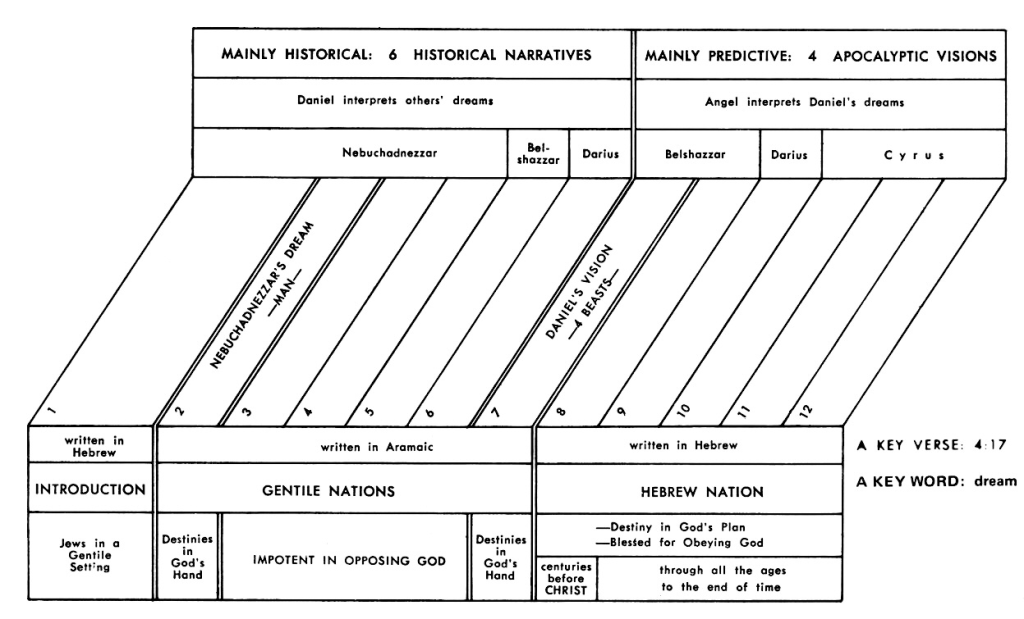
The Aramaic portion of Daniel clearly covers the “Times of the Gentiles,” while the Hebrew portions at the beginning and end devote more attention to what happens to Israel and the children of Israel in the midst of the nations. Aramaic was also the contemporary language of international business.

Canonical Place

When we use the word “canon” we’re talking about the books which were recognized [not “determined,” but “recognized”] as being inspired by God and they formed the group of books we call our Old and New Testaments.

In our English Bible (Septuagint, Vulgate and Luther), the book of Daniel appears as the last of the major prophets. Along with Ezekiel, Daniel wrote in the exilic period. In the Hebrew Bible Daniel is part of the Kethubim (the writings). The Jews call the Old Testament the Tanak, which is a word that consists of the T for Torah, the first five books of the Old Testament, what we often call the Pentateuch; the N stands for Neviim, the prophets, and the K stands for Kethubim. Daniel is part of the Kethubim, the writings.

Robert Dick Wilson believes that this is because Daniel was never called a “prophet” (navi, נָבִיא), but a “seer” (hozeh, חֹזֶה) and “wise man” (hakhamin, חַכִּימִ֣ין). J. B. Payne observes, “For though Christ spoke of Daniel’s function as prophetic (Matt. 24:15), his position was that of governmental official and inspired writer, rather than ministering prophet (cf. Acts 2:29-30)” (J. Barton Payne, “Book of Daniel,” Zondervan Pictorial Bible Dictionary, p. 198).

So why is Daniel placed in the Writings rather than in the Prophets for the Jews? This may be because Daniel’s prophetic messages do not confront the Jewish people with their sins, which was common among the Major and Minor Prophets. Also, the Masoretes may not have considered Daniel to be a prophet because there is no mention of his ordination or calling to be a prophet.

Major Divisions and Unity

The traditional division of the book of Daniel into two halves (1-6; 7-12) has usually been justified on the basis that the first six chapters are historical and the last six chapters are apocalyptic or predictive. There is much to commend this division which often also regards chapter 1 as introductory.

An alternative approach, recognizing the Aramaic section as being significant, divides the book into three major divisions: (1) Introduction, Daniel 1; (2) The Times of the Gentiles, presented in Aramaic, Daniel 2-7; (3) Israel in Relation to the Gentiles, in Hebrew, Daniel 8-12.
These two approaches are roughly the same.

Overview of the Book of Daniel

One of the things I like to do whenever I study or preach on a book of the Bible is to first look at the whole book and how it is organized and laid out, to get the “30,000 foot view” so that I can see the whole before examining the parts.

There are several good resources for this. The Bible Project has a video on YouTube and a chart that you can find on Google images, that is a good overview of the book.

Charles Swindoll has his book chart on his website Insight for Living. Philip Jensen has a book chart on the Precepts Austin website.

The book of Daniel is divided into two parts, the historical narratives of chapters 1-6 and the apocalyptic visions of chapters 7-12. In the first half, Daniel is interpreting the dreams or experiences of two Gentile kings, Nebuchadnezzar and Belshazzar. Darius is included chronologically in this section as the Medo-Persian empire conquered Babylon in 539 B.C. In the second half, it is Daniel’s visions that are interpreted by an angel. Again, chapters 2-7 are written in Aramaic, primarily because the history (both present and future history) covered in this part concerned Gentile empires, while chapters 8-12 are written in Hebrew because the history (both present and future history) concerns Israel.

The Key Verse

Some books have purpose statements, such as the gospel of John, “these are written that you may believe that Jesus is the Messiah, the Son of God, and that by believing you may have life in his name” (John 20:31). The Gospel of John was revealed to John by God’s Spirit for the express purpose of helping people believe in Jesus Christ as God’s Son and experiencing “life in his name.”

Likewise, the first epistle of John has an express purpose statement. 1 John 5:12 says, “I write these things to you who believe in the name of the Son of God so that you may know that you have eternal life.” The Gospel of John is written so that we may believe and the epistle of John is written so that believers “may know that you have eternal life. God wants us to have the assurance that we possess the very life He promised to give through His Son.

The book of Acts has verse that reveals the programmatic desires of Jesus for his church. In Acts 1:8 Jesus says, “But you will receive power when the Holy Spirit comes on you; and you will be my witnesses in Jerusalem, and in all Judea and Samaria, and to the ends of the earth.” As you follow the narrative of the book of Acts, you see that the gospel witness and the outpouring of the Holy Spirit begins in Jerusalem (Acts 2), but later expands into Judea-Samaria (Acts 8) and finally reaches to the Gentiles (Acts 10 and following).

Is there are similar verse for the book of Daniel? Well, there is not a clear and explicit purpose statement, but we can identify a verse which highlights a major theme of the book of Daniel—God’s sovereignty over the nations.

The key verse for the book of Daniel could very well be Daniel 4:17.

“‘The decision is announced by messengers, the holy ones declare the verdict, so that the living may know that the Most High is sovereign over all kingdoms on earth and gives them to anyone he wishes and sets over them the lowliest of people.’”

In this case God wanted Nebuchadnezzar to know that He, “the Most High,” “is sovereign over all kingdom on earth and gives them to anyone he wishes and sets over them the lowliest of people.” Nebuchadnezzar needed to realize that the power of Babylon did not depend upon Nebuchadnezzar himself but upon “the Most High” God of the Israelites. And as Israel read this, they would remember that they were “the lowliest of people” at this time and would have taken heart that God could reverse their misfortunes that they were presently experiencing. It would give them hope, as prophecy should give us hope, that God will fulfill all His promises for His people someday soon.

Introduction to the Book of Daniel, part 2

Well, today we are continuing our introduction the book of Daniel. We ended last week giving some historical background. The first part of Daniel takes place with Nebuchadnezzar king of Babylon and so we were talking about the beginning of the Neo-Babylonian empire.

Today we want to start by reminding ourselves of the nature of the place to which Daniel and his friends were taken. This was not a God-friendly place.

An article From Babel to Babylon on monergism.com., describes the anti-God nature of this city throughout history.

Not unlike Babel, Babylon stands for the corruption of human power, wealth, and influence. It represents the perversion of God’s creation, the exploitation of the weak and vulnerable, and the seduction of the nations by false gods. Babylon was notorious for its arrogance, wickedness, and cruelty. It was a center of pagan worship, characterized by sexual immorality, idolatry, and materialism. Babylon was a city that exalted itself above God and oppressed God’s people. It symbolizes the human tendency to use power for selfish purposes, to worship idols instead of God, and to oppress those who are weaker. (https://www.monergism.com/babel-babylon#:~:text=The%20biblical%20narrative%20of%20Babel,power%2C%20wealth%2C%20and%20influence.)

Babylon the Great, in the book of Revelation, is the culmination of human rebellion against God. It is a symbol of the world system that opposes Christ and His kingdom. It is a city that is drunk with the blood of the saints and the martyrs, that deceives the nations with her sorceries and seduces them with her wealth and power. Babylon the Great is a false bride who entices the world with her beauty and wealth, but who ultimately leads them to destruction. It is a warning against the seduction of the world and the dangers of compromise with the world’s values.

So Daniel and his three friends were entering into a culture that would challenge the foundations of their faith to the very core, down to their roots. Remaining faithful to Yahweh would prove to be very difficult and I’m sure that not every Hebrew youth rose to the challenge.
Not everything was negative, however, for Babylon was a wondrous sight to behold. As Daniel and his three friends were marched into Babylon they would see a spectacular city. Bryan Windle, in his Biblical Archeology article reports on the city Daniel saw (https://biblearchaeologyreport.com/2019/08/09/footsteps-three-things-in-babylon-daniel-likely-saw/).

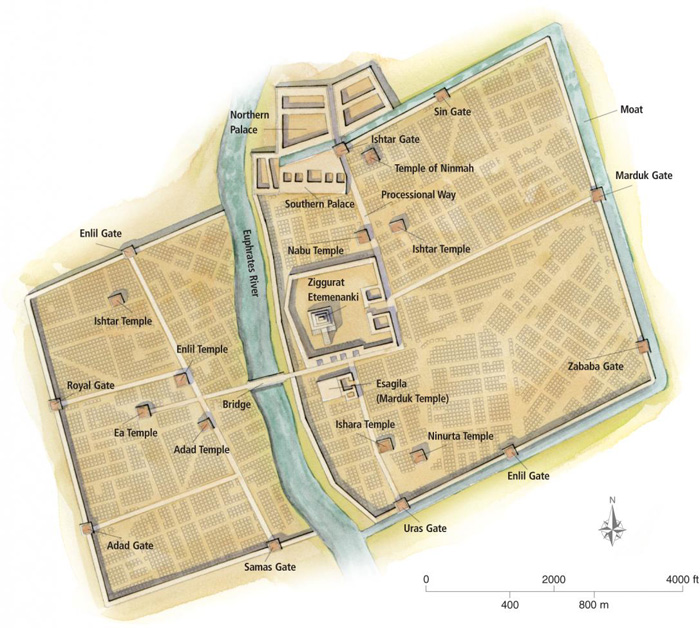
Nebuchadnezzar had initiated a vast building program and improved the city’s fortifications, raising its magnificence to new heights. At the time Daniel lived there, it was the largest city in the world, covering over 10 square kilometers (4 square miles).

A reconstruction of ancient Babylon, with the Etemenaki (stepped ziggurat) in the center, and the Esagila (Temple of Marduk) to the right of it. Image Credit: J.R. Casals / https://www.artstation.com/artwork/25NVv [tried to get permission]

Taken from the ESV® Study Bible (The Holy Bible, English Standard Version®), copyright ©2008 by Crossway, a publishing ministry of Good News Publishers. Used by permission. All rights reserved. For more information on how to cite this material, see permissions information here.
Daniel would have seen the grand palace of Nebuchadnezzar.

A panoramic view of the reconstructed Southern Palace of Nebuchadnezzar. Photo Credit: Osama Shukir Muhammed Amin FRCP(Glasg) / Wikimedia Commons / CC BY-SA 4.0

Here is a modern reconstruction of what Nebuchadnezzar’s palace would have looked like:

Screenshot from Pedersén’s virtual 3D model of Babylon, period of Nebuchadnezzar II (604-662 BCE) and Nabonidus (555-539 BCE). Overlooking south onto the Etemenanki Ziggurat from within the South Palace main courtyard, walls decorated with glazed bricks.

On the north side of the city Nebuchadnezzar had built the majestic Ishtar Gate.

The Ishtar Gate in Babylon. Photo Credit: Wikimedia Commons / Public Domain

It was one of eight double-gates that served as entrances to the city and stood over 12m (38 feet) high. The gate was finished around 575 BC, after Daniel had already been living in the city for many years. He no doubt watched its construction and marveled at its beauty.

Today, a reconstruction of the Ishtar Gate can be seen at the Pergamon Museum in Berlin. It is made out of materials excavated by Robert Koldewey in the early 1900’s.

A reconstruction of the Ishtar Gate at the Pergamon Museum in Berlin, Germany. Photo Credit: flickr photo by youngrobv / CC BY-NC 2.0

In Daniel 4:30, King Nebuchadnezzar boasts, “Is not this great Babylon, which I have built by my mighty power as a royal residence and for the glory of my majesty?” The archaeological record affirms the massive building campaigns of Nebuchadnezzar.

Who was Daniel?

Daniel was a young man (Daniel 1:4), likely around the age of 16, when he was taken captive in the first wave of deportations in 605 B.C. Could you imagine, at that young age, being ripped from your family, your home, your friends, your chances for work or education, not knowing what was going to happen next? You didn’t know if you would live or die. You didn’t know if you would spend the remainder of your life enslaved or in prison. There were a lot of unknowns, and as we know, into that vacuum of unknowns, fear and anxiety are frequent irritants.

He never saw his family, friends, or homeland again. But what matters most about Daniel’s life is how he remained faithful to God throughout his life, while living in a land where its inhabitants had not even heard of Jehovah. Daniel was considered to be a man of great integrity, classified along with Noah and Job in Ezekiel 14:14, 20 as key intercessors. In fact, like Joseph, not a single sin is attributed to Daniel. And the angel repeatedly calls him “greatly beloved.”

These three intercessors represent our battle against the world, the flesh and the devil. Job overcame the devil, Noah the world, and Daniel the flesh.

The name Daniel (dan-i-el) means “God is my judge,” a name that likely guided and guarded Daniel’s thinking and conduct as he realized that one day God would hold him accountable for how he lived his life. It is likely that Daniel was one of several young men who came from “the royal family and of the nobility” (Daniel 1:3).

No mention is made, specifically, of Daniel’s birthplace or family (other than being of the tribe of Judah, Daniel 1:3) and thus the Jewish Encyclopedia concludes “It is not known whether he belonged to the family of the King of Israel or to that of an Israelitish magnate.”

Josephus (“Ant.” x. 10, § 1) evidently inferred from Sanh. i. 3 that Daniel was a relation of King Zedekiah (ἧσαυ τῶυ ἐκ τοῦ Σεδεκίου γέυους τέσσαρες ), while Pseudo-Epiphanius, on the strength of the same passage, makes Daniel the scion of a noble Israelitish family (compare Prince, “Critical Commentary on the Book of Daniel,” p. 25).

According to rabbinical tradition Daniel was of royal descent; and his fate, together with that of his three friends, Hananiah, Mishael, and Azariah, was foretold by the prophet Isaiah to King Hezekiah in these words, “and they shall be eunuchs in the palace of the king of Babylon” (Isa. xxxix. 7; compare Sanh. 93b; Pirḳe R. El. lii.; Origen, commentary to Matt. xv. 5; Jerome, commentary to Isaiah, l.c.). Of course, we do not know for sure that they were eunuchs, although we never hear of their wives or children.

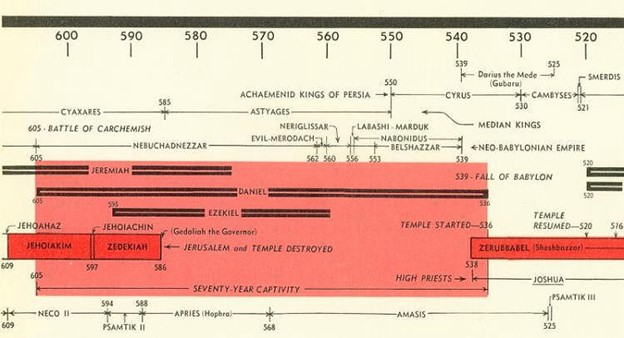
Daniel served under king Nebuchadnezzar (Daniel 1:19-20) all the way through the empire change and served King Cyrus (Daniel 1:21). Daniel bridges the entire 70 years of the Babylonian captivity (ca. 605–536 B.C.; cf. 1:1 and 9:1-3).

Daniel began his career about eighteen years before Jerusalem fell, and his last message was given after the Jews had returned to build again the temple (10:1.), covering a period of about 73 years from the year 607 to 534 B. C., then beyond that to the reign of Darius.

The most well-known event in the life of Daniel was his one-night stay in the den of lions under Darius. Today in the stands this depiction of a roaring lion (with wings, by the way).

https://www.worldhistory.org/image/724/lion-of-babylon-ishtar-gate/

This was one of 120 lions that lined the processional way into Nebuchadnezzar’s throne room and it dates to the exact time that Daniel was there in Babylon! He would have passed by these lions a number of times on his way to advise King Nebuchadnezzar. The glazed bricks remind us of the need for fiery furnaces needed to make the bricks. Daniel had been in Babylon 66 years and was 83 years old when he faced the lions.

The Book of Daniel

Date and Authorship

We will deal with who wrote the book and when because this issue has been debated by biblical scholars and historians. Was it written by Daniel in the 6th century B.C. or by someone else in the 2nd to 3rd century B.C.?

Conservative scholars have believed the book to be written by Daniel, taken captive by Nebuchadnezzar in 605 B.C. The record of events extends to the third year of Cyrus, 536 B.C., and, accordingly, covers a span of about seventy years. Daniel himself may well have lived on to about 530 B. C., and the book of Daniel was probably completed in the last decade of his life.

Although Daniel does not speak of himself in the first person until chapter 7, there is little question that the book presents Daniel as its author. This is assumed in the latter portion of the book and mentioned especially in 12:4. The use of the first person with the name Daniel is found repeatedly in the last half of the book (7:2, 15, 28; 8:1,15, 27; 9:2, 22; 10:2, 7, 11, 12; 12:5).

Important confirmation of the historicity of Daniel himself is found in three passages in Ezekiel (Eze 14:14, 20; 28:3), written after Daniel had assumed an important post in the king’s court at Babylon. Convincing also to conservative scholars is the reference to “Daniel the prophet” by Christ in the Olivet Discourse (Mt 24:15; Mk 13:14).

Except for the attack of the pagan Porphyry (third century A. D.), no question was raised concerning the traditional sixth century B. C. date, the authorship of Daniel the prophet, or the genuineness of the book until the rise of higher criticism in the seventeenth century, more than two thousand years after the book was written.

Higher criticism, totally humanistic and materialistic in its outlook, denies that Daniel could be the author because they want to deny the possibility of supernatural predictive prophecy and so the book had to be written later so that the prophecies related to Alexander the Great and the wars between the Ptolemies and the Seleucids would be a historical report rather than future events that were miraculously fulfilled by God’s sovereign plan.

Daniel wrote this book in the sixth century B.C. It records the events of Daniel’s life and the visions that he saw from the time of his exile in 605 B.C. (1:1) until 536 B.C., the third year of King Cyrus (10:1). Then it is Darius who consigned him to the den of lions (Dan. 6). So it is likely that Daniel finished this book around 520 B.C.

Ezekiel, Habakkuk, Jeremiah, and Zephaniah were Daniel’s prophetic contemporaries.

Jensen’s Survey of the Old Testament

Daniel is alluded to by the writer of Hebrews as one of “…the prophets: who through faith…stopped the mouths of lions” (Heb. 11:32-33).

Why do we believe that it was Daniel who wrote this book in the 6th century B. C., rather than some unnamed author in the 2nd century?

First, the book claims to be written by Daniel in Daniel 7:1 and 12:14.

In the first year of Belshazzar king of Babylon, Daniel saw a dream and visions of his head as he lay in his bed. Then he wrote down the dream and told the sum of the matter. (Dan. 7:1)

Second, Jesus attributed to Daniel the prophecy about the abomination of desolation (Dan. 12:11).

Jesus said, “You [will] see the abomination of desolation which was spoken of through Daniel the prophet” (Mt. 24:15).

Third, Ezekiel—a contemporary prophet—believed in a historical Daniel. Ezekiel lived in roughly 575 BC, and he explains that Daniel is a real and historical figure (Ezek. 14:14, 20; 28:3).

Fourth, Josephus—a first century Jewish and Roman historian—believed that Daniel was a prophet and a historical person. Josephus believed that the book of Daniel was shown to Alexander the Great, when he came to Jerusalem in 330 BC. Of course, Daniel predicted the life of Alexander the Great. So when he arrived in Jerusalem, the priests showed him these prophecies. Josephus writes,

\He (Alexander) came into the city; and when he went up into the temple, he offered sacrifice to God, according to the high priest’s direction, and magnificently treated both the high priest and the priests. And when the book of Daniel was showed to him, wherein Daniel declared that one of the Greeks should destroy the empire of the Persians, he supposed that himself was the person intended… The next day he called them to him, and had them ask what favors they pleased of him… (and) he granted all they desired.[4]

He did not destroy Jerusalem because of this.

Fifth, the author of 1 Maccabees believed Daniel was a historical person. In 1 Maccabees 2:59-61, we read, “Hananiah, Azariah, and Mishael had faith, and they were saved from the flames. Daniel was a man of integrity, and he was rescued from the lion’s jaws. So bear in mind how in the history of the generations no one who trusts in Heaven ever lacks strength.”

In context, Matthathias was writing about an event which took place in 167 BC. Therefore, to have written this, he must have already considered Daniel to be a historical figure. As Walvoord writes, “It is highly questionable whether the Jews living in the Maccabean period would have accepted Daniel if it had not had a previous history of canonicity” (Walvoord, John. Daniel: The Key to Prophetic Revelation, Introduction, 1989. See “Authorship”).

Sixth, 1 Enoch cites Daniel. When we compare 1 Enoch 14:18-22 with Daniel 7:9–10, we see striking similarities. 1 Enoch dates to roughly 150 BC.

Seventh, archaeological discoveries shows that Daniel faithfully described the sixth century world of Babylon.

  1. Daniel correctly distinguishes Susa and Elam.
    In Daniel 8:2, Daniel writes that he was “in the citadel of Susa, which is in the province of Elam.” Now, Susa was assigned to a new province in the Persian era. The territory of Elam was shrunk during this time, and Susa was assigned to a new territory of Susiana.
    It would have taken a 6th century inhabitant of Susa to know of this historical detail. A 2nd century author would have been out of date with this historical nuance. (Archer, Gleason L. A Survey of Old Testament Introduction: Revised and Expanded. Chicago, IL: Moody, 2007. 380).
  2. The existence of Belshazzar
    Prior to the middle of the 19th century, a Babylonian king named Belshazzar was unknown to history, allowing critics to question the historical accuracy of the book of Daniel. Ancient historians, such as Berosus and Abydenus recorded that Nabonidus was the last king of Babylon. Similarly, the Uruk King List omits Belshazzar, moving from Nabonidus to Cyrus.
    Things changed in 1854, when J.E. Taylor discovered four cylinders in the ruins of a ziggurat at Ur which contained a prayer of Nabonidus to the gods. The so-called Nabonidus Cylinders record:
    “As for me, Nabonidus, King of Babylon, save me from sinning against your great godhead and grant me as a present a life of long days, and as for Belshazzar, my oldest son my offspring, instill reverence for your great godhead in his heart and may he not commit any cultic mistake, may he be sated with a life of plentitude.”

One of the Nabonidus cylinders from Ur, which records Nabonidus’ renovations to the moon god, Sin’s, ziggurat, as well as a prayer for himself and his son Belshazzar. Photo: A.D. Riddle / Bibleplaces.com.

  1. Nabonidus Chronicle
    That very night Belshazzar the Chaldean king was killed. (Dan 5:30)
    The Babylonian Chronicle for the years 556 to 539 BC, also called the Nabonidus Chronicle, describes the final years of King Nabonidus’ reign and the fall of Babylon to Cyrus, king of Persia. It records:
    “When Cyrus did battle at Opis on the [bank of] the Tigris against the army of Akkad, the people of Akkad retreated. He carried off the plunder (and) slaughtered the people. On the fourteenth day Sippar was captured without a battle. Nabonidus fled. On the sixteenth day, Ugbaru, governor of Gutium, and the army of Cyrus, without battle they entered Babylon. Afterwards, after Nabonidus retreated, he was captured in Babylon…. On the third day of the month Arahsamna, Cyrus entered Babylon.” (iii, 12-18)

The Nabonidus Chronicle describes the final years of King Nabonidus’ reign and the fall of Babylon to the Persians. Photo: ChrisO / Wikimedia Commons / CC BY-SA 3.0

Moreover, William Shea has argued, based on other details in the text of the Nabonidus chronicle that the enigmatic “Darius the Mede” who became King of Babylon (Dan. 5:31) was none other than Ugbaru, the general of the army who captured the city. Thus, the historicity of Darius was verified.

  1. Dead Sea Scroll Fragments of Daniel
    “So when you see the abomination of desolation spoken of by the prophet Daniel, standing in the holy place…” (Mat 24:15)
    Many today would argue that the book of Daniel was composed sometime during the second century BC, after the prophecies related to the Seleucids and Maccabeans (Dan. 9-12), and not during the sixth century BC by the prophet himself. According to this theory, Daniel was written to encourage the Jewish people during the Maccabean period (ca. 168-165 BC). This late date is assumed largely on the basis of the presupposition of modern scholars that supernatural fore-telling of events is not possible.
    The fact that these copies are now known to exist shows us that already in the second century B. C. the book of Daniel was already composed, circulated and accepted as canonical.
    You might ask, why is this important—whether Daniel wrote the book or not, whether it communicates actual historical events from the 6th century B.C. or records apocryphal tales from the 2nd century?
    As James Hamilton puts it,
    There is a massive difference between the theological meaning of a wish-fantasy and that of a historically reliable account of God miraculously preserving someone alive in a fiery furnace. Dismissing a false fable as irrelevant to my conduct reflects my view of the theological meaning and value of fairy tales. Risking my life because I believe the stories result from convictions about theological meaning that cannot be separated from historicity. …
    If some Maccabean-era author is making fraudulent claims, if these are fictional deliverances and not future predictions but recitals of what has already happened presented as though being predicted by Daniel, then there is no real proof that Yahweh can either deliver from death or predict the future. This means there is no proof that he is any better than the false gods who can neither reveal the future nor deliver their worshippers, which is exactly what the book of Daniel claims Yahweh can do. …
    The whole theological meaning of the book depends upon Yahweh’s ability to deliver his people and declare the future before it takes place. If he cannot do these things, no one should “stand firm and take action” and risk his life for Yahweh (Dan. 11:32).

    J. M. Hamilton Jr., With the Clouds of Heaven: The Book of Daniel in Biblical Theology, New Studies in Biblical Theology 32 (Nottingham, England: Apollos, 2014), 31–32.

The Final Benediction, part 2 (Hebrews 13:21-25)

“Have you seen God at work lately?” is a wonderful question to ask your friends and family. One person replied, “I see Him at work as I read the Scriptures each morning; I see Him at work as He helps me face each new day; I see Him at work when I know that He has been with me every step of the way—I realize how He has helped me to face challenges while giving me joy.” I love his answer because it reflects how through God’s Word and the indwelling presence of the Holy Spirit, God stays near to, and works in, those who love Him.”

The writer of Hebrews ends his book with this wonderful benediction. A benediction is more powerful than a prayer because it confers upon the recipient a blessing. The difference is that a prayer or a doxology is from us to God, while a benediction is from God to us. In this case it is from an inspired author of Scripture to the congregation of the Hebrews and it talks about how God is at work in our lives.

“Now may the God of peace who brought again from the dead our Lord Jesus, the great shepherd of the sheep, by the blood of the eternal covenant, equip you with everything good that you may do his will, working in us that which is pleasing in his sight, through Jesus Christ, to whom be glory forever and ever. Amen” (Hebrews 13:20-21).

Verse 20 gives the foundation from which this blessing can be imparted—a God of peace, a powerful God who raised Jesus from the dead, a loving and tender shepherd who guides us and an eternal covenant which provides everything necessary for our spiritual life.

His basic sentence is “Now may the God of peace…equip you with everything good that you may do his will,” then adds by way of explaining the means, “working in us that which is pleasing in his sight, through Jesus Christ, to whom be glory forever and ever. Amen.”

What God will do is “equip” us. The Greek word here is καταρτίζω [katartizō], a word that means “to restore, put in order, mend, make complete or usable.” Doctors used it to refer to the setting of broken bones, putting them back into a condition of health. Fishermen spoke of mending a broken net. For sailors it meant to “outfit a ship for a voyage.” To soldiers it means to “equip the troops for battle.” Paul uses it in Galatians 6:1 regarding restoring a brother—that is, putting him back in place of spiritual health and usefulness. Peter experienced this in his own life. Jesus prayed for him, saying, ““Simon, Simon, behold, Satan demanded to have you, that he might sift you like wheat, but I have prayed for you that your faith may not fail. And when you have turned again, strengthen your brothers.” That repentance allowed Peter to return to usefulness and to be the one to strengthen his brothers.

In other words, God takes our brokenness and mistakes, God mends all the cracks and crevasses so that we are once again useful to Him. He equips us for service and battle. He does all this so that He can work in us and through us that which pleases Him and accomplishes His will.

The relevance of this closing benediction for the church on troubled seas is obvious: God can put you back together so you can do his will, no matter what. Can you hear the prayer as its benediction lingered over the beleaguered congregation with its sweet, healing hope?

Warren Wiersbe asks the practical question, “How does He equip us?” and then gives several tools that the New Testament says that God uses to bring us to maturity. “He uses the Word of God (2 Tim. 3:16-17) and prayer (1 Thess. 3:13) in the fellowship of the local church (Eph. 4:11-12). He also uses individual believers to equip us and mend us (Gal. 6:1). Finally, He uses suffering to perfect His children (1 Peter 5:10), and this relates to what we learned from Hebrews 12 about chastening” (The Wiersbe Bible Commentary: NT, p. 845).

Though false teachers had “varied and strange teachings” (Heb 13:9) that differed from each other, they all had the same goal: to alter “the faith which was once for all handed down to the saints” (Jude 1:3). To contend against these false teachers and to promote sound doctrine and right living, Jesus gave to the church gifted leaders–apostles, prophets, evangelists, pastors, and teachers. These leaders equip the church for ministry and help them grow into the image of Christ, so that they would no longer be children, “tossed here and there by waves and carried about by every wind of doctrine, by the trickery of men, by craftiness in deceitful scheming” (Eph 4:11-14). (Charles R. Swindoll, Swindoll’s Living Insights: Hebrews, 223)

Notice here in Hebrews 13:21 that God equips us “with everything good,” everything beneficial for the accomplishment of His purpose in our lives, which is to conform us to the image of His Son (Rom. 8:28-29).

The word “good” occurs two other times in Hebrews, all in the plural, referring to all that God has accomplished for believers in Christ Jesus. In Hebrews 9:11-12, the author, contrasting the work of Old Testament priest with Christ, says,

But when Christ appeared as a high priest of the good things that have come, then through the greater and more perfect tent (not made with hands, that is, not of this creation) he entered once for all into the holy places, not by means of the blood of goats and calves but by means of his own blood, thus securing an eternal redemption.

It seems clear that the “good things” in verse 11 refer to all the promises of the new covenant fulfilled in Christ.

Hebrews 10:1 defines “good things” in the same way, saying, “For since the law has but a shadow of the good things to come instead of the true form of these realities, it can never, by the same sacrifices that are continually offered every year, make perfect those who draw near.” The good things here also include the once for all sacrifice of Jesus (Hebrews 10:8-14).

Based on this understanding, the author of Hebrews prays that God would equip us with all good things, the precious promises and benefits of Christ in the gospel (Dieudonné Tamfu https://www.desiringgod.org/articles/how-to-please-a-holy-god).

The Apostle Paul, advocating that our justification occurs not through works, but through faith, nevertheless shows that God equips us to do good works in obedience to Him. “For we are his workmanship, created in Christ Jesus for good works, which God prepared beforehand, that we should walk in them” (Ephesians 2:10).

God is the God who both shows us his will and equips us to do it. He never gives us a task without also giving us the power to accomplish it. When God sends us out, he sends us equipped with everything we need. (William Barclay, The Daily Study Bible Series, Hebrews, 201)

The clause “to do His will” (εἰς τὸ ποιῆσαι τὸ θέλημα αὐτοῦ) is explicitly the purpose. The author’s prayer is that God make us complete for the purpose of doing his will. This is why God equips us “with everything good.” That equipping has a purpose and that purpose is that we “do His will.”
Now, the act “To do God’s will” is to be like Jesus, because He came to do God’s will (Heb. 10:7). This is a lifelong process that is never complete in this life. But the point here is that the same mighty power that raised Jesus from the dead equips us to do God’s will and to live for His glory.

Sam Storms draws out these implications:

What this means is that:

You don’t have to live any longer in unforgiveness. God can equip you with every good thought and affection and determination to do his will when it comes to forgiving those who have sinned against you.

You don’t have to live in bondage to lust. God can equip you with the strength to resist the temptation to look lustfully at another person.

You don’t have to live in bitterness and anger. God can equip you with power to recognize the countless blessings you have in Christ and free you from the habit of constantly berating your spouse or your children.

You don’t have to live in the clutches of pornography. God can equip you and empower you to turn off the computer. He can equip and empower you to set your sights and affections on the beauty of Christ in place of your infatuation with the allure of sexual immorality.

You don’t have to live in constant hatred and resentment of your spouse. No matter how deep the wounds may be, no matter how often he/she has berated you, God can equip and empower you to love as Christ has loved you.

Whatever God’s will is, the promise of his covenant with you in Christ is that he can equip you with everything good so that you might live in obedience to it.

The gift of God working in us can take us by surprise; perhaps we forgive someone who wrongs us or show patience to someone we find difficult.

God equips us to do His will “by working in us that which is pleasing in His sight.” Literally, we are told in v. 21 that God equips us to “do” his will by “doing” in us what pleases him. The words translated “do” and “doing” (or “working”) are the same in Greek. We “work” because God “works”. God is at work in us. Whatever we do in God’s will, it is God doing the doing. When we “do” his will it is because he is “doing” in us what is pleasing to himself. This “working in us” is a present participle, indicating that God is always “working in us.” We may not feel it or notice it right away, but He is constantly “working in us.”

Notice that God works from the inside out. This is not just external behavior modification, but a heart that desires above all else to please God. It is not image management, but new internal motivations. Remember that the promise of the New Covenant is: “I will put my law within them, and I will write it on their hearts” (Jeremiah 31:33). This is much like Philippians 2:12-13, “Work out your own salvation with fear and trembling.” But more importantly we are told why: “For it is God who works in you, both to will and to work for his good pleasure,” or “giving you the desire and power to do His good pleasure.

You are secure not because you are strong, but because God is sovereign and because God is faithful to his new covenant promises. “I will put My Spirit within you and cause you to walk in My statutes” (Ezekiel 36:27). All the exhortations to persevere in this book God will fulfil in those who are his.
Obedience to God’s will is His desire for our lives. It is not always easy, as Jesus proved when He struggled with God’s will at Gethsemane. Sometimes it is very costly and very difficult to do.

But our hearts now want to please God, to do what would bring Him pleasure. That is now our deepest desire. As John Piper says, “If we are able to please God — if we do his good pleasure — it is because the blood-bought grace of God has moved from mere equipping to omnipotent transforming” (https://www.desiringgod.org/articles/outfitted-and-empowered).

We know from Hebrews 11:6 that faith is what pleases God the most, believing in Him and His good promises and benefits.

We want to do what is pleasing “in his sight,” that is, in His estimation. As infants we begin life seeking above all to please ourselves, then we learn to please others. Unfortunately, we may never grow out of that desire to please others, to live in fear of what others think of us. Our greatest desire, however, should be to “play to an audience of One,” to seek to do what is “pleasing in His sight.”

Is it right and enough for God to be pleased mainly by his work in us and to commend us because of that? Yes, because he is doing so “through Jesus Christ” (Hebrews 13:21). God is just to commend us, not based on our performances, but on his performance for and in us. “For by a single offering he has perfected for all time those who are being sanctified” (Hebrews 10:14).

It is only “in Christ” and “through” our union to Him that we are able to do God’s will and do what is pleasing to Him. According to the famed Greek scholar Adolf Deissman, the term “in Christ” or “in Christ Jesus” occurs some 169 times in Paul’s writings. Perhaps the most famous of Paul’s “in Christ” statements is 2 Corinthians 5:17—“Therefore, if anyone is in Christ, he is a new creation. The old has passed away; behold, the new has come.”

None of the other gods work this way. If you want to have a relationship with any other god you have to do the work to please them. But the God of the Bible, through the sacrificial death of His Son, does everything needed for us to please Him and all we have to do is trust Him to do it through us. As we live out our union with Him by abiding in Jesus, then we can produce spiritual fruit (John 15:1-7).

Remember what Augustine prayed: “Command what you will, and give what you command.” We will do God’s will (obey His commands) only because He has equipped us with everything good to do that will.

God does it from beginning (justification) to end (glorification). He does this so that He will receive the “glory forever and ever. Amen.”

Our author closes this exhortation with these words:

22 I appeal to you, brothers, bear with my word of exhortation, for I have written to you briefly. 23 You should know that our brother Timothy has been released, with whom I shall see you if he comes soon. 24 Greet all your leaders and all the saints. Those who come from Italy send you greetings. 25 Grace be with all of you.

Notice that he says two things about his letter to them. First, he calls it “my word of exhortation” and second, he says it is “brief.” The Greek noun paraklasis (“exhortation”) means imploration, entreaty, admonition, encouragement, consolation, comfort, and solace. In other words, he has hoped that his readers will receive and take to heart and apply to their lives what he has taught them.

This expression designates what we call a sermon (cf. Acts 13:15): a spoken exposition and application of Scripture, such as those offered in first-century synagogues or Christian congregations (Acts 13:15; 1 Tim. 4:13). Through his sermon, our author has brought exhortation, as he had urged his hearers to persevere in their trust in Jesus Christ alone for their salvation, not returning to the Jewish religious system.

His mention of Timothy in verse 23 shows that the writer composed this epistle during the lifetime of “Timothy” and after some confinement that Timothy had experienced. By this news the author shows that he too remembers those in prison (10:34; 13:3). Evidently the writer and Timothy were close associates in the Lord’s work. This is the same Timothy who was a co-worker with Paul. Our writer’s hope is to come “see you,” which was a typical hope that Paul expressed to the recipients of his epistles.

The exchange of greetings between a letter’s author and those with him, on the one hand, and its recipients, on the other, is customary in NT correspondence. Here our author gives precedence to “all your leaders,” reinforcing their authority, in case some in the congregation still fail to accord them the respect their office warrants (Heb. 13:17). He then greets “all the saints,” expressing inclusivity and reinforcing their unity (cf. Phil. 1:1; 4:21).

“Those who come from Italy,” who were with the author and asked him to convey their greetings, might be people residing in Italy. But the ESV is probably correct: with the author are believers who now sojourn as expatriates away from Italy and wish to send greetings home. Perhaps they were exiled when Emperor Claudius banned Jews from the imperial capital (AD 49), as Aquila and his wife Priscilla had been (Acts 28:2).

The closing benediction, though similar to many others in the NT, is filled with meaning because of the rich exposition of grace throughout this sermon-letter. This is a fitting end for a book that documents the passing of the Old Covenant and the institution of the New Covenant.

Our preacher has used “grace” (charis) to identify God’s undeserved favor that:

• ordained the redemptive plan in which Christ “[tasted] death” for all his brothers (2:9);
• flows from God’s throne of grace to give us timely help (4:16);
• characterizes the Spirit of God (10:19);
• epitomizes believers’ final inheritance and the means by which they reach it (12:15);
• strengthens hearts through faith in Christ’s priestly mediation (13:9).

Hebrews shows God’s grace with us in other ways. God acknowledges as sons and leads to glory (2:10) those who required purification of their consciences. This could be achieved only by the blood of Christ, shed to redeem us from the transgressions committed under the first covenant (9:13-15). Though once excluded from his presence by our defiance and defilement, we can now draw near in confident assurance of his welcome (10:19-22). We are receiving a kingdom that cannot be shaken, and this gift from God makes us grateful and eager to offer worship that pleases him (12:28). Amid the dangers of our earthly pilgrimage, we have the promise of his constant presence and strong protection: “I will never leave you nor forsake you” (13:5). God’s grace is indeed with us.

The Final Benediction, part 1 (Hebrews 13:20)

Do you find it difficult to do God’s will? Do the commands of the New Testament seem daunting to you? G. K. Chesterton, turn of the century British author, Roman Catholic, and journalist, once famously said: “Christianity has not so much been tried and found wanting, as it has been found difficult and left untried.”

Admittedly, forgiving our enemies, keeping ourselves holy…these are not easy things to do. Are we really expected to keep all the commands and exhortations that we find sprinkled throughout the Bible?

But the reality is that God has not left us to rely only upon our own strength and resources to be able to do what He has asked. In fact, let me quote yet another person who has saying to say about this, St. Augustine. In his spiritual autobiography, entitled The Confessions, Augustine says to God: “Command what you will, and give what you command.”

This is precisely the genius of the New Covenant. Whereas with the Mosaic Covenant there were commands but no inner Holy Spirit. Now, God has given us “everything we need for life and godliness” (2 Pet. 1:3). God not only encourages us, but He equips us.

In Philippians 2:12-13 Paul gives us this formula for spiritual life: “Therefore, my beloved, as you have always obeyed, so now, not only as in my presence but much more in my absence, work out your own salvation with fear and trembling, for it is God who works in you, both to will and to work for his good pleasure.”

These two verses give us both sides of the equation: we work out what God is working in us. Notice verse 12 says “work out your salvation,” (not “for” your salvation) and we do this because “it is God who works in you.” And what does He do? He gives us the desire (the will) and the power (to work) so that we can live a life that is pleasing to Him.

Notice that God’s work always comes first. He takes the initiative and we respond. He acts and then we act. “We love because He first loved us” (1 John 4:19). So we can get up and get to work because we have the confidence that God has already been at work in us, equipping us that we “may do his will, working in us that which is pleasing in his sight” (Heb. 13:21).

This is why our author ends this book with a benediction. A benediction is literally a “good word,” a pronouncement of blessing upon someone. There are as many as 30 benedictions scattered throughout the New Testament. The original benediction is the Aaronic blessing, found in Numbers 6:24-26.

24 The Lord bless you and keep you;
25 the Lord make his face to shine upon you and be gracious to you;
26 the Lord lift up his countenance upon you and give you peace.

Benedictions in the New Testament are brief declarations of God’s blessings upon his loved ones, and are often found at the end of epistles. They are intended to bring comfort, peace, joy, and security to those who trust in God. Many Christian worship services conclude with a benediction. Pastors have the privilege of announcing, prayerfully, divine blessings on the people of God as they scatter from the place of corporate worship.

Benedictions pack more weight than a petitioner’s requests. They confer benefit through a minister authorized to speak from and for God.

The book of Hebrews closes with one of the most exquisite and soaring of all Scriptural benedictions. Multiple millions of worshipers have been dismissed with the pastor’s upraised hand and the sonorous words that begin, “Now may the God of peace . . .”

The whole benediction reads, “Now may the God of peace who brought again from the dead our Lord Jesus, the great shepherd of the sheep, by the blood of the eternal covenant, equip you with everything good that you may do his will, working in us that which is pleasing in his sight, through Jesus Christ, to whom be glory forever and ever. Amen” (Hebrews 13:20-21).

This benediction is requesting God’s help in staying on track in the Christian life—doing God’s will and being pleasing to Him—but it based upon what God offers to us (peace) by the blood of the cross. So verse 20 gives the foundation upon which the blessing in verse 21 is requested. Their ability to continue on living for God is based upon God’s attributes of peace, power (by raising Christ from the dead), loving and tender care (as a great shepherd) and ever giving grace (through the blood of the eternal covenant). This benediction seems to draw together the major themes of Hebrews: peace, the resurrected Christ, the blood, the covenant, spiritual perfection (maturity) and God’s work in the believer.

The first foundational gift is God’s peace. How necessary this peace is. We are born enemies of God, alienated from Him because of our sin and rebellion (Rom. 5:10; Eph. 2:12, 19; 4:18), but God has “brought us near” because “ he himself is our peace” (Eph. 2:12-13). He is the one who has reconciled us to God (Rom. 5:10; 2 Cor. 5:18-19). God is called “the God of peace” at least five other times in the New Testament (Romans 15:33; 16:20; 2 Corinthians 13:11; Philippians 4:9; 1 Thessalonians 5:23). Perhaps the frequency of this expression is attributable to the influence of the Aaronic blessing, which closes, “The LORD lift up his countenance upon you and give you peace” (Num. 6:26). These citations, along with the opening invocation of our text, “Now may the God of peace,” reference two marvelous aspects of that peace.

First, it points to His own divine tranquility—the eternal calmness of God’s essential being. This means that God is totally at harmony within Himself and in relation to the Trinity and all He has made. God the Father is called the “God of peace” (Hebrews 13:20). God the Son, the “Prince of peace” (Isaiah 9:6). God the Holy Ghost, the “Spirit…of peace” (Ephesians 4:3).

John MacArthur says, “God is at all times at perfect peace, without any discord within Himself. He is never under stress, worried, anxious, fearful, unsure, or threatened. He is always perfectly calm, tranquil, and content. There are no surprises for His omniscience, no changes for His immutability, no threats to His sovereignty, no doubts to cloud His wisdom, no sin to stain His holiness. Even His wrath is clear, controlled, calm, and confident” (1 and 2 Thessalonians, p. 313).

The Hebrew word shalom means so much more than merely an absence of conflict. It means completeness, wholeness, harmony.

Jesus Christ is the “Prince of Peace” and only through him can we find the “peace that goes beyond understanding.” (Isaiah 9:6, Philippians 4:7).

And that leads us to the second aspect of God’s peace. God can share His peace with us. He gives it to us as a gift. “My peace I give to you” Jesus says in John 14:27. In that vein, there is a distinction between “peace with God” and experiencing the “peace of God.” “Peace with God” is the objective reality that we as former enemies have become, through the cross and belief in Jesus Christ, reconciled to God and now are His friends. This “peace treaty” with God is an objective, one-time experience. Once established, it remains.

The ”peace of God” is the subjective calmness and tranquility we experience whenever we remind ourselves that God is with us, that God loves us and that God is on our side and we need to be reestablished in the “peace of God” time and time again, whenever we face new trials and difficulties. This peace is what Jesus is talking about in John 14:27, “Peace I leave with you; my peace I give to you. Not as the world gives do I give to you. Let not your hearts be troubled, neither let them be afraid.” The normal fears and anxieties of life disappear when we are experiencing God’s peace. Notice that this is a peace that Jesus gives to us and leaves with us even though He would be leaving this earth. It is not a peace like the world gives—shallow and short-lived—but a peace that dwells deep within and sustains us through the storms.

“God took the initiative to establish peace with rebellious men, and He is the author of both personal peace as well as peace among men,” said Matthew Henry.

“Peace with God” precedes experiencing the “peace of God.” In other words, our status with God must change—from enemies alienated from all that He is and has for us, to friends now enabled to receive everything He has for us—before our inner peace can be experienced. All who are God’s children have “peace with God” and can experience the “peace of God” if we fully rely upon Him and His promises.

Invoking God as “the God of peace” is parallel to Jeremiah 29:11, which reads literally, “‘For I know the plans I am planning for you,’ declares the Lord, ‘plans for shalom and not for calamity, to give you a future and a hope’” (based on NASB). Significantly, this promise of shalom was given to God’s covenant people at the beginning of the Babylonian captivity when it appeared that the seas of the Gentile world had inundated God’s people for good.

Therefore, the title “the God of peace” at the end of Hebrews comes as a consciously appropriate benediction to fearful, restless hearts—“Your God is a God of peace, and he will pick up the pieces no matter what happens—he will heal your wounds and fulfill what is lacking. No storm will sink you! So hang in there!”

It is this “God of peace” that is now bestowing these precious blessings upon the Hebrew Christians and us today.

Secondly, we see that God is a powerful, life-giving God. He proved when He “brought again from the dead our Lord Jesus.” Surprisingly enough, this is the first and only mention in the book of Hebrews of the resurrection of Jesus. Yes, He is spoken of as “ever living” and having an “indestructible life,” both of which point to the fact of the resurrection, but this is the only mention of Him being raised from the dead.

Of course, Jesus Himself raised Himself up from the dead, as He says in John 10: “For this reason the Father loves me, because I lay down my life that I may take it up again. No one takes it from me, but I lay it down of my own accord. I have authority to lay it down, and I have authority to take it up again. This charge I have received from my Father” (Johnn 10:17-18).

Here it is again in John 5:21-22: “As the Father raises the dead and gives them life, so also the Son gives life to whom he will. For the Father . . . has given all judgment to the Son.” So the Son has authority to raise from the dead whomever he will, including himself. So Jesus says in John 2:19: “Destroy this temple, and in three days I will raise it up.” And John adds, “He was speaking about the temple of his body” (John 2:21). Destroy this body, and in three days, I will raise it up. And he did.

But God also “brought again from the dead our Lord Jesus” (cf. 1 Pet. 1:3; Acts 2:32-33; Rom. 8:11). This was the Father’s stamp of approval on all that Jesus had accomplished through the cross. Jesus said, “Paid in full; it is finished.” The Father showed that it was finished by reversing death and bringing the Innocent One back to life. The significance of this is that “The resurrection of Christ is the Amen of all His promises.” This means that everything God has promised He will now provide.
Hebrews has built its case for Jesus’ perpetual tenure as High Priest, in part, on the “power of [his] indestructible life” (Heb. 7:16), so that “he always lives to make intercession” for believers (7:25). Now, at last, our author explicitly announces Jesus’ resurrection, when God “brought [him] again from the dead.”

As he has previously, our author builds anticipation by reserving the Savior’s name for the end of the clause (in Greek word order): “who brought again from the dead the great shepherd of the sheep by the blood of the eternal covenant, our Lord Jesus” (cf. 2:9; 3:1; 4:14; 7:22; 12:2, 24). Thus, the name of Jesus concludes the description of the divine subject who blesses (13:20), and reappears to conclude the blessing he confers (13:21).

“Brought again” (or “led up,” anagō) is an unusual verb for resurrection (cf. Rom. 10:7), reflecting the influence of Isaiah 63:11, which reads in the LXX, “who brought up [anabibazō] from the earth the shepherd of the sheep.” In the exodus, the shepherd was Moses (cf. Psa. 77:20) and the rescue was from the sea; now the great shepherd, Jesus, has been “led up” from the realm of the dead.
And this leads us to the third foundational truth which establishes this benediction with theological weight to carry our obedience to Christ…He is our loving and sacrificial shepherd.

The shepherd metaphor is one of the most spiritually humbling in all of God’s Word. It reveals volumes about us (the sheep) and about the Lord (our Shepherd). As to our “sheepness,” Dr. Bob Smith, long-time philosophy professor at Bethel College in Minnesota, used to humor his point home regarding our human state by insisting that the existence of sheep is prima facie evidence against evolution. Sheep are so unintelligent and obtuse and defenseless, they could not have possibly evolved—the only way they could have survived is with shepherds!

We may gripe and complain about being called sheep, but we cannot but greatly appreciate that Jesus took up the term shepherd and applied it to himself (cf. Mark 14:27). Jesus’ shepherd heart welled with compassion, for Mark tells us, “When he went ashore he saw a great crowd, and he had compassion on them, because they were like sheep without a shepherd” (Mark 6:34).

Even more, Jesus identified himself as the shepherd who would lay down his life to protect his sheep (John 10:1-18; cf. Ezek. 34:1-24; 1 Pet. 2:25; 5:4). This image of Christ comes from Psalm 23, where the Lord God is the Shepherd who provides for His sheep (Ps 23:1), nourishes and refreshes them (Ps 23:2-3), and protects them from their enemies (Ps 23:5; see also Jn 10:11-15). This association between Jesus as “our Lord” and as the “great Shepherd” is a final strong affirmation of the deity of Christ. (Charles R. Swindoll, Swindoll’s Living Insights: Hebrews, 228)

But here our writer tells us that he is not only a “good shepherd”—he is also “the great shepherd of the sheep.” Why? Precisely because he is a risen Shepherd—“brought [back] again from the dead.” As the great risen Shepherd, his compassion and protection are mediated from a position of an unparalleled display of power! He, our Shepherd, is exalted at the right hand of the Father. All other shepherds pale by comparison. There is none like our “great shepherd.” Our risen Shepherd lives not only to give us life, but to tend us so that we will be sheep who bring him glory through our obedience and living a life pleasing to Him. This means that our grandest spiritual desires are never audacious and that any spiritual aspirations less than the loftiest are not grand enough. What security and what challenge the fact of our risen “great shepherd” brings to our souls.

Warren Wiersbe reminds us that “as the Good Sheperd, Jesus Christ died for the sheep (John 10:11). As the Great Shepherd, He lives for the sheep in heaven today, working on their behalf. As the Chief Shepherd, He will come for the sheep at His return (1 Pet. 5:4)” (The Wiersbe Bible Commentary: NT, p. 845). As the Good Shepherd He worked for us when He completed the great work of redemption (John 17:4). Now that He is in heaven, He is working in us to mature us in His will.

Fourthly, our God is a covenant keeping God, and sealed that covenant with the blood of His one and only Son.

Moses sprinkled the “blood of the covenant” on the Israelites at Sinai (Heb. 9:20, citing Exod. 24:8), but they broke that covenant, and Jeremiah 31:31-34 pronounced it “obsolete” (Heb. 8:13). The new covenant, which Jesus’ blood inaugurates, secures our everlasting salvation, fulfilling God’s promises to establish an “eternal covenant” with his people (2 Sam. 23:5; Isa. 55:3; 61:8; Jere. 32:40; 50:5; Ezek. 16:59-60; 37:26).

“Specifically, the foundation for our highest dreams is the everlasting, unbreakable new covenant promise earlier quoted in 8:10 where God says, “I will put my laws into their minds, and write them on their hearts, and I will be their God, and they shall be my people” (cf. Jeremiah 31:31–34). The promise is nothing less than a renewed heart and a personal relationship with God through the atoning work of God the Son and the indwelling of God the Holy Spirit. We have his word for it that all this is ours if we come to him!

“And this covenant, this promise, is eternal. It will never be replaced by another as it once replaced the old covenant. It was established by the blood of the ultimate Lamb of God, whose atoning death was ratified and verified by his resurrection. The writer’s friends were being encouraged to remember that whatever came, no matter how high the seas, his new covenant promise would never change or fail. The eternal covenant granted them eternal life” (R. Kent Hughes, Hebrews: An Anchor for the Soul, Volume 2, p. 244).

Every time we partake of the Lord’s Supper we remind ourselves of this eternal covenant. On the night he was betrayed Jesus broke the bread and distributed the cup as a sign of the new and eternal covenant that his blood would inaugurate and establish: “This cup that is poured out for you is the new covenant in my blood” (Luke 22:20; see 1 Cor. 11:25). How can we know with absolute certainty and assurance that God will keep his word in the new and eternal covenant to forgive our sins and be our God and never leave us or forsake us? We can know because the covenant was signed, sealed, established, and delivered on the foundation of the blood of God’s very own, dear Son Jesus Christ.

They Keep Watch Over Your Souls, part 2 (Hebrews 13:18-19)

Last week we talked about the obedience and submission that congregations owe to their spiritual leaders: “Obey your leaders and submit to them, for they are keeping watch over your souls, as those who will have to give an account. Let them do this with joy and not with groaning, for that would be of no advantage to you” (Heb. 13:17).

But that is not all we owe our leaders. Verses 18-19

18 Pray for us, for we are sure that we have a clear conscience, desiring to act honorably in all things. 19 I urge you the more earnestly to do this in order that I may be restored to you the sooner.
If we don’t pray for our leaders, they will certainly be preyed upon. Satan would like nothing more than to destroy the lives and testimonies of our spiritual leaders and he seems to be having a field day lately.

Jesus told Peter, “Simon, Simon, behold, Satan demanded to have you, that he might sift you like wheat, but I have prayed for you that your faith may not fail. And when you have turned again, strengthen your brothers” (Luke 22:31-32).

Peter didn’t know how vulnerable he was to Satan’s attacks and most of us are not vigilant enough to successfully avoid his deceptions and temptations. The only way that Peter survived this ordeal and didn’t end his life like Judas did, is because Jesus prayed for him. That same thing may be true for any pastor today: Unless people are praying for you, you will fall and fail. The situation is that precarious. If you don’t want to see your pastor fall, then be praying for him.

Fortunately, we know that both the Son (Romans 8:34) and the Holy Spirit (Romans 8:26) are constantly interceding for us—that is one of our assurances that we will persevere to the end and be saved. But we need the intercession of other believers to help us from falling into particular sins or making grievous mistakes in ministry. We need others praying for us and to know that they are praying for us.

If Apostles needed the prayers of the churches, how much more ordinary ministers! “Brethren, pray for us.” (John Brown, Geneva Series Commentaries: Hebrews, 713) Charles Spurgeon indicated that the success of his ministry was not really due to his own giftedness or earnestness, but the prayers of his congregation.

Spurgeon was a19th-century English preacher and pastor of the New Park Street Chapel in London, England, later named the Metropolitan Tabernacle.\

The church held 5,000 people. With no sound system, it was said that his voice could be heard by all.

A group of young ministers called on him one day to see the large preaching place. After showing them his massive sanctuary, Spurgeon offered to show then his “boiler room.” The guests declined but the pastor insisted.

Spurgeon led them to the basement. They found about 100 people in prayer. “This,” Spurgeon said with a smile, “is my boiler room.” Whenever Spurgeon was asked the secret of his ministry he always replied, “My people pray for me.”

The thought occurred to me: “Wouldn’t it be wonderful if every church had a boiler room; an asking place in the building where people would seek the will of God.

Nothing warms a preacher’s heart more than to have a faithful member say, “Reverend, I want you to know that I pray for you.”

Thus, Mark Labberton says, “I’m convinced that the dynamic life of the congregation I serve is explained by God’s grace answering the humble prayers of ordinary believers who seek God’s blessing for all we do. That is the story of power and prayer. I am utterly dependent on the way the prayers of such saints have changed my life and ministry. I think the same is true of our whole church. We are what we are by the grace of God at work through the prayers of these saints who lean on God for our sake and for the sake of all we long to see happen in our ministry, both locally and globally” (Mark Labberton, The Dangerous Act of Worship, 129).

So our author asks his hearers to pray for him, as Paul often does as well (Rom. 15:30-32; Eph. 6:19-20; Col. 4:3-4; 1 Thess. 5:25; cf. Phil. 1:19). Paul knew that if he was not prayed for, he would be preyed upon. The world, the flesh and the devil are our constant enemies, seeking to bring us down. Again, seeing how many pastors have fallen just in the past five years is a warning to us to keep our pastors in our prayers.

The reason that our writer wanted his readers to pray for him is because “we are sure that we have a clear conscience, desiring to act honorably in all things.” Previously the “cleansing” (katharizō) of our consciences by the blood of Christ referred to the objective result of forgiveness, which immediately removes defilement and disqualification to approach God’s presence. Now, however, a (lit.) “good [kalos] conscience” reflects the subjective transformation God’s grace produces in believers’ motivations and desires over time.

I think this first of all points back to all that he has communicated to these Hebrew Christians, saying that his conscience is clear in all that he has written—it was done with honorable intentions and for their good.

The writer’s conscience is clear because he has performed well in his spiritual duties toward his friends. His conscience has made him confident toward both men and God. Similarly, Paul could write, “For our boast is this, the testimony of our conscience, that we behaved in the world with simplicity and godly sincerity, not by earthly wisdom but by the grace of God, and supremely so toward you” (2 Corinthians 1:12). And, “By the open statement of the truth we would commend ourselves to everyone’s conscience in the sight of God” (2 Corinthians 4:2). What a blessing a clear conscience is! When the conscience is clear, one can ask wholeheartedly for the prayers of all the saints.

Likely this refers to the warnings that he has given his readers. Like Ezekiel, who was a watchman for old covenant Israel, the author of Hebrews was tasked with encouraging his audience away from apostasy and with telling them what would happen if they abandoned the Lord (see Ezek. 3:16-21). Having fulfilled that role with this letter, the author and his fellow workers could rest, knowing that they had done their duty.

But I also think he is wanting their prayers so that he could continue to live with a good conscience. It not only points back to previous ministry but forward to potential ministry. He doesn’t just want to preach the gospel to them; he wants a life that’s lived in line with the gospel. He knows how important it is to practice what he preaches. He knows that he needs the gospel preached to himself every day and asks that they would pray that he could live in line with that gospel.

Paul David Tripp has written a book entitled Dangerous Calling, which is written to pastors with the realization that we can go through the routines of ministry without having a genuine, deep relationship with the God we proclaim. In other words, in the words of John Piper, we have become “professionals.” In that book Brothers, We are Not Professionals, Piper writes:

We pastors are being killed by the professionalizing of the pastoral ministry … Professionalism has nothing to do with the essence and heart of the Christian ministry. The more professional we long to be, the more spiritual death we will leave in our wake. For there is no professional childlikeness (Matt. 18:3); there is no professional tenderheartedness (Eph. 4:32); there is no professional panting after God (Ps. 42:1).

Professionals can stand apart from a congregation and speak dispassionately. A true pastor cannot. A true pastor gets personal. A true pastor is real before his congregation. A true pastor practices what he preaches. A true pastor knows that the most important thing he can give to his congregation is a holy life. A true pastor knows that he deeply needs the prayers of his congregation in order to live faithfully before them.

God’s leaders face temptations that most other believers do not face to the same degree, because Satan knows that, if he can undermine the leaders, many others will go down with them. If he can get them to compromise, to weaken their stand, to lessen their efforts, to become dejected and hopeless, he has caused the work of Christ great damage.

Paul did not hesitate to ask for prayer. “Pray on my behalf, that utterance may be given to me in the opening of my mouth, to make known with boldness the mystery of the gospel” (Eph. 6:19). How much more do God’s ordinary ministers need the prayer of their people. (John MacArthur Jr., The MacArthur NT Commentary: Hebrews, 448). If the apostle Paul was that aware of his need for prayer, how much more the rest of us who attempt to serve the Lord! As Paul exclaimed, “Who is adequate for these things?” (2 Cor. 2:16).

Our author’s request honors his hearers, implying that they have the priestly privilege of access to God’s throne of grace (Heb. 4:14-16). He wants them to realize how vital this is for his success in ministry and in life. Maintaining a good conscience means that he can confidently stand before the judgment seat knowing that he will be rewarded for the “gold, silver and precious stones” with which he has built his ministry.

The verb “pray” is present tense, showing that our writer recognizes his need for their prayers constantly, not just occasionally. It also graciously indicates that he knew that they had already been praying for him. Notice also that he asks pray for “us.” Up until now Paul has sometimes placed himself in the same status as his readers, but he is probably referring to Timothy, who may be able to come with him when he next visits (Heb. 13:23).

Also, the fact that he asks them to pray for him indicates that not all of them had apostatized. He hardly would have asked for prayer from them if he knew that all of them were unbelievers. No, he was confident that at least some of his readers would persevere, so he turned to them for spiritual assistance. His readers, in turn, were to pray for him and his fellow workers, believing that God just might allow the author to visit them sooner. After all, we know that prayers do much in the purposes of God, and through our prayers He often works out His will (James 5:13-18).

Our writer makes one simple request, “that I may be restored to you the sooner” (v. 19). This is why he wanted them to “more earnestly” (v. 19). Like the Apostle Paul, he loved his followers so much that he longed to be with them. This shows his great affection for them. He wanted to see them face to face and have fellowship together. If they fail to pray, his return to them may be slowed or possibly never take place. But if they pray, he expects that their prayers will speed his restoration.
Some obstacle stood in Paul’s way; some difficulty blocked his path. We don’t know if it was a health problem, persecution and imprisonment or something else. Possibly some critics voiced the idea, “If he really cared for us, we would have seen his face by now!” But the author’s heart was to visit them, and so he asks them to pray.

His request shows that God is bigger than any circumstance we face, and that prayer is our means of laying hold of God’s power. Prayer is not just a polite gesture that shows brotherly concern. God has ordained prayer as one of the ways that He pours out His power and blessing on His people. Prayer shows us that we are not competent people who just need a little boost from God now and then. We are totally inadequate, unless He works, and He has chosen to work through our prayers. If more people prayed more regularly for their pastors, maybe there would be fewer church splits and fewer people leaving churches over petty matters, fewer pastors quitting. (adapted from Steve Cole’s sermon Your Duties Toward Church Leaders).

As far as the writer to the Hebrews was concerned their prayers determined if and when he is reunited with them. This shows how seriously he regarded their prayers for him and how important prayer is as a secondary cause of God’s will being enacted. God is sovereign, but prayer makes things possible that otherwise would not be possible. (John MacArthur Jr., The MacArthur NT Commentary: Hebrews, 449)

He knows that if the readers pray for him, the bond of unity between himself and the recipients of his letter is strengthened. And if they pray, they indicate that the message he conveys has been well received. (William Hendriksen & Simon J. Kistemaker, NT Commentary: Hebrews, 428)

His desire to be “restored” to them implies that he had previously ministered among them. This explains his detailed knowledge of their previous experience (Heb. 6:9-10; 10:32-34). Like other NT authors, he prefers ministry offered in person to written correspondence (Gal. 4:18-20; 3 John 1-14). He has urged them to encourage each other daily as they meet together (Heb. 3:14; 10:24-25), and he is eager to join them in that interaction. In the second cycle of closing news he will indicate that Timothy may accompany him “if he comes soon” (13:23), reemphasizing his sense of urgency to return to them “soon.”

A. W. Pink reminds us pastors: “If ministers desire the prayers of their people, then let them see to it that they are not backward in praying for those God has committed to their charge. This is an essential part of the minister’s functions. It is not sufficient that he faithfully preaches the Word: he must also fervently and frequently ask God to bless that Word unto those who have heard him. O that all who are called to the sacred office may feelingly exclaim “God forbid that I should sin against the Lord in ceasing to pray for you” (1 Sam. 12:23). (Arthur W. Pink, An Exposition of Hebrews, 1265-6)

If you want to hear a better sermon Sunday, then pray for your pastor throughout the week. R. Kent Hughes encourages us: “How different the modern church would be if the majority of its people prayed for its pastors and lay leadership. There would be supernatural suspensions of business-as-usual worship. There would be times of inexplicable visitations from the Holy Spirit. More lay people would come to grips with the deeper issues of life. The leadership vacuum would evaporate. There would be more conversions. (R. Kent Hughes, Preaching the Word: Hebrews, vol. 2, 239)

This passage emphasizes the mutual ministry between the pastor/preacher and the congregation. For the pastor to be able to remain faithful in his life and ministry he vitally depends upon the prayers of the people. This is the body image that Paul expounds upon and to which the author of Hebrews frequently alludes. So Philip Ryken says:

The metaphor of the church as a body is employed by the NT to represent both our union with Christ and mutual dependence: “The eye cannot say to the hand, ‘I have no need of you’” (1 Cor 12:21). We need each other: “We, who are many, are one body in Christ, and individually members one of another” (Rom 12:5). We need each other’s gifts (Eph 4:11-16; 1 Cor 12-14; Rom 12). We need each other’s graces (as in the many “one anothers” found throughout the NT: love one another, be kind to one another, bear one another’s burdens, etc.). We need each other’s fellowship. So we are warned, “Let us consider how to stimulate one another to love and good deeds, not forsaking our own assembling together.” The writer to the Hebrews sees the public assembly as the primary place in which the mutual stimulation to “love and good deeds” takes place: “Not forsaking our own assembling together, as is the habit of some, but encouraging one another, and all the more as you see the day drawing near” (Heb 10:24-25). (Philip Graham Ryken, Give Praise to God A Vision for Reforming Worship, 330-1)

The simple truth is that we need each other. We are not independent titans who can conquer the world on our own, but a band of brothers who together, each fulfilling our God-given roles with the gifts God has graciously given to us, can accomplish great things together.

On one of his visits to the Continent, Charles Spurgeon met an American minister who said, “I have long wished to see you, Mr. Spurgeon, and to put one or two simple questions to you. In our country there are many opinions as to the secret of your great influence. Would you be good enough to give me your own point of view?” After a moment’s pause, Spurgeon replied, “My people pray for me” (in Iain Murray, The Forgotten Spurgeon [Banner of Truth], p. 44). Maybe we should listen to him.

Remember: Your pastor, if you won’t pray for him, he will be preyed upon. Satan would love to discourage him, to make him fall, to bring about some moral failure, because Satan knows, the bigger they are, the harder they fall, and more people fall in their wake. In other words, if your pastor falls, many people will be disillusioned. Of course, to be disillusioned, that means that they had to have the illusion to begin with that their pastor was a superman who could never fall. So pray for your pastor, pray diligently, pray earnestly for him.

Stick with Jesus, part 2 (Hebrews 13:11-16)

All throughout the book of Hebrews the author has been warning, encouraging and pleading with these Jewish Christians not to abandon their faith in Jesus and return back to the Jewish religious system with its sacrifices. The passage we have before us today refers back to those sacrifices, particularly the Day of Atonement (Yom Kippur) and the point is made that since that sacrifice happened “outside the camp” (v. 11), then we are to “go to [Jesus] outside the camp and bear the reproach he endured” (v. 13).

11 For the bodies of those animals whose blood is brought into the holy places by the high priest as a sacrifice for sin are burned outside the camp. 12 So Jesus also suffered outside the gate in order to sanctify the people through his own blood. 13 Therefore let us go to him outside the camp and bear the reproach he endured. 14 For here we have no lasting city, but we seek the city that is to come. 15 Through him then let us continually offer up a sacrifice of praise to God, that is, the fruit of lips that acknowledge his name. 16 Do not neglect to do good and to share what you have, for such sacrifices are pleasing to God.

The imagery shifts from the perennial peace offerings to the annual Day of Atonement sacrifices, when the high priest entered the Most Holy Place, carrying blood to atone first for his own sins and then for the sins of the people (9:7, 25). This annual rite has been contrasted with the self-sacrifice of Christ, who brought his own blood into the heavenly sanctuary, atoning for sins once for all (9:24-28; 10:10-14).

Now our attention is directed to what happened to the carcasses of the animals after their blood was brought into God’s presence. Whereas the meat of peace offerings could be consumed by priests and worshipers after the Lord’s best portions were consumed on the altar, on the Day of Atonement the whole bull and goat from which atoning blood had been taken were carried outside Israel’s camp and completely incinerated. They were destroyed “outside the camp,” the realm of what was unclean, unfit to be seen by the Lord, who “walks in the midst of your camp” (Deut. 23:14; cf. also Lev. 13:45-46; Num. 5:1-4).

The bodies of Nadab and Abihu, the sons of Aaron, were taken outside the camp after they were judged and killed for offering up strange fire on the altar. If someone blasphemed God they were stoned outside the camp (Lev. 24:14, 23). When Miriam, the sister of Moses, was stricken with leprosy, she had to spend seven days outside the camp (Num. 12:14ff.). After the sins of the people were symbolically laid on the head of the scapegoat it had to be taken outside the camp (Lev. 16).
Eventually Jerusalem itself was considered holy ground. Everything beyond its borders was considered unholy or profane. Golgotha, where Jesus was crucified, was considered outside the city.

Golgotha site photographed in about 1870.

The association of territory “outside the camp” with defilement and banishment from God’s holy presence explains the theological significance of the fact that Jesus was crucified “outside the gate” of Jerusalem (cf. John 19:16-17). He endured God’s wrath as he bore others’ sin in his body on the tree (Matt. 27:46; Rom. 3:24-25; 1 Pet. 2:24). By bearing our guilt and absorbing its penalty, this “holy, innocent, unstained” High Priest (Heb. 7:26) endured sin’s curse (2 Cor. 5:21; Gal. 3:13) and thereby “sanctified” all believers by his blood. Throughout this sermon, “sanctify” (hagiazō; Heb. 2:11; 10:10, 14), “cleanse” (katharizō; 9:14, 23), and “perfect” (teleioō; 7:19; 9:9; 101, 14) have designated the purging from defilement that now qualifies worshipers to approach God’s holy presence.

Jesus’ sacrifice sanctifies his people so that they may respond to divine grace with thankful and reverent worship (12:28), standing in God’s presence as priests and offering sacrifices pleasing to him (13:15-16).

Our author is communicating two great things: (1) All those who remained committed to the old Jewish system were excluded from the benefit of partaking of Christ’s atoning death. And, (2) Jesus’ death outside the camp means that he is accessible to anyone in the world who will come to him.
Jesus’ crucifixion outside Jerusalem represented not only his forsakenness by God but also his repudiation by the Jewish community, “his own” people (Mark 15:9-15, 29-32; John 1:11; Acts 3:13-15). Jesus bore “our reproach” (v. 13).

When he says that Jesus died “outside the city,” he means He died outside Judaism. The Lord was utterly rejected by Israel. Judaism didn’t want Him. He was taken OUTSIDE and crucified–as if He were refuse. Therefore, His death was totally outside the Jewish system; utterly removed from it. (C. S. Lovett, Lovett’s Lights on Hebrews, 331)

Jesus did faithfully prepare his disciples to endure the same rejection he had endured (Luke 6:22; John 16:2), and indeed they were rejected (John 9:22, 33; 12:42; Acts 18:5-7). To follow after Jesus is to carry one’s cross toward shameful death (Mark 8:23; Heb. 12:2). Now the recipients of this letter must be prepared to share the reproach that Jesus endured, just as Moses did long ago (Heb. 11:24-26). To join Jesus “outside the camp” may demand that one forgo access to the Jerusalem temple, acceptance in local synagogues, and acknowledgment by one’s own family (Matt. 10:35-38).
For the Christian there must be a real identification with Christ and his shame; he must enter into a genuine “fellowship of Christ’s sufferings (Phil 3:10), and be willing even, like the first martyr Stephen, to lay down his life for his Lord and Savior “outside the city” (Acts 7:58). The recipients of this letter had gone forth “outside the camp” to associate themselves with Christ and his cross; but now their resolve is weakening and they are being tempted to turn back in the hope of finding an easier and more respectable existence “inside the camp.” (Philip Edgcumbe Hughes, A Commentary on the Epistle to the Hebrews, 580)

There was and even is today a price to be paid in following Jesus which the Jews of that age did not have to bear. But as Jesus was despised, so would be His disciples. The question is: Are we willing to pay the price?

Spurgeon said: “A sorry life your Master had, you see. All the filth in earth’s kennels was thrown at him by sacrilegious hands. No epithet was thought coarse enough; no terms hard enough; he was the song of the drunkard, and they that sat in the gate spoke against him. This was the reproach of Christ; and we are not to marvel if we bear as much. ‘Well,’ says one, ‘I will not be a Christian if I am to bear that.’ Skulk back, then, you coward, to your own damnation; but oh! Men that love God, and who seek after the eternal reward, I pray you do not shrink from this cross. You must bear it.”
Pursuing Jesus “outside the camp” comes at a price.

Yet one OT passage foreshadows the privilege now enjoyed by those who go “outside the camp” for Jesus’ sake. After Israel’s adultery with the golden calf, the Israelites’ defilement was so pervasive that Moses had to pitch the tent of meeting “outside the camp” (Exod. 33:7-11). That became the place where people went to meet with God. Because of institutional Judaism’s repudiation of the Messiah, the spheres of the holy community and the polluted wasteland have been reversed. Those unwelcome in earthly Jerusalem’s temple and expelled from synagogues have become heirs of God’s unshakable kingdom and citizens of “the city that is to come.” Admittedly, “here we [followers of Jesus] have no lasting city.” But within a few years, in AD 70, Roman troops would destroy Jerusalem and its temple on Mount Zion. That city, which the psalmists had extolled for its security (Psalm 48, 87), would lie in ruins. When compared to the promise of being welcomed into the coming city that abides forever, to be expelled from a community that has turned its back on God’s grace in Christ is no great loss.

There thus remains only one thing to do, and so the writer exhorts us: “Therefore let us go to him outside the camp and bear the reproach he endured. For here we have no lasting city, but we seek the city that is to come” (vv. 13, 14). Guthrie sees verse 13 as the crux of the conclusion, a final direct appeal to the readers to identify themselves wholly with Christ.” In other words, he says, “Christians, join Jesus in his sufferings!”

The cities of the earth—all earthly institutions—will fall apart. Only the heavenly Zion will remain. We must go, flee to him outside the camp, and willfully embrace his “reproach,” for such an act is worth doing a million times over! Thus Jesus Christ, who is “the same yesterday and today and forever,” becomes our constant meal—our food, our drink, our life—and we will receive from him grace upon grace upon grace. And because he is outside the camp, he will always be accessible. In fact, he is with us, in us, and coming to us! This understanding that he nourishes us and is accessible to us will help us stay on course.

The good news is that for those who bear His reproach, this world is the worst they will ever have it. The best is yet to come! But for cowards who turn their back on Jesus, this life is the absolute best they will ever have it.

May we not say, too, that the Son who invites us to join him “outside the camp” himself first left the “camp” of heaven, which is the true and abiding camp and to which he returned in triumph; and that he came to our unholy ground for the purpose of removing the defilement of his people and for the consecration and renewal of the whole creation, so that in the eternity of his glorious kingdom all will be one “camp,” one “city,” without blemish and without bounds, because there will no longer be any such things as unholy territory, and the harmony of heaven and earth, of God and man, will be established forevermore? (Philip Edgcumbe Hughes, A Commentary on the Epistle to the Hebrews, 582-3)

Christ went outside the city gate and suffered. We must go after him, and to him. This means we have to relinquish all the privileges of the camp and the city for his sake. We have to leave them behind and go to him. We must cling by faith to his sacrifice and through this sanctification, in place of all the sacrifices of the law. We must own him under all that reproach and contempt that were heaped on him during his suffering outside the gate. We must not be ashamed of the cross of Christ. (John Owen, Crossway Classic Commentaries: Hebrews, 264)

It was time for Jewish Christians to declare their loyalty to Christ above any other loyalty, to choose to follow the Messiah whatever suffering that might entail, to “go out to him outside the camp.” They needed to move outside the safe confinement of their past, their traditions, and their ceremonies to live for Christ. Since Jesus was rejected by Judaism, they should reject Judaism. (Bruce Barton, Life Application Bible Commentary: Hebrews, 238)

First, to the Hebrews to whom this letter was addressed, they are being told that as long as they remain within old covenant Judaism they cannot eat at the altar of God’s grace in Jesus Christ. They must leave the old covenant and embrace the new covenant. If they are to share in the salvation that Christ has obtained they must renounce their trust and confidence in the sacrifices and rituals of the old covenant system and put their hope and trust in Jesus Christ who is himself the fulfillment of all that came before. They must sever themselves from the now outmoded Mosaic system and cleave unto Christ in whom that system has been fulfilled. Don’t look to the priesthood of Aaron. Don’t put your hope in the feasts and rituals of the old covenant. Put your trust entirely in him to whom all such religious practices pointed: Jesus!

Second, we are also being called to share in the reproach that Jesus endured (v. 13). Today we don’t have a literal “camp” or “city” outside of which we are to go. So the “camp” must represent or symbolize something else for us. I think it points to everything we regard as safe and secure and respectable. To go “outside the camp” is to move beyond the comfort and acceptance that this world offers us. Inside the camp, inside the city gates, is where we find familiarity and ease and affirmation and respect from this world and its value system. To follow Jesus outside the camp is to embrace and bear the shame and reproach he suffered. To join Jesus outside the camp is to willingly identify with him in his suffering and to move out among the lost and unbelieving people of this world. It’s only outside the camp that we will find the unreached people of the world.

And the only thing that makes this a reasonable thing to do is the simple but glorious truth stated in v. 14. There we read that we do this “because” here “we have no lasting city, but we seek the city that is to come” (v. 14). We can joyfully embrace the reproach that Jesus himself endured because we are looking for the city to come, the heavenly Jerusalem that God has prepared for his people who trust him and put their hope in him.

Perhaps the Jews were trying to entice the Hebrew Christians back into the Jewish fold by saying, “We have Jerusalem, but you have no such glorious city!” The author says, “Oh, but we do have a city! Ours is the same city that Abraham and the patriarchs were seeking, that heavenly city that God prepared for them and us” (11:13-16). After 70 A.D. these Jews would no longer be able to claim Jerusalem for themselves.

The religious leaders clung to the city of Jerusalem and cast Jesus from it. They surely did not realize that within a short span of some forty years the city of Jerusalem and the temple they trusted in would be totally destroyed. On the Temple Mount platform there would not be one stone left standing upon another exactly according to Jesus’ words in Matthew 24:2.

This concept of a heavenly city and heavenly reward is something we’ve seen repeatedly in Hebrews. Do you recall in Hebrews 10:34 that Christians are described as having “joyfully accepted the plundering” of their property because they knew they “had a better possession and an abiding one”? They were seeking a city that is to come; a city that has foundations; the eternal and heavenly Jerusalem on the new earth. Knowing this was theirs, they gladly suffered for the sake of aiding and supporting other Christians. It was a permanent possession that could never be taken away from them.

We saw it in Hebrews 11:25-26 where Moses “refused to be called the son of Pharaoh’s daughter, choosing rather to be mistreated with the people of God than to enjoy the fleeting pleasures of sin. He considered the reproach of Christ greater wealth than the treasures of Egypt, for he was looking to the reward.” The reward is the heavenly Jerusalem, the place of God’s eternal dwelling with his people on the new earth.

And what is to be our response to this pursuit of Christ into a life with pain and suffering?

15 Through him [Jesus] then let us continually offer up a sacrifice of praise to God, that is, the fruit of lips that acknowledge his name. 16 Do not neglect to do good and to share what you have, for such sacrifices are pleasing to God.

Verse 15 says it is a life of praise to God — real, heartfelt, verbal praise — the kind that comes out of your mouth as the fruit and overflow of your heart.

In ancient days some Jewish rabbis believed that the time would come when all sacrifices would cease and instead there would be praises. Also, the First Century Jewish writer Philo spoke of a time when the best sacrifice would be the ones glorifying God with hymns. Indeed, in Psalm 50:23 it is written: “The one who offers thanksgiving as his sacrifice glorifies me, to the one who orders his way righty, I will show the salvation of God.”

Scholars feel the “fruit of lips” is taken from Hosea 14:2. In the Hebrew of this verse it reads literally “the young bulls of our lips” (par-im se-fa-te-nu). Praise is indeed like a sacrifice, that costs us something.

When our author refers to this worship as a “sacrifice,” it is an analogy that we’ve seen Paul and Peter use (Romans 12:2; 1 Peter 2:9). Under the New Covenant the sacrifices are no longer physical, but spiritual—the praise of our lips to the God who saved us.

In the words of Warren Wiersbe, “The words of praise from our lips, coming from our heart, are like beautiful frit laid on the altar” (The Wiersbe Bible Commentqry: New Testament, p. 844).
So we are to offer sacrifices…sacrifices of praise. This exhortation can only rightly be exercised “through him,” that is, through Jesus. It is only because of Him and what He has done for us that we have something to praise God for.

It is praise “to God,” certainly not to ourselves. We did absolutely nothing to deserve or gain our salvation. And this praise is to be “continuous,” why? Because of all that God has done for us through Christ. As we noticed in 12:28, worship is always our most natural response to our redemption. Praise, therefore, should be our constant habit. There should hardly be a moment when our lips are not trembling with praise for how kindly and graciously and tenderly and mercifully our God has dealt with us through His Son Jesus Christ.

This praise is further clarified as “the fruit of lips that acknowledge his name,” that is praise that publicly affirms our trust in Jesus Christ, acknowledging Him as our Savior and Lord.
The second response we should have toward our redemption in Christ is to love one another, a theme that began in verse 1, but here it is spelled out in very practical terms.

16 Do not neglect to do good and to share what you have, for such sacrifices are pleasing to God.

These works of “doing good” and “sharing what you have” would likely include the hospitality mentioned in Hebrews 13:2, as well as the ministry to prisoners in Hebrews 13:3. “Doing good” today can include a number of ministries: sharing food with the needy, transporting people to and from church or medical appointments, contributing to needy causes; perhaps just being a helpful neighbor.

Our highest aspiration as those being “conformed” to the image of Jesus, is to live a life that is “pleasing to God.” In my mind, pleasing God goes a step beyond obeying God. We obey the explicit commands or prohibitions of God, while we please God by knowing His heart well enough to know not so much what He demands, but what He desires.

When we go with Jesus to the place of his sacrifice outside the camp, we see more clearly than ever that his sacrifice for us — the sacrifice of himself, once for all for sinners (Hebrews 9:26, 28) — brings to an end all sacrifices except for two kinds: the sacrifice of praise to God (verse 15) and the sacrifice of love to people (verse 16).

Jim Elliot, Pete Fleming, Ed McCully, Nate Saint, and Roger Youderian were killed on January, 1956, in Ecuador, moving toward the need of the Auca Indians and not toward comfort.

Shortly before their deaths on Palm Beach they sang this hymn. Elliot writes,
At the close of their prayers the five men sang one of their favorite hymns, “We Rest on Thee,” to the stirring tune of “Finlandia.” Jim and Ed had sung this hymn since college days and knew the verses by heart. On the last verse their voices rang out with deep conviction.

We rest on Thee, our Shield and our Defender,
Thine is the battle, Thine shall be the praise,
When passing through the gates of pearly splendor
Victors, we rest with Thee through endless days.

With that confidence, they went to Jesus outside the camp. They moved toward need, not comfort, and they died. And Jim Elliot’s credo proved true: “He is no fool to give what he cannot keep to gain what he cannot lose.” “Here we do not have a lasting city, but we are seeking the city which is to come” (Hebrews 13:14).

Stick with Jesus, part 2 (Hebrews 13:11-16)

All throughout the book of Hebrews the author has been warning, encouraging and pleading with these Jewish Christians not to abandon their faith in Jesus and return back to the Jewish religious system with its sacrifices. The passage we have before us today refers back to those sacrifices, particularly the Day of Atonement (Yom Kippur) and the point is made that since that sacrifice happened “outside the camp” (v. 11), then we are to “go to [Jesus] outside the camp and bear the reproach he endured” (v. 13).

11 For the bodies of those animals whose blood is brought into the holy places by the high priest as a sacrifice for sin are burned outside the camp. 12 So Jesus also suffered outside the gate in order to sanctify the people through his own blood. 13 Therefore let us go to him outside the camp and bear the reproach he endured. 14 For here we have no lasting city, but we seek the city that is to come. 15 Through him then let us continually offer up a sacrifice of praise to God, that is, the fruit of lips that acknowledge his name. 16 Do not neglect to do good and to share what you have, for such sacrifices are pleasing to God.

The imagery shifts from the perennial peace offerings to the annual Day of Atonement sacrifices, when the high priest entered the Most Holy Place, carrying blood to atone first for his own sins and then for the sins of the people (9:7, 25). This annual rite has been contrasted with the self-sacrifice of Christ, who brought his own blood into the heavenly sanctuary, atoning for sins once for all (9:24-28; 10:10-14).

Now our attention is directed to what happened to the carcasses of the animals after their blood was brought into God’s presence. Whereas the meat of peace offerings could be consumed by priests and worshipers after the Lord’s best portions were consumed on the altar, on the Day of Atonement the whole bull and goat from which atoning blood had been taken were carried outside Israel’s camp and completely incinerated. They were destroyed “outside the camp,” the realm of what was unclean, unfit to be seen by the Lord, who “walks in the midst of your camp” (Deut. 23:14; cf. also Lev. 13:45-46; Num. 5:1-4).

The bodies of Nadab and Abihu, the sons of Aaron, were taken outside the camp after they were judged and killed for offering up strange fire on the altar. If someone blasphemed God they were stoned outside the camp (Lev. 24:14, 23). When Miriam, the sister of Moses, was stricken with leprosy, she had to spend seven days outside the camp (Num. 12:14ff.). After the sins of the people were symbolically laid on the head of the scapegoat it had to be taken outside the camp (Lev. 16).

Eventually Jerusalem itself was considered holy ground. Everything beyond its borders was considered unholy or profane. Golgotha, where Jesus was crucified, was considered outside the city.

Golgotha site photographed in about 1870.

The association of territory “outside the camp” with defilement and banishment from God’s holy presence explains the theological significance of the fact that Jesus was crucified “outside the gate” of Jerusalem (cf. John 19:16-17). He endured God’s wrath as he bore others’ sin in his body on the tree (Matt. 27:46; Rom. 3:24-25; 1 Pet. 2:24). By bearing our guilt and absorbing its penalty, this “holy, innocent, unstained” High Priest (Heb. 7:26) endured sin’s curse (2 Cor. 5:21; Gal. 3:13) and thereby “sanctified” all believers by his blood. Throughout this sermon, “sanctify” (hagiazō; Heb. 2:11; 10:10, 14), “cleanse” (katharizō; 9:14, 23), and “perfect” (teleioō; 7:19; 9:9; 101, 14) have designated the purging from defilement that now qualifies worshipers to approach God’s holy presence.

Jesus’ sacrifice sanctifies his people so that they may respond to divine grace with thankful and reverent worship (12:28), standing in God’s presence as priests and offering sacrifices pleasing to him (13:15-16).

Our author is communicating two great things: (1) All those who remained committed to the old Jewish system were excluded from the benefit of partaking of Christ’s atoning death. And, (2) Jesus’ death outside the camp means that he is accessible to anyone in the world who will come to him.
Jesus’ crucifixion outside Jerusalem represented not only his forsakenness by God but also his repudiation by the Jewish community, “his own” people (Mark 15:9-15, 29-32; John 1:11; Acts 3:13-15). Jesus bore “our reproach” (v. 13).

When he says that Jesus died “outside the city,” he means He died outside Judaism. The Lord was utterly rejected by Israel. Judaism didn’t want Him. He was taken OUTSIDE and crucified–as if He were refuse. Therefore, His death was totally outside the Jewish system; utterly removed from it. (C. S. Lovett, Lovett’s Lights on Hebrews, 331)

Jesus did faithfully prepare his disciples to endure the same rejection he had endured (Luke 6:22; John 16:2), and indeed they were rejected (John 9:22, 33; 12:42; Acts 18:5-7). To follow after Jesus is to carry one’s cross toward shameful death (Mark 8:23; Heb. 12:2). Now the recipients of this letter must be prepared to share the reproach that Jesus endured, just as Moses did long ago (Heb. 11:24-26). To join Jesus “outside the camp” may demand that one forgo access to the Jerusalem temple, acceptance in local synagogues, and acknowledgment by one’s own family (Matt. 10:35-38).

For the Christian there must be a real identification with Christ and his shame; he must enter into a genuine “fellowship of Christ’s sufferings (Phil 3:10), and be willing even, like the first martyr Stephen, to lay down his life for his Lord and Savior “outside the city” (Acts 7:58). The recipients of this letter had gone forth “outside the camp” to associate themselves with Christ and his cross; but now their resolve is weakening and they are being tempted to turn back in the hope of finding an easier and more respectable existence “inside the camp.” (Philip Edgcumbe Hughes, A Commentary on the Epistle to the Hebrews, 580)

There was and even is today a price to be paid in following Jesus which the Jews of that age did not have to bear. But as Jesus was despised, so would be His disciples. The question is: Are we willing to pay the price?

Spurgeon said: “A sorry life your Master had, you see. All the filth in earth’s kennels was thrown at him by sacrilegious hands. No epithet was thought coarse enough; no terms hard enough; he was the song of the drunkard, and they that sat in the gate spoke against him. This was the reproach of Christ; and we are not to marvel if we bear as much. ‘Well,’ says one, ‘I will not be a Christian if I am to bear that.’ Skulk back, then, you coward, to your own damnation; but oh! Men that love God, and who seek after the eternal reward, I pray you do not shrink from this cross. You must bear it.”
Pursuing Jesus “outside the camp” comes at a price.

Yet one OT passage foreshadows the privilege now enjoyed by those who go “outside the camp” for Jesus’ sake. After Israel’s adultery with the golden calf, the Israelites’ defilement was so pervasive that Moses had to pitch the tent of meeting “outside the camp” (Exod. 33:7-11). That became the place where people went to meet with God. Because of institutional Judaism’s repudiation of the Messiah, the spheres of the holy community and the polluted wasteland have been reversed. Those unwelcome in earthly Jerusalem’s temple and expelled from synagogues have become heirs of God’s unshakable kingdom and citizens of “the city that is to come.” Admittedly, “here we [followers of Jesus] have no lasting city.” But within a few years, in AD 70, Roman troops would destroy Jerusalem and its temple on Mount Zion. That city, which the psalmists had extolled for its security (Psalm 48, 87), would lie in ruins. When compared to the promise of being welcomed into the coming city that abides forever, to be expelled from a community that has turned its back on God’s grace in Christ is no great loss.

There thus remains only one thing to do, and so the writer exhorts us: “Therefore let us go to him outside the camp and bear the reproach he endured. For here we have no lasting city, but we seek the city that is to come” (vv. 13, 14). Guthrie sees verse 13 as the crux of the conclusion, a final direct appeal to the readers to identify themselves wholly with Christ.” In other words, he says, “Christians, join Jesus in his sufferings!”

The cities of the earth—all earthly institutions—will fall apart. Only the heavenly Zion will remain. We must go, flee to him outside the camp, and willfully embrace his “reproach,” for such an act is worth doing a million times over! Thus Jesus Christ, who is “the same yesterday and today and forever,” becomes our constant meal—our food, our drink, our life—and we will receive from him grace upon grace upon grace. And because he is outside the camp, he will always be accessible. In fact, he is with us, in us, and coming to us! This understanding that he nourishes us and is accessible to us will help us stay on course.

The good news is that for those who bear His reproach, this world is the worst they will ever have it. The best is yet to come! But for cowards who turn their back on Jesus, this life is the absolute best they will ever have it.

May we not say, too, that the Son who invites us to join him “outside the camp” himself first left the “camp” of heaven, which is the true and abiding camp and to which he returned in triumph; and that he came to our unholy ground for the purpose of removing the defilement of his people and for the consecration and renewal of the whole creation, so that in the eternity of his glorious kingdom all will be one “camp,” one “city,” without blemish and without bounds, because there will no longer be any such things as unholy territory, and the harmony of heaven and earth, of God and man, will be established forevermore? (Philip Edgcumbe Hughes, A Commentary on the Epistle to the Hebrews, 582-3)

Christ went outside the city gate and suffered. We must go after him, and to him. This means we have to relinquish all the privileges of the camp and the city for his sake. We have to leave them behind and go to him. We must cling by faith to his sacrifice and through this sanctification, in place of all the sacrifices of the law. We must own him under all that reproach and contempt that were heaped on him during his suffering outside the gate. We must not be ashamed of the cross of Christ. (John Owen, Crossway Classic Commentaries: Hebrews, 264)

It was time for Jewish Christians to declare their loyalty to Christ above any other loyalty, to choose to follow the Messiah whatever suffering that might entail, to “go out to him outside the camp.” They needed to move outside the safe confinement of their past, their traditions, and their ceremonies to live for Christ. Since Jesus was rejected by Judaism, they should reject Judaism. (Bruce Barton, Life Application Bible Commentary: Hebrews, 238)

First, to the Hebrews to whom this letter was addressed, they are being told that as long as they remain within old covenant Judaism they cannot eat at the altar of God’s grace in Jesus Christ. They must leave the old covenant and embrace the new covenant. If they are to share in the salvation that Christ has obtained they must renounce their trust and confidence in the sacrifices and rituals of the old covenant system and put their hope and trust in Jesus Christ who is himself the fulfillment of all that came before. They must sever themselves from the now outmoded Mosaic system and cleave unto Christ in whom that system has been fulfilled. Don’t look to the priesthood of Aaron. Don’t put your hope in the feasts and rituals of the old covenant. Put your trust entirely in him to whom all such religious practices pointed: Jesus!

Second, we are also being called to share in the reproach that Jesus endured (v. 13). Today we don’t have a literal “camp” or “city” outside of which we are to go. So the “camp” must represent or symbolize something else for us. I think it points to everything we regard as safe and secure and respectable. To go “outside the camp” is to move beyond the comfort and acceptance that this world offers us. Inside the camp, inside the city gates, is where we find familiarity and ease and affirmation and respect from this world and its value system. To follow Jesus outside the camp is to embrace and bear the shame and reproach he suffered. To join Jesus outside the camp is to willingly identify with him in his suffering and to move out among the lost and unbelieving people of this world. It’s only outside the camp that we will find the unreached people of the world.

And the only thing that makes this a reasonable thing to do is the simple but glorious truth stated in v. 14. There we read that we do this “because” here “we have no lasting city, but we seek the city that is to come” (v. 14). We can joyfully embrace the reproach that Jesus himself endured because we are looking for the city to come, the heavenly Jerusalem that God has prepared for his people who trust him and put their hope in him.

Perhaps the Jews were trying to entice the Hebrew Christians back into the Jewish fold by saying, “We have Jerusalem, but you have no such glorious city!” The author says, “Oh, but we do have a city! Ours is the same city that Abraham and the patriarchs were seeking, that heavenly city that God prepared for them and us” (11:13-16). After 70 A.D. these Jews would no longer be able to claim Jerusalem for themselves.

The religious leaders clung to the city of Jerusalem and cast Jesus from it. They surely did not realize that within a short span of some forty years the city of Jerusalem and the temple they trusted in would be totally destroyed. On the Temple Mount platform there would not be one stone left standing upon another exactly according to Jesus’ words in Matthew 24:2.

This concept of a heavenly city and heavenly reward is something we’ve seen repeatedly in Hebrews. Do you recall in Hebrews 10:34 that Christians are described as having “joyfully accepted the plundering” of their property because they knew they “had a better possession and an abiding one”? They were seeking a city that is to come; a city that has foundations; the eternal and heavenly Jerusalem on the new earth. Knowing this was theirs, they gladly suffered for the sake of aiding and supporting other Christians. It was a permanent possession that could never be taken away from them.

We saw it in Hebrews 11:25-26 where Moses “refused to be called the son of Pharaoh’s daughter, choosing rather to be mistreated with the people of God than to enjoy the fleeting pleasures of sin. He considered the reproach of Christ greater wealth than the treasures of Egypt, for he was looking to the reward.” The reward is the heavenly Jerusalem, the place of God’s eternal dwelling with his people on the new earth.

And what is to be our response to this pursuit of Christ into a life with pain and suffering?

15 Through him [Jesus] then let us continually offer up a sacrifice of praise to God, that is, the fruit of lips that acknowledge his name. 16 Do not neglect to do good and to share what you have, for such sacrifices are pleasing to God.

Verse 15 says it is a life of praise to God — real, heartfelt, verbal praise — the kind that comes out of your mouth as the fruit and overflow of your heart.

In ancient days some Jewish rabbis believed that the time would come when all sacrifices would cease and instead there would be praises. Also, the First Century Jewish writer Philo spoke of a time when the best sacrifice would be the ones glorifying God with hymns. Indeed, in Psalm 50:23 it is written: “The one who offers thanksgiving as his sacrifice glorifies me, to the one who orders his way righty, I will show the salvation of God.”

Scholars feel the “fruit of lips” is taken from Hosea 14:2. In the Hebrew of this verse it reads literally “the young bulls of our lips” (par-im se-fa-te-nu). Praise is indeed like a sacrifice, that costs us something.

When our author refers to this worship as a “sacrifice,” it is an analogy that we’ve seen Paul and Peter use (Romans 12:2; 1 Peter 2:9). Under the New Covenant the sacrifices are no longer physical, but spiritual—the praise of our lips to the God who saved us.

In the words of Warren Wiersbe, “The words of praise from our lips, coming from our heart, are like beautiful frit laid on the altar” (The Wiersbe Bible Commentqry: New Testament, p. 844).

So we are to offer sacrifices…sacrifices of praise. This exhortation can only rightly be exercised “through him,” that is, through Jesus. It is only because of Him and what He has done for us that we have something to praise God for.

It is praise “to God,” certainly not to ourselves. We did absolutely nothing to deserve or gain our salvation. And this praise is to be “continuous,” why? Because of all that God has done for us through Christ. As we noticed in 12:28, worship is always our most natural response to our redemption. Praise, therefore, should be our constant habit. There should hardly be a moment when our lips are not trembling with praise for how kindly and graciously and tenderly and mercifully our God has dealt with us through His Son Jesus Christ.

This praise is further clarified as “the fruit of lips that acknowledge his name,” that is praise that publicly affirms our trust in Jesus Christ, acknowledging Him as our Savior and Lord.

The second response we should have toward our redemption in Christ is to love one another, a theme that began in verse 1, but here it is spelled out in very practical terms.

16 Do not neglect to do good and to share what you have, for such sacrifices are pleasing to God.

These works of “doing good” and “sharing what you have” would likely include the hospitality mentioned in Hebrews 13:2, as well as the ministry to prisoners in Hebrews 13:3. “Doing good” today can include a number of ministries: sharing food with the needy, transporting people to and from church or medical appointments, contributing to needy causes; perhaps just being a helpful neighbor.

Our highest aspiration as those being “conformed” to the image of Jesus, is to live a life that is “pleasing to God.” In my mind, pleasing God goes a step beyond obeying God. We obey the explicit commands or prohibitions of God, while we please God by knowing His heart well enough to know not so much what He demands, but what He desires.

When we go with Jesus to the place of his sacrifice outside the camp, we see more clearly than ever that his sacrifice for us — the sacrifice of himself, once for all for sinners (Hebrews 9:26, 28) — brings to an end all sacrifices except for two kinds: the sacrifice of praise to God (verse 15) and the sacrifice of love to people (verse 16).

Jim Elliot, Pete Fleming, Ed McCully, Nate Saint, and Roger Youderian were killed on January, 1956, in Ecuador, moving toward the need of the Auca Indians and not toward comfort.

Shortly before their deaths on Palm Beach they sang this hymn. Elliot writes, At the close of their prayers the five men sang one of their favorite hymns, “We Rest on Thee,” to the stirring tune of “Finlandia.” Jim and Ed had sung this hymn since college days and knew the verses by heart. On the last verse their voices rang out with deep conviction.

We rest on Thee, our Shield and our Defender,
Thine is the battle, Thine shall be the praise,
When passing through the gates of pearly splendor
Victors, we rest with Thee through endless days.

With that confidence, they went to Jesus outside the camp. They moved toward need, not comfort, and they died. And Jim Elliot’s credo proved true: “He is no fool to give what he cannot keep to gain what he cannot lose.” “Here we do not have a lasting city, but we are seeking the city which is to come” (Hebrews 13:14).