After World War II many of the Eastern European countries were under the control of the Union of Soviet Socialist Republic. For those living in these countries the control and intimidation were oppressive. It was a time of terror and intense sufferings. The Socialists were determined to stamp out the culture and religion of the occupied nations, seeking to change their culture, their language and their religion. Their children were indoctrinated into the Socialist worldview. Anyone who was a potential leader was either executed or exiled to some distant part of the Soviet empire.
Can you imagine what it would have been like to have been torn from your families, to be alone and scared, to be stripped of all you formerly believed in and held dear, to be tortured for any sign of disloyalty or disobedience? How could you possibly cope in such a situation? Would your faith and loyalty to Jesus Christ remain intact, or would you just give up and assimilate into the new norm?
While we here in the U. S. have not had to imagine such circumstances, we do have to take seriously that God has called us to live as “strangers and aliens” in whatever country we live in. This world is not our home, and its values are not supposed to be our values. This world will try to squeeze us into its mold (Romans 12:2) and make us conform to the crowds so that we don’t stick out as different (holy). All around us we feel the pressure to fit in, to be like others, to not make waves or stand out, but to go along with the crowd. We are expected to like the same kind of music and TV shows, to laugh at the same jokes, to enjoy gossiping about others. We are expected to cut corners at work, to not work so hard as to make others feel lazy, to lie for our bosses. Whenever we are in public we are asked to leave our religious beliefs at home. They are “not for the public square.” So we, too, have to choose daily whether to act like this world we are “exiled” to, or to take the difficult path of standing against it.
\
So how do we remain faithful and obedient to the God of heaven? When life gets hard, and everything and everyone around us is forcing us to bow to the pressure of becoming like them, what do we do? These are the kind of questions that the book of Daniel helps us with. Again, it was a book written to God’s Old Testament people, the Jews, when they were experiencing the hardness and harshness of life in exile, far away from home and all that they knew. It was written to encourage them to still walk with and depend upon God, who was still with them even in the midst of their pain.
What they needed to know and rely upon, what that God was still their God and He was faithful to keep His promises to them.
Daniel’s story began like this:
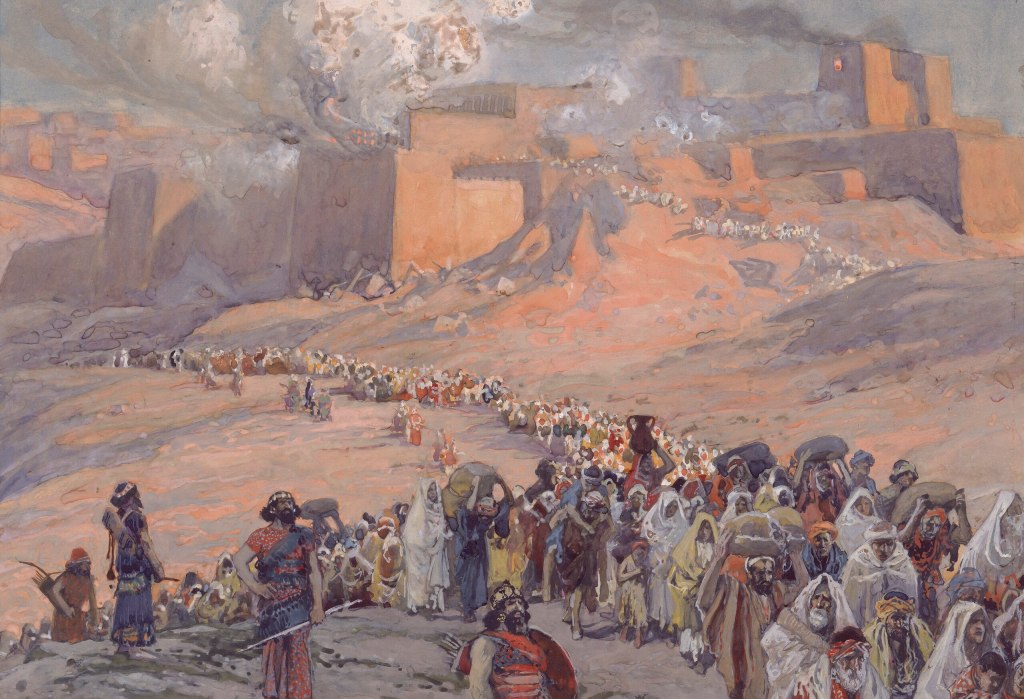
1 In the third year of the reign of Jehoiakim king of Judah, Nebuchadnezzar king of Babylon came to Jerusalem and besieged it. 2 And the Lord gave Jehoiakim king of Judah into his hand, with some of the vessels of the house of God. And he brought them to the land of Shinar, to the house of his god, and placed the vessels in the treasury of his god. 3 Then the king commanded Ashpenaz, his chief eunuch, to bring some of the people of Israel, both of the royal family and of the nobility, 4 youths without blemish, of good appearance and skillful in all wisdom, endowed with knowledge, understanding learning, and competent to stand in the king’s palace, and to teach them the literature and language of the Chaldeans. 5 The king assigned them a daily portion of the food that the king ate, and of the wine that he drank. They were to be educated for three years, and at the end of that time they were to stand before the king.
In order to live faithfully in exile, we first need to know and rely upon God’s constant faithfulness. How did Daniel experience God’s faithfulness?
Well, first of all, he experienced God’s faithfulness in the fact that God’s people were now being judged with exile in Babylon. Verses 1 and 2 show very clearly that Judah’s exile in Babylon was no accident of history, nor was it simply that Babylon had a stronger army than Judah’s. Nebuchadnezzar may have thought that, but God makes it very clear here that the reason Judah was in exile is because “the Lord gave Jehoiakim king of Judah into his hand.” Generally when an army of the Ancient Near Eastern culture dominated and destroyed another culture, they believed that their god was the stronger god. But the emphasis of this passage, the true account, is that “the Lord gave Jehoiakim king of Judah into his hand.” Nebuchadnezzar’s strength wasn’t the cause, God’s sovereignty was.
Proverbs 21:1 tells us, “The king’s heart is a stream of water in the hand of the LORD; he turns it wherever he will.” Kings had absolute, irresistible, despotic rule at this time in history, yet in God’s hands they are like water. As Charles Bridges says, “The king’s heart he directs as a responsible agent, without interfering with the moral liberty of his will.”
Yahweh had warned Israel of the determined consequences of their sins in the book of Leviticus. At the beginning of Israel’s history as a nation, God made a covenant with the people, a covenant that was explained in Leviticus 26 as containing curses if they disobeyed it and blessings if they obeyed.
If they served the Lord faithfully, being loving him (no idolatry) and their neighbors (no social sins), then they were experience blessing and favor (Lev. 26:3-13). BUT, if they abandoned the LORD for idols and mistreated one another, they would be visited with wrath and curses (26:19-25). They would experience famine, diseases, defeat by their enemies (26:19-25). If they didn’t learn from their disasters and persisted in disloyalty and disobedience, Yahweh would scatter them among the nations and take them into exile (Lev. 26:33, 39).
Nebuchadnezzar’s actions in Daniel 1:1-2 represent only the first of three stages of Jerusalem’s fall. The dates of 597 and 586 BC complete the second and third stages. From 605 to 586 BC, Judah’s status seemed dark, unfathomable, chaotic, and hopeless. This judgment was an expression of God’s faithfulness to the Mosaic covenant, which contained fitting curses for disobedience and idolatry, one of which was exile: “The LORD will bring you and your king whom you set over you to a nation that neither you nor your fathers have known. And there you shall serve other gods of wood and stone” (Deut. 28:36-37).
Another reason Judah went into exile is more specific. In fact, it relates to the seventy years that they were in captivity (605 B. C. to 536 B. C.). This 70 years was not some random number, but was determined according to the exact number of sabbath years that had been missed in Israel’s history.
“He took into exile in Babylon those who had escaped from the sword, and they became servants to him and to his sons until the establishment of the kingdom of Persia, to fulfill the word of the LORD by the mouth of Jeremiah, until the land had enjoyed its Sabbaths. All the days that it lay desolate it kept Sabbath, to fulfill seventy years” (2 Chronicles 36:20-21).
Israel had been instructed, upon entering the land, that they were to leave the land fallow every seventh year (Lev. 25:1-4). That year they weren’t to plow; they weren’t to plant. But Israel had failed to keep that once-in-seven-years Sabbath for 490 years, thus their captivity would make up for it, seventy years.
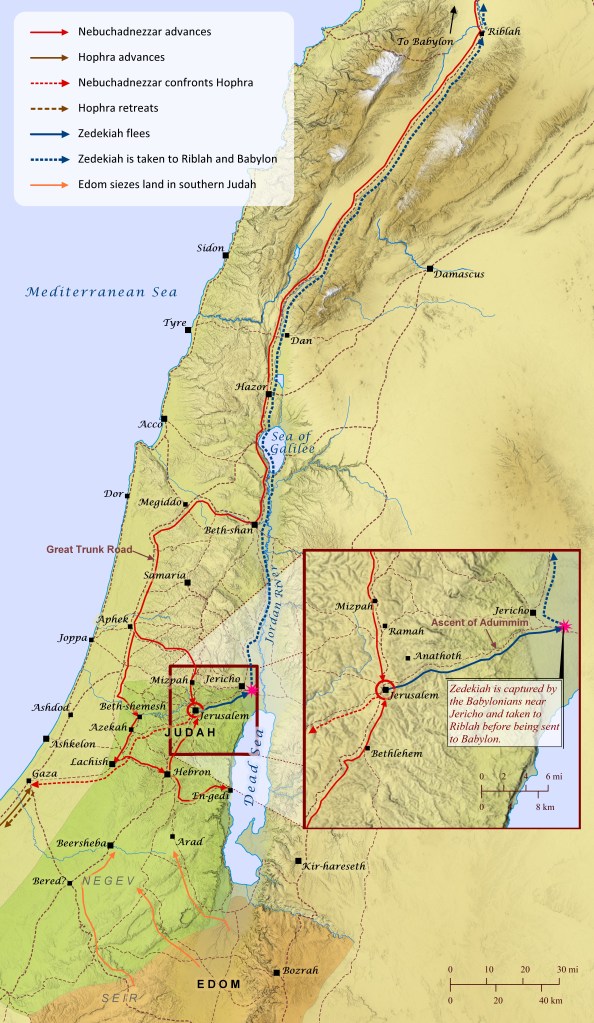
Nebuchadnezzar came against Jerusalem because the Pharaoh of Egypt invaded Babylon. In response, the young prince Nebuchadnezzar defeated the Egyptians at Carchemish, then he pursued their fleeing army all the way down to the Sinai. Along the way (or on the way back), he subdued Jerusalem, which had been loyal to the Pharaoh of Egypt.
This specific attack mentioned by Daniel is documented by the Babylonian Chronicles, a collection of tablets discovered as early as 1887 and now kept in the British Museum. Nebuchadnezzar’s 605 B.C. presence in Judah is documented and clarified in these tablets.
God was already angry with Judah “because of all the provocations with which Manasseh had provoked him” (2 Kings 23:26) and had resolved to remove Judah from his sight (v. 27). This began the seventy-year captivity because of Israel’s idolatry (1 Kings 11:5; 12:28; 16:31; 18:19; 2 Kings 21:3-5; 2 Chron. 28:2-8). This is the beginning of the important prophetic time period — the times of the Gentiles. This period began in 605 B.C. and will extend until Jesus returns as the Messiah.
They will fall by the edge of the sword and be led captive among all nations, and Jerusalem will be trampled underfoot by the Gentiles, until the times of the Gentiles are fulfilled. (Luke 21:24)
Yet the fate of Daniel and his friends hung not merely on these violations of the covenant stipulations as a nation, but also because of the specific fulfillment of the prophecy of Isaiah in 2 Kings 20:18.
Judah’s King Hezekiah had received envoys and a gift from Merodach Baladan, then the king of Babylon. In response, Hezekiah showed him everything that was of value in his storehouses and all of his treasures (20:13).
Now, why was the LORD so upset over what Hezekiah had done? What was the problem with giving the envoys of Babylon a tour of the palace? Well, as you might know, in the world of diplomacy, nothing comes for free.
When Merodach Baladan sent envoys and a gift to Hezekiah, it wasn’t merely a friendly gesture of goodwill on his recovery from illness. Rather, he was seeking Hezekiah’s help and support in his ongoing struggle against Assyria.
Thus, Hezekiah showing Merodach Baladan’s envoys around the palace indicates that he was responding positively to his overtures of an alliance and seeking to prove to him that he had resources that Merodah Baladan could use to be successful.
And this in spite of the fact that God had only recently miraculously rescued Jerusalem from the surrounding armies of Sennacherib and the Assyrians. Instead of trusting in God, who had just shown Himself strong in Hezekiah’s behalf, now Hezekiah is looking to political means for resolving his Assyria problem.
This is by far merely an ancient temptation. Our own elections prove that. Every four years we get to vote on a new Savior who will deliver us from the evils of the previous administration. We get so tied into one or the other political party that we lose our voice as a church because our values are co-opted and soon corrupted by our alliance with any political party.
I’m not saying that being political knowledgeable or active is wrong, but political leaders, parties or platforms will not save us or sanctify us. Instead, the church is to be a prophetic voice in society that calls either party back to God and back into the ways of His righteousness.
Isaiah’s word of judgment on Hezekiah’s strategy was very specific and very severe. Because Hezekiah sought to preserve his treasures by trusting in Babylon, it would be the Babylonians themselves (what irony!) who would come and carry off everything in his palace (2 Kings 20:17; Dan. 1:2).
Far from guaranteeing the safety and security of his line, his foolish alliance would even result in some of his own offspring being taken off to become eunuchs in the palace of the Babylonian king.
Behold, the days are coming, when all that is in your house, and that which your fathers have stored up till this day, shall be carried to Babylon. Nothing shall be left, says the Lord. And some of your own sons, who will come from you, whom you will father, shall be taken away, and they shall be eunuchs in the palace of the king of Babylon.” (2 Kings 20:17-18)
It is these specific words that are being fulfilled in the first verses of the book of Daniel. Nebuchadnezzar, the king of Babylon, came to Jerusalem and carried off treasures from the temple of God to put in the house of his own god (Dan. 1:2), and he also took some of the royal family and nobility—likely the very descendants of Hezekiah—and put them under the charge of Ashpenaz, the chief of his court officials, or eunuchs (1:4). Thus, God’s judgment upon the line of Hezekiah had been faithfully carried out just as Isaiah had said.
Matthew Henry notes how ironic it is that Judah, who had begun to worship the idols of other gods in their own temple, now suffer the vessels of their temple to be carried off to the temples of other gods. In the Babylonian worship, they would only see Israel’s God as a defeated god, a god inferior to their own.
Now, back when the Philistines captured the Ark of the Covenant and brought it into the temple of their god, Dagon. That time, God caused Dagon’s statue to fall broken on its face before the Ark, and the true God was shown to be the most powerful (1 Sam. 5). But this time, nothing happened. The articles were brought into the Babylonian temple, but God didn’t show up to avenge their theft. But God was still on the throne and He would reveal over and over again that He is sovereign over empires, over kings and over history.
No, the Babylonian statues wouldn’t literally fall on their faces. But God would reveal Himself in other ways. And in the very next chapter of Daniel, He would use a statue as an allegory of earth’s kingdoms, and reveal that – in the end – He will smash that statue to pieces and replace it with His own everlasting kingdom that will never be destroyed (Daniel 2).
So just as the Assyrians had been God’s rod against Israel, Babylon performed the same disciplinary action against Judah. God said He had ordained Babylon “for judgment” and that he had “marked them for correction” (Habakkuk 1:12). For the next seventy years the people of Judah would live in Babylon in a constant state of upheaval under the successive control of the Babylonians, Medo-Persian, and Persian empires (David Jeremiah, Agents of Babylon, p. 13).
Yet, the recognition that their fate came from the hand of God as a faithful act of judgment was itself also an encouragement to these exiles. Their future was not controlled by the Babylonian kings or their gods, but rather by the LORD, the God of heaven (Dan. 2:19).
The one who had sent them into exile had promised that He would be with them there, and that he would ultimately restore them from exile after a time of judgment.
Iain Duguid points out an implicit parallel between the sacred articles pilfered from the temple and the Hebrew children who were taken by Nebuchadnezzar: these young men were described as “free from defect” (me’um), a word more commonly used of sacrifices (1:4). Just as the Lord allowed Nebuchadnezzar to carry away the precious temple vessels, he also allowed him to carry away the best of his people. And just as after seventy years these temple vessels would be returned to Jerusalem (Ezra 1:7-11), so many of the exiles, or at least their children and grandchildren, would be able to return home. God does not abandon those who are His own. (Daniel, Reformed Expository Commentary, pp. 7-8).
God promises in Jeremiah 29:10, “For thus says the Lord: When seventy years are completed for Babylon, I will visit you, and I will fulfill to you my promise and bring you back to this place.” Daniel counts on this fact in his prayer in Daniel 9. It is possible, however, that Daniel and his friends did not know this until Ezekiel arrived in Babylon in 597 B.C., some eight years later.
How important this is for us to remember. Even during our hardest moments, when life seems out of control or hardly worth living anymore, we need to remember that God is with us and He is for us (Romans 8:31).
We may believe that our situation is due to unfortunate accidents, or due to the malevolence of wicked people, but in reality it is all always under the control of a all-loving and all-wise God. If we remember that no sparrow falls to the ground without God’s knowledge (Matthew 10:29) and that he knows every hair of our heads (Luke 12:7), then we can be assured that even the most trivial events do not escape either his notice or his control. At the other extreme, God is still in control of even the most wicked, heinous sins that were ever committed against the most innocent Person who ever lived (Acts 4:28). Although sinners were responsible, it was all according to God’s plan. Everything…everything that we experience in life, no matter how difficult or how much it may seem to be meaningless, is God’s purpose for us. All of these circumstances, the good and the bad, are God’s means of sanctifying us. “And we know that for those who love God all things work together for good, for those who are called according to his purpose” (Romans 8:28). And that “good,” the very best thing for us, is defined in verse 29 as being “conformed to the image of his Son,” becoming more and more like Jesus Christ.
“All things” includes both the good and the bad. In other words, God uses the good things, like our obedience and faith and sacrifice and Bible reading and prayer and worship and fellowship to conform us to the image of His Son, but He will also use the bad things like trials, sickness, pain, financial hardship, rebellious children, a failed marriage, being hated and mistreated, as ways to conform us to the image of His Son.
In fact, we usually learn how to love not by being around lovely, lovable, loving people, but by being around unlovely, unlovable, unloving people. We learn patience not by getting whatever we want right away, but by having to wait in lines, or wait for our birthday. The fruit of the Spirit grows best in difficulties.





 Grace Still Amazes