Introduction to the Book of Daniel, part 3

Today is our third week introducing the book of Daniel. It is vitally important that we understand the background of any book of the Bible. That is why we are spending so much time on it.
The Purpose of the Book

At this dark hour in Israel’s history, with the tragic destruction of Jerusalem and its temple, a strong reminder was needed that their God, Yahweh, really was in total control of nations and national rulers.

The book of Daniel is, for the most part, a prophetical history of Gentile world-power from the reign of Nebuchadnezzar to the coming of CHRIST. The prophets in general emphasize GOD’s power and sovereignty in relation to Israel, and they reveal Him as guiding the destinies of His chosen people throughout the centuries until their final restoration.

Daniel, on the other hand, emphasizes GOD’s sovereignty in relation to the Gentile world-empires, and reveals Him as the One controlling and overruling in their affairs, until the time of their destruction at the coming of His Son.

“The vision is that of the overruling GOD, in wisdom knowing and in might working; of kings reigning and passing, of dynasties and empires rising and falling, while GOD enthroned above rules their movements” (Campbell Morgan).

John MacArthur reminds us, “The book of Daniel will teach you who is running human history. God raises up the Assyrians and puts them down. God raises up the Babylonians and puts the down. God raises up Nebuchadnezzar and puts him down. God raises up Cyrus and has him do what He wants. God literally controls human history.”

The book’s central theme is God’s sovereignty over history, empires, and kings (2:21; 4:43-47). All the kingdoms of this world will come to an end and will be replaced by the Lord’s kingdom, which will never pass away (2:44; 7:27). This is illustrated by the fact that even Daniel outlived the Babylonian Empire!

Though trials and difficulties will continue for God’s people up until the end, those who are faithful will be raised to glory, honor, and everlasting life in this final kingdom (12:1-3).

John Walvoord notes, “The book of Daniel, like Esther, reveals God continuing to work in His people Israel even in the time of their chastening. In this framework the tremendous revelation concerning the times of the Gentiles and the program of God for Israel was unfolded. While it is doubtful whether these prophecies were sufficiently known in Daniel’s lifetime to be much of an encouragement to the captives themselves, the book of Daniel undoubtedly gave hope to the Jews who returned to restore the temple and the city, and it was particularly helpful during the Maccabean persecutions.”

Key Themes

I. It is possible to live a faithful life while surrounded by pagan influences, if one serves the Lord wholeheartedly (ch. 1).
II. God can give his faithful servants abilities that cause even unbelievers to appreciate them (chs. 2, 3, 6). Nevertheless, believers should not assume that God will always rescue them from harm (3:16-18).
III. God humbles the proud and raises up the humble. Even the hearts of the greatest kings are under his control (chs. 4, 5).
IV. This world will be a place of persecution for God’s people, getting worse and worse rather than better and better (chs. 2, 7). The Lord will judge the kingdoms of this world and bring them to an end, replacing them with his own kingdom that will never end. This kingdom will be ruled by “one like a son of man” who comes “with the clouds,” a figure who combines human and divine traits (7:13).
V. God is sovereign over the course of history, even over those who rebel against him and seek to destroy his people (ch. 8).
VI. The Babylonian exile was not the end of Israel’s history of rebellion and judgment. In the future, Israel would continue to sin against the Lord, and Jerusalem would be handed over to her enemies, who would damage her temple and do other offensive things (chs. 8, 9, 12). Eventually, though, the anointed ruler would come to deliver God’s people from their sins (9:24-27).
VII. These earthly events are reflections of a great conflict between angelic forces of good and evil (ch. 10). Prayer is a significant weapon in that conflict (9:23).
VIII. God rules over all of these conflicts and events, he limits the damage they do, and he has a precise timetable for the end of his people’s persecutions. At that time he will finally intervene to cleanse and deliver his people (ch. 12).
IX. In the meantime, believers must be patient and faithful in a hostile world, looking to the Lord alone for deliverance (11:33-35).

Genre: Apocalyptic

Daniel is classified as an apocalyptic writing, because of its series of supernatural visions which by their character fulfilled what is intimated by the Greek word apokalypsis, which means unveiling of truth which would otherwise be concealed.

Although apocalyptic works abound outside the Bible, relatively few are found in Scripture. In the New Testament only the book of Revelation can be classified as apocalyptic; but in the Old Testament, Ezekiel and Zechariah may be so classified in addition to Daniel.

A couple of hundred years later, apocalyptic writings abound. These were classified as pseudepigrapha, written to imitate the style of biblical apocalyptic books. Apocalyptic works classified as the pseudepigrapha include such titles as Ascension of Isaiah; Assumption of Moses; Book of Enoch; Book of Jubilees; Greek Apocalypse of Baruch; Letters of Aristeas; III and IV Maccabees; Psalms of Solomon; Secrets of Enoch; Sibylline Oracles; Syriac Apocalypse of Baruch; Testament of the Twelve Patriarchs; Apocalypses of Adam, Elijah, and Zephaniah; and Testament of Abram, Isaac, and Jacob.

Another characteristic about the book of Daniel is that, unlike most of the other prophets, Daniel does not confront the people of Israel with their sins. He comforts only. In addition, Daniel’s book includes historical narrative in the first 6 chapters.

Apocalyptic literature is a uniquely Jewish literary genre. It was often used in tension-filled times to express the conviction that God is in control of history and will bring deliverance to His people.

This type of literature is characterized by:

  1. a strong sense of the universal sovereignty of God (monotheism and determinism)
  2. a struggle between good and evil, this evil age and the age of righteousness to come (a limited dualism)
  3. use of standardized secret code words (usually from the OT prophetic texts or intertestamental Jewish apocalyptic literature)
  4. use of colors, numbers, animals, sometimes animals/human hybrids
  5. use of angelic involvement by means of visions and dreams, which are usually interpreted by angels
  6. primarily focuses on the soon-coming, climatic events of the end-time (new age)
  7. use of a fixed set of symbols to communicate the end-time message from God.

Languages

An unusual feature of the book of Daniel is the fact that the central portion (2:4-7:28) is written in biblical Aramaic, also called Chaldee. A similar use of Aramaic is found in Ezra 4:8-6:18; 7:12-26; Jer 10:11; and the two words of the compound name Jegar-Sahadutha in Genesis 31:47, showing that the Aramaic tongue had been around long before the inter-testamental period.
The Aramaic portion of Daniel clearly covers the “Times of the Gentiles,” while the Hebrew portions at the beginning and end devote more attention to what happens to Israel and the children of Israel in the midst of the nations. Aramaic was also the contemporary language of international business.

Canonical Place

When we use the word “canon” we’re talking about the books which were recognized [not “determined,” but “recognized”] as being inspired by God and they formed the group of books we call our Old and New Testaments.

In our English Bible (Septuagint, Vulgate and Luther), the book of Daniel appears as the last of the major prophets. Along with Ezekiel, Daniel wrote in the exilic period. In the Hebrew Bible Daniel is part of the Kethubim (the writings). The Jews call the Old Testament the Tanak, which is a word that consists of the T for Torah, the first five books of the Old Testament, what we often call the Pentateuch; the N stands for Neviim, the prophets, and the K stands for Kethubim. Daniel is part of the Kethubim, the writings.

Robert Dick Wilson believes that this is because Daniel was never called a “prophet” (navi, נָבִיא), but a “seer” (hozeh, חֹזֶה) and “wise man” (hakhamin, חַכִּימִ֣ין). J. B. Payne observes, “For though Christ spoke of Daniel’s function as prophetic (Matt. 24:15), his position was that of governmental official and inspired writer, rather than ministering prophet (cf. Acts 2:29-30)” (J. Barton Payne, “Book of Daniel,” Zondervan Pictorial Bible Dictionary, p. 198).

So why is Daniel placed in the Writings rather than in the Prophets for the Jews? This may be because Daniel’s prophetic messages do not confront the Jewish people with their sins, which was common among the Major and Minor Prophets. Also, the Masoretes may not have considered Daniel to be a prophet because there is no mention of his ordination or calling to be a prophet.

Major Divisions and Unity

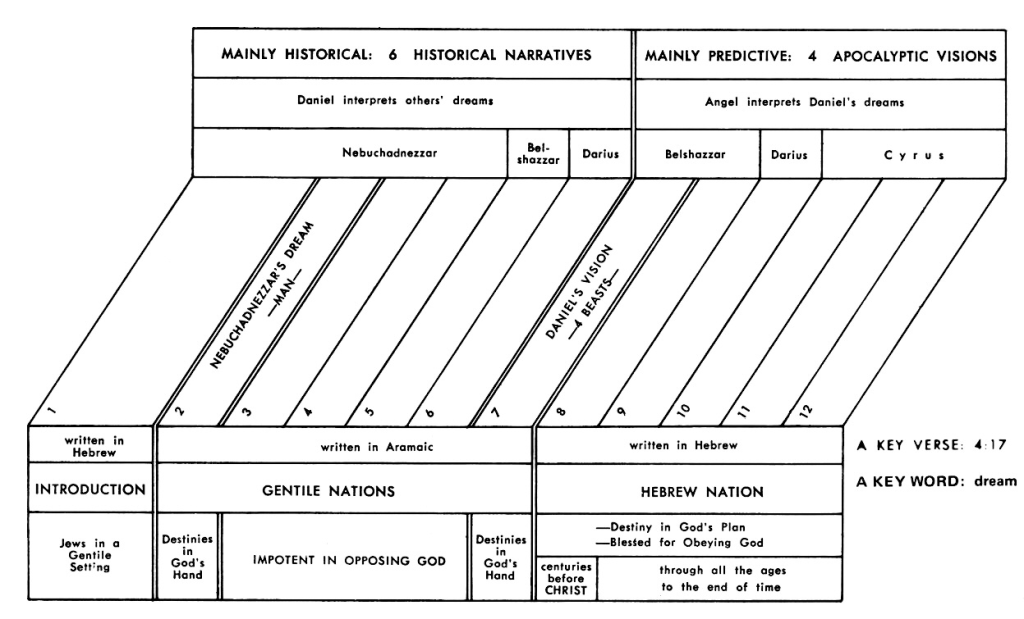
The traditional division of the book of Daniel into two halves (1-6; 7-12) has usually been justified on the basis that the first six chapters are historical and the last six chapters are apocalyptic or predictive. There is much to commend this division which often also regards chapter 1 as introductory.

An alternative approach, recognizing the Aramaic section as being significant, divides the book into three major divisions: (1) Introduction, Daniel 1; (2) The Times of the Gentiles, presented in Aramaic, Daniel 2-7; (3) Israel in Relation to the Gentiles, in Hebrew, Daniel 8-12.
These two approaches are roughly the same.

Overview of the Book of Daniel

One of the things I like to do whenever I study or preach on a book of the Bible is to first look at the whole book and how it is organized and laid out, to get the “30,000 foot view” so that I can see the whole before examining the parts.

There are several good resources for this. The Bible Project has a video on YouTube and a chart that you can find on Google images, that is a good overview of the book.

Charles Swindoll has his book chart on his website Insight for Living. Philip Jensen has a book chart on the Precepts Austin website.

The book of Daniel is divided into two parts, the historical narratives of chapters 1-6 and the apocalyptic visions of chapters 7-12. In the first half, Daniel is interpreting the dreams or experiences of two Gentile kings, Nebuchadnezzar and Belshazzar. Darius is included chronologically in this section as the Medo-Persian empire conquered Babylon in 539 B.C. In the second half, it is Daniel’s visions that are interpreted by an angel. Again, chapters 2-7 are written in Aramaic, primarily because the history (both present and future history) covered in this part concerned Gentile empires, while chapters 8-12 are written in Hebrew because the history (both present and future history) concerns Israel.

The Key Verse

Some books have purpose statements, such as the gospel of John, “these are written that you may believe that Jesus is the Messiah, the Son of God, and that by believing you may have life in his name” (John 20:31). The Gospel of John was revealed to John by God’s Spirit for the express purpose of helping people believe in Jesus Christ as God’s Son and experiencing “life in his name.”

Likewise, the first epistle of John has an express purpose statement. 1 John 5:12 says, “I write these things to you who believe in the name of the Son of God so that you may know that you have eternal life.” The Gospel of John is written so that we may believe and the epistle of John is written so that believers “may know that you have eternal life. God wants us to have the assurance that we possess the very life He promised to give through His Son.

The book of Acts has verse that reveals the programmatic desires of Jesus for his church. In Acts 1:8 Jesus says, “But you will receive power when the Holy Spirit comes on you; and you will be my witnesses in Jerusalem, and in all Judea and Samaria, and to the ends of the earth.” As you follow the narrative of the book of Acts, you see that the gospel witness and the outpouring of the Holy Spirit begins in Jerusalem (Acts 2), but later expands into Judea-Samaria (Acts 8) and finally reaches to the Gentiles (Acts 10 and following).

Is there are similar verse for the book of Daniel? Well, there is not a clear and explicit purpose statement, but we can identify a verse which highlights a major theme of the book of Daniel—God’s sovereignty over the nations.

The key verse for the book of Daniel could very well be Daniel 4:17.

“‘The decision is announced by messengers, the holy ones declare the verdict, so that the living may know that the Most High is sovereign over all kingdoms on earth and gives them to anyone he wishes and sets over them the lowliest of people.’”

In this case God wanted Nebuchadnezzar to know that He, “the Most High,” “is sovereign over all kingdom on earth and gives them to anyone he wishes and sets over them the lowliest of people.” Nebuchadnezzar needed to realize that the power of Babylon did not depend upon Nebuchadnezzar himself but upon “the Most High” God of the Israelites. And as Israel read this, they would remember that they were “the lowliest of people” at this time and would have taken heart that God could reverse their misfortunes that they were presently experiencing. It would give them hope, as prophecy should give us hope, that God will fulfill all His promises for His people someday soon.

Introduction to the Book of Daniel, part 2

Well, today we are continuing our introduction the book of Daniel. We ended last week giving some historical background. The first part of Daniel takes place with Nebuchadnezzar king of Babylon and so we were talking about the beginning of the Neo-Babylonian empire.

Today we want to start by reminding ourselves of the nature of the place to which Daniel and his friends were taken. This was not a God-friendly place.

An article From Babel to Babylon on monergism.com., describes the anti-God nature of this city throughout history.

Not unlike Babel, Babylon stands for the corruption of human power, wealth, and influence. It represents the perversion of God’s creation, the exploitation of the weak and vulnerable, and the seduction of the nations by false gods. Babylon was notorious for its arrogance, wickedness, and cruelty. It was a center of pagan worship, characterized by sexual immorality, idolatry, and materialism. Babylon was a city that exalted itself above God and oppressed God’s people. It symbolizes the human tendency to use power for selfish purposes, to worship idols instead of God, and to oppress those who are weaker. (https://www.monergism.com/babel-babylon#:~:text=The%20biblical%20narrative%20of%20Babel,power%2C%20wealth%2C%20and%20influence.)

Babylon the Great, in the book of Revelation, is the culmination of human rebellion against God. It is a symbol of the world system that opposes Christ and His kingdom. It is a city that is drunk with the blood of the saints and the martyrs, that deceives the nations with her sorceries and seduces them with her wealth and power. Babylon the Great is a false bride who entices the world with her beauty and wealth, but who ultimately leads them to destruction. It is a warning against the seduction of the world and the dangers of compromise with the world’s values.

So Daniel and his three friends were entering into a culture that would challenge the foundations of their faith to the very core, down to their roots. Remaining faithful to Yahweh would prove to be very difficult and I’m sure that not every Hebrew youth rose to the challenge.
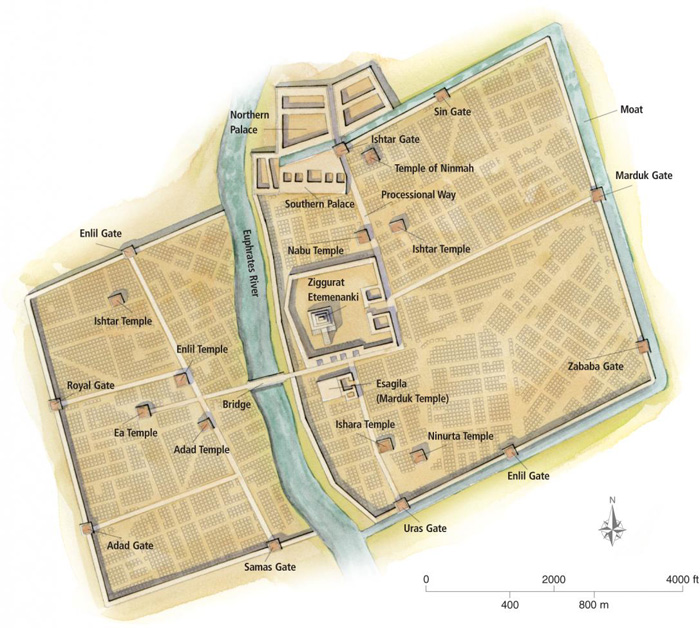
Not everything was negative, however, for Babylon was a wondrous sight to behold. As Daniel and his three friends were marched into Babylon they would see a spectacular city. Bryan Windle, in his Biblical Archeology article reports on the city Daniel saw (https://biblearchaeologyreport.com/2019/08/09/footsteps-three-things-in-babylon-daniel-likely-saw/).

Nebuchadnezzar had initiated a vast building program and improved the city’s fortifications, raising its magnificence to new heights. At the time Daniel lived there, it was the largest city in the world, covering over 10 square kilometers (4 square miles).

A reconstruction of ancient Babylon, with the Etemenaki (stepped ziggurat) in the center, and the Esagila (Temple of Marduk) to the right of it. Image Credit: J.R. Casals / https://www.artstation.com/artwork/25NVv [tried to get permission]

Taken from the ESV® Study Bible (The Holy Bible, English Standard Version®), copyright ©2008 by Crossway, a publishing ministry of Good News Publishers. Used by permission. All rights reserved. For more information on how to cite this material, see permissions information here.
Daniel would have seen the grand palace of Nebuchadnezzar.

A panoramic view of the reconstructed Southern Palace of Nebuchadnezzar. Photo Credit: Osama Shukir Muhammed Amin FRCP(Glasg) / Wikimedia Commons / CC BY-SA 4.0

Here is a modern reconstruction of what Nebuchadnezzar’s palace would have looked like:

Screenshot from Pedersén’s virtual 3D model of Babylon, period of Nebuchadnezzar II (604-662 BCE) and Nabonidus (555-539 BCE). Overlooking south onto the Etemenanki Ziggurat from within the South Palace main courtyard, walls decorated with glazed bricks.

On the north side of the city Nebuchadnezzar had built the majestic Ishtar Gate.

The Ishtar Gate in Babylon. Photo Credit: Wikimedia Commons / Public Domain

It was one of eight double-gates that served as entrances to the city and stood over 12m (38 feet) high. The gate was finished around 575 BC, after Daniel had already been living in the city for many years. He no doubt watched its construction and marveled at its beauty.

Today, a reconstruction of the Ishtar Gate can be seen at the Pergamon Museum in Berlin. It is made out of materials excavated by Robert Koldewey in the early 1900’s.

A reconstruction of the Ishtar Gate at the Pergamon Museum in Berlin, Germany. Photo Credit: flickr photo by youngrobv / CC BY-NC 2.0

In Daniel 4:30, King Nebuchadnezzar boasts, “Is not this great Babylon, which I have built by my mighty power as a royal residence and for the glory of my majesty?” The archaeological record affirms the massive building campaigns of Nebuchadnezzar.

Who was Daniel?

Daniel was a young man (Daniel 1:4), likely around the age of 16, when he was taken captive in the first wave of deportations in 605 B.C. Could you imagine, at that young age, being ripped from your family, your home, your friends, your chances for work or education, not knowing what was going to happen next? You didn’t know if you would live or die. You didn’t know if you would spend the remainder of your life enslaved or in prison. There were a lot of unknowns, and as we know, into that vacuum of unknowns, fear and anxiety are frequent irritants.

He never saw his family, friends, or homeland again. But what matters most about Daniel’s life is how he remained faithful to God throughout his life, while living in a land where its inhabitants had not even heard of Jehovah. Daniel was considered to be a man of great integrity, classified along with Noah and Job in Ezekiel 14:14, 20 as key intercessors. In fact, like Joseph, not a single sin is attributed to Daniel. And the angel repeatedly calls him “greatly beloved.”

These three intercessors represent our battle against the world, the flesh and the devil. Job overcame the devil, Noah the world, and Daniel the flesh.

The name Daniel (dan-i-el) means “God is my judge,” a name that likely guided and guarded Daniel’s thinking and conduct as he realized that one day God would hold him accountable for how he lived his life. It is likely that Daniel was one of several young men who came from “the royal family and of the nobility” (Daniel 1:3).

No mention is made, specifically, of Daniel’s birthplace or family (other than being of the tribe of Judah, Daniel 1:3) and thus the Jewish Encyclopedia concludes “It is not known whether he belonged to the family of the King of Israel or to that of an Israelitish magnate.”

Josephus (“Ant.” x. 10, § 1) evidently inferred from Sanh. i. 3 that Daniel was a relation of King Zedekiah (ἧσαυ τῶυ ἐκ τοῦ Σεδεκίου γέυους τέσσαρες ), while Pseudo-Epiphanius, on the strength of the same passage, makes Daniel the scion of a noble Israelitish family (compare Prince, “Critical Commentary on the Book of Daniel,” p. 25).

According to rabbinical tradition Daniel was of royal descent; and his fate, together with that of his three friends, Hananiah, Mishael, and Azariah, was foretold by the prophet Isaiah to King Hezekiah in these words, “and they shall be eunuchs in the palace of the king of Babylon” (Isa. xxxix. 7; compare Sanh. 93b; Pirḳe R. El. lii.; Origen, commentary to Matt. xv. 5; Jerome, commentary to Isaiah, l.c.). Of course, we do not know for sure that they were eunuchs, although we never hear of their wives or children.

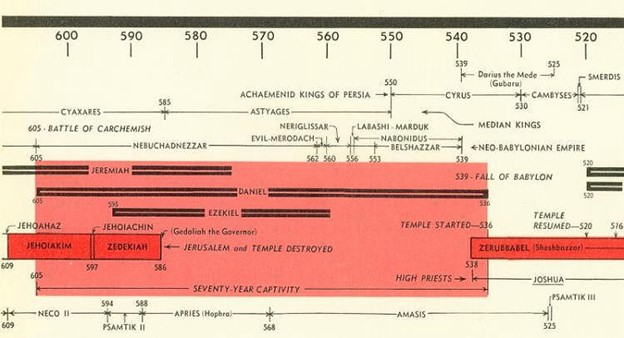
Daniel served under king Nebuchadnezzar (Daniel 1:19-20) all the way through the empire change and served King Cyrus (Daniel 1:21). Daniel bridges the entire 70 years of the Babylonian captivity (ca. 605–536 B.C.; cf. 1:1 and 9:1-3).

Daniel began his career about eighteen years before Jerusalem fell, and his last message was given after the Jews had returned to build again the temple (10:1.), covering a period of about 73 years from the year 607 to 534 B. C., then beyond that to the reign of Darius.

The most well-known event in the life of Daniel was his one-night stay in the den of lions under Darius. Today in the stands this depiction of a roaring lion (with wings, by the way).

https://www.worldhistory.org/image/724/lion-of-babylon-ishtar-gate/

This was one of 120 lions that lined the processional way into Nebuchadnezzar’s throne room and it dates to the exact time that Daniel was there in Babylon! He would have passed by these lions a number of times on his way to advise King Nebuchadnezzar. The glazed bricks remind us of the need for fiery furnaces needed to make the bricks. Daniel had been in Babylon 66 years and was 83 years old when he faced the lions.

The Book of Daniel

Date and Authorship

We will deal with who wrote the book and when because this issue has been debated by biblical scholars and historians. Was it written by Daniel in the 6th century B.C. or by someone else in the 2nd to 3rd century B.C.?

Conservative scholars have believed the book to be written by Daniel, taken captive by Nebuchadnezzar in 605 B.C. The record of events extends to the third year of Cyrus, 536 B.C., and, accordingly, covers a span of about seventy years. Daniel himself may well have lived on to about 530 B. C., and the book of Daniel was probably completed in the last decade of his life.

Although Daniel does not speak of himself in the first person until chapter 7, there is little question that the book presents Daniel as its author. This is assumed in the latter portion of the book and mentioned especially in 12:4. The use of the first person with the name Daniel is found repeatedly in the last half of the book (7:2, 15, 28; 8:1,15, 27; 9:2, 22; 10:2, 7, 11, 12; 12:5).

Important confirmation of the historicity of Daniel himself is found in three passages in Ezekiel (Eze 14:14, 20; 28:3), written after Daniel had assumed an important post in the king’s court at Babylon. Convincing also to conservative scholars is the reference to “Daniel the prophet” by Christ in the Olivet Discourse (Mt 24:15; Mk 13:14).

Except for the attack of the pagan Porphyry (third century A. D.), no question was raised concerning the traditional sixth century B. C. date, the authorship of Daniel the prophet, or the genuineness of the book until the rise of higher criticism in the seventeenth century, more than two thousand years after the book was written.

Higher criticism, totally humanistic and materialistic in its outlook, denies that Daniel could be the author because they want to deny the possibility of supernatural predictive prophecy and so the book had to be written later so that the prophecies related to Alexander the Great and the wars between the Ptolemies and the Seleucids would be a historical report rather than future events that were miraculously fulfilled by God’s sovereign plan.

Daniel wrote this book in the sixth century B.C. It records the events of Daniel’s life and the visions that he saw from the time of his exile in 605 B.C. (1:1) until 536 B.C., the third year of King Cyrus (10:1). Then it is Darius who consigned him to the den of lions (Dan. 6). So it is likely that Daniel finished this book around 520 B.C.

Ezekiel, Habakkuk, Jeremiah, and Zephaniah were Daniel’s prophetic contemporaries.

Jensen’s Survey of the Old Testament

Daniel is alluded to by the writer of Hebrews as one of “…the prophets: who through faith…stopped the mouths of lions” (Heb. 11:32-33).

Why do we believe that it was Daniel who wrote this book in the 6th century B. C., rather than some unnamed author in the 2nd century?

First, the book claims to be written by Daniel in Daniel 7:1 and 12:14.

In the first year of Belshazzar king of Babylon, Daniel saw a dream and visions of his head as he lay in his bed. Then he wrote down the dream and told the sum of the matter. (Dan. 7:1)

Second, Jesus attributed to Daniel the prophecy about the abomination of desolation (Dan. 12:11).

Jesus said, “You [will] see the abomination of desolation which was spoken of through Daniel the prophet” (Mt. 24:15).

Third, Ezekiel—a contemporary prophet—believed in a historical Daniel. Ezekiel lived in roughly 575 BC, and he explains that Daniel is a real and historical figure (Ezek. 14:14, 20; 28:3).

Fourth, Josephus—a first century Jewish and Roman historian—believed that Daniel was a prophet and a historical person. Josephus believed that the book of Daniel was shown to Alexander the Great, when he came to Jerusalem in 330 BC. Of course, Daniel predicted the life of Alexander the Great. So when he arrived in Jerusalem, the priests showed him these prophecies. Josephus writes,

\He (Alexander) came into the city; and when he went up into the temple, he offered sacrifice to God, according to the high priest’s direction, and magnificently treated both the high priest and the priests. And when the book of Daniel was showed to him, wherein Daniel declared that one of the Greeks should destroy the empire of the Persians, he supposed that himself was the person intended… The next day he called them to him, and had them ask what favors they pleased of him… (and) he granted all they desired.[4]

He did not destroy Jerusalem because of this.

Fifth, the author of 1 Maccabees believed Daniel was a historical person. In 1 Maccabees 2:59-61, we read, “Hananiah, Azariah, and Mishael had faith, and they were saved from the flames. Daniel was a man of integrity, and he was rescued from the lion’s jaws. So bear in mind how in the history of the generations no one who trusts in Heaven ever lacks strength.”

In context, Matthathias was writing about an event which took place in 167 BC. Therefore, to have written this, he must have already considered Daniel to be a historical figure. As Walvoord writes, “It is highly questionable whether the Jews living in the Maccabean period would have accepted Daniel if it had not had a previous history of canonicity” (Walvoord, John. Daniel: The Key to Prophetic Revelation, Introduction, 1989. See “Authorship”).

Sixth, 1 Enoch cites Daniel. When we compare 1 Enoch 14:18-22 with Daniel 7:9–10, we see striking similarities. 1 Enoch dates to roughly 150 BC.

Seventh, archaeological discoveries shows that Daniel faithfully described the sixth century world of Babylon.

  1. Daniel correctly distinguishes Susa and Elam.
    In Daniel 8:2, Daniel writes that he was “in the citadel of Susa, which is in the province of Elam.” Now, Susa was assigned to a new province in the Persian era. The territory of Elam was shrunk during this time, and Susa was assigned to a new territory of Susiana.
    It would have taken a 6th century inhabitant of Susa to know of this historical detail. A 2nd century author would have been out of date with this historical nuance. (Archer, Gleason L. A Survey of Old Testament Introduction: Revised and Expanded. Chicago, IL: Moody, 2007. 380).
  2. The existence of Belshazzar
    Prior to the middle of the 19th century, a Babylonian king named Belshazzar was unknown to history, allowing critics to question the historical accuracy of the book of Daniel. Ancient historians, such as Berosus and Abydenus recorded that Nabonidus was the last king of Babylon. Similarly, the Uruk King List omits Belshazzar, moving from Nabonidus to Cyrus.
    Things changed in 1854, when J.E. Taylor discovered four cylinders in the ruins of a ziggurat at Ur which contained a prayer of Nabonidus to the gods. The so-called Nabonidus Cylinders record:
    “As for me, Nabonidus, King of Babylon, save me from sinning against your great godhead and grant me as a present a life of long days, and as for Belshazzar, my oldest son my offspring, instill reverence for your great godhead in his heart and may he not commit any cultic mistake, may he be sated with a life of plentitude.”

One of the Nabonidus cylinders from Ur, which records Nabonidus’ renovations to the moon god, Sin’s, ziggurat, as well as a prayer for himself and his son Belshazzar. Photo: A.D. Riddle / Bibleplaces.com.

  1. Nabonidus Chronicle
    That very night Belshazzar the Chaldean king was killed. (Dan 5:30)
    The Babylonian Chronicle for the years 556 to 539 BC, also called the Nabonidus Chronicle, describes the final years of King Nabonidus’ reign and the fall of Babylon to Cyrus, king of Persia. It records:
    “When Cyrus did battle at Opis on the [bank of] the Tigris against the army of Akkad, the people of Akkad retreated. He carried off the plunder (and) slaughtered the people. On the fourteenth day Sippar was captured without a battle. Nabonidus fled. On the sixteenth day, Ugbaru, governor of Gutium, and the army of Cyrus, without battle they entered Babylon. Afterwards, after Nabonidus retreated, he was captured in Babylon…. On the third day of the month Arahsamna, Cyrus entered Babylon.” (iii, 12-18)

The Nabonidus Chronicle describes the final years of King Nabonidus’ reign and the fall of Babylon to the Persians. Photo: ChrisO / Wikimedia Commons / CC BY-SA 3.0

Moreover, William Shea has argued, based on other details in the text of the Nabonidus chronicle that the enigmatic “Darius the Mede” who became King of Babylon (Dan. 5:31) was none other than Ugbaru, the general of the army who captured the city. Thus, the historicity of Darius was verified.

  1. Dead Sea Scroll Fragments of Daniel
    “So when you see the abomination of desolation spoken of by the prophet Daniel, standing in the holy place…” (Mat 24:15)
    Many today would argue that the book of Daniel was composed sometime during the second century BC, after the prophecies related to the Seleucids and Maccabeans (Dan. 9-12), and not during the sixth century BC by the prophet himself. According to this theory, Daniel was written to encourage the Jewish people during the Maccabean period (ca. 168-165 BC). This late date is assumed largely on the basis of the presupposition of modern scholars that supernatural fore-telling of events is not possible.
    The fact that these copies are now known to exist shows us that already in the second century B. C. the book of Daniel was already composed, circulated and accepted as canonical.
    You might ask, why is this important—whether Daniel wrote the book or not, whether it communicates actual historical events from the 6th century B.C. or records apocryphal tales from the 2nd century?
    As James Hamilton puts it,
    There is a massive difference between the theological meaning of a wish-fantasy and that of a historically reliable account of God miraculously preserving someone alive in a fiery furnace. Dismissing a false fable as irrelevant to my conduct reflects my view of the theological meaning and value of fairy tales. Risking my life because I believe the stories result from convictions about theological meaning that cannot be separated from historicity. …
    If some Maccabean-era author is making fraudulent claims, if these are fictional deliverances and not future predictions but recitals of what has already happened presented as though being predicted by Daniel, then there is no real proof that Yahweh can either deliver from death or predict the future. This means there is no proof that he is any better than the false gods who can neither reveal the future nor deliver their worshippers, which is exactly what the book of Daniel claims Yahweh can do. …
    The whole theological meaning of the book depends upon Yahweh’s ability to deliver his people and declare the future before it takes place. If he cannot do these things, no one should “stand firm and take action” and risk his life for Yahweh (Dan. 11:32).

    J. M. Hamilton Jr., With the Clouds of Heaven: The Book of Daniel in Biblical Theology, New Studies in Biblical Theology 32 (Nottingham, England: Apollos, 2014), 31–32.

Introduction to the Book of Daniel, part 1

Well, today we are starting a study of the Old Testament major prophet, the book of Daniel. You might wonder, “Why study the book of Daniel?”

In many corners of the world these days the climate of hostility hangs over any overt Christian faith commitment or any gathering of believers in Jesus Christ. Any kind of Christian commitment is now assumed to imply intolerance and often prompts reactions that range from a low-grade hostility and exclusion in the West to the vicious and murderous assaults on Christian believers in Pakistan, Nigeria, Kenya, Egypt, Syria and Iraq and elsewhere.

Such issues are not new. Christians have faced them ever since Nero’s lions, and even before that. Jews also have faced the same questions all throughout their history, most tragically sometimes enduring horrendous persecution from states claiming to be Christian. So, it is not surprising that the Bible gives a lot of attention to these questions.

The book of Daniel tackles the problem head on, both in the historical stories of Daniel and his friends, and in the prophetic visions he received. A major theme of the book is how people who worship the one, true, living God—the God of Israel—can live and work and survive in the midst of a nation, a culture, and a government that are hostile and sometimes life-threatening. What does it mean to live as believers in the midst of a non-Christian state and culture? How can we live “in the world” and yet not let the world own us and squeeze us into the shape of its own fallen values and assumptions? How can one stay faithful to God in the midst of a hostile culture in the midst life-threatening pressures to bow the knee to another god? Can God be trusted in such times?

The book was written to encourage believers to keep in mind that both the present and the future, no matter how terrifying they may become, rests in the faithful hands of the sovereign Lord God—and in that assurance to get on with the challenging task of living in God’s world for the sake of God’s mission. We need that encouragement even today.

We want to start today by examining the historical background of the book of Daniel. It’s always important to put the books of the Bible in their historical time and situation. It helps us dive deeper into the text instead of just skimming the surface.

The Assyrian Empire ruled and reigned over the Ancient Near East for nearly 300 years, beginning with an expansion under Ashurnasirpal II (883-859 B.C.) and ending with attacks from the Babylonians and Medes around the mid 7th century B.C.

Map 75 Assyrian Supremacy in the Seventh Century, Holman Bible Atlas, p. 151

After Solomon, the kingdom of Israel was divided. Jeroboam took ten tribes and they became known as the Northern Kingdom, leaving only Judah and Benjamin with Rehoboam, the son of Solomon.

Map 57 The Kingdoms of Israel and Judah, Holman Bible Atlas, p. 118

Shalmaneser V sacked Damascus, the capital city of the Northern Kingdom in 722 B.C., taking those people captive and scattering them among the other conquered peoples of that campaign. The Southern Kingdom, ruled by the line of David, lasted another roughly 150 years. There were no good kings in all the history of the Northern Kingdom, but there were a few in the Southern Kingdom.
Josiah was the last good king of Judah. Under his leadership a religious reform took place (640 B.C. to 609 B.C.). That reform is described in the Bible in 2 Kings 22–23 and 2 Chronicles 34–35. The author of Kings describes the accession of Josiah to the throne at 8 years of age, and then some busy years of reform in his teenage years (age 16-18). So as far as teenagers go, he was a pretty good one! Even as a youth “he began to seek the God of his ancestor David” (2 Chron. 34:3)

It begins with the decision to renovate the Temple, which leads to the discovery of the Book of the Law. Josiah removed pagan altars and idols from the temple, destroyed rural sanctuaries, and took down other places of worship. He centralized worship in Jerusalem, having destroyed the temple at Bethel. He renewed the covenant with his people. Josiah restored the Passover after many years of neglect and he returned the Ark of the Covenant to the Temple.

Both books [2 Kings and 2 Chronicles] bookend the story of Josiah with the highest possible praise for this king. Unlike so many of the kings of Judah, Josiah “walked in the way of his father David, turning aside neither to the right or the left.” But he was even greater than David: “Before him there was no king like him, who turned to the Lord with all his heart, with all his soul, and with all his might, according to all the law of Moses; nor did any like him arise after him” (2 Kings 22:2; 23:25; cf. 2 Chron. 34:2; 35:18).

However, Josiah met an early death at the hand of the Egyptian King Neco II. Neco was leading an Egyptian force northward to support a final Assyrian effort to recapture Haran. Josiah intercepted Neco near Megiddo, was mortally wounded, and eventually was buried in Jerusalem (2 Kings 23:28-30; 2 Chronicles 35:20-27).

Josiah Battles Neco

The consolidation of the Chaldean Dynasty at Babylon was completed by 609 B.C. The victory of Nabopolassar over the Assyrian and Egyptian armies made Babylon the new master. From there, the Babylonians began to invade southward into Syria and Palestine.

The prophet Habakkuk foresaw these events, declaring that God was “For behold, I am raising up the Chaldeans, that bitter and hasty nation, who march through the breadth of the earth, to seize dwellings not their own” (Hab. 1:6)

The ensuing power struggle between Babylon and Egypt caught Israel in a vice-grip and put the kings of Judah in a precarious position. To whom would they appeal for help?

With the death of Josiah in 609 B.C., Neco removed Jehoahaz, a son of Josiah chosen by the people of Judah, and replaced him with another son whose regal name was Jehoiakim (2 Kings 23:30-35). Judah was for a short time an Egyptian vassal, and Jehoiakim reigned at the pleasure of Neco.
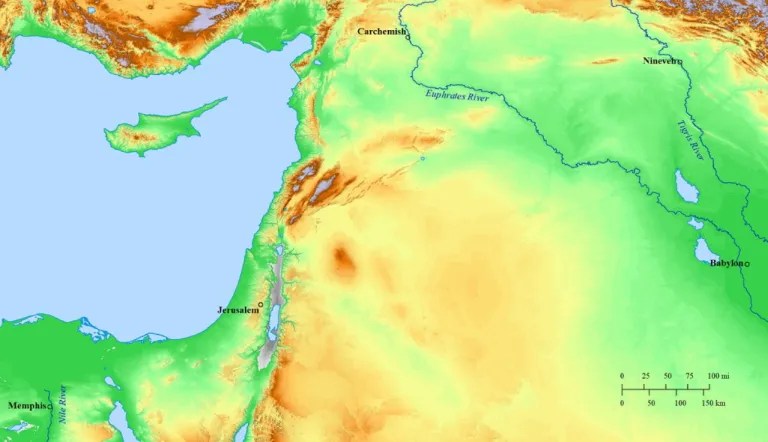
The Battle of Carchemish in 605 B.C. established Babylon as the dominant power all the way to the border of Egypt.

Jeremiah 46

In 604 B.C. Nebuchadnezzar campaigned in Palestine and conquered Ashkelon. Jehoiakim quickly switched his allegiance to Nebuchadnezzar. It was during this campaign that Nebuchadnezzar took hostages from Jerusalem, which included such men as Daniel and his three companions Hanniah, Mishael and Azariah and carried them to Babylon (Daniel 1:1-7) and the seventy years of captivity had begun (Daniel 9:1-2; Jeremiah 25:11; 2 Chronicles 36:17-21).

Jeremiah’s prophecy foretold that the “land shall be a desolation” and that the Jews would “serve the king of Babylon seventy years” (Jeremiah 25:11; compare 2 Chronicles 36:17-21). After the 70 years were completed in Babylon, God told them, He would cause them “to return to this place [Jerusalem]” (Jeremiah 29:10).

However, Jeremiah 29:4-7 also tells the Israelites who were exiled to Babylon to settle down, build homes, and work for the welfare of the city. The passage also instructs them to pray for the city’s prosperity, as their own prosperity would be tied to it. However, this wouldn’t be easy. Psalm 137 hauntingly records, “By the waters of Babylon, there we sat down and wept, when we remembered Zion. On the willows there we hung up our lyres. For there our captors required of us songs, and our tormentors, mirth, saying, “Sing us one of the songs of Zion!” How shall we sing the LORD’s song in a foreign land? If I forget you, O Jerusalem, let my right hand forget its skill! Let my tongue stick to the roof of my mouth, if I do not remember you, if I do not set Jerusalem above my highest joy!” (Psalm 137:1-6)

These people, who once experienced the favor of the true God, find themselves debased and enslaved by their enemy. Far from home. Paralyzed with fear. Their identity stripped from them. Their captors taunt them, “Sing us one of the songs of Zion!” And instead they wept, remembering Zion and their glory days there.

Some of these people would grow comfortable in Babylon and would forget Zion. Some would return, and some of them, like Daniel would remain as a faithful remnant in a foreign, anti-God culture.

But Jeremiah had prophesied that their captivity would last 70 years. This prophecy of punishment came upon the people of Judah because of their disobedience to God’s laws. As Jeremiah explained to the people of Judah, “3 For twenty-three years, from the thirteenth year of Josiah the son of Amon, king of Judah, to this day, the word of the Lord has come to me, and I have spoken persistently to you, but you have not listened. 4 You have neither listened nor inclined your ears to hear, although the Lord persistently sent to you all his servants the prophets,” (Jeremiah 25:3-4).

This prophecy of punishment came upon the people of Judah because of their disobedience to God’s laws. According to the Jamieson, Fausset and Brown Commentary, the 70 years was “the exact number of years of Sabbaths in four hundred and ninety years, the period from Saul to the Babylonian captivity.

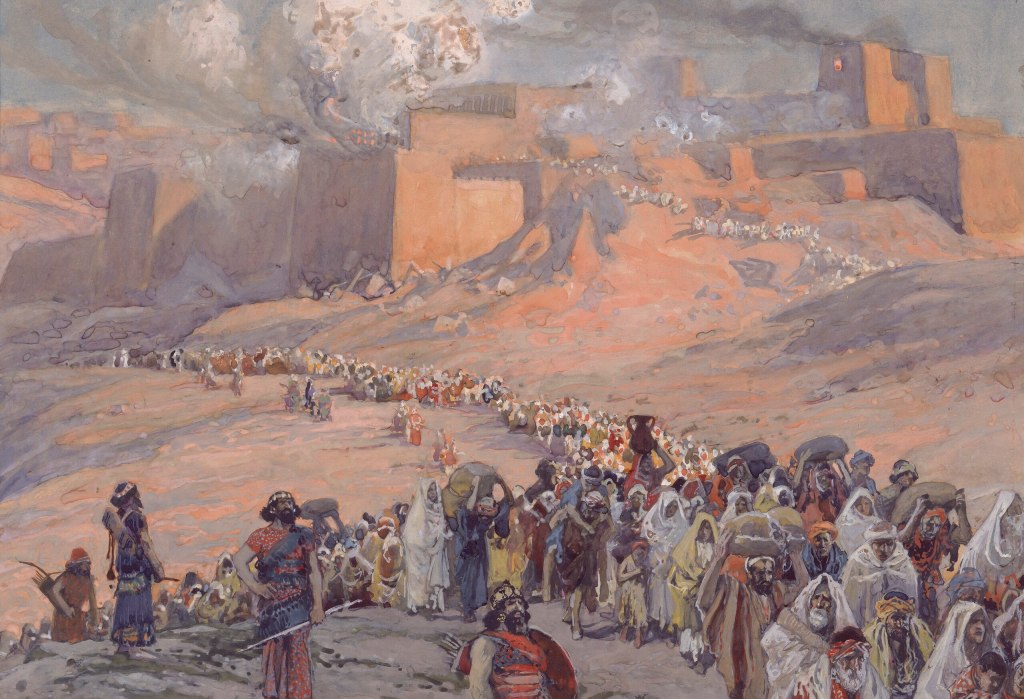
James Tissot’s painting “The Flight of the Prisoners” illustrates Judah’s exile from Jerusalem.

Nebuchadnezzar also came against Jerusalem on two other occasions, first in 598 B.C. against Jehoiakim. Jerusalem was besieged and finally surrendered on March 16, 597 B.C. and Jehoiakim apparently died during the siege. He was replaced by Jehoiahin, who surrendered the city.
The Babylonians plundered the city, including the temple treasuries and deported Jehoiachin and his family along with other Jewish leaders (2 Kings 24:13-16), including the prophet Ezekiel.
After the surrender of Jerusalem in 597 B.C. Nebuchadnezzar appointed Mattaniah, the young uncle of Jehoiachin, as king of Judah and changed his name to Zedekiah. Zedekiah’s reign of 11 years was marked with anti-Babylonian conspiracy despite Jeremiah’s condemnation of this policy (Jere. 27-29).

Nebuchadnezzar’s Final Campaign against Judah

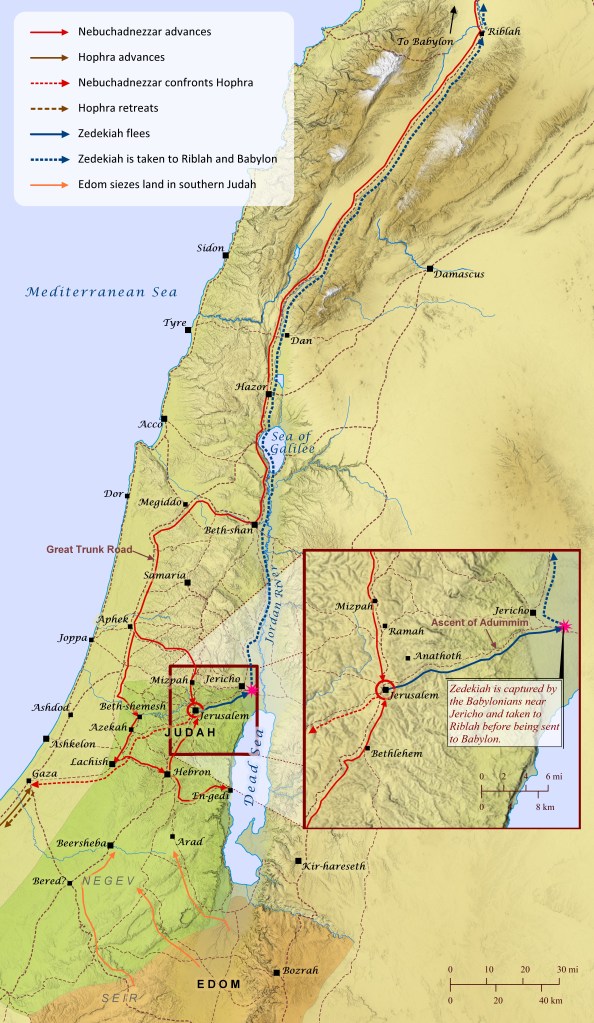
The final collapse of the southern kingdom of Judah as an independent nation came at the hands of King Nebuchadnezzar II of Babylon in 586 B.C. Nebuchadnezzar’s army besieged Jerusalem again from 588-586 B.C., and when the city’s supplies were completely depleted, Jerusalem fell and the temple was destroyed. Zedekiah fled towards Egypt but was captured and forced to witness the execution of his sons before being blinded and led away to Babylon in chains. A third deportation of Jews occurred at this time.

Judah Is Exiled to Babylon

Babylon: The Heart of the Empire

Daniel and his friends were taken to Babylon (Daniel 1:1-6). Babylon was the chief city of Babylonia, long the capital of the kingdom and empire that controlled the whole or a large part of the valley of the Tigris and Euphrates. This was the Neo-Babylonian empire, the latest rendition of Babylonian dynasties.

It was spiritually like walking into the mouth of the lion. Who is our lion-enemy? Living in Babylon was no vacation from home, as Psalm 137:1 reports: “By the rivers of Babylon we sat and wept when we remembered Zion.” It was indeed a very sad time.

Although we are not sure of the origin of Babylon, its roots lie in Genesis 10:8-12.

8 Cush fathered Nimrod; he was the first on earth to be a mighty man. 9 He was a mighty hunter before the Lord. Therefore it is said, “Like Nimrod a mighty hunter before the Lord.” 10 The beginning of his kingdom was Babel, Erech, Accad, and Calneh, in the land of Shinar. 11 From that land he went into Assyria and built Nineveh, Rehoboth-Ir, Calah, and 12 Resen between Nineveh and Calah; that is the great city.

It appears to be mentioned in a historical inscription by Agu-kak-rime (about 1650 B.C.), who restored the shrines of Marduk and Sarpanit in the temple of E-sagila.

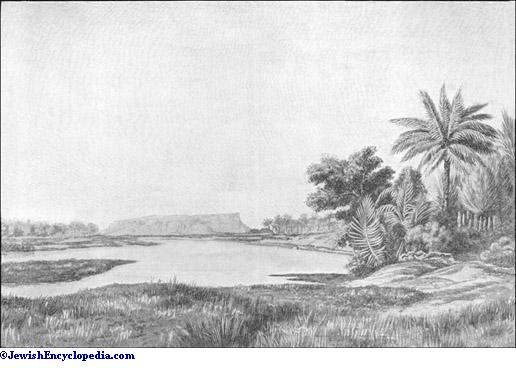
View of the Ruins of Babylon. (From Perrot and Chipiez, “Art in Chaldæa and Assyria.”)

The ruins which have been identified with ancient Babylon lie about 50 miles south of the city of Bagdad and on the east bank of the Euphrates.

Of course, most of us are familiar with the historical situation in Genesis 11, where the nations, which were supposed to ““Be fruitful and multiply and fill the earth” (Gen. 9:1), instead migrated from the west and found a plain in the land of Shinar and settled there, and said “Come, let us build ourselves a city and a tower with its top in the heavens, and let us make a name for ourselves, lest we be dispersed over the face of the whole earth” (Gen. 11:4).

God was against this, confused their language (Gen. 11:7) and “dispersed them from there over the face of all the earth” (11:8). That place was called Babel “because there the Lord confused the language of all the earth” (11:9). It is quite possible that the Nimrod mentioned in Genesis 10 took over this region and established his new kingdom.

After Nimrod established himself as a king and began conquering the surrounding lands (Genesis 10:10-11), he was sadly elevated to a godlike status by his descendants, worshipped simply as “Belus/Bel,” or the more common “Baal/Ba’al” (John Gill, Exposition of the Old Testament, notes on Genesis 10:6). He was also known as Marduk/Merodach, who is equated with “Bel” in Jeremiah 50:2. The tower became known as the tower of Bel, after “Belus Nimrod” or the “Temple Tower of Marduk”—another variant name for Nimrod.

From its beginning, as a center lifted up against God, Babel and Babylon became known as the anti-God city. In the Bible, Babel and Babylon are cities that represent human rebellion against God, idolatry, and oppression.

Later in its history the Assyrian king Sennacherib sacked Babylon around the same timeframe as King Hezekiah and the prophet Isaiah (around the seventh to eighth centuries BC). In fact, Sennacherib even tried conquering Jerusalem, which caused Hezekiah to cry out to God for help and resulted in God rescuing the city and sending Sennacherib back to Nineveh.

When the city of Babylon rebelled, Sennacherib had Babylon destroyed and then flooded. The following king of Assyria, Esarhaddon (one of Sennacherib’s sons), rebuilt Babylon back to its famed glory in his short 12-year reign.

Esarhaddon’s oldest son and heir died young. But in a strange twist, Esarhaddon gave the power of his throne, not to his son next in line for the throne (Shamash-shum-ukin), but instead to his younger son (Ashurbanipal). In a consolation attempt, Shamash-shum-ukin was given charge of Babylon itself, yet still under the authority of his younger brother. This, of course, had the initial makings of a rebellion (in case you didn’t notice).

Ashurbanipal of Assyria and Nineveh (the younger brother and now supreme ruler of the empire) defeated the city of Babylon (ruled by his older brother Shamash-shum-ukin) as it tried to revolt. After the fall of the Assyrians, Babylon was taken over by the Chaldeans (descendants of Heber) under Nabopolassar. This was the beginning of the Neo-Babylonian empire.

Order of events using Ussher’s date for the tower of Babel (though it was likely a little later)
https://answersingenesis.org/tower-of-babel/history-and-archaeology-of-worlds-oldest-city/?srsltid=AfmBOooYNryD0J5BVFvFNuS_qr_2JbnvjgdRVoAZjnjVQXBZOaLnThwC

The Final Benediction, part 1 (Hebrews 13:20)

Do you find it difficult to do God’s will? Do the commands of the New Testament seem daunting to you? G. K. Chesterton, turn of the century British author, Roman Catholic, and journalist, once famously said: “Christianity has not so much been tried and found wanting, as it has been found difficult and left untried.”

Admittedly, forgiving our enemies, keeping ourselves holy…these are not easy things to do. Are we really expected to keep all the commands and exhortations that we find sprinkled throughout the Bible?

But the reality is that God has not left us to rely only upon our own strength and resources to be able to do what He has asked. In fact, let me quote yet another person who has saying to say about this, St. Augustine. In his spiritual autobiography, entitled The Confessions, Augustine says to God: “Command what you will, and give what you command.”

This is precisely the genius of the New Covenant. Whereas with the Mosaic Covenant there were commands but no inner Holy Spirit. Now, God has given us “everything we need for life and godliness” (2 Pet. 1:3). God not only encourages us, but He equips us.

In Philippians 2:12-13 Paul gives us this formula for spiritual life: “Therefore, my beloved, as you have always obeyed, so now, not only as in my presence but much more in my absence, work out your own salvation with fear and trembling, for it is God who works in you, both to will and to work for his good pleasure.”

These two verses give us both sides of the equation: we work out what God is working in us. Notice verse 12 says “work out your salvation,” (not “for” your salvation) and we do this because “it is God who works in you.” And what does He do? He gives us the desire (the will) and the power (to work) so that we can live a life that is pleasing to Him.

Notice that God’s work always comes first. He takes the initiative and we respond. He acts and then we act. “We love because He first loved us” (1 John 4:19). So we can get up and get to work because we have the confidence that God has already been at work in us, equipping us that we “may do his will, working in us that which is pleasing in his sight” (Heb. 13:21).

This is why our author ends this book with a benediction. A benediction is literally a “good word,” a pronouncement of blessing upon someone. There are as many as 30 benedictions scattered throughout the New Testament. The original benediction is the Aaronic blessing, found in Numbers 6:24-26.

24 The Lord bless you and keep you;
25 the Lord make his face to shine upon you and be gracious to you;
26 the Lord lift up his countenance upon you and give you peace.

Benedictions in the New Testament are brief declarations of God’s blessings upon his loved ones, and are often found at the end of epistles. They are intended to bring comfort, peace, joy, and security to those who trust in God. Many Christian worship services conclude with a benediction. Pastors have the privilege of announcing, prayerfully, divine blessings on the people of God as they scatter from the place of corporate worship.

Benedictions pack more weight than a petitioner’s requests. They confer benefit through a minister authorized to speak from and for God.

The book of Hebrews closes with one of the most exquisite and soaring of all Scriptural benedictions. Multiple millions of worshipers have been dismissed with the pastor’s upraised hand and the sonorous words that begin, “Now may the God of peace . . .”

The whole benediction reads, “Now may the God of peace who brought again from the dead our Lord Jesus, the great shepherd of the sheep, by the blood of the eternal covenant, equip you with everything good that you may do his will, working in us that which is pleasing in his sight, through Jesus Christ, to whom be glory forever and ever. Amen” (Hebrews 13:20-21).

This benediction is requesting God’s help in staying on track in the Christian life—doing God’s will and being pleasing to Him—but it based upon what God offers to us (peace) by the blood of the cross. So verse 20 gives the foundation upon which the blessing in verse 21 is requested. Their ability to continue on living for God is based upon God’s attributes of peace, power (by raising Christ from the dead), loving and tender care (as a great shepherd) and ever giving grace (through the blood of the eternal covenant). This benediction seems to draw together the major themes of Hebrews: peace, the resurrected Christ, the blood, the covenant, spiritual perfection (maturity) and God’s work in the believer.

The first foundational gift is God’s peace. How necessary this peace is. We are born enemies of God, alienated from Him because of our sin and rebellion (Rom. 5:10; Eph. 2:12, 19; 4:18), but God has “brought us near” because “ he himself is our peace” (Eph. 2:12-13). He is the one who has reconciled us to God (Rom. 5:10; 2 Cor. 5:18-19). God is called “the God of peace” at least five other times in the New Testament (Romans 15:33; 16:20; 2 Corinthians 13:11; Philippians 4:9; 1 Thessalonians 5:23). Perhaps the frequency of this expression is attributable to the influence of the Aaronic blessing, which closes, “The LORD lift up his countenance upon you and give you peace” (Num. 6:26). These citations, along with the opening invocation of our text, “Now may the God of peace,” reference two marvelous aspects of that peace.

First, it points to His own divine tranquility—the eternal calmness of God’s essential being. This means that God is totally at harmony within Himself and in relation to the Trinity and all He has made. God the Father is called the “God of peace” (Hebrews 13:20). God the Son, the “Prince of peace” (Isaiah 9:6). God the Holy Ghost, the “Spirit…of peace” (Ephesians 4:3).

John MacArthur says, “God is at all times at perfect peace, without any discord within Himself. He is never under stress, worried, anxious, fearful, unsure, or threatened. He is always perfectly calm, tranquil, and content. There are no surprises for His omniscience, no changes for His immutability, no threats to His sovereignty, no doubts to cloud His wisdom, no sin to stain His holiness. Even His wrath is clear, controlled, calm, and confident” (1 and 2 Thessalonians, p. 313).

The Hebrew word shalom means so much more than merely an absence of conflict. It means completeness, wholeness, harmony.

Jesus Christ is the “Prince of Peace” and only through him can we find the “peace that goes beyond understanding.” (Isaiah 9:6, Philippians 4:7).

And that leads us to the second aspect of God’s peace. God can share His peace with us. He gives it to us as a gift. “My peace I give to you” Jesus says in John 14:27. In that vein, there is a distinction between “peace with God” and experiencing the “peace of God.” “Peace with God” is the objective reality that we as former enemies have become, through the cross and belief in Jesus Christ, reconciled to God and now are His friends. This “peace treaty” with God is an objective, one-time experience. Once established, it remains.

The ”peace of God” is the subjective calmness and tranquility we experience whenever we remind ourselves that God is with us, that God loves us and that God is on our side and we need to be reestablished in the “peace of God” time and time again, whenever we face new trials and difficulties. This peace is what Jesus is talking about in John 14:27, “Peace I leave with you; my peace I give to you. Not as the world gives do I give to you. Let not your hearts be troubled, neither let them be afraid.” The normal fears and anxieties of life disappear when we are experiencing God’s peace. Notice that this is a peace that Jesus gives to us and leaves with us even though He would be leaving this earth. It is not a peace like the world gives—shallow and short-lived—but a peace that dwells deep within and sustains us through the storms.

“God took the initiative to establish peace with rebellious men, and He is the author of both personal peace as well as peace among men,” said Matthew Henry.

“Peace with God” precedes experiencing the “peace of God.” In other words, our status with God must change—from enemies alienated from all that He is and has for us, to friends now enabled to receive everything He has for us—before our inner peace can be experienced. All who are God’s children have “peace with God” and can experience the “peace of God” if we fully rely upon Him and His promises.

Invoking God as “the God of peace” is parallel to Jeremiah 29:11, which reads literally, “‘For I know the plans I am planning for you,’ declares the Lord, ‘plans for shalom and not for calamity, to give you a future and a hope’” (based on NASB). Significantly, this promise of shalom was given to God’s covenant people at the beginning of the Babylonian captivity when it appeared that the seas of the Gentile world had inundated God’s people for good.

Therefore, the title “the God of peace” at the end of Hebrews comes as a consciously appropriate benediction to fearful, restless hearts—“Your God is a God of peace, and he will pick up the pieces no matter what happens—he will heal your wounds and fulfill what is lacking. No storm will sink you! So hang in there!”

It is this “God of peace” that is now bestowing these precious blessings upon the Hebrew Christians and us today.

Secondly, we see that God is a powerful, life-giving God. He proved when He “brought again from the dead our Lord Jesus.” Surprisingly enough, this is the first and only mention in the book of Hebrews of the resurrection of Jesus. Yes, He is spoken of as “ever living” and having an “indestructible life,” both of which point to the fact of the resurrection, but this is the only mention of Him being raised from the dead.

Of course, Jesus Himself raised Himself up from the dead, as He says in John 10: “For this reason the Father loves me, because I lay down my life that I may take it up again. No one takes it from me, but I lay it down of my own accord. I have authority to lay it down, and I have authority to take it up again. This charge I have received from my Father” (Johnn 10:17-18).

Here it is again in John 5:21-22: “As the Father raises the dead and gives them life, so also the Son gives life to whom he will. For the Father . . . has given all judgment to the Son.” So the Son has authority to raise from the dead whomever he will, including himself. So Jesus says in John 2:19: “Destroy this temple, and in three days I will raise it up.” And John adds, “He was speaking about the temple of his body” (John 2:21). Destroy this body, and in three days, I will raise it up. And he did.

But God also “brought again from the dead our Lord Jesus” (cf. 1 Pet. 1:3; Acts 2:32-33; Rom. 8:11). This was the Father’s stamp of approval on all that Jesus had accomplished through the cross. Jesus said, “Paid in full; it is finished.” The Father showed that it was finished by reversing death and bringing the Innocent One back to life. The significance of this is that “The resurrection of Christ is the Amen of all His promises.” This means that everything God has promised He will now provide.
Hebrews has built its case for Jesus’ perpetual tenure as High Priest, in part, on the “power of [his] indestructible life” (Heb. 7:16), so that “he always lives to make intercession” for believers (7:25). Now, at last, our author explicitly announces Jesus’ resurrection, when God “brought [him] again from the dead.”

As he has previously, our author builds anticipation by reserving the Savior’s name for the end of the clause (in Greek word order): “who brought again from the dead the great shepherd of the sheep by the blood of the eternal covenant, our Lord Jesus” (cf. 2:9; 3:1; 4:14; 7:22; 12:2, 24). Thus, the name of Jesus concludes the description of the divine subject who blesses (13:20), and reappears to conclude the blessing he confers (13:21).

“Brought again” (or “led up,” anagō) is an unusual verb for resurrection (cf. Rom. 10:7), reflecting the influence of Isaiah 63:11, which reads in the LXX, “who brought up [anabibazō] from the earth the shepherd of the sheep.” In the exodus, the shepherd was Moses (cf. Psa. 77:20) and the rescue was from the sea; now the great shepherd, Jesus, has been “led up” from the realm of the dead.
And this leads us to the third foundational truth which establishes this benediction with theological weight to carry our obedience to Christ…He is our loving and sacrificial shepherd.

The shepherd metaphor is one of the most spiritually humbling in all of God’s Word. It reveals volumes about us (the sheep) and about the Lord (our Shepherd). As to our “sheepness,” Dr. Bob Smith, long-time philosophy professor at Bethel College in Minnesota, used to humor his point home regarding our human state by insisting that the existence of sheep is prima facie evidence against evolution. Sheep are so unintelligent and obtuse and defenseless, they could not have possibly evolved—the only way they could have survived is with shepherds!

We may gripe and complain about being called sheep, but we cannot but greatly appreciate that Jesus took up the term shepherd and applied it to himself (cf. Mark 14:27). Jesus’ shepherd heart welled with compassion, for Mark tells us, “When he went ashore he saw a great crowd, and he had compassion on them, because they were like sheep without a shepherd” (Mark 6:34).

Even more, Jesus identified himself as the shepherd who would lay down his life to protect his sheep (John 10:1-18; cf. Ezek. 34:1-24; 1 Pet. 2:25; 5:4). This image of Christ comes from Psalm 23, where the Lord God is the Shepherd who provides for His sheep (Ps 23:1), nourishes and refreshes them (Ps 23:2-3), and protects them from their enemies (Ps 23:5; see also Jn 10:11-15). This association between Jesus as “our Lord” and as the “great Shepherd” is a final strong affirmation of the deity of Christ. (Charles R. Swindoll, Swindoll’s Living Insights: Hebrews, 228)

But here our writer tells us that he is not only a “good shepherd”—he is also “the great shepherd of the sheep.” Why? Precisely because he is a risen Shepherd—“brought [back] again from the dead.” As the great risen Shepherd, his compassion and protection are mediated from a position of an unparalleled display of power! He, our Shepherd, is exalted at the right hand of the Father. All other shepherds pale by comparison. There is none like our “great shepherd.” Our risen Shepherd lives not only to give us life, but to tend us so that we will be sheep who bring him glory through our obedience and living a life pleasing to Him. This means that our grandest spiritual desires are never audacious and that any spiritual aspirations less than the loftiest are not grand enough. What security and what challenge the fact of our risen “great shepherd” brings to our souls.

Warren Wiersbe reminds us that “as the Good Sheperd, Jesus Christ died for the sheep (John 10:11). As the Great Shepherd, He lives for the sheep in heaven today, working on their behalf. As the Chief Shepherd, He will come for the sheep at His return (1 Pet. 5:4)” (The Wiersbe Bible Commentary: NT, p. 845). As the Good Shepherd He worked for us when He completed the great work of redemption (John 17:4). Now that He is in heaven, He is working in us to mature us in His will.

Fourthly, our God is a covenant keeping God, and sealed that covenant with the blood of His one and only Son.

Moses sprinkled the “blood of the covenant” on the Israelites at Sinai (Heb. 9:20, citing Exod. 24:8), but they broke that covenant, and Jeremiah 31:31-34 pronounced it “obsolete” (Heb. 8:13). The new covenant, which Jesus’ blood inaugurates, secures our everlasting salvation, fulfilling God’s promises to establish an “eternal covenant” with his people (2 Sam. 23:5; Isa. 55:3; 61:8; Jere. 32:40; 50:5; Ezek. 16:59-60; 37:26).

“Specifically, the foundation for our highest dreams is the everlasting, unbreakable new covenant promise earlier quoted in 8:10 where God says, “I will put my laws into their minds, and write them on their hearts, and I will be their God, and they shall be my people” (cf. Jeremiah 31:31–34). The promise is nothing less than a renewed heart and a personal relationship with God through the atoning work of God the Son and the indwelling of God the Holy Spirit. We have his word for it that all this is ours if we come to him!

“And this covenant, this promise, is eternal. It will never be replaced by another as it once replaced the old covenant. It was established by the blood of the ultimate Lamb of God, whose atoning death was ratified and verified by his resurrection. The writer’s friends were being encouraged to remember that whatever came, no matter how high the seas, his new covenant promise would never change or fail. The eternal covenant granted them eternal life” (R. Kent Hughes, Hebrews: An Anchor for the Soul, Volume 2, p. 244).

Every time we partake of the Lord’s Supper we remind ourselves of this eternal covenant. On the night he was betrayed Jesus broke the bread and distributed the cup as a sign of the new and eternal covenant that his blood would inaugurate and establish: “This cup that is poured out for you is the new covenant in my blood” (Luke 22:20; see 1 Cor. 11:25). How can we know with absolute certainty and assurance that God will keep his word in the new and eternal covenant to forgive our sins and be our God and never leave us or forsake us? We can know because the covenant was signed, sealed, established, and delivered on the foundation of the blood of God’s very own, dear Son Jesus Christ.

Stick with Jesus, part 2 (Hebrews 13:11-16)

All throughout the book of Hebrews the author has been warning, encouraging and pleading with these Jewish Christians not to abandon their faith in Jesus and return back to the Jewish religious system with its sacrifices. The passage we have before us today refers back to those sacrifices, particularly the Day of Atonement (Yom Kippur) and the point is made that since that sacrifice happened “outside the camp” (v. 11), then we are to “go to [Jesus] outside the camp and bear the reproach he endured” (v. 13).

11 For the bodies of those animals whose blood is brought into the holy places by the high priest as a sacrifice for sin are burned outside the camp. 12 So Jesus also suffered outside the gate in order to sanctify the people through his own blood. 13 Therefore let us go to him outside the camp and bear the reproach he endured. 14 For here we have no lasting city, but we seek the city that is to come. 15 Through him then let us continually offer up a sacrifice of praise to God, that is, the fruit of lips that acknowledge his name. 16 Do not neglect to do good and to share what you have, for such sacrifices are pleasing to God.

The imagery shifts from the perennial peace offerings to the annual Day of Atonement sacrifices, when the high priest entered the Most Holy Place, carrying blood to atone first for his own sins and then for the sins of the people (9:7, 25). This annual rite has been contrasted with the self-sacrifice of Christ, who brought his own blood into the heavenly sanctuary, atoning for sins once for all (9:24-28; 10:10-14).

Now our attention is directed to what happened to the carcasses of the animals after their blood was brought into God’s presence. Whereas the meat of peace offerings could be consumed by priests and worshipers after the Lord’s best portions were consumed on the altar, on the Day of Atonement the whole bull and goat from which atoning blood had been taken were carried outside Israel’s camp and completely incinerated. They were destroyed “outside the camp,” the realm of what was unclean, unfit to be seen by the Lord, who “walks in the midst of your camp” (Deut. 23:14; cf. also Lev. 13:45-46; Num. 5:1-4).

The bodies of Nadab and Abihu, the sons of Aaron, were taken outside the camp after they were judged and killed for offering up strange fire on the altar. If someone blasphemed God they were stoned outside the camp (Lev. 24:14, 23). When Miriam, the sister of Moses, was stricken with leprosy, she had to spend seven days outside the camp (Num. 12:14ff.). After the sins of the people were symbolically laid on the head of the scapegoat it had to be taken outside the camp (Lev. 16).

Eventually Jerusalem itself was considered holy ground. Everything beyond its borders was considered unholy or profane. Golgotha, where Jesus was crucified, was considered outside the city.

Golgotha site photographed in about 1870.

The association of territory “outside the camp” with defilement and banishment from God’s holy presence explains the theological significance of the fact that Jesus was crucified “outside the gate” of Jerusalem (cf. John 19:16-17). He endured God’s wrath as he bore others’ sin in his body on the tree (Matt. 27:46; Rom. 3:24-25; 1 Pet. 2:24). By bearing our guilt and absorbing its penalty, this “holy, innocent, unstained” High Priest (Heb. 7:26) endured sin’s curse (2 Cor. 5:21; Gal. 3:13) and thereby “sanctified” all believers by his blood. Throughout this sermon, “sanctify” (hagiazō; Heb. 2:11; 10:10, 14), “cleanse” (katharizō; 9:14, 23), and “perfect” (teleioō; 7:19; 9:9; 101, 14) have designated the purging from defilement that now qualifies worshipers to approach God’s holy presence.

Jesus’ sacrifice sanctifies his people so that they may respond to divine grace with thankful and reverent worship (12:28), standing in God’s presence as priests and offering sacrifices pleasing to him (13:15-16).

Our author is communicating two great things: (1) All those who remained committed to the old Jewish system were excluded from the benefit of partaking of Christ’s atoning death. And, (2) Jesus’ death outside the camp means that he is accessible to anyone in the world who will come to him.
Jesus’ crucifixion outside Jerusalem represented not only his forsakenness by God but also his repudiation by the Jewish community, “his own” people (Mark 15:9-15, 29-32; John 1:11; Acts 3:13-15). Jesus bore “our reproach” (v. 13).

When he says that Jesus died “outside the city,” he means He died outside Judaism. The Lord was utterly rejected by Israel. Judaism didn’t want Him. He was taken OUTSIDE and crucified–as if He were refuse. Therefore, His death was totally outside the Jewish system; utterly removed from it. (C. S. Lovett, Lovett’s Lights on Hebrews, 331)

Jesus did faithfully prepare his disciples to endure the same rejection he had endured (Luke 6:22; John 16:2), and indeed they were rejected (John 9:22, 33; 12:42; Acts 18:5-7). To follow after Jesus is to carry one’s cross toward shameful death (Mark 8:23; Heb. 12:2). Now the recipients of this letter must be prepared to share the reproach that Jesus endured, just as Moses did long ago (Heb. 11:24-26). To join Jesus “outside the camp” may demand that one forgo access to the Jerusalem temple, acceptance in local synagogues, and acknowledgment by one’s own family (Matt. 10:35-38).

For the Christian there must be a real identification with Christ and his shame; he must enter into a genuine “fellowship of Christ’s sufferings (Phil 3:10), and be willing even, like the first martyr Stephen, to lay down his life for his Lord and Savior “outside the city” (Acts 7:58). The recipients of this letter had gone forth “outside the camp” to associate themselves with Christ and his cross; but now their resolve is weakening and they are being tempted to turn back in the hope of finding an easier and more respectable existence “inside the camp.” (Philip Edgcumbe Hughes, A Commentary on the Epistle to the Hebrews, 580)

There was and even is today a price to be paid in following Jesus which the Jews of that age did not have to bear. But as Jesus was despised, so would be His disciples. The question is: Are we willing to pay the price?

Spurgeon said: “A sorry life your Master had, you see. All the filth in earth’s kennels was thrown at him by sacrilegious hands. No epithet was thought coarse enough; no terms hard enough; he was the song of the drunkard, and they that sat in the gate spoke against him. This was the reproach of Christ; and we are not to marvel if we bear as much. ‘Well,’ says one, ‘I will not be a Christian if I am to bear that.’ Skulk back, then, you coward, to your own damnation; but oh! Men that love God, and who seek after the eternal reward, I pray you do not shrink from this cross. You must bear it.”
Pursuing Jesus “outside the camp” comes at a price.

Yet one OT passage foreshadows the privilege now enjoyed by those who go “outside the camp” for Jesus’ sake. After Israel’s adultery with the golden calf, the Israelites’ defilement was so pervasive that Moses had to pitch the tent of meeting “outside the camp” (Exod. 33:7-11). That became the place where people went to meet with God. Because of institutional Judaism’s repudiation of the Messiah, the spheres of the holy community and the polluted wasteland have been reversed. Those unwelcome in earthly Jerusalem’s temple and expelled from synagogues have become heirs of God’s unshakable kingdom and citizens of “the city that is to come.” Admittedly, “here we [followers of Jesus] have no lasting city.” But within a few years, in AD 70, Roman troops would destroy Jerusalem and its temple on Mount Zion. That city, which the psalmists had extolled for its security (Psalm 48, 87), would lie in ruins. When compared to the promise of being welcomed into the coming city that abides forever, to be expelled from a community that has turned its back on God’s grace in Christ is no great loss.

There thus remains only one thing to do, and so the writer exhorts us: “Therefore let us go to him outside the camp and bear the reproach he endured. For here we have no lasting city, but we seek the city that is to come” (vv. 13, 14). Guthrie sees verse 13 as the crux of the conclusion, a final direct appeal to the readers to identify themselves wholly with Christ.” In other words, he says, “Christians, join Jesus in his sufferings!”

The cities of the earth—all earthly institutions—will fall apart. Only the heavenly Zion will remain. We must go, flee to him outside the camp, and willfully embrace his “reproach,” for such an act is worth doing a million times over! Thus Jesus Christ, who is “the same yesterday and today and forever,” becomes our constant meal—our food, our drink, our life—and we will receive from him grace upon grace upon grace. And because he is outside the camp, he will always be accessible. In fact, he is with us, in us, and coming to us! This understanding that he nourishes us and is accessible to us will help us stay on course.

The good news is that for those who bear His reproach, this world is the worst they will ever have it. The best is yet to come! But for cowards who turn their back on Jesus, this life is the absolute best they will ever have it.

May we not say, too, that the Son who invites us to join him “outside the camp” himself first left the “camp” of heaven, which is the true and abiding camp and to which he returned in triumph; and that he came to our unholy ground for the purpose of removing the defilement of his people and for the consecration and renewal of the whole creation, so that in the eternity of his glorious kingdom all will be one “camp,” one “city,” without blemish and without bounds, because there will no longer be any such things as unholy territory, and the harmony of heaven and earth, of God and man, will be established forevermore? (Philip Edgcumbe Hughes, A Commentary on the Epistle to the Hebrews, 582-3)

Christ went outside the city gate and suffered. We must go after him, and to him. This means we have to relinquish all the privileges of the camp and the city for his sake. We have to leave them behind and go to him. We must cling by faith to his sacrifice and through this sanctification, in place of all the sacrifices of the law. We must own him under all that reproach and contempt that were heaped on him during his suffering outside the gate. We must not be ashamed of the cross of Christ. (John Owen, Crossway Classic Commentaries: Hebrews, 264)

It was time for Jewish Christians to declare their loyalty to Christ above any other loyalty, to choose to follow the Messiah whatever suffering that might entail, to “go out to him outside the camp.” They needed to move outside the safe confinement of their past, their traditions, and their ceremonies to live for Christ. Since Jesus was rejected by Judaism, they should reject Judaism. (Bruce Barton, Life Application Bible Commentary: Hebrews, 238)

First, to the Hebrews to whom this letter was addressed, they are being told that as long as they remain within old covenant Judaism they cannot eat at the altar of God’s grace in Jesus Christ. They must leave the old covenant and embrace the new covenant. If they are to share in the salvation that Christ has obtained they must renounce their trust and confidence in the sacrifices and rituals of the old covenant system and put their hope and trust in Jesus Christ who is himself the fulfillment of all that came before. They must sever themselves from the now outmoded Mosaic system and cleave unto Christ in whom that system has been fulfilled. Don’t look to the priesthood of Aaron. Don’t put your hope in the feasts and rituals of the old covenant. Put your trust entirely in him to whom all such religious practices pointed: Jesus!

Second, we are also being called to share in the reproach that Jesus endured (v. 13). Today we don’t have a literal “camp” or “city” outside of which we are to go. So the “camp” must represent or symbolize something else for us. I think it points to everything we regard as safe and secure and respectable. To go “outside the camp” is to move beyond the comfort and acceptance that this world offers us. Inside the camp, inside the city gates, is where we find familiarity and ease and affirmation and respect from this world and its value system. To follow Jesus outside the camp is to embrace and bear the shame and reproach he suffered. To join Jesus outside the camp is to willingly identify with him in his suffering and to move out among the lost and unbelieving people of this world. It’s only outside the camp that we will find the unreached people of the world.

And the only thing that makes this a reasonable thing to do is the simple but glorious truth stated in v. 14. There we read that we do this “because” here “we have no lasting city, but we seek the city that is to come” (v. 14). We can joyfully embrace the reproach that Jesus himself endured because we are looking for the city to come, the heavenly Jerusalem that God has prepared for his people who trust him and put their hope in him.

Perhaps the Jews were trying to entice the Hebrew Christians back into the Jewish fold by saying, “We have Jerusalem, but you have no such glorious city!” The author says, “Oh, but we do have a city! Ours is the same city that Abraham and the patriarchs were seeking, that heavenly city that God prepared for them and us” (11:13-16). After 70 A.D. these Jews would no longer be able to claim Jerusalem for themselves.

The religious leaders clung to the city of Jerusalem and cast Jesus from it. They surely did not realize that within a short span of some forty years the city of Jerusalem and the temple they trusted in would be totally destroyed. On the Temple Mount platform there would not be one stone left standing upon another exactly according to Jesus’ words in Matthew 24:2.

This concept of a heavenly city and heavenly reward is something we’ve seen repeatedly in Hebrews. Do you recall in Hebrews 10:34 that Christians are described as having “joyfully accepted the plundering” of their property because they knew they “had a better possession and an abiding one”? They were seeking a city that is to come; a city that has foundations; the eternal and heavenly Jerusalem on the new earth. Knowing this was theirs, they gladly suffered for the sake of aiding and supporting other Christians. It was a permanent possession that could never be taken away from them.

We saw it in Hebrews 11:25-26 where Moses “refused to be called the son of Pharaoh’s daughter, choosing rather to be mistreated with the people of God than to enjoy the fleeting pleasures of sin. He considered the reproach of Christ greater wealth than the treasures of Egypt, for he was looking to the reward.” The reward is the heavenly Jerusalem, the place of God’s eternal dwelling with his people on the new earth.

And what is to be our response to this pursuit of Christ into a life with pain and suffering?

15 Through him [Jesus] then let us continually offer up a sacrifice of praise to God, that is, the fruit of lips that acknowledge his name. 16 Do not neglect to do good and to share what you have, for such sacrifices are pleasing to God.

Verse 15 says it is a life of praise to God — real, heartfelt, verbal praise — the kind that comes out of your mouth as the fruit and overflow of your heart.

In ancient days some Jewish rabbis believed that the time would come when all sacrifices would cease and instead there would be praises. Also, the First Century Jewish writer Philo spoke of a time when the best sacrifice would be the ones glorifying God with hymns. Indeed, in Psalm 50:23 it is written: “The one who offers thanksgiving as his sacrifice glorifies me, to the one who orders his way righty, I will show the salvation of God.”

Scholars feel the “fruit of lips” is taken from Hosea 14:2. In the Hebrew of this verse it reads literally “the young bulls of our lips” (par-im se-fa-te-nu). Praise is indeed like a sacrifice, that costs us something.

When our author refers to this worship as a “sacrifice,” it is an analogy that we’ve seen Paul and Peter use (Romans 12:2; 1 Peter 2:9). Under the New Covenant the sacrifices are no longer physical, but spiritual—the praise of our lips to the God who saved us.

In the words of Warren Wiersbe, “The words of praise from our lips, coming from our heart, are like beautiful frit laid on the altar” (The Wiersbe Bible Commentqry: New Testament, p. 844).

So we are to offer sacrifices…sacrifices of praise. This exhortation can only rightly be exercised “through him,” that is, through Jesus. It is only because of Him and what He has done for us that we have something to praise God for.

It is praise “to God,” certainly not to ourselves. We did absolutely nothing to deserve or gain our salvation. And this praise is to be “continuous,” why? Because of all that God has done for us through Christ. As we noticed in 12:28, worship is always our most natural response to our redemption. Praise, therefore, should be our constant habit. There should hardly be a moment when our lips are not trembling with praise for how kindly and graciously and tenderly and mercifully our God has dealt with us through His Son Jesus Christ.

This praise is further clarified as “the fruit of lips that acknowledge his name,” that is praise that publicly affirms our trust in Jesus Christ, acknowledging Him as our Savior and Lord.

The second response we should have toward our redemption in Christ is to love one another, a theme that began in verse 1, but here it is spelled out in very practical terms.

16 Do not neglect to do good and to share what you have, for such sacrifices are pleasing to God.

These works of “doing good” and “sharing what you have” would likely include the hospitality mentioned in Hebrews 13:2, as well as the ministry to prisoners in Hebrews 13:3. “Doing good” today can include a number of ministries: sharing food with the needy, transporting people to and from church or medical appointments, contributing to needy causes; perhaps just being a helpful neighbor.

Our highest aspiration as those being “conformed” to the image of Jesus, is to live a life that is “pleasing to God.” In my mind, pleasing God goes a step beyond obeying God. We obey the explicit commands or prohibitions of God, while we please God by knowing His heart well enough to know not so much what He demands, but what He desires.

When we go with Jesus to the place of his sacrifice outside the camp, we see more clearly than ever that his sacrifice for us — the sacrifice of himself, once for all for sinners (Hebrews 9:26, 28) — brings to an end all sacrifices except for two kinds: the sacrifice of praise to God (verse 15) and the sacrifice of love to people (verse 16).

Jim Elliot, Pete Fleming, Ed McCully, Nate Saint, and Roger Youderian were killed on January, 1956, in Ecuador, moving toward the need of the Auca Indians and not toward comfort.

Shortly before their deaths on Palm Beach they sang this hymn. Elliot writes, At the close of their prayers the five men sang one of their favorite hymns, “We Rest on Thee,” to the stirring tune of “Finlandia.” Jim and Ed had sung this hymn since college days and knew the verses by heart. On the last verse their voices rang out with deep conviction.

We rest on Thee, our Shield and our Defender,
Thine is the battle, Thine shall be the praise,
When passing through the gates of pearly splendor
Victors, we rest with Thee through endless days.

With that confidence, they went to Jesus outside the camp. They moved toward need, not comfort, and they died. And Jim Elliot’s credo proved true: “He is no fool to give what he cannot keep to gain what he cannot lose.” “Here we do not have a lasting city, but we are seeking the city which is to come” (Hebrews 13:14).

Follow the Leader, part 2 (Hebrews 13:8)

We talked last week about remembering and imitating the faith of our leaders. For the Hebrews, some, maybe most, of those leaders were now gone, likely having been martyred for their faith. The reality is for all of us that our pastors come and go, and some of them fall into sin. We’ve seen that happen far too often among pastors we have respected and loved lately.

Not only will our leaders change, but the religious landscape around us will change. All of us who are older know that our culture has gotten “worse and worse” (2 Tim. 3:13). So Jesus’ unchanging character not only encourages them in the midst of losing good leaders but also admonishes them to stay true to the faith and not follow “diverse and strange teachings” (Heb. 13:9). If Jesus does not change, we should be wary of any new teachings.

“Jesus Christ” was the center of the message that the leaders had preached to these hearers (cf. v. 7). That message and its Hero is what this writer had urged his readers not to abandon. The leaders had preached the Word of God to these readers, and that preaching culminated in Jesus Christ.

All the changes that we face is why it is so important to keep our eyes and trust on Jesus Christ. Everything, and I mean everything else changes. Some of those changes upset us. That is why it is so comforting that “Jesus is the same yesterday, today and forever” (Heb. 13:8). So we need most to follow our real Leader, Jesus Christ our Lord.

In the midst of this ever-changing environment, it is good to remember that there is one thing that never changes — and that is Jesus Christ! He was in the past exactly who He is in the present and precisely who He will be forever! That’s why Hebrews 13:8 says, “Jesus Christ is the same yesterday, and today, and forever.”

Here, the very same Old Testament Scriptures and wording that describe God the Father’s immutableness are applied directly to Christ (cf. Psalm 102:27 and Hebrews 1:12; Isaiah 48:12 and Revelation 1:17).

The later admonition to “obey your leaders and submit to them” (13:17) may imply that some in the congregation have not transitioned well from the first generation to the present leadership. If any were troubled over the loss of those who once shepherded them, they must realize that their great shepherd is and always will be with them: “Jesus Christ is the same [ho autos] yesterday and today and forever.” The OT citations showing the Son’s divine superiority to angels at the start of this sermon included Psalm 102:25-27, in which the Son is contrasted with the created heavens and earth: “They will perish, but you remain. . . . You are the same [ho autos], and your years will have no end” (Heb. 1:10-12).

The created order’s mutability has touched his hearers’ experience in the death of their shepherds, but the divine Son, Jesus Christ, remains “the same,” unchangeable and eternal. That divine Son has become the incarnate Son, has undergone temptation and suffering and death, and has emerged triumphant “by the power of an indestructible life” (7:16) to become and remain a “priest forever, after the order of Melchizedek” (7:17). If the death of trusted human shepherds has contributed to the hearers’ weariness and faintheartedness, they must realize that they have a “great shepherd” whom God “brought again from the dead” (13:20). He “always lives to make intercession for them” (7:25) and keeps his word, promising, “I will never leave you nor forsake you,” which he expressed in other words to his awestruck disciples after his resurrection: “I am with you always, to the end of the age” (Matt. 28:20). (ESV Expository Commentary).

Some of these readers might have experienced Jesus while he was still alive, but for most of them they had no first-hand experience with Christ. But the Jesus seated at the right hand of God is the same Jesus who walked on earth and the same Jesus who will come again for us.

Everything around us changes. We humans change most of all. Our moods sweeten or sour, our ability to work lessens as we age, we age and fall ill and eventually we die. Jesus does not. He always lives and is always the same.

Yesterday Jesus “offered up prayers and supplications, with loud cries and tears, to him who was able to save him from death” (5:7). Today he is a high priest before the Father who is able to sympathize with our weakness because “in every respect [he] has been tempted as we are, yet without sin” (4:15). And forever this same Jesus “always lives to make intercession for them” (7:25). “Our priest is eternally the same and eternally contemporary. We need not fear opinion changes or mood swings in Jesus!” (R. Kent Hughes, Preaching the Word: Hebrews, vol. 2, 228).

But what does that mean? What does it mean to say that Jesus is the “same” no matter what time or season it is? This is what theologians call “immutability.” That is, God does not change in His essence (character), His will or His plans or His promises. There is no variableness, no “shadow of turning” (James 1:17) in Christ.

“[Immutability] means that, being perfect, God cannot and does not change. In order to change, a moral being must change in either of two ways. Either he must change for the better or he must change for the worse. God cannot get better, because that would mean that He was less than perfect earlier, in which case He would not have been God. But God cannot get worse either, because in that case He would become imperfect, which He cannot be. God is and must remain perfect in all His attributes” (James Montgomery Boice, Minor Prophets, Volume 2, p. 600).

When we say that Jesus is always and ever the same and that he never changes we aren’t thinking of immutability in the way we apply that term to the Rock of Gibraltar. The Rock of Gibraltar is a very real place off the southwestern tip of Europe on the Iberian Peninsula, was known in myths and history as a solid, stable entity that could not be moved.

John MacArthur has written: “Immutability does not mean that God is static or inert, nor does it mean that He does not act distinctly in time or possess true affections. God is impassible—not in the sense that he is devoid of true feeling or has no affections but in the sense that His emotions are active and deliberate expressions of His holy dispositions, not (as is often the case with human emotions) involuntary passions by which He is driven.”

God is solid and stable, like a rock, and we can depend upon Him in any and every circumstance. But rocks don’t have sense or feelings. Jesus is alive and feels and thinks and responds to circumstances.

Jesus Christ did “become flesh” (John 1:14) but did not cease to be God. God is willing and able to be reconciled to former enemies through the cross (Romans 5:10; 2 Corinthians 5:18-19).
The Greek word for the “same” emphatically states that Jesus Christ is unchangeable! What good news this is in a world where things are changing at lightning speed! Jesus Christ is the one Person we can depend on to be the same, regardless of the time or the spirit of the age. We don’t need to refigure who Jesus is, what He thinks, or what His message is, because He is the same — and everything He represents is the same — yesterday, today, and forever!

The word “yesterday” is the Greek word exthes, and it depicts all time that ever was up until this present moment. It describes the past. The word “today” is the Greek word semeron, and it means today or at this very moment or this current age. It depicts the present. But in the Bible when the words “yesterday and today” are used in one phrase, as they are used here, it also portrays continuity.
The words “yesterday and today” are an Old Testament expression to denote continuity (see Exodus 5:14; 2 Samuel 15:20). So here we find that Jesus isn’t one way in the past and another way in the present. Whoever He was in the past is exactly who He is in the present. There is continuity in Jesus Christ!

Therefore, if you discover Jesus of the past, you have also discovered Jesus of the present, and you have discovered Jesus of the future, because He is continuously the same. The word “forever” in Greek means into all the ages of the future. This phrase depicts all future time to come, including all ages that will ever be known. Hence, it describes the future.

I don’t know about you, but I am so thankful that Jesus Christ is the same yesterday and today and for all future ages! With all the sweeping changes happening in the world right now, I thank God that Jesus isn’t one of them!

Who He was in the past, in the Gospels is the same Jesus who is present with us today and will be with us forever!

There is no “before” or “after” with God, as there is with us. There’s no “He used to be like that, but now He’s like this.” There’s no such thing as “the Old Testament God” as opposed to “the New Testament God.” He was good, He is good, and He always will be good. And the same can be said about His power, His wisdom, His love, and so on.

Another way to talk about God’s immutability is that whereas you and I are always “becoming,” God is always “being.” We’re always traveling; God is already there and has always been. We can develop or deteriorate, grow or decay, progress or regress. But with God, there is no room for improvement. He has always been, and always will be, utterly and delightfully perfect in every way. One theologian puts it like this: “All that is creaturely is in [the] process of becoming. [The creature] is changeable, constantly striving, in search of rest and satisfaction, and finds this rest only in him who is pure being without becoming.”

So when we talk about Jesus never changing, we mean, first of all, that His love towards us does not change. There is no “loves me, loves me not.” Whom He loves, He loves to the end (John 13:1). His love for you doesn’t rise and fall like a thermometer. It doesn’t change toward us because we fail Him, rather His love changes us.

William E. Sangster, a Methodist leader, suggested that if you nail your heart to people, they will move and change, but if you nail your heart to Jesus, as the Bible says, He is, “the same yesterday and today and forever.”

Now, understand that God loves different people in different ways. God “loved the world” (John 3:16) and provides the possibility of salvation. God loves His own children in a different and deeper way. He also loves someone who obeys Him (John 15:14) and who is a cheerful giver (2 Cor. 9:6) in a different way. We could say for those who belong to Jesus Christ God’s love towards us is unconditional, or maybe better said, “contra-conditional.” He loves us even though we are sinners.

The Puritan Thomas Adams takes his love back into the past before the worlds began. He writes:
“Much comfort I must hear leave to your meditation. If God preordained a Savior for man before He had either made man, or man had marred himself—as Paul to Timothy, “He hath saved us according to His own purpose and grace, which was given us in Christ Jesus before the world began” (2 Tim. 1:9)—then surely he meant that nothing would separate us from that eternal love in that Savior (Romans 8:29)” (Thomas Adams, The Immutable Mercy of Jesus Christ).

Secondly, God’s promises do not change. Isaiah 40:8 makes the point: “The grass withers, the flower fades, but the word of our God will stand forever.” He will always be faithful to keep His promises no matter how seemingly impossible it may be. “There is many a believer who forsakes God, but there is never a believer whom God forsakes” says Bob LaForge.

When God’s people departed from Him (in the Old Testament biblical accounts) all the more emphasis was put upon His faithfulness, so that the only hope of His wayward people lay not only in His grace and mercy but also in His faithfulness, which stands in marked contrast with the faithlessness and inconstancy of His people (Gaspar Hodge).

“God is true. His Word of Promise is sure. In all His relations with His people God is faithful. He may be safely relied upon. No one ever yet really trusted Him in vain. We find this precious truth expressed almost everywhere in the Scriptures, for His people need to know that faithfulness is an essential part of the Divine character. This is the basis of our confidence in Him” (A. W. Pink, The Attributes of God). As Spurgeon says, “God writes with a pen that never blots, speaks with a tongue that never slips, acts with a hand that never fails.”

Consider God’s faithfulness to His promises: We learn that all things do work together for good (Rom. 8:28). We learn that God will never leave us nor forsake us (Heb. 13:5). We learn that nothing will separate us from the love of Christ (Rom. 8:35). We learn to walk by faith and not by sight (2 Cor. 5:7). We learn to trust in God’s character and not our circumstances. We learn no detail of our life is outside His loving purpose and sovereign control. We learn His solution far surpasses our most creative imagination. We learn God is often closest when we least feel His presence. We learn Hebrews 10:23 which calls us to “hold fast the confession of our hope without wavering, for He who promised is faithful.”

Thirdly, His presence is always with us. To say that Jesus is unchanging and always the same means that there never has been a time in the past and never will be in the days ahead when his assurance to us in the Great Commission will prove false. You will recall that in Matthew 28 Jesus said, “And I will be with you, even to the end of the age.”

So here in v. 8 he tells us that we need never fear that we will wake up one day and God will be gone, vanished, having left us to ourselves. We know this will never be the case because Jesus Christ who is God is the “same” yesterday, when he first made that promise, as well as today when I need him to be near and close by to me, and in the days and weeks and years ahead when my life starts to fall apart.

When we face difficulties, we sometimes forget God’s past faithfulness. We see only the detours and the dangerous path. But look back and you will also see the joy of victory, the challenge of the climb, and the presence of your Traveling Companion who has promised never to leave you nor forsake you.

I’m sure most of you are familiar with the poem Footprints in the Sand.

One night I dreamed I was walking along the beach with
the Lord. Scenes from my life flashed across the sky. In
each, I noticed footprints in the sand. Sometimes there were
two sets of footprints; other times there was only one.
During the low periods of my life I could see only one set of
footprints, so I said, “You promised me, Lord, that you would
walk with me always. Why, when I have needed you most,
have you not been there for me?”
The Lord replied, “The times when you have seen only one set
of footprints, my child, is when I carried you.”

This is the consistent reason, throughout Scripture, why we have no need to fear. After the death of Moses, God encouraged Joshua, the new leader who would lead the children of Israel into the covenanted land, “Have I not commanded you? Be strong and courageous. Do not be frightened, and do not be dismayed, for the Lord your God is with you wherever you go” (Joshua 1:9).

What a precious promise.

What this means most of all for us and for our author’s first-century readers, is that everything else may change and does change, and only Christ can be depended upon. Our trust in him is therefore a confident trust, for we know that he will not, indeed cannot, change. His purposes are unfailing, his promises unassailable. It is because the God who promised us eternal life is immutable that we may rest assured that nothing, not trouble or hardship or persecution or famine or nakedness or danger or sword shall separate us from the love of Christ. It is because Jesus Christ is the same yesterday, today, and forever that neither angels nor demons, neither the present nor the future, not even powers, height, depth, nor anything else in all creation, will be able to separate us from the love of God that is in Christ Jesus our Lord (Rom. 8:38-39)!

No matter what lies ahead in this always-changing world with its drifting continents and fading suns—no matter what the seas may bring, we must sustain ourselves with this double-focus—remembering those who have gone before and focusing on Jesus Christ, our eternal, unchangeable contemporary. Those who truly do this will navigate the roughest seas.

Follow the Leader, part 1 (Hebrews 13:7)

Today we’re going to look at a verse in Hebrews 13 that has to do with our response to those who lead us in the church. Who has had an impact upon your life spiritually? What men or women have taught you truth that has changed your life? Who are your mentors? More than likely someone has planted seeds in your life that have helped you to become the man or woman you are today. Hebrews 13:7 encourages us to remember them and imitate them.

Remember your leaders, those who spoke to you the word of God. Consider the outcome of their way of life, and imitate their faith.

Oh how the church, and even our culture, needs leaders who faithfully speak God’s Word and live in such a way that we want to imitate their faith. Unfortunately, even in this past year we have seen pastor after pastor fall to moral failures.

How we need models. We need men and women that we can pattern our lives after. Men and women of ironclad integrity, strong faith, indomitable courage, sacrificial kindness and genuine humility.
The Bible puts a high emphasis on remembering, usually remembering things about what God has done for us and who He is. But we are also to remember our leaders, those who taught us and modeled the faith for us. We are to regularly call them to mind so that we can imitate their faith. The verb consider actually means to “look at again and again,” to “observe carefully.” (William Hendriksen & Simon J. Kistemaker, NT Commentary: Hebrews, 414)

It’s too easy to forget those who are dead and gone. Our attention span can only focus on so much these days, and the new and spectacular tends to grab our attention. Warren Wiersbe reminds us that “while we do not worship people or give them the glory, it is certainly right to honor them for their faithful work.”

Unlike the Lord, who is ever with us (Heb. 13:5-6), human leaders, just like the Old Testament priests are “prevented by death from continuing in office” (Heb. 7:23). Therefore, in addition to “remembering” those presently suffering imprisonment and abuse (13:3), the hearers must also “remember” their congregation’s original leaders, who no longer serve among them.

It is important to have guides and mentors from the past. Maybe for you these are people who have long since passed from this life, people like John Calvin, Jonathan Edwards, Charles Simeon or even more recently J. I. Packer or Eugene Peterson. I would encourage you, if you cannot think of someone who has impacted your life significantly, to turn to some of these mentors from the past and learn from them.

In fact, I would encourage you to read Christian biographies. There are some compilations which feature several key Christians, like John Woodbridge’s Sketches of Faith: An Introduction to Characters from Christian History, Eric Metaxas’ Seven Men and the Secret of Their Greatness and Seven Women and the Secret of Their Greatness, and James and Marti Hefleys’ By Their Blood: Christian Martyrs of the 20th Century and Tim Chester’s Bitesize Biographies. All of John Piper’s compilations of men from the past which he calls The Swans are not Silent, seven books each covering three biographical sermons about men from the past are excellent.

Then there are individual biographies as well. I would recommend John Bunyan’s Grace Abounding, Hudson Taylor’s Spiritual Secret, Iain Murray’s Amy Carmichael. There are several biographies of C. S. Lewis, Charles Spurgeon, Martin Luther and John Newton that are excellent as well. All of these will encourage your faith. Tim Challies has a long list of Christian biographies on his website: https://www.challies.com/book-recommendations/biographies/

Now, the key concepts here are remembering and imitating. One of the dangers we have in our society is what is widely known as the “celebrity culture” in which pastors are often put upon pedestals and almost treated as gods. This is unhealthy. It is fine to remember them and imitate their lives, but don’t worship them.

R. Kent Hughes reminds us how this passage fits in this context. He says…

“Significantly, this is beautifully consistent with the purpose of chapter 13, which is to strengthen the little Hebrew church so it will ride out the coming storms of persecution. A church that adequately recalls its godly leaders and considers the outcome of their way of life and attempts to imitate that way of life will sail well! Remembering, considering, and imitating the virtues of departed believers is of greatest spiritual importance both to one’s family and to the broader family of the Body of Christ. Doing so will certainly help keep the boat afloat” (R. Kent Hughes, Hebrews, An Anchor for the Soul, volume 2, p. 227).

Our author points out two specific characteristics of these men. They had taught them the Word and they lived out their faith. In other words, they preached the Word, then they practiced what they preached (Ezra 7:10). First, these are men “who spoke to you the word of God.” When you recall how few copies of Scripture these first century churches possessed, you can see how highly dependent they were upon teachers of the Word. This teaching the Word is a vital part of our mentoring and discipling of others today, that we engage with them over the Scriptures. We open the Scriptures and seek to interpret its meaning just like Ezra and Nehemiah did. “They read from the book, from the Law of God, clearly, and they gave the sense, so that the people understood the reading” (Neh. 8:8).

Likely this author wanted his readers to become so proficient with the Scriptures that, like the Bereans, they could “examin[e] the Scriptures daily to see if these things were so” (Acts 17:11).

Relationships that impact us deeply are relationships that are built upon the truth of God’s Word. Oh, we can have relationships with people outside the faith. In fact, we should. But our spiritual lives are nourished by being around people of the Book. We need the Word of God to guide us, especially today with its emphasis on feelings.

In Paul’s final imprisonment he wrote the Pastoral Epistles. Over and over again in those three letters to Timothy and Titus Paul emphasized the importance of sound doctrine and instructing people in that sound doctrine.

Paul gives instructions for many ministries of the church, but the one he emphasizes most is the ministry of preaching and teaching the Word of God. He exhorts Timothy to “devote [himself] to the public reading of Scripture, to exhortation [preaching], to teaching” (1 Tim. 4:13). The ministry of the Word is critical to faith. Faith comes by hearing and hearing by the Word of God. Moreover, sitting under the Word strengthens the faith of God’s people. In 2 Timothy, Paul exhorts his younger colleague to “preach the Word . . . in season and out of season . . . for the time is coming when people will not endure sound teaching, but having itching ears they will accumulate for themselves teachers to suit their own passions” (2 Tim. 4:2-3).

Paul told Timothy, “and what you have heard from me in the presence of many witnesses entrust to faithful men, who will be able to teach others also” (2 Tim. 2:2). We are to teach the Word so that it is passed on from generation to generation.

But we are not only to listen to these men teach, we are also to watch their lives, the way that they live and (likely) the way that they died. This is so that we can imitate them. They say that more is caught than taught, meaning that the way you live preaches more powerfully than the words of your mouth.

Remember that Jesus chose twelve men “so that they might be with him and he might send them out to preach” (Mark 4:13). These men learned by watching Jesus. It was not just what He taught that was vitally important, it was the way he interacted with people, cared for people, and lived His life before the Father. They saw him pray and then asked, “Teach us to pray” (Luke 11:1). It was this very reality that these men had been “with Jesus” that was so obvious to the religious leaders after Pentecost. In Acts 4:13, as Peter and John are preaching before the Sanhedrin, their conclusion was “Now when they saw the boldness of Peter and John, and perceived that they were uneducated, common men, they were astonished. And they recognized that they had been with Jesus.”

Life on life is so very important. Those who disciple, don’t just depend upon some written curriculum and believe that once you have finished that you have discipled someone. They need to see how you live. That was the genius of Dawson Trotman, the founder of the Navigators. He would invite sailors into his home to see how he and Lila and his children lived together. They need to see your “way of life.”

Now, it is quite possible that our author is speaking of leaders who are no longer with them. In the past they “spoke to you the word of God,” and hearers must now recollect the “outcome of their way of life.” That “outcome” (ekbasis) was their exit from life on this earth, the completion of their pilgrimage. Whether their deaths were due to natural or accidental causes or to martyrdom, our author does not say. Although the hearers of Hebrews themselves had not yet shed blood (12:4), some of their leaders may have done so.

Scholars agree that the author here is referring to past leaders who have already died. In 13:17 & 24, he refers to current leaders. But in 13:7, they are told to consider (Greek = “to look at again and again”) the result or outcome of these past leaders’ way of life, implying that they successfully finished their course. While some of them had been martyred, it is not specifically the actual death which they were to consider and imitate, but rather the “sum total” or “achievement” of their day-to-day behavior, manifested in a whole life. Yes, they had finished their race well.

This, of course, is what our author had earlier encouraged all of them to do, to run the race so as to win. Back in Hebrews 12 he encouraged them:

1 Therefore, since we are surrounded by so great a cloud of witnesses, let us also lay aside every weight, and sin which clings so closely, and let us run with endurance the race that is set before us, 2 looking to Jesus, the founder and perfecter of our faith, who for the joy that was set before him endured the cross, despising the shame, and is seated at the right hand of the throne of God.

Elsewhere in the NT, congregational leaders are called “elders” or “overseers” (Acts 20:17-35; Phil. 1:1; 1 Tim. 3:1-7; Titus 1:5-9; 1 Pet. 5:2-3). Teaching and spiritual shepherding are the ministries of such elders/overseers. The original leaders of the people reading this letter “spoke . . . the word of God,” and their successors were “keeping watch over your souls” (Heb. 13:7, 17). The first generation’s integrity and conduct were no doubt exemplary, but our author spotlights their faith as that which must be imitated (reinforcing the point of 10:26-12:3).

Now, reading this passage in its context, we realize that the dilemma these readers were facing, in addition to losing some of their leaders, there was the possibility of being “carried away by varied and strange teachings” (13:9), including returning to Judaism. So he calls them to remember the godly teachers who had spoken the word of God to them (13:7). Even though these men had now died, Jesus Christ, whom they preached, is the same yesterday, today, and forever (13:8). His grace (13:9) and His sacrificial death on the cross (13:10-12) are at the center of sound doctrine.

Jesus and His death on the cross have become our altar, which supersedes and replaces the Jewish altar in the temple. Therefore, we must turn our backs on Judaism or any other religion and hold firmly to Christ and the cross (13:13). If such faith leads to hardship, rejection, persecution, or even death, keep in mind that we are not living for rewards in this life, but for the reward He has promised us in heaven (13:14).

The fact that our heroes do sometimes fall and every leader eventually dies is what makes verse 8 so powerful. “Jesus Christ is the same yesterday and today and forever.” The reality is, even for those of us preachers and leaders who are still here, we need to point our people to Jesus. Their focus must be on Him, not us.

Warren Wiersbe relates how after announcing his resignation from a church that he had been pastoring for several years, one of the members said to him, “I don’t see how I’m going to make it without you! I depend so much on you for my spiritual help!”

His reply shocked her. He said, “Then the sooner I leave, the sooner you can start depending on the Lord. Never build your life on any servant of God. Build your life on Jesus Christ. He never changes.”

So, keep pointing to Jesus. Give him all the glory. Don’t steal the glory from God.

But all of us, as leaders, should want to finish well. Seeing men that we have known and respected crash and burn through moral failures makes this all the more urgent. We should want to be like Paul, neither coasting into the final years of our lives, nor crashing and burning, but finishing well.
Paul said at the end of his two letters to Timothy (2 Timothy 4:7-8)…

“I have fought the good fight, I have finished the race, I have kept the faith. Henceforth there is laid up for me the crown of righteousness, which the Lord, the righteous judge, will award to me on that day, and not only to me but also to all who have loved his appearing.”

Paul fought, Paul finished, Paul kept the faith. Finishing well means that we deal with our sins decisively, killing sin and confessing it when we commit sin. It also means treasuring God, beholding Christ, and being filled with the Spirit — finding all our satisfaction in Him.

It made me think of Robertson McQuilkin, who served as president of Columbia International University for 22 years, died in 2016. He wrote these words before he died:

It’s sundown, Lord … I fear not death, for that grim foe betrays himself at last, thrusting me forever into life: life with you, unsoiled and free.

But I do fear … That I should end before I finish or finish, but not well. That I should stain your honor, shame your name, grieve your loving heart. Few, they tell me, finish well. . . Lord, let me get home before dark.

McQuilkin feared “the darkness of a spirit grown mean and small, fruit shriveled on the vine, bitter to the taste of my companions … the darkness of tattered gifts, rust-locked, half-spent, or ill-spent, a life that once was used of God now set aside.” He longed for fruit “lush and sweet, a joy to all who taste.” He wanted to burn brighter at the end.

“Of your grace, Father, I humbly ask. . . Let me get home before dark,” he prayed. And to that we say, “Amen.”

When we use the phrase, “finishing well,” we mean following Christ to the very end of our lives, finishing his assignments for us and hearing his “well done, good and faithful servant.” That should be our highest desire, our greatest goal in life.

Ultimately, the only thing that can keep is in the race and help us to finish well is to drink deeply of God’s grace constantly. Grace is also how we start the race. Grace is what keeps us in the race. And grace is what takes us to the end. As John Newton put it in his famous hymn, “Tis grace hath brought me safe thus far, and grace will lead me home.”

When all is said and done, grace is the ultimate explanation for why any of us make it. We are kept by the grace of God. It is then very appropriate to pray, “Lord, give me the grace to finish well.”
Jerry Bridges identifies four practices that can help us finish well. He says…

There may be other issues that are important, but I believe these four are fundamental. They are:
 daily time of focused personal communion with God
 daily appropriation of the gospel
 daily commitment to God as a living sacrifice
 firm belief in the sovereignty and the love of God
https://www.desiringgod.org/messages/four-essentials-to-finishing-well

So if you are a leader, set your nose to the grindstone and pursue those practices that will help you to finish well. The church depends upon it. Future generations of Christians depend upon it. Teach the Word well, but also live a life that is worth imitating.

If you are a Christian, look for leaders whose life you can imitate. If you cannot find one that is near you, get on the phone or go visit them. If you cannot find anyone that is alive, find a mentor among the biographies I mentioned earlier.

For the Hebrews, it was their regular recollection of the victorious witness of those persons who had first led them to Christ by faith, of their joyful living for the glory of God, and of their untroubled dying in the assured hope of resurrection, that would put away from them all thoughts of giving up their own struggle. It would encourage them to “keep on keeping on.”

And I hope it will do the same for you today.

Two of Our Most Dangerous Idols, part 3 (Hebrews 13:4-6)

Last week we looked at a second idol that is so dangerous to our Christian race, the temptation to believe that money and possessions will fill the holes in our souls and bring us ultimate joy and satisfaction. The reality is that only God can do that. Our text is Hebrews 13:5-6:

5 Keep your life free from love of money, and be content with what you have, for he has said, “I will never leave you nor forsake you.” 6 So we can confidently say, “The Lord is my helper; I will not fear; what can man do to me?”

Instead of coveting more, we need to learn to be content with what we have, with what God has given us.

Steve Cole illustrates the reality that contentment is an attitude of the heart independent of circumstances in this way:

A Jewish man in Hungary went to his rabbi and complained, “Life is unbearable. There are nine of us living in one room. What can I do?” The rabbi answered, “Take your goat into the room with you.” The man was incredulous, but the rabbi insisted, “Do as I say and come back in a week.”

A week later the man returned looking more distraught than before. “We can’t stand it,” he told the rabbi. “The goat is filthy.” The rabbi said, “Go home and let the goat out, and come back in a week.” A week later the man returned, radiant, exclaiming, “Life is beautiful. We enjoy every minute of it now that there’s no goat—only the nine of us.” (Reader’s Digest [12/81].) Contentment is more a matter of our perspective than of our circumstances, isn’t it!

But even among God’s people, true contentment is not common. The Puritan Jeremiah Burroughs captured this fact by titling his book, The Rare Jewel of Christian Contentment. The philosopher, Immanuel Kant, saw this when he observed, “Give a man everything he wants, and at that moment, everything will not be everything” (cited by Richard Swenson, Margin [NavPress], p. 190).
Contentment never comes from having more, contentment comes from trusting in the God who can provide all that we need. When we have God, we have all we need.

What is to be the standard of contentment as to food and clothing? The Apostle furnishes us with it in the words before us: “Be content with present things.” Indeed, if we do not make this the standard of contentment, we will never be content at all (John Brown, Geneva Series Commentaries: Hebrews, 682). We are to be content with the things we already possess, that God has already given to us. In fact, one of the best ways to overcome our greed is to be grateful for what we already have. Another is to be generous with what we have.

For you see, not only does contentment focus upon what I presently have, not what I feel like I “need”; contentment also focuses upon eternity. Joni Eareckson Tada says it like this:
For me, true contentment on earth means asking less of this life because more is coming in the next. Godly contentment is great gain. Heavenly gain. Because God has created the appetites in your heart, it stands to reason that He must be the consummation of that hunger. Yes, heaven will galvanize your heart if you focus your faith not on a place of glittery mansions, but on a Person, Jesus, who makes heaven a home” (Heaven: Your Real Home, p. 126)

The reality was, some of these people our author is addressing had had property seized, had been put in prison, had all their worldly possessions taken away from them. Certainly that could be a reason for them to abandon their faith. But the writer here encourages them to keep their eyes on their Lord.

A boatload of discontented materialists—lovers of money—will not do well in the coming storms. Those who always want more and more will turn away from God when their Christianity brings material subtraction rather than addition. On the other hand, those who are content—who have found their ultimate treasure in the unflagging presence and care of God—these will sail on!

And that gets us to the reason our author gives for pursuing contentment in life, “for he has said, “I will never leave you nor forsake you.” What a wonderful, amazing promise!

The Greek text is very emphatic that this is a promise directly from God to you, for literally “He himself said ‘I will never leave you nor forsake you.” No one else has said it on God’s behalf. This isn’t someone claiming to speak for God. God himself, and it is quite emphatic, is the one who makes this promise and assurance to us. And he doesn’t merely say it once. Again, more literally, “he said it and it still stands.” Or, the ever-lingering and always applicable effect of what he said is that he will never leave us.

“Greed not only flows from the lie that God is not enough for us in the present, but the fear that he will not adequately provide for our future. Greed not only wants to hoard, acquire, and possess more today, but it also fears that God will not meet our sense of need and be enough for us tomorrow. Hebrews 13:5 not only teaches us that the opposite of the ‘love of money’ is being ‘content with what you have,’ but it also takes God’s stunning promise of provision to Joshua (Josh. 1:5) and gives it to every Christian: ‘I will never leave you nor forsake you.’ Far better than having some seemingly endless, but finite reserve of possessions is having the infinite God himself and his truly endless energy and resourcefulness to supply our every need, and to lavish his grace on us ‘far more abundantly than all that we ask or think’ (Eph. 3:20)” (David Mathis, Kill Joys: The Seven Deadly Sins)

In other words, “Christians, be content because you have God—and he will never forsake you!” “be content with what you have, for he has said, ‘I will never leave you nor forsake you.’”
Where in the Old Testament did God say he would never leave us or forsake us? Only occasionally explicitly, but everywhere implicitly! God told Jacob as he fled from Esau to Bethel, “I am with you. . . . I will not leave you” (Gen. 28:15). Moses encouraged the Israelites, “Be strong and courageous. Do not fear or be in dread of them, for it is the LORD your God who goes with you. He will not leave you or forsake you” (Deut. 31:6, cf. vv. 7, 8). When Joshua was called to take over Moses’ leadership, God said, “I will be with you. I will not leave you or forsake you” (Josh. 1:5). David instructed Solomon, “Do not be afraid and do not be dismayed, for the LORD God, even my God, is with you” (1 Chron. 28:20). David expressed the preciousness of God’s presence when he said, “Even though I walk through the valley of the shadow of death, I will fear no evil, for you are with me.” “To the people of Israel as a whole God said: “When you pass through the waters, I will be with you; and through the rivers, they shall not overwhelm you” (Isa. 43:2). To the church Jesus said: “And behold, I am with you always, to the end of the age” (Matt. 28:20).

There is no more precious promise than God’s presence with us. In Psalm 73 Asaph initially becomes envious of the wicked who had so much—not only material possessions, but health and comfort and influence over others. It bothered him greatly, until he went to worship and there his perspective turned more towards God, towards spiritual realities and towards eternity. Then he realized that all that they had on earth would perish with them, but he would be received into glory (Psa. 73:24). His conclusion then are some of my favorite verses in Scripture:

“Whom have I in heaven but you? And there is nothing on earth that I desire besides you. My flesh and my heart may fail, but God is the strength of my heart and my portion forever.” (Psa. 73:25-26)

Asaph was enabled to revive in his estimation the value of God’s presence over having all the advantages of this life. You see, idols cannot be just rooted out of one’s life by willpower, it has to be replaced. As Thomas Chalmers called this the “expulsive power of a new affection.” You get rid of the old affections by replacing them with new, and greater, affections.

Dr. Martyn Lloyd-Jones illustrates it this way: “The way the dead leaves of winter are removed from some trees is not that people go around plucking them off; no, it is the new life, the shoot that comes and pushes off the dead in order to make room for itself. In the same way the Christian gets rid of all such things as bitterness and wrath and anger and clamour and evil speaking and all malice. The new qualities develop and the others simply have no room; they are pushed out and they are pushed off.”

Charles Spurgeon reminds us, “You that are familiar with the Greek text know that there are five negatives here. We cannot manage five negatives in English, but the Greeks find them not too large a handful. Here the negatives have a fivefold force. It is as though it said, ‘I will not, not leave thee; I will never, no never, forsake thee.’” How wonderful is that? He uses a double negative which might be rendered this way: “I will not, no, by no means will I ever abandon you. And if that doesn’t register with your soul, let me say it again: I will not, no, by no means ever will I forsake you.” Wow!

You would think saying it once would be enough. But God knows how prone we are to doubt. He knows how inclined we are to question whether or not he’s really that committed to us. He knows that our experience in this world is one where we are often abandoned by people closest to us. People make promises. They make vows. They declare their undying and unwavering commitment and promise that no matter what happens they will always be there for us. No matter how bad it gets, whether there be financial disaster or physical disability or some devastating loss, they tell us that we can count on them. They won’t let us down.

God knows that all of us, at some time or other, and in the case of many of you several times, have experienced the devastation that comes when that person on whom you thought you could always depend failed to show up or decided not to stick with you. Or if they did show up, they told you they were backing out of a relationship or a marriage or now refuse to fulfill a promise or pay a debt.
God says:

“I know how hard it is for you to believe anyone when they promise they’ll always be present with you. I know how deep the pain is in your heart. I know that your instinct is never to trust anyone ever again. I know that you’ve put up defenses in your heart lest you suffer that unimaginably painful rejection yet again. I know that you think you yourself can only rely on you yourself. But I’m telling you that, as God, as the only totally truthful being in the universe, I will always be there when you need me. You may not feel my presence. You may feel all alone, but you aren’t. I’m there. I’m watching and loving and caring and guiding you through even the worst of circumstances. So don’t be afraid. Don’t make stupid or sinful decisions based on your past experience with unreliable people. Trust me. I will never, ever, by no means ever leave you or forsake you or abandon you. There isn’t much you can rely on in this life. The stock market looks stable, but one day it will crash. Your house feels sturdy and strong, but a tornado may leave it in a pile of rubble. Your husband/wife gives every indication that they meant what they said when they exchanged wedding vows with you, but there’s no guarantee they won’t fall in love with someone else. Your best friend has repeatedly told you, ‘If you’re ever in a bind, call me.’ But I’m the only one you can ultimately and unconditionally and with complete confidence know will keep his word to you.”

And here’s the most important point. God will be there when money cannot be. You can’t trust money to be there like you can trust God to be there.

Again, “This is the reason why we must not be covetous. There is no room to be covetous, no excuse for being covetous, for God hath said, ‘I will never leave thee, nor forsake thee.’ We ought to be content. If we are not content, we are acting insanely, seeing the Lord has said, ‘I will never leave thee, nor forsake thee.’”

The material things in life can decay or be stolen, but God will “never leave us or forsake us.” He will not leave us even for a little while. He may seem to hide his face, but he will not leave us.

The soul that on Jesus hath lean’d for repose,
I will not, I will not, desert to his foes;
That soul, though all hell should endeavour to shake,
I’ll never, no never, no never forsake.
Rippon’s Hymns, 1787

What a wonderful promise. God promises he will “never leave us or forsake us.” People may forsake us, turning their backs on us and we can no longer count on them as friends. Even married people can become enemies and divorce. And people, through no fault of anyone, may move away and leave us. But God does neither. He will not forsake us, no matter how much we mistreat Him. And He will never leave us, He is always present, right at our side, or as Tozer says, “God is as near to you as your own breath, as near to you as your blood, as near to you as your nerves, as near to you as your thoughts and your soul.”

And here’s the amazing truth. God will always be there for us precisely because one day on a cruel cross at Calvary, God abandoned His own Son. Yes, God did forsake his only-begotten Son. He abandoned him on the cross. He gave him over to torture and death. He turned His back on His beloved Son. Jesus cried out from the cross those plaintive words of Psalm 22, “My God, my God, why have you forsaken me?”

Of all the people on earth that God should have kept this promise to, it was Jesus, His perfect Son. But out of eternal love and grace and mercy He had determined to forsake His Son on the cross so that you and I might be accepted, eternally and fully and completely accepted.

Jesus was forsaken and abandoned as the punishment and judgment you and I deserved, precisely in order that we would never have to undergo such an experience. We will never be forsaken by God precisely because Jesus was forsaken in our place. Whatever abandonment you and I deserved, abandonment to eternal torment, he suffered. The separation from God that he endured, we should have, but now never will.

Therefore, if someone had pushed back against God’s promise here in v. 5 and said, “How do I know you will never leave me or forsake me,” God would reply by pointing to the cross of Christ. “There,” he says to us, “right there in the God-forsakenness of my Son and your substitute is the assurance that you will never undergo what he did. All the reasons why I might leave you or forsake you have been poured out on Jesus.”

Based upon this strong, amazing promise (v. 5), we can speak to ourselves with confidence (θαρροῦντας), reminding ourselves that “The Lord is my helper.” Our mind-set must be crowned with matchless confidence: “So we can confidently say, ‘The Lord is my helper; I will not fear; what can man do to me?’” (v. 6). The Apostle Paul addressed this same issue in slightly different terms in Romans 8. He asked: “If God is for us, who can be against us”? (Rom. 8:31). And he backed this statement up with another look at the cross for proof: “He who did not spare his own Son but gave him up for us all, how will he not also with him graciously give us all things?” (Rom. 8:32).

When our minds are fearful at what man can do to us, this is the promise we must remember.
This is the mind-set that will ride out the storm no matter what happens to us—just as Chrysostom did when he was brought before the Roman emperor and was threatened with banishment:

“Thou canst not banish me for this world is my father’s house.” “But I will slay thee,” said the Emperor. “Nay, thou canst not,” said the noble champion of the faith, “for my life is hid with Christ in God.” “I will take away thy treasures.” “Nay, but thou canst not for my treasure is in heaven and my heart is there.” “But I will drive thee away from man and thou shalt have no friend left.” “Nay, thou canst not, for I have a friend in heaven from whom thou canst not separate me. I defy thee; for there is nothing that thou canst do to hurt me.”

Our author quotes from Psalm 118:6 (LXX 117:6): “The Lord is my helper [boēthos]; I will not fear; what can man do to me?” The ancient psalmist, surrounded by enemies, confidently defeated them “in the name of the LORD” (Psalm 118:10-13). Hebrews has shown the length to which the Lord went to be our “helper,” undergoing suffering and temptation in order to “help” (boētheō) us in temptation (2:14-18) and to grant us access to the throne of grace, where we find “grace to help [boētheia] in time of need” (4:16).

This quotation from Psalm 118:6 points to the truth that real contentment comes only when we trust in God to meet our needs and to be our security. There will always be the temptation to believe that our security comes from our bank accounts and pension plans, from insurance and retirement accounts. But our help comes from God.

Psalm 118 us a Messianic Psalm, meaning that it is fulfilled in Jesus Christ. As Warren Wiersbe says, “It was a source of great peace to the early Christian to know that they were safe from the fear of man, for no man could do anything to them apart from God’s will, Men might take their goods, but God would meet their needs” (The Wiersbe Bible Commentary: New Testament, p. 843).

A woman once said to evangelist D. L. Moody, “I have found a promise that helps me when I am afraid. It is Psalm 56:3—‘What time I am afraid, I will trust in thee.’” Mr. Moody replied, “I have a better promise than that! Isaiah 12:2—‘I will trust and not be afraid.’” Both promises are true and each has its own application to life circumstances. The important thing is that we know Jesus Christ as our Lord and Helper, and that we not put our trust in material things.

Our last two statements about God “never leaving or forsaking” and God is “my helper,” show us that theology—what we believe about God—is vitally relevant and practical for our daily lives. We are all theologians. We all believe something about God. Unfortunately, that something is not always accurate nor adequate.

To think accurately about God is to think about him exactly as the Scriptures have presented Him to us. Throughout history, even the Israelites of all people, worshipped gods other than the true God. God had warned them to “have no other gods before me” (Exodus 20:3), but throughout history until their return from Babylon, the Jewish people had a tendency to adopt the gods of the surrounding nations and worship them. That ruined their lives.

Late in the history of the Northern Kingdom, before they were taken into captivity in 722 B.C. by the Assyrians, Hosea warned, “My people are destroyed for lack of knowledge…” (Hos. 4:6). In particular, they didn’t know their God and they disregarded His laws.

It is vital that we think accurately about God today. We have the advantage of the whole Bible and two thousand years of study and reflection upon the Word of God. We have commentaries and theological works to help us understand and worship the true God. There is no excuse for us. Yet today we still worship idols—idols of sexual pleasure and material accumulation. We mistakenly believe that they will “save” us from lives of disappointment, boredom, meaninglessness, powerlessness, victimhood, aloneness. Every addiction is our attempt to fill the holes in our souls through idols.

It is also vital that we think adequately about God today. What do I mean by that? Why is that important? We think accurately about God when we understand that He is holy—completely unique and totally set apart from sin. But we think adequately about God when it our hearts grasp that He is “holy, holy, holy,” holy to the highest extreme. It is important to know that God is merciful, but even more important that we know that He is “rich in mercy.”

So knowing God is vitally important and it is practically relevant to our lives today. Because God is always with us and promises to help us, we don’t have to fall into the trap of trusting in money to be our savior, we can trust in the only One who truly can deliver us.

Two of Our Most Dangerous Idols, part 2 (Hebrews 13:4-6)

Over the course of the last few weeks we’ve been looking at several imperatives that start off Hebrews 13, commands on how to live the Christian life: “Let brotherly love continue,” “do not neglect to show hospitality to strangers,” “remember those who are in prison,” then last week “let marriage be held in honor among all, and let the marriage bed be undefiled.”  Today we come to the last of the imperatives and the second of which identifies two of our most dangerous idols that we pursue for the sake of happiness—sexual fulfillment and a multiplicity of possessions.

Let marriage be held in honor among all, and let the marriage bed be undefiled, for God will judge the sexually immoral and adulterous. Keep your life free from love of money, and be content with what you have, for he has said, “I will never leave you nor forsake you.” So we can confidently say, “The Lord is my helper; I will not fear; what can man do to me?”

I’m fairly confident in saying that regardless of the century in which a person lives, sex and money will always be at the top of the list when it comes to our greatest battles and the temptations we encounter.  Today we want to look at the temptation to greed and covetousness.

Decades ago Friedrich Nieztzsche wrote that with the absence of God in our culture, money would take His place.  Money would become our idol.

“What induces one man to use false weights, another to set his house on fire after having insured it for more than its value, a third to take part in counterfeiting, while three-fourths of our upper classes indulge in legalized fraud…what gives rise to all this? It is not real want, — for their existence is by no means precarious…but they are urged on day and night by a terrible impatience at seeing their wealth pile up so slowly, and by an equally terrible longing and love for these heaps of gold…What was once done “for the love of God” is now done for the love of money, i.e. for the love of that which at present affords us the highest feeling of power and a good conscience.”

But so few of us really think that we are greedy!  The other guy, sure, but not me. In fact, covetousness and greed are often admired in our culture.  It is part and parcel of ambition.  

The Bible also calls this covetousness and it is the last of the prohibitions in the Ten Commandments (Exod. 20:17) and the one that Paul says tripped him up (Rom. 7:7-8). John Owen has said that “covetousness is an inordinate desire to enjoy more money than we have, or than God is pleased to give us.”

Yet, love of money is a huge pitfall in the Christian life.  So here in Hebrews 13:4-6 our author links together these two prevalent idols in our culture—the desire for sexual fulfillment and the desire for more and more.

The sins of sexual impurity and covetousness are linked in several NT passages (e.g., 1 Cor 5:10-11; Eph 4:19; 1 Thes 4:3-6), probably because their prohibitions are given side by side as the seventh and eighth of the Ten Commandments.  Both the sexually immoral and those greedy for money pursue a myopic self-gratification that takes them outside the bounds of God’s provision.  Such greed amounts to accusing God of incompetence as a provider of one’s most basic needs and, therefore, is incompatible with commitment to God himself (cf. Mt 6:24).  Consequently, Christians are exhorted to keep their lives “free from the love of money” and to “be content” with what they have.  (George H. Guthrie, The NIV Application Commentary: Hebrews, 437)

The pagan culture at the time, and our modern, especially New York culture today; puts those two things (money and sex) in opposition.  For us today, sex is just a means to an end.  It is not a holy, sacred thing.  So you do it with whomever.  But, money is very, very sacred and so you don’t share it with anybody.  But you see, Christians are the opposite.  Because in Christianity, sex is seen as a holy thing in itself.  Something that you don’t share with anybody but your spouse.  But money is not big a deal.  You share it with whomever. (Tim Keller; Money and Your Faith)

Covetousness, either of another man’s wife, or someone else’s property, is a perilous snare.  The Christian believes that in his providential goodness the Lord will give him what is good for him.  He will work hard, be generous with his possessions, and leave the rest with God.  He certainly does not spend his precious time fretting about how he can collect more money, or acquire more valuable things.  This is the way the godless behave.  The believer is grateful for those material necessities he already possesses and rejoices in far more satisfying spiritual possessions.  His heart is set on those riches, not on the perishable things which have no value beyond death.  Covetousness is born of doubt; contentment is the child of faith.  (Raymond Brown, The Bible Speaks Today:  Hebrews, 254)

So our author tells us, “Keep your life free from love of money, and be content with what you have…”  We are to be content with “what we have.”  Although these are two separate statements, they are saying the same thing.  Not to be in love with money is contentment.  And if you are able to live in contentment with what you have, it means you are free from the love of money. 

To grumble about our circumstances is to challenge the love and goodness of our heavenly Father.  To be discontented implies that He has not provided us with what we need. Discontent was the sin of Israel in the wilderness.  God had just miraculously delivered them from slavery in Egypt and He was miraculously meeting their needs, yet they grumbled and complained about their hardships and even threatened to return to Egypt.

Notice first of all in our passage that it is not money that is the problem, but the “love of money,” the desire to have more and more of it, to make our wants our needs.  It is not sinful to have money, and some people God has blessed with greater wealth.  I believe that God gives people wealth when He knows He can trust them with it—that it will not become an idol and will be used to glorify God and bless others.  So money itself is not the problem.  Rather, loving money is.

And it is not only the rich who face this temptation.  Even poor people can be obsessed with getting money.  1 Timothy 6:9-10 expresses this danger that we all face:

But those who desire to be rich fall into temptation, into a snare, into many senseless and harmful desires that plunge people into ruin and destruction. 10 For the love of money is a root of all kinds of evils. It is through this craving that some have wandered away from the faith and pierced themselves with many pangs.

Money and possessions can be a snare that plunges us to ruin and destruction.  It is a craving that can cause us to doubt God and ruin our spiritual life.

Men who trap animals in Africa for zoos in America say that one of the hardest animals to catch is the ringtailed monkey.  For the Zulus of that continent, however, it’s simple.  They’ve been catching this agile little animal with ease for years.  The method the Zulus use is based on knowledge of the animal.  Their trap is nothing more than a melon growing on a vine.  The seeds of this melon are a favorite of the monkey.  Knowing this, the Zulus simply cut a hole in the melon, just large enough for the monkey to insert his hand to reach the seeds inside.  The monkey will stick his hand in, grab as many seeds as he can, then start to withdraw it.  This he cannot do.  His fist is now larger than the hole.  The monkey will pull and tug, screech and fight the melon for hours.  But he can’t get free of the trap unless he gives up the seeds, which he refuses to do.  Meanwhile, the Zulus sneak up and nab him.

The author of Hebrews does not want us to fall into the trap of being so greedy for more that we imperil our spiritual lives.

Again, it is “the love of money” that is so harmful.  And as such it is “a root of all kinds of evils.”  Materialistic cravings and greed are a great evil because they show dependence on money rather than on Christ.  Materialism is the antithesis of chapters 11-12, where a life pursuing heavenly rather than earthly rewards is extolled.  Materialism also demonstrates that someone cares more about items they can see than about spiritual promises that they cannot presently see.  (Bruce Barton, Life Application Bible Commentary: Hebrews, 233)

So terrible is this sin and so great is its power that, one who is governed by it will trample upon the claims of justice, as Ahab did in seizing the vineyard of Naboth (1 Kings 21); he will disregard the call of charity, as David did in taking the wife of Uriah (2 Sam. 11); he will stoop to the most fearful lies, as did Ananias and Sapphira; he will defy the express commandment of God, as Achan did; he will sell Christ, as Judas did.  This is the mother sin, for “the love of money is the root of all evil.”  (Arthur W. Pink, An Exposition of Hebrews, 1140)

Yet, most of us truly believe that if we had “just a little bit more” we would be happy.  Instead of being content, we long for more; we believe that we need more.  But the Scriptures say that this attitude will ruin us.

Leo Tolstoy once wrote a story about a successful peasant farmer who was not satisfied with his lot. He wanted more of everything.  One day he received a novel offer.  For 1000 rubles, he could buy all the land he could walk around in a day.  The only catch in the deal was that he had to be back at his starting point by sundown.  Early the next morning he started out walking at a fast pace.  By midday he was very tired, but he kept going, covering more and more ground.  Well into the afternoon he realized that his greed had taken him far from the starting point.  He quickened his pace and as the sun began to sink low in the sky, he began to run, knowing that if he did not make it back by sundown the opportunity to become an even bigger landholder would be lost.  As the sun began to sink below the horizon he came within sight of the finish line.  Gasping for breath, his heart pounding, he called upon every bit of strength left in his body and staggered across the line just before the sun disappeared.  He immediately collapsed, blood streaming from his mouth.  In a few minutes he was dead.  Afterwards, his servants dug a grave.  It was not much over six feet long and three feet wide. 

The title of Tolstoy’s story was: How Much Land Does a Man Need?  How much money is enough money?  For John D. Rockefeller the answer was “just a little bit more.” At the peak of his wealth, Rockefeller had a net worth of about 1% of the entire US economy. He owned 90% of all the oil & gas industry of his time.  Compared to today’s rich guys, Rockefeller makes Bill Gates and Warren Buffett look like paupers.  And yet he still wanted “just a little bit more.”

Forbes Magazine, February 19, 2024 issue reported: “For millennials, however, make that 480% more.  In a 2023 study by financial services company Empower, millennials reported needing to earn $525,000 a year to be happy.”

The author of Ecclesiastes informs us, “He who loves money will not be satisfied with money, nor he who loves wealth with his income” (Ecclesiastes 5:10).  Our hearts resonate with the wisdom of these ancient words. C. H. Spurgeon amplifies this thought:

It is not possible to satisfy the greedy.  If God gave them one whole world to themselves they would cry for another; and if it were possible for them to possess heaven as they now are, they would feel themselves in hell, because others were in heaven too, for their greed is such that they must have everything or else they have nothing.

Jesus also warned us that, “the deceitfulness of riches and the desires for other things enter in and choke the word” (Mark 4:19).  Our spiritual growth is likely to be stunted by the desire for and the ownership of many possessions.

The sin is not in having more, the sin is being discontent with what God has given us.  The sin is not in having wealth, the sin is in what you do with it.  It’s not the amount, it’s the attitude… It’s not about what you have, it’s about how you feel about what you have.

The very first temptation in the history of mankind was the temptation to be discontent…that is exactly what discontent(ment) is – a questioning of the goodness of God.

The Scriptures tells us that desire for wealth is a danger. After Jesus’ encounter with the rich young man, Mark tells us:

And Jesus looked around and said to his disciples, “How difficult it will be for those who have wealth to enter the kingdom of God!”  And the disciples were amazed at his words. But Jesus said to them again, “Children, how difficult it is to enter the kingdom of God! It is easier for a camel to go through the eye of a needle than for a rich person to enter the kingdom of God.”  And they were exceedingly astonished, and said to him, “Then who can be saved?”  Jesus looked at them and said, “With man it is impossible, but not with God.  For all things are possible with God.” (Mark 10:23–27)

Jesus’ point was that it is impossible for a man who trusts in riches to get into Heaven, because a rich man trusts in himself!  However, by the grace of God it is still possible.  God’s grace can change hearts. At the end of the Sermon on the Mount Jesus recommended:

Do not lay up for yourselves treasures on earth, where moth and rust destroy and where thieves break in and steal, but lay up for yourselves treasures in heaven, where neither moth nor rust destroys and where thieves do not break in and steal. For where your treasure is, there your heart will be also. (Matthew 6:19–21)

So again, our author tells us, “Keep your life free from love of money, and be content with what you have…”  Choose contentment with what you have, over covetousness for what you don’t have.  Don’t let your possessions possess you.  “The avaricious man is never content: ungenerous and grasping, he always wants more and is always afraid of losing what he has” (Philip Edgecombe Hughes, A Commentary on the Epistle to the Hebrews, p. 567)

An insatiable appetite to acquire possessions is a form of idolatry (Eph. 5:5; Col. 3:5), since it relies on created things to provide the satisfaction and security found only in the Creator (Rom. 1:25; cf. Jer. 2:11-13).  It’s idolatry because the contentment that the heart should be getting from God, it starts to get from something else.  The Lord Jesus warned against covetousness: “One’s life does not consist in the abundance of his possessions” (Luke 12:15).

Paul talks about contentment in Philippians 4 as a “secret” that needs to be “learned.”  In other words, it doesn’t occur to us naturally.  Naturally, from infancy we learn to strive for more.  We cry out for more nourishment as babies, we fight for one more toy as infants,

10 I rejoiced in the Lord greatly that now at length you have revived your concern for me. You were indeed concerned for me, but you had no opportunity. 11 Not that I am speaking of being in need, for I have learned in whatever situation I am to be content. 12 I know how to be brought low, and I know how to abound. In any and every circumstance, I have learned the secret of facing plenty and hunger, abundance and need. 13 I can do all things through him who strengthens me.

Paul goes on to promise these potential givers, something that he and all of us need to remember, that “my God will supply every need of yours according to his riches in glory in Christ Jesus” (Phil. 4:19).

So Paul learned to be content no matter what his external circumstances were, whether “facing plenty and hunger, abundance and need” and then reflected on the reality that this was not due to his own strength, but “through him who strengthens me,” through his personal relationship with Jesus Christ, in total dependence upon Him.

What is contentment?  It is an attitude of satisfaction with your present circumstances.  It doesn’t depend upon the circumstances.  Those circumstances could be good or bad.  Contentment is “a result of faith in God’s provision and is a supernatural gift that can be found in any situation” (John Piper).

“The contented person experiences the sufficiency of God’s provision for his needs and the sufficiency of God’s grace for his circumstances. He believes God will indeed meet all his material needs and that He will work in all his circumstances for his good “(The Practice of Godliness, NavPress, 1996, p. 85).  That is a contented person.

Don’t misunderstand what Paul is saying.  This is not laziness or fatalism or yielding passively to whatever comes our way.  This is not resignation.  That’s not what contentment is.  Rather it is a detachment from anxious concern by having learned to live immune from the poison of circumstances. It doesn’t mean that we shouldn’t try to improve our lot in life, nor does it mean that we shouldn’t enjoy the material blessings God has given us.  It simply means that whether we have a lot of stuff or nothing at all, our confidence in God and our joy in life are unchanged!  We don’t transfer our trust from God to money, but continue to trust in God and enjoy Him no matter how much of this world’s “stuff” we have or don’t have.

John Ortberg concludes:

We keep thinking that a train called more will get us to a station called satisfaction.

What if trying to pursue satisfaction by having more is like trying to run after the horizon?  Why would we ever expect more to be enough here if this is not our home?

What if the train is called contentment?  What if the station is called heaven?

What if the station is real and is to be the object of our truest and deepest longings?  Then we will see God face-to-face.  Then our longings for glory, beauty, love, and meaning will be fully realized.  Then the restless human race will finally cry out, “Enough!”

And God will say, “More!”  (John Ortberg, When the Game is Over It All Goes Back in the Box, 200)

O How They Love One Another, part 3 (Hebrews 13:3)

So far in our study of Hebrews 13 we’ve discussed two ways we show the depth in which God has changed our lives, from selfish individuals to people who truly love others—loving our siblings in Christ, and loving strangers (sometime outside of Christ).

Let brotherly love continue. 2Do not neglect to show hospitality to strangers, for thereby some have entertained angels unawares. 3Remember those who are in prison, as though in prison with them, and those who are mistreated, since you also are in the body.

The third exhortation to love is towards the imprisoned.  “Remember those who are in prison, as though in prison with them, and those who are mistreated, since you also are in the body” (Heb. 12:3).  These were people you could no longer invite into your home, so our author encourages us to go to them. These were not people in prison because they had committed crimes, but because they were Christians who stood up for Jesus Christ.  Our author is encouraging them to care about these people.  So  what about those who, robbed of their freedom, cannot visit our homes, but long for us to visit them?  Do we care?

R. Kent Hughes relates this story:

Herman Melville in his novel White Jacket has one of the ship’s sailors became desperately ill with severe abdominal pain.  The ship’s surgeon, Dr. Cuticle, waxes enthusiastic at the possibility of having a real case to treat, one that challenges his surgeon’s ability.  Appendicitis is the happy diagnosis.  Dr. Cuticle recruits some other sailors to serve as his attendants.

The poor seaman is laid out on the table, and the doctor goes to work with skillful enthusiasm.  His incisions are precise, and while removing the diseased appendix he proudly points out interesting anatomical details to his seaman-helpers who had never before seen the inside of another human.  He is completely absorbed in his work and obviously a skilled professional. It is an impressive performance, but the sailors—without exception—are not impressed but are rather appalled.  Why?  Their poor friend, now receiving his last stitch, has long been dead on the table! Dr. Cuticle had not even noticed (Eugene H. Peterson, Working the Angles (Grand Rapids, MI: Eerdmans, 1989), p. 74).

Cold Dr. Cuticle—a man with ice water in his veins—was insensitive and void of empathy.  We might lack empathy today, not because we are cold professionals, but because we have experienced compassion fatigue.

In the mid-’80s Neil Postman wrote Amusing Ourselves to Death, which explored how media affects public discourse.  He made the observation that before the telegraph, people found out about tragedies, fires or illness by word of mouth.  They felt empowered because they were responding to local situations.  They could express their compassion concretely and immediately.

Then, in 1906, when news of the San Francisco earthquake was telegraphed across the country, people were horrified but didn’t know what to do.  Since the turn of the last century, there has been an exponential increase in the amount of news we hear or read from every corner of the globe.  In turn, there is an increasing sense of disempowerment or impotency in the face of such suffering and pain because we don’t know what we can do.

Add to that our addiction to our phones and we find that our attention to others is eroded, our penchant for communicating our anger has increased, and even the fact that everyone is one their phones only serves to alienate us from one another.

So empathy and compassion are in short supply these days.  But our author wanted his original audience, who faced their own obstacles to empathy and compassion, as well as us today with our challenges, to…

Remember those who are in prison, as though in prison with them, and those who are mistreated, since you also are in the body.

“The prisoners” in view were evidently Christians who were suffering for their testimonies (cf. 10:34; Matt. 25:36, 40).  

Prisoners depended on relatives and friends to provide food, clothing, and other necessities. The numerous references to Paul’s experiences as a prisoner reveal that his friends came to take care of his needs (Acts 24:23; 27:3; 28:10, 16, 30; Phil 4:12; 2 Tm 1:16; 4:13, 21).  Prisoners, then, had to be remembered; otherwise they suffered hunger, thirst, cold, and loneliness  (William Hendriksen & Simon J. Kistemaker, NT Commentary: Hebrews, 409).

The existence of a significant number of prisoners (plural) supports a date of writing after A.D. 64, when an empire-wide persecution of Christians began.  In July of that same year Emperor Nero set fire to Rome and blamed the Christians. This resulted in much persecution of Christians.  

Remembering these people would involve praying for them and assisting them in any way possible.  Christians are to have eyes and ears and hearts open to those who are in need around them and do something about it.  This is true whether the needy are in prison or otherwise oppressed or mistreated.  As Christians, we are all called to the ministry of compassion  (Ray C. Stedman, How to Live What You Believe, 182).

Our author had expressed earlier that they had been assisting prisoners before.  In 10:32-34 we read:

But recall the former days when, after you were enlightened, you endured a hard struggle with sufferings, sometimes being publicly exposed to reproach and affliction, and sometimes being partners with those so treated.  For you had compassion on those in prison, and you joyfully accepted the plundering of your property, since you knew that you yourselves had a better possession and an abiding one.

And how important their sympathetic caring had been, because those suffering the abuse of prison were virtually dependent on the church for survival.

Believers were always trying to find ways to smuggle food and themselves into the prisons.  Often it cost them their lives to reach and help an ailing brother.  The early Christians became so notorious for this that one Roman emperor, Licinius, passed a law forbidding anyone to show mercy to starving prisoners.  Anyone caught supplying food to them was to share the same fate as the one he was trying to help.  Yet that didn’t stop those early Christians.  They bribed guards, paid ransoms, anything to help their brethren  (C. S. Lovett, Lovett’s Lights on Hebrews, 323).  Some early Christians sold themselves into slavery to get money to free a fellow believer  (John MacArthur Jr., The MacArthur NT Commentary: Hebrews, 428).

Similarly, The Apology of Aristides describes Christians’ care for the incarcerated, saying: “If they hear that any of their number is imprisoned or oppressed for the name of their Messiah, all of them provide for his needs, and if it is possible that he may be delivered, they deliver him.  If there is among them a man that is poor or needy, and they have not an abundance of necessaries, they fast two or three days that they may supply the needy with their necessary food  (J. Rendel Harris, The Apology of Aristides, Vol. 1, 48-9)  (R. Kent Hughes, Preaching the Word: Hebrews, vol. 2, 211-2).

Lucian, again, has his bogus Christian, Proteus Peregrinus, tossed into prison, and, satirical as Lucian was, the sympathetic care of Christians shines through.  Says Lucian, the Christians

. . . left nothing undone in the effort to rescue him. Then, as this was impossible, every other form of attention was shown him, not in any casual way but with assiduity [diligent attention]; and from the very break of day aged widows and orphan children could be seen waiting near the prison, while their officials even slept inside with him after bribing the guards. The elaborate meals were brought in, and sacred books of theirs were read aloud (The Passing of Peregrinus , 12).

How beautiful the church had been and would continue to be!  Lights in a world gone dark.

They were to remember them “as though in prison with them.”  The unadorned empathy commanded here was not based on the esoteric truth that Christians are members of each other in Christ, but rather on the truth of shared humanity.  Project your humanity into the place where their humanity now is—in suffering or in prison.  “These believers knew that at any time any of them could be imprisoned for his or her faith.  They could become one another’s “fellow prisoners” in a very real sense.  Those who were sent to prison ought to be remembered by those who were still free” (Bruce Barton, Life Application Bible Commentary: Hebrews, 231).

When we do go through pain and trouble and heartache, it is easier for us to sympathize with others.  Charles Spurgeon says, “It must be a terrible thing for a man to have never to have suffered physical pain.  You say, ‘I should like to be that man.’  Ah, unless you had extraordinary grace, you would grow hard and cold; you would get to be a sort of cast iron man, breaking other people with your touch.  No, let my heart be tender, even be soft, if it must be softened by pain, for I would fain know how to bind up my fellow’s wound.  Let my eye have a tear ready for my brother’s sorrows, even if in order to that, I should have to shed ten thousand for my own.  As escape from suffering would be escape from the power to sympathize, and that were to be deprecated beyond all things.” 

Love to the brethren is to manifest itself in sympathy for sufferers.  Most reprehensible and un-Christlike is that selfish callousness which says, “I have troubles enough of my own without concerning myself over those of other people.”  Putting it on its lowest ground, such a spirit ministers no relief: the most effectual method of getting away from our own sorrows is to seek out and relieve others in our distress.  But nothing has a more beneficial tendency to counteract our innate selfishness than a compliance with such exhortations as the one here before us: to be occupied with the severer afflictions which some of our brethren are experiencing will free our minds from the lighter trials we may be passing through.  (Arthur W. Pink, An Exposition of Hebrews, 1121)

“Sympathy is a shallow stream in the souls of those who have not suffered” (William E. Sangster).  Sympathy sees and says, “I’m sorry.”  Compassion sees and says, “I’ll help.”  Jesus says to minister to such people “in prison” is to minister to Him (Matthew 25:36, 40).

This is intended to mean more than simply to call to mind: it involves the idea of identification with them.  This would require deep Christian understanding and sympathy; to sit as it were with those who are afflicted (Donald Guthrie, Tyndale NT Commentaries: Hebrews, 268).  The words “since you are also in the body” are added to remind the readers that they too could be exposed to the same treatment.  The readers themselves might one day suffer the same fate as these prisoners, since they were still leading a mortal existence (“are in the body”).  

They were to FEEL the hurt, the same as God feels it when any of us is in trouble.  Only in this way could they be an extension of God’s love.  Believers are able to express this kind of sympathy inasmuch as they are still in the body and exposed to similar testings themselves.  In those days no one knew when it might be his turn to suffer for Jesus.  The times were perilous indeed.  The ability to put yourself in the shoes of an imprisoned brother and feel his suffering was a part of “brother-love.”  (C. S. Lovett, Lovett’s Lights on Hebrews, 323)

Paul urged Timothy not to be ashamed of him when he was a prisoner (2 Tim. 1:8).  All the Christians in the province of Asia had abandoned Paul at that time, except for those in Onesiphorus’ household (2 Tim 1:15-18).  

Nothing is more pleasing to parents than to see their children caring for each other.  “Behold, how good and how pleasant it is for brothers to dwell together in unity!” (Ps 133:1).  When His children care for each other, help each other, and live in harmony with each other, God is both delighted and glorified.  (John MacArthur Jr., The MacArthur NT Commentary: Hebrews, 424)

Because of our compassion fatigue and distractions through our Smart Phones, we have need of this reminder to think of, feel with and assist those who are imprisoned and mistreated.  We must will to identify with the imprisoned and mistreated.  None of us can excuse ourselves by rationalizing that we are not empathetic by nature.  We are to labor at an imaginative sympathy through the power of God!

And let’s go beyond those who are in prison.  Raymond Brown reminds us, “Some patients in geriatric units would welcome regular visits from a Christian.  Are not such ‘isolated” people in greater need of the good news of Christ at the end of their lives than others who may often hear of him through everyday contacts with believers?  But shut-in people will hear only if they are remembered and visited by Christians who discern this neglected area of work as their opportunity for pastoral service and compassionate witness” (Raymond Brown, The Bible Speaks Today:  Hebrews, 252).

Honestly, it is far too easy to forget such people, whether people in prison or people in nursing homes or shut in at their own homes.  “Out of sight, out of mind,” we say.  But we should care for them because we are linked to them as brothers in Christ, because we share the same humanity and likely we also will share much of the same experiences.  Today it is them, tomorrow it may be us.

There is no way you can love others with this kind of sacrifice, commitment, compassion and grace without having your heart changed by Jesus Who exemplified it all.   Human nature simply does not have the capacity to do this without the presence of the Spirit of the Living God given through Jesus.  (Acts 16:33; Gal 5:6, 22; 2 Pt 1:7; 1 Jn 3:10-11, 14, 17; 4:7-21)

We have the capacity to love like this only because Jesus first loved us (1 John 4:19).  His infinite love for us is the source and stimulus of our love for each other.  Hence the precept given by the Master in the upper room: “This is my commandment, that you love one another as I have loved you” (Jn 13:34; cf. 15:12, 17; 2 Jn 5; 1 Jn 3:11, 14, 16-18; 4:7-12).  (Philip Edgcumbe Hughes, A Commentary on the Epistle to the Hebrews, 562)

To understand Jesus’ teachings, we must realize that deep in our orientations of our spirit we cannot have one posture toward God and a different one toward other people.  We are a whole being, and our true character pervades everything we do.  We cannot, for example, love God and hate human beings.  As the apostle John wrote, “Those who do not love their brother who is visible cannot love God who is invisible” (1 Jn 4:20).  And: “The one who does not love does not know God, who is love” (4:8).

Similarly, James rules out the blessing of God and the cursing of human beings, “made in the likeness of God,” coming from the same mouth (3:9).  He also indicates that humility before God and humility before others go together.  Those humble before God do not “judge” their brothers and sisters (4:6-12).

The same basic point of the necessary unity of spiritual orientation is seen in Jesus’ teachings about forgiveness and about forgiveness and prayer.  “If you forgive men the wrongs they do you, your Father in the heavens will also forgive you.  But if you don’t, neither will he (Mt 6:14-15).  (Dallas Willard, The Divine Conspiracy, 232)

In summary, we are to stand at the foot of the two mountains—Sinai and Zion–and gaze reverently at God’s consuming fire and consuming love.  We are to drink it in with all its mysterious paradox—for in it lies the vision of God.

But having gazed upward we turn from the vertical to the horizontal, from the indicative to the imperative —the ethics of a life aglow with God.  And here we must will to obey the imperatives—God’s commands.

We must will to practice brotherly love, philadelphia: “Let brotherly love continue” (v. 1). We must will to contemplate the fact of our mutual generation, its profundity and eternity. Our words and actions must be committed to enhancing brotherly love.

We must will to practice love of hospitality, philozenia —a love for strangers: “Do not neglect to show hospitality to strangers, for thereby some have entertained angels unawares” (v. 2). Open hearts and open houses are the Christian way.  Hospitality builds the Body of Christ and opens the door to a lost world.

We must will to be empathetic, to be imaginatively sympathetic: “Remember those who are in prison, as though in prison with them, and those who are mistreated, since you also are in the body” (v. 3).  The will to have imaginative sympathy will make our hearts like that of the Master and will encourage an authentic Christian walk.

Through Ligonier you can help inmates.

https://gift.ligonier.org/3688/prison-outreach?mkt_tok=MTg5LUpMQS0yMTYAAAGWRA16_OUyMZRgHyovB_bLdnWx5mAZmAah5_BbaWxvMyBUPUVKb4x5CtPUG4-Jy8OpNbOJQw6TAPfqiVemN0pnz4kADJ3SrX20ZM1h0KxqSbEIDA

Give to provide Provide Inmates With:

Copies of the Reformation Study Bible

Subscriptions to Tabletalk magazine

Books by R.C. Sproul and other authors

Teaching series from Ligonier