Two of Our Most Dangerous Idols, part 1 (Hebrews 13:4-6)

Idols, throughout the Bible they were made of stone, metal or wood or nature itself—sun, moon, rain, etc.–, but they were all used in an effort to bring some sort of blessings upon the one who sacrificed to the idol.  But on a deeper level, and one which is still in operation today, is that idolatry is “anything that we come to rely on for some blessing, or help, or guidance in the place of a wholehearted reliance on the true and living God” (John Piper)

If we come to crave, love, depend upon, and trust for a blessing people’s praise to enhance our self-exaltation, or money, or power, or sex, or family, or productivity, or anything else besides God himself for the greatest blessing, help, guidance, and satisfaction, then in essence we are doing what idolatry has always done.  Thus, the Apostle John concludes his first epistle with this clarion call, “Little children, keep yourselves from idols” (1 John 5:21).

If verses 1-3 were looking at how we look out for others in love, here in vv. 4-6 we are encouraged to look out for ourselves.  We must guard our own hearts in order to pursue genuine love for God and true holiness.  So our author chooses to focus in on what are likely the two most common idols that human beings struggle with: sex and money.

Let marriage be held in honor among all, and let the marriage bed be undefiled, for God will judge the sexually immoral and adulterous. Keep your life free from love of money, and be content with what you have, for he has said, “I will never leave you nor forsake you.” So we can confidently say, “The Lord is my helper; I will not fear; what can man do to me?”

These directives summon Christians to seek satisfaction of their physical needs and desires through submitting to God’s will and trusting in God’s presence. Sex and money are perennial human issues, and with both the author orients our hearts toward God, who designed our sexual drives to be fulfilled in marriage and who jealously woos our anxious hearts away from an adulterous affair with silver. In doing so, God makes good his promise never to leave us (a promise that silver cannot keep: Prov. 23:4-5; Luke 12:16-21).

He starts with sex: “Let marriage be held in honor among all…”

Marriage was under attack in the first century, either through asceticism or libertinism.  Ascetics considered “virginity as necessary to Christian perfection” (Philip Edgcumbe Hughes, A Commentary on the Epistle to the Hebrews (Grand Rapids, MI: Eerdmans, 1977), p. 556).  This later developed in the second century into the Montanist movement, which later spawned celibate monasticism. To such, those who choose marriage choose inferior spirituality. 

We know that this was an issue even within the New Testament era because Paul in 1 Corinthians 7 addresses some in the church at Corinth who believed that sexual relations in marriage were spiritually defiling and that husbands and wives, though married, should refrain from all sexual contact with each other.  Paul sternly rebukes them for this.  Then again in 1 Timothy 4 Paul issues this warning:

“Now the Spirit expressly says that in later times some will depart from the faith by devoting themselves to deceitful spirits and teachings of demons, through the insincerity of liars whose consciences are seared, who forbid marriage and require abstinence from foods that God created to be received with thanksgiving by those who believe and know the truth. For everything created by God is good, and nothing is to be rejected if it is received with thanksgiving, for it is made holy by the word of God and prayer” (1 Timothy 4:1-5)

But the greatest assault on marriage’s honor came from the libertines who saw marriage as irrelevant as they pursued unbridled sexual fulfillment.  In fact, it was very common for Roman men to have a wife to sire his children and a number of women on the side, including slaves, to fulfill his sexual desires.  There was no expectation in that society that men would be sexually faithful to their wives. 

So Christians were already distinctive in the way they viewed sex and marriage.  The second-century Christian writer Tertullian, for example, said, “One in mind and soul, we do not hesitate to share our earthly goods with one another.  All things are common among us but our wives (Apologetics, p. 39, italics are mine)

Wouldn’t you agree that marriage is under attack in our world today?  People no longer honor marriage like we used to.  Instead, people ridicule it, argue against it, make fun of it, and hide from it.  Divorce, adultery, cohabitation, homosexuality and transgenderism all dishonor the biblical idea of marriage.  Today radical secular wisdom claims that marriage impedes self-actualization—an unforgivable sin in the eyes of modern men and women.  We live in the wake of the “free sex” movement of the 1960s which allows any and every sexual expression.

So our author addresses both groups.  To the one he says: “Marriage is good.  Marriage is not to be forbidden or avoided.  Hold marriage in high regard.  Honor it as the divine gift from our heavenly Father.”  To the other group he says: “And when you get married, be faithful to your spouse.  Don’t defile your marriage covenant or the marriage bed by committing sexual immorality or adultery.”

So what is marriage?  What does the Bible say?  Well, first of all, marriage is God’s good idea.  We find it in Genesis 2.  Genesis proclaims, after God gave Eve to Adam, “Therefore a man shall leave his father and his mother and hold fast to his wife, and they shall become one flesh” (Genesis 2:24).   This is God’s instruction.  It is God’s good idea.

Ray Ortlund reminds us: “What every married couple needs to know is that their marriage is a remnant of Eden. This is why every marriage is worth working at, worth fighting for. A marriage filled with hope in God is nothing less than an afterglow of the garden of Eden, radiant with hope until perfection is finally restored.”

Sam Storms gives this definition of marriage: I would define marriage as the enjoyment of spiritual and physical unity between one man and one woman based on a life-long, covenant commitment, the ultimate aim of which is to display the covenant relationship between Jesus Christ and his Bride, the Church.

Marriage, from the beginning, was between one man and one woman and it was to be a permanent, heterosexual relationship.  As Jesus later said, “What therefore God has joined together, let not man separate” (Matthew 19:6).

There are no other acceptable alternatives in the Bible.  God’s clear and unmistakable revealed will is that marriage is a life-long covenant between one man and one woman that illustrates or displays the covenant love between Christ and his Church.  Same-sex marriage does not exist as far as the Bible is concerned.  It is not what God calls “marriage.”

Our author says that marriage should be “held in honor.”  “Held in honor” reflects the adjective timios (Acts 5:34), which can often mean “precious” in the sense of having great value, such as “precious stones” (1 Kings 10:2, 10-11; 1 Cor. 3:12).  Our author focuses, therefore, on the priceless gem of sexual intimacy, to be protected by the covenant of exclusive fidelity between one man and one woman. 

Charles Swindoll notices that our author places the adjective “honored” at the front of the sentence in a position of emphasis.  In contrast to the triad of asceticism, immorality, and indifference, Christian marriage should be honored.  (Charles R. Swindoll, Swindoll’s Living Insights: Hebrews, 215)

Our author here in Hebrews is telling us that marriage is not simply an institution or arrangement or even merely a covenant.  It is not to be looked at as a negative thing, an imprisonment.  Rather, it is something of immeasurable value: it is precious in the sight of God and we must treat it accordingly.  Treasure it.  Respect it.  Esteem it.  Prize it.  And therefore protect it.

Honoring marriage is so vitally important partly because it is a picture of something bigger and greater and more mysterious.  The Holy Spirit honors it in Ephesians 5 by using it to portray the relationship between Christ and his church (Ephesians 5:23–32).  So if you dishonor marriage, you dishonor God’s picture of redemptive love.  That’s a big deal!

John Piper writes:

What this implies is that when God engaged to create man and woman and to ordain the union of marriage, he didn’t roll the dice or draw straws or flip a coin as to how they might be related to each other.  He patterned marriage very purposefully after the relationship between his Son and the church, which he had planned from all eternity…Those of us who are married need to ponder again and again how mysterious and wonderful it is that God grants us in marriage the privilege to image forth stupendous divine realities infinitely bigger and greater than ourselves. (https://www.desiringgod.org/articles/the-mystery-of-marriage).

Two sins seem to be represented here, “sexual immorality” and “adultery.”  The difference, basically, is whether one is married or not.  Sexual immorality, from the Greek πόρνους, from which we get our word pornography, stands for any kind of sex outside of marriage.  This would include premarital sex, pornography, masturbation, polyamory and homosexuality.  It is the broad sweeping term.  In contrast, adultery (μοιχοὺς), can only be committed by a married person who is being unfaithful to their marriage vows and engaging in sex with someone other than their spouse.

F. F. Bruce confirms:  “Fornication and adultery are not synonymous in the New Testament: adultery implies unfaithfulness by either party to the marriage vow, while the word translated ‘fornication’ covers a wide range of sexual irregularities.”

Unfortunately, sexual immorality and adultery are not confined to unbelievers in the world around us.  Far too many pastors, not to mention other Christians, have fallen into sexual sins lately.  That’s why this counsel from our author is so needed today!

Christopher Ash provides six reasons to take adultery very seriously in his book Marriage for God.  First, adultery is turning away from a promise made to the person we married.  At the wedding we turned towards them and made promises, but adultery is turning away from them and breaking those promises. 

Second, adultery leads the adulterer from security to chaos.  Because the adulterer has turned away, he or she enters into a life of torn loyalties.  “Once the promise is broken, the barrier is breached, the secure wall of marriage is torn down, all hell breaks loose.  And an adulterer finds he or she has not after all exchanged one secure place (his marriage) for another secure place (the new home with the new partner).  That is the illusion, but the reality is much different.

Third, adultery is secretive and dishonest.  Adultery is inherently secretive, inherently dishonest.  It has to be because no one wants to trumpet that they are breaking a promise.  Adultery loves the darkness and flees the light and for as long as it can it tries to remain a secret.  “Whereas news of a marriage is broadcast by joyful announcement and invitations, news of adultery leaks out by rumor and under pressure.”  Ouch.  That alone should tell us what is at the heart of adultery, for sin loves to remain in the darkness while righteousness loves the light.

Fourth, adultery destroys the adulterer.  Adultery does no favors to the adulterer.  To the contrary, it undermines and erodes character and integrity.  “Like all secret sin, it eats away like some noxious chemical at the integrity of the one who commits it.  The moment any of us drive a wedge between what we say we are publicly and what we actually are privately, we injure ourselves at the deepest possible level.”

Fifth, adultery damages society.  We can widen the scope from the individual to the society around him and see that the damage continues there, too.  Adultery does harm to the very fabric of society.  “Each act of adultery is like a wrecker’s ball taking a swing at the secure walls of the social fabric of society. It stirs up hatred and enmity.  It encourages a culture which reckons marriage boundaries needn’t really be quite so rigid.”  We love to think our sins are our own, that they concern only us.  But no, our sin goes far beyond ourselves and impacts others, tragically so.

And that leads us to the sixth serious consequence of adultery, adultery hurts children. Adultery does grievous harm to an innocent party—children.  “Because children are right in the thick of it, in the intimacy of the family home broken by cheating on promises, darkened by secrecy and lies, riven with conflict and hatreds.”  Children thrive when there is structure, when there is stability, when there is peace and order.  Children are harmed when adultery brings chaos and conflict and disunity.  Children are innocent parties who are terribly harmed when adultery separates their parents.

But there is an even greater consequence that our text forewarns: God’s judgment.  The reason marriage should “be held in honor among all” “the marriage bed be undefiled” is because “God will judge the sexually immoral and adulterous.”

God’s judgment will follow the sexually impure (cf. 12:29).  Under the Old Covenant the Israelites were to punish fornicators and adulterers, but under the New Covenant, God Himselfhas promised to do it. 

“It is because of immorality and impurity, says Paul, that ‘the wrath of God comes upon the sons of disobedience’ (Eph. 5:5f; cf. Rom. 1:26ff.), cutting them off from the divine blessing, as our author has warned by citing the example of Esau (12:16f.).  Similarly, again, Paul admonishes the members of the Thessalonian church: ‘This is the will of God, your sanctification, that you abstain from sexual immorality…because the Lord is an avenger of all these things, as we solemnly forewarned you.  For God has not called us for uncleanness, but in holiness’ (1 Thess. 4:4-7)” (Philip Edgecombe Hughes, A Commentary on the Epistle to the Hebrews, pp. 566-567).

Proverbs tells us “Can a man carry fire next to his chest and his clothes not be burned? Or can one walk on hot coals and his feet not be scorched?  So is he who goes in to his neighbor’s wife; none who touches her will go unpunished” (Proverbs 6:27-29) and “He who commits adultery lacks sense; he who does it destroys himself” (Proverbs 6:32).

“How does God judge fornicators and adulterers?  Sometimes they are judged in their own bodies (Rom. 1:24-27) as God “gives them over” to their idolatrous desires.  Certainly they will be judged at the final judgment (Rev. 21:8; 22:15).  Believers who commit these sins certainly may be forgiven, but they will lose rewards in heaven (Eph. 5:5ff).  David was forgiven, but he suffered the consequences of his adultery for years to come; and he suffered in the hardest way: through his own children” (Warren Wiersbe, The Wiersbe Bible Commentary: New Testament, p. 842).

When our author is saying, “Let marriage be held in honor among all…” he is not saying that marriage IS held in honor by all, but is exhorting all of them to hold marriage in high honor.  As Christians we should celebrate biblical marriage, we should celebrate anniversaries.  Holding marriage in honor also means that we reject any marriage that does not follow the biblical example.  We don’t have to be ugly about it, but we don’t honor marriage as God presented it by countenancing any other type of marriage pattern.  Marriage is God’s good gift.  He ordained it and defines it.

Indispensable, of course, to the honor of marriage is purity, and thus the text adds, “and let the marriage bed be undefiled” (v. 4b).  “Bed” is used here as a euphemism for sexual intercourse, and in demanding that it be kept “undefiled” “our author is referring in sacrificial terms to married chastity” (Hugh Montefiore, A Commentary on the Epistle to the Hebrews (London: Adam & Charles Black, 1964), p. 240).  The marriage “bed” is an altar, so to speak where a pure offering of a couple’s lives is made to each other and to God.

The Bible celebrates sex between one man and one woman united in marriage, such as we see in that book that was off-limits to young Jewish men, the Song of Solomon.  There we see passionate sex which God applauds between a man and woman who were now married.  Before that, he says three times, “Do not arouse or awaken love until it pleases,” or, as paraphrased by Eugene Peterson in The Message, “Don’t excite love, don’t stir it up, until the time is ripe — and you’re ready.”  And that time is within the boundaries of a marriage between one man and one woman.  Marriage, as an ordinance and gift from God, is neither defiling nor to be defiled.

Sex between a man and woman who have committed themselves to one another through marriage is precious and sacred and life-giving.  Paul says in 1 Corinthians 7:6-7 that sexual desire is not, in itself, sin.  However, if someone has those desires, the answer is to get married.  Marriage is the place to legitimately satisfy our sexual desires.

This was radical stuff in the pagan context—and Christians lived it out.  When Pliny was sent by the Roman Emperor Trajan to govern the province of Bithynia and looked for charges against the Christians, he had to report back that on the Lord’s Day, “They bound themselves by oath, not for any criminal end, but to avoid theft or adultery, never to break their word. . . .” (William Barclay, The Letter to the Hebrews (Philadelphia: Westminster, 1957), p. 221).  Christian sexual morality was unique in the pagan world and a source of wonder. 

Today it is more a subject of ridicule.  And it has become increasingly so today in a world that considers adultery irrelevant, purity abnormal, and sex a “right” (however and with whomever one may get it) and that has invented the egregious term “recreational sex.”

Sex is not just for reproduction, nor is it merely for pleasure, although both of those are good results.  Sex is primarily to build together a one-flesh intimacy, a deepening knowledge and appreciation of one another as we meet one another’s sexual needs.

Talk-show host Dennis Prager wrote about an ad he read for a sex therapist in Los Angeles: “If you’re not completely satisfied with your sex life, give us a call.”  The more he thought about it, the more he was struck by the brilliance on the ad, all because of two words: “completely satisfied.”  Who is ever completely satisfied with anything?

Imagine these ads:

If you’re not completely satisfied with your spouse, give us a call.

If you’re not completely satisfied with your body, give us a call.

If you’re not completely satisfied with your church, give us a call.

We are completely satisfied with nothing.

Why are we completely satisfied by nothing on earth?  Maybe it’s because we are too demanding.  Maybe the answer is to bank our desires, settle for what life gives, and try to keep ourselves from wanting.

Or maybe it’s because we were made for something earth does not have to offer and we’re playing life’s game in a way it wasn’t designed to be played.  (John Ortberg, When the Game is Over It All Goes Back in the Box, 193).  Maybe we were made for something greater, something more satisfying.  As C. S. Lewis said in his wonderful book Mere Christianity, ““If I find in myself desires which nothing in this world can satisfy, the only logical explanation is that I was made for another world.”  We were made to find our deepest desires and needs met in God Himself, not in anything He has created, even our spouses.

Can sex become an idol?  Sure it can!

So John Piper reminds us…

It is astonishing that in this Psalm (51), David never prays directly about sex.  His corruption all started with sex, leading to deceit, leading to murder…or did it?   I don’t think so.  Why isn’t he crying out for sexual restraint?  Why isn’t he praying for men to hold him accountable?   Why isn’t he praying for protected eyes and lust-free thoughts?  The reason is that David knows that sexual sin is a symptom, not the disease.  People give way to sexual sin because they don’t have fullness of joy and gladness in Jesus.  Their spirits are not steadfast and firm and established.  They waver.  They are enticed, and they give way because God does not have the proper place in their feelings and thoughts. (John Piper, Shaped By God, 37)
Hosea and His Children (Hosea 1:4-9)

Today on Grace Still Amazes we’re going to look at Hosea’s three children, mentioned in Hosea 1:4-9.  Just like I wouldn’t want to be married to a woman named Gomer, I wouldn’t want to have to name my children the names Hosea gave them.  But he gave them to them for a reason.

Listen to Hosea 1:4-9.  I’m going to actually start in verse 3.

3 So he went and took Gomer, the daughter of Diblaim, and she conceived and bore him a son. 4 And the LORD said to him, “Call his name Jezreel, for in just a little while I will punish the house of Jehu for the blood of Jezreel, and I will put an end to the kingdom of the house of Israel. 5 And on that day I will break the bow of Israel in the Valley of Jezreel.” 6 She conceived again and bore a daughter. And the LORD said to him, “Call her name No Mercy, for I will no more have mercy on the house of Israel, to forgive them at all. 7 But I will have mercy on the house of Judah, and I will save them by the LORD their God. I will not save them by bow or by sword or by war or by horses or by horsemen.” 8 When she had weaned No Mercy, she conceived and bore a son. 9 And the LORD said, “Call his name Not My People, for you are not my people, and I am not your God.”

The events described in this section of Hosea reflect, in a broader sense, the tragic conditions existing in Israel (and Judah to some extent) at the time of Hosea’s ministry.  That is, the domestic tragedy in Hosea’s home was a microcosm of a far greater tragedy in the nation.  That tragedy was turning their backs on Yahweh to embrace other gods.  Such turning could only result in ultimate judgment from God.

So three children were born—Jezreel, Lo-Ruhamah, and Lo-Ammi, which were translated here in the ESV, “No Mercy” and “Not my People.”  These three names represent God’s judgment against faithless Israel.

By the way, Hosea was not the only prophet to use the names of his children to communicate judgment to God’s people.  Isaiah, writing to Judah, gave his children names relating to Judah’s future judgment (Isaiah 8:3-4) and future redemption (Isaiah 7:3).

One might notice that of Jezreel it is said in verse 3 that “she conceived and bore him (that is Hosea) a son” whereas with both Lo-Ruhamah and Lo-Ammi it is simply said “she conceived and bore a daughter or son.”  Some believe that this means that only Jezreel was Hosea’s son and that Gomer was already committing adultery and those trysts made her pregnant with the last two children.

Each section on Hosea’s children (vv. 3-5, 6-7, 8-9) contains a birth notice, a word of instruction from the Lord about the child’s name, and an explanation of the meaning of the name.  The names of Hosea’s children all reminded everyone who heard them of the broken relationship that existed between Yahweh and Israel, and each one anticipated judgment.

So Derek Kidner says…

The three persons are a crescendo—first of judgment, but in the end a crescendo of grace to round off each of the first two chapters.  Grace has a way of interrupting oracles of doom…but for the moment there is no break in the clouds, and the darkness will get deeper with each successive birth. (The Message of Hosea, p. 20)

The first child born, to both Hosea and Gomer, was Jezreel.  This name has a double meaning that is illustrated in both the judgment phase and the deliverance phase.  Jezreel means “God scatters” (a picture of judgment upon the land and people of Israel, played out through the Assyrian policy of scattering and intermarrying conquered countries).  Jezreel can also mean “God sows,” which illustrates the restoration of the people of Israel to their homeland.

Jezreel was most likely born during the final years of Jeroboam II’s reign.

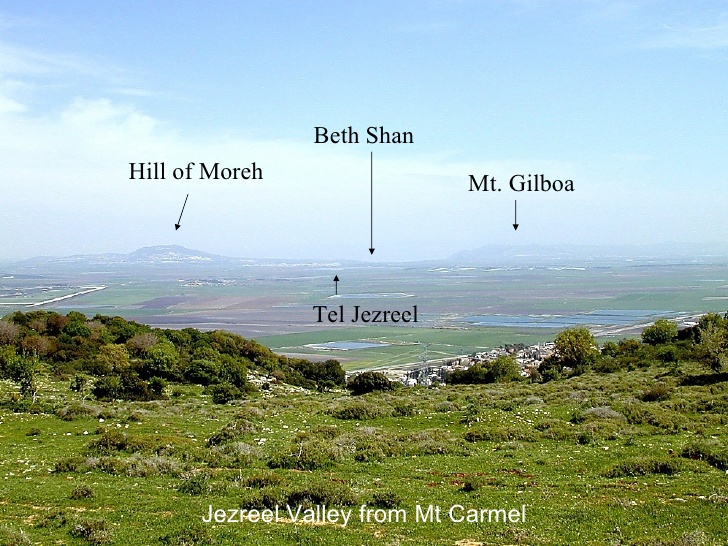
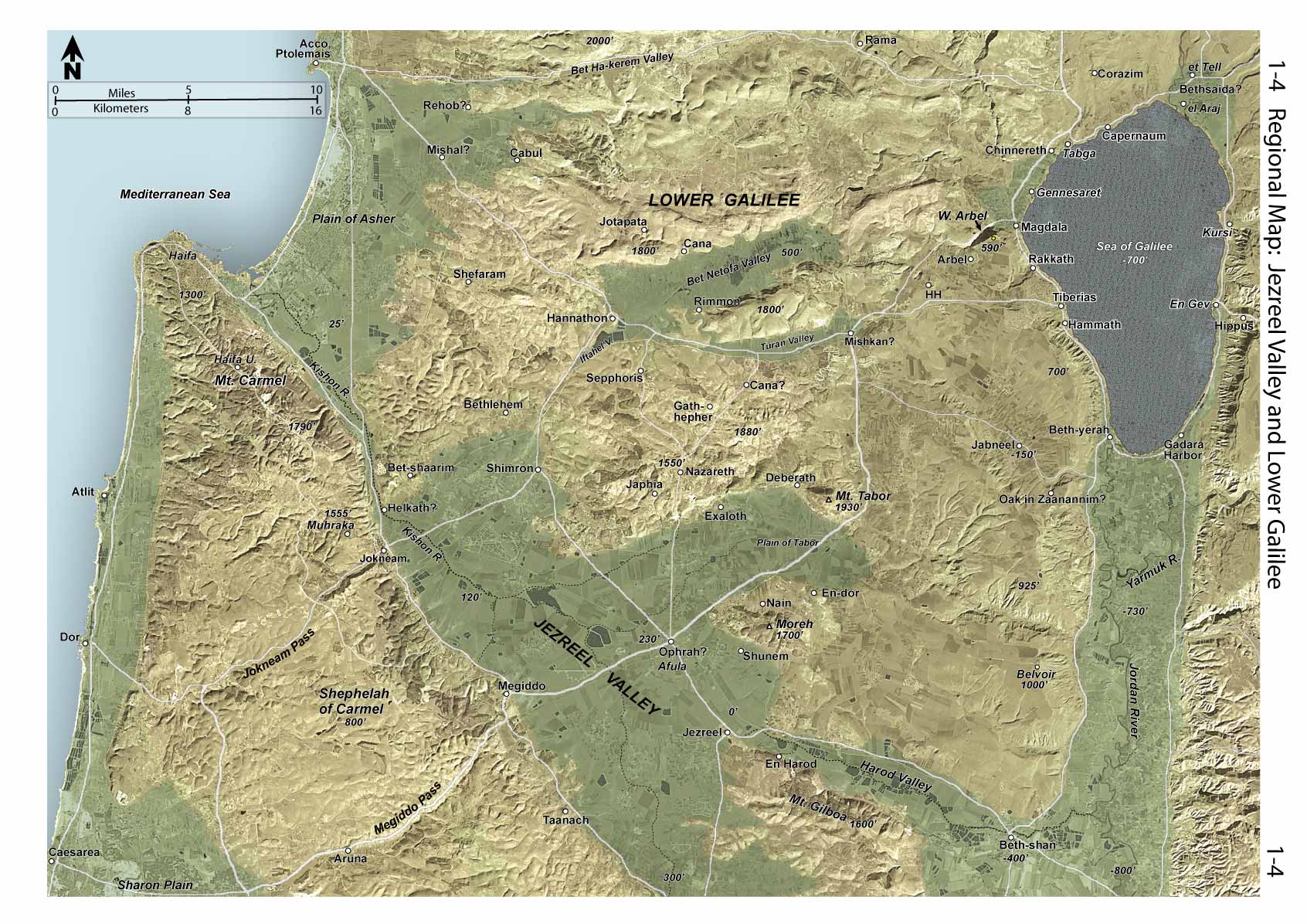
But it is not just the meaning of the name which is significant.  There was a town in Israel by the name of Jezreel.  It was located at the east end of the Jezreel Valley, called the “breadbasket of Israel” because it is the largest plain in Israel.  At the midpoint is Megiddo.  This great plain in Israel was one of the few places where chariots, cavalry and large armies could maneuver.  It was a key place were the bow and arrow were prime instruments of warfare.

jezreel valley and lower galilee map

This map is from the Satellite Bible Atlas.

jezreel valley from mount carmel, with hill of morech, beth shan and mount gilboa labelledjezreel and surrounding region, bible atlas

This map shows the city of Jezreel, Bible Atlas online


jezreel--where jezebel was thrown down, biblical archaeology society

Jezreel had become the Israelite winter capital by the time of Ahab (9th century BC), who built a palace there; the Bible also mentions a wall and defensive tower.  In 1 Kings 21, when Naboth the Jezreelite refuses to sell his vineyard to Ahab, Ahab’s wife Jezebel has him stoned to death.  This is followed by a visit from none other than the prophet Elijah and the subsequent gruesome death of Jezebel.

The reason Hosea and Gomer’s son is named Jezreel is because, verse 4, “I will punish the house of Jehu for the blood of Jezreel…”

The “house of Jehu” was the ruling dynasty of the northern kingdom at that time.  Jeroboam II, the greatest of king of the northern kingdom, was the grandson of Jehu.

If you remember the story of Jehu (2 Kings 9-10), he was told by God to take over the northern kingdom, but he went too far in shedding blood.  This bloodbath started in the city of Jezreel, located at the edge of the large, fertile valley of Jezreel in the north of Israel.  Its most famous victim, Jezebel the queen mother, was thrown down from an upper window.

Jehu had received his commission from Elisha.  In 2 Kings 9:6-10 we read…

6 So he [Elisha] arose and went into the house. And the young man poured the oil on his head, saying to him, “Thus says the LORD, the God of Israel, I anoint you king over the people of the LORD, over Israel. 7 And you shall strike down the house of Ahab your master, so that I may avenge on Jezebel the blood of my servants the prophets, and the blood of all the servants of the LORD. 8 For the whole house of Ahab shall perish, and I will cut off from Ahab every male, bond or free, in Israel.9 And I will make the house of Ahab like the house of Jeroboam the son of Nebat, and like the house of Baasha the son of Ahijah. 10 And the dogs shall eat Jezebel in the territory of Jezreel, and none shall bury her.”  Then he opened the door and fled.

It was at Jezreel that King Jehu of Israel (841-814 B.C.) massacred many enemies of Israel, including King Ahab and Queen Jezebel of Israel, King Jehoram of Israel, and many prophets of Baal, which was good (cf. 2 Kings 9:6-10, 24; 10:18-28, 30).

But he also killed King Ahaziah of Judah and 42 of his relatives, which was bad (2 Kings 9:27-28; 10:12-14).  Ahaziah and his relatives did not die in Jezreel, but their deaths were part of Jehu’s wholesale slaughter at Jezreel.  Jehu went too far and thereby demonstrated disrespect for the Lord’s commands (cf. 2 Kings 10:29-31).

Because of Jehu’s atrocities that overstepped his authority to judge Israel’s enemies, God promised to punish his house (dynasty).  The fulfillment came when Shallum assassinated King Zechariah, Jeroboam II’s son and the fourth king of Jehu’s dynasty, in 753-752 B.C.  This death ended Jehu’s kingdom (dynasty) forever (2 Kings 15:10).  It happened at the town of Ibleam (2 Kings 15:10), located in a southern part of the Jezreel valley.  The captivity that followed gave Jezreel a very bitter meaning for Israel, namely, the scatting throughout the world (2 Kings 17:18).

The dynasty ended as it had begun, with the assassination of the ruling house of Israel in the valley of Jezreel.

There is a slight paradox here, for in carrying out God’s judgment against the house of Ahab, God said…

30 And the LORD said to Jehu, “Because you have done well in carrying out what is right in my eyes, and have done to the house of Ahab according to all that was in my heart, your sons of the fourth generation shall sit on the throne of Israel.”

So why was Jehu being judged for the “blood of Jezreel”?  Apparently, just like God would use Sennacherib, the Assyrian conqueror, and Nebuchadnezzar, who sacked Jerusalem, yet later judged them for how they went about it and their pride, so Jehu is being judged here for both going too far and showing a proud heart.

Thus, the final word on Jehu, from 2 Kings 10: 29, 31

29 But Jehu did not turn aside from the sins of Jeroboam the son of Nebat, which he made Israel to sin–that is, the golden calves that were in Bethel and in Dan.  31 But Jehu was not careful to walk in the law of the LORD, the God of Israel, with all his heart. He did not turn from the sins of Jeroboam, which he made Israel to sin.

So Kidner states

Self-interest and bloodlust were his dominant springs of conduct, and it was this that made “the blood of Jezreel” an accusing stain.

And the reason that Israel was now about to experience a similar judgment, some hundred years later, is because they never repudiated this attitude of violence.

Duane Garrett has a simpler explanation, and that is that the Hebrew word here translated “punish” can, and should here, mean “visit.”  So it should be translated, “And I will bring (visit) the bloodshed of Jezreel upon the house of Jehu.”

He says,

This is not punishment for Jehu’s zeal in the slaughter at Jezreel; rather it is punishment for not learning the lesson of Jezreel.  Jehu himself had been the agent of God’s fury and personally had seen how terribly it fell upon an apostate dynasty.  But he and his household went on to repeat the apostasy of the Omrides and their predecessors (2 Kings 10:31; 13:1).  God visited the bloodshed of Jezreel on the house of Jehu because, in the final analysis, his dynasty’s rule was little better than that of Jeroboam I or Ahab and Jezebel.  Jehu’s actions at Jezreel were, if anything, the main reason God did not eliminated his dynasty sooner (2 Kings 10:30). (Duane Garrett, Hosea-Amos, p. 57)

Verse 5 indicates that the name of Hosea’s first son would also point to a future judgment that would also take place in the valley near Jezreel.  It would happen on “that day,” namely, a future unspecified day.  Yahweh promised to break Israel’s military strength, symbolized by an archer’s “bow,” there and then.

jezreel valley__israel's breadbasket

Usually, when God promises to “break the bow” of some fighting force, it means that God is coming to Israel’s rescue.  It is the enemy’s fighting force that would be broken.  There is a notable example in 2:18b where at the time of God’s future deliverance…

Bow and sword and battle I will abolish from the land, so that all may lie down in safety.

Also Psalm 46:9

9 He makes wars cease to the ends of the earth. He breaks the bow and shatters the spear; he burns the shields with fire.

But here, it is the bow of Israel that God will break, indicating that Israel would no longer be a force for God.  The “house of Jehu” (government) and the “bow” (military might) will fall as one.

Also, the further sting of this final sentence of judgment under the name Jezreel is the great reversal that it implies by the scene of defeat.  Jezreel was the valley of Gideon’s great victory over the Midianites (Judges 6-7), as well as Deborah before him (Judges 4-5).  Thus, Jezreel had once been a name of Israel’s glory.  But since Jehu’s massacres, it could only stand for savagery. (Kidner, 21)

This valley, because it was so strategic to trade routes, had seen many battles.  Gideon had defeated the Midianites in this valley (Judg. 6:33; 7), the Philistines had defeated the Israelites under Saul’s leadership there (1 Sam. 29:1, 11; 31), and Pharaoh Neco II defeated Josiah there after the Assyrians attacked (2 Kings 23:29-30).

But now the Assyrian king Tiglath-Pilesar III would fulfill this prophecy when he invaded and defeated Israel there in the valley of Jezreel 733 B.C. (2 Kings 15:29; cf. 2 Kings 17:3-5).  So though forty years apart, the end of Jehu’s dynasty and the end of the northern kingdom would take place in the area of Jezreel.

This valley will also be the place where the great end times battle, the battle of Armageddon, or Har-Meggido, will be fought.  There, the armies of the vicious and violent Antichrist will amass his armies against Jerusalem and Jesus will break the bow of Antichrist with the word of His mouth.

In verse 6-7 we then read about the second child.  If Jezreel’s name signified defeat, this daughter’s name represents deportation.

6 She conceived again and bore a daughter. And the LORD said to him, “Call her name No Mercy, for I will no more have mercy on the house of Israel, to forgive them at all. 7 But I will have mercy on the house of Judah, and I will save them by the LORD their God. I will not save them by bow or by sword or by war or by horses or by horsemen.”

The name “No Mercy” is in Hebrew Lo-Ruhamah.  We could also translate it “Not Loved.”  What a terrible name to give to a little girl!  It communicates complete alienation and rejection by her father and says that she has been abandoned to face the difficulties of life alone.

For a culture as child-centered as Israel was, it is difficult to imagine a name more scandalous and offensive.  At the mention of her name, people would naturally query, “Why would anyone name his daughter that?”

I don’t imagine that it represented Hosea’s true feelings towards her.  Nor does it demand that we take her as the offspring of Gomer with another man.  Although verse 6 does not say, “bore him a daughter” like verse 3 says of Jezreel, it could simply be a shortening of the birth statement.

What it does signify is that Yahweh had been very compassionate, very loving, towards Israel in her past, but that her persistent unfaithfulness to Him and His covenant with her made continuing love impossible.  Just as Gomer showed no love for Hosea had vanished, so the Lord’s compassion towards His people had been stretched to the breaking point.

God was withdrawing his mercy from the house of Israel because He had been betrayed by the repeated adulteries (that is, idolatry) of the nation of Israel.  You can read it throughout 1 and 2 Kings.  They could no longer expect grace from God.  He had given it time and time again before, but now his patience has run out.

This is the same type of sentiment which causes Jesus to cry out (Matthew 23:37b):

How often would I have gathered your children together as a hen gathers her brood under her wings, and you would not!

Garrett says

The people heard that terrible name and no doubt whispered to one another, “Hosea’s wife is unfaithful; he must doubt that this child is his.  He has rejected the poor thing!” and Hosea could respond something like: “Do you trouble yourself over Lo-Ruhamah?  I tell you, you are Lo-Ruhamah!  Yahweh has turned his back on you!”

In contrast, it says in verse 7 that the Lord would have compassion on the Southern Kingdom of Judah and deliver her from such a fate.  Was this to provoke Israel to jealousy?

He said deliverance would come by “Yahweh their God”, perhaps using His own name in this way to impress on the Israelites who their true God was.

He said He would not do this in battle, however.  The Israelites relied on human arms and alliances, but the Judahites trusted in the Lord, generally speaking, so He delivered the Judahites supernaturally.

The Lord delivered them in 701 B.C., by killing 185,000 Assyrian soldiers in one night while they slept encamped around Jerusalem (2 Kings 19:32-36; Isa. 37).  Jerusalem was the only great city that did not fall to the Assyrians during this invasion of Syria-Palestine.  There would be no such reprieve for an impenitent Samaria.

And this would not be the only time when Judah would experience a supernatural deliverance, for this verse likewise points forward to the ultimate “in the last day” when God will fight for His people.

2 For I will gather all the nations against Jerusalem to battle [the battle of Armageddon], and the city shall be taken and the houses plundered and the women raped.  Half of the city shall go out into exile, but the rest of the people shall not be cut off from the city. 3 Then the LORD will go out and fight against those nations as when he fights on a day of battle. (Zechariah 14)

From this prediction by Hosea Israel should have realized that God will have compassion on those who trust in Him and do not seek security through their own devices (weapons, alliances).

Are the words of Hosea 14 speaking of present Israel, or future Israel?  If present Israel, then some people “got it” and turned back to God.

1 Return, O Israel, to the LORD your God, for you have stumbled because of your iniquity. 2 Take with you words and return to the LORD; say to him, “Take away all iniquity; accept what is good, and we will pay with bulls the vows of our lips. 3 Assyria shall not save us; we will not ride on horses; and we will say no more, ‘Our God,’ to the work of our hands.  In you the orphan finds mercy.”

Judah’s sins were not as great as Israel’s at this time.  Judah enjoyed a succession of four “good” kings (Joash, Amaziah, Uzziah, and Jotham), and Hosea may have received this prophecy when Uzziah or Jotham was reigning.

Now, Duane Garret argues that the end of verse 7 best reads from the Hebrew, “I will no longer show love to the house of Israel, I shall completely forgive them.”  That is a jolting statement, similar to what we see in the oracle of Lo-Ammi in verses 8-10.  It is also similar to the pathos of Hosea 11:8

8 How can I give you up, O Ephraim? How can I hand you over, O Israel? How can I make you like Admah? How can I treat you like Zeboiim? My heart recoils within me; my compassion grows warm and tender.

So Garrett says, “This inconsistency (first saying one thing, then the opposite) is the language of the vexation of a broken heart—and it also reflects the mystery of a God whose ways are above our ways.

The effect of this, of course, should have led Israel to repentance, just like Jonah’s oracles of Nineveh’s doom did.

The name of the third child signals the final stage of judgment against Israel.  Lo-Ammi, “not my people,” “not mine” signified Yahweh’s divorce from Israel.  From defeat, to deportation, to divorce.  They are totally disowned.

Again, this could possibly indicate that this third child, and possibly the second, were not Hosea’s.  That is debatable, but there is no doubt that the use of this name is the prophet’s means of saying that Israel has broken the covenant relationship and therefore God severs them from the covenant relationship.

The mention of weaning in verse 8 grounds this text in real history and since a child was weaned after two to three years, it may signify that Israel was being given a little more time to comprehend these prophecies and repent.

“Not my people,” however, signals a total change in their status.  Now, they are no longer God’s favored nation, but “just like everyone else,” alienated from God and His covenant promises.  The relationship and covenant between God and Israel is now null and void.

H. Ronald Vandermey notes:

God’s time clock for judgment had but one final alarm: Lo-AmmiJezreel had promised a scattering of the people; Lo-ruhamah, the withdrawal of God’s covenant mercy; and Lo-ammi, the severing of Israel’s peculiar position as God’s covenant nation. (Hosea, Moody Bible Institute, p. 23)

The phrase “you are not my people, and I am not your God” is a reversal of God’s pledge to Israel in Exodus 6:7

7 I will take you to be my people, and I will be your God, and you shall know that I am the LORD your God, who has brought you out from under the burdens of the Egyptians.

This name strikes at the very heart of the covenant that God had made with Israel at Sinai.

Because of his special relationship with them, he would deliver them; now that that relationship is over, judgment will come.

The reality is, that Israel had been acting like it had no relation with God for a long time.  They were not acting as children should, imitating their God, nor were they treating God as their God, instead going after Baals.

All the things that Israel treasured most–their homeland, the mercies of God, a special status with the one true God, were all about to be taken away.

You can listen to Grace Still Amazes on KENA at 7:45 a.m. on Sundays and Saturday at 7 a.m., Sunday at 8 a.m., and starting Sunday January 6, 2018 will also air at 11:45 a.m. on Sundays on KAWX.  Often this posting will be longer and include more material than the radio broadcast, which is 15 minutes.