Introduction to the Book of Daniel, part 3

Today is our third week introducing the book of Daniel. It is vitally important that we understand the background of any book of the Bible. That is why we are spending so much time on it.
The Purpose of the Book

At this dark hour in Israel’s history, with the tragic destruction of Jerusalem and its temple, a strong reminder was needed that their God, Yahweh, really was in total control of nations and national rulers.

The book of Daniel is, for the most part, a prophetical history of Gentile world-power from the reign of Nebuchadnezzar to the coming of CHRIST. The prophets in general emphasize GOD’s power and sovereignty in relation to Israel, and they reveal Him as guiding the destinies of His chosen people throughout the centuries until their final restoration.

Daniel, on the other hand, emphasizes GOD’s sovereignty in relation to the Gentile world-empires, and reveals Him as the One controlling and overruling in their affairs, until the time of their destruction at the coming of His Son.

“The vision is that of the overruling GOD, in wisdom knowing and in might working; of kings reigning and passing, of dynasties and empires rising and falling, while GOD enthroned above rules their movements” (Campbell Morgan).

John MacArthur reminds us, “The book of Daniel will teach you who is running human history. God raises up the Assyrians and puts them down. God raises up the Babylonians and puts the down. God raises up Nebuchadnezzar and puts him down. God raises up Cyrus and has him do what He wants. God literally controls human history.”

The book’s central theme is God’s sovereignty over history, empires, and kings (2:21; 4:43-47). All the kingdoms of this world will come to an end and will be replaced by the Lord’s kingdom, which will never pass away (2:44; 7:27). This is illustrated by the fact that even Daniel outlived the Babylonian Empire!

Though trials and difficulties will continue for God’s people up until the end, those who are faithful will be raised to glory, honor, and everlasting life in this final kingdom (12:1-3).

John Walvoord notes, “The book of Daniel, like Esther, reveals God continuing to work in His people Israel even in the time of their chastening. In this framework the tremendous revelation concerning the times of the Gentiles and the program of God for Israel was unfolded. While it is doubtful whether these prophecies were sufficiently known in Daniel’s lifetime to be much of an encouragement to the captives themselves, the book of Daniel undoubtedly gave hope to the Jews who returned to restore the temple and the city, and it was particularly helpful during the Maccabean persecutions.”

Key Themes

I. It is possible to live a faithful life while surrounded by pagan influences, if one serves the Lord wholeheartedly (ch. 1).
II. God can give his faithful servants abilities that cause even unbelievers to appreciate them (chs. 2, 3, 6). Nevertheless, believers should not assume that God will always rescue them from harm (3:16-18).
III. God humbles the proud and raises up the humble. Even the hearts of the greatest kings are under his control (chs. 4, 5).
IV. This world will be a place of persecution for God’s people, getting worse and worse rather than better and better (chs. 2, 7). The Lord will judge the kingdoms of this world and bring them to an end, replacing them with his own kingdom that will never end. This kingdom will be ruled by “one like a son of man” who comes “with the clouds,” a figure who combines human and divine traits (7:13).
V. God is sovereign over the course of history, even over those who rebel against him and seek to destroy his people (ch. 8).
VI. The Babylonian exile was not the end of Israel’s history of rebellion and judgment. In the future, Israel would continue to sin against the Lord, and Jerusalem would be handed over to her enemies, who would damage her temple and do other offensive things (chs. 8, 9, 12). Eventually, though, the anointed ruler would come to deliver God’s people from their sins (9:24-27).
VII. These earthly events are reflections of a great conflict between angelic forces of good and evil (ch. 10). Prayer is a significant weapon in that conflict (9:23).
VIII. God rules over all of these conflicts and events, he limits the damage they do, and he has a precise timetable for the end of his people’s persecutions. At that time he will finally intervene to cleanse and deliver his people (ch. 12).
IX. In the meantime, believers must be patient and faithful in a hostile world, looking to the Lord alone for deliverance (11:33-35).

Genre: Apocalyptic

Daniel is classified as an apocalyptic writing, because of its series of supernatural visions which by their character fulfilled what is intimated by the Greek word apokalypsis, which means unveiling of truth which would otherwise be concealed.

Although apocalyptic works abound outside the Bible, relatively few are found in Scripture. In the New Testament only the book of Revelation can be classified as apocalyptic; but in the Old Testament, Ezekiel and Zechariah may be so classified in addition to Daniel.

A couple of hundred years later, apocalyptic writings abound. These were classified as pseudepigrapha, written to imitate the style of biblical apocalyptic books. Apocalyptic works classified as the pseudepigrapha include such titles as Ascension of Isaiah; Assumption of Moses; Book of Enoch; Book of Jubilees; Greek Apocalypse of Baruch; Letters of Aristeas; III and IV Maccabees; Psalms of Solomon; Secrets of Enoch; Sibylline Oracles; Syriac Apocalypse of Baruch; Testament of the Twelve Patriarchs; Apocalypses of Adam, Elijah, and Zephaniah; and Testament of Abram, Isaac, and Jacob.

Another characteristic about the book of Daniel is that, unlike most of the other prophets, Daniel does not confront the people of Israel with their sins. He comforts only. In addition, Daniel’s book includes historical narrative in the first 6 chapters.

Apocalyptic literature is a uniquely Jewish literary genre. It was often used in tension-filled times to express the conviction that God is in control of history and will bring deliverance to His people.

This type of literature is characterized by:

  1. a strong sense of the universal sovereignty of God (monotheism and determinism)
  2. a struggle between good and evil, this evil age and the age of righteousness to come (a limited dualism)
  3. use of standardized secret code words (usually from the OT prophetic texts or intertestamental Jewish apocalyptic literature)
  4. use of colors, numbers, animals, sometimes animals/human hybrids
  5. use of angelic involvement by means of visions and dreams, which are usually interpreted by angels
  6. primarily focuses on the soon-coming, climatic events of the end-time (new age)
  7. use of a fixed set of symbols to communicate the end-time message from God.

Languages

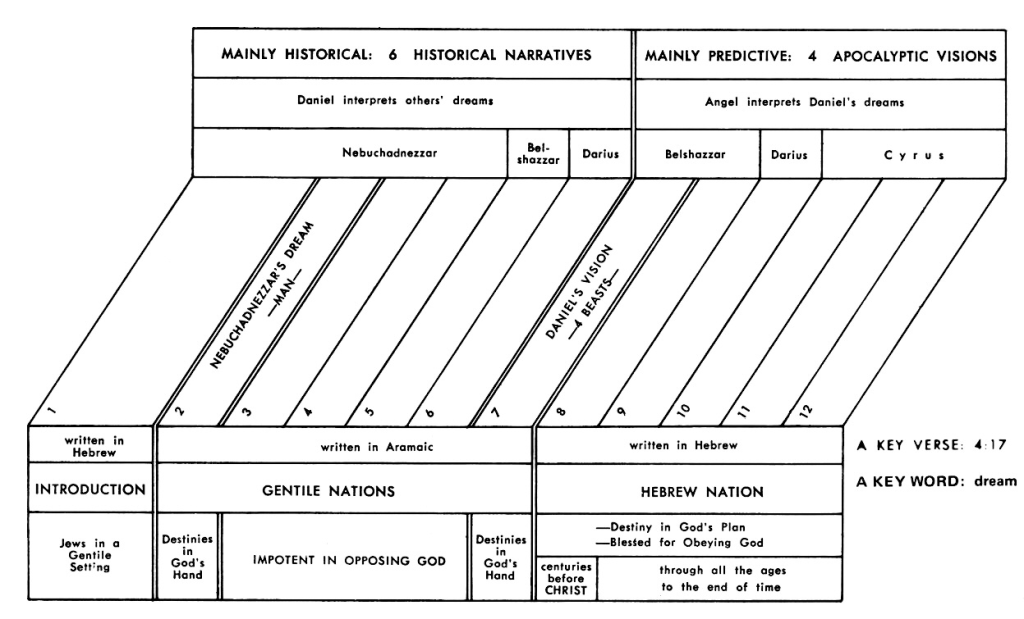
An unusual feature of the book of Daniel is the fact that the central portion (2:4-7:28) is written in biblical Aramaic, also called Chaldee. A similar use of Aramaic is found in Ezra 4:8-6:18; 7:12-26; Jer 10:11; and the two words of the compound name Jegar-Sahadutha in Genesis 31:47, showing that the Aramaic tongue had been around long before the inter-testamental period.
The Aramaic portion of Daniel clearly covers the “Times of the Gentiles,” while the Hebrew portions at the beginning and end devote more attention to what happens to Israel and the children of Israel in the midst of the nations. Aramaic was also the contemporary language of international business.

Canonical Place

When we use the word “canon” we’re talking about the books which were recognized [not “determined,” but “recognized”] as being inspired by God and they formed the group of books we call our Old and New Testaments.

In our English Bible (Septuagint, Vulgate and Luther), the book of Daniel appears as the last of the major prophets. Along with Ezekiel, Daniel wrote in the exilic period. In the Hebrew Bible Daniel is part of the Kethubim (the writings). The Jews call the Old Testament the Tanak, which is a word that consists of the T for Torah, the first five books of the Old Testament, what we often call the Pentateuch; the N stands for Neviim, the prophets, and the K stands for Kethubim. Daniel is part of the Kethubim, the writings.

Robert Dick Wilson believes that this is because Daniel was never called a “prophet” (navi, נָבִיא), but a “seer” (hozeh, חֹזֶה) and “wise man” (hakhamin, חַכִּימִ֣ין). J. B. Payne observes, “For though Christ spoke of Daniel’s function as prophetic (Matt. 24:15), his position was that of governmental official and inspired writer, rather than ministering prophet (cf. Acts 2:29-30)” (J. Barton Payne, “Book of Daniel,” Zondervan Pictorial Bible Dictionary, p. 198).

So why is Daniel placed in the Writings rather than in the Prophets for the Jews? This may be because Daniel’s prophetic messages do not confront the Jewish people with their sins, which was common among the Major and Minor Prophets. Also, the Masoretes may not have considered Daniel to be a prophet because there is no mention of his ordination or calling to be a prophet.

Major Divisions and Unity

The traditional division of the book of Daniel into two halves (1-6; 7-12) has usually been justified on the basis that the first six chapters are historical and the last six chapters are apocalyptic or predictive. There is much to commend this division which often also regards chapter 1 as introductory.

An alternative approach, recognizing the Aramaic section as being significant, divides the book into three major divisions: (1) Introduction, Daniel 1; (2) The Times of the Gentiles, presented in Aramaic, Daniel 2-7; (3) Israel in Relation to the Gentiles, in Hebrew, Daniel 8-12.
These two approaches are roughly the same.

Overview of the Book of Daniel

One of the things I like to do whenever I study or preach on a book of the Bible is to first look at the whole book and how it is organized and laid out, to get the “30,000 foot view” so that I can see the whole before examining the parts.

There are several good resources for this. The Bible Project has a video on YouTube and a chart that you can find on Google images, that is a good overview of the book.

Charles Swindoll has his book chart on his website Insight for Living. Philip Jensen has a book chart on the Precepts Austin website.

The book of Daniel is divided into two parts, the historical narratives of chapters 1-6 and the apocalyptic visions of chapters 7-12. In the first half, Daniel is interpreting the dreams or experiences of two Gentile kings, Nebuchadnezzar and Belshazzar. Darius is included chronologically in this section as the Medo-Persian empire conquered Babylon in 539 B.C. In the second half, it is Daniel’s visions that are interpreted by an angel. Again, chapters 2-7 are written in Aramaic, primarily because the history (both present and future history) covered in this part concerned Gentile empires, while chapters 8-12 are written in Hebrew because the history (both present and future history) concerns Israel.

The Key Verse

Some books have purpose statements, such as the gospel of John, “these are written that you may believe that Jesus is the Messiah, the Son of God, and that by believing you may have life in his name” (John 20:31). The Gospel of John was revealed to John by God’s Spirit for the express purpose of helping people believe in Jesus Christ as God’s Son and experiencing “life in his name.”

Likewise, the first epistle of John has an express purpose statement. 1 John 5:12 says, “I write these things to you who believe in the name of the Son of God so that you may know that you have eternal life.” The Gospel of John is written so that we may believe and the epistle of John is written so that believers “may know that you have eternal life. God wants us to have the assurance that we possess the very life He promised to give through His Son.

The book of Acts has verse that reveals the programmatic desires of Jesus for his church. In Acts 1:8 Jesus says, “But you will receive power when the Holy Spirit comes on you; and you will be my witnesses in Jerusalem, and in all Judea and Samaria, and to the ends of the earth.” As you follow the narrative of the book of Acts, you see that the gospel witness and the outpouring of the Holy Spirit begins in Jerusalem (Acts 2), but later expands into Judea-Samaria (Acts 8) and finally reaches to the Gentiles (Acts 10 and following).

Is there are similar verse for the book of Daniel? Well, there is not a clear and explicit purpose statement, but we can identify a verse which highlights a major theme of the book of Daniel—God’s sovereignty over the nations.

The key verse for the book of Daniel could very well be Daniel 4:17.

“‘The decision is announced by messengers, the holy ones declare the verdict, so that the living may know that the Most High is sovereign over all kingdoms on earth and gives them to anyone he wishes and sets over them the lowliest of people.’”

In this case God wanted Nebuchadnezzar to know that He, “the Most High,” “is sovereign over all kingdom on earth and gives them to anyone he wishes and sets over them the lowliest of people.” Nebuchadnezzar needed to realize that the power of Babylon did not depend upon Nebuchadnezzar himself but upon “the Most High” God of the Israelites. And as Israel read this, they would remember that they were “the lowliest of people” at this time and would have taken heart that God could reverse their misfortunes that they were presently experiencing. It would give them hope, as prophecy should give us hope, that God will fulfill all His promises for His people someday soon.

Introduction to the Book of Daniel, part 2

Well, today we are continuing our introduction the book of Daniel. We ended last week giving some historical background. The first part of Daniel takes place with Nebuchadnezzar king of Babylon and so we were talking about the beginning of the Neo-Babylonian empire.

Today we want to start by reminding ourselves of the nature of the place to which Daniel and his friends were taken. This was not a God-friendly place.

An article From Babel to Babylon on monergism.com., describes the anti-God nature of this city throughout history.

Not unlike Babel, Babylon stands for the corruption of human power, wealth, and influence. It represents the perversion of God’s creation, the exploitation of the weak and vulnerable, and the seduction of the nations by false gods. Babylon was notorious for its arrogance, wickedness, and cruelty. It was a center of pagan worship, characterized by sexual immorality, idolatry, and materialism. Babylon was a city that exalted itself above God and oppressed God’s people. It symbolizes the human tendency to use power for selfish purposes, to worship idols instead of God, and to oppress those who are weaker. (https://www.monergism.com/babel-babylon#:~:text=The%20biblical%20narrative%20of%20Babel,power%2C%20wealth%2C%20and%20influence.)

Babylon the Great, in the book of Revelation, is the culmination of human rebellion against God. It is a symbol of the world system that opposes Christ and His kingdom. It is a city that is drunk with the blood of the saints and the martyrs, that deceives the nations with her sorceries and seduces them with her wealth and power. Babylon the Great is a false bride who entices the world with her beauty and wealth, but who ultimately leads them to destruction. It is a warning against the seduction of the world and the dangers of compromise with the world’s values.

So Daniel and his three friends were entering into a culture that would challenge the foundations of their faith to the very core, down to their roots. Remaining faithful to Yahweh would prove to be very difficult and I’m sure that not every Hebrew youth rose to the challenge.
Not everything was negative, however, for Babylon was a wondrous sight to behold. As Daniel and his three friends were marched into Babylon they would see a spectacular city. Bryan Windle, in his Biblical Archeology article reports on the city Daniel saw (https://biblearchaeologyreport.com/2019/08/09/footsteps-three-things-in-babylon-daniel-likely-saw/).

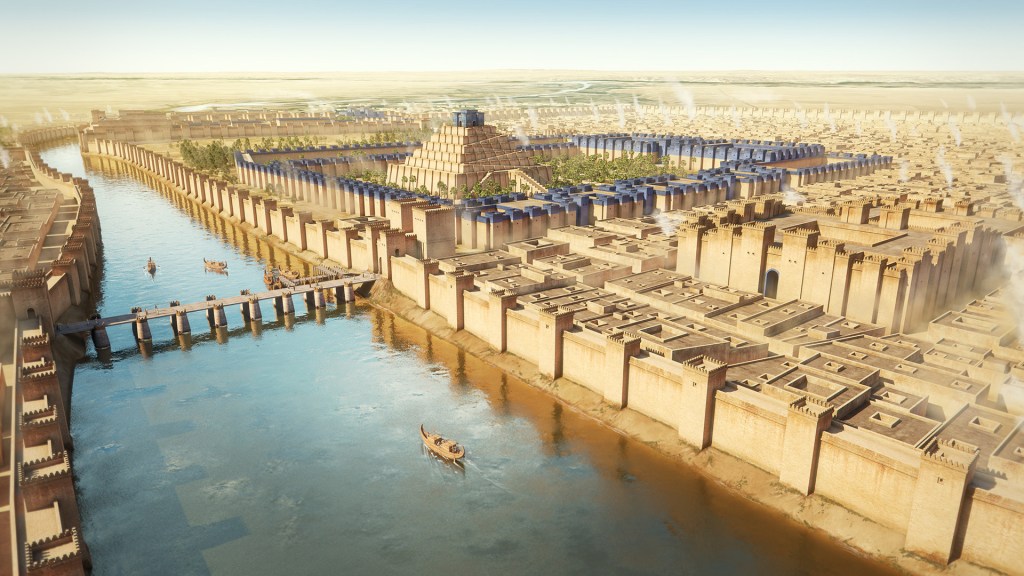
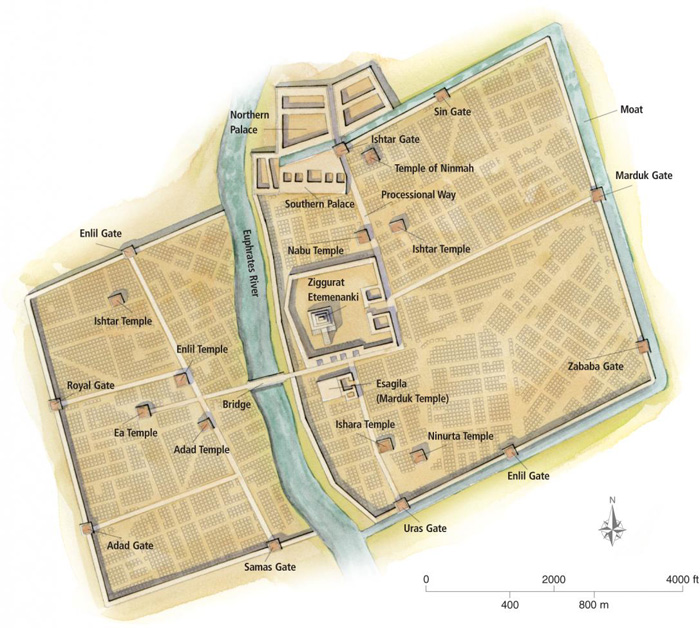
Nebuchadnezzar had initiated a vast building program and improved the city’s fortifications, raising its magnificence to new heights. At the time Daniel lived there, it was the largest city in the world, covering over 10 square kilometers (4 square miles).

A reconstruction of ancient Babylon, with the Etemenaki (stepped ziggurat) in the center, and the Esagila (Temple of Marduk) to the right of it. Image Credit: J.R. Casals / https://www.artstation.com/artwork/25NVv [tried to get permission]

Taken from the ESV® Study Bible (The Holy Bible, English Standard Version®), copyright ©2008 by Crossway, a publishing ministry of Good News Publishers. Used by permission. All rights reserved. For more information on how to cite this material, see permissions information here.
Daniel would have seen the grand palace of Nebuchadnezzar.

A panoramic view of the reconstructed Southern Palace of Nebuchadnezzar. Photo Credit: Osama Shukir Muhammed Amin FRCP(Glasg) / Wikimedia Commons / CC BY-SA 4.0

Here is a modern reconstruction of what Nebuchadnezzar’s palace would have looked like:

Screenshot from Pedersén’s virtual 3D model of Babylon, period of Nebuchadnezzar II (604-662 BCE) and Nabonidus (555-539 BCE). Overlooking south onto the Etemenanki Ziggurat from within the South Palace main courtyard, walls decorated with glazed bricks.

On the north side of the city Nebuchadnezzar had built the majestic Ishtar Gate.

The Ishtar Gate in Babylon. Photo Credit: Wikimedia Commons / Public Domain

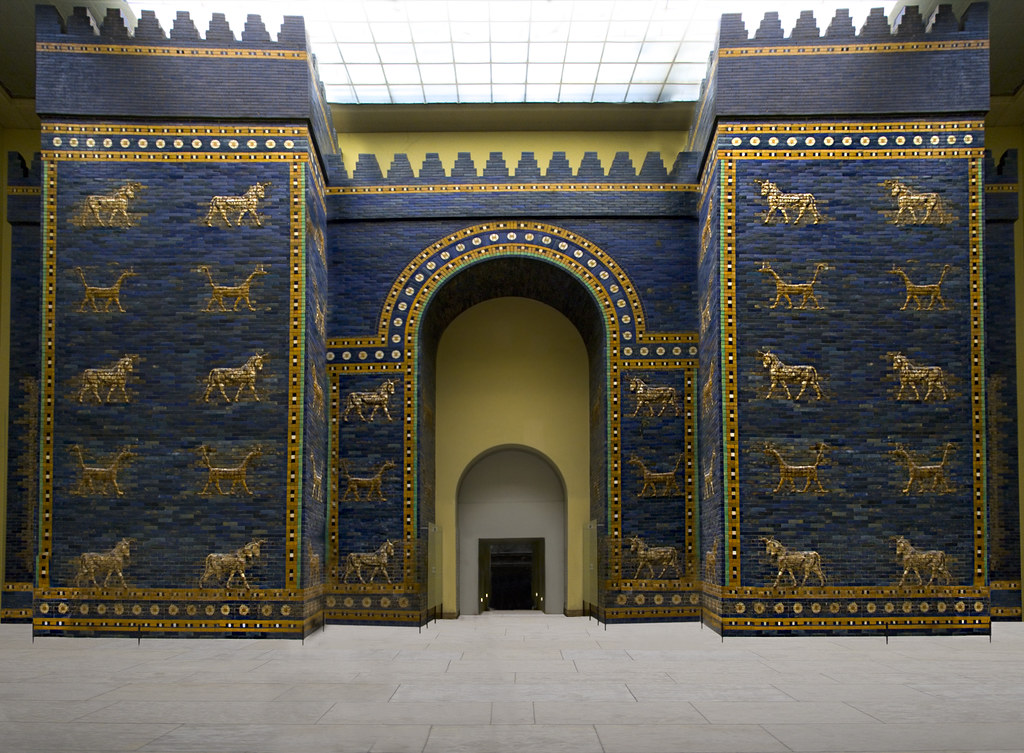
It was one of eight double-gates that served as entrances to the city and stood over 12m (38 feet) high. The gate was finished around 575 BC, after Daniel had already been living in the city for many years. He no doubt watched its construction and marveled at its beauty.

Today, a reconstruction of the Ishtar Gate can be seen at the Pergamon Museum in Berlin. It is made out of materials excavated by Robert Koldewey in the early 1900’s.

A reconstruction of the Ishtar Gate at the Pergamon Museum in Berlin, Germany. Photo Credit: flickr photo by youngrobv / CC BY-NC 2.0

In Daniel 4:30, King Nebuchadnezzar boasts, “Is not this great Babylon, which I have built by my mighty power as a royal residence and for the glory of my majesty?” The archaeological record affirms the massive building campaigns of Nebuchadnezzar.

Who was Daniel?

Daniel was a young man (Daniel 1:4), likely around the age of 16, when he was taken captive in the first wave of deportations in 605 B.C. Could you imagine, at that young age, being ripped from your family, your home, your friends, your chances for work or education, not knowing what was going to happen next? You didn’t know if you would live or die. You didn’t know if you would spend the remainder of your life enslaved or in prison. There were a lot of unknowns, and as we know, into that vacuum of unknowns, fear and anxiety are frequent irritants.

He never saw his family, friends, or homeland again. But what matters most about Daniel’s life is how he remained faithful to God throughout his life, while living in a land where its inhabitants had not even heard of Jehovah. Daniel was considered to be a man of great integrity, classified along with Noah and Job in Ezekiel 14:14, 20 as key intercessors. In fact, like Joseph, not a single sin is attributed to Daniel. And the angel repeatedly calls him “greatly beloved.”

These three intercessors represent our battle against the world, the flesh and the devil. Job overcame the devil, Noah the world, and Daniel the flesh.

The name Daniel (dan-i-el) means “God is my judge,” a name that likely guided and guarded Daniel’s thinking and conduct as he realized that one day God would hold him accountable for how he lived his life. It is likely that Daniel was one of several young men who came from “the royal family and of the nobility” (Daniel 1:3).

No mention is made, specifically, of Daniel’s birthplace or family (other than being of the tribe of Judah, Daniel 1:3) and thus the Jewish Encyclopedia concludes “It is not known whether he belonged to the family of the King of Israel or to that of an Israelitish magnate.”

Josephus (“Ant.” x. 10, § 1) evidently inferred from Sanh. i. 3 that Daniel was a relation of King Zedekiah (ἧσαυ τῶυ ἐκ τοῦ Σεδεκίου γέυους τέσσαρες ), while Pseudo-Epiphanius, on the strength of the same passage, makes Daniel the scion of a noble Israelitish family (compare Prince, “Critical Commentary on the Book of Daniel,” p. 25).

According to rabbinical tradition Daniel was of royal descent; and his fate, together with that of his three friends, Hananiah, Mishael, and Azariah, was foretold by the prophet Isaiah to King Hezekiah in these words, “and they shall be eunuchs in the palace of the king of Babylon” (Isa. xxxix. 7; compare Sanh. 93b; Pirḳe R. El. lii.; Origen, commentary to Matt. xv. 5; Jerome, commentary to Isaiah, l.c.). Of course, we do not know for sure that they were eunuchs, although we never hear of their wives or children.

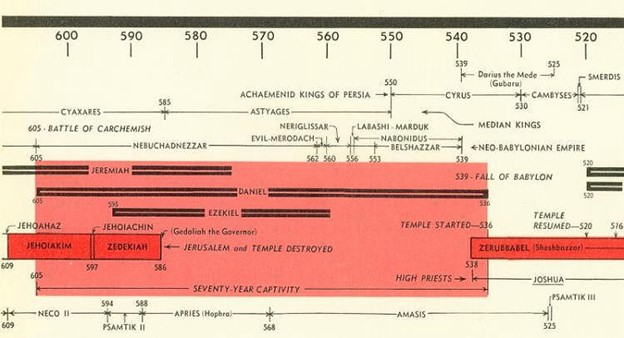
Daniel served under king Nebuchadnezzar (Daniel 1:19-20) all the way through the empire change and served King Cyrus (Daniel 1:21). Daniel bridges the entire 70 years of the Babylonian captivity (ca. 605–536 B.C.; cf. 1:1 and 9:1-3).

Daniel began his career about eighteen years before Jerusalem fell, and his last message was given after the Jews had returned to build again the temple (10:1.), covering a period of about 73 years from the year 607 to 534 B. C., then beyond that to the reign of Darius.

The most well-known event in the life of Daniel was his one-night stay in the den of lions under Darius. Today in the stands this depiction of a roaring lion (with wings, by the way).

https://www.worldhistory.org/image/724/lion-of-babylon-ishtar-gate/

This was one of 120 lions that lined the processional way into Nebuchadnezzar’s throne room and it dates to the exact time that Daniel was there in Babylon! He would have passed by these lions a number of times on his way to advise King Nebuchadnezzar. The glazed bricks remind us of the need for fiery furnaces needed to make the bricks. Daniel had been in Babylon 66 years and was 83 years old when he faced the lions.

The Book of Daniel

Date and Authorship

We will deal with who wrote the book and when because this issue has been debated by biblical scholars and historians. Was it written by Daniel in the 6th century B.C. or by someone else in the 2nd to 3rd century B.C.?

Conservative scholars have believed the book to be written by Daniel, taken captive by Nebuchadnezzar in 605 B.C. The record of events extends to the third year of Cyrus, 536 B.C., and, accordingly, covers a span of about seventy years. Daniel himself may well have lived on to about 530 B. C., and the book of Daniel was probably completed in the last decade of his life.

Although Daniel does not speak of himself in the first person until chapter 7, there is little question that the book presents Daniel as its author. This is assumed in the latter portion of the book and mentioned especially in 12:4. The use of the first person with the name Daniel is found repeatedly in the last half of the book (7:2, 15, 28; 8:1,15, 27; 9:2, 22; 10:2, 7, 11, 12; 12:5).

Important confirmation of the historicity of Daniel himself is found in three passages in Ezekiel (Eze 14:14, 20; 28:3), written after Daniel had assumed an important post in the king’s court at Babylon. Convincing also to conservative scholars is the reference to “Daniel the prophet” by Christ in the Olivet Discourse (Mt 24:15; Mk 13:14).

Except for the attack of the pagan Porphyry (third century A. D.), no question was raised concerning the traditional sixth century B. C. date, the authorship of Daniel the prophet, or the genuineness of the book until the rise of higher criticism in the seventeenth century, more than two thousand years after the book was written.

Higher criticism, totally humanistic and materialistic in its outlook, denies that Daniel could be the author because they want to deny the possibility of supernatural predictive prophecy and so the book had to be written later so that the prophecies related to Alexander the Great and the wars between the Ptolemies and the Seleucids would be a historical report rather than future events that were miraculously fulfilled by God’s sovereign plan.

Daniel wrote this book in the sixth century B.C. It records the events of Daniel’s life and the visions that he saw from the time of his exile in 605 B.C. (1:1) until 536 B.C., the third year of King Cyrus (10:1). Then it is Darius who consigned him to the den of lions (Dan. 6). So it is likely that Daniel finished this book around 520 B.C.

Ezekiel, Habakkuk, Jeremiah, and Zephaniah were Daniel’s prophetic contemporaries.

Jensen’s Survey of the Old Testament

Daniel is alluded to by the writer of Hebrews as one of “…the prophets: who through faith…stopped the mouths of lions” (Heb. 11:32-33).

Why do we believe that it was Daniel who wrote this book in the 6th century B. C., rather than some unnamed author in the 2nd century?

First, the book claims to be written by Daniel in Daniel 7:1 and 12:14.

In the first year of Belshazzar king of Babylon, Daniel saw a dream and visions of his head as he lay in his bed. Then he wrote down the dream and told the sum of the matter. (Dan. 7:1)

Second, Jesus attributed to Daniel the prophecy about the abomination of desolation (Dan. 12:11).

Jesus said, “You [will] see the abomination of desolation which was spoken of through Daniel the prophet” (Mt. 24:15).

Third, Ezekiel—a contemporary prophet—believed in a historical Daniel. Ezekiel lived in roughly 575 BC, and he explains that Daniel is a real and historical figure (Ezek. 14:14, 20; 28:3).

Fourth, Josephus—a first century Jewish and Roman historian—believed that Daniel was a prophet and a historical person. Josephus believed that the book of Daniel was shown to Alexander the Great, when he came to Jerusalem in 330 BC. Of course, Daniel predicted the life of Alexander the Great. So when he arrived in Jerusalem, the priests showed him these prophecies. Josephus writes,

\He (Alexander) came into the city; and when he went up into the temple, he offered sacrifice to God, according to the high priest’s direction, and magnificently treated both the high priest and the priests. And when the book of Daniel was showed to him, wherein Daniel declared that one of the Greeks should destroy the empire of the Persians, he supposed that himself was the person intended… The next day he called them to him, and had them ask what favors they pleased of him… (and) he granted all they desired.[4]

He did not destroy Jerusalem because of this.

Fifth, the author of 1 Maccabees believed Daniel was a historical person. In 1 Maccabees 2:59-61, we read, “Hananiah, Azariah, and Mishael had faith, and they were saved from the flames. Daniel was a man of integrity, and he was rescued from the lion’s jaws. So bear in mind how in the history of the generations no one who trusts in Heaven ever lacks strength.”

In context, Matthathias was writing about an event which took place in 167 BC. Therefore, to have written this, he must have already considered Daniel to be a historical figure. As Walvoord writes, “It is highly questionable whether the Jews living in the Maccabean period would have accepted Daniel if it had not had a previous history of canonicity” (Walvoord, John. Daniel: The Key to Prophetic Revelation, Introduction, 1989. See “Authorship”).

Sixth, 1 Enoch cites Daniel. When we compare 1 Enoch 14:18-22 with Daniel 7:9–10, we see striking similarities. 1 Enoch dates to roughly 150 BC.

Seventh, archaeological discoveries shows that Daniel faithfully described the sixth century world of Babylon.

  1. Daniel correctly distinguishes Susa and Elam.
    In Daniel 8:2, Daniel writes that he was “in the citadel of Susa, which is in the province of Elam.” Now, Susa was assigned to a new province in the Persian era. The territory of Elam was shrunk during this time, and Susa was assigned to a new territory of Susiana.
    It would have taken a 6th century inhabitant of Susa to know of this historical detail. A 2nd century author would have been out of date with this historical nuance. (Archer, Gleason L. A Survey of Old Testament Introduction: Revised and Expanded. Chicago, IL: Moody, 2007. 380).
  2. The existence of Belshazzar
    Prior to the middle of the 19th century, a Babylonian king named Belshazzar was unknown to history, allowing critics to question the historical accuracy of the book of Daniel. Ancient historians, such as Berosus and Abydenus recorded that Nabonidus was the last king of Babylon. Similarly, the Uruk King List omits Belshazzar, moving from Nabonidus to Cyrus.
    Things changed in 1854, when J.E. Taylor discovered four cylinders in the ruins of a ziggurat at Ur which contained a prayer of Nabonidus to the gods. The so-called Nabonidus Cylinders record:
    “As for me, Nabonidus, King of Babylon, save me from sinning against your great godhead and grant me as a present a life of long days, and as for Belshazzar, my oldest son my offspring, instill reverence for your great godhead in his heart and may he not commit any cultic mistake, may he be sated with a life of plentitude.”

One of the Nabonidus cylinders from Ur, which records Nabonidus’ renovations to the moon god, Sin’s, ziggurat, as well as a prayer for himself and his son Belshazzar. Photo: A.D. Riddle / Bibleplaces.com.

  1. Nabonidus Chronicle
    That very night Belshazzar the Chaldean king was killed. (Dan 5:30)
    The Babylonian Chronicle for the years 556 to 539 BC, also called the Nabonidus Chronicle, describes the final years of King Nabonidus’ reign and the fall of Babylon to Cyrus, king of Persia. It records:
    “When Cyrus did battle at Opis on the [bank of] the Tigris against the army of Akkad, the people of Akkad retreated. He carried off the plunder (and) slaughtered the people. On the fourteenth day Sippar was captured without a battle. Nabonidus fled. On the sixteenth day, Ugbaru, governor of Gutium, and the army of Cyrus, without battle they entered Babylon. Afterwards, after Nabonidus retreated, he was captured in Babylon…. On the third day of the month Arahsamna, Cyrus entered Babylon.” (iii, 12-18)

The Nabonidus Chronicle describes the final years of King Nabonidus’ reign and the fall of Babylon to the Persians. Photo: ChrisO / Wikimedia Commons / CC BY-SA 3.0

Moreover, William Shea has argued, based on other details in the text of the Nabonidus chronicle that the enigmatic “Darius the Mede” who became King of Babylon (Dan. 5:31) was none other than Ugbaru, the general of the army who captured the city. Thus, the historicity of Darius was verified.

  1. Dead Sea Scroll Fragments of Daniel
    “So when you see the abomination of desolation spoken of by the prophet Daniel, standing in the holy place…” (Mat 24:15)
    Many today would argue that the book of Daniel was composed sometime during the second century BC, after the prophecies related to the Seleucids and Maccabeans (Dan. 9-12), and not during the sixth century BC by the prophet himself. According to this theory, Daniel was written to encourage the Jewish people during the Maccabean period (ca. 168-165 BC). This late date is assumed largely on the basis of the presupposition of modern scholars that supernatural fore-telling of events is not possible.
    The fact that these copies are now known to exist shows us that already in the second century B. C. the book of Daniel was already composed, circulated and accepted as canonical.
    You might ask, why is this important—whether Daniel wrote the book or not, whether it communicates actual historical events from the 6th century B.C. or records apocryphal tales from the 2nd century?
    As James Hamilton puts it,
    There is a massive difference between the theological meaning of a wish-fantasy and that of a historically reliable account of God miraculously preserving someone alive in a fiery furnace. Dismissing a false fable as irrelevant to my conduct reflects my view of the theological meaning and value of fairy tales. Risking my life because I believe the stories result from convictions about theological meaning that cannot be separated from historicity. …
    If some Maccabean-era author is making fraudulent claims, if these are fictional deliverances and not future predictions but recitals of what has already happened presented as though being predicted by Daniel, then there is no real proof that Yahweh can either deliver from death or predict the future. This means there is no proof that he is any better than the false gods who can neither reveal the future nor deliver their worshippers, which is exactly what the book of Daniel claims Yahweh can do. …
    The whole theological meaning of the book depends upon Yahweh’s ability to deliver his people and declare the future before it takes place. If he cannot do these things, no one should “stand firm and take action” and risk his life for Yahweh (Dan. 11:32).

    J. M. Hamilton Jr., With the Clouds of Heaven: The Book of Daniel in Biblical Theology, New Studies in Biblical Theology 32 (Nottingham, England: Apollos, 2014), 31–32.

Introduction to the Book of Daniel, part 1

Well, today we are starting a study of the Old Testament major prophet, the book of Daniel. You might wonder, “Why study the book of Daniel?”

In many corners of the world these days the climate of hostility hangs over any overt Christian faith commitment or any gathering of believers in Jesus Christ. Any kind of Christian commitment is now assumed to imply intolerance and often prompts reactions that range from a low-grade hostility and exclusion in the West to the vicious and murderous assaults on Christian believers in Pakistan, Nigeria, Kenya, Egypt, Syria and Iraq and elsewhere.

Such issues are not new. Christians have faced them ever since Nero’s lions, and even before that. Jews also have faced the same questions all throughout their history, most tragically sometimes enduring horrendous persecution from states claiming to be Christian. So, it is not surprising that the Bible gives a lot of attention to these questions.

The book of Daniel tackles the problem head on, both in the historical stories of Daniel and his friends, and in the prophetic visions he received. A major theme of the book is how people who worship the one, true, living God—the God of Israel—can live and work and survive in the midst of a nation, a culture, and a government that are hostile and sometimes life-threatening. What does it mean to live as believers in the midst of a non-Christian state and culture? How can we live “in the world” and yet not let the world own us and squeeze us into the shape of its own fallen values and assumptions? How can one stay faithful to God in the midst of a hostile culture in the midst life-threatening pressures to bow the knee to another god? Can God be trusted in such times?

The book was written to encourage believers to keep in mind that both the present and the future, no matter how terrifying they may become, rests in the faithful hands of the sovereign Lord God—and in that assurance to get on with the challenging task of living in God’s world for the sake of God’s mission. We need that encouragement even today.

We want to start today by examining the historical background of the book of Daniel. It’s always important to put the books of the Bible in their historical time and situation. It helps us dive deeper into the text instead of just skimming the surface.

The Assyrian Empire ruled and reigned over the Ancient Near East for nearly 300 years, beginning with an expansion under Ashurnasirpal II (883-859 B.C.) and ending with attacks from the Babylonians and Medes around the mid 7th century B.C.

Map 75 Assyrian Supremacy in the Seventh Century, Holman Bible Atlas, p. 151

After Solomon, the kingdom of Israel was divided. Jeroboam took ten tribes and they became known as the Northern Kingdom, leaving only Judah and Benjamin with Rehoboam, the son of Solomon.

Map 57 The Kingdoms of Israel and Judah, Holman Bible Atlas, p. 118

Shalmaneser V sacked Damascus, the capital city of the Northern Kingdom in 722 B.C., taking those people captive and scattering them among the other conquered peoples of that campaign. The Southern Kingdom, ruled by the line of David, lasted another roughly 150 years. There were no good kings in all the history of the Northern Kingdom, but there were a few in the Southern Kingdom.
Josiah was the last good king of Judah. Under his leadership a religious reform took place (640 B.C. to 609 B.C.). That reform is described in the Bible in 2 Kings 22–23 and 2 Chronicles 34–35. The author of Kings describes the accession of Josiah to the throne at 8 years of age, and then some busy years of reform in his teenage years (age 16-18). So as far as teenagers go, he was a pretty good one! Even as a youth “he began to seek the God of his ancestor David” (2 Chron. 34:3)

It begins with the decision to renovate the Temple, which leads to the discovery of the Book of the Law. Josiah removed pagan altars and idols from the temple, destroyed rural sanctuaries, and took down other places of worship. He centralized worship in Jerusalem, having destroyed the temple at Bethel. He renewed the covenant with his people. Josiah restored the Passover after many years of neglect and he returned the Ark of the Covenant to the Temple.

Both books [2 Kings and 2 Chronicles] bookend the story of Josiah with the highest possible praise for this king. Unlike so many of the kings of Judah, Josiah “walked in the way of his father David, turning aside neither to the right or the left.” But he was even greater than David: “Before him there was no king like him, who turned to the Lord with all his heart, with all his soul, and with all his might, according to all the law of Moses; nor did any like him arise after him” (2 Kings 22:2; 23:25; cf. 2 Chron. 34:2; 35:18).

However, Josiah met an early death at the hand of the Egyptian King Neco II. Neco was leading an Egyptian force northward to support a final Assyrian effort to recapture Haran. Josiah intercepted Neco near Megiddo, was mortally wounded, and eventually was buried in Jerusalem (2 Kings 23:28-30; 2 Chronicles 35:20-27).

Josiah Battles Neco

The consolidation of the Chaldean Dynasty at Babylon was completed by 609 B.C. The victory of Nabopolassar over the Assyrian and Egyptian armies made Babylon the new master. From there, the Babylonians began to invade southward into Syria and Palestine.

The prophet Habakkuk foresaw these events, declaring that God was “For behold, I am raising up the Chaldeans, that bitter and hasty nation, who march through the breadth of the earth, to seize dwellings not their own” (Hab. 1:6)

The ensuing power struggle between Babylon and Egypt caught Israel in a vice-grip and put the kings of Judah in a precarious position. To whom would they appeal for help?

With the death of Josiah in 609 B.C., Neco removed Jehoahaz, a son of Josiah chosen by the people of Judah, and replaced him with another son whose regal name was Jehoiakim (2 Kings 23:30-35). Judah was for a short time an Egyptian vassal, and Jehoiakim reigned at the pleasure of Neco.
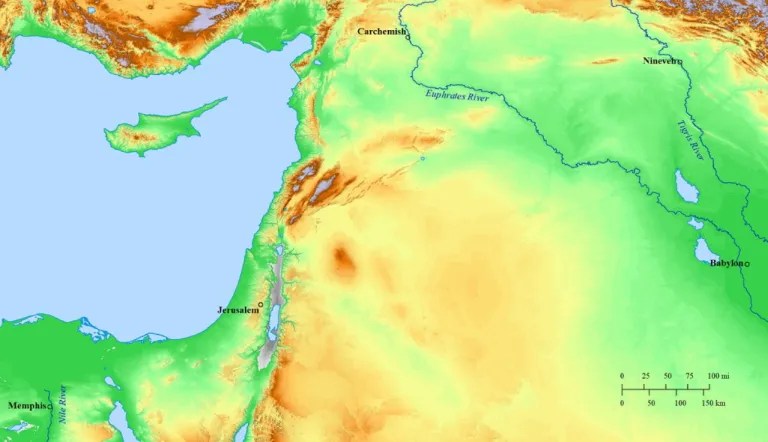
The Battle of Carchemish in 605 B.C. established Babylon as the dominant power all the way to the border of Egypt.

Jeremiah 46

In 604 B.C. Nebuchadnezzar campaigned in Palestine and conquered Ashkelon. Jehoiakim quickly switched his allegiance to Nebuchadnezzar. It was during this campaign that Nebuchadnezzar took hostages from Jerusalem, which included such men as Daniel and his three companions Hanniah, Mishael and Azariah and carried them to Babylon (Daniel 1:1-7) and the seventy years of captivity had begun (Daniel 9:1-2; Jeremiah 25:11; 2 Chronicles 36:17-21).

Jeremiah’s prophecy foretold that the “land shall be a desolation” and that the Jews would “serve the king of Babylon seventy years” (Jeremiah 25:11; compare 2 Chronicles 36:17-21). After the 70 years were completed in Babylon, God told them, He would cause them “to return to this place [Jerusalem]” (Jeremiah 29:10).

However, Jeremiah 29:4-7 also tells the Israelites who were exiled to Babylon to settle down, build homes, and work for the welfare of the city. The passage also instructs them to pray for the city’s prosperity, as their own prosperity would be tied to it. However, this wouldn’t be easy. Psalm 137 hauntingly records, “By the waters of Babylon, there we sat down and wept, when we remembered Zion. On the willows there we hung up our lyres. For there our captors required of us songs, and our tormentors, mirth, saying, “Sing us one of the songs of Zion!” How shall we sing the LORD’s song in a foreign land? If I forget you, O Jerusalem, let my right hand forget its skill! Let my tongue stick to the roof of my mouth, if I do not remember you, if I do not set Jerusalem above my highest joy!” (Psalm 137:1-6)

These people, who once experienced the favor of the true God, find themselves debased and enslaved by their enemy. Far from home. Paralyzed with fear. Their identity stripped from them. Their captors taunt them, “Sing us one of the songs of Zion!” And instead they wept, remembering Zion and their glory days there.

Some of these people would grow comfortable in Babylon and would forget Zion. Some would return, and some of them, like Daniel would remain as a faithful remnant in a foreign, anti-God culture.

But Jeremiah had prophesied that their captivity would last 70 years. This prophecy of punishment came upon the people of Judah because of their disobedience to God’s laws. As Jeremiah explained to the people of Judah, “3 For twenty-three years, from the thirteenth year of Josiah the son of Amon, king of Judah, to this day, the word of the Lord has come to me, and I have spoken persistently to you, but you have not listened. 4 You have neither listened nor inclined your ears to hear, although the Lord persistently sent to you all his servants the prophets,” (Jeremiah 25:3-4).

This prophecy of punishment came upon the people of Judah because of their disobedience to God’s laws. According to the Jamieson, Fausset and Brown Commentary, the 70 years was “the exact number of years of Sabbaths in four hundred and ninety years, the period from Saul to the Babylonian captivity.

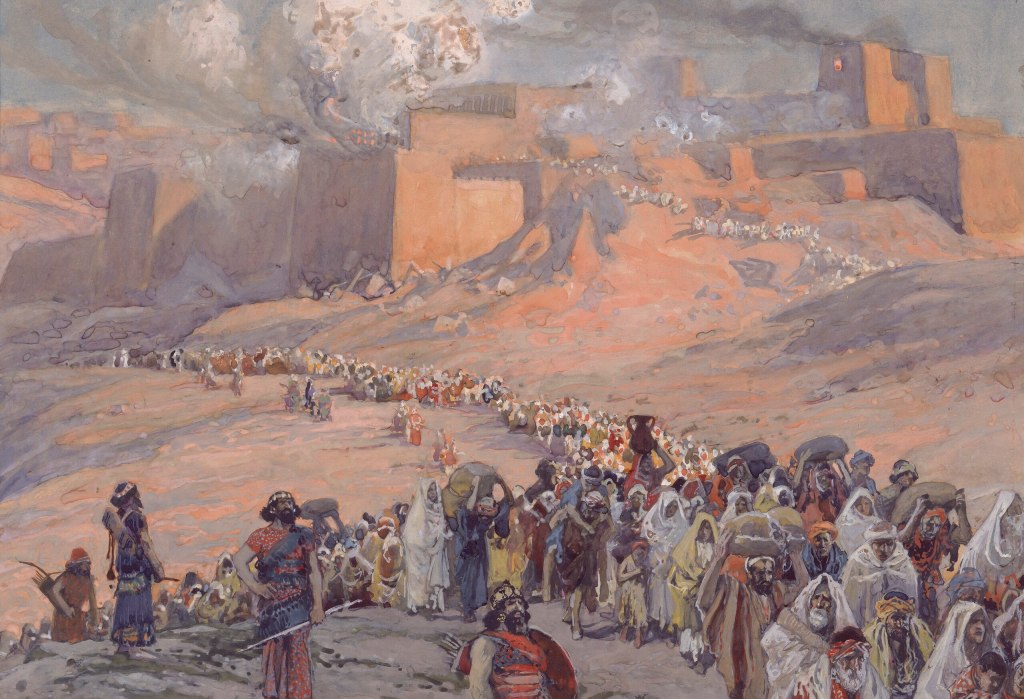
James Tissot’s painting “The Flight of the Prisoners” illustrates Judah’s exile from Jerusalem.

Nebuchadnezzar also came against Jerusalem on two other occasions, first in 598 B.C. against Jehoiakim. Jerusalem was besieged and finally surrendered on March 16, 597 B.C. and Jehoiakim apparently died during the siege. He was replaced by Jehoiahin, who surrendered the city.
The Babylonians plundered the city, including the temple treasuries and deported Jehoiachin and his family along with other Jewish leaders (2 Kings 24:13-16), including the prophet Ezekiel.
After the surrender of Jerusalem in 597 B.C. Nebuchadnezzar appointed Mattaniah, the young uncle of Jehoiachin, as king of Judah and changed his name to Zedekiah. Zedekiah’s reign of 11 years was marked with anti-Babylonian conspiracy despite Jeremiah’s condemnation of this policy (Jere. 27-29).

Nebuchadnezzar’s Final Campaign against Judah

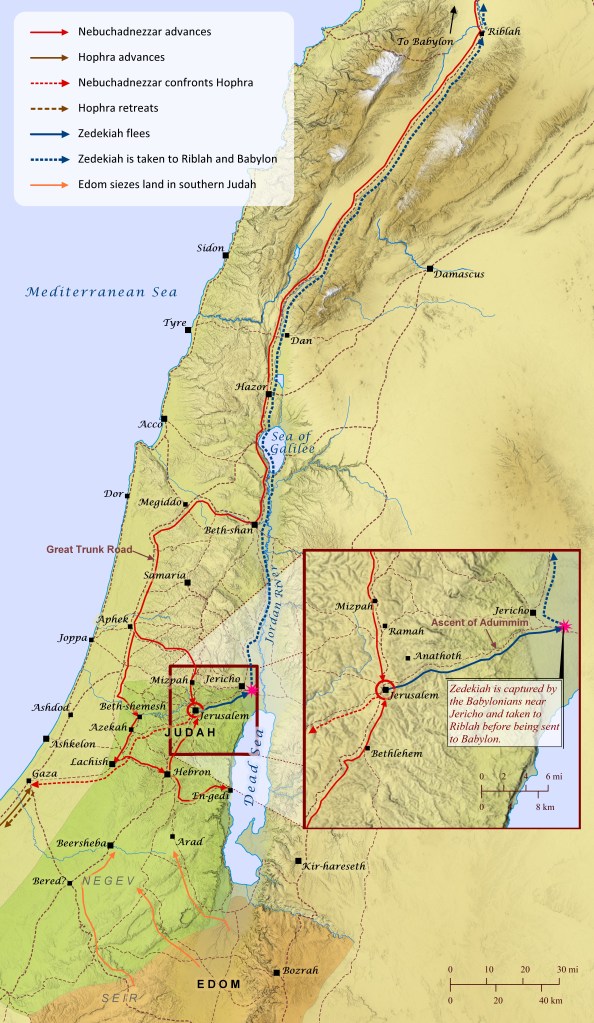
The final collapse of the southern kingdom of Judah as an independent nation came at the hands of King Nebuchadnezzar II of Babylon in 586 B.C. Nebuchadnezzar’s army besieged Jerusalem again from 588-586 B.C., and when the city’s supplies were completely depleted, Jerusalem fell and the temple was destroyed. Zedekiah fled towards Egypt but was captured and forced to witness the execution of his sons before being blinded and led away to Babylon in chains. A third deportation of Jews occurred at this time.

Judah Is Exiled to Babylon

Babylon: The Heart of the Empire

Daniel and his friends were taken to Babylon (Daniel 1:1-6). Babylon was the chief city of Babylonia, long the capital of the kingdom and empire that controlled the whole or a large part of the valley of the Tigris and Euphrates. This was the Neo-Babylonian empire, the latest rendition of Babylonian dynasties.

It was spiritually like walking into the mouth of the lion. Who is our lion-enemy? Living in Babylon was no vacation from home, as Psalm 137:1 reports: “By the rivers of Babylon we sat and wept when we remembered Zion.” It was indeed a very sad time.

Although we are not sure of the origin of Babylon, its roots lie in Genesis 10:8-12.

8 Cush fathered Nimrod; he was the first on earth to be a mighty man. 9 He was a mighty hunter before the Lord. Therefore it is said, “Like Nimrod a mighty hunter before the Lord.” 10 The beginning of his kingdom was Babel, Erech, Accad, and Calneh, in the land of Shinar. 11 From that land he went into Assyria and built Nineveh, Rehoboth-Ir, Calah, and 12 Resen between Nineveh and Calah; that is the great city.

It appears to be mentioned in a historical inscription by Agu-kak-rime (about 1650 B.C.), who restored the shrines of Marduk and Sarpanit in the temple of E-sagila.

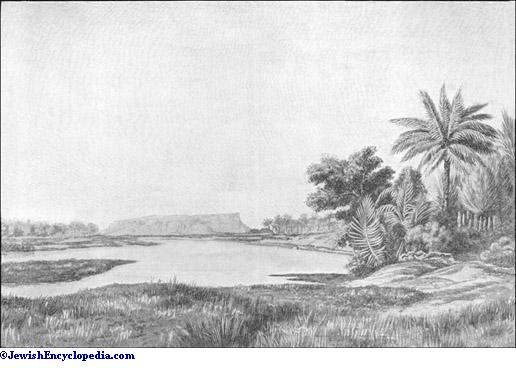
View of the Ruins of Babylon. (From Perrot and Chipiez, “Art in Chaldæa and Assyria.”)

The ruins which have been identified with ancient Babylon lie about 50 miles south of the city of Bagdad and on the east bank of the Euphrates.

Of course, most of us are familiar with the historical situation in Genesis 11, where the nations, which were supposed to ““Be fruitful and multiply and fill the earth” (Gen. 9:1), instead migrated from the west and found a plain in the land of Shinar and settled there, and said “Come, let us build ourselves a city and a tower with its top in the heavens, and let us make a name for ourselves, lest we be dispersed over the face of the whole earth” (Gen. 11:4).

God was against this, confused their language (Gen. 11:7) and “dispersed them from there over the face of all the earth” (11:8). That place was called Babel “because there the Lord confused the language of all the earth” (11:9). It is quite possible that the Nimrod mentioned in Genesis 10 took over this region and established his new kingdom.

After Nimrod established himself as a king and began conquering the surrounding lands (Genesis 10:10-11), he was sadly elevated to a godlike status by his descendants, worshipped simply as “Belus/Bel,” or the more common “Baal/Ba’al” (John Gill, Exposition of the Old Testament, notes on Genesis 10:6). He was also known as Marduk/Merodach, who is equated with “Bel” in Jeremiah 50:2. The tower became known as the tower of Bel, after “Belus Nimrod” or the “Temple Tower of Marduk”—another variant name for Nimrod.

From its beginning, as a center lifted up against God, Babel and Babylon became known as the anti-God city. In the Bible, Babel and Babylon are cities that represent human rebellion against God, idolatry, and oppression.

Later in its history the Assyrian king Sennacherib sacked Babylon around the same timeframe as King Hezekiah and the prophet Isaiah (around the seventh to eighth centuries BC). In fact, Sennacherib even tried conquering Jerusalem, which caused Hezekiah to cry out to God for help and resulted in God rescuing the city and sending Sennacherib back to Nineveh.

When the city of Babylon rebelled, Sennacherib had Babylon destroyed and then flooded. The following king of Assyria, Esarhaddon (one of Sennacherib’s sons), rebuilt Babylon back to its famed glory in his short 12-year reign.

Esarhaddon’s oldest son and heir died young. But in a strange twist, Esarhaddon gave the power of his throne, not to his son next in line for the throne (Shamash-shum-ukin), but instead to his younger son (Ashurbanipal). In a consolation attempt, Shamash-shum-ukin was given charge of Babylon itself, yet still under the authority of his younger brother. This, of course, had the initial makings of a rebellion (in case you didn’t notice).

Ashurbanipal of Assyria and Nineveh (the younger brother and now supreme ruler of the empire) defeated the city of Babylon (ruled by his older brother Shamash-shum-ukin) as it tried to revolt. After the fall of the Assyrians, Babylon was taken over by the Chaldeans (descendants of Heber) under Nabopolassar. This was the beginning of the Neo-Babylonian empire.

Order of events using Ussher’s date for the tower of Babel (though it was likely a little later)
https://answersingenesis.org/tower-of-babel/history-and-archaeology-of-worlds-oldest-city/?srsltid=AfmBOooYNryD0J5BVFvFNuS_qr_2JbnvjgdRVoAZjnjVQXBZOaLnThwC