Belshazzar’s Mega Party (Daniel 5:1)

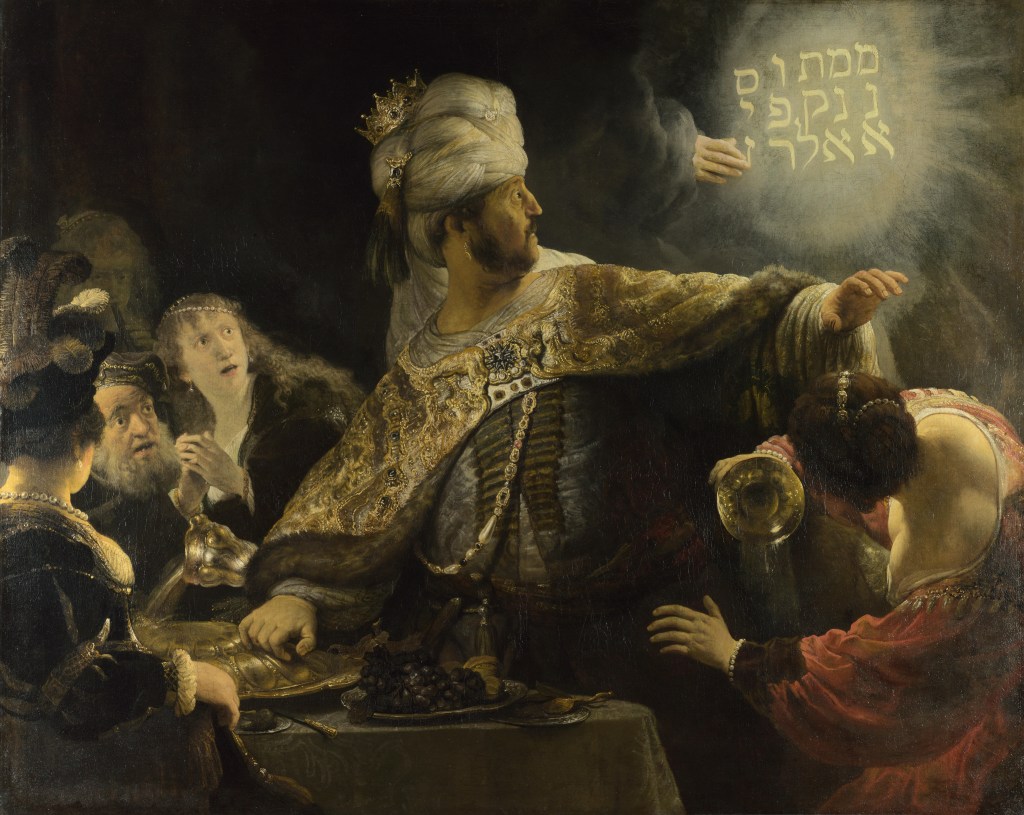
“The handwriting on the wall” has come into the English language as an idiom that means there are clear signs or indications that something bad or difficult is about to happen.  It is an ominous warning.  It is a signal that should provide us a warning not to continue on the path we are traveling.

Tim Challies, Canadian blogger, writes: “It seems that it was first used as an English idiom beginning in the eighteenth century. In 1720 we find Jonathan Swift writing: “A baited Banker thus desponds, / From his own Hand foresees his Fall; / They have his Soul who have his Bonds; / ‘Tis like the Writing on the Wall.”  Since that time it has come into common use, though most people have little knowledge of its origins.  A search of just one week’s news stories turns up hundreds of uses.

Daniel chapter 5 tells the story of the humbling of Belshazzar and the final defeat of Babylon.  At a great feast, King Belshazzar commands that the temple vessels—which had been taken from Jerusalem in successive deportations—be used for wine and the praise of pagan gods (5:1-4).  In response to this act, a hand appears at the feast and writes on the palace wall (v. 5), but none of the king’s men can decipher the message (vv. 7-8).  The queen suggests Daniel as the most likely interpreter (vv. 10-12), and when he arrives, he rebukes Belshazzar for not heeding the lesson about humility that Nebuchadnezzar had learned (vv. 20-22).  The writing on the wall is a message of judgment against Belshazzar and the Babylonian kingdom (vv. 24-28).

In this chapter we learn things about the nature of God and what our response to him should be, whether we are a prince or a pauper. Since God is a God of justice, we must humble ourselves before him.

Once again, the chapter forms a chiasm.  That is, it is organized literarily like the Greek letter chi, which is formed like our letter “x.”

Daniel 5 begins and ends with Belshazzar.  The opening verse reports a great feast (1), and the final verses report the king’s death (1′).  The intervening sections explain why Belshazzar does not survive the night of the banquet.  On two occasions in the story, he gives explicit commands, one for the temple vessels to be brought to the banquet (2) and the other for Daniel to be rewarded for his help (2′).

The drama picks up the pace once a hand appears and writes a message on the palace wall (3). In the literary arrangement of the chapter, the matching section (3′) records the interpretation of the cryptic writing. The wise men cannot discern the meaning (4) while Daniel can (4′). The verses in 4 are framed by an inclusio, for verses 6 and 9 both speak of the king’s alarm and change of color.  In the center of the chiastic structure is the queen’s glowing endorsement of Daniel’s abilities (5).  These are her only words in the story—and in the book as a whole—and their location in the narrative indicates their importance.

Daniel 5 is the final chapter of the narratives involving Babylon.  (The events of chapter 6 take place under Medo-Persian rule.)  In these chapters, only chapter 5 features a Babylonian king other than Nebuchadnezzar.  However, the connection between the two kings in chapters 4-5 is evident—these two chapters are the center of the Aramaic chiasm (chs. 2-7) and each narrates God’s judgment on a Babylonian king:  chapter 4 is the judgment of proud king Nebuchadnezzar and chapter 5 is the judgment of proud king Belshazzar.  Obviously, pride is “an abomination” to God (Prov. 6:16).  Everyone who is arrogant in heart is an abomination to the Lord; be assured, he will not go unpunished.

Nebuchadnezzar learned from his humiliating experience (Daneil 4).  In the case of Belshazzar, king of Babylon, the humbling he should have learned from was not his own but that of his (grand)father, Nebuchadnezzar.  But he did not.  Instead, he would have to learn his lesson the hard way, through personal humiliation.

This story transpired many years after the events of chapter four.  Nebuchadnezzar had died in 562 B. C., after forty-three years of reign, which included his seven years of insanity.

In the 40-plus-year period between chapters 4 and 5, Daniel received additional revelation as recorded in chapters 7 (the sequence of Gentile kingdoms represented as rapacious beasts) and 8 (the identities of the 2nd and 3rd kingdoms as Medo-Persian and Greece).

Besides revelation God had provided directly to Daniel, he was an avid student of Scripture and studied the writings of the contemporary prophet Jeremiah (Dan. 9:1). In addition, Daniel was undoubtedly acquainted with the predictions concerning Babylon and Medo-Persia made by other prophets such as Ezekiel and Isaiah.

As this chapter opens, Daniel, as a student of Jeremiah’s prophecies, would have already known:

  • The kingdom of Medo-Persia would overthrow Babylon (Isa. 13:1, 17; 21:2, 9; 45:1; Jer. 50:9; Jer. 51:11, 28-31; Dan. 2:32, 39; 7:5; 8:3-8, 20-21.
  • Cyrus would initiate the Jew’s release from Babylon and the temple’s reconstruction in Jerusalem (Isa. 44:27-28; 45:1-5).  This, in turn, implies Cyrus would gain ascendancy over Babylon—the nation holding the Jews captive.
  • The overthrow of Babylon would enable Jews to return to Israel (Jer. 50:4-5, 8, 19, 28; 51:45).
  • The reign of Babylon would end with Nebuchadnezzar’s grandson (Jer. 27:6-7).
  • The seventy years of servitude were nearing fulfillment (Jer. 25:11-12; 29:10).


“Daniel believed God.  He took God’s Word at face value.  No mystical, allegorical, theoretical interpretation of the Scriptures for him!  His method was down-to-earth, literal interpretation.  So Daniel took Jeremiah’s prophecies at face value and he staked his life on them.  No wonder he was so bold to speak up to the evil Belshazzar!  He knew that Babylon’s day was done and that the city was doomed.  The handwriting on the wall only ratified what he had known for a long time.”

Our chapter opens with Belshazzar throwing a grand party.

King Belshazzar made a great feast for a thousand of his lords and drank wine in front of the thousand. (Dan. 5:1)

As Nero is said to have fiddled while Rome burned, so Belshazzar feasted while Babylon fell.

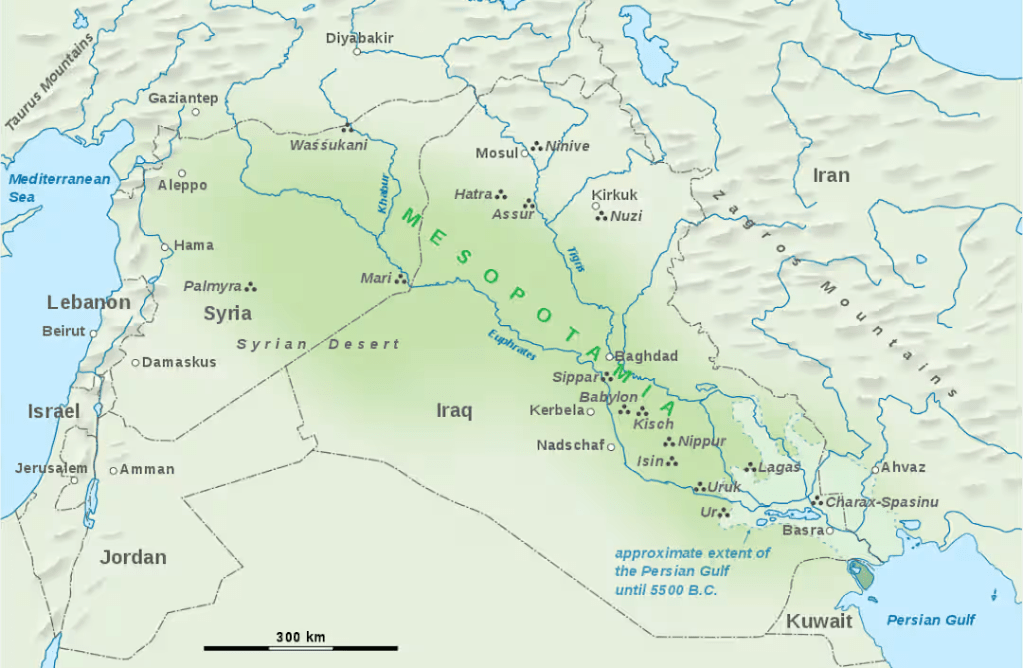
Life in the magnificent city of Babylon, with its Hanging Gardens, one of the Seven Wonders of the ancient world, seemed normal on the night of October 12, 539 B.C.  Just over a decade earlier, Cyrus the Great had conquered the Medes and formed the mighty Medo-Persian army, and now he leads his army to the doorstep of the Babylonians.  But on the city’s agenda this night was a huge party thrown by the new kid on the block, the Babylonian king, Belshazzar.  The party was likely thrown in honor of the god Bel.  After all, that is who Belshazzar was named after.

King Belshazzar made a great feast for a thousand of his lords and drank wine in front of the thousand. (Dan. 5:1)

Belshazzar, successor to Nebuchadnezzar, threw a “great feast” for a thousand lords, feasting and drinking before them.  In the days of Esther, the Persian emperor Xerxes threw a big enough party, indeed (Esther 1:1-12), but the feast conjured by Belshazzar was greater far.

Doing these deeds “in front of” the crowds illustrate both his high privilege and also his arrogance.  If he was concerned about building morale, he would have wanted to have a maximum number of people present.  “Oriental despots took great pleasure,” says Warren Wiersbe, “in hosting great banquets and displaying their wealth and splendor (see Esther 1)” (The Wiersbe Bible Commentary:  Old Testament, p. 1361).

He goes on to say: “This feast was a microcosm of the world system and focused on ‘the lust of the flesh, and the lust of the eyes, and the pride of life’ (1 John 2:16).  ‘What shall we eat?’ and ‘What shall we drink?’ are the questions most people want answered as they go through life (Matt. 6:25-34), and they’re willing to follow anybody who will entertain and gratify their appetites” (Warren Wiersbe, The Wiersbe Bible Commentary:  Old Testament, p. 1361).

Just like in Daniel 4 God determined to humble another proud Babylonian king, so here the Most High takes the initiative to humble King Belshazzar.  How will we respond when we are confronted, unsettled, and accosted, in the moments when our semblances of control vanish and we’re taken off guard by life in a fallen world?  Will we repent like Nebuchadnezzar, or will we stubbornly proceed on our way or ignore God’s warnings by indulging in our own pleasures?

Now, for some time, there was doubt that a person named “Belshazzar” actually existed in history.  For centuries there was no independent archaeological evidence for the existence of any king of Babylon named Belshazzar.

Two things we must always remember concerning archaeological evidence for the Bible.  First, there is a massive amount of archaeological evidence already that does prove that the Bible is a historical, factual record.  Second, there has never, ever been any archaeological discovery that contradicted the Bible in any way.  Having said that, it is true that not every detail of the Bible has been independently proven yet.  But remember that “absence of evidence does not mean evidence of absence.”

In this case we do have evidence that Belshazzar actually existed!  In 1854 the Nebonidus Cylinder was discovered by Sir Austen Henry Layard and is now displayed in the British museum.

https://ferrelljenkins.blog/2012/02/12/

According to Ferrell Jenkins, several kings had ruled Babylon since the days of Nebuchadnezzar, none for very long.

Evil-Merodach (562-560 B.C., just two years) was assassinated by Nergal-Sharezer, who ruled as king of Babylon for four years. Nothing about his reign is recorded in the Bible, but he is mentioned in Jeremiah 39:3 and 13 from the time of the destruction of Jerusalem (587 B.C.).  At that time he served as one of the officials of Nebuchadnezzar.

After four years on the throne, Nergal-Sharezer was followed by his son, Labaši-Marduk, who ruled only 9 months.

Nabonidus, who is not named in the Bible, then came to the throne in 556 B.C.  According to Wiseman the king,

… campaigned in Syria and N. Arabia, where he lived at Tema for 10 years while his son BELSHAZZAR acted as co-regent in Babylon.  About 544 his people and the kings of Arabia, Egypt and the Medes being favourably disposed, Nabonidus returned to his capital…, but by this time the country was weak and divided. (New Bible Dictionary (3rd ed.), 115).

Fant & Reddish provide this translation of the relevant portion of the Nabonidus Chronicle:

“As for me, Nabonidus, king of Babylon, save me from sinning against your great godhead and grant me as a present a life of long days, and as for Belshazzar, the eldest son my offspring, instill reverence for your great godhead (in) his heart and may he not commit any cultic mistake, may he be sated with a life of plenitude” (Lost Treasures of the Bible, 233).

Nabonidus seems to be concerned that his son was irreligious (although Nabonidus was no better).  Ironically, he prays to his god that Belshazzar would “be sated with a life of plentitude.”  This was exactly his problem on this fateful night: indulging in an orgy of plentitude, satiating himself with wine and women.

Nabonidus and Belshazzar, father and son, thus functioned as co-regents, Belshazzar ruling in Babylon and Nabonidus in Tema.  According to one account, Nabonidus “entrusted the kingship” to Belshazzar. — BAR 11:03 (May/June 1985).

Apparently Belshazzar was a “godless” young man, giving reverence to no one.  His name probably meant, “May Bel protect the king,” but Belshazzar doesn’t seem to have been very religious.  He was out to have a good time, making his desires preeminent.  His own drive for pleasure was his god, his idol.

By the way, three factors indicate that this book was written by a contemporary to this scene.

First, the idea that Belshazzar was in charge of Babylon at this time was lost by the Maccabean era.  “Shea comments that if the book had been written in the second century [as some liberal scholars believe], the name ‘Nabonidus’ probably would have been inserted rather than the then-forgotten ‘Belshazzar.’  How did the author come to possess such exact knowledge?  The most logical explanation is that Daniel 5 contains a firsthand report by one who lived through the events” (Stephen R. Miller, Daniel in E. Ray Clendenen, Kenneth A. Mathews, and David S. Dockery, eds., The New American Commentary, p. 150)

Second, the offered reward of becoming “third ruler in the kingdom (Dan. 5:8) posed a difficulty not understood in the Maccabean era down to the modern era.  The Nabonidus Chronicle indicates the option of a co-regency, which would mean that the “third ruler in the kingdom” was the highest ranking that Belshazzar could offer to anyone, for he was “second ruler.”

Third, it also explains the absence of Nabonidus from Babylon.  Daniel locates Belshazzar there and implies that Nabonidus was absent from the palace or city at that time, by not mentioning him. The Nabonidus Chronicle confirms this implication by noting that Nabonidus had fled from Sippar just two days earlier and had not yet returned to Babylon by the time it fell to the Persians.

Some would also argue that Daniel was mistaken in titling Belshazzar as “king” of Babylon.  But as Nabonidus’ eldest son, Belshazzar was appointed coregent and directed the affairs of the city of Babylon in his father’s ten-year absence.

Since Belshazzar was second in the kingdom, serving as a co-regent along with his absent father, he could offer Daniel nothing greater than “third ruler in the kingdom.”

Even though Belshazzar is not literally Nebuchadnezzar’s direct son, he is as arrogant and pompous as Nebuchadnezzar.  In the ancient languages, the term “son” was a very elastic term extending several generations.  We will deal with this issue in more depth in the coming weeks.

Nebuchadnezzar’s Restoration (Daniel 4:34-37)

The first thirty-three verses of Daniel 4 illustrate that God resists the proud, but these last four verses demonstrate that He also gives grace to the humble.

Do you like getting humiliated?  Chuck Colson tells how he climbed the ladder of power and prestige to become the Special Counsel to the President of the United States of America.  He was filled with pride as he walked in and out of the office of the most powerful man in the world any time he wanted.  That most powerful man was seeking advice from him, and Colson’s heart swelled with pride.

That was when he became involved in the Watergate affair of the Nixon administration.  John Dean blew the whistle in 1973, and Colson soon found himself a convicted criminal doing time in a federal penitentiary.  He was so humiliated that he lifted up his eyes to the King of Heaven and gave his heart to Jesus Christ.  (He was, in fact, reading Lewis’ Mere Christianity and his chapter on pride).  He still admits that the worst, most humiliating experience in his life was the best thing that ever happened to him.

In Luke 18:14 Jesus says, “Everyone who exalts himself will be humbled, and he who humbles himself will be exalted.”

Nebuchadnezzar’s pride was stripped away along with all his achievements, until he came to recognize that whatever he possessed or achieved before was a gracious gift from God, who is able to exalt the lowliest of men to heights of power or bring down the mightiest of men to depths of humiliation.

Nebuchadnezzar once again picks up the storyline and speaks in the first person (cf. Dan. 4:1-3).  While a narrator recounted the details of his fall, Nebuchadnezzar wanted everyone to hear his repentance from his own mouth.

34 At the end of the days I, Nebuchadnezzar, lifted my eyes to heaven, and my reason returned to me, [and what did Nebuchadnezzar do, he…] and I blessed the Most High, and praised and honored him who lives forever,

Before, “I built all this…” Now, “I bow before the real King.”  We can summarize these verses:

He looked up—lifted his eyes to heaven.

He woke up—sanity restored.

He spoke up—praised the Most High.

Just as suddenly as judgment had fallen upon him, it was lifted.  Mission accomplished.  His chains fell off.  He looked up and saw the heavens above.  “He has the use of his reason so far restored to him that with it he glorifies God, and humbles himself.  Men never rightly use their reason till they begin to be religious, nor live as men till they live to the glory of God” (Matthew Henry, Commentary on the Whole Bible, p. 1090).  His sanity was restored, and his soul burst into song.

for his dominion is an everlasting dominion, and his kingdom endures from generation to generation; 35 all the inhabitants of the earth are accounted as nothing, and he does according to his will among the host of heaven and among the inhabitants of the earth; and none can stay his hand or say to him, “What have you done?”

God’s rule never ends, unlike any man’s, even Nebuchadnezzar’s.  He realizes that now.  Also, he sees that “he does according to his will…and one can stay his hand” or ask “What have you done?”  God is accountable to no one.  He is the true sovereign.

None can stay his hand.  It’s not even a good fight with him.  There’s no fight.  He is God. He does as he pleases.  He is sovereign.  God of gods.  Able to rescue as he chooses.  And his power and reign will not expire.  His kingdom is everlasting.  None can hold him back.  None can stay his hand.

This once-pagan king now openly declares the praises of God.  He has truly gotten the message. God can do anything he wants to do, and no one can stand against him.  Earthly kings rule by God’s permission and they stay on the throne only so long as it pleases God to give them power and authority.  Nebuchadnezzar has learned the truth the hard way.  Now he proclaims it for all the world to hear:  God has the right to do everything he wants and everything he wants is right to do.

Before, Nebuchadnezzar would have pointed back to some military victory or building exploit as he greatest moment, but from here forward he will always look back to this moment when God humbled him and he came to the full realization that God is God and not me.  That God can do what He wants because He is God.

Notice that Nebuchadnezzar’s reason returned to him when he took his eyes off of himself and off of his accomplishments that he had done, and turned his eyes “to heaven,” to God, “the Most High.”  Lifting one’s eyes to heaven suggests both faith and submission.  “To you I lift up my eyes, O you who are enthroned in the heavens!” (Psalm 123:1)  “Turn to me and be saved, all the ends of the earth!  For I am God, and there is no other” (Isa. 45:22).

This is what God was looking for in Nebuchadnezzar—repentance.  Now he would look to the true God in heaven and bow before Him instead of expecting everyone to bow before him as king of Babylon or his golden image.

By a miracle of grace his mind was suddenly healed and his reason returned.  He knew what had happened to him and remembered Daniel’s warning and prediction.  Overwhelmed by this demonstration of Yahweh’s limitless power, Nebuchadnezzar prostrated himself before the Ruler of heaven and earth.

This was an act of acknowledgement and an act of dependence and supplication, as well as worship.  It is likely that as his eyes were opened to perceive God Most High in heaven, that his reason was returned and his mouth was opened to acknowledge and worship the true God.

True humility is not looking on ourselves and believing ourselves as worthless.  It is to get our eyes off of ourselves entirely and to gaze upon the beauty and greatness of God Most High.  True humility acknowledges that everything I have, everything I’ve accomplished and all that I am is because of what God has graciously done for me.

Seven years before, the king had considered himself a great man and his kingdom a great kingdom, but now he has a different viewpoint, “all the inhabitants of the earth are accounted as nothing,” and Nebuchadnezzar includes himself now, in that number.

Perhaps Daniel had previously quoted the prophet Isaiah to the king: “Behold, the nations are like a drop from a bucket, and are accounted as the dust on the scales” (Isa. 40:15), “It is he who sits above the circle of the earth, and its inhabitants are like grasshoppers (Isa. 40:22) and then “who brings princes to nothing, and makes the rulers of the earth as emptiness” (Isa. 40:23).

Even this terrible experience could be considered as God’s hand of gracious discipline upon Nebuchadnezzar, while yet an unbeliever!  Notice that a time limit was set upon it.  It wouldn’t be forever and by the end of it it was expected that the lesson would have been learned.  Also, there was a definite purpose in the ordeal, and that is that Nebuchadnezzar would learn “that the Most High rules in the kingdom of men, [and] gives it to whomever He will.”

The sovereignty of God over the affairs of human beings is one of the great lessons we learn from this chapter.  Five times in our text that message is plainly declared:

  • “the Most High rules the kingdom of men and gives it to whom he will and sets over it the lowliest of men” (Dan. 4:17).
  • “the Most High rules the kingdom of men and gives it to whom he will” (Dan. 4:25).
  • “your kingdom shall be confirmed for you from the time that you know that Heaven rules” (Dan. 4:26).
  • “until you know that the Most High rules the kingdom of men and gives it to whom he will” (Dan. 4:32)
  • “I blessed the Most High, and praised and honored him who lives forever, for his dominion is an everlasting dominion, and his kingdom endures from generation to generation” (Dan. 4:34).

This last verse is Nebuchdnezzar’s own recognition of that truth.

We are all called to bow before the sovereignty of God, but the heart of sinful man will always chafe and rebel at the very idea of a sovereign God, for the human heart wants to be “free” of all outside control and determine our own way.  Few sinners realize that they are not actually “free” but are in bondage to their fallen, fleshly nature and the forces of Satan (2 Timothy 2:26).  Charles Spurgeon was very balanced in his theology, writing:

“Most men quarrel with this [the sovereignty of God].  But mark, the thing that you complain of in God is the very thing that you love in yourself.  Every man likes to feel that he has a right to do with his own as he pleases.  Oh, for a spirit that bows always before the sovereignty of God” (Charles Spurgeon, The New Park Street Pulpit, vol. 4, p. 82)

The end result of it all is that Nebuchadnezzar’s humbling became an even greater occasion of exaltation because of his repentance.

36 At the same time my reason returned to me, and for the glory of my kingdom, my majesty and splendor returned to me.  My counselors and my lords sought me, and I was established in my kingdom, and still more greatness was added to me. 37 Now I, Nebuchadnezzar, praise and extol and honor the King of heaven, for all his works are right and his ways are just; and those who walk in pride he is able to humble.

I don’t think Nebuchadnezzar felt embarrassed about his seven years of insanity.  If he had been, he wouldn’t have written the story down for the whole world to know.  You can know that you have made a spiritual breakthrough when you can tell your own story without feeling a need either to embellish or to cover up the negative aspects.  When all the glory goes to God for rescuing you from yourself and your own foolish choices.

God had truly taught Nebuchadnezzar by priceless experience that “all his works are right and his ways are just; and those who walk in pride he is able to humble.”  It was a painful experience, but a valuable one.  It was a lesson that every political leader must learn: God rules; we don’t.  God rules; I don’t.

No truth is more fundamental than the one Nebuchadnezzar discovered: He’s God and We’re Not.  This is where all true spiritual growth begins, bowing before the sovereignty of God.  As Ray Pritchard says, “Here is some good news.  If you are ready, you can rip that big G off your sweatshirt.  Since you aren’t God, you can stop playing God.”

The fear of the Lord was beginning to be formed in Nebuchadnezzar’s heart and God could trust him with “more greatness.”  The “head of gold” had bowed in humble submission to the God of Daniel (v. 37).  Can God trust you with greater greatness, or will it go to your head and make you proud?

Pride was the sin of Lucifer, who was enthroned in heaven on high as the anointed cherub, the most gifted and glorious of all of the angelic hosts.  Pride!  It was the sin of Eve—to Iisten to the serpent, mishandling God’s Word, and succumbing to the dangled delusion—‘Ye shall be gods.’  It was the sin of Herod Agrippa I (Acts 12:20-23).  It was the sin of sins.  It still is.  Let us beware!

At the end of the seven years not only was Nebuchadnezzar’s reason returned to him, but also the majesty and splendor of his kingdom.  His cabinet sought him out and restored him to his throne, with even more glory than before!

John Phillips reminds us how amazing this is: “The madness of Nebuchadnezzar ordinarily would have unleashed a power struggle, and the king’s life would be terminated as a triumphant conspirator seized the throne.  A mad emperor must have been an enormous liability to those who actually ran the everyday affairs of the empire.

Yet for seven years, the king was protected from the people who would have exploited his madness and would have seen in it sufficient cause to murder him and seize the reins of power for themselves.  The fact that the king’s condition was not exploited points to the Holy Spirit who, as the great Restrainer, sovereignly restrained all such intrigues.  God kept faith with the poor lunatic.

So the kingdom was returned to Nebuchadnezzar when his sanity was restored.  This restoration awed the king and caused him to acknowledge the works, ways, and wonders of God” (John Phillips, Exploring Daniel, p. 82).

This is Nebuchadnezzar’s own personal confession of faith in Israel’s God, and it is the last word we hear from his lips in the Bible.  This great and mighty persecutor of Israel, the destroyer of Jerusalem, has now been humbled by God’s grace and brought to confess His mercy.  If a person like Nebuchadnezzar can be humble and restored, then surely no one is beyond the reach of God’s mercy!

How different from Pharoah’s response to what the Lord did in Egypt!  Instead of bowing to God’s sovereignty and acknowledging His authority, Pharoah continued to rebel again and again against God’s will, saying, “But Pharaoh said, “Who is the LORD, that I should obey his voice and let Israel go? I do not know the LORD, and moreover, I will not let Israel go” (Exodus 5:2).  As a result of his rebellion, he and his country were destroyed.

Mankind doesn’t think pride is such a big deal.  But pride idolizes self and God won’t share His glory with anyone.  In Isaiah 13:11 Yahweh says, “I will punish the world for its evil, and the wicked for their iniquity; I will put an end to the pomp of the arrogant, and lay low the pompous pride of the ruthless.”

“Will we see King Nebuchadnezzar in heaven?  That’s difficult to know.  He certainly had a life-changing experience with the merciful God.  But we can never know the true state of his heart.  Did he recognize the Lord as the one true God, or did he just shift Him to the top of his Top Ten Deities list, bumping himself down to number two?  There is coming a time when we’ll know for sure.  I, for one, hope to meet him one day in eternity” (Amir Tsarfati, Discovering Daniel, p. 95).

Matthew Henry adds: “It was not long after this that Nebuchadnezzar ended his life and reign, Abydenus, quoted by Eusebius (Preap. Evang. 1.9) reports that upon his deathbed he foretold the taking of Babylon by Cyrus.  Whether he continued to live in the same good mind that here he seems to have been in we are not told.  If our charity may reach so far as to hope he did, we must admire free grace, by which he lost his wits for a while, that he might save his soul for ever” (Commentary on the Whole Bible, p. 1090).

If you are God’s child (through believing in Jesus Christ alone), God will not allow you to live in sin forever.  God loves you far too much to allow you to go on in your sinful rebellion forever.  Sooner or later He will intervene, sometimes in ways both public and painful, so that He can bring us back home again.  Like the prodigal, you may have to wallow in the pig pen and despair of life, but hopefully it will stir your hunger for home, for God.

Before his humbling, Nebuchadnezzar was a proud pagan, but afterwards, he began to sound like a Puritan theologian, fully convinced of the sovereignty of God.  Our God reigns.

Our God reigns.  That is a monumental and paramount truth.  It is a reality that changes everything.  When you wake up in the morning, you do not wake up to a world that is void of purpose.  No, our God reigns.  When you go throughout your day, there are no accidental conversations or interactions.  Why?  Our God reigns.  When you go to bed at night after a day full of turmoil in seeing sin paraded in the country on the news, in hearing sin praised in your workspace, in knowing the sin that you’ve committed yourself, you do not go to bed to bed without hope… no, again, our God reigns.  (Henry Anderson)

A Warning Unheeded (Daniel 4:24-27)

In July of this year we saw some terrible flash flooding and tragedies in Texas, which was then repeated in more than ten states.  But there a powerful storm caused the Guadalupe River in the Texas Hill Country to rise twenty-six feet in forty-five minutes before dawn Friday, washing away homes and vehicles.  Camp Mystic, a nearly century-old Christian camp for girls, was in the path of the flood.

In Kerr County, where the camp is located, the floods killed at least sixty-eight people, including twenty-eight children, Sheriff Larry Leitha said.  In total, at least eighty are dead and many more are missing, according to officials.

This year’s Fourth of July was the first time that the town of Comfort, Texas, used the sirens intended to warn its roughly 2,000 residents of imminent flooding.  Founded by German abolitionists in 1854, Comfort sits along the Guadalupe River in an area known as “Flash Flood Alley.”  It installed its siren-based warning system last year, a move that neighboring Kerr County, where well over 100 people died in this month’s floods, opted against.

One Comfort resident told Grist that when she heard the sirens, she had no way of knowing just how much urgency was called for. 

“In my mind, I’m going, ‘Okay we’ve got a couple hours before it gets up to the house, because it’s a 50-foot drop from our house to the creek,” she said. Her husband started walking down to check on the water level, but quickly ran back inside. “You’ve got five minutes,” he told her. “Grab everything you need.’” 

Ultimately, she and her husband were lucky — they were able to shelter with a neighbor whose house is on higher ground — but their close call captures a dilemma that’s taking on new urgency as flash floods claim lives from Texas to North Carolina: Even the most comprehensive disaster warnings are only as helpful as the responses of those who receive them. 

Did you notice two realities:  First, you need to have a warning system in place, because flash floods can be deadly.  Second, “disaster warnings are only as helpful as the response of those who receive them.”

Throughout Scripture God gives warnings of coming judgments.  He did this for His chosen people Israel (Lev. 26; Deut. 28).  The curses would worsen as the people remained impenitent, culminating in the worst covenant curse of all—exile, the banishment from God’s special place of blessing.  He did this for other nations.  Some examples are the destruction of Sodom and Gomorrah (Genesis 19), prophecies against Babylon (Isaiah 13), and the judgments on nations surrounding Israel (Jeremiah 46-51), ultimately Matthew 25:31ff speaks of the end times judgment of how nations treated Israel during the tribulation.

God also warned individuals of impending judgment, like Noah (Genesis 6); Lot (Genesis 19:17), Eli (1 Sam. 3:11-14) and, of course, here in Daniel 4 with Nebuchadnezzar.  Daniel has been interpreting Nebuchadnezzar’s troubling dream.  So far he has said…

24 this is the interpretation, O king: It is a decree of the Most High, which has come upon my lord the king, 25 that you shall be driven from among men, and your dwelling shall be with the beasts of the field. You shall be made to eat grass like an ox, and you shall be wet with the dew of heaven, and seven periods of time shall pass over you, till you know that the Most High rules the kingdom of men and gives it to whom he will. 26 And as it was commanded to leave the stump of the roots of the tree, your kingdom shall be confirmed for you from the time that you know that Heaven rules. 27 Therefore, O king, let my counsel be acceptable to you: break off your sins by practicing righteousness, and your iniquities by showing mercy to the oppressed, that there may perhaps be a lengthening of your prosperity.”

This dream is a warning to Nebuchadnezzar that no matter how powerful and important he thought he was, God would cut him down and humble him, turning him into an animal unless he broke off from his sins.  Of course, the primary sin issue in Nebuchadnezzar’s heart was pride, but it was expressed in the ways he took advantage of people.

So in vv. 24-25 we see that those beasts and birds that had previously benefitted from his rule (Dan. 4:12) would now be his companions in the fields.  “The one who thought of himself in godlike terms as the very center of the universe will be transformed into a beast so that he can learn that he is merely human after all” (Iain Duguid, Daniel in Reformed Expository Commentary, p. 67).

In his dream, when the tree was cut down, the stump and roots were allowed to remain (Dan. 4:15).  This represents the hope of renewal, with potential new growth to emerge from the stump.  God’s act of judgment upon Nebuchadnezzar was not a permanent cutting off, for the command to leave the stump (Dan 4:26) meant that his kingdom would be restored.  But the condition for restoration was that “your kingdom shall be confirmed for you from the time that you know that Heaven rules” (Dan. 4:26).  The full period of judgment was expressed as “seven times,” since seven is the number for completion.  When that time was complete and when Nebuchadnezzar acknowledged that “heaven rules”—that is, that the true God, Daniel’s God, rules the universe and not Nebuchadnezzar himself—then his sanity and his kingdom would be restored to him.

God very graciously warns us before He sends judgment.  This dream was given to Nebuchadnezzar like a warning shot across the bow, so that he might repent of his pride.  Daniel adds, and you can hear his pathos and tenderness here, in verse 27, “Renounce your sins by doing what is right, and your wickedness by being kind to the oppressed.  It may be that then your prosperity will continue” (v. 27). 

Daniel needed real courage to inform his royal master that his rule was marred by the sin of oppression and callousness toward the poor and disadvantaged among his people.  Daniel’s candor could have cost him his position or even his life.

Like any good evangelist, he is pleading with Nebuchadnezzar to “Turn back, O man, forswear thy foolish ways.”  Like any good preacher, he makes an application to his sermon.  It’s far too easy to leave prophecy in the arena of speculation or information.  For transformation to happen, it has to be applicable.  We have to be able to “do” something about it (James 1:22-27).

For example, Peter’s admonition in 2 Peter 3:11-18 explains how believers behave when they really believe that the Lord is returning soon.

So there was hope.  He could avoid all this if he remained humble; but even after judgment he could return through repentance.

“Renounce your sins by doing what is right” represents both sides of repentance; turn away from sin and turn to righteousness.  Replace evil deeds with good deeds.

Matthew Henry notes: “It is necessary, in repentance, that we not only cease to do evil, but learn to do good.  Though it might not wholly prevent the judgment, yet the trouble may be longer before it comes, or shorter when it does come.  And everlasting misery will be escaped by all who repent and turn to God.”

More specifically, the good you are to pursue is good towards your neighbor.

We don’t have to look very far to see how cruel and ruthless Nebuchadnezzar could be.  He took summary vengeance on the Judean king Zedekiah.  He murdered Zedekiah’s sons right in front of him and then blinded him so that the very last thing this wretched man saw was the slaughter of his own sons (2 Kings 25:5-8).  Then, too, on penalty of death, he forced his subjects to bow to his idol.

God had warned the leaders of Israel about exploiting the poor in Isaiah 3:14-15; Micah 2:1-2.

14 The Lord will enter into judgment
    with the elders and princes of his people:
“It is you who have devoured the vineyard,
    the spoil of the poor is in your houses.
15 What do you mean by crushing my people,
    by grinding the face of the poor?”
declares the Lord God of hosts. (Isaiah 3)

Woe to those who devise wickedness
    and work evil on their beds!
When the morning dawns, they perform it,
    because it is in the power of their hand.
They covet fields and seize them,
    and houses, and take them away;
they oppress a man and his house,
    a man and his inheritance. (Micah 2)

Exploiting the poor is never a good policy for kings under God’s providence.  Proverbs 29:14 says, “If a king faithfully judges the poor, his throne will be established forever.”

The poor – widows, their children, or others – need protectors from those that might take advantage of them due to their vulnerability and weakness.  Therefore, God ordained civil government and established laws for their protection (Prov. 22:22-23; 23:10-11; Exod. 22:22-24 Deut. 27:19; Psa. 12:5). This rule of wisdom is important to God and should be to you.

So Daniel was calling for a change in the king’s behavior and policies.  If he repented, he would be blessed.  If Nebuchadnezzar humbled himself, then God would not need to further humble him.  If he failed to repent, however, then he would once again be reminded who was really in control of the universe—not him, but the LORD God.

We can be thankful that God does that for us as well.  He sometimes impresses upon our hearts the likely outcome of a present course.  He may warn us by having a pastor that we greatly respect fall, giving us a glimpse of what might happen to us in a dozen years or so if we continue giving in to “little lapses” of judgment.  Or God may give us a glimpse of our own heart, realizing how dangerous our thinking or desires have become.  You may not have committed the act yet, but in your secret thoughts who were planning it.  If God gives you a shot across the bow warning you, take that opportunity to repent, please…now.

David Jeremiah points out how this prophecy of judgment, although severe, was interwoven with evidences of God’s mercy:

  • God promised to preserve Nebuchadnezzar’s life and kingdom during his seven years of insanity.
  • The judgment was preceded by a warning.  God always warns before he judges.
  • The judgment was presented as a condition.  God gave the king twelve months to repent.
  • The judgment was proposed with a remedy (v. 27).

But as so often is the case, God gives people space and grace, and people often use those mercies to harden their hearts against God.  Ouch!

Nebuchadnezzar knew enough about Daniel’s God to know what Daniel spoke was the truth, but he did nothing about it.  The king was passing up a gracious opportunity to make a new beginning and submit to the will of the Most High God.  He made the wrong decision.

Warren Wiersbe asks, “Did God know that the king would not repent that day?  Of course He did, because He knows all things.  Did that make His offer less than sincere?  No, because neither Daniel nor the king knew what might happen when Daniel urged Nebuchadnezzar to repent.  Had the king repented, the Lord would have relented and called off the judgment.  The situation was similar to that of Jonah and Nineveh” (Warren Wiersbe, The Wiersbe Bible Commentary: OT Volume, p. 1360, footnote 9).

Even though we will find out in the rest of this chapter that Nebuchadnezzar failed to heed this warning and experienced the judgments illustrated here, there was still mercy in God’s declaration to Nebuchadnezzar, for he says in v. 25, “and seven periods of time shall pass over you, till [or until] you know that the Most High rules the kingdom of men and gives it to whom he will.”

God predicts that there would come a moment when Nebuchadnezzar would come to the realization that “the Most High rules the kingdom of men…”  But he would suffer “until” that moment occurred.  Responding positively now to God’s warning would result in “a lengthening of your prosperity” (Dan. 4:27), but if not, his sanity can be restored when he acknowledges “that the Most High rules the kingdom of men and gives it to whom he will.”

We can also see God’s mercy as contrasted to Nebuchadnezzar’s mercilessness.  Nebuchadnezzar had not shown mercy to the poor in his land and yet God was merciful enough to send a judgment against him so that he might repent. 

Ligon Duncan says: “There is a contrast all along between the sovereignty of Nebuchadnezzar which was really tyranny, and the sovereignty of God which was good and which was designed to set us free from sin.  Nothing breaks down pride like a view of God’s sovereignty.  God’s sovereignty is perhaps one of the greatest evangelistic tools we have.  It is precisely when we realize that God is God, that evangelism begins.  Pat Morley says it this way in his book, “There is a God we want and there is the God who is, and the two are not the same.”  And it is precisely when we realize that the God who is is, not the God we want, [but] the God who is is, that’s when spiritual life begins.”  And that view of God’s sovereignty is God’s tool for breaking down our own pride.

During the great awakening, Jonathan Edwards commented on how frequently the doctrine of God’s sovereignty was used to bring about spiritual conversions.  He said this, “I think that I have found no discourses have been more remarkably blessed than those on the doctrine of God’s absolute sovereignty with regard to the salvation of sinners.”  Isn’t that interesting.  Because we’re usually told today, “The problem with you Presbyterians is you believe in God’s sovereignty and that’s going to keep you from doing evangelism.”  But it’s the other way around, isn’t it?  We really have a view of bringing those who are puffed up in pride and self-righteousness to the Lord and lift up the biblical truth of God’s sovereignty so that they might be humble and cast their hope on the Lord. God’s sovereignty is His great evangelistic tool.

Sam Storms points out the negative affects of dismissing God’s sovereignty.  If I did not believe in the absolute sovereignty of God:

1. I would despair of my eternal destiny. I would have no assurance of salvation. Knowing the depravity of my soul, I would most certainly apostatize were it not for God’s sovereign preservation of me (cf. Rom. 8).

2. I would be terrified of all suffering, with no confidence that God can turn evil for good and bring me safely through (cf. Rom. 8:28 and relation to vv. 29-30).

3. I would become manipulative and pragmatic in evangelism, believing that conversion is altogether a matter of my will/skill vs. will/skill of unbeliever.

4. I would cease praying for God to convert and save the lost.  If the ultimate causal factor in human conversion is the self-determined human will, not the divine will, it is futile and useless to ask God to work or touch or move upon the human will so as to assuredly bring them to faith.

5. I would despair of the political process and live in fear/anxiety/resentment of those elected officials who oppose the kingdom of God. See Daniel 2:21; 4:17,25,32; 5:18-31.

6. I would live in fear of nature: tornadoes, earthquakes, volcanoes, wind and hail and rain (cf. Psalms 147-148).

7. I would despair of ever doing anything of a spiritual nature that God requires and commands of me. Phil. 2:12-13.

Excepted from: If I did not believe in the absolute sovereignty of God, Nov. 8, 2006, http://www.enjoyinggodministries.com

This king who delighted in cutting down trees would himself be cut down. It is indicated that the cutting down and destruction of the tree in the dream symbolized the fact that God would remove Nebuchadnezzar from his office of king.  Just as the stump in the dream was bound with a metal band, so God would bind the king with a form of mental illness.  This illness would cause the king to act like a wild beast.  He would be driven from the palace to live outdoors in all kinds of weather.  His hair would get matted from the dew.  He would eat grass like other wild animals.  This madness would last until Nebuchadnezzar would acknowledge the fact that Jehovah is sovereign over the kingdom of men” (Renald Showers, The Most High God: Commentary on the Book of Daniel).

Daniel Interprets Nebuchadnezzar’s Dream (Daniel 4:18-23)

Nebuchadnezzar’s wise men could not interpret his dream (4:4-7), so Nebuchadnezzar turned to Daniel and told him his dream (4:8-17).  Now Nebuchadnezzar asks Daniel to interpret it.

Whereas the king’s cabinet was unable to interpret the dream (Dan. 4:6-7), once again Daniel, because he serves the true God, is able to correctly interpret it for him.  However, this is not a good dream for Nebuchadnezzar’s sake.

Daniel, out of his concern for the king, knowing it was about him, was “greatly perplexed for a time, and his thoughts terrified him” (Dan. 4:19).  The word “perplexed” has the idea of being struck mute.  Being overwhelmed, you just don’t know what to say.  This lasted “for a time.”

Nobody likes to be the bearer of bad news, especially bad news about the supreme ruler.  Like Daniel, we all shrink back from telling someone something negative about themselves.  It is a highly uncomfortable situation and requires courage.  But like we saw earlier, the king depended upon Daniel because Daniel was a truth teller.  I truly believe that Daniel was less concerned about the consequences for himself as the bearer of bad news, than he was truly concerned about what was going to happen to Nebuchadnezzar.

Oh that we could have that kind of love for unbelievers.  It’s reminiscent of Paul, isn’t it? I could wish myself a curse if my own kinsmen according to the flesh would but come to Christ and confess.

Seeing Daniel’s consternation, Nebuchadnezzar, out of his concern for Daniel, said, “Belteshazzar, let not the dream or the interpretation alarm you.”

Ironside comments: “Nebuchadnezzar must have discerned the anxiety and sorrow in the face of his minister, for he speaks in a way to give him confidence to proceed with the interpretation. He did not want smooth words made up for the occasion. Little though he (the king) realized what was coming, he still desired to know the truth. It is a blessed thing for any soul to get to the place where he can say: ‘Give me God’s Word, and let me know it is His Word, and I will receive it, no matter how it cuts, and interferes with my most cherished thoughts.’”

Joseph Parker notes: “Only the Divine Spirit could make him equal to the responsibilities of that critical hour.  Many words we can utter easily, but to pronounce doom upon a life, any life, old man’s or little child’s, is a task which drives our words back again down the throat.”  He goes on to point out how we must not shirk back from declaring, when necessary, judgment upon those to whom it is justly due, to warn people of the horrors coming to the wicked man.

I learned a new word a few years ago when I read Ron Chernow’s biography of Alexander Hamilton.  It is the German word schadenfreude, which means “rejoicing over someone else’s misfortune.”

That is what makes Daniel’s response to Nebuchadnezzar’s dream so interesting.  This was the man who had kidnapped him from his home, emasculated him, and forced him to serve in his own court, encouraging him to follow foreign gods.  This was the man who was responsible for the destruction for the temple in Jerusalem and the slaughter of many of Daniel’s fellow countrymen.  However, here we see no gloating on Daniel’s part, no silent glee that this terrible judgment was about to happen to Nebuchadnezzar.  Instead, he didn’t want this to be true about his king.  I find this amazing, because I know my own heart.  In my worst moments, I’m likely to seek a little schadenfreude.

“Daniel gives us a superb pattern of how to preach the judgment of God to people.  It needs to be done with a broken heart, with a true concern, pointing out the consequences with mercy” (David Jeremiah, The Handwriting on the Wall, pp. 91-92).  The message of judgment must always be delivered with a broken heart.

Dwight L. Moody once said, “I cannot preach on hell unless I preach with tears.”We cannot preach on God’s judgment without some deep sense of grief.  Well, we can, but we shouldn’t.  This is why hellfire and brimstone preaching developed a bad reputation—lack of tears.  If we lack a deep sense of heartbreak when speaking about hell, we will sound callous.

David Jeremiah then goes on to give this illustration:

It was in London when a great preacher by the name of Caesar Milan was invited one evening to a very large and prominent home where a choice musical was to be presented.

The musician was Charlotte Elliott born in Clapham, England, on March 18, 1789.  As a young person she had lived a carefree life, gaining popularity as a portrait artist, musician and writer of humorous verse.

Now at thirty, her health began to fail rapidly, and soon she would become a bedridden invalid for the remaining years of her life.  With her failing health came great feelings of despondency.  The visit that night by the noted Swiss evangelist, Dr. Caesar Malan, proved to be a turning point in Charlotte’s life.  Charlotte thrilled the audience with her singing and playing.  When she finished, the evangelist threaded his way through the crowd which was gathered around her.

When he finally came to her and had her attention, he said, “Young lady, when you were singing, I sat there and thought how tremendously the cause of Christ would be benefited if you would dedicate yourself and your talents to the Lord.

But,” he added, “you are just as much a sinner as the worst drunkard in the street, or any harlot on Scarlet Street.  But I am glad to tell you that the blood of Jesus Christ, God’s Son, will cleanse you from all sin if you will come to Him.”  In a very haughty manner, she turned her head aside and said to him, “You are very insulting, sir.”  And she started to walk away.  He said, “Lady, I did not mean any offense, but I pray that the Spirit of God will convict you.”

Well, they all went home, and that night this young woman could not sleep.  At two o’clock in the morning she knelt at the side of her bed and took Christ as her Savior.  And then she, Charlotte Elliott, sat down and, while sitting there, wrote the words of a favorite hymn “Just As I Am”:

Just as I am, without one plea, But that Thy blood was shed for me, And that Thou bidd’st me come to Thee, O Lamb of God, I come!

Just as I am, and waiting not To rid my soul of one dark blot, To Thee whose blood can cleanse each spot, O Lamb of God, I come!

Just as I am, tho’ tossed about With many a conflict, many a doubt, Fightings and fears within, without, O Lamb of God, I come, I come.

Just as I am, poor, wretched, blind— Sight, riches, healing of the mind, Yea, all I need in Thee to find— O Lamb of God, I come, I come.

And then the final stanza: Just as I am—Thou wilt receive, Wilt welcome, pardon, cleanse, relieve; Because Thy promise I believe, O Lamb of God, I come!

My friend, may I say to you, that this is the basis on which all of us must come to Christ.

So “It seems that genuine affection had grown between king and wise man.  Daniel had accepted that the Lord had placed him in this position, and he was striving to do his job to the best of his abilities” (Amir Tsarfati, Discovering Daniel, p. 87).

It reminds us once again of what Jeremiah had written to the exiles in Babylon.  Jeremiah had told them:

Build houses and live in them; plant gardens and eat their produce. Take wives and have sons and daughters; take wives for your sons, and give your daughters in marriage, that they may bear sons and daughters; multiply there, and do not decrease. But seek the welfare of the city where I have sent you into exile, and pray to the Lord on its behalf, for in its welfare you will find your welfare. (Jeremiah 29:5-7)

Daniel knew that as the king went, so went the kingdom.  And as the kingdom went, so went the living conditions of his fellow exiles.  So he served his king wholeheartedly and gladly.  It is difficult to serve anyone with your whole heart if your heart is against them, whether it is despot on the throne, your boss at work or your husband at home.  Did Daniel agree with all that his sovereign did?  (Remember the last chapter, requiring everyone to bow to his image?)  Even so, he truly desired what was best for the man.  Like Daniel, we live in this world to love and to show the truth of God’s salvation to all sinners, great or small, evil or kind, friend or enemy.

So Daniel provided the key for the interpretation of Nebuchadnezzar’s dream.  Initially it was good news, for the majestic tree represented Nebuchadnezzar in his glory as the center and pivotal point of the entire universe.  “As with the king’s dream of a statue in Daniel 2, where Nebuchadnezzar was the head of gold, this dream acknowledged Nebuchadnezzar’s power and might” (Iain Duguid, Daniel in Reformed Expositor’s Commentary, p. 66).

This was the good news.

20 The tree you saw, which grew and became strong, so that its top reached to heaven, and it was visible to the end of the whole earth, 21 whose leaves were beautiful and its fruit abundant, and in which was food for all, under which beasts of the field found shade, and in whose branches the birds of the heavens lived— 22 it is you, O king, who have grown and become strong. Your greatness has grown and reaches to heaven, and your dominion to the ends of the earth.

This is you, O king, you are this mighty tree!

Renald Showers comments:

Showers comments that…

God’s representation of Nebuchadnezzar as a large tree that provided food and lodging for all was very fitting for at least two reasons.  First, in several of his inscriptions Nebuchadnezzar had boasted about the peaceful shelter and abundance of food that he had provided for his subjects through Babylon.  Indeed, in these boasts he used language descriptive of a tree when referring to his rule through Babylon. In one inscription he said, “The produce of the lands, the product of the mountains, the bountiful wealth of the sea within her I received.  Under her everlasting shadow I gathered all men in peace.  Vast heaps of grain beyond measure I stored up within her.”  In another inscription he declared, “Under her everlasting shadow I gathered all men in peace.  A reign of abundance, years of plenty I caused to be in my land.”

Second, as a result of military campaigns that took him several times through the forests of Lebanon, Nebuchadnezzar became greatly captivated by the huge cedar trees of that land.  This attitude was reflected in one of his inscriptions where he described the trees as follows: “mighty cedars, tall and strong, of costly value, whose dark forms towered aloft, the massive growth of Lebanon.”  Indeed, in his inscriptions Nebuchadnezzar boasted that he personally had cut down some of these huge trees with his own hands.  He even had a picture of himself cutting a cedar inscribed on stone.  One gets the impression that the king exalted in the fact that he could cut down such a towering giant of strength (The Most High God: A Commentary on the Book of Daniel).

Well, so far, so good!  Nebuchadnezzar had built an empire that spanned the world of his day.  Other empires would be grander than his, taking in more territory and lasting much longer.  But in some ways his empire truly was greater than those others (Dan. 3).  Again, his reign began that important biblical time period called “the times of the Gentiles.”  Here, at the zenith of his power, he was the great tree that overshadowed the earth.

But the bad news was (and you can almost hear Daniel pause, gulp, and take a deep breath)…

23 And because the king saw a watcher, a holy one, coming down from heaven and saying, ‘Chop down the tree and destroy it, but leave the stump of its roots in the earth, bound with a band of iron and bronze, in the tender grass of the field, and let him be wet with the dew of heaven, and let his portion be with the beasts of the field, till seven periods of time pass over him,’

Which is why Daniel had said to his king in v. 19, “My lord, if only the dream applied to your enemies and its meaning to your adversaries!”  The implication, of course, is that this dream does apply to Nebuchadnezzar, sadly.

Daniel drew his breath.  He was in a situation much like that of Esther would and might have qujietly said to himself, “If I perish, I perish.”

The description of the tree reaching to the heavens (4:11) reminds us once again of the ancient attempt of the buildings of the Tower of Babel to construct an structure whose top would enter the heavens (Gen. 11:4).  Such acts of hubris inevitably lead to disaster.  In this case, a divine lumberjack will bring the mighty tree crashing down to the ground, removing it from is place of influence and glory (cf. Ezekiel 31).

Not only would Nebuchadnezzar be brought low, losing his power and authority and glory, but also his very humanity would be removed from him for a time.

Warren Wiersbe notes: When men and women refuse to submit themselves to God as creatures made in His image, they are in grave danger of descending to the level of animals.  It’s worth noting that God used animals when He wanted to describe the great empires of history (Dan. 7) and that the last great world dictator is called “the beast” (Rev. 11:7; 13:ff.; 14:9, 11).  Men and women are made in the image of God, but when they leave God out of their lives and resist His will, they can descend to the level of animals.  “Do not be like the horse or like the mule,” warned King David, who was guilty of acting like both (Psalm 32:9, NKJV).  Like the impulsive horse, he rushed into sin when he committed adultery with Bathsheba, and then like the stubborn mule, he delayed confessing his sins and repenting (2 Sam. 11-12).  When the Lord arrested Saul on the road to Damascus, He compared the pious rabbi to a stubborn ox when He said, “It is hard for you to kick against the goads” (Acts 9:5, NKJV). (The Wiersbe Bible Commentary: OT Ediction, pp. 1357-1358).

Daniel interprets the dream to the king.  Realize sometimes that truth hurts.  We have a tendency to avoid telling the ones we love about the sin in their lives, knowing we live in glass houses ourselves, but the most loving thing to do is to tell them the truth.

So this is the bad news.  The tree, Nebuchadnezzar, would be cut down.

The Gospel is good news, literally, that is what the word means.  But the good news is only good news to us if we first realize the bad news.  The bad news is that we are all sinners; we all are guilty before a holy God.  Even our righteousness has no value to God.  We cannot earn our way into His favor.

The good news is that God has provided a Savior, a substitute who came to earth, lived a perfect life, obeying every command of God without ever sinning, so that He could die in our place for our sake on the cross.

That death is accepted by God as payment for our sins.  We don’t have to die for our sins, but we can live eternally IF we accept the payment Christ made for our sins.  If you’ve never done that, I hope you will contact me at Grace Bible Church so we can talk.

Nebuchadnezzar’s Troubling Dream (Daniel 4:10-17)

We are in Daniel 4 and today we’re going to look at the second dream given to Nebuchadnezzar by God, the purpose of which was to help Nebuchadnezzar avoid the judgment that is the natural consequence of pride.  However, knowing that Nebuchadnezzar was not going to heed that warning, his downfall is predicted in the dream.  Here is the dream…

10 The visions of my head as I lay in bed were these: I saw, and behold, a tree in the midst of the earth, and its height was great. 11 The tree grew and became strong, and its top reached to heaven, and it was visible to the end of the whole earth. 12 Its leaves were beautiful and its fruit abundant, and in it was food for all. The beasts of the field found shade under it, and the birds of the heavens lived in its branches, and all flesh was fed from it.

Okay so far, right?

Oh, if only the dream could have ended there with “and they lived happily ever after.”  But there was a significant problem.  There was a sickness in the tree that could no longer be countenanced.  It was time for judgment.

David Jeremiah points out several positive characteristics of this tree:

  • It is strategically located: “in the midst of the earth.”
  • It is strong: “the tree grew and became strong.”
  • It stretched to the heavens: “its top reached to heaven.”
  • It was seen by the entire world: “visible to the end of the whole earth.”
  • It was superbly productive: “its leaves were beautiful and its fruit abundant.”
  • It supplied nourishment for everyone: “in it was food for all…all flesh was fed from it”
  • It sheltered the animals: “the beasts of the field found shade under it.”
  • It sustained the birds: “the birds of the heavens lived in its branches”

13 “I saw in the visions of my head as I lay in bed, and behold, a watcher, a holy one, came down from heaven. 14 He proclaimed aloud and said thus: ‘Chop down the tree and lop off its branches, strip off its leaves and scatter its fruit. Let the beasts flee from under it and the birds from its branches. 15 But leave the stump of its roots in the earth, bound with a band of iron and bronze, amid the tender grass of the field. Let him be wet with the dew of heaven. Let his portion be with the beasts in the grass of the earth. 16 Let his mind be changed from a man’s, and let a beast’s mind be given to him; and let seven periods of time pass over him. 17 The sentence is by the decree of the watchers, the decision by the word of the holy ones, to the end that the living may know that the Most High rules the kingdom of men and gives it to whom he will and sets over it the lowliest of men.’ 

Nebuchadnezzar is obviously troubled and needed Daniel to tell him what this dream meant.  Thus after commending Daniel, he says “tell me the visions of my dream that I saw and their interpretation” and then recounts the dream.

It involved a very large tree, which was obviously important due to its height and strength.  It was visible in “the whole earth.”  It benefited the animal kingdom by its beauty and the benefits of abundant food, shade and protection (a resting place for birds).

Porteous notes that Bentzen “refers to a building inscription of Nebuchadnezzar in which Babylon is compared to a spreading tree” (Norman W. Porteous, Daniel: A Commentary, p. 68).  Young states, “Among the commentators Haevernick particularly has illustrated the fondness with which the Orientals depicted the rise and fall of human power by means of the symbol of a tree” (Young, p. 101).

A lofty, pre-eminent, verdant, protective, fruitful, long-lived tree is a common symbol for the living, transcendent, life-giving, sustaining Cosmos or Reality or Deity itself. A sacred tree at the center of the earth symbolically links earth and heaven; a tree of life grows in God’s garden; world history can be symbolized as a tree (John Goldingay, Daniel, vol. 30, Word Biblical Commentary, p. 87).

It wasn’t uncommon in the Bible for a tree to be used for symbolic purposes (2 Kings 14:9; Psalm 1:3; 37:35; 52:8; 92:12; Ezekiel 17).

Nebuchadnezzar is like a tree reaching from earth to heaven (4:8, 17, 19 [11, 20, 22]) and protecting the birds, which themselves defy the separation between earth and heaven (4:9, 18 [12, 21]); yet he is subject to judgment from heaven (4:10, 20, 28 [13, 23, 31]). The heaven to which he reached will supply his humble needs as it supplies those of the rest of creation (4:12, 20, 22, 30 [15, 22, 25, 33]; 5:21). In the end he will need to look to heaven as the real source of help, rather than pretending to be self-sufficient, to acknowledge that heaven rules, and as a king on earth to worship the King of heaven who rules in heaven as on earth (4:23, 31, 32, 34 [26, 34, 35, 37]; cf. “Lord of heaven,” 5:23).  (John Goldingay, Daniel, vol. 30, Word Biblical Commentary, p. 89).

As Nebuchadnezzar observed the scene, an actor appears in the form of “a watcher and an holy one” who is described as coming “down from heaven.”  An angel came down from heaven and proclaimed, “Chop down the tree and lop off its branches, strip off its leaves and scatter its fruit.  Let the beasts flee from under it and the birds from its branches” (Dan. 4:13).  This was the troubling part of Nebuchadnezzar’s dream.  It was an immediately harsh, but ultimately hopeful, picture.

Our text calls this angel a “watchman.”  John Goldingay indicates: “An earthly king had watchmen, for instance, who were the eyes and ears whereby he controlled and provided for his realm (see n. 3:2.c).  The heavenly king governs his realm by similar means, members of the Council of Yahweh (1 Kgs 22:19–22; Job 1–2; Ps 89:6–8 [5–7]; Jer 23:18) who act as his eyes (2 Chr 16:9; Zech 4:10; cf. 1:9), keeping him informed on the affairs of his realm and seeing that his will is put into effect throughout it.  (Daniel, vol. 30, Word Biblical Commentary, p. 88).

Revelation 4:8 speaks of the four angelic creatures seen by John hovering around the throne of God, having “six wings [and] were full of eyes around and within.”  These angels are prepared to do his bidding, as David wrote:

Bless the LORD, O you his angels, you mighty ones who do his word, obeying the voice of his word!  Bless the LORD, all his hosts, his ministers, who do his will! (Psalm 103:20-21)

So this watcher is most likely an angel sent from God even though the word angel is not used.  The expressions “watchers” and “the holy ones” are mentioned in verse 17 by the messenger himself.  Nebuchadnezzar seems to use the term in its heathen connotation as he understood it.  He probably would not have understood what was meant by using the term angel in this connection, although he used angel himself in 3:28.

“This immense tree, beautiful in appearance, beneficial and generous to all that sought food and shelter, was destined for the axe.  Not only would it be taken to the ground, but its branches would be stripped and its fruit scattered.  There it would lie, exposed to the elements, helpless and worthless” (Amir Tsarfati, Discovering Daniel, p. 85).

The tree was not utterly destroyed, however.  There was a ray of hope that the tree would be revived later.  “The stump would not be ground down or cut to pieces.  It would remain, and with it, the root system below.  True, it would be bound with an band of iron and bronze so that it could not grow.  But there would still be life” (Amir Tsarfati, Discovering Daniel, p. 85).  Matthew Henry says, “God in judgment remembers mercy; and may yet have good things in store for those whose condition seems most forlorn” (Commentary on the Whole Bible, p. 1089).

“This is so typical of God’s punishments.  They can be harsh and devastating, because that is often what is needed to wake us up to our sin.  Yet if we look hard into the darkness of our struggle, we’ll see a flicker of light.  That is where mercy waits.  That is where we will find forgiveness, reconciliation, and, once again, joy” (Amir Tsarfati, Discovering Daniel, p. 85).

The stump is to be surrounded by the tender grass of the field, to be wet with the dew of heaven, and to have its portion with the beasts of the earth.  It seems evident that the description goes beyond the symbol of a stump to the actual fulfillment in Nebuchadnezzar’s experience.

Thus, the stump was personified as a person who would spend a period of time away from the comforts of the palace, living in the wild and acting like a wild animal.  But the transition in imagery from stump to person didn’t last long.  This news wasn’t good.  Nebuchadnezzar was about to lose his sanity and live in the wild like an animal.

This would be for a period of seven years (cf. LXX).  This was the decision of the Most High God.  Literally it is “seven times,” but as we will see in Daniel 7:25 and 12:7 (confirmed by Revelation 12:14), this refers to “seven years.”  It is certain that the period is specific and not more than seven years.

One wonders who had political power during this seven years when Nebuchadnezzar was away from the throne.  Wiersbe suggests that Daniel and the other officers managed the affairs of the kingdom.

God could have destroyed both this king and his kingdom, but He still had purposes to fulfill for His people and His prophet Daniel.

The dream concludes with a purpose statement:

“The sentence is by the decree of the watchers, the decision by the word of the holy ones, to the end that the living may know that the Most High rules the kingdom of men and gives it to whom he will and sets over it the lowliest of men.” (Daniel 4:17)

The purpose is that people living in the world may recognize the true God described as “the most High” and acknowledge Him as the true ruler of men, who has the power to place “the basest of men” over earthly kingdoms.  That God can set up in a position of power the lowliest of men is a common truth of Scripture (see 1 Sam. 2:7-8; Job 5:11; Psa. 113:7-8; Luke 1:52; and the story of Joseph).  This statement is a direct confrontation of Nebuchadnezzar’s pride in his own attainments and power.

Sinclair Ferguson has said, “The purpose of this dream and decree was not left to Nebuchadnezzar’s imagination.  It was to teach men that God reigns, that He sets up and pulls down kingdoms, that His action in history focuses on the work of humbling men in order that they may dispense with their foolish pride and acknowledge Him as their God.”

Every blessing in life, even Nebuchadnezzar’s position of power was a gift from God.  Nebuchadnezzar failed to realize that or refused to acknowledge that (Dan. 4:17, 25, 32; 1 Cor. 4:7), even though it was the truth.

The king could issue his decrees (2:13, 15; 3:10, 29; 6:7-10, 12-13, 15, 26), but it was the decrees from the throne of heaven that ruled events on earth (4:17, 24; 9:24-27).  “The Lord has established his throne in heaven, and his kingdom rules over all” (Psalm 103:19 NIV).    Psalm 33:10-11 states: “The Lord brings the counsel of the nations to nothing; he frustrates the plans of the peoples.  The counsel of the Lord stands forever, the plans of his heart to all generations.”  All rulers need to realize that they rule not because they are masters of their fate or captains of their souls, but only by the permission of God (Rom. 13:1, 4).  According to Paul all authorities are “appointed by God” (Rom. 13:2) and are “God’s servants” (Rom. 13:4).

This is God’s eternal purpose—that He would receive the glory as the sovereign ruler of the universe.  The Most High wanted to ensure that the king knew who He was, the Jews knew who He was, and the Gentiles of all the nations knew who He was.  This was the difficult lesson that Pharoah, another oppressive king, had to learn (Exodus 4-14).  This may be the most difficult lesson that we have to learn as well.  But when we do learn it, it provides an abundance of peace and security, knowing that God is in ultimate control of all things and that He is working all things together for our good and for His glory (Rom. 8:28-29).

We must remember that history is God’s story.  He reigns when the politicians we vote for get into office, and He reigns when those we oppose get elected.  God is sovereign over the rulers of this world (Dan. 4:17).  We can trust Him to do what is right because His “works are truth, and His ways justice” (Dan. 4:37).

Clyde Kilby of Wheaton College said one time,

I shall bet my life on the assumption that this world is not idiotic, neither run by an absentee landlord, but that today, this very day, some stroke is being added to the cosmic canvas that in due course I shall understand with joy as a stroke made by the architect who calls himself Alpha and Omega.

Even when life seems to be falling apart, when everything seems to be going against you, God is still in control.

According to Isaiah the very fact that God is God means he had a determinate purpose in history from the very beginning and that this purpose cannot be frustrated:

I am God and there is no other; I am God and there is none like me, declaring the end from the beginning and from ancient times things not yet done, saying, ‘My counsel shall stand and I will accomplish all my purpose.’ (Isaiah 46:9-10)

Jeremiah, in his Lamentations over Jerusalem, reflects on God’s capacity to wield the nations and concludes that no human commands are ever executed unless the Lord ordains it:

‘Who has commanded and it came to pass, unless the Lord has ordained it? Is it not from the mouth of the Most High that good and evil come?” (Lamentations 3:27-38 cf. Isaiah 45:1-7)

Seventy-two times in the Bible, God uses the words “then they will know that I am the LORD
 or words similar to that.  Of that number, 58 are found in the writings of Daniel’s contemporary, the exilic prophet Ezekiel.  A key theme in Ezekiel was that God was bringing judgment upon His people so that the Jews would know that He is the Lord.

But the house of Israel rebelled against me in the wilderness. They did not walk in my statutes but rejected my rules, by which, if a person does them, he shall live; and my Sabbaths they greatly profaned.

Then I said I would pour out my wrath upon them in the wilderness, to make a full end of them. But I acted for the sake of my name, that it should not be profaned in the sight of the nations, in whose sight I had brought them out. . . .

because they rejected my rules and did not walk in my statutes, and profaned my Sabbaths; for their heart went after their idols. . . . But I withheld my hand and acted for the sake of my name, that it should not be profaned in the sight of the nations, in whose sight I had brought them out. (Ezekiel 20:13-14, 16, 22)

Ezekiel also records that God will ultimately deliver and bless Israel, again “for the sake of his name.”

Therefore, say to the house of Israel, thus says the Lord: “It is not for your sake, O house of Israel, that I am about to act, but for the sake of my holy name which you have profaned among the nations to which you came.  And I will vindicate the holiness of my great name. . .  It is not for your sake, that I will act says the Lord God; let that be known to you. Be ashamed and confounded for your ways, O house of Israel” (Ezekiel 36: 22, 23, 32).

But God would later restore the Jews to their homeland so that the world would know that He is the Lord.  Time after time in Ezekiel, the reason God gives for His present and future judgments and His present and future restorations was so that all people could see Him for Who He is.  He’s not just another God.  He’s the King of kings and Lord of lords.

Being troubled by this dream, Nebuchadnezzar reiterated his confidence in Daniel’s ability to interpret it in v. 18, saying “And you, O Belteshazzar, tell me the interpretation, because all the wise men of my kingdom are not able to make known to me the interpretation, but you are able, for the spirit of the holy gods is in you.”

John Phillips says, “The king was on tenterhooks.  The longer Daniel paused, the greater grew the tension and the deeper was the unease of the king.  Doubtless, by now he was inwardly terrified.  Daniel was not a man to sidestep unpleasant truth.  At the same time, he was a man of like passions as we are; he was not immune to fear.  He was fully aware that monarchs are apt to wreak fearful vengeance on those who assailed their ears with unwelcome news.  And Daniel well knew the temper of this particular king.  He sought diplomatically to prepare the king for the worst” (Expoloring Daniel, p. 76).

The Wise Men of Babylon Fail Again (Daniel 4:4-9)

One of the things I like to watch on YouTube are funny fails, videos of people trying to do something, sometimes routine, sometimes daring, but in every case they fail.  Sometimes I laugh, sometimes I cringe.

One of the recurring themes of the book of Daniel is the failure of the king’s wise men and enchanters to be able to successfully guide the king because they cannot interpret the dreams or signs (Daniel 2:10-11, 4:7, 5:8-9).  However, in each case Daniel can.  Why?  Because he has a personal relationship with the God who not only sovereignly sends these dreams and signs, but that God then enables Daniel to correctly interpret them.

Today we’re going to be looking at vv. 4-7 of Daniel chapter 4.

4 I, Nebuchadnezzar, was at ease in my house and prospering in my palace. I saw a dream that made me afraid.  As I lay in bed the fancies and the visions of my head alarmed me. So I made a decree that all the wise men of Babylon should be brought before me, that they might make known to me the interpretation of the dream. Then the magicians, the enchanters, the Chaldeans, and the astrologers came in, and I told them the dream, but they could not make known to me its interpretation. 

First, we see that Nebuchadnezzar’s dream greatly troubled him.  He was “afraid” and “alarmed” by the dream.

Gleason Archer Jr. believes that this dream occurred in 583 B.C., allowing for a seven-year period in which there were no major military operations (582-575 B.C.) (Expositor’s Bible Commentary, p. 60).

Before Nebuchadnezzar relates the judgments brought upon him because of his pride, he gives an account of the fair warning he had of them before they came.

While Nebuchadnezzar was at rest in his private life and prosperous in his royal life, he discovered that security in his kingdom did not bring peace, and personal prosperity did not enable him to sleep.  Whereas Nebuchadnezzar was “troubled” by his first dream (Dan. 2:3), this one “alarmed” or “terrified” him (Dan. 4:5).

When the king describes himself as “thriving” in his palace, the adjective used, raʽnan, corresponds to a Hebrew word used to denote the luxuriant foliage of a tree (e.g. Deut. 12:2, ‘under every green tree’; Jer. 11:16, ‘a green olive tree, fair with goodly fruit’).  It is used metaphorically when the image of a flourishing tree is used to denote human prosperity (e.g. Ps. 37:35; 92:13–15 [evv 92:12–14]).  Here its use no doubt looks forward to the content of Nebuchadnezzar’s dream (Ernest Lucas, Daniel, ed. David W. Baker and Gordon J. Wenham, vol. 20, Apollos Old Testament Commentary (Leicester, England; Downers Grove, IL: Apollos; InterVarsity Press, 2002), 108)

It may also be significant that about half its occurrences in the HB are in the phrase ‘under every green tree’, referring to the sites where the Israelites indulged in pagan idolatrous practices, of the sort with which the young men in the preceding story refused to have anything to do (Ernest Lucas, Daniel, ed. David W. Baker and Gordon J. Wenham, vol. 20, Apollos Old Testament Commentary (Leicester, England; Downers Grove, IL: Apollos; InterVarsity Press, 2002), 108–109).

Truly the king had every reason to feel safe and secure and satisfied.  There was no one to challenge him; he had anything he wanted.  Ease and prosperity characterized Nebuchadnezzar’s life at the zenith of his empire.  He was at peace because everyone was afraid to oppose him.  He had thousands of Jews in his kingdom who were virtually slaves, doing all the work the Babylonian people did not want to do.

He was content.  He had plenty of money in Babylonian Trust and Savings, even after building a golden statue.   He had just completed a new palace and built a new capital in southern Babylon, a place called Tema, later renamed Babylon.  Life just does not get any better than this.  It is possible that during this time he had built the famed Hanging Gardens.

His wife had sired him a son who would be the heir to his throne.  As he was getting older, nearing retirement, he was considering giving his son co-regency.  

The man was content and prosperous and proud. In his pride he concluded that he did not need God.   His contentedness and prosperity were obstacles to the work of God in his life that had to be addressed if his heart was to be changed.

Iain Duguid has this insight: “Discontent and disaster, or at the least profound personal discomfort, are very often the necessary precursors of spiritual growth and change.  As long as we are comfortable and at ease in this world, we are not normally ready to examine our hearts and institute deep change.  On the other hand, when God disturbs the calm waters of our lives we begin to be ready to seek different paths to pursue….These shattering experiences should prompt within us the expectation and hope that God is going to do something important in our lives.  It is precisely through the storms of life that God will show us who we really are and, even more importantly, who He really is” (Daniel in Reformed Expository Commentary, p. 64).

There is no rest for the wicked, however (Isaiah 57:21) and God was about to disturb that rest.  God soon shook him from his false security.  God began to stir up his heart.  The transformation would require stripping away of everything in which Nebuchadnezzar had formerly gloried.

At this point we see Nebuchadnezzar’s admission, “I saw a dream that made me afraid” (v. 5), and this reminds us of another time when he had been troubled about a dream (2:1).

Once again, for a second time, he saw a vision from God while sleeping.  What he saw—“fancies” and “visions”—alarmed him because without understanding their meaning he could not discern how they applied to him or his kingdom.

This dream was quite different from the dream in chapter 2, where Nebuchadnezzar was pictured as the head of gold, a very prominent and enviable position.

More dreams and visions.  God doesn’t seem to communicate this way so much in our Western world, “but in the Middle East and other parts of the world, such things are not uncommon.  Many Muslims who live in countries where the gospel is prohibited, like Iran, have come to faith in Jesus Christ through dreams and visions.  A common story told among new believers is of a man coming to the foot of the bed and telling them about the hope that can be found in Yasu, the name for Jesus used by many Arabic Christians.  When people do not have the Word of God available to them, the Lord still finds ways to make Himself known to those who desire to discover the truth of the Creator God” (Amir Tsarfati, Discovering Daniel, pp. 78-79).

So Nebuchadnezzar had this dream.  He was “afraid” and “alarmed.”  So he did what kings normally do, and that is that he called his advisors, his wise men and enchanters, to his throne.

Just like before, Nebuchadnezzar called “all the wise men of Babylon” in an effort to understand what this disturbing dream meant.

So I made a decree that all the wise men of Babylon should be brought before me, that they might make known to me the interpretation of the dream. Then the magicians, the enchanters, the Chaldeans, and the astrologers came in, and I told them the dream, but they could not make known to me its interpretation. 

Why did Nebuchadnezzar need their help in interpreting this dream?  Maybe Nebuchadnezzar had a sneaking suspicion that he knew that this dream was not so complimentary as his former dream and that it portended a much more negative event in Nebuchadnezzar’s life.  Maybe he hoped that in interpreting the dream they would tell him that this had nothing to do with him or that it wasn’t nearly as bad as he might have feared.

As in chapter 2, this dream troubled Nebuchadnezzar, but in this case, unlike in chapter 2, he “told them the dream” but even with that advantage they still could not interpret it for him.  They couldn’t even make something up!  Even though the dream was adverse and might present a problem in telling Nebuchadnezzar, they probably would have made some attempt to explain it to him, if they had understood it.

The same group of advisors were there who had been surpassed by Daniel and his friends in chapter 1, then who were unable to recount and interpret Nebuchadnezzar’s dream in chapter 2.  These men were only still alive because Daniel had been able to recount and interpret Nebuchadnezzar’s dream in chapter 2.  Yet here they are again, this hapless and helpless bunch of frauds.

So Nebuchadnezzar calls in Daniel, the one who “had understanding in all visions and dreams” (Dan. 1:17), whom Nebuchadnezzar consistently found “ten times better than all the magicians and enchanters that were in all his kingdom” (Dan. 1:20).  Nebuchadnezzar knew from experience that Daniel’s God was “a revealer of mysteries, for you have been able to reveal this mystery” (Dan. 2:47).

Matthew Henry reminds us, “Many make God’s word their last refuge, and never have recourse to it till they are driven off from all other succors” (Commentary on the Whole Bible, p. 1089).

Why is it that we typically save going to God for the answers until we have exhausted all other recourses?  We plan and scheme and do and talk, but we fail to go to the source of wisdom and knowledge, to God Himself.  Daniel was God’s man and could tell the king what God was trying to communicate to him in this dream.

So in verse 8 Nebuchadnezzar calls in Daniel. “At last Daniel came in before me—he who was named Belteshazzar after the name of my god, and in whom is the spirit of the holy gods…”

Daniel is the only wise man who wasn’t afraid of the king.  He didn’t live in fear of the king because he feared God.

Nebuchadnezzar reminds himself that Daniel’s “real” name was Belteshazzar “after the name of my God” Bel, possibly to prop up his flagging belief in the power of his own gods, and then notes that in Daniel “is the spirit of the holy gods” (a true plural here), to be able to interpret his dream.  At this point Nebuchadnezzar was still married to his gods.

He will also, in verse 9, say that “no mystery is too difficult for you.”  Whereas his other psychic advisors had failed him again and again, Daniel had come through every time he was needed.  So the king appeals to him once again, acknowledging that he needed Daniel’s help.

In the OT the presence of God’s Spirit often implies the activity of God in his dynamic power, giving life and freedom to his people and to the world; the effect of this on human beings is to make them behave in remarkable ways and perform extraordinary deeds.  A person who receives out-of-the-ordinary insights or revelations does so by the work of the divine spirit (Gen 41:38; Num 24:2; 2 Sam 23:2; 2 Chr 15:1; 20:14; 24:20) (John Goldingay, Daniel, vol. 30, Word Biblical Commentary, p. 87).

The same is true for Christ followers under the New Covenant.  We have been given the gifts of the Holy Spirit, sometimes miraculous in nature, but always enabling us to be able to perform ministry beyond our natural abilities, wisdom or strength.  We are dependent upon the Holy Spirit not only for fruitbearing ministry but also for flourishing in our Christian growth.

The transformation in Nebuchadnezzar’s thinking that takes place in the course of this chapter is underlined by the names that Nebuchadnezzar uses for Daniel.  In the narrative frame, written after his experience of humbling, Nebuchadnezzar calls Daniel by his Judean name (meaning, “God is my judge”), whereas in the reported conversations that took place earlier, he called him “Belteshazzar” (meaning, “Bel, guard his life”).  In the same way, prior to his humbling, Nebuchadnezzar described Daniel in pagan terms as one “in whom is the spirit of the gods” (Dan. 4:8).

What is meant by this statement?  John Walvoord notes:

It is debatable whether gods is singular or plural, as it could be translated either way.  Young, with a wealth of evidence from Montgomery, considers it a singular noun and thus a recognition by the king “that the God of Dan. was different from his own gods.”  This distinction is borne out by the adjective “holy” (4:8, 18; 5:11). The philological evidence supports the singular, although Leupold agrees with Driver that the noun and its adjective are plural and a reflection of the king’s polytheism.  

The word holy, according to Young, refers to gods who are divine, rather than specifically having moral purity.  The ultimate judgment of the expression depends on how well Nebuchadnezzar comprehended the nature of Daniel’s God.  He obviously had high respect for the God of Daniel and may have had a true faith in the God of Israel.  Nebuchadnezzar, having justified his singling out Daniel of all the wise men, now records in his decree his conversation with Daniel which includes a restatement of his dream.

I do believe that by the end of this experience Nebuchadnezzar has finally come to believe in the one true God, God Most High, the God of Daniel.  However, it may be that at the beginning of this experience, before his humbling, he still thought of Daniel’s God as one among many gods to be worshiped.

Ligon Duncan points out: “Isn’t it interesting, in verses 8 and 9, how they record for us both Nebuchadnezzar’s trust in Daniel and Nebuchadnezzar’s fear of Daniel.  Notice in verse 8, Nebuchadnezzar is careful to call Daniel Belteshazzar who was named after his own gods.  It’s almost like he reminds himself that Daniel is Belteshazzar, who is named after his own gods, to protect him from any undue influence that this Hebrew prophet might have over him.  You can almost see the king’s insecurity with the power of this man, with this man’s connection with heaven, with his evident godliness and character, and so he makes sure to call Daniel, not by his Hebrew name, but by his Babylonian name and remind himself that that name itself is the name of Nebuchadnezzar’s own god.  He’s a little bit frightened of the kind of influence that Daniel may have over him.  And at the same time, we see in verses 8 and 9 that Nebuchadnezzar knows that Daniel will tell him the truth.  What a testimony to Daniel’s faithfulness.  Of all the people in Nebuchadnezzar’s court, Daniel and those three witnesses were the most faithful friends that Nebuchadnezzar really had because they would tell him the truth no matter what.  Even Nebuchadnezzar knew that.  He knew that whatever the case was, Daniel was going to tell him the truth, he would tell him what that dream really meant.

There is a lot of pressure on Christians these days to express their love for others by agreeing with their sinful choices.  But in reality the most loving thing we can do is to tell people the truth, to warn them that their choices will not give them true joy and satisfaction and fulfillment, that true freedom is found not in pursuing our own will and desires, but in pursuing the will and desires of God.  We are to always “speak the truth in love” (Eph. 4:15) even when it may seem to rub people the wrong way.

In our current culture, friends who tell us what we want to hear are the ones we naturally value.  People more likely prefer friends who flatter them. They want friends who will respond to a problem about a difficult decision in their life with, “You should do what makes you happy.” Friendship in our culture often involves mutual encouragement to sin.

Bur a true friend will point out spiritual things to us we can’t see, such as sin and idolatry.  They will point out to us when we’ve wandered off the narrow path.  They will show us areas in our life where we lack joy in God — relishing in the wonder of who he is and what he has done.  A Christian friend won’t tell us what we want to hear, but what we need to hear.  “Better is open rebuke than hidden love. Faithful are the wounds of a friend; profuse are the kisses of an enemy” (Proverbs 27:5-6).

As C.H. Spurgeon said about such friendships,

True friends put enough trust in you to tell you openly of your faults. Give me for a friend the man who will speak honestly of me before my face; who will not tell first one neighbor, and then another, but who will come straight to my house, and say, “Sir, I feel there is such-and-such a thing in you, which, as my brother, I must tell you of.” That man is a true friend; he has proved himself to be so; for we never get any praise for telling people of their faults; we rather hazard their dislike; a man will sometimes thank you for it, but he does not often like you any the better.

Daniel was this type of friend to Nebuchadnezzar, and that is why Nebuchadnezzar turned to him time after time for help when he needed it.  Let’s try to be a friend like Daniel, one who will tell the truth even when it is difficult because we truly love that person.

Nebuchadnezzar’s Amazing Confession (Daniel 4:1-3)

So, last week we talked about how, when we think so highly of ourselves, that God sometimes has to take us down a notch or two, to humble us, to get us to see reality, to help us understand who is really on the throne.

Some of you are old enough to remember Mike Tyson.  He was a great heavyweight boxer in the 80’s and early 90’s.  He had a string of heavyweight challenges between 1985-1990 which he knocked out in 1 minute or less—ten of them.  But at the peak of his career, in 1990, Iron Mike squared off against a no-name fighter by the name of Buster Douglas.  This wasn’t even supposed to be a challenge.  Tyson had knocked out his previous opponent in 93 seconds, so the bets were not on whether he would win, but how long it would take. 

But Mike was had such a big head from his previous successes that he didn’t even prepare for this fight.  He stayed out late partying the night before.

You can guess what happened:  Buster Douglas won by knockout in the 10th round.  That no-name boxer beat the champion.  Tyson’s career went rapidly downhill from there.  Mike Tyson’s life illustrates a tragic truth: defeat is difficult, but success can be fatal.  It can cause us to take things for granted and believe we are invincible and the creator of all this success.

God did the same thing for Nebuchadnezzar.  In the midst of all his success and glory, God took him down a notch of two and literally made him eat grass.  But through it all, Nebuchandezzar learned his lesson and came out a winner again.

The world is filled with people who think they don’t need God, or believe that they are God—that is, capable of living their own lives to their own satisfaction.  But God still knows how to humble the proud.

British playwright George Bernard Shaw put it this way:

There are two tragedies in life. One is to lose your heart’s desire, and the other is to gain it. We don’t look at it that way. In our eyes gaining your heart’s desire is the very purpose of life itself. But how many people have achieved their dreams only to be ruined in the process? Success can be just as big a temptation as failure, perhaps more so since success tends to make us take life for granted. While it is true that God speaks to us both ways, we tend to listen more when God speaks through sorrow, pain, loss, and personal failure. Success tends to make us complacent but failure cannot be denied.

In this chapter of Daniel Nebuchadnezzar is enjoying the zenith of success.  Everything is going his way.  He has conquered many nations, he has built a beautiful city, the envy of the world, he was living in peace and abundance and luxury.  But God was going to teach him a lesson about how little he was and how big God is.

We enjoy hearing the testimonies of those who have come to put their trust in Jesus Christ.  Sometimes those stories are very dramatic, in which people have been saved out of a traumatic or wicked past and God’s grace is made much of.  Others grew up in Christian homes and their story, while maybe not as dramatic, is still real and relevant as they speak of how God used various influences in their lives to acquaint them with the gospel.

In Daniel chapter 4 we have the testimony of Nebuchadnezzar.

Chapter 4 begins like a letter, like the New Testament epistles: “King Nebuchadnezzar to all peoples, nations, and languages, that dwell in all the earth: Peace be multiplied to you!” (Dan. 4:1)

Doesn’t that sound similar to the way Paul introduces his epistles?  “Grace and peace…”

The opening formula, ‘(From) X [the writer] to Y’[the recipients], is common in Aramaic letters of the Persian period (Fitzmyer 1974: 211), and is also found in Neo-Babylonian letters (Knutson 1983: 20) (Ernest Lucas, Daniel, ed. David W. Baker and Gordon J. Wenham, vol. 20, Apollos Old Testament Commentary (Leicester, England; Downers Grove, IL: Apollos; InterVarsity Press, 2002), p. 108).  A greeting very much like 4:1 is found in Daniel 6:25 where Darius wrote a similar decree with almost the same wording.  And, of course, we see this in the New Testament epistles as well.

So this is news that Nebuchadnezzar wants spread far and wide—“to all peoples, nations and languages, that dwell in all the earth.”  Like a newborn Christian, Nebuchadnezzar wants the whole world to know what God has done for him.

Wherever Babylon had influence, the tale would be told.  He wants everyone in his kingdom (and even beyond) to know what Most High God had done for him!  That’s pretty amazing.  He is being an evangelist here!  Even more amazing is that this story is not flattering to Nebuchadnezzar at all!

But, as we saw in chapter 2, Nebuchadnezzar was not afraid to humble himself when confronted with power greater than his own.  As Warren Wiersbe notes: “That Nebuchadnezzar should openly admit his pride, his temporary insanity, and his beastly behavior, and then give glory to the God of Israel for his recovery, is indeed a remarkable thing” (Warren Wiersbe, The Wiersbe Bible Commentary: Old Testament, p. 1356).

Now “peace be multiplied to you” would surely stick in the craw of most of those nations who had been subjugated to Babylon’s military might, especially the Jews.  Psalm 137 paints a vivid picture of how nations, ground beneath the Babylonian juggernaut, felt toward imperial Babylon.  Peace?  You’ve got to be kidding!

This was either cruel hyperbole, or evidence of a glorious change of heart!

This benediction upon them shows awareness of his responsibility as God’s instrument on their behalf to further their prosperity and security, as any God-fearing king would do.

Nebuchadnezzar ruled Babylon and its empire, yet his message’s recipients extended far beyond his empire.  The purpose of his account was “to show the signs and wonders that the Most High God has done for me” (v. 2).

It has seemed good to me to show the signs and wonders that the Most High God has done for me. (Dan. 4:2)

These verses (vv. 2-3) introduce the central concern of this story: the kingship of Nebuchadnezzar and the kingship of the Most High God.  What God had done to him and for him served to convince him that God alone is the source of power and authority and that any power and authority he possessed he now acknowledges as being by God’s permission (Romans 13:1, 4).  As the book of Daniel constantly emphasizes, and something we do well to remember even today, is that any position of power and authority is a gift from God; it is given to them by God (cf. Rom. 13:1-4).

The words “seemed good to” declares to others his experience because it is good to declare this truth.  It was good news!  David Guzik says, “It is good to declare what God has done for us.  Satan has a huge interest in keeping us unnaturally silent about the signs and wonders that the Most High God has worked for us.”  But we should be excited and bold to share it with whomever might listen!

Remember the song Blessed Assurance?  “This is my story, this is my song…”  We should be constantly voicing our praise of this great God who has saved us from our sins and eternal punishment.

So these words became the introduction to a Babylonian state document and “God did something with this proclamation of Nebuchadnezzar that the emperor could not have imagined: He picked it up and incorporated it into His own deathless Word, which can never pass away” (John Phillips, Exploring Daniel, p. 70).

Matthew Henry says, “Nebuchadnezzar was now old, had reigned above forty years, and had seen much of the world and revolutions, yet never till now was he brought to admire God’s signs and his wonders” (Commentary on the Whole Bible p. 1089).

These wonders include a vision and an interpretation of the vision (vv. 4-27), a judgment involving beastly behavior (vv. 28-33), a restoration of his reason (vv. 34-35), then after that an increase of his greatness (vv. 36-37).  Due to the emphasis on God’s granting the kingdoms of men to whomever he will (vv. 17, 25-26, 32), the king’s humiliation and restoration are especially in view.  As Nebuchadnezzar made clear, he attributes these wonders to “Most High God” (v. 2; cf. 3:26).  His gratitude overwhelms his soul and he can’t help praising the Most High God.

David Jeremiah, in his book Handwriting on the Wall, calls this chapter “The Gospel according to Nebuchadnezzar.”

As others read this letter, many might have wondered at this point, “Who is this Most High God?”  Is he more powerful than Marduk or Nabu?  Is he more deserving of worship than that giant golden idol erected by the king on the plains of Dura?  Is he worthy of the worship I’ve given to my gods throughout the years?  Who is this Most High God?

Then there was the group of Jewish exiles.  They knew who this “Most High God” was, but why was Nebuchadnezzar now praising him?

With two pairs of parallel statements, Nebuchadnezzar extolled God’s deeds and rule (4:3).

How great are his signs, how mighty his wonders!  His kingdom is an everlasting kingdom, and his dominion endures from generation to generation. (Dan. 4:3).

Nebuchadnzzar is extolling God’s greatness and goodness to him, the true King, the ultimate King who reigns forever.  His kingdom will never end and never be taken away from Him.

The content of the first line in each pair is repeated in the second line.  His deeds are “great” and “mighty” and are called “signs” and “wonders.”  God’s rule is synonymous with “kingdom” and “dominion,” and its duration is “everlasting” and “from generation to generation.” The hymn-like nature of verse 3 resembles the acclaim of Yahweh voiced by his prophets, but the words did not imply true worship from Babylon’s king.  To him, “God Most High” was real, but he was not God alone.  At least not yet, but he does seem to get there by the end of this chapter.  Of course, these opening sentences are giving us “The Rest of the Story.”

Now, notice that this letter is addressed to “peoples, nations and men of every language,” the same group summoned in the previous chapter to bow down to King Nebuchadnezzar’s image (4:1; 3:7).  It was like Nebuchadnezzar was now, to his credit, trying to reverse a past mistake.  Whereas he had formerly called all these people to worship the idol, he tells that same group of people now to worship, not the idol, but the true God, God Most High, the God of the Jews.

Also, the “miraculous signs and wonders” would certainly fit the deliverance of Shadrach, Meshach and Abednego from the fiery furnace.  The key difference, however, is that now Nebuchadnezzar speaks of “signs and wonders that the Most High God has performed for me” (4:2).  From being a persecutor of the faithful in the previous chapter, Nebuchadnezzar has now himself become a loud witness to the power of the true God.

Iain Duguid points out: “This is a striking shift in the life of the most powerful man in the world.  It is as dramatic as the transformation in the New Testament of Saul, the persecuting Pharisee, to Paul, the apostle to the Gentiles.  How did such an incredible change take place?  In both cases, the change was not wrought by witnessing the power of God as an observer.  King Nebuchadnezzar watched Shadrach, Meshach and Abednego emerge unscathed from the fiery furnace (Dan. 3) even as Saul saw the Lord’s grace sustain Stephen through his violent death (Acts 8:1), yet neither man was immediately converted by the experience.  Miraculous demonstrations of God’s power can certainly stop people in their tracks and make them think, but true conversion can only be accomplished by a personal experience of God’s power and grace” (Daniel in Reformed Expository Commentary, pp. 63-64).

Writing in the aftermath of the First Great Awakening in New England, Jonathan Edwards wrote one book defending the signs and wonders attending the revival and then a second book A Treatise on Religious Affections he meticulously explores the nature of true religious conversion, distinguishing it from mere emotional experiences or outward displays of piety.  He emphasizes that while intense feelings and observable actions can sometimes accompany genuine conversion, they are not, in themselves, sufficient proof of a transformed heart.  In other words, miracles, or extraordinary events and experiences, do not necessarily equate to genuine conversion. 

For conversion to happen, there must be a divine work of a change of heart, or a new birth or resurrection which enables one to believe.

In each of our lives we must be exposed to the mighty power and amazing grace of God and be humbled before him in order for that miraculous conversion to happen to us.  The Holy Spirit must open our spiritual eyes and ears to behold the beauty, sufficiency and supremacy of Jesus Christ as our Savior.

Although Nebuchadnezzar would not have welcomed the notion at this point that his earthly reign would end, he opened his account declaring that God’s kingdom is the one that truly is an everlasting kingdom.   Since unending dominion belonged to God, it did not belong to the king of Babylon.  This admission is both true and shocking because of Nebuchadnezzar’s attitude and actions that we’ve observed in chapters 1–3.  

Throughout the first three chapters of Daniel, we have seen God working in the king’s life to teach him humility.  In chapter 2, God sends a vision to Nebuchadnezzar of the statue.  The purpose of that vision was to remind him that even the most powerful human civilizations would all eventually fall, and only God’s kingdom would endure forever.  But instead of responding with humility and submitting himself to this God, Nebuchadnezzar built an idol (reminiscent of the golden head, but this time made completely of gold) and demanded everyone in his empire to worship it.  Needless to say, the vision went to his head!

God therefore used the occasion of the dedication of the image to remind Nebuchadnezzar of who was really on the throne.  The Lord crashed the party.  His three chosen instruments would not bow down to his idol.  So, the king grew furious and had them thrown into the fiery furnace.   He definitely thought that his power was absolute and that he had the final word.  But God protected their lives and once again demonstrated that He, not Nebuchadnezzar, was the King of Kings.

While Nebuchadnezzar did make a perfunctory statement about God’s greatness at the end of chapter 3, it was possibly just a temporary blip and soon he regressed to his old arrogant ways.  Unfortunately, we see that happen all too often, even in our own lives, how we get excited about God and make grand promises to him and then a few weeks later we slide back into old bad habits.  But God wasn’t finished with Nebuchadnezzar, as the events of this chapter show.

Some, however, do believe that Nebuchadnezzar’s spiritual turning point came in chapter 3.  Bill Wenstrom that Nebuchadnezzar’s praise of God in Daniel 3:28 came from the mouth of a true believer.  He goes on to say: “The king’s praise is an expression of his faith in the God of Israel.  The Aramaic verb berǎḵ which we translated “worthy to be praised” appears only once in the book of Daniel.  However, its Hebrew equivalent bā∙rǎḵ (בָּרַךְ) (baw-rak´) appears 75 times in the Old Testament.  When the word is used of praising God, the individual praising God is always a believer and never an unbeliever.  Thus, Daniel 3:28 is recording for us the conversion of Nebuchadnezzar.

Therefore, if Nebuchadnezzar was not yet a believer at the end of chapter 3, chapter 4 is God’s further work in humbling him so that he does finally come to commit himself to the worship of the true God in chapter 4.  On the other hand, if Nebuchadnezzar’s spiritual birth happened in chapter 3, then chapter 4 points out to us believers the reality that sometimes God may have to deal with us ever so severely to rid of our sins, particularly the insidious sin of pride.

Normally a doxology like this comes at the end of the events to which it refers.  Some have compared these three verses to a movie or television episode which shows the ending first, then backs up to a previous time and describes what brings about such a surprising ending.

God had to do something pretty drastic to get Nebuchadnezzar’s attention.  This time, God deals with him personally.  He doesn’t just show him a vision (chapter 2), or do something miraculous for someone else (chapter 3), but he directly shows Nebuchadnezzar who’s really the boss.

What happened to Nebuchadnezzar happens to all of us sooner or later.  And we can thank God when it does.

The Sin of Pride (Daniel 4 overview)

One of the most powerful and chilling portrayals of the insanity of rejecting God—which we do whenever in words or actions we proudly affirm our own greatness and achievements—is Nebuchadnezzar in Daniel 4.

Daniel 4 is that strange chapter in the book of Daniel which shows that the greatest man on earth, the moment he proclaims his own greatness, is humbled by the truly greatest God of heaven.  He spends seven years on all fours, rooting around the ground like an animal.

In his book Mere Christianity, C. S. Lewis called it “the great sin.”  Do you know what that sin was?  He goes on to say…

“There is one vice of which no man in the world is free; which everyone in the world loathes when they see it in others; and of which hardly any people, except some Christians, ever imagine that they are guilty themselves. There is no fault which we are more unconscious of in ourselves; and the more we have it in ourselves, the more we dislike it in others” (C. S. Lewis, Mere Christianity (New York: Simon and Schuster, 1980), p. 109).

This vice is the sin of pride. Lewis called it “the great sin” because of the enmity it created not only between man and man, but between man and God.  You see, sin is imagining that we deserve to be in the place of God.  Again, C. S. Lewis said, “It was through Pride that the devil became the devil: Pride leads to every other vice: it is the completely anti-God state of mind” (Mere Christianity).  This is why God hates pride (Prov. 6:16-17; 8:13).  “God abhors those people worst who adore themselves most” (William Secker, The Consistent Christian).

Robert Rayburn notes: “Pride is the idolatry of the self.  It is the nature of pride as competition with God – the displacing of God by the self at the center – that has led many Christian thinkers through the ages to regard pride (superbia) as the mother sin and the essential element in all sin” (“Pride and Humility,” Tabletalk, May 2008, p. 64).

Pride is essentially stealing glory from God, believing that we deserve the credit and glory for what we have made of ourselves.  Nebuchadnezzar will commit this vertical larceny, standing on his balcony basking in the glory of his achievements, proclaiming “Is not this great Babylon, which I have built by my mighty power as a royal residence and for the glory of my majesty?” (Dan. 4:30).

America’s greatest theologian, Jonathan Edwards, said this about pride:

Pride is a person having too high an opinion of himself. Pride is the first sin that ever entered into the universe, and the last sin that is rooted out. Pride is the worst sin. It is the most secret of all sins. There is no other matter in which the heart is more deceitful and unsearchable. Alas, how much pride the best have in their hearts! Pride is God’s most stubborn enemy! There is no sin so much like the devil as pride. It is a secret and subtle sin, and appears in a great many shapes which are undetected and unsuspected.

Jesus told the story of two men who lived in Jerusalem.  This is found in Luke 16:19-31.

One was a humble, poor beggar who loved the God of Abraham, Isaac, and Jacob.  The other was a proud, wealthy man who looked down upon the poor beggar and never took the time to look up to the living and true God.

They died about the same time.  Since Lazarus, the poor beggar, was trusting in Jesus Christ alone for his salvation, he immediately went to Heaven.  The wealthy man died and found himself in the torment of Hell (Hades/Sheol).  Now he looked up and saw Abraham far away with Lazarus at his side.  He begged and pleaded that Abraham would send Lazarus to him for just a moment so he could dip his finger in water and cool his tongue because he was in such agony.

Abraham answered, “No.” He said, “There is a great chasm fixed so that no one in Heaven can cross over into Hell and no one in Hell can ever cross over into Heaven.”  In other words, there is no crossing over from one realm to another, so therefore no assistance can come to you.

Do you remember what the wealthy man said next?

Then the proud, wealthy man begged and pleaded with Abraham to send Lazarus back from the dead to his five brothers to tell them about this place of torment so they would not end up there.  The wealthy man now understood how his pride and prosperity had kept his heart away from the Lord, and he was desperate to get his message out so his family would not end up in the same torment.

He said, “I beg you, father, send Lazarus to my father’s house, for I have five brothers. Let him warn them, so that they will not also come to this place of torment” (Luke 16:27, 28).  Can you feel the urgency and the passion of this proud, wealthy man to get this message out?  Ah, but it was too late; there was now nothing he could do.

Nebuchadnezzar, here in Daniel 4, had this same sense of urgency and passion to get that same message out to those whose hearts were so filled with pride and whose lives were so filled with prosperity that they had no room for the true and living God.  The lesson he learned is recorded in the last sentence of his testimony: “Those who walk in pride [God] is able to humble” (Daniel 4:37).  The lesson Nebuchadnezzar learned came from the worst experience of his life, but today from Heaven he would tell you it was the best thing that ever happened to him.

It is best that we learn this lesson as well.  For both the Old and New Testaments warn us: “God opposes the proud but shows favor to the humble.” (Prov. 3:34; James 4:6)

And 1 Peter 5:6 tells us, “Humble yourselves, therefore, under God’s mighty hand, that he may lift you up in due time.”

James Montgomery Boice’s commentary entitles this chapter, “The Sin that God Will Not Tolerate.”  All sin will be judged. Many sins are judged in this life; all sins will be judged in the life to come. Thus in using this title I am speaking in a different sense, and what I want to point out is that although God does temporarily tolerate some sins in this world, yet there is one sin that God does not seem to countenance.

Napoleon is portrayed by the artists he commissioned to memorialize him as a strutting little man, standing defiantly with his right hand pushed between his vest buttons or as a hero astride a fiery steed, pointing the way for his troops to cross the Alps.  His bicorn hat made instantly recognizable and imitated at costume parties through the years.  He was proud, a man driven by ambition to conquer Europe.

On the morning of the battle of Waterloo, Napoleon was describing to his commanding officers his strategy for that day’s campaign.  He said, “We’ll put the infantry here, the cavalry over there, and the artillery in that spot.  At the end of the day, England will be at the feet of France and Wellington will be the prisoner of Napoleon.”

One commanding officer responded, “But we must not forget that man proposes and God disposes.”

With typical arrogance, the little dictator pulled his body to its full five-feet-two and replied, “I want you to understand, sir, that Napoleon proposes and Napoleon disposes.”

Victor Hugo, the novelist, wrote, “From that moment, Waterloo was lost, for God sent rain and hail so that the troops of Napoleon could not maneuver as he had planned, and on that night it was Napoleon who was prisoner of Wellington, and France was at the feet of England.”

Again pride is #1 on God’s hate list.  “There are six things the LORD hates, seven that are detestable to him: haughty eyes” (Prov. 6:16, 17a).  While the remainder of the “seven deadly sins”—lust, sloth, greed, and so on, have been recategorized as harmless peccadilloes, pride is still generally reckoned deservedly to go before the fall.

Proverbs hits the issue of pride hard:

“The LORD detests all the proud of heart. Be sure of this: They will not go unpunished.” (Prov. 16:5).

“To fear the LORD is to hate evil; I hate pride and arrogance, evil behavior and perverse speech.” (Prov. 8:13)

So God obviously hates pride.  It takes God off the throne and puts ourselves on the throne, making us sovereign over our lives.  We determine what is best for us and how we live.  The biggest problem with pride is that it is so easily seen in others, but we find it hard to admit in ourselves.

And here is what pride leads to…

“Pride goes before destruction, a haughty spirit before a fall.” (Prov. 16:18)

“When pride comes, then comes disgrace, but with humility comes wisdom.” (Prov. 11:2)

In God’s grace and mercy to us, he sometimes uses life’s difficult experiences to remove the blinders from our eyes and show us what our hearts really harbor.  He exposes and confounds our pride in order to transform us from the inside out.

Spurgeon said: “No matter how dear you are to God, if pride is harbored in your spirit, He will whip it out of you.”  In fact, it is a sign of God’s love that He will whip pride out of us.  And that is what God is going to do for Nebuchadnezzar.

God has been dealing with Nebuchadnezzar now for decades.  There were times when Nebuchadnezzar seemed close to bowing his knee to God Most High (Dan. 2:47; 3:28-29), but he had never crossed that line of committing himself totally to being a worshipper of Yahweh alone.  It seems that the events of this chapter were necessary as the tipping point in Nebuchadnezzar’s faith journey.

Overview

This chapter is unique in Scripture.  It is the one time that a Gentile monarch narrates a story.  It is Nebuchadnezzar’s personal testimony of how God took him from where he was to where He wanted him to be, and Nebuchadnezzar tells in his own language exactly how God dealt with him.  We have Paul’s testimonies in the book of Acts, but this is the only personal testimony in the Old Testament.  And again, what makes it so unique is that it is the testimony of a Gentile.

The key to understanding these early chapters, and perhaps the entire Book of Daniel, comes in the second verse of the book, “And the Lord delivered Jehoiakim king of Judah into his hand, along with some of the articles from the temple of God. These he carried off to the temple of his god in Babylonia and put in the treasure house of his god” (Dan. 1:2).

By this symbolic act Nebuchadnezzar was asserting that his gods were stronger than Jehovah.  And so it seemed.  We know that God permits others to triumph over his people for his own reasons, generally to bring judgment for sin.  The temporary victory of evil persons does not mean that God is not more powerful than evil or that he will not ultimately be victorious.  Yet this is what Nebuchadnezzar thought.  These opening chapters of Daniel show Jehovah teaching this proud monarch that neither his gods nor Nebuchadnezzar himself was stronger than the Most High.  God is God!  “My glory I will not give to another,” says God.  He does not allow Nebuchadnezzar to give God’s glory to another in this story.

So after two to three decades since the first one, Nebuchadnezzar has a dream that no one but Daniel can interpret: a tree grows to a great height and provides food and shade for animals, yet a command is given for it to be chopped down to a stump (4:5-7, 8=16).  The lesson of the dream once again concerns God’s rule over earthly kings and kingdoms (v. 17): Nebuchadnezzar is the tree (vv. 20-22), and God will humble him if he does not repent and practice righteousness (vv. 25-27).  God fulfills the dream by giving him the mind and behavior of a beast (vv. 29-33).  Once God restores Nebuchadnezzar’s faculties, the king praises God and declares his unconquerable sovereign power (vv. 34-37).

Nebuchadnezzar wanted the whole world to know what God had done for him.  It is apparent from our study of the first three chapters of Daniel that God has been dealing with Nebuchadnezzar’s heart.  This is the third time that the Babylonian king has been confronted by his Maker.

Outline

  1. Judgment on Royal Arrogance (4:1-37)
  2. Nebuchadnezzar Confesses God’s Everlasting Dominion (4:1-3)
  3. Nebuchadnezzar Is Afraid Because of a Dream’s Content (4:4-5)
  4. The Wise Men of Babylon Fail to Interpret the Dream (4:6-7)
  5. Nebuchadnezzar Tells Daniel the Dream (4:8-18)

3′. Daniel Successfully Interprets the Dream (4:19-27)

2′. Nebuchadnezzar Is Humiliated Because of the Dream’s Fulfillment (4:28-33)

1′. Nebuchadnezzar Confesses God’s Everlasting Dominion (4:34-37)

This narrative begins with the lesson Nebuchadnezzar learned as a result of the events recounted in this chapter and ends with the same exclamation: God’s dominion is forever (1 and 1′). Also common to 1 and 1′ is language addressing everyone who dwells on earth (vv. 1, 35).

The next sections of the chiasm relate Nebuchadnezzar’s dream that troubles him (2) and this dream becoming a reality that humbles him (2′).  In the former, he prospered in his palace but became fearful (2), and in the latter he became prideful in his palace and experienced the dream’s fulfillment (2′).

3 and 3′ provide a contrast between the Babylonian wise men and Daniel.  Even though Nebuchadnezzar told his wise men the dream, they did not even attempt to interpret it. Daniel, however, interpreted the dream after the king described its content.

Nebuchadnezzar’s description of the dream is the central section (4) of this chapter.  This description is itself an inclusio, marked by the language in verses 8-9 and 18 that includes the name “Belteshazzar,” a reference to “the spirit of the holy gods,” and a recognition of the wise men’s inability contrasted with Daniel’s ability. Within the inclusio (vv. 8-9, 18) are two distinct subsections: verses 10-12 and verses 13-17.  The first subsection describes the activity of the tree (vv. 10-12), while the second subsection relates the command of the watcher against that tree (vv. 13-17).  Each subsection begins similarly: “The visions of my head as I lay in bed were these: I saw, and behold . . .” (v. 10) and “I saw in the visions of my head as I lay in bed, and behold . . .” (v. 13).

Chapter 4 stands out from chapters 1-3 as first-person narration from Nebuchadnezzar’s point of view (cf. 4:1, 4, 18 24, 27).  Only in this chapter of the book does someone other than Daniel convey a first-person account (cf. 8:1; 9:2; 10:2; 12:5).  There is a brief transition to a third-person vantage point in 4:28-33, but the verses surrounding it (vv. 1-27, 34-37) are the king’s account.  Chapter 4 is the last chapter in the book featuring Nebuchadnezzar as a character.

Perhaps we commit vertical larceny (stealing God’s glory) much more than we realize. Perhaps we quest for personal glory more than we think. Perhaps, in some way, we stand on our balcony and take credit for what only God can produce.

Perhaps we’re not too far from Nebuchadnezzar’s sin.

This Old Testament story is a warning to us today, and in the story, God uses Daniel to warn Nebuchadnezzar (see 4:24-27). Daniel interprets Nebuchadnezzar’s second dream and pleads with him to “break off your sins by practicing righteousness.”

When you read this story, you must meditate on how incredible God’s mercy is. In the face of the arrogance and murderous self-glory of Nebuchadnezzar, God has every holy reason to rise in righteous intolerance and wipe this man from the face of the earth. Everything this worldly ruler stood for was an abomination to the Lord Almighty. It should stun you that God stooped first to warn him.

Again, we find ourselves in the shoes of Nebuchadnezzar. If you’re God’s child, you are blessed with the convicting, warning, merciful ministry of the Holy Spirit.

The question is: are you listening?

When the Holy Spirit blesses you with convicting grace, it will be tempting to harden your heart and argue for your righteousness. It will be tempting to claim your biblical literacy and theological knowledge as evidence of your spiritual maturity.

When the Holy Spirit visits you with a merciful warning, it will be tempting to compare yourself to others and argue that you are surely more righteous than they are. It will be tempting to ignore these warnings if God chooses to use people who you think are unqualified or less mature than you.

The Rewards for Faithfulness (Daniel 3:25-30)

Shadrach, Meshach and Abednego took a brave stand for their faith in God, refusing to bow down to the imposing idol that Nebuchadnezzar had built.  The penalty for refusal to worship the image was to be cast into the fiery furnace.  In his anger, Nebuchadnezzar pumped up the heat seven times.  However, these three young men not only survived the flames, but had the opportunity to spend at least a few moments with “one like the son of God.”  Daniel 3:24-25 says…

24 Then King Nebuchadnezzar was astonished and rose up in haste. He declared to his counselors, “Did we not cast three men bound into the fire?” They answered and said to the king, “True, O king.” 25 He answered and said, “But I see four men unbound, walking in the midst of the fire, and they are not hurt; and the appearance of the fourth is like a son of the gods.”

While these three men still survived and would be taken out of the fiery furnace, the first reward mentioned for their faith and their faithfulness is that a fourth men walked with them.

Who was this fourth man, one “like the son of the gods”?

In favor of identifying the individual as an angel is Nebuchadnezzar’s statement in verse 28 where he refers to the individual as an angel and the numerous passages in the OT where angels are referred to as sons of God (Gen. 6:2-4; Deu. 32:8; Job 1:6; 2:1; 38:7).  Also supporting this identification is the subsequent delivery of Daniel in the lions’ den which is said to be by an angel (Dan. 6:22). This is the view taken by some commentators.

On the other hand, some passages in the OT refer to a unique individual as God’s Son (singular), who appears to differ from the angels (Psa. 2:7, 12; Prov. 30:4; cf. Dan. 7:13.  This is what theologians and commentators call a “Christophany,” a pre-incarnation appearance of Jesus Christ.  Many Christian commentators take this individual to be one and the same as the Angel of the Lord—the mysterious figure who speaks in the first-person for God and even receives worship (Gen. 16:7-14; 22:11-15; 31:33-13; 32:28-30; Exod. 3:2-5; 23:20-23; Num. 22:35; Deut. 4:37; Josh. 5:13-15; Judg. 6:11-24; 13:21-23; Hosea 12:3-5).  Although it is beyond the scope of our treatment to expound on this topic at length, many believe this special angel was a preincarnate representation of the Second Person of the Trinity: Jesus Christ.

The wonderful promise of the Gospel is that Jesus came as Immanuel, “God with us.”  He dwelt among us (John 1:14) and lived a perfect life and then died for us.  And now, He promises to live within us (Matt. 28:20; Col. 1:27; Gal. 2:20).  Just like these three young Hebrews, Jesus Christ experienced being abandoned to judgment by God.  Iain Duguid comments: “When the fire of God’s wrath burned him to the core and blazed unchecked over him, he was entirely alone” (“Daniel” in Reformed Expository Commentary, p. 58).  And He did that for our sake!  But not these three young men!

It may well be that these three young men had remembered and had claimed the promise uttered by the prophet Isaiah some years before: “But now thus says the LORD, he who created you, O Jacob, he who formed you, O Israel: “Fear not, for I have redeemed you; I have called you by name, you are mine.  When you pass through the waters, I will be with you; and through the rivers, they shall not overwhelm you; when you walk through fire you shall not be burned, and the flame shall not consume you” (Isa. 43:1-2).

“He was with Moses who saw Him in the burning bush, with the disciples in the midst of the storm at sea, and with Stephen as he was being stoned by an angry mob” (David Jeremiah, Handwriting on the Wall, p. 83).

Christ did not keep them out of the furnace but found them in it.  He does not always shield you from all distresses and dangers, but it is in the loneliness, in the betrayal, in the loss that the Fourth Man comes and walks with you.  He has the knack of both exposing you to, yet keeping you through, waters and rivers and fire (cf. Isa. 43:2–3)—and operating rooms and funeral parlours and an empty house.  The Fourth Man can always find his people.” (Dale Ralph Davis, The Message of Daniel: His Kingdom Cannot Fail, ed. Alec Motyer and Derek Tidball, The Bible Speaks Today (Nottingham, England: Inter-Varsity Press, 2013), p. 58).

God had been faithful to keep His promise.  He has called Shadrach, Meshach and Abednego by name thirteen times in this narrative.  And he had delivered them through the fire.  And most of all, he had been with them.

Do you feel God’s presence with you when you go through significant trials?  When everything else seems lost, do you feel His presence?  Do you see the fourth person standing in the fire with you?

God doesn’t always keep us out of the fires, but sometimes lets us go through the fires, but never alone.  Our Lord has promised to be “with us,” Immanuel.  As a result, nothing in all creation can separate us from God’s love (Rom. 8:38-39).  That commitment to be “with us” finds its richest fulfillment in the coming of Christ.  In Jesus, the promise of “God with us” took on flesh and walked among us, experiencing all the pressures and temptations of this world, yet remaining utterly without sin.

And this is not because his commitment to holiness went untested.  He faced Satan in the wilderness (Matthew 4:1-10).  Being tempted three times He passed the tests.  “He faced the difficulties and frustrations that we all feel, without once bowing his head to an idol.  He never surrendered, even under the greatest temptation and pressure.  However, even this humbling of himself was not sufficient identification with us in our trials.  To complete the process, Jesus Christ was himself falsely accused, condemned to death by the Roman authorities, and then nailed to a cross.  Like Shadrach, Meshach and Abednego, his obedience was tested and found faithful unto death” (Iain Duguid, Daniel: Reformed Expository Commentary, p. 57).

God delivered Shadrach, Meshach and Abed-Nego, but not His own Son.  Why?  “The answer to that question is that on the cross Jesus was taking into himself the fiery pains that we deserve for our compromise and idolatry.  Unlike Daniel’s three friends, I am no hero of the faith.  Every time I bow down to the idols of my heart, I merit for myself God’s judgment curse.  I choose to escape the fiery threat of my idol, but only at the cost of earning the fiery judgment of God for my unfaithfulness…Yet in the case of his people, God took all our fiery judgment curse and laid it on his own Son.  He personally paid the price of my hell during those six hours on the cross so that I might pass through the threatening fire unburned and emerge safely on the other side.  What is more, his perfect faithfulness is now credited to my account as if it were my own.  A faithfulness that far exceeds that of Shadrach, Meshach and Abednego is now mine as a free gift” (Iain Duguid, Daniel: Reformed Expository Commentary, p. 58).

God was faithful to deliver Shadrach, Meshach and Abednego.  Daniel will soon experience similar supernatural protection during his night in the lions’ den, “was taken up out of the den, and no kind of harm was found on him, because he had trusted in his God” (Dan. 6:23).

We don’t know if anything like this has ever happened again.  In the first few centuries many martyrs died in the flames.  But in this case God did deliver these three young men who trusted Him and worshiped Him alone.

God’s promise to preserve believers through the fire (cf. Isa. 43:2) was a source of comfort for the English Protestant reformer Thomas Bilney on the night before his martyrdom:

The night before his death [in 1531], he was eating a hearty meal when Matthew Parker and some friends came to visit him. They tried to comfort him before the horrible ordeal of the following day, but Bilney said nothing. When he had finished eating his meal, he slipped down the bench to where they were sitting, put his open Bible on the table beside him, held his index finger over the flame of the candle and burned it to the bone. He looked at his stunned friends and pointed to Isaiah 43:2 – “When though walkest through fire, thou shalt not be burned.”

Hugh Lattimer and Nicholas Ridley were influential English Reformers in the mid 1500s.  Bishops Hugh Latimer and Nicholas Ridley are fastened together in history primarily because they were fastened to the same stake on October 16, 1555, on the north side of Oxford. 

Ridley was the first to strengthen his friend. “Be of good heart, brother, for God will either assuage the fury of the flame, or else strengthen us to abide it.” As the bundle of sticks caught fire beneath them, Latimer had his turn. Raising his voice so Ridley could hear, he cried, “Be of good comfort, Master Ridley, and play the man; we shall this day light such a candle, by God’s grace, in England, as I trust shall never be put out.” (https://www.desiringgod.org/articles/the-british-candle)

God didn’t keep Shadrach, Meshach and Abed-Nego out of the flames because, first, it is within the fires that our faith is tested and approved (1 Peter 1:5-7).  These three young men had great faith before, but now they had fire-tested faith!  Second, by going through the flames unharmed, and with the revelation of a fourth person, it was a testimony to Nebuchadnezzar that these men worshipped the true God.

This is the second time that Nebuchadnezzar had been confronted by the true God.  He would need a third time before it really sank in.

The result is that Nebuchadnezzar was “astonished” (Dan. 3:24).  Nebuchadnezzar and his princes and counselors were astounded.  Certainly nothing like this had ever happened before.  Nebuchadnezzar now realizes that he has overstepped into something much bigger than himself.  He quickly sought to remedy the situation.

The second reward for exhibiting faith in God and faithfulness in not bowing down to Nebuchadnezzar’s idol is their rescue.

26 Then Nebuchadnezzar came near to the door of the burning fiery furnace; he declared, “Shadrach, Meshach, and Abednego, servants of the Most High God, come out, and come here!”  Then Shadrach, Meshach, and Abednego came out from the fire.  27 And the satraps, the prefects, the governors, and the king’s counselors gathered together and saw that the fire had not had any power over the bodies of those men. The hair of their heads was not singed, their cloaks were not harmed, and no smell of fire had come upon them.

Nebuchadnezzar and all the rest saw that “the fire had not had any power over the bodies of these men.”  Their bodies were not harmed, their clothes were intact, there hair was not signed and their bodies didn’t even smell of smoke.

God had fulfilled Isaiah’s promise made two centuries earlier: “When you pass through the waters, I will be with you; and through the rivers, they shall not overwhelm you; when you walk through fire you shall not be burned, and the flame shall not consume you” (Isa. 42:3).  Notice that this is not a promise to take us around the waters or to keep the fire far from us, but, like we are promised now (Acts 14:22; 2 Tim. 3:12; John 16:4), God will be with us in our trials and persecutions and will produce something good (1 Pet. 1:6-7; Matt. 5:12).

Notice the change in perspective in Nebuchadnezzar.  Before he had challenged them that no god could deliver them out of his hands (v. 19) and now he admits that they are “servants of the Most High God.”  He had seen an amazing demonstration of the power of this God and he was now convinced of His supremacy.  In admitting that He was “Most High God,” Nebuchadnezzar was saying about the same thing that he did earlier to Daniel when he used the phrase “God of gods” (2:47).

When Nebuchadnezzar called “come out, and come here” this was an admission of defeat.  He had taken several special measures to guarantee their deaths and nothing had worked.

Unlike Jesus’ triumphant “Lazarus, come forth,” Nebuchadnezzar’s “come forth” was an admission of defeat.  Like Satan, Nebuchadnezzar could not keep these men dead, and they came “out of the grave alive.”

This would have humiliated Nebuchadnezzar.  As Leon Wood notes, “The careful and extreme effort that had been made to destroy the men made the miracle wrought in the furnace still more remarkable in the eyes of the king’s counselors and others standing by” (A Commentary on Daniel, p. 95).

Third, we see that Nebuchadnezzar was deeply moved.  Their faithfulness proved who the true God was.

28 Nebuchadnezzar answered and said, “Blessed be the God of Shadrach, Meshach, and Abednego, who has sent his angel and delivered his servants, who trusted in him, and set aside the king’s command, and yielded up their bodies rather than serve and worship any god except their own God.

Forgotten now was the foul image that had so occupied Nebuchadnezzar’s mind for months.  He now realizes that the God of the Hebrews was the true God to be worshipped, for He had delivered His people in a decidedly miraculous way.  “Because of the courage of these three young men, a loud-mouthed, proud, vain king was [now] led to praise the God of heaven” (David Jeremiah, Agents of Babylon, p. 106).

I love what it says about them, that “they trusted in Him,” even though they had possessed no assurance that He would come through for them.

Also, they daringly “set aside the king’s command,” taking a risk that was very dangerous by not obeying his command.

And finally they “yielded up their bodies rather than serve and worship any god except their own God.”  They laid their lives on the line, declaring their loyalty to their God alone.  This reminds me of what is said about the tribulation saints in Revelation 12:11, “[T]they have conquered him [that is, Satan] by the blood of the Lamb and by the word of their testimony, for they loved not their lives even unto death.”

If you know that God is holy and will keep his word to punish sin, you know that it is better to die trusting Christ and clinging to the gospel than to go on living by denying that gospel.  Better to die with the gospel than to live without it, because if you live without the gospel, you still face the alarming prospect of standing before God.  Without the gospel, when you stand before God, all Satan’s accusations will ring true, and you will be damned with Satan, your master who will turn on you, accuse you, then take his pleasure in your pain.  But you can be delivered from Satan. You need only turn from your sin and trust in Christ. (James Hamilton, Revelation: The Spirit Speaks to the Churches).

But as a result, they were not harmed.  Not a hair was singed; their clothes did not even smell of smoke.  Their was no soot on them.  The only objects that suffered harm were the king’s ropes and the strong men.

Nebuchadnezzar and these officials had just witnessed undeniable evidence of the supremacy of the Judean God that day.  This was no slight of hand trickery that delivered these three men., no optical illusions. It was obvious that a miracle had occurred.

And so now Nebuchadnezzar blesses their God.  He is forced to praise the very God he had previously mocked.  Again, it is unlikely that Nebuchadnezzar at this point is one who has put his faith in Yahweh alone, as chapter 4 will demonstrate, but he is drawing nearer.

Nebuchadnezzar’s heart was not yet changed at a deep level, despite the great miracle he had just witnessed.  The sad truth is that throughout history people have always been able to explain away the miraculous.  In itself, Jonathan Edwards showed in his Treatise on Religious Affections, the miraculous doesn’t convince; it doesn’t guarantee faith.

The last thing that happens is another promotion.

29 Therefore I make a decree: Any people, nation, or language that speaks anything against the God of Shadrach, Meshach, and Abednego shall be torn limb from limb, and their houses laid in ruins, for there is no other god who is able to rescue in this way.”  30 Then the king promoted Shadrach, Meshach, and Abednego in the province of Babylon.

Nebuchadnezzar does an about-face and proposes that instead of worshipping Nebuchadnezzar’s image, no one should speak “anything against the God of Shadrach, Meshach, or Abednego” or they would face terrible deaths.  Why?  Because “there is no other god who is able to rescue in this way.”

This is an about-face from what Nebuchadnezzar had said in v. 15 when Nebuchadnezzar had arrogantly said, “who is the god who will deliver you out of my hands?”  Obviously Nebuchadnezzar had learned his lesson.

Grant R. Jeffrey notes the far-reaching impact of this new decree from Nebuchadnezzar:

“The full spiritual and prophetic significance of this new decree is often missed.  While Nebuchadnezzar’s initial order required only that public officials must worship the golden image, it is certain that the decree would have subsequently been expanded to include all the subjects of his empire.  The millions of Jews living in captivity throughout the Babylonian Empire would have been ordered to worship an idol.  If God had not intervened, all the Jews who refused to worship a false god would have been executed.  By choosing obedience to God, the vast majority of the Jews in Babylon would have fallen victim to genocide” (Grant R. Jeffrey, Countdown to the Apocalypse, pp. 70-71).

Is there a hint, here, of Nebuchadnezzar’s own budding faith?  Maybe he was examining his own relation to this God of Shadrach, Meshach and Abednego.

In his repentance, Nebuchadnezzar goes a step further, promoting these three Hebrews further up the ladder in the province of Babylon.

God rewards faith.  He rewards the day-to-day faith that expresses itself in obedience and sacrificial love.  He reward the dangerous faith that doesn’t compromise, even when the consequences are harsh.  Shadrach, Meshach and Abed-Nego knew that a life submitted to the one true God was the only worthwhile way to live.  Nebuchadnezzar didn’t understand that quite yet, but he was about to learn.

This book, indeed this chapter, was written by Daniel to encourage his readers to be faithful and worship and obey God alone no matter the cost.  This amazing miracle encourages us to stay true to God, and whether or not He delivers us, we will see Christ.

But even more important than a miracle which gave comfort to exiled, distressed Jews, was the message that the worship of God is paramount.  This furnace story tells of deliverance but it is about worship.  Daniel 3 means to tell me that the only matter that matters is that I keep the first commandment even if it kills me (Dale Ralph Davis, The Message of Daniel: His Kingdom Cannot Fail, ed. Alec Motyer and Derek Tidball, The Bible Speaks Today (Nottingham, England: Inter-Varsity Press, 2013), p. 58).

John Chrysostom was one of the greatest Greek church fathers.  He lived in A. D. 347-407.  As a very young Christian he was brought before the emperor, who said that if he would not give up Christ, he would be banished from the country.

Chrysostom said, “You cannot, for the whole world is my Father’s land.  You can’t banish me.”

The emperor said, “I Then I will take away all your property.”

“You cannot.  My treasures are in heaven,” was the reply.

“Then I’ll take you to a pale where there is not a friend to speak of.”

Chrysostom replied, “You cannot.  I have a friend who is closer than a brother.  I shall have Jesus Christ forever.”

The emperor finally threatened, “Then I’ll take away your life!”

The answer was, “You cannot.  My life is hid with God in Christ.”

And the emperor finally said, “What do you do with a man like that?”

Indeed, what do you do with a man or woman who lives as if everything is in Christ, every joy and delight, even their very life?  You cannot take anything away from them to hurt them if what they treasure most is Jesus Christ and their life in Him.

That is the secret of these three Hebrew men—they worshipped the true God and found their joy and delight in Him and Him alone.  Even their very lives were held in forfeit if they could only have this God.  As Asaph says in Psalm 73:26, “My heart and my flesh my fail, but God is the strength of my life [now] and my portion forever!”

The Cost of Compromise (Daniel 3:19-25)

Over the last few weeks we’ve been looking at the response that Shadrach, Meshach and Abednego gave to king Nebuchadnezzar after he gave them a second chance to bow down to his idol.  He ended that appeal with a challenging, somewhat mocking statement: “Who is the god who will deliver you out of my hands?” (Dan. 3:15).

And here’s what they said:

“O Nebuchadnezzar, we have no need to answer you in this matter.  If this be so, our God whom we serve is able to deliver us from the burning fiery furnace, and he will deliver us out of your hand, O king.  But if not, be it known to you, O king, that we will not serve your gods or worship the golden image that you have set up.” (Daniel 3:16b-18)

Now, what is amazing to me here is that Shadrach, Meshach and Abed-Nego would have such faith in God’s power to save them.  After all, all that they had experienced over the last twenty years had been watching their God seemingly being defeated by other gods.  As young men, they were among those deported to Babylon, emasculated and forced into serving a pagan government.  Since then, they had seen Nebuchadnezzar’s forces deport even more Jews from Jerusalem, ultimately destroying their city and God’s temple.

But as surprising as these events might have appeared to those unacquainted with God, these young men knew from Scripture that all these things had happened according to God’s sovereign control of history in fulfillment of the warnings by Moses in Leviticus and Deuteronomy and the prophet Jeremiah.

So whether God delivers them or not, they determine, “we will not serve your gods or worship the golden image that you have set up” (Dan. 3:18).  They did not know what God would do, but they knew what they would not do.  Like Daniel in the first chapter, they took a stand.

And the king blew up!  His pride was wounded, his will had been denied, and he was so mad he exploded!

John Philips says, “Nobody had spoken thus to this pagan king in all of his memory and experience.  He was thunderstruck.  His personal condescension had been spurned, his new golden god has been scorned, the God of these fanatical Hebrews had been extolled, his proposed global religion had been challenged, and his threat of fire and brimstone had been treated with utter contempt” (Exploring the Book of Daniel, p. 65).

Bernard of Clairvaux wrote, “Only by desertion can we be defeated.  With Christ and for Christ victory is certain.  We can lose the victory by flight but not by death.  Happy are you if you die in battle, for after death you will be crowned.  But woe to you if by forsaking the battle you forfeit at once both the victory and the crown.”

What do you think?  Do you think you would have this same level of courage and confidence when faced with a similar choice of denying Christ and a painful death?  God has only promised us to give us the grace we need in the situations into which He actually brings us, not every dangerous situation.  Which reminds us that this same battle may be fought daily in our hearts over much lesser issues.  There are a number of tempting situations that we face to trust in the idols of our culture which prove where the loyalties of our hearts lie.

Iain Duguid says, “For some, the golden image is the respect and admiration of others.  As young people, we often feel the pressure to be one of the ‘in-crowd’ at school, even though the cost of admission to this club is that we mustn’t show respect to our parents [or any authority], or talk about God, or keep ourselves mentally and physically pure until marriage.  ‘Bow down to me,’ the image says, ‘or I will throw you into the fiery furnace of the mockery and ridicule of your peers.  This idolatry was described by C. S. Lewis as the allure of ‘The Inner Ring,’ the desire to be on the right side of an invisible line that divides ‘insiders’ from ‘outsiders’” (Daniel: Reformed Expository Commentary, p. 54).

For pastors that idol may be the respect and admiration we get for “excellent sermons” or the fact that we are successful and our church is growing.  For others it may be food or drink, sexual satisfaction or romantic daydreams.  There may be no gun pointed to our heads, but we bow before these idols because we want to please others or ourselves (our most demanding idol!).

William Peel notes: “One of the greatest decisions every one of us makes is who will take care of us.  Repeatedly God challenges His children to entrust themselves to His care.  Any alternative will invariably lead us away from obedience.  If I assume ultimate responsibility for my welfare, without fail I will be offered a way to save my skin that will violate God’s law.  If I doubt God’s protection, I will cut and run every time” (Living in the Lion’s Den without Being Eaten, p. 92).  So settle that issue:  God is my Protector and I will trust Him to protect me in every situation no matter how difficult it may be.  This is what Jesus did on the cross (1 Pet. 2:22-23).

Needless to say, Nebuchadnezzar’s countenance was altered from conciliatory patience to vehement rage…

19 Then Nebuchadnezzar was filled with fury, and the expression of his face was changed against Shadrach, Meshach, and Abednego. He ordered the furnace heated seven times more than it was usually heated.  20 And he ordered some of the mighty men of his army to bind Shadrach, Meshach, and Abednego, and to cast them into the burning fiery furnace.  21 Then these men were bound in their cloaks, their tunics, their hats, and their other garments, and they were thrown into the burning fiery furnace.  22 Because the king’s order was urgent and the furnace overheated, the flame of the fire killed those men who took up Shadrach, Meshach, and Abednego.

The answer of the three men to Nebuchadnezzar left no doubt as to their determined purpose not to serve the gods of Babylon and worship the image.  After all, this was forbidden in Exodus 20:4-6.

When we stand up to our idols, we better be prepared to experience their wrath.  Nebuchadnezzar was “furious with Shadrach, Meschach and Abed-Nego.”  He had been angry before (v. 13) and now his anger had risen to a fever pitch.

The Scriptural idea of being “filled with” something indicates that the emotion we are “filled with” takes over and we are now controlled by it.  And of course, this was shown on his face as well. [This is why we must be “filled with the Spirit” and not with anger or fear or doubts.]

The book of Proverbs, filled with wisdom, has this to say about standing before a king:

A king’s wrath is a messenger of death, and a wise man will appease it.  In the light of a king’s face there is life, and his favor is like the clouds that bring the spring rain. (Prov. 16:14-15)

It is a noted point of weakness for rulers and leaders to be unable to control their tempers.  A point of weakness for this king was his inability to control his anger.  He should have remained calm so that he could think through a more rational response (non-anxious presence).

Right now, Shadrach, Meshach and Abed-Nego were behind in the count, down two strikes—a wrathful heart and an angry countenance.  They were skating on thin ice.

He was so angry his countenance changed.  Most people automatically reflect their feelings in their faces and other forms of non-verbal communication.  Non-verbal communication, however, is notoriously difficult to interpret, but we have Nebuchadnezzar’s actions word and actions here to indubitably express his extreme anger.

While able to be rational before and giving them an opportunity to obey his command, their explanation of their faith in God caused him to become quite irrational, proven by his outrageous efforts to burn them to the utmost extreme.

Nebuchadnezzar is as angry as he possibly could be under any circumstance, his face is distorted, his pride has been severely punctured, and he gives the foolish order to heat the furnace seven times hotter than usual, as if this would increase the torment.

Finally getting control of himself enough to at least spew out a few words, he “ordered the furnace heated seven times more than it was usually heated” which is likely a hyperbole (since they had no thermometers back in the day), just indicating that it was exceedingly and dangerously hot, as hot as possible.  He wanted the temperature of the furnace to match the temperature of his rage.  See how destructive rage can be?

As William Peel points out: “Obviously Nebuchadnezzar didn’t understand that whether the temperature was 100 degrees or 2500 degrees Fahrenheit, it made little difference to the Creator and Preserver of the laws of physics” (Living in the Lion’s Den without Being Eaten, p. 86).  There was indeed a God who was able to rescue these men out of the king’s hand!

Geoffrey R. King writes, “He lost his temper!  That is always the mark of a little man.  His furnace was hot, but he himself got hotter!  And when a man gets full of fury, he gets full of folly.  There is no fool on earth like a man who has lost his temper.  And Nebuchadnezzar did a stupid thing.  He ought to have cooled the furnace seven times less if he had wanted to hurt them; but instead of that in his fury he heated it seven times more” (Daniel: A Detailed Explanation of the Book, p. 85).

Wasting no time, Nebuchadnezzar ordered “some of the mighty men of his army to bind” the three Jews and cast them into the furnace.   The extreme heat and the strong men were attempts by the king to forestall any possible fulfillment of the trust that these men had in their god to deliver them.  This way there would be no escaping on the way to the furnace, nor once they were inside it.

The mighty men then bound the faithful youth, further securing them to death, who were still wearing “their cloaks, their tunics, their hats, and their other garments” (v. 21).  Clothing could catch fire more easily and thus accelerate the process.  They would become flaming human torches!

This reminds me of a story Tim Williamson once told me.  Upon discovering hornets coming up out of a hole in his yard, he decided to pour gasoline down the hole and light it.  It blew a five-foot hole in his yard and spewed out flaming hornets flying through the air!

At this point the young men were possibly wondering whether their God would deliver them.  But God definitely had a purpose in allowing things to go this far.

One was that the impression on Nebuchadnezzar and other Babylonians, when the deliverance had been carried out, would be the greater as a result.  The other was that, even for the three, the blessing of being saved through the fire rather than from it would be more wonderful.  When all was over, they would be glad that God had arranged the overall occasion just as He had.  When our lives are over, despite all the difficulties we have been through, we will be amazed at the wisdom and goodness of God expressed in exactly how things worked out.

“And so it was done.  The captives were bundled into their clothes and bound with all the strength that these mighty men could command.  Then they picked up these human bundles and dragged them to the lip of the seething cauldron of fire and flame.  Everything in the vicinity of the furnace must have been scorched by the white-hot heat.  The very bolts and bars glowed with the terrible heat.  The flames roared.  The heat was enormous.  The king’s men felt the fury of the flames.  Even as they flung their captives into the furnace, its heat overwhelmed them and they perished in a flash.  The dreadful deed was done” (John Phillips, Exploring the Book of Daniel, p. 65).

In the process of carrying out his anger, Nebuchadnezzar lost some of his men.  This just shows that these were real flames, no Hollywood props.  Proverbs 11:8 gives us the general principle: “The righteous is delivered from trouble, and the wicked walks into it instead.”  These men die while Shadrach, Meshach and Abed-Nego live.

As we’ve seen before, Satan is not against losing some of his followers if only he might take away a few of Christ’s followers.

Such is the folly of decisions made in anger (Prov. 14:17, 29; 25:28; Eccl. 7:9; Matt. 2:16). Here we find an important principle: those under authority generally suffer from the poor decisions of their leader—whether the leader be a king, master, father, or husband, especially decisions made in anger.

Are any of you NBA fans?  Daniel Darling recently posted an article entitled “The Luka Trade and the Peril of Emotional Decision Making.”  Apparently what happened is that Luka Doncic, one of the top three players in the league, was traded from the Dallas Mavericks to the Los Angeles Lakers because the general manager of the Mavericks, Nico Harrison, had a falling out with his star.  Harrison made the move in isolation, fueled by resentment, without consulting people who might have given him good counsel and advice.  Now, the star Dallas traded for in return, Anthony Davis, is out for several weeks with his own injury. They traded a 25-year-old star who sometimes gets injured for a 31-year-old star who gets injured even more.  The point is, it doesn’t make sense, but the decision was made because of anger.  And it has cost the team.

Ironically, we see that the men who cast the three Hebrews into the fiery furnace died on the outside of the furnace from the heat, while the three who fell into the flames were preserved!

“At this point the Greek translations insert the ‘Prayer of Azariah’ and the ‘Song of the Three Youths’ with some introductory verses” (Young, The Prophecy of Daniel).  “It is between these verses that the apocryphal Song of the Three Children, as it is called, has been inserted by St. Jerome and others; but with this note: Quae sequuntur in Hebraeis voluminibus non reperi; ‘What follows I have not found in the Hebrew books.’” (Adam Clarke).  In other words, it is part of the apocryphal books, written between Malachi and the Gospels, which were not included in the Hebrew canon of recognized books.

Following upon The Song of the Three Children, the LXX resumes at verse 24 with the additional inserted phrase, “And Nabuchodonosor heard them singing praises . . .”

Conservative scholarship is agreed that this is not part of the scriptural text, although it is possible that these men, godly as they were, might have expressed prayer in a similar way if time permitted.

Well, apparently the fiery furnace had some feature that allowed the observers to see inside, and something caught the king’s eye.  What was this?  Were his eyes deceiving him?  Had he forgotten how to count?”  Maybe he asked those around him, “Wasn’t it three men that were cast into the furnace?”  The king was startled.

Not only were the three friends free and unharmed, but they were also joined by a fourth individual.

Verse 24 reads, “Then King Nebuchadnezzar was astonished and rose up in haste. He declared to his counselors, ‘Did we not cast three men bound into the fire?’ They answered and said to the king, ‘True, O king.’”

But there were four men.  Verse 25 says, “”But I see four men unbound, walking in the midst of the fire, and they are not hurt; and the appearance of the fourth is like a son of the gods.”

Three curious factors:  First, there were four men, not just three. 

Second, they were all walking around “in the midst of the fire” unbound and yet unhurt.   “Apparently no pain was etched on their faces; they were not limping; nor where they clutching some part of their body as though suffering” (Leon Wood, A Commentary on Daniel, p. 93).

And third, and best of all, this fourth person “is like a son of the gods,” apparently he looked differently than Shadrach, Meshach and Abednego.  How Nebuchadnezzar came to this conclusion is not clear, but he probably did so because of the miraculous element of deliverance.

It was true alright.  Some power, likely the power of that godlike visitor, had “quenched the violence of the fire” (Heb. 11:33-34).  God had preserved these three young men through the fire.  That was a miracle.  But an even greater miracle to them was seeing a “fourth presence” with them in their trials.  Maybe they had previously regretted the fact that Daniel had not been with them to give them confidence and strength to go through this, but this was so much better!

This was “far more abundantly than all that we ask or think,” as Paul says in Ephesians 3:20.

But who was the fourth man?  That we will explore next week!