Daniel Interprets Nebuchadnezzar’s Dream, part 3 (Daniel 2:36-41)

Nebuchadnezzar’s dream had bothered him.  No one could interpret it for him, much less tell him what it was.  However, Daniel was able to do so, but not after praying to God Most High for wisdom and insight.  In Daniel 2:31-36 he told the king the details of his dream and in vv. 37-45 he interprets it.

36 “This was the dream. Now we will tell the king its interpretation. 37 You, O king, the king of kings, to whom the God of heaven has given the kingdom, the power, and the might, and the glory, 38 and into whose hand he has given, wherever they dwell, the children of man, the beasts of the field, and the birds of the heavens, making you rule over them all—you are the head of gold. 39 Another kingdom inferior to you shall arise after you, and yet a third kingdom of bronze, which shall rule over all the earth. 40 And there shall be a fourth kingdom, strong as iron, because iron breaks to pieces and shatters all things. And like iron that crushes, it shall break and crush all these. 41 And as you saw the feet and toes, partly of potter’s clay and partly of iron, it shall be a divided kingdom, but some of the firmness of iron shall be in it, just as you saw iron mixed with the soft clay. 42 And as the toes of the feet were partly iron and partly clay, so the kingdom shall be partly strong and partly brittle. 43 As you saw the iron mixed with soft clay, so they will mix with one another in marriage, but they will not hold together, just as iron does not mix with clay. 44 And in the days of those kings the God of heaven will set up a kingdom that shall never be destroyed, nor shall the kingdom be left to another people. It shall break in pieces all these kingdoms and bring them to an end, and it shall stand forever, 45 just as you saw that a stone was cut from a mountain by no human hand, and that it broke in pieces the iron, the bronze, the clay, the silver, and the gold. A great God has made known to the king what shall be after this. The dream is certain, and its interpretation sure.”

The interpretation of the dream revolves around three factors: initial domination, then deterioration and ultimately disintegration of each of these kingdoms.  “The dream and the interpretation given to Daniel were actually quite simple, at least if we focus our attention on its central message, and yet at the same time incredibly profound” (Iain Duguid, Daniel in Reformed Expository Commentary, p. 36).

World domination (vv. 37-38) was initially given to Nebuchadnezzar.

You, O king, the king of kings, to whom the God of heaven has given the kingdom, the power, and the might, and the glory, and into whose hand he has given, wherever they dwell, the children of man, the beasts of the field, and the birds of the heavens, making you rule over them all–you are the head of gold. (Daniel 2:37-38)

Daniel acknowledged that Babylon was strong and imposing, formidable to those who looked on, yet he gave even greater honor where it was due, referring to the king as the one “to whom the God of heaven has given” and “into whose hand he has given” these things.  Nebuchadnezzar held power over a vast and strong kingdom only by God’s sovereign plan.  Into Nebuchadnezzar’s “hand,” God gave “the kingdom, the power, and the might, and the glory,” God gave “the children of man, the beasts of the field, and the birds of the heavens, making you rule over them all.”  This “God of heaven” ruled the rulers.  Everything that Nebuchadnezzar had had been given to him by the “God of heaven.”

The language of verse 38 recalls the sixth day of creation: “Let them have dominion over the fish of the sea and over the birds of the heavens and over the livestock and over all the earth and over every creeping thing that creeps on the earth” (Gen. 1:26).  Adam, and all of his descendants, were destined to have dominion over the earth and its inhabitants; however, Adam and Eve’s rebellion in the garden ruined all that.

As an image-bearer of God (even as a pagan), Nebuchadnezzar was a kind of Adam, charged with the creation mandate—even though he would not be a faithful image-bearer, exercising dominion for his own glory and exaltation (cf. Dan. 3:1-7).

John Phillips reminds us: “The right to rule the world, to this point the prerogative of the nation of Israel, was now transferred to Nebuchadnezzar.  He was ‘a king of kings,’ an emperor” (Exploring the Book of Daniel, p. 53).  Earlier, Jeremiah had warned the kings of Edom, Moab, Ammon, Tyre, and Sidon that God had given Nebuchadnezzar sovereignty over the entire earth, including the animals (Jer. 27:6-7, 14).   Nebuchadnezzar is by far the most significant Gentile king in the Bible, being mentioned about 90 times by the biblical writers.  On three different occasions, God refers to Nebuchadnezzar as “my servant” (Jeremiah 25:9; 27:6; 43:10), yet he is also called “the lowest of men” (Daniel 4:17).  This just shows us that God chooses to use nobodies.

After all this build up Daniel says, “You are the head of gold.”  When the Greek historian Herodotus described Babylon about one hundred years after Nebuchadnezzar’s reign, he noted the extravagant amount of gold in the temple.  Perhaps this is why Jeremiah wrote, “Babylon was a golden cup in the LORD’s hand, making all the earth drunken; the nations drank of her wine; therefore the nations went mad.”

“For a despot like Nebuchadnezzar, his government was the ideal type and was therefore esteemed as highly as gold. He exercised unrestricted authority over life and death throughout all Babylon. His word was law; no prior written law could challenge his will (v. 38)” (Gleason Archer, “Daniel,” p. 46).  (Remember that Darius was “held captive” by the “law of the Medes and the Persians” and could not deviate from it.)

Although the Babylonian empire was relatively small (compared to future world empires), Nebuchadnezzar could have subdued the world, that authority had been given to him.  But it was only in the subsequent empires that this world rule factor entered into the equation of their power.  “The only empire that will, in fact, rule the whole world will be the last one, the empire of the Antichrist” (John Phillips, Exploring the Book of Daniel, p. 53).

Notice that Daniel is very clear and speaks clearly to Nebuchadnezzar that God had “given“ Nebuchadnezzar his kingdom.  The Lord Yahweh referred to Nebuchadnezzar as “king of kings” in Ezekiel 26:7.  Nevertheless, “the God of heavens” (cf. vv. 18, 28) had given this mighty monarch, Nebuchadnezzar, his position.  The king ruled under the authority of a higher, infinitely more powerful ruler.

Originally, the right to rule over the earth was given man who was to have dominion over it and all the creatures in it (Gen. 1:26).  Here Nebuchadnezzar by divine appointment was helping fulfill what God had planned for man.  Ultimately, Jesus Christ will be recognized as “King of kings” (1 Tim. 6:16; Rev. 17:14; 19:16) and fulfill the role that “man” was designed for.

It took considerable courage for Daniel to tell the most powerful ruler of his time that he was responsible to God (Elohim).  God had given Nebuchadnezzar sovereignty (symbolized by the head of the statue), power (according to the head’s weight), strength (again, the connotation of the head to the rest of the body), and glory (its value as gold).

Nebuchadnezzar was the head of gold.  The head is the most important single member of the body, and gold is the most precious of all metals.  This dual symbolism thus refers to an absolute monarch.  This image does not refer to the other kings of Babylon, either before or after Nebuchadnezzar, but to him and his absolute rule.

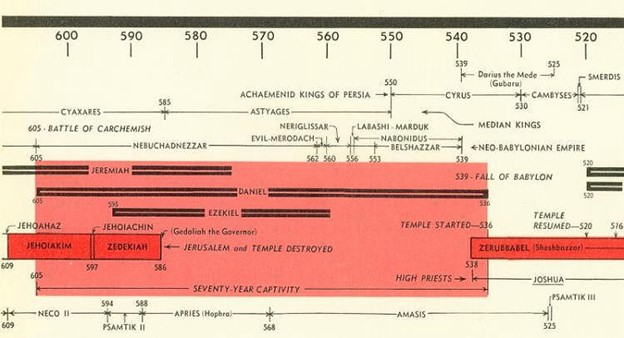
Nebuchadnezzar ruled about 45 years (605-560 B.C.), and his empire only lasted another 21 years.  Nebuchadnezzar’s father, Nabopolassar, founded the Neo-Babylon Empire in 627 B.C., and it fell to the Persians in 539 B.C. So it existed for only about 88 years.  Like all of the earthly empires, it would eventually come to an end.

The king’s position at the top was good news.  The bad news was that it wouldn’t last.  It’s like Amir Tsarfati says, “When you’re on the top, it’s hard to imagine a time when you will no longer be there.  But it happens to everyone.  You may have climbed to the top of the corporate ladder, but there is a limit to your time in charge.  Eventually, you will walk out of your office for the last time, and the next day, someone else’s family picture will be on the desk” (Discovering Daniel, p. 50).  It’s good to be reminded of our brevity.  It’s also a reminder that it’s better to lay up eternal treasures than treasures on earth (Matthew 6:19-20).

“After” Nebuchadnezzar, as we will see in the next verse, his kingdom will be defeated.  Everything would remain fine and dandy while he was king.  He wouldn’t have to live to see his kingdom conquered.  But once he was gone, the dreams of a dynasty would disappear.

The deterioration of the empires is seen in vv. 39-43 as Daniel describes the next two kingdoms quickly in one verse:

Another kingdom inferior to you shall arise after you, and yet a third kingdom of bronze, which shall rule over all the earth. (Daniel 2:39)

The generally accepted view is that the four kingdoms envisioned in Nebuchadnezzar’s dream are the same as those that Daniel saw in his vision of the four wild beasts (Daniel 7), indicating Babylon, Medo-Persia, Greece and Rome.

The second kingdom, therefore, is Medo-Persia and the third kingdom is the Grecian Empire as is made clear in Daniel 8.  Of course, Daniel lived to see the Medo-Persian army conquer Babylon in 539 B.C. in the midst of Belshazzar’s drunken party.

Gleason Archer Jr. explains: “The silver empire was to be Medo-Persia, which began with Cyrus the Great, who conquered Babylon in 539 and died ten years later.  His older son, Cambyses, conquered Egypt but died in 523 or 522.  After a brief reign by an upstart claiming to be Cyrus’s younger son, Darius son of Hystaspes deposed and assassinated him and established a new dynasty.  Darius brought the Persian Empire to its zenith of power but left unsettled the question of the Greeks in his western border, even though he did conquer Thrace.  Xerxes (485-464) his son in his abortive invasion of 480-479, failed to conquer the Greeks.  Nor did his successor Artaxerxes I (464-424) do this but rather contented himself with intrigue by setting Greek city-states against one another.  Later Persian emperors—Darius II (423-404); Artaxerxes II (404-359), Artaxerxes III (35—3380; Arses (338-336); and Darius III (336-331)—declined still further in power.  The silver empire was supreme in the Near and Middle East for about two centuries” (Daniel in The Expositor’s Bible Commentary, p. 47).

Matthew Henry tells us, “The kingdom was founded by Darius the Mede and Cyrus the Persian, in alliance and therefore represented by two arms.  Cyrus was himself a Perian by his father and a Mede by his mother” (Matthew Henry’s Commentary on the Whole Bible, p. 1086).

A progression from Babylon to Persia in Nebuchadnezzar’s vision is reasonable because Babylon fell not to the Medes but to the Persians, eleven years after the Persians had absorbed the Median Empire (c. 550 BC).  Nevertheless, the Medes continued to play an important role in the Persian Empire, and the Greeks frequently referred to Persians as “Medes,” until the fourth century BC.

The deterioration of the succeeding world empires is seen in the way the vision moves from the head to the breast and arms, from the breast and arms to the belly and thighs, from the belly and thighs to the legs and finally to the feet, which walk in the dust.  It moves consistently downward, not only visually, but in importance.

It is also seen in the decline in value from gold to silver, from silver to brass or bronze, from bass to iron, and from iron to clay.

The successive world empires of prophecy were not marked so much by a decline in the vastness and extent of their territorial gains (in fact, they grew successively larger) but in the real power, the absolute authority, of the head of state. While Nebuchadnezzar was an absolute monarch and whatever he said was law, the government of the Medes and Persians was a government of law (Dan. 6:1, 14).  As great and successful as Alexander was, he was curbed by his generals, and after he died, his empire was carved up by his four generals.

The second empire under the Persian monarchs could not annul a law once it went into effect (cf. 6:8, 12).  This restricted the absolute authority of the king.  However, in some respects this kingdom was superior to Babylonia.  For example, it covered a larger geographical area, and it lasted longer (539-331 B.C., about 208 years).  The two arms of the image evidently represented the two nations of Media and Persia that united to defeat Babylon.

The world kingdom that succeeded Persia was Greece (the third empire)—under Alexander the Great (cf. 8:20-21).  Its territory was even larger than that of Persia. Greece dominated the ancient cradle of civilization from 331 to 31 B.C., so it lasted longer than either Babylonia or Persia: about 300 years.  “During his lifetime, the soldiers under his commands were dressed in bronze and brass helmets, breastplates, shields and swords” (David Jeremiah, Handwriting on the Wall, p. 59).

However, after Alexander the Great died in 323 B.C., his empire split into four parts, and each of Alexander’s generals took one piece.  Antipater ruled Macedon-Greece, Lysimachus governed Thrace-Asia Minor, Seleucus headed Asia, and Ptolemy reigned over Egypt, Cyrenaica, and Canaan.  Greece lacked the unified strength of Persia and Babylonia. Its democratic form of government gave more power to the people and less to the rulers.  The two thighs of the statue evidently represented the two major divisions of the Greek Empire: its eastern and western sectors (Syria and Egypt).

The remainder of the former Greek Empire was annexed by Rome after Antiochus the Great was defeated at Magnesia in 190 B C.  Macedon was then annexed by Rome in 168, Greece was permanently subdued in 146 the Seleucid domains west of the Tigris were annexed by Pompey the Great in 63 B. C.  Thus the bronze kingdom lasted for about 260-300 years before it was supplanted by the fourth kingdom prefigured in Nebuchadnezzar’s dream.

The fourth empire, however, is the one that receives the most interest in this passage.

And there shall be a fourth kingdom, strong as iron, because iron breaks to pieces and shatters all things. And like iron that crushes, it shall break and crush all these.  And as you saw the feet and toes, partly of potter’s clay and partly of iron, it shall be a divided kingdom, but some of the firmness of iron shall be in it, just as you saw iron mixed with the soft clay.  And as the toes of the feet were partly iron and partly clay, so the kingdom shall be partly strong and partly brittle. (Daniel 2:40-42)

In this kingdom, the legs are of iron and the feet a mixture of iron and clay, showing further weakening.

Most believe this to be the Roman Empire, the one that succeeded the Greek empire in history.

The legs are the longest portion of the image, an indication that this fourth empire would endure longer than the preceding empires.  Rome was as strong as iron.  Its armies were noted for their iron armor and they ruled the ancient world with an iron fist.  It showed no mercy to rebels as shown by its retribution against Jerusalem in 70 A.D. and in crushing the Bar Kochba rebellion in A. D. 135.

“It was Roman rule that put Jesus on the cross.  It was the imperialistic Romans who ruled ruthlessly throughout the world in the early days of the church.  The Roman legions were known for their ability to crush all resistance with an iron heel” (David Jeremiah, Handwriting on the Wall, p. 60).

Rome defeated the last vestige of the Greek Empire in 31 B.C. and ruled for hundreds of years—the Western Roman Empire until A.D. 476, and the Eastern Roman Empire until A.D. 1453.  The eastern and western divisions of this empire crushed all opposition with a brutal strength that surpassed any of its predecessors.  Some believe that the two legs represent both divisions of the Roman Empire into the Western and Eastern areas.

The Babylonian Empire stood for 66 years; the Medo-Persian Empire for 208 years; the Grecian Empire for roughly 185 years, and the Roman Empire stood for more than 500 years.

The description is of a triumphant empire, seemingly undefeatable, obliterating its opponents with the strength of iron.  Yet Rome was not invincible: “As you saw the feet and toes, partly of potter’s clay and partly of iron, it shall be a divided kingdom, but some of the firmness of iron shall be in it, just as you saw iron mixed with the soft clay” (v. 41).
The King’s Disturbing Dreams (Daniel 2:1-3)

Have you ever had a nightmare?

I have. One night I dreamt that Becky and I were over at Mom and Dad’s. This was years ago when they were still alive. Becky was sitting at a table to the right of the TV doing something with a big needle on a rug.

While watching TV, all of a sudden an image appeared of a woman who was not fully clothed, or maybe with no clothes on at all. Remember, this is a dream.

I immediately turned towards Becky to see if she noticed and she picked up that needle and aimed it straight at my eye. I woke up panting, sweating…and I was glad that it was just a dream.

Sometimes we have dreams like that, dreams that disturb us, dreams that can stay with us for years. I’m sure that Nebuchadnezzar’s dream in Daniel 2 was a dream similar to that. Our text says that Nebuchadnezzar “dreamed dreams” and “his mind was troubled and he could not sleep.” So, his dreams kept him awake for the remainder of the night.

His dreams seem to be a portent of the future and he couldn’t escape the feeling that it was his future that was at stake. In the ancient world, such dreams were thought to be shadows that the future cast in front of itself, tipping its hand to show what lay ahead. Indeed, this dream is about the future and the rise and fall of several ancient (and future) kingdoms around the Mediterranean.

That is why Nebuchadnezzar was in such a tizzy to have this dream interpreted. Like most kings of that day, Nebuchadnezzar had a staff of diviners, on hand to interpret the significance of such dreams, and whatever omens might occur.

Matthew Henry notes that “while the sleep of the labouring man is sweet and sound, and the sleep of the sober temperate man free from confused dreams” but we see here that Nebuchadnezzar was a “troubler of God’s Israel” and thus God used these dreams to chasten and humble him.

As chapter 2 begins, we see that it had been a bad night for the king, for his dreams disturbed him. I’m sure he spent the rest of his night in sleepless anxiety, determined to find out what it meant the next morning. And when the king ain’t happy, everybody is in danger. Warren Wiersbe reminds us that “Oriental despots were notoriously temperamental and unpredictable, and here Nebuchadnezzar reveals this side of his character” (The Wiersbe Bible Commentary: Old Testament, p. 1438).

Charles Feinberg tells us, “Whoever wishes to understand the prophetic Scriptures must come to this chapter for the broad outline of God’s future program for the nations, for Israel, and for the glorious kingdom of Messiah. This outline is the simple but comprehensive framework of a multitude of future events. No political document can compare with it, and its importance cannot be overstated” (Charles Lee Feinberg, Daniel: The Kingdom of the Lord, p. 29).

Beginning with the second chapter of Daniel, the grand outline of the program of God for the period of Gentile supremacy and chastisement of Israel is now presented. Nowhere else in Scripture, except in Daniel 7, is a more comprehensive picture given of world history as it stretched from the time of Daniel, 600 years before Christ, to the consummation at the second advent of Christ. It is most remarkable that Daniel was not only given this broad revelation of the course of what Christ called “the times of the Gentiles” (Lk 21:24), but also the chronological prophecy of Israel’s history stretching from the rebuilding of Jerusalem to the second advent of Christ.
Daniel 2 is part of a greater design extending through chapter 7. This section of six chapters is in Aramaic rather than Hebrew and is arranged chiastically:

A. Vision of Four Kingdoms Preceding an Eternal Kingdom (2:1-49)

  1. Nebuchadnezzar Responds to His Dream (2:1-2)
  2. Babylonian Wise Men Fail to Convey the Dream and Interpretation (2:3-13)
  3. Daniel Speaks with the Captain of the Guard (2:14-16)
  4. Daniel Praises God for Answering His Prayer (2:17-23)
    3′. Daniel Speaks with the Captain of the Guard (2:24-25)
    2′. Daniel Succeeds in Conveying the Dream and Interpretation (2:26-45)
    1′. Nebuchadnezzar Responds to Daniel’s Interpretation (2:46-49)

The chapter begins and ends with the king’s responses. Nebuchadnezzar is troubled by his dream and summons Babylonian wise men (1), and later he honors and promotes Daniel for his ability to meet the royal request (1′). Sections 2 and 2′ contrast the Babylonian wise men with Daniel: court magicians and enchanters cannot relay the king’s dream, but Daniel does. On two occasions Daniel speaks with Arioch, the captain of the king’s guard (3 and 3′), while the center of the chiasm (4) recounts Daniel’s praise to God for answering his prayer.

The structure of the chapter showcases Daniel’s praise, as his themes are integral to the rest of the book. Wisdom and might belong to God (v. 20); he is sovereign over kings and kingdoms (v. 21); he reveals mysteries (v. 22); and he is worthy of thanks and praise (v. 23). This exaltation of God’s sovereignty and power is important for the interpretation Daniel will relay to Nebuchadnezzar, as the succession of kingdoms will occur according to a divine timetable and toward a consummation exalting God’s kingdom over all.

Daniel 2 showcases also the difference between Daniel and the other court enchanters and magicians, but more fundamentally, the vast difference between the true God and the god that Nebuchadnezzar worshipped. Ian Duguid comments that “This is evident from the fact that the story conforms closely to the genre of a “court tale of contest,” much like that of Joseph’s interpretation of Pharoah’s dream in Genesis 41 and similar stories from the Ancient Near East” (Daniel in the Reformed Expository Commentary, p. 19).

In verses 1-3 we see the king’s dilemma.

First, there is the dream that disturbed King Nebuchadnezzar. Verse 1 says…

In the second year of the reign of Nebuchadnezzar, Nebuchadnezzar had dreams; his spirit was troubled, and his sleep left him.

The events related in this chapter happened in the second year of Nebuchadnezzar’s reign. According to several reliable scholars, Nebuchadnezzar officially became king on September 7, 605 B.C. On the first of Nisan, 604 B.C., during the following spring, the first official year of his reign began. The intervening months constituted his accession year and were credited to his father’s reign. The first year of his reign then ended on the first of Nisan the following year: 603 B.C. The second year of his reign (v. 1) began in 603 and ended in 602 B.C.

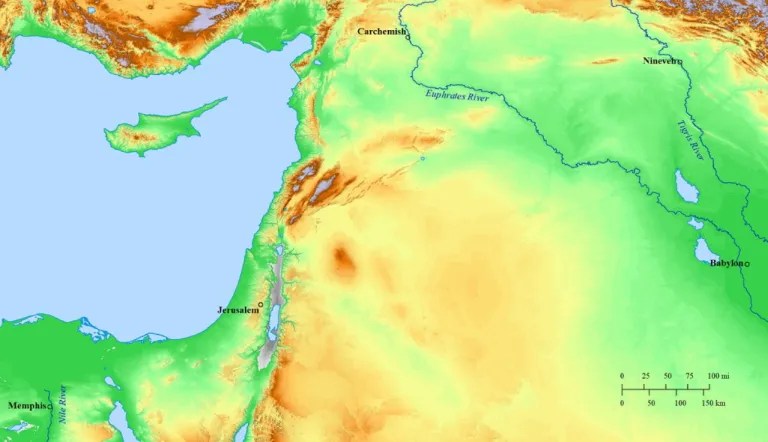
Daniel probably arrived in Babylon during the summer of 605 B.C., soon have Nebuchadnezzar’s victory over the Egyptians at Carchemish and began his three-year education (1:4-5) shortly after that, perhaps in the fall. His curriculum may not have taken three full years; it could have ended in the spring of 602 B.C. Thus, Daniel had probably just finished his education and entered into government service when the events of chapter 2 unfolded, as the text implies.

John Walvoord includes this timeline. The chronology of the period, following Wiseman, Thiele, and Finegan, seems to require the following order of events.

May-June, 605 B. C.: Babylonian victory over the Egyptians at Carchemish

June-August, 605 B. C.: Fall of Jerusalem to Nebuchadnezzar, and Daniel and companions taken captive

September 7, 605 B. C.: Nebuchadnezzar, the general of the army, made king over Babylon after the death of his father, Nabopolassar

September 7, 605 B. C. to Nisan (March-April) 604 B.C.: Year of accession of Nebuchadnezzar as king, and first year of Daniel’s training

Nisan (March-April) 604 B. C. to Nisan (March-April) 603 B. C.: First year of the reign of Nebuchadnezzar, second year of training of Daniel
Nisan (March-April) 603 B. C. to Nisan (March-April) 602 B. C.: Second year of the reign of Nebuchadnezzar, third year of training of Daniel, also the year of Nebuchadnezzar’s dream

This dream came to Nebuchadnezzar in the second year as sole monarch. “It was not something that the king was likely to forget, but the Holy Spirit ensured his memory by dating it” (John Philllips, Exploring the Book of Daniel, p. 44).

David Jeremiah points out how strange this was, that God would communicate His future plans through a pagan, “the vilest world ruler at that time. It was like God revealing to Hitler what was going to happen with the Berlin Wall, the demise of the USSR, and the Second Coming” (The Handwriting on the Wall, p. 47).

Thomas Constable notes: “Daniel opened this new section of his book with another chronological reference (cf. 1:1, 21). This indicates that his interest in this book was in the progress of events and their relationship to one another. As the book unfolds, chronology plays an important part in what God revealed, though the chronology is not always without interruption” (https://soniclight.com/tcon/notes/html/daniel/daniel.htm#_ftnref85).

The Hebrew text of verse 1 says that Nebuchadnezzar had “dreamed dreams” that disturbed him. Evidently he had a recurring dream or similar dreams that he later described as one dream (v. 3). These dreams robbed him of rest, as Pharaoh’s dreams did him (Gen. 41), and Ahasuerus’ dream did him (Esth. 6). He couldn’t go back to sleep for the rest of the night.

He was unsettled, deeply disturbed, by what he saw and because he did not understand its meaning. This would be especially frustrating for a king who thought that perhaps the gods were revealing something to him about the future of his kingdom. What was it?

Maybe Nebuchadnezzar was worried about how long Babylon would be great. Shakespeare was right, “Uneasy lies the head that wears a crown.” Or as British teacher Geoffrey R. King writes, “As is so often the case, the cares of the day become also the cares of the night….Nebuchadnezzar did a thing which no believer in God should ever dream of doing: Nebuchadnezzar took his problems to bed with him” (Daniel: A Detailed Explanation of the Book, p. 49).

All of these Gentile rulers suffered insomnia as part of God’s dealings with them and the people who lived under their authority. Earlier Gentile rulers who received revelations from God were Abimelech (Gen. 20:3) and Pharoah (Gen. 41:1-8). The ancients regarded dreams as having significance and as foreshadowings of events to come.

God gave this dream to Nebuchadnezzar because through him “the times of the Gentiles” had begun. Nebuchadnezzar was the first Gentile king to be ruler of the world, but more particularly, he was the Gentile king who, in conquering Judah, started the era known as “the times of the Gentiles,” which stretches from 605 B.C. to the second coming of Jesus Christ.

By the way, when God gave His revelation to Nebuchadnezzar, He communicated by dreams. He never used visions, as He did in His revelations to Daniel. “In fact,” writes commentator Leon Wood, “the Scripture shows God regularly employing a dream when giving a revelation to pagans. The reasons seems to be that, with the dream, the human personality is neutralized and made a passive instrument for the occasion. With the vision, however, the person himself is often a participant and must be constituted to respond and react in a proper manner, something true only of a child of God” (A Commentary on Daniel, p. 44). In visions, there can be back and forth conversation.

Then there is Nebuchadnezzar’s decision to call his wise men to help him determine the meaning of this dream. Daniel and his friends were not included for some reason. This may well have happened the very same night of his dream, early in the morning.

Then the king commanded that the magicians, the enchanters, the sorcerers, and the Chaldeans be summoned to tell the king his dreams. So they came in and stood before the king.

Notice that he had a whole cadre of counselors to help him not only interpret troubling dreams, but to give him guidance for ruling his kingdom. In modern American terms, this was his “cabinet” of advisors and Nebuchadnezzar called for all of them. So greatly in need of the help of his expects in oneiromancy (a form of divination based upon dreams, and the use of those dreams to predict the future), Nebuchadnezzar turned in vain to them to reconstruct the dream itself (v. s) and then to tell him its significance (v. 3).

“Magicians” functioned to “repel demons and evil spirits by means of special spells and incantations. In other words, they dealt in magic, an art of reaching back into the mists of antiquity” (John Philllips, Exploring the Book of Daniel, pp. 44-45).

“Enchanters” were prophets “who cast horoscopes and studied the stars, announced the will of heaven, and predicted the future” (John Philllips, Exploring the Book of Daniel, p. 45). These could communicate with the spirit world.

The “sorcerers” were the wizards who practiced black magic and communicated with the dead.

Now, in the law, God had warned the Hebrews not to have any dealings with such people. In fact, they were to exercise strict and swift judgment against them. Exodus 22:18 says, “Do not allow a sorceress to live.”

The “Chaldeans” were a special class, distinct from ordinary Babylonians (Jere. 22:25; Ezek. 23:23) and belonged to southern Babylonia. “They seem also to have comprised a special class within the priesthood. They were the elite, a group made up of those people of exclusively Chadean linage, and they seem to have had a special relation to the temple of Bel-Merodach, in which Nebuchadnezzar had put the temple vessels that he had plundered from the temple of Jerusalem” (John Phillips, Exploring the Book of Daniel, p. 45).

These were the professional counselors to the king. Their specialty was the world of the unknown, discerning the “signs.” Today we call them “psychics.”

All of this dependence upon signs and the stars is still around today. According to a Gallup survey more than 32 million Americans believe in astrology.

It is likely that the king already had his doubts about this group. He said to them “I had a dream, and my spirit is troubled to know the dream” (Daniel 2:3). As we will see, Nebuchadnezzar refuses to tell them what the dream itself was. This would make it impossible for them to give a correct interpretation of the dream unless truly inspired by the gods. As we will see, their inability to do so put them all in real danger and provides the opportunity for Daniel to come forth as a genuine interpreter of dreams because he served the true God.

Thus, this was like the showdown at O.K. Corral. Death was certainly a possibility in this story. It was Daniel and his three friends vs. Nebuchadnezzar’s cabinet of advisors; but even more, it was between Judah’s God and the idols and false gods of the Babylonian empire. Through all this God was trying to humble Nebuchadnezzar so that he would seek the true God and He was seeking to assure His people that He was still in control and still watching out for them.

Resisting Indoctrination, part 2 (Daniel 1:3-7)

Do you remember the Sunday school song Dare to be a Denial?

Dare to be a Daniel
Dare to stand alone
Dare to have a purpose firm
Dare to make it known
Standing by a purpose true
Heeding God’s command
Honor them, the faithful few
All hail to Daniel’s band

I find it amazing that these four young men, facing tremendous pressures to give up their faith and assimilate into the Babylonian culture, stood firm for God. Daniel was entirely alone, but he was able to stand alone and lead his friends to stay true to the God of Israel.

Last week we began to look at how Nebuchadnezzar was attempting to indoctrinate these young Hebrew youths into becoming good Babylonians—not only politically, but religiously, psychologically, mentally and emotionally. Like Satan, Nebuchadnezzar wanted to capture their hearts, their deepest loyalties to himself and his gods.

Thus, we saw last week that he ripped them from their homes and support systems, leaving them vulnerable to suggestion and temptations. He chose impressionable youths that he could train in his system. He very possibly made them eunuchs, which would keep them undistracted at least and more docile and submissive at best. And we saw that he trained them for three years in Babylon U, immersing them in the polytheistic religion and practices of the “magicians and enchanters” (Dan. 1:21). As youth are always fascinating with new ideas, the old truths of Judaism would become irrelevant, or maybe even no longer worthy of being believed.

What else did Nebuchadnezzar do to try to capture their loyalty?

Fifth, they were treated with kindness, receiving from the king “a daily portion of the food that the king ate, and of the wine that he drank” (Dan. 1:5). D. A. Bayliss reveals the temptation:

To assume that the world has only one angle of attack, or to assume it will play in a straightforward manner is always a mistake. In this passage the young men had been taken from their homes and permanently mutilated. The hopes and aspirations they might properly have had had been taken from them. At this point the cost of being in Babylon would have been very clear to the young Jews and resentment would readily have built. And thus the world switches tactic. Suddenly the king is taking a personal interest and providing them meat directly from the royal table. It is not difficult to imagine how readily an uncertain person would have grasped at this sign of potential favor. It is a long distance from a poor, besieged, tributary nation to the sumptuous luxury of Babylonian life. Yet the king had kindly offered to feed these young men food that would make them healthy.

Iain Duguid comments: “This provides us with a picture of the world’s strategy of spiritual reprogramming. At its most effective, it consists of a subtle combination of threat and promise, of enforcement and encouragement. Those who are totally recalcitrant may be sent to prison camps or gulags if necessary, but the majority of the population are more easily assimilated if they are well fed and provided for. After all, more flies are caught with honey than with vinegar. The fundamental goal of the whole process, though, was in one way or another to obliterate all memory of Israel and Israel’s God from the lips and the minds of these young men, and to instill into them a sense of total dependence on Nebuchadnezzar for all of the good things in life” (Daniel: Reformed Expository Commentary, p. 9).

In the words of David Jeremiah, “He wanted them to get accustomed to the good things of the palace so they would never be satisfied to leave the king’s service” (Agents of Babylon, pp. 18-19). This would place them under a sense of obligation as well as accustom them to luxury, lavishness and comfort.

And isn’t this still Satan’s way today? With some he may violently persecute them, but for many of us he works more effectively by seducing and deceiving us into desiring his dainties that he sets before us rather than the riches of Christ. It reminds me of that great quote by C. S. Lewis in his “The Weight of Glory and Other Addresses” when he said: “It would seem that Our Lord finds our desires not too strong, but too weak. We are half-hearted creatures, fooling about with drink and sex and ambition when infinite joy is offered us, like an ignorant child who wants to go on making mud pies in a slum because he cannot imagine what is meant by the offer of a holiday at the sea. We are far too easily pleased.”

Sixth, Nebuchadnezzar changed their names.

Verse 7 says, “the chief of the eunuchs gave them names: Daniel he called Belteshazzar, Hananiah he called Shadrach, Mishael he called Meshach, and Azariah he called Abednego.”

This was part of the psychological and spiritual reprogramming; and was this a clever tool. It was all designed to encourage them to forget about the past and become “new men,” to put their race and their religion behind them.

We all have names. We’ve all received names throughout our lives, some of them unwanted, like fat, ugly and stupid.

It is important to remember our true name, our real name, especially our spiritual identity. The names you allow to label you often title the scripts you live by.
In the Bible, names were given to show the ownership or sovereignty of the name-giver. Adam named the animals; God changed names to indicate new destinies. In the Bible, names were vitally important.

This explains why the number one goal of your Enemy, the Devil, is to attack your identity. He wants to give you a different name, one that stands in direct contrast to the name God gave you when He created you. He wants to give you the name “Ugly” or “Stupid” or “Worthless.”

We live in a world where people have become adept at doing what is right in their own eyes, defining their identities according to their own constantly shifting desires. From school-age children who want to change their genders to couples of the same gender planning their weddings, it’s increasingly acceptable to pursue what feels right.

But there are limits as to how far we can go to reinvent ourselves. Our created bodies provide some limits, but also the fact that we have been created by God, in His image.

God knows who He made each of us to be, and in the end his design is always better than what we come up with on our own. Daniel understood this even though Babylon U gave them new names.

This was not an innocent attribution of nicknames, but an intentional strategy to try to fully acculturate these men into Babylonian culture. In those days, when victors integrated enslaved captives into their own culture, it was customary to change the captives’ names as a sign of new ownership. These new names are meant to obliterate the old identities.

In colleges and companies today people will applaud and even promote you taking on a new name, like Gay Christian, or Trans Christian or White Fragility Christian, or to apply new pronouns to yourself.

Their original Hebrew names of these four young men had been given to them at birth to reflect the glory of God. Now, their new names are intended to remind them, every time they hear their name called, that their God is as good as dead.

Rodney Storz sees this as an attempt to change their worship. It wasn’t just about them and their self identities as much as it was about the way that they would see God. It was to enforce a total break from their past lives, to make them believe about themselves and about their god something new and different.

The Hebrew names of these young men were Daniel, Hananiah, Mishael, and Azariah. They were changed to Belteshazzar, Shadrach, Meshach, and Abednego. It should be immediately evident to anyone with even a limited knowledge of Hebrew that the Jewish names of these men each contains a name of God and has a spiritual meaning. Their parents named them to remind them of their spiritual heritage in relation to the one true God.

The name Daniel means “Elohim is my judge.” Elohim is one of the Hebrew names for God. The name Belteshazzar means “May Bel protect his life.” Bel is one of the gods of Babylon.

The prince of the eunuchs decided that his life must be spent under the shadow of the Babylonian God Bel, the patron God of Babylon, otherwise known as Marduk. He was the sun god and believed to be all-powerful.

“Imagine this young man, while striving to remain true to his Lord, being labeled with the name Baal, the one false god who had likely been the greatest stumbling block for wayward Jews over the centuries” (Amir Tsarfati, Discovering Daniel, p. 27).

Hananiah means, “Yahweh is gracious.” Yahweh is the personal name of the God of the Bible. Shadrach means, “Aku is exalted.” Others believe that “Shadrach” is an Akkadian term meaning I am fearful, command of Aku.

Again, this was designed to directly contradict the meaning of his original name – “Under the gracious care of God” to “Under the enlightening care of the sun/moon god.” This might seem to be an improvement because they were now living under God’s wrath. Hananiah needed to remember that God was gracious, even in the midst of judgment. But that is the rub, isn’t it? I think we all struggle with that.

More than a thousand years earlier, Abraham had turned his back on this very god and chosen to worship the true and living God instead.

Mishael means, “Who is what Elohim is?” while Meshach means, “Who is what Aku is?” Surely this was a form of insult. Phillips believes that this goddess was also known as Ashtoreth, Astarte, or Ishtar, the goddess of sensual love and fertility (Exploring the Book of Daniel, p. 33).

Azariah means, “Yahweh is my helper,” and Abednego means “The servant of Nebo,” another Babylonian god. Would Azariah continue to remember that God was his helper? Would he keep looking to him for strength?

Now, instead of looking to God to be his help, he would feel enslaved to the service of a new god.

Did this rebranding work? What is interesting is that, with just a few exceptions, whenever Daniel is mentioned using his Babylonian name, he used some variation of the formula, “Daniel, whose name was Belteshazzar.” Nebuchadnezzar changed the men’s names, but he could not change their hearts. They remained faithful to the true God of Israel, as the story shows.

By giving these four young men these names, Ashpenaz hoped to eradicate Hebrew culture and inculcate Chaldean culture into their thinking. The new names indicate that they were subject to the Chaldean gods.

After awhile they would be asking: Are our Jewish names for real? Was it all make-believe? Is our God the true God? Is He gracious . . . wise . . . all powerful . . . able to care for us?

Doesn’t look like it!

John Lennox tells us, “This name-changing was no innocent action. It was an early attempt at social engineering, with the objective of obliterating inconvenient distinctions and homogenizing people, so that they would be easier to control. Throughout history such attempts have often been marked by the undermining of human dignity. A contemporary example of this phenomenon is political correctness which, though originally intended to avoid offence, has become an intolerant suppressor of open and honest public discussion” (John Lennox, Against the Flow: The Inspiration of Daniel in an Age of Relativism (Oxford: Monarch Books, 2015), 69

The Babylonians changed the Hebrew teens’ names in an attempt to make them forget the true God and change their worship, but it appears throughout the entire book that Daniel never did forget the name he was given, which honored the true God. Even the king (in chapter 6), when Daniel was in the lions’ den, came to him the next morning and used his Jewish name saying, “Daniel, servant of the living God. . .” “Nebuchadnezzar wanted Daniel and his three friends to forget Jerusalem, their god, the temple, and everything related to their Jewish heritage and culture. But Daniel and his friend didn’t forget” (David Jeremiah, Agents of Babylon, p. 20). After noting Daniel’s faithfulness to pray even when it was against state law, David Jeremiah says, “Nebuchadnezzar could change their names, but he couldn’t change their nature. Though much of David’s life was assimilated into Babylonian culture, his heart remained centered in Jerusalem” (Agents of Babylon, p. 20).

“Across the Babylonian’s whole futile exercise of trying to wean these young Judean princelings from their loyalty to the living God by changing their names, God wrote the word folly! ‘Thou shalt have no other gods before me.’ So ran the law (Exod. 20:3). Little weight would these Babylonian gods have with these four committed believers!” (John Phillips, Exploring the Book of Daniel, p. 34).

Like Babylon, our culture wants you to forget who you belong to. They want to encourage you to “be yourself,” “be true to yourself,” “be anything you want to be,” thus untethering you from your God-given identity, given first through creation and then through redemption.

The world wants you to forget who you are and where you have come from. The world will encourage you to change your identity, to encourage you to live to impress others rather than living for God.

Can you remain faithful to God under such pressure? Will you?

The purpose of the food, names, and education was simple. This was an effort at total indoctrination, with the goal of making these young Jewish men leave behind their Hebrew God and culture. Undoubtedly, Nebuchadnezzar wanted to communicate to these young men, “look to me for everything.” Daniel and his friends refused, insisting that they would look to God. (David Guzik)

ow, not only are they at a new location far from home, learning lots of exciting new things, living under aliases, they will face a brand new temptation.

What was the response of Daniel and his friends? We will see some of this in the next scene, but I think Iain Duguid captures their thinking when he writes:

“To be sure, they did not outwardly resist the Babylonian system. They did not refuse to work for the Babylonians, perhaps because they recognized the hand of God in their situation. They understood the word that the Lord gave through Jeremiah, that those whom he had sent to Babylon should labor there for the blessing of the place in which they found themselves (Jere. 29:4-7). As far as possible these young men sought to work within the system in which they had been placed, being good citizens of Babylon as well as of heaven” (Daniel: Reformed Expository Commentary, p. 10).

He goes on to say however, “they also inwardly resisted the assimilation process of the Babylonian empire in a number of specific ways. In the first place, they resisted the total renaming program of the Babylonians. They didn’t refuse to answer to their Babylonian names, to be sure, but they did maintain their Jewish names (and identities) as well. Daniel did not become Belteshazzar, even though he answered to that name, nor did Hananiah, Mishael, and Azariah become Shadrach, Meshach and Abed-Nego. They preserved their Hebrew names amongst themselves as a marker of who they really were (see 1:11, 19; 2:17); they lived with dual names as a reminder of their dual identities, and more fundamentally as a reminder of the true nature of their God” (Daniel: Reformed Expository Commentary, pp. 10-11).

We also have to live with a dual citizenship. We are “citizens of heaven” but we live also in Mena, Arkansas. While our ultimate loyalties lie with heaven, we are still to be good citizens here, engaged in this world for the glory of God and the good of our neighbor.

And we come together every week to remind ourselves of our true homeland. The goal of our worship services should be not only to be equipped for more effective service here on earth in our home towns, but to remind ourselves of who were truly are in heaven’s eyes and the importance of remembering our heavenly destiny and judgment. If our heavenly identity is strong, it will change the way we live within our families and communities.

As the Word is preached, a heavenly wisdom is proclaimed that runs counter to the wisdom of the world around us. In baptism, the sign of heavenly citizenship is acknowledged by us, reminding us of where our true citizenship lies. In the Lord’s Supper, we eat and drink the elements from the earth, but we remind ourselves of the cost at which our citizenship was bought and to look forward to the ultimate feast that awaits us at home. All of these aspects of our worship services should help us to preserve and remember our true identity.

Resisting Indoctrination, part 1 (Daniel 1:3-7)

We all know how impressionable our children are. At a young age, they believe anything anyone tells them—whether it is true or not. As they grow older, their abilities to discern truth from error improves and then they stop believing everything they are told! In fact, we sometimes wonder if our teenagers listen to anything anyone else tells them anymore, except maybe their friends and the media.
Because children and teenagers are so impressionable and easily led, educators and politicians have recognized the need to educate them so that they can be good citizens. However, these very instruments–our schools and universities–an easily become, and indeed have become, places to indoctrinate our young people in the propaganda of the liberal, far left social agenda.

Both Everett Piper and Jonathan Haidt have written about the disruption on college campuses over the past decade as students have rioted, disinvited speakers who don’t agree with them, and had teachers fired over racial or sexual microaggressions.

Everett Piper, in his book Not a Daycare, writes that…

Our universities are doing a tremendous disservice, both to students and our culture, by letting students think they can bend reality to fit their whims. In the real world, people don’t get paid to be selfish and disruptive, but, rather, to be productive members of society….Our universities are producing a generation of Americans who are unable to function in the real world. We are quickly becoming a culture of Peter Pans, believing we can avoid reality in a Neverland of our own making. We’re encouraging students to embrace their selfish fantasies and to expect everyone around them to bend and submit to their narcissistic whims and personal prejudices. We have created a generation that expects to receive affirmation for every feeling they have and every emotion they feel. Objective reality doesn’t matter. Subjective opinions are king.

In their book The Coddling of the American Mind, by Greg Lukianoff and Jonathan Haidt, they note that students have been, and will be taught three great untruths:

• First, what doesn’t kill you makes you weaker. They are not taught to handle adversity or opposition and thus learn to attack those who make them hurt in any way. They feel justified in attacking someone physically who has wounded them emotionally.

• Second, always trust your feelings. Facts don’t matter, narratives do. If your story feels right to you, no one can deny it. Whatever your desires are, that determines your identity and your reality.

• Third, life is a battle between good people and evil people. In other words, if you aren’t in my tribe, you are evil and I have a right to hate you.

They have forgotten what Aleksandr Solzhenitsyn wrote in his The Gulag Archipelago:

“The line separating good and evil passes not through states, nor between classes, nor between political parties either — but right through every human heart — and through all human hearts. This line shifts. Inside us, it oscillates with the years. And even within hearts overwhelmed by evil, one small bridgehead of good is retained”

You are in for a battle, and the world wants to change your mind. They want you to doubt what you have been taught at home and in the church. They want you to believe that “truth” is relative. But now there is no “truth,” just how people feel in the moment.

It’s not that you haven’t faced it before. It is all over the media we consume. But the difference is—at college you will be away from home, away from your roots. You will be told that your parents are old-fashioned, irrelevant and that your church taught you “dangerous” dogma.

In our universities and collage faculties here in the U. S. a notable shift began in the middle of the 1990s as the Greatest Generation was leaving the stage and the last Baby Boomers were taking up teaching positions. Between 1995 and 2010, members of the academy went from leaning left to being almost entirely on the left. Moderates declined by nearly a quarter and conservatives decreased by nearly a third.

As we look at the book of Daniel, we see that these four Hebrew friends that had been taken to Babylon, were in very vulnerable positions and might easily have given up on their beliefs and convictions in order to fit in with the Babylonian culture. It seems clear that Nebuchadnezzar’s Babylon U was all about trying to make good Babylonians out of any culture that was taken captive. Would Daniel and his friends succumb? What about you and me? We live in a culture that is very anti-God, post-truth, anything goes. We live in a culture that defines themselves by their desires (sexual desires) rather than God’s design. Will we stand for the truth? Will we be faithful to our God?

God had “given” Daniel and his friends to Nebuchadnezzar (Daniel 1:1). So we read in vv. 3-7,

Then the king commanded Ashpenaz, his chief eunuch, to bring some of the people of Israel, both of the royal family and of the nobility, youths without blemish, of good appearance and skillful in all wisdom, endowed with knowledge, understanding learning, and competent to stand in the king’s palace, and to teach them the literature and language of the Chaldeans. The king assigned them a daily portion of the food that the king ate, and of the wine that he drank. They were to be educated for three years, and at the end of that time they were to stand before the king. Among these were Daniel, Hananiah, Mishael, and Azariah of the tribe of Judah. And the chief of the eunuchs gave them names: Daniel he called Belteshazzar, Hananiah he called Shadrach, Mishael he called Meshach, and Azariah he called Abednego.

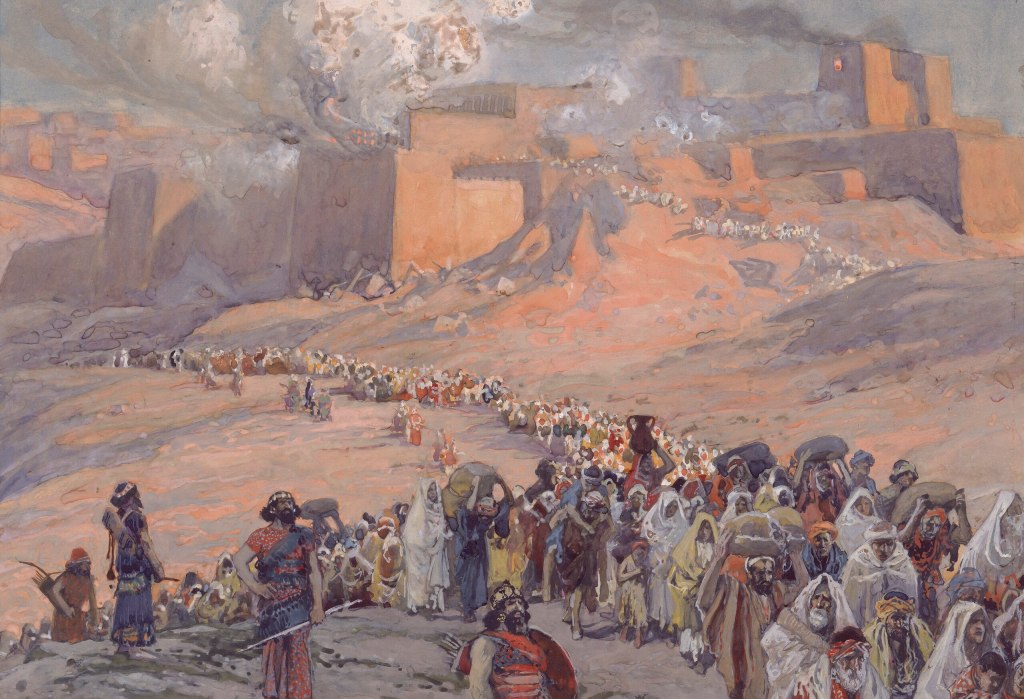
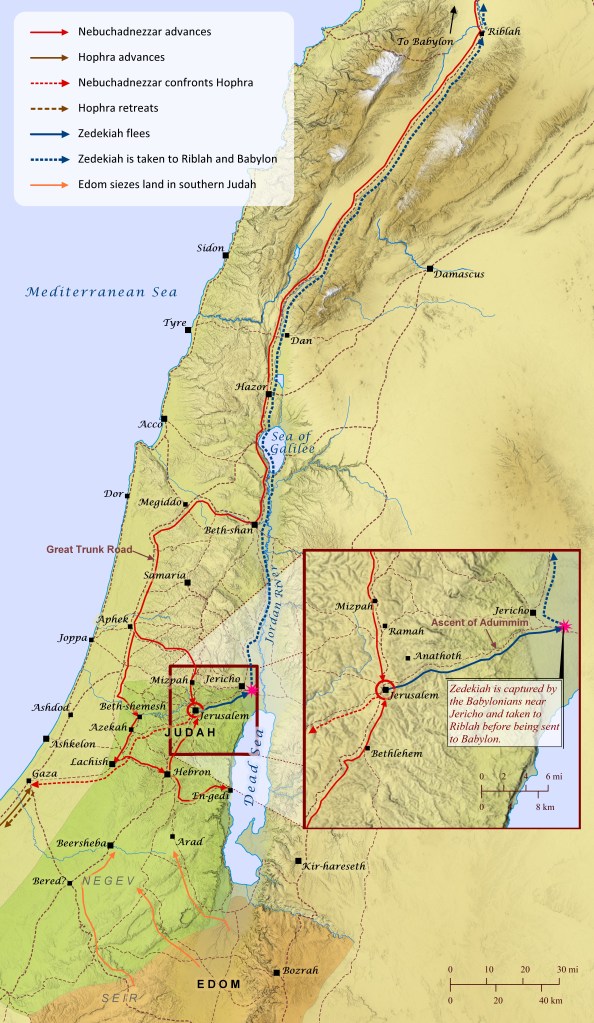
Soon after Nebuchadnezzar had conquered Jerusalem in 605 B.C., he received word that his father had died, so he quickly returned to Babylon to take care of the affairs of state. Some say he did this in an amazing march of two weeks (roughly 700 miles), taking Daniel and his friends with him, if we assume that they marched along one of the northern trade routes through Damascus that connected to Mari and then down the Euphrates River.

In order to govern such a large, diverse empire, Nebuchadnezzar saw the practical wisdom of recruiting and training individuals from different ethnic groups of his realm to serve within his state department. Nebuchadnezzar wanted the best and brightest minds at the service of his empire. Most Bible historians believe in the neighborhood of 60 young people were specifically marched the 700 miles to Babylon for this very purpose.

Notice that Daniel and his friends were the “cream of the crop,” being from royal or noble families. Some believe that Daniel was of the lineage of David (the “royal family”) while others hold that he was from a wealthy family in Jerusalem (“the nobility”).

According to Jerome’s Commentary on Daniel, Rabbinic tradition holds that Daniel, Hananiah, Mishael, and Azariah were descendants of King Hezekiah, based on Isaiah 39:7. (Jay Braverman, Jerome’s Commentary on Daniel: A Study of Comparative Jewish and Christian Interpretations of the Hebrew Bible (Washington. D.C.: Catholic Biblical Association of America, 1978), pp. 67, 68).

According to vv. 3-4 these young men had to meet some pretty high standards to meet the entrance requirements for Babylon U.

First, they were to be “youths without blemish.” In other words, Nebuchadnezzar only wanted flawless physical specimens in his court. The Hebrew word translated blemish (מְאוּם, mᵊʾûm) occurs in an alternate form in Lev 21:17–23 in which men with physical defects were disqualified for priestly service. It was not enough, however, that they be free of physical defect. Positively, they had to even be “good-looking” (lit., “those good in appearance”). Thus, a premium was placed upon physical condition and appearance.

Just as Israel often chose their first king based on physical qualities alone, Nebuchadnezzar was all about image. In other words, how they looked made him look good.

But they were not just brawn and beauty, they had to have brains as well. They had to be “skillful in all wisdom, endowed with knowledge, understanding learning.” He didn’t want good looking guys who couldn’t spell – they had to be bright too. A high IQ was mandatory.

“Wisdom is a rare commodity. The king was prepared to pay a high premium to find men who could speak with insight and clarity on complex issues that came to the attention of the throne” (John Phillips, Exploring the Book of Daniel, p. 31). You see wisdom is more than mere comprehension of the facts. Wisdom is the ability to skillfully and successfully apply knowledge and understanding to a specific situation. Any king or leader needs people like that.

They also had to be discerning, a reference to being able to gather data and correlate facts and then come to the right conclusion. This would come in handy in interpreting Nebuchadnezzar’s dreams. He wanted them to be inquisitive and informed.

Finally, they had to be able to “stand in the king’s court.” They not only needed IQ but EQ as well. They had to have refined manners. They had to know their way around a royal, political court with all its rules and regulations. Again, it is likely that they came from noble families, if not royalty itself.

I’m sure they would have to learn some new court procedures there in Babylon, but they had to show some aptitude to learning how to stand in the king’s court.
With all this potential, these youth weren’t given slave duty, they were given scholarships to Babylon U! How exciting! How enticing! How dangerous!

What was Nebuchadnezzar’s strategy in assimilating these young men into the culture of the day? What did he do to try to turn these servants of Yahweh into servants of Babylon and its gods?

First, Nebuchadnezzar brings these young men to a place far from home, far from the influence of their family and their religious support system. Marching through the Ishtar Gate, if there was ever a time to doubt the apparently defeated God of Judah, it was now. If there was ever a time to wonder about the promises of God’s earthly kingdom, it was now.

While together as a group of 60 or so young men, they were stripped of all their former educational and emotional support, making them easy prey for someone else to step in and become their “friend” or “mentor.”

Second, they were young. Most believe these young men were somewhere between 14 and 16 when they were captured. That is still a very impressionable time when young people are trying to figure out the meaning of life and what to do with their lives and are easily led by authority figures in their lives or by the peers around them.

The younger the subject, the longer he could serve in the royal court and the more impressionable he would be to the Babylonian worldview. And as Matthew Henry says, “He chose such as were young, because they would be tractable, would forget their own people and become Chaldeans (Matthew Henry’s Commentary: One Volume, p. 1083).

Warren Wiersbe said, “Obviously the purpose of their education was to transform these Jews into Babylonians” (Warren Wiersbe). He wants to reorient their worldview and capture their allegiance to his own culture and gods.

Third, although this isn’t clear from the text, it is quite possible that Nebuchadnezzar had all these young men emasculated. You will notice in verse 3 that the one in charge of these young men was Ashpenaz, who was Nebuchadnezzar’s “chief eunuch.”

There are a number of reasons to believe that Daniel and his friends were also eunuchs, very possibly “who have been made eunuchs by men.” D. A. Bayliss tells us that foreign kings normally surrounded themselves with eunuchs because then they would not have wives or families that would distract them from duty, or even worse, who might foment rebellion. We have no record in Scripture of Daniel being married or having a family and he showed no interest in returning to Jerusalem when that possibility arose. So “chief eunuch” may mean “chief of the eunuchs.”

If Daniel and his friends were made this way intentionally in a way that his faith taught him was a disgrace, now ripped away from his family and deposited in a strange land he had every reason to be confused, bitter and even angry or maybe more docile and submissive. This is what Nebuchadnezzar wanted. Out of this fertile ground he could turn them into good Babylonians.

Isaiah had made this prophecy to Hezekiah due to his entertaining the envoys of Babylon and showing them all the treasures in his palace (and very likely the “vessels of the house of God”), saying, “Behold, the days are coming, when all that is in your house, and that which your fathers have stored up till this day, shall be carried to Babylon. Nothing shall be left, says the LORD. And some of your own sons, who will come from you, whom you will father, shall be taken away, and they shall be eunuchs in the palace of the king of Babylon” (Isaiah 39:6-7). It is quite possible that Daniel and his friends are the very ones Isaiah prophesied about.

Fourth, these young men were chosen “to teach them the literature and language of the Chaldeans” (Daniel 1:4). No doubt this involved some of the occultic arts practiced at that time by “magicians and enchanters” (Dan. 1:20), who may even have been some of their teachers. In other words, they were to be indoctrinated into another culture, a godless culture, or rather a culture that would turn their hearts away from the true God to other gods.

While much of this literature would have been of an historical and legal nature, an extensive amount would have been religious, including omen texts, magic, sorcery, occultic practices, and the science of astrology. The Mosaic law had banned the practice of such occultic techniques (Deut. 18:10–12; cf. 1 Sam. 28:3–25). To read and study this material was not therefore strictly forbidden, but Daniel and his friends would have needed a strong walk with God and a biblical mindset to retain the ability to think critically when engaged in this type of study. Evidently, their esteem for God’s Word protected them during this time of indoctrination.

Imagine the influence these pagan Babylonian teachers had on these young teenagers in their classrooms, amazing them with all this new information. The Babylonians’ literature promoted their worldview, their view of man, their view of God, their view of sin, and their view of redemption, which were all directly opposed to everything these young teens had been taught and believed while in Israel.

Though Daniel and his friends went through these classes, they apparently resisted the pressure to change their thinking. This can be seen through the historical accounts of these young men in the chapters to follow.

But we cannot say that about all 60 or so of them. It is likely that many of them blessed their good fortune and became semi-pagans. After all, when you are in Babylon, you do as the Babylonians do.

The pressure on Christians to change their thinking today comes from the print media, movies, and television as well as from teachers. For example, we have all experienced the pressure of our society trying to change our thinking about homosexuality, calling it an alternate lifestyle. Books, even on the elementary level, teach children about “Heather who has two mommies.” They teach children that this is a good alternative. God calls it both shameful and a perversion in Romans 1:26, 27:

Because of this, God gave them over to shameful lusts. Even their women exchanged natural relations for unnatural ones. In the same way the men also abandoned natural relations with women and were inflamed with lust for one another. Men committed indecent acts with other men, and received in themselves the due penalty for their perversion.

Sometimes the world succeeds in molding and shaping our thinking, conforming our minds to the world (Romans 12:2), which is why Paul says that we must continually renew our minds in God’s Word.

Now, some may wonder whether it is appropriate for a Christian to attend a secular university. I think the implication of this text is that these young men were able to take this curriculum and cull from it what is in accordance with God’s truth, discerning truth from error and right from wrong. Other godly men did the same: Moses learned the wisdom of Egypt (Acts 7:22), and Paul spoke before the Supreme Court of Athens (the Areopagus), even quoting from their own poets.

We need to stand firm and resist the pressure. Be encouraged that Daniel and his three teenage friends stood firm against the Babylonian attempts to change their thinking. We will see what these Jewish teenagers and their parents did to prepare to withstand the pressure, because it is not easy. Christian, though the forces against you are great, take heart, stand firm, and dare to be a Daniel.

Introduction to the Book of Daniel, part 2

Well, today we are continuing our introduction the book of Daniel. We ended last week giving some historical background. The first part of Daniel takes place with Nebuchadnezzar king of Babylon and so we were talking about the beginning of the Neo-Babylonian empire.

Today we want to start by reminding ourselves of the nature of the place to which Daniel and his friends were taken. This was not a God-friendly place.

An article From Babel to Babylon on monergism.com., describes the anti-God nature of this city throughout history.

Not unlike Babel, Babylon stands for the corruption of human power, wealth, and influence. It represents the perversion of God’s creation, the exploitation of the weak and vulnerable, and the seduction of the nations by false gods. Babylon was notorious for its arrogance, wickedness, and cruelty. It was a center of pagan worship, characterized by sexual immorality, idolatry, and materialism. Babylon was a city that exalted itself above God and oppressed God’s people. It symbolizes the human tendency to use power for selfish purposes, to worship idols instead of God, and to oppress those who are weaker. (https://www.monergism.com/babel-babylon#:~:text=The%20biblical%20narrative%20of%20Babel,power%2C%20wealth%2C%20and%20influence.)

Babylon the Great, in the book of Revelation, is the culmination of human rebellion against God. It is a symbol of the world system that opposes Christ and His kingdom. It is a city that is drunk with the blood of the saints and the martyrs, that deceives the nations with her sorceries and seduces them with her wealth and power. Babylon the Great is a false bride who entices the world with her beauty and wealth, but who ultimately leads them to destruction. It is a warning against the seduction of the world and the dangers of compromise with the world’s values.

So Daniel and his three friends were entering into a culture that would challenge the foundations of their faith to the very core, down to their roots. Remaining faithful to Yahweh would prove to be very difficult and I’m sure that not every Hebrew youth rose to the challenge.
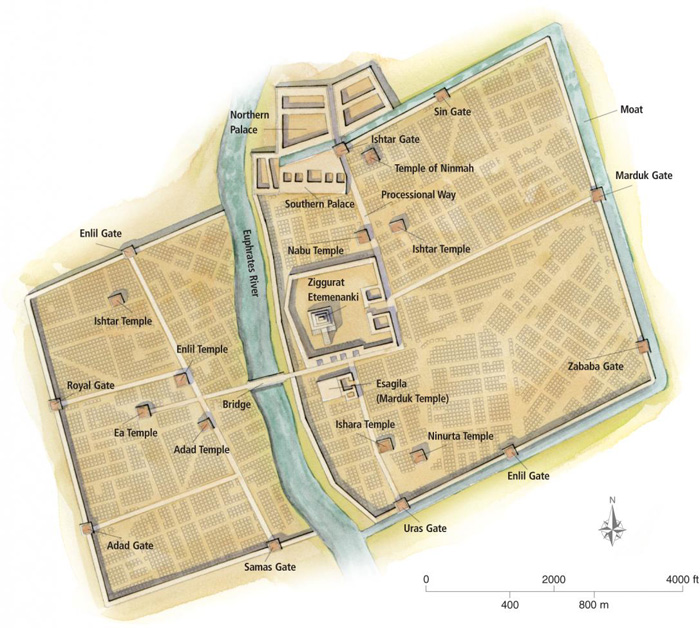
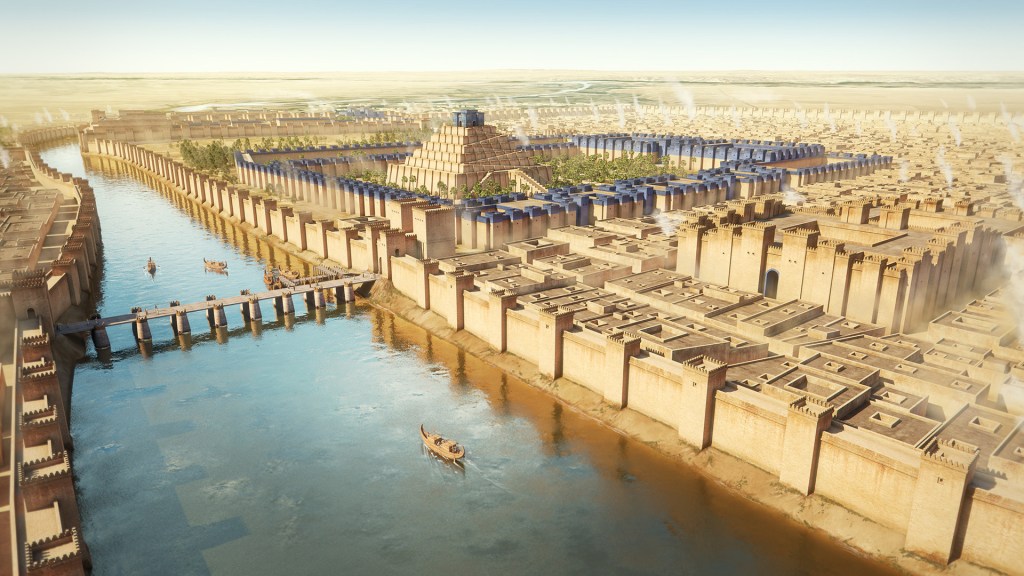
Not everything was negative, however, for Babylon was a wondrous sight to behold. As Daniel and his three friends were marched into Babylon they would see a spectacular city. Bryan Windle, in his Biblical Archeology article reports on the city Daniel saw (https://biblearchaeologyreport.com/2019/08/09/footsteps-three-things-in-babylon-daniel-likely-saw/).

Nebuchadnezzar had initiated a vast building program and improved the city’s fortifications, raising its magnificence to new heights. At the time Daniel lived there, it was the largest city in the world, covering over 10 square kilometers (4 square miles).

A reconstruction of ancient Babylon, with the Etemenaki (stepped ziggurat) in the center, and the Esagila (Temple of Marduk) to the right of it. Image Credit: J.R. Casals / https://www.artstation.com/artwork/25NVv [tried to get permission]

Taken from the ESV® Study Bible (The Holy Bible, English Standard Version®), copyright ©2008 by Crossway, a publishing ministry of Good News Publishers. Used by permission. All rights reserved. For more information on how to cite this material, see permissions information here.
Daniel would have seen the grand palace of Nebuchadnezzar.

A panoramic view of the reconstructed Southern Palace of Nebuchadnezzar. Photo Credit: Osama Shukir Muhammed Amin FRCP(Glasg) / Wikimedia Commons / CC BY-SA 4.0

Here is a modern reconstruction of what Nebuchadnezzar’s palace would have looked like:

Screenshot from Pedersén’s virtual 3D model of Babylon, period of Nebuchadnezzar II (604-662 BCE) and Nabonidus (555-539 BCE). Overlooking south onto the Etemenanki Ziggurat from within the South Palace main courtyard, walls decorated with glazed bricks.

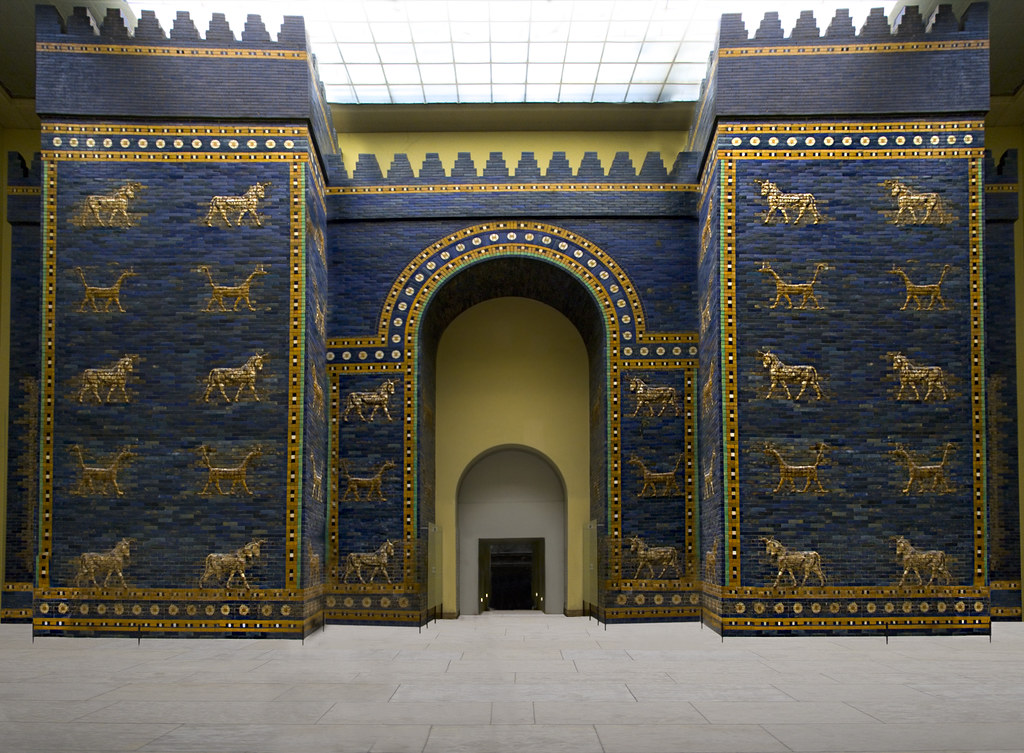
On the north side of the city Nebuchadnezzar had built the majestic Ishtar Gate.

The Ishtar Gate in Babylon. Photo Credit: Wikimedia Commons / Public Domain

It was one of eight double-gates that served as entrances to the city and stood over 12m (38 feet) high. The gate was finished around 575 BC, after Daniel had already been living in the city for many years. He no doubt watched its construction and marveled at its beauty.

Today, a reconstruction of the Ishtar Gate can be seen at the Pergamon Museum in Berlin. It is made out of materials excavated by Robert Koldewey in the early 1900’s.

A reconstruction of the Ishtar Gate at the Pergamon Museum in Berlin, Germany. Photo Credit: flickr photo by youngrobv / CC BY-NC 2.0

In Daniel 4:30, King Nebuchadnezzar boasts, “Is not this great Babylon, which I have built by my mighty power as a royal residence and for the glory of my majesty?” The archaeological record affirms the massive building campaigns of Nebuchadnezzar.

Who was Daniel?

Daniel was a young man (Daniel 1:4), likely around the age of 16, when he was taken captive in the first wave of deportations in 605 B.C. Could you imagine, at that young age, being ripped from your family, your home, your friends, your chances for work or education, not knowing what was going to happen next? You didn’t know if you would live or die. You didn’t know if you would spend the remainder of your life enslaved or in prison. There were a lot of unknowns, and as we know, into that vacuum of unknowns, fear and anxiety are frequent irritants.

He never saw his family, friends, or homeland again. But what matters most about Daniel’s life is how he remained faithful to God throughout his life, while living in a land where its inhabitants had not even heard of Jehovah. Daniel was considered to be a man of great integrity, classified along with Noah and Job in Ezekiel 14:14, 20 as key intercessors. In fact, like Joseph, not a single sin is attributed to Daniel. And the angel repeatedly calls him “greatly beloved.”

These three intercessors represent our battle against the world, the flesh and the devil. Job overcame the devil, Noah the world, and Daniel the flesh.

The name Daniel (dan-i-el) means “God is my judge,” a name that likely guided and guarded Daniel’s thinking and conduct as he realized that one day God would hold him accountable for how he lived his life. It is likely that Daniel was one of several young men who came from “the royal family and of the nobility” (Daniel 1:3).

No mention is made, specifically, of Daniel’s birthplace or family (other than being of the tribe of Judah, Daniel 1:3) and thus the Jewish Encyclopedia concludes “It is not known whether he belonged to the family of the King of Israel or to that of an Israelitish magnate.”

Josephus (“Ant.” x. 10, § 1) evidently inferred from Sanh. i. 3 that Daniel was a relation of King Zedekiah (ἧσαυ τῶυ ἐκ τοῦ Σεδεκίου γέυους τέσσαρες ), while Pseudo-Epiphanius, on the strength of the same passage, makes Daniel the scion of a noble Israelitish family (compare Prince, “Critical Commentary on the Book of Daniel,” p. 25).

According to rabbinical tradition Daniel was of royal descent; and his fate, together with that of his three friends, Hananiah, Mishael, and Azariah, was foretold by the prophet Isaiah to King Hezekiah in these words, “and they shall be eunuchs in the palace of the king of Babylon” (Isa. xxxix. 7; compare Sanh. 93b; Pirḳe R. El. lii.; Origen, commentary to Matt. xv. 5; Jerome, commentary to Isaiah, l.c.). Of course, we do not know for sure that they were eunuchs, although we never hear of their wives or children.

Daniel served under king Nebuchadnezzar (Daniel 1:19-20) all the way through the empire change and served King Cyrus (Daniel 1:21). Daniel bridges the entire 70 years of the Babylonian captivity (ca. 605–536 B.C.; cf. 1:1 and 9:1-3).

Daniel began his career about eighteen years before Jerusalem fell, and his last message was given after the Jews had returned to build again the temple (10:1.), covering a period of about 73 years from the year 607 to 534 B. C., then beyond that to the reign of Darius.

The most well-known event in the life of Daniel was his one-night stay in the den of lions under Darius. Today in the stands this depiction of a roaring lion (with wings, by the way).

https://www.worldhistory.org/image/724/lion-of-babylon-ishtar-gate/

This was one of 120 lions that lined the processional way into Nebuchadnezzar’s throne room and it dates to the exact time that Daniel was there in Babylon! He would have passed by these lions a number of times on his way to advise King Nebuchadnezzar. The glazed bricks remind us of the need for fiery furnaces needed to make the bricks. Daniel had been in Babylon 66 years and was 83 years old when he faced the lions.

The Book of Daniel

Date and Authorship

We will deal with who wrote the book and when because this issue has been debated by biblical scholars and historians. Was it written by Daniel in the 6th century B.C. or by someone else in the 2nd to 3rd century B.C.?

Conservative scholars have believed the book to be written by Daniel, taken captive by Nebuchadnezzar in 605 B.C. The record of events extends to the third year of Cyrus, 536 B.C., and, accordingly, covers a span of about seventy years. Daniel himself may well have lived on to about 530 B. C., and the book of Daniel was probably completed in the last decade of his life.

Although Daniel does not speak of himself in the first person until chapter 7, there is little question that the book presents Daniel as its author. This is assumed in the latter portion of the book and mentioned especially in 12:4. The use of the first person with the name Daniel is found repeatedly in the last half of the book (7:2, 15, 28; 8:1,15, 27; 9:2, 22; 10:2, 7, 11, 12; 12:5).

Important confirmation of the historicity of Daniel himself is found in three passages in Ezekiel (Eze 14:14, 20; 28:3), written after Daniel had assumed an important post in the king’s court at Babylon. Convincing also to conservative scholars is the reference to “Daniel the prophet” by Christ in the Olivet Discourse (Mt 24:15; Mk 13:14).

Except for the attack of the pagan Porphyry (third century A. D.), no question was raised concerning the traditional sixth century B. C. date, the authorship of Daniel the prophet, or the genuineness of the book until the rise of higher criticism in the seventeenth century, more than two thousand years after the book was written.

Higher criticism, totally humanistic and materialistic in its outlook, denies that Daniel could be the author because they want to deny the possibility of supernatural predictive prophecy and so the book had to be written later so that the prophecies related to Alexander the Great and the wars between the Ptolemies and the Seleucids would be a historical report rather than future events that were miraculously fulfilled by God’s sovereign plan.

Daniel wrote this book in the sixth century B.C. It records the events of Daniel’s life and the visions that he saw from the time of his exile in 605 B.C. (1:1) until 536 B.C., the third year of King Cyrus (10:1). Then it is Darius who consigned him to the den of lions (Dan. 6). So it is likely that Daniel finished this book around 520 B.C.

Ezekiel, Habakkuk, Jeremiah, and Zephaniah were Daniel’s prophetic contemporaries.

Jensen’s Survey of the Old Testament

Daniel is alluded to by the writer of Hebrews as one of “…the prophets: who through faith…stopped the mouths of lions” (Heb. 11:32-33).

Why do we believe that it was Daniel who wrote this book in the 6th century B. C., rather than some unnamed author in the 2nd century?

First, the book claims to be written by Daniel in Daniel 7:1 and 12:14.

In the first year of Belshazzar king of Babylon, Daniel saw a dream and visions of his head as he lay in his bed. Then he wrote down the dream and told the sum of the matter. (Dan. 7:1)

Second, Jesus attributed to Daniel the prophecy about the abomination of desolation (Dan. 12:11).

Jesus said, “You [will] see the abomination of desolation which was spoken of through Daniel the prophet” (Mt. 24:15).

Third, Ezekiel—a contemporary prophet—believed in a historical Daniel. Ezekiel lived in roughly 575 BC, and he explains that Daniel is a real and historical figure (Ezek. 14:14, 20; 28:3).

Fourth, Josephus—a first century Jewish and Roman historian—believed that Daniel was a prophet and a historical person. Josephus believed that the book of Daniel was shown to Alexander the Great, when he came to Jerusalem in 330 BC. Of course, Daniel predicted the life of Alexander the Great. So when he arrived in Jerusalem, the priests showed him these prophecies. Josephus writes,

\He (Alexander) came into the city; and when he went up into the temple, he offered sacrifice to God, according to the high priest’s direction, and magnificently treated both the high priest and the priests. And when the book of Daniel was showed to him, wherein Daniel declared that one of the Greeks should destroy the empire of the Persians, he supposed that himself was the person intended… The next day he called them to him, and had them ask what favors they pleased of him… (and) he granted all they desired.[4]

He did not destroy Jerusalem because of this.

Fifth, the author of 1 Maccabees believed Daniel was a historical person. In 1 Maccabees 2:59-61, we read, “Hananiah, Azariah, and Mishael had faith, and they were saved from the flames. Daniel was a man of integrity, and he was rescued from the lion’s jaws. So bear in mind how in the history of the generations no one who trusts in Heaven ever lacks strength.”

In context, Matthathias was writing about an event which took place in 167 BC. Therefore, to have written this, he must have already considered Daniel to be a historical figure. As Walvoord writes, “It is highly questionable whether the Jews living in the Maccabean period would have accepted Daniel if it had not had a previous history of canonicity” (Walvoord, John. Daniel: The Key to Prophetic Revelation, Introduction, 1989. See “Authorship”).

Sixth, 1 Enoch cites Daniel. When we compare 1 Enoch 14:18-22 with Daniel 7:9–10, we see striking similarities. 1 Enoch dates to roughly 150 BC.

Seventh, archaeological discoveries shows that Daniel faithfully described the sixth century world of Babylon.

  1. Daniel correctly distinguishes Susa and Elam.
    In Daniel 8:2, Daniel writes that he was “in the citadel of Susa, which is in the province of Elam.” Now, Susa was assigned to a new province in the Persian era. The territory of Elam was shrunk during this time, and Susa was assigned to a new territory of Susiana.
    It would have taken a 6th century inhabitant of Susa to know of this historical detail. A 2nd century author would have been out of date with this historical nuance. (Archer, Gleason L. A Survey of Old Testament Introduction: Revised and Expanded. Chicago, IL: Moody, 2007. 380).
  2. The existence of Belshazzar
    Prior to the middle of the 19th century, a Babylonian king named Belshazzar was unknown to history, allowing critics to question the historical accuracy of the book of Daniel. Ancient historians, such as Berosus and Abydenus recorded that Nabonidus was the last king of Babylon. Similarly, the Uruk King List omits Belshazzar, moving from Nabonidus to Cyrus.
    Things changed in 1854, when J.E. Taylor discovered four cylinders in the ruins of a ziggurat at Ur which contained a prayer of Nabonidus to the gods. The so-called Nabonidus Cylinders record:
    “As for me, Nabonidus, King of Babylon, save me from sinning against your great godhead and grant me as a present a life of long days, and as for Belshazzar, my oldest son my offspring, instill reverence for your great godhead in his heart and may he not commit any cultic mistake, may he be sated with a life of plentitude.”

One of the Nabonidus cylinders from Ur, which records Nabonidus’ renovations to the moon god, Sin’s, ziggurat, as well as a prayer for himself and his son Belshazzar. Photo: A.D. Riddle / Bibleplaces.com.

  1. Nabonidus Chronicle
    That very night Belshazzar the Chaldean king was killed. (Dan 5:30)
    The Babylonian Chronicle for the years 556 to 539 BC, also called the Nabonidus Chronicle, describes the final years of King Nabonidus’ reign and the fall of Babylon to Cyrus, king of Persia. It records:
    “When Cyrus did battle at Opis on the [bank of] the Tigris against the army of Akkad, the people of Akkad retreated. He carried off the plunder (and) slaughtered the people. On the fourteenth day Sippar was captured without a battle. Nabonidus fled. On the sixteenth day, Ugbaru, governor of Gutium, and the army of Cyrus, without battle they entered Babylon. Afterwards, after Nabonidus retreated, he was captured in Babylon…. On the third day of the month Arahsamna, Cyrus entered Babylon.” (iii, 12-18)

The Nabonidus Chronicle describes the final years of King Nabonidus’ reign and the fall of Babylon to the Persians. Photo: ChrisO / Wikimedia Commons / CC BY-SA 3.0

Moreover, William Shea has argued, based on other details in the text of the Nabonidus chronicle that the enigmatic “Darius the Mede” who became King of Babylon (Dan. 5:31) was none other than Ugbaru, the general of the army who captured the city. Thus, the historicity of Darius was verified.

  1. Dead Sea Scroll Fragments of Daniel
    “So when you see the abomination of desolation spoken of by the prophet Daniel, standing in the holy place…” (Mat 24:15)
    Many today would argue that the book of Daniel was composed sometime during the second century BC, after the prophecies related to the Seleucids and Maccabeans (Dan. 9-12), and not during the sixth century BC by the prophet himself. According to this theory, Daniel was written to encourage the Jewish people during the Maccabean period (ca. 168-165 BC). This late date is assumed largely on the basis of the presupposition of modern scholars that supernatural fore-telling of events is not possible.
    The fact that these copies are now known to exist shows us that already in the second century B. C. the book of Daniel was already composed, circulated and accepted as canonical.
    You might ask, why is this important—whether Daniel wrote the book or not, whether it communicates actual historical events from the 6th century B.C. or records apocryphal tales from the 2nd century?
    As James Hamilton puts it,
    There is a massive difference between the theological meaning of a wish-fantasy and that of a historically reliable account of God miraculously preserving someone alive in a fiery furnace. Dismissing a false fable as irrelevant to my conduct reflects my view of the theological meaning and value of fairy tales. Risking my life because I believe the stories result from convictions about theological meaning that cannot be separated from historicity. …
    If some Maccabean-era author is making fraudulent claims, if these are fictional deliverances and not future predictions but recitals of what has already happened presented as though being predicted by Daniel, then there is no real proof that Yahweh can either deliver from death or predict the future. This means there is no proof that he is any better than the false gods who can neither reveal the future nor deliver their worshippers, which is exactly what the book of Daniel claims Yahweh can do. …
    The whole theological meaning of the book depends upon Yahweh’s ability to deliver his people and declare the future before it takes place. If he cannot do these things, no one should “stand firm and take action” and risk his life for Yahweh (Dan. 11:32).

    J. M. Hamilton Jr., With the Clouds of Heaven: The Book of Daniel in Biblical Theology, New Studies in Biblical Theology 32 (Nottingham, England: Apollos, 2014), 31–32.

Introduction to the Book of Daniel, part 1

Well, today we are starting a study of the Old Testament major prophet, the book of Daniel. You might wonder, “Why study the book of Daniel?”

In many corners of the world these days the climate of hostility hangs over any overt Christian faith commitment or any gathering of believers in Jesus Christ. Any kind of Christian commitment is now assumed to imply intolerance and often prompts reactions that range from a low-grade hostility and exclusion in the West to the vicious and murderous assaults on Christian believers in Pakistan, Nigeria, Kenya, Egypt, Syria and Iraq and elsewhere.

Such issues are not new. Christians have faced them ever since Nero’s lions, and even before that. Jews also have faced the same questions all throughout their history, most tragically sometimes enduring horrendous persecution from states claiming to be Christian. So, it is not surprising that the Bible gives a lot of attention to these questions.

The book of Daniel tackles the problem head on, both in the historical stories of Daniel and his friends, and in the prophetic visions he received. A major theme of the book is how people who worship the one, true, living God—the God of Israel—can live and work and survive in the midst of a nation, a culture, and a government that are hostile and sometimes life-threatening. What does it mean to live as believers in the midst of a non-Christian state and culture? How can we live “in the world” and yet not let the world own us and squeeze us into the shape of its own fallen values and assumptions? How can one stay faithful to God in the midst of a hostile culture in the midst life-threatening pressures to bow the knee to another god? Can God be trusted in such times?

The book was written to encourage believers to keep in mind that both the present and the future, no matter how terrifying they may become, rests in the faithful hands of the sovereign Lord God—and in that assurance to get on with the challenging task of living in God’s world for the sake of God’s mission. We need that encouragement even today.

We want to start today by examining the historical background of the book of Daniel. It’s always important to put the books of the Bible in their historical time and situation. It helps us dive deeper into the text instead of just skimming the surface.

The Assyrian Empire ruled and reigned over the Ancient Near East for nearly 300 years, beginning with an expansion under Ashurnasirpal II (883-859 B.C.) and ending with attacks from the Babylonians and Medes around the mid 7th century B.C.

Map 75 Assyrian Supremacy in the Seventh Century, Holman Bible Atlas, p. 151

After Solomon, the kingdom of Israel was divided. Jeroboam took ten tribes and they became known as the Northern Kingdom, leaving only Judah and Benjamin with Rehoboam, the son of Solomon.

Map 57 The Kingdoms of Israel and Judah, Holman Bible Atlas, p. 118

Shalmaneser V sacked Damascus, the capital city of the Northern Kingdom in 722 B.C., taking those people captive and scattering them among the other conquered peoples of that campaign. The Southern Kingdom, ruled by the line of David, lasted another roughly 150 years. There were no good kings in all the history of the Northern Kingdom, but there were a few in the Southern Kingdom.
Josiah was the last good king of Judah. Under his leadership a religious reform took place (640 B.C. to 609 B.C.). That reform is described in the Bible in 2 Kings 22–23 and 2 Chronicles 34–35. The author of Kings describes the accession of Josiah to the throne at 8 years of age, and then some busy years of reform in his teenage years (age 16-18). So as far as teenagers go, he was a pretty good one! Even as a youth “he began to seek the God of his ancestor David” (2 Chron. 34:3)

It begins with the decision to renovate the Temple, which leads to the discovery of the Book of the Law. Josiah removed pagan altars and idols from the temple, destroyed rural sanctuaries, and took down other places of worship. He centralized worship in Jerusalem, having destroyed the temple at Bethel. He renewed the covenant with his people. Josiah restored the Passover after many years of neglect and he returned the Ark of the Covenant to the Temple.

Both books [2 Kings and 2 Chronicles] bookend the story of Josiah with the highest possible praise for this king. Unlike so many of the kings of Judah, Josiah “walked in the way of his father David, turning aside neither to the right or the left.” But he was even greater than David: “Before him there was no king like him, who turned to the Lord with all his heart, with all his soul, and with all his might, according to all the law of Moses; nor did any like him arise after him” (2 Kings 22:2; 23:25; cf. 2 Chron. 34:2; 35:18).

However, Josiah met an early death at the hand of the Egyptian King Neco II. Neco was leading an Egyptian force northward to support a final Assyrian effort to recapture Haran. Josiah intercepted Neco near Megiddo, was mortally wounded, and eventually was buried in Jerusalem (2 Kings 23:28-30; 2 Chronicles 35:20-27).

Josiah Battles Neco

The consolidation of the Chaldean Dynasty at Babylon was completed by 609 B.C. The victory of Nabopolassar over the Assyrian and Egyptian armies made Babylon the new master. From there, the Babylonians began to invade southward into Syria and Palestine.

The prophet Habakkuk foresaw these events, declaring that God was “For behold, I am raising up the Chaldeans, that bitter and hasty nation, who march through the breadth of the earth, to seize dwellings not their own” (Hab. 1:6)

The ensuing power struggle between Babylon and Egypt caught Israel in a vice-grip and put the kings of Judah in a precarious position. To whom would they appeal for help?

With the death of Josiah in 609 B.C., Neco removed Jehoahaz, a son of Josiah chosen by the people of Judah, and replaced him with another son whose regal name was Jehoiakim (2 Kings 23:30-35). Judah was for a short time an Egyptian vassal, and Jehoiakim reigned at the pleasure of Neco.
The Battle of Carchemish in 605 B.C. established Babylon as the dominant power all the way to the border of Egypt.

Jeremiah 46

In 604 B.C. Nebuchadnezzar campaigned in Palestine and conquered Ashkelon. Jehoiakim quickly switched his allegiance to Nebuchadnezzar. It was during this campaign that Nebuchadnezzar took hostages from Jerusalem, which included such men as Daniel and his three companions Hanniah, Mishael and Azariah and carried them to Babylon (Daniel 1:1-7) and the seventy years of captivity had begun (Daniel 9:1-2; Jeremiah 25:11; 2 Chronicles 36:17-21).

Jeremiah’s prophecy foretold that the “land shall be a desolation” and that the Jews would “serve the king of Babylon seventy years” (Jeremiah 25:11; compare 2 Chronicles 36:17-21). After the 70 years were completed in Babylon, God told them, He would cause them “to return to this place [Jerusalem]” (Jeremiah 29:10).

However, Jeremiah 29:4-7 also tells the Israelites who were exiled to Babylon to settle down, build homes, and work for the welfare of the city. The passage also instructs them to pray for the city’s prosperity, as their own prosperity would be tied to it. However, this wouldn’t be easy. Psalm 137 hauntingly records, “By the waters of Babylon, there we sat down and wept, when we remembered Zion. On the willows there we hung up our lyres. For there our captors required of us songs, and our tormentors, mirth, saying, “Sing us one of the songs of Zion!” How shall we sing the LORD’s song in a foreign land? If I forget you, O Jerusalem, let my right hand forget its skill! Let my tongue stick to the roof of my mouth, if I do not remember you, if I do not set Jerusalem above my highest joy!” (Psalm 137:1-6)

These people, who once experienced the favor of the true God, find themselves debased and enslaved by their enemy. Far from home. Paralyzed with fear. Their identity stripped from them. Their captors taunt them, “Sing us one of the songs of Zion!” And instead they wept, remembering Zion and their glory days there.

Some of these people would grow comfortable in Babylon and would forget Zion. Some would return, and some of them, like Daniel would remain as a faithful remnant in a foreign, anti-God culture.

But Jeremiah had prophesied that their captivity would last 70 years. This prophecy of punishment came upon the people of Judah because of their disobedience to God’s laws. As Jeremiah explained to the people of Judah, “3 For twenty-three years, from the thirteenth year of Josiah the son of Amon, king of Judah, to this day, the word of the Lord has come to me, and I have spoken persistently to you, but you have not listened. 4 You have neither listened nor inclined your ears to hear, although the Lord persistently sent to you all his servants the prophets,” (Jeremiah 25:3-4).

This prophecy of punishment came upon the people of Judah because of their disobedience to God’s laws. According to the Jamieson, Fausset and Brown Commentary, the 70 years was “the exact number of years of Sabbaths in four hundred and ninety years, the period from Saul to the Babylonian captivity.

James Tissot’s painting “The Flight of the Prisoners” illustrates Judah’s exile from Jerusalem.

Nebuchadnezzar also came against Jerusalem on two other occasions, first in 598 B.C. against Jehoiakim. Jerusalem was besieged and finally surrendered on March 16, 597 B.C. and Jehoiakim apparently died during the siege. He was replaced by Jehoiahin, who surrendered the city.
The Babylonians plundered the city, including the temple treasuries and deported Jehoiachin and his family along with other Jewish leaders (2 Kings 24:13-16), including the prophet Ezekiel.
After the surrender of Jerusalem in 597 B.C. Nebuchadnezzar appointed Mattaniah, the young uncle of Jehoiachin, as king of Judah and changed his name to Zedekiah. Zedekiah’s reign of 11 years was marked with anti-Babylonian conspiracy despite Jeremiah’s condemnation of this policy (Jere. 27-29).

Nebuchadnezzar’s Final Campaign against Judah

The final collapse of the southern kingdom of Judah as an independent nation came at the hands of King Nebuchadnezzar II of Babylon in 586 B.C. Nebuchadnezzar’s army besieged Jerusalem again from 588-586 B.C., and when the city’s supplies were completely depleted, Jerusalem fell and the temple was destroyed. Zedekiah fled towards Egypt but was captured and forced to witness the execution of his sons before being blinded and led away to Babylon in chains. A third deportation of Jews occurred at this time.

Judah Is Exiled to Babylon

Babylon: The Heart of the Empire

Daniel and his friends were taken to Babylon (Daniel 1:1-6). Babylon was the chief city of Babylonia, long the capital of the kingdom and empire that controlled the whole or a large part of the valley of the Tigris and Euphrates. This was the Neo-Babylonian empire, the latest rendition of Babylonian dynasties.

It was spiritually like walking into the mouth of the lion. Who is our lion-enemy? Living in Babylon was no vacation from home, as Psalm 137:1 reports: “By the rivers of Babylon we sat and wept when we remembered Zion.” It was indeed a very sad time.

Although we are not sure of the origin of Babylon, its roots lie in Genesis 10:8-12.

8 Cush fathered Nimrod; he was the first on earth to be a mighty man. 9 He was a mighty hunter before the Lord. Therefore it is said, “Like Nimrod a mighty hunter before the Lord.” 10 The beginning of his kingdom was Babel, Erech, Accad, and Calneh, in the land of Shinar. 11 From that land he went into Assyria and built Nineveh, Rehoboth-Ir, Calah, and 12 Resen between Nineveh and Calah; that is the great city.

It appears to be mentioned in a historical inscription by Agu-kak-rime (about 1650 B.C.), who restored the shrines of Marduk and Sarpanit in the temple of E-sagila.

View of the Ruins of Babylon. (From Perrot and Chipiez, “Art in Chaldæa and Assyria.”)

The ruins which have been identified with ancient Babylon lie about 50 miles south of the city of Bagdad and on the east bank of the Euphrates.

Of course, most of us are familiar with the historical situation in Genesis 11, where the nations, which were supposed to ““Be fruitful and multiply and fill the earth” (Gen. 9:1), instead migrated from the west and found a plain in the land of Shinar and settled there, and said “Come, let us build ourselves a city and a tower with its top in the heavens, and let us make a name for ourselves, lest we be dispersed over the face of the whole earth” (Gen. 11:4).

God was against this, confused their language (Gen. 11:7) and “dispersed them from there over the face of all the earth” (11:8). That place was called Babel “because there the Lord confused the language of all the earth” (11:9). It is quite possible that the Nimrod mentioned in Genesis 10 took over this region and established his new kingdom.

After Nimrod established himself as a king and began conquering the surrounding lands (Genesis 10:10-11), he was sadly elevated to a godlike status by his descendants, worshipped simply as “Belus/Bel,” or the more common “Baal/Ba’al” (John Gill, Exposition of the Old Testament, notes on Genesis 10:6). He was also known as Marduk/Merodach, who is equated with “Bel” in Jeremiah 50:2. The tower became known as the tower of Bel, after “Belus Nimrod” or the “Temple Tower of Marduk”—another variant name for Nimrod.

From its beginning, as a center lifted up against God, Babel and Babylon became known as the anti-God city. In the Bible, Babel and Babylon are cities that represent human rebellion against God, idolatry, and oppression.

Later in its history the Assyrian king Sennacherib sacked Babylon around the same timeframe as King Hezekiah and the prophet Isaiah (around the seventh to eighth centuries BC). In fact, Sennacherib even tried conquering Jerusalem, which caused Hezekiah to cry out to God for help and resulted in God rescuing the city and sending Sennacherib back to Nineveh.

When the city of Babylon rebelled, Sennacherib had Babylon destroyed and then flooded. The following king of Assyria, Esarhaddon (one of Sennacherib’s sons), rebuilt Babylon back to its famed glory in his short 12-year reign.

Esarhaddon’s oldest son and heir died young. But in a strange twist, Esarhaddon gave the power of his throne, not to his son next in line for the throne (Shamash-shum-ukin), but instead to his younger son (Ashurbanipal). In a consolation attempt, Shamash-shum-ukin was given charge of Babylon itself, yet still under the authority of his younger brother. This, of course, had the initial makings of a rebellion (in case you didn’t notice).

Ashurbanipal of Assyria and Nineveh (the younger brother and now supreme ruler of the empire) defeated the city of Babylon (ruled by his older brother Shamash-shum-ukin) as it tried to revolt. After the fall of the Assyrians, Babylon was taken over by the Chaldeans (descendants of Heber) under Nabopolassar. This was the beginning of the Neo-Babylonian empire.

Order of events using Ussher’s date for the tower of Babel (though it was likely a little later)
https://answersingenesis.org/tower-of-babel/history-and-archaeology-of-worlds-oldest-city/?srsltid=AfmBOooYNryD0J5BVFvFNuS_qr_2JbnvjgdRVoAZjnjVQXBZOaLnThwC