We are in Daniel chapter 5. So far we’ve seen Belshazzar, as prophecy had predicted, engaged in a drunken revelry. Even worse, he had blasphemed the Most High God by taking some of the vessels of the Jewish temple and drinking wine from them in honor of his own gods, the gods he believed were superior to the god of the forsaken Jews.
But all of that was about to come to an abrupt stop.
What is the significance of the handwriting on the wall? Lennox writes, “It would be hard to imagine a more spectacular breach of the first commandment: You shall have no other gods before me. Centuries earlier the hand of God had written the Ten Commandments on two tablets of stone and given them to Moses, the great lawgiver. That [same] hand had now written once more: this time on the wall of Belshazzar’s palace” (John Lennox, Against the Flow: The Inspiration of Daniel in an Age of Relativism, p. 182).
5 Immediately the fingers of a human hand appeared and wrote on the plaster of the wall of the king’s palace, opposite the lampstand. And the king saw the hand as it wrote.
Suddenly, a hand appeared and began writing on the wall. Belshazzar was terrified. The music stopped, and the dancing girls stood still. All eyes are now on the king. Even a belly full of wine couldn’t make him courageous in this ominous setting. Belshazzar sobered up pretty quickly.
“Immediately” underscores how quickly judgment fell in response to the actions recorded in the previous verse. Again, it magnifies the similarity with Nebuchadnezzar’s proud boasting (Dan. 4:31) and how quickly that triggered God’s humiliation of these proud kings. This was in order that the offender might recognize that his punishment was not inflicted upon him for any other reason but his blasphemy.
Holed up within what was believed to be an impenetrable fortress with supplies sufficient for many years, Babylon’s lords believed themselves secure and invulnerable. Their confidence was in their fortifications and their false gods. Yet, they would find themselves in a similar position as the rich man who trusted in his many goods:
19 And I will say to my soul, “Soul, you have ample goods laid up for many years; relax, eat, drink, be merry.”’ 20 But God said to him, ‘Fool! This night your soul is required of you, and the things you have prepared, whose will they be?’ 21 So is the one who lays up treasure for himself and is not rich toward God” (Luke 12:19-21)
Neither powerful defenses nor plenteous riches will protect us from eternal judgment.
Whenever we find ourselves in a time of peace or surplus, there is a tendency to begin to trust in our conditions and to forget how they came to be—by the mercy and grace of God. The longer these conditions prevail, the more likely we [misattribute] blessings from God to another cause—attributing them to our own cleverness or prowess—in a vain pattern of self-elevation. But each day we live, each meal we eat, each breath we take, is ultimately a gift from God. We need to remember to retain an understanding of dependency and thankfulness to our Lord. The more we remember God in consideration of our place, the less surprised we will be when and if our condition changes—even if suddenly and radically. The wicked, being mindless of the things of God, are unprepared for their sudden loss (Job 15:20-27). This unpreparedness for coming judgment—continuing in blasphemy and riotous living as it nears—is a characteristic of an ungodly culture. The intrusion of the future Day of the Lord upon a God-rejecting world will make the fall of Belshazzar’s Babylon look insignificant in comparison. (Andy Woods, https://www.spiritandtruth.org/teaching/Book_of_Daniel/commentary/htm/chapters/05.html#36786)
2 For you yourselves are fully aware that the day of the Lord will come like a thief in the night. 3 While people are saying, “There is peace and security,” then sudden destruction will come upon them as labor pains come upon a pregnant woman, and they will not escape. (1 Thessalonians 5:2-3)
Now, getting back to our text…
5 Immediately the fingers of a human hand appeared and wrote on the plaster of the wall of the king’s palace, opposite the lampstand. And the king saw the hand as it wrote.
God used this supernatural manifestation to rivet the attention of everyone at the feast. The sight was designed to frighten the celebrants and elicit the sober attention of the king. “Belshazzar must have set the all-time record for sobriety. Gone was the smirk, the defiance of God; instead he had a look of stark terror” (David Jeremiah, Handwriting on the Wall, p. 105).
“Suddenly the king’s eyes went wide. The bowl fell from his hands and clattered to the table. Wine dribbled down his beard, and he collapsed in his chair, staring in horror above the Temple lampstand” (David Jeremiah, Agents of Babylon, p. 143).
“This writing appears on a wall “near the lampstands” so the king can clearly see the hand writing the words. This writing is an inscription and is a parody of Assyrian or Babylonian official writing. Just as the King of Babylon inscribes words on statues or walls, so too the Lord is inscribing his own imperial edict for the king to read” (Philip J. Long, https://readingacts.com/2020/02/01/daniel-55-12-what-was-the-meaning-of-the-handwriting-on-the-wall/)
The detached hand wrote on the wall “opposite the lampstand,” which illuminated the writing for all to see. This “lampstand” may have been one of the items from the Jerusalem temple. In the actual Jerusalem temple, the bread of the Presence had stood opposite the lampstand (1 Kings 7:48-50; Exod. 25:23-26:37) to remind the people of Israel of God’s provision and sustenance. If this lampstand was now in Belshazzar’s palace, then instead of illuminating an object of provision, it was illuminating a sign of judgment (Rodney Storz, Daniel: The Triumph of God’s Kingdom).
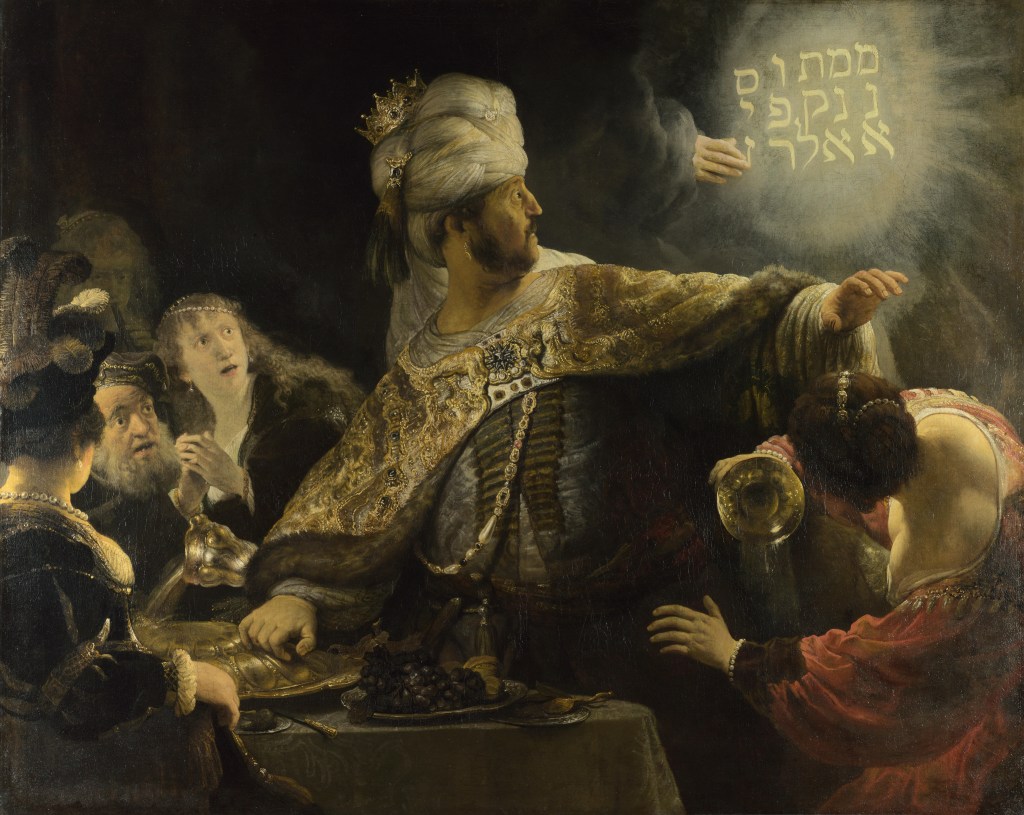
Belshazzar’s Feast, Rembrandt
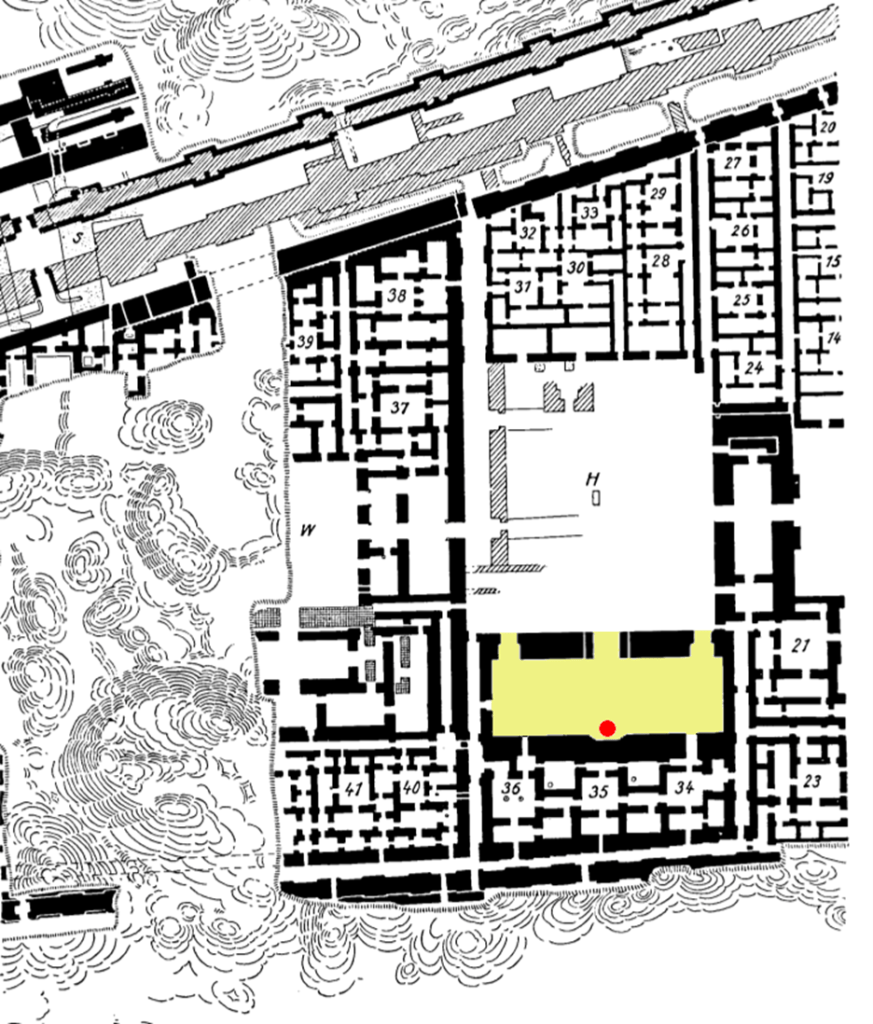
The hand wrote upon the “plaster” on the wall. Here is a significant detail in the Scriptural record that may seem unimportant: the material the fingers wrote upon, plaster. This detail has archaeological and biblical significance. The plaster is archaeologically significant because the hall where this event likely transpired has been excavated confirming this detail. The walls of the banquet hall included an area opposite the entrance that, like the ruins of palaces at Nineveh, was covered in white plaster.
“In the ruins of Nebuchadnezzar’s palace archaeologists have uncovered a large throne room 56-60 feet wide and 173 feet long which probably was the scene of this banquet. Midway in the long wall opposite the entrance there was a niche in front of which the king may well have been seated. Interestingly, the wall behind the niche was covered with white plaster as described by Daniel, which would make an excellent background for such a writing” (John Walvoord, Daniel: The Key to Prophetic Revelation).
The plaster is biblically significant due to a theme running throughout Scripture: God’s standard of judgment written on stone (or materials related to stone, such as dust):
- The Ten Commandments were written by the finger of God upon stone (Exod. 24:12; 31:18; 32:36; 34:1, 28; Deut. 5:22; 9:10; 10:4).
- Judgment against Belshazzar is written in plaster (made of dust from stones, Dan. 5:5).
- Jesus appears to have written concerning judgment in the dirt, in response to the accusers of the woman caught in adultery (John 8:6).
- Believers are an epistle of God written on the heart rather than stone (2 Cor. 3:3-7).
- Believers will receive a new name written on stone (Rev. 2:17).
The writing on the plaster of the wall by the finger of God serves a similar function in this chapter: Belshazzar is evaluated and found wanting—he does not even come close to measuring up to God’s standards, as set forth in the Ten Commandments and the rest of the law. The common theme among these passage involves: 1) the finger of God; 2) writing on stone-like material; 3) the divine requirements or evaluation of the character of men.
The writing on stone serves as a witness against those whom it evaluates (Josh. 4:9, 20; Josh. 8:32). In some passages, stones themselves become a witness (Matt. 3:9; Luke 3:8; 19:40). A special irony is found regarding the judgment of Babylon written in plaster. The kings of Babylon had sought to immortalize their glory by writing on their own stones!
Norman W. Porteous (1898-2003) summarizes, “The mysterious hand had written not so much in warning as in judgment.” (Porteous, Daniel: A Commentary (Old Testament Library), 81). For Belshazzar, the party was over.
So Belshazzar saw the back of God’s hand, writing an ominous message upon the wall. But what did it say? What did it mean?
6 Then the king’s color changed, and his thoughts alarmed him; his limbs gave way, and his knees knocked together.
Up to now, the king’s demeanor had appeared bold, as if assured of Babylon’s impregnability. But Jeremiah reveals he feared what might come of the siege. Jeremiah 50:43, “The king of Babylon heard the report of them, and his hands fell helpless; anguish seized him, pain as of a woman in labor.”
He experienced what is technically called delirium tremens—wild, terrifying hallucinations brought on by heavy drinking. Only these weren’t just hallucinations in his own deranged mind, but something that everyone could clearly see with their own eyes.
“The king’s body was seized by a fit of uncontrollable trembling. Gone now were the proud glance and the sheering score. The man shook in his shoes. Moreover, his thoughts troubled him. Conscience was awake at least and baying in his soul. It could be seen on his whitened countenance. The apparition had appeared too hard on the heels of the king’s blasphemous boasts and guilty behavior. Belshazzar could have had no doubt that Jehovah, the God of the Jews, whose golden vessels he had desecrated, had spoken. The message was there, etched on the wall by the finger of God, over near the golden candelabrum. But the writing made no sense” (John Phillips, Exploring the Book of Daniel, p. 88).
“’Then the king’s face grew pale,’ instantly all the blood drains out of his face, ‘and his thoughts alarmed him;’ I want you to notice that this is a principle here that’s true of every carnal Christian and every non-Christian. When an individual is on negative volition and operating on the sin nature his conscience is always sensitive and will always give testimony to his failures, given the right circumstances. And no matter how skilled you might be at covering up your conscience and hardening your conscience and suppressing it, sooner or later you’re going to get into some situation and all of a sudden all those things in your conscience are going to come bubbling to the surface and you’re going to become overwhelmed with guilt and guilt always comes along with its handmaiden, fear, which is the fear of discovery and the fear of having to pay the consequences for our actions” (Dean, Lessons on Daniel, 22.261).
“The writing on the wall he could neither read nor understand; but his conscience had written bitter things against him, which now being held to the fire of God’s wrath become legible.” (John Trapp)
Just the appearance of the hand would have alarmed him, but his fears would have multiplied at the thought that the message must be ominous.
While Nebuchadnezzar’s dreams caused him to be “troubled” or frightened,” Belshazzar’s reaction is absolute terror, he turns pale, and his legs give way. Literally this is the “bands/knots of his legs were loosed”, he comes very near to fainting and falling over. This idiom can be translated a number of different ways, the NRSV, for example, has “his knees knocked together.” Seow suggests that the idiom could be translated “his bowels were loosed” (Daniel, 79). We know what that means!
A prophecy by Isaiah concerning the overthrow of Babylon by Cyrus may have this event in view. Isaiah prophesies:
Thus says the Lord to his anointed, to Cyrus,
whose right hand I have grasped,
to subdue nations before him
and to loose the belts of kings,
to open doors before him
that gates may not be closed (Isaiah 45:1)
Belshazzar would have been better served studying the Hebrew Scriptures rather than the palace’s wine-tasting menu!
“One might have thought the king was having a heart attack. Barely able to stand, his face was ashen and seized with terror. The raucous laughter turned to deafening silence with all eyes on the king. The king’s eyes were fixed upon the hand as it wrote. As a sense of foreboding and panic fell on the crowd, all eyes turned to the mysterious writing on the wall. The king’s actions alarmed all who were present” (Bob Deffinbaugh, Daniel: Relating Prophecy to Piety).
It is an appalling scene when a sinning mortal knows that the great God has come to meet him in the very midst of his sins!—How changed the scene from the glee of his blasphemous revelry to this paleness of cheek, convulsion of frame, remorse of conscience, and dread foreboding of doom! Many a sinner has had a like experience, and other thousands must have it!—Cowles.
Oh that God’s Spirit might bring every sinner to such a bracing experience, that they might cry out for mercy!
Well, Belshazzar certainly wanted to know what this message was. The ominous silence descending upon the gathering at the sight of the hand and the king’s startled reaction was shattered by the panicky summons of the king for his advisors.
He “screams out” in alarm and urgency and the verb here is a participle, used with a to-be verb to imply a continuous action: he “was screaming” for his advisors.
7 The king called loudly to bring in the enchanters, the Chaldeans, and the astrologers. The king declared to the wise men of Babylon, “Whoever reads this writing, and shows me its interpretation, shall be clothed with purple and have a chain of gold around his neck and shall be the third ruler in the kingdom.” 8 Then all the king’s wise men came in, but they could not read the writing or make known to the king the interpretation. 9 Then King Belshazzar was greatly alarmed, and his color changed, and his lords were perplexed.
Just like his grandfather Nebuchadnezzar (Dan. 2:2; 4:6) and Pharoah before him (Gen. 41:8) the king summons his best advisors in his time of need. And, just like Nebuchadnezzar and the Pharaoh, the assembled wisdom of those without knowledge of God will prove inadequate.
By now these people must have been some of the most nervous folks in Babylon. So far, they had batted a big zero in interpreting any king’s visions and dreams. Their score was to remain unchanged. The blindness of the wise men went deeper than their inability to interpret the message; they could not even read it.
Where was Daniel? It is possible that Daniel was in retirement. “Historians tell us that after Nebuchadnezzar died, all of the ministers who were at the core of the palace regulars were banished and sent away from the throne….When Belshazzar sent out invitations to his Debauchery Ball, Daniel was not on the guest list” (David Jeremiah, Handwriting on the Wall, p. 99).
“Whoever reads this writing, and shows me its interpretation” is the request of the king. This is the common futile pattern of secular leaders seeking secular wisdom. Assemble the best of the (secular) best while rejecting those who fear and acknowledge God and possess a genuine understanding of His revelation. Instead, rely on these secular “experts” to explain things that ultimately originated with God.
Again, there is a promise of riches: “shall be clothed with purple and have a chain of gold around his neck…” Clothing someone in purple meant giving him royal authority (cf. Esth. 8:15). The necklace of gold would have had symbolic as well as monetary value.
Daniel would later reluctantly receive this honor (Dan. 5:29) but had little use for it because he possessed the true riches of God.
This offer of being third ruler remained a puzzle for hundreds of years. If Belshazzar was king, why wouldn’t he offer Daniel the position as second ruler, as Pharaoh offered Joseph (Gen. 41:40-44) and Ahasuerus offered Mordecai (Esther 10:3)? Again, the Nabonidus Cylinder reveals that Belshazzar shared a co-regency with Nabonidus, his father; thus he could only legitimately offer the prized person “third ruler.”
But, as in every case in the book of Daniel, the king’s advisors could not help him. They “could not read the writing or make known to the king the interpretation.” Tom Constable wittily observes, “Scholars have wearied themselves trying to figure out how Daniel got his interpretation from these three apparently Aramaic words. They have been as unsuccessful as Belshazzar’s original wise men were.”

 Grace Still Amazes
