Well, today we are continuing our introduction the book of Daniel. We ended last week giving some historical background. The first part of Daniel takes place with Nebuchadnezzar king of Babylon and so we were talking about the beginning of the Neo-Babylonian empire.
Today we want to start by reminding ourselves of the nature of the place to which Daniel and his friends were taken. This was not a God-friendly place.
An article From Babel to Babylon on monergism.com., describes the anti-God nature of this city throughout history.
Not unlike Babel, Babylon stands for the corruption of human power, wealth, and influence. It represents the perversion of God’s creation, the exploitation of the weak and vulnerable, and the seduction of the nations by false gods. Babylon was notorious for its arrogance, wickedness, and cruelty. It was a center of pagan worship, characterized by sexual immorality, idolatry, and materialism. Babylon was a city that exalted itself above God and oppressed God’s people. It symbolizes the human tendency to use power for selfish purposes, to worship idols instead of God, and to oppress those who are weaker. (https://www.monergism.com/babel-babylon#:~:text=The%20biblical%20narrative%20of%20Babel,power%2C%20wealth%2C%20and%20influence.)
Babylon the Great, in the book of Revelation, is the culmination of human rebellion against God. It is a symbol of the world system that opposes Christ and His kingdom. It is a city that is drunk with the blood of the saints and the martyrs, that deceives the nations with her sorceries and seduces them with her wealth and power. Babylon the Great is a false bride who entices the world with her beauty and wealth, but who ultimately leads them to destruction. It is a warning against the seduction of the world and the dangers of compromise with the world’s values.
So Daniel and his three friends were entering into a culture that would challenge the foundations of their faith to the very core, down to their roots. Remaining faithful to Yahweh would prove to be very difficult and I’m sure that not every Hebrew youth rose to the challenge.
Not everything was negative, however, for Babylon was a wondrous sight to behold. As Daniel and his three friends were marched into Babylon they would see a spectacular city. Bryan Windle, in his Biblical Archeology article reports on the city Daniel saw (https://biblearchaeologyreport.com/2019/08/09/footsteps-three-things-in-babylon-daniel-likely-saw/).
Nebuchadnezzar had initiated a vast building program and improved the city’s fortifications, raising its magnificence to new heights. At the time Daniel lived there, it was the largest city in the world, covering over 10 square kilometers (4 square miles).
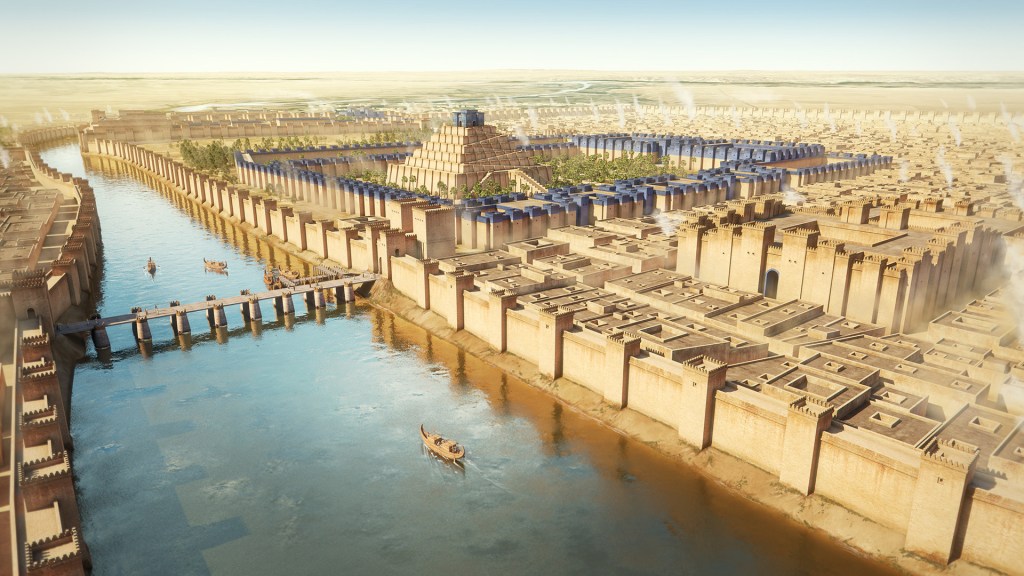
A reconstruction of ancient Babylon, with the Etemenaki (stepped ziggurat) in the center, and the Esagila (Temple of Marduk) to the right of it. Image Credit: J.R. Casals / https://www.artstation.com/artwork/25NVv [tried to get permission]
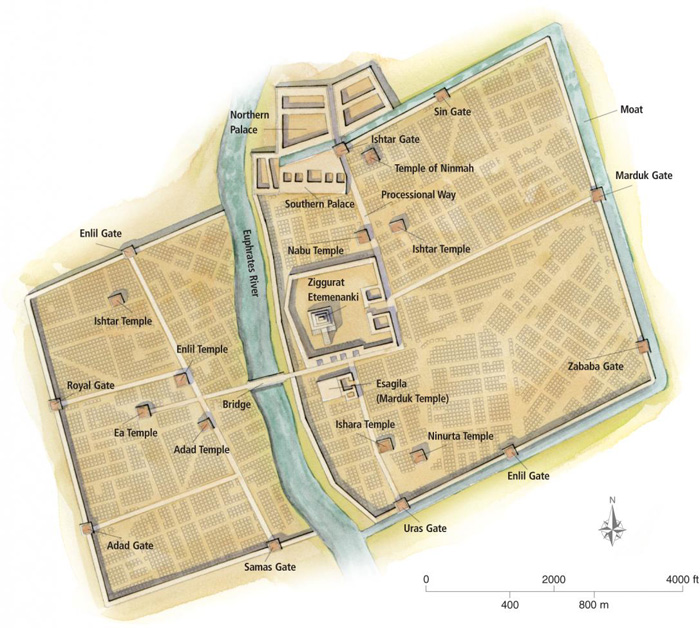
Taken from the ESV® Study Bible (The Holy Bible, English Standard Version®), copyright ©2008 by Crossway, a publishing ministry of Good News Publishers. Used by permission. All rights reserved. For more information on how to cite this material, see permissions information here.
Daniel would have seen the grand palace of Nebuchadnezzar.

A panoramic view of the reconstructed Southern Palace of Nebuchadnezzar. Photo Credit: Osama Shukir Muhammed Amin FRCP(Glasg) / Wikimedia Commons / CC BY-SA 4.0
Here is a modern reconstruction of what Nebuchadnezzar’s palace would have looked like:

Screenshot from Pedersén’s virtual 3D model of Babylon, period of Nebuchadnezzar II (604-662 BCE) and Nabonidus (555-539 BCE). Overlooking south onto the Etemenanki Ziggurat from within the South Palace main courtyard, walls decorated with glazed bricks.
On the north side of the city Nebuchadnezzar had built the majestic Ishtar Gate.

The Ishtar Gate in Babylon. Photo Credit: Wikimedia Commons / Public Domain
It was one of eight double-gates that served as entrances to the city and stood over 12m (38 feet) high. The gate was finished around 575 BC, after Daniel had already been living in the city for many years. He no doubt watched its construction and marveled at its beauty.
Today, a reconstruction of the Ishtar Gate can be seen at the Pergamon Museum in Berlin. It is made out of materials excavated by Robert Koldewey in the early 1900’s.
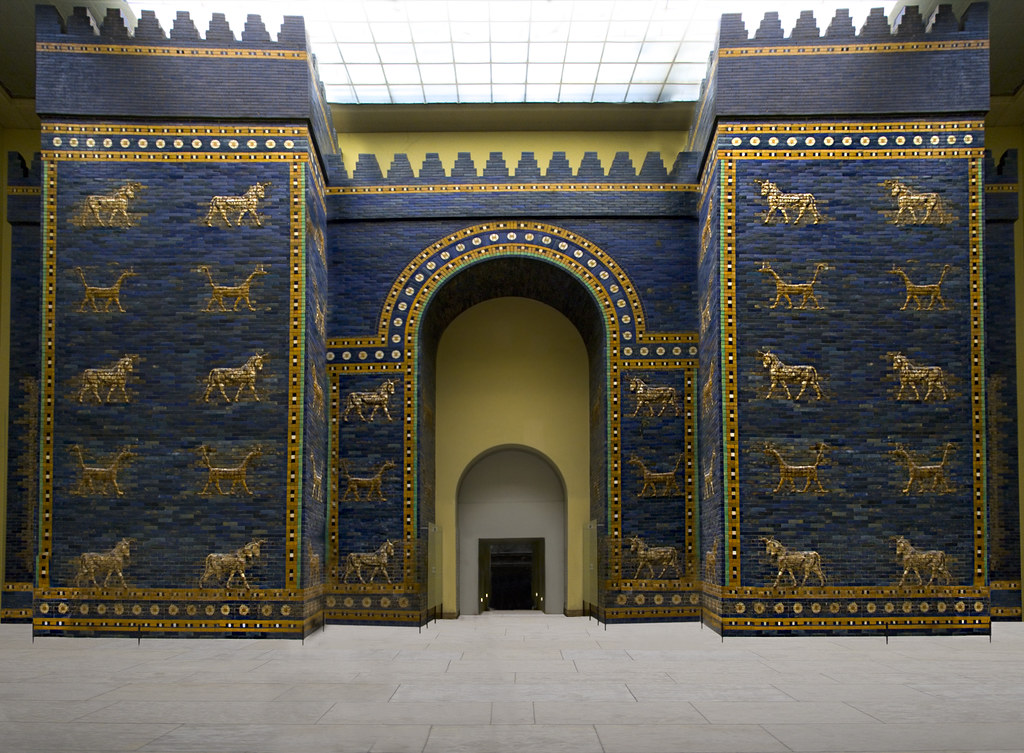
A reconstruction of the Ishtar Gate at the Pergamon Museum in Berlin, Germany. Photo Credit: flickr photo by youngrobv / CC BY-NC 2.0
In Daniel 4:30, King Nebuchadnezzar boasts, “Is not this great Babylon, which I have built by my mighty power as a royal residence and for the glory of my majesty?” The archaeological record affirms the massive building campaigns of Nebuchadnezzar.
Who was Daniel?
Daniel was a young man (Daniel 1:4), likely around the age of 16, when he was taken captive in the first wave of deportations in 605 B.C. Could you imagine, at that young age, being ripped from your family, your home, your friends, your chances for work or education, not knowing what was going to happen next? You didn’t know if you would live or die. You didn’t know if you would spend the remainder of your life enslaved or in prison. There were a lot of unknowns, and as we know, into that vacuum of unknowns, fear and anxiety are frequent irritants.
He never saw his family, friends, or homeland again. But what matters most about Daniel’s life is how he remained faithful to God throughout his life, while living in a land where its inhabitants had not even heard of Jehovah. Daniel was considered to be a man of great integrity, classified along with Noah and Job in Ezekiel 14:14, 20 as key intercessors. In fact, like Joseph, not a single sin is attributed to Daniel. And the angel repeatedly calls him “greatly beloved.”
These three intercessors represent our battle against the world, the flesh and the devil. Job overcame the devil, Noah the world, and Daniel the flesh.
The name Daniel (dan-i-el) means “God is my judge,” a name that likely guided and guarded Daniel’s thinking and conduct as he realized that one day God would hold him accountable for how he lived his life. It is likely that Daniel was one of several young men who came from “the royal family and of the nobility” (Daniel 1:3).
No mention is made, specifically, of Daniel’s birthplace or family (other than being of the tribe of Judah, Daniel 1:3) and thus the Jewish Encyclopedia concludes “It is not known whether he belonged to the family of the King of Israel or to that of an Israelitish magnate.”
Josephus (“Ant.” x. 10, § 1) evidently inferred from Sanh. i. 3 that Daniel was a relation of King Zedekiah (ἧσαυ τῶυ ἐκ τοῦ Σεδεκίου γέυους τέσσαρες ), while Pseudo-Epiphanius, on the strength of the same passage, makes Daniel the scion of a noble Israelitish family (compare Prince, “Critical Commentary on the Book of Daniel,” p. 25).
According to rabbinical tradition Daniel was of royal descent; and his fate, together with that of his three friends, Hananiah, Mishael, and Azariah, was foretold by the prophet Isaiah to King Hezekiah in these words, “and they shall be eunuchs in the palace of the king of Babylon” (Isa. xxxix. 7; compare Sanh. 93b; Pirḳe R. El. lii.; Origen, commentary to Matt. xv. 5; Jerome, commentary to Isaiah, l.c.). Of course, we do not know for sure that they were eunuchs, although we never hear of their wives or children.
Daniel served under king Nebuchadnezzar (Daniel 1:19-20) all the way through the empire change and served King Cyrus (Daniel 1:21). Daniel bridges the entire 70 years of the Babylonian captivity (ca. 605–536 B.C.; cf. 1:1 and 9:1-3).
Daniel began his career about eighteen years before Jerusalem fell, and his last message was given after the Jews had returned to build again the temple (10:1.), covering a period of about 73 years from the year 607 to 534 B. C., then beyond that to the reign of Darius.

The most well-known event in the life of Daniel was his one-night stay in the den of lions under Darius. Today in the stands this depiction of a roaring lion (with wings, by the way).

https://www.worldhistory.org/image/724/lion-of-babylon-ishtar-gate/
This was one of 120 lions that lined the processional way into Nebuchadnezzar’s throne room and it dates to the exact time that Daniel was there in Babylon! He would have passed by these lions a number of times on his way to advise King Nebuchadnezzar. The glazed bricks remind us of the need for fiery furnaces needed to make the bricks. Daniel had been in Babylon 66 years and was 83 years old when he faced the lions.
The Book of Daniel
Date and Authorship
We will deal with who wrote the book and when because this issue has been debated by biblical scholars and historians. Was it written by Daniel in the 6th century B.C. or by someone else in the 2nd to 3rd century B.C.?
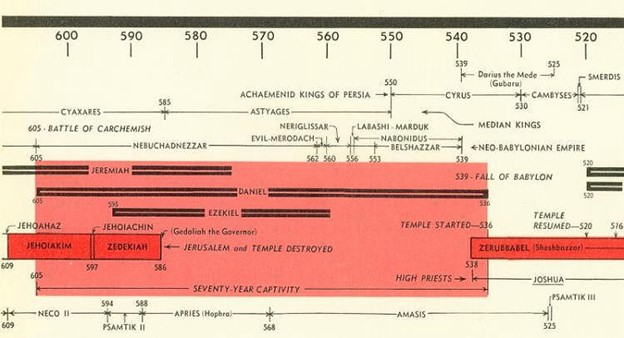
Conservative scholars have believed the book to be written by Daniel, taken captive by Nebuchadnezzar in 605 B.C. The record of events extends to the third year of Cyrus, 536 B.C., and, accordingly, covers a span of about seventy years. Daniel himself may well have lived on to about 530 B. C., and the book of Daniel was probably completed in the last decade of his life.
Although Daniel does not speak of himself in the first person until chapter 7, there is little question that the book presents Daniel as its author. This is assumed in the latter portion of the book and mentioned especially in 12:4. The use of the first person with the name Daniel is found repeatedly in the last half of the book (7:2, 15, 28; 8:1,15, 27; 9:2, 22; 10:2, 7, 11, 12; 12:5).
Important confirmation of the historicity of Daniel himself is found in three passages in Ezekiel (Eze 14:14, 20; 28:3), written after Daniel had assumed an important post in the king’s court at Babylon. Convincing also to conservative scholars is the reference to “Daniel the prophet” by Christ in the Olivet Discourse (Mt 24:15; Mk 13:14).
Except for the attack of the pagan Porphyry (third century A. D.), no question was raised concerning the traditional sixth century B. C. date, the authorship of Daniel the prophet, or the genuineness of the book until the rise of higher criticism in the seventeenth century, more than two thousand years after the book was written.
Higher criticism, totally humanistic and materialistic in its outlook, denies that Daniel could be the author because they want to deny the possibility of supernatural predictive prophecy and so the book had to be written later so that the prophecies related to Alexander the Great and the wars between the Ptolemies and the Seleucids would be a historical report rather than future events that were miraculously fulfilled by God’s sovereign plan.
Daniel wrote this book in the sixth century B.C. It records the events of Daniel’s life and the visions that he saw from the time of his exile in 605 B.C. (1:1) until 536 B.C., the third year of King Cyrus (10:1). Then it is Darius who consigned him to the den of lions (Dan. 6). So it is likely that Daniel finished this book around 520 B.C.

Ezekiel, Habakkuk, Jeremiah, and Zephaniah were Daniel’s prophetic contemporaries.

Jensen’s Survey of the Old Testament
Daniel is alluded to by the writer of Hebrews as one of “…the prophets: who through faith…stopped the mouths of lions” (Heb. 11:32-33).
Why do we believe that it was Daniel who wrote this book in the 6th century B. C., rather than some unnamed author in the 2nd century?
First, the book claims to be written by Daniel in Daniel 7:1 and 12:14.
In the first year of Belshazzar king of Babylon, Daniel saw a dream and visions of his head as he lay in his bed. Then he wrote down the dream and told the sum of the matter. (Dan. 7:1)
Second, Jesus attributed to Daniel the prophecy about the abomination of desolation (Dan. 12:11).
Jesus said, “You [will] see the abomination of desolation which was spoken of through Daniel the prophet” (Mt. 24:15).
Third, Ezekiel—a contemporary prophet—believed in a historical Daniel. Ezekiel lived in roughly 575 BC, and he explains that Daniel is a real and historical figure (Ezek. 14:14, 20; 28:3).
Fourth, Josephus—a first century Jewish and Roman historian—believed that Daniel was a prophet and a historical person. Josephus believed that the book of Daniel was shown to Alexander the Great, when he came to Jerusalem in 330 BC. Of course, Daniel predicted the life of Alexander the Great. So when he arrived in Jerusalem, the priests showed him these prophecies. Josephus writes,
\He (Alexander) came into the city; and when he went up into the temple, he offered sacrifice to God, according to the high priest’s direction, and magnificently treated both the high priest and the priests. And when the book of Daniel was showed to him, wherein Daniel declared that one of the Greeks should destroy the empire of the Persians, he supposed that himself was the person intended… The next day he called them to him, and had them ask what favors they pleased of him… (and) he granted all they desired.[4]
He did not destroy Jerusalem because of this.
Fifth, the author of 1 Maccabees believed Daniel was a historical person. In 1 Maccabees 2:59-61, we read, “Hananiah, Azariah, and Mishael had faith, and they were saved from the flames. Daniel was a man of integrity, and he was rescued from the lion’s jaws. So bear in mind how in the history of the generations no one who trusts in Heaven ever lacks strength.”
In context, Matthathias was writing about an event which took place in 167 BC. Therefore, to have written this, he must have already considered Daniel to be a historical figure. As Walvoord writes, “It is highly questionable whether the Jews living in the Maccabean period would have accepted Daniel if it had not had a previous history of canonicity” (Walvoord, John. Daniel: The Key to Prophetic Revelation, Introduction, 1989. See “Authorship”).
Sixth, 1 Enoch cites Daniel. When we compare 1 Enoch 14:18-22 with Daniel 7:9–10, we see striking similarities. 1 Enoch dates to roughly 150 BC.
Seventh, archaeological discoveries shows that Daniel faithfully described the sixth century world of Babylon.
- Daniel correctly distinguishes Susa and Elam.
In Daniel 8:2, Daniel writes that he was “in the citadel of Susa, which is in the province of Elam.” Now, Susa was assigned to a new province in the Persian era. The territory of Elam was shrunk during this time, and Susa was assigned to a new territory of Susiana.
It would have taken a 6th century inhabitant of Susa to know of this historical detail. A 2nd century author would have been out of date with this historical nuance. (Archer, Gleason L. A Survey of Old Testament Introduction: Revised and Expanded. Chicago, IL: Moody, 2007. 380). - The existence of Belshazzar
Prior to the middle of the 19th century, a Babylonian king named Belshazzar was unknown to history, allowing critics to question the historical accuracy of the book of Daniel. Ancient historians, such as Berosus and Abydenus recorded that Nabonidus was the last king of Babylon. Similarly, the Uruk King List omits Belshazzar, moving from Nabonidus to Cyrus.
Things changed in 1854, when J.E. Taylor discovered four cylinders in the ruins of a ziggurat at Ur which contained a prayer of Nabonidus to the gods. The so-called Nabonidus Cylinders record:
“As for me, Nabonidus, King of Babylon, save me from sinning against your great godhead and grant me as a present a life of long days, and as for Belshazzar, my oldest son my offspring, instill reverence for your great godhead in his heart and may he not commit any cultic mistake, may he be sated with a life of plentitude.”

One of the Nabonidus cylinders from Ur, which records Nabonidus’ renovations to the moon god, Sin’s, ziggurat, as well as a prayer for himself and his son Belshazzar. Photo: A.D. Riddle / Bibleplaces.com.
- Nabonidus Chronicle
That very night Belshazzar the Chaldean king was killed. (Dan 5:30)
The Babylonian Chronicle for the years 556 to 539 BC, also called the Nabonidus Chronicle, describes the final years of King Nabonidus’ reign and the fall of Babylon to Cyrus, king of Persia. It records:
“When Cyrus did battle at Opis on the [bank of] the Tigris against the army of Akkad, the people of Akkad retreated. He carried off the plunder (and) slaughtered the people. On the fourteenth day Sippar was captured without a battle. Nabonidus fled. On the sixteenth day, Ugbaru, governor of Gutium, and the army of Cyrus, without battle they entered Babylon. Afterwards, after Nabonidus retreated, he was captured in Babylon…. On the third day of the month Arahsamna, Cyrus entered Babylon.” (iii, 12-18)

The Nabonidus Chronicle describes the final years of King Nabonidus’ reign and the fall of Babylon to the Persians. Photo: ChrisO / Wikimedia Commons / CC BY-SA 3.0
Moreover, William Shea has argued, based on other details in the text of the Nabonidus chronicle that the enigmatic “Darius the Mede” who became King of Babylon (Dan. 5:31) was none other than Ugbaru, the general of the army who captured the city. Thus, the historicity of Darius was verified.
- Dead Sea Scroll Fragments of Daniel
“So when you see the abomination of desolation spoken of by the prophet Daniel, standing in the holy place…” (Mat 24:15)
Many today would argue that the book of Daniel was composed sometime during the second century BC, after the prophecies related to the Seleucids and Maccabeans (Dan. 9-12), and not during the sixth century BC by the prophet himself. According to this theory, Daniel was written to encourage the Jewish people during the Maccabean period (ca. 168-165 BC). This late date is assumed largely on the basis of the presupposition of modern scholars that supernatural fore-telling of events is not possible.
The fact that these copies are now known to exist shows us that already in the second century B. C. the book of Daniel was already composed, circulated and accepted as canonical.
You might ask, why is this important—whether Daniel wrote the book or not, whether it communicates actual historical events from the 6th century B.C. or records apocryphal tales from the 2nd century?
As James Hamilton puts it,
There is a massive difference between the theological meaning of a wish-fantasy and that of a historically reliable account of God miraculously preserving someone alive in a fiery furnace. Dismissing a false fable as irrelevant to my conduct reflects my view of the theological meaning and value of fairy tales. Risking my life because I believe the stories result from convictions about theological meaning that cannot be separated from historicity. …
If some Maccabean-era author is making fraudulent claims, if these are fictional deliverances and not future predictions but recitals of what has already happened presented as though being predicted by Daniel, then there is no real proof that Yahweh can either deliver from death or predict the future. This means there is no proof that he is any better than the false gods who can neither reveal the future nor deliver their worshippers, which is exactly what the book of Daniel claims Yahweh can do. …
The whole theological meaning of the book depends upon Yahweh’s ability to deliver his people and declare the future before it takes place. If he cannot do these things, no one should “stand firm and take action” and risk his life for Yahweh (Dan. 11:32).
J. M. Hamilton Jr., With the Clouds of Heaven: The Book of Daniel in Biblical Theology, New Studies in Biblical Theology 32 (Nottingham, England: Apollos, 2014), 31–32.

 Grace Still Amazes