Well, today we are starting a study of the Old Testament major prophet, the book of Daniel. You might wonder, “Why study the book of Daniel?”
In many corners of the world these days the climate of hostility hangs over any overt Christian faith commitment or any gathering of believers in Jesus Christ. Any kind of Christian commitment is now assumed to imply intolerance and often prompts reactions that range from a low-grade hostility and exclusion in the West to the vicious and murderous assaults on Christian believers in Pakistan, Nigeria, Kenya, Egypt, Syria and Iraq and elsewhere.
Such issues are not new. Christians have faced them ever since Nero’s lions, and even before that. Jews also have faced the same questions all throughout their history, most tragically sometimes enduring horrendous persecution from states claiming to be Christian. So, it is not surprising that the Bible gives a lot of attention to these questions.
The book of Daniel tackles the problem head on, both in the historical stories of Daniel and his friends, and in the prophetic visions he received. A major theme of the book is how people who worship the one, true, living God—the God of Israel—can live and work and survive in the midst of a nation, a culture, and a government that are hostile and sometimes life-threatening. What does it mean to live as believers in the midst of a non-Christian state and culture? How can we live “in the world” and yet not let the world own us and squeeze us into the shape of its own fallen values and assumptions? How can one stay faithful to God in the midst of a hostile culture in the midst life-threatening pressures to bow the knee to another god? Can God be trusted in such times?
The book was written to encourage believers to keep in mind that both the present and the future, no matter how terrifying they may become, rests in the faithful hands of the sovereign Lord God—and in that assurance to get on with the challenging task of living in God’s world for the sake of God’s mission. We need that encouragement even today.
We want to start today by examining the historical background of the book of Daniel. It’s always important to put the books of the Bible in their historical time and situation. It helps us dive deeper into the text instead of just skimming the surface.
The Assyrian Empire ruled and reigned over the Ancient Near East for nearly 300 years, beginning with an expansion under Ashurnasirpal II (883-859 B.C.) and ending with attacks from the Babylonians and Medes around the mid 7th century B.C.

Map 75 Assyrian Supremacy in the Seventh Century, Holman Bible Atlas, p. 151
After Solomon, the kingdom of Israel was divided. Jeroboam took ten tribes and they became known as the Northern Kingdom, leaving only Judah and Benjamin with Rehoboam, the son of Solomon.

Map 57 The Kingdoms of Israel and Judah, Holman Bible Atlas, p. 118
Shalmaneser V sacked Damascus, the capital city of the Northern Kingdom in 722 B.C., taking those people captive and scattering them among the other conquered peoples of that campaign. The Southern Kingdom, ruled by the line of David, lasted another roughly 150 years. There were no good kings in all the history of the Northern Kingdom, but there were a few in the Southern Kingdom.
Josiah was the last good king of Judah. Under his leadership a religious reform took place (640 B.C. to 609 B.C.). That reform is described in the Bible in 2 Kings 22–23 and 2 Chronicles 34–35. The author of Kings describes the accession of Josiah to the throne at 8 years of age, and then some busy years of reform in his teenage years (age 16-18). So as far as teenagers go, he was a pretty good one! Even as a youth “he began to seek the God of his ancestor David” (2 Chron. 34:3)
It begins with the decision to renovate the Temple, which leads to the discovery of the Book of the Law. Josiah removed pagan altars and idols from the temple, destroyed rural sanctuaries, and took down other places of worship. He centralized worship in Jerusalem, having destroyed the temple at Bethel. He renewed the covenant with his people. Josiah restored the Passover after many years of neglect and he returned the Ark of the Covenant to the Temple.
Both books [2 Kings and 2 Chronicles] bookend the story of Josiah with the highest possible praise for this king. Unlike so many of the kings of Judah, Josiah “walked in the way of his father David, turning aside neither to the right or the left.” But he was even greater than David: “Before him there was no king like him, who turned to the Lord with all his heart, with all his soul, and with all his might, according to all the law of Moses; nor did any like him arise after him” (2 Kings 22:2; 23:25; cf. 2 Chron. 34:2; 35:18).
However, Josiah met an early death at the hand of the Egyptian King Neco II. Neco was leading an Egyptian force northward to support a final Assyrian effort to recapture Haran. Josiah intercepted Neco near Megiddo, was mortally wounded, and eventually was buried in Jerusalem (2 Kings 23:28-30; 2 Chronicles 35:20-27).

Josiah Battles Neco
The consolidation of the Chaldean Dynasty at Babylon was completed by 609 B.C. The victory of Nabopolassar over the Assyrian and Egyptian armies made Babylon the new master. From there, the Babylonians began to invade southward into Syria and Palestine.
The prophet Habakkuk foresaw these events, declaring that God was “For behold, I am raising up the Chaldeans, that bitter and hasty nation, who march through the breadth of the earth, to seize dwellings not their own” (Hab. 1:6)
The ensuing power struggle between Babylon and Egypt caught Israel in a vice-grip and put the kings of Judah in a precarious position. To whom would they appeal for help?
With the death of Josiah in 609 B.C., Neco removed Jehoahaz, a son of Josiah chosen by the people of Judah, and replaced him with another son whose regal name was Jehoiakim (2 Kings 23:30-35). Judah was for a short time an Egyptian vassal, and Jehoiakim reigned at the pleasure of Neco.
The Battle of Carchemish in 605 B.C. established Babylon as the dominant power all the way to the border of Egypt.
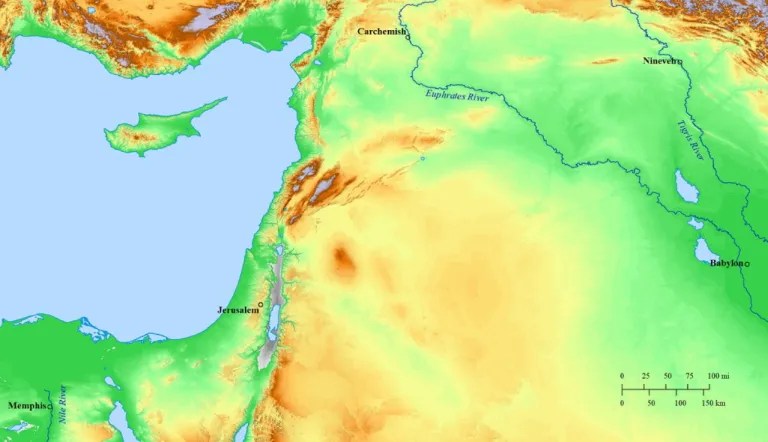
Jeremiah 46
In 604 B.C. Nebuchadnezzar campaigned in Palestine and conquered Ashkelon. Jehoiakim quickly switched his allegiance to Nebuchadnezzar. It was during this campaign that Nebuchadnezzar took hostages from Jerusalem, which included such men as Daniel and his three companions Hanniah, Mishael and Azariah and carried them to Babylon (Daniel 1:1-7) and the seventy years of captivity had begun (Daniel 9:1-2; Jeremiah 25:11; 2 Chronicles 36:17-21).
Jeremiah’s prophecy foretold that the “land shall be a desolation” and that the Jews would “serve the king of Babylon seventy years” (Jeremiah 25:11; compare 2 Chronicles 36:17-21). After the 70 years were completed in Babylon, God told them, He would cause them “to return to this place [Jerusalem]” (Jeremiah 29:10).
However, Jeremiah 29:4-7 also tells the Israelites who were exiled to Babylon to settle down, build homes, and work for the welfare of the city. The passage also instructs them to pray for the city’s prosperity, as their own prosperity would be tied to it. However, this wouldn’t be easy. Psalm 137 hauntingly records, “By the waters of Babylon, there we sat down and wept, when we remembered Zion. On the willows there we hung up our lyres. For there our captors required of us songs, and our tormentors, mirth, saying, “Sing us one of the songs of Zion!” How shall we sing the LORD’s song in a foreign land? If I forget you, O Jerusalem, let my right hand forget its skill! Let my tongue stick to the roof of my mouth, if I do not remember you, if I do not set Jerusalem above my highest joy!” (Psalm 137:1-6)
These people, who once experienced the favor of the true God, find themselves debased and enslaved by their enemy. Far from home. Paralyzed with fear. Their identity stripped from them. Their captors taunt them, “Sing us one of the songs of Zion!” And instead they wept, remembering Zion and their glory days there.
Some of these people would grow comfortable in Babylon and would forget Zion. Some would return, and some of them, like Daniel would remain as a faithful remnant in a foreign, anti-God culture.
But Jeremiah had prophesied that their captivity would last 70 years. This prophecy of punishment came upon the people of Judah because of their disobedience to God’s laws. As Jeremiah explained to the people of Judah, “3 For twenty-three years, from the thirteenth year of Josiah the son of Amon, king of Judah, to this day, the word of the Lord has come to me, and I have spoken persistently to you, but you have not listened. 4 You have neither listened nor inclined your ears to hear, although the Lord persistently sent to you all his servants the prophets,” (Jeremiah 25:3-4).
This prophecy of punishment came upon the people of Judah because of their disobedience to God’s laws. According to the Jamieson, Fausset and Brown Commentary, the 70 years was “the exact number of years of Sabbaths in four hundred and ninety years, the period from Saul to the Babylonian captivity.
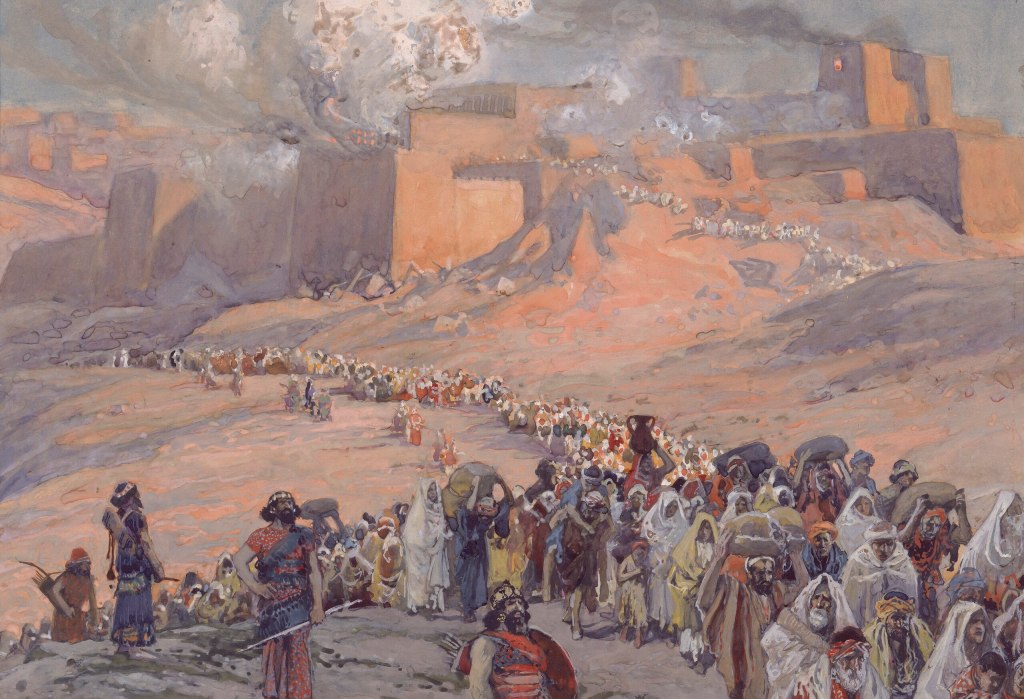
James Tissot’s painting “The Flight of the Prisoners” illustrates Judah’s exile from Jerusalem.
Nebuchadnezzar also came against Jerusalem on two other occasions, first in 598 B.C. against Jehoiakim. Jerusalem was besieged and finally surrendered on March 16, 597 B.C. and Jehoiakim apparently died during the siege. He was replaced by Jehoiahin, who surrendered the city.
The Babylonians plundered the city, including the temple treasuries and deported Jehoiachin and his family along with other Jewish leaders (2 Kings 24:13-16), including the prophet Ezekiel.
After the surrender of Jerusalem in 597 B.C. Nebuchadnezzar appointed Mattaniah, the young uncle of Jehoiachin, as king of Judah and changed his name to Zedekiah. Zedekiah’s reign of 11 years was marked with anti-Babylonian conspiracy despite Jeremiah’s condemnation of this policy (Jere. 27-29).
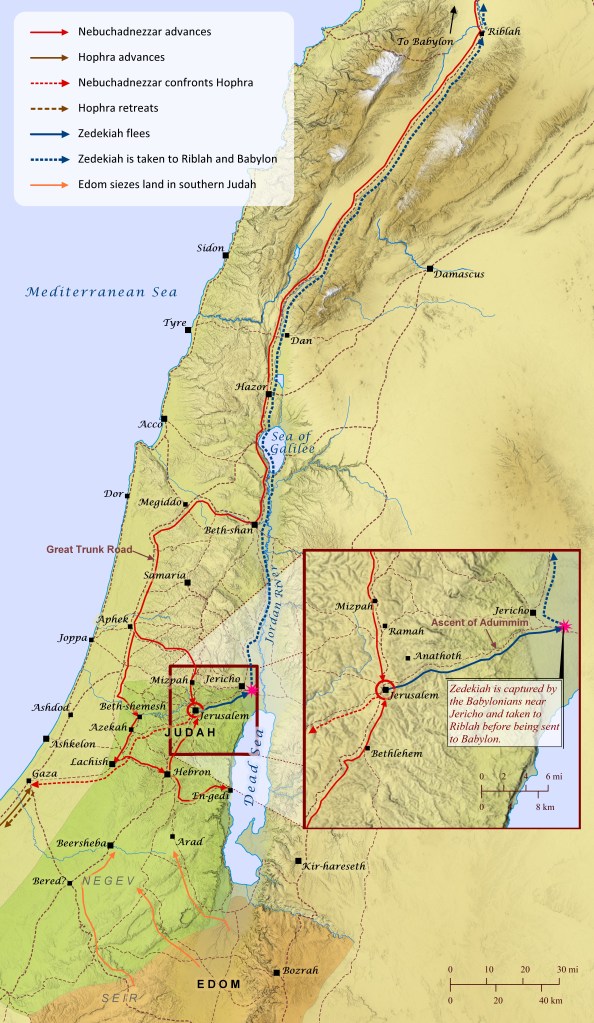
Nebuchadnezzar’s Final Campaign against Judah
The final collapse of the southern kingdom of Judah as an independent nation came at the hands of King Nebuchadnezzar II of Babylon in 586 B.C. Nebuchadnezzar’s army besieged Jerusalem again from 588-586 B.C., and when the city’s supplies were completely depleted, Jerusalem fell and the temple was destroyed. Zedekiah fled towards Egypt but was captured and forced to witness the execution of his sons before being blinded and led away to Babylon in chains. A third deportation of Jews occurred at this time.

Judah Is Exiled to Babylon
Babylon: The Heart of the Empire
Daniel and his friends were taken to Babylon (Daniel 1:1-6). Babylon was the chief city of Babylonia, long the capital of the kingdom and empire that controlled the whole or a large part of the valley of the Tigris and Euphrates. This was the Neo-Babylonian empire, the latest rendition of Babylonian dynasties.
It was spiritually like walking into the mouth of the lion. Who is our lion-enemy? Living in Babylon was no vacation from home, as Psalm 137:1 reports: “By the rivers of Babylon we sat and wept when we remembered Zion.” It was indeed a very sad time.
Although we are not sure of the origin of Babylon, its roots lie in Genesis 10:8-12.
8 Cush fathered Nimrod; he was the first on earth to be a mighty man. 9 He was a mighty hunter before the Lord. Therefore it is said, “Like Nimrod a mighty hunter before the Lord.” 10 The beginning of his kingdom was Babel, Erech, Accad, and Calneh, in the land of Shinar. 11 From that land he went into Assyria and built Nineveh, Rehoboth-Ir, Calah, and 12 Resen between Nineveh and Calah; that is the great city.
It appears to be mentioned in a historical inscription by Agu-kak-rime (about 1650 B.C.), who restored the shrines of Marduk and Sarpanit in the temple of E-sagila.
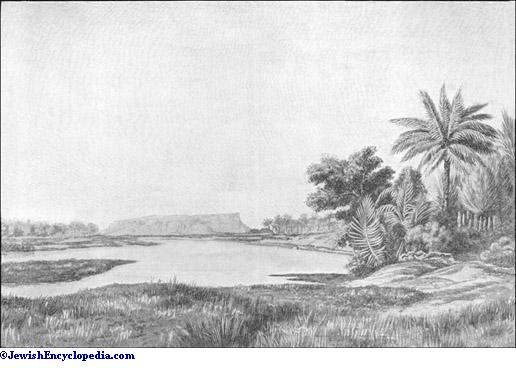
View of the Ruins of Babylon. (From Perrot and Chipiez, “Art in Chaldæa and Assyria.”)
The ruins which have been identified with ancient Babylon lie about 50 miles south of the city of Bagdad and on the east bank of the Euphrates.
Of course, most of us are familiar with the historical situation in Genesis 11, where the nations, which were supposed to ““Be fruitful and multiply and fill the earth” (Gen. 9:1), instead migrated from the west and found a plain in the land of Shinar and settled there, and said “Come, let us build ourselves a city and a tower with its top in the heavens, and let us make a name for ourselves, lest we be dispersed over the face of the whole earth” (Gen. 11:4).
God was against this, confused their language (Gen. 11:7) and “dispersed them from there over the face of all the earth” (11:8). That place was called Babel “because there the Lord confused the language of all the earth” (11:9). It is quite possible that the Nimrod mentioned in Genesis 10 took over this region and established his new kingdom.
After Nimrod established himself as a king and began conquering the surrounding lands (Genesis 10:10-11), he was sadly elevated to a godlike status by his descendants, worshipped simply as “Belus/Bel,” or the more common “Baal/Ba’al” (John Gill, Exposition of the Old Testament, notes on Genesis 10:6). He was also known as Marduk/Merodach, who is equated with “Bel” in Jeremiah 50:2. The tower became known as the tower of Bel, after “Belus Nimrod” or the “Temple Tower of Marduk”—another variant name for Nimrod.
From its beginning, as a center lifted up against God, Babel and Babylon became known as the anti-God city. In the Bible, Babel and Babylon are cities that represent human rebellion against God, idolatry, and oppression.
Later in its history the Assyrian king Sennacherib sacked Babylon around the same timeframe as King Hezekiah and the prophet Isaiah (around the seventh to eighth centuries BC). In fact, Sennacherib even tried conquering Jerusalem, which caused Hezekiah to cry out to God for help and resulted in God rescuing the city and sending Sennacherib back to Nineveh.
When the city of Babylon rebelled, Sennacherib had Babylon destroyed and then flooded. The following king of Assyria, Esarhaddon (one of Sennacherib’s sons), rebuilt Babylon back to its famed glory in his short 12-year reign.
Esarhaddon’s oldest son and heir died young. But in a strange twist, Esarhaddon gave the power of his throne, not to his son next in line for the throne (Shamash-shum-ukin), but instead to his younger son (Ashurbanipal). In a consolation attempt, Shamash-shum-ukin was given charge of Babylon itself, yet still under the authority of his younger brother. This, of course, had the initial makings of a rebellion (in case you didn’t notice).
Ashurbanipal of Assyria and Nineveh (the younger brother and now supreme ruler of the empire) defeated the city of Babylon (ruled by his older brother Shamash-shum-ukin) as it tried to revolt. After the fall of the Assyrians, Babylon was taken over by the Chaldeans (descendants of Heber) under Nabopolassar. This was the beginning of the Neo-Babylonian empire.

Order of events using Ussher’s date for the tower of Babel (though it was likely a little later)
https://answersingenesis.org/tower-of-babel/history-and-archaeology-of-worlds-oldest-city/?srsltid=AfmBOooYNryD0J5BVFvFNuS_qr_2JbnvjgdRVoAZjnjVQXBZOaLnThwC

 Grace Still Amazes